Water and weather 31st October 2018

Today I reviewed the water sources of the Tahquitz area meadows on the way to my fire lookout shift at Tahquitz Peak. Our hike yesterday went to San Jacinto Peak via Wellman’s Cienega, then descended Deer Springs Trail, checking the higher elevation water sources around the mountain en route.

Weather Temperatures have been above-average for the past week, and will remain so for at least the first week of November. Nevertheless, other than on unseasonably warm days, hikers should now expect temperatures near or below freezing at the high peaks (potentially well below freezing with windchill).

At San Jacinto Peak yesterday, Tuesday 30th October, at 0930 the air temperature was 39.5°F (4°C), with a windchill temperature of 27.4°F (-2.6°C), 31% relative humidity, and a fresh 10 mph due West wind gusting to 17 mph.

Bear update One of our resident Black Bears passed through Thousand Trails in upper Pine Cove on or around Sunday 28th October 2018. [Many thanks to Kathy Price-Robinson for this information.]

Trail overview The water situation in the San Jacinto mountains remains very poor, and the overall status of water sources is basically unchanged from early October. Small patches of snow remain on San Jacinto Peak in Snow Creek on the uppermost North Face.

Cedar Spring on the Desert Divide just to the east of the PCT continues to flow gently, as detailed in a prior report at this link.

EASTERN SLOPE WATER FEATURES

The Round Valley faucet has been dry since the summer.

Both the northern and southern springs at Wellman’s Cienega continue to flow gently.

Wellman’s Cienega North spring, 30th October 2018.

These springs are the sources for Willow Creek, which is no longer flowing where it crosses the Willow Creek Trail. There are small pools where water could be filtered just upstream from the crossing. The creek is actually flowing gently a few hundred yards upstream from the trail crossing, but access is not easy. Willow Creek has not previously been known to stop flowing at the trail crossing.

Tahquitz Valley has been completely dry since May.

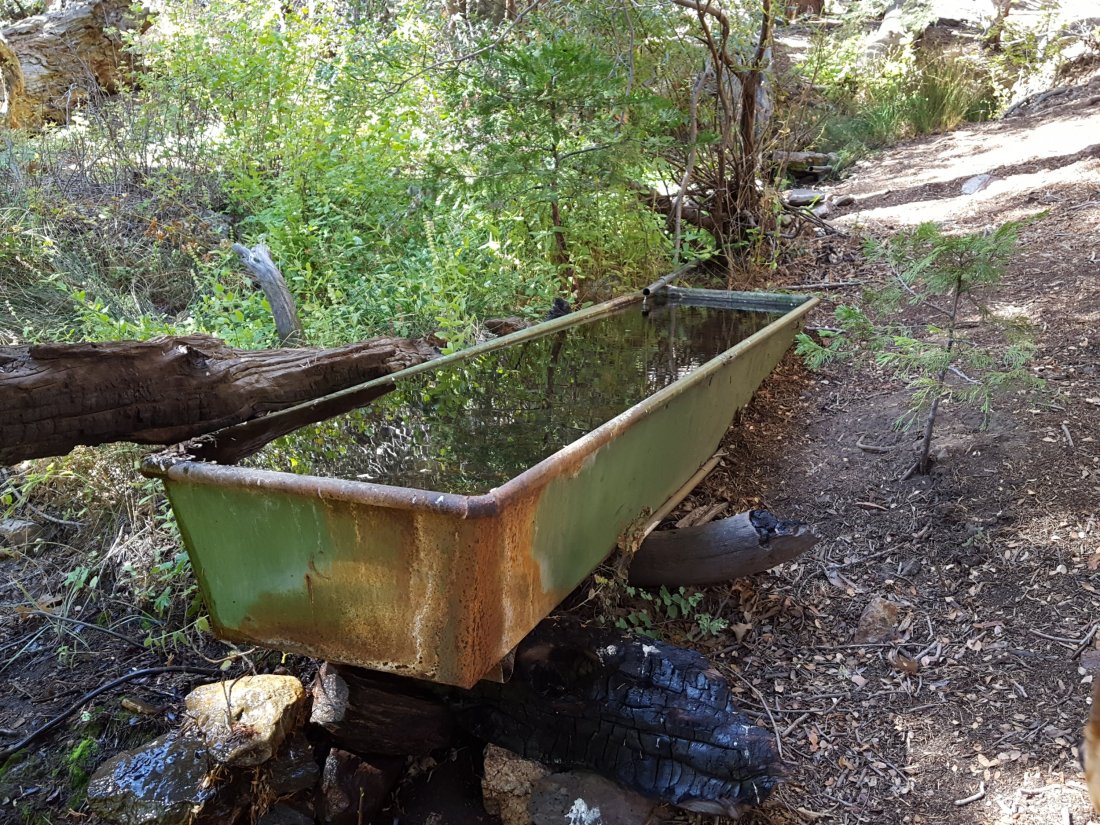
Tahquitz Creek continues to flow well at the northern (lower) end of Little Tahquitz Meadow. This is the last remaining “reliable” water source in the Tahquitz meadows area.

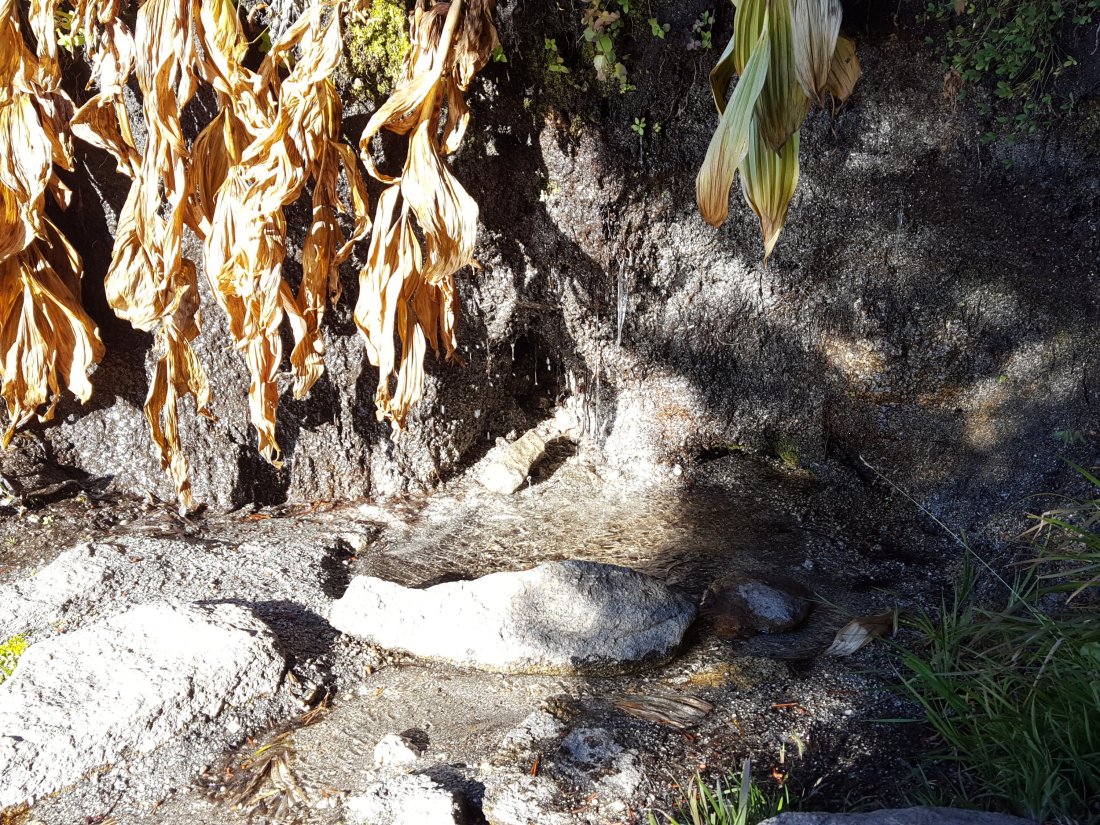
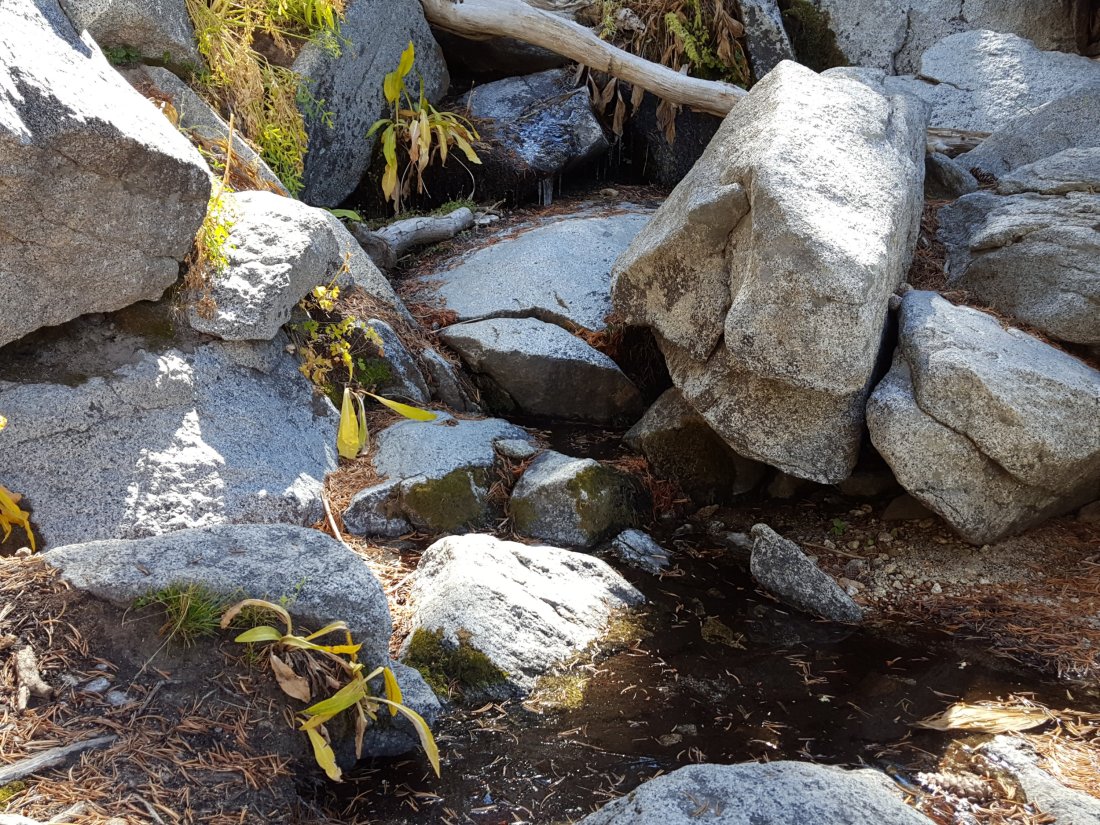
Tahquitz Creek at the north end of Little Tahquitz Meadow, 31st October 2018

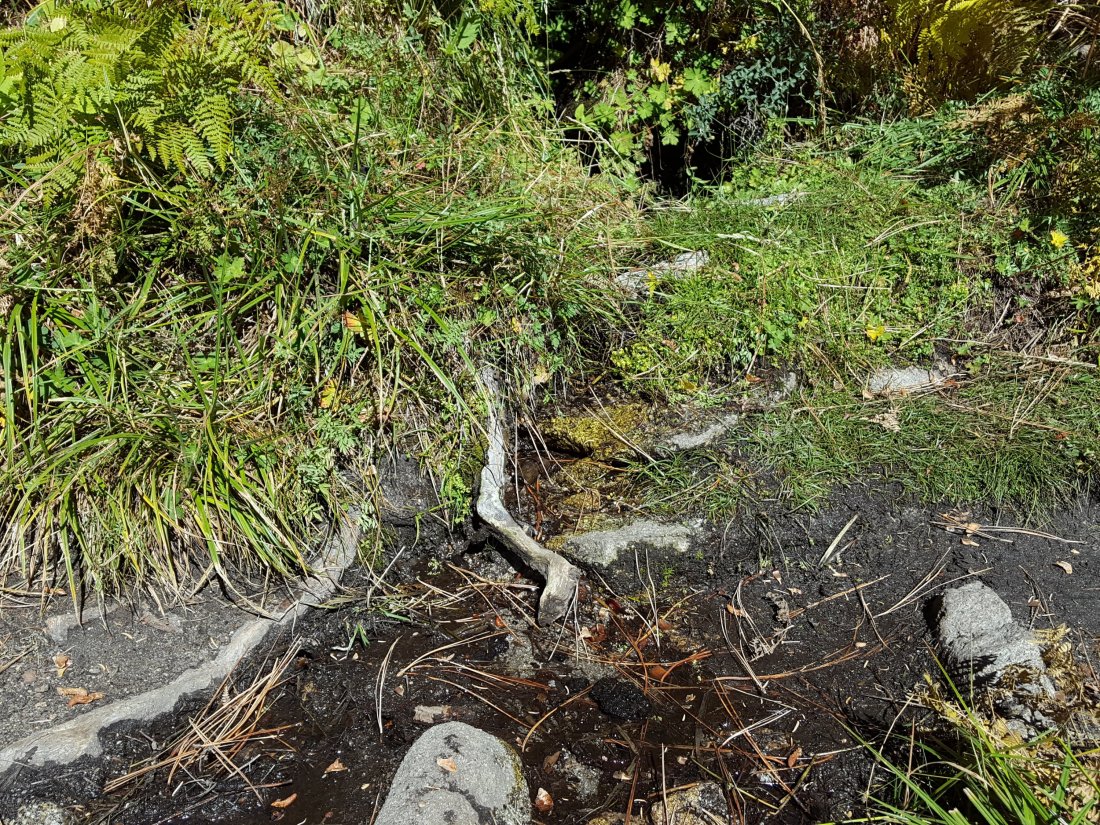
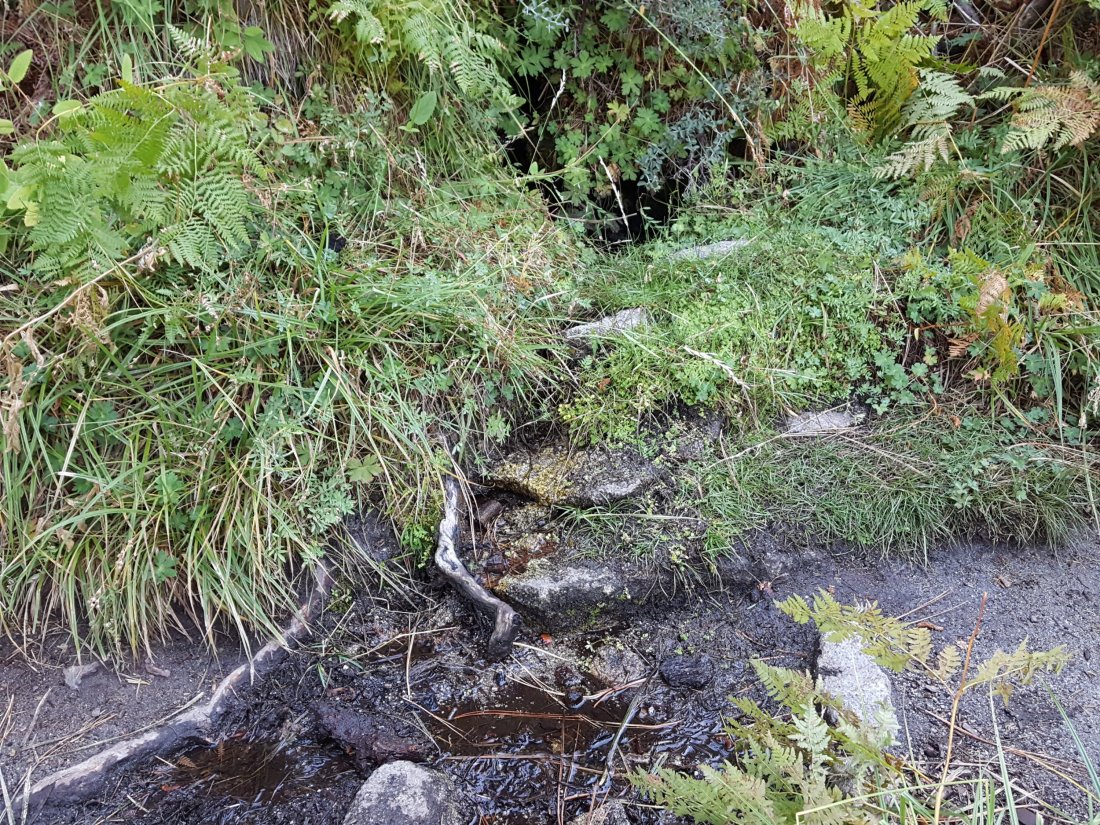
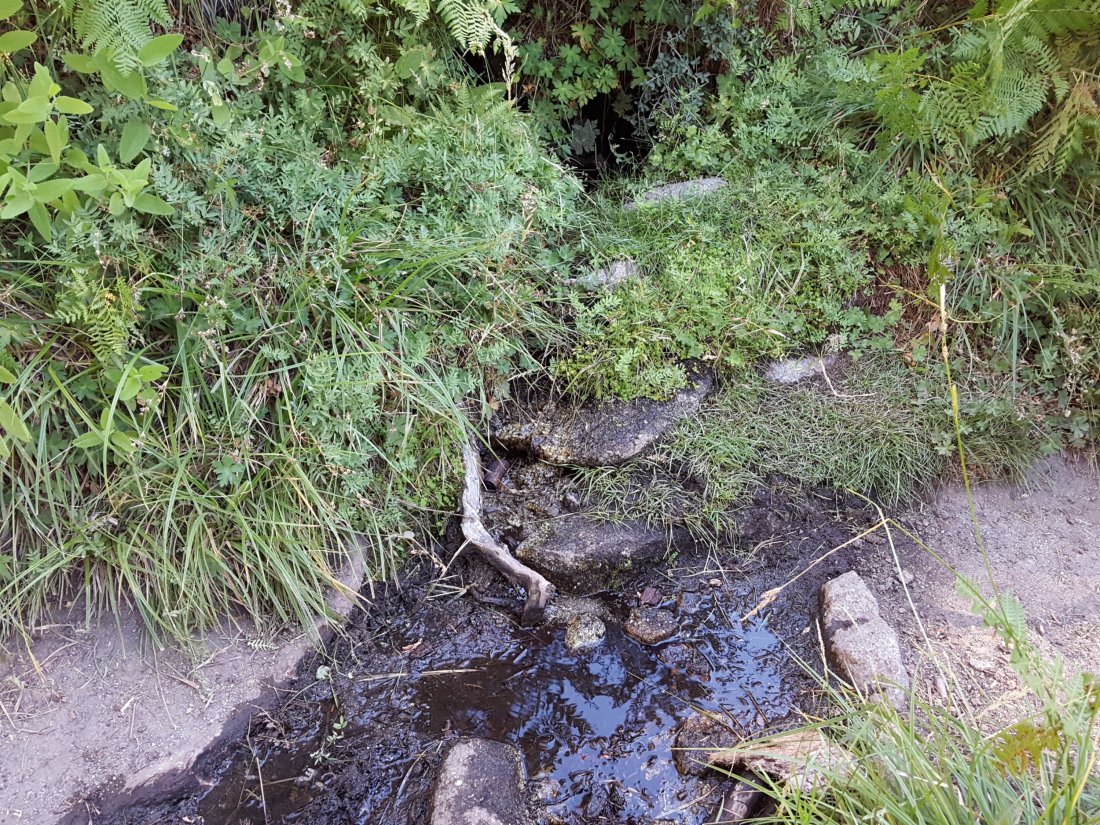
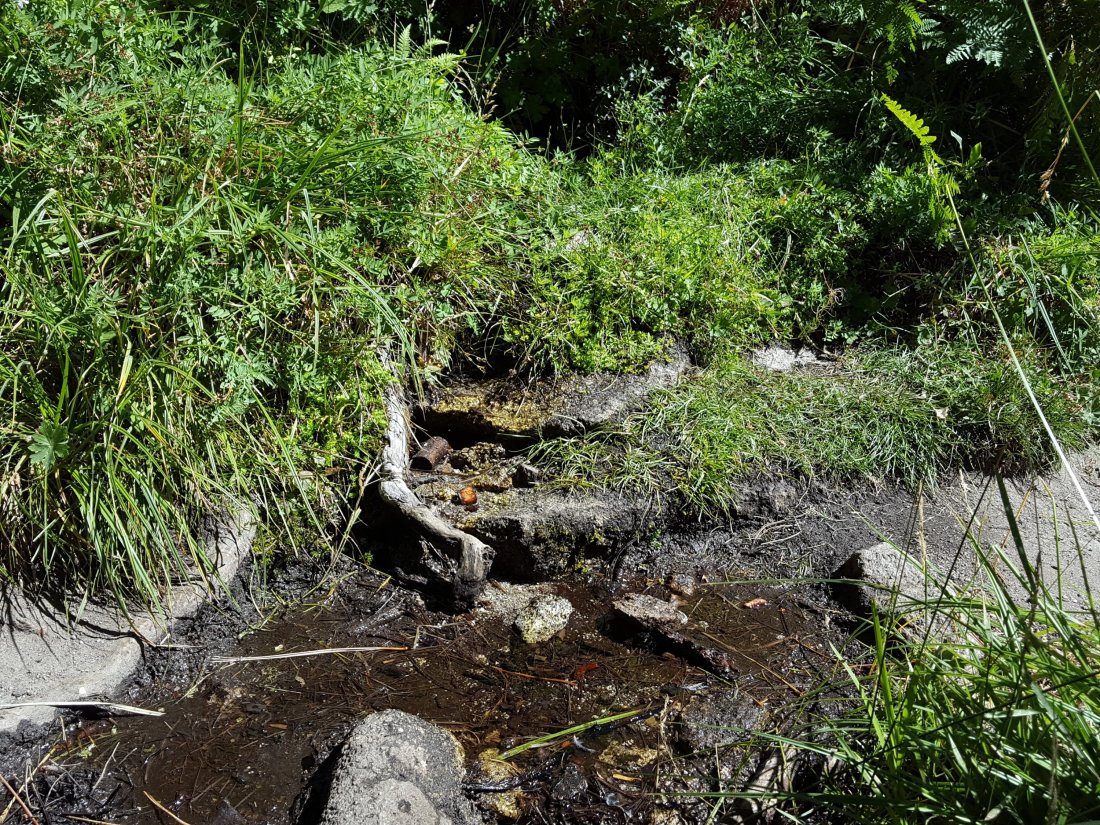
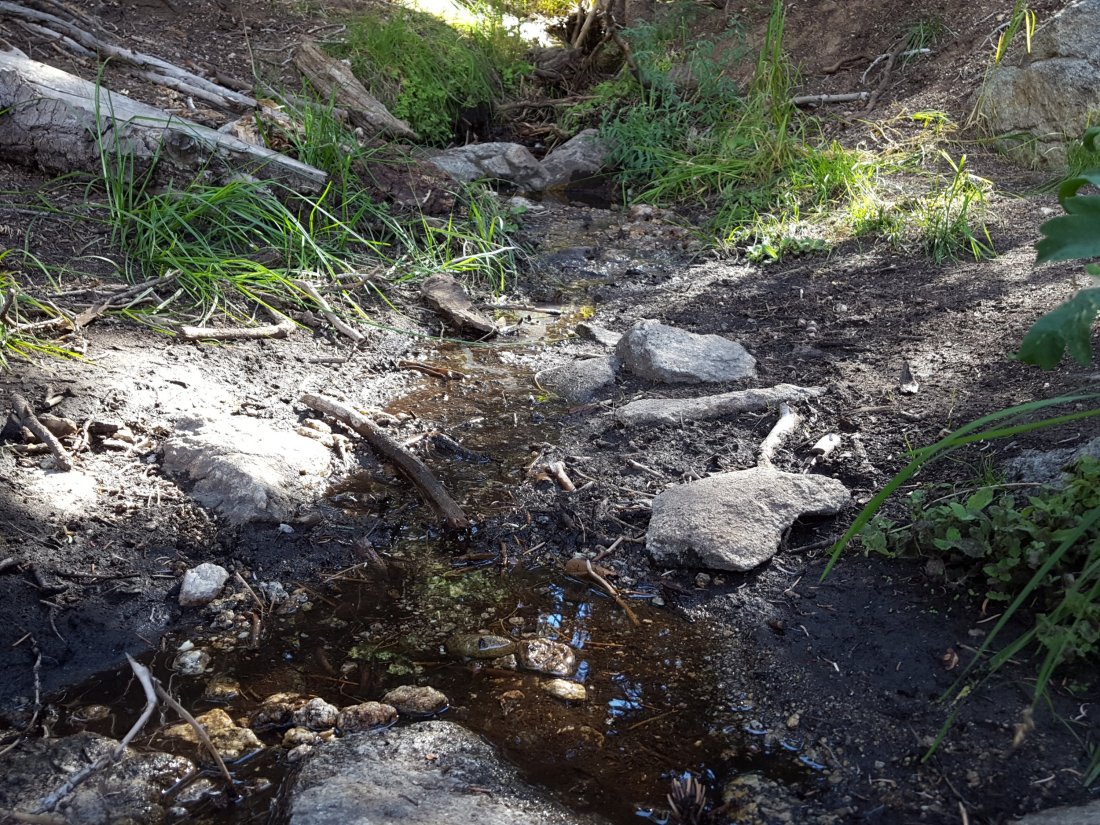
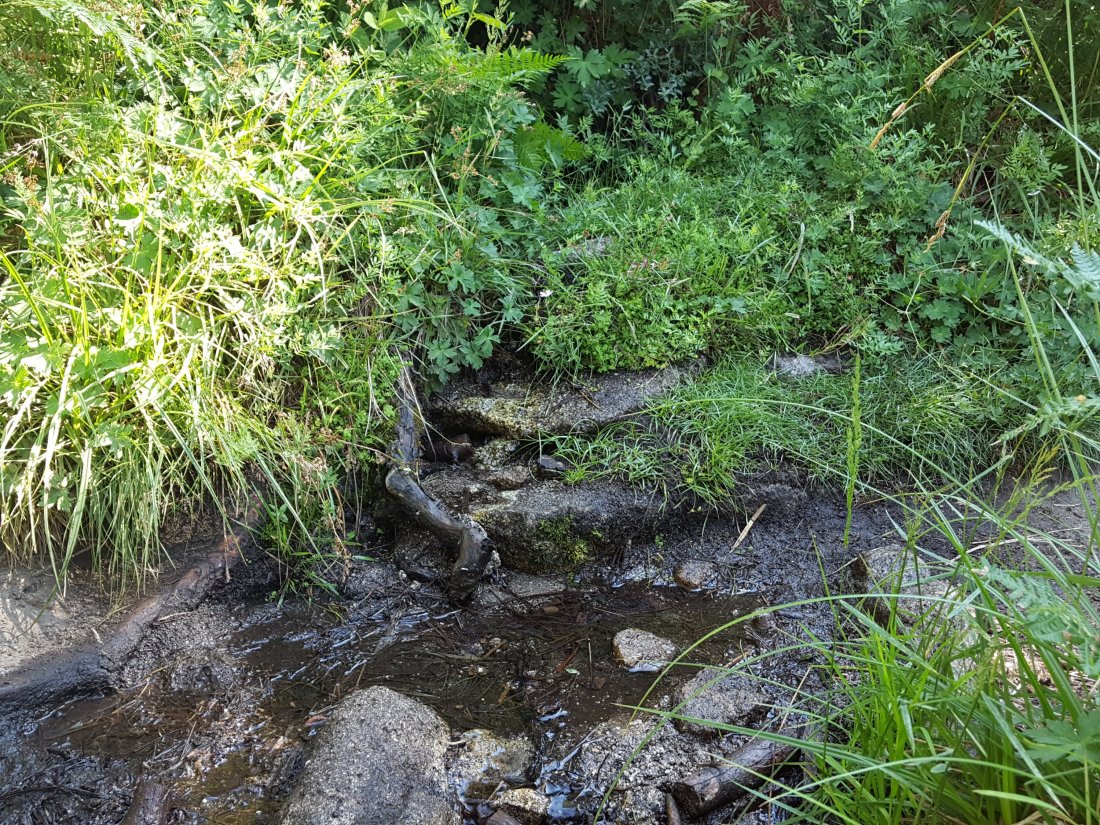
Tahquitz Creek is barely trickling further upstream at its source (known locally as Grethe Spring) where it crosses the PCT at the northern end of the fire closure (approx. PCT Mile 177). Immediately after (barely) crossing the PCT, the creek dries up.

Grethe Spring, the source of Tahquitz Creek, barely trickling, 31st October 2018.

Skunk Cabbage Creek is dry where the trail crosses Skunk Cabbage Meadow at the small wooden bridge.

WESTERN SLOPE WATER FEATURES

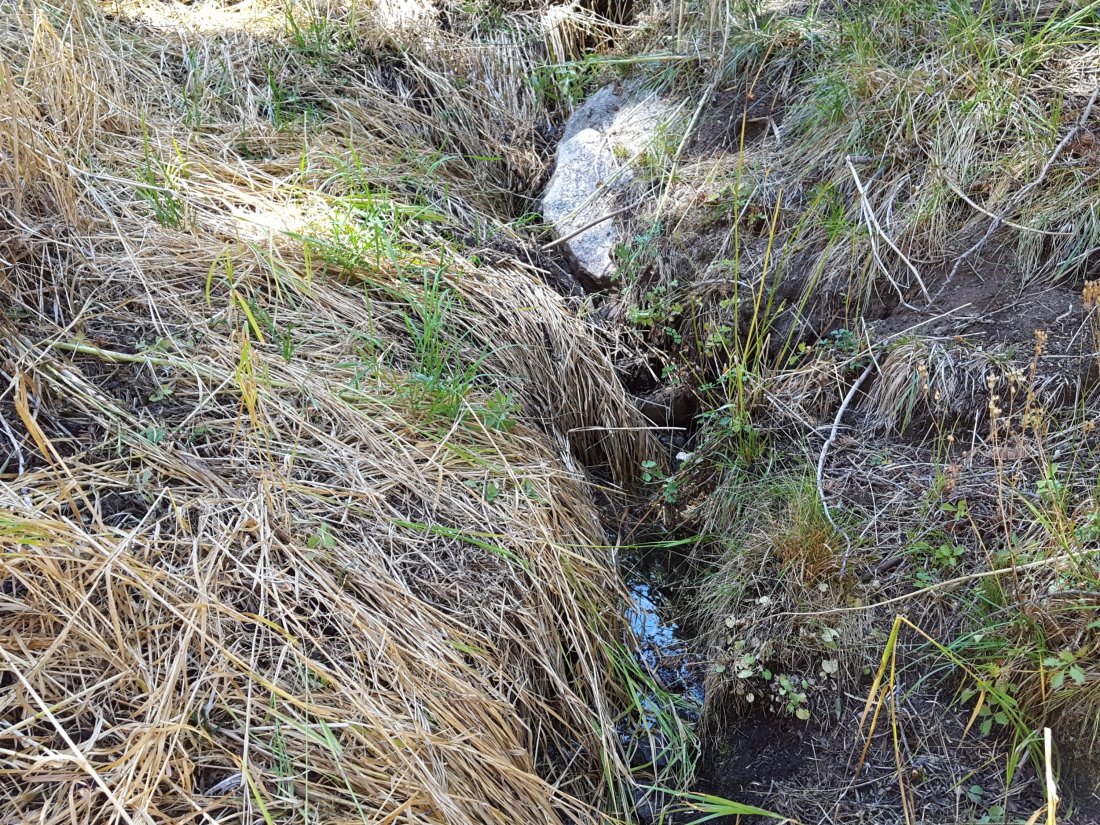
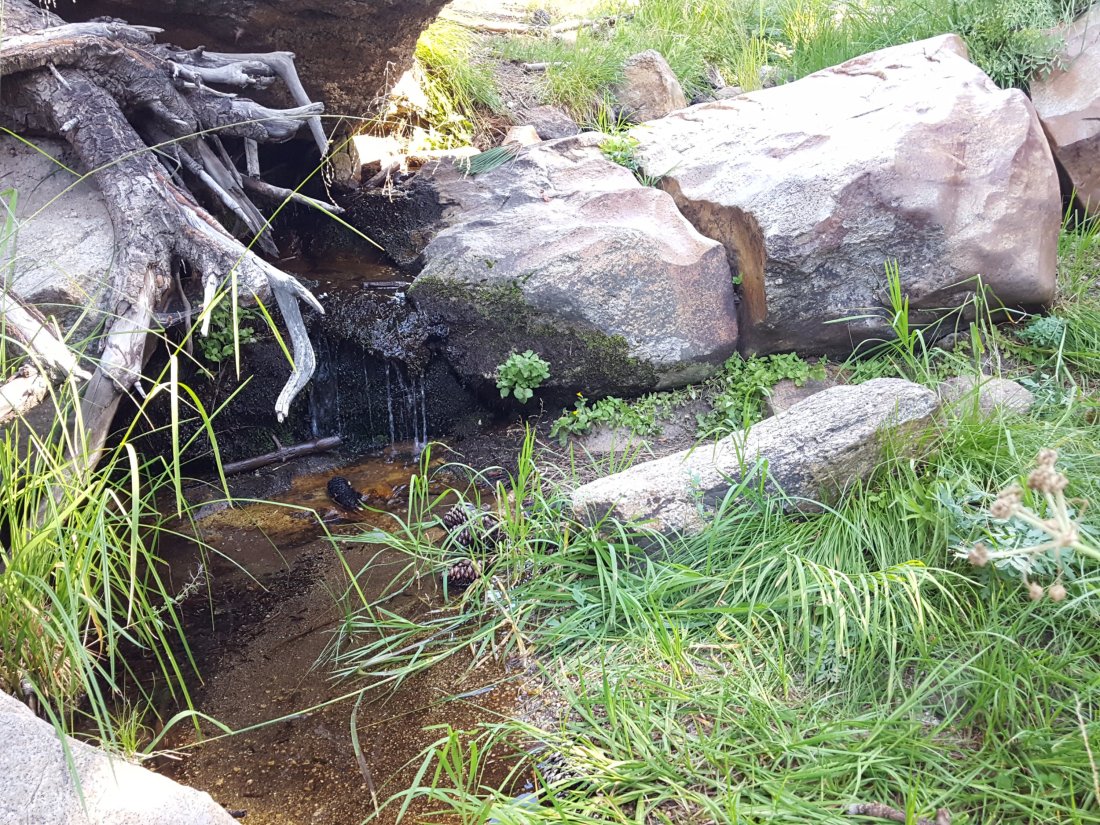
The North Fork of the San Jacinto River continues to flow poorly where it crosses the Deer Springs Trail. Flow rate was only about 0.5 gallons per minute today. Flow of this major west-side water source this year has been the lowest in known history.
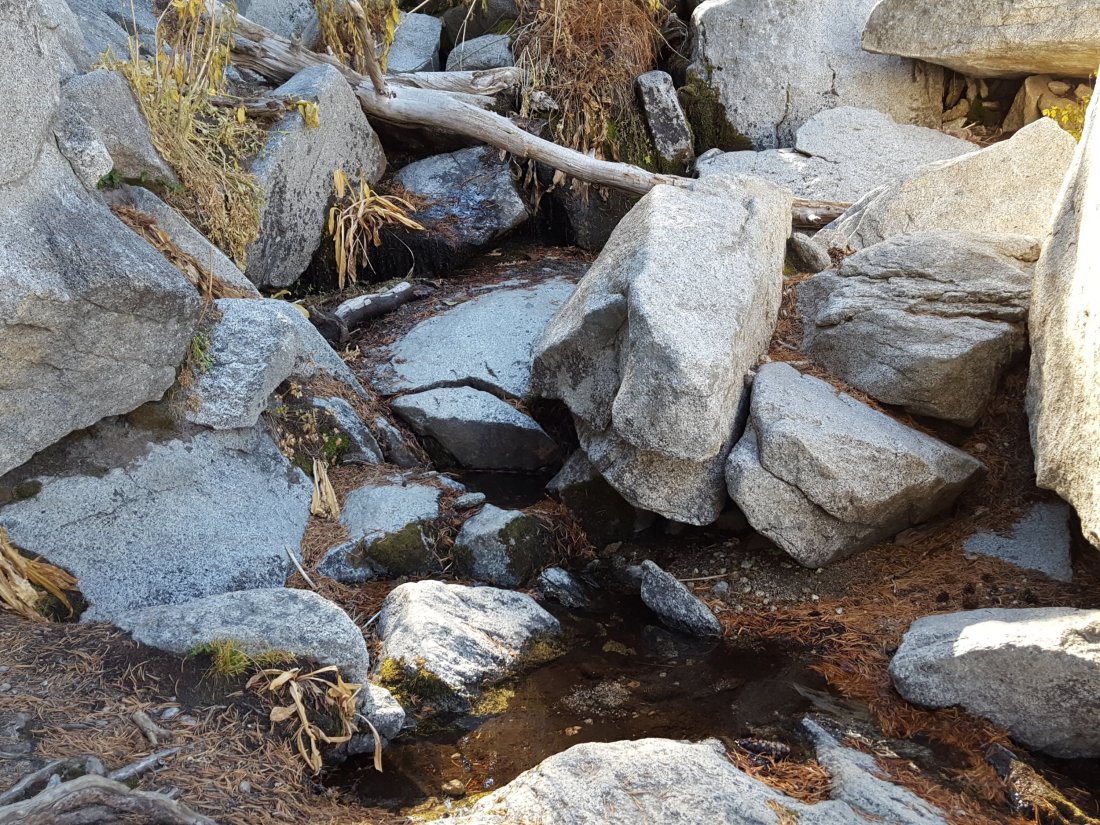
North Fork of the San Jacinto River on Deer Springs Trail, 30th October 2018.

Just downstream, the North Fork of the San Jacinto River remains dry where it crosses the Pacific Crest Trail on Fuller Ridge (approx. PCT Mile 186). This was the critical water source for PCTers and others hiking to or from Snow Creek, a 22 mile section of trail infamous for being waterless (now waterless for >25 miles). Options for southbound PCT hikers (and other hikers) on this section are all poor. Switchback Spring and Strawberry Cienega (see below) are possibilities staying on the PCT, but both are at extremely low flows. Alternatively, from where the PCT crosses the Black Mountain Road it is possible to descend the road 2.4 miles to the Cinco Poses Spring (a faucet by the roadside, see below). This undulating and exposed road is a descent of about 600′ and ascent of 200′, that would have to be reversed on the way back. PCT hikers who choose to leave the PCT to ascend San Jacinto Peak quickly get access to water at the North Fork on Deer Springs Trail (as described above) and subsequently at Wellman’s Cienega (assuming they choose to descend via the east side).

O’Sullivan Creek (PCT Mile 186.3) on Fuller Ridge Trail has been dry since early May.

The spring in the creek in Little Round Valley has been completely dry since early June.

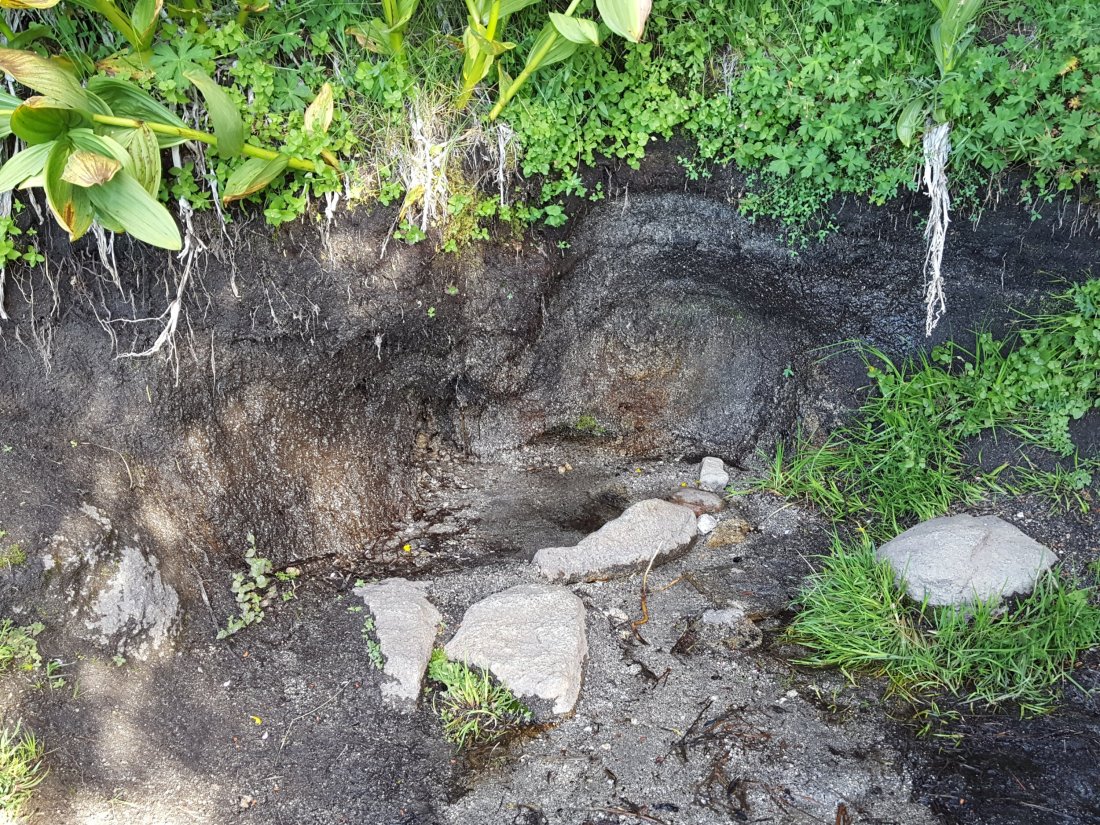
Shooting Star Spring – 0.28 trail miles below Little Round Valley – continues to flow very gently. For hikers it is just possible to filter water from the source at the base of the obvious huge rock at the top of the wet area of trail, but a better option is to descend to the North Fork crossing mentioned above.

The Deer Springs stream crossing at the PCT (approx. PCT mile 185.6) is dry, and the pools just upstream (and downstream) of the trail are also dry. The Deer Springs themselves continue to flow gently, about 0.15 miles upslope from the trail. Unfortunately, almost all the flow is diverted into a pipe for the Deer Springs camp. The Deer Springs camp just downslope from the trail had been occupied by a crew from the California Conservation Corps off-and-on since late May, but on 30th October they appeared to be packing up and the camp will likely be vacated very soon.

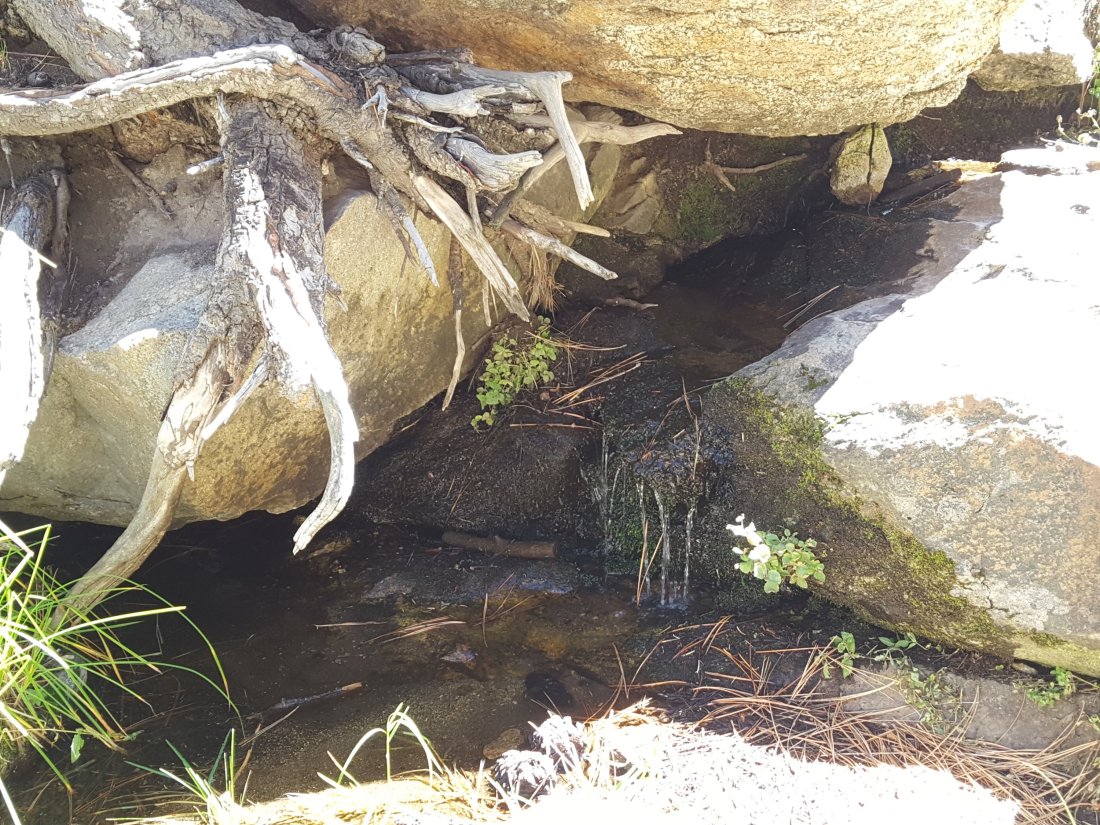
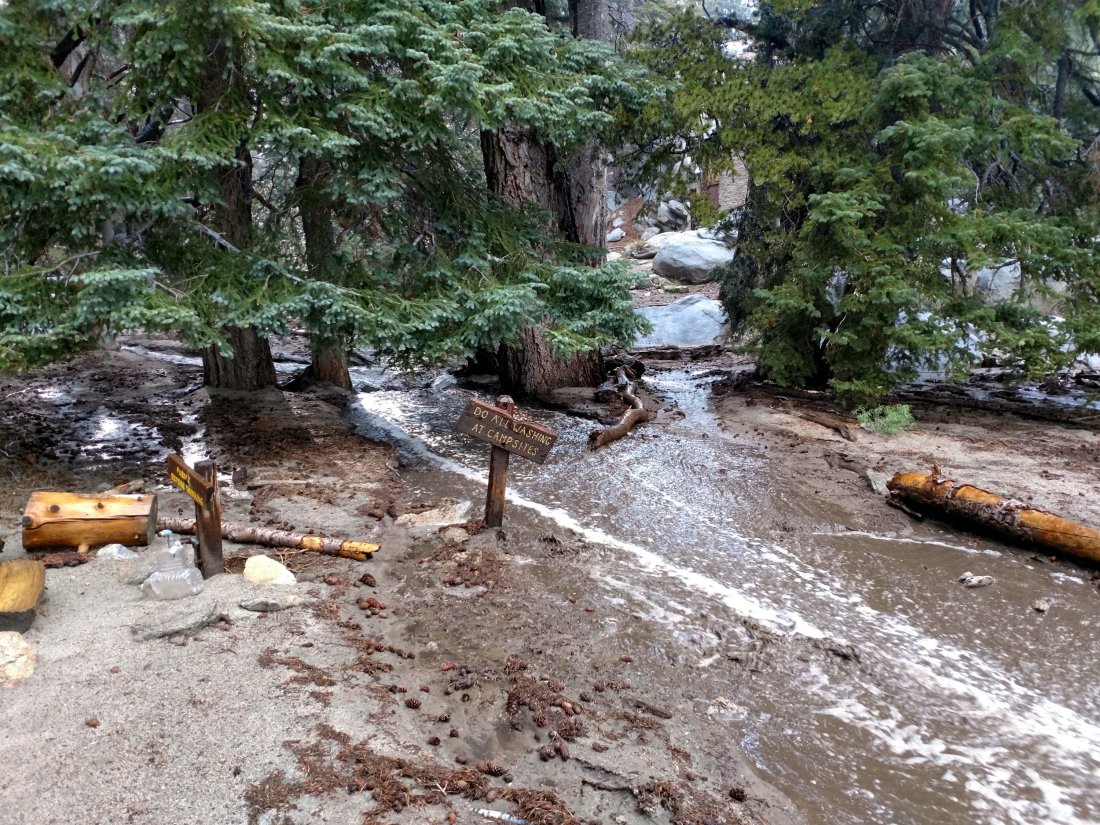
Switchback Spring – the small spring just below the eight switchbacks on Deer Springs Trail about 0.4 miles north of Strawberry Junction – continues to trickle gently, although flow was very weak today. The tiny pool on the upslope side of the trail is now so shallow that filtering is very challenging.
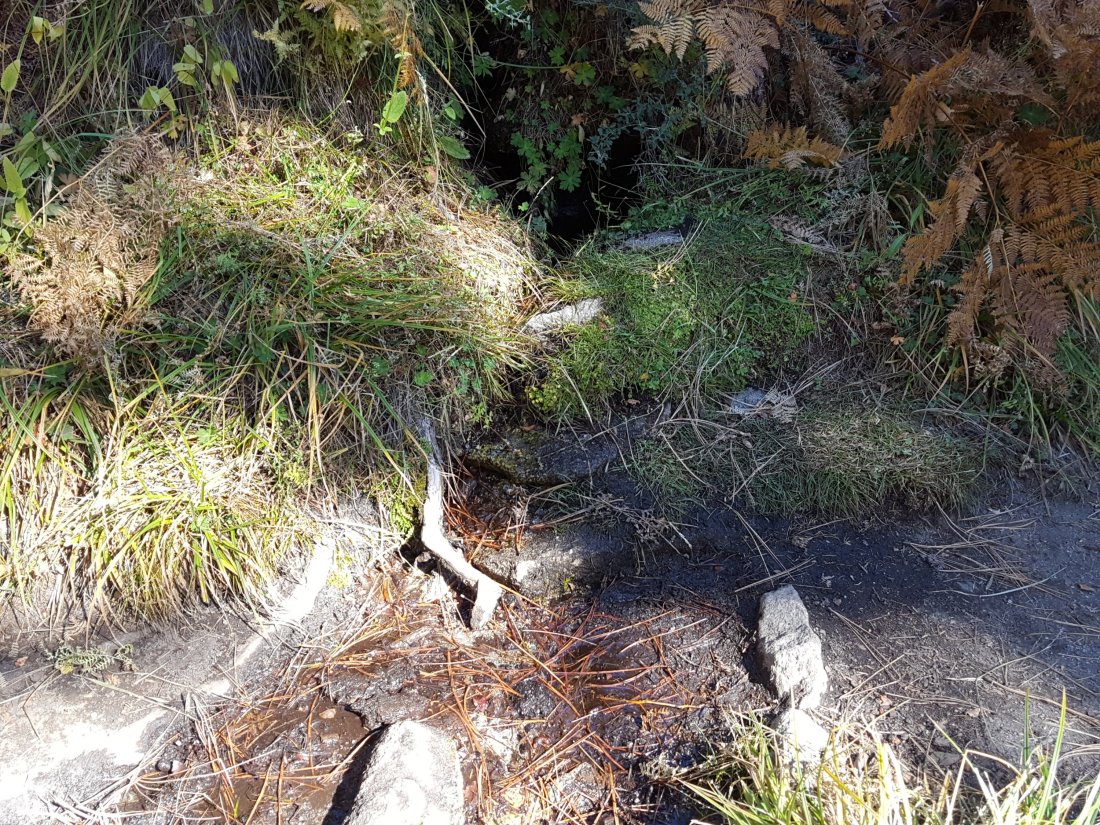
Switchback Spring on Deer Springs Trail, 30th October 2018.

The little spring at Strawberry Cienega (PCT mile 183) is dry. The tiny pool in the crack between the two large rocks might be useable for emergency filtering.

Cinco Poses Spring on Black Mountain Road (4.7 miles up from Highway 243) still has abundant water at the faucet. Please do not forget to completely turn off the faucet when you are finished here. This could be an important emergency water source as others dry up throughout the western side of the mountain.

On Devil’s Slide Trail, Middle Spring has been dry since 26th July.

On the Ernie Maxwell Trail, Chinquapin Creek just below Humber Park has been periodically diverted by Fern Valley Water District since the summer. It was dry where it crosses the trail when I checked it on Monday 29th October. Even when the creek is diverted, good pools receive some fresh flow immediately upstream from the trail. This is a very important water source for the many dogs walked on this trail.

Water and weather 25th October 2018

Our hike today went to San Jacinto Peak via Wellman’s Cienega, then descending Deer Springs Trail, which allowed a check of most higher elevation water sources around the mountain. Other hikes this week have included a couple in the Tahquitz area and one up-and-down the Black Mountain Trail. A hike with friends on Thursday 18th October to several peaks above 10,000′ included my 100th ascent of San Jacinto Peak this year.

Weather The moderate precipitation of 12th-13th October is already a distant memory. Temperatures had been pleasantly cool and more-or-less seasonal, but a marked warming to above-average temperatures starting today will continue over the next few days, before a return to cooler weather early next week.

Other than during the unseasonably warm weather for about the next week, hikers should now expect temperatures near freezing in the high country >9,000′ elevation, and at or below freezing at the high peaks (potentially well below freezing with windchill).

At San Jacinto Peak at 0925 this morning, Thursday 25th October, the air temperature was 45°F (7°C), with a windchill temperature of 40.4F (5°C), 32% relative humidity, and a very light mph North wind gusting to 5 mph. Note that the windchill temperature was 45° warmer than at the same time ten days earlier!

On Thursday 18th October at 0730, the air temperature was 27°F (-3°C), with a windchill temperature of 9.4°F (-12.5°C), 62% relative humidity, and a bitter 21 mph NNE wind gusting to 24 mph.

Giant Sequoia (Sequoiadendron giganteum) on Black Mountain Trail, 23rd October 2018. There is a thriving introduced population of nearly 200 (very small!) sequoias between 6700′-7300′ elevation on this trail.

Trail overview The modest rainfall throughout the mountain – with even a dusting of snow in the high country – nearly two weeks ago has had no lasting impact on the water situation in the San Jacinto mountains, which remains very poor. The overall status of water sources is basically unchanged from early October. Miniscule patches of snow remain on San Jacinto Peak near the East Ridge Trail, but some decent patches (1-2″ deep) remain in Snow Creek on the uppermost North Face.

Cedar Spring on the Desert Divide just to the east of the PCT continues to flow gently, as detailed in a prior report at this link.

Excellent news on the Seven Pines Trail, as first reported here last week. It seems that frequent reporting of the poor condition of this trail to the agencies paid off, and the several dozen trees that were across this lovely trail have been largely cleared by a State maintenance team.

EASTERN SLOPE WATER FEATURES

The Round Valley faucet has been dry since the summer.

Both the northern and southern springs at Wellman’s Cienega continue to flow gently.

Wellman’s Cienega North spring, 25th October 2018.

These springs are the sources for Willow Creek, which is no longer flowing where it crosses the Willow Creek Trail. There are small pools where water could be filtered just upstream from the crossing. The creek is actually flowing gently a few hundred yards upstream from the trail crossing, but access is not easy. Willow Creek has not previously been known to stop flowing at the trail crossing.

Tahquitz Valley has been completely dry since May.

Tahquitz Creek continues to flow well at the northern (lower) end of Little Tahquitz Meadow. This is the last remaining “reliable” water source in the Tahquitz meadows area.

Tahquitz Creek at the north end of Little Tahquitz Meadow, 16th October 2018.

Tahquitz Creek is barely trickling further upstream at its source (known locally as Grethe Spring) where it crosses the PCT at the northern end of the fire closure (approx. PCT Mile 177). Immediately after (barely) crossing the PCT, the creek dries up.

Skunk Cabbage Creek is dry where the trail crosses Skunk Cabbage Meadow at the small wooden bridge.

WESTERN SLOPE WATER FEATURES

The North Fork of the San Jacinto River continues to flow poorly where it crosses the Deer Springs Trail. Flow rate was down to about 0.5 gallons per minute today. Flow of this major west-side water source this year has been the lowest in known history.

North Fork of the San Jacinto River on Deer Springs Trail, 25th October 2018.

Just downstream, the North Fork of the San Jacinto River was still dry today where it crosses the Pacific Crest Trail on Fuller Ridge (approx. PCT Mile 186). This was the critical water source for PCTers and others hiking to or from Snow Creek, a 22 mile section of trail infamous for being waterless (but now waterless for >25 miles). Options for southbound PCT hikers (and other hikers on this section) are all poor. Switchback Spring and Strawberry Cienega (see below) are possibilities staying on the PCT, but both are at extremely low flows. If heading to San Jacinto Peak, the North Fork where it crosses the Deer Springs Trail is a good option. Alternatively, from where the PCT crosses the Black Mountain Road it is possible to descend the road 2.4 miles to the Cinco Poses Spring (a faucet by the roadside, see below). This undulating and exposed road is a descent of about 600′ and ascent of 200′, that would have to be reversed on the way back. PCT hikers who choose to leave the PCT to ascend San Jacinto Peak quickly get access to water at the North Fork on Deer Springs Trail (as described above) and subsequently at Wellman’s Cienega (assuming they choose to descend via the east side).

O’Sullivan Creek (PCT Mile 186.3) on Fuller Ridge Trail has been dry since early May.

The spring in the creek in Little Round Valley has been completely dry since early June.

Shooting Star Spring – 0.28 trail miles below Little Round Valley – continues to flow very gently. For hikers it is just possible to filter water from the source at the base of the obvious huge rock at the top of the wet area of trail, but a better option is to descend to the North Fork crossing mentioned above.

The Deer Springs stream crossing at the PCT (approx. PCT mile 185.6) is dry, and the pools just upstream (and downstream) of the trail are also dry. The Deer Springs themselves continue to flow gently, about 0.15 miles upslope from the trail. Unfortunately, almost all the flow is diverted into a pipe for the Deer Springs camp. The Deer Springs camp just downslope from the trail has been occupied by a crew from the California Conservation Corps off-and-on since late May.

Switchback Spring – the small spring just below the eight switchbacks on Deer Springs Trail about 0.4 miles north of Strawberry Junction – continues to trickle gently, although flow was very weak today. The tiny pool on the upslope side of the trail is now so shallow that filtering is very challenging.

Switchback Spring on Deer Springs Trail, 25th October 2018.

The little spring at Strawberry Cienega (PCT mile 183) is dry. The tiny pool in the crack between the two large rocks might be useable for emergency filtering.

Cinco Poses Spring on Black Mountain Road (4.7 miles up from Highway 243) still has abundant water at the faucet. Please do not forget to completely turn off the faucet when you are finished here. This could be an important emergency water source as others dry up throughout the western side of the mountain. [Many thanks to Florian Boyd for this update from our joint shift at the Black Mountain fire lookout on Tuesday 23rd October.]

On Devil’s Slide Trail, Middle Spring has been dry since 26th July.

On the Ernie Maxwell Trail, Chinquapin Creek just below Humber Park has been periodically diverted by Fern Valley Water District since the summer. It was dry where it crosses the trail when I checked it on Monday 22nd October. Even when the creek is diverted, good pools receive some fresh flow immediately upstream from the trail. This is a very important water source for the many dogs walked on this trail.

Snow and wind 15th October 2018

My pleasantly chilly hike today went to San Jacinto Peak via Wellman’s Cienega and a quick check of the Round Valley faucet, then descended on Deer Springs Trail, with a side hike part-way along Fuller Ridge Trail. This allowed me to check the higher elevation water sources around the mountain. [I was able to check the water sources of the Tahquitz area meadows on Tuesday 16th.]

Error
This video doesn’t exist

Weather The entire mountain experienced moderate rainfall on Friday night and throughout Saturday, 12th-13th October. In total we had 0.72″ at 5550′ elevation in Idyllwild, while Garner Valley and Long Valley received an inch, and all the weather stations in the region recorded at least 0.5″.

The high elevations even received a dusting of October snow. About 0.5″ fell above 9800′ on the east side, with about 1.0″ above 10,300′. On the west side, the snow level was a little higher (there was none in Little Round Valley). Only very limited patches remained today (except in upper Snow Creek), and no traction assistance (e.g., microspikes) is currently required.

Also, hikers should now expect temperatures near freezing in the high country >9,000′ elevation, and at or below freezing at the high peaks (potentially well below freezing with windchill).

At San Jacinto Peak at 1045 this morning, Monday 15th October, the air temperature was 20°F (-7°C), with a windchill temperature of -4.7°F (-20°C), 30% relative humidity, and a sustained, frigid 22 mph NE wind gusting to 32.2 mph.

On Thursday 11th October at 1445, the air temperature was 38°F (3.3°C), with a windchill temperature of 30.9°F (-1°C), 79% relative humidity, and a light 3 mph South wind gusting to 7.5 mph.

Trail overview The water situation in the San Jacinto mountains remains very poor despite the precipitation of recent days discussed above. My observations indicate that water sources that were still flowing experienced an increase in flow rate thanks to the rainfall. However, sources that were already dry did not receive enough new input to get them flowing again.

Excellent news on the Seven Pines Trail. After years of neglect by the State Park, during which dozens of fallen trees significantly obscured this lovely trail, a maintenance program has removed almost all the obstructions. It seems that frequent reporting of the poor condition of this trail by myself and others to the agencies has finally paid off (I have had two search-and-rescue missions on Seven Pines this year alone, with hikers getting lost due to the challenges of navigating this trail).

EASTERN SLOPE WATER FEATURES

The Round Valley faucet remained dry today, with no evidence of any flow in recent days despite the rain.

Round Valley faucet, 15th October 2018.

Both the northern and southern springs at Wellman’s Cienega continue to flow. The northern spring was flowing much stronger this morning than last week.

Wellman’s Cienega North spring, 15th October 2018.

These springs are the sources for Willow Creek, which is no longer flowing where it crosses the Willow Creek Trail. There are small pools where water could be filtered just upstream from the crossing. The creek is actually flowing gently a few hundred yards upstream from the trail crossing, but access is not easy. Willow Creek has not previously been known to stop flowing at the trail crossing.

Tahquitz Valley has been completely dry since May.

Tahquitz Creek continues to flow well at the northern (lower) end of Little Tahquitz Meadow. This is the last remaining “reliable” water source in the Tahquitz meadows area.

Tahquitz Creek at the north end of Little Tahquitz Meadow, 16th October 2018.

Tahquitz Creek is barely trickling further upstream at its source (known locally as Grethe Spring) where it crosses the PCT at the northern end of the fire closure (approx. PCT Mile 177). Immediately after (barely) crossing the PCT, the creek dries up.

Tahquitz Creek crossing the PCT immediately below Grethe Spring, 16th October 2018.

Skunk Cabbage Creek is dry where the trail crosses Skunk Cabbage Meadow at the small wooden bridge.

WESTERN SLOPE WATER FEATURES

The North Fork of the San Jacinto River continues to flow gently where it crosses the Deer Springs Trail. Initially on 15th October I thought the flow rate had dropped, but this was because the river was partly frozen just upstream (note the icicles in the upper part of the photo).

North Fork of the San Jacinto River on Deer Springs Trail, 15th October 2018.

Just downstream, the North Fork of the San Jacinto River was still dry today where it crosses the Pacific Crest Trail on Fuller Ridge (approx. PCT Mile 186). This was the critical water source for PCTers and others hiking to or from Snow Creek, a 22 mile section of trail infamous for being waterless (but now waterless for >25 miles). Options for southbound PCT hikers (and other hikers on this section) are all poor. Switchback Spring and Strawberry Cienega (see below) are possibilities staying on the PCT, but both are at extremely low flows. If heading to San Jacinto Peak, the North Fork where it crosses the Deer Springs Trail is a good option. Alternatively, from where the PCT crosses the Black Mountain Road it is possible to descend the road 2.4 miles to the Cinco Poses Spring (a faucet by the roadside, see below). This undulating and exposed road is a descent of about 600′ and ascent of 200′, that would have to be reversed on the way back.

O’Sullivan Creek (PCT Mile 186.3) on Fuller Ridge Trail has been dry since early May.

The spring in the creek in Little Round Valley has been completely dry since early June.

Shooting Star Spring – 0.28 trail miles below Little Round Valley – continues to flow gently. For hikers it is possible to filter water from the source at the base of the obvious huge rock at the top of the wet area of trail, but a better option is to descend to the North Fork crossing mentioned above.

Deer Springs Trail immediately below Shooting Star Spring, 15th October 2018.

The Deer Springs stream crossing at the PCT (approx. PCT mile 185.6) is dry, and the pools just upstream (and downstream) of the trail are also dry. The Deer Springs themselves continue to flow gently, about 0.15 miles upslope from the trail. Unfortunately, almost all the flow is diverted into a pipe for the Deer Springs camp. The Deer Springs camp just downslope from the trail has been occupied by a crew from the California Conservation Corps off-and-on since late May.

Switchback Spring – the small spring just below the eight switchbacks on Deer Springs Trail about 0.4 miles north of Strawberry Junction – continues to trickle gently. Today there was no sign that the flow rate had improved after recent rain. The tiny pool on the upslope side of the trail is now so shallow that filtering is very challenging.

Switchback Spring on Deer Springs Trail, 15th October 2018.

The little spring at Strawberry Cienega (PCT mile 183) is still dry. The tiny pool in the crack between the two large rocks might be useable for emergency filtering.

Cinco Poses Spring on Black Mountain Road (4.7 miles up from Highway 243) still has running water at the faucet. This could be an important emergency water source as others dry up throughout the western side of the mountain.

On Devil’s Slide Trail, Middle Spring has been dry since 26th July, and remained dry this morning despite recent rainfall.

On the Ernie Maxwell Trail, Chinquapin Creek just below Humber Park was no longer being diverted by Fern Valley Water District as of 2nd October. Today there were good pools in the trail, and the creek was trickling across the trail. [Many thanks to Anne King for today’s update.] Even if the creek is diverted, good pools receive some fresh flow immediately upstream from the trail. This creek is a very important water source for the many dogs walked on this trail.

Weather 11th October 2018

There have been no significant changes to the water conditions on the mountain, which are detailed at the previous posting here.

However it has been a busy week for hiking, especially yesterday, as I mention in the video below. Also on Wednesday 10th, Anabel and I hiked the Cedar Springs and upper Jo Pond trails, and on 8th I went to San Jacinto Peak to check on the weather.

Error
This video doesn’t exist

Weather Prospects for some rain at all elevations – even a dusting of snow on the Peak – seem good over the weekend. As I mention in the video, temperatures are near or below freezing at the highest elevations throughout the day at this time.

At San Jacinto Peak at 1445 on Thursday 11th October, the air temperature was 38°F (2.5°C), with a windchill temperature of 31°F (-0.5°C), 79% relative humidity, and a cool 3 mph South wind gusting to 8 mph.

On Monday 8th October at 0920, the air temperature was 34°F (1°C), with a windchill temperature of 21.4°F (-6°C), 32% relative humidity, and a sustained 5 mph NNW wind gusting to 14 mph.

Cedar Spring continues to flow gently. The trough about 35 yards upslope from the sign is full of water that is good for filtering.

Cedar Spring trough, 10th October 2018.

Water and weather 5th October 2018

My lovely hike today went up Deer Springs Trail to San Jacinto Peak then descended on the east side via the Tahquitz area meadows to Tahquitz Peak. This allowed for a check of most water sources around the mountain, and to see the extent of the rainfall from yesterday morning.

Trail overview The water situation in the San Jacinto mountains remains very poor. At this stage of the year, I am optimistic that the few water sources that are still flowing will not dry up before adequate precipitation falls. The high country above 9000′ elevation missed out on the drizzle that fell yesterday (discussed below), so the status of most water sources remains unchanged from recent updates.

Weather There was very light rainfall in the early hours of Thursday morning, 4th October, with 0.15″ at 5500′ elevation in Idyllwild. Elevations above about 9000′ remained above the cloud and received no rainfall. On the trails there was subtle evidence of light rainfall below about 9000′ on all sides of the mountain.

As is typical in the San Jacintos, the transition from summer to winter is very rapid, and conditions are already starting to feel pleasantly wintry in the highest elevations. Temperatures are now near freezing in the high country >10,000′ elevation (and below freezing on exposed peaks with windchill).

At San Jacinto Peak at 1010 this morning, Friday 5th October, the air temperature was 37°F (3°C), with a windchill temperature of 25.3°F (-4°C), 54% relative humidity, and a cool 6 mph North wind gusting to 12 mph.

On Wednesday 3rd October at 0950, the air temperature was 41°F (5°C), with a windchill temperature of 28.4°F (-2°C), 45% relative humidity, and a sustained 8 mph SSW wind gusting to 18 mph.

EASTERN SLOPE WATER FEATURES

The Round Valley faucet is dry.

Both the northern and southern springs at Wellman’s Cienega continue to flow weakly. The northern spring was flowing very slightly stronger this morning than recent days.

Wellmans North Cienega, 5th October 2018.

These springs are the sources for Willow Creek, which is no longer flowing where it crosses the Willow Creek Trail. There are small pools where water could be filtered just upstream from the crossing. The creek is actually flowing gently a few hundred yards upstream from the trail crossing, but access is not easy. Willow Creek has not previously been known to stop flowing at the trail crossing.

Tahquitz Valley has been completely dry since May.

Tahquitz Creek continues to flow well at the northern (lower) end of Little Tahquitz Meadow. Flow today was slightly stronger following the light rain. This is the last remaining “reliable” water source in the Tahquitz meadows area.

Tahquitz Creek at the north end of Little Tahquitz Meadow, 5th October 2018.

Tahquitz Creek is barely trickling further upstream at its source (known locally as Grethe Spring) where it crosses the PCT at the northern end of the fire closure (approx. PCT Mile 177). Immediately after (barely) crossing the PCT, the creek dries up.

Grethe Spring (the source of Tahquitz Creek), 5th October 2018.

Skunk Cabbage Creek is dry where the trail crosses Skunk Cabbage Meadow at the small wooden bridge.

WESTERN SLOPE WATER FEATURES

The North Fork of the San Jacinto River continues to flow weakly where it crosses the Deer Springs Trail, but the flow has dropped dramatically in the past couple of weeks to only about 0.6 gallons per minute. The water levels for this river are the lowest in living memory.

North Fork of the San Jacinto River on Deer Springs Trail, 5th October 2018.

Just downstream, the North Fork of the San Jacinto River has dried up where it crosses the Pacific Crest Trail on the Fuller Ridge Trail (approx. PCT Mile 186). This was the critical water source for PCTers and others hiking to or from Snow Creek, a 22 mile section of trail infamous for being waterless (but now waterless for >25 miles). Options for southbound PCT hikers (and other hikers on this section) are all poor. Switchback Spring and Strawberry Cienega (see below) are possibilities staying on the PCT, but both are at extremely low flows. If heading to San Jacinto Peak, the North Fork where it crosses the Deer Springs Trail is a good option. Alternatively, from where the PCT crosses the Black Mountain Road it is possible to descend the road 2.4 miles to the Cinco Poses Spring (a faucet by the roadside, see below). This undulating and exposed road is a descent of about 600′ and ascent of 200′, that would have to be reversed on the way back.

O’Sullivan Creek (PCT Mile 186.3) on Fuller Ridge Trail has been dry since early May.

The spring in the creek in Little Round Valley has been completely dry since early June.

Shooting Star Spring – 0.28 trail miles below Little Round Valley – continues to flow gently. For hikers it is possible to filter water from the source at the base of the obvious huge rock at the top of the wet area of trail, but a better option is to descend to the North Fork crossing mentioned above.

The Deer Springs stream crossing at the PCT (approx. PCT mile 185.6) is dry, and the pools just upstream (and downstream) of the trail are also dry. The Deer Springs themselves continue to flow gently, about 0.15 miles upslope from the trail. Unfortunately, almost all the flow is diverted into a pipe for the Deer Springs camp. The Deer Springs camp just downslope from the trail has been occupied by a crew from the California Conservation Corps off-and-on since late May.

Switchback Spring – the small spring just below the eight switchbacks on Deer Springs Trail about 0.4 miles north of Strawberry Junction – continues to trickle very gently. The tiny pool on the upslope side of the trail (where water could be filtered in an emergency) is now so shallow that filtering is challenging.

Switchback Spring crossing the PCT, 5th October 2018.

The little spring at Strawberry Cienega (PCT mile 183) has now dried up. The tiny pool in the crack between the two large rocks might be useable for emergency filtering.

Cinco Poses Spring on Black Mountain Road (4.7 miles up from Highway 243) still has running water at the faucet. This could be an important emergency water source as others dry up throughout the western side of the mountain.

On Devil’s Slide Trail, Middle Spring has been dry since 26th July.

On the Ernie Maxwell Trail, Chinquapin Creek just below Humber Park was no longer being diverted by Fern Valley Water District as of 2nd October. Even if the creek is diverted, good pools receive some fresh flow immediately upstream from the trail. This creek is a very important water source for the many dogs walked on this trail.

Water and weather 3rd October 2018

Our hike today to San Jacinto Peak allowed a check of water sources around the mountain. On Monday 1st, I was able to check the Tahquitz area on a hike to Tahquitz Peak, and yesterday we checked the status of Chinquapin Creek with a hike on the Ernie Maxwell Trail.

Cranston Fire news The closure of the popular South Ridge Trail will continue well into 2019. That is the recommendation of the BAER (Burned Area Emergency Report) for the damage to the San Jacinto Ranger District. Erosion and possible rock slides in burned sections of the trail are apparently the primary concerns. The current closure order closes this trail until 31st July 2019. As first reported on this website, there was no significant damage to the Pacific Crest Trail. It will completely reopen throughout the Desert Divide section in time for the 2019 PCT northbound spring season, hopefully sooner.

Trail overview The water situation in the San Jacinto mountains is at its worst in known history. Most well-known water sources are dry or are close to drying up and should not be relied upon by hikers at this time.

Weather Despite optimistic forecasts, the passage of Tropical Storm Rosa through the far south-eastern corner of California over the past three days produced no significant rainfall whatsoever in the San Jacinto mountains. There was a trace in Idyllwild on 1st October (<0.01″), and evidence of a similar amount around 9100′ (but not above or below that elevation) from yesterday. There is a slim chance of light rain over the next few days.

Regardless of the lack of precipitation, autumnal weather continues in the high country, and temperatures have now dropped to seasonal norms. Temperatures are now near freezing in the high country >10,000′ elevation (and below freezing on exposed peaks with windchill).

At San Jacinto Peak at 0950 this morning, Wednesday 3rd October, the air temperature was 41°F (5°C), with a windchill temperature of 28.4°F (-2°C), 45% relative humidity, and a sustained 8 mph SSW wind gusting to 18 mph.

On Friday 28th September, at 0630 the air temperature was 49°F (9.4°C), with a windchill temperature of 42.3°F (5.7°C), 24% relative humidity, and a light S wind at 8 mph gusting to 10 mph.

EASTERN SLOPE WATER FEATURES

The Round Valley faucet is dry.

Both the northern and southern springs at Wellman’s Cienega continue to flow weakly. The northern spring was flowing slightly stronger this morning, presumably from a little rainfall in the past couple of days, but this improvement is very subtle and will be short-lived.

These springs are the sources for Willow Creek, which is no longer flowing where it crosses the Willow Creek Trail. There are small pools where water could be filtered just upstream from the crossing. The creek is actually flowing gently a few hundred yards upstream from the trail crossing, but access is not easy. Willow Creek has not previously been known to stop flowing at the trail crossing.

Tahquitz Valley has been completely dry for about four months.

Tahquitz Creek continues to flow gently at the northern (lower) end of Little Tahquitz Meadow. This is the last remaining “reliable” water source in the Tahquitz meadows area.

Tahquitz Creek is barely trickling further upstream at its source (known locally as Grethe Spring) where it crosses the PCT at the northern end of the fire closure (approx. PCT Mile 177). Immediately after crossing the PCT, the creek dries up and disappears subsurface.

Skunk Cabbage Creek is dry where the trail crosses Skunk Cabbage Meadow at the small wooden bridge.

WESTERN SLOPE WATER FEATURES

The North Fork of the San Jacinto River continues to flow weakly where it crosses the Deer Springs Trail, but the flow has dropped dramatically in the past week to only 0.6 gallons per minute. The water levels for this river are the lowest in living memory.

Just downstream, the North Fork of the San Jacinto River has dried up where it crosses the Pacific Crest Trail on the Fuller Ridge Trail (approx. PCT Mile 186). This was the critical water source for PCTers and others hiking to or from Snow Creek, a 22 mile section of trail infamous for being waterless (but now waterless for >25 miles). Options for southbound PCT hikers (and other hikers on this section) are all poor. Switchback Spring and Strawberry Cienega (see below) are possibilities staying on the PCT, but both are at extremely low flows. If heading to San Jacinto Peak, the North Fork where it crosses the Deer Springs Trail is a good option. Alternatively, from where the PCT crosses the Black Mountain Road it is possible to descend the road 2.4 miles to the Cinco Poses Spring (a faucet by the roadside, see below). This undulating and exposed road is a descent of about 600′ and ascent of 200′, that would have to be reversed on the way back.

O’Sullivan Creek (PCT Mile 186.3) on Fuller Ridge Trail has been dry since early May.

The spring in the creek in Little Round Valley has been completely dry since early June.

Shooting Star Spring – 0.28 trail miles below Little Round Valley – continues to flow weakly. For hikers it is possible to filter water from the source at the base of the obvious huge rock at the top of the wet area of trail, but a better option is to descend to the North Fork crossing mentioned above.

The Deer Springs stream crossing at the PCT (approx. PCT mile 185.6) is dry, and the pools just upstream (and downstream) of the trail are also dry. The Deer Springs themselves continue to flow gently, about 0.15 miles upslope from the trail. Unfortunately, almost all the flow is diverted into a pipe for the Deer Springs camp. The Deer Springs camp just downslope from the trail has been occupied by a crew from the California Conservation Corps off-and-on since late May.

Switchback Spring – the small spring just below the eight switchbacks on Deer Springs Trail about 0.4 miles north of Strawberry Junction – continues to trickle very gently. The tiny pool on the upslope side of the trail (where water could be filtered if necessary) is now so shallow that filtering is challenging.

The little spring at Strawberry Cienega (PCT mile 183) has now dried up. The tiny pool in the crack between the two large rocks might be useable for emergency filtering.

Cinco Poses Spring on Black Mountain Road (4.7 miles up from Highway 243) still has running water at the faucet. This could be an important emergency water source as others dry up throughout the western side of the mountain.

On Devil’s Slide Trail, Middle Spring has been dry since 26th July.

On the Ernie Maxwell Trail, Chinquapin Creek just below Humber Park was no longer being diverted by Fern Valley Water District as of 2nd October. Even if the creek is diverted, good pools receive some fresh flow immediately upstream from the trail. This creek is a very important water source for the many dogs walked on this trail.

Water and weather 28th September 2018

On Tuesday and again Thursday/Friday I hiked various trails to and around San Jacinto Peak. The former included a check of the Willow Creek drainage on our descent, and the latter included a large circuit to check water sources around the entire mountain.

Cranston Fire news The closure of the popular South Ridge Trail is likely to continue for at least a year. This is the recommendation of the BAER (Burned Area Emergency Report) for the damage to the San Jacinto Ranger District. Erosion and possible rock slides in burned sections of the trail are apparently the primary concerns. As first reported on this website, there was no significant damage to the Pacific Crest Trail. It will apparently completely reopen throughout the Desert Divide section in time for the 2019 PCT northbound spring season, hopefully sooner.

Trail overview The water situation in the San Jacinto mountains is at its worst in known history. Most well-known water sources are dry or are very close to drying up and should not be relied upon by hikers at this time. Thankfully, some rainfall is forecast next week in spinoff from Hurricane Rosa currently in the Pacific off western Mexico.

Details of the condition of high country trails following the 25th-30th July 2018 Cranston Fire are described at an earlier posting linked here.

Weather As mentioned above, significant rainfall is possible from Hurricane Rosa on Monday-Wednesday, 1st-3rd October. Associated temperatures will be around freezing (or even well below, with windchill) in the high country >10,000′ elevation.

Currently, lovely autumnal weather continues in the high country. Temperatures (especially overnight lows) remain well above average for September, with low humidity. Winds in the high country are changing direction multiple times every day.

At San Jacinto Peak at 0630 this morning, Friday 28th September, the air temperature was 49°F (9.4°C), with a windchill temperature of 42.3°F (5.7°C), 24% relative humidity, and a moderate 8 mph South wind gusting to 10 mph.

Yesterday morning Thursday 27th September, at 1100 the air temperature was a summery 57°F (14°C), with a windchill temperature of 50°F (10°C), 49% relative humidity, and a very light SW wind at 3 mph gusting to 6.6 mph.

Sunset from San Jacinto Peak, 27th September 2018.

Be Bear aware Our two resident Black Bears have had a low profile for the last couple of months. Apparently they have been largely in Hall’s Canyon, above Lake Fulmor. Unfortunately they have been making a nuisance of themselves, getting into trash and bird seed at the James Reserve. Hikers and campers everywhere, but especially those on the western side of the mountain (e.g. in the Black Mountain area), should have bear safety awareness, and practice bear-safe food storage. The tips at this CDFW website are useful.

EASTERN SLOPE WATER FEATURES

The Round Valley faucet is dry.

Both the northern and southern springs at Wellman’s Cienega continue to flow gently, but the northern spring in particular is now very weak. It will dry up in October without new precipitation.

These springs are the sources for Willow Creek, which is no longer flowing where it crosses the Willow Creek Trail. There are small pools where water could be filtered just upstream from the crossing. The creek is actually flowing gently a few hundred yards upstream from the trail crossing, but access is not easy. Willow Creek has not previously been known to stop flowing at the trail crossing.

A sadly dry Willow Creek at its crossing of the Willow Creek Trail, 25th September 2018.

Tahquitz Valley has been completely dry for about four months.

Tahquitz Creek continues to flow gently at the northern (lower) end of Little Tahquitz Meadow. This is the last remaining “reliable” water source in the Tahquitz meadows area.

Tahquitz Creek is barely trickling further upstream at its source (known locally as Grethe Spring) where it crosses the PCT at the northern end of the fire closure (approx. PCT Mile 177). Immediately after crossing the PCT, the creek dries up and disappears subsurface.

Skunk Cabbage Creek is dry where the trail crosses Skunk Cabbage Meadow at the small wooden bridge.

WESTERN SLOPE WATER FEATURES

The North Fork of the San Jacinto River continues to flow weakly where it crosses the Deer Springs Trail, but this morning I was surprised to find that the flow has dropped dramatically in the past week to only 0.6 gallons per minute. The water levels for this river are the lowest in living memory.

North Fork of the San Jacinto River on Deer Springs Trail, 28th September 2018.

Just downstream, the North Fork of the San Jacinto River has dried up where it crosses the Pacific Crest Trail on the Fuller Ridge Trail (approx. PCT Mile 186). This was the critical water source for PCTers and others hiking to or from Snow Creek, a 22 mile section of trail infamous for being waterless (but now waterless for >25 miles). Options for southbound PCT hikers (and other hikers on this section) are all poor. Switchback Spring and Strawberry Cienega (see below) are possibilities staying on the PCT, but both are at extremely low flows. If heading to San Jacinto Peak, the North Fork where it crosses the Deer Springs Trail is a good option. Alternatively, from where the PCT crosses the Black Mountain Road it is possible to descend the road 2.4 miles to the Cinco Poses Spring (a faucet by the roadside, see below). This undulating and exposed road is a descent of about 600′ and ascent of 200′, that would have to be reversed on the way back.

O’Sullivan Creek (PCT Mile 186.3) on Fuller Ridge Trail has been dry since early May.

The spring in the creek in Little Round Valley has been completely dry since early June.

Shooting Star Spring – 0.28 trail miles below Little Round Valley – continues to flow weakly. For hikers it is possible to filter water from the source at the base of the obvious huge rock at the top of the wet area of trail, but a better option is to descend to the North Fork crossing mentioned above.

Shooting Star Spring flowing into the Deer Springs Trail, 28th September 2018.

The Deer Springs stream crossing at the PCT (approx. PCT mile 185.6) is dry, and the pools just upstream (and downstream) of the trail are also dry. In my off-trail wanderings last week, I confirmed that the Deer Springs themselves continue to flow gently, about 0.15 miles upslope from the trail. Unfortunately, almost all the flow is diverted into a pipe for the Deer Springs camp. The Deer Springs camp just downslope from the trail has been occupied by a crew from the California Conservation Corps off-and-on since late May.

Switchback Spring – the small spring just below the eight switchbacks on Deer Springs Trail about 0.4 miles north of Strawberry Junction – continues to trickle very gently. The tiny pool on the upslope side of the trail (where water could be filtered if necessary) is now so shallow that filtering is challenging.

Switchback Spring on Deer Springs Trail, 28th September 2018.

The little spring at Strawberry Cienega (PCT mile 183) has now dried up. The tiny pool in the crack between the two large rocks might be useable for emergency filtering.

Cinco Poses Spring on Black Mountain Road (4.7 miles up from Highway 243) still has running water at the faucet. This could be an important emergency water source as others dry up throughout the western side of the mountain.

On Devil’s Slide Trail, Middle Spring has been dry since 26th July.

On the Ernie Maxwell Trail, Chinquapin Creek just below Humber Park has been diverted by Fern Valley Water District more-or-less continuously since 1st July, drying the creek where it crosses the trail. However good pools receive some fresh flow immediately upstream from the trail. This can be a very important water source for the many dogs walked on this trail.

Mount San Gorgonio at sunset, photographed from San Jacinto Peak, 27th September 2018.

Water and weather 21st September 2018

Last Friday I apparently set an arcane record, having hiked up San Jacinto Peak on 12 consecutive days. This week I have spent the past three days in the high country, with several opportunities to check water sources around the entire mountain.

Trail overview The Palm Springs Aerial Tramway remains shut for annual maintenance until 1st October. See the tram website for more details. Please do not even consider attempting the Skyline Trail at this time unless you fully understand that your only option is to hike off the mountain.

The water situation in the San Jacinto mountains is at its worst in known history. Most well-known water sources are dry or are very close to drying up and should not be relied upon by hikers at this time.

Details of the condition of high country trails following the 25th-30th July 2018 Cranston Fire are described at an earlier posting linked here.

Weather Lovely autumnal weather continues in the high country. Nevertheless, temperatures (especially overnight lows) remain well above average for September, with low humidity.

At San Jacinto Peak at 0630 this morning, Friday 21st September, the air temperature was 45°F (7°C), with a chilly windchill temperature of 33.9°F (1°C), 38% relative humidity, and a stiff 16 mph SSW wind gusting to 19 mph.

In stark contrast, yesterday morning Thursday 20th September, at 0630 the air temperature was 51°F (10.5°C), with a windchill temperature of 47°F (8°C), 6% relative humidity (yes, only six!), and a barely discernable NE wind at 4 mph.

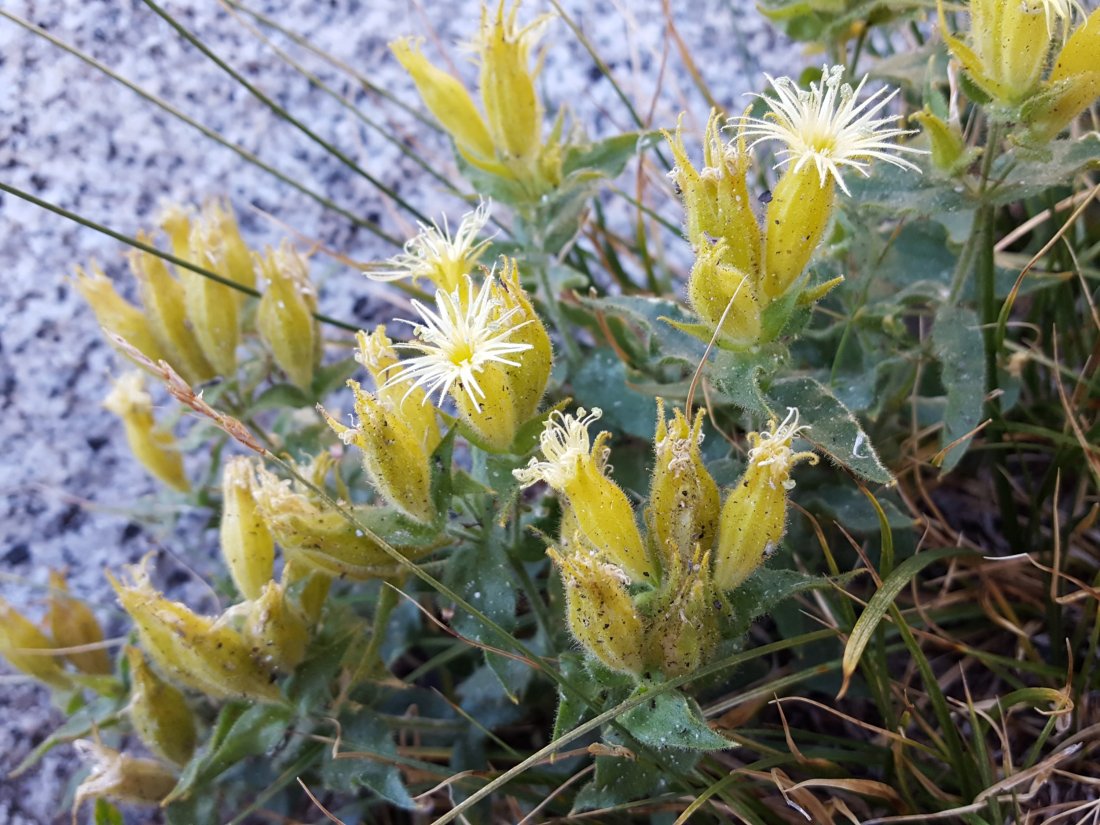
Parish’s Catchfly (Silene parishii) flowering at 10,800′ on San Jacinto Peak, 13th September 2018. This flower is endemic to the mountains of Southern California.

Be Bear aware Our two resident Black Bears have had a low profile for the last couple of months. Apparently they have been largely in Hall’s Canyon, above Lake Fulmor. Unfortunately they have been making a nuisance of themselves, getting into trash and bird seed at the James Reserve. Hikers and campers everywhere, but especially those on the western side of the mountain (e.g. in the Black Mountain area), should have bear safety awareness, and practice bear-safe food storage. The tips at this CDFW website are useful.

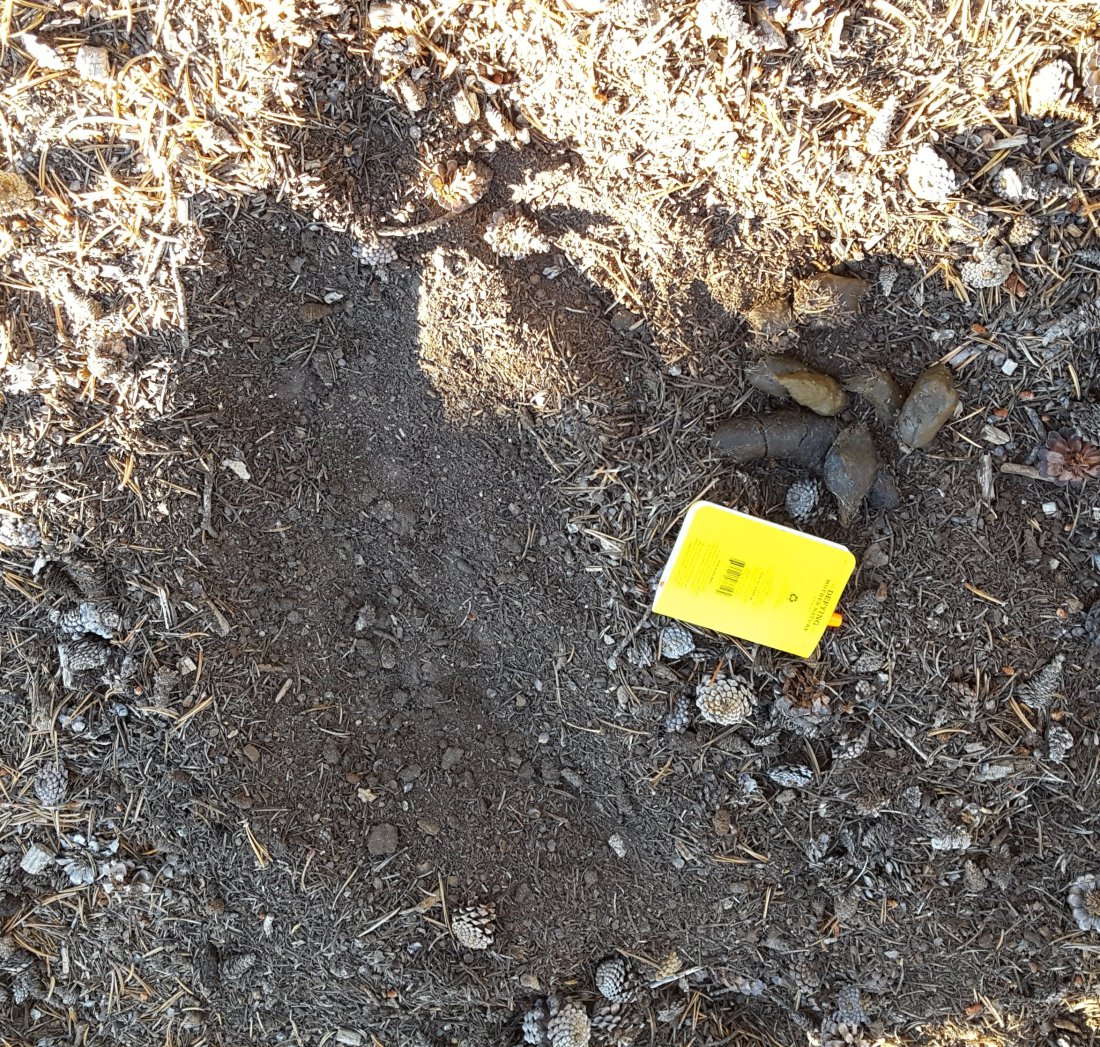
Always be Lion aware I always like to be reminded that Mountain Lions are common everywhere on the mountain. And I mean everywhere. Early this morning I found this very fresh lion scat at 10,400′ elevation near Miller Peak. Descending the Peak Trail, I found a fresh print in soft sand at 10,200′. In the area of Wellman’s Cienega at 9,200′, I found more fresh scat in the trail. None of these signs had been there 48 hours earlier. There are lots of Mule Deer in the high country this autumn, and where there are deer, there are lions.

Mountain Lion scat and associated scratch marks at 10,400′, 21st September 2018. The notebook measures 4.5 x 3 inches.
Mountain Lion print at 10,200′, 21st September 2018. The lip balm for size reference is placed at the heel of the print and is nearly 3 inches long.

EASTERN SLOPE WATER FEATURES

The Round Valley faucet is dry.

Both the northern and southern springs at Wellman’s Cienega continue to flow gently, but the northern spring in particular is now very weak. It will dry up in October without new precipitation.

Wellman’s Cienega North spring, 21st September 2018.

These springs are the sources for Willow Creek, which is no longer flowing where it crosses the Willow Creek Trail. There are some pools a few inches deep where water could be filtered near the crossing. Willow Creek has never previously been known to stop flowing at this location.

Tahquitz Valley has been completely dry for at least three months.

Tahquitz Creek continues to flow gently at the northern (lower) end of Little Tahquitz Meadow. This is the last remaining “reliable” water source in the Tahquitz meadows area.

Tahquitz Creek is barely trickling further upstream at its source (known locally as Grethe Spring) where it crosses the PCT at the northern end of the fire closure (approx. PCT Mile 177). Immediately after crossing the PCT, the creek dries up and disappears subsurface.

Skunk Cabbage Creek is dry where the trail crosses Skunk Cabbage Meadow at the small wooden bridge.

WESTERN SLOPE WATER FEATURES

The North Fork of the San Jacinto River continues to flow gently where it crosses the Deer Springs Trail, but flow has dropped to about 1.5 gallons per minute. The water levels for this river are apparently the lowest in living memory.

North Fork of the San Jacinto River on Deer Springs Trail, 20th September 2018.

The North Fork of the San Jacinto River has dried up where it crosses the Pacific Crest Trail on the Fuller Ridge Trail (approx. PCT Mile 186.2). This was the critical water source for PCTers and others hiking to or from Snow Creek, a 22 mile section of trail infamous for being waterless (now waterless for >25 miles). Options for southbound PCT hikers (and other hikers on this section) are all poor. Switchback Spring and Strawberry Cienega (see below) are possibilities staying on the PCT, but both are at very low flows. If heading to San Jacinto Peak, the North Fork where it crosses the Deer Springs Trail is a very good option. Alternatively, from where the PCT crosses the Black Mountain Road it is possible to descend the road 2.4 miles to the Cinco Poses Spring (a faucet by the roadside, see below). This undulating and exposed road is a descent of about 600′ and ascent of 200′, that would have to be reversed on the way back.

O’Sullivan Creek (PCT Mile 186.4) on Fuller Ridge Trail has been dry since early May.

The spring in the creek in Little Round Valley has been completely dry since early June.

Shooting Star Spring – 0.28 trail miles below Little Round Valley – continues to flow gently. For hikers it is possible to filter water from the source at the base of the obvious huge rock at the top of the wet area of trail, but a better option is to descend to the North Fork crossing mentioned above.

The Deer Springs stream crossing at the PCT (approx. PCT mile 185.6) is dry, and the pools just upstream (and downstream) of the trail are also dry. In my off-trail wanderings this week, I confirmed that the Deer Springs themselves continue to flow gently, about 0.15 miles upslope from the trail. Unfortunately, most of the flow is diverted into a pipe for the Deer Springs camp. The Deer Springs camp just downslope from the trail has been occupied by a crew from the California Conservation Corps off-and-on since late May.

Switchback Spring – the small spring just below the eight switchbacks on Deer Springs Trail about 0.4 miles north of Strawberry Junction – continues to trickle very gently. There is a tiny pool on the upslope side of the trail where water can be filtered if necessary.

The little spring at Strawberry Cienega (PCT mile 183) has now dried up. For emergency filtering, the tiny pool in the crack between the two large rocks remains for the time being.

Cinco Poses Spring on Black Mountain Road (4.7 miles up from Highway 243) still has plenty of running water at the faucet. This could be an important emergency water source as others dry up throughout the western side of the mountain.

On Devil’s Slide Trail, Middle Spring has been dry since 26th July.

On the Ernie Maxwell Trail, Chinquapin Creek just below Humber Park has been diverted by Fern Valley Water District more-or-less continuously since 1st July, drying the creek where it crosses the trail. However good pools receive some fresh flow immediately upstream from the trail. This can be a very important water source for the many dogs walked on this trail.

Water and weather 12th September 2018

I have spent the last three days in the high country, visiting San Jacinto Peak several times, and checked water sources yesterday on a long loop hike around the entire mountain.

Trail overview A reminder that the Palm Springs Aerial Tramway is shut for annual maintenance until 1st October. See the tram website for more details. Do not even consider attempting the Skyline Trail at this time unless you fully understand that you must hike off the mountain. Many thanks to Florian Boyd for placing a warning sign to this effect at the Palm Springs Art Museum trailhead. A CCC crew continues to work in Long Valley during the closure (I passed them today on Devil’s Slide Trail).

The water situation continues to deteriorate. Last week I noted that the North Fork of the San Jacinto River has dried up where it crosses the Pacific Crest Trail on Fuller Ridge. In addition, Willow Creek has stopped flowing where it crosses the Willow Creek Trail, and Strawberry Cienega has finally stopped flowing too (these are discussed in more detail below). In summary, most well-known water sources are dry or are very close to drying up and should not be relied upon by hikers at this time. There is no snow anywhere on the mountain (all trails have been completely clear since early May). Details of the condition of high country trails following the 25th-30th July 2018 Cranston Fire are described at an earlier posting linked here. Finally, a reminder that the Black Mountain Road was graded last week.

Weather Some delightful autumnal weather in the high country over the past few days. Temperatures (especially overnight lows) remain above average for September, with low humidity, and persistent strong winds at the high peaks.

At San Jacinto Peak at 1905 on Monday 10th September, the air temperature was 55°F (12.7°C), with a mild windchill temperature of 51°F (10.6°C), 14% relative humidity, and a light 4 mph W wind gusting to 7 mph. By contrast this morning Wednesday 12th September, at 0615 the air temperature was 44°F (6.7°C), with a fresh windchill temperature of 32°F (0°C), 38% relative humidity, and a stiff 21 mph W wind gusting to 27.5 mph. Winds were SW or WSW near or above 20 mph all day on 11th September.

EASTERN SLOPE WATER FEATURES

The Round Valley faucet is dry.

Both the northern and southern springs at Wellman’s Cienega continue to flow gently, but the northern spring in particular is now very weak. These springs are the sources for Willow Creek, which is no longer flowing where it crosses the Willow Creek Trail. There are some pools a few inches deep where water could be filtered near the crossing. Willow Creek has never previously been known to stop flowing at this location. [Many thanks to good friend of the Trail Report Val Rock for this Willow Creek update from today.]

Tahquitz Valley has been completely dry for at least three months.

Tahquitz Creek continues to flow gently at the northern (lower) end of Little Tahquitz Meadow. This is the last remaining “reliable” water source in the Tahquitz meadows area.

Tahquitz Creek is barely trickling further upstream at its source (known locally as Grethe Spring) where it crosses the PCT at the northern end of the fire closure (approx. PCT Mile 177). Immediately after crossing the PCT, the creek dries up and disappears subsurface.

Skunk Cabbage Creek is dry where the trail crosses Skunk Cabbage Meadow at the small wooden bridge.

WESTERN SLOPE WATER FEATURES

The North Fork of the San Jacinto River continues to flow gently where it crosses the Deer Springs Trail, but flow has dropped about another 10% for the second consecutive week, down now to about 1.6 gallons per minute. The water levels for this river are apparently the lowest in living memory.

North Fork of the San Jacinto River on Deer Springs Trail, 11th September 2018.

The North Fork of the San Jacinto River has dried up where it crosses the Pacific Crest Trail on the Fuller Ridge Trail (approx. PCT Mile 186.2). This was the critical water source for PCTers and others hiking to or from Snow Creek, a 22 mile section of trail infamous for being waterless (now waterless for >25 miles). Options for southbound PCT hikers (and other hikers on this section) are all poor. Switchback Spring and Strawberry Cienega (see below) are possibilities staying on the PCT, but both are at very low flows. If heading to San Jacinto Peak, the North Fork where it crosses the Deer Springs Trail is a very good option. Alternatively, from where the PCT crosses the Black Mountain Road it is possible to descend the road 2.4 miles to the Cinco Poses Spring (a faucet by the roadside, see below). This undulating and exposed road is a descent of about 600′ and ascent of 200′, that would have to be reversed on the way back.

O’Sullivan Creek (PCT Mile 186.4) on Fuller Ridge Trail has been dry since early May.

The spring in the creek in Little Round Valley has been completely dry since early June.

Shooting Star Spring – 0.28 trail miles below Little Round Valley – continues to flow gently. For hikers it is possible to filter water from the source at the base of the obvious huge rock at the top of the wet area of trail, but a better option is to descend to the North Fork crossing mentioned above.

The Deer Springs stream crossing at the PCT (approx. PCT mile 185.6) is dry, and the pools just upstream (and downstream) of the trail are also dry. The Deer Springs camp just downslope has been occupied by a crew from the California Conservation Corps since late May (although only very briefly since the fire evacuation on 25th July).

Switchback Spring – the small spring just below the eight switchbacks on Deer Springs Trail about 0.4 miles north of Strawberry Junction – continues to trickle very gently. There is a tiny pool on the upslope side of the trail where water can be filtered if necessary.

Switchback Spring crossing the PCT, 11th September 2018.

The little spring at Strawberry Cienega (PCT mile 183) has now dried up. For emergency filtering, the tiny pool in the crack between the two large rocks remains for the time being.

Strawberry Cienega spring by the PCT, 11th September 2018. A small pool persists between the rocks at the top of this image.

Cinco Poses Spring on Black Mountain Road (4.7 miles up from Highway 243) still has plenty of running water at the faucet. This could be an important emergency water source as others dry up throughout the western side of the mountain.

The faucet of Cinco Poses Spring next to Black Mountain Road, 6th September 2018.

On Devil’s Slide Trail, Middle Spring has been dry since 26th July.

On the Ernie Maxwell Trail, Chinquapin Creek just below Humber Park has been diverted by Fern Valley Water District more-or-less continuously since 1st July, drying the creek where it crosses the trail. However good pools receive some fresh flow immediately upstream from the trail. This can be a very important water source for the many dogs walked on this trail.

Water and weather 6th September 2018

Today I hiked to San Jacinto Peak via Fuller Ridge Trail. We checked many water sources yesterday on a long loop hike to the Peak, descending via Deer Springs Trail. Tuesday morning’s hike to the Peak was just a quick one up the east side to enjoy the chilly weather.

Trail overview A flurry of noteworthy events on the mountain. The North Fork of the San Jacinto River has dried up where it crosses the Pacific Crest Trail on Fuller Ridge. The absence of this critical water source for hikers is discussed in more detail in the relevant section below. This presents a major problem for long distance hikers to/from Snow Creek.

The CCC crew working on the Pacific Crest Trail/Deer Springs Trail have completed the section near the Deer Springs crossing. Having taken at least four summer seasons to complete a few hundred yards of trail, questions have been asked whether it was the best use of resources, although it is very well constructed and a pleasure to use.

The Black Mountain road was graded earlier this week, and the road is now in its best condition since Spring 2017. Grading was completed all the way through to the Fuller Ridge campground and trailhead. This usually takes place right around Memorial Day weekend, but this year US Forest Service waited until after Labor Day weekend instead!

Flow rates at water sources are far below historic norms. Many well-known water sources are dry or are very close to drying up and should not be relied upon by hikers at this time. There is no snow anywhere on the mountain (all trails have been completely clear since early May). Details of the condition of high country trails following the 25th-30th July 2018 Cranston Fire are described at an earlier posting linked here.

Weather Some delightful autumnal weather in the high country over the past four days. Tuesday morning a sub-freezing windchill led me to pull on some thin gloves for the first time since May. A brief but rapid warming trend is expected for this weekend, followed thankfully by a return to more typical September temperatures next week.

At San Jacinto Peak at 0830 on Tuesday 4th September, the air temperature was 44°F (6.7°C), with a refreshing windchill temperature of 30.0°F (-1°C), 80% relative humidity (rising to 90% when cloud enveloped the Peak), and a strong 20 mph SE wind gusting to 27 mph. On Wednesday 5th September, at 0845 the air temperature was 46°F (7.8°C), with a cool windchill temperature of 36°F (2.2°C), 72% relative humidity, and a cool 10 mph ESE wind gusting to 19 mph.

Skilton’s Skink (Plestiodon skiltonianus) basking on Devil’s Slide Trail, 4th September 2018.

EASTERN SLOPE WATER FEATURES

The Round Valley faucet is dry.

Both the northern and southern springs at Wellman’s Cienega continue to flow, but very weakly. These springs are the sources for Willow Creek, which continues to flow gently where it crosses the Willow Creek Trail.

Tahquitz Valley has been completely dry for at least three months.

Tahquitz Creek continues to flow steadily at the northern (lower) end of Little Tahquitz Meadow.

Tahquitz Creek at the north end of Little Tahquitz Meadow, 29th August 2018.

Tahquitz Creek is barely trickling further upstream at its source (known locally as Grethe Spring) where it crosses the PCT at the northern end of the fire closure (approx. PCT Mile 177). Immediately after crossing the PCT, the creek dries up and disappears subsurface.

Skunk Cabbage Creek is dry where the trail crosses Skunk Cabbage Meadow at the small wooden bridge.

WESTERN SLOPE WATER FEATURES

The North Fork of the San Jacinto River continues to flow gently where it crosses the Deer Springs Trail, but flow has dropped another 10% from last week, to about 1.8 gallons per minute. The water levels for this river are apparently the lowest in living memory.

The North Fork of the San Jacinto River on Deer Springs Trail, 5th September 2018.

The North Fork of the San Jacinto River has dried up where it crosses the Pacific Crest Trail on the Fuller Ridge Trail (approx. PCT Mile 186.2). This was the critical water source for PCTers and others hiking to or from Snow Creek, a 22 mile section of trail infamous for being waterless (now waterless for >25 miles). Options for southbound PCT hikers (and other hikers on this section) are all poor. Switchback Spring and Strawberry Cienega (see below) are possibilities staying on the PCT, but both are at very low flows. If heading to San Jacinto Peak, the North Fork where it crosses the Deer Springs Trail is a very good option. Alternatively, from where the PCT crosses the Black Mountain Road it is possible to descend the road 2.4 miles to the Cinco Poses Spring (a faucet by the roadside, see below). This undulating and exposed road is a descent of about 600′ and ascent of 200′, that would have to be reversed on the way back.

A depressingly dry North Fork of the San Jacinto River on Fuller Ridge Trail, 6th September 2018.

O’Sullivan Creek (PCT Mile 186.4) on Fuller Ridge Trail has been dry since early May.

The spring in the creek in Little Round Valley has been completely dry since early June.

Shooting Star Spring – 0.28 trail miles below Little Round Valley – continues to flow relatively gently. For hikers it is possible to filter water from the source at the base of the obvious huge rock, but a better option is to descend to the North Fork crossing mentioned above.

Water trickling down the Deer Springs Trail from Shooting Star Spring, 5th September 2018.

The Deer Springs stream crossing at the PCT (approx. PCT mile 185.6) is dry, and the pools just upstream (and downstream) of the trail are also dry. The Deer Springs camp just downslope has been occupied by a crew from the California Conservation Corps since late May (although only very briefly since the fire evacuation on 25th July).

Switchback Spring – the small spring just below the eight switchbacks on Deer Springs Trail about 0.4 miles north of Strawberry Junction – continues to trickle. There is a tiny pool on the upslope side of the trail where water can be filtered if necessary.

Switchback Spring on Deer Springs Trail, 5th September 2018.

The little spring in the rock crack at Strawberry Cienega (PCT mile 183) is now barely flowing. For filtering, there is a tiny pool among the rocks (currently heavily obscured by vegetation).

Cinco Poses Spring on Black Mountain Road (4.7 miles up from Highway 243) still has plenty of running water at the faucet. This could be an important emergency water source as others dry up throughout the western side of the mountain.

The faucet of Cinco Poses Spring next to Black Mountain Road, 6th September 2018.

On Devil’s Slide Trail, Middle Spring has been dry since 26th July.

On the Ernie Maxwell Trail, Chinquapin Creek just below Humber Park has been diverted by Fern Valley Water District more-or-less continuously since 1st July, drying the creek where it crosses the trail. However good pools receive some fresh flow immediately upstream from the trail. This can be a very important water source for the many dogs walked on this trail.

Weather 3rd September 2018

Anne and I hiked to San Jacinto Peak from Humber Park early this morning. Water conditions are little changed from last week, as described here. Lovely cool, windy weather at the Peak led to another brief video.

Error
This video doesn’t exist

Despite the autumnal feel in recent days, another warming trend is forecast for the next few days. Both overnight low and daytime high temperatures will steadily rise this week to above average for midsummer (not September!) at the weekend, before starting to cool slightly the following week.

In summary today, at San Jacinto Peak at 0810 on Monday 3rd September, the air temperature was 44°F (6.7°C), with a cool windchill temperature of 33°F (0.5°C), 74% relative humidity, and a strong 16 mph SE wind gusting to 21 mph.

Although thunderstorms are not currently forecast, hikers should always be prepared for rapidly changing conditions in the high country in summer. Thunderstorms with lightning can occur at or near the high peaks even when such storms are not forecast for lower elevations.

On a different note, I usually tidy up the summit hut just below San Jacinto Peak every week. We had brought up a couple of bags specifically for this purpose today, only to find things had got a bit out of hand in just the past few days.

Above are the 18 empty plastic bottles we gathered from the hut. In addition we brought down two small bags of non-recyclable trash.

While I suspect the readers of this Trail Report are not the sort of hikers leaving their garbage up there, maybe now would be a good time to remind everyone that the San Jacinto Peak summit hut is not a public trash can. Thanks.

Water conditions 30th August 2018

We checked most water sources on a long loop hike to San Jacinto Peak on Tuesday 28th, descending by Deer Springs Trail. On Wednesday 29th, I reviewed the springs and creeks around the Tahquitz area meadows following a fire lookout shift at Tahquitz Peak.

Weather The rain from storms in the middle of August is already a distant memory, and its impacts on water sources were predictably short-lived.

At San Jacinto Peak at 0830 on Tuesday 28th August, the air temperature was 47°F (8.3°C), with a cool windchill temperature of 38°F (3.3°C), 17% relative humidity, and a stiff 14 mph W wind gusting to 17 mph.

Although thunderstorms are not currently forecast, hikers should always be prepared for rapidly changing conditions in the high country in summer. Thunderstorms with lightning can occur at or near the high peaks even when such storms are not forecast for lower elevations.

Noteworthy climate observation #1. The historical average overnight low temperature for August in Idyllwild is 54.8°F (National Weather Service data). With only a couple of days remaining in August 2018, Idyllwild will have recorded a low temperature below 55°F only once this month, and the average low for the first 20 days of the month was 59.5°F.

Trail overview Flow rates at water sources are far below seasonal norms. Several well-known water sources are dry or are very close to drying up and should not be relied upon by hikers at this time. There is no snow anywhere on the mountain (all trails have been completely clear since early May). Details of the condition of high country trails following the 25th-30th July 2018 Cranston Fire are described at an earlier posting linked here.

EASTERN SLOPE WATER FEATURES

The Round Valley faucet is dry.

Both the northern and southern springs at Wellman’s Cienega continue to flow weakly. These springs are the sources for Willow Creek, which continues to flow where it crosses the Willow Creek Trail.

Tahquitz Valley has been completely dry for at least two months.

Tahquitz Creek continues to flow steadily at the northern (lower) end of Little Tahquitz Meadow.

Tahquitz Creek at the north end of Little Tahquitz Meadow, 29th August 2018.

Tahquitz Creek is barely trickling further upstream at its source (known locally as Grethe Spring) where it crosses the PCT at the northern end of the fire closure (approx. PCT Mile 177). Immediately after crossing the PCT, the creek dries up and disappears subsurface.

Tahquitz Creek crossing the PCT immediately below Grethe Spring, 29th August 2018.

Skunk Cabbage Creek is dry where the trail crosses Skunk Cabbage Meadow at the small wooden bridge.

WESTERN SLOPE WATER FEATURES

The North Fork of the San Jacinto River continues to flow gently where it crosses the Deer Springs Trail, but flow has almost halved from last week, down to about 2.0 gallons per minute. The same river is close to drying up where it crosses the Pacific Crest Trail on the Fuller Ridge Trail (approx. PCT Mile 186.2), with flow at at only 0.1 gallons per minute. The latter is extremely low flow for this critical PCT water source. These two crossings are the most important water sources for hikers on the western side of the mountain. The water levels for this river are apparently the lowest in living memory.

North Fork of the San Jacinto River on Deer Springs Trail, 28th August 2018.

O’Sullivan Creek (PCT Mile 186.4) on Fuller Ridge Trail remains completely dry.

The spring in the creek in Little Round Valley has been completely dry since early June.

Shooting Star Spring – 0.28 trail miles below Little Round Valley – continues to flow relatively well. For hikers it is possible to filter water from the source at the base of the obvious huge rock, but a better option is to descend to the North Fork crossing mentioned above.

The minor creek crossing (sometimes known as Rock Spring) on Deer Springs Trail midway between the North Fork of the San Jacinto River crossing and Shooting Star Spring, is functionally dry.

The Deer Springs stream crossing at the PCT (approx. PCT mile 185.6) is dry, and the pools just upstream (and downstream) of the trail are also dry. The Deer Springs camp just downslope has been occupied by a crew from the California Conservation Corps since late May (although not since the fire evacuation on 25th July).

Switchback Spring – the small spring just below the eight switchbacks on Deer Springs Trail about 0.4 miles north of Strawberry Junction – continues to flow well. There is a tiny pool on the upslope side of the trail where water can be filtered if necessary.

Switchback Spring crossing the PCT, 28th August 2018.

The little spring in the rock crack at Strawberry Cienega (PCT mile 183) is flowing very weakly. For filtering, there is a tiny pool among the rocks (currently heavily obscured by plants).

On Devil’s Slide Trail, Middle Spring has been dry since 26th July.

On the Ernie Maxwell Trail, Chinquapin Creek just below Humber Park has been diverted by Fern Valley Water District more-or-less continuously since 1st July, drying the creek where it crosses the trail. However good pools receive some fresh flow immediately upstream from the trail. This can be a very important water source for the many dogs walked on this trail.

Water conditions 24 August 2018

We went up to San Jacinto Peak this morning and also on Tuesday 21st, the latter via Fuller Ridge and the upper Deer Springs Trail before a fire lookout shift at Black Mountain. On Wednesday 22nd August, I reviewed the springs and creeks around the Tahquitz area meadows when descending from a fire lookout shift at Tahquitz Peak.

As the San Jacinto Trail Report creeps slowly into the 21st Century, I thought I’d try an occasional short video blog. All the usual detail follows in the text below.

Error
This video doesn’t exist

Weather Rainfall from thunderstorms three days in a row last week, 15-17 August, included a spectacular storm cell over Idyllwild on the afternoon of 17th, when we recorded 1.50″ rain at home in under an hour! Despite similar rainfall on many parts of the mountain at the same time, impacts on water sources were remarkably short-lived.

At San Jacinto Peak at 0840 today, Friday 24th August, the air temperature was 51°F (10.5°C), with a pleasant windchill temperature of 43°F (6°C), a return to a more typical 39% relative humidity, and a firm 9 mph SW breeze gusting to 15 mph. It was even more autumnal on Tuesday 21st August, when at 0720 the air temperature was 49°F (9.5°C), with a cool windchill temperature of 40.4°F (4.7°C), 73% relative humidity, and a chilly SSW wind sustained at 16 mph and gusting just over 20 mph.

Despite the shift this week from monsoonal easterly airflow to more typical westerly maritime weather, hikers should always be prepared for rapidly changing conditions in the high country in summer. Thunderstorms with lightning can occur at or near the high peaks even when such storms are not forecast for lower elevations.

Trail overview Despite the rains of last week, flow rates at water sources have rapidly returned to being far below seasonal norms. Several well-known water sources are dry or are very close to drying up and should not be relied upon by hikers at this time. There is no snow anywhere on the mountain (all trails have been completely clear since early May). Details of the condition of high country trails following the 25-30 July 2018 Cranston Fire are described at an earlier posting linked here.

EASTERN SLOPE WATER FEATURES

The Round Valley faucet is dry again, despite flowing for a few days briefly after rain on Thursday 16th. [Thanks to Florian Boyd for this update from today.]

The flow rates at the northern and southern springs at Wellman’s Cienega have dropped drastically since the rains, but both continue to flow gently. These springs are the sources for Willow Creek, which continues to flow where it crosses the Willow Creek Trail.

Wellmans North Cienega early this morning, 24 August 2018.

Tahquitz Valley has been completely dry for at least two months.

Tahquitz Creek continues to flow steadily at the northern (lower) end of Little Tahquitz Meadow.

Tahquitz Creek at the north end of Little Tahquitz Meadow, 22 August 2018.

Tahquitz Creek continues to trickle gently further upstream at its source (known locally as Grethe Spring) where it crosses the PCT at the northern end of the fire closure (approx. PCT Mile 177). Immediately after crossing the PCT, the creek dries up and disappears subsurface.

Tahquitz Creek crossing the PCT immediately below Grethe Spring, 22 August 2018.

Skunk Cabbage Creek is dry where the trail crosses Skunk Cabbage Meadow at the small wooden bridge.

WESTERN SLOPE WATER FEATURES

The North Fork of the San Jacinto River continues to flow gently where it crosses the Deer Springs Trail, at about 3.7 gallons per minute (up from about 2.6 gpm prior to last weeks rains). However, the same river just downslope is now flowing very weakly where it crosses the Pacific Crest Trail on the Fuller Ridge Trail (approx. PCT Mile 186.2), at only 0.2 gallons per minute. The latter is extremely low flow for this critical PCT water source. These two crossings are the most important water sources for hikers on the western side of the mountain. Prior to recent rains the flow rate was the lowest in living memory, and it will rapidly return to that status without new precipitation.

North Fork of the San Jacinto River on Fuller Ridge Trail, 21 August 2018.

O’Sullivan Creek (PCT Mile 186.4) on Fuller Ridge Trail remains completely dry.

The spring in the creek in Little Round Valley has been completely dry since early June.

Shooting Star Spring – 0.28 trail miles below Little Round Valley – continues to flow significantly better than before the rain last week. For hikers it is possible to filter water from the source at the base of the obvious huge rock, but a better option is to descend to the North Fork crossing mentioned above.

The minor creek crossing (sometimes known as Rock Spring) on Deer Springs Trail midway between the North Fork of the San Jacinto River crossing and Shooting Star Spring, remained dry even during the rainfall, and has been dry across and below the trail since June.

The Deer Springs stream crossing at the PCT (approx. PCT mile 185.6) is dry, and the pools just upstream (and downstream) of the trail are also dry. The Deer Springs camp just downslope has been occupied by a crew from the California Conservation Corps since late May (although not since the fire evacuation on 25th July).

Switchback Spring – the small spring just below the eight switchbacks on Deer Springs Trail about 0.4 miles north of Strawberry Junction – continues to flow well. There is a tiny pool on the upslope side of the trail where water can be filtered if necessary.

Switchback Spring crossing the PCT, flowing well today, 17 August 2018.

The little spring in the rock crack at Strawberry Cienega (PCT mile 183) is back to flowing very weakly. For filtering, there is a tiny pool among the rocks (currently heavily obscured by plants). A permanently placed tent stake makes a clean accessible trickle out of the mud when flow rates are reasonable.

On Devil’s Slide Trail, Middle Spring has been completely dry since 26th July, with no significant flow even after last weeks rain.

On the Ernie Maxwell Trail, Chinquapin Creek just below Humber Park has been diverted by Fern Valley Water District to their storage tanks more-or-less continuously since 1st July, usually drying the creek where it crosses the trail. However good pools receive some fresh flow immediately upstream from the trail. This can be a very important water source for the many dogs walked on this trail.

Water and weather 17 August 2018

For details of the condition of high country trails following the 25-30 July 2018 Cranston Fire, see an earlier posting linked here.

Four hikes to San Jacinto Peak in the last five days via various routes included two full loops to review almost all water sources and the extent of recent rains. Yesterday, 16th August, I was able to review the springs and creeks around the Tahquitz area meadows en route to my fire lookout shift.

Weather Finally some reasonable rainfall from thunderstorms three days in a row, 15-17 August. At Idyllwild, the rainfall has been poor – although it is now raining heavily as I write this – with only a trace at 5550′ elevation on 15th, and 0.04″ on 16th. However many other areas of the mountain received good rainfall yesterday (16th), with roughly half-an-inch reported from such widely spread areas as Keenwild, Vista Grande, and Long Valley.

Spectacular clouds around San Jacinto Peak yesterday afternoon, 16th August 2018, as seen from Tahquitz Peak.

On the trails, yesterday there was evidence of light rain from the 15th all the way on the eastern side of the mountain from Humber Park to San Jacinto Peak. Judging by today’s hike, the rain yesterday afternoon (16th) was focused on the east side of the high country, again all the way from 6500′ to San Jacinto Peak. However on the west side, there was only evidence of much lighter rain, and some sections of the PCT/Deer Springs Trail were almost dry.

At San Jacinto Peak at 0740 today, Friday 17th August, the air temperature was 54°F (12°C), with a modest windchill temperature of 50°F (10°C), 78% relative humidity, and a light 3-5 mph ESE breeze. The previous two days, 15th and 16th August, the weather was very similar both mornings at around 0800 and starting to feel autumnal. The air temperature was 51°F (10.5°C), with lovely fresh windchill temperatures of 43°F (6°C), 80% relative humidity, and a firm SE breeze at 8 mph gusting to 15 mph.

Hikers should always be prepared for rapidly changing weather conditions in the high country in summer. Thunderstorms with lightning and rapidly falling temperatures can occur at or near the high peaks even when such storms are not forecast for lower elevations.

Flash flooding yesterday afternoon, 16th August, at the Round Valley junction (photo copyright Jeremy Odom).

Highway closures Note that during and following rain storms, highways through areas that were denuded by the Cranston Fire are being closed abruptly due to elevated risk of flooding and mud/rock slides. The last two days Highway 243 from Idyllwild to Mountain Center, and Highway 74 from Hemet to Lake Hemet, have been closed for up to several hours in the afternoons. Factor this in to travel plans if there are storms in the forecast.

Trail overview Prior to the rains of the last couple of days, flow rates at all water sources were at their lowest of the year, and far below seasonal norms. Despite recent rains, some well-known water sources remain dry or are very close to drying up and should not be relied upon by hikers at this time. There is no snow anywhere on the mountain (all trails have been completely clear since early May).

Muddy trails following rain are perfect for recording animal tracks. This Mountain Lion track was near 9800′ above Wellman Divide early this morning, 17th August 2018. The lip balm for reference measures 2.6″ long.

EASTERN SLOPE WATER FEATURES

The Round Valley faucet was dry by Monday 13th, having apparently dried up a day or two earlier. It started flowing again after rain on Thursday 16th, but was only a steady trickle. [Thanks to Jeremy Odom for this information.] Nevertheless, this may only be temporary relief for a few days or weeks at best. Hikers and campers to Round and Tamarack valleys from the Tram are advised not to rely on this ephemeral water source and to pack in all their water.

The flow rate at both the northern and southern springs at Wellman’s Cienega doubled from Monday to Wednesday, and doubled again by today, Friday. These springs are the sources for Willow Creek, which continues to flow gently where it crosses the Willow Creek Trail.

Wellman’s North Cienega, 17th August 2018.

Tahquitz Valley has been completely dry for at least two months, and recent rains have not changed that situation.

Tahquitz Creek continues to flow steadily at the northern (lower) end of Little Tahquitz Meadow.

Lower (north) end of Little Tahquitz Meadow, 16th August 2018.

Tahquitz Creek has briefly flash-flooded twice in the past three days further upstream at its source (known locally as Grethe Spring) where it crosses the PCT at the northern end of the fire closure (approx. PCT Mile 177). However shortly after rains it has returned to a very low flow. Immediately after crossing the PCT, the creek dries up and disappears subsurface.

Tahquitz Creek at Grethe Spring, 16th August 2018, drying out after a brief flooding event.

Skunk Cabbage Creek remains largely dry where the trail crosses Skunk Cabbage Meadow at the small wooden bridge.

WESTERN SLOPE WATER FEATURES

The North Fork of the San Jacinto River continues to flow steadily both where it crosses the Deer Springs Trail, and where it crosses the Fuller Ridge Trail on the PCT (approx. PCT Mile 186.2). These two crossings are the most important water sources for hikers on the western side of the mountain. Prior to recent rains the flow rate was the lowest in living memory. About 100′ downstream from the river crossing on Fuller Ridge Trail the river runs dry and disappears subsurface.

O’Sullivan Creek (PCT Mile 186.4) on Fuller Ridge Trail remains completely dry.

The spring in the creek in Little Round Valley remained completely dry this morning despite recent rains, as it has been since early June.

Shooting Star Spring – 0.28 trail miles below Little Round Valley – is flowing at about twice the rate of Monday. For hikers it is possible to filter water from the source at the base of the obvious huge rock, but a better option is to descend to the North Fork crossing mentioned above.

The minor creek crossing (sometimes known as Rock Spring) on Deer Springs Trail midway between the North Fork of the San Jacinto River crossing and Shooting Star Spring remained completely dry this morning, and has been dry across and below the trail since June.

The Deer Springs stream crossing at the PCT (approx. PCT mile 185.6) is dry, and the pools just upstream (and downstream) of the trail are also dry. The Deer Springs camp just downslope has been occupied by a crew from the California Conservation Corps since late May (although not since the fire evacuation on 25th July).

Switchback Spring – the small spring just below the eight switchbacks on Deer Springs Trail about 0.4 miles north of Strawberry Junction – continues to flow well. There is a tiny pool on the upslope side of the trail where water can be filtered if necessary.

Switchback Spring crossing the PCT, flowing well today, 17th August 2018.

The little spring in the rock crack at Strawberry Cienega (PCT mile 183) is now flowing at least at double the rate of last week. For filtering, there is a tiny pool among the rocks (currently heavily obscured by plants), and a permanently placed tent stake makes a clean accessible trickle out of the mud.

On Devil’s Slide Trail, Middle Spring has been completely dry since 26th July. There was a little muddy rain puddle there this morning, not even enough for a dog to drink from.

On the Ernie Maxwell Trail, Chinquapin Creek just below Humber Park has been diverted by Fern Valley Water District to their storage tanks more-or-less continuously since 1st July, drying the creek where it crosses the trail. However good pools receive some fresh flow immediately upstream from the trail. This can be a very important water source for the many dogs walked on this trail.

Water conditions 13 August 2018

For details of the condition of high country trails following the July 2018 Cranston Fire, see the prior posting linked here. Today we were able to check all high country water sources on a lengthy loop hike to San Jacinto Peak via Devil’s Slide Trail, descending via Deer Springs Trail, with a couple of side hikes to check other sources too. Last week I was able to review the springs and creeks around the Tahquitz area meadows.

Weather At San Jacinto Peak at 0740 today, Monday 13th August, the air temperature was 52°F (11°C), with a lovely fresh windchill temperature of 45°F (7°C), 54% relative humidity, and a pleasant 5 mph SSE breeze gusting to 13 mph.

There is a moderate possibility of thunderstorms for the next three or four days. Hikers should always be prepared for rapidly changing weather conditions in the high country in summer. Thunderstorms with lightning can occur at or near the high peaks even when such storms are not forecast for lower elevations.

Trail overview Flow rates at all water sources are at their lowest of the year, and far below seasonal norms. Some well-known water sources are dry or are very close to drying up and should not be relied upon by hikers at this time. There is no snow anywhere on the mountain (all trails have been completely clear since early May).

EASTERN SLOPE WATER FEATURES

The Round Valley faucet was dry this morning, having apparently dried up in the last day or two (it was still just trickling on Friday 10th). Hikers and campers to Round and Tamarack valleys from the Tram must pack in all their water.

Both the northern and southern springs at Wellman’s Cienega are flowing weakly, but with no notable change since last week. These springs are the sources for Willow Creek, which continues to flow gently where it crosses the Willow Creek Trail.

Wellmans North Cienega, 13 August 2018.

Tahquitz Valley has been completely dry for at least two months.

Tahquitz Creek continues to flow gently at the northern (lower) end of Little Tahquitz Meadow.

Tahquitz Creek is only flowing very weakly further upstream at its source (known locally as Grethe Spring) where it crosses the PCT at the northern end of the fire closure (approx. PCT Mile 177). Immediately after crossing the PCT, the creek dries up and disappears subsurface.

Skunk Cabbage Creek is dry where the trail crosses Skunk Cabbage Meadow at the small wooden bridge.

WESTERN SLOPE WATER FEATURES

The North Fork of the San Jacinto River continues to flow gently both where it crosses the Deer Springs Trail, and where it crosses the Fuller Ridge Trail on the PCT (approx. PCT Mile 186.2). These two crossings are the most important water sources for hikers on the western side of the mountain. However, the flow rate is now the lowest in memory, even weaker than in the autumns of 2015 and 2016, today at only about 2.9 gallons per minute. About 100′ downstream from the river crossing on Fuller Ridge Trail the river runs dry and disappears subsurface. In addition, the North Fork is dry at all three of its crossings of the Seven Pines Trail.

North Fork of the San Jacinto River at Deer Springs Trail, 13 August 2018.

O’Sullivan Creek (PCT Mile 186.4) on Fuller Ridge Trail is completely dry.

The spring in the creek in Little Round Valley has been completely dry since early June. [See photos below of the newly-constructed toilet in the LRV campground.]

Shooting Star Spring – 0.28 trail miles below Little Round Valley – is flowing weakly but consistently. For hikers it is possible to filter water from the source at the base of the obvious huge rock, but a better option is to descend to the North Fork crossing mentioned above.

The minor creek crossing (sometimes known as Rock Spring) on Deer Springs Trail midway between the North Fork of the San Jacinto River crossing and Shooting Star Spring is virtually dry, and has been dry across and below the trail since June.

The last remaining trickle at so-called Rock Spring just above Deer Springs Trail, 13 August 2018.

The Deer Springs stream crossing at the PCT (approx. PCT mile 185.6) is dry, and the pools just upstream (and downstream) of the trail are also dry. The Deer Springs camp just downslope has been occupied by a crew from the California Conservation Corps (CCC) off-and-on since late May.

Switchback Spring – the small spring just below the eight switchbacks on Deer Springs Trail about 0.4 miles north of Strawberry Junction – continues to flow quite well. There is a tiny pool on the upslope side of the trail where water can be filtered if necessary.

Switchback Spring crossing at the PCT, 13 August 2018.

The little spring in the rock crack at Strawberry Cienega (PCT mile 183) is now flowing very weakly. For filtering, there is a tiny pool among the rocks (currently heavily obscured by plants), and a permanently placed tent stake makes a clean accessible trickle out of the mud. The current flow rate at the tent stake is too low to reliably measure (<0.01 gpm), down from 0.07 gallons per minute on 20th July.

On Devil’s Slide Trail, Middle Spring has been completely dry since 26th July.

On the Ernie Maxwell Trail, Chinquapin Creek just below Humber Park has been diverted by Fern Valley Water District to their storage tanks more-or-less continuously since 1st July, drying the creek where it crosses the trail. However good pools receive some fresh flow immediately upstream from the trail. This can be a very important water source for the many dogs walked on this trail.

Above and below, the new pit toilet in Little Round Valley completed in the last week by a scout troop from Indio

Post-Cranston Fire trail conditions

The following is a final trail-by-trail review of the impacts of the Cranston Fire in the high country of the San Jacinto mountains, likely to mainly be of interest to readers most familiar with the trail system. This is NOT an official Forest Service assessment of trail conditions. Nevertheless, this information from a variety of sources is detailed and reliable.

Pacific Crest Trail The PCT on the Desert Divide was not significantly damaged as it was in the Mountain Fire. The Cranston Fire burned up the ridges from May Valley to the western and north-west flanks of Antsell Rock, and to the peaks of South Peak and Red Tahquitz. This section of the PCT was still closed from the 2013 Mountain Fire, but rehabilitation work had just been completed and the PCT was tentatively scheduled to reopen later in 2018. This plan may be in jeopardy, as the Mountain Fire closure order has been absorbed within the new Cranston Fire closure order which runs through July 2019.

Fortunately, the Cranston Fire largely did not burn over to the east side of the Desert Divide due to the lack of fuels caused, ironically, by the widespread destruction of the Mountain Fire. In this area, the PCT largely runs along the eastern flank of the Desert Divide. Only at the saddle between Red Tahquitz and South Peak, and just north of Antsell Rock, did the Cranston Fire reach the PCT, but in these relatively rocky areas there was no damage to the trail.

Although the Cranston Fire did burn a short way north between Red Tahquitz and Grey Tahquitz (Peak 8792), it did not reach the PCT here. The fire did however reach north to the PCT at Chinquapin Flat, having burned completely around Anabel Peak (Peak 8860), the high point of the ridge just east of Tahquitz Peak proper. The fire jumped the PCT by fewer than 100 feet in a couple of locations just downslope from Chinquapin Flat.

In summary, the PCT is essentially unchanged from its post-Mountain Fire status. Plans to reopen this section soon should be unaffected. This will be especially important given that the PCT Alternate through Hurkey Creek campground and May Valley – that we helped develop in 2014 and 2015 – was completely burned over by the Cranston Fire and may be closed for some considerable time (possibly years rather than months).

The Pacific Crest Trail at Chinquapin Flat, August 2018
The Pacific Crest Trail just east of (below) Chinquapin Flat, August 2018.

South Ridge Trail This is the high country trail most impacted by the Cranston Fire, and the only high country trail that remains closed under the reduced closure order. Vegetation along most of the trail side was not directly burned, but in a couple of areas the fire did jump the trail. Nowhere was the tread of the trail itself damaged. Specifically, vegetation on both sides of several switchbacks burned roughly midway between South Ridge Road and Old Lookout Flat. Just above Old Lookout Flat the fire started to descend the west side through the forest by about a hundred yards over a fairly wide area. In addition, significant vegetation cutting occurred at the top of South Ridge Road, and along the trail from there to Old Lookout Flat, as a measure to reduce spread of the fire.

Old Lookout Flat, looking approximately north, August 2018
South Ridge Trail just above Old Lookout Flat, looking South, August 2018

The fire was allowed to burn up Hurkey Creek Canyon all the way to Tahquitz Peak, and some vegetation burned to within about 40 feet on the south and south-east sides of Tahquitz Peak fire lookout. Despite what was implied (or in some cases boldly stated) in inaccurate information disseminated by multiple irresponsible individuals – I’m trying to be polite here – the Tahquitz Peak fire lookout did NOT burn down in the Cranston Fire.

Tahquitz Peak fire lookout looking west-south-west, August 2018.

South Ridge Trail (from South Ridge Road south to Keenwild fire station) This multi-use trail, a popular mountain bike trail, was completely burned over, and will likely be closed for some considerable time.

May Valley Road (and adjacent bike trails) This dirt road very popular with locals for biking, hiking, running, and dog walking, was completely burned over from its crest just beyond Cowbell Alley all the way down to its junction with Bonita Vista Road. The latter burned from near Fleming Ranch west all the way along Keen Camp Ridge to Hwy 74.

No other high country trails were directly affected by the Cranston Fire. This includes all the trails around the Tahquitz area meadows, Devils Slide, Ernie Maxwell Trail, Willow Creek Trail, Ramona Trail, etc., all of which have now reopened. Black ash flakes were visible throughout all the trails of the mountain, even all the way to San Jacinto Peak, at least for the first few days after the fire. That there were not more spot fires scattered around the high country is very fortunate, to put it mildly.

Fobes Trail The Cranston Fire did not reach this far south in Garner Valley. However, dozer lines were inserted along/near Fobes Ranch Road, which is currently not open to non-residents, limiting trailhead access.

Spitler Peak Trail Although the fire burned both sides of Apple Canyon Road, the Spitler Peak Trail itself was unaffected. However, it may be some time before Apple Canyon Road – the access for the Spitler Peak trailhead – is fully open to non-residents.

Zen Center Trail This informal trail was unaffected by the Cranston Fire, although it remains in fairly poor condition, particularly in its upper elevations, since the Mountain Fire.

Water conditions 4 August 2018

For details of the current status of trail openings, see the previous post here. For vehicle access to the mountain, Highway 243 will apparently reopen with no restrictions from Mountain Center to Idyllwild today at 1200. Highway 74 from Lake Hemet to Mountain Center and on to Hemet will reopen this afternoon with significant restrictions (one-way traffic and pilot car). [Highway 243 from Banning to Idyllwild has been open for a week.]

Yesterday, 3rd August, I was able to check all high country water sources in the State Park on a very circuitous hike (due to the Cranston Fire closure of Forest Service lands). During this hike I had the pleasure of a long chat with friends and San Jac regulars Ellen and Marilee, the only other folks I encountered on the trails all day. Meanwhile, good friend of the Trail Report Florian Boyd was hiking in Round Valley and checked the faucet there. Immediately before and after the brief fire closures, I was able to check all water sources on Forest Service lands during multiple hikes.

Weather At San Jacinto Peak at 0915 on Friday 3rd August the air temperature was 55°F (13°C), with 71% relative humidity, and a barely noticeable NW breeze gusting to 2 mph.

In general, temperatures for the next week will remain above average in the high country. As much as we could use more rain, heavy thunderstorms right now would be catastrophic in the recent burn areas. Thankfully, the likelihood of thunderstorms is diminished for the next week or so. Nevertheless, hikers should always be prepared for rapidly changing weather conditions in the high country in summer. Thunderstorms with lightning can occur at or near the high peaks even when such storms are not forecast for lower elevations.

Trail overview Flow rates at all water sources are at their lowest of the year, and far below seasonal norms. There is no snow anywhere on the mountain (all trails have been completely clear since early May). The sections of trail that burned in the Cranston Fire were last described in the posting linked here and will be updated shortly.

EASTERN SLOPE WATER FEATURES

The Round Valley faucet flow rate on Friday 3rd August was only 0.06 gallons per minute, down from the previous low on 6th July of 0.10 gallons per minute. [UPDATE Friday 10th August: the faucet flow rate is <0.01 gpm, barely dripping and basically unusable for hikers.] [Many thanks to Florian Boyd for these data from Round Valley.]

Both the northern and southern springs at Wellman’s Cienega are flowing weakly. These springs are the sources for Willow Creek, which continues to flow fairly well where it crosses the Willow Creek Trail.

Tahquitz Valley is completely dry.

Tahquitz Creek continues to flow well at the northern (lower) end of Little Tahquitz Meadow.

Tahquitz Creek is only flowing weakly further upstream at its source (known locally as Grethe Spring) where it crosses the PCT at the northern end of the fire closure (approx. PCT Mile 177). Just after crossing the PCT, the creek dries up and disappears subsurface.

Skunk Cabbage Creek is dry where the trail crosses Skunk Cabbage Meadow at the small wooden bridge.

WESTERN SLOPE WATER FEATURES

The North Fork of the San Jacinto River continues to flow reliably but fairly weakly both where it crosses the Deer Springs Trail, and where it crosses the Fuller Ridge Trail on the PCT (approx. PCT Mile 186.2). About 100′ downstream from the river crossing on Fuller Ridge Trail the river runs dry and disappears subsurface. During a search-and-rescue mission on Wednesday 25th July, I noticed that the North Fork is dry at all three of its crossings of the Seven Pines Trail.

O’Sullivan Creek (PCT Mile 186.4) on Fuller Ridge Trail is completely dry.

The spring in the creek in Little Round Valley has been completely dry since early June.

Shooting Star Spring – 0.28 trail miles below Little Round Valley – is flowing weakly. For hikers it is possible to filter water from the source at the base of the obvious huge rock, but a better option is to descend to the North Fork crossing mentioned above.

The minor creek crossing (sometimes known as Rock Spring) on Deer Springs Trail midway between the North Fork of the San Jacinto River crossing and Shooting Star Spring is basically completely dry, and has been dry across and below the trail for more than a month.

The Deer Springs stream crossing at the PCT (approx. PCT mile 185.6) is dry, and the pools just upstream (and downstream) of the trail are also dry. The Deer Springs camp just downslope has been occupied by a crew from the California Conservation Corps (CCC) since late May (although they have been absent for the last 10 days due to fire evacuation).

Switchback Spring – the small spring just below the eight switchbacks on Deer Springs Trail about 0.4 miles north of Strawberry Junction – continues to flow quite well. There is a tiny pool on the upslope side of the trail where water can be filtered.

The little spring in the rock crack at Strawberry Cienega (PCT mile 183) is now flowing weakly. For filtering, there is a tiny pool among the rocks (now heavily obscured by plants), and a permanently placed tent stake makes a clean accessible trickle out of the mud. The current flow rate at the tent stake is too low to measure (<0.01 gpm), down from 0.07 gallons per minute on 20th July.

On Devil’s Slide Trail, Middle Spring has been completely dry since 26th July.

On the Ernie Maxwell Trail, Chinquapin Creek just below Humber Park is – since 1st July – periodically diverted by Fern Valley Water District to their storage tanks, drying the creek where it crosses the trail. However, even when the creek flow is diverted, good pools remain immediately upstream from the trail. This is a very important water source for the many dogs walked on this trail.
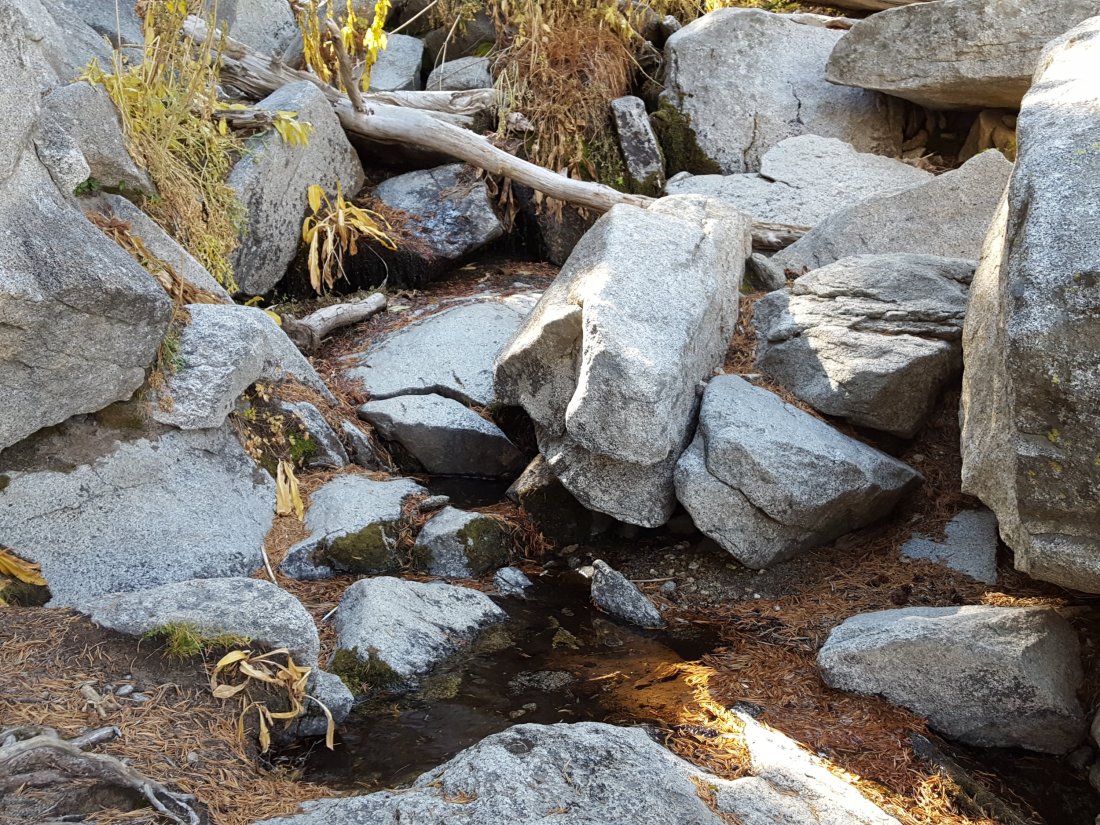
Forest Service trails reopen 4 August 2018

The U.S. Forest Service has issued a reduced Cranston Fire forest closure order. All high country trails will be open starting 4th August 2018, with the exception of South Ridge Trail south from Tahquitz Peak. Trails that were already closed from the Mountain Fire – namely Caramba and Laws trails, and the PCT from Grethe Spring south to Spitler Peak Trail – remain closed. South Ridge Trail from Chinquapin Flat to Tahquitz Peak fire lookout will be open. South Ridge Road will remain closed.

Lower elevation trails such as May Valley Road and adjacent trails and roads will remain closed.

The reduced forest closure order is valid thru 31 July 2019 and is outlined on InciWeb, where the full text and map of the order can also be downloaded, linked here.

In addition, the entire wilderness of the Mount San Jacinto State Park reopened on Thursday 2nd August.

A full review of all the water resources on the mountain has been completed and will be updated as soon as possible.

Tahquitz Peak fire lookout, completely undamaged by the Cranston Fire – although it came close on the south and south-east sides – looking west-south-west.

State Park trails open 2 August 2018

For a full review of the status of access and trail conditions in the San Jacinto mountains high country following the Cranston Fire, see the previous post from 31st July linked here. Revised information is as follows.

The wilderness of the Mount San Jacinto State Park reopened today, Thursday 2nd August. Currently access is via the Palm Springs Aerial Tramway, as other routes pass through US Forest Service land, which remains closed (at least thru today, see below). This arrangement is outlined in a message on the State Park website (linked here). Also the Idyllwild and Stone Creek developed campgrounds reopened on Tuesday 31st July.

Currently all trails in the USFS San Jacinto Ranger District remain closed. The U.S. Forest Service issued an official forest closure order on the evening of 27th July, details of which are available at this link. However, a revised order may be released as soon as tonight or tomorrow, Friday 3rd August. This will likely reopen many of the trails that were unaffected by the Cranston Fire (and hence provide full access to the State Park wilderness). This will presumably include Marion Mountain Trail, Seven Pines Trail, Fuller Ridge and Black Mountain at least.

Black Mountain fire lookout reopened yesterday, 1st August. I accompanied Florian Boyd in having the pleasure of going back into service for the first time post-fire. Access is initially for lookout volunteers only, but hopefully this popular area will reopen very soon for all.

Cranston Fire: trail update

The following is a review of the status of access and trail conditions in the San Jacinto mountains high country following the Cranston Fire. Following a review of the current state of access, there is a trail-by-trail breakdown of the fire’s impacts. The latter section is likely of interest mainly to local and hardcore hikers very familiar with the trail system. The trail details could not have been completed without information and photos from a completely reliable (anonymous) source on the ground.

Access overview: Forest Service lands

All trails in the USFS San Jacinto Ranger District remain closed. The U.S. Forest Service issued an official forest closure order on the evening of 27th July, details of which are available at this link. This measure initially closes the entire San Jacinto Ranger District trail system until 31st August 2018.

Good news however. USFS informed me yesterday that because most trails received little or no damage from the fire (as discussed in detail below), a new forest closure order has already been drafted and is in the review process (i.e. head office and legal team). We should hear about this revised order as soon as Friday, 3rd August. It is therefore likely that many trails in the forest will reopen sooner than initially feared.

More good news. Black Mountain fire lookout reopened 1st August. Access will initially be for fire lookout volunteers only. However it is further evidence that the trail and access conditions are returning to normal rather quickly.

Access overview: Mount San Jacinto State Park

The Palm Springs Aerial Tramway reopened 30th July, along with the Desert View and Nature trails in Long Valley. A message on the homepage of the State Park website (linked here) indicates that the Idyllwild and Stone Creek developed campgrounds reopened today, 31st July. All other State Park camping and trails in the wilderness remain closed.

Pacific Crest Trail Fears that the PCT on the Desert Divide would once again be badly damaged (as it was in the Mountain Fire) were thankfully not realised. The Cranston Fire burned up the ridges from May Valley to the western and north-west flanks of Antsell Rock, and to the peaks of South Peak and Red Tahquitz. This section of the PCT remained closed from the 2013 Mountain Fire, but rehabilitation work had just been completed and the PCT was likely to reopen later this year. Fortunately, the Cranston Fire could not burn over to the east side of the Desert Divide due to the lack of fuels. In this area, the PCT largely runs along the eastern flank of the Desert Divide. Only at the saddle between Red Tahquitz and South Peak did the Cranston Fire reach the PCT, but in this relatively rocky area there was no significant damage to the trail.

Although the Cranston Fire did burn a short way north between Red Tahquitz and Grey Tahquitz (Peak 8792), it did not reach the PCT here. The fire did however reach north to the PCT at Chinquapin Flat, having burned completely around Anabel Peak (Peak 8860), the high point of the ridge just east of Tahquitz Peak proper. The fire jumped the PCT by only a few yards just downslope from the sign at Chinquapin Flat.

In summary, the PCT is virtually unchanged from its post-Mountain Fire status. Hopefully plans to reopen this section soon will be unaffected. This will be especially important given that the PCT Alternate through Hurkey Creek campground and May Valley has been completely destroyed by the Cranston Fire.

The PCT at Chinquapin Flat looking towards Tahquitz Peak, July 2018.
View from Red Tahquitz looking WSW (Tahquitz Peak on far right), July 2018

Fobes Trail The Cranston Fire did not reach this far south in Garner Valley. However the Fobes Ranch Road area remains closed until further notice.

Spitler Peak Trail Although there were some spot fires ahead of the main fire front in the semi-desert area south of Apple Canyon Road, the Spitler Peak Trail itself was apparently unaffected. However, it may be some time before Apple Canyon Road – the access for the Spitler Peak trailhead – is open to non-residents. [I don’t have reliable information on the status of the informal Zen Center Trail at this time.]

South Ridge Trail This is the higher elevation (>6000′) trail most impacted by the Cranston Fire. Most of the trail was not directly burned, but many areas were heavily covered with phos-chek retardant. Between Chinquapin Flat and Tahquitz Peak, some vegetation burned right around Tahquitz Peak. [Unless you have been slavishly following highly irresponsible individuals online or by email, you know by now that the Tahquitz Peak fire lookout did NOT burn down.]

South from Tahquitz Peak to Old Lookout Flat, the trail is well below the ridgeline on the western flank. As the fire was held at or near the ridgeline in most places, this section of trail is unaffected. From Old Lookout Flat south to the trailhead at the top of South Ridge Road, the trail was heavily hit with phos-chek retardant. In addition, the fire broke through in a few minor spots here. While the surrounding vegetation is burned, the fire was not notably hot through these areas and the trail itself is undamaged.

Phos-chek retardant on the Tahquitz Peak to Chinquapin Flat trail, 26 July 2018.

South Ridge Trail (from South Ridge Road to May Valley Road) This multi-use trail, a popular mountain bike trail, was completely burned over.

May Valley Road (and adjacent bike trails) This dirt road very popular with locals for biking, hiking, running, and dog walking, was completely burned over from its crest just beyond Cowbell Alley all the way down to its junction with Bonita Vista Road.

All other high country trails were not directly affected by the Cranston Fire. This includes all the trails around the Tahquitz area meadows, Devils Slide, Ernie Maxwell Trail, Willow Creek Trail, Ramona Trail, etc. It is however amazing (and frankly disconcerting) to see black ash flakes throughout all the trails of the mountain, even all the way to San Jacinto Peak. That there were not more spot fires scattered around the high country is very fortunate. It is to be hoped that all these other trails can be reopened promptly once all necessary fire suppression activities have been completed.