Storms and closures update 5th March 2023

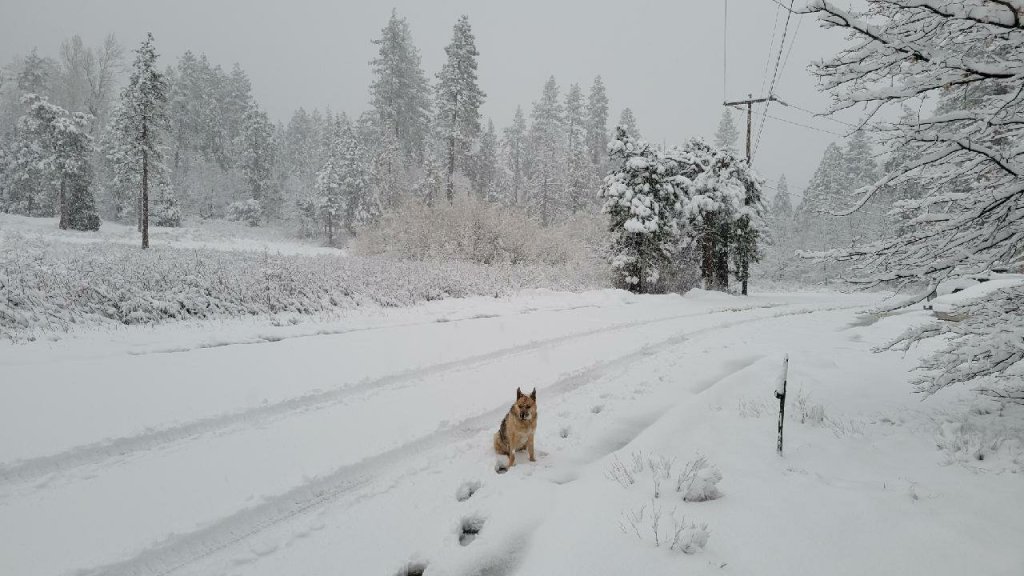
UPDATE Saturday 11th March: It started raining yesterday morning at about 0700 at mid elevations, with a mixture of rain and light sleet in Long Valley (8600 ft) from about 1100. Rainfall in Idyllwild totaled an impressive 2.36 inches (measured at 5550 ft), finally stopping at 0930. Snow level in the high country is estimated to be at about 9500 ft, with none falling in Long Valley and only a couple of inches expected around the highest peaks.

UPDATE Thursday 9th March: I snowshoed this morning to San Jacinto Peak via Devil’s Slide Trail and the eastern side route. With freeze/thaw cycles, Devil’s Slide was firm early morning, and I ascended to Saddle Junction just in spikes. I then used snowshoes from there to the Peak, and all the way back down. My track from last week had held up well, and my ascent was consequently nearly two hours faster. By late morning the snow was getting soft and sloppy, and postholing would have been brutal. Snow melt/compaction has been rapid and substantial in just a week, 6-12 inches at all high country locations I measured (and even more in Idyllwild). Snow conditions are generally benign, excellent for snowshoeing, there is no avalanche risk (now even on the north face), and the continued State Park closure seems insupportable.

UPDATE Wednesday 8th March: Light but steady rain is now forecast at mid elevations for at least 10th-11th and 14th-15th March, with about one inch inch expected at mid elevations during the first of these storms, and roughly half that amount during the second storm. Combined with mild temperatures, the rain on snow will further increase melting, and make for very sloppy snow conditions. The high country may be above the cloud for some of the storm days, but light snow is tentatively forecast at higher elevations, especially on 14th-15th.

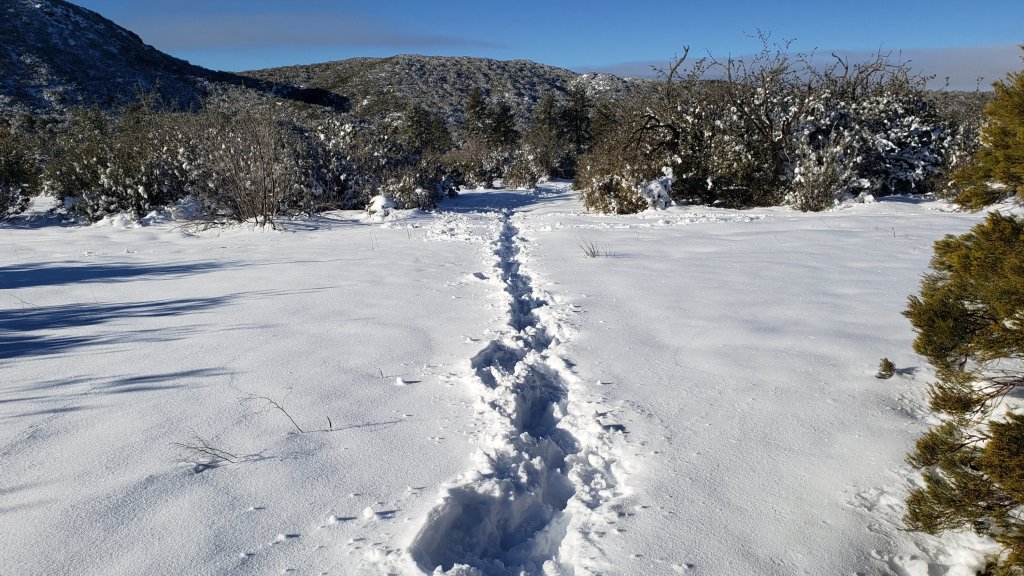
UPDATE Monday 6th March: Idyllwild had a very light dusting of snow (0.1 inch) early this morning, and it was drizzling in Garner Valley. Fobes Ranch Road (the side access to the PCT from about Mile 165) is clear of snow. Snow depth has more than halved in the past few days at PCT Mile 151 where the trail crosses Highway 74 (now averaging 4-6 inches with some bare patches, photo below). Given the strong warming trend in the next week, by the time the Forest closure is expected to lift on 16th March the PCT will be readily passable from Mile 151-165 (spikes strongly recommended). Proceeding north from Mile 165 is not currently recommended, as it will require crampons, ice axe, and the necessary snow hiking experience to use that equipment safely in high angle terrain, plus considerable patience, stamina, and route-finding skills.

————————

Well that was fun! Five snow storms impacted the San Jacinto mountains in a nine day period, ending 1st March. All the storms were somewhat different from one another in terms of quantity of snowfall, associated temperatures and winds, and lowest snow elevation. Strawberry Valley (where Idyllwild is located) was hit hardest relative to its elevation, with heavy snow there even at times that the high country was above the cloud, as reflected in the snow totals below.

I won’t repeat all the details as these storms were largely summarized in a daily updated blog format maintained over the past week or so (available here). Their combined impact was dramatic, including just over a foot of snow throughout Garner Valley (4300-4800 ft), nearly four feet of snow in Idyllwild (the annual average for town is 31 inches), and 2.5-4 feet of snow in the high country, depending on elevation.

The snowfall in Idyllwild this winter has already been the most recorded for 59 years, as discussed in a summary of National Weather Service statistics that I posted on 2nd March (linked here). With another 5-6 inches, we could experience the most snow to fall in Idyllwild in one winter since the 1940s.

Regrettably one consequence of this impressive snowfall is closure of both the National Forest lands and State Park wilderness in recent days. The latter is particularly unfortunate as conditions are actually more benign now than they were 2-6 weeks ago, when high country slopes were extremely icy and required more specialist equipment and skills.

San Bernardino National Forest, including the San Jacinto Ranger District, is closed until at least 16th March 2023. See their closure notice here for more details. The State Park wilderness closed on 1st March (see State Park website). It is clear that these closures will dramatically and negatively impact early season PCT hikers.

On Friday 3rd March I ascended and descended San Jacinto Peak via the east side (roughly the Devil’s Slide, Wellman, Peak, and East Ridge trail routes), breaking trail snowshoeing the entire way from Humber Park. I recorded a lengthy video discussing the general snow and closure situation while at the Peak (available here) plus a brief panorama video from the Peak itself (available here).

Currently trails above about 5500 ft (lower in places) are largely obscured by moderate to deep snow. Trails down to 4000 ft elevation currently have shallower snow cover. Very cautious navigation is essential everywhere.

Details of snow depths measured at various locations on the trail system are given at the foot of this posting. Note that snow depth itself is rarely indicative of the difficulty (or otherwise) of hiking a particular track or trail. For example a well-compacted snowshoe track across snow several feet deep may be much easier hiking than an angled icy section just a few inches deep.

Conditions are currently ideal for snowshoes everywhere (that is open) above about 4500 ft. This elevation will climb steadily over the next few days as temperatures rise and melting accelerates.

Crampons – with hiking poles and an ice axe, depending on terrain – may become increasingly useful everywhere above about 6500 ft, as freeze/thaw cycles lead to hardening of the snow surfaces. They will likely become essential on certain moderate and higher angle slopes, at a minimum on the Peak Trail above Wellman Divide, the Wellman Trail, Deer Springs Trail above Little Round Valley, and uppermost South Ridge Trail, and on both flanks but critically on the north face of Tahquitz Peak.

Currently, and increasingly as snow conditions change, spikes are strongly recommended for the foreseeable future everywhere above about 4000 ft. They are currently invaluable even for walking around Idyllwild early in the morning! This elevation will slowly move upwards with steady melting over the next few days and weeks, but will remain relatively low for weeks at least.

Recently I have mentioned the challenges of hard, icy snow underfoot and the value of using spikes (and/or crampons) especially for descending and traversing. While fresh snow may be optimum for snowshoeing for the next several weeks, snow at all elevations will become increasingly firm and icy following multiple freeze-thaw cycles, and compaction by increasing hiker traffic in places (once trails reopen), and I cannot overemphasize the importance of having both appropriate equipment and the right skill set for the terrain. The latter includes interpreting the snow/ice conditions, understanding your physical and mental abilities, and conservative decision making. These concerns will steadily increase over the next few weeks with temperatures fluctuating either side of freezing, seasonally stronger insolation, and highly variable snowmelt.

Hikers should be prepared for temperatures below freezing in the high country (once generally accessible), and well below freezing when considering wind chill effects.

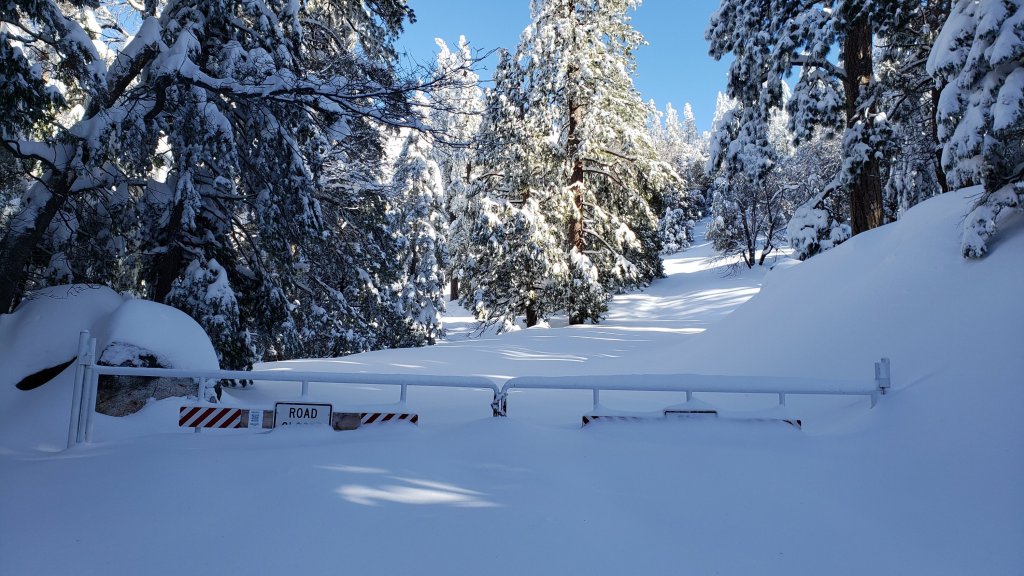
The USFS gate at Humber Park is closed. Even when the gate is closed there are nine legal parking spaces below the locked gate (which still require an Adventure Pass or equivalent to be displayed). If there are “Road Closed” signs across Fern Valley Road near its junction with Forest Drive – currently the case due to the forest-wide closure – then those nine spaces are also unavailable for legal parking.

Based on my assessment on 3rd March, there is currently no significant avalanche risk (other than on the north face of San Jacinto Peak, which, contrary to recent erroneous information in local media, avalanches regularly every year, even in low snow years). Snow layers evidently consolidated rapidly, and the situation will only improve further with melting and freeze/thaw cycles. I found none of the pre-avalanche characteristics that I last observed on the exposed easterly slopes above 10,000 ft in early 2017 (in shallower but more dangerously layered snow).

Evidence of an avalanche at the highest point of the Snow Creek drainage, 10,800 ft elevation, as viewed from the East Ridge on 3rd March 2023 (image enlarged). Snow slabs appear to have separated from the distinct cornice. San Jacinto Peak is just out of view to the left of the image. This was likely at least part of the source of an avalanche on 26th February reported, with photograph, in an earlier Report (linked here).

WEATHER

After the meteorological excitement of the past two months, even a few days of relatively sunny, dry weather seem notable. A steady warming trend will lead to temperatures above seasonal (remember those?) from Friday 10th March onwards, rapidly accelerating snowmelt. Many of the next ten days will be at least partly cloudy. Temperatures in the high country will remain at or below freezing for another few days, before moving just above freezing starting Thursday 9th.

Light but steady rain is now forecast at mid elevations for at least 10th-11th and 14th-15th March, with about 1.0 inch expected at mid elevations during the first of these storms, and roughly half that amount during the second storm. Combined with mild temperatures, the rain on snow will further increase melting, and make for very sloppy snow conditions. The high country may be above the cloud for some of the storm days, but light snow is tentatively forecast at higher elevations, especially on 14th-15th.

The latest NWS San Diego video forecast (available here) provides an excellent summary of what happened meteorologically throughout the California mountains in late February, plus an overview of the weather coming to Southern California in March.

At San Jacinto Peak (10,810ft/3295m) on Friday 3rd March 2023 at 1155 the air temperature was 27.9°F (-2°C), with a windchill temperature of 10.1°F (-12°C), 18% relative humidity, and a frigid NW wind sustained at 14 mph gusting to 25 mph.

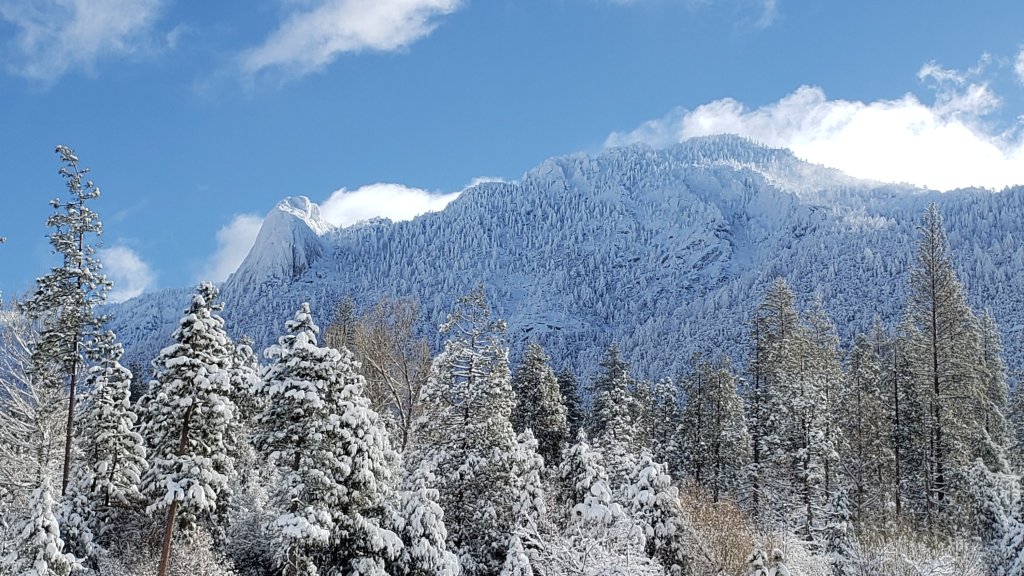
Tahquitz Peak and Tahquitz Rock at their finest, 3rd March 2023, looking south from about PCT Mile 180.5.

TRAIL CONDITIONS

All trails above about 4000 ft are largely snow-covered (wholly snow-covered above about 5000 ft). This will change steadily with melting over the next few days and weeks.

Devil’s Slide Trail [updated 9th March] has a lightly-traveled snowshoe and posthole track up to Saddle Junction. It is firm in cold early mornings (ideal for spikes) but soft and sloppy by late morning (snowshoes required, or expect deep postholing). The track does not follow the established trail route in the uppermost switchbacks close to Saddle Junction, and very careful navigation is required.

My snowshoe track continues on to San Jacinto Peak, via a route roughly approximating to the PCT, Wellman, Peak, and East Ridge trails, climbing more steeply in places than the established trails, and generally contouring through the snow as needed to minimize unnecessary elevation loss. Dustings of snow forecast over the next week or so may combine with strong winds to obscure parts of this track.

The Ernie Maxwell Trail [updated 8th March] has a very lightly traveled snowshoe and posthole track to follow along its entire length. Early morning the snow is firm and relatively easy to hike, but it will be soft with deep postholing by late morning. The majority of this trail is not on Forest Service land.

In addition to the wider closure mentioned above, effective 26th January 2023 the State Park closed the section of Skyline Trail that falls within its jurisdiction, above 5800 ft elevation, “until further notice due to dangerous weather conditions”. (For readers who are unclear, Skyline Trail forms the lower two-thirds of the “Cactus-to-Clouds” [C2C] route.) The State Park boundary is not marked but is near the site of the old Florian’s Cache, below Flat Rock. The open section of trail below 5800 ft received some light snow cover down to about 4500 ft over the past week, but this has already melted.

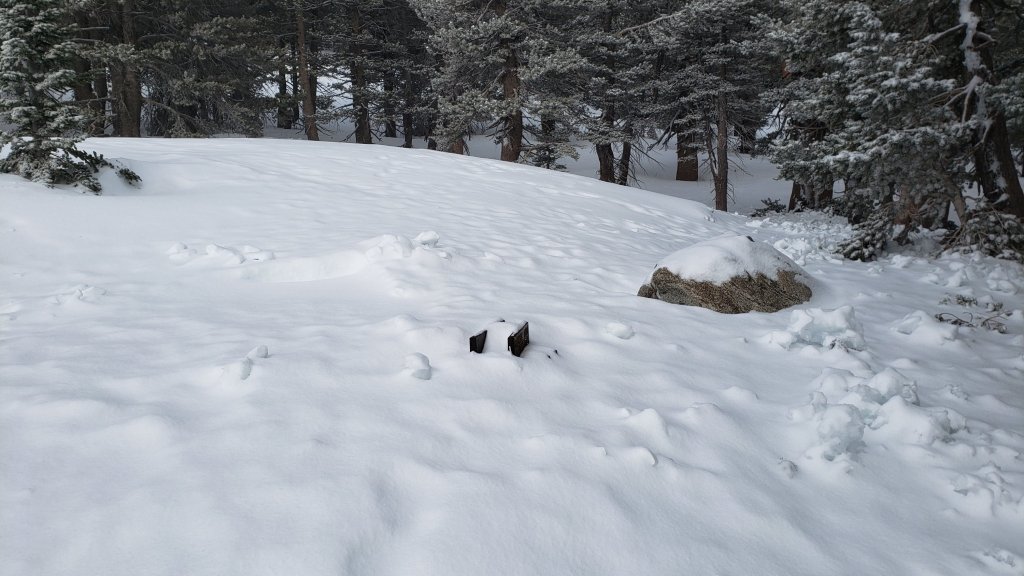
San Jacinto Peak summit hut under an average depth of about seven feet of snow, 3rd March 2023. My pack and poles to the left provide scale. This is the most accumulated snow at the Peak for at least 12 years.

SNOW DEPTHS

Measured on Friday 3rd March (unless otherwise stated). The first number is the current total snow depth, with the fresh snowfall in the multi-storm event from 21st February to 1st March given in parentheses. Note that averages are given; due to strong winds accompanying all storms this winter there is widespread drifting. Altitudes are approximate.

San Jacinto Peak (10810 ft): 80-85 inches (40-45 inches)

Wellman Divide (9700 ft): 70-75 inches (30-35 inches)

Annie’s Junction/PCT Mile 180.8 (9070 ft): 75-80 inches (30-35 inches), heavily drifted here

Long Valley (8600 ft): 55-60 inches (35-38 inches)

Saddle Junction/PCT Mile 179 (8070 ft): 48-50 inches (28-30 inches)

Devil’s Slide trailhead at Humber Park (6550 ft): 46 inches on 2nd March (44-46 inches) melting rapidly by 3rd

Idyllwild (at 5550 ft): 45-46 inches on 2nd March (45-46 inches) melting rapidly by 3rd

PCT Mile 151 at crossing with Highway 74 (4800 ft): 13 inches, measured on 27th February

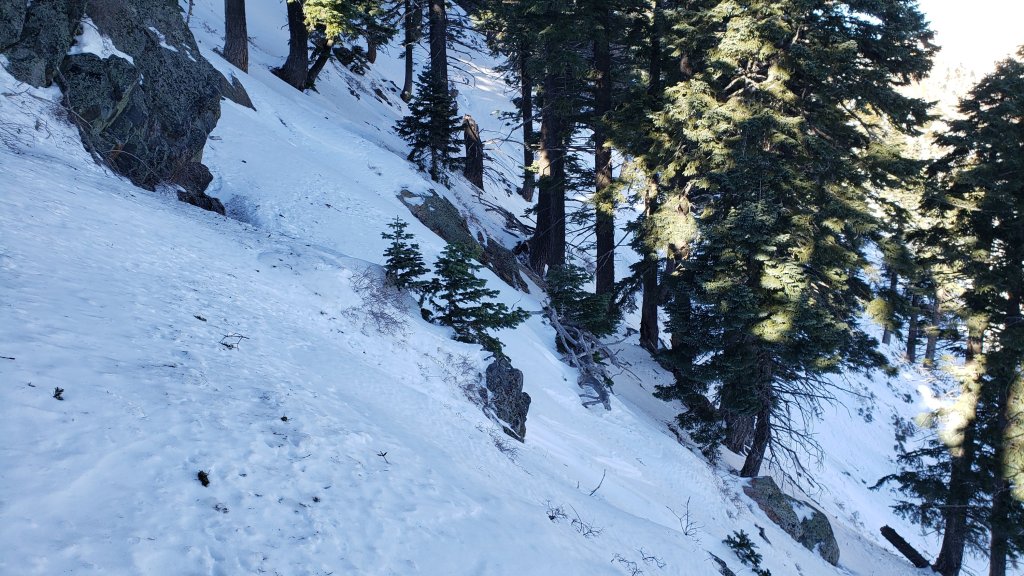
The north face of Tahquitz Rock, as seen from Devil’s Slide Trail, 3rd March 2023.

While many hundreds of hours of time and labor are volunteered annually, the San Jacinto Trail Report uses small private donations to help cover modest operating costs. Every year seems to have its unique challenges, and clearly 2023 will be no exception. Your contribution keeps the Report available to all, free from advertising or paywalls, and independent from agencies. If you have found this Report useful, please consider using this link to the Donate page. Zelle, Venmo, and PayPal are all options. Thank you so much for your support.

Saddle Junction, 8100 ft elevation, approx. PCT Mile 179. Above, on 3rd March 2023, and below, slightly more than two months earlier on 31st December 2022. At least four feet of new snow accumulated over that period, half of it in late February 2023.
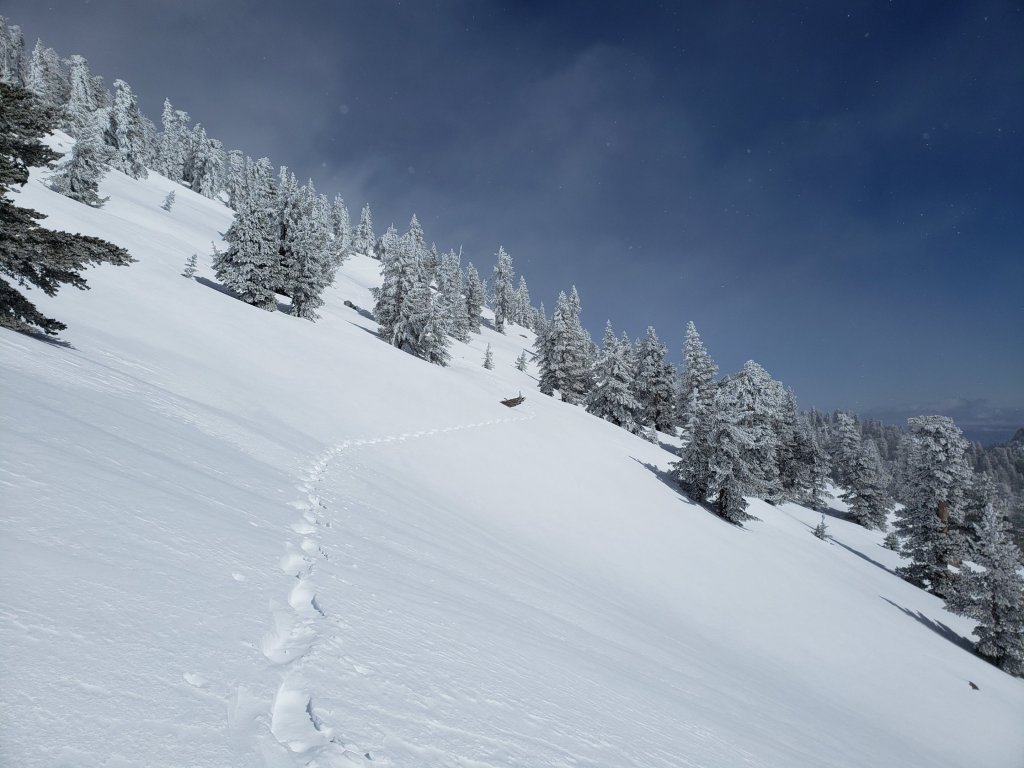
The Peak Trail at about 9800 ft elevation. Above, on 3rd March 2023 under 4-7 feet snow depth (drifting dependent), and below, just over two months earlier on 31st December 2022. A very distinctive near-horizontal protruding log in the distant center of both images provides a reliable reference point that I have never seen fully covered by snow.
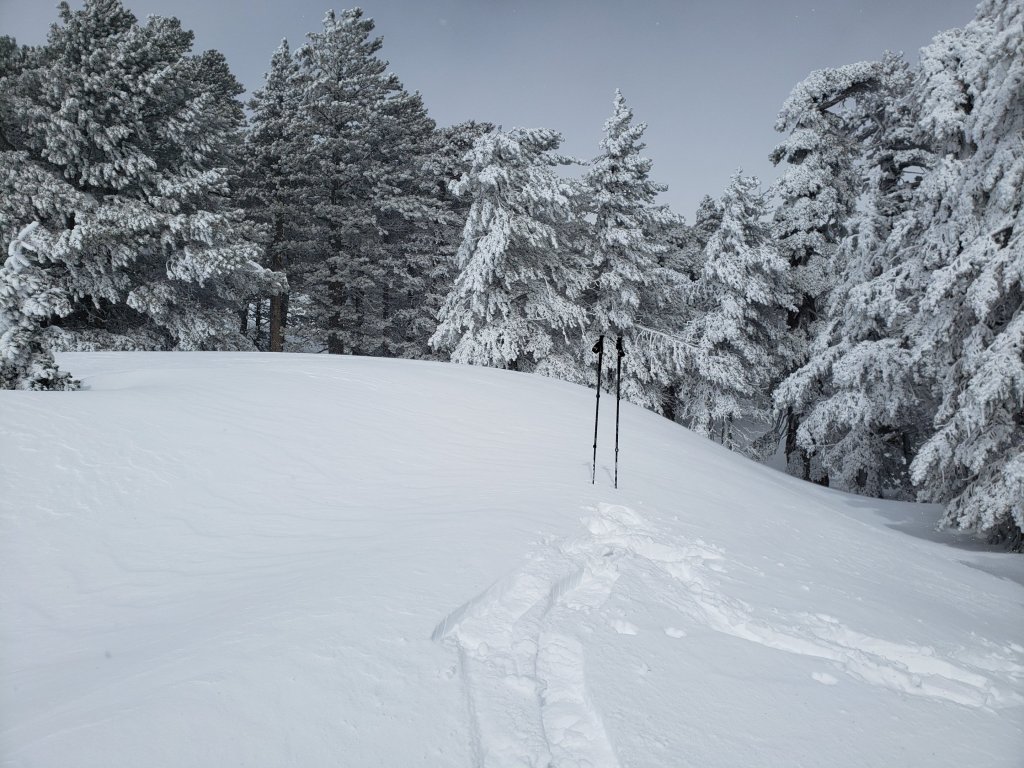
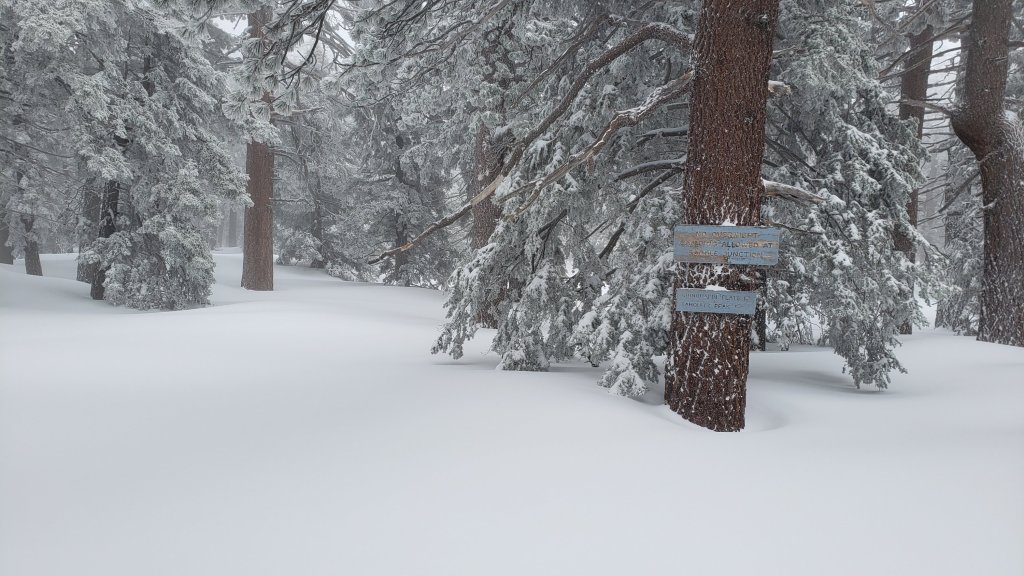
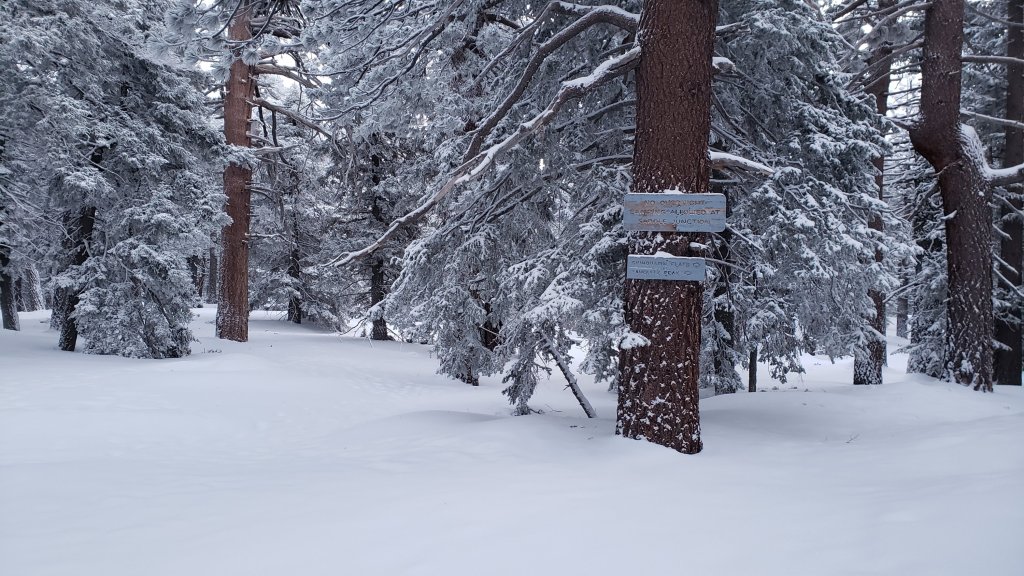
Wellman Divide, 3rd March 2023, with an average depth of about six feet of snow. My poles mark the approximate position of the trail junction sign.
The PCT at about Mile 151 (crossing of Highway 74), 6th March 2023. Snow depth is less than half of the 13 inches measured eight days earlier.

Forest closure 3rd March 2023

San Bernardino National Forest – including the San Jacinto Ranger District – is closed until at least 16 March 2023. See closure notice link below for more details. Special thanks to Florian Boyd, great friend of the Trail Report, for bringing this to my attention (via text when I was snowshoeing at 9000 ft elevation on the PCT early this morning!).

Click to access fseprd1092464.pdf

The State Park wilderness was also closed a couple of days ago (see earlier Trail Report or State Park website). It is clear, based on information on the PCTA website closures page (linked here), that these closures will dramatically and negatively impact early season PCT hikers.

In related (but frankly much more positive) news, today I had a long but spectacular day snowshoeing to San Jacinto Peak. I hope to provide a more thorough Report tomorrow. In the meantime, a lengthy video discussion of the current situation recorded at the Peak is available here, and a brief panorama video from the Peak proper is available here.

The Great Snow of 2022/23

I put together this table from a spreadsheet I maintain of publicly available National Weather Service meteorological data. Data are provisional and require verification. Nevertheless, the snowfall so far in winter 2022/23 in Idyllwild would place it seventh in recorded history (reliable data collection started in 1943). Perhaps more significantly, we have received the most snow in a winter since 1963/64, a span of 59 years. So rather than being a “once-in-a-generation” event, this may prove to be a once-in-a-lifetime event for most Idyllwild residents. The table also shows that with another few inches, this could be the biggest snow season since the 1940s!

Although our perceptions may have been skewed by some extremely dry winters in the past decade, major snowfalls are not as rare as many current residents might think. This is the third time this century that Idyllwild has surpassed 60 inches of snow in a winter (62.8 inches in 2000/01, and 62.4 inches in 2010/11), so 60+ inch winters might be considered to occur roughly once every decade.

Major snowfall months have also occurred recently, in winters that did not otherwise end up with exceptional annual totals. February 2011 recorded 45.5 inches, and there were 45.5 inches in March 2006. By comparison, approximately 42 inches were recorded in February 2023 (provisional data). Of course, this February was notable in that roughly 80% of the total fell all in the last week of the month, with no respite for significant melting.

These data only reflect snowfall measurements, and do not incorporate rainfall totals. Broadly speaking it is clear that snowfall has become much more variable in the past decade, ranging from extremely dry (<10 inches) to, obviously, very snowy.

Note that data for the high country are dramatically different from those for Idyllwild, and generally sadly lacking, other than meteorological records for Long Valley (8600 ft elevation) since the 1960s. For example, although Long Valley currently has about 5 feet of snow, publicly available records for the 1970s show that Long Valley averaged 119 inches (almost 10 feet!) per winter back then.

The top ten snowfall totals by winter for Idyllwild are as follows:

108.1 inches  1948/49

107.5 inches  1943/44

77.1 inches  1952/53

76.1 inches  1963/64

74.9 inches  1961/62

72.7 inches  1951/52

71.8 inches  2022/23 (to date)

69.4 inches  1981/82

65.5 inches  1957/58

63.3 inches  1954/55

The gate at Humber Park, Thursday 2nd March 2023. I measured a snow depth of 44-46 inches of snow at the Devil’s Slide trailhead.
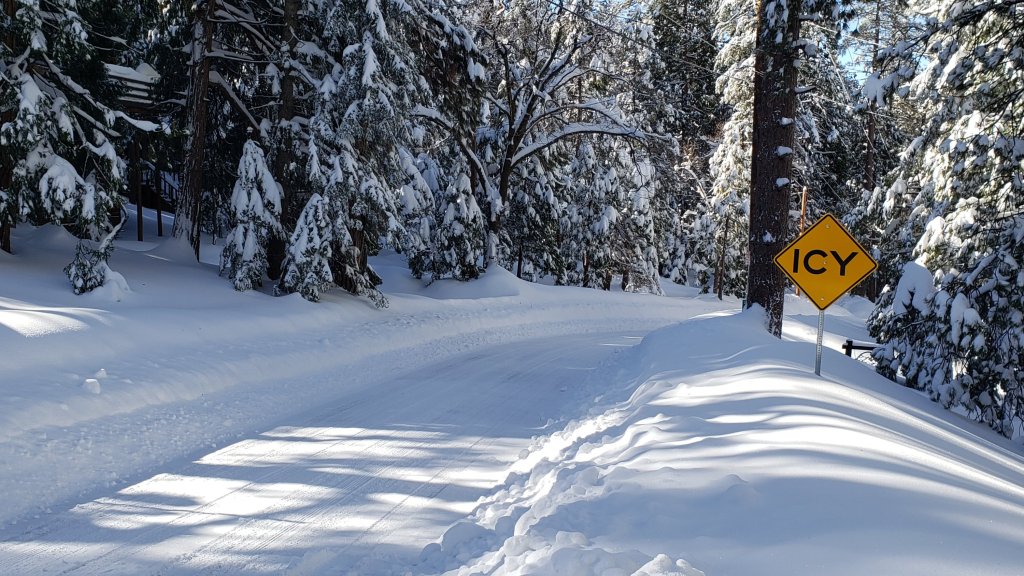
Upper Fern Valley Road, 2nd March 2023. Roads are currently very narrow, and treacherous for those without suitable vehicles and experience driving in such conditions.
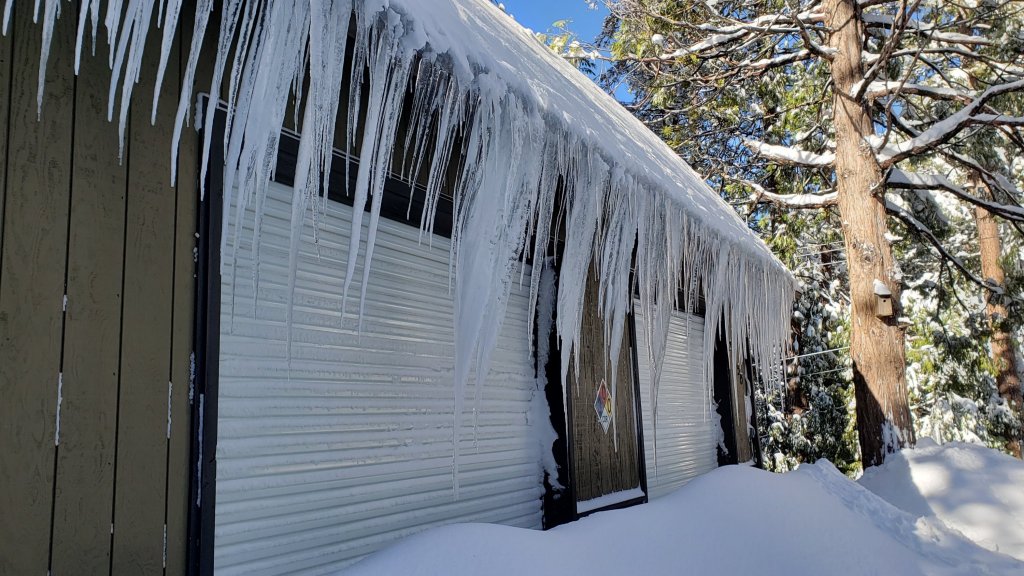
Spectacular icicles on the Fern Valley Water District building, upper Fern Valley Road, 2nd March 2023.

While many hundreds of hours of time and labor are volunteered annually, the San Jacinto Trail Report uses small private donations to help cover modest operating costs. Every year seems to have its unique challenges, and clearly 2023 will be no exception. Your contribution keeps the Report available to all, free from advertising or paywalls, and independent from agencies. If you have found this Report useful, please consider using this link to the Donate page. Zelle, Venmo, and PayPal are all options. Thank you so much for your support.

Storm updates 24th February-1st March 2023

The 20th storm of winter 2022/23, the second of two storms across three days, is currently impacting the San Jacinto mountains. Please check this page for periodic updates (the most recent is at the top). A significant triple storm system had a major impact on 21st-26th February, and those updates are posted below also.

UPDATE on Wednesday 1st March at 1930

A remarkable further 9.5 inches of snow fell in Idyllwild today, bringing the storm total to 19.5 inches, before largely stopping and the cloud cover partly clearing out near dusk. Highways into Idyllwild were closed today and may well be for some or all of tomorrow. Sadly weight of snow has caused the roof of one shop in town to collapse, and I saw one collapsed car port (with cars inside) under the dramatic volume of snow.

The snowfall of this 20th storm of the winter brings the seasonal total here to 71.8 inches of snow, which is 233% of the average water year snowfall for Idyllwild. About 46 inches have fallen in the past eight days.

The State Park has closed the wilderness due to the weather conditions, as described on their website here. The Palm Springs Aerial Tramway/Long Valley remain open. Ironically the closure is due to “unprecedented snow fall”, although such snow fall was average prior to this century, and would have even been below average in the 1970s.

UPDATE on Wednesday 1st March at 0950

Storm number 20, and the last of a stunning first two months of 2023, produced another major snowfall with 10 inches overnight in Idyllwild, and it is still snowing heavily. When Anabel and I waded out for a modest walk, the snowplows seemed to be struggling to keep up on the streets, but we know they will catch up in due course. Forecasts suggest it may stop snowing in the next few hours. Long Valley (8600 ft) looks to have added about 12 inches since last night.

UPDATE on Tuesday 28th February at 1930

Today qualified as a day off from the incessant storms, although even then we managed a minor storm in Strawberry Valley (where Idyllwild is located), with two inches of fresh snowfall overnight and into the morning. The high country remained above the cloud for this one, with no fresh snowfall above about 8000 ft.

Largely a day for digging out again, and getting prepared for the next major snowfall, due tonight. Forecasts are inconsistent regarding the amount of snowfall in this next storm, but those that I trust suggest 12+ inches in Idyllwild over the next 24 hours, with 1-2 feet in the high country.

UPDATE on Monday 27th at 1910

Below is an excellent videograb of an avalanche in the Snow Creek drainage on the north face of San Jacinto Peak that was witnessed by friend of the Trail Report Catherine Peterson yesterday morning at about 0840. She was driving on Interstate 10 (and had to concentrate on the road!) but her friend Joyce Schwartz took some short videos from which this still image is taken.

The latest Trail Report (linked here) mentions the increasing avalanche risk with recent heavy wind-loaded snowfall on top of the icy pre-existing snow, and how avalanches occur every winter on the north face (contrary to erroneous information in recent local media stories). Conditions are currently excellent for avalanches on specific terrain in the San Jacinto high country, as proven below.

Avalanche on the north face of San Jacinto Peak, at about 0840 on 26th February 2023, as seen from Interstate 10. Videograb image courtesy of Joyce Schwartz, provided to the Trail Report by Catherine Peterson.

UPDATE on Monday 27th at 1140

We surveyed the PCT where it crosses Highway 74 (approx. PCT Mile 151) this morning, and recorded a short video available here on YouTube. This is the flattest portion of the PCT in the San Jacinto mountains, and snow depth currently averages about 13 inches. As evident in the video, spikes are currently needed at least, and snowshoes would be ideal especially for sections that have not yet been traveled.

Yesterday afternoon we checked Devil’s Slide trailhead at Humber Park, and measured an average snow depth of 26 inches. Snowshoes are very strongly recommended for any trails in, or leading to, the high country.

Further light snow is expected starting this evening, followed by much heavier snow overnight on 28th February-1st March.

PCT at about Mile 151 in the southernmost San Jacinto mountains, passing through 13 inches of snow depth, 27th February 2023.

UPDATE on Sunday 26th at 1220

An additional 5.5 inches of snow fell in Idyllwild overnight, rather more than forecast, meaning we had to dig out yet again this morning. It finally stopped snowing at about 0700, and some blue sky has resulted in spectacular vistas.

By my measurements, Idyllwild is up to 51 inches of snow to date for this winter, compared to the average for the thirty year period 1991-2020 of 31 inches. Bear in mind that half the winter total, 26 inches, have fallen in the past five days!

Tahquitz Peak and Tahquitz Rock (to the left) encased in deep snow, as seen from our street in Idyllwild, 26th February 2023.
South Circle Drive in Idyllwild, early morning on 26th February 2023, following nearly six inches of snow overnight, and more than two feet in the past few days.

While many hundreds of hours of time and effort are volunteered every year, the San Jacinto Trail Report uses small private donations to help cover modest operating costs. Every year seems to have its challenges and it is clear already that 2023 will be no exception. Your contribution keeps the Report available to all, free from advertising or paywalls, and independent from agencies. If you have found this Report useful, please consider using this link to the Donate page. Zelle, Venmo, and PayPal are all options. Thank you so much for your support.

UPDATE on Saturday 25th at 1920

Steady heavy snow started in Idyllwild at about 0830 but stopped at about 1400. Very fine snow fell briefly this evening. An additional six inches of accumulation today brings the total in Idyllwild since 21st February to 20.5 inches. Forecasts suggest a further 2-3 inches are possible tonight.

It warmed last night to just above freezing below 6000 ft, with a mixture of rain and sleet falling on top of the prior snow, turning it increasingly to wet slush at mid elevations (we measured about 0.25 inch rain in Idyllwild). Long Valley added about 4-6 inches of snow overnight, and a little less than that during the day today.

UPDATE on Friday 24th at 1715

After a relatively benign day, it started snowing gently at 1340, and has become steady with large wet flakes in the past hour or so. Accumulation so far of about 0.5 inch in Idyllwild, and one inch at Long Valley.

Note that the Palm Springs Aerial Tramway has announced they will be closed tomorrow, Saturday 25th, due to “extreme weather”. See their announcement here. Many thanks to Florian Boyd for bringing this to my attention.

UPDATE on Friday 24th at 1210

I measured 15 inches of snow during a check of Devil’s Slide trailhead (6520 ft) at Humber Park this morning. I recorded a short video discussion there (available here on YouTube) which gives a feel for current conditions.

Snowshoes are recommended everywhere with snow above 4000 ft, potentially lower in places, and spikes are invaluable anywhere that has been cleared or compacted. I hope to provide more information on the high country situation on Sunday 26th, depending on conditions/weather.

UPDATE on Friday 24th at 0500

The story so far….. A minor storm on the night of Tuesday 21st (sixteenth storm of the winter) produced little snow – just an inch in Idyllwild – but severe cold and severe winds, erasing all tracks with wild drifting. This was immediately followed by a milder storm on 22nd-23rd that brought heavy snowfall with 13 inches in Idyllwild across a 30 hour period (measured at 5550 ft), and about 18 inches in Long Valley (8600 ft).

The eighteenth storm, due this evening, is an unusual atmospheric river combined with very cold air again, expected to produce heavy snowfall for 24th-25th February.

Snow update 21st February 2023

UPDATE Thursday 23rd: Idyllwild woke up to about four inches of fresh snow overnight, and it snowed fairly consistently today (averaging 0.75 inch/hour), adding six more inches by late afternoon. Snowfall in Long Valley (8600 ft) has been steady until largely stopping by 1600, with close to 10 inches added since yesterday for a total accumulation there of nearly three feet. Florian Boyd kindly reported this morning that snow has dusted down to 4500 ft on the lower (open) section of Skyline Trail.

UPDATE Wednesday 22nd: the first of four storms expected over the next eight days, the sixteenth storm of this winter, produced a very light snowfall but bitterly cold conditions in the San Jacinto mountains overnight. I measured 1.5 inches of fresh snow at Saddle Junction early this morning, with about one inch at Humber Park, and 0.8 inch of snow (following 0.7 inch of rain) at 5550 ft in Idyllwild. Long Valley (8600 ft) has added about two inches, where it continues to snow gently this morning. The next, much more substantial, wave of snow arrives later this afternoon.

———————————————-

The primary purpose of this update is an advisory of imminent major snow accumulation forecast due to a triple storm sequence. A minor storm on the night of Tuesday 21st will include severe cold and severe winds, followed by milder, moderate storm on 22nd-23rd, and then an unusual atmospheric river combined with very cold air again producing heavy snowfall for 23rd-25th February. A fourth and final minor system is expected on 28th February-1st March. Consequently the trail conditions and snow depths reported herein will change dramatically over the next few days. Forecasts are currently indicating about 30-40 inches of snow for the highest peaks of the San Jacinto mountains (>10,000 ft) between 21st and 25th February, and about 18-30 inches for Idyllwild (5000-6000 ft elevations). Some of the storms are expected to be very cold with snow levels below 3000 ft, and, for example, Garner Valley may receive between 6-12 inches of snow by early March.

For those interested in a detailed statewide discussion of this dramatic weather event, I recommend reading the excellent analysis on Weather West (linked here). Most notable for our region is the remaining uncertainty within the meteorological models, which could result in us receiving half (or double!) the snowfall predicted in some forecasts.

On multiple recent ascents of San Jacinto Peak I have generally ascended and descended via the east side (Devil’s Slide, Wellman, Peak, and East Ridge routes). I have typically postholed barebooting to 8900-9200 ft before putting on crampons. Alternatively snowshoes could have been used, depending on personal preference and time of day. I have kept crampons on for most of the descent, removing them most of the way down Devil’s Slide Trail.

The fourteenth and fifteenth storm systems of winter 2022/23 impacted the San Jacinto mountains back-to-back on 13th and 14th February, as discussed in the previous Report available here.

Currently trails above about 7500 ft (lower in places) are largely obscured by moderate to deep snow. Trails down to 5000 ft elevation currently have patchy shallow snow cover. Very cautious navigation is strongly recommended everywhere.

Details of snow depths measured at various locations on the trail system are given at the foot of this posting. Note that snow depth itself is rarely indicative of the difficulty (or otherwise) of hiking a particular track or trail. Obviously these depths are expected to change dramatically over the next few days.

Snowshoes are useful in low to moderate angle terrain with adequate snow depth above about 8000 ft, for example the Tahquitz area meadows near Saddle Junction, sections of Deer Springs Trail, and Long Valley/Round Valley. Snowshoes can be used for ascending the highest peaks, but with considerable caution. They are not currently recommended for traversing moderate or higher angle slopes above 9000 ft that have challenging ice underlying powder. However, snowshoes will become increasingly useful as snow depths increase over the coming days; they may initially be useful as low as 4000 ft, steadily rising to 5000-6000 ft next week.

As mentioned above, crampons – with hiking poles and an ice axe, depending on terrain – are currently very useful everywhere above about 9000 ft. They are strongly recommended on certain moderate and higher angle slopes, at a minimum on the Peak Trail above Wellman Divide, the Wellman Trail, Deer Springs Trail above Little Round Valley, and uppermost South Ridge Trail, and on both flanks but critically on the north face of Tahquitz Peak.

Currently, and increasingly as snow conditions change, spikes are strongly recommended for the foreseeable future everywhere above about 6000 ft, lower in places. They are now invaluable on heavily traveled, compacted, icy tracks (before they clear of snow in the coming weeks) such as Devil’s Slide, Ernie Maxwell, and Deer Springs trails, at least, especially mornings when conditions tend to be most icy, and for descending. They are not however required, depending upon your comfort level hiking on shallow variable snow, potentially mixed with slushy and icy patches, and on the quality of your footwear (tread grip, in particular). Spikes could potentially be used to ascend to the highest peaks at this time, although crampons are certainly safer for traversing. This will change later this week.

Recently I have mentioned the challenges of hard, icy snow underfoot and the value of using spikes (and/or crampons) especially for descending and traversing. While fresh snow may be optimum for snowshoeing for the next couple of weeks, snow at all elevations will become increasingly firm and icy following multiple freeze-thaw cycles, and compaction by increasing hiker traffic in places, and I cannot overemphasize the importance of having both appropriate equipment and the right skill set for the terrain. The latter includes interpreting the snow/ice conditions, understanding your physical and mental abilities, and conservative decision making. These concerns may steadily increase over the next few weeks with (eventually) temperatures fluctuating either side of freezing, seasonally stronger insolation, and highly variable snowmelt.

Hikers should be prepared for temperatures below freezing in the high country, and far below freezing when considering wind chill effects (see below for my recent weather observations from San Jacinto Peak). Storm systems forecast for 21st-24th and 28th February are all predicted to include severe windchill temperatures near or below -20°F (-29°C).

Avalanche risk is currently minimal and is rarely a factor in the San Jacinto mountains with the exception of a couple of traditional locations (notably the north face of San Jacinto Peak). However avalanche risk may become significant over the next week if we receive a major wind-loaded snowfall on top of the deep, hardened base of snow currently in place. With storms accompanied by strong west winds, the slopes above about 9500 ft on the east flanks of San Jacinto and Jean peaks may develop a snow structure with minor to moderate avalanche risk by the weekend of 25th-26th (as last seen on these slopes in early 2017).

The USFS gate at Humber Park remains closed. Even when the gate is closed there are nine legal parking spaces below the locked gate (which still require an Adventure Pass or equivalent to be displayed). If there are “Road Closed” signs across Fern Valley Road at its junction with Forest Drive – likely the case at least on weekends and holidays when significant snow is present – then those nine spaces are also unavailable for legal parking.

South Ridge Road (5S11), Dark Canyon Road (4S02, the access to Seven Pines Trail), and Santa Rosa Truck Trail (7S02) are currently closed to vehicle traffic, as is Black Mountain Road at the gate 1.7 miles up from Highway 243.

WEATHER

As mentioned above, the focus is on heavy snowfall expected over the next 5-6 days (and potentially again on 28th February-1st March). The storm sequence starts with a minor storm on the night of Tuesday 21st, which may only produce 2-3 inches of snow at all elevations, but accompanied by high winds and bitterly cold temperatures.

This is followed by steady moderate to heavy snowfall starting in the afternoon of Wednesday 22nd and continuing into the early hours of Sunday 26th February. Forecasts are currently predicting 30-50 inches of snow for the highest peaks of the San Jacinto mountains (>10,000 ft) mainly between 23rd and 25th February, and about 18-30 inches for the Idyllwild area (5000-6000 ft elevations). Freeze levels will be well below 3000 ft at times, and for example Garner Valley (4300-4800 ft) could receive as much as 6-12 inches of snow this week. Additional moderate snowfall is tentatively forecast for 28th February-1st March.

At San Jacinto Peak (10,810ft/3295m) on Sunday 19th February 2023 at 1015 the air temperature was 19.6°F (-7°C), with a windchill temperature of 4.1°F (-16°C), 44% relative humidity, and a moderate SSE wind sustained at 8 mph gusting to 14 mph.

At the Peak on Wednesday 15th February 2023 at 1030 the air temperature was 4.9°F (-15°C), with a windchill temperature of -26.3°F (-32°C), 65% relative humidity, and a bitter due North wind sustained at 19 mph gusting to 27.7 mph.

At the on Monday 13th February 2023 at 1010 the air temperature was 16.8°F (-10°C), with a windchill temperature of -1.3°F (-19°C), 95% relative humidity, and a wintry NNW wind sustained at 7 mph gusting to 13.2 mph.

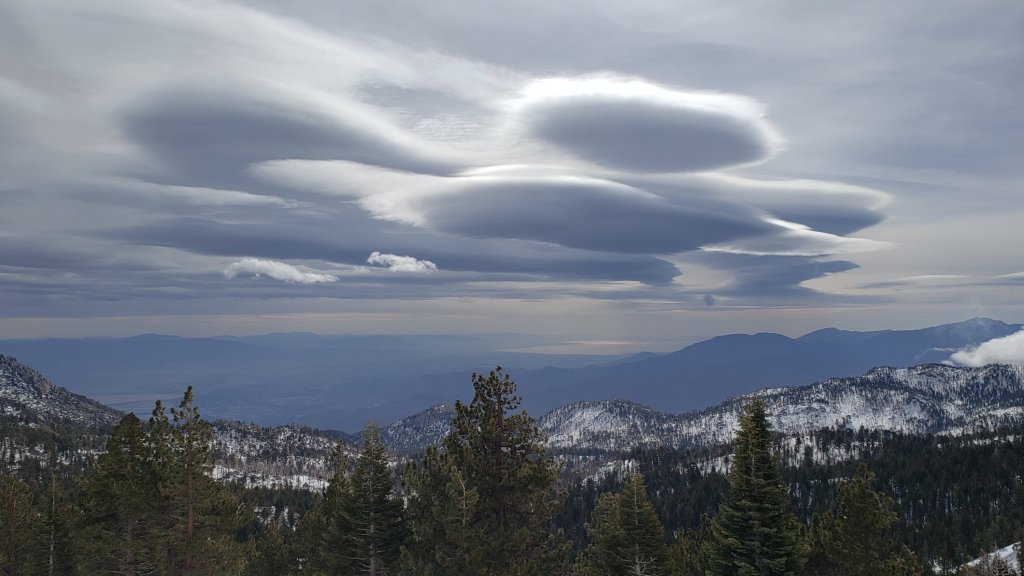
Spectacular altocumulus undulatus cloud – with some cirrus uncinus to the lower right – portend a change in the weather, Fern Valley late afternoon on 19th February 2023.

TRAIL CONDITIONS

All trails above about 5500 ft are largely snow-covered (wholly snow-covered above about 7000 ft). Note that tracks are being obscured very quickly by drifting of snow from strong winds, sometimes in hours or even minutes (see photo below). A light snowfall on the evening of Tuesday 21st will be accompanied by very strong winds, and is expected to largely or completely eliminate all tracks above about 7000 ft.

Effective 26th January 2023 the State Park closed the section of Skyline Trail that falls within its jurisdiction, above 5800 ft elevation, “until further notice due to dangerous weather conditions”. (For readers who are unclear, Skyline Trail forms the lower two-thirds of the “Cactus-to-Clouds” [C2C] route.) The State Park boundary is not marked but is near the site of the old Florian’s Cache, below Flat Rock. The open section of trail below 5800 ft is clear of snow.
Ernie Maxwell Trail has a well traveled track to follow along its entire length, through the increasingly patchy icy snow. Average snow cover is 40%, but is nearly continuous near Humber Park. Spikes are recommended especially in the morning as the snow is now hard, compacted and very icy in places. Three significant trees are now down across the trail, including two major hazards that are not easy to hike around both roughly halfway along the trail. All have been reported to US Forest Service.

Devil’s Slide Trail has a moderately traveled track to Saddle Junction. There are two new treefall hazards to pass on the upper trail.

Lightly-traveled snowshoe and/or posthole tracks radiate away from Saddle Junction around the meadow trail and south toward Chinquapin Flat, but I have not checked how accurately they follow established trail routes or how far they continue.

The 0.4 mile section of South Ridge Trail between Chinquapin Flat/PCT and Tahquitz Peak has no steps to follow through the steeply angled ice with overlying deep snow. These icy slopes are notoriously treacherous. Currently crampons, always with an ice axe, and thorough knowledge of how to use this equipment, are essential. Snowshoes are not advisable due to the angle of the icy snow.

Deer Springs Trail has a posthole track to follow along its entire length. My track from last week largely followed the established route of the trail, especially below the Fuller Ridge junction, but higher up the track is much more direct in places. Above Little Round Valley in particular my track down from the Peak is very direct, steep, and would be a challenging ascent.

Marion Mountain Trail has a lightly-traveled posthole track to follow, that does not follow the trail route in places.

Spitler Peak Trail had 10 new treefall hazards, almost all in the upper switchbacks. Only five of these require cutting, and I was able to remove three by hand earlier in February.

SNOW DEPTHS measured on 19th-20th February (east and south side locations) and 15th February 2023 (west side) are as follows. The number given is the current average total snow depth. Note that generally the maximum depths so far this winter were immediately following the major storm sequence on 14th-17th January 2023 (details of those depths available here). Note that averages are given; due to strong winds and considerable powder there is extreme drifting. Altitudes are approximate.

San Jacinto Peak (10810 ft): 37-42 inches, drifted >50 inches especially on east flank

Little Round Valley (9800 ft): 42-46 inches, heavily drifted

Wellman Divide (9700 ft): 40 inches

Seven Pines Trail junction with Deer Springs Trail (8700 ft): 35 inches

Annie’s Junction/PCT Mile 180.8 (9070 ft): 44 inches

Long Valley (8600 ft): 22 inches

Strawberry Junction (8100 ft): 15 inches

Saddle Junction/PCT Mile 179 (8070 ft): 21 inches

Devil’s Slide trailhead at Humber Park (6550 ft): 0-2 inches

Idyllwild (at 5550 ft): 0-1 inch

Thank you for taking the time to read this. While all time and labor is volunteered, the San Jacinto Trail Report uses small private donations to help cover costs. Every year seems to have its unique challenges, and it is already clear that 2023 will be no exception. Your contribution keeps the Report available to all, free from advertising or paywalls, and independent from agencies. If you have found this Report useful, please consider using this link to the Donate page. Zelle, Venmo, and PayPal are all options. Thank you so much for your support.
Horsethief Creek flowing steadily where it crosses Cactus Spring Trail in the Santa Rosa Wilderness, 17th February 2023. Largely fed from the slopes of Toro Peak, frankly I had expected this creek to be flowing stronger. This area should all be under several inches of snow soon.

Minor storms update 16th February 2023

The fourteenth and fifteenth storm systems of winter 2022/23, both of them minor but having a significant effect in combination, impacted the San Jacinto mountains back-to-back on 13th and 14th February. Both storms were relatively cold, the second in particular dusting snow below 3500 ft elevation. Their arrival followed a period of several days of temperatures well above seasonal the previous week which had produced some significant melting. In fact on my hike to San Jacinto Peak on Monday 13th through steady morning snow I could barely tell the difference in snow depths from the previous week, as the few inches of fresh snow had almost exactly replaced the few inches of depth that had melted over the previous week.

Both storms produced more snow than was generally forecast. On 13th, Idyllwild received 2.75 inches, and I measured five inches at San Jacinto Peak, with 3-4 inches at locations in between. I recorded a short video at the Peak late morning on the 13th, available here on YouTube. On 14th, about 2.0 inches fell in Idyllwild, with an inch all the way down to 3500 ft (and a dusting even lower), but upper elevations received a similar amount, with 2.5 inches in Long Valley (8600 ft) and at Wellman Divide (9700 ft), and no more than three inches at San Jacinto Peak. However the combined effect of the two minor storms, in combination with wild gusty winds pushing spindrift snow all over the high country, had completely erased the few tracks that were in place by the morning of Wednesday 15th.

Temperatures on the morning of 15th were the lowest of this winter, and among the lowest of the past decade. At home at 5550 ft in Idyllwild we recorded 10.9°F (-12°C), the lowest temperature we have recorded there in nine winters. Later that morning at San Jacinto Peak, I measured a windchill temperature of -26.3°F (-32°C), the fourth lowest temperature I have ever recorded there.

Two ascents of San Jacinto Peak in three days had challenging snow and weather, but both were hugely enjoyable. On the morning of Wednesday 15th February I ascended via the east side (Devil’s Slide, Wellman, Peak, and East Ridge routes), descending the western side via – roughly – Deer Springs Trail. With the light fresh powder the previous evening, accompanied by very strong winds causing extensive drifting, prior tracks, including my own from 13th, had been totally erased everywhere so I was again breaking trail the entire way. Even Devil’s Slide Trail was largely obscured in deep drifted powder (photo below).

I postholed barebooting to 8900 ft before putting on crampons. Alternatively snowshoes could have been used for much of the hike. Although I made a concerted effort to put in a track as faithful to the trail routes as conditions permitted, wild winds and spindrift powder on all the exposed slopes rendered that fairly pointless.

On Monday 13th I also postholed the entire hike, as I was able to ascend barebooting to about 9200 ft before putting on crampons. I kept those on for the rest of the ascent, and almost all of the descent, finally removing them most of the way down Devil’s Slide Trail. Although that day was not as cold and windy as 15th, I ascended in heavy cloud conditions with steady snowfall for the first three hours. Once it stopped snowing, the mountain was shrouded in thick foggy cloud, such that visibility was as low as 100 feet on the exposed slopes of the Peak Trail. The cloud largely dissipated on my descent, affording some spectacular vistas.

Details of snow depths measured at various locations on the trail system are given at the foot of this posting. Note that snow depth itself is rarely indicative of the difficulty (or otherwise) of hiking a particular track or trail.

Be prepared for trails above about 7500 ft (lower in places) obscured by moderate to deep snow, and even fresh tracks being erased by spindrift snow in places. Trails down to 4000 ft elevation currently have shallow snow cover. Extremely cautious navigation is strongly recommended everywhere.

As described above, crampons – with hiking poles and an ice axe, depending on terrain – are currently very useful everywhere above about 9000 ft. They are strongly recommended on certain moderate and higher angle slopes, at a minimum on the Peak Trail above Wellman Divide, the Wellman Trail, Deer Springs Trail above Little Round Valley, and uppermost South Ridge Trail, and on both flanks but critically on the north face of Tahquitz Peak.

Currently, and increasingly as snow conditions change, spikes are strongly recommended for the foreseeable future everywhere above about 7000 ft, lower in places. They are now invaluable on heavily traveled, compacted, icy tracks (before they clear of snow in the coming weeks) such as Devil’s Slide, Ernie Maxwell, and Deer Springs trails, at least, especially mornings when conditions tend to be most icy, and for descending. They are not however required, depending upon your comfort level hiking on shallow variable snow, potentially mixed with slushy and icy patches, and on the quality of your footwear (tread grip, in particular). Spikes could potentially be used to ascend to the highest peaks at this time, although crampons are certainly safer for traversing.

Snowshoes are useful in low to moderate angle terrain with adequate snow depth above about 8000 ft, for example the Tahquitz area meadows near Saddle Junction, sections of Deer Springs Trail, and Long Valley/Round Valley. Snowshoes can be used for ascending the highest peaks, but with considerable caution. They are not currently recommended for traversing moderate or higher angle slopes above 9000 ft that have challenging ice underlying powder. However, snowshoes will become increasingly useful as conditions warm sufficiently for snow to become soft above about 8000 ft, especially on sunny slopes and afternoons. Snowshoes will remain valuable anywhere off trail above about 8000 ft for the foreseeable future.

Recently I have mentioned the challenges of hard, icy snow underfoot and the value of using spikes (and/or crampons) especially for descending and traversing. Snow at all elevations will become increasingly firm and icy following multiple freeze-thaw cycles, and compaction by increasing hiker traffic in places, and I cannot overemphasize the importance of having both appropriate equipment and the right skill set for the terrain. The latter includes interpreting the snow/ice conditions, understanding your physical and mental abilities, and conservative decision making. These concerns may steadily increase over the next few weeks with rising then falling temperatures, seasonally stronger insolation, and highly variable snowmelt.

Hikers should be prepared for temperatures below freezing in the high country, and far below freezing when considering wind chill effects (see below for my recent weather observations from San Jacinto Peak). A storm currently predicted for Wednesday 22nd February is tentatively forecast to have near record low (i.e. potentially dangerous) windchill temperatures.

The USFS gate at Humber Park remains closed. Even when the gate is closed there are nine legal parking spaces below the locked gate (which still require an Adventure Pass or equivalent to be displayed).

Azalea Drive, the access road to Marion Mountain trailhead, has not been fully plowed (surveyed Tuesday 14th). While the shallow icy snow should melt steadily over the next few days, 4WD/AWD vehicles are recommended.

South Ridge Road (5S11), Dark Canyon Road (4S02, the access to Seven Pines Trail), and Santa Rosa Truck Trail (7S02) are currently closed to vehicle traffic, as is Black Mountain Road at the gate 1.7 miles up from Highway 243.

This remarkable but depressing sight was with me most of my hike on Wednesday 15th February 2023. The vast area of white in the distance is the burn scar of the Fairview Fire (that burned 28,300 acres in early September 2022). With a dusting down to low elevation, all the snow is visible in the burn area. In adjacent unburned areas, the vegetation dissipates and obscures the snow. Photo taken from San Jacinto Peak, with Marion Mountain on the far left of the image and Diamond Valley Reservoir to the distant right.

WEATHER

The remainder of February is currently forecast to continue the cold temperatures of recent days, generally at or below seasonal at all mountain elevations, and to be increasingly unsettled. The first couple of days early next week (20th-21st) may warm slightly above seasonal, before promptly dropping well below average again, accompanying another unsettled period of multiple consecutive storm systems on 22nd-28th.

While snowfall accompanying the first of those storms may be light, perhaps 2-4 inches in Idyllwild and 4-6 inches in the high country, strong winds at the highest peaks are tentatively forecast to produce extremely cold windchill conditions, similar to 15th February (see below). Provisional forecasts suggest the later storm systems, around 25th-27th February, could produce much more significant snowfall, potentially 10-12 inches in Idyllwild and 24+ inches at the highest elevations.

At San Jacinto Peak (10,810ft/3295m) on Wednesday 15th February 2023 at 1030 the air temperature was 4.9°F (-15°C), with a windchill temperature of -26.3°F (-32°C), 65% relative humidity, and a bitter due North wind sustained at 19 mph gusting to 27.7 mph.

At the Peak on Monday 13th February 2023 at 1010 the air temperature was 16.8°F (-10°C), with a windchill temperature of -1.3°F (-19°C), 95% relative humidity, and a wintry NNW wind sustained at 7 mph gusting to 13.2 mph.

At the Peak on Monday 6th February 2023 at 0930 the air temperature was 11.1°F (-12°C), with a windchill temperature of -11.0°F (-24°C), 59% relative humidity, and a frigid NNW wind sustained at 12 mph gusting to 20.2 mph.

Devil’s Slide Trail at about 7700 ft elevation, pre-dawn on 15th February 2023. The photo is taken looking back down trail at my ascending posthole tracks. Even with a minor storm, so much drifting powder had erased pre-existing tracks, and indeed any evidence of the trail altogether.

TRAIL CONDITIONS

All trails above about 4500 ft are snow-covered. By the afternoon of 15th, melting was already underway below 7000 ft. Reliable tracks are currently only known to be my posthole tracks from 15th for Devil’s Slide Trail through to San Jacinto Peak via the Wellman, Peak, and East Ridge trails, and then descending Deer Springs Trail.

Note that tracks are being obscured very quickly by drifting of snow from strong winds, sometimes in hours or even minutes (see photo below).

Effective 26th January 2023 the State Park closed the section of Skyline Trail that falls within its jurisdiction, above 5800 ft elevation, “until further notice due to dangerous weather conditions”. (For readers who are unclear, Skyline Trail forms the lower two-thirds of the “Cactus-to-Clouds” [C2C] route.) The State Park boundary is not marked but is near the site of the old Florian’s Cache, below Flat Rock. The open section of trail below 5800 ft is clear of snow.

Devil’s Slide Trail has a very lightly traveled track to Saddle Junction in place. There are two new treefall hazards to pass on the upper trail.

Deer Springs Trail has an excellent posthole track to follow along its entire length. This western side of the mountain was better protected from winds and drifting snow, and this track should largely survive until the weekend. My track largely followed the established route of the trail, especially below the Fuller Ridge junction, but higher up the track is much more direct in places. Above Little Round Valley in particular my track down from the Peak is very direct, steep, and would be a challenging ascent.

There were no visible hiker tracks on Marion Mountain, Seven Pines, or Fuller Ridge trails, as of 15th February.

The 0.4 mile section of South Ridge Trail between Chinquapin Flat/PCT and Tahquitz Peak has no steps to follow through the steeply angled ice with overlying deep snow. These icy slopes are notoriously treacherous. Currently crampons, always with an ice axe, and thorough knowledge of how to use this equipment, are essential. Snowshoes are not advisable due to the angle of the icy snow.

Spitler Peak Trail had 10 new treefall hazards, almost all in the upper switchbacks. Only five of these require cutting, and I was able to remove three by hand earlier in February.

SNOW DEPTHS measured on 15th February 2023 are as follows. The first number is the current average total snow depth at that location followed in parentheses where known by the combined fresh snowfall from the two minor storms on 13th-14th February. Note that generally the maximum depths so far this winter were immediately following the major storm sequence on 14th-17th January 2023 (details of those depths available here). Note that averages are given; due to strong winds and light powder there is extreme drifting. Altitudes are approximate.

San Jacinto Peak (10810 ft): 39-44 inches (new snow 8 inches)

Little Round Valley (9800 ft): 44-48 inches, heavily drifted

Wellman Divide (9700 ft): 42 inches (6 inches)

Seven Pines Trail junction with Deer Springs Trail (8700 ft): 35 inches (6 inches)

Annie’s Junction/PCT Mile 180.8 (9070 ft): 46 inches (5 inches)

Long Valley (8600 ft): 22 inches (4 inches)

Strawberry Junction (8100 ft): 16 inches (5 inches)

Saddle Junction/PCT Mile 179 (8070 ft): 22 inches (6 inches)

Devil’s Slide trailhead at Humber Park (6550 ft): 3-6 inches (6 inches, partly melted by afternoon of 15th)

Idyllwild (at 5550 ft): 2 inches (5 inches, largely melted by afternoon of 15th)

As an example of how quickly strong winds were erasing tracks on 15th February 2023, note how my posthole tracks are already filling in with spindrift. The photo was taken less than one minute after I had hiked the slope, at 9800 ft on the Peak Trail.

Thank you for taking the time to read this. While all time and labor is volunteered, the San Jacinto Trail Report uses small private donations to help cover costs. Every year seems to have its unique challenges, and it is already clear that 2023 will be no exception. Your contribution keeps the Report available to all, free from advertising or paywalls, and independent from agencies. If you have found this Report useful, please consider using this link to the Donate page. Zelle, Venmo, and PayPal are all options. Thank you so much for your support.
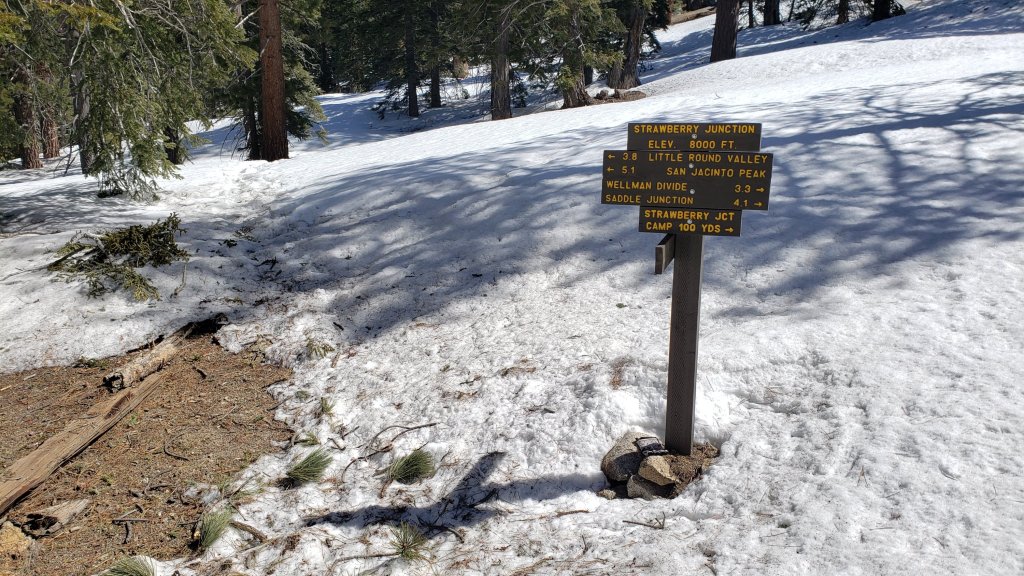
The junction sign on Deer Springs Trail at the top of Seven Pines Trail (8700 ft elevation), 15th February 2023. Snow depth is nearly three feet at that location, although only about 5-6 inches of that was fresh snow in the preceding two days of minor storms
An immaculate set of large and relatively fresh Mountain Lion tracks, 6800 ft elevation near Deer Springs Trail, afternoon of 15th February 2023.

Snow and trail update 7th February 2023

UPDATE Monday 13th February: the first of two consecutive minor storms came through this morning, and produced more snow than was generally forecast. Idyllwild received 2.75 inches, and I measured five inches at San Jacinto Peak on my hike through the storm this morning, with 3-4 inches at locations in between. I recorded a short video at the Peak, available here on YouTube. With another storm imminent tomorrow, I do not plan a thorough update until Wednesday 15th.

UPDATE Sunday 12th February: back-to-back minor snow storms are forecast for this evening and all day Tuesday 14th. Current expectations are only for 1-2 inches of snow at mid elevations (e.g., Idyllwild) and not much more at higher elevations, perhaps 2-3 inches with each storm. Consequently the next comprehensive Report update will probably be published on Wednesday 15th February.

———————————–

Following the twelfth storm system of this winter on 29th-30th January, temperatures have largely swung to well above seasonal, with melting underway at all elevations, but especially below 8000 ft. However a brief frigid interlude on 5th-6th February included a very light overnight snowfall at all elevations above 5000 ft, with 0.75 inch in Idyllwild, increasing to 1.5 inch at San Jacinto Peak.

On the morning of Monday 6th February I ascended San Jacinto Peak for the fifth time in the past two weeks, this time via the east side (Devil’s Slide, Wellman, Peak, and East Ridge trails), descending the same way. With the light dusting of fresh powder overnight, accompanied by strong winds causing extensive drifting, prior tracks had been partially obscured everywhere and almost completely erased above 8900 ft so I was again breaking trail in the high country. Thankfully it was relatively straightforward in crampons as the underlying snow was very solid due to freeze/thaw cycles, and the overlying powder was generally shallow. Although I made a concerted effort to put in a track as faithful to the trail routes as conditions permitted, further strong winds and blowing powder in the high country were erasing tracks within hours or even minutes.

As last week, I was able to ascend barebooting to about 9200 ft before putting on crampons. I kept those on for the rest of the ascent, and almost all of the descent, finally removing them most of the way down Devil’s Slide Trail. There are layers of hard ice and firm icy snow beneath the fresh powder, and crampons are ideal at present everywhere above 9000 ft, potentially lower in places.

Details of snow depths measured at various locations on the trail system are given at the foot of this posting. Note that snow depth itself is rarely indicative of the difficulty (or otherwise) of hiking a particular track or trail.

Be prepared for trails above about 8000 ft (possibly lower in places) obscured by moderate snow, and even fresh tracks being erased by spindrift snow in places. Strong winds expected on 11th-12th, and again on 14th, will likely obscure many tracks. Cautious navigation is strongly recommended everywhere.

As described above, crampons – with hiking poles and an ice axe, depending on terrain – are currently ideal everywhere above about 9500 ft. They are strongly recommended on certain moderate and higher angle slopes, at a minimum on the Peak Trail above Wellman Divide, the Wellman Trail, Deer Springs Trail above Little Round Valley, and uppermost South Ridge Trail, and on both flanks but critically on the north face of Tahquitz Peak.

Currently, and increasingly as snow conditions change, spikes are strongly recommended for the foreseeable future everywhere above about 7000 ft, lower in places. They are now invaluable on heavily traveled, compacted, icy tracks (before they clear of snow in the coming weeks) such as Devil’s Slide, Ernie Maxwell, and Deer Springs trails, at least, especially mornings when conditions tend to be most icy, and for descending. They are not however required, depending upon your comfort level hiking on shallow variable snow, potentially mixed with slushy and icy patches, and on the quality of your footwear (tread grip, in particular). Spikes could potentially be used to ascend to the highest peaks at this time, although crampons are certainly safer for traversing (e.g., see photo below).

Snowshoes are useful in lower angle terrain with adequate snow depth above about 8000 ft, for example the Tahquitz area meadows near Saddle Junction, sections of Deer Springs Trail, and Long Valley/Round Valley. They are not currently recommended for traversing moderate angle slopes above 9000 ft that have challenging ice underlying shallow powder. However, snowshoes will become increasingly useful as conditions warm sufficiently for snow to become soft above about 9000 ft, especially on sunny slopes and afternoons. Snowshoes will remain valuable anywhere off trail above about 8000 ft for the foreseeable future.

Recently I have mentioned the challenges of hard, icy snow underfoot and the value of using spikes (and/or crampons) especially for descending and traversing. Snow at all elevations will become increasingly firm and icy following multiple freeze-thaw cycles, and compaction by increasing hiker traffic in places, and I cannot overemphasize the importance of having both appropriate equipment and the right skill set for the terrain. The latter includes interpreting the snow/ice conditions, understanding your physical and mental abilities, and conservative decision making. These concerns may steadily increase over the next few weeks with rising then falling temperatures, seasonally stronger insolation, and highly variable snowmelt.

Hikers should be prepared for temperatures below freezing in the high country, and well below freezing when considering wind chill effects (see below for my recent weather observations from San Jacinto Peak).

The USFS gate at Humber Park remains closed. Even when the gate is closed there are nine legal parking spaces below the locked gate (which still require an Adventure Pass or equivalent to be displayed). If there are “Road Closed” signs further down at the junction with Forest Drive – sometimes the case at weekends and holidays when snow is present – then those nine spaces are also theoretically unavailable for legal parking.

South Ridge Road (5S11), Dark Canyon Road (4S02, the access to Seven Pines Trail), and Santa Rosa Truck Trail (7S02) are currently closed to vehicle traffic, as is Black Mountain Road at the gate 1.7 miles up from Highway 243.

WEATHER

February has been more settled than the very eventful January, but temperatures remain on something of a rollercoaster ride. Temperatures have been largely above seasonal in the first week of the month, then following a brief cold spell another period of temperatures well above seasonal is forecast for 8th-10th. Thereafter a cooling trend will take temperatures well below seasonal again including the possibility of minor precipitation on 11th-15th February. Forecast precipitation is currently only a dusting of 1-2 inches of snow at upper elevations, but combined with strong winds this will be sufficient to complicate route-finding.

At San Jacinto Peak (10,810ft/3295m) on Monday 6th February 2023 at 0930 the air temperature was 11.1°F (-12°C), with a windchill temperature of -11.0°F (-24°C), 59% relative humidity, and a frigid NNW wind sustained at 12 mph gusting to 20.2 mph.

At the Peak on Wednesday 1st February 2023 at 0935 the air temperature was 16.6°F (-8°C), with a windchill temperature of -8.0°F (-22°C), 13% relative humidity, and a wild NNE wind sustained at 21 mph gusting to 35.2 mph.

At the Peak on Monday 30th January 2023 at 1110 the air temperature was 15.5°F (-9°C), with a windchill temperature of -0.4°F (-18°C), 98% relative humidity, and a light SSE wind sustained at 3 mph gusting to 8.4 mph.

Sunrise near the Salton Sea, as seen from 8800 ft elevation on the PCT roughly one mile north of Saddle Junction, 6th February 2023. The impressive “snow moon” was well above the horizon in the opposite direction at the same time.

TRAIL CONDITIONS

All trails above about 6500 ft are currently snow-covered, and partially snow-covered above 5500 ft. Snow cover is shallow up to about 7000 ft, but relatively heavy above 8000 ft. Melting on sun-exposed slopes is already well underway, e.g., on lower Devil’s Slide Trail, South Ridge and lower Deer Springs trails. Steady melting is expected with warming temperatures this week, especially at mid elevations and on sun-exposed slopes.

Note that tracks discussed can be obscured quickly by drifting of snow from strong winds, sometimes in days or even hours. Strong winds expected on 11th-12th February, and again on 14th, will likely obscure many tracks with spindrift.

Effective 26th January 2023 the State Park closed the section of Skyline Trail that falls within its jurisdiction, above 5800 ft elevation, “until further notice due to dangerous weather conditions”. (For readers who are unclear, Skyline Trail forms the lower two-thirds of the “Cactus-to-Clouds” [C2C] route.) The State Park boundary is not marked but is near the site of the old Florian’s Cache, below Flat Rock. The open section of trail below 5800 ft is clear of snow.

Ernie Maxwell Trail has a well traveled track to follow along its entire length, through the increasingly patchy icy snow. Average snow cover is 60%, but is nearly continuous near Humber Park. Spikes are recommended especially in the morning as the snow is now hard, compacted and very icy in places. Three significant trees are now down across the trail, including two major hazards (one new in gale force winds on 26th January) that are not easy to hike around both roughly halfway along the trail. All have been reported to US Forest Service.

Devil’s Slide Trail has a traveled and largely compacted track to Saddle Junction in place already. The lower half of the trail in particular is very icy. Spikes are recommended at least for descending, and will become increasingly important with increasing compaction and freeze/thaw cycles. There are two new treefall hazards to pass on the upper trail.

Otherwise, reliable posthole tracks are in place from Saddle Junctions through to San Jacinto Peak via Wellman Divide, but parts will become obscured by drifting snow. From near Miller Peak I put in a track up the East Ridge, rather than continuing on the Peak Trail round to Summit Junction, but this track was being partially erased by spindrift within minutes.

South Ridge Trail [surveyed 10th Feb] is largely snow free until Old Lookout Flat at 7600 ft (c.15% snow cover). However the remaining snow patches are icy in the morning. Snow cover is continuous from there, with a posthole track to Tahquitz Peak. Spikes at least are required, but preferably crampons, both best used with an ice axe, specifically for the uppermost switchbacks, but traction is useful for descending much lower also. South Ridge Road remains closed now with only about 35% icy snow cover.

The 0.4 mile section of South Ridge Trail between Chinquapin Flat/PCT and Tahquitz Peak has no steps to follow through the steeply angled ice with overlying deep snow. These icy slopes are notoriously treacherous. Currently crampons, always with an ice axe, and thorough knowledge of how to use this equipment, are essential. Snowshoes are not advisable due to the angle of the icy snow.

Tracks are in place around Skunk Cabbage Meadow, and south from Saddle Junction toward Chinquapin Flat.

By 1st February there was a somewhat meandering snowshoe track from Round Valley (and presumably Long Valley) up to San Jacinto Peak, ultimately using the East Ridge route from near Miller Peak, that generally followed lower angle terrain and avoided the traversing slopes of the Peak Trail. However there was no sign of that route by 6th, due to drifting snow.

Spitler Peak Trail had 10 new treefall hazards, almost all in the upper switchbacks. Only five of these require cutting, and I was able to remove three by hand last week.

SNOW DEPTHS measured on 6th February 2023 are as follows. The first number is the current average total snow depth at that location followed in parentheses by the maximum depth where known so far this winter, generally immediately following the major storm sequence on 14th-17th January 2023. Note that averages are given; due to strong winds accompanying storms there is extensive drifting. Altitudes are approximate.

San Jacinto Peak (10810 ft): 36-40 inches (winter max depth 45-48 inches), drifted >50 inches in places

Wellman Divide (9700 ft): 38 inches (45 inches)

Annie’s Junction/PCT Mile 180.8 (9070 ft): 44 inches (48 inches)

Long Valley (8600 ft): 20 inches (24 inches)

Saddle Junction/PCT Mile 179 (8070 ft): 18 inches (22 inches)

Devil’s Slide trailhead at Humber Park (6550 ft): 0-3 inches, partly melted by afternoon of 6th (6 inches)

Idyllwild (at 5550 ft): <1.0 inch, largely melted by afternoon of 6th (4 inches)

Thank you for taking the time to read this. While all time and labor is volunteered, the San Jacinto Trail Report uses small private donations to help cover costs. Every year seems to have its unique challenges, and it is already clear that 2023 will be no exception. Your contribution keeps the Report available to all, free from advertising or paywalls, and independent from agencies. If you have found this Report useful, please consider using this link to the Donate page. Zelle, Venmo, and PayPal are all options. Thank you so much for your support.
Wellman Divide (9700 ft), the junction of the Wellman, Peak, and Round Valley trails, 6th February 2023. The sign is steadily emerging from the snow having been completely covered a couple of weeks earlier, indicating that at least 6-7 inches of snow has melted.
My crampon “posthole” tracks are barely visible breaking the route of the Peak Trail at 10,300 ft on my early morning ascent, 6th February 2023. This demonstrates how firm the icy snow is currently (on cold mornings at least) on the expansive high country snow slopes.
Anabel is always on the lookout for anything four-legged moving through the chaparral, even during a well-earned tea and snack stop. A remote section of the Friendship Trail, Garner Valley, 3rd February 2023.
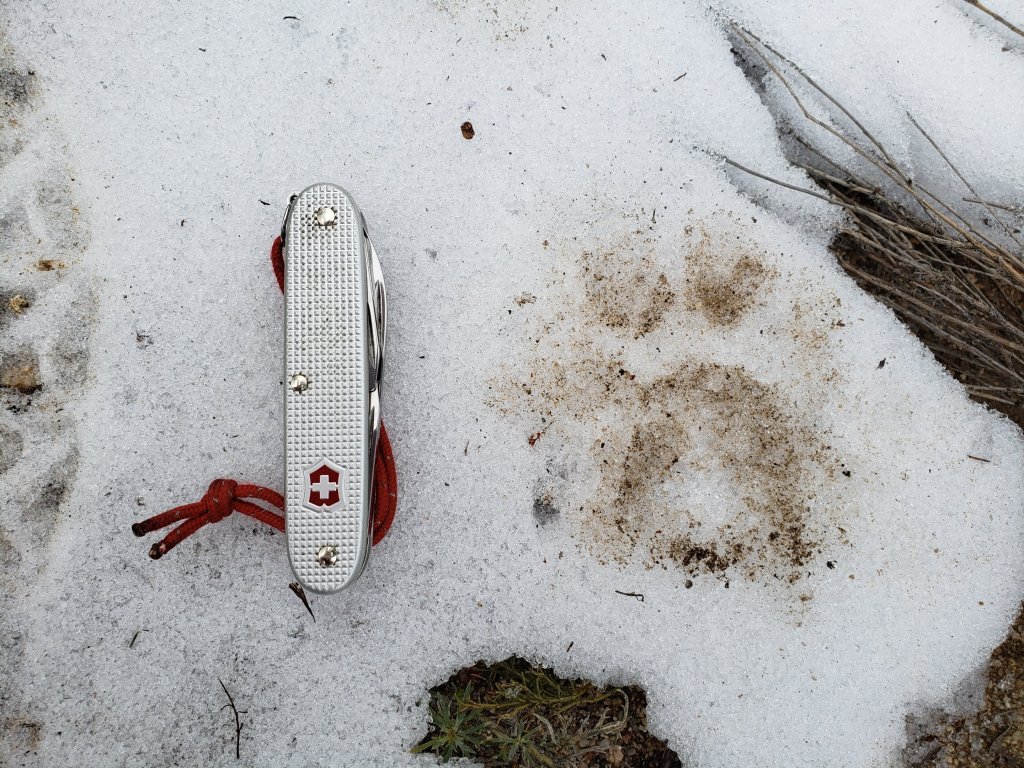
She had good reason to stay alert. This extremely fresh Mountain Lion track had been left only hours or perhaps even minutes earlier on one of the few remaining snow patches on the Prospector Trail, Garner Valley, early morning on 3rd February 2023. The knife is 3.6 inches long for scale.

Minor storm update 1st February 2023

The twelfth storm system of winter 2022/23 impacted the San Jacinto mountains with a minor snow storm on 29th-30th January. With a rapidly changing climate in the region in recent years, it has become increasingly common for there to be little or no difference in snow quantities at mid and higher elevations, often because the high country remains above the cloud, and this system was no exception.

Snow started in Idyllwild at about 1015 on Sunday 29th, ultimately accumulating about 3.5 inches (at 5550 ft) by the afternoon of 30th, while San Jacinto Peak (10,810 ft) added only two inches of powder. Locations in between, especially those on the western and southern slopes, added more with up to five inches at Saddle Junction (8100 ft). Long Valley at 8600 ft on the east slope received only about two inches of fresh snow.

On the mornings of both Wednesday 1st February and Monday 30th January I ascended San Jacinto Peak via the east side (Devil’s Slide, Wellman, Peak, and East Ridge trails), descending the same way. With such strong Santa Ana winds on Thursday 26th causing extensive drifting, and a light snowfall early on 30th, by the 30th prior tracks had been thoroughly erased and I was once again breaking trail the entire way from Humber Park to San Jacinto Peak, largely through relatively shallow powder. I made a concerted effort to put in a track as faithful to the trail routes as conditions permitted, both up and down. Further strong winds and blowing powder had eliminated much of these tracks again by Wednesday, and I again largely re-broke trail that day too. Indeed a wild wind in the high country that day was erasing tracks within hours or even minutes (see photos below).

On both days I was able to ascend barebooting to about 8800 ft on 30th and to 9200 ft on 1st, before putting on crampons. I kept those on for the rest of the ascent, and almost all of the descent, finally removing them most of the way down Devil’s Slide Trail. There are layers of hard ice and firm icy snow beneath the fresh powder, and crampons are ideal at present everywhere above 9000 ft, lower in places.

I recorded a short(ish) video report from San Jacinto Peak late morning on Monday 30th (available here on YouTube) that gives a feel for the conditions in the high country at that time.

Details of snow depths measured at various locations on the trail system are given at the foot of this posting. Measurements taken on Monday 30th were unchanged by Wednesday 1st. Note that snow depth itself is rarely indicative of the difficulty (or otherwise) of hiking a particular trail. Although the high country currently has its deepest snow accumulation since March 2019, this winter nevertheless remains well below the average for snowfall in the San Jacinto mountains to date.

Be prepared for trails above about 8000 ft (perhaps lower in places) completely or largely obscured by moderate to deep snow. Cautious navigation is strongly recommended everywhere.

As described above, crampons (always in conjunction with an ice axe) are currently recommended everywhere above about 8500 ft, and are strongly recommended on certain moderate and higher angle slopes, at a minimum on the Peak Trail above Wellman Divide, the Wellman Trail, Deer Springs Trail above Little Round Valley, and uppermost South Ridge Trail, on both flanks but especially on the north face of Tahquitz Peak.

Snowshoes are useful in lower angle terrain with adequate snow depth above about 8000 ft, for example the Tahquitz area meadows near Saddle Junction, sections of Deer Springs Trail, and Long Valley/Round Valley. They are not currently recommended for moderate angle slopes above 9000 ft that have challenging ice underlying shallow powder. However, snowshoes may become increasingly useful if conditions warm sufficiently for snow to become soft above about 9000 ft, especially on sunny slopes and afternoons. Snowshoes will remain valuable anywhere off trail above about 8000 ft for the foreseeable future.

Currently, and as conditions change, spikes are strongly recommended for the foreseeable future everywhere above about 7000 ft. They will be especially valuable on well-consolidated tracks over the coming days and weeks before they clear of snow (e.g., Devil’s Slide, Ernie Maxwell, Deer Springs trails, at least), on colder mornings when conditions are icy, and for descending. They are not however required, depending upon your comfort level hiking on shallow variable snow, potentially mixed with slushy and icy patches.

Melting and freeze/thaw cycles will combine to change trail conditions and potentially the preferred equipment for the terrain for the remainder of February.

Hikers should be prepared for temperatures below freezing in the high country, and well below freezing when considering wind chill effects (see below for my recent weather observations from San Jacinto Peak).

Skyline Trail closed on 26th January due to “dangerous weather conditions” above the State Park boundary (5800 ft elevation). There is no planned reopening date at this time. For those that are unclear, the Skyline Trail is the first segment of the C2C (“cactus to clouds”) from Palm Springs up to Grubb’s Notch, the access point to Long Valley.

The USFS gate at Humber Park remains closed. Even when the gate is closed there are nine legal parking spaces below the locked gate (which still require an Adventure Pass or equivalent to be displayed). If there are “Road Closed” signs further down at the junction with Forest Drive – sometimes the case at weekends and holidays when snow is present – then those nine spaces are also unavailable for legal parking.

South Ridge Road (5S11), Dark Canyon Road (4S02, the access to Seven Pines Trail), and Santa Rosa Truck Trail (7S02) are currently closed to vehicle traffic, as is Black Mountain Road at the gate 1.7 miles up from Highway 243.

WEATHER

February is forecast to be somewhat more settled than the very eventful January. A significant warming trend is expected for later this week and next weekend at all elevations, with significant melting likely, before cooling slightly Monday 6th February but remaining slightly above seasonal. Even around the 10,000 ft peaks temperatures are expected to fluctuate either side of freezing for at least the first half of February, which will lead to freeze/thaw cycles and likely icy conditions in the mornings followed by soft, challenging snow in the afternoons. At this time there is no further significant precipitation forecast prior to mid February.

At San Jacinto Peak (10,810ft/3295m) on Wednesday 1st February 2023 at 0935 the air temperature was 16.6°F (-8°C), with a windchill temperature of -8.0°F (-22°C), 13% relative humidity, and a wild NNE wind sustained at 21 mph gusting to 35.2 mph.

At the Peak on Monday 30th January 2023 at 1110 the air temperature was 15.5°F (-9°C), with a windchill temperature of -0.4°F (-18°C), 98% relative humidity, and a light SSE wind sustained at 3 mph gusting to 8.4 mph.

At the Peak on Monday 23rd January 2023 at 1010 the air temperature was 11.1°F (-11°C), with a windchill temperature of -16.2°F (-26°C), 47% relative humidity, and a bitter NNE wind sustained at 20 mph gusting to 27.7 mph.

The high country of the San Jacinto mountains as seen from near Apache Peak, 28th January 2023.

TRAIL CONDITIONS

All trails above about 5500 ft are currently snow-covered. Snow cover is shallow up to about 7000 ft, but relatively heavy above 8000 ft. Melting on sun-exposed slopes is already well underway, e.g., on lower Devil’s Slide Trail, South Ridge and Deer Springs trails. Steady melting is expected with warming temperatures this week, especially at mid elevations and on sun-exposed slopes.

Note that tracks discussed are obscured quickly by heavy drifting of snow from strong winds, sometimes in days or even hours.

Effective 26th January 2023 the State Park closed the section of Skyline Trail that falls within its jurisdiction, above 5800 ft elevation, “until further notice due to dangerous weather conditions”. (For readers who are unclear, Skyline Trail forms the lower two-thirds of the “Cactus-to-Clouds” [C2C] route.) The State Park boundary is not marked but is near the site of the old Florian’s Cache, below Flat Rock. The open section of trail below 5800 ft is clear of snow.

Devil’s Slide Trail has a well traveled and compacted track to Saddle Junction in place already. Spikes are not needed yet, but that will change soon with increasing compaction and freeze/thaw cycles. There are two new treefall hazards to pass on the upper trail.

Otherwise, reliable posthole tracks are in place from Saddle Junctions through to San Jacinto Peak via Wellman Divide, but parts will become obscured by any additional light snowfall and/or especially by drifting snow from strong winds. From near Miller Peak I put in a track up the East Ridge, rather than continuing on the Peak Trail round to Summit Junction.

By 1st February there was a somewhat meandering snowshoe track from Round Valley (and presumably Long Valley) up to San Jacinto Peak, ultimately using the East Ridge route from near Miller Peak, that generally followed lower angle terrain and avoided the traversing slopes of the Peak Trail.

Ernie Maxwell Trail [checked 2nd February] has a heavily traveled track to follow along its entire length, through the increasingly patchy icy snow. Average snow cover is 60%, but is nearly continuous near Humber Park. Spikes are recommended especially in the morning as the snow is now hard, compacted and very icy in places. Three significant trees are now down across the trail, including two major hazards (one new in gale force winds on 26th January) that are not easy to hike around both roughly halfway along the trail. All have been reported to US Forest Service.

On South Ridge Trail spikes at least, but preferably crampons, are required for the uppermost switchbacks.

The 0.4 mile section of South Ridge Trail between Chinquapin Flat/PCT and Tahquitz Peak has no steps to follow through the steeply angled ice with overlying deep snow. These icy slopes are notoriously treacherous. Currently crampons, always with an ice axe, and advanced knowledge of how to use this equipment, are required. Snowshoes are not advisable due to the angle of the icy snow.

Wellman Divide (9700 ft), the junction of the Wellman, Peak, and Round Valley trails, 30th January 2023. The sign is visible emerging from the snow, indicating that at least 3-4 inches of snow had melted in the previous week.

SNOW DEPTHS measured on 30th January 2023 (unless otherwise indicated) and checked again on 1st February are as follows. Three numbers are given: the first number is the current average total snow depth at that location, followed in brackets by the new snow accumulation from the storm on 29th-30th January, and finally in parentheses by the maximum depth where known so far this winter, generally on 18th January following the major storm sequence on 14th-17th January 2023. For locations measured on 23rd January, these measurements are still useful, as the new recent snow depth is roughly offset by melting over the past week. Note that averages are given; due to strong winds accompanying storms there is extensive drifting. Altitudes are approximate.

San Jacinto Peak (10810 ft): 40-45 inches [2 inches] (45-48 inches), drifted >50 inches in places

Little Round Valley (9800 ft): 45 inches, heavily drifted, measured 23rd January

Wellman Divide (9700 ft): 40 inches [2 inches] (45 inches)

Annie’s Junction/PCT Mile 180.8 (9070 ft): 44 inches [4 inches] (48 inches)

Tahquitz Peak (8836 ft): 25 inches, heavily drifted to 40 inches in places, measured 20th January

Seven Pines Trail junction with Deer Springs Trail (8700 ft): 36 inches, measured 23rd January

Long Valley (8600 ft): 22 inches [2 inches] (24 inches)

Strawberry Junction/PCT Mile 183 (8100 ft): 15 inches, measured 23rd January

Saddle Junction/PCT Mile 179 (8070 ft): 22 inches [5 inches] (22 inches)

Suicide Rock Trail junction with Deer Springs Trail (6950 ft): 3 inches, measured 23rd January

Devil’s Slide trailhead at Humber Park (6550 ft): 4-5 inches [4 inches] (6 inches) already melting afternoon of 30th

Idyllwild (at 5550 ft): 0-2 inches [3.5 inches] (3-4 inches) rapidly melting afternoon of 30th

Saddle Junction (8100 ft) at about PCT Mile 179, under nearly two feet of snow, 30th January 2023.

Thank you for taking the time to read this. While all time and labor is volunteered, the San Jacinto Trail Report uses small private donations to help cover costs. Every year seems to have its unique challenges, and it is already clear that 2023 will be no exception. Your contribution keeps the Report available to all, free from advertising or paywalls, and independent from agencies. If you have found this Report useful, please consider using this link to the Donate page. Zelle, Venmo, and PayPal are all options. Thank you so much for your support.
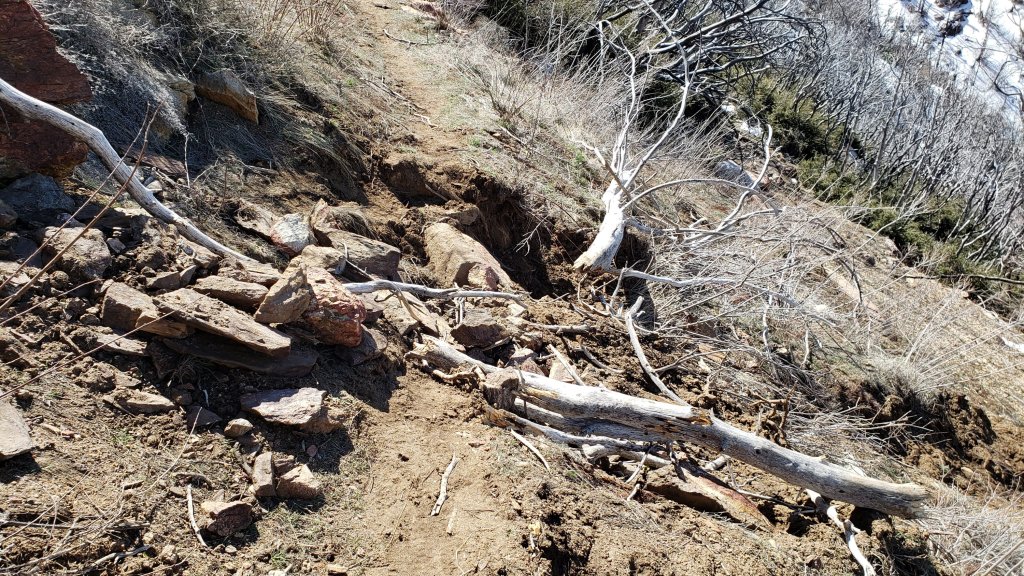
The north-east face of Apache Peak, approx. PCT Mile 169.5, on 28th January 2023. The trail route runs away from the camera just below the boulders on the left side of the image. The current snow conditions are not overly complicated, but require spikes at least, and an ice axe (with solid knowledge of how to use it) would be a good idea.
Above, my crampon posthole tracks breaking the route of the Peak Trail at 10,300 ft on my early morning ascent on 1st February 2023. Below, the same view just 74 minutes later on my descent, with my prior tracks already almost completely eliminated by wind drifted powder. This demonstrates the speed with which tracks can currently be erased on a windy and powdery slope in the high country.

Snow update 25th January 2023

IMPORTANT UPDATE Thursday 26th January 2023: The State Park has announced that Skyline Trail is closed with immediate effect due to hazardous conditions above the State Park boundary (5800 ft elevation). There is no planned reopening date at this time. For those that are unclear, the Skyline Trail is the first segment of the C2C (“Cactus to clouds”) from Palm Springs up to Grubb’s Notch (Long Valley).

WEATHER UPDATE Thursday 26th January 2023: Wild Santa Ana (north-east) winds today in the San Jacinto mountains have included gusts of 69 and 73 mph early this morning at automated stations at each end of Bonita Vista Road. On the north side, a location just south-east of Banning in San Gorgonio Pass recorded a gust of 92 mph. Hikers should anticipate new treefall hazards in trails – we have already found one major new one on the Ernie Maxwell Trail – and also that tracks in snow may have been obscured by windblown drifting powder. The storm forecast for 29th-30th January looks less dramatic than previously predicted, with the high country largely above the storm (only an inch of snow forecast), and only 2-4 inches now expected at the elevation of Idyllwild.

—————————–

The previous Report (available here) summarized the conditions following the multiple storm event of 14th-17th January. My blogging throughout the storms gave more day-to-day detail and is available here. Since then Idyllwild had a very light dusting (<0.25 inch) of snow on Friday 20th, but the high country was above the cloud and unaffected.

Early on Monday 23rd January I ascended San Jacinto Peak via the east side (Devil’s Slide, Wellman, and Peak trails) that I had broken last Wednesday 18th, and descended the west side via (more-or-less) Deer Springs Trail. A strong and bitterly cold NNE wind made conditions interesting, with large parts of the broken tracks filling in overnight with spindrift (and wind blown ice blocks), so I found myself breaking lengthy sections of trail yet again. This started as low as Devil’s Slide Trail and continued all morning. On the plus side, as I had hoped, the cold meant that the exposed snow slopes from 9200 ft and above were largely firm and icy (example photo below). Consequently I put on crampons at Wellman’s Cienega, keeping them on all day until low down on Deer Springs Trail. Although I carried snowshoes it would have been risky to try to use them on the icy traverses.

On Friday 20th I broke South Ridge Trail to Tahquitz Peak. I put in a posthole track the entire way up, but crampons (with an ice axe) were essential at that time on the upper switchbacks above about 8300 ft due to the typical steeply angled ice obscured underneath 6-12 inches of powder (photos below).

Details of snow depths measured at various locations on the trail system are given at the foot of this posting. Note however that snow depth itself is rarely indicative of the difficulty (or otherwise) of hiking a particular trail. Although the high country currently has its deepest snow accumulation in almost four years, since March 2019, this winter nevertheless remains well below the average for snowfall in the San Jacinto mountains to late January.

Be prepared for trails above about 8000 ft (perhaps lower in places) completely or largely obscured by moderate to deep snow. Very cautious navigation is strongly recommended everywhere.

Current forecasts suggest that there may be significant snowfall on Sunday 29th-Monday 30th January at all elevations, but some warming and steady snow melt likely on either side of that date. Fresh snowfall, melting, and freeze/thaw cycles will all combine to change trail conditions and potentially the preferred equipment for the terrain over the next week or two.

With some melting already underway and compaction caused by freeze-thaw cycles and hiker traffic, conditions will deteriorate for snowshoeing over the next few days, especially on more heavily traveled trails below 9000ft. Nevertheless, snowshoes will be valuable anywhere off trail above about 8000ft for the foreseeable future, and on trail where tracks have not yet been broken. They may become increasingly useful if conditions warm sufficiently for snow to become soft above about 9000 ft, especially on sunny slopes and afternoons.

In addition to snowshoes, and as conditions change, spikes are strongly recommended for the foreseeable future everywhere above about 6000ft. They will be especially valuable on well-consolidated tracks over the coming weeks before they clear of snow (e.g., Devil’s Slide, Ernie Maxwell, Deer Springs trails, at least), on colder mornings when conditions are icy, and for descending. They are not however required, depending upon your comfort level hiking on shallow variable snow, potentially mixed with slushy and icy patches.

As described above, crampons (always in conjunction with an ice axe) are currently recommended on certain moderate and higher angle slopes, at a minimum on the Peak Trail above Wellman Divide, the Wellman Trail, and uppermost South Ridge Trail, on both flanks but especially on the north face of Tahquitz Peak.

Hikers should be prepared for temperatures below freezing in the high country, and well below freezing when considering wind chill effects (see below for my recent weather observations from San Jacinto Peak).

Avalanche risk in the high country is currently minimal due to snow depths and conditions, with the exception of the traditionally unstable north face of San Jacinto Peak which avalanches to some extent every winter.

As always after storms in the San Jacinto range be aware of considerable ice fall from overhead trees. Sadly this phenomenon has become much more of a factor in recent years with freezing rainfall (rather than snow) occurring at higher elevations at higher frequency with much warmer weather systems. This rain produces huge masses of ice in the trees, including chunks I have estimated as weighing 40-100 lb this winter, which can dislodge dramatically once direct sunlight warms the trees.

Hikers should be prepared for temperatures below freezing in the high country, and far below freezing when considering wind chill effects (see below for my recent weather observations from San Jacinto Peak).

The USFS gate at Humber Park remains closed. Even when the gate is closed there are nine legal parking spaces below the locked gate (which still require an Adventure Pass or equivalent to be displayed). If there are “Road Closed” signs further down – often the case at weekends and holidays when snow is present – then those nine spaces are also unavailable for legal parking.

South Ridge Road (5S11), Dark Canyon Road (4S02, the access to Seven Pines Trail), and Santa Rosa Truck Trail (7S02) are currently closed to vehicle traffic, as is Black Mountain Road at the gate 1.7 miles up from Highway 243.

Tahquitz Peak fire lookout, 20th January 2023.

WEATHER

After an interesting month of weather, the remainder of January into February is forecast to be somewhat more settled. In general temperatures are expected to warm to above average into next month at all elevations, especially at the highest elevations in the first week of February. Melting is expected to be steady and start to accelerate into February, but freeze/thaw cycles, compaction, and refreezing overnight may ultimately combine to produce very icy conditions.

That said, a moderate snow storm is forecast for Sunday 29th to Monday 30th January, with up to six inches of snow forecast above about 5000 ft, possibly up to 12 inches above 10,000 ft, and a freeze level down to 4000 ft.

At San Jacinto Peak (10,810ft/3295m) on Monday 23rd January 2023 at 1010 the air temperature was 11.1°F (-11°C), with a windchill temperature of -16.2°F (-26°C), 47% relative humidity, and a bitter NNE wind sustained at 20 mph gusting to 27.7 mph.

At the Peak on Wednesday 18th January 2023 at 1115 the air temperature was 16.8°F (-8°C), with a windchill temperature of -3.6°F (-20°C), 27% relative humidity, and a frigid NNW wind sustained at 10 mph gusting to 25.8 mph.

At the Peak on Sunday 15th January 2023 at 0750 the air temperature was 17.8°F (-8°C), with a windchill temperature of -5.6°F (-21°C), 100% relative humidity, and a wild SW wind sustained at 19 mph gusting to 30.2 mph.

The view south-east from San Jacinto Peak, mid morning on 23rd January 2023. A remarkable sand storm in the Coachella Valley (to the left) was being stirred up and blown south by a severe NNE wind, reported as gusting above 40 mph at Palm Springs Airport. Sand and/or dust was being blown over the Desert Divide (far right) into Garner Valley and beyond. The prominent dark peak emerging from the dust storm to the upper right is Toro Peak, the high point of the Santa Rosa range.

TRAIL CONDITIONS

All trails above about 5500 ft are currently snow-covered. Snow cover is shallow up to about 7000 ft, but relatively heavy above 8000 ft. Melting on sun-exposed slopes is well underway, e.g., on lower South Ridge and Deer Springs trails.

Note that tracks discussed here may become obscured by heavy drifting of snow from strong winds combined with extensive ice fall from trees overhead.

Devil’s Slide Trail has a relatively well-traveled and compacted track to Saddle Junction in place already. Note that there are about a dozen stream crossings and sections of the trail with water flowing in them, at times for tens of feet. Waterproof or highly water resistant footwear is recommended. Spikes are not needed yet, but that will change soon with increasing compaction and freeze/thaw cycles. There are two new treefall hazards to pass on the upper trail.

Ernie Maxwell Trail [checked 23rd and 26th January] has good tracks to follow along its entire length, through the shallow icy snow (still >90% snow cover). Spikes are strongly recommended as the snow is now hard, compacted and very icy in places. Three significant trees are now down across the trail, including two major hazards (one new in gale force winds on 26th) that are not easy to hike around both roughly halfway along the trail.

South Ridge Trail has been broken from the top of South Ridge Road to Tahquitz Peak with a simple posthole track. Spikes at least, but preferably crampons, are required for the uppermost switchbacks (see photo below).

The 0.4 mile section of South Ridge Trail between Chinquapin Flat/PCT and Tahquitz Peak [checked 20th January] has no steps to follow through the steeply angled ice with overlying deep snow. These icy slopes are notoriously treacherous. Currently crampons, always with an ice axe, and advanced knowledge of how to use this equipment, are required. Snowshoes are not advisable due to the angle of the icy snow.

On 23rd January I saw posthole tracks from Saddle Junction that head down the start of the Caramba Trail, the start of Willow Creek Trail, and following the PCT southbound toward Chinquapin Flat, but I have no further details at this time.

The Wellman Trail track was disappearing under spindrift as I re-broke it on Monday 23rd. The route does not follow the established trail for the most part, and steepens considerably as it nears Wellman Divide. Crampons (or perhaps spikes or snowshoes on some days) are recommended.

The Peak Trail track is also partially disappearing under fresh spindrift (photos below). The route largely follows the established trail, but hikers coming from Long Valley over the weekend either did not find or follow my broken trail from last week, so in sections the route is unusual. Crampons are recommended for the traversing slopes.

The East Ridge Trail from near Miller Peak to San Jacinto Peak has multiple tracks, all of which were disappearing under fresh spindrift when I ascended that way on Monday 23rd.

Deer Springs Trail has a broken track to follow all the way to San Jacinto Peak. A well-traveled snowshoe track is in place up to Strawberry Junction. From there to the top of Marion Mountain Trail the route is a lightly-traveled posthole track. From the top of Marion, the route is well-traveled but pretty uneven, up into Little Round Valley. It does not accurately follow the established trail route in significant sections but is navigable. Through LRV and up to San Jacinto Peak, there are at least three tracks (two posthole, one snowshoe), none of which attempt to follow the trail route, and all are steep and very direct. There are five new major treefall hazards, plus many other limbs and branches, across the trail between the Suicide Rock junction and the Marion Mountain Trail junction.

Marion Mountain Trail has a well-traveled snowshoe track to follow along its entire length. Note that near its junction with Deer Springs Trail, the route was not close to the established trail, so cautious navigation may be needed.

There was no evidence of hiker tracks on Fuller Ridge Trail or Seven Pines Trail as of Monday 23rd January.

My posthole tracks around Switchback 16, just below Tahquitz Peak on uppermost South Ridge Trail, 20th January 2023. Crampons and ice axe were required above about 8300 ft elevation that morning.

SNOW DEPTHS measured on 23rd January 2023 (unless otherwise indicated) are as follows. The first number is the current average total snow depth at that location, followed in parentheses where known by the maximum depth so far this winter immediately following the latest storm sequence on 14th-17th January 2023. Note that average depth is given; due to strong winds accompanying storms there is extensive drifting. Altitudes are approximate.

San Jacinto Peak (10810 ft): 42 inches (45-48 inches), drifted to 60 inches in places, especially on East Ridge.

Little Round Valley (9800 ft): 45 inches, heavily drifted

Wellman Divide (9700 ft): 40 inches (45 inches)

Annie’s Junction/PCT Mile 180.8 (9070 ft): 44 inches (45-48 inches)

Tahquitz Peak (8836 ft): 25 inches, heavily drifted to 40 inches in places (measured 20th January)

Seven Pines Trail junction with Deer Springs Trail (8700 ft): 36 inches

Long Valley (8600 ft): 20 inches (24 inches)

Strawberry Junction/PCT Mile 183 (8100 ft): 15 inches

Saddle Junction/PCT Mile 179 (8070 ft): 19 inches (21 inches)

Suicide Rock Trail junction with Deer Springs Trail (6950 ft): 1-3 inches

Devil’s Slide trailhead at Humber Park (6550 ft): 2-4 inches (5-6 inches)

Idyllwild (at 5550 ft): 0-2 inches (3 inches)

Thank you for taking the time to read this. While all time and labor is volunteered, the San Jacinto Trail Report uses small private donations to help cover costs. Every year seems to have its unique challenges, and it is already clear that 2023 will be no exception. Your contribution keeps the Report available to all, free from advertising or paywalls, and independent from agencies. If you have found this Report useful, please consider using this link to the Donate page. Zelle, Venmo, and PayPal are all options. Thank you so much for your support.
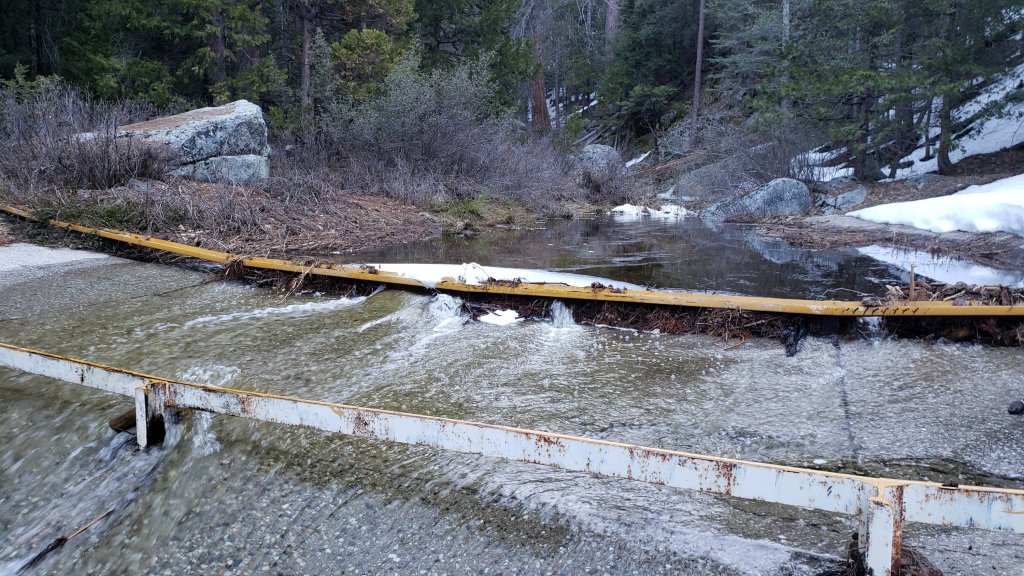
Above and below, the Peak Trail at about 10,300 ft. Above, on Monday 23rd January 2023, showing how hard and icy the slope had become, as my crampon tracks traversing the slope are barely visible. Below, the same view on Wednesday 18th January, when I broke trail across the slope with exactly the same equipment, but through soft, fresh powder, leaving an obvious posthole track.
Little Round Valley, at 9800 ft elevation. Above, on 23rd January 2023, with the sign completely buried in a total depth of about four feet of snow. Below, the same view on 11th January 2023, prior to the storms of 14th-17th January.
On 19th January 2023 we were treated to a superb set of Mountain Lion tracks in very shallow snow on May Valley Road. This is an area where we regularly encounter tracks, and have even seen lion in broad daylight here in the past. The tracks continued up the unpaved Forest road for about 0.3 mile, and were probably from the previous night.

Snow storms update 19th January 2023

UPDATE Friday 20th January: Overnight Idyllwild had a very light dusting (<0.25 inch) of snow, but the high country was above the cloud so existing tracks should be unaffected. This morning I broke South Ridge Trail to Tahquitz Peak. I put in a posthole track the entire way up, but crampons (with an ice axe) were necessary on the upper switchbacks above about 8300 ft due to the usual steeply angled ice obscured underneath 6-12 inches of powder. Average snow depth around the peak was 24-25 inches, but heavily drifted.

Tahquitz Peak fire lookout, 20th January 2023.

——————————-

We have had an excellent start to 2023 regarding the water and snow situations in the San Jacinto mountains. This is a summary of conditions following the tenth and eleventh Pacific storms of winter 2022/23 to impact the San Jacinto range, that were basically a double “atmospheric river” event spread across 14th-17th January. My blogging throughout the storms gave more day-to-day detail and is available here.

I recorded an overly rambling and partly wind affected video report from San Jacinto Peak late morning on Wednesday 18th, available here on YouTube, but it does give a sense for the conditions underfoot at the highest elevations, and for the spectacular vista that day.

Across the three storm days, locations above about 9000 ft all generally added at least two feet of snow (admixed with layers of freezing rain in areas up to 10,000 ft). The highest peaks appeared to add slightly less snow than some lower locations, probably because they were above the cloud for some of the precipitation events.

Final precipitation numbers for Idyllwild (measured at 5550 ft elevation) across the three days were 5.06 inches of rain and 6.5 inches of snow, although only about half of the latter remained on the ground as a few inches were removed by (relatively) warm rain between snow storms.

The high country currently has the deepest snow accumulation in the San Jacinto mountains in almost four years, since March 2019. As encouraging as that is, it should be noted that snow accumulation at San Jacinto Peak is only at about 65% of the depth in March 2019, and this winter overall remains well below the historical average for snow in the high country, despite recent events.

Details of snow depths measured at various locations on the trail system are given at the foot of this posting. Note however that snow depth itself is rarely indicative of the difficulty (or otherwise) of hiking a particular trail.

Early on Wednesday 18th January I barebooted up Devil’s Slide Trail (which I had broken to Saddle the previous morning). From there I used snowshoes to ascend via Annie’s Junction and Wellman Divide. My track largely follows the established trail routes, with some modifications for the conditions. I stubbornly kept on my snowshoes to 10,100 ft elevation on the Peak Trail, despite some lateral slipping as I traversed the icy snow slopes. I switched to crampons and then finished breaking the Peak Trail through to near Miller Peak (photo below). From there I put in a direct ascending track roughly following the old East Ridge Trail to the Peak.

I kept my crampons on for the entire descent, taking advantage of excellent cross-country glissading conditions, and made it from San Jacinto Peak back to Humber Park in just over two hours.

With two further minor snowfalls possible in January, and strong winds in the high country expected on some days causing substantial spindrift, tracks broken through the snow may not last long. Be prepared for trails above about 8000 ft (perhaps lower in places) completely or largely obscured by moderate to deep snow; very cautious navigation is strongly recommended everywhere.

Currently few major trail routes have been traveled and even those may become partially obscured by drifted snow and fresh icefall. My tracks from Wednesday 18th January from Humber Park to/from San Jacinto Peak will be largely visible but may become somewhat obscured in places.

Snow depths are currently excellent for snowshoeing above about 7000 ft, where trails haven’t been too heavily traveled and compacted. However the snow conditions may not be suitable for snowshoeing on certain slopes, depending on the ice conditions below the surface due to multiple freezing rain incidents this winter. Eventually with compaction of the trails caused by increasing hiker traffic and freeze/thaw cycles snowshoes may steadily become less useful, however they will certainly remain valuable for off-trail travel in the high country well into February at least.

Spikes are currently useful throughout the trail system above about 6000 ft, possibly lower in places on cold (icy) mornings. They are not however required, depending upon your comfort level hiking on shallow variable snow, potentially mixed with slushy and icy patches. Spikes will become increasingly useful over the next few days and weeks as established trails become consolidated by hiker traffic and undergo freeze-thaw cycles. Spikes tend to be especially useful for descending trails.

As described above, crampons (always in conjunction with an ice axe) are currently recommended on certain moderate and higher angle slopes, at a minimum on the Peak Trail above Wellman Divide, and uppermost South Ridge Trail, especially on the north face of Tahquitz Peak.

Hikers should be prepared for temperatures below freezing in the high country, and well below freezing when considering wind chill effects (see below for my recent weather observations from San Jacinto Peak).

As always after storms in the San Jacinto range be aware of considerable ice fall from overhead trees. Sadly this phenomenon has become much more of a factor in recent years with freezing rainfall (rather than snow) occurring at higher elevations at higher frequency with much warmer weather systems. This rain produces huge masses of ice in the trees, including many chunks I have estimated as weighing 40-100 lb this winter, which can dislodge dramatically once direct sunlight warms the trees.

Currently the snow is relatively powdery; this will steadily change over the next few days and weeks. Underlying that powder are layers of ice (largely from freezing rain storms) which are much more perilous. Note that temperatures fluctuating either side of freezing are forecast for both mid and upper elevations. Steady melting of snow, especially on sun-exposed slopes, and freeze-thaw cycles will combine to change trail conditions and potentially the preferred equipment for the terrain.

Some general comments on snow/ice conditions. Time of day, temperature, and sun exposure all have significant impacts on the nature of the snow, in turn changing the conditions underfoot, and hence both the hiking difficulty and the preferred traction device (if any). These impacts are especially striking in Southern California mountains, where the sun is relatively potent even in midwinter and where even on the coldest days temperatures at mid elevations may fluctuate either side of freezing. A rapidly warming montane climate, with changes especially striking at high elevation, is exacerbating all of these issues.

Hikers should be prepared for temperatures below freezing in the high country, and far below freezing when considering wind chill effects (see below for my recent weather observations from San Jacinto Peak).

Currently the USFS gate at Humber Park is closed. When the gate is closed there are still nine legal parking spaces this side of the locked gate (which still require an Adventure Pass or equivalent to be displayed). Vehicles not parked in these spaces may be ticketed and/or towed. If there are “Road Closed” signs further down – often the case at weekends and holidays when snow is present – then those nine spaces are also unavailable for legal parking.

South Ridge Road (5S11) is also currently closed to vehicle traffic.

Dark Canyon Road (4S02, the access to Seven Pines Trail) and Santa Rosa Truck Trail (7S02) closed to vehicle traffic for the season on 7th November 2022. Black Mountain Road also closed on 7th November to vehicle traffic at the gate 1.7 miles up from Highway 243. Forest Service campgrounds at Boulder Basin, Marion Mountain, and Fern Basin are closed for the season. The State Park Stone Creek campground is also closed.

My boot tracks on the approximate route of the Peak Trail, looking south-south-east at about 10,300 ft, 18th January 2023. This gives a good feel for the current conditions to be expected in the San Jacinto high country. Jean Peak is to the upper right.

WEATHER

In general conditions in the remainder of January will be much more settled than for the first half of the month. Temperatures are expected to remain below average for January for the remainder of the month in Strawberry Valley (Idyllwild area), but are forecast to swing well above average (above freezing) for the highest elevations on 21st-26th January. Melting may be slow and largely confined to the most sun-exposed slopes, but freeze/thaw cycles, compaction, and low overnight temperatures may lead to very icy conditions.

In addition, there is the possibility of minor snow storms on Thursday 19th and around Sunday 29th January. While the snow quantities are forecast to be 1-2 inches at most, they may be much colder systems than have been typical so far this winter, with freeze levels below 5000 ft. Even if there is no precipitation, there will be temperatures well below seasonal on those days.

At San Jacinto Peak (10,810ft/3295m) on Wednesday 18th January 2023 at 1115 the air temperature was 16.8°F (-8°C), with a windchill temperature of -3.6°F (-20°C), 27% relative humidity, and a frigid NNW wind sustained at 10 mph gusting to 25.8 mph.

At the Peak on Sunday 15th January 2023 at 0750 the air temperature was 17.8°F (-8°C), with a windchill temperature of -5.6°F (-21°C), 100% relative humidity, and a wild SW wind sustained at 19 mph gusting to 30.2 mph.

At the Peak on Wednesday 11th January 2023 at 0915 the air temperature was 24.0°F (-4°C), with a windchill temperature of 5.8°F (-15°C), 74% relative humidity, and a bitter NNW wind sustained at 19 mph gusting to 24.5 mph.

TRAIL CONDITIONS

All trails above about 5000 ft are currently snow-covered. Snow cover is shallow up to about 7000 ft, but relatively heavy above 8000 ft.

Reliable tracks are in place (at least) for Devil’s Slide Trail. My snowshoe track continues from Saddle Junction through to San Jacinto Peak via Wellman Divide , the Peak Trail, and East Ridge, but this may become obscured by additional light snowfall and/or drifting snow from strong winds.

Devil’s Slide Trail has a relatively well-traveled and compacted track to Saddle Junction in place already. Note that there are about a dozen stream crossings and sections of the trail with water flowing in them, at times for tens of feet. Waterproof or highly water resistant footwear is recommended. Spikes are not needed yet, but that will change soon with increasing compaction and freeze/thaw cycles.

Ernie Maxwell Trail has good tracks to follow along its entire length, through the continuous snow cover a few inches deep. Many hikers may find spikes are already useful, and will become increasingly so during and after this weekend with melting and compaction. [Checked 18th January by Anne and Anabel.

On the afternoon of 18th I saw posthole tracks that head down the start of the Caramba Trail, and following the PCT southbound toward Chinquapin Flat, but I have no further details at this time.

The 0.4 mile section of South Ridge Trail between Chinquapin Flat/PCT and Tahquitz Peak [checked 20th January] has no steps to follow through the steeply angled ice with overlying deep snow. These icy slopes are notoriously treacherous. Currently crampons, always with an ice axe, and advanced knowledge of how to use this equipment, are required. Snowshoes are not advisable due to the angle of the icy snow.

Looking south across the San Jacinto high country from San Jacinto Peak, 18th January 2023. Note the spectacular rime formations on the Limber Pine trees in the foreground.

SNOW DEPTHS measured on 18th January 2023 (unless otherwise indicated) are as follows. The first number is the current average total snow depth at that location, followed in parentheses by the approximate depth of fresh snow added by the latest storm sequence on 14th-17th January. Note that average depth is given; due to strong winds accompanying storms there is extensive drifting. Altitudes are approximate.

San Jacinto Peak (10810 ft): 45-48 inches (includes about 24 inches snow in latest storms), heavily drifted to 60 inches in places, especially on the East Ridge.

Wellman Divide (9700 ft): 45 inches (30 inches snow in latest storms) but heavily drifted here

Annie’s Junction/PCT Mile 180.8 (9070 ft): 45-48 inches (about 30-32 inches snow in latest storms)

Tahquitz Peak (8836 ft): 25 inches, heavily drifted to 40 inches in places (measured 20th January)

Long Valley (8600 ft): 24 inches (16 inches in latest storms)

Saddle Junction/PCT Mile 179 (8070 ft): 21 inches (13 inches snow in latest storms)

Devil’s Slide trailhead at Humber Park (6550 ft): 5-6 inches (all from latest storms, four inches of snow on top of ice)

Idyllwild (at 5550 ft): 3 inches (all from latest storms, admixed with 5.06 inches rain on 14th-16th) already melting steadily on 18th.

Saddle Junction (8100 ft elevation) on 17th January 2023 with about 21 inches of total snow depth (above), and the same view on 31st December 2022 with a patchy 0.5 inch of ice remaining from prior storms (below).

Thank you for taking the time to read this. While all time and labor is volunteered, the San Jacinto Trail Report uses small private donations to help cover costs. Every year seems to have its unique challenges, and it is already clear that 2023 will be no exception. Your contribution keeps the Report available to all, free from advertising or paywalls, and independent from agencies. If you have found this Report useful, please consider using this link to the Donate page. Zelle, Venmo, and PayPal are all options. Thank you so much for your support.
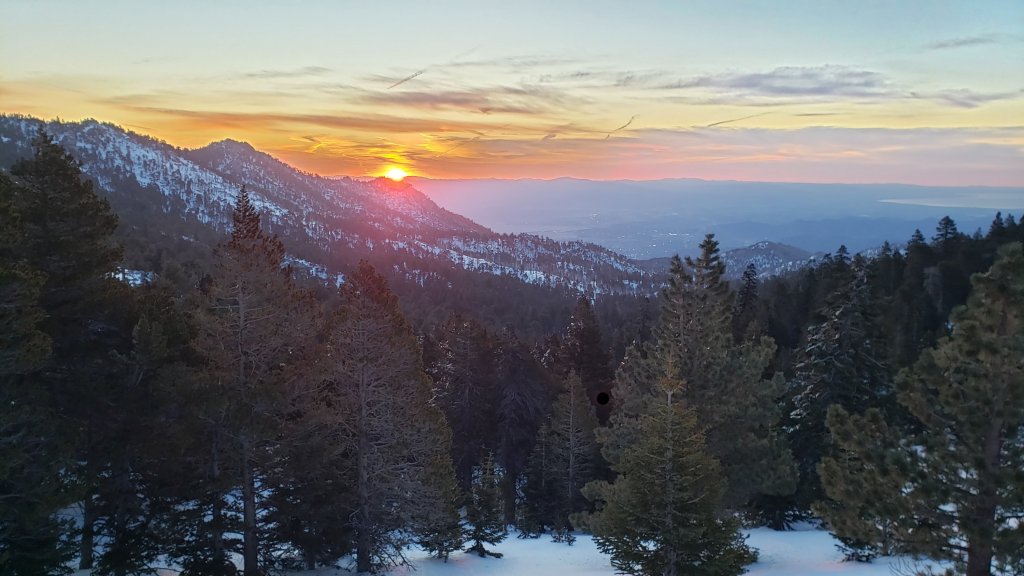
Above, Wellman Divide (9700 ft) on 18th January 2023 and below, the same view on 31st December 2022. In the upper image, the sign is completely buried under about four feet of snow and my hiking poles mark the approximate location.
The Peak Trail at about 9800 ft elevation looking north-east. Above, on the afternoon of 18th January 2023 with my ascending snowshoe track and descending crampon track demarcating the trail, and below, the same view on 31st December 2022. There has been a net accumulation of at least three feet of snow so far this month at that elevation.
Annie’s Junction (9070 ft), the high point of the PCT in Southern California at approx. Mile 180.8. Above, on 18th January 2023, and below the same view on 1st January 2023.

Storm updates 14th-17th January 2023

Back-to-back Pacific storm systems – already the tenth and eleventh storms of this winter – are forecast for Saturday 14th and then from late Sunday 15th January to the early hours of Tuesday 17th January.

Please check this page for periodic updates – the most recent is at the top – throughout the multiple day storm sequence. The next comprehensive Report update is not expected before Wednesday 18th January.

UPDATE on Tuesday 17th January at 1200

A light overnight snowfall, which produced another three inches in Idyllwild, finally stopped at 0700 this morning. Final totals for Idyllwild for the three day storm event were 6.5 inches of snow, plus an impressive 5.06 inches of rain.

This morning Anabel and I broke trail up Devil’s Slide Trail to Saddle Junction. The powder was lovely and soft, and overlying a firm icy layer (from all the freezing rain). While the snow was not especially deep, it still took about double the time of a completely dry ascent. I barebooted to Saddle, and then snowshoed back down to help consolidate the track. There had been an additional six inches of snow (plus an unknown amount of rain) since my measurement two days earlier, for a current total snow depth of about 21 inches at Saddle Junction. Two new trees were down on the upper trail, unsurprising given the huge weight of ice from freezing rain plastered all over the trees.

Current snow depth at Devil’s Slide trailhead at Humber Park is 4-5 inches on top of 1-2 inches of ice/icy snow from recent freezing rain.

Saddle Junction (8070 ft; PCT Mile c.179) under about 21 inches of average snow depth, 17th January 2023.

UPDATE on Monday 16th January at 1740

Rain has continued solidly today in Idyllwild, with another 0.90 inch since 0700 this morning. It turned to occasional light snow at about 1500, but less than 0.5 inch has accumulated so far (at 5550 ft). However the high country has been largely above this precipitation, with the sun even trying to peek out at times in Long Valley, and only about another inch of snow was added there this morning. That is expected to change, with up to several inches of snow forecast both in the high country and at mid elevations tonight.

UPDATE on Monday 16th January at 0920

Overnight in Idyllwild we had three inches of snow, the first notable snowfall of this latest storm series, but temperatures actually warmed during the night (presumably with the arrival of the latest “atmospheric river”) and before dawn it was raining on top of the snow. The snow quickly turned into semi-melted slush. In combination with the four inches of rain since Saturday, not to mention the many inches of rain earlier this winter, the mid elevations, including the mountain communities, are now best described as a very soggy and slushy mess.

The freeze level is currently at about 7500 ft and it has been periodically snowing gently above that elevation, with Long Valley (8600 ft) having added a few inches overnight, for a current total depth of about 24 inches.

Thank you for taking the time to read this. While all time and effort is volunteered, the San Jacinto Trail Report requests small private donations to cover costs. Every year seems to have unique challenges and 2023 is already proving to be no exception. Your contribution keeps the Report available to all, free from advertising or paywalls, and independent from agencies. If the Report is useful to you in any way, please consider using this link to the Donate page. Zelle, Venmo, and PayPal are all now options. Thank you so much for your support.

UPDATE on Sunday 15th January at 1420

I snowshoed down from San Jacinto Peak via Wellman Divide, Saddle Junction, and Devil’s Slide Trail. It was near-whiteout conditions due to wild spindrift above Wellman Divide, but the new snow was firm and overall made for good snowshoeing conditions. Crunchy layers as high as 9800 ft elevation told me it had rained that high at the start of the storm yesterday, but conversely there was very light snow (<1 inch) down to 5500 ft in Idyllwild.

Measured snow depths as of late morning/early afternoon today are: San Jacinto Peak (10,810 ft) 38 inches, at least 14 new in this storm; Wellman Divide (9700 ft) 30 inches, with 15 new in this storm; Annie’s Junction – at 9070 ft the highest point of the PCT in Southern California – 30 inches, with 14 new in this storm; Saddle Junction (8100ft) 15 inches, about 7-8 new in this storm; Devil’s Slide Trailhead at Humber Park (6520 ft) 2 inches, all from this storm.

Personally I would not currently venture above 9000 ft elevation without crampons (always with an ice axe) and snowshoes, due to the current complexity and challenges of the icy snow slopes above that elevation.

Conversely, lower down Devil’s Slide Trail is a combination of very light snow cover, slush, and multiple stream crossings, with much water flowing down the trail. Suitable waterproof footwear is strongly recommended.

Wellman Divide (9700ft) late morning on Sunday 15th January 2023 (above) and the same view the day before, mid morning Saturday 14th, prior to about 14 inches of new snow in the latest storm.

UPDATE on Sunday 15th January at 0830

The high country added only another couple of inches of snow overnight. Storm total at San Jacinto Peak is about 14 inches for a current total depth of 36+ inches (but very heavily drifted). It stopped snowing at about 0800.

Similarly, Long Valley (8600ft) added about two inches overnight for a storm total of about seven inches and a current total depth of about 15 inches.

Current air temperature at San Jacinto Peak is 17.8°F (-8°C) with a windchill of -5.6°F (-21°C) and a steady SW wind sustained at 19 mph gusting to 30.2 mph.

It continued to rain heavily overnight at mid elevations everywhere below about 7000 ft. Idyllwild at 5550 ft elevation recorded an impressive 4.01 inches of rain in the 24 hour period up to 0700 this morning. It is starting to turn to light sleet now as temperatures drop to near freezing. Locations in Pine Cove up to 6500 ft were reporting 3.1 to 3.8 inches of rain by 0500 today.

UPDATE on Saturday 14th January at 2010

The snow continues unabated, although the pace has slowed somewhat in the past hour. There is an average of 9-10 inches of fresh powder so far today at San Jacinto Peak, and about 5 inches in Long Valley.

Today’s rainfall total has passed an inch in Idyllwild, and various locations in Pine Cove (5800-6500 ft) were reporting 1.1 to 1.3 inches two hours ago. The freeze level has remained around 7500 ft for most of today, but is forecast to drop overnight closer to 6000 ft.

UPDATE on Saturday 14th January at 1705

The intensity of snowfall at San Jacinto Peak this afternoon is the best I’ve seen since late 2019. Although the flakes are small, it has been steadily accumulating at an inch per hour, with about six inches fresh powder so far today, for a Peak area total of about 30 inches. Another 10+ inches are forecast overnight, which is very possible given current conditions.

Snowfall at the elevation of Long Valley (8600 ft) has been similarly steady, and 3-4 inches of fresh powder there takes the total depth close to one foot.

Rainfall in Idyllwild (at 5550ft) has also maintained a steady pace, with close to 0.7 inch so far today.

UPDATE on Saturday 14th January at 1505

Cloud cover started to envelop the mountains early this morning. On my hike up to San Jacinto Peak it started snowing gently at 1025 in the high country. Snow accumulation was initially slow but has been an inch per hour recently, with 2.5 inch added at San Jacinto Peak since late this morning (on top of about 24 inches remaining from prior storms).

On my ascent I put crampons on at Wellman’s Cienega (9300 ft) and they were more-or-less essential for traversing the icy slopes of the Peak Trail. My tracks from Wednesday were still largely visible and helped a little with traction.

The initial freeze level was at about 9000 ft but has already dropped. After some early sleety drizzle it has been snowing in Long Valley (8600 ft) since late morning with 0.75 inch accumulating so far.

In Idyllwild (at 5550 ft) it started raining at 1100, where it has been relatively slow to accumulate so far, with 0.4 inch by 1500.

The Peak Trail at 9800 ft about 0.4 mile north of Wellman Divide, late morning Saturday 14th January 2023.

Minor snow storm update 11th January 2023

IMPORTANT UPDATE Friday 13th January: back-to-back Pacific storm systems are forecast to impact the San Jacinto mountains this weekend, the first on Saturday 14th, immediately followed by another Sunday 15th-Monday 16th January. These storms are currently forecast to each produce at least ten inches of snow at the highest elevations and an inch or more of rain at mid elevations (e.g., in Idyllwild). The second storm on 15th-16th is expected to be colder with a lower freeze level which may result in 1-2 inches of snow down to 5000 ft or possibly even lower.

—————————————-

The flow of “atmospheric river” storm systems continues unabated across California. Generally the San Jacinto mountains have just caught the southern edge of these systems, with nothing like the dramatic precipitation being reported from further north. That said, the cumulative effect of multiple systems is helpful to our moisture situation, and Tuesday 10th January saw the sixth storm in just over two weeks in the San Jacinto mountains (a timeline of the recent sequence of storms is available here in the previous Report).

Lamentably this latest storm was again very mild, with rain falling as high as the elevation of San Jacinto Peak – see photos below – all morning on Tuesday 10th, until finally turning to light snow in the early afternoon (at about 1330 in Long Valley). Rain had started overnight in Idyllwild, ending in late afternoon at a total of 1.26 inches.

Only 2.5 inches of snow fell at San Jacinto Peak (10,810ft) decreasing to 0.25 inch in upper Fern Valley (at approximately 6000 ft). With such mild storms this winter, it is interesting to speculate how much snow would currently be around the high peaks if air temperatures had been just a couple of degrees cooler. Currently there is less than three feet of snow at San Jacinto Peak; I suspect it would be 5-8 feet had we had fractionally cooler conditions in the past month.

Snow depths measured at many locations on the trail system on 11th January are given at the foot of this posting. Note however that snow depth itself is rarely indicative of the difficulty (or otherwise) of hiking a particular route, as discussed below. Many locations below 9000 ft had actually experienced a net loss of snow depth, as the (relatively) warm rain had melted and compacted the pre-existing snow, and so little new snow fell subsequently.

On the morning of Wednesday 11th January, getting an Alpine start, I broke trail the entire way from Humber Park to San Jacinto Peak via Devil’s Slide, PCT, Wellman, Peak, and East Ridge trails. That said, the going was extremely easy as the rain layer on top of the snow remaining for earlier storms had completely frozen, so I was only having to “break trail” through an inch or two of fine powder. The natural traction was superb, and I barebooted all the way to just above Wellman Divide (9700 ft) before finally putting on Kahtoola microspikes, accompanied by an ice axe.

The traversing slopes above Wellman’s Divide (roughly 9800-10,500 ft) were extremely firm early in the morning and potentially treacherous. Spikes at least, but preferably crampons, plus an ice axe (and thorough knowledge of how to use it) are currently required for traversing these slopes. It is possible they may deteriorate even further with some warming from direct sunlight. Snowshoes are not currently advisable on these slopes due to the angle of the underlying ice.

From near Miller Peak, I did not continue to break trail on the Peak Trail, but instead turned up the East Ridge, breaking a track roughly along the route of the old East Ridge Trail.

I descended Deer Springs Trail, again breaking trail the entire way, but again through light snow sitting on top of a very solid, icy snow layer. My route down to Little Round Valley will not be especially helpful to ascending hikers, as I made the most of conditions to take a direct glissading route. Through and below Little Round Valley, my track almost entirely follows the established trail.

All trails above about 8000 ft are obscured by snow at this time, and cautious navigation is strongly recommended everywhere. With significant further snowfalls expected in the next week (at least), and moderate to strong winds in the high country expected for many of those days causing some daily drifting of snow, much of the trail system may remain completely or somewhat obscured by snow throughout most or all of January.

Currently only two major trail routes have been traveled and even those may become partially obscured by drifted snow and fresh icefall. My tracks from Wednesday 11th January from Humber Park to San Jacinto Peak and down Deer Springs Trail will be largely visible but may be somewhat obscured in places.

Snow depths are currently suitable for snowshoeing above about 9000 ft, potentially lower in places. However the snow conditions may not be suitable for snowshoeing on certain slopes, as described above. This may continue for several weeks, or could change given further fresh snowfall forecast. Eventually with compaction of the trails caused by increasing hiker traffic and freeze/thaw cycles snowshoes may steadily become less useful, however they will likely remain valuable for off-trail travel in the high country into February.

Spikes are currently useful throughout the trail system above about 7000 ft, possibly lower in places on cold (icy) mornings. They are not however required, depending upon your comfort level hiking on shallow variable snow, potentially mixed with slushy and icy patches. Spikes will likely become increasingly useful over the next few days and weeks as established trails become consolidated by hiker traffic and undergo freeze-thaw cycles. Spikes tend to be especially useful for descending trails.

As mentioned above, crampons (always in conjunction with an ice axe) are currently recommended on certain moderate and higher angle slopes, notably the Peak Trail above Wellman Divide, and uppermost South Ridge Trail, especially on the north face of Tahquitz Peak.

Hikers should be prepared for temperatures well below freezing in the high country, and far below freezing when considering wind chill effects (see below for my recent weather observations from San Jacinto Peak). Potentially dangerous cold is currently forecast for the highest peaks for 14th-23rd January at least.

As always after storms in the San Jacinto range be aware of considerable ice fall from overhead trees. Sadly this phenomenon has become much more of a factor in the past 5-10 years with freezing rainfall (rather than snow) occurring at higher elevations at higher frequency with much warmer weather systems. This rain produces huge masses of ice in the trees, including chunks as large as a small microwave weighing 40-80 lb, which then dislodge as soon as direct sunlight warms the trees.

Some general comments on snow/ice conditions. Time of day, temperature, and sun exposure all have significant impacts on the nature of the snow, in turn changing the conditions underfoot, and hence both the hiking difficulty and the preferred traction device (if any). These impacts are especially striking in Southern California mountains, where the sun is relatively potent even in midwinter and where even on the coldest days temperatures at mid elevations may fluctuate either side of freezing. A rapidly warming montane climate, with changes especially striking at high elevation, is exacerbating all of these issues.

My pre-dawn hike up Devil’s Slide Trail on 11th January was delightful, primarily because there was the noise of running water almost everywhere. All seasonal and ephemeral streams were running strongly, and the current water conditions are the best for four years, since the great Valentine’s Day flood event of 2019. The other bonus was an immaculate set of fresh Mountain Lion tracks in the trail (photos below), with sign that the lion had crossed back-and-forth across Devil’s Slide in multiple locations further up also.

Currently the USFS gate at Humber Park is closed. When the gate is closed there are nine legal parking spaces this side of the locked gate (which still require an Adventure Pass or equivalent to be displayed). Vehicles not parked in these spaces may be ticketed and/or towed. If there are “Road Closed” signs further down at the junction with Forest Drive – as is often the case at weekends and holidays when snow is present – then those nine spaces are also unavailable for legal parking.

South Ridge Road (5S11) is also currently closed to vehicle traffic.

Dark Canyon Road (4S02, the access to Seven Pines Trail) and Santa Rosa Truck Trail (7S02) closed to vehicle traffic for the season on 7th November 2022. Black Mountain Road also closed on 7th November to vehicle traffic at the gate 1.7 miles up from Highway 243. Forest Service campgrounds at Boulder Basin, Marion Mountain, and Fern Basin are closed for the season. The State Park Stone Creek campground is also closed.

The view south-east from near Wellman’s Cienega (9200 ft) early morning, 11th January 2023. The Salton Sea is just visible immediately under the rising sun.

WEATHER

Conditions will remain very unsettled well into the third week of January. Two more significant “atmospheric river” storm systems are forecast on Saturday 14th-Sunday 15th, and on 16th-18th. While expected to be relatively mild at first with rain above 9000 ft, overall this next sequence of storms may prove to be colder than most of the recent systems. About 6-10 inches of snow are forecast for the high country on Saturday 14th, with 1-2 inches possible at the elevation of Idyllwild (preceded by 1-2 inches of rain).

Forecasts remain more uncertain about the second wave of stormy weather on 16th-18th January. However, forecast models suggest anywhere from 6-20 inches of snow above 10,000 ft elevation spread across at least two of the three days, and the possibility of several inches of snow at mid elevations (e.g., 2-4 inches in Idyllwild).

At San Jacinto Peak (10,810ft/3295m) on Wednesday 11th January 2023 at 0915 the air temperature was 24.0°F (-4°C), with a windchill temperature of 5.8°F (-15°C), 74% relative humidity, and a bitter NNW wind sustained at 19 mph gusting to 24.5 mph.

At the Peak on Friday 6th January 2023 at 0930 the air temperature was 25.7°F (-4°C), with a windchill temperature of 14.7°F (-10°C), 44% relative humidity, and a chilly NNW breeze sustained at 5 mph gusting to 10.6 mph.

At the Peak on Sunday 1st January 2023 at 0830 the air temperature was 17.9°F (-8°C), with a windchill temperature of -2.3°F (-19°C), 100% relative humidity, and a sharp WSW wind sustained at 11 mph gusting to 21.1 mph.

Stone Creek where it crosses (and currently flows along!) the PCT/Deer Springs Trail, at about PCT Mile 183.6 (8400 ft), 11th January 2023. Many streams are currently at their best flow rates in four years. Long may it last.

TRAIL CONDITIONS

All trails above about 6500 ft are currently lightly, or above 8000 ft moderately, snow-covered. As discussed above, multiple additional snowfalls forecast for 14th-18th January will further complicate the trail conditions.

Reliable tracks are in place (at least) for Devil’s Slide Trail through to San Jacinto Peak via Wellman Divide, and for the entire Deer Springs Trail. As of this morning, I saw no other broken tracks on the high country trail system.

The track on Deer Springs Trail largely follows the existing trail route up to Little Round Valley. My posthole/glissading track between LRV and San Jacinto Peak is very direct and steep, and of limited help to an ascending hiker.

The 0.4 mile section of South Ridge Trail between Chinquapin Flat/PCT and Tahquitz Peak [checked 9th January] has no steps to follow through the steeply angled icy snow. Although the snow is not particularly deep (10-12 inches) it is heavily drifted and steeply angled, and has at least one ice layer underneath the fresh powder. These icy slopes are notoriously treacherous and have been an area of multiple hiker fatalities in winter conditions in recent decades. Currently crampons, with an ice axe (and knowledge of how to use both), are strongly recommended. Snowshoes are dangerous due to the angle of the icy snow.

The traversing slopes above Wellman’s Divide (roughly 9800-10,500 ft) were extremely firm early in the morning and potentially treacherous. Spikes at least, but preferably crampons, plus an ice axe (and thorough knowledge of how to use it) are currently required for traversing these slopes. It is possible they may deteriorate even further with some warming from direct sunlight. Snowshoes are not currently advisable on these slopes due to the angle of the underlying ice.

The Ernie Maxwell Trail [surveyed 10th January] has minor patches of snow along its entire length, however it is largely clear for long sections, and the remaining snow is rarely icy. Spikes are not required.

Little Round Valley (9800 ft) currently under about two feet of snow (and ice), 11th January 2023.

SNOW DEPTHS measured on 11th January 2023 are as follows. The first number is the current average total snow depth at that location, followed in parentheses by the depth of fresh snow added by the latest storm on Tuesday 10th. Since the depths given in the previous Report, there has been some melting at higher elevations on sunny days and below 9000 ft caused by the heavy rainfall. Note that average depth is given; due to strong winds accompanying storms there is extensive drifting, often accumulating in the trails. Conversely in places scouring by the wind means the depths are well below the average. Altitudes are approximate.

San Jacinto Peak (10810 ft): 25-27 inches (includes 2.5 inches snow added on 10th January) but very heavily drifted

Little Round Valley (9800 ft): 24 inches (2 inches on 10th January)

Wellman Divide (9700 ft): 16 inches (1.5 inches snow plus unknown quantity of rain on 10th)

Annie’s Junction/PCT Mile 180.8 (9070 ft): 16 inches (1.5 inches snow plus unknown quantity of rain on 10th)

Seven Pines Trail junction with Deer Springs Trail/PCT Mile 184.9 (8700 ft): 13 inches (1 inch snow on 10th)

Long Valley (8600 ft): 8 inches (1 inch snow plus 1.5 inches rain on 10th)

Strawberry Junction/PCT Mile 183.3 (8100 ft): 6 inches (1 inch snow plus unknown quantity of rain on 10th)

Saddle Junction/PCT Mile 179 (8070 ft): 8 inches (1 inch snow plus unknown quantity of rain on 10th)

Deer Springs Trail at Suicide Rock Trail junction (6950 ft): 0-1 inch (0.5 inch snow plus >1.0 inch rain on 10th)

Devil’s Slide trailhead at Humber Park (6550 ft): 0.5 inch (0.5 inch snow plus >1.0 inch rain on 10th)

Idyllwild (at 5550 ft): 0 inch (no snow, 1.26 inches rain on 10th).

Looking south from San Jacinto Peak on a beautiful partially cloudy day, mid morning 11th January 2023. Note the Limber Pines in the foreground encased in ice from freezing rain.

Thank you for taking the time to read this. While all time and labor is volunteered, the San Jacinto Trail Report uses small private donations to cover costs. Your contribution keeps the Report available to all, free from advertising or paywalls, and independent from agencies. If you have found this Report useful, please consider using this link to the Donate page. Zelle, Venmo, and PayPal are all options. Thank you so much for your support.

The Peak Trail at 9800 ft elevation looking north-east. Above, early morning of 11th January 2023 before I put a posthole track through on my ascent, and below, the same view on the afternoon of 31st December 2022 prior to a sequence of six storms in less than a fortnight.
Spectacular ice formations on the summit rocks at San Jacinto Peak, 11th January 2023, the product of freezing rain for much of the previous day.
Fresh Mountain Lion track at about 7200 ft elevation on Devil’s Slide Trail, pre dawn on 11th January 2023. Above, part of an extended walking sequence. The knife is 3.6 inches long for scale. Below, where the lion apparently stopped to scan the steep slope below.
For comparison, track of a large Bobcat, at about 6600 ft near Deer Springs Trail, 11th January 2023. Again, the knife is 3.6 inches long for scale.

Minor snow storm update 7th January 2023

UPDATE Tuesday 10th January: Another minor and relatively warm storm is passing through our mountains today. The freeze level again started very high at >9000 ft, with light rain falling in Long Valley (8600 ft) all morning. Rain started overnight in Idyllwild, and by late this afternoon (at 1550) totals 1.22 inch. Precipitation turned to occasional light snow in Long Valley at about 1330, with an accumulation by 1550 of just 0.5 inch. The next comprehensive update of the Report will likely be in the evening of Wednesday 11th.

—————————————

Thursday 5th January saw the fifth storm in the past ten days in the San Jacinto mountains. While we have to be grateful for any precipitation received given our rapidly warming mountain climate, it was not the significant snow-producing storm that had been generally forecast in recent days. About six inches of snow fell at San Jacinto Peak (10,810ft) decreasing to 0.5 inch in upper Fern Valley (at c.6000 ft).

This latest storm was again very mild, as expected from an “atmospheric river” system pulling moisture in from warmer latitudes. The freeze level was above 7000 ft for most of the storm, with freezing rain plastering the vegetation as high as 10,000 ft. The system was cooler in the early hours of Friday morning, with a dusting of snow to 6000 ft and a covering of icy sleet below that in Idyllwild. Prior to that Idyllwild (at 5550 ft) had received 1.04 inches of rain, with a little hail and sleet mixed in.

I recorded a brief video at San Jacinto Peak at about 0930 on Friday 6th (available here on YouTube) which discusses conditions at that time.

On the morning of Friday 6th January, getting an Alpine start, I broke trail the entire way from Humber Park to San Jacinto Peak via Devil’s Slide, PCT, Wellman, Peak, and East Ridge trails. Tracks of myself and a couple of others from recent days were largely visible up Devil’s Slide Trail, and I barebooted to Saddle Junction through thin powder overlying ice. Above Saddle there was a layer of fresh powder (from the previous night) on top of a thick layer of ice, itself on top of more snow from prior storms. This was tricky for postholing which went through the ice layer. but ideal for snowshoes, which I used from Saddle to San Jacinto Peak and back. My Alpine start meant that all layers remained firm throughout the ascent. The traversing slopes above Wellman’s Divide were very firm and relatively tricky in snowshoes, and some hikers may prefer to use spikes (or probably crampons) plus an ice axe above about 9800 ft.

From near Miller Peak, I did not continue to break trail on the Peak Trail, but instead turned up the East Ridge, breaking a track roughly along the route of the old East Ridge Trail.

As I descended past Saddle Junction I was surprised not to see any other tracks as of early afternoon on Friday 6th, which I mention only because of the lack of broken trails this indicates. Indeed there were no other tracks anywhere above Humber Park, not even on lower Devil’s Slide Trail. Cautious navigation is strongly recommended everywhere. With two further snowfalls expected in the next ten days, and moderate to strong winds in the high country expected for most of those days causing some daily drifting of snow, much of the trail system may remain completely or somewhat obscured by moderate snow at least into the third week of January.

Currently only one major trail route has been traveled and even that is partially obscured by icefall, melting and drifted snow. My tracks from today (Friday 6th January) from Humber Park to San Jacinto Peak and back will be largely visible but will be somewhat obscured in places.

Details of snow depths measured at various locations on the trail system are given at the foot of this posting. Note however that snow depth itself is rarely indicative of the difficulty (or otherwise) of hiking a particular route.

Snow depths are currently suitable for snowshoeing everywhere above about 8000 ft, potentially lower in places. This will likely continue to be the case for several weeks, given fresh snowfall expected. Eventually with compaction of the trails caused by increasing hiker traffic and freeze/thaw cycles snowshoes may steadily become less useful, however they will remain valuable for off-trail travel in the high country well into February.

Spikes are currently useful throughout the trail system above about 6000 ft, potentially lower in places. They are not however required, depending upon your comfort level hiking on shallow variable snow, mixed with slushy and icy patches. Spikes will likely become more increasingly useful over the next few days as established trails become consolidated by hiker traffic and undergo freeze-thaw cycles. Spikes tend to be especially useful for descending trails.

Hikers should be prepared for temperatures below freezing in the high country, and far below freezing when considering wind chill effects (see below for my recent weather observations from San Jacinto Peak).

As always after storms in the San Jacinto range be aware of considerable ice fall from overhead trees. Sadly this phenomenon has become much more of a factor in the past 5-10 years with freezing rainfall (rather than snow) occurring at higher elevations at higher frequency with much warmer weather systems. This rain produces huge masses of ice in the trees, including chunks as large as a small microwave weighing 40-80 lb, which then dislodge as soon as direct sunlight warms the trees.

Some general comments on snow/ice conditions. Time of day, temperature, and sun exposure all have significant impacts on the nature of the snow, in turn changing the conditions underfoot, and hence both the hiking difficulty and the preferred traction device (if any). These impacts are especially striking in Southern California mountains, where the sun is relatively potent even in midwinter and where even on the coldest days temperatures at mid elevations may fluctuate either side of freezing. A rapidly warming montane climate, with changes especially striking at high elevation, is exacerbating all of these issues.

Prior to this storm, conditions had been extremely unsettled for about ten days, with four storms in a week, although only one of those was a significant snow-producing system. Those systems are summarized here:

  • Minor storm overnight on 27th-28th December. A very mild system with rain to 9000 ft elevation (and consequently very icy conditions), and one inch of fresh snow above about 9000 ft elevation, increasing to 1.5 inch above 10,000 ft. Most of this snow had melted prior to my hike to San Jacinto Peak on 31st December.
  • Minor 0.5 inch dusting of snow above 8000 ft on Thursday 29th (as I describe in this video). Most of this snow had also melted off by 31st December.
  • Moderate storm largely in the early hours of 1st January 2023 was the third significant snowfall of winter 2022/23 to impact the San Jacinto mountains. This was discussed in the last Report. About 11 inches of snow fell at San Jacinto Peak. Initially a warm system with nearly two inches of rain in Idyllwild, later on New Year’s Day the snow level fell as low as 4000 ft, with three inches of snow in Idyllwild.
  • Minor snow storm in the early hours of Tuesday 3rd January 2023 then turned to rain all day. Initially a cold system that brought 2-3 inches of snow to elevations between 4500 ft and 9000 ft. A short video summary of what we found when we broke trail up Devil’s Slide that morning is available here. The high country was above the weather for much of the night and added negligible new snow. Sadly at dawn the precipitation turned to drizzle at all elevations on the western slope and it rained all day, ruining the snow quality below 9000 ft. Total rainfall in Idyllwild was 0.38 inch.

Currently the USFS gate at Humber Park is closed. When the gate is closed there are nine legal parking spaces this side of the locked gate (which still require an Adventure Pass or equivalent to be displayed). Vehicles not parked in these spaces may be ticketed and/or towed. If there are “Road Closed” signs further down at the junction with Forest Drive – as is often the case at weekends and holidays when snow is present – then those nine spaces are also unavailable for legal parking.

South Ridge Road (5S11) is also currently closed to vehicle traffic.

Dark Canyon Road (4S02, the access to Seven Pines Trail) and Santa Rosa Truck Trail (7S02) closed to vehicle traffic for the season on 7th November 2022. Black Mountain Road also closed on 7th November to vehicle traffic at the gate 1.7 miles up from Highway 243. Forest Service campgrounds at Boulder Basin, Marion Mountain, and Fern Basin are closed for the season. The State Park Stone Creek campground is also closed.

A gorgeous clear morning in the mountains of Southern California. The San Bernardino range as seen from San Jacinto Peak, 6th January 2023.

WEATHER

Conditions will remain very unsettled throughout the second and third weeks of January. Two significant further “atmospheric river” storm systems are forecast, on Tuesday 10th, and then again on Saturday 14th-Sunday 15th. Both of these storms are expected to be relatively mild at first with rain a possibility up to 9000 ft before freeze levels drop down to 6000 ft. Relatively little snow is therefore expected throughout the mid elevations including Idyllwild.

Forecast models have a higher degree of confidence for the Tuesday storm than the storm next weekend. For both storms snow estimates for the highest elevations range from 10-15 inches, with perhaps only an inch of snow in Idyllwild following some rainfall. Current forecasts suggest that the moderate storm on 14th-15th January may be cooler than the Tuesday storm, with somewhat more snow at lower elevations.

At San Jacinto Peak (10,810ft/3295m) on Friday 6th January 2023 at 0930 the air temperature was 25.7°F (-4°C), with a windchill temperature of 14.7°F (-10°C), 44% relative humidity, and a chilly NNW breeze sustained at 5 mph gusting to 10.6 mph.

At the Peak on Sunday 1st January 2023 at 0830 the air temperature was 17.9°F (-8°C), with a windchill temperature of -2.3°F (-19°C), 100% relative humidity, and a sharp WSW wind sustained at 11 mph gusting to 21.1 mph.

The challenging but spectacular north face of Tahquitz Peak as seen at sunrise from PCT Mile 180, 6th January 2023.

TRAIL CONDITIONS

All trails above about 6500 ft are currently lightly, or above 7500 ft moderately, snow-covered.

Reliable tracks are in place (at least) for Devil’s Slide Trail. While my snowshoe track continues from Saddle Junction through to San Jacinto Peak via Wellman Divide, this was already becoming partially obscured by a combination of ice fall from overhead trees, melting of surface snow, and light drifting of powder in some areas.

As discussed above, additional snowfall expected on 10th and 14th-16th January will further complicate the trail conditions.

The 0.4 mile section of South Ridge Trail between Chinquapin Flat/PCT and Tahquitz Peak has no steps to follow through the steeply angled icy snow. Although the snow is not currently particularly deep (10-12 inches) it is heavily drifted and has at least one ice layer underneath the fresh powder. These icy slopes are notoriously treacherous and have been an area of multiple hiker fatalities in winter conditions in recent decades. Currently spikes at a minimum, and ideally crampons, with an ice axe (and knowledge of how to use it), are strongly recommended. Snowshoes are not advisable due to the angle of the icy snow.

The Ernie Maxwell Trail [surveyed 5th January] has patchy snow along its entire length, however it is largely clear for long sections, and the remaining snow is soft. On cold mornings the trail will be icy and some hikers will find spikes are useful, however on warmer days and afternoons spikes are not required.

SNOW DEPTHS measured on 6th January 2023 are as follows. The first number is the current average total snow depth at that location, followed in parentheses by the depth of fresh snow added by the latest storm on Thursday 5th. Since the depths given in the previous Report, there has been some melting at higher elevations which have been above the cloud at times, and below 7000 ft where temperatures have remained above freezing for several days. Note that average depth is given; due to strong winds accompanying storms there is extensive drifting, often accumulating in the trails. Conversely in places scouring by the wind means the depths are well below the average. Altitudes are approximate.

San Jacinto Peak (10810 ft): 22-24 inches (includes 6 inches added on 5th January)

Wellman Divide (9700 ft): 15 inches (5 inches snow plus unknown quantity of rain on 5th)

Annie’s Junction/PCT Mile 180.8 (9070 ft): 17 inches (5 inches snow plus unknown quantity of rain on 5th)

Long Valley (8600 ft): 8 inches (2 inches on 5th)

Saddle Junction/PCT Mile 179 (8070 ft): 10 inches (2 inches snow plus unknown quantity of rain on 5th)

Devil’s Slide trailhead at Humber Park (6550 ft): 3-5 inches (1 inch snow plus >1.0 inch rain on 5th)

Idyllwild (at 5550 ft): 0-1 inch (0.5 inch hail/sleet plus 1.04 inch rain on 5th).

Thank you for taking the time to read this. While all time and labor is volunteered, the San Jacinto Trail Report uses small private donations to cover costs. Your contribution keeps the Report available to all, free from advertising or paywalls, and independent from agencies. If you have found this Report useful, please consider using this link to the Donate page. Zelle, Venmo, and PayPal are all options. Thank you so much for your support.
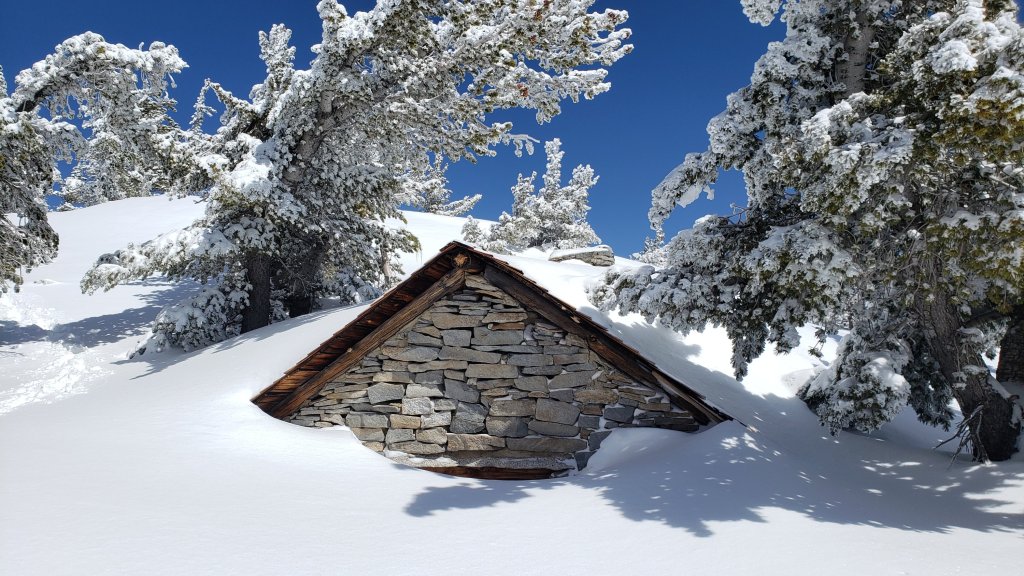
Saddle Junction (8100 ft) at noon on 6th January 2023 with nearly ten inches of total snow depth (above), and the same view one week earlier on 31st December 2022 with a patchy 0.5 inch of ice remaining from prior storms (below).
The Peak Trail at 9800 ft elevation looking north-east. Above, on late morning of 6th January 2023 with only my snowshoe tracks from my ascent and descent that day, and below, the same view on the afternoon of 31st December 2022 prior to a sequence of three storms in a week.
Above, Wellman Divide (9700 ft) on 6th January 2023 and below, the same view on 31st December 2022.
Shallow snow depths at mid elevations are ideal for observing mammal tracks, and the past week has been especially productive, with bobcat and mule deer tracks everywhere. Mountain Lions are also very common in the San Jacinto mountains. Above, where a lion stopped to scan the valley below, South Ridge Trail, 4th January 2023. Below, very fresh tracks where a lion planted prior to jumping up a bank, May Valley Road, 2nd January 2023. The huge claws, usually retracted of course, are visible. In both images, the knife is 3.6 inches long for scale.

Moderate snow storm 1st January 2023

UPDATE Thursday 5th January 2023: We are just catching the southern edge of the highly-publicized storm currently passing through central California. By dusk today it had rained 0.68 inch in Idyllwild, and Long Valley had 1.5 inches of fresh snowfall. The system was generally very mild, with the freeze level near 8000 ft, but this is expected to drop overnight, by which time the precipitation will have largely passed. The next comprehensive update to the Report will hopefully be tomorrow evening, Friday 6th.

UPDATE Tuesday 3rd January 2023: Following another minor overnight snow storm – our fourth in the past week – Anabel and I briskly broke trail up Devil’s Slide to Saddle Junction early this morning. A short video summary of what we found is available here. The high country was above the weather most of the night, and added an inch of fresh snow at most, however there were 2.25 inches in Idyllwild, and also roughly the same fresh snow depth at Humber Park and Saddle Junction. Current known total accumulations are 4 inches in Idyllwild, 6 inches at Devil’s Slide Trailhead, 9 inches at Saddle Junction, and 8 inches at Long Valley. Sadly at first light the precipitation turned to drizzle at all elevations on the western slope between (at least) Idyllwild and 8100 ft at Saddle Junction, and consequently the snow quality was deteriorating fast at mid elevations this morning. It continued to drizzle in Idyllwild all day, slowly accumulating to about 0.25 inch of rain.

————————————–

A positive start to the new year, this is a summary of conditions following the fifth Pacific storm (but only the third significant snowfall) of winter 2022/23 to impact the San Jacinto mountains. Forecasts indicate we will get a few more inches of snow overnight on 2nd-3rd January, and again on Thursday 5th January. The second week of January is expected to be relatively warm and sunny, so extensive melting will start, especially at mid elevations. Clearly conditions are expected to continue to change over the next week or two, so this summary is intentionally brief.

The storm started relatively mild, as might be expected from an “atmospheric river” system pulling moisture in from warmer latitudes, and as a result the freeze level was above 6500 ft for most of the storm, with rain as high as 9000 ft, before finally falling to about 5000 ft on the afternoon of Sunday 1st. Precipitation at the elevation of Idyllwild fell largely as rain (1.79 inches) before turning to “thunder snow” starting at 1235 on Sunday afternoon (currently accumulated to 1.5 inch but still snowing as I write this).

The total snow accumulation was ultimately somewhat below prior forecasts, with San Jacinto Peak receiving about 9-10 inches overnight (rather than the 12-16 anticipated). However subsequent light snow on Sunday 1st improved the depths by another couple of inches.

As I snowshoed down past 9000 ft elevation it was clear from a layer of ice underfoot that after a light snowfall, there had been rain on top of snow, before it started snowing again on top of that Sunday morning. This makes for less than perfect snowshoeing conditions, but still preferable to postholing.

Conditions prior to this storm had been unsettled for several days, with a minor storm overnight on 27th-28th December. This was a very mild system, producing rain to 9000 ft elevation (and consequently very icy conditions), and one inch of fresh snow above about 9000 ft elevation (increasing to 1.5 inch >10,000 ft). There was a further 0.5 inch dusting of snow above 8000 ft on Thursday 29th (as I describe in this video). Conditions are forecast to remain very unsettled for the first week of January. At least two further minor storm systems are forecast, overnight into Tuesday 3rd January, and then again all day on Thursday 5th January, as described in more detail in the Weather section below.

Details of snow depths measured at various locations on the trail system are given at the foot of this posting. Note however that snow depth itself is rarely indicative of the difficulty (or otherwise) of hiking a particular trail.

With at least two further snowfalls expected in the next few days, and strong winds in the high country expected for the next week causing substantial daily drifting of snow, much of the trail system will remain largely obscured by light to moderate snow until the second week of January. Consequently cautious navigation is recommended everywhere.

Snow depths are currently excellent for snowshoeing everywhere above about 8000 ft, potentially lower in places. This will continue to be the case for at least a week, given fresh snowfall expected. With compaction of the trails in the second week of January, snowshoes may steadily become less useful, however they will remain valuable for off-trail travel in the high country for the foreseeable future.

Spikes are currently useful throughout the trail system above about 5000 ft, potentially lower in places. They are not however required, depending upon your comfort level hiking on shallow variable snow, mixed with slushy and icy patches. Spikes will likely become more increasingly useful over the next few days and weeks as established trails become consolidated by hiker traffic and undergo freeze-thaw cycles. Spikes tend to be especially useful for descending trails.

As of the afternoon of Sunday 1st, the only tracks that I saw and that are known to be in place are my snowshoe track between Humber Park and San Jacinto Peak (using Devil’s Slide, Wellman, and Peak trails). There were posthole tracks heading south from Saddle Junction toward Chinquapin Flat. There is already a moderately traveled posthole track on Devil’s Slide Trail, and I was surprised to find that below 7000 ft some of the trail was already slushy simply due to relatively warm air temperatures as there was no direct sun.

Some general comments on snow/ice conditions. Time of day, temperature, and sun exposure all have significant impacts on the nature of the snow, in turn changing the conditions underfoot, and hence both the hiking difficulty and the preferred traction device (if any). These impacts are especially striking in Southern California mountains, where the sun is relatively potent even in midwinter and where even on the coldest days temperatures at mid elevations may fluctuate either side of freezing. A rapidly warming montane climate, with changes especially striking at high elevation, is exacerbating all of these issues.

Currently the snow is relatively powdery and benign; this will steadily change over the next few days and weeks. Note that temperatures fluctuating either side of freezing are forecast for both mid and upper elevations starting in a few days time. Steady melting of snow, especially on sun-exposed slopes, and freeze-thaw cycles will combine to change trail conditions and potentially the preferred equipment for the terrain.

Hikers should be prepared for temperatures below freezing in the high country, and far below freezing when considering wind chill effects (see below for my recent weather observations from San Jacinto Peak).

Currently the USFS gate at Humber Park is closed. When the gate is closed there are still nine legal parking spaces this side of the locked gate (which still require an Adventure Pass or equivalent to be displayed). Vehicles not parked in these spaces may be ticketed and/or towed. If there are “Road Closed” signs further down – as was often the case last winter at weekends and holidays – then those nine spaces are also unavailable for legal parking.

South Ridge Road (5S11) is also currently closed to vehicle traffic.

Dark Canyon Road (4S02, the access to Seven Pines Trail) and Santa Rosa Truck Trail (7S02) closed to vehicle traffic for the season on 7th November 2022. Black Mountain Road also closed on 7th November to vehicle traffic at the gate 1.7 miles up from Highway 243. Forest Service campgrounds at Boulder Basin, Marion Mountain, and Fern Basin are closed for the season. The State Park Stone Creek campground is also closed.

Looking south-west from San Jacinto Peak at sunset on 31st December 2022. The low cloud rising rapidly, indicative of the impending storm, created a spectacular effect as it rose and turned pink over Marion Mountain.

WEATHER

Conditions remain very unsettled for the first week of January. At least two further minor storm systems are forecast, overnight on Monday 2nd into Tuesday 3rd, and then again all day on Thursday 5th. These storms are each expected to produce a further 4-6 inches of snow. However the Tuesday storm is forecast to be much colder, with a freeze level dropping to 5000 ft, with several of inches of snow therefore possible at the elevation of Idyllwild. The high country may be above the cloud for some of that storm, as only 2-3 inches are forecast for the high country. The Thursday system will be significantly warmer, with a freeze level not dropping below about 7000 ft. Precipitation at the elevation of Idyllwild should therefore be rain (0.5-0.7 inch currently forecast), which may therefore largely melt and remove the snow that had fallen earlier in the week at that elevation.

At San Jacinto Peak (10,810ft/3295m) on Sunday 1st January 2023 at 0830 the air temperature was 17.9°F (-8°C), with a windchill temperature of -2.3°F (-19°C), 100% relative humidity, and a sharp WSW wind sustained at 11 mph gusting to 21.1 mph.

At the Peak on Saturday 31st December 2022 at 1650 the air temperature was 24.9°F (-4°C), with a windchill temperature of 4.8°F (-15°C), 62% relative humidity, and a bitter WSW wind sustained at 18 mph gusting to 30.1 mph.

At the Peak on Thursday 29th December 2022 at 0910 the air temperature was 25.8°F (-3°C), with a windchill temperature of 7.2°F (-14°C), 81% relative humidity, and a harsh WNW wind sustained at 12 mph gusting to 25.4 mph.

TRAIL CONDITIONS

All trails above about 5000 ft are currently lightly (or above 8000 ft, moderately) snow-covered.

Reliable tracks are in place (at least) for Devil’s Slide Trail. While my snowshoe track continues from Saddle Junctions through to San Jacinto Peak via Wellman Divide, this may rapidly become obscured by additional light snowfall and/or drifting snow from strong winds.

As discussed above, additional light snowfall on 3rd and 5th January will further complicate the trail conditions.

The 0.4 mile section of South Ridge Trail between Chinquapin Flat/PCT and Tahquitz Peak has no steps to follow through the steeply angled icy snow. Although the snow is not currently particularly deep (10-12 inches) it is heavily drifted and has an ice layer underneath the fresh powder. These icy slopes are notoriously treacherous. Currently spikes at a minimum, and ideally crampons, with an ice axe, are strongly recommended. Snowshoes are not advisable due to the angle of the icy snow.

SNOW DEPTHS measured on 1st January 2023 are as follows. The first number is the depth of fresh snow from this latest storm, followed in parentheses by the current total snow depth. Since the depths given in the previous Report, there had been very minor storms on 28th and 29th December, which added a couple of inches at the highest elevations, down to 0.5 inch at 8000 ft. However I was surprised to find almost all of this had melted by the time I hiked to San Jacinto Peak on 31st December. Note that average depth is given; due to strong winds accompanying the storm there is extensive drifting, often particularly accumulating in the trails. Conversely in some places scouring by the wind means the depths are well below the average. Altitudes are approximate.

San Jacinto Peak (10810 ft): storm total 12 inches (total depth 17-20 inches)

Wellman Divide (9700 ft): 8 inches (total 9 inches)

Annie’s Junction/approx. PCT Mile 181.8 (9070 ft): 9-10 inches (total 11-12 inches)

Long Valley (8600 ft): 8 inches (8-9 inches)

Saddle Junction/approx. PCT Mile 179.9 (8070 ft): 8 inches (8-9 inches)

Devil’s Slide trailhead at Humber Park (6550 ft): 4 inches (total 4 inches)

Idyllwild (at 5550 ft): 3.5 inches (total 3.5 inch).

Saddle Junction (8100 ft elevation) at noon on 1st January 2023 with about five inches of fresh snow at that time (above), and the same view mid afternoon on 31st December 2022 with a patchy 0.5 inch of ice remaining from prior storms (below).

Thank you for taking the time to read this. While all time and labor is volunteered, the San Jacinto Trail Report uses small private donations to cover costs. Your contribution keeps the Report available to all, free from advertising or paywalls, and independent from agencies. If you have found this Report useful, please consider using this link to the Donate page. Zelle, Venmo, and PayPal are all options. Thank you so much for your support.

The Peak Trail at about 10,500 ft elevation looking north-east. Above, on morning of 1st January 2023 following about 8-9 inches of fresh overnight snowfall, and below, the same view on the afternoon of 31st December 2022. In the lower image, Miller Peak is visible to the right.
Above, Wellman Divide (9700 ft) on 1st January 2023 and below, the same view on 31st December 2022.

Weather and trail update 27th December 2022

UPDATE Sunday 1st January 2023: A moderate overnight storm produced 1.53 inches of rain in Idyllwild (at 5550ft). Snowfall in the high country has been somewhat below expectations, with nine inches at San Jacinto Peak (for a current total depth of about 16-18 inches), and 5-6 inches in Long Valley (8600ft, total c.6 inches). However a couple more inches of snow are expected this afternoon, and also on 2nd and 5th January.

UPDATE Thursday 29th December: I have uploaded a video from my hike to San Jacinto Peak this morning (available here on YouTube) where I enjoyed a minor snow storm. Compacted trails – such as Devil’s Slide, Deer Springs, Marion Mountain, South Ridge – are extremely icy between 7400-8900 ft due to the rain yesterday which has now frozen. Spikes are strongly recommended. Between the dustings of snow yesterday and today, high country tracks are becoming obscured and cautious navigation is strongly advised. The forecasts are very unsettled for the next week, but significant snowfall arrives on Saturday 31st (12+ inches expected in the high country) and may continue on/off until Friday 6th January 2023, potentially totaling 2-3 feet above 10,000 ft elevation.

UPDATE Wednesday 28th December: the overnight rain storm produced 0.73 inch in Idyllwild (measured at 5550 ft) while Long Valley (8600 ft) led San Jacinto mountain locations in rainfall with 1.01 inch. Due to the very high freeze level snowfall was restricted to a light dusting above 8200 ft, increasing to one inch above 9000 ft and 1.5 inch above 10,000 ft. Impacts will be minimal on high country trails, but trails between 7000-9000 ft with pre-existing snow may be a mix of slush, snow and ice, and will require some caution.

—————————————-

The holiday weekend had temperatures far above seasonal until Tuesday 27th. Such unseasonably warm temperatures led to rapid snow melt everywhere, despite the low sun angle at this time of year, while in many areas freeze/thaw cycles have resulted in icy trails and roads especially in the early mornings.

Such warm conditions will soon be a distant memory. Multiple “atmospheric river” storm systems are forecast to bring very unsettled weather to the San Jacinto mountains starting Tuesday 27th December, lasting well into the first week of January. While these are expected to bring significant precipitation throughout the state, there remains considerable uncertainty regarding timing and precipitation amounts for Southern California.

A key feature of this sequence of storms will be the relative warmth of the air masses which will lead to high freeze levels. This may mean rain and/or freezing rain as high as 10,000 ft, and challenging layers of icy or mixed snow/ice conditions at all elevations, including the possible melting of some or most preexisting snow below about 8000 ft due to rainfall.

Current forecasts for precipitation suggest as much as three inches of rain around the elevation of Idyllwild (5000-6000 ft) between the evening of Tuesday 27th December 2022 and Friday 6th January 2023. Forecasts for snowfall have varied greatly in both timing and volume, the latter ranging from inches to feet.

The first storm system comes through overnight on Tuesday 27th, with precipitation continuing into the morning of Wednesday 28th. Up to one inch of rain is forecast at mid elevations, but with only a couple of inches of snow likely around the highest peaks as the high country may be above the cloud for some of the storm. The freeze level will initially be above 10,000 ft, ultimately only falling to about 9000 ft, so many of the main access trails to the high country may get no new snowfall.

The second system may be more substantial, with precipitation expected most of the day and night of Saturday 31st December into Sunday 1st January. The freeze level will again start very high, but is forecast to fall lower, with the possibility of a light dusting of snow down to about 5500 ft. Another inch of rain is forecast for mid elevations, but a heavier snowfall is expected in the high country, with predictions ranging from 8-20 inches above 10,000 ft.

Further precipitation is tentatively forecast for 3rd-6th January, but amounts, timing, and freeze levels remain uncertain this far ahead. Again the freeze levels may be relatively high, with little more than an inch or two of snow likely below 6000 ft, a forecast 2-6 inches of fresh snowfall in the high country scattered across two or more days, and roughly 0.5-1.0 inch of rain (perhaps mainly freezing rain) throughout the mid elevations.

Recent hikes have included the high peaks (>10,000 ft) 2-4 times per week by various routes, Tahquitz Peak and area 1-2 times per week, South Ridge, Spitler Peak, and Marion Mountain trails, and May Valley Road and Indian Mountain Truck Trail.

Early morning hikes to San Jacinto Peak have generally had icy snow underfoot with sufficient bite for grippy boots, allowing me to bareboot all the way to San Jacinto Peak. There I generally put on Kahtoola microspikes for the descent. On 22nd for example I wore spikes down to about 7500 ft on Marion Mountain Trail, while on 27th I wore spikes down the Peak and Wellman trails and PCT down to 9000 ft.

Although good tracks are now in place for most major trails (details below), cautious navigation is recommended everywhere. Snow expected in the high country in the early hours of Wednesday 28th is not expected to be sufficient to obscure some of the higher elevation trails and complicate navigation.

Snow depths measured at various locations on the trail system are given at the foot of this posting. Note however that snow depth itself is rarely indicative of the difficulty (or otherwise) of hiking a particular trail. Very shallow snow is often icy and potentially perilous, while deeper powder can actually be much safer, albeit slow-going for hiking. Snow depths are expected to change multiple times over the next ten days due to mixed precipitation, including even possibly loss of snow at mid elevations due to rainfall.

Spikes are currently recommended throughout the trail system above about 7500 ft. They are not however required, depending upon your comfort level hiking on shallow variable snow, potentially mixed with slushy and/or icy patches (depending upon time of day). Spikes are expected to remain extremely useful over the next few weeks given the unpredictable weather. They tend to be especially valuable for descending trails.

Snowshoes are currently not required on the established trail system, which is now too heavily traveled and compacted for snowshoes. However they remain valuable for off-trail travel at elevations above about 9000 ft (potentially lower in places). Snowshoes are likely to become useful (even essential in early January), at least above about 9000 ft, if there is significant snowfall during the coming week or so as forecast.

Hikers should be prepared for temperatures below freezing in the high country, and generally far freezing when considering wind chill effects.

The USFS gate at Humber Park remains closed. Even when the gate is closed there are nine legal parking spaces this side of the locked gate (near the upper Ernie Maxwell trailhead; these nine space still require an Adventure Pass or equivalent). Vehicles not parked in these spaces have been ticketed and/or towed. If there are “Road Closed” signs further down – as was often the case last winter especially at weekends and holiday periods after fresh snowfall – then those nine spaces are also unavailable for legal parking.

South Ridge Road (5S11) remains closed to vehicle traffic. On 24th the road had about 30% patchy ice cover.

Dark Canyon Road (4S02, the access to Seven Pines Trail) and Santa Rosa Truck Trail (7S02) closed to vehicle traffic for the season on 7th November 2022. Black Mountain Road also closed on 7th November to vehicle traffic at the gate 1.7 miles up from Highway 243. Forest Service campgrounds at Boulder Basin, Marion Mountain, and Fern Basin, and the State Park campground at Stone Creek, are closed for the season.

Red sky in the morning…… Tahquitz Peak as seen from the PCT north of Saddle Junction shortly before sunrise, 27th December 2022.

WEATHER

The strange rollercoaster ride that has been winter 2022/23 so far will continue for the foreseeable future. Multiple mild storm systems are forecast to bring extremely unsettled weather to the San Jacinto mountains starting Tuesday 27th December, lasting well into the first week of January. Latest details are given in the introduction above. Rainfall may continue at mid elevations potentially for several consecutive days, and the relative warmth of the air masses may produce rain and/or freezing rain as high as San Jacinto Peak, challenging layers of icy or mixed snow/ice conditions at all elevations, and perhaps melting of much preexisting snow below about 8000 ft.

Current forecasts for precipitation suggest as much as three inches of rain around the elevation of Idyllwild (5000-6000 ft) between the afternoon of Tuesday 27th December 2022 and Wednesday 4th January 2023. Regarding snowfall, the high country may be above the cloud at times, with dustings of snow above about 7000 ft across much of the nine day period, but with the highest probability for a heavy snowfall on Saturday 31st December, totaling 8-15 inches.

At San Jacinto Peak (10,810ft/3295m) on Tuesday 27th December 2022 at 0850 the air temperature was 31.2°F (-1°C), with a windchill temperature of 15.1°F (-9°C), 31% relative humidity, and a sharp WSW wind sustained at 17 mph gusting to 26.1 mph.

At the Peak on Thursday 22nd December 2022 at 0910 the air temperature was 39.9°F (4°C), with a windchill temperature of 30.4°F (-1°C), 13% relative humidity, and a light WNW wind sustained at 9 mph gusting to 13.8 mph.

At the Peak on Monday 19th December 2022 at 0920 the air temperature was 31.3°F (0°C), with a windchill temperature of 20.7°F (-6°C), 9% relative humidity, and a gentle WNW wind sustained at 5 mph gusting to 9.9 mph.

Little Round Valley (9800ft) on 22nd December 2022. There is now a relatively well-traveled track through the snow up to San Jacinto Peak (visible to left of sign).

TRAIL CONDITIONS

All trails above about 7500 ft remain lightly snow-covered. However, relatively well-traveled tracks are now in place for most major trails (details below). These conditions are expected to change significantly over the next ten days due to the highly unsettled weather forecast into early January.

The Ernie Maxwell Scenic Trail is largely clear of icy snow, with a few patches remaining, mostly close to Humber Park.

Devil’s Slide Trail is functionally clear of snow below 7600 ft, about two miles up, and then snow cover is about 60% up to Saddle Junction but becoming almost continuous within 0.2 mile of the junction. Spikes are recommended.

The 0.4 mile section of South Ridge Trail between Chinquapin Flat/PCT and Tahquitz Peak has a lightly traveled posthole track to follow through the drifted powder. Although not essential in the moderate depth powder, spikes are strongly recommended and many hikers will find them useful especially for descending. Hikers who have an ice axe (and know how to use it) may find it useful in places on this short section of trail. This trail will become significantly more treacherous as it is expected to add freezing rain and/or layers of snow and ice over the next ten days.

For about one mile north of Saddle Junction, snow cover is only a patchy 30% on the sun exposed slope (“Angel’s Glide”) and then averages about 50% on the Wellman Trail, but then icy snow cover is about 95% on the Peak Trail to San Jacinto Peak. However the route is now well-traveled and compacted.

There is a lightly traveled compacted snowshoe track on the East Ridge between Miller Peak and San Jacinto Peak but it does not accurately follow the route of the East Ridge Trail.

There is a compacted, well-traveled track on continuous light icy snow from Long Valley/Tram to Wellman Divide.

Skyline Trail has a good track to follow through very thin and patchy icy snow above about 7200 ft (the Traverse to Grubb’s Notch). Some hikers will find spikes preferable.

South Ridge Trail [updated 24th December] has about 30% icy snow cover from the top of South Ridge Road to Old Lookout Flat (7600 ft). To Tahquitz Peak snow cover averages about 40%, alternating on the 18 switchbacks between those that are largely clear (south-facing) and those that are largely snow-covered (north-facing). There is a well-traveled track to follow through the very light and patchy 1-3 inches of icy snow. Spikes are not generally required for ascending, but most hikers will find them useful for descending.

Deer Springs Trail [updated 22nd December] has an accurate track to follow all the way to San Jacinto Peak as I broke trail the entire way down to the Suicide Rock Trail junction on 15th December. I was pleased to see that over the weekend some posthole tracks were added on top of my snowshoe track from last week all the way up Deer Springs Trail to San Jacinto Peak. Although my original track accurately followed the trail above Little Round Valley, there are now a fair number of alternate shortcut tracks across this slope, so cautious navigation is advised. The trail is largely clear of snow from Highway 243 to Strawberry Junction, and with about 60% snow cover from there up to 8600 ft.

Marion Mountain Trail [updated 22nd December] has a well-defined but lumpy posthole track throughout. Spikes are recommended, at least for descending. A few cleared patches are developing below 7000 ft.

Seven Pines Trail has not been traveled since the storm in mid December, at least not in its uppermost section, and there is no track to follow through the snow.

Spitler Peak Trail is now functionally clear of snow. There is a very visible boot track – through light snow in places in its upper switchbacks – to the PCT.

SNOW DEPTHS measured on 22nd-27th December 2022 are as follows. The first number is the current total snow depth, followed in parentheses by the greatest depth of the winter to date following the latest storm on 11th-12th December. Note that average depth is given; due to strong winds accompanying the storm there is extensive drifting, often particularly accumulating in the trails. Conversely in some places scouring by the wind means the depths are well below the average. Altitudes are approximate.

San Jacinto Peak (10810 ft): 6-8 inches (12-14 inches on 12th December)

Little Round Valley (9800 ft): 8 inches (10-12 inches on 12th December)

Wellman Divide (9700 ft): 0-2 inches (7 inches on 12th December)

Annie’s Junction/approx. PCT Mile 181.8 (9070 ft): 2-3 inches (5.5 inches on 12th December)

Marion Mountain Trail at junction with PCT (8700 ft): 3-4 inches (6 inches on 12th December)

Long Valley (8600 ft): 1-2 inches (5-6 inches on 12th December)

Strawberry Junction (8100 ft): 0-1 inches (4 inches on 12th December)

Saddle Junction/approx. PCT Mile 179.9 (8070 ft): 0-1 inch (4 inches on 12th December)

Devil’s Slide trailhead at Humber Park (6550 ft): 0 inch (3.5 inches on 12th December)

Idyllwild (at 5550 ft): 0 inch (3.0 inches on 12th December).

Thank you for taking the time to read this. While all time and labor is volunteered, the San Jacinto Trail Report uses small private donations to cover costs. Every year seems to have its unique challenges and 2022 has been no exception. Your contribution keeps the Report available to all, free from advertising or paywalls, and independent from agencies. If you have found this Report useful, please consider using this link to the Donate page. Zelle, Venmo, and PayPal are all options. Thank you so much for your support.

South Fork of the San Jacinto River, 20th December 2022. On our hike down the South Fork Wilderness Trail we were surprised to find the “river” was completely dry at 3000 ft elevation where it is crossed by the trail. Despite what is generally regarded as reasonable precipitation so far this winter, evidently water is not being released from Lake Hemet. Hopefully this may change in the next couple of weeks.

Snow and trail update 21st December 2022

WEATHER UPDATE 23rd December: forecasts have been shifting dramatically in recent days. Following an unusually warm weekend, multiple “atmospheric river” storms will bring cold, cloudy weather with variable precipitation from Tuesday 27th December well into the first week of January. There is considerable uncertainty regarding timing and precipitation amounts for Southern California. Two or more inches of rain are likely for mid elevations (e.g., Idyllwild) on 27th-30th, with several inches of snow possible above 10,000 ft elevation on various days over the next week or so. High freeze levels may mean rain and/or freezing rain at the highest peaks at times, and icy or mixed snow/ice conditions at all elevations. The next full update will likely be on the afternoon of 25th.

————————————-

Conditions immediately following last week’s snow storm, the second significant Pacific system of winter 2022/23, that impacted the San Jacinto mountains on 11th-12th December were summarized in the previous Report (available here).

A major warming trend will significantly change conditions on the trail system in the next week or two. The week from 21st-26th December may be among the warmest on record for the year-end holiday period. In Idyllwild for several days both overnight low and daytime high temperatures will be more typical of March or even April than of late December. In the high country temperatures will be more like April or May, some 10-20°F above seasonal, before finally cooling (but still remaining above average) in the last couple of days of the year. Most significantly – in terms of snow conditions – daytime temperatures at all elevations will be well above freezing for about a week starting 20th.

Such unseasonably warm temperatures mean that snow melt will be rapid everywhere while in many areas freeze/thaw cycles will result in icy trails in the early mornings above about 7000 ft. By late morning snow conditions will become poor for hiking (soft, slippery, and even slushy) especially in sun-exposed areas.

On Thursday 15th I ascended San Jacinto Peak via the east side (Devil’s Slide, Wellman, and Peak trails) and descended the west side via Deer Springs Trail, while on Monday 19th we hiked to the Peak up and down the east side trails. In the week since the last storm we have surveyed trails around Tahquitz Peak twice, plus South Ridge, Spitler Peak, and Marion Mountain trails, among others.

On 15th I barebooted (i.e. no traction device) to 9000 ft on a lightly traveled and lumpy posthole track through thin icy snow. I snowshoed the rest of the way to San Jacinto Peak through lovely light powder. I descended via Deer Springs Trail, breaking trail snowshoeing through virgin powder all the way down to the Suicide Rock Trail junction.

On 19th the cold icy early morning snow had good bite for grippy boots and I barebooted all the way to San Jacinto Peak. I was surprised to find that no one had made it through on the Wellman Trail over the weekend, so I postholed somewhat over my snowshoe tracks from 15th until Wellman Divide. From there the Peak Trail was easy going, having been well-traveled by hikers coming up the Tram. I put on my Kahtoola microspikes to descend from the Peak, ultimately leaving them on most of the way down Devil’s Slide Trail.

Although good tracks are now in place for most major trails (details below), cautious navigation is recommended everywhere.

Snow depths measured at various locations on the trail system are given at the foot of this posting. Note however that snow depth itself is rarely indicative of the difficulty (or otherwise) of hiking a particular trail. Very shallow snow is often icy and potentially perilous, while deeper powder can actually be much safer, albeit slow-going for most hikers.

Spikes are currently recommended throughout the trail system above about 6500 ft. They are not however required, depending upon your comfort level hiking on shallow variable snow, potentially mixed with slushy and/or icy patches (depending upon time of day). Spikes will likely become increasingly useful over the next few days and weeks as established trails become consolidated by hiker traffic and undergo freeze-thaw cycles. They tend to be especially useful for descending trails.

Snowshoes are no longer required on the established trail system, which is now too compacted for snowshoes. However they will remain very valuable for off-trail travel at elevations above about 9000 ft (potentially lower in places) for the next week or two at least.

Note that temperatures fluctuating either side of freezing are forecast for mid to upper elevations (at least >6000 ft) for the foreseeable future. Melting of snow on sun-exposed slopes and freeze-thaw cycles will combine to change trail conditions and potentially the preferred equipment for the terrain. The advice above should be used with this in mind, and if in any doubt carry the necessary traction devices that you will be most comfortable using.

Despite warmer temperatures on some days, hikers should be prepared for temperatures near freezing in the high country, and generally below freezing when considering wind chill effects (see below for my recent weather observations from San Jacinto Peak).

Currently the USFS gate at Humber Park remains closed. Even when the gate is closed there are nine legal parking spaces this side of the locked gate (near the upper Ernie Maxwell trailhead). Vehicles not parked in these spaces may be ticketed and/or towed. If there are “Road Closed” signs further down – as was often the case last winter especially at weekends and holiday periods – then those nine spaces are also unavailable for legal parking.

South Ridge Road (5S11) is also currently closed to vehicle traffic.

Dark Canyon Road (4S02, the access to Seven Pines Trail) and Santa Rosa Truck Trail (7S02) closed to vehicle traffic for the season on 7th November 2022. Black Mountain Road also closed on 7th November to vehicle traffic at the gate 1.7 miles up from Highway 243. Forest Service campgrounds at Boulder Basin, Marion Mountain, and Fern Basin, and the State Park campground at Stone Creek, are closed for the season.

Anabel taking a well-earned break in 4-5 inches of lovely fluffy powder at Old Lookout Flat (7600 ft) on South Ridge Trail, 13th December 2022. Tahquitz Peak is directly behind her with the San Jacinto high country in the distance on the left.

WEATHER

The forecast for the last ten days of December differs radically from what was predicted just a week ago, and a major warming trend is expected rather than another cold Pacific storm. Indeed the final third of December may be one of the warmest on record for the holiday period. Temperatures will climb steadily this week and be well above seasonal for at least 21st-28th December. In Idyllwild both overnight low and daytime high temperatures will be more typical of late March or even April than of late December. In the high country temperatures will be 10-20°F above seasonal and, more significantly regarding snow/ice conditions, well above freezing for at least a week.

Despite the relatively weak sun at this time of year, such warm temperatures mean that snow melt may be unusually rapid (for December) at all elevations, snow conditions will generally be poor for hiking (soft, slippery, and even slushy), while in many areas conditions will be ideal for freeze/thaw cycles and hence icy trails in the early mornings above about 7000 ft.

There is precipitation forecast from Wednesday 28th into the first week of 2023. Light or moderate rain is currently forecast daily at mid elevations (possibly totaling one inch in Idyllwild), with an uncertain possibility of light snow in the high country (<3 inches above 10,000 ft elevation).

At San Jacinto Peak (10,810ft/3295m) on Monday 19th December 2022 at 0920 the air temperature was 31.3°F (0°C), with a windchill temperature of 20.7°F (-6°C), 9% relative humidity, and a light WNW wind sustained at 5 mph gusting to 9.9 mph.

At the Peak on Thursday 15th December 2022 at 0715 the air temperature was 28.0°F (-2°C), with a windchill temperature of 13.9°F (-10°C), 52% relative humidity, and a chilly WNW wind sustained at 9 mph gusting to 14.5 mph.

At the Peak on Monday 12th December 2022 at 0715 the air temperature was 9.7°F (-12°C), with a windchill temperature of -13.4°F (-25°C), 100% relative humidity, and a sharp WSW wind sustained at 12 mph gusting to 21.2 mph.

Upper end of Little Round Valley (9800 ft) on 15th December 2022, with about ten inches of snow, mostly from the storm four days earlier.

TRAIL CONDITIONS

All trails above about 6500 ft remain lightly (or above 9000 ft, moderately) snow-covered. However, relatively well-traveled tracks are now in place for most major trails (details below).

The Ernie Maxwell Scenic Trail has a well-traveled track to follow throughout its length, snow cover is about 80%.

Devil’s Slide Trail has an excellent compacted track to follow to Saddle Junction. Snow cover is only 50% below 6700 ft, about 95% up to 7200 ft, and continuous thereafter. However it is thinning rapidly everywhere, and will look radically different in a week or so.

Early on the morning of Saturday 17th I broke trail back-and-forth across the 0.4 mile section of South Ridge Trail between Chinquapin Flat/PCT and Tahquitz Peak which now has a lightly traveled posthole track to follow through the drifted powder. The average snow depth in this area is only about five inches, but on this slope it is heavily drifted in places at 10-12 inches. Although not essential in the moderate depth powder, spikes are strongly recommended and many hikers will find them useful especially for descending. Hikers who have an ice axe (and know how to use it) may find it useful in places on this short section of trail. This trail will become significantly more treacherous as it undergoes freeze/thaw cycles and compaction over the next week or two.

Immediately north of Saddle Junction, snow cover is starting to become somewhat patchy on the sun exposed slope (“Angel’s Glide”) but icy snow cover is continuous through the Wellman and Peak trails to San Jacinto Peak. However the route is now largely well-traveled and compacted.

There is a compacted, well-traveled track on continuous light icy snow from Long Valley/Tram to Wellman Divide.

Skyline Trail has a good track to follow through light icy snow above about 7200 ft (the Traverse to Grubb’s Notch). Spikes are recommended.

South Ridge Trail from the top of South Ridge Road to Tahquitz Peak has a well-traveled track to follow through the very light and patchy 1-3 inches of icy snow. Spikes are not required for ascending, but some hikers will find them useful for descending.

Deer Springs Trail [updated 22nd December] has an accurate track to follow all the way to San Jacinto Peak as I broke trail the entire way down to the Suicide Rock Trail junction on 15th December. I was pleased to see that over the weekend some posthole tracks were added on top of my snowshoe track from last week all the way up Deer Springs Trail to San Jacinto Peak. Although my original track accurately followed the trail above Little Round Valley, there are now a fair number of alternate shortcut tracks across this slope, so cautious navigation is advised. There is a very well-traveled track on the lowest section of Deer Springs Trail continuing out to Suicide Rock.

Marion Mountain Trail [updated 22nd December] has a well-defined but lumpy posthole track throughout. Snow cover remains virtually continuous, but a few small patches are clearing below 7000 ft. Spikes are strongly recommended, at least for descending.

Seven Pines Trail has not been traveled since last week’s storm, at least not in its uppermost section, and there is no track to follow through the snow.

Spitler Peak Trail has a very visible boot track – through light snow in its upper switchbacks – to the PCT.

SNOW DEPTHS measured on 19th December (east side) or 15th December (west side) 2022 are as follows. The first number is the current total snow depth, followed in parentheses by the greatest depth of the winter to date following the latest storm on 11th-12th December. Note that average depth is given; due to strong winds accompanying the storm there is extensive drifting, often particularly accumulating in the trails. Conversely in some places scouring by the wind means the depths are well below the average. Altitudes are approximate.

San Jacinto Peak (10810 ft): 10-12 inches (12-14 inches on 12th December)

Little Round Valley (9800 ft): 9 inches (10-12 inches on 12th December)

Wellman Divide (9700 ft): 2-4 inches (7 inches on 12th December)

Annie’s Junction/approx. PCT Mile 181.8 (9070 ft): 4-5 inches (5.5 inches on 12th December)

Marion Mountain Trail at junction with PCT (8700 ft): 4-6 inches (6 inches on 12th December)

Long Valley (8600 ft): 3-4 inches (5-6 inches on 12th December)

Strawberry Junction (8100 ft): 3 inches (4 inches on 12th December)

Saddle Junction/approx. PCT Mile 179.9 (8070 ft): 3 inches (4 inches on 12th December)

Devil’s Slide Trail at Humber Park (6550 ft): 0-1 inches (3.5 inches on 12th December)

Idyllwild (at 5550 ft): 0 inch (3.0 inches on 12th December).

Relatively fresh Mountain Lion track, at 6500 ft near Deer Springs Trail, 15th December 2022 (above). The knife is 3.6 inches long for scale. Below, fresh, large Bobcat tracks, 17th December 2022, at 8600 ft on South Ridge Trail.

Thank you for taking the time to read this. While all time and labor is volunteered, the San Jacinto Trail Report uses small private donations to cover costs. Every year seems to have its unique challenges and 2022 has been no exception. Your contribution keeps the Report available to all, free from advertising or paywalls, and independent from agencies. If you have found this Report useful, please consider using this link to the Donate page. Zelle, Venmo, and PayPal are all options. Thank you so much for your support.
The Peak Trail just above Wellman Divide at 9800 ft on 19th December 2022 (above), and the same view one week earlier on 12th December (below).

Moderate snow storm 11th-12th December 2022

UPDATE Saturday 17th December 2022: Early this morning we hiked South Ridge Trail to Tahquitz Peak, and I broke trail from Tahquitz Peak to and from Chinquapin Flat through moderate snow. No tracks had made it as far as Chinquapin from Saddle Junction at that time. Trail conditions are updated below.

UPDATE Thursday 15th December 2022: Early this morning I hiked to San Jacinto Peak from Humber via Devil’s Slide, Wellman and Peak trails. I barebooted to 9000 ft, then snowshoed the rest of the way through lovely light powder. I descended via Deer Springs Trail, breaking trail through virgin powder all the way down to the Suicide Rock Trail junction. Most major trails now have a track through the snow to follow, details have been updated below.

UPDATE Wednesday 14th December 2022: Early this morning Anabel and I broke trail up Spitler Peak Trail to the PCT. There was thin patchy snow at the trailhead (4900 ft) and then it was largely continuous above 5800 ft. Most of the upper half of the trail had 3-4 inches of lovely fluffy powder. I was very happy to find no new treefall hazards down on Spitler Peak Trail. The lower half of the trail should be largely clear of snow by the weekend.

UPDATE Tuesday 13th December 2022: This morning Anabel and I broke trail up South Ridge Road and South Ridge Trail to Old Lookout Flat (7600 ft). Note that South Ridge Road (5S11) is closed to vehicle traffic. I measured an average of about four inches of snow at Old Lookout Flat, although with some deeper drifts in the trail.

————————————

This is a summary of conditions following the second significant Pacific storm of winter 2022/23 to impact the San Jacinto mountains. The “atmospheric river” of moisture from lower latitudes was weaker than the storm in early November, although snowfall was ultimately slightly greater in this storm than in November, perhaps in part due to the colder temperatures. The system averaged colder than the November storm, with more snow at lower elevations, although it was still notable that it initially rained as high as 9500 ft on the morning of Sunday 11th. There was a dusting of snow in Garner Valley (4300 ft).

The total snow accumulation was ultimately very close to that forecast in the days immediately prior to the storm. The rainfall totals at mid elevations were unremarkable, especially compared to those of the storm in early November (discussed here). As forecast, the storm came in two main waves, with the bulk of the precipitation falling for most of the daylight hours of Sunday 11th, followed by a remarkably calm and clear night, and then a much less intense period of snowfall between about 0800-1300 on Monday 12th.

For example, San Jacinto Peak received about 9 inches of fresh powder (on top of about 2-4 patchy inches of icy snow remaining from November) on Sunday 11th, with an additional inch falling on Monday 12th. In Idyllwild (data from 5550 ft) there was 1.14 inches of rain on Sunday 11th which turned to snow that afternoon, settling to 0.5 inch. On the morning of Monday 12th a further 2.5 inches of snow settled in Idyllwild.

I recorded a short video at San Jacinto Peak early on the morning of Monday 12th December (available here) which gives a feel for conditions as the storm was nearing its end.

As of the afternoon of Monday 12th, the only tracks that I saw and that are known to be in place are my snowshoe track between Humber Park and San Jacinto Peak (using Devil’s Slide, Wellman, and Peak trails), and the track of Kyle Eubanks from the previous evening between Long Valley and the Peak via Wellman Divide (which remained surprisingly visible in places about 15-20 hours later, showing how calm the winds were overnight).

Although snow depths are not generally sufficient to obscure the routes of the major trails, cautious navigation is recommended everywhere for the next few days in particular until tracks through the snow are in place.

Details of snow depths measured at various locations on the trail system are given at the foot of this posting. Note however that snow depth itself is rarely indicative of the difficulty (or otherwise) of hiking a particular trail.

Some general comments on snow/ice conditions. Time of day, temperature, and sun exposure all have significant impacts on the nature of the snow, in turn changing the conditions underfoot, and hence both the hiking difficulty and the preferred traction device (if any). These impacts are especially striking in Southern California mountains, where the sun is relatively potent even in midwinter and where even on the coldest days temperatures at mid elevations may fluctuate either side of freezing. A rapidly warming montane climate, with changes especially striking at high elevation, is exacerbating all of these issues.

Currently the snow is relatively powdery and benign; this will steadily change over the next few days and weeks. Note that temperatures fluctuating either side of freezing are forecast for both mid and upper elevations for the foreseeable future. Steady melting of snow, especially on sun-exposed slopes, and freeze-thaw cycles will combine to change trail conditions and potentially the preferred equipment for the terrain.

Snow depths are currently suitable for snowshoeing everywhere above about 8000 ft, possibly lower in places. However they are not required, depending on your comfort level with postholing in drifted snow of moderate depth. With compaction of the trails over the next few days, snowshoes will become less useful on-trail, however they will remain valuable for off-trail travel at the highest elevations for the foreseeable future.

Spikes are currently useful throughout the trail system above about 5000 ft, potentially lower in places. They are not however required, depending upon your comfort level hiking on shallow variable snow, mixed with slushy and icy patches. Spikes will likely become increasingly useful over the next few days and weeks as established trails become consolidated by hiker traffic and undergo freeze-thaw cycles. They tend to be especially useful for descending.

For the foreseeable future hikers should be prepared for temperatures below freezing in the high country, and well below freezing when considering wind chill effects (see below for my recent weather observations from San Jacinto Peak).

Currently the USFS gate at Humber Park is closed. This may change after the weekend. When plowed Humber will remain very icy for the next few days at least. Even when the gate is closed there are nine legal parking spaces this side of the locked gate (near the upper Ernie Maxwell trailhead). Vehicles not parked in these spaces may be ticketed and/or towed. If there are “Road Closed” signs further down – as was often the case last winter – then those nine spaces are also unavailable for legal parking.

South Ridge Road (5S11) is currently closed to vehicle traffic but is rapidly clearing [checked Saturday 17th] of snow.

Dark Canyon Road (4S02, the access to Seven Pines Trail) and Santa Rosa Truck Trail (7S02) closed to vehicle traffic for the season on 7th November 2022. Black Mountain Road also closed on 7th November to vehicle traffic at the gate 1.7 miles up from Highway 243. Forest Service campgrounds at Boulder Basin, Marion Mountain, and Fern Basin are closed for the season. The State Park Stone Creek campground is also closed.

The Peak “Trail” at about 10,500 ft looking north-east, late morning of 12th December 2022. Miller Peak is just visible in the distance. About eight inches of snow had fallen here the previous day.

WEATHER

Temperatures are forecast to remain near or below seasonal averages for at least the next week, with freezing conditions every night above about 4000 ft elevation. Most days will be at least partly cloudy. Combined with a weak sun at this time of year, snow melt will generally be very slow at upper elevations, and conditions will be ideal for freeze/thaw cycles and hence icy trails. The significant Pacific storm of the winter that had been forecast over an extended period between about 16th-21st December is no longer thought likely to impact the San Jacinto mountains, although considerable uncertainty persists in the weather models for that period.

At San Jacinto Peak (10,810ft/3295m) on Thursday 15th December 2022 at 0715 the air temperature was 28.0°F (-2°C), with a windchill temperature of 13.9°F (-10°C), 52% relative humidity, and a chilly WNW wind sustained at 9 mph gusting to 14.5 mph.

At the Peak on Monday 12th December 2022 at 0715 the air temperature was 9.7°F (-12°C), with a windchill temperature of -13.4°F (-25°C), 100% relative humidity, and a sharp WSW wind sustained at 12 mph gusting to 21.2 mph.

At the Peak on Thursday 8th December 2022 at 0900 the air temperature was 28.4°F (-2°C), with a windchill temperature of 12.7°F (-11°C), 11% relative humidity, and a fresh SW wind sustained at 7 mph gusting to 9.3 mph.

The view north from Old Lookout Flat (7600 ft) on South Ridge Trail, 13th December 2022. Tahquitz Peak is near right, and the San Jacinto high country is distant left.

TRAIL CONDITIONS

All trails above about 5500 ft are currently lightly (or above 8500 ft, moderately) snow-covered. Underlying the fresh snow is – in places – a thin layer of ice and/or icy snow remaining from the previous storm in early November. This will make trail conditions more complicated, and if in any doubt whatsoever carry and use traction devices accordingly (see discussion in introduction above).

Devil’s Slide Trail has an excellent compacted track to follow to Saddle Junction.

Early on the morning of Saturday 17th I broke trail back-and-forth across the 0.4 mile section of South Ridge Trail between Chinquapin Flat/PCT and Tahquitz Peak which now has a lightly traveled posthole track to follow through the drifted powder (photo below). The average snow depth in this area is only about five inches, but on this slope it is heavily drifted in places at 10-12 inches. Although not essential in the moderate depth powder, spikes are strongly recommended and many hikers will find them useful especially for descending. Hikers who have an ice axe (and know how to use it) may find it useful in places on this short section of trail. This trail will become significantly more treacherous as it undergoes freeze/thaw cycles and compaction over the next week or two.

There is evidence of a relatively well-traveled track south from Saddle Junction on the PCT, but as of the morning of Saturday 17th this track did not make it through to Chinquapin Flat.

There is an excellent snowshoe track to follow on the Wellman Trail and the Peak Trail up to San Jacinto Peak.

There is a relatively well-traveled track on the Round Valley Trail from Long Valley through to Wellman Divide.

Deer Springs Trail [updated 15th December] now has an accurate snowshoe track to follow all the way to San Jacinto Peak as I broke trail the entire way down to the Suicide Rock Trail junction on the afternoon of 15th. Unusually for me, I followed the entire route of the established trail down to Little Round Valley. There is a well-traveled track on the lowest section of Deer Springs Trail continuing out to Suicide Rock.

Marion Mountain Trail [updated 15th] has a mix of snowshoe and posthole tracks all the way up to its junction with Deer Springs Trail.

The Ernie Maxwell Scenic Trail has a well-traveled track to follow throughout, snow cover is 90%.

South Ridge Trail [hiked 13th and 17th December] has a well-traveled posthole track through shallow snow as far as Tahquitz Peak. Spikes are not essential but will be useful for most hikers, especially for descending. Melting has already reduced the snow cover to 90% as far as Old Lookout Flat (7600 ft).

Spitler Peak Trail has a very visible boot track through light snow to the PCT.

Seven Pines Trail has no sign of any hiker traffic since the snow on 12th.

My posthole track breaking trail through drifted powder on the short section of South Ridge Trail on the north side of Tahquitz Peak, 17th December 2022. This route may get some traffic over the weekend of 17th-18th but will also become more icy over the next week or two.

SNOW DEPTHS measured on 12th November 2022 are as follows (measured on 15th for Deer Springs Trail locations). The first number is the current total snow depth, followed in parentheses by the storm total for this latest storm 11th-12th December. Note that average depth is given; due to strong winds accompanying the storm there is extensive drifting, often particularly accumulating in the trails. Conversely in some places scouring by the wind means the depths are well below the average. Altitudes are approximate.

San Jacinto Peak (10810 ft): 12-14 inches (storm total 10 inches)

Little Round Valley (9800 ft): 10-12 inches (storm total 7 inches)

Wellman Divide (9700 ft): 7 inches (storm total 6 inches)

Round Valley (9100 ft): 6 inches (storm total 5 inches) [thanks to Kyle Eubanks for this measurement]

Annie’s Junction/approx. PCT Mile 181.8 (9070 ft): 5.5 inches (storm total 5 inches)

Marion Mountain Trail at junction with PCT (8700 ft): 6 inches (storm total 5 inches)

Long Valley (8600 ft): 5-6 inches (storm total 5 inches) [thanks to Kyle Eubanks for this measurement]

Strawberry Junction (8100 ft): 3-4 inches (storm total 3-4 inches)

Saddle Junction/approx. PCT Mile 179.9 (8070 ft): 4 inches (storm total 3.5 inches)

Devil’s Slide Trail at Humber Park (6550 ft): 3.5 inches (storm total 3.5 inches)

Idyllwild (at 5550 ft): 3.0 inches (storm total 3.0 inches).

PCT Mile 168.5 at its junction with Spitler Peak Trail, 14th December 2022. Apache Peak is to the upper left. Snow depth averaged 3-4 inches here at about 7000 ft elevation.

While all time and labor is volunteered, the San Jacinto Trail Report uses small private donations to cover costs. Every year seems to have its unique challenges and 2022 has been no exception. Your contribution keeps the Report available to all, free from advertising or paywalls, and independent from agencies. If you have found this Report useful, please consider using this link to the Donate page. Zelle, Venmo, and PayPal are all now options. Thank you so much for your support.

Saddle Junction (8100 ft) at about noon on 12th December 2022 (above), and the same view roughly 24 hours earlier on 11th December (below). About 3.0-3.5 inches of fresh snow had fallen in the intervening period.
Wellman Divide (9700 ft) on 12th December 2022 with about six inches of fresh snow (above) and the same view on 11th December when largely covered by verglas (below).

Storm updates 11th-12th December 2022

The second significant Pacific storm of winter 2022/23 is currently impacting the San Jacinto mountains. This storm is expected to have two periods of precipitation, one each on 11th and 12th. Please check this page for periodic updates throughout the storm (the most recent is at the top).

UPDATE on Monday 12th at 0810

A short video giving a feel for current snow conditions at San Jacinto Peak is available here on YouTube.

No fresh snow fell overnight, with storm totals of about nine inches at San Jacinto Peak and 0.5 inch in Idyllwild unchanged. That said, it has just started gently snowing in both locations, so storm totals may increase slightly over the next couple of hours.

UPDATE on Sunday 11th at 1930

It has stopped snowing both in Idyllwild (current storm total 0.75 inch snow plus 1.14 inches of rain) and at San Jacinto Peak (9 inches snow).

Many thanks to Kyle Eubanks who I chatted with at the Peak this afternoon. He has just reported storm snow totals of 5-6 inches at Wellman Divide (9700 ft) and four inches in both Round and Long valleys from his descending hike.

UPDATE on Sunday 11th at 1645

In Idyllwild at 5550 ft, rainfall storm total today is 1.14 inches. It turned to occasional light snow showers at about 1430, with just 0.5 inch settled so far.

Moderate snow has continued for the past few hours at San Jacinto Peak, with a storm total so far of about 7.5 inches. The high winds forecast did not materialize, although gusts up to 35 mph have been enough to cause very heavy drifting.

Fresh snowfall in Long Valley is now at about four inches.

UPDATE on Sunday 11th at 1330

Precipitation has been steady at mid and upper elevations for the past few hours. Fresh snow at San Jacinto Peak now measures 3-4 inches, snow in Long Valley (8600 ft) at three inches, and rainfall in Idyllwild since 0700 this morning at 0.6 inch.

Dutch Flat, at about 5600 ft elevation between Idyllwild and Pine Cove, recorded 0.86 inch of rain by 1300.

UPDATE on Sunday 11th at 1050

Very light precipitation well before first light this morning included a dusting of snow above 6000 ft, <0.25 inch below 8000 ft and about 0.25 inch above that elevation, plus 0.03 inch of drizzle in Idyllwild.

On my hike up to San Jacinto Peak late this morning there was a little drizzle on most of Devil’s Slide Trail, then an on/off mix of drizzle, freezing rain,, and fine snow in the high country.

Currently there is about 1.5 inches of fresh snow at San Jacinto Peak, on top of the very patchy and icy 2-4 inches remaining from early November. However the fresh powder is very fine and drifting heavily in the strong SW wind, and I had 2-3 inches in places in the upper Peak Trail.

In Idyllwild (at 5550 ft) additional light rain this morning has added up to 0.1 inch. The rain has becoming heavier in the past hour or so. It remains well above freezing there, currently at 41°F.

Long Valley (8600 ft) has received about 1.0 inch fresh snow this morning.

Wellman Divide (9700 ft), late morning on Sunday 11th December 2022.

While all time and labor is volunteered, the San Jacinto Trail Report uses small private donations to cover costs. Every year seems to have its challenges and 2022 has been no exception. Your contribution keeps the Report available to all, free from advertising or paywalls, and independent from agencies. If you have found this Report useful, please consider using this link to the Donate page. Zelle, Venmo, and PayPal are all options. Thank you so much for your support.
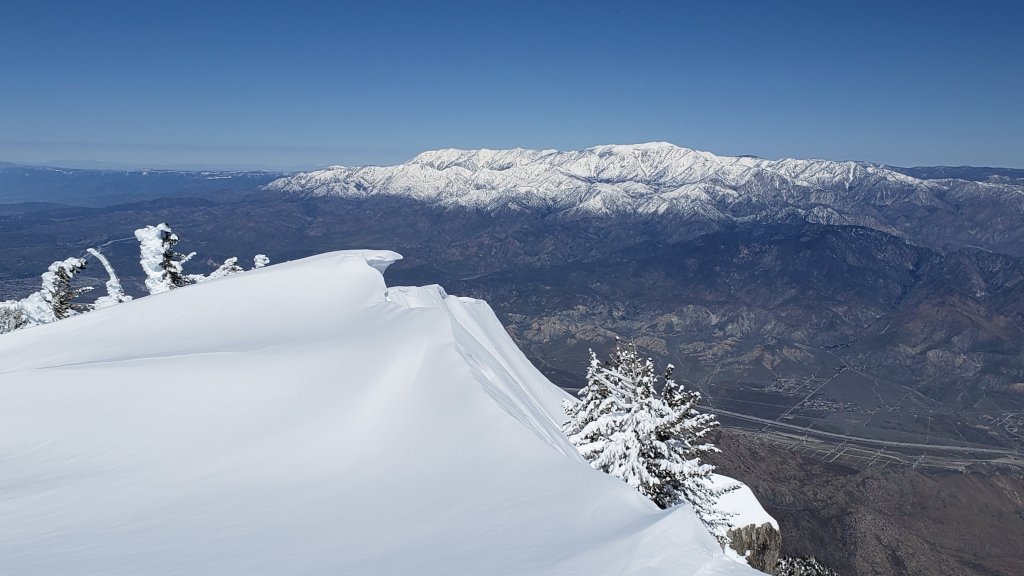
Trail update 7th December 2022

Two moderate snow storms in the next ten days or so are expected to have a major combined impact on the San Jacinto mountains. The first on Sunday 11th-Monday 12th may initially produce up to 1.5 inch of rain at the elevation of Idyllwild, transitioning to 2-4 inches of snow on Sunday night into Monday, while 10-12 inches of snow are forecast for the high country. There is disagreement between the forecast models where the freeze level will be for most of Sunday 11th which may alter the potential snowfall amounts (versus rainfall) at mid elevations. A less intense but slow moving multi-storm system is forecast for Friday 16th-Wednesday 21st. Forecasts range widely from 6-22 inches of snow for the highest elevations across multiple days, with a mix of rain and several inches of snow at mid elevations.

——————————

Potentially stormy weather forecast for four periods in the past ten days all failed to significantly impact the San Jacinto mountains. Cold clouds in the high country produced thick rime on the trees above about 10,200 ft elevation on 1st December (photo from 2nd below) but otherwise no meaningful precipitation. On the afternoon of Monday 6th I was treated to moody clouds and virga, a cloud base just above my head at San Jacinto Peak, and the briefest possible flurry of small snow flakes while at the Peak (but nothing settled).

As mentioned last week, current trail conditions are oddly reminiscent of spring, with snow distribution and iciness typical of April rather than December. That said, temperatures in the high country are much more typical of December than April! Snow from the moderate storm on 8th-9th November (discussed here) continues to melt slowly.

We survey the trail system daily, with hikes via different routes to San Jacinto Peak several times per week, Tahquitz Peak and vicinity at least weekly, and many other trails on other days. On 2nd, 5th, and 6th we barebooted to San Jacinto Peak on well-traveled and compacted tracks through increasingly patchy light icy snow. Monday 5th was the first day since the snow storm in early November that I did not use spikes for descending, as the icy snow in the high country was crisp and grippy in cold, cloudy conditions. Conversely on the afternoon of Tuesday 6th the ice was distinctly more watery, and I wore spikes from San Jacinto Peak down to Wellman Divide (9700 ft). In general most hikers will likely prefer to use spikes at least for descending down to about 10,000 ft (or lower).

Trails remain icy due to daily freeze/thaw cycles and compaction from hiker traffic, and spikes are useful throughout the trail system above about 9000 ft (lower in places). Spikes tend to be most valuable for descending even when not needed for ascending. Given cold temperatures for the foreseeable future, melting is expected to slow (or largely stop in the high country). Snowshoes are not required anywhere, as recent experience has shown that off-trail snow is now too shallow and/or patchy for snowshoes.

Hikers should be prepared for temperatures generally below freezing in the high country, and well below freezing when considering wind chill effects (see below for my recent weather observations from San Jacinto Peak).

Snow depths measured at various locations on the trail system are given at the foot of this posting. Note however that snow depth is rarely indicative of the ease (or otherwise) of hiking a given trail. Although excellent tracks are now in place and clearly visible for almost all major trails cautious navigation remains recommended.

Dark Canyon Road (4S02, the access to Seven Pines Trail) and Santa Rosa Truck Trail (7S02) closed to vehicle traffic for the season on 7th November 2022. Black Mountain Road also closed on 7th November to vehicle traffic at the gate 1.7 miles up from Highway 243. Forest Service campgrounds at Boulder Basin, Marion Mountain, and Fern Basin are closed for the season. Stone Creek campground had also closed, then reopened for Thanksgiving weekend.

The stunning vista south from about PCT Mile 180 shortly after sunset on 6th December 2022. The distinctive outline of Tahquitz Peak and Tahquitz Rock are to the left, while the lights of central Idyllwild are visible in the valley below.

WEATHER

A classic La Nina pattern – cool but relatively dry – is in place for the third winter in a row. Temperatures will be below seasonal for December for at least the next week, with many days cloudy or at least partly cloudy. Forecasts are increasingly confident of a moderate storm on Sunday 11th, with up to 1.5 inch of rain at the elevation of Idyllwild, turning into 1-3 inches of light snow on Sunday night, while 8-14 inches of snow are forecast for the high country.

At San Jacinto Peak (10,810ft/3295m) on Tuesday 6th December 2022 at 1530 the air temperature was 19.9°F (-7°C), with a windchill temperature of 3.8°F (-16°C), 18% relative humidity, and a sharp due West wind sustained at 7 mph gusting to 13.2 mph.

At the on Monday 5th December 2022 at 0840 the air temperature was 24.1°F (-4°C), with a windchill temperature of 2.8°F (-16°C), 20% relative humidity, and a bitter WSW wind sustained at 18 mph gusting to 33.0 mph.

At the Peak on Friday 2nd December 2022 at 1620 the air temperature was 26.2°F (-3°C), with a windchill temperature of 11.8°F (-11°C), 55% relative humidity, and a fresh WSW wind sustained at 8 mph gusting to 15.4 mph.

Early morning high clouds to the south-east as seen from the Peak Trail, 5th December 2022. Luella Todd and Divide peaks are in the foreground to the left, and the Santa Rosa mountains in the distance to the right. Note the extremely hazy conditions in the Coachella Valley, and the first hint of the elevated marine layer reaching the Desert Divide on the far right of the image.

TRAIL CONDITIONS

Trails above about 8500 ft currently remain lightly covered with patchy icy snow (more continuous above about 9000 ft on the west side, 9900 ft on the east). However excellent well-traveled and compacted tracks are now in place for almost all major trails (details below).

Hikers will encounter new treefall hazards due to the enormous weight of ice from freezing rain associated with the early November storm, followed by recent Santa Ana winds, and since the passage of Tropical Storm Kay in September. New treefall hazards on major trails have been reported to relevant agencies, and those on Spitler Peak Trail have already been cleared by the Trail Report.

The Ernie Maxwell Trail is clear of snow. One major treefall hazard is across the trail almost exactly midway between the trailheads at Humber Park and Tahquitz View Drive.

Devil’s Slide Trail is functionally clear of icy snow to Saddle Junction. A few minor patches exist close to the top. Spikes are generally not required.

There is a very well-traveled track through increasingly patchy thin icy snow from Saddle Junction to Tahquitz Peak. The 0.4 mile section of South Ridge Trail between Chinquapin Flat/PCT and Tahquitz Peak has a well-traveled and level track to follow through the slowly melting inch of patchy icy snow (photo below from 30th November). Although not required, some hikers will find spikes useful especially for descending.

The Wellman Trail from Annie’s Junction to Wellman Divide has about 20% icy snow cover. Some hikers will find spikes are useful at least for descending.

The Peak Trail still has about 90% cover of icy snow to San Jacinto Peak. Spikes can be useful for descending in particular. Early on cold mornings, the icy snow is grippy, and I did not find spikes necessary on 5th.

The East Ridge Trail (from near Miller Peak to San Jacinto Peak) has a handful of tracks through the continuous snow, though none (including mine) accurately follow the trail route. Snow on this east slope is drifted, and remains 3-8 inches deep in places.

There is a well-traveled track on light icy snow from Long Valley/Tram to Wellman Divide. Skyline Trail is now largely clear, but has very limited patchy, thin, icy snow above about 7200 ft (the Traverse to Grubb’s Notch). Spikes will not be required by most hikers, depending upon comfort level hiking on patchy angled icy snow.

South Ridge Trail is now functionally clear of snow to Tahquitz Peak with only 1-2% icy snow cover overall. Some hikers may continue to find spikes useful for some of the minor icy patches but they are no longer required. South Ridge Road is clear of ice and snow.

Marion Mountain Trail (surveyed at least weekly in past month) now has only about 20% icy snow cover, largely in the central section between about 7400-8200 ft elevation which is less sun-exposed. Many hikers will nevertheless find spikes useful in places, especially for descending.

Deer Springs Trail (surveyed 8th December) is functionally clear of ice to Strawberry Junction (8100 ft). Snow cover is a patchy 20% from Strawberry Junction north for about 1.5 mile (roughly 8600 ft). From the top of Marion Mountain Trail icy snow cover is about 90% to Little Round Valley, although there are a few lengthy clear areas on sun-exposed sections. Snow cover remains >95% through Little Round Valley up to San Jacinto Peak. Above Little Round Valley there are multiple tracks through the snow ascending toward San Jacinto Peak, none of which entirely accurately follow the established trail. The trail is clearest above immediately above LRV and again close to the Peak junction. Spikes are recommended at least for descending upper Deer Springs Trail.

Spitler Peak Trail (last surveyed 18th November) is clear of snow. Given the importance of this trail for the safety of northbound PCT hikers in particular, it is one of several trails “adopted” by the Trail Report. We removed nine treefall hazards on 18th November and the trail is now completely clear again, bringing to 56 the number of trees we have removed from this trail since mid 2021.

Willow Creek Trail remains a relatively slow, messy hike for a couple of miles. Some 37 trees are down on the Forest Service section of this trail between Skunk Cabbage Junction and the State Park boundary (23rd September 2022 survey). Of those, 27 are in the 0.6 mile section between Willow Creek crossing and the State Park boundary. A few trees were cut by chainsaw at the far (Hidden Divide) end of the Forest Service section recently, presumably by a CCC or State Park crew. The State Park cut about a dozen trees on the section of trail under their jurisdiction in late July. Another tree came down near the start of this trail close to Saddle Junction in Tropical Storm Kay.

Although some treefall hazards from Red Tahquitz to Antsell Rock (PCT Miles 172.5-175) were cleared in June 2021 prior to the rockslide removal work, the situation has badly deteriorated since. In my most recent survey there were at least 82 treefall hazards between PCT Miles 170-175 including 20+ major ones, and about six more on PCT Miles 175-177. PCTA is aware of the situation, and is hoping to start addressing it soon (weather permitting).

On Fuller Ridge Trail there are five major treefall hazards obstructing the trail in the 1.5 mile section nearest to the campground (PCT Miles 189-190.5). Although most of the downed trees reported this summer were cleared in July, four more major trees came down in Tropical Storm Kay in September.

The Caramba Trail from near Reeds Meadow through Laws Camp and on to Caramba, and the Cedar Trail from Willow Creek Trail to Laws, are described by the Forest Service as “not maintained”. This is frankly grossly misleading and in reality both trails no longer exist and are so completely overgrown I strongly advise hikers do not attempt to follow them. An informal use trail to Laws is much more direct and avoids all of the very challenging bushwhacking of the former trails (local hikers Charles Phelan and Mark Gumprecht kindly nicknamed it the “King Trail” when I established the route in 2019). It leaves the Willow Creek Trail exactly 1.0 mile from Saddle Junction (0.46 mile from the Skunk Cabbage turning), descending largely on established deer trails for 1.2 miles, meeting Willow Creek just upstream from the old Laws Camp. From Laws east to Caramba the route of the original Caramba Trail has been well-cairned by myself and others and can largely be followed with very careful route-finding. My 2022 survey counted 97 trees down on this 2.1 miles of trail. It is especially obscure 0.1-0.3 mile east of the Willow Creek crossing, becoming more obvious near Caramba. Very cautious navigation is advised throughout the area.

Seven Pines Trail has one set of hiker tracks through the snow since the storm in early November 2022. This trail has had limited hiker traffic since November 2018, largely because Dark Canyon Road has only been open for a few months since the “Great Valentine’s Day flood” of 2019. The Trail Report has “adopted” Seven Pines Trail as a priority for maintenance work as the trail has had a disproportionate number of lost hiker rescues in the past decade. Between November 2021 and May 2022, 61 downed trees were removed and almost the entire trail thoroughly trimmed and cleared. Remarkably Tropical Storm Kay did not add any new treefall hazards to this trail. Nevertheless Seven Pines remains a genuine wilderness trail unlike the relatively wide, bare, and obvious routes of, for example, Devil’s Slide or Marion Mountain trails. Cautious navigation remains required for those who do not have significant experience of hiking this trail.

San Jacinto Peak, late afternoon on 2nd December 2022. Thick rime had accumulated on the tress and rocks above about 10,200 ft overnight, but there was no fresh snow. In the distance, Mount San Gorgonio is just obscured by a cloud base at about 11,400 ft elevation.

SNOW DEPTHS measured on 2nd-5th December 2022 are as follows, with depths after the only significant storm of this winter to date (on 9th November) for comparison in parentheses where known. Note that average depth is given; due to strong winds there has been drifting, often particularly accumulating in the trails. Conversely in places scouring by the wind means the depths can be well below the average. Altitudes are approximate.

San Jacinto Peak (10810 ft): 2-4 inches (was 12 inches on 9th November)

Little Round Valley (9800 ft): 2-4 inches (was approx. 10 inches on 9th November)

Wellman Divide (9700 ft): 0-1 inch (was 4 inches on 9th November)

Annie’s Junction/approx. PCT Mile 181.8 (9070 ft): 0-1 inch (was 6 inches on 9th November)

Deer Springs Trail at top of Marion Mountain Trail (8700 ft): 0-1 inch

Tahquitz Peak (north side trail, 8700 ft): 0-1 inch

Tahquitz Peak (south side trail, 8500-8700 ft): 0 inch

Long Valley (8600 ft): 0-1 inch (was 2-3 inches on 9th November)

Strawberry Junction (8100 ft): 0 inch (was approx. 2-3 inches on 9th November)

Saddle Junction/approx. PCT Mile 179.9 (8070 ft): 0-1 inch (was 3 inches on 9th November)

Devil’s Slide Trail at Humber Park (6550 ft): 0 inch (was 2.5 inches on 9th November)

Idyllwild (at 5550 ft): 0 inch (was <1 inch on 9th November)

While all time and labor is volunteered, the San Jacinto Trail Report uses small private donations to cover costs. Every year seems to have unique challenges and 2022 has been no exception. Your contribution keeps the Report available to all, free from advertising or paywalls, and independent from agencies. If you have found this Report useful, please consider using this link to the Donate page. Zelle, Venmo, and PayPal are all options. Thank you so much for your support.
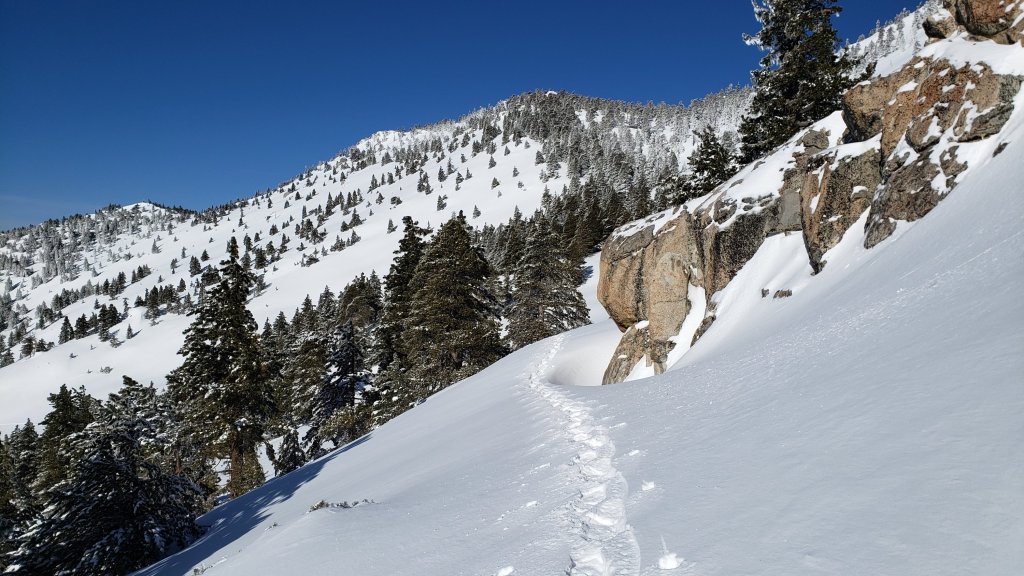
The well-defined track on the short section of South Ridge Trail between the north side of Tahquitz Peak and Chinquapin Flat, 30th November 2022. Although many hikers will prefer to use spikes, they are not required, depending on comfort level hiking on this type of thin icy snow (and also on quality of footwear).
Above, Wellman Divide (9700 ft) on 28th November 2022, and below, the same view immediately after a moderate snow storm nearly three weeks earlier on 9th November.

Trail update 30th November 2022

[UPDATE 1st December 2022: the double storm system that looks likely to bring significant precipitation to northern and central California appears to be missing the San Jacinto mountains, despite optimistic forecasts over the previous week. Three periods of cold, cloudy days are now expected over the next ten days, but little if any precipitation.]

The storm expected on 28th November failed to materialize, producing only below average temperatures, wind, and spectacular clouds (photos below). A second forecast storm system may bring some light precipitation to the San Jacinto mountains on 2nd December, and possibly again on 4th-5th.

Current trail conditions are oddly reminiscent of spring, with snow distribution and iciness feeling more typical for April or May than late November. Snow from the moderate storm on 8th-9th November (summarized here) has been melting steadily at mid elevations but more slowly in the high country given the relative weakness of the sun at this time of year.

We have surveyed the high country almost daily, with hikes taking in San Jacinto Peak at least twice per week, Tahquitz Peak area once per week, and a variety of other trails on other days (World Cup viewing permitting of course). On 24th and 28th we barebooted to the Peak on well-traveled and compacted tracks through light icy snow. Both days I put spikes on at the Peak for the descent, on 24th keeping them on until about 8000 ft on Marion Mountain Trail, and on 28th until about 9900 ft on the Peak Trail, roughly one mile north of Wellman Divide.

Trails remain very icy due to daily freeze/thaw cycles and compaction from hiker traffic, so spikes are recommended throughout the trail system above about 8000 ft (lower in places). Spikes are especially valuable for descending even when they are no necessarily needed for ascending. Given colder temperatures for the foreseeable future, melting is expected to slow (or almost stop in the high country) and spikes will remain recommended well into December at least.

Snowshoes are not required anywhere on the established trail system, where snow is now too shallow, icy and compacted. In my recent experience off-trail snow is now also largely too shallow and/or patchy for snowshoes.

Snow depths measured at various locations on the trail system are given at the foot of this posting. Note however that snow depth is rarely indicative of the challenge (or otherwise) of a given trail. Although excellent tracks are now in place for almost all major trails cautious navigation remains recommended.

Hikers should be prepared for temperatures near or below freezing in the high country, and generally well below freezing when considering wind chill effects (see below for my recent weather observations from San Jacinto Peak).

Dark Canyon Road (4S02, the access to Seven Pines Trail) and Santa Rosa Truck Trail (7S02) closed to vehicle traffic for the season on 7th November 2022. Black Mountain Road also closed on 7th November to vehicle traffic at the gate 1.7 miles up from Highway 243. Forest Service campgrounds at Boulder Basin, Marion Mountain, and Fern Basin are closed for the season. Stone Creek campground had also closed, but I saw that it had apparently reopened for Thanksgiving weekend.

An early morning hike to San Jacinto Peak on Monday 28th November was delightful for a cloud observer. Looking south from the PCT about one mile north of Saddle Junction with Tahquitz Peak just left of center, under a layer of (largely) altocumulus with a cloud base at 15,000 ft elevation.

WEATHER

Temperatures will be near or generally below seasonal for the next ten days at least. A weather system, possibly in two waves across a broad time window between 2nd and 5th December, is currently forecast to produce light precipitation at all elevations, including a possible dusting of snow in the high country [update 1st December: no precipitation is now expected from these storms passing to the north of us]. The highest probability of precipitation is early morning on Friday 2nd. Precipitation on Sunday 4th into the early hours of Monday 5th is significantly less likely in the latest models. Temperatures may be mild enough to produce rain at mid elevations, for example totaling less than 0.25 inch in Idyllwild, while snow accumulation above 10,000 ft elevation is currently forecast to be a dusting, perhaps few inches at most.

At San Jacinto Peak (10,810ft/3295m) on Monday 28th November 2022 at 0855 the air temperature was 26.2°F (-3°C), with a windchill temperature of 8.8°F (-13°C), 11% relative humidity, and a sharp due West wind sustained at 17 mph gusting to 24.6 mph.

At the Peak on Thursday 24th November 2022 at 0810 the air temperature was 29.0°F (-2°C), with a windchill temperature of 5.7°F (-15°C), 16% relative humidity, and a severe NNW wind sustained at 25 mph gusting to 35.1 mph.

This stunning array of clouds was visible looking south-east from the Wellman Trail, early morning on 28th November 2022. The most prominent distant mountain is Toro Peak, the high point of the Santa Rosas, and the reflection to the left is off the Salton Sea. Note the haze in the Coachella Valley to the lower left, stirred up by a strong West wind accompanying the clouds.

TRAIL CONDITIONS

Trails above about 7500 ft currently remain lightly covered with patchy icy snow (more continuous above about 9000 ft). However excellent well-traveled and compacted tracks are now in place for almost all major trails (details below).

Hikers will encounter new treefall hazards due to the enormous weight of ice from freezing rain associated with the early November storm, followed by recent Santa Ana winds, and since the passage of Tropical Storm Kay in September. New treefall hazards on major trails have been reported to relevant agencies, and those on Spitler Peak Trail have already been cleared by the Trail Report.

The Ernie Maxwell Trail is functionally clear of icy snow, although a few minor patches remain, especially close to Humber Park. Spikes are not required. One major treefall hazard is across the trail almost exactly midway between the trailheads at Humber Park and Tahquitz View Drive.

Devil’s Slide Trail is functionally clear of icy snow to about 7700 ft (about 1.7 miles up) although some dirty icy patches remain below that. Spikes not required to that elevation. Above that elevation, icy snow cover is about 60% to Saddle Junction. Spikes are generally not required for ascending, but most hikers find them useful at least for descending.

There is a very well-traveled track from Saddle Junction to Tahquitz Peak. The 0.4 mile section of South Ridge Trail between Chinquapin Flat/PCT and Tahquitz Peak has a well-traveled and level track to follow through the slowly melting inch of patchy icy snow (photo below from 30th). Although not required, many hikers will find spikes useful especially for descending.

The PCT on the south-facing slope (“Angel’s Glide”) for about 1.0 mile north of Saddle Junction is largely clear of snow (spikes not required).

The Wellman Trail from Annie’s Junction to Wellman Divide has about 40% icy snow cover. Some hikers will find spikes are useful at least for descending.

The Peak Trail has about 90% cover of icy snow to 9900 ft elevation, and then >95% cover to San Jacinto Peak. Spikes are recommended.

The East Ridge Trail (from near Miller Peak to San Jacinto Peak) has a handful of tracks through the continuous snow, though none (including mine) accurately follow the trail route. Snow on this east slope is drifted, and remains up to 12 inches deep in places.

There is a well-traveled track on light icy snow from Long Valley/Tram to Wellman Divide. Skyline Trail has a good track to follow through increasingly patchy, very thin, icy snow above about 7000 ft (the Traverse to Grubb’s Notch). Spikes are recommended but not required depending upon your comfort level hiking on angled icy snow.

South Ridge Trail (surveyed 26th and 30th November) is now functionally clear of snow to Tahquitz Peak with only 1-2% icy snow cover overall. Some hikers may continue to find spikes useful for some of the minor icy patches but they are no longer required. South Ridge Road is now clear of ice and snow.

Marion Mountain Trail (surveyed at least weekly in past month) has a very well-defined track to follow. Icy snow cover is 60% overall, becoming increasingly patchy below about 7000 ft, and again in the sun-exposed areas above 8000 ft. Spikes are useful, especially for descending.

Deer Springs Trail is clear from the Highway 243 trailhead to the Suicide Rock trail junction at 7000 ft, and functionally clear from there to Strawberry Junction (8100 ft), with a few icy snow patches increasing in length and frequency as you ascend. Snow cover is about 60% from Strawberry Junction north for about 1.0 mile (roughly 8500 ft), and thereafter >90% to San Jacinto Peak. An excellent track is easy to follow to Little Round Valley. Above Little Round Valley there are at least half-a-dozen tracks ascending toward San Jacinto Peak, none of which entirely accurately follow the established trail route. The main track is clearest just above LRV and again close to the Peak junction. Spikes are recommended at least for descending upper Deer Springs Trail.

Spitler Peak Trail (last surveyed 18th November) is clear of snow. Given the importance of this trail for the safety of northbound PCT hikers in particular, it is one of several trails “adopted” by the Trail Report. We removed nine treefall hazards on 18th November and the trail is now completely clear again, bringing to 56 the number of trees we have removed from this trail since mid 2021.

Willow Creek Trail remains a relatively slow, messy hike for a couple of miles. Some 37 trees are down on the Forest Service section of this trail between Skunk Cabbage Junction and the State Park boundary (23rd September 2022 survey). Of those, 27 are in the 0.6 mile section between Willow Creek crossing and the State Park boundary. A few trees were cut by chainsaw at the far (Hidden Divide) end of the Forest Service section recently, presumably by a CCC or State Park crew. The State Park cut about a dozen trees on the section of trail under their jurisdiction in late July. Another tree came down near the start of this trail close to Saddle Junction in Tropical Storm Kay.

Although some treefall hazards from Red Tahquitz to Antsell Rock (PCT Miles 172.5-175) were cleared in June 2021 prior to the rockslide removal work, the situation has badly deteriorated since. In my most recent survey there were at least 82 treefall hazards between PCT Miles 170-175 including 20+ major ones, and about six more on PCT Miles 175-177. PCTA is aware of the situation, and is hoping to start addressing it soon (weather permitting).

On Fuller Ridge Trail there are five major treefall hazards obstructing the trail in the 1.5 mile section nearest to the campground (PCT Miles 189-190.5). Although most of the downed trees reported this summer were cleared in July, four more major trees came down in Tropical Storm Kay in September.

The Caramba Trail from near Reeds Meadow through Laws Camp and on to Caramba, and the Cedar Trail from Willow Creek Trail to Laws, are described by the Forest Service as “not maintained”. This is frankly grossly misleading and in reality both trails no longer exist and are so completely overgrown I strongly advise hikers do not attempt to follow them. An informal use trail to Laws is much more direct and avoids all of the very challenging bushwhacking of the former trails (local hikers Charles Phelan and Mark Gumprecht kindly nicknamed it the “King Trail” when I established the route in 2019). It leaves the Willow Creek Trail exactly 1.0 mile from Saddle Junction (0.46 mile from the Skunk Cabbage turning), descending largely on established deer trails for 1.2 miles, meeting Willow Creek just upstream from the old Laws Camp. From Laws east to Caramba the route of the original Caramba Trail has been well-cairned by myself and others and can largely be followed with very careful route-finding. My 2022 survey counted 97 trees down on this 2.1 miles of trail. It is especially obscure 0.1-0.3 mile east of the Willow Creek crossing, becoming more obvious near Caramba. Very cautious navigation is advised throughout the area.

Seven Pines Trail has one set of hiker tracks through the snow since the storm in early November 2022. This trail has had limited hiker traffic since November 2018, largely because Dark Canyon Road has only been open for a few months since February 2019. The Trail Report has “adopted” Seven Pines Trail as a priority for maintenance work as the trail has had a disproportionate number of lost hiker rescues in the past decade. Between November 2021 and May 2022, 61 downed trees were removed and almost the entire trail thoroughly trimmed and cleared. Remarkably Tropical Storm Kay did not add any new treefall hazards to this trail. Nevertheless Seven Pines remains a genuine wilderness trail unlike the relatively wide, bare, and obvious routes of, for example, Devil’s Slide or Marion Mountain trails. Cautious navigation remains required for those who do not have significant experience of hiking this trail.

SNOW DEPTHS measured on or around 28th November 2022 are as follows, with depths after the last significant storm (on 9th November) for comparison in parentheses where known. Note that average depth is given; due to strong winds there has been extensive drifting, often particularly accumulating in the trails. Conversely in places scouring by the wind means the depths are well below the average. Altitudes are approximate.

San Jacinto Peak (10810 ft): 4-5 inches (was 12 inches on 9th)

Little Round Valley (9800 ft): 4 inches on 24th (was approx. 10 inches on 9th)

Wellman Divide (9700 ft): 0-1 inch (was 4 inches on 9th)

Annie’s Junction/approx. PCT Mile 181.8 (9070 ft): 0-1 inch, photo below (was 6 inches on 9th)

Deer Springs Trail at top of Marion Mountain Trail (8700 ft): 1-2 inches

Tahquitz Peak (north side trail, 8700 ft): 0-1 inch [measured 26th November]

Tahquitz Peak (south side trail, 8500-8700 ft): 0 inch [measured 26th November]

Long Valley (8600 ft): <1 inch (was 2-3 inches on 9th)

Strawberry Junction (8100 ft): 0 inch (was approx. 2-3 inches on 9th)

Saddle Junction/approx. PCT Mile 179.9 (8070 ft): <1 inch (was 3 inches on 9th)

Devil’s Slide Trail at Humber Park (6550 ft): 0 inch (was 2.5 inches on 9th)

Idyllwild (at 5550 ft): 0 inch (was <1 inch on 9th)

While all time and labor is volunteered, the San Jacinto Trail Report uses small private donations to cover costs. Every year seems to have unique challenges and 2022 has been no exception. Your contribution keeps the Report available to all, free from advertising or paywalls, and independent from agencies. If you have found this Report useful, please consider using this link to the Donate page. Zelle, Venmo, and PayPal are all options. Thank you so much for your support.

The well-defined track on the short section of South Ridge Trail between the north side of Tahquitz Peak and Chinquapin Flat, 30th November 2022. Although many hikers will prefer to use spikes, they are not required, depending on comfort level hiking on this type of thin icy snow (and also on quality of footwear).
Above, Wellman Divide (9700 ft) on 28th November 2022, and below, the same view immediately after a moderate snow storm nearly three weeks earlier on 9th November.
Annie’s Junction (9100 ft) at about PCT Mile 181 on 28th November 2022 (above), and for comparison on 9th November (below).