Please continue to check this page for periodic storm updates throughout today.
UPDATED @ 0720 Friday 29th
White Friday! In what is likely a record for Idyllwild in November, another 6.75″ of snow fell at 5550′ elevation overnight, for a storm total of 19.5 inches! In November! It has stopped snowing there (although electricity is out in large parts of town, just to make life more exciting).
At San Jacinto Peak, an additional 8-10″ of fresh powder fell overnight, for a storm total of close to 30 inches, and an average depth around the Peak of nearly three feet.
UPDATED @ 1730 Thursday 28th
It stopped snowing at all elevations at about 1630 this evening (although it has restarted at a very gentle rate in the last few minutes at San Jacinto Peak).
Fresh snowfall for today was about 14″ at San Jacinto Peak. In combination with yesterday’s 5-6″, and a patchy 4″ remaining from last week, there is an average of about 24″ around the Peak. I found some drifts of at least 30″ on the East Ridge just now.
In Idyllwild (at 5550′) a very impressive 11.75″ fell today, for a storm total of nearly 13″.
It is probably fair to estimate that everywhere in the San Jacinto mountains above about 5000′ elevation has between one and 2.5 feet of snow as of tonight.
UPDATED @ 1505 Thursday 28th
Idyllwild (at 5550′) has added 8″ of fresh snow today so far. About the same has fallen at San Jacinto Peak, for a current storm total of about 12-13″ there. Snowfall totals today have been remarkably similar across many elevations of the mountains, with 6-10″ also today at Long and Round valleys, and Wellman Divide.
UPDATED @ 1220 Thursday 28th
Snow started falling heavily at all mountain elevations at about 0830. In Idyllwild by noon, three inches had fallen this morning, for a storm total of four inches.
At San Jacinto Peak, an additional four inches had fallen this morning, for a storm total of about 9″, and a grand total of about 13″ depth.
Many thanks to Kyle Eubanks for reporting total snow depths as he descended from the Peak to the Tram: Wellman Divide 6-8″, Round Valley 8-10″, Long Valley 6″.
Fine granular snow continues to fall heavily at all elevations. If it continues to accumulate at roughly one inch per hour, we will reach some very impressive totals, especially for November.
UPDATED @ 0815 Thursday 28th
No fresh snow overnight at San Jacinto Peak nor in Idyllwild. An overnight low temperature of 29°F in Idyllwild (at 5550′), and a rather chillier 15°F at San Jacinto Peak. Windchil at the Peak at about 0700 was a brisk -6.9°F (-22°C).
A short video giving a feel for the conditions at San Jacinto Peak has just been uploaded to YouTube.
Forecasts continue to predict 2-3 feet of snow in the high country later today and a foot or more around 6000′ elevation.
UPDATED @ 1930 Wednesday 27th
It stopped snowing in Idyllwild at about 1700, and at San Jacinto Peak by 1830. Fresh snowfalls of one inch in Idyllwild and about five at the Peak. Overnight temperatures will plunge with clear skies. Heavy snow is forecast tomorrow, we’ll see!
UPDATED @ 1720 Wednesday 27th
Snowfall at San Jacinto Peak is up to 4″ of fresh powder, for a total of about 8″. Fairly fine flakes continue to fall steadily and are accumulating rapidly. The WSW wind has dropped a little, but still gusting close to 30 mph. Air temperature just now was 15.6°F, with a windchill of -6.7°F.
Snow accumulation in Idyllwild (at 5550′ elevation) was 1.0″ as of 1700.
UPDATED @ 1520 Wednesday 27th
Snowfall at San Jacinto Peak has been heavier since about 1330, with 1.0-1.5 inches of fresh snow so far today (on top of an average of 4″ remaining from last week).
Rainfall in Idyllwild (at 5550′ elevation) was exactly 0.25″ until just before 1500, at which time the precipitation switched to snow and started to accumulate.
UPDATED @ 1310 Wednesday 27th
Started snowing just before 1200 at San Jacinto Peak. Currently fine rounded grain snow which is struggling to accumulate, especially in a severe SW wind (gusting over 30 mph). Air temperature about 20°F with a windchill down to -2°F.
A steady light rainfall began in Idyllwild (at 5550′) at about 1230.
San Jacinto Trail Report: available for everyone, funded by readers. If you have found this Report useful, please consider visiting the Donate page. Thank you.
San Jacinto Trail Report: available for everyone, funded by readers. While thousands of hours of labor are provided for free, this Report is wholly dependent on small private donations to cover its direct costs (e.g., gear, gas, web space). It looks like we will have another busy winter, followed by an even busier PCT season. Every contribution is invaluable, and your donation helps subsidise the thousands of thru-hikers who also use the Report. If you find the Report useful, please consider visiting the Donate page. Thank you.
The first snow storm of this winter last week will be quickly followed by a much more substantial system this week. Although we hiked to San Jacinto Peak this morning, conditions reported here are only valid until sometime on Wednesday 27th, when heavy rain and snowfall are forecast to start (see Weather below). This week’s storm will be unusually cold and severe for November, so please plan accordingly and exercise considerable caution.
Currently all main trails, including the main routes on both east and west sides of San Jacinto Peak, have been well-traveled and are obvious.
Melting has been considerable in most areas, with nearly half of last week’s snowfall lost above 8000′, and much more lost below that elevation.
Microspikes are currently useful at all elevations above about 6500′. They are especially useful for descending the trails, many of which are icy and compacted. Snow depths are now inadequate for snowshoeing.
Hikers should be prepared for temperatures at or below freezing in the high country, and well below freezing when considering windchill effects. Temperatures later this week will be far below seasonal at all elevations, with dangerously low windchill values in the high country.
WEATHER The likelihood of an historically large storm this week (27th-29th November) is fading. However the storm will still be dramatic for November, with 12+ inches of snow forecast for 6000′ elevation (e.g. Fern Valley and Pine Cove) and at least two feet of snow above 10,000′ elevation. It will be unseasonably cold everywhere, with high country windchill temperatures well below 0°F (-18°C). Heavy rainfall is possible at mid-elevations at least.
At San Jacinto Peak (10,810ft/3295m) today, Monday 25th November 2019 at 0950 the air temperature was 34.4°F (1°C), with a windchill temperature of 16.6°F (-9°C), 33% relative humidity, and a wild WNW wind sustained at 32.0 mph gusting to 48.4 mph.
At the Peak on Wednesday 20th November 2019 at 0710 the air temperature was 20.5°F (-6°C), with a windchill temperature of 3.3°F (-16°C), 100% relative humidity, and a brisk WSW wind sustained at 5.0 mph gusting to 16.3 mph, while lightly snowing.
Wellman Divide this morning, 25th November 2019.
TRAIL CONDITIONS
All trails above about 6800′ are at least partially snow-covered, and microspikes are recommended. See comments above.
Reliable, well-traveled tracks are currently in place for Devil’s Slide Trail, Tahquitz-area meadows, Tahquitz Peak from the PCT, South Ridge Trail, Deer Springs Trail, Marion Mountain Trail, and from the Tram through to San Jacinto Peak.
SNOW DEPTHS measured today are as follows. Average depth is given, drifts may be significantly deeper than the average in places. Altitudes are approximate.
San Jacinto Peak (10810′): 6″ (about 10″ on 21st November)
Wellman Divide (9700′): 5″
Annie’s Junction (9070′): 5″
Saddle Junction (8070′): 4″ (about 7″ on 21st)
Devil’s Slide Trail at Humber Park (6550′): 0″ (5″ on 21st)
Idyllwild (at 5550′): 0″ (4″ on 21st).
New tree down about two-thirds of the way up Devil’s Slide Trail, 25th November 2019. Given the weather forecast this is likely to be here for weeks or even months.
[Weather update: the likelihood of an historically large storm this week (27th-29th November) is fading. However the storm will still be dramatic for November, with 10+ inches of snow forecast for 6000′ elevation (e.g. Fern Valley and Pine Cove) and about two feet of snow above 10,000′ elevation. It will be unseasonably cold everywhere. Heavy rainfall is possible at mid-elevations at least. Please be prepared and very cautious.]
[Technical note: although it seems counterintuitive, I have found that I am often able to upload videos more easily to YouTube from the high country than upload text updates to this website. Please subscribe to San Jacinto Trail Report on YouTube if you would like to get the latest real time updates from the mountain, in addition to the greater detail here on the website. Thank you.]
Our first snow storm of winter 2019/2020 arrived in some style on Wednesday. Rain starting around midday on Tuesday 19th turned to snow at San Jacinto Peak that afternoon as I hiked up, but did not start settling due to the warm ground until early on Wednesday. Even then, it fell as very fine rounded grain snow initially, struggling to accumulate to more than an inch or so. Eventually the Peak received 10″ of snow, though it is interesting to note that this is not much more than at Saddle Junction, nearly 3000′ lower.
At lower elevations, rain did not turn to snow until about midday Wednesday. Thereafter, it snowed intermittently all afternoon, in large, wet snowflakes that accumulated rapidly. For the whole system in a 24 hour period, Idyllwild (at 5550′) received 0.86″ rain followed by 4.0″ snow.
I recorded a short video at about 0730 Wednesday morning at San Jacinto Peak, which give a flavour for the conditions at that time, available here on YouTube.
Thursday morning we hiked Devil’s Slide Trail to Saddle Junction to assess snow depths at about 6500′ and 8100′. In that two hour period, the snow depth at Humber Park reduced by almost half due to rapid melting (and the sun has barely even emerged from the cloud yet).
This morning we hiked from home to Tahquitz Peak via South Ridge Trail to assess snow conditions on a (largely) sun-exposed route.
Microspikes are potentially useful at all elevations above about 7000′. In fresh powder they are not currently required, but with freeze-thaw cycles the trails will become increasingly icy and compacted. With anticipated rapid melting, the elevation at which spikes are useful may rise quickly. Snow depths were marginal for snowshoeing above about 8000′ elevation today, but will likely be unsuitable by the weekend.
Waterproof footwear is recommended on approach trails at least (e.g., Devil’s Slide, lower Deer Springs) due to slushy melting snow, especially after early morning. It will also be invaluable for at least the next few days elsewhere in soft melting snow.
Despite dramatic temperature fluctuations between storm systems, hikers should nevertheless be prepared for temperatures near or below freezing in the high country, and potentially well below freezing when considering windchill effects.
The warmth of the ground before the snow fell will speed the rapid melting during the warming trend expected in the next few days. Conditions may therefore change quickly. Depending on when the Trail Report is updated, it is possible to find less snow this weekend than is described here.
Saddle Junction (c.8070′) at about 0900 on 21st November 2019.
WEATHER As is so often the case these days following a good winter storm, a significant warming trend follows. This will be especially pronounced on 23rd-25th November which will melt much of the new snow at all elevations, especially below about 8000′. However this brief, warm spell will be followed by another storm system, currently forecast to be even more dramatic than this week’s. Precipitation on 27th-29th November may be more than double what we experienced in recent days.
At San Jacinto Peak (10,810ft/3295m) on Wednesday 20th November 2019 at 0710 the air temperature was 20.5°F (-6°C), with a windchill temperature of 3.3°F (-16°C), 100% relative humidity, and a brisk WSW wind sustained at 5.0 mph gusting to 16.3 mph, while lightly snowing.
At the Peak on 19th November 2019 at 1645 the air temperature was 33.4°F (1°C), with a windchill temperature of 19.3°F (-7°C), 89% relative humidity, and an sharp WSW wind at 9.0 mph gusting to 20.4 mph, while lightly snowing.
TRAIL CONDITIONS
All trails above about 5000′ were completely snow-covered Thursday morning, but by this afternoon melting meant that many areas below 7000′ were already becoming patchy and/or slushy. Those areas may refreeze overnight and be more challenging underfoot in subsequent days (microspikes recommended).
All trails above 7500′, including much of the PCT in the San Jacinto mountains, are currently under continuous snow cover approximately 2-10″ deep.
Reliable, well-traveled tracks are currently in place for (at least): Devil’s Slide Trail, Tahquitz-area meadows, Tahquitz Peak from the PCT, South Ridge Trail, and from the Tram through to San Jacinto Peak.
SNOW DEPTHS measured on 21st November are as follows. Average depth is given, drifts may be significantly deeper than the average in places. Altitudes are approximate. Many thanks to Kyle Eubanks for data from Long Valley to the Peak.
San Jacinto Peak (10810′): 10″
Long Valley (8500′): 5″
Saddle Junction (8070′): 7″
Devil’s Slide Trail at Humber Park (6550′): 5.0″ (early Thursday morning, now almost all melted)
Idyllwild (at 5550′): 4.0″ (all melted by today).
North spring at Wellman’s Cienega at about noon on 20th November (above), and the previous afternoon for comparison (below).
During the course of the morning the snow level dropped to 5000′ elevation, and it is currently snowing steadily in Idyllwild (approaching 2″ depth at 5550′ elevation).
As I descended from San Jacinto Peak, snow depths were remarkably consistent at 1-1.5″ at all elevations, with very little setting on bushes. On the East Ridge of San Jacinto Peak some drifted areas were 2-3″ deep. The highest elevations were in and out of the cloud, with intermittent snowfall.
At Saddle Junction (8100′) at 1230, depth was only 0.5″, suggesting that rain had turned to snow only very recently.
UPDATED @ 0800
So far the storm system has been disappointing in the high country with well under one inch of snowfall at San Jacinto Peak. However it continues to snow very gently. Thunderstorms were visible over San Diego county overnight, which got much heavier rainfall than the San Jacinto mountains, including in the desert interior. By 0700 this morning rainfall in Idyllwild was 0.78″ at 5550′ elevation.
Carrying microspikes is currently recommended anywhere above about 6000′ elevation.
[UPDATE Monday 18th November: the first storm system of this winter arrives tomorrow afternoon, with an inch-plus of rain expected, and a few inches of snow possible above 6000′. Excellent weather and warnings summary just published by NWS available here on YouTube.]
A busy autumn has continued this week with multiple ascents of San Jacinto Peak, and a hike on the Black Mountain Trail (the latter now accessible from the south with the reopening of Highway 243). A short weather discussion recorded at the Peak this morning is available on YouTube.
About a dozen trees down on the upper section of Black Mountain Trail, reported last week, have all been removed. This delightful trail is now in its best maintained condition in at least eight years.
Hikers to Tahquitz Peak and Black Mountain fire lookouts should note that both close for the season this weekend, Black Mountain on Saturday 16th, and Tahquitz on Sunday 17th.
In a sign of how urgently we need precipitation, I was surprised to find that the Cinco Poses Spring spigot, about four miles up the Black Mountain Truck Trail, was dry yesterday. Other than that, the condition of water sources around the mountain is not significantly changed from the comprehensive update in last week’s posting. Given the forecast, hopefully the Trail Report will not be mentioning water availability again this year!
Hikers should be prepared for temperatures at or below freezing. From Tuesday 19th, temperatures will be below freezing in the high country, and may approach 0°F (-18°C) at the highest peaks when considering windchill effects.
WEATHER Exceptionally warm weather in November so far – with temperatures well above seasonal average at all elevations – will finally come to an end with a vigourous cold front forecast to arrive on Tuesday 19th. This should produce some much-needed precipitation on 20th and 21st at least, with a dusting of snow possible above about 6000′ elevation, and rainfall forecast everywhere else.
The latest very informative weather modeling from our local National Weather Service San Diego office was released today via YouTube.
At San Jacinto Peak (10,810’/3295m) today, Wednesday 13th November 2019, at 0840 the air temperature was 53°F (12°C), with a windchill temperature of 52.5°F (11°C), 20% relative humidity, and a barely discernible West wind sustained at <1.0 mph gusting to 1.7 mph.
In contrast, at the Peak on Monday 11th November 2019 at 0800 the air temperature was 38.6°F (4°C), with a windchill temperature of 24.8°F (-4°C), 21% relative humidity, and a severe NNE wind sustained at 24 mph gusting to 27.6 mph.
This large tree, down across upper Black Mountain Trail for about seven years, required an awkward scramble on hands-and-knees to pass, until this week.
TRAIL CONDITIONS
The Pacific Crest Trail remains open at the rockslide just north of Antsell Rock (Mile 172.5). The updated video report from 7th October (available here) can be useful for deciding whether to try to hike around the rockslide or take an alternate route.
One fallen burned pine tree, along the trail and at a challenging height, one mile from the top of the Spitler Peak Trail is passable with care by hikers. The trail is currently impassable to pack animals however.
Forest Service closures to the Boulder Basin and Black Mountain Group campgrounds (both accessed from Black Mountain Road), and Dark Canyon Road, will remain in place all year. Consequently, Dark Canyon campground is also closed, and there is no access toSeven Pines trailhead.
We resurveyed Seven Pines Trail in mid October. There are three trees down on Forest Service land, and about 30 on State Park land, the latter almost all above 7500′ elevation. The anticipated tree removal work by State Park in September did not occur. This trail has been extremely lightly traveled since late 2018, and is indistinct in places, especially in its uppermost mile. Hikers without prior experience of this trail should take care with routefinding.
The Caramba Trail from near Reeds Meadow through Laws Camp to Caramba, and the Cedar Trail from Willow Creek Trail to Laws, are not maintained. Temporary signage to this effect has been in place since the end of June. Both trails are very indistinct and heavily overgrown with challenging whitethorn in places, and hikers without considerable prior experience of this area should exercise extremely cautious navigation. From Laws east to Caramba the route of the original trail is relatively easy to follow (for those who were very familiar with this trail prior to the 2013 Mountain Fire). An informal use trail to Laws has been developed which is much more direct and avoids all of the challenging bush-whacking of the unmaintained trails (some local hikers have kindly dubbed it the “King Trail”). It leaves the Willow Creek Trail exactly 1.0 mile from Saddle Junction (0.46 mile from the Skunk Cabbage turning), descending largely on deer trails for 1.2 miles, basically paralleling Willow Creek just to its south. Currently it is quite obvious for about a mile, becoming more indistinct as it nears Laws (by which time Willow Creek is close on the north [left] side, so navigation is not a challenge).
The Cranston Fire closure order expired at the beginning of August. Although this does not impact the wilderness trail situation, it does mean that the popular dirt roads and mountain bike trails of the May Valley and Bonita Vista roads area are now open. May Valley Road is apparently open to vehicular traffic despite being washed out in places (the new USFS gate just up from the Cowbell Alley access is currently locked open).
A busy ten days has included surveys of water sources and trees down on the Pacific Crest Trail and all side trails from Highway 74 north to Black Mountain, plus ascents of San Jacinto Peak, Tahquitz Peak, and Black Mountain Trail (the latter now accessible from the south with the reopening of Highway 243). Every week I am hopeful that it will be the final discussion of water sources for 2019, but having said that, there is still no precipitation forecast in the foreseeable future.
Although just north of the area typically covered by the Trail Report, I got word that Whitewater Preserve and associated trails, including the trail to/from the PCT, reopened this week. This area had been closed since the Valentine’s Day flood event. Thanks to Don Line for this information.
Hikers should be prepared for temperatures at or below freezing throughout the high country, but certainly above about 10,000′ elevation, especially by mid month.
WEATHER Temperatures continue to be above seasonal average at all elevations, and are forecast to remain that way for another week. By about 15th November, seasonally typical temperatures are forecast, including conditions well below freezing in the high country. No precipitation is forecast for the foreseeable future, although several days next week (13th-15th November) are likely to be cloudy.
At San Jacinto Peak (10,810’/3295m) on Monday 4th November 2019 at 0830 the air temperature was 33.8°F (1°C), with a windchill temperature of 19.9°F (-7°C), 47% relative humidity, and a stiff NNE wind sustained at 14 mph gusting to 21.3 mph.
At the Peak on Friday 1st November 2019 at 0900 the air temperature was 42.9°F (7°C), with a windchill temperature of 34.3°F (1°C), 14% relative humidity, and a moderate SE wind sustained at 10 mph gusting to 16.8 mph.
TRAIL CONDITIONS
All trails, including the entire Pacific Crest Trail throughout the San Jacinto mountains, have been free of snow since the end of June.
The Pacific Crest Trail remains open at the rockslide just north of Antsell Rock (Mile 172.5). The updated video report from 7th October (available here) can be useful for deciding whether to try to hike around the rockslide or take an alternate route.
The Black Mountain Trail has ten trees down on the upper mile of the trail, most of which are new this year. While many are easily passable by hikers, a couple require some scrambling.
One fallen burned pine tree, along the trail and at a challenging height, one mile from the top of the Spitler Peak Trail is passable with care by hikers. The trail is currently impassable to pack animals however.
Forest Service closures to the Boulder Basin and Black Mountain Group campgrounds (both accessed from Black Mountain Road), and Dark Canyon Road, will remain in place all year. Consequently, Dark Canyon campground is also closed, and there is no access toSeven Pines trailhead.
We resurveyed Seven Pines Trail in mid October. There are three trees down on Forest Service land, and about 30 on State Park land, the latter almost all above 7500′ elevation. The anticipated tree removal work by State Park in September did not occur. This trail has been very lightly traveled since late 2018, and is indistinct in places, especially in its uppermost mile. Hikers without prior experience of this trail should take care with routefinding.
The Caramba Trail from near Reeds Meadow through Laws Camp to Caramba, and the Cedar Trail from Willow Creek Trail to Laws, are not maintained. Temporary signage to this effect has been in place since the end of June. Both trails are very indistinct and heavily overgrown with challenging whitethorn in places, and hikers without considerable prior experience of this area should exercise extremely cautious navigation. From Laws east to Caramba the route of the original trail is relatively easy to follow (for those who were very familiar with this trail prior to the 2013 Mountain Fire). An informal use trail to Laws has been developed which is much more direct and avoids all of the challenging bush-whacking of the unmaintained trails (some local hikers have kindly dubbed it the “King Trail”). It leaves the Willow Creek Trail exactly 1.0 mile from Saddle Junction (0.46 mile from the Skunk Cabbage turning), descending largely on deer trails for 1.2 miles, basically paralleling Willow Creek just to its south. Currently it is quite obvious for about a mile, becoming more indistinct as it nears Laws (by which time Willow Creek is close on the north [left] side, so navigation is not a challenge).
The Cranston Fire closure order expired at the beginning of August. Although this does not impact the wilderness trail situation, it does mean that the popular dirt roads and mountain bike trails of the May Valley and Bonita Vista roads area are now open. May Valley Road is apparently closed to vehicular traffic (there is a new USFS gate just up from the Cowbell Alley access).
WATER STATUS: Eastern slope
The Round Valley spigot continues to flow well.
Both the northern and southern springs at Wellman’s Cienega are flowing steadily. These springs are the sources for Willow Creek, which is flowing well where it crosses the Willow Creek Trail.
Tahquitz Valley creek, where it crosses the meadow trail, dried up in late September.
Tahquitz Creek is flowing very well at the northern end of Little Tahquitz Meadow. It continues to flow well further upstream at its source (known locally as Grethe Spring) where it crosses the PCT (approx. PCT Mile 177).
Tahquitz Creek where it crosses the PCT at about Mile 177, with Grethe Spring in the background, 6th November 2019.
Candy’sCreek – that flows through Skunk Cabbage Meadow and then crosses the Caramba Trail near Reeds Meadow – is basically dry in the former. It is much more accessible where it is flowing gently across the Caramba Trail.
WATER STATUS: Western slope
The North Fork of the San Jacinto River is flowing well both where it crosses the Deer Springs Trail and the Fuller Ridge Trail on the PCT (approx. PCT Mile 186.0).
O’Sullivan Creek (PCT Mile 186.4) on Fuller Ridge Trail is also flowing.
The creek in Little Round Valley continues to flow gently. This is the first time in seven or more years that this has flowed throughout the year.
Little Round Valley creek, 4th November 2019.
Shooting Star Spring (below Little Round Valley but above the North Fork of the San Jacinto River crossing) is flowing.
The Deer Springs stream crossing at the PCT (approx. PCT mile 185) is flowing well.
Switchback Spring (about 0.4 miles north of Strawberry Junction) is now flowing only gently, there is very little depth in which to filter water, and it is heavily overgrown.
Strawberry Cienega has functionally dried up. The tiny pool between the rocks, formerly good for filtering, filled with sediment last winter and no longer accumulates water.
On Devil’s Slide Trail, Middle Spring is barely a trickle now (but with tiny pools from which to drink for dogs being walked on the trail).
On the Ernie Maxwell Trail, the crossing of Chinquapin Creek just below Humber Park continues to flow just upstream of the trail. Intermittent diversion by Fern Valley Water District (who unhelpfully refer to it as Tahquitz Creek!) results in the flow across the actual trail being unreliable at present. This creek is an important source of water for the many dogs walked on this trail.
WATER STATUS: Desert Divide
Highway 74 water cache is being resupplied regularly for southbound PCT hikers. This is located on the north side of the highway where the PCT crosses Highway 74. The ususal warnings apply about never completely relying on a water cache.
Live Oak Spring (N 33 37 21, W 116 33 24) Flowing well. The most reliable water source on the Desert Divide.
Cedar Spring (N 33 40 36, W 116 34 35) Flowing gently. Easiest access is the trough just upstream from the sign on the trail to the campsite.
Apache Spring (N 33 43 11, W 116 37 13) Flowing gently. The trail off the PCT to this spring was greatly upgraded earlier this year, and is now a joy to use (despite the 17 switchbacks!).
Apache Spring, 29th October 2019.
Spitler Peak Trail Descending this trail from the PCT there are five water crossings. The first two, at 0.9 and 0.95 miles down, cross a tiny (almost dry) side creek which should be ignored. The next three crossings, at 1.1 to 1.3 miles down, are Spitler Creek, which continues to flow gently.
Antsell Rock Creek (N 33 41 52, W 116 39 08) Right by the Spitler Peak Trail trailhead on Apple Canyon Road, Antsell Rock Creek is flowing well. Just on the upstream side of the road there is excellent access to the creek. Potentially useful if hikers are descending the Spitler Peak Trail.
New trees down at Saddle Junction at the start of the Caramba Trail (above), and north of Strawberry Junction near PCT Mile 184 (below) (6th and 4th November 2019 respectively). All trees down are reported to relevant agencies immediately.
In light of the challenging wind/fire conditions this week, after an ascent of San Jacinto Peak on Monday we have spent the past two days surveying long sections of the Desert Divide, one of the most windy (and flammable) parts of the San Jacinto mountains.
Winds were strong today (20-30 mph) in Garner Valley and on parts of the Desert Divide. Both yesterday and today we passed by the notoriously exposed Fobes Saddle and it was interesting to note that the West wind there yesterday was actually stronger than the ENE wind this morning. Although it looked very hazy and dusty in the lowlands to both the east and west, the air remained clear and fresh in the mountains (at least above about 5000′).
Santa Ana winds have not been strong in the high country. Although seemingly counterintuitive, this is typical in the San Jacinto mountains, where terrain above about 9000′ is largely above the strongest north-east winds. Nevertheless with air temperatures near freezing everywhere above 4000′, windchill conditions at all montane elevations have been well below freezing.
Other than the weather conditions and associated fire risk, the most notable news is Caltrans’ announcement last night at a local community meeting that Highway 243 between Idyllwild and Banning will reopen no later than the eveningofFriday 1st November. There may be some limited flagman operations for the foreseeable future. The entire highway from Lake Fulmor down to Banning has also been repaved in the past two months.
Our indefatigable PCTA Section B trail crew removed 16 downed trees in the Red Tahquitz area last weekend (PCT Miles 174.4 to 176.5). Only about five trees remain down between South Peak and the rockslide at Mile 172.5.
Almost all water sources have been rechecked in recent days, and there have been no significant changes since last week’s Report, linked here.
Despite unusually mild November weather, hikers should nevertheless be prepared for temperatures at or below freezing every day throughout the high country, but certainly above about 10,000′ elevation.
WEATHER Following a rapid plunge this week to temperatures well below seasonal, the first ten days of November are forecast to have temperatures well above seasonal average, more typical of late September. There continues to be no precipitation forecast for the foreseeable future.
At San Jacinto Peak (10,810’/3295m) on Monday 28th October 2019 at 0925 the air temperature was 38.3°F (4°C), with a windchill temperature of 30.8°F (-1°C), 18% relative humidity, and a light NNW wind sustained at 4.0 mph gusting to 8.3 mph.
Apache Spring flowing gently, 29th October 2019.
TRAIL CONDITIONS
All trails, including the entire Pacific Crest Trail throughout the San Jacinto mountains, have been free of snow since the end of June.
The Pacific Crest Trail remains open at the rockslide just north of Antsell Rock (Mile 172.5). The updated video report from 7th October (available here) can be useful for deciding whether to try to hike around the rockslide or take an alternate route.
One newly fallen tree, along the trail and at a challenging height, one mile from the top of the Spitler Peak Trail is passable with care by hikers. The trail is currently impassable to pack animals however.
Forest Service closures to the Boulder Basin and Black Mountain Group campgrounds (both accessed from Black Mountain Road), and Dark Canyon Road, will remain in place all year. Consequently,Dark Canyon campground is also closed, and there is no access toSeven Pines trailhead.
We resurveyed Seven Pines Trail in mid October. There are three trees down on Forest Service land, and about 30 on State Park land, the latter almost all above 7500′ elevation. The anticipated tree removal work by State Park in September did not occur. This trail has been very lightly traveled since late 2018, and is indistinct in places, especially in its uppermost mile. Hikers without prior experience of this trail should take care with routefinding.
The Caramba Trail from near Reeds Meadow through Laws Camp to Caramba, and the Cedar Trail from Willow Creek Trail to Laws, are not maintained. Temporary signage to this effect has been in place since the end of June. Both trails are very indistinct and heavily overgrown with challenging whitethorn in places, and hikers without considerable prior experience of this area should exercise extremely cautious navigation. From Laws east to Caramba the route of the original trail is relatively easy to follow (for those who were very familiar with this trail prior to the 2013 Mountain Fire). An informal use trail to Laws has been developed which is much more direct and avoids all of the challenging bush-whacking of the unmaintained trails (some local hikers have kindly dubbed it the “King Trail”). It leaves the Willow Creek Trail exactly 1.0 mile from Saddle Junction (0.46 mile from the Skunk Cabbage turning), descending largely on deer trails for 1.2 miles, basically paralleling Willow Creek just to its south. Currently it is quite obvious for about a mile, becoming more indistinct as it nears Laws (by which time Willow Creek is close on the north [left] side, so navigation is not a challenge).
The Cranston Fire closure order expired at the beginning of August. Although this does not impact the wilderness trail situation, it does mean that the popular dirt roads and mountain bike trails of the May Valley and Bonita Vista roads area are now open. May Valley Road remains closed to vehicular traffic (there is a new USFS gate just up from the Cowbell Alley access).
[Update 29th October: Caltrans has just announced that Highway 243 between Idyllwild and Banning will reopen no later than6pm onFriday 1st November. There may be some limited flagman operations for the foreseeable future.]
Three ascents of San Jacinto Peak last week followed by two so far this week, by a wide variety of routes, have allowed thorough assessment of many water sources. Today’s loop hike up the Peak Trail and down Deer Springs Trail included a check of Strawberry Cienega.
Our hard-working PCTA Section B trail crew has scheduled tree removal work on the PCT in the Red Tahquitz area for 25th-27th October. There are some 20 trees down on the PCT between Miles 172.5 (the rockslide) and 176.5 (just north-west of Red Tahquitz). Anyone interested in helping is encouraged to check the project announcement on the PCTA website, and contact crew leader Don Line at the email address given therein.
The status of water sources, some of which having experienced significant declines in flow rates recently, is updated below.
Hikers should be prepared for temperatures at or near freezing, potentially colder when considering windchill effects, especially above about 10,000′ elevation but possible at all montane elevations starting next week.
WEATHER Temperatures have been well above seasonal average for most of October. However starting early next week wintry temperatures, with lows near freezing in Idyllwild, are expected. There continues to be no significant precipitation forecast for the foreseeable future.
At San Jacinto Peak (10,810’/3295m) today, Wednesday 23rd October 2019 at 0920 the air temperature was 48.3°F (9°C), with a windchill temperature of 46.9°F (8°C), 25% relative humidity, and a very light NW breeze sustained at 1.5 mph gusting to 3.1 mph.
At the Peak on Monday 21st October 2019 at 0915 the air temperature was 41.9°F (6°C), with a windchill temperature of 36.3°F (2°C), 37% relative humidity, and a gentle NW breeze sustained at 5 mph gusting to 7.5 mph.
TRAIL CONDITIONS
All trails, including the entire Pacific Crest Trail throughout the San Jacinto mountains, have been free of snow since the end of June.
The Pacific Crest Trail remains open at the rockslide just north of Antsell Rock (Mile 172.5). The updated video report from 7th October (available here) can be useful for deciding whether to try to hike around the rockslide or take an alternate route.
The section of the PCT north of the rockslide (Miles 172.5 to 176.5) is badly impacted by 20 downed trees. Although all of these are passable by hikers, some caution is required. The trail is impassable to pack animals. As reported above, many of these will hopefully be cleared this weekend.
One newly fallen tree, along the trail and at a challenging height, one mile from the top of the Spitler Peak Trail is passable with care by hikers. The trail is currently impassable to pack animals however.
Forest Service closures to the Boulder Basin and Black Mountain Group campgrounds (both accessed from Black Mountain Road), and Dark Canyon Road, will remain in place all year. Consequently,Dark Canyon campground is also closed, and there is no access toSeven Pines trailhead.
We resurveyed Seven Pines Trail last week. There are three trees down on Forest Service land, and about 30 on State Park land, the latter almost all above 7500′ elevation. The anticipated tree removal work by State Park in September did not happen. This trail has been very lightly traveled since late 2018, and is indistinct in places, especially in its uppermost mile. Hikers without prior experience of this trail should take care with routefinding.
The Caramba Trail from near Reeds Meadow through Laws Camp to Caramba, and the Cedar Trail from Willow Creek Trail to Laws, are not maintained. Temporary signage to this effect has been in place since the end of June. Both trails are very indistinct and heavily overgrown with challenging whitethorn in places, and hikers without considerable prior experience of this area should exercise extremely cautious navigation. From Laws east to Caramba the route of the original trail is relatively easy to follow (for those who were very familiar with this trail prior to the 2013 Mountain Fire). An informal use trail to Laws has been developed which is much more direct and avoids all of the challenging bush-whacking of the unmaintained trails (some local hikers have kindly dubbed it the “King Trail”). It leaves the Willow Creek Trail exactly 1.0 mile from Saddle Junction (0.46 mile from the Skunk Cabbage turning), descending largely on deer trails for 1.2 miles, basically paralleling Willow Creek just to its south. Currently it is quite obvious for about a mile, becoming more indistinct as it nears Laws (by which time Willow Creek is close by on your left hand side, so navigation is not a challenge).
The Cranston Fire closure order expired at the beginning of August. Although this does not impact the wilderness trail situation, it does mean that the popular dirt roads and mountain bike trails of the May Valley and Bonita Vista roads area are now open. May Valley Road remains closed to vehicular traffic (there is a new USFS gate just up from the Cowbell Alley access).
WATER STATUS: Eastern slope
The Round Valley spigot continues toflow well at about 2.0 gpm.
Both the northern and southern springs at Wellman’s Cienega are flowing steadily. These springs are the sources for Willow Creek, which is flowing well where it crosses the Willow Creek Trail.
Wellman’s Cienega north spring, 21st October 2019.
Tahquitz Valley creek, where it crosses the meadow trail, dried up in late September.
Tahquitz Creek is flowing well at the northern end of Little Tahquitz Meadow. It is also flowing gently further upstream at its source (known locally as Grethe Spring) where it crosses the PCT (approx. PCT Mile 177).
Candy’sCreek – that flows through Skunk Cabbage Meadow and then crosses the Caramba Trail near Reeds Meadow – is almost dry in the former. It is much more accessible where it is flowing gently across the Caramba Trail.
WATER STATUS: Western slope
The North Fork of the San Jacinto River is flowing well both where it crosses the Deer Springs Trail and the Fuller Ridge Trail on the PCT (approx. PCT Mile 186.0).
North Fork of the San Jacinto River at its crossing of the Deer Springs Trail, 23rd October 2019.
O’Sullivan Creek (PCT Mile 186.4) on Fuller Ridge Trail is also flowing.
The creek in Little Round Valley continues to flow gently. This is the first time in seven or more years that this has flowed into the autumn.
Little Round Valley creek, 23rd October 2019.
Shooting Star Spring (below Little Round Valley but above the North Fork of the San Jacinto River crossing) is flowing.
The Deer Springs stream crossing at the PCT (approx. PCT mile 185) is flowing well.
Switchback Spring (about 0.4 miles north of Strawberry Junction) is now flowing only gently, there is very little depth in which to filter water, and it is heavily overgrown.
Strawberry Cienega has functionally dried up. The tiny pool between the rocks, formerly good for filtering, filled with sediment last winter and no longer accumulates water.
On Devil’s Slide Trail, Middle Spring is barely a trickle now.
On the Ernie Maxwell Trail, the crossing of Chinquapin Creek just below Humber Park continues to flow just upstream of the trail. Intermittent diversion by Fern Valley Water District (who unhelpfully refer to it as Tahquitz Creek!) results in the flow across the actual trail being unreliable at present. This creek is an important source of water for the many dogs walked on this trail.
WATER STATUS: Desert Divide
Live Oak Spring (N 33 37 21, W 116 33 24) Flowing well. The most reliable water source on the Desert Divide.
Cedar Spring (N 33 40 36, W 116 34 35) Flowing well. Easiest access is the trough just upstream from the trail to the campsite.
Apache Spring (N 33 43 11, W 116 37 13) Flowing gently. The trail off the PCT to this spring was greatly upgraded earlier this year, and is now a joy to use (despite 17 switchbacks!).
Spitler Peak Trail Descending this trail from the PCT there are five water crossings. The first two, at 0.9 and 0.95 miles down, cross a tiny side creek which should be ignored. The next three crossings, at 1.1 to 1.3 miles down, are Spitler Creek, which continues to flow well.
Antsell Rock Creek (N 33 41 52, W 116 39 08) Right by the Spitler Peak Trail trailhead on Apple Canyon Road, Antsell Rock Creek is flowing well. Just on the upstream side of the road there is excellent access to the creek. Potentially useful if hikers are descending the Spitler Peak Trail.
An active few days has seen us hiking multiple ascents of San Jacinto Peak via both the Peak and Deer Springs trails, much of the PCT in the San Jacinto mountains, multiple hikes east to Laws or Caramba, and hikes in Long and Round valleys, plus Skyline and Seven Pines trails.
Our hard-working PCTA Section B trail crew has scheduled tree removal work on the PCT in the Red Tahquitz area for 25th-27th October. As reported last week, there are some 20 trees down on the PCT between Miles 172.5 (the rockslide) and 176.5 (just north-west of Red Tahquitz). Anyone interested in helping is encouraged to check the project announcement on the PCTA website, and contact crew leader Don Line at the email address given therein.
The final (nearly 4′ diameter) tree down across Willow Creek Trail on State Park land was cut on 12th October by the PCTA Section B trail crew.
The newly constructed section of the Round Valley Trail designed to keep hikers away from the meadows, between the High Trail junction and the Round Valley spigot, opened to hikers on 9th October. We were among the first hikers to use it as we passed through on a C2C2I speed hike on 11th.
The status of water sources, all of which have been checked in the past few days, is unchanged from last week’s report linked here. Many thanks to Kyle Koppenhaver (owner of Minimul Packs) for checking a couple of the water sources I hike to less frequently.
Although some days will be milder, hikers should be prepared for autumnal temperatures at or near freezing above about 10,000′ elevation, and potentially cooler when considering windchill effects.
Beautifully crafted rock work on the new Round Valley Trail, 11th October 2019.
WEATHER After weeks of considerable variability, temperatures have settled down, to above seasonal average for late October. Overnight low temperatures, especially next week, will be well above seasonal. That said, windchill values at or even below freezing overnight, generally above 10,000′ elevation, are now typical. There continues to be no precipitation forecast for the foreseeable future.
At San Jacinto Peak (10,810’/3295m) today, Wednesday 16th October 2019 at 0945 the air temperature was 52.0°F (11°C), with a windchill temperature of 47.7°F (8°C), 13% relative humidity, and a light SE breeze sustained at 5 mph gusting to 9.7 mph.
At the Peak on Monday 14th October 2019 at 0940 the air temperature was 39.9°F (5°C), with a windchill temperature of 34.5°F (1°C), 18% relative humidity, and a gentle due West breeze sustained at 3 mph gusting to 7.0 mph.
North Fork of the San Jacinto River where it crosses the Seven Pines Trail near the State Park boundary, 16th October 2019.
TRAIL CONDITIONS
All trails, including the entire Pacific Crest Trail throughout the San Jacinto mountains, have been free of snow since the end of June.
The Pacific Crest Trail remains open at the rockslide just north of Antsell Rock (Mile 172.5). My updated video report from 7th October (available here) can be useful for deciding whether to try to hike around the rockslide or take an alternate route.
The section of the PCT north of the rockslide (Miles 172.5 to 176.5) is badly impacted by 20 downed trees. Although all of these are passable by hikers, some caution is required. The trail is impassable to pack animals. As reported above, many of these will hopefully be cleared in late October.
One newly fallen tree, along the trail and at a challenging height, one mile from the top of the Spitler Peak Trail is passable with care by hikers. The trail is currently impassable to pack animals however.
Forest Service closures to the Boulder Basin and Black Mountain Group campgrounds (both accessed from Black Mountain Road), and Dark Canyon Road, will remain in place all year. Consequently,Dark Canyon campground is also closed, and there is no vehicular access toSeven Pines trailhead.
We surveyed Seven Pines Trail again today. There are three trees down on Forest Service land, and about 30 on State Park land, the latter almost all above 7500′ elevation. This trail has been very lightly traveled since late 2018, and is indistinct in places, especially in its uppermost mile. Hikers without prior experience of this trail should take care with routefinding.
The Caramba Trail from near Reeds Meadow through Laws Camp to Caramba, and the Cedar Trail from Willow Creek Trail to Laws, are not maintained. Temporary signage to this effect has been in place since the end of June. Both trails are very indistinct and heavily overgrown with challenging whitethorn in places, and hikers without considerable prior experience of this area should exercise extremely cautious navigation. From Laws east to Caramba the route of the original trail is relatively easy to follow (for those who were very familiar with this trail prior to the 2013 Mountain Fire). An informal use trail to Laws has been developed which is much more direct and avoids all of the challenging bush-whacking of the unmaintained trails (some local hikers have kindly dubbed it the “King Trail”). It leaves the Willow Creek Trail exactly 1.0 mile from Saddle Junction (0.46 mile from the Skunk Cabbage turning), descending largely on deer trails for 1.2 miles, basically paralleling Willow Creek just to its south. Currently it is quite obvious for about a mile, becoming more indistinct as it nears Laws (by which time Willow Creek is close by on your left hand side).
The Cranston Fire closure order expired at the beginning of August. Although this does not impact the wilderness trail situation, it does mean that the popular dirt roads and mountain bike trails of the May Valley and Bonita Vista roads area are now open. May Valley Road remains closed to vehicular traffic (there is a new USFS gate just up from the Cowbell Alley access).
[Update 12th October: the final (very large) tree down across Willow Creek Trail on State Park land was cut today by our hard-working PCTA Section B Trail crew.]
[Update 11th October: the newly constructed section of the Round Valley Trail, between the High Trail junction and the Round Valley spigot, opened to hikers on 9th We were among the first hikers to use it as we passed through on a C2C speed hike.]
Near-perfect hiking weather has seen us on a wide diversity of trails in the past five days, including a loop out to Caramba, the PCT south to Spitler Peak, the Apache Spring and Spitler Peak trails, and the Peak and Deer Springs trails to San Jacinto Peak.
I took the opportunity as I passed by the rockslide just north of Antsell Rock (PCT Mile 172.5) yesterday, to record an updated video (available on YouTube here). This may be useful for deciding whether to try to hike around the rockslide or take an alternate route.
The status of water sources, some of which having experienced significant declines in flow rates recently, is updated below. The status of highway closures is also described at the foot of this posting.
Hikers should be prepared for autumnal temperatures at or near freezing above about 10,000′ elevation, and potentially cooler when considering windchill effects.
WEATHER As noted last week, temperatures continue on an unpredictable rollercoaster. Above-average temperatures in recent days will give way to cold Santa Ana (NE) winds accompanied by extremely low humidity on 10th-11th October. This will be followed by rapid warming back to seasonal temperatures and a swing to SW airflow starting on Sunday 13th. Despite this variability, windchill values at or even below freezing overnight, generally above 10,000′ elevation, are now typical. There is no precipitation forecast for the foreseeable future.
At San Jacinto Peak (10,810’/3295m) today, Tuesday 8th October 2019 at 0855 the air temperature was 43.5°F (6°C), with a windchill temperature of 38.2°F (4°C), 27% relative humidity, and a gentle NE breeze sustained at 5 mphgusting to 6.8 mph.
In contrast, at the Peak on Tuesday 1st October 2019 at 0915 the air temperature was 35.5°F (2°C), with awindchill temperature of 22.5°F (-5°C), 19% relative humidity, and a brisk W wind sustained at 9 mph gusting to 17.8 mph.
Fresh Mountain Lion print, Caramba Trail, 4th October 2019. The lip balm stick for size reference is about 2.7″ long.
TRAIL CONDITIONS
All trails, including the entire Pacific Crest Trail throughout the San Jacinto mountains, have been free of snow since the end of June.
The Pacific Crest Trail remains open at the rockslide just north of Antsell Rock (Mile 172.5). An updated video report from 7th October (available here) can be useful for deciding whether to try to hike around the rockslide or take an alternate route.
The section of the PCT north of the rockslide (Miles 172.5 to 176.5) is badly impacted by 20 downed trees. Although all of these are passable by hikers, some caution is required. The trail is impassable to pack animals. It is anticipated that these trees may be cleared in late October.
One newly fallen tree, along the trail and at a challenging height, one mile from the top of the Spitler Peak Trail is passable with care by hikers. The trail is currently impassable to pack animals however.
Forest Service closures to the Boulder Basin and Black Mountain Group campgrounds (both accessed from Black Mountain Road), and Dark Canyon Road, will remain in place all year. Consequently, Dark Canyon campground is also closed, and there is no vehicular access toSeven Pines trailhead.
Seven Pines Trail has at least 35 trees down, almost all above 7500′ elevation. This trail has been very lightly traveled since 2018, and is indistinct in places. Hikers without considerable prior experience of this trail should take great care with routefinding.
The Caramba Trail from near Reeds Meadow through Laws Camp to Caramba, and the Cedar Trail from Willow Creek Trail to Laws, are not maintained. Temporary signage to this effect has been in place since the end of June. Both trails are very indistinct and heavily overgrown with impenetrable whitethorn in places, and hikers without considerable prior experience of this area should exercise extremely cautious navigation. From Laws to Caramba the route of the original trail is relatively easy to follow (for those who were very familiar with this trail prior to the 2013 Mountain Fire). An informal use trail to Laws is under development (details to follow).
The Cranston Fire closure order expired at the beginning of August. Although this does not impact the wilderness trail situation, it does mean that the popular dirt roads and mountain bike trails of the May Valley and Bonita Vista roads area are now open.
WATER STATUS: Eastern slope
The Round Valley spigot continues toflow well at about 2.0 gpm.
Both the northern and southern springs at Wellman’s Cienega are flowing steadily. These springs are the sources for Willow Creek, which is flowing well where it crosses the Willow Creek Trail.
Tahquitz Valley creek, where it crosses the meadow trail, dried up in late September.
Tahquitz Creek is flowing well at the northern end of Little Tahquitz Meadow. It is also flowing gently further upstream at its source (known locally as Grethe Spring) where it crosses the PCT (approx. PCT Mile 177).
Tahquitz Creek at its crossing of the PCT near Mile 177, 7th October 2019.
Candy’sCreek – that flows through Skunk Cabbage Meadow and then crosses the Caramba Trail near Reeds Meadow – is flowing gently, but is very overgrown with thick vegetation, and is too shallow for easy filtering. It is much more accessible where it is flowing steadily across the Caramba Trail.
WATER STATUS: Western slope
The North Fork of the San Jacinto River is flowing well both where it crosses the Deer Springs Trail and the Fuller Ridge Trail on the PCT (approx. PCT Mile 186.0).
O’Sullivan Creek (PCT Mile 186.4) on Fuller Ridge Trail is also flowing.
The creek in Little Round Valley is flowing. This is the first time in seven or more years that this has flowed into the autumn.
Little Round Valley creek, 8th October 2019.
Shooting Star Spring (below Little Round Valley but above the North Fork of the San Jacinto River crossing) is flowing well.
The Deer Springs stream crossing at the PCT (approx. PCT mile 185) is flowing well.
Switchback Spring (about 0.4 miles north of Strawberry Junction) is now flowing only gently, there is very little depth in which to filter water, and it is heavily overgrown.
Strawberry Cienega spring is flowing very gently. The tiny pool between the rocks, formerly good for filtering, filled with sediment last winter.
On Devil’s Slide Trail, Middle Spring is barely a trickle now (although there is just sufficient water for dogs to drink).
On the Ernie Maxwell Trail, the crossing of Chinquapin Creek just below Humber Park continues to flow well just upstream of the trail. Intermittent diversion by Fern Valley Water District (who unhelpfully refer to it as Tahquitz Creek!) results in the flow across the actual trail being unreliable at present. This creek is an important source of water for the many dogs walked on this trail.
WATER STATUS: Desert Divide
Live Oak Spring (N 33 37 21, W 116 33 24) Flowing well. The most reliable water source on the Desert Divide.
Cedar Spring (N 33 40 36, W 116 34 35) Flowing well. Easiest access is the trough just upstream from the trail to the campsite.
Apache Spring (N 33 43 11, W 116 37 13) Flowing gently. The trail off the PCT to this spring was greatly upgraded earlier this year, and is now a joy to use (despite the 17 switchbacks!).
Apache Spring, 7th October 2019.
Spitler Peak Trail Descending this trail from the PCT there are five water crossings. The first two, at 0.9 and 0.95 miles down, cross a tiny side creek which should be ignored. The next three crossings, at 1.1 to 1.3 miles down, are Spitler Creek, which continues to flow well.
Spitler Creek at its lowest crossing of the Spitler Peak Trail, 7th October 2019.
Antsell Rock Creek (N 33 41 52, W 116 39 08) Right by the Spitler Peak Trail trailhead on Apple Canyon Road, Antsell Rock Creek is flowing well. Just on the upstream side of the road there is excellent access to the creek. Useful if hikers are descending the Spitler Peak Trail.
ACCESS CLOSURES The Valentine’s Day 2019 flood events continue to make access to the San Jacinto mountains challenging. However progress is being made. Highway 243 between Banning and Idyllwild is closed from Skyland Ranch (north of Bay Tree Spring) to just north of Lake Fulmor. This highway has been estimated by Caltrans to reopen on 1st November 2019, with some form of traffic control (to be determined) into 2020. However, informed local opinion suggests that this is unlikely to happen, and that the original Caltrans estimate of sometime in 2020 for controlled reopening seems to be more realistic. Highway 74 between Mountain Center and Valle Vista (Hemet) reopened full time on 3rd October, but with some localized flagging operations for the foreseeable future.
I have spent most of the last ten days hiking in the San Jacinto high country. There has been yet another wild swing in weather conditions in the past few days.
Two pieces of noteworthy trail-related news. Highway 74 between Valle Vista and MountainCenter reopens this evening at 1700 with no pilot car. Localized flagging operations will continue for several weeks.
The annual maintenance closure of the Palm Springs Aerial Tramway will continue thru Sunday 6th October. Check the tram website to confirm the reopening currently scheduled for 7th October.
The status of water sources is basically unchanged, as described here.
Although temperatures for the next week will be above seasonal norms, hikers should nevertheless be prepared for temperatures near freezing above about 10,000′ elevation, and potentially lower when considering windchill effects.
Fresh treefall across the Tahquitz Valley trail at its junction with the Caramba Trail, 1st October 2019. The tree was removed today, 3rd October.
WEATHER In keeping with the weather theme for 2019, temperatures are on a dramatic rollercoaster again. After wintry temperatures in late September, the next week will be much warmer than average for early October, with a return to prevailing westerly airflow since Monday. There is no precipitation forecast for the foreseeable future.
At San Jacinto Peak (10,810’/3295m) on Tuesday 1st October 2019 at 0915 the air temperature was 35.5°F (2°C), with a windchill temperature of 22.5°F (-5°C), 19% relative humidity, and a brisk W wind sustained at 9 mph gusting to 17.8 mph.
Sunset on 25th September 2019, looking toward San Gorgonio from San Jacinto Peak.
TRAIL CONDITIONS
All trails, including the entire Pacific Crest Trail throughout the San Jacinto mountains, have been free of snow since the end of June.
Hikers planning ascents of Skyline Trail are reminded that the Palm Springs Aerial Tramway is closed for maintenance until 7th October.
The Pacific Crest Trail remains open at the rockslide near Antsell Rock (Mile 172.5). The video report from late May (available here) can be useful for deciding whether to try to hike around the rockslide.
Forest Service closures to the Boulder Basin and Black Mountain Group campgrounds (both accessed from Black Mountain Road), and Dark Canyon Road, will remain in place all year. Consequently, Dark Canyon campground is also closed, and there is no vehicular access toSeven Pines trailhead.
Seven Pines Trail has at least 35 trees down, almost all above 7500′ elevation. This trail has been very lightly traveled since 2018, and is indistinct in places. Hikers without considerable prior experience of this trail should take great care with routefinding.
The Caramba Trail from near Reeds Meadow through Laws Camp to Caramba, and the Cedar Trail from Willow Creek Trail to Laws, are not maintained. Temporary signage to this effect has been in place since the end of June. Both trails are very indistinct and heavily overgrown in places, and hikers without considerable prior experience of this area should exercise extremely cautious navigation.
The Cranston Fire closure order expired at the beginning of August. Although this does not impact the wilderness trail situation, it does mean that the popular dirt roads and mountain bike trails of the May Valley and Bonita Vista roads area are now open.
[UPDATE 28th September: Palm Springs media outlets are reporting that the Palm Springs Aerial Tramway, currently closed for maintenance, will not now reopen until Monday 7th October. Many thanks to Florian Boyd for this breaking news.]
I spent Monday to Friday in the San Jacinto high country, hiking mostly off-trail. It was a week of dramatic and changeable autumn weather.
After weeks dominated by west and south-west winds, a shift to a northerly air flow in the early hours of Tuesday 24th caused a dramatic temperature drop, with an air temperature near freezing and a windchill of 19°F at San Jacinto Peak. I posted a short video from there that morning. Later that morning I recorded a wind gust of 49 mph near Marion Mountain.
The cool N-NE wind flow remained all week. Although Wednesday 25th was a little warmer, it was cloudy, and in the afternoon I watched as haboob conditions (a type of sandstorm) developed in the Coachella Valley and Anza-Borrego desert. The north-east winds drove sand all the way through the San Gorgonio Pass as far as Beaumont by dusk.
Thursday 26th was a day of spectacular cloud formations throughout Southern California. While much of the western lowlands and many peaks were shrouded in cloud, with its exceptional prominence San Jacinto Peak remained above it for most of the day. Thunderstorms originating near Joshua Tree spread south to Borrego, but stayed east of the San Jacinto mountains. I posted a short video of the surrounding cloud view at noon yesterday.
A high, deep marine cloud layer over the coastal lowlands led to a dramatic (even by San Jac standards) sunset last night, and a great visual effect at sunrise this morning.
San Jacinto Peak is unusually prominent over its surrounding lowlands. In addition to creating much of it’s own weather, it also casts it’s own distinctive, if short-lived, shadow. Conditions vary, but at sunrise this morning, the deep marine layer to the west provided a perfect canvas for the “San Jac shadow“. My time-lapse video, recorded this morning, shows the spectacular 30 minute rise and fall of the San Jac shadow in just under one minute.
Regarding trail conditions, the status of water sources and highway closures is basically unchanged since last week, as described here.
Despite occasional milder days, hikers should now be prepared for temperatures around freezing above about 10,000′ elevation, and potentially lower when considering windchill effects.
Sunset over an ocean of cloud, as seen from San Jacinto Peak, 26th September 2019 (above looking west, below with the San Bernadino mountains “floating” on the right).
WEATHER After wintry temperatures for the next few days, milder weather will return on about 2nd October. Autumnal temperatures dominate, accompanied by periodic strong winds and extremely variable humidity at the highest peaks. Air temperatures, and certainly windchill values, at or below freezing overnight are now typical. There is no precipitation forecast for elevations above about 5000′ for the foreseeable future.
At San Jacinto Peak (10,810’/3295m) today, Friday 27th September 2019 at 0630 the air temperature was 47.0°F (8°C), with a windchill temperature of 40.1°F (5°C), 51% relative humidity, and a cool N wind sustained at 7 mph gusting to 13.9 mph.
At the Peak on Thursday 26th September 2019 at 0625, the air temperature was 37.2°F (3°C), with a windchill temperature of 31.5°F (0°C), 98% relative humidity, and a light NNE wind at 2 mph gusting to 6.2 mph, accompanied by cloud and brief drizzle.
At the Peak on Tuesday 24th September 2019 at 0625, the air temperature was 34.5°F (1°C), with a windchill temperature of 19.3°F (-8°C), 85% relative humidity, and a sevare NNE wind at 17 mph gusting to 29.9 mph.
Sunset on 25th September 2019, looking NW from San Jacinto Peak.
TRAIL CONDITIONS
All trails, including the entire Pacific Crest Trail throughout the San Jacinto mountains, have been free of snow since the end of June.
Hikers planning ascents of Skyline Trail are reminded that the Palm Springs Aerial Tramway is closed for maintenance until 7th October.
The Pacific Crest Trail remains open at the rockslide near Antsell Rock (Mile 172.5). The video report from late May (available here) can be useful for deciding whether to try to hike around the rockslide.
Forest Service closures to the Boulder Basin and Black Mountain Group campgrounds (both accessed from Black Mountain Road), and Dark Canyon Road, will remain in place all year. Consequently, Dark Canyon campground is also closed, and there is no vehicular access toSeven Pines trailhead.
Seven Pines Trail has at least 35 trees down, almost all above 7500′ elevation. This trail has been very lightly traveled since 2018, and is indistinct in places. Hikers without considerable prior experience of this trail should take great care with routefinding.
The Caramba Trail from near Reeds Meadow through Laws Camp to Caramba, and the Cedar Trail from Willow Creek Trail to Laws, are not maintained. Temporary signage to this effect has been in place since the end of June. Both trails are very indistinct and heavily overgrown in places, and hikers without considerable prior experience of this area should exercise extremely cautious navigation.
The Cranston Fire closure order expired at the beginning of August. Although this does not impact the wilderness trail situation, it does mean that the popular dirt roads and mountain bike trails of the May Valley and Bonita Vista roads area are now open.
Usually due to lighting conditions the shadow cast by San Jacinto Peak is less obvious at sunset than at sunrise. The evening of 25th September 2019 was an exception, with the dust of haboob conditions creating a perfect canvas east of the Peak.
Again I’ve spent the last three days camped in the San Jacinto high country, hiking extensively on the trail system and elsewhere.
Autumnal weather arrived abruptly (and in some style) on Monday evening, with strong, chilly winds dominating the high country for the past two nights. I documented the spectacular cloud effects at sunset on Monday 16th at San Jacinto Peak in a short video, available here on YouTube.
The status of water sources, most of which having experienced significant declines in flow rates in the past couple of weeks, is updated below. The status of highway closures is unchanged and is described at the foot of this posting.
Hikers should be prepared for autumnal temperatures at or below freezing above about 10,000′ elevation (but potentially lower), at least when considering windchill effects.
Spectacular cloud formation south-east of San Jacinto Peak at sunset, 16th September 2019.
WEATHER Autumnal temperatures dominate, accompanied by extremely low humidity and periodic strong winds at the highest peaks. Windchill values at or below freezing overnight, generally above 10,000′ elevation, are now typical. There is a chance of precipitation on several days next week (25th-29th September).
At San Jacinto Peak (10,810’/3295m) today, Wednesday 18th September 2019 at 0620 the air temperature was 42.9°F (6°C), with a windchill temperature of 30.9°F (-1°C), 7% relative humidity, and a potent SW wind sustained at 27 mph gusting to 31.8 mph.
At the Peak on Tuesday 17th September 2019 at 0625, the air temperature was 38.0°F (3°C), with a windchill temperature of 24.2°F (-4°C), 35% relative humidity, and a fresh WSW wind at 17 mph gusting to 26.4 mph.
TRAIL CONDITIONS
All trails, including the entire Pacific Crest Trail throughout the San Jacinto mountains, have been free of snow since the end of June.
Hikers planning ascents of Skyline Trail are reminded that the Palm Springs Aerial Tramway is closed for maintenance 9th-29th September. Warning signs have been posted at the Ramon and Museum trailheads by friend of the Trail Report, Florian Boyd.
The Pacific Crest Trail remains open at the rockslide near Antsell Rock (Mile 172.5). The video report from late May (available here) can be useful for deciding whether to try to hike around the rockslide.
Forest Service closures to the Boulder Basin and Black Mountain Group campgrounds (both accessed from Black Mountain Road), and Dark Canyon Road, will remain in place all year. Consequently, Dark Canyon campground is also closed, and there is no vehicular access toSeven Pines trailhead.
Seven Pines Trail has at least 35 trees down, almost all above 7500′ elevation. State Park has apparently scheduled work this month to remove some or most of these obstructing trees. This trail has been very lightly traveled since 2018, and is indistinct in places. Hikers without considerable prior experience of this trail should take great care with routefinding.
The Caramba Trail from near Reeds Meadow through Laws Camp to Caramba, and the Cedar Trail from Willow Creek Trail to Laws, are not maintained. Temporary signage to this effect has been in place since the end of June. Both trails are indistinct in places, and hikers without considerable prior experience of this area should use cautious navigation.
The Cranston Fire closure order expired at the beginning of August. Although this does not impact the wilderness trail situation, it does mean that the popular dirt roads and mountain bike trails of the May Valley and Bonita Vista roads area are now open.
WATER STATUS: Eastern slope
The Round Valley spigot continues toflow well at about 2.0 gpm.
Both the northern and southern springs at Wellman’s Cienega are flowing steadily. These springs are the sources for Willow Creek, which is flowing well where it crosses the Willow Creek Trail.
Tahquitz Valley continues to flow gently where it crosses the meadow trail, the first time in some seven years that this has flowed all summer.
Tahquitz Creek is flowing well at the northern end of Little Tahquitz Meadow. It is also flowing gently further upstream at its source (known locally as Grethe Spring) where it crosses the PCT (approx. PCT Mile 177).
Candy’sCreek – that flows through Skunk Cabbage Meadow and then crosses the Caramba Trail near Reeds Meadow – is flowing gently, but is very overgrown with thick vegetation, and is too shallow for easy filtering. It is much more accessible where it is flowing steadily across the Caramba Trail.
WATER STATUS: Western slope
The North Fork of the San Jacinto River is flowing well both where it crosses the Deer Springs Trail and the Fuller Ridge Trail on the PCT (approx. PCT Mile 186.0).
North Fork of the San Jacinto River crossing the Deer Springs Trail, 18th September 2019.
O’Sullivan Creek (PCT Mile 186.4) on Fuller Ridge Trail is also flowing.
The creek in Little Round Valley is flowing at its strongest in at least six years, but the flow rate continues to decline steadily.
Little Round Valley creek early this morning, 18th September 2019.
Shooting Star Spring (below Little Round Valley but above the North Fork of the San Jacinto River crossing) is flowing well.
The Deer Springs stream crossing at the PCT (approx. PCT mile 185) is flowing well.
Deer Springs creek where it crosses the PCT/Deer Springs Trail, 18th September 2019.
Switchback Spring (about 0.4 miles north of Strawberry Junction) is now flowing only gently, there is very little depth in which to filter water, and it is heavily overgrown.
Strawberry Cienega spring is flowing very gently. The tiny pool between the rocks, formerly good for filtering, filled with sediment over the winter.
On Devil’s Slide Trail, Middle Spring is flowing very weakly now.
On the Ernie Maxwell Trail, the crossing of Chinquapin Creek just below Humber Park continues to flow well just upstream of the trail. Intermittent diversion by Fern Valley Water District (who unhelpfully refer to it as Tahquitz Creek!) results in the flow across the actual trail being unreliable at present. This creek is an important source of water for the many dogs walked on this trail.
WATER STATUS: Desert Divide
Live Oak Spring (N 33 37 21, W 116 33 24) Flowing well. The most reliable water source on the Desert Divide.
Cedar Spring (N 33 40 36, W 116 34 35) Flowing well. Easiest access is the trough just upstream from the trail to the campsite.
Apache Spring (N 33 43 11, W 116 37 13) Flowing weakly. The trail off the PCT to this spring was greatly improved earlier this summer.
Spitler Peak Trail Descending this trail from the PCT there are five water crossings. The first two, at 0.9 and 0.95 miles down, cross a tiny side creek which is largely dry and should be ignored. The next three crossings, at 1.1 to 1.3 miles down, are Spitler Creek, which continues to flow gently.
Antsell Rock Creek (N 33 41 52, W 116 39 08) Right by the Spitler Peak Trail trailhead on Apple Canyon Road, Antsell Rock Creek is flowing well. Just on the upstream side of the road there is excellent access to the creek. Useful if hikers are descending the Spitler Peak Trail.
ACCESS CLOSURES The Valentine’s Day 2019 flood events continue to make access to the San Jacinto mountains challenging, however the news is encouraging. Highway 243 between Banning and Idyllwild is closed from Skyland Ranch (north of Bay Tree Spring) to just north of Lake Fulmor. This highway is now estimated to reopen on 1st November 2019, with some form of traffic control (details to be determined). Highway 74 from Mountain Center to Hemet reopened full time, but with a pilot car, on 30th August, likely continuing until October.
I’ve spent the last three days camped in the San Jacinto high country, hiking extensively on the trail system and elsewhere. A short vlog from San Jacinto Peak – the first in a while – is on YouTube linked here.
The status of water sources, many of which were rechecked yesterday and today, is basically unchanged from the update linked here, and news on the status of road closures is also described at the foot of that posting.
The thunderstorms of last week refreshed the forest and caused some minor erosion, visible throughout the trail system.
Extensive trail work should be underway this month, with tree clearance crews from various agencies scheduled for upper Deer Springs Trail, the PCT from Spitler to Red Tahquitz, and Seven Pines Trail, at least.
Hikers should always be prepared for rapidly changing weather conditionsin the high country. Autumnal temperatures are now the norm (see Weather below). Thunderstorms with lightning, precipitation, and rapid temperature drops, are possible in the high country even when such storms are not forecast.
WEATHER Autumnal temperatures (accompanied by extremely low humidity) are here, with windchill values near freezing overnight above 10,000′ elevation. That said, the next few days, including the weekend, will be unseasonably warm, before a return to pleasantly chilly September conditions next week. No notable precipitation is forecast.
At San Jacinto Peak (10,810’/3295m) today, Wednesday 11th September 2019 at 0620 the air temperature was 43.9°F (7°C), with a windchill temperature of 36.1°F (2°C), 13% relative humidity, and a brisk due West wind at 12 mph gusting to 16.5 mph.
At the Peak on Tuesday 10th September 2019 at 0625, the air temperature was 43.3°F (6°C), with a windchill temperature of 33.4°F (1°C), 9% relative humidity, and a steady WSW wind at 10 mph gusting to 14.9 mph.
Sunset from San Jacinto Peak, 10th September 2019.
TRAIL CONDITIONS
All trails, including the entire Pacific Crest Trail throughout the San Jacinto mountains, have been free of snow since the end of June.
Hikers planning ascents of Skyline Trail are reminded that the Palm Springs Aerial Tramway is closed for maintenance 9th-29th September. Warning signs have kindly been posted at the Ramon and Museum trailheads by great friend of the Trail Report, Florian Boyd.
The Pacific Crest Trail remains open at the rockslide near Antsell Rock (Mile 172.5). The video report from late May (available here) can be useful for deciding whether to try to hike around the rockslide.
Forest Service closures to the Boulder Basin and Black Mountain Group campgrounds (both accessed from Black Mountain Road), and Dark Canyon Road, will remain in place all year. Consequently, Dark Canyon campground is also closed, and there is no vehicular access toSeven Pines trailhead.
Willow Creek Trail has had almost all obstructing trees removed this summer. Two trees down on the trail between Willow Creek and Hidden Divide are both passable, one on USFS land by a temporary alternate trail, and one on State Park land can be climbed over. This is a huge improvement from the nearly 30 trees down on this trail in June.
Seven Pines Trail has at least 35 trees down, almost all above 7500′ elevation. State Park has scheduled work this month to remove some or most of these obstructing trees. This trail has been very lightly traveled since 2018, and is indistinct in places. Hikers without considerable prior experience of this trail should take great care with routefinding.
The Caramba Trail from near Reeds Meadow through Laws Camp to Caramba, and the Cedar Trail from Willow Creek Trail to Laws, are not maintained. Temporary signage to this effect has been in place since the end of June. Both trails are indistinct in places, and hikers without considerable prior experience of this area should use cautious navigation.
The Cranston Fire closure order expired at the beginning of August. Although this does not impact the wilderness trail situation, it does mean that the popular dirt roads and mountain bike trails of the May Valley and Bonita Vista roads area are now open.
[UPDATE 6th September: spectacular thunderstorms over the whole mountain yesterday afternoon produced violent precipitation. Trail erosion caused by runoff was widespread all the way to San Jacinto Peak this morning. In Idyllwild we received 0.77″ of rain, most of it in less than 30 minutes, during which we were also bombarded by intense garbanzo bean-sized hail for at least five minutes!]
Ascents of San Jacinto Peak yesterday and Friday included full surveys of the main eastern and western high country trails. Most other trails, and the Tahquitz area meadows, were thoroughly surveyed last week.
The status of water sources, many of which were rechecked yesterday, is unchanged from the last update linked here, and news on the status of road closures is also described at the foot of that posting.
Three storms occurred in the past two days. Relatively light rainfall occurred on Sunday and Monday afternoons (0.03″ and 0.08″ respectively in Idyllwild), though with heavier rain locally in the high country. Pea-sized hail was reported in Little Round Valley on Monday afternoon.
However in between there was a spectacular overnight thunderstorm between about 0130-0300 on Monday 2nd, which produced severe localised rainfall and strong winds. In Idyllwild less than 0.2″ rain fell, but Palm Springs and the Desert Divide recorded about one inch. One cell passed over Pinyon (1.4″ rain) tracking NW over Garner Valley and Lake Hemet. The San Jacinto high country was hardest hit by a very intense storm cell, with 2.46″ of rain in under two hours at Long Valley. Evidence of substantial run-off is obvious on all the high country trails. Colleagues overnighting at Tahquitz Peak fire lookout reported winds in excess of 40mph – even blowing out one of the windows – and hundreds of lightning strikes, none of which thankfully hit the tower itself.
Hikers should always be prepared for rapidly changing weather conditionsin the high country in summer (as the last few days have demonstrated!). Monsoonal conditions are always a possibility in this season (see Weather below). Thunderstorms with lightning, precipitation, and rapid temperature drops, can occur in the high country even when such storms are not forecast.
WEATHER Humid, potentially monsoonal, summer weather continues for the next couple of days, with well above-average temperatures for September. At the weekend (7th-8th September) temperatures are forecast to drop dramatically to seasonal norms, and it will start to feel autumnal in the high country.
At San Jacinto Peak (10,810’/3295m) yesterday, Tuesday 3rd September 2019 at 0815 the air temperature was 52.5°F (11°C), with a windchill temperature of 49.0°F (9°C), 68% relative humidity, and a light SE breeze at 4 mph gusting to 8.6 mph.
At the Peak on Friday 30th August 2019 at 0815, the air temperature was 54.0°F (12°C), with a windchill temperature of 49.3°F (10°C), 33% relative humidity, and a steady W wind at 9 mph gusting to 11.6 mph.
The creek in Little Round Valley continues to flow, 3rd September 2019.
TRAIL CONDITIONS
All trails, including the entire Pacific Crest Trail throughout the San Jacinto mountains, have been free of snow since the end of June.
Hikers planning ascents of Skyline Trail are reminded that the Palm Springs Aerial Tramway is closed for maintenance 9th-29th September.
The Pacific Crest Trail remains open at the rockslide near Antsell Rock (Mile 172.5). The video report from late May (available here) can be useful for deciding whether to try to hike around the rockslide.
Forest Service closures to the Boulder Basin and Black Mountain Group campgrounds (both accessed from Black Mountain Road), and Dark Canyon Road, will remain in place all year. Consequently, Dark Canyon campground is also closed, and there is no vehicular access toSeven Pines trailhead.
Willow Creek Trail has had almost all obstructing trees removed this summer. As of Monday 26th August there remained two trees down on the trail between Willow Creek and Hidden Divide (one on USFS land is passable by a temporary alternate trail, and one on State Park land can be climbed over). This is a huge improvement from the nearly 30 trees down on this trail in June.
Seven Pines Trail has at least 35 trees down, almost all above 7500′ elevation. State Park has scheduled work this month to remove some or most of these obstructing trees. This trail has been very lightly traveled since 2018, and is indistinct in places. Hikers without considerable prior experience of this trail should take great care with routefinding.
The Caramba Trail from near Reeds Meadow through Laws Camp to Caramba, and the Cedar Trail from Willow Creek Trail to Laws, are not maintained. Temporary signage to this effect has been in place since the end of June. Both trails are indistinct in places, and hikers without considerable prior experience of this area should use cautious navigation.
The Cranston Fire closure order expired at the beginning of August. Although this does not impact the wilderness trail situation, it does mean that the popular dirt roads and mountain bike trails of the May Valley and Bonita Vista roads area are now open.
[UPDATE 2nd September 2019: A spectacular overnight thunderstorm between about 0130-0300 this morning produced some intense localised rainfall and severe winds. In Idyllwild less than 0.2″ rain fell, but Palm Springs, Pinyon, and the Desert Divide all recorded about one inch. The San Jacinto high country was hardest hit, with 2.46″ of rain in under two hours at Long Valley. Colleagues overnighting at Tahquitz Peak fire lookout reported severe winds – even blowing out one of the windows – and hundreds of lightning strikes, none of which thankfully hit the tower itself.]
Ascents of San Jacinto Peak in the past few days included full surveys of the Willow Creek, Round Valley, and Deer Springs trails among others. The Tahquitz area meadow trail complex was also hiked today in conjunction with a fire lookout shift at Tahquitz Peak.
The status of water sources, most of which have been checked in recent days, is updated below, and the latest (positive!) news on the status of road closures is also described at the foot of this posting.
Hikers should always be prepared for rapidly changing weather conditions in the high country in summer. Monsoonal conditions are always a possibility in this season (see Weather below). Thunderstorms with lightning, precipitation, and rapid temperature drops, can occur in the high country even when such storms are not otherwise forecast.
Remain rattlesnake aware. With warmer than average temperatures persisting into late August (and early September apparently), Southern Pacific Rattlesnakes have remained very active. Of note, myself and others have had multiple sightings in the last week or so right around the Devil’s Slide trailhead at Humber Park, and at or near Tahquitz Peak fire lookout.
Southern Pacific Rattlesnake near Devil’s Slide trailhead this evening, 28th August 2019.
WEATHER Typical summer weather continues for the foreseeable future, with above-average temperatures for late August. Overnight low temperatures will remain well above-average into September. There is a chance of monsoonal precipitation, most likely in the first few days of September. Wednesday 13th June remains the warmest morning of the year recorded at San Jacinto Peak.
At San Jacinto Peak (10,810’/3295m) on Monday 26th August 2019 at 0910 the air temperature was 56.1°F (13°C), with a windchill temperature of 54.3°F (12°C), 56% relative humidity, and a light ESE breeze at 4 mph gusting to 8.8 mph.
At the Peak on Friday 23rd August 2019 at 0815, the air temperature was 53.1°F (12°C), with a windchill temperature of 46.4°F (8°C), 14% relative humidity, and a steady SSW wind at 12 mph gusting to 17.9 mph.
Just before sunrise on the Willow Creek Trail, 26th August 2019.
TRAIL CONDITIONS
All trails, including the entire Pacific Crest Trail throughout the San Jacinto mountains, have been free of snow since the end of June.
The Pacific Crest Trail remains open at the rockslide near Antsell Rock (Mile 172.5). The video report from late May (available here) can be useful for deciding whether to try to hike around the rockslide.
As reported last month, Forest Service closures to the Boulder Basin and Black Mountain Group campgrounds (both accessed from Black Mountain Road), and Dark Canyon Road, will remain in place through this year. Consequently, Dark Canyon campground is also closed, and there is no vehicular access toSeven Pines trailhead.
Willow Creek Trail has had almost all obstructing trees removed this summer. As of Monday 26th August there remained two trees down on the trail between Willow Creek and Hidden Divide (one on USFS land is passable by a temporary alternate trail, and one on State Park land can be climbed over). This is a huge improvement from the nearly 30 trees down on this trail in June.
The final downed tree on the State Park section of Willow Creek Trail, 26th August 2019. It is fairly easy to climb over at the cut.
Seven Pines Trail has at least 35 trees down, almost all above 7500′ elevation. State Park has scheduled work in September to remove some or most of these obstructing trees. This trail has been very lightly traveled since 2018, and is indistinct in places. Hikers without considerable prior experience of this trail should take great care with routefinding.
The Caramba Trail from near Reeds Meadow through Laws Camp to Caramba, and the Cedar Trail from Willow Creek Trail to Laws, are not maintained. Temporary signage to this effect has been in place since the end of June. Both trails are indistinct in places, and hikers without considerable prior experience of this area should use cautious navigation.
The Cranston Fire closure order expired at the beginning of this month. Although this does not impact the wilderness trail situation, it does mean that the popular dirt roads and mountain bike trails of the May Valley and Bonita Vista roads area are now open.
WATER STATUS: Eastern slope
The Round Valley spigot continued toflow well at about 2.0 gpm on 26th August.
Both the northern and southern springs at Wellman’s Cienega are flowing steadily, but flow rates continue to decline. These springs are the sources for Willow Creek, which is flowing very well where it crosses the Willow Creek Trail.
Tahquitz Valley continues to flow gently where it crosses the meadow trail, the first time in some seven years that this has flowed all summer.
Creek in Tahquitz Valley at the trail crossing, 28th August 2019.
Tahquitz Creek is flowing well at the northern end of Little Tahquitz Meadow. It is also flowing gently further upstream at its source (known locally as Grethe Spring) where it crosses the PCT (approx. PCT Mile 177).
Tahquitz Creek at the north end of Little Tahquitz Meadow, 28th August 2019.
Candy’sCreek – that flows through Skunk Cabbage Meadow and then crosses the Caramba Trail near Reeds Meadow – is flowing gently, but is very overgrown with thick vegetation, and is too shallow for easy filtering. It is much more accessible where it is flowing steadily across the Caramba Trail.
Candy’s Creek at its crossing of the Caramba Trail, 28th August 2019.
WATER STATUS: Western slope
The North Fork of the San Jacinto River is flowing well where it crosses the Deer Springs Trail and even better where it crosses the Fuller Ridge Trail on the PCT (approx. PCT Mile 186.0).
O’Sullivan Creek (PCT Mile 186.4) on Fuller Ridge Trail is also flowing well.
The creek in Little Round Valley is flowing at its strongest in at least six years, but the flow rate continues to decline steadily.
Shooting Star Spring (below Little Round Valley but above the North Fork of the San Jacinto River crossing) is flowing well.
The Deer Springs stream crossing at the PCT (approx. PCT mile 185) is flowing well.
Switchback Spring (about 0.4 miles north of Strawberry Junction) is now flowing only gently, there is very little depth in which to filter water, and it is heavily overgrown.
The little creek at Strawberry Cienega is flowing very gently. The tiny pool between the rocks, formerly good for filtering, filled with sediment over the winter.
On Devil’s Slide Trail, Middle Spring is flowing very weakly now. Powderbox and Jolley springs, and the several unnamed ephemeral creeks on this trail, dried up many weeks ago.
On the Ernie Maxwell Trail, the crossing of Chinquapin Creek just below Humber Park continues to flow well just upstream of the trail. Intermittent diversion by Fern Valley Water District (who erroneously refer to it as Tahquitz Creek!) results in the flow across the actual trail being unreliable at present. This creek is an important source of water for the many dogs walked on this trail.
WATER STATUS: Desert Divide
Live Oak Spring (N 33 37 21, W 116 33 24) Flowing well. The most reliable water source on the Desert Divide.
Cedar Spring (N 33 40 36, W 116 34 35) Flowing well. Easiest access is the trough just upstream from the trail to the campsite.
Apache Spring (N 33 43 11, W 116 37 13) Flowing gently. The trail off the PCT to this spring was greatly improved earlier this summer.
Spitler Peak Trail Descending this trail from the PCT there are five water crossings. The first two, at 0.9 and 0.95 miles down, cross a tiny side creek which is largely dry and should be ignored. The next three crossings, at 1.1 to 1.3 miles down, are Spitler Creek, which continues to flow gently.
Antsell Rock Creek (N 33 41 52, W 116 39 08) Right by the Spitler Peak Trail trailhead on Apple Canyon Road, Antsell Rock Creek is flowing well. Just on the upstream side of the road there is excellent access to the creek. Useful if hikers are descending the Spitler Peak Trail.
ACCESS CLOSURES The Valentine’s Day 2019 flood events continue to make access to the San Jacinto mountains challenging, however the news is encouraging. Highway 243 between Banning and Idyllwild is closed from Skyland Ranch (north of Bay Tree Spring) to just north of Lake Fulmor. This highway is now estimated to reopen on 1st November 2019, with some form of traffic control (details to be determined). Highway 74 from Mountain Center to Hemet reopens full time with a pilot car this Friday 30th August, likely continuing until October. Currently this road is open with a pilot car and restricted hours (0400-0800, 1800-0000) on weekdays.
Two ascents of San Jacinto Peak in the past three days surveyed most of the major trails and water sources on the east and west sides of the mountain. The Tahquitz area meadows were surveyed last week.
The Cranston Fire closure order expired at the beginning of this month. Although this does not impact the wilderness trail situation, it does mean that the popular dirt roads and mountain bike trails of the May Valley and Bonita Vista roads area are now open.
Highway 243 just north of Pine Cove has apparently been experiencing some hard closures this week as part of ongoing roadwork. This may affect access to Black Mountain Road and Lake Fulmor during normal business hours for the remainder of this week.
The status of water sources is essentially unchanged from the previous update linked here. Road closures are also described at the foot of that posting.
Hikers should always be prepared for rapidly changing weather conditions in the high country in summer. Thunderstorms with lightning, precipitation, and rapid temperature drops, can occur in the high country even when such storms are not otherwise forecast at lower elevations.
WEATHER Typical summer weather at present. Today is forecast to be the warmest day of the year at San Jacinto Peak, finally surpassing 13th June. Cooler overnight temperatures last weekend made for delightful early morning hikes/runs. Monsoonal conditions, usually in the afternoons, are forecast as a possibility most days next week, starting Saturday 24th.
At San Jacinto Peak (10,810’/3295m) yesterday, Tuesday 20th August 2019 at 0855, the air temperature was 57.6°F (14°C), with a windchill temperature of 53.2°F (12°C), 19% relative humidity, and a pleasant due West wind at 8 mph gusting to 16.1 mph.
At the Peak on Sunday 18th August 2019 at 0715, the air temperature was 49.7°F (10°C), with a windchill temperature of 41.9°F (6°C), 14% relative humidity, and a cool SW wind at 17 mph gusting to 19.4 mph.
The creek in Little Round Valley, 20th August 2019. This is the first time in seven years this creek has flowed into late summer.
TRAIL CONDITIONS
All trails, including the entire Pacific Crest Trail throughout the San Jacinto mountains, have been free of snow since the end of June.
The Pacific Crest Trail remains open at the rockslide near Antsell Rock (Mile 172.5). The video report from late May (available here) can be useful for deciding whether to try to hike around the rockslide.
As reported last month, closures to the Boulder Basin and Black Mountain Group campgrounds (both accessed from Black Mountain Road), and Dark Canyon Road, will remain in place through this year.
With the closure of Dark Canyon Road, Dark Canyon campground is also closed, and there is no access toSeven Pines trailhead.
Willow Creek Trail has had most obstructing trees removed this summer, and there are fewer than five trees down on the trail between Willow Creek and Hidden Divide (2-3 on USFS land and one on State Park). This is a huge improvement from the nearly 30 trees down on this trail in early June. However at least one of the remaining trees can be a little challenging to hike around (or over, depending on one’s abilities).
Seven Pines Trail has at least 35 trees down, almost all above 7500′ elevation. This trail has been very lightly traveled since 2018, and is indistinct in places. Hikers without considerable prior experience of this trail should take great care with routefinding.
The Caramba Trail from near Reeds Meadow through Laws Camp to Caramba, and the Cedar Trail from Willow Creek Trail to Laws, are not maintained. Temporary signage to this effect has been in place since the end of June. Both trails are indistinct in places, and hikers without considerable prior experience of this area should use cautious navigation.
Three ascents of San Jacinto Peak in the past five days have covered most of the major trails on the east and west sides of the mountain. The Tahquitz area meadows were surveyed last week.
The status of water sources, most of which have been checked in recent days, is updated below, and the status of road closures is also described at the foot of this posting.
As reported last month, closures to the Boulder Basin and Black Mountain Group campgrounds (both accessed from Black Mountain Road), and Dark Canyon Road, will remain in place through this year.
Hikers should always be prepared for rapidly changing weather conditions in the high country in summer. Monsoonal conditions, most often in the afternoons, are a slim possibility for the foreseeable future. Thunderstorms with lightning, precipitation, and rapid temperature drops, can occur in the high country even when such storms are not otherwise forecast.
WEATHER Typical summer weather at present. Slightly cooler overnight temperatures recently have made for delightful early morning hiking. There is no precipitation in the forecast (but see comments above regarding monsoonal storms). Wednesday 12th June remains the warmest morning of the year recorded at San Jacinto Peak.
At San Jacinto Peak (10,810’/3295m) today, Tuesday 13th August 2019 at 0805, the air temperature was 53.6°F (12°C), with a windchill temperature of 49.4°F (10°C), 33% relative humidity, and a pleasant SE wind at 5 mph gusting to 10.8 mph.
At the Peak on Saturday 10th August 2019 at 0810, the air temperature was 48.1°F (9°C), with a windchill temperature of 41.2°F (5°C), 16% relative humidity, and a fresh SSW breeze at 10 mph gusting to 14.7 mph.
TRAIL CONDITIONS
All trails, including the entire Pacific Crest Trail throughout the San Jacinto mountains, have been free of snow since the end of June.
The Pacific Crest Trail remains open at the rockslide near Antsell Rock (Mile 172.5). The video report from late May (available here) can be useful for deciding whether to try to hike around the rockslide.
With the closure of Dark Canyon Road, Dark Canyon campground is also closed, and there is no vehicular access toSeven Pines trailhead (although the road is hikeable of course, 3.5 miles each way).
Willow Creek Trail has had most obstructing trees removed this summer, and there are fewer than five trees down on the trail between Willow Creek and Hidden Divide (2-3 on USFS land and one on State Park). This is a huge improvement from the nearly 30 trees down on this trail in early June. However at least one of the remaining trees can be challenging to hike around (or over, depending on one’s abilities).
Seven Pines Trail has at least 35 trees down, almost all above 7500′ elevation. This trail has been very lightly traveled since 2018, and is indistinct in places. Hikers without considerable prior experience of this trail should take great care with routefinding.
The Caramba Trail from near Reeds Meadow through Laws Camp to Caramba, and the Cedar Trail from Willow Creek Trail to Laws, are not maintained. Signage to this effect has been in place since the end of June. Both trails are indistinct in places, and hikers without considerable prior experience of this area should use cautious navigation.
WATER STATUS: Eastern slope
The Round Valley spigot is flowing well.
Both the northern and southern springs at Wellman’s Cienega are flowing well, but flow rates dropped dramatically last month. These springs are the sources for Willow Creek, which is flowing well where it crosses the Willow Creek Trail.
Tahquitz Valley continues to flow well where it crosses the meadow trail.
Creek through Tahquitz Valley, 7th August 2019.
Tahquitz Creek is flowing strongly at the northern end of Little Tahquitz Meadow. It is also flowing well further upstream at its source (known locally as Grethe Spring) where it crosses the PCT (approx. PCT Mile 177).
Tahquitz Creek at the north end of Little Tahquitz Meadow, 7th August 2019.
Candy’sCreek – that flows through Skunk Cabbage Meadow and then crosses the Caramba Trail near Reeds Meadow – is flowing gently, but is very overgrown with thick vegetation, and is too shallow for easy filtering. It is much more accessible where it crosses the Caramba Trail.
WATER STATUS: Western slope
The North Fork of the San Jacinto River is flowing very well where it crosses the Deer Springs Trail and even better where it crosses the Fuller Ridge Trail on the PCT (approx. PCT Mile 186.0).
O’Sullivan Creek (PCT Mile 186.4) on Fuller Ridge Trail is flowing well.
The creek in Little Round Valley is flowing at its strongest in at least six years, but the flow rate continues to decline steadily.
Shooting Star Spring (below Little Round Valley but above the North Fork of the San Jacinto River crossing) is flowing well.
The Deer Springs stream crossing at the PCT (approx. PCT mile 185) is flowing very well.
Switchback Spring (about 0.4 miles north of Strawberry Junction) is now flowing only gently, but there is very little depth in which to filter water, and it is heavily overgrown.
The little creek at Strawberry Cienega is flowing gently. However the tiny pool between the rocks, good for filtering, was filled with sediment over the winter.
On Devil’s Slide Trail, Middle Spring is flowing very weakly now. Powderbox and Jolley springs, and the several unnamed ephemeral creeks on this trail, dried up many weeks ago.
On the Ernie Maxwell Trail, the crossing of Chinquapin Creek just below Humber Park continues to flow well just upstream of the trail. Intermittent diversion by Fern Valley Water District results in the flow across the actual trail being inconsistent at present. This creek is an important source of water for the many dogs walked on this trail.
WATER STATUS: Desert Divide
Live Oak Spring (N 33 37 21, W 116 33 24) Flowing well. The most reliable water source on the Desert Divide.
Cedar Spring (N 33 40 36, W 116 34 35) Flowing well. Easiest access is the trough just upstream from the trail to the campsite.
Apache Spring (N 33 43 11, W 116 37 13) Flowing gently. The trail off the PCT to this spring was greatly improved earlier this summer.
Spitler Peak Trail Descending this trail from the PCT there are five water crossings. The first two, at 0.9 and 0.95 miles down, cross a tiny side creek which is largely dry and should be ignored. The next three crossings, at 1.1 to 1.3 miles down, are Spitler Creek, which continues to flow well.
Antsell Rock Creek (N 33 41 52, W 116 39 08) Right by the Spitler Peak Trail trailhead on Apple Canyon Road, Antsell Rock Creek is flowing well. Just on the upstream side of the road there is excellent access to the creek. Useful if hikers are descending the Spitler Peak Trail.
ACCESS CLOSURES The Valentine’s Day 2019 flood events continue to make access to the San Jacinto mountains challenging. Highway 243 between Banning and Idyllwild is closed from Skyland Ranch (north of Bay Tree Spring) to just north of Lake Fulmor. This will not reopen until well into 2020, possibly with a pilot car by spring, but it may be next summer before it fully reopens. The status of Highway 74 from Mountain Center to Hemet remains unchanged, namely reopening full time in September but with flagmen and partial single lane traffic. Currently this road is open with a pilot car and restricted hours (0400-0800, 1800-0000) on weekdays, and broader hours (0400-0000) on weekends and holidays. It is unclear when it will completely reopen to unhindered access.
The before and after of one of three fire rings removed from Little Round Valley on 5th August 2019. A gentle reminder that no fires are ever permitted in the San Jacinto wilderness.
Anne and I hiked Marion Mountain Trail to San Jacinto Peak this morning, doing a plant survey and packing out an unconscionable amount of trash. I surveyed trees on Willow Creek Trail yesterday, and hiked the east side trails to San Jacinto Peak on Monday 29th July.
Although not strictly trail-related, the big news concerns our ongoing road situation. Highway 243, closed since the Valentine’s Day flood event, will not reopen until well into next year. The highway “should be open with a pilot car by spring of 2020”, but it will be a year (presumably from now) before it is “back to normal” (per Caltrans, as quoted in Idyllwild Town Crier newspaper, dated today). The status of Highway 74 from Mountain Center to Hemet remains unchanged, namely reopening full time in September but with flagmen and partial single lane traffic. Currently this road is open with a pilot car and restricted hours (0400-0800, 1800-0000) on weekdays, and broader hours (0400-0000) on weekends and holidays. It is unclear when it will completely return to “normal”.
Water status is not significantly different from last weeks report (linked here), although flow rates continue to decline steadily, and ephemeral sources below 9000′ should no longer be relied upon.
As reported previously, closures to the Boulder Basin and Black Mountain Group campgrounds (both accessed from Black Mountain Road), and Dark Canyon Road, will remain in place through this year.
On Willow Creek Trail there are now only five trees down, in a 0.3 mile section either side of the Forest Service/State Park boundary (four on USFS land and one on State Park). This is a great improvement from the nearly 30 trees down on this trail in early June. However a couple of the remaining large trees require caution to hike around (or over, depending on preference).
Hikers should always be prepared for rapidly changing weather conditions in the high country in summer. Thunderstorms with lightning, precipitation, and rapid temperature drops, can occur in the high country even when such storms are not forecast for lower elevations.
WEATHER Typical summer temperatures at present. There is no precipitation in the forecast (but see comments above regarding monsoonal storms). Below-average temperatures are currently forecast for later next week. Wednesday 12th June remains the warmest day of the year recorded at San Jacinto Peak.
At San Jacinto Peak (10,810’/3295m) today 1st August 2019 at 0820, the air temperature was 52°F (11°C), with a windchill temperature of 47.3°F (8°C), 45% relative humidity, and a ligh WSW breeze at 6 mph gusting to 9.1 mph.
At the Peak on Monday 29th July 2019 at 0735, the air temperature was 55°F (13°C), with a windchill temperature of 50.8°F (10°C), 38% relative humidity, and a light WSW wind at 6 mph gusting to 12 mph.
Willow Creek flowing steadily where it crosses its namesake trail, 31st July 2019.
TRAIL CONDITIONS
All trails, including the entire Pacific Crest Trail throughout the San Jacinto mountains, have been free of snow since the end of June.
The Pacific Crest Trail remains open at the rockslide near Antsell Rock (Mile 172.5). The video report from late May (available here) may be useful for deciding whether to try to hike around the rockslide.
With the closure of Dark Canyon Road, Dark Canyon campground is also closed, and there is no vehicular access toSeven Pines trailhead (although the road is hikeable of course, 3.5 miles each way).
The improving treefall situation on Willow Creek Trail is described above.
I last surveyed Seven Pines Trail in mid June and it had 35 trees down, almost all above 7500′ elevation. This trail has been very lightly traveled since 2018, and is indistinct in places. Hikers without considerable prior experience of this trail should take care with routefinding.
The Caramba Trail from near Reeds Meadow through Laws Camp to Caramba, and the Cedar Trail from Willow Creek Trail to Laws, are not maintained. Signage to this effect has been in place since the end of June. Both trails are very indistinct in places, and hikers without considerable prior experience of this area should use cautious navigation.
Above and below, spectacular high clouds near Hidden Divide, 31st July 2019.
A long day yesterday included surveying trails east, west, and south of San Jacinto Peak, having checked water sources throughout the Tahquitz area meadows last week. The status of all major water sources, trails, and road access, are detailed below.
As reported last week, closures to the Boulder Basin and Black Mountain Group campgrounds (both accessed from Black Mountain Road), and Dark Canyon Road, will remain in place through this year.
Hikers should always be prepared for rapidly changing weather conditions in the high country in summer. Monsoonal conditions, most often in the afternoons, are possible for the foreseeable future. Thunderstorms with lightning, precipitation, and rapid temperature drops, can occur in the high country even when such storms are not forecast for lower elevations.
We are encountering Southern Pacific Rattlesnakes on the trails every week at present. This one was on the PCT near Strawberry Cienega on 24th July.
WEATHER Humid monsoonal conditions with summer temperatures took hold a few days ago. In Idyllwild it has tried to rain each day since Monday (<0.01″ each day). There have also been localised showers throughout the high country each day, but the intense thunderstorm cells have so far been at lower elevations. To date, Wednesday 12th June remains the warmest day of the year recorded at San Jacinto Peak.
At San Jacinto Peak (10,810’/3295m) yesterday 24th July 2019 at 0720, the air temperature was 52.3°F (11°C), with a windchill temperature of 47.4°F (8°C), 66% relative humidity, and a light SE wind at 4 mph gusting to 11.2 mph.
At the Peak on 18th July 2019 at 0800, the air temperature was 51°F (11°C), with a windchill temperature of 43°F (6°C), 12% relative humidity, and a stiff SSW wind at 18 mph gusting to 25.2 mph.
Shaggy-haired Alumroot (Heuchera hirsutissima) at 9900′ near Little Round Valley, 24th July 2019.
TRAIL CONDITIONS
All trails, including the entire Pacific Crest Trail throughout the San Jacinto mountains, have been free of snow since the end of June.
The Pacific Crest Trail remains open at the rockslide near Antsell Rock (Mile 172.5). The video report from late May (available here) may be useful for deciding whether to try to hike around the rockslide.
With the closure of Dark Canyon Road, Dark Canyon campground is also closed, and there is no vehicular access toSeven Pines trailhead (although the road is hikeable of course, 3.5 miles each way).
Willow Creek Trail has had most obstructing trees removed, and there are now only five trees down on the trail between Willow Creek and Hidden Divide (four on USFS land and one on State Park). This is a huge improvement from the nearly 30 trees down on this trail in early June. However a couple of the remaining trees can be challenging to hike around (or over, depending on one’s abilities).
I surveyed Seven Pines Trail in mid June and it had 35 trees down, almost all above 7500′ elevation. This trail has been very lightly traveled since 2018, and is indistinct in places. Hikers without considerable prior experience of this trail should take great care with routefinding.
The Caramba Trail from near Reeds Meadow through Laws Camp to Caramba, and the Cedar Trail from Willow Creek Trail to Laws, are not maintained. Signage to this effect has been in place since the end of June. Both trails are very indistinct in places, and hikers without considerable prior experience of this area should use cautious navigation.
WATER STATUS: Eastern slope
The Round Valley spigot is flowing well at about 2.0 gpm.
Both the northern and southern springs at Wellman’s Cienega are flowing well, but flow rates have dropped dramatically this month.
Wellman’s Cienega North spring, 24th July 2019.
These springs are the sources for Willow Creek, which is flowing very well where it crosses the Willow Creek Trail.
Tahquitz Valley is still flowing well where it crosses the meadow trail.
Tahquitz Valley, where the trail crosses the creek, 16th July 2019.
Tahquitz Creek is flowing strongly at the northern end of Little Tahquitz Meadow. It is also flowing well further upstream at its source (known locally as Grethe Spring) where it crosses the PCT (approx. PCT Mile 177).
Tahquitz Creek at the north end of Little Tahquitz Valley (above), and where it crosses the PCT just below its source at Grethe Spring (below), 16th July 2019.
Candy’sCreek – that flows through Skunk Cabbage Meadow and then crosses the Caramba Trail near Reeds Meadow – is flowing gently, but is very overgrown with thick vegetation, and is too shallow for easy filtering.
Skunk Cabbage Meadow at the creek crossing, 16th July 2019.
WATER STATUS: Western slope
The North Fork of the San Jacinto River is flowing very well where it crosses the Deer Springs Trail and even better where it crosses the Fuller Ridge Trail on the PCT (approx. PCT Mile 186.0).
North Fork of the San Jacinto River at Deer Springs Trail, 24th July 2019.
O’Sullivan Creek (PCT Mile 186.4) on Fuller Ridge Trail is flowing well.
The creek in Little Round Valley is flowing the strongest I have seen in at least six years, but flow rate has dropped dramatically this month.
Shooting Star Spring (below Little Round Valley but above the North Fork of the San Jacinto River crossing) is flowing well.
The Deer Springs stream crossing at the PCT (approx. PCT mile 185) is flowing strongly.
Switchback Spring (about 0.4 miles north of Strawberry Junction) is now flowing only gently, but there is very little depth in which to filter water.
The little creek at Strawberry Cienega is flowing gently. However the tiny pool between the rocks, good for filtering, was filled with sediment over the winter.
Strawberry Cienega, 24th July 2019.
On Devil’s Slide Trail, Middle Spring is flowing gently, but flow rate is greatly diminished. Powderbox and Jolley springs, and the several unnamed ephemeral creeks on this trail, dried up several weeks ago.
On the Ernie Maxwell Trail, the crossing of Chinquapin Creek just below Humber Park continues to flow very well (an important source of water for the many dogs walked on this trail).
WATER STATUS: Desert Divide
Live Oak Spring (N 33 37 21, W 116 33 24) Flowing well. The most reliable water source on the Desert Divide.
Cedar Spring (N 33 40 36, W 116 34 35) Flowing well. Easiest access is the trough just upstream from the trail to the campsite.
Apache Spring (N 33 43 11, W 116 37 13) Flowing fairly well. See comments above regarding the greatly improved trail to this spring.
Spitler Peak Trail Descending this trail from the PCT there are five water crossings. The first two, at 0.9 and 0.95 miles down, cross a tiny side creek which is largely dry and should be ignored. The next three crossings, at 1.1 to 1.3 miles down, are Spitler Creek, which is currently flowing well.
Antsell Rock Creek (N 33 41 52, W 116 39 08) Right by the Spitler Peak Trail trailhead on Apple Canyon Road, Antsell Rock Creek is flowing very well. Just on the upstream side of the road there is excellent access to the creek. Useful if hikers are descending the Spitler Peak Trail.
ACCESS CLOSURES The Valentine’s Day flood events continue to make access to the San Jacinto mountains challenging. In the past week even the open sections of Highways 74 and 371 have been closed briefly for roadside fires, so always be prepared for additional delays. Highway 243 between Banning and Idyllwild is closed from Skyland Ranch (north of Bay Tree Spring) to just north of Lake Fulmor. The remaining closed section may not reopen until 2020. Highway 74 between Mountain Center and Hemet is currently open with a pilot car and restricted hours (0400-0800, 1800-0000) on weekdays, and broader hours (0400-0000) on weekends and holidays. It may reopen in September but still with a flagman and partial single lane traffic.


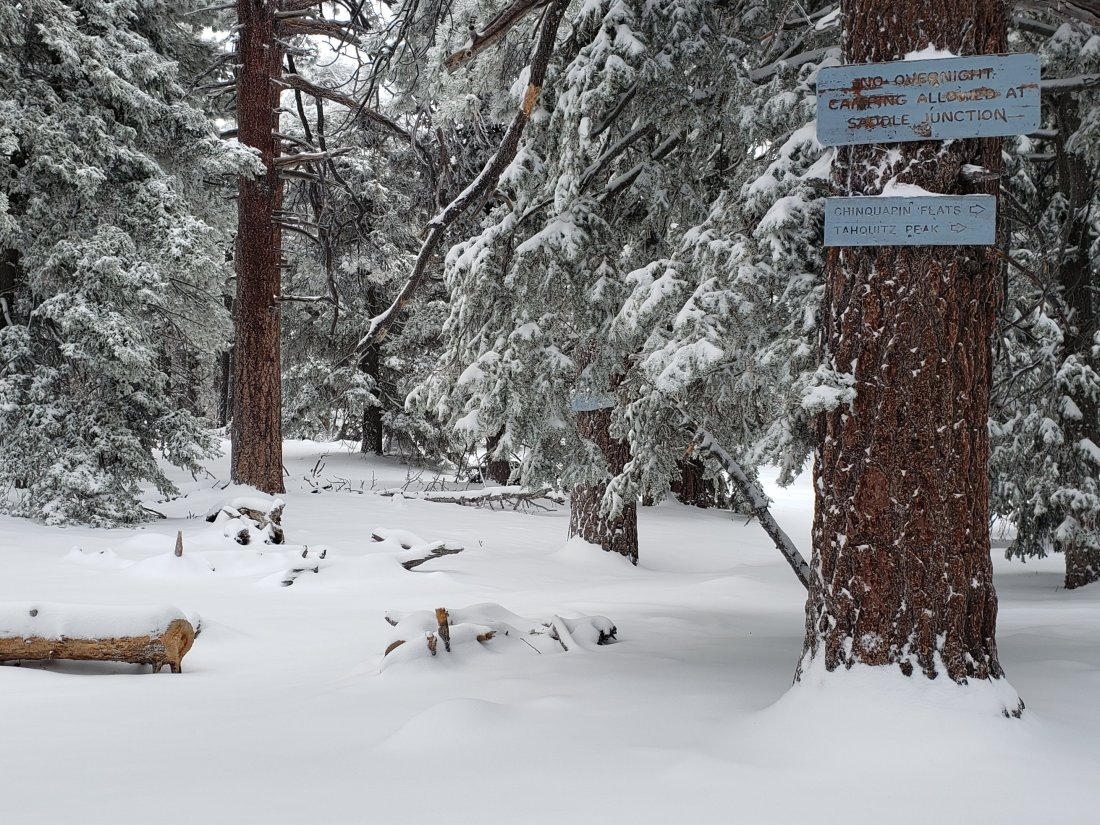
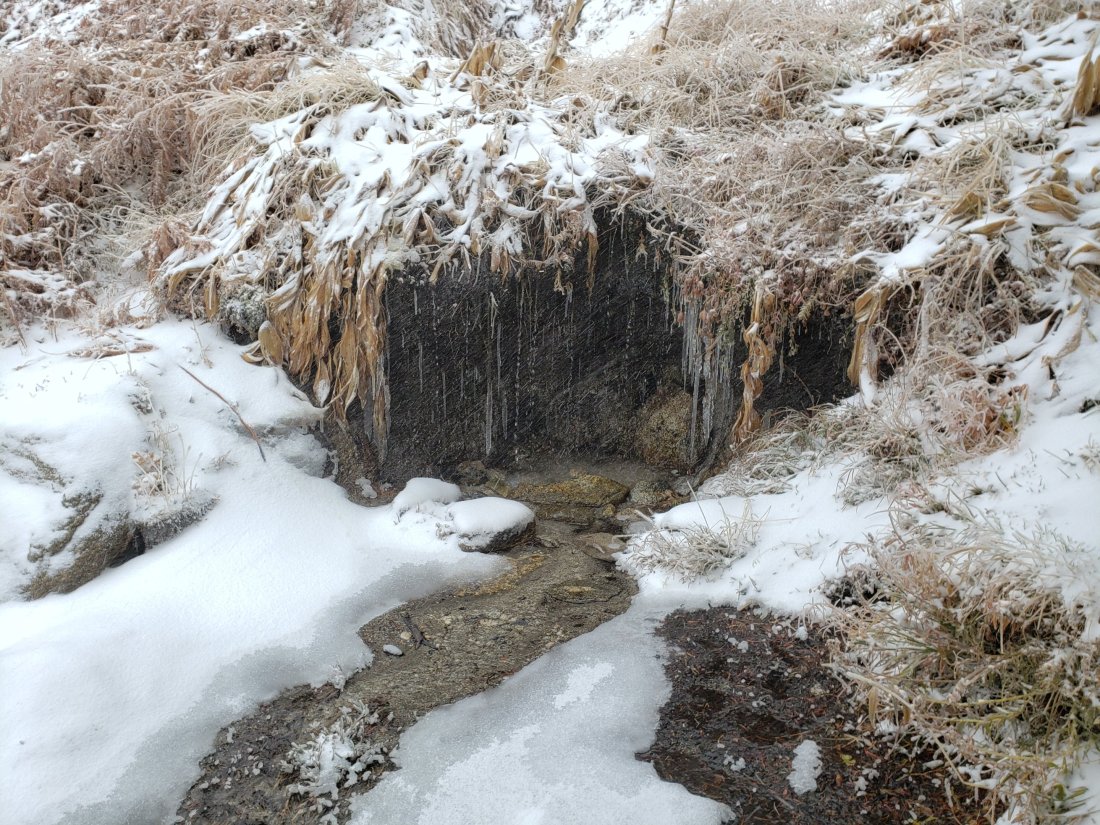
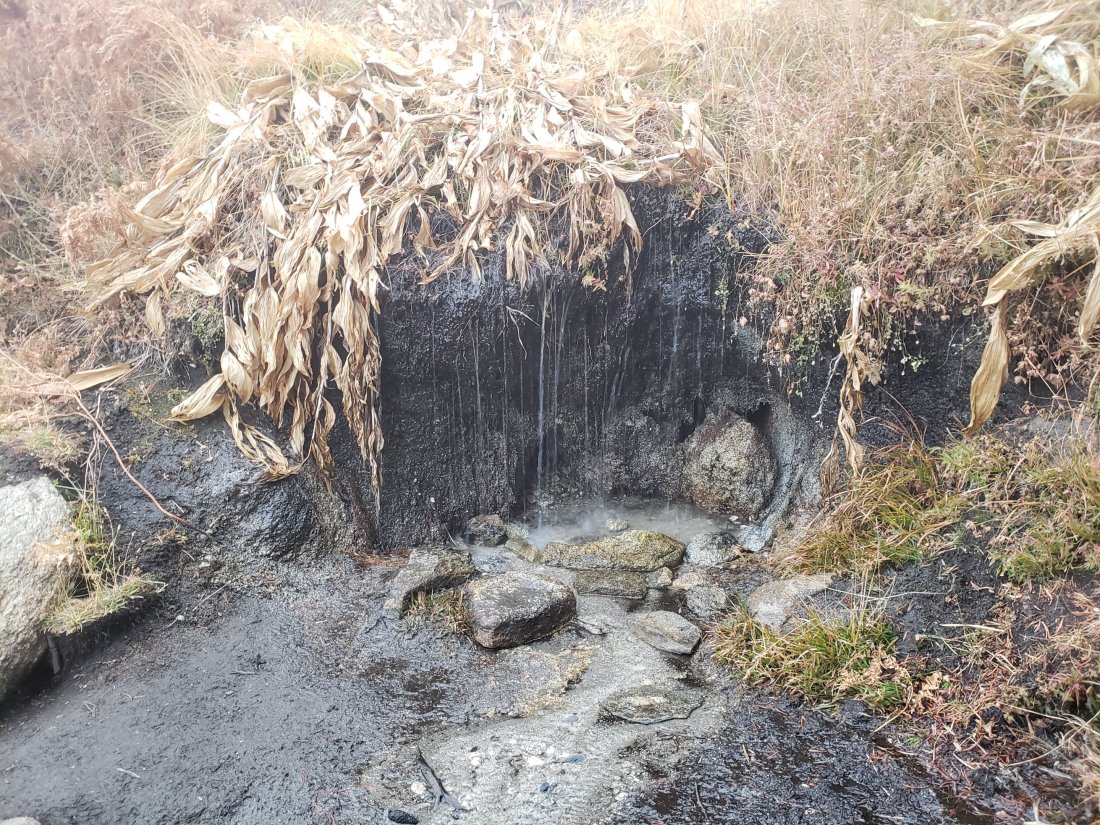
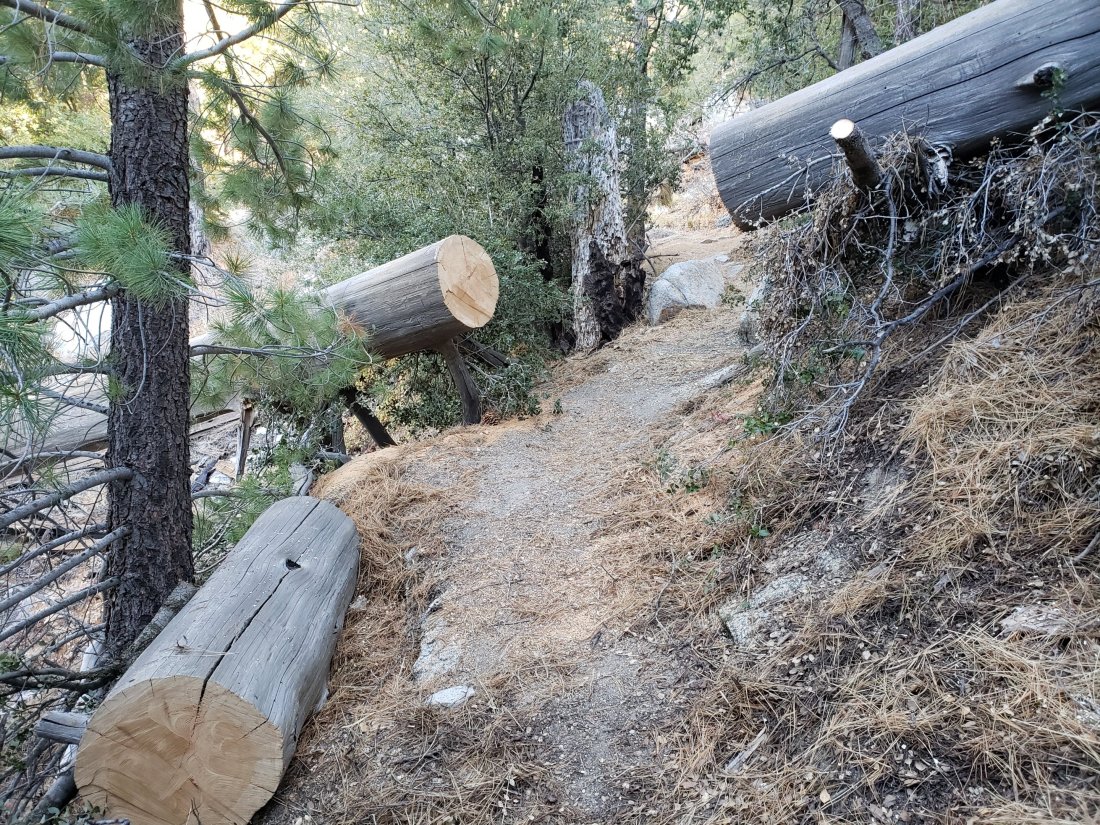


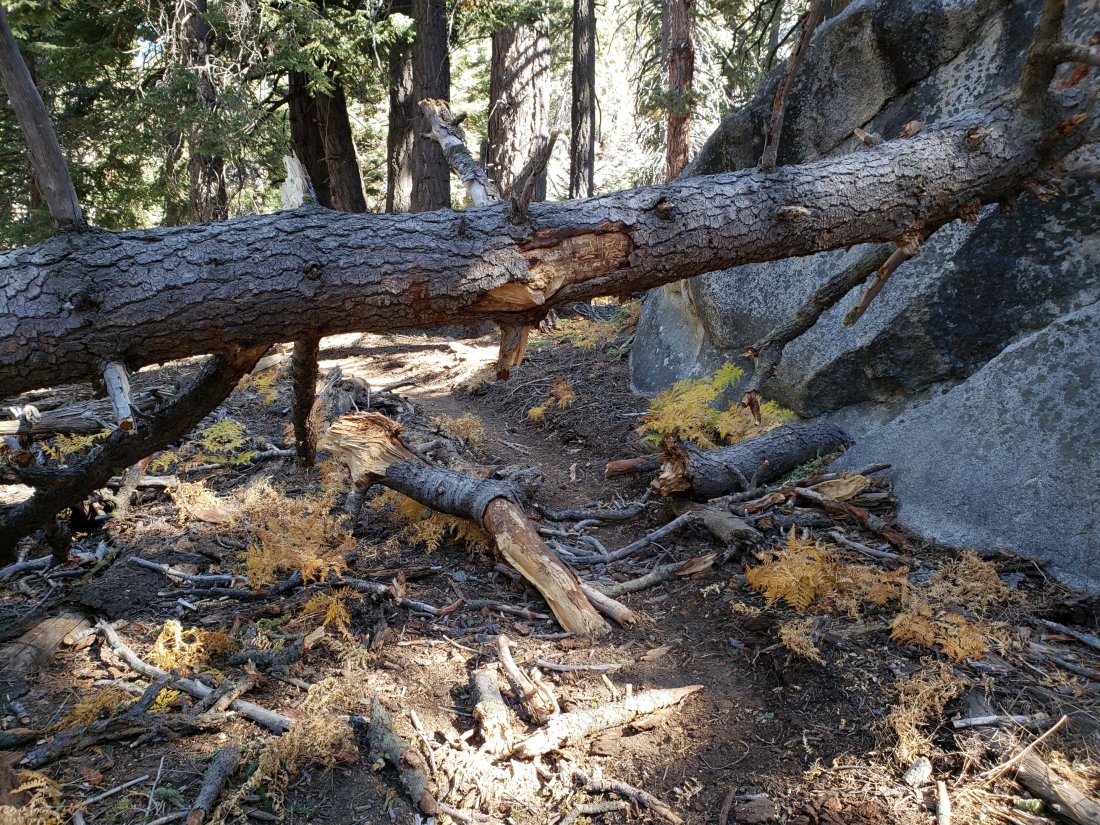

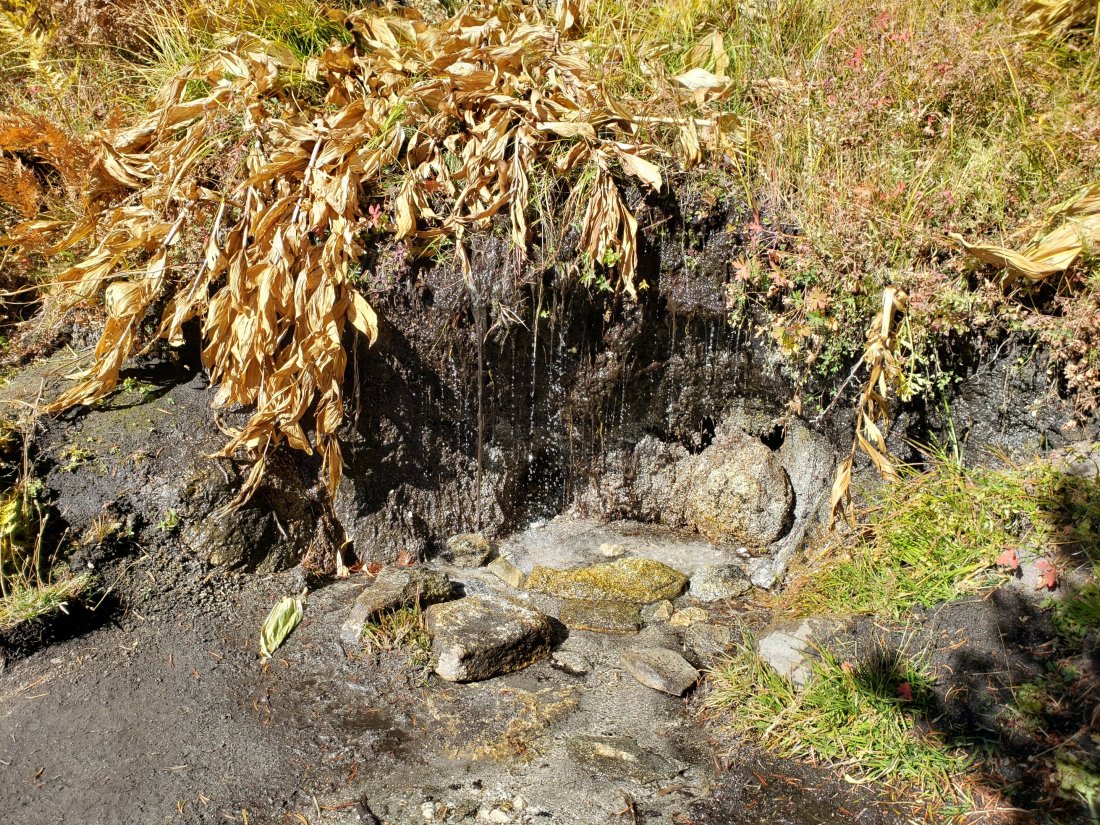

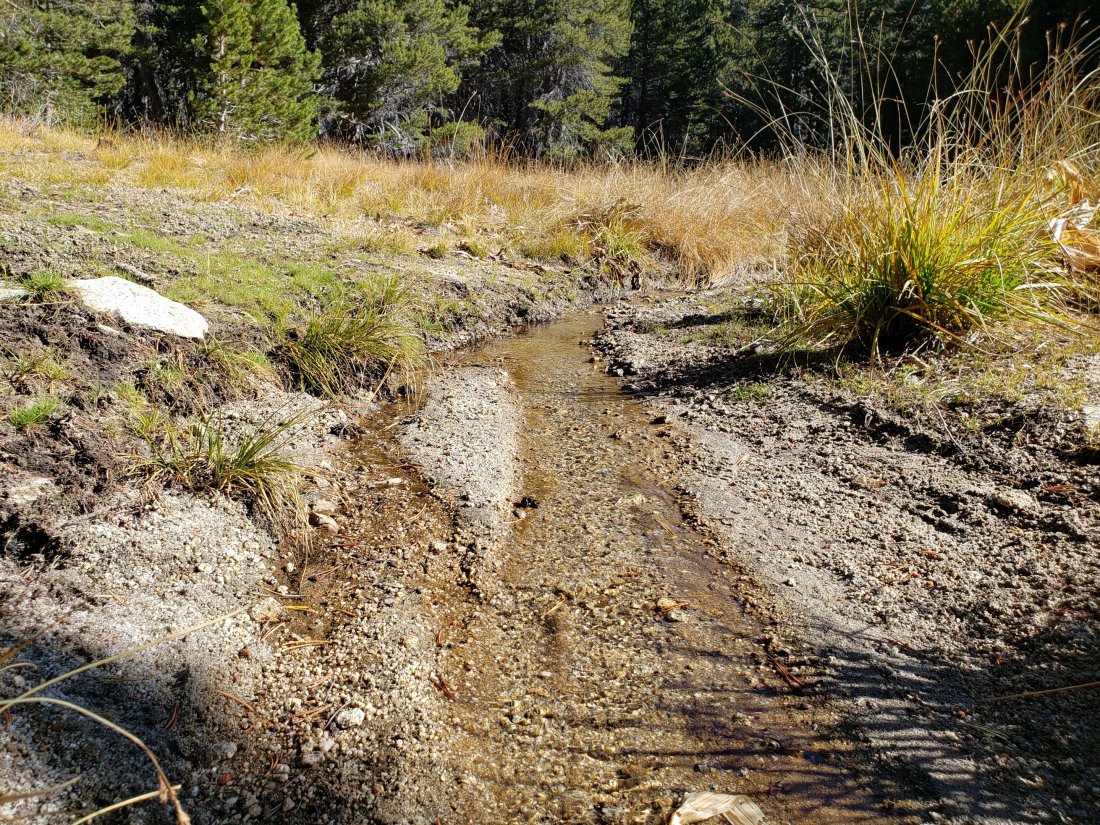


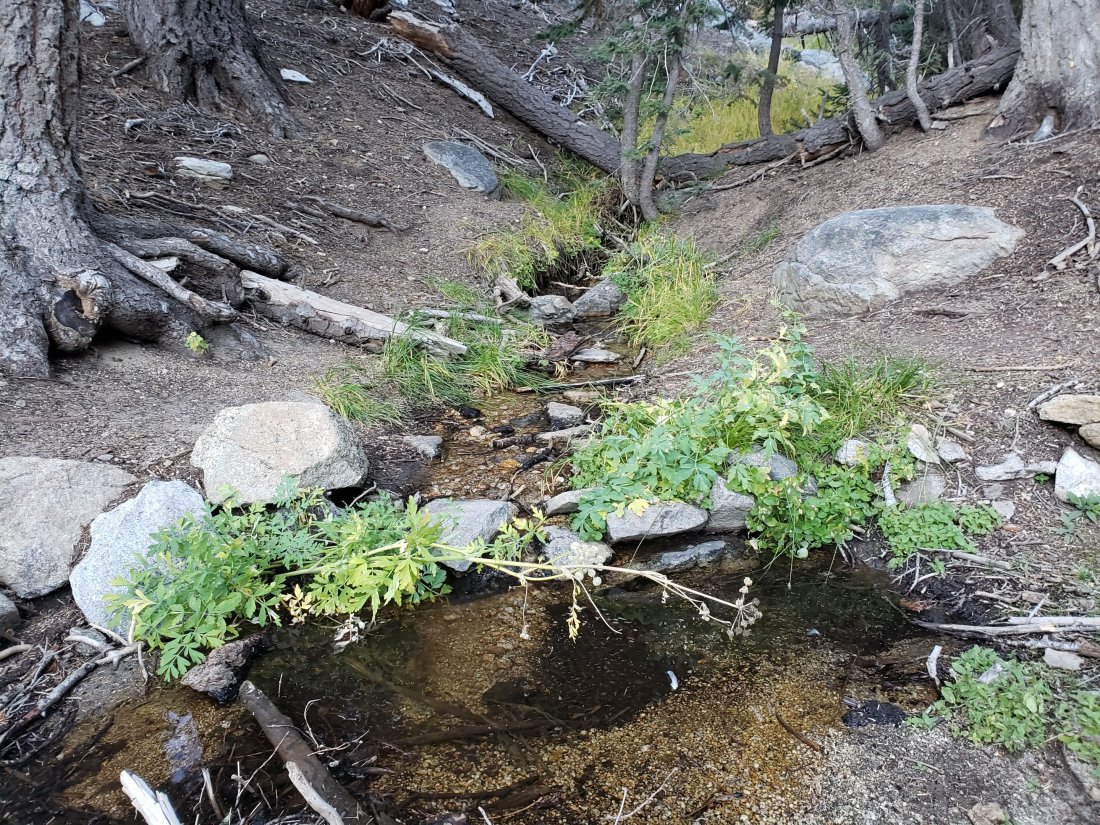
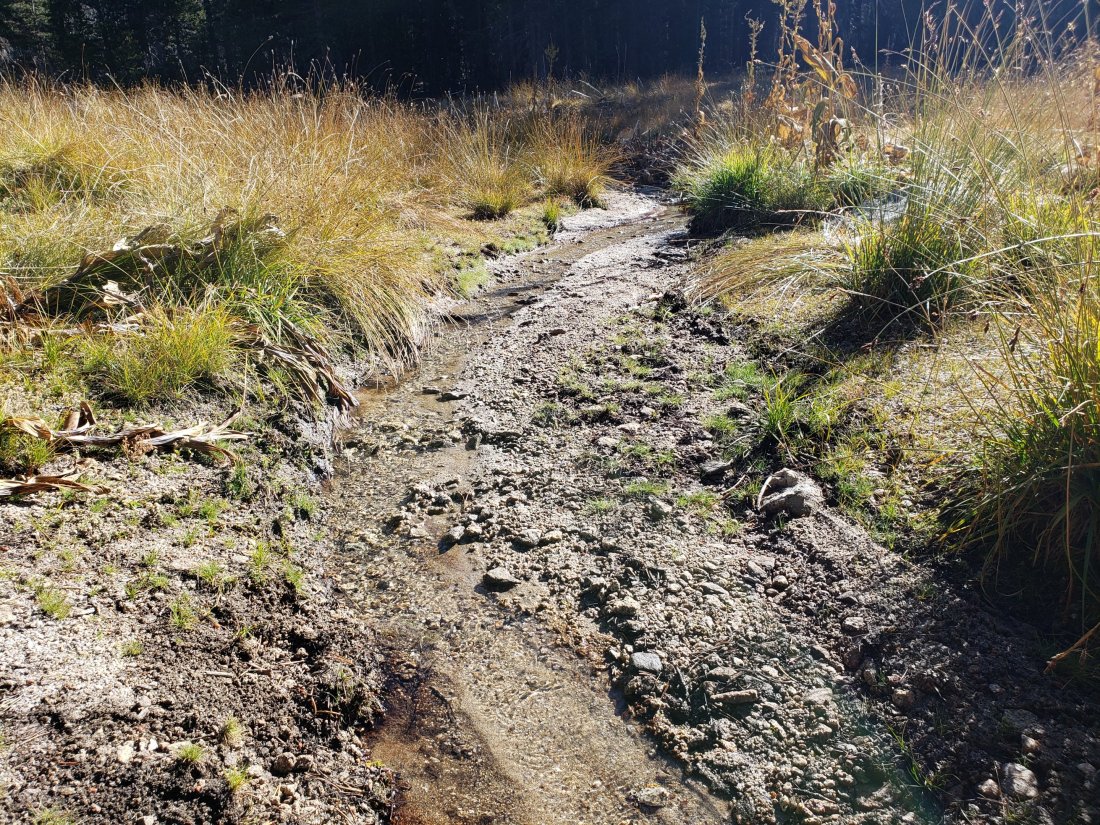
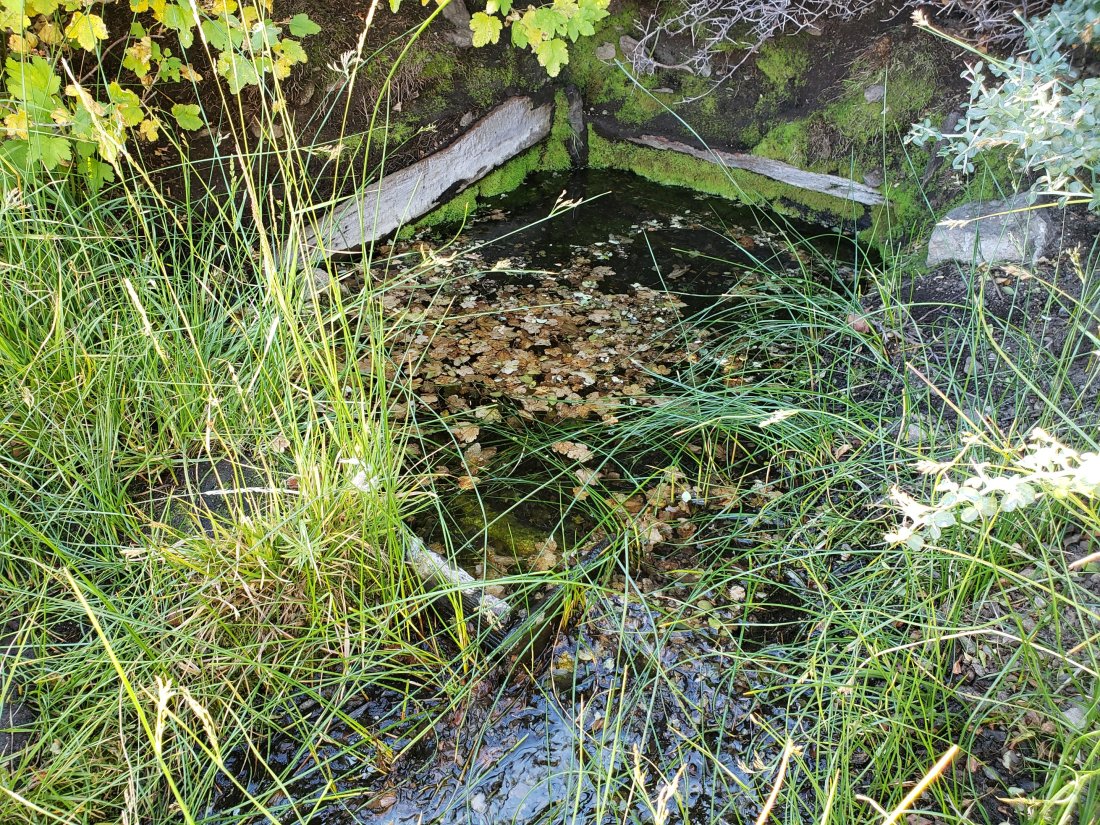
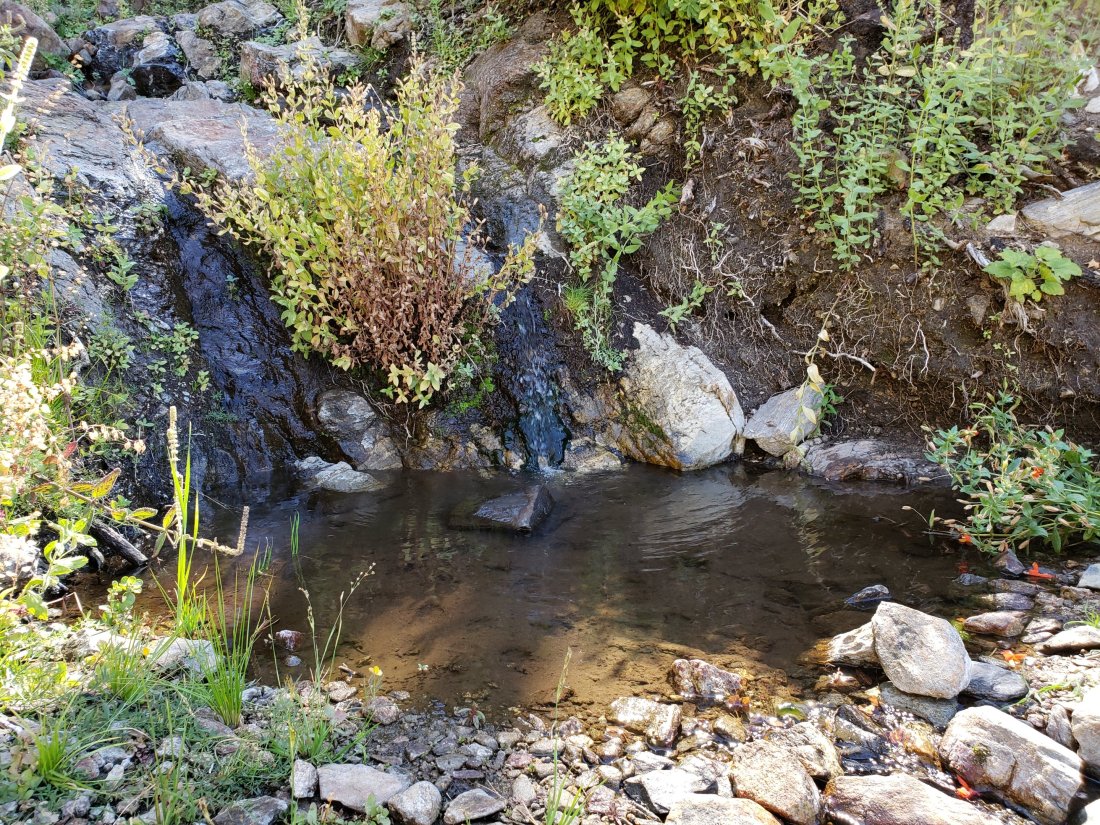
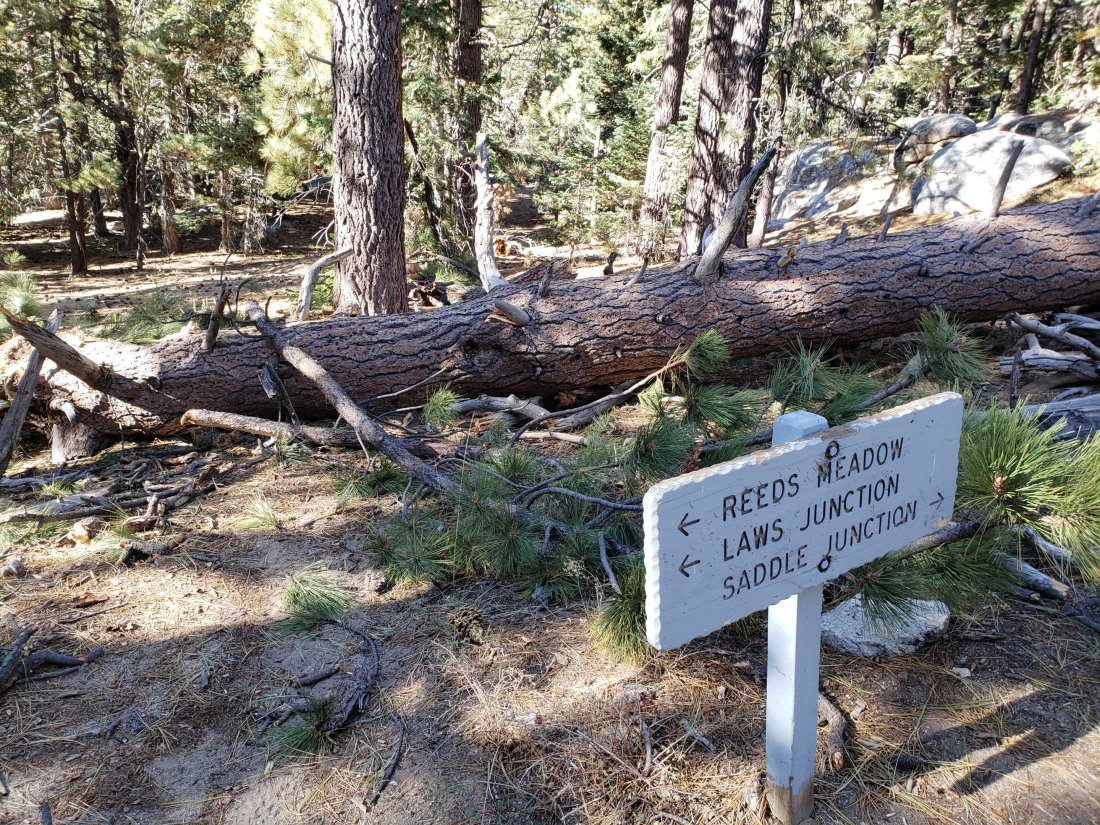
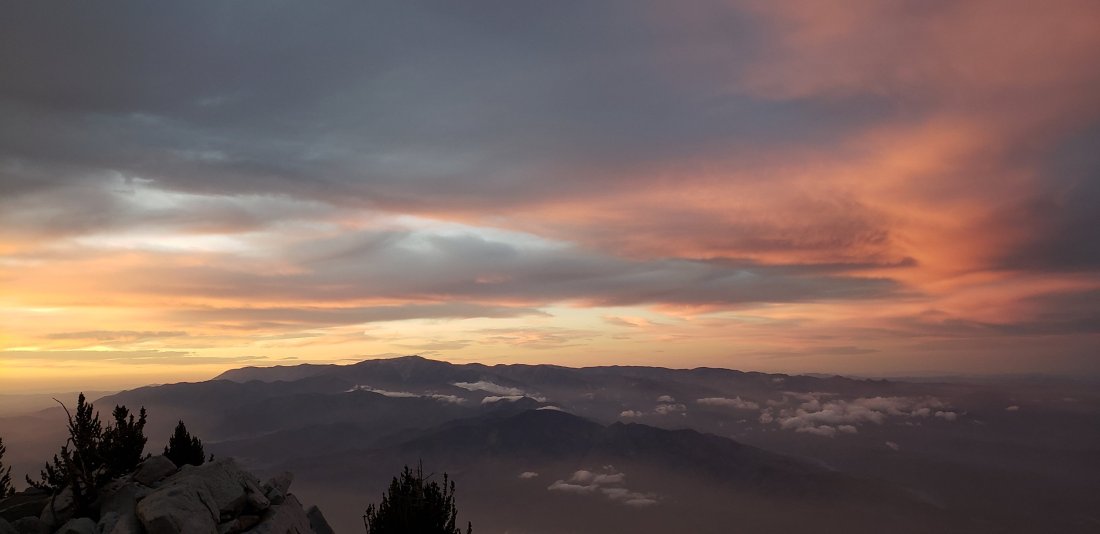


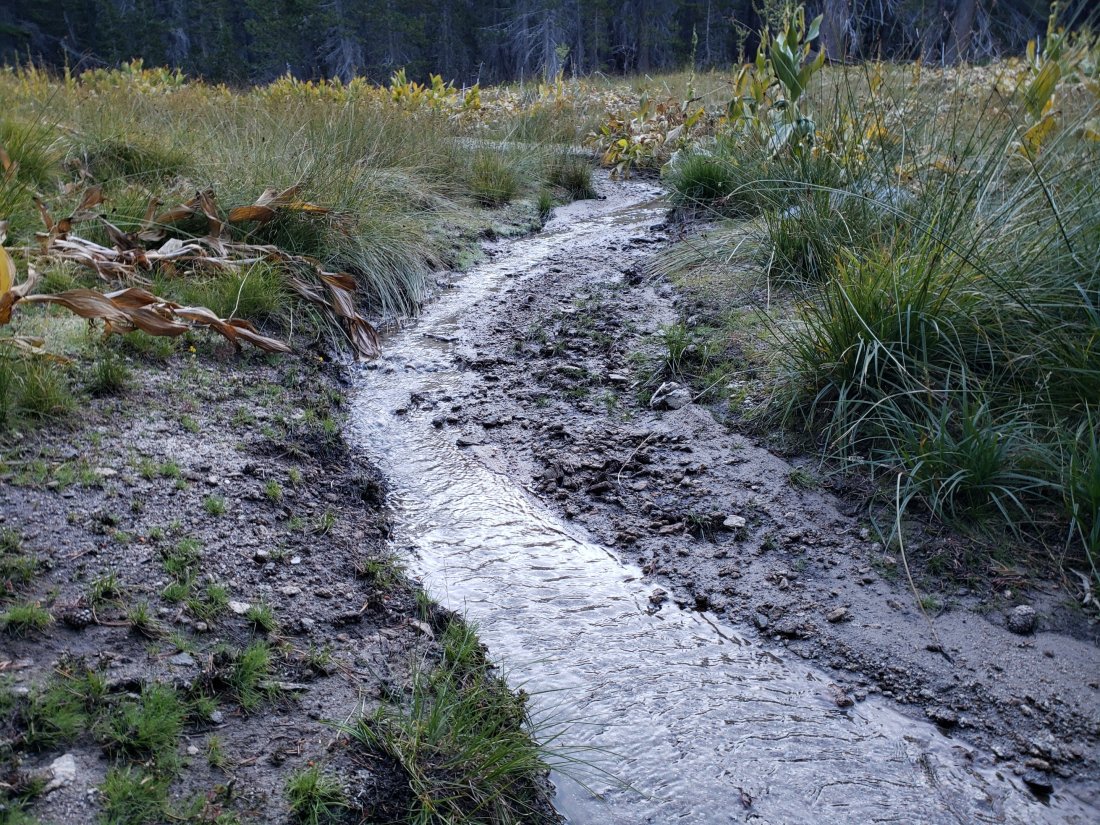


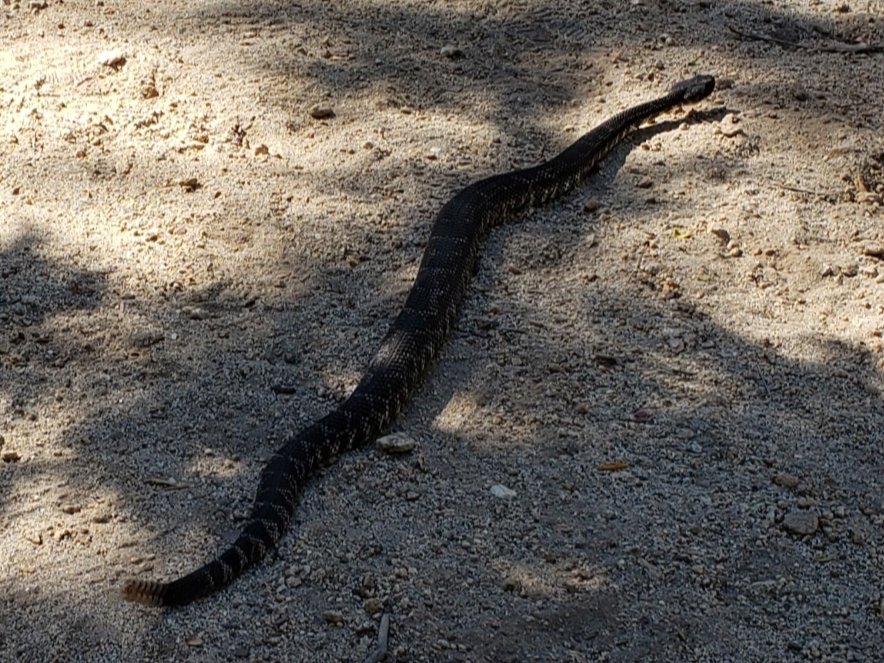

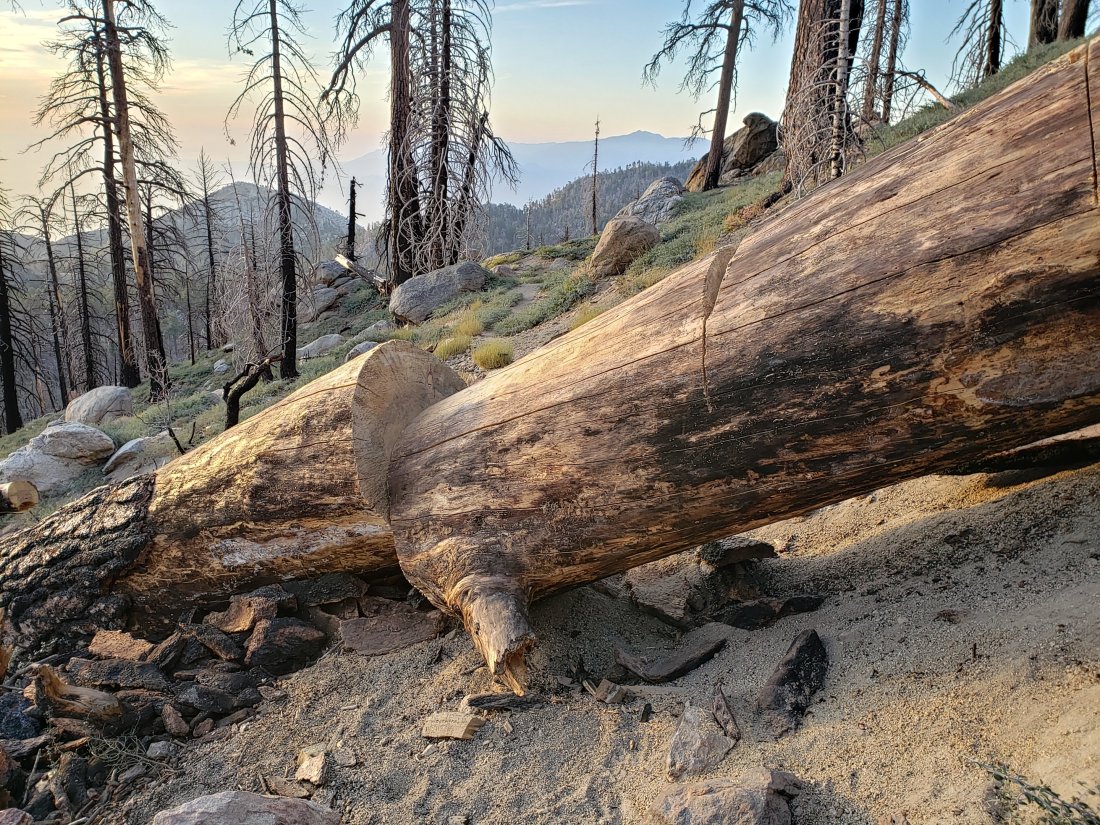


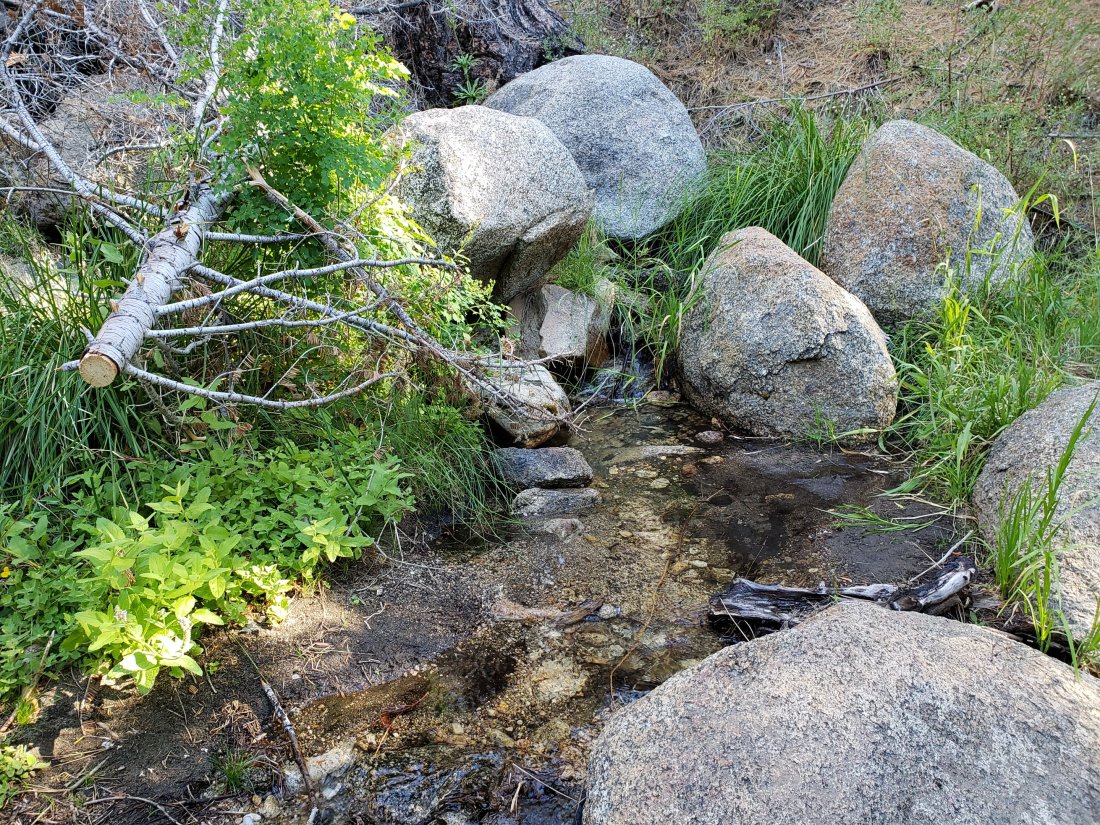

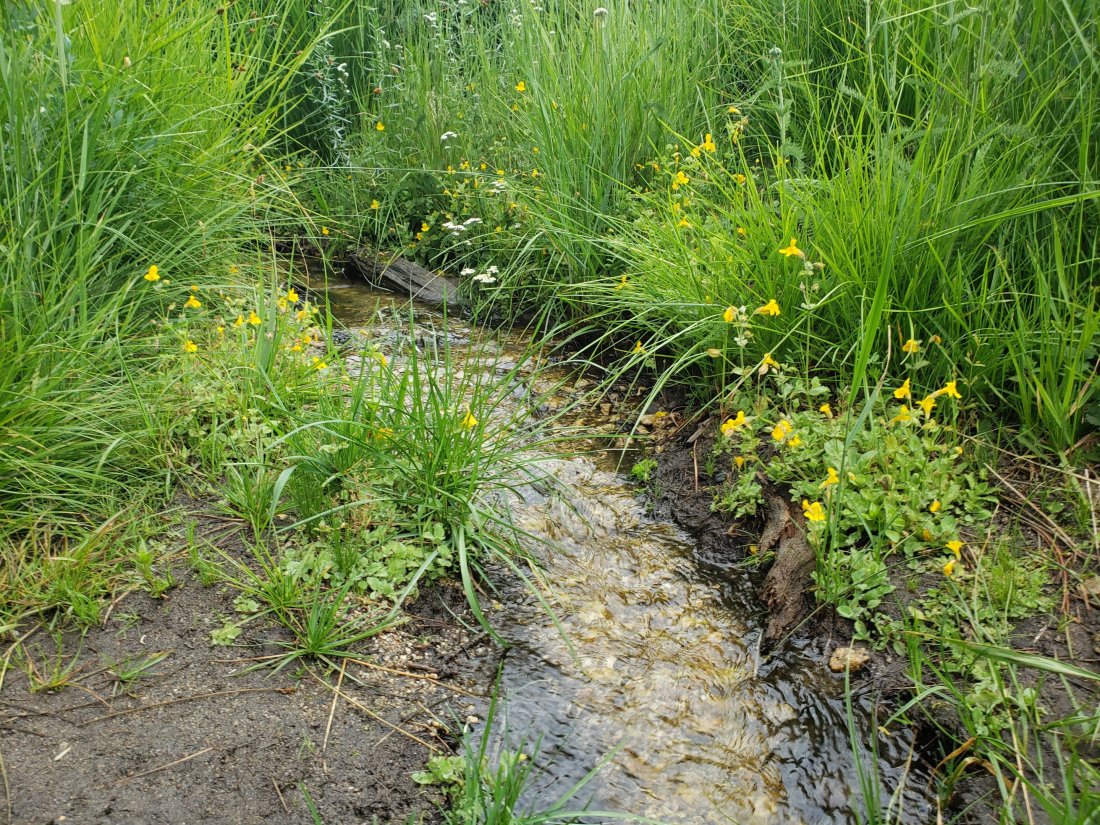
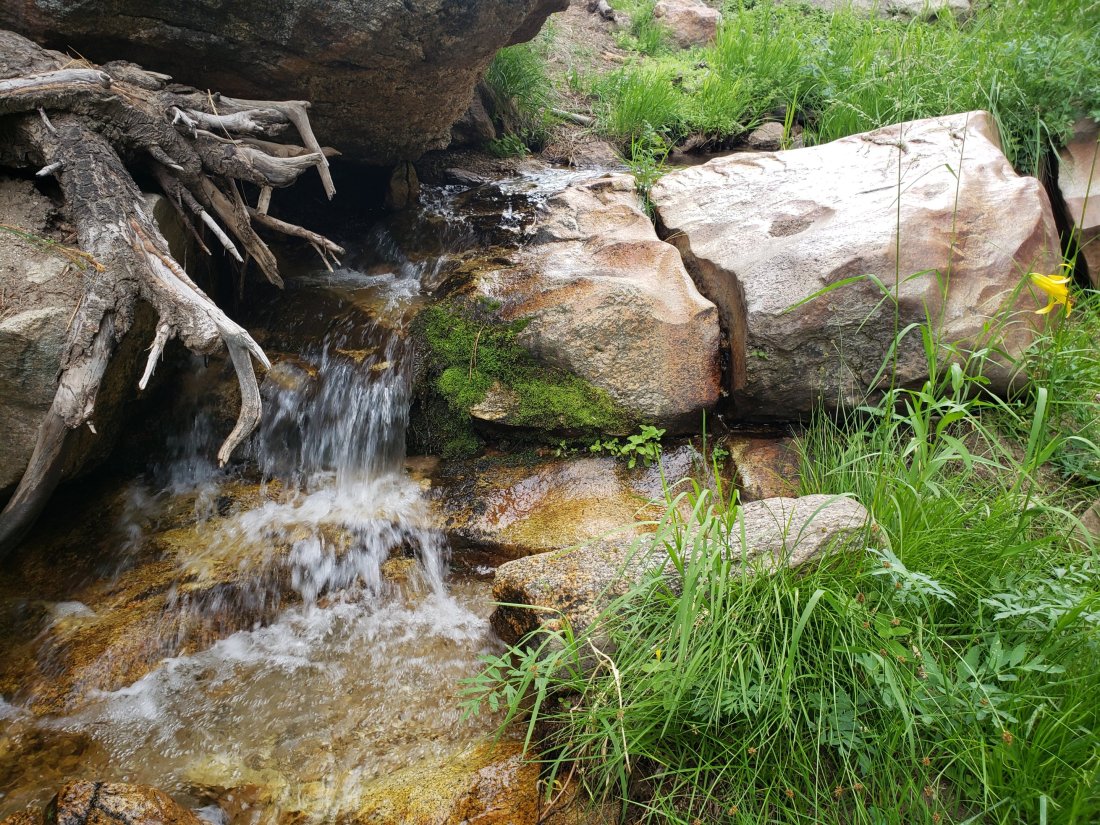
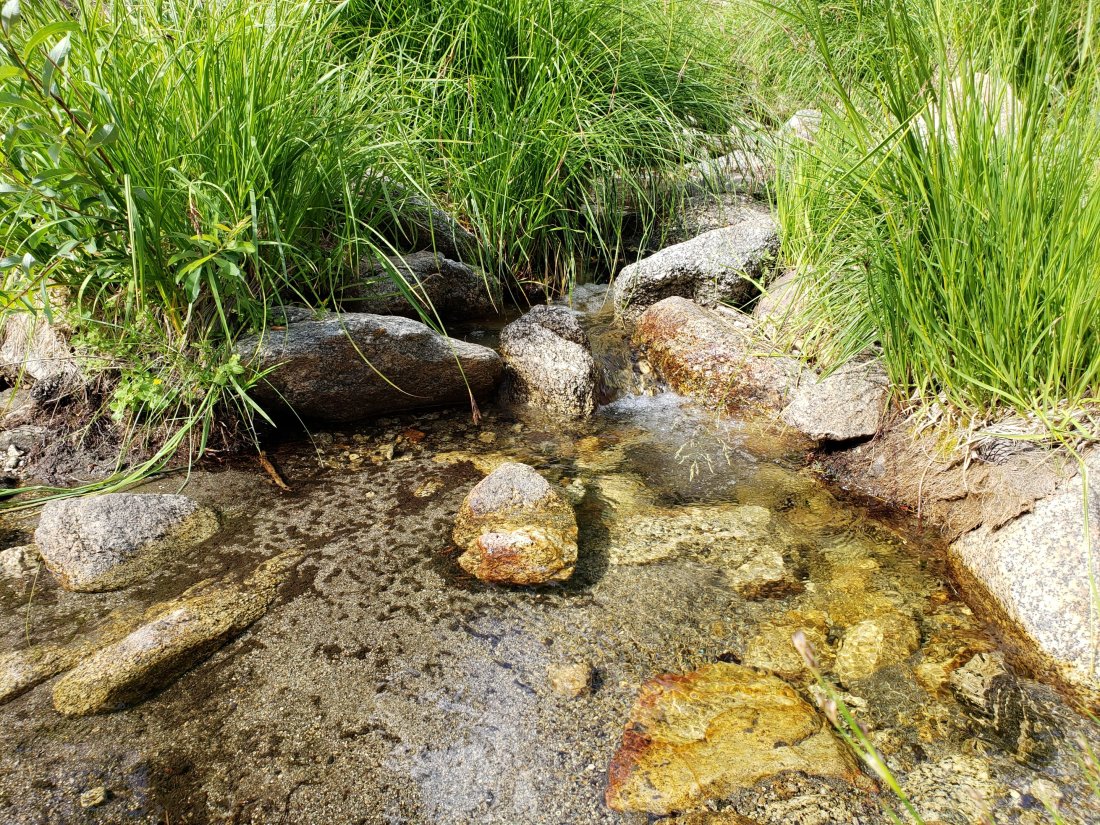
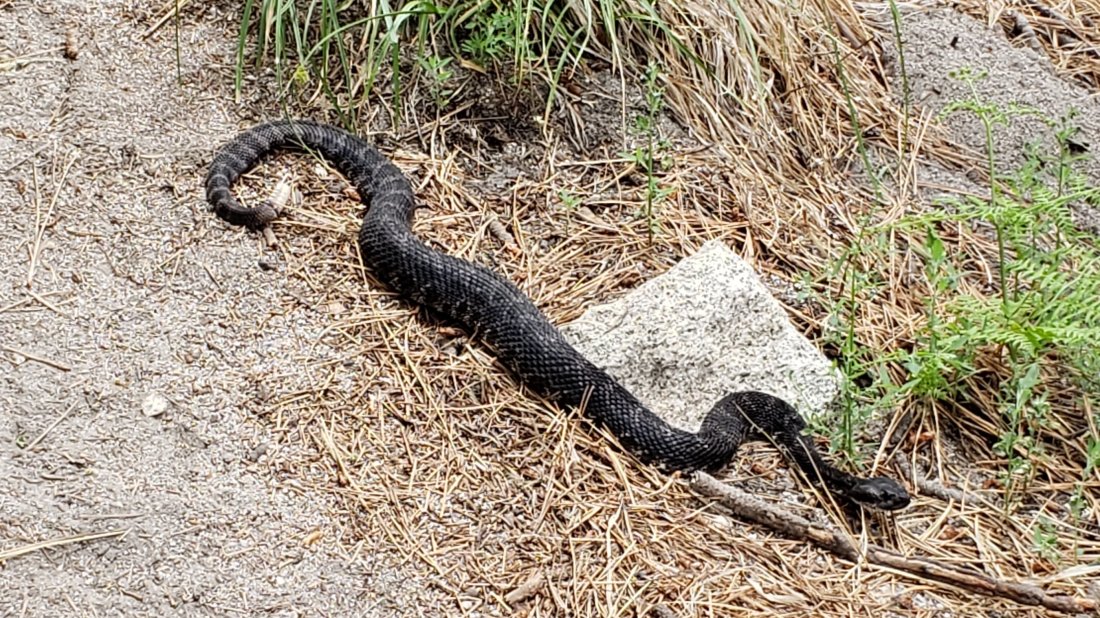
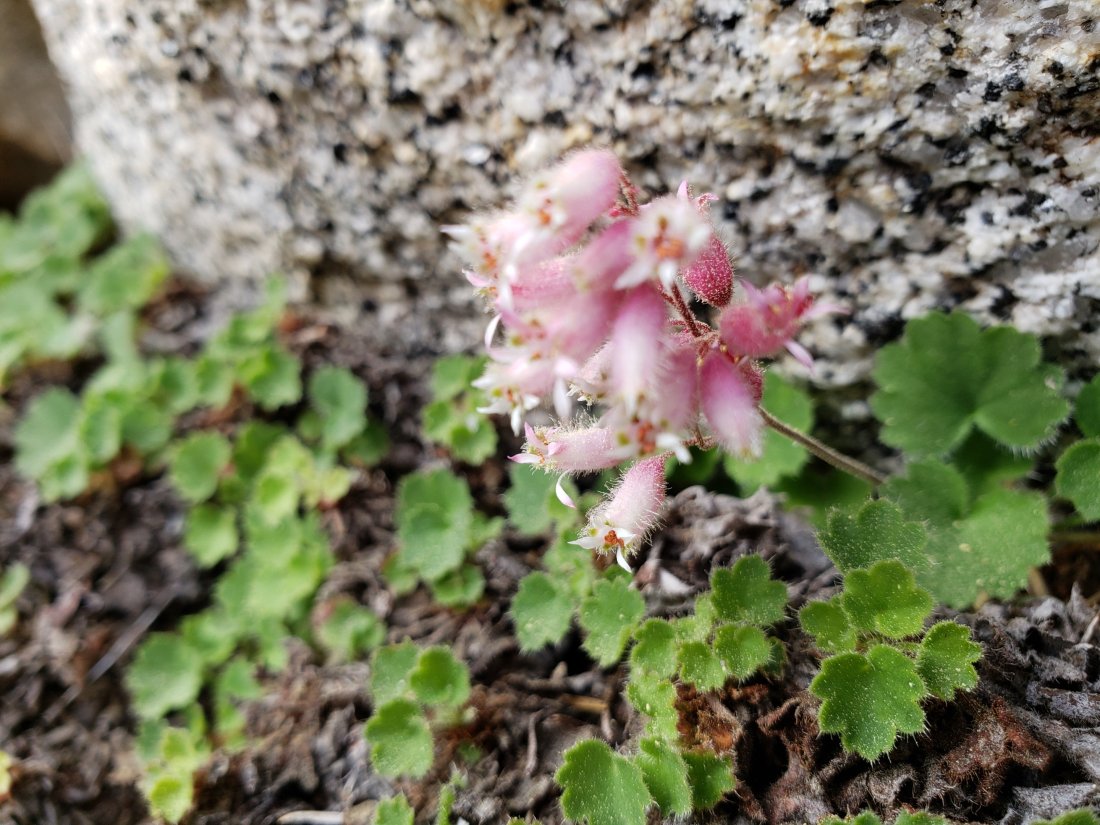
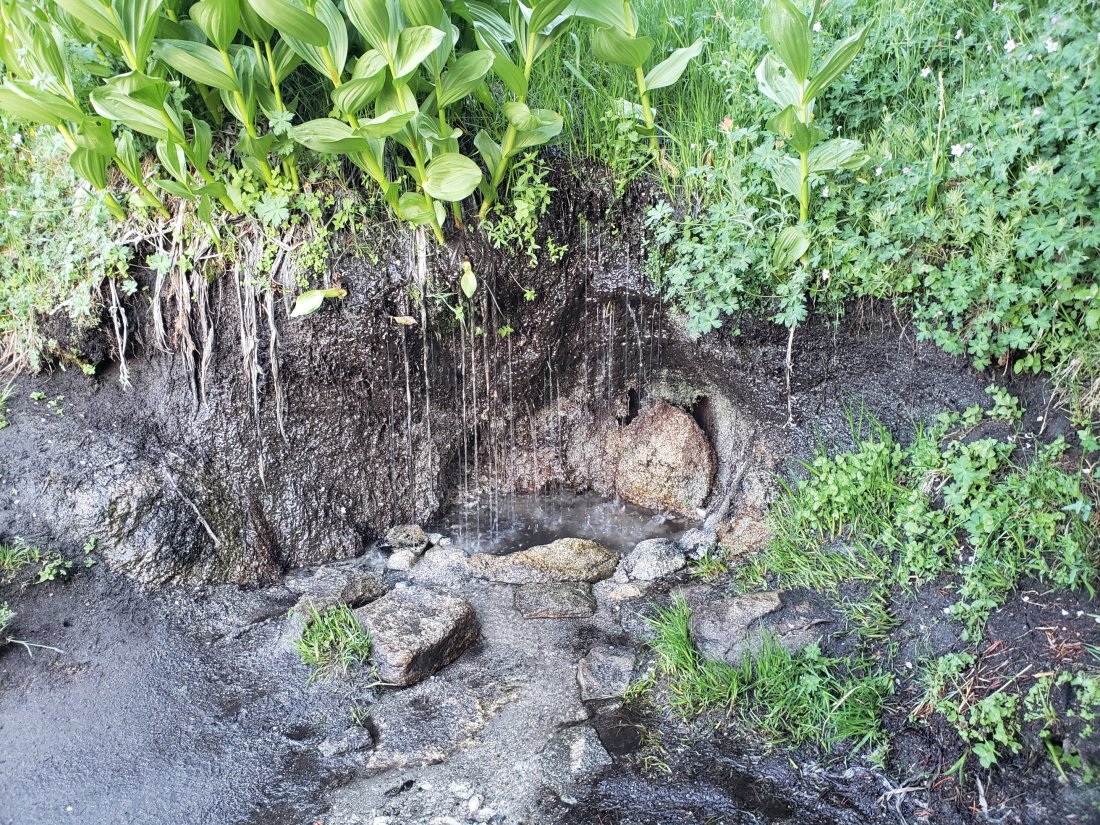


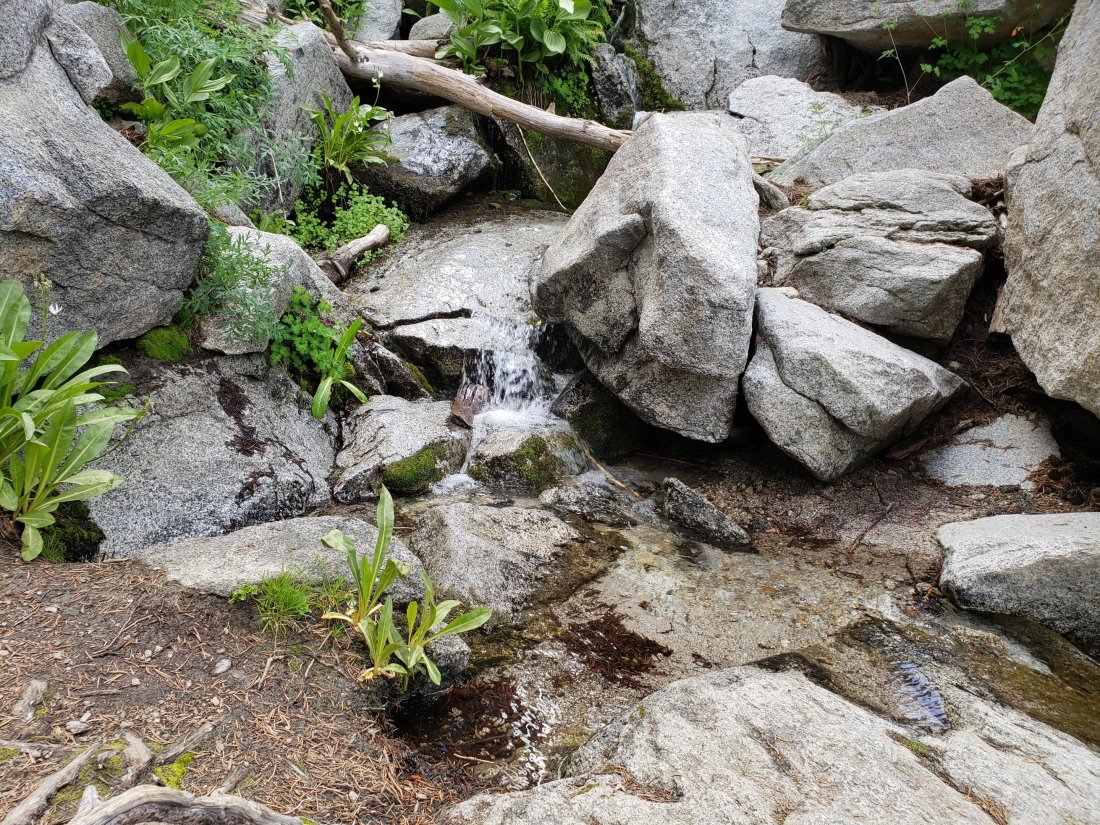

 San Jacinto Trail Report