Trail and water update 7 May 2018

This morning we ran/hiked to San Jacinto Peak from Humber Park via Wellman Divide, returning via Deer Springs Trail and the PCT southbound back around to Devils Slide Trail. The main focus today was the status of springs and creeks.

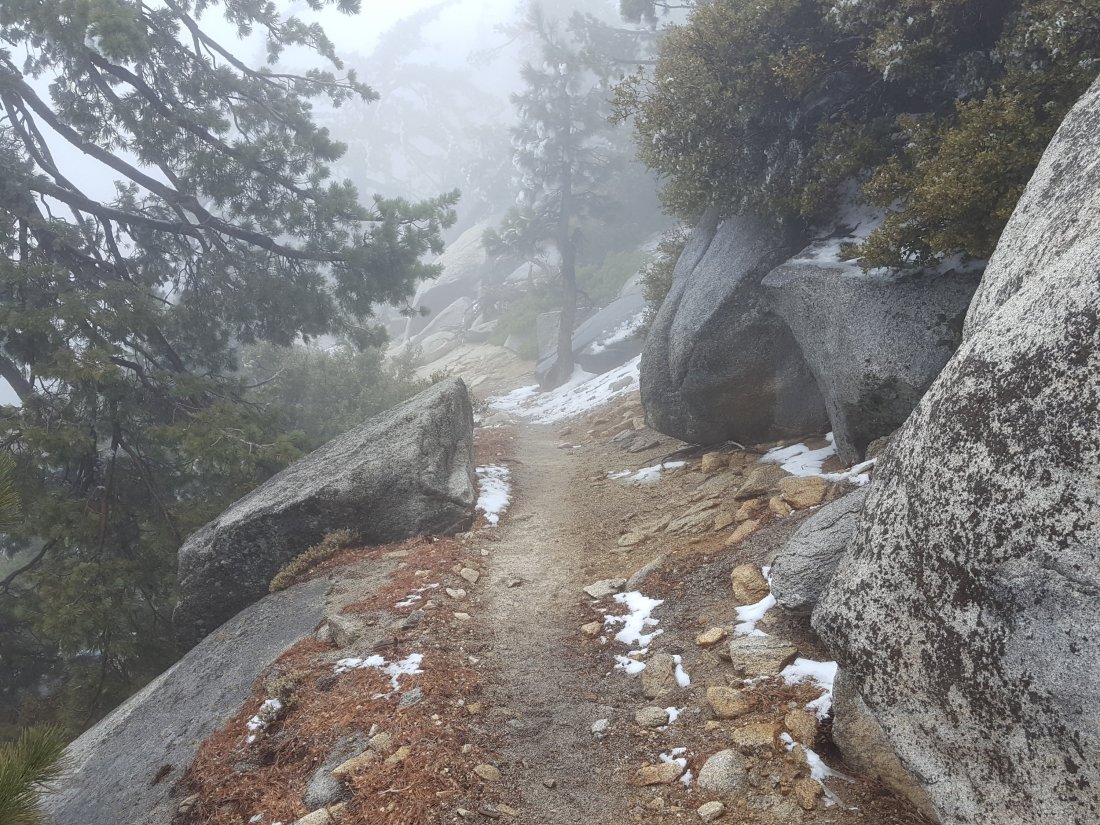
Trails All evidence of the snow of 2nd May is long gone, and virtually no snow remains from earlier in the year either. All trails are completely clear of snow. At San Jacinto Peak there is no snow cover (except some limited patches on the north face). The eastern slope between San Jacinto and Miller peaks has only a few tiny patches of snow, and the East Ridge Trail is now clear.

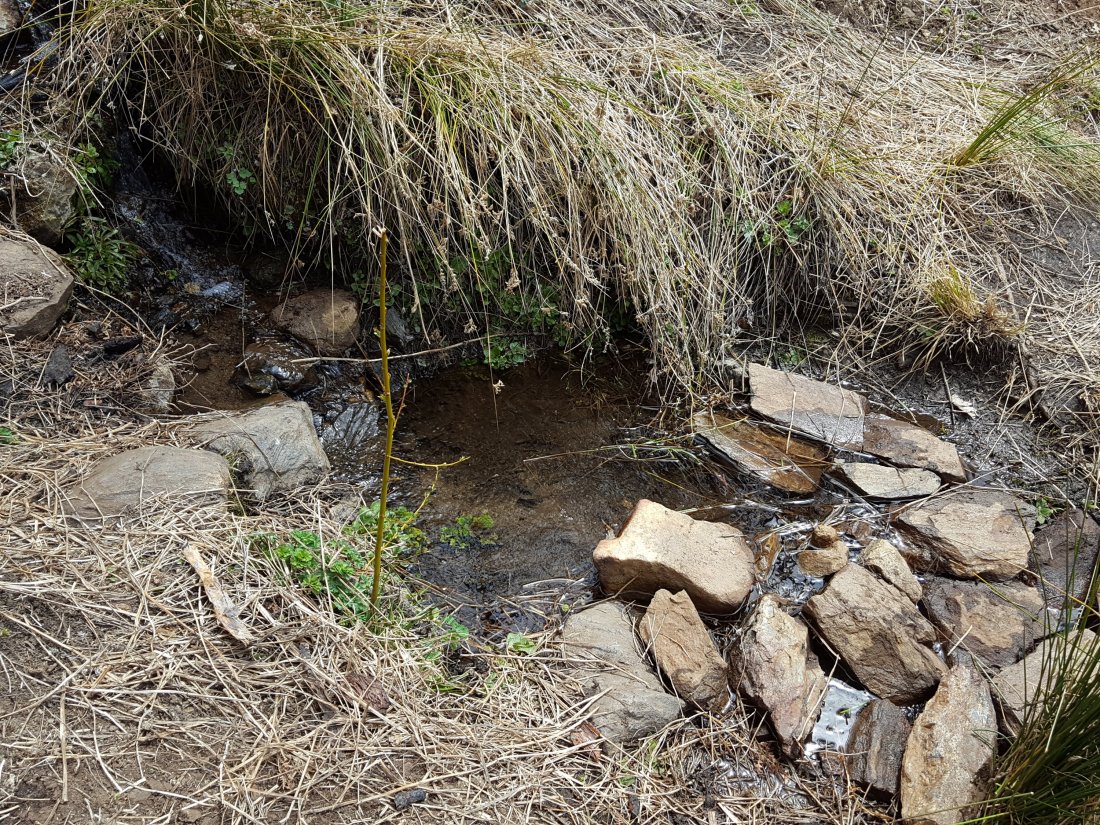
Water resources along the PCT (and elsewhere) are already flowing relatively poorly. The flow rates of many of the “perennial” springs are reminiscent of late summer.

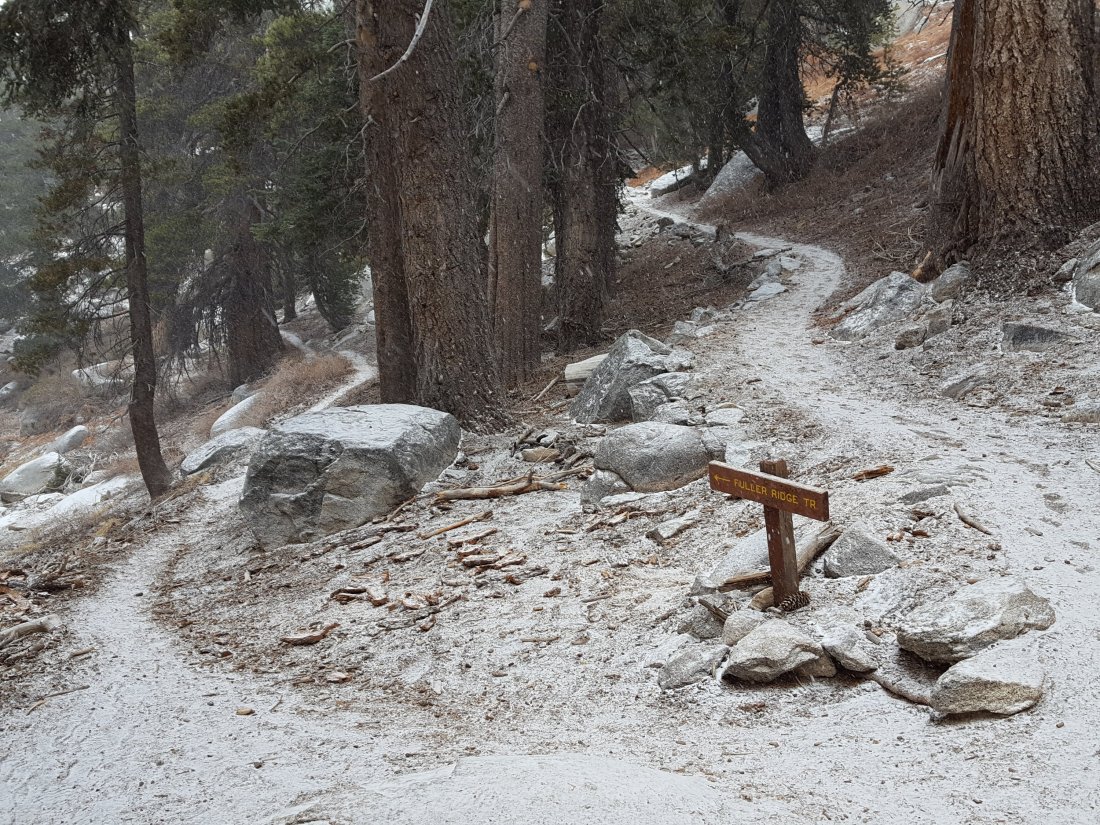
The North Fork of the San Jacinto River is flowing well both where it crosses the Deer Springs Trail above Fuller Ridge, and where it crosses the Fuller Ridge Trail on the PCT (approx. PCT Mile 186.2). [For northbound thru-hikers, the latter is the crucial refill point before a section of 22.5 miles with no water.]

O’Sullivan Creek (PCT Mile 186.4) on Fuller Ridge Trail is completely dry.

The spring in the creek in Little Round Valley is only a trickle for about 10 yards just above the crossing for Campsite 2 (Owls Hootch).

The Deer Springs stream crossing at the PCT (approx. PCT mile 185.6) is now dry, and even the tiny pools just upstream (and downstream) of the trail are drying rapidly. [PCT thru hikers note: almost all PCT guides and apps confuse the Deer Springs crossing with the North Fork of the San Jacinto River. The latter is another 0.5 miles further north on the Fuller Ridge Trail, and is flowing well.]

The little spring in the rock crack at Strawberry Cienega (PCT mile 183.0) continues to flow well.

Both the northern and southern springs at Wellman’s Cienega are flowing well, but flow rates are very low for May.

Trail and snow update 2 May 2018

[UPDATE 3 May 2018 – I hiked San Jacinto Peak from Humber Park this morning. There were small patches of snow around 9000′ near the State Park boundary, from Wellman Divide to 10,100′, and above 10,500′. The snow was just 1-2″ deep and easily hiked without microspikes, and was melting fast already by mid morning. All other sections of trail were more exposed to direct sun and were completely clear. With a strong warming trend, almost all remaining fresh snowfall will likely have gone by Saturday 5th May.]

Today I surveyed the PCT along the Fuller Ridge Trail, then turned up to San Jacinto Peak via Little Round Valley, before returning by the same route.

Overview Today was an especially striking example of how quickly weather can change in the mountains. As expected a storm system overnight brought a dusting of snow above 5000′, a consistent 1.0″ (25mm) of snow on all trails above 6000′, and 1.5-2.0″ of snow on San Jacinto Peak above 10,500′. There was some drifting in the trails (to 4″ deep) in the most exposed areas, such as at the Peak >10,500′ and on the west slope of Fuller Ridge.

At San Jacinto Peak at 1200 today, I recorded a temperature of 23.5°F (-5°C), but the windchill under a light north-east breeze was down to 9°F (-13°C). At times during my hike it tried to snow again, and at others the sun put in brief appearances through the thick cloud.

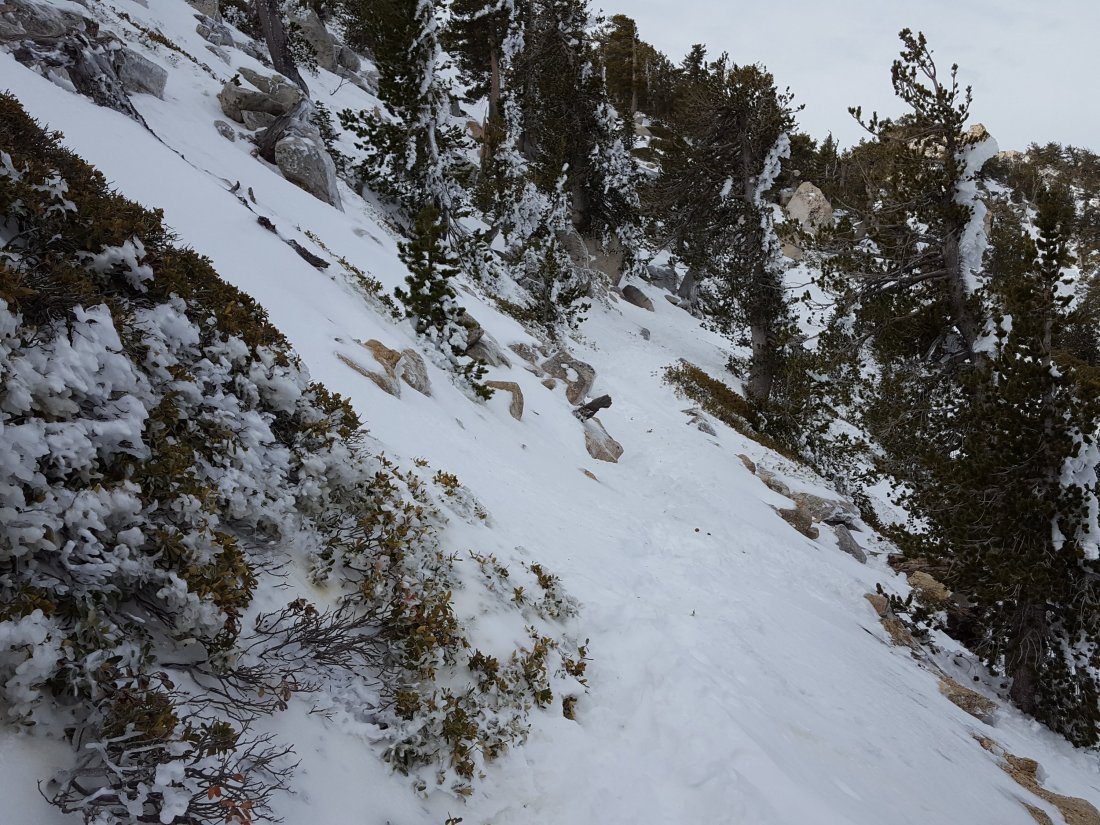
In contrast to the sharp cold this morning, a very strong warming trend took hold in the afternoon, and even under cloudy skies there was dramatic melting everywhere. Trails that were completely snow covered in the morning were largely clear by the afternoon (see photos below). Remarkably by 1600, all areas below 8000′ were almost completely clear of snow.

Consequently the fresh snow had no significant impact on routefinding or the accessibility of any trails. No traction devices (e.g., microspikes) are necessary anywhere on the trail system.

Weather prognosis The strong warming trend that started this afternoon will continue and strengthen further for the next several days. By Friday (4th May) there will probably be no sign that we even had snow today!

The PCT midway along the Fuller Ridge Trail at 0930 this morning, 2 May 2018
The same location as above just over five hours later at about 1500 this afternoon!

Weather update 1 May 2018

The basic trail conditions are currently unchanged from my report yesterday. The temperature on the mountain (above 6000′) never got above freezing today, and a light snowfall seems likely tonight into tomorrow. We hiked early this morning from Humber Park to San Jacinto Peak, returning via Tahquitz Peak, and then checked the water sources in the Tahquitz meadows before descending Devils Slide Trail.

At San Jacinto Peak at 0900 this morning, the air temperature was 22°F (-5.5°C), but with a westerly wind gusting to nearly 20 mph, the wind chill temperature was as low as 6.3°F (-14°C). At that time the cloud level was below 7000′, but as we descended it rose to around 9000′. At Tahquitz Peak at 1200, we were in and out of the cloud and winds were lighter, and I recorded an air temperature of 25°F (-4°C) with a wind chill temp down to 17°F (-8°C).

We had no precipitation all day until we finally encountered some light drizzle below 6800′ as we descended Devils Slide Trail, but in Idyllwild it had barely rained (<0.1″).

Current forecasts project up to 2″ of snow above 5500′ elevation tonight into tomorrow morning, with up to about 3″ as high as San Jacinto Peak. I will update again tomorrow afternoon with revised trail conditions.

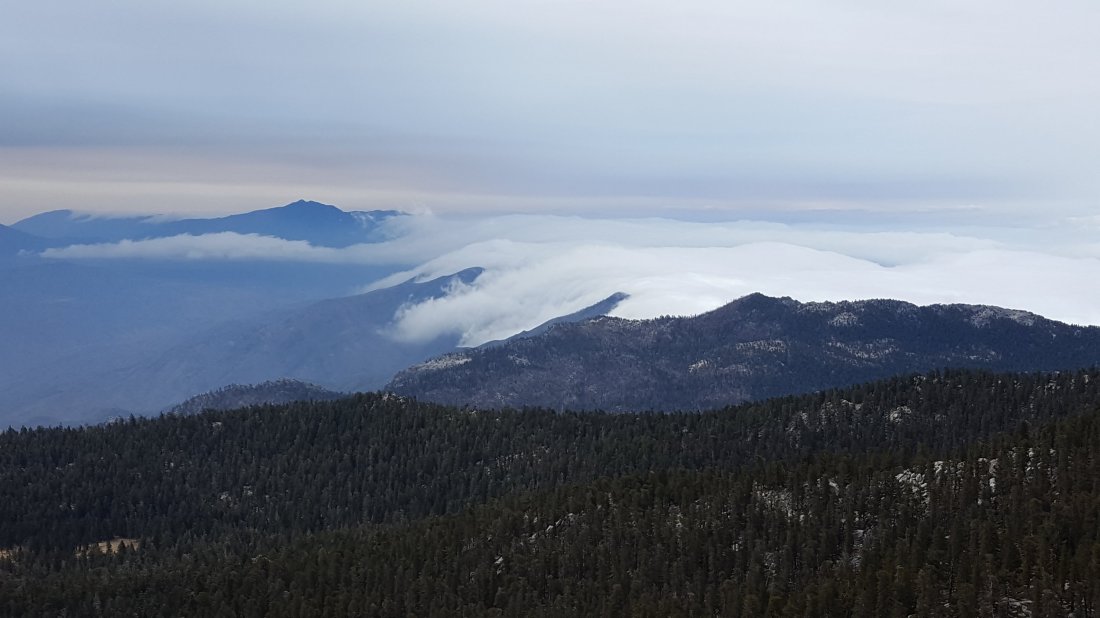
View to the south-east from just below San Jacinto Peak this morning., with the cloud pouring east over the Desert Divide, and also between Toro and Rabbit peaks (on the far left)

Trail update 30 April 2018

Yesterday we checked the Tahquitz Peak area via South Ridge Trail, and this morning hiked to San Jacinto Peak via the Marion Mountain Trail. Given the forecast of inclement weather, I plan to check San Jacinto Peak daily this week, via various routes.

Weather prognosis Rain and snow are forecast over the next couple of days, mainly from tomorrow afternoon (Tuesday 1st May) until the afternoon of Wednesday 2nd May. Current projections are for only about 1-2′ of snow at San Jacinto Peak, and for a dusting above about 5000′ elevation. This should not significantly impact routefinding or trail conditions, especially as very rapid warming is forecast within 1-2 days of the snowfall. Note that temperatures were well below freezing yesterday morning at Tahquitz Peak and this morning at San Jacinto Peak, and on both May 1st and 2nd wind chill temperatures at San Jacinto Peak may be lower than 10° F (-12° C).

Water resources along the PCT (and elsewhere) are already flowing relatively poorly. The flow rates of many of the “perennial” springs are now more reminiscent of late summer. Compared to last week, two significant water sources have almost dried up. The spring in the creek in Little Round Valley is barely a trickle for a few yards just above the crossing for Campsite 2 (Owls Hootch). The Deer Springs stream crossing at the PCT (approx. PCT mile 185.6) is now dry, although there are tiny pools just upstream (and downstream) of the trail. [PCT thru hikers note: almost all PCT guides and apps confuse the Deer Springs crossing with the North Fork of the San Jacinto River. The latter is another 0.5 miles further north on the Fuller Ridge Trail, and is flowing well.]

Pacific Crest Trail is currently completely clear.

San Jacinto Peak trails (both west and east sides) All clear.

At San Jacinto Peak itself there is no snow cover. The eastern slope between San Jacinto and Miller peaks has only patches of icy snow, and the East Ridge Trail is now clear.

South Ridge Trail between Tahquitz Peak and the PCT at Chinquapin Flat was completely clear of ice and icy snow by Monday 16th April.

Deer Springs crossing at PCT mile 185.6 this morning, 30 April 2018. Tiny pools and a light flow remain above the trail.
Black Mountain from the Marion Mountain trail this morning. Cloud cover was solid to the west at about 6000′ elevation.

Trail update 24 April 2018

Overview Judging by our run to San Jacinto Peak this morning, all evidence of the snow of five days ago is long gone, as is almost all the little remaining snow from earlier in the year. Barring any new snow storms (still quite likely until late May), the emphasis of the trail report and my hikes will now be shifting to water resources.

Pacific Crest Trail is completely clear.

Water resources along the PCT (and elsewhere) are currently flowing adequately. The flow rates of many of the “perennial” springs are more reminiscent of mid summer, and water will likely become a major issue in the next month or so.

San Jacinto Peak (west side trails) All clear.

San Jacinto Peak (east side trails) Completely clear to the Peak. The only snow near the trail remaining from earlier in the winter are a few tiny dirty icy patches just below and around 10,000′. These pose no hazard.

At San Jacinto Peak itself there is no snow cover. The eastern slope between San Jacinto and Miller peaks still has about 15% cover of icy snow, mainly a few inches deep. The East Ridge Trail is now largely visible, especially the lower third, and the upper areas involve limited snow travel.

South Ridge Trail between Tahquitz Peak and the PCT at Chinquapin Flat was completely clear of ice and icy snow by Monday 16th April.

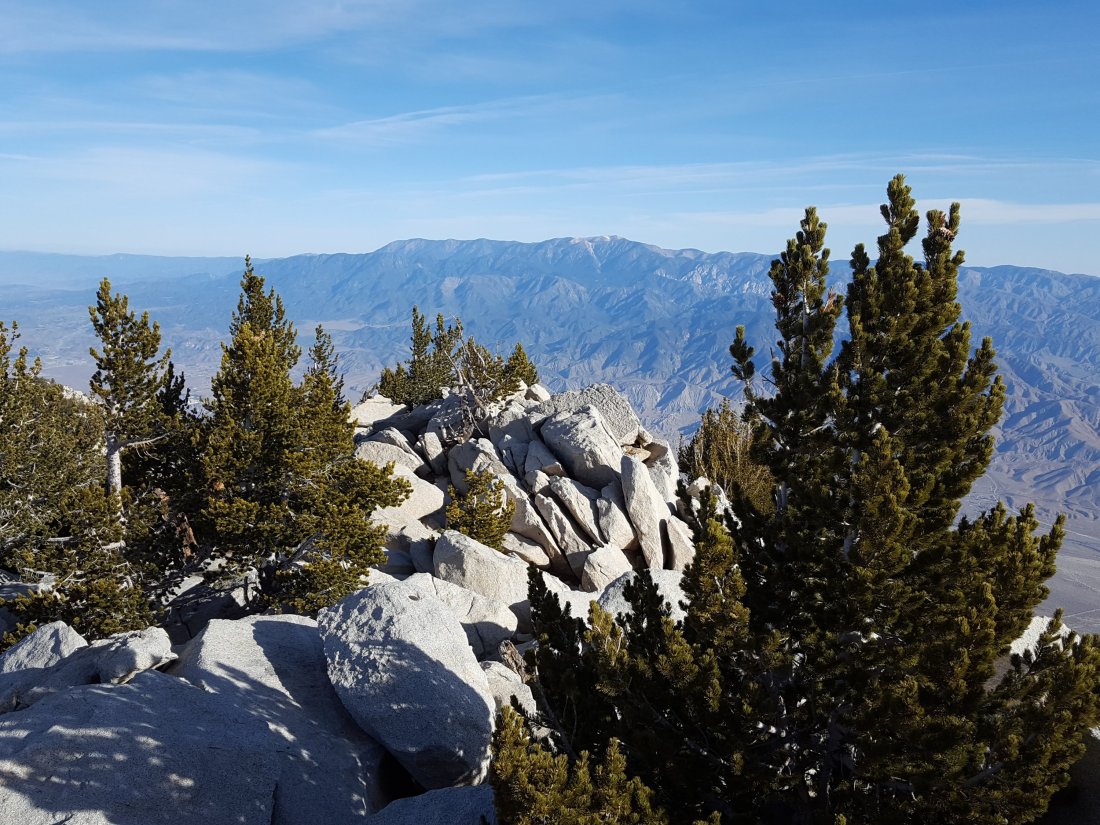
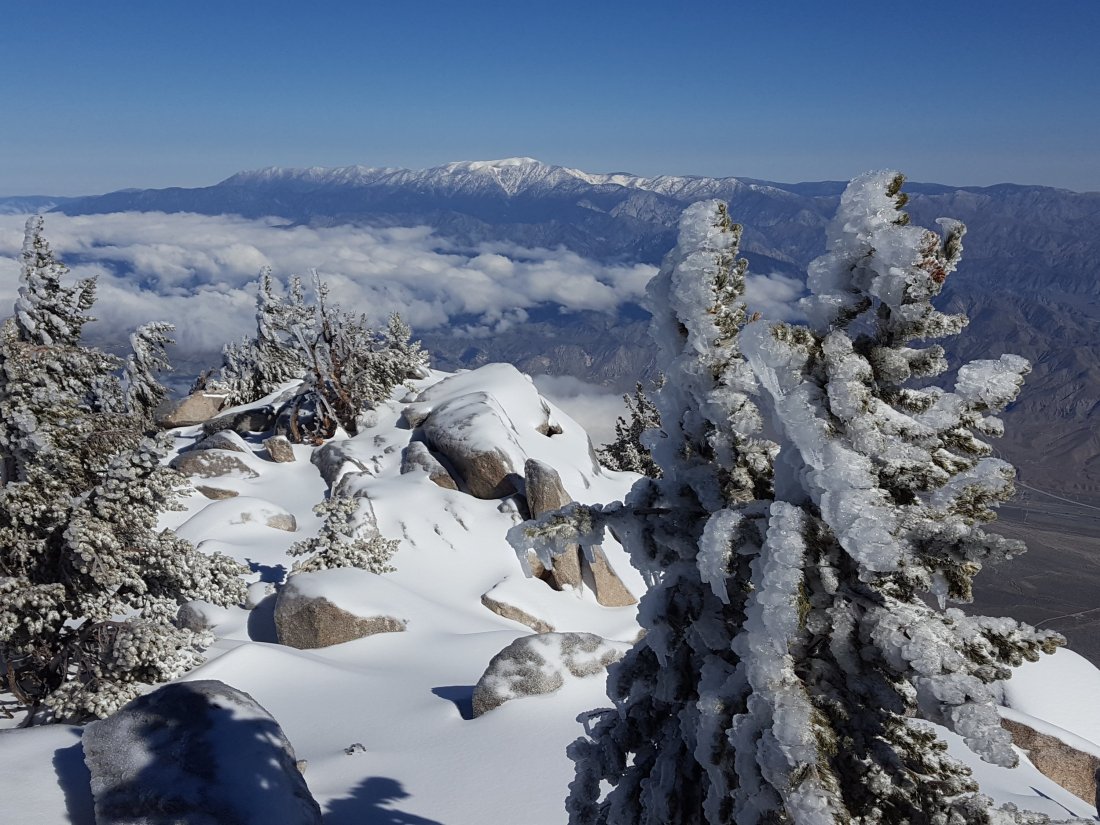
San Jacinto Peak this morning, 24 April 2018, with San Gorgonio in the background. Even at 700 feet higher, San Gorgonio is virtually devoid of snow already.
A similar view of San Gorgonio from San Jacinto Peak on the same date last year, 24 April 2017. The difference in snow cover between years is obvious on both peaks.

Trail and snow update 19 April 2018

Today I surveyed from Humber Park to San Jacinto Peak via Wellman Divide, returning via Little Round Valley and the PCT southbound through Strawberry Junction back to Devils Slide Trail. Earlier in the week I got more information on trail and water conditions by running up South Ridge Trail to Tahquitz Peak (16th), checking the Ernie Maxwell Trail (17th), and hiking all around the Willow Creek and Tahquitz meadows area (18th).

Overview Today was a great example of how quickly weather can change in the mountains. Another fairly mild week had melted almost all remaining snow/ice on the trails. A cold storm system today brought a dusting of snow above 4000′, and a consistent 0.5″ (12mm) of snow above 8000′, which fell between 0900 and 1100 this morning. At San Jacinto Peak at 0845 today, I recorded a windchill temperature of -8.0° F (-22° C)! However, as soon as the sun emerged, all snow in exposed areas below 10,000′ melted within an hour or so, and most was gone by early afternoon (see photos below). Consequently the fresh snow had no significant impact on routefinding or the accessibility of any trails. No traction devices (e.g., microspikes) are necessary anywhere on the trail system. There is a strong warming trend starting tomorrow, and any remaining snow from today’s storm will likely be melted in the next day or two.

Pacific Crest Trail is clear of snow, other than patches of fresh snow up to 0.5″ deep in areas that are very sheltered. All remaining areas of icy snow from earlier in the season have melted.

Water resources along the PCT (and elsewhere) are currently flowing well, but a number of ephemeral streams are drying up. The flow rates of many of the springs are more reminiscent of mid summer, and water will become a major issue in a month or so without substantial new precipitation.

San Jacinto Peak (west side trails) The upper Deer Springs Trail above the Fuller Ridge Trail junction is clear to San Jacinto Peak, other than patches of fresh snow from today less than an inch deep in sheltered areas.

San Jacinto Peak (east side trails) Completely clear to the Peak, other than patches of fresh snow from today less than an inch deep in sheltered areas. The only snow remaining from earlier in the winter are a few dirty icy patches about 0.3 miles above Wellman Divide, just below and at 10,000′. These pose minimal hazard.

At San Jacinto Peak itself there is almost no snow cover, and the regular route to the Peak involves no snow travel. The eastern slope between San Jacinto and Miller peaks still has about 40% cover of icy snow mainly 4-10″ deep. As a result the East Ridge Trail is still largely obscured.

South Ridge Trail between Tahquitz Peak and the PCT at Chinquapin Flat was completely clear of ice and icy snow on Monday 16th.

PCT at south end of Fuller Ridge this morning, 19 April 2018
PCT (Deer Springs Trail) at junction with Marion Mountain Trail during heaviest snowfall this morning, 19 April 2018
PCT at Strawberry Junction at midday today, 19 April 2018. The only snow remaining is in the shadow of the sign.
PCT at Annie’s Junction (9000′ elevation, PCT Mile 181.8) this afternoon, 19 April 2018

PCT and Peak trails 11 April 2018

This update is a compilation of two surveys. On 9th April we hiked from Humber Park to San Jacinto Peak via Wellman Divide. Then on 11th we hiked up Marion Mountain Trail to San Jacinto Peak via the PCT/Deer Springs Trail and Little Round Valley.

[12 April update: I checked the South Ridge Trail between Tahquitz Peak and Chinquapin Flat/PCT where the last remaining sections of icy snow have almost disappeared and are easily passable without microspikes. The windchill temperature was 18°F (-8°C) up there early this morning!]

Overview Other than a couple of very limited areas discussed below, all trails, including the entire PCT, are clear (or functionally clear) of snow and ice. No traction devices (e.g., microspikes) are necessary anywhere on the trail system.

Pacific Crest Trail is virtually completely clear of snow/ice. A couple of very short sections of Fuller Ridge, near the southern and northern ends, have tiny patches of icy snow, but these pose no significant hazard.

Water resources along the PCT (and elsewhere) are flowing well, but a number of ephemeral streams are drying up. The flow rates of many of the springs are more reminiscent of mid summer, and water could become a major issue in a month or so without substantial new precipitation.

San Jacinto Peak (west side trails) The upper Deer Springs Trail above the Fuller Ridge Trail junction is virtually clear to San Jacinto Peak. Above 10,200′ there are about a dozen tiny patches of icy snow in the trail, but these can either be avoided or easily crossed.

San Jacinto Peak (east side trails) Virtually completely clear to the Peak, except for a section of about 0.2 miles above Wellman Divide, between 9900′ and 10,000′, where there is icy compacted snow in a series of extended patches. These are easily crossed without spikes and pose minimal hazard.

At San Jacinto Peak itself there is about 10% snow cover, and the route to the Peak involves no significant snow travel.

Hikers are reminded that NO FIRES ARE PERMITTED anywhere in wilderness under any circumstances. I was extremely disappointed to find the remains of a relatively fresh camp fire at the junction of the Fuller Ridge and Deer Springs trails this morning. This is especially dangerous and selfish under the current dry and windy conditions. In addition to the severe threat to lives, homes, and livelihoods of people living in the area, hikers should consider the effect that a wildfire caused by a camp fire getting out of control would have on the forest they are supposedly here to enjoy, on the long term future of the PCT in these mountains, and on the perception of hikers in the San Jacinto mountain communities.

Hiker camp fire at Fuller Ridge Trail and Deer Springs Trail junction, 11 April 2018.

PCT water sources Hwy 74 to Idyllwild

On 2 April 2018 Anne, Anabel, and I ran the PCT north from Highway 74. Then today, 6 April 2018, I had a great hike with my friend Florian Boyd from the Cedar Spring Trail north up the PCT and descending via the Spitler Peak Trail (the current closure diversion). These trips allowed me to check all the key water sources along the Desert Divide section of the PCT. They are listed below from south to north. Bear in mind the three springs mentioned all involve a significant diversion off the PCT downhill to the east.

For trail conditions, see yesterday’s update, and reports for earlier days.

Highway 74 There are two major water caches where the PCT crosses Highway 74, on the south side of the highway. In addition, there is a much smaller cache behind the Andy Elam memorial on the north side of the highway. These appear to be reliably maintained, but never assume water caches will definitely be there.

Pool 3.5 miles north of Highway 74 Probably best used only in an emergency, this pool is right next to the trail. It is what remains of an ephemeral creek, and will dry up soon.

Live Oak Spring (N 33 37 21, W 116 33 24) Flowing strongly. The most reliable water source on the Desert Divide.

Cedar Spring (N 33 40 36, W 116 34 35) Flowing well. Easiest access is the trough just upstream from the trail to the campsite.

Trough at Cedar Spring, 6 April 2018

Apache Spring (N 33 43 11, W 116 37 13) Technically this is beyond the current closure boundary. However as the closure at the Spitler Peak Trail is currently unsigned (see photo at foot of this post), I have heard of some hikers continuing north past this point, so I thought I would list Apache Spring as a possible emergency source. Flowing well.

Apache Spring, 6 April 2018

Spitler Peak Trail Descending the diversion trail, there are five water crossings. The first two, at 0.9 and 0.95 miles down, cross a tiny side creek and should be ignored. The next crossing, at 1.1 miles down, is Spitler Creek and is the best source of water (see photo below). The next two crossings are the same creek, but for obvious reasons it is best to fill up at the highest of the three crossings.

Upper crossing of Spitler Creek on Spitler Peak Trail, 6 April 2018

Antsell Rock Creek (N 33 41 52, W 116 39 08) Right by the Spitler Peak Trail trailhead on Apple Canyon Road, Antsell Rock Creek is flowing very well. Just on the upstream side of the road there is excellent access to the creek.
PCT diversion at junction with Spitler Peak Trail, 6 April 2018. Note the lack of signs. There are some sticks across the trail. Turn left (west) here for the PCT Alternate.

PCT and Peak trails 5 April 2018

This morning we surveyed from Humber Park to San Jacinto Peak via Wellman Divide, then descended Deer Springs Trail via Little Round Valley and Strawberry Junction.

Overview Other than a couple of small areas of Fuller Ridge (see 1 April update), and South Ridge Trail on the north side of Tahquitz Peak (updated on 3 April), trails below 9000′ (2700m) are completely clear of snow and ice, including almost all of the PCT. The forecast for at least the next week will result in accelerated melting of the ice and snow persisting at higher elevations. The most difficult area remains the Upper Deer Springs Trail from San Jacinto Peak on the west side down to 9800′ (Little Round Valley). The majority of this trail remains under ice and icy snow. Although passable with considerable care without microspikes for those experienced on ice, hikers who are unfamiliar with ice/snow travel may well find microspikes useful for this section, especially on the descent.

Pacific Crest Trail The PCT is largely clear of snow/ice from Saddle Junction (Mile 179.9) to about Mile 185. The few tiny ice patches present can be safely crossed without microspikes. From about Mile 185 (just south of the Marion Mountain Trail junction) for about 0.5 mile, icy snow patches are more frequent, but spikes are not necessary. Fuller Ridge is also passable without microspikes, see the 1 April update for details. All water resources along the PCT (and elsewhere), including many ephemeral streams, are currently flowing well.

San Jacinto Peak trails On the west side, the Upper Deer Springs Trail above the Fuller Ridge Trail junction is clear to about 9600′, then there is a 0.25 mile section to 9700′ with extensive ice patches. The trail is largely clear again from 9700′ to the bottom of Little Round Valley. Little Round Valley has about 50% icy snow cover, although most is fairly flat and easy to traverse. There is about 60% snow cover to San Jacinto Peak from 10,200′, with the patches being very icy, especially in the morning. See comments above regarding value of microspikes in this area.

On the east side, the trail is almost completely clear to the Peak, except for a section of about 0.3 miles above Wellman Divide, between 9900′ and 10,100′, where there is almost continuous thin ice and compacted snow. Hikers uncomfortable with ice/snow travel may find microspikes useful on this section, at least for descending.

At San Jacinto Peak itself there is about 90% snow cover, but the steepest sections near the Peak can be reached via exposed boulders without significant snow travel. The East Ridge Trail (from near Miller Peak to just below San Jacinto Peak) is still 100% snow covered, largely 4-12″ deep, with some deeper drifts. There are no obvious tracks to follow. In the morning the snow here is hard and easy to ascend, but would probably require microspikes to descend.

The junction of the PCT with the Deer Springs Trail at the south end of Fuller Ridge, 5 April 2018. The same week last year, the sign was hidden under 3-4 feet (about one metre) of snow!

South Ridge Trail 3 April 2018

Anabel and I hiked South Ridge Trail to Tahquitz Peak this morning, continuing through to the PCT at Chinquapin Flat to check trail conditions. For details of most Peak and PCT trails, see report for 29 March (with Fuller Ridge updated on 1 April). The trails to San Jacinto Peak will next be updated on 5 April.

South Ridge Trail to Tahquitz Peak is completely clear, the last remaining tiny patches of dirty ice are barely visible.

South Ridge Trail from Tahquitz Peak to Chinquapin Flat/PCT This notorious section of trail is melting rapidly, and is now passable without use of microspikes. There are still five short patches of icy snow drifts that require care to cross, however they have very clear steps dug into them, making footholds reliable. As a good gauge for the state of the “winter” up here in 2018, this section of trail – traditionally one of the last to become safe to traverse – cleared some seven weeks later in 2016, and about five weeks later in 2017.

Fuller Ridge 1 April 2018

I was able to hike the Fuller Ridge Trail this evening in perfect cool, cloudy, and calm conditions. Many thanks to PCT section hiker Mary (“Badger”) for supporting this survey hike.

Very little snow remains – especially for the time of year – on Fuller Ridge Trail, and with care, microspikes are not required to traverse this trail.

The areas of snow that persist are small, patchy, and soft. The most extensive sections are either side of the crossing of the North Fork of the San Jacinto River (PCT Mile 186.5), and then where the trail is on the north-facing slope between Miles 189.3 and 190.5. However neither of these areas presents a significant challenge, especially if using hiking poles.

San Jacinto Peak via Wellman Divide 30 March 2018

I had no intention to update yesterday’s trail report, but on a quick hike to San Jac Peak this morning via Devil’s Slide Trail and Wellman Divide, I was impressed by the amount of melting in just the past 24 hours at higher elevations on the east side.

The continuous thin ice above Wellman Divide (9700′) has become very patchy, and has largely disappeared between 9700′ and 9900′. The exposed slope from 10,100′ to 10,300′ is virtually clear of snow. Much of the Peak Trail snow to 10,500′ is now patchy or soft.

Conditions have changed enough that for hikers comfortable with some moderate snow/ice travel, spikes are no longer necessary for hiking San Jacinto Peak via the east side route. This is especially true for those attempting the Peak later in the day (e.g., from the Palm Springs Aerial Tramway) when the remaining snowy sections will be soft underfoot.

Note that the extended areas of snow described yesterday around Annie’s Junction and the 10,000′ area remain largely unchanged. Also, conditions on the west side remain challenging and still require microspikes.

Conditions will continue to get easier with mild temperatures (especially overnight) forecast for the next week at least. At San Jacinto Peak early this morning, the temperature was above freezing, even with a slight windchill.

PCT and Peak trails 29 March 2018

Its been a busy few days! I undertook a solo private rescue on the north side of San Jacinto Peak on Monday, trail surveys Tuesday through today, plus another rescue (unfortunately of a PCT hiker) that I helped coordinate yesterday afternoon and completed this morning with RMRU. It has been fun to see and talk to so many hikers in the last few days, most of them having made great use of the San Jacinto Trail Report.

This morning I surveyed from Humber Park to San Jacinto Peak via Wellman Divide, combining that with assisting on the rescue at the Peak summit hut, then descended Deer Springs Trail via Little Round Valley and Strawberry Junction to home.

For details of the Willow Creek Trail, South Ridge Trail, the PCT south of Saddle Junction, and the Tahquitz Valley area trails, please see the report for yesterday.

The following trails are completely clear of snow: Devil’s Slide Trail, Ernie Maxwell Trail, Deer Springs Trail (below Strawberry Junction), Suicide Rock Trail.

Overview Melting in recent days has been moderate above about 9500′, but rapid below that elevation. The forecast for at least the next week will result in accelerated melting at all elevations. There are however a number of places where snow has become compacted into dangerous ice due to increased hiker traffic where microspikes remain highly recommended. Thru hikers who remain on the PCT from Saddle Junction through Fuller Ridge do not need microspikes. All hikers attempting ascents of San Jacinto Peak from either east or west sides are strongly recommended to carry spikes. All trails now have many very obvious tracks to follow, so routefinding should be straightforward.

Pacific Crest Trail The PCT is largely clear from Saddle Junction to about 0.2 miles south of Annie’s Junction (PCT Mile 181.8). There are 1-2″ ice from here to Annie’s Junction, but it can be crossed without microspikes. The section from Mile 182 to 185 is clear of snow. From about Mile 185 (just south of the Marion Mountain Trail junction) there is largely continuous ice/compacted snow cover, but again spikes are not essential. Fuller Ridge averages less than 20% thin snow/ice cover. The most challenging areas are near the northern end where the trail is on the north-east side of the ridgeline. Microspikes may be useful (especially in the morning) but not essential. All water resources along the PCT (and elsewhere) are currently flowing well, and thick ice is no longer a problem.

San Jacinto Peak trails On the west side, the Upper Deer Springs Trail above the Fuller Ridge Trail junction is largely clear to about 9500′, then with extensive icy snow patches to Little Round Valley. Little Round Valley has about 90% snow cover, again thin compacted snow, then there is 100% snow cover to the turning to San Jacinto Peak, a mixture of snow and ice. Descending (and even ascending) on these trails without spikes would be dangerous and unwise.

On the east side, there is almost continuous icy snow for 0.2 miles on either side of Annie’s Junction (the State Park boundary), then the trail is clear from Wellman’s Cienega to Wellman Divide. Above Wellman Divide (9700′) there is almost continuous thin ice on the trail to about 9900′, then virtually continuous thin compacted snow to the Peak. Again spikes are recommended, at least for descending.

At San Jacinto Peak itself there is about 90% snow cover, with many rocks and a few bare patches starting to become obvious. Icy snow is only 1-4″ deep on most of the trail near the Peak, but snow remains deeper (with some very deep drifts) off trail.

Marion Mountain Trail is largely clear of snow, with only a few isolated icy patches in shaded areas, especially near the junction with the PCT/Deer Springs Trail.

Riverside County Sheriff’s Department helicopter Star 9 over the Peak summit hut this morning, extracting an injured Austrian PCT hiker

Willow Creek and Tahquitz trails 28 March 2018

Our survey hike today took us up Devil’s Slide Trail (accompanied by our friend Michele) then from Saddle Junction on the Willow Creek Trail to its junction with the High Trail, back to the PCT south to Tahquitz Peak, a check of South Ridge Trail, then home. Despite cool temperatures, widespread melting has continued and much snow below 9000′ elevation has gone. I’ll update the San Jacinto Peak and PCT/Deer Springs trails tomorrow.

Willow Creek Trail is now completely clear, the last couple of tiny icy snow patches on either side of Hidden Divide having melted off the trail. Lovely water is flowing at the three creek crossings along the trail.

Pacific Crest Trail south of Saddle Junction is largely clear of snow/ice. There are a few extended patches of icy snow roughly midway between Chinquapin Flat and Saddle Junction (in the area of PCT mile 178.9 to 179.3) but these are easily traversed and do not require microspikes.

South Ridge Trail (from Tahquitz Peak to Chinquapin Flat/PCT). Despite extensive melting, this notoriously treacherous section remains challenging. There are good steps kicked into the sloping snow, but especially in the morning the drifts remain icy. Use of microspikes is still strongly recommended, especially for descending (northbound).

South Ridge Trail (south from Tahquitz Peak) is largely clear. A few icy snow patches remain along the traverse and some of the switchbacks above Old Lookout Flat (7800′), but these are melting fast and microspikes are not required.

Trails through Skunk Cabbage Meadow, Tahquitz Valley, and Little Tahquitz Valley are all largely clear, with just a few small patches of soft, melting snow.

Trail update 23 March 2018

Yesterday I surveyed South Ridge Trail via Tahquitz Peak to the PCT at Chinquapin Flat, then this morning I went from Humber Park to San Jacinto Peak via Wellman Divide, returning down the Deer Springs Trail, with a partial check of Fuller Ridge.

Overview Three storm systems affected the mountain since the last survey. Two systems between 14-18 March deposited modest snowfalls of a few inches across the mountain, but mild temperatures have since melted most snow below 8000′ elevation. Then yesterday a very warm system (a “pineapple express”) produced good rainfall at all elevations, even at San Jacinto Peak. Above about 9000′ this fell as frozen rain and rime, covering everything with a thick coating of ice, then early this morning it turned to snow, giving a very thin dusting of powder above 8300′ on top of the ice. Rainfall was 1.12″ at 5550′ in Idyllwild, and 1.76″ at 8600′ in Long Valley.

Forecast cold temperatures will probably mean little change to conditions over the next 3-4 days, then early summer weather arrives for the last few days of March (and into April), so very rapid melting will start. Microspikes remain useful in places for descending, and in the early morning, especially for trails on both sides of San Jacinto Peak above 9500′ elevation, but are not essential anywhere on the PCT.

The following trails are clear (or virtually clear) of snow/ice: Ernie Maxwell Trail, Devils Slide Trail, and Deer Springs Trail (below Strawberry Junction).

South Ridge Trail (to Tahquitz Peak) is largely clear from the top of South Ridge Road to Old Lookout Flat (7800′) although there are a few small patches of soft snow in places. From Old Lookout Flat to Tahquitz Peak, the trail is largely snow-covered, with 1-3″ of soft snow, and some deeper drifts in places. This area received only about 0.25″ of fresh snow last night, but may be icy in places over the next few mornings.

South Ridge Trail (from Tahquitz Peak to Chinquapin Flat/PCT) is completely covered with 4-8″ of (largely soft) snow, but with major drifts up to 2-3′ in places. There is not currently a very good set of tracks across this notoriously treacherous section due to continued drifting, melting, and ice fall. Microspikes are useful, especially when descending (i.e. going northbound).

Pacific Crest Trail The PCT is largely covered in 1-4″ of snow from Chinquapin Flat (mile 178) through Fuller Ridge, but with some clear areas mainly below 8300′ (higher on south-facing slopes). Saddle Junction (PCT mile 179.9) north to 9000′ elevation (about mile 181) is largely clear, but then there is continuous deeper snow cover for the next mile, 4-10″ in places, that makes for slow hiking. Either side of Strawberry Junction is largely clear until just south of the Marion Mountain Trail, after which snow cover is continuous at 2-4″ deep, with some deeper drifts. There was no significant fresh snow last night below 9000′ elevation.

Fuller Ridge Trail averages about 90% snow cover at the southern end, generally 1-4″ of soft snow, with occasional deeper drifts. On sunny sections of the trail, snow cover is no more than 40%, and there is rapid melting. The northern end of Fuller Ridge has more continuous snow (where the trail is on the shaded north-east side of the ridge) with some deeper drifts. There are now many clear tracks along Fuller Ridge Trail, making routefinding relatively easy.

San Jacinto Peak trails On both sides of the mountain, there is continuous snow cover on all trails above 9000′. Almost all this snow is from prior storms, not yesterday. Snow depths are very variable depending on drifting, but range from 2-10″. Depths are at the lower end of this range at lower elevations (e.g., Wellman’s Cienega and below Little Round Valley), and at the higher end of this range above Wellman Divide and above Little Round Valley.

The freezing rain yesterday, followed by a little drifting powder, has removed all signs of tracks above about 9700′. My footprints from today have probably largely disappeared already due to melting and drifting of powder, so some caution is required in routefinding. There are reasonable tracks to follow up from the Fuller Ridge Trail turning to Little Round Valley, but then nothing from there to San Jacinto Peak (I descended off-trail this morning, so please do not attempt to follow those!). There were no tracks whatsoever from Wellman Divide to the Peak early this morning on the east side.

Fresh snowfall last night was only 0.25″ from 9000′-9300′, 0.5″ to 9700′, and 1.0″ above 9700′, but bear in mind most precipitation yesterday fell as rain, which is currently sitting under this snow as a sheet of ice. At San Jacinto Peak, total snow cover now averages about 6-8″, but with heavy drifting throughout, from 1-3′ in places. The temperature at San Jacinto Peak at 0900 this morning was 25° F (-4° C), but with windchill was only 7° F (-14° C). The NW wind was gusting to at least 22 mph.

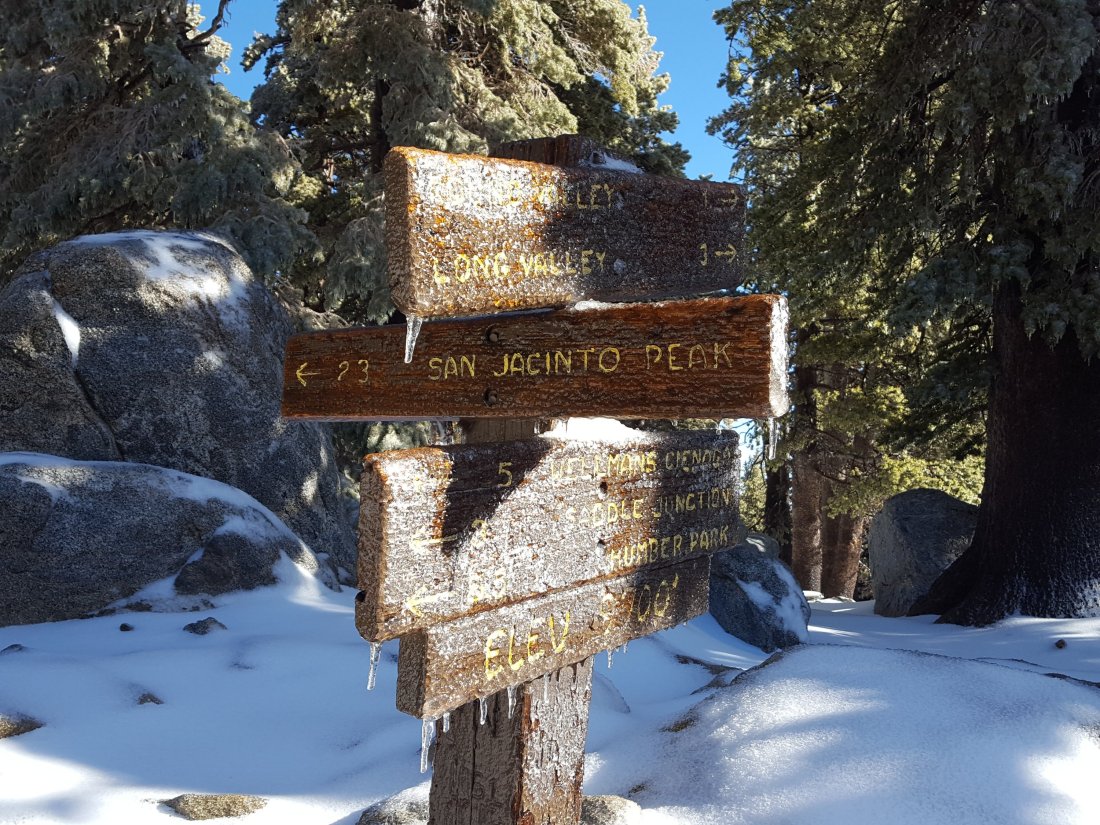
The sign at Wellman Divide (9700′) this morning, plastered with frozen rain.
San Gorgonio from San Jacinto Peak this morning, 23 March 2018. Note the rime on the trees.

Trail update 12 March 2018

My hike today went up Deer Springs Trail – including a partial check of Fuller Ridge – to San Jacinto Peak, returning via Wellman Divide and Saddle Junction through to Tahquitz Peak, then back-tracking to descend Devils Slide Trail to Humber Park.

Overview A very mild storm system on 10 March produced rain (and some melting) at elevations below 9000′, and only 1-3″ snow higher up. The PCT was unaffected by new snowfall, and most sections of all trails below about 8100′ are completely clear. In addition, all trails have been well traveled and have obvious sets of tracks to follow. Unusually for this area, new snowfall was greater on the east side of the mountain than the west, with 1″ at Little Round Valley (9800′) increasing to 3″ at San Jacinto Peak, but with 2″ down to Wellman’s Cienega (9250′) and 1″ to about 9000′ near Annie’s Junction. The snow that fell was wet and fell largely on warm surfaces, so melting has been very rapid, and some trails were already clearing this morning barely 24 hours after the storm passed, especially on south and east aspects. Microspikes remain useful in places for descending, and in the early morning, but are not essential anywhere.

Due to a family health issue, the next update will not be until March 22-23. The weather for the next week will be mixed, with disagreement between forecasts about the balance of snow versus rain at different elevations. High elevations will receive some snowfall, but projections are for inches rather than feet, and perhaps nothing significant until 20-21 March. It is unlikely that more than microspikes will be required anywhere, but routefinding will be more challenging after fresh snowfalls than at present.

The following trails are largely or completely clear of snow/ice: Ernie Maxwell Trail, Devils Slide Trail, South Ridge Trail (south of Tahquitz Peak), Deer Springs Trail (Hwy 243 to Strawberry Junction), Marion Mountain Trail.

South Ridge Trail (from Tahquitz Peak to Chinquapin Flat/PCT) has improved significantly from just four days ago, but microspikes are still advisable, especially descending (northbound). This section of trail remains completely snow covered, but there is now a good set of steps and tracks to follow, and considerable melting has reduced the ice hazards along this notoriously treacherous section.

Pacific Crest Trail The PCT is predominantly clear from Chinquapin Flat (mile 178) through Fuller Ridge, but with some extended areas of melting ice/snow generally only about 1-2″ deep. Most significant of these is about 0.7 miles long from just south of the Marion Mountain Trail junction to the Fuller Ridge turning. Fuller Ridge averages about 40% snow cover, typically 1-2″ of soft snow, with a few deeper drifts. There are now several sets of tracks along Fuller Ridge Trail, making routefinding relatively easy.

For thru-hikers the water situation has improved significantly. Almost all ephemeral and perennial streams and springs are flowing. Above 8500′ elevation, many remain heavily or partially frozen, but flows of rainwater and meltwater are now accessible. The two crossings of the North Fork of the San Jacinto River (on Fuller Ridge and on the upper Deer Springs Trail) are still largely frozen, but in each case there is accessible water a few yards upstream from the trail.

San Jacinto Peak trails On the west side, the Upper Deer Springs Trail above the Fuller Ridge Trail junction has 50% ice/snow cover to about 9500′, then 95% snow cover to San Jacinto Peak. The route has been well traveled and is largely thin compacted snow, but there are patches of dangerous ice.

On the east side, there is continuous, but rapidly melting, snow (mainly 1-3″ deep) from just south of Annie’s Junction (the State Park boundary) through Wellman Divide to San Jacinto Peak. There is a short section of deeper, drifted snow around 10,000′ elevation. The lightly-traveled East Ridge Trail (from Miller Saddle to the Peak) is fully snow covered, mainly 3-5″ deep, but with drifts to 10-12″.

South end of Fuller Ridge Trail (PCT mile 186.3) on 12 March 2018. Deer Springs Trail to San Jacinto Peak continues to the right.
Wellman Divide (9700′, 2957m) on 12 March 2018.

Tahquitz area trails 7 March 2018

Anabel and I hiked South Ridge Trail to Tahquitz Peak this morning, returning via the PCT from Chinquapin Flat to Saddle Junction, then down Devils Slide and Ernie Maxwell trails.

Overview Snow on trails has largely turned to ice, due to a combination of several days of freeze-thaw cycles, compacting by hiker traffic, and the precipitation a couple of days ago that was largely freezing rain to at least 9000′ elevation. This has made microspikes increasingly useful, best used in combination with hiking poles (or ice axe if you prefer). A significant additional problem is what my wife Anne has perfectly dubbed “ice cube” patches, where the recent freezing rain clumps are falling from the trees and accumulating in large piles in the trail. These patches can make progress slower, especially in trail running shoes. Although there is significant melting underway below about 7800′, at higher elevations all these ice problems will remain for the foreseeable future.

South Ridge Trail (to Tahquitz Peak) is largely clear below about 7700′, although with frequent ice patches. The trail has much more extensive icy sections and ice cube patches from Old Lookout Flat (7800′) to Tahquitz Peak. Spikes are not essential, but are very helpful, especially for descending.

South Ridge Trail (from Tahquitz Peak to Chinquapin Flat/PCT) True to its reputation, this section of trail is now very treacherous. Freezing rain of recent days has coated everything, including the snow drifts, with a thick layer of ice. Clumps of ice falling from trees above were bombarding us as we traversed, while the ice we dislodged from the trail was falling hundreds of feet below the trail. Extensive ice cube patches were complicating the trail in many areas. While the ice chunks are mostly smaller than baseballs, some pieces are softball or nearly soccer ball size. The deepest snowdrift I crunched into was about 27″ (70cm) deep. Microspikes are strongly recommended (crampons are not yet necessary), best used in combination with hiking poles or an ice axe. The potential consequences of a mistake on this section of trail are now very severe. (See photo below.)

PCT from Chinquapin Flat to Saddle Junction Largely covered in about 1″ of ice and/or compacted snow, with some short clear sections.

Devils Slide Trail [UPDATE 8 March: clear below 7700′, easily traversed small ice patches to Saddle Junction above] Completely clear below 6800′, then largely clear but with some small icy sections below 7700′. Almost completely ice-covered from 7700′ to Saddle Junction. Can be ascended without spikes, but they are very useful for descending the upper sections.

Ernie Maxwell Trail is essentially clear, with just a few tiny icy areas mainly at the northern (Humber Park) end. These are melting rapidly. No traction aids required.

Trail between Chinquapin Flat and Tahquitz Peak on 7 March 2018. Note the ice covering bushes and trees.

PCT and Peak trails 28 Feb 2018

Today I surveyed from Humber Park to San Jacinto Peak via Wellman Divide, then back via Little Round Valley, the south end of Fuller Ridge Trail, and Deer Springs Trail. See yesterday’s update for details of the South Ridge Trail, the PCT south of Saddle Junction, Devil’s Slide Trail and the Ernie Maxwell Trail. The next trail update will be 7-8 March 2018.

Overview A good snowfall in the early hours of yesterday morning, and some flurries during yesterday, produced a remarkably consistent 4.5-5.5″ (approx. 13cm) of snow at almost all elevations above about 5000′. Strong winds have resulted in some drifting, in many places 6-8″ in trails. Although traction aids (e.g., microspikes) are not strictly essential, they will be useful in many areas, especially for descending, and in the morning when still icy. Very rapid melting started this afternoon below 8000′ at least, and will likely continue on/off for the next week. See the report for 23 Feb regarding the hazards of cold, water availability, and route finding. These issues will improve with higher temperatures over the next few days, but remain challenging. At San Jacinto Peak this morning the air temperature was 20.5° F (-6° C) with a windchill down to 8° F (-13° C), almost tropical compared to last week! At the time of writing, only my tracks were present on every trail surveyed today and yesterday, and these may soon be obscured by drifting snow and melting.

Pacific Crest Trail The entire PCT above 5500′ through the San Jacinto Mountains, including Fuller Ridge, is currently covered with about 3-5″ of fresh snow, with deeper drifts, making it slow going. Fuller Ridge does not have fresh tracks to follow. Snow depth at Saddle Junction was 5″, but only 3-4″ from Strawberry Junction to the Marion Mountain Trail junction. At the south end of Fuller Ridge, snow depth was 5.5″. Most water resources along the PCT above 8300′ are frozen solid and heavily obscured by snow.

San Jacinto Peak trails On the west side, the Upper Deer Springs Trail from Fuller Ridge Junction to San Jacinto Peak has continuous fresh snow cover of 4.5-5.5″ (significantly deeper in areas of drifting and in Little Round Valley where old snow remained). The fresh and drifted snow masks ice from previous storms, and at the various creek and spring crossings, so microspikes are very useful, especially when descending.

On the east side, snow depth at Annie’s Junction (the State Park boundary) was 5″, but only 3-4″ from Wellman’s Cienega through Wellman Divide, thereafter about 5″ to the Peak (but heavily drifted from 9900-10,100′). At San Jacinto Peak itself, fresh snow depth was about 5-6″, but in places overlaying icy snow from January, and heavily drifted.

Deer Springs Trail Snow depth at Strawberry Junction was only 3″, and from 7000-8000′ was 1-3″ with deeper drifts but also some rapidly melting clear areas. Below the Suicide Rock junction, largely clear with small snow patches melting quickly. (See above for sections north from Strawberry Junction.)

Tahquitz trails 27 Feb 2018

Anabel and I hiked through the fresh overnight snow from home via South Ridge Trail to Tahquitz Peak this morning, returning via the PCT from Chinquapin Flat to Saddle Junction, then down Devils Slide and Ernie Maxwell trails.

I would currently recommend using (or at least carrying) microspikes on all these trails. Although the powder currently provides good traction, in places (especially drifts) it masks ice from past storms underneath. Also, generally milder conditions starting tomorrow (but especially after next weekend) will result in freeze-thaw cycles that will turn more of this powder into ice. There is not yet sufficient depth and consistency of snow cover for snowshoeing.

South Ridge Trail (to Tahquitz Peak) received similar snowfall as Idyllwild (about 5″) for almost all of its length, but slightly more (5.5″) at the Peak. There has been significant drifting, especially above 7600′, and the trail sometimes alternates from almost bare to drifts up to 12″ deep. For PCT hikers the South Ridge Trail through to Saddle Junction can be an important route for those skipping Idyllwild, and/or for those doing continuous steps from the PCT Alternate at May Valley Road.

South Ridge Trail (from Tahquitz Peak to the PCT) has deep, drifted powder, from 6-18″, especially nearer the Peak. The deepest drift I crossed was about 27″ (70cm) deep. Although traction is relatively easy in the soft powder, the drifts hide dangerous ice from January storms, and spikes and hiking poles (or an ice axe if you prefer) are very useful. This short section of trail is notoriously treacherous, please use considerable caution.

PCT from Chinquapin Flat to Saddle Junction unusually received slightly less snow than South Ridge Trail, and has continuous snow cover from 4-5″ deep, with some shallower and deeper patches depending on drifting.

Devils Slide Trail has continuous snow cover averaging about 5″ at both Humber Park (6500′) and at Saddle Junction (8100′).

Ernie Maxwell Trail has continuous snow cover, with (oddly) slightly less snow at its upper end at Humber Park (about 4.5″) than at its lower end at Tahquitz View Drive (5″).

Trail from Tahquitz Peak to Chinquapin Flat 27 Feb 2018
The PCT at Chinquapin Flat (mile 178.5) 27 Feb 2018

Trails 23 Feb 2018

Yesterday evening I surveyed South Ridge Trail past Tahquitz Peak to the PCT at Chinquapin Flat, and today hiked from Humber Park to San Jacinto Peak then back via Little Round Valley, the south end of Fuller Ridge Trail, and Deer Springs Trail.

Overview We have had three light dustings of snow this week, on Monday (discussed in previous post), yesterday, and briefly this morning. Combined these have produced a fairly consistent maximum of 2″ (5cm) of snow across the mountain above about 8000′, and above 6500′ about 1″ or even less. However very strong winds have resulted in extensive drifting, especially accumulating in trails. The uppermost parts of the mountain were above most of the cloud, and have also only received about 2″ of fresh snow, although here drifting has been extreme, especially on the east side of San Jacinto Peak. Although traction aids (e.g., microspikes) are not currently essential, I would now recommend them in a couple of specific areas (discussed below), and as always, hikers unfamiliar with snow/ice travel may find microspikes useful in many areas. Three notable hazards at present are discussed first.

Severe cold Last night at Tahquitz Peak, the windchill temperature was -1° F. At San Jacinto Peak today the air temperature (in the sun!) was only 4° F (-15.5° C) and I recorded a windchill temperature of -25.1° F (-32° C)! Everywhere above 9000′ (2700m) today was below 0° F (-18° C) when including windchill. Temperatures will warm very slightly this weekend, but at higher elevations (>8000′) they will remain below freezing day and night for the foreseeable future. These forecast temperatures do not include additional treacherous windchill effects. I advise against venturing into the highest elevations without the very best equipment suitable for such conditions.

Water This is only really an issue for thru hikers. Most sources above 8000′ are frozen solid and covered with inches of ice (that is a challenge to remove even with an ice axe!). This may remain a problem for at least the next couple of weeks. Of course there is plenty of snow to melt, but that is not very efficient with stove fuel.

Routefinding Many trails have received very little traffic this week, so there are few tracks to follow. On the less traveled trails on the western side of the mountain, in many cases there are one or two sets of tracks at most, but with strong winds and light powdery snow, tracks are disappearing within hours (or even minutes). The East Ridge Trail that was obvious on Monday had completely disappeared by Friday morning under drifts up to 12″ (30cm) deep.

Pacific Crest Trail Basically the entire PCT above 7500′ through the San Jacinto Mountains, including Fuller Ridge, is currently covered with at least 1-2″ of snow. However the route has tracks and is relatively easy to follow. The section north from Saddle Junction to Annie’s Junction (PCT miles 180-182) has some of the worst drifting, up to 4-6″ in places, and is consequently slow going.

Tahquitz Peak to Chinquapin Flat/PCT This is the most hazardous section of trail at present. Last night I waded through powder drifts at least 12″ deep, especially near the Tahquitz Peak end (at Chinquapin Flat there is less than 2″ of snow). By the time I headed back, just 10 minutes later, my tracks were already disappearing. I would recommend hiking poles and microspikes for most hikers on this section. If you do not know the route and there are no good tracks to follow, I do not recommend attempting this trail. Once these drifts become icy (perhaps as early as this weekend), this is an intimidating crossing.

San Jacinto Peak trails On the west side, the Upper Deer Springs Trail (from Fuller Ridge Junction to San Jacinto Peak) is lightly snow-covered (generally 2″ but significantly deeper in areas of drifting). However the drifted snow masks ice from previous storms, and microspikes are very useful here, especially when descending. The crossings of the various springs below Little Round Valley are frozen solid and form treacherous ice sheets. From Little Round Valley to the Peak the trail appears to have had only one set of tracks (which have probably now disappeared) in recent days.

On the east side, the trail from Wellman Divide to the Peak is clear for long stretches (<0.25″ snow depth), except from about 9900-10,100′, where drifted powder is overlaying icy snow from January, and varies from 2-8″ deep.

From Annie’s Junction (where the PCT turns sharply west at the State Park boundary) to Wellman Divide, the trail is initially under several inches of drifted snow, but then relatively clear (<1″ snow depth) to Wellman Divide.

Deer Springs Trail up to Strawberry Junction (see above for sections beyond Strawberry Junction) A patchwork of clear sections and areas of drifted powder to 2″ deep. Below the Suicide Rock turning, largely clear and small snow patches melting quickly.

Devils Slide Trail Below 7500′, a very light covering of snow (about 1″), increasing to 2″ by Saddle Junction (8100′). Currently, none of this is icy requiring microspikes, however this may change after weekend hiker traffic compacts the snow.

South Ridge Trail A light covering of snow (about 1″) as far as Old Lookout Flat (7800′) then at least 2″ deep to Tahquitz Peak, but with deeper drifts in places. Again, none of this is icy requiring microspikes yet, but this will change if weekend hiker traffic compacts the snow.