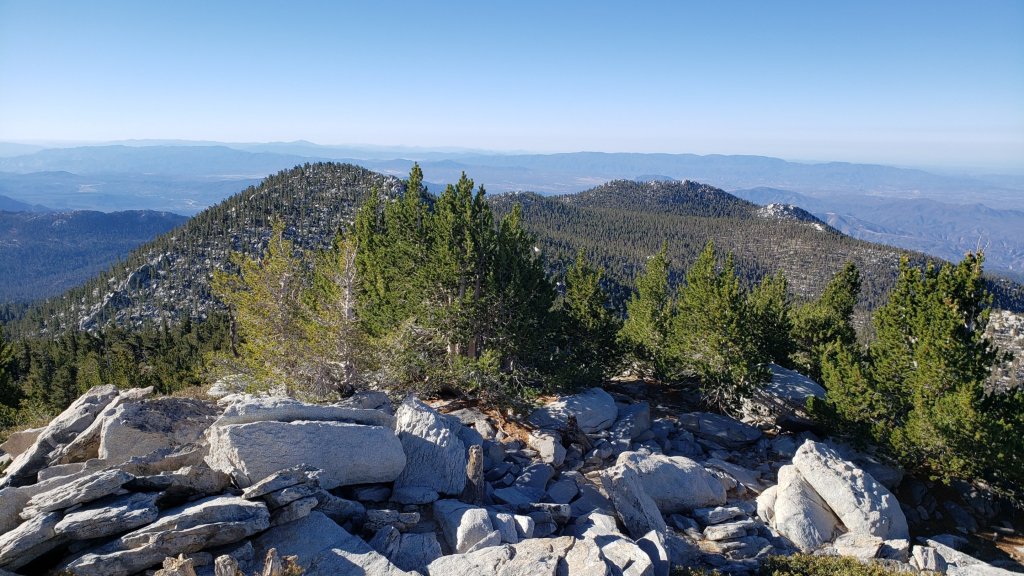
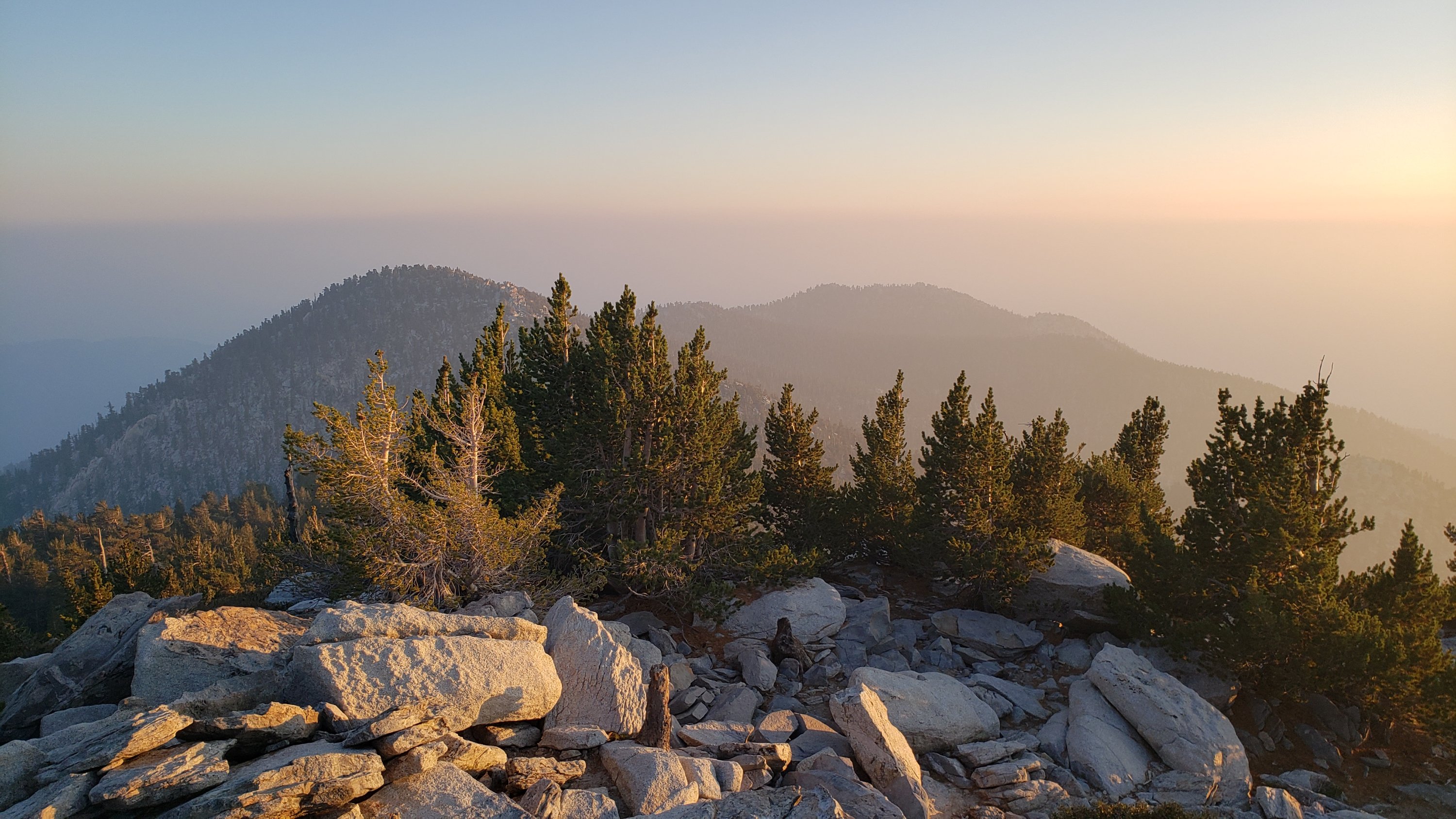
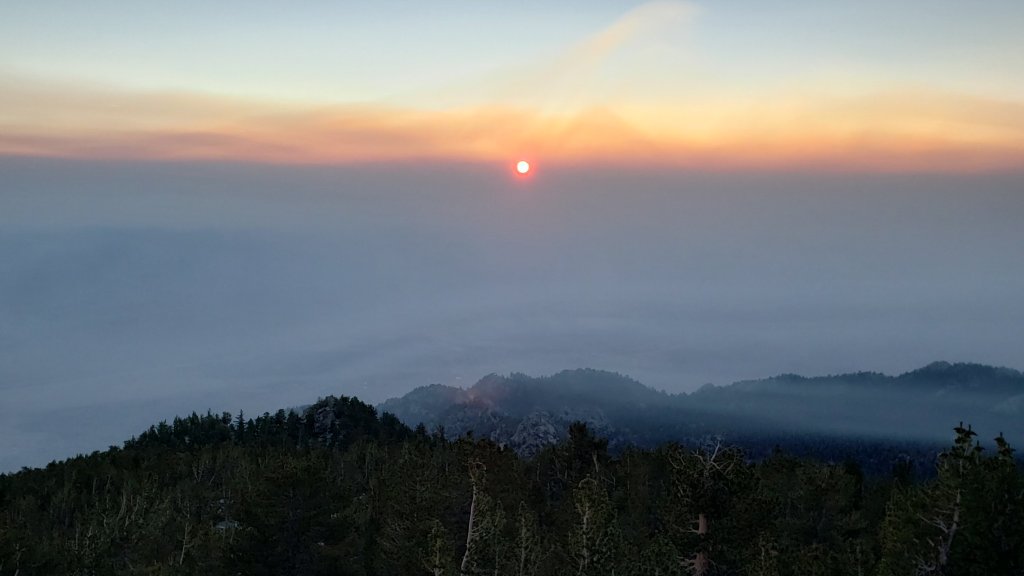
The second significant storm (and fourth overall) of winter 2021/22 is currently impacting the San Jacinto mountains.
Please continue to check this page for periodic updates throughout the storm.
UPDATE @ 0705 on Friday 24th
Rainfall storm total in Idyllwild (at 5550ft) by 0700 this morning was a very impressive 3.47 inches.
San Jacinto Peak now has a storm total of about 13 inches of fresh snow, on top of about 8in from last week. Strong winds mean that the snow is heavily drifted.
Long Valley (8600ft) has added 5-6 inches, for a current total depth of 9-10in.
UPDATE @ 2010 on Thursday 23rd
San Jacinto Peak has gained about six inches of snow so far today, with perhaps another foot expected overnight. Long Valley (8600ft) had over an inch of rain (which helped remove 1-2 inches of snow) before it turned to snow, with about two inches accumulating so far. In Idyllwild rainfall has reached 1.2in, with at least that much expected again overnight.
UPDATE @ 1755 on Thursday 23rd
About five inches of snow have fallen so far at San Jacinto Peak. The rain has finally turned to snow in Long Valley, with about an inch accumulating there. Rainfall in Idyllwild surpassed an inch for today at 1650.
UPDATE @ 1540 on Thursday 23rd
As discussed below, this warm system is so far producing rain, rather than snow, at all but the highest elevations. Snow Creek at 6800ft on the north face currently leads the way with 1.2in already. Various sites in Pine Cove (around 6000ft) have passed one inch, while even at Long Valley at 8600ft, it continues to fall as rain (0.8in).
UPDATE @ 1340 on Thursday 23rd
In Idyllwild at 5550ft it started drizzling at about 0400. By 1330 storm total rainfall was already 0.85in.
My ascent to San Jacinto Peak this morning was a soggy, postholing one, with drizzle alternating with light rain all the way to the Peak. There was a little snow mixed in by 10,200ft, but it was not until 1230 that it finally turned completely to snow. It is already accumulating steadily at about an inch per hour.
In Long Valley (8600ft) it has rained about 0.6in this morning, and it remains just above freezing with no snow accumulation so far today.
It was so mild this morning (45°F at Humber Park!) that a lot of snow was melting below 9000ft. Devil’s Slide Trail – that had 90% snow/ice cover on Monday – was 75% clear this morning. It remained remarkably mild all the way up into the high country, where snow that was pleasantly compacted on Monday now had the consistency of soft serve ice cream. Hoping with undue optimism that it would be cold enough higher up for the snow to be firm, I nevertheless had to finally put on snowshoes at 10,000ft to finish my ascent without constant postholing.
Wellman Divide (9700ft) in the rain just after 1110 this morning, 23rd December 2021. Only about three inches of snow from the storm on 14th December remained.
Thank you fellow hikers for taking the time to read this. While all labor and time is volunteered, the San Jacinto Trail Report completely depends on small private donations to cover operating costs. Every year seems to have its challenges and 2021 has been no exception, so every contribution, no matter how small, is truly valuable. If you have found this Report useful, please consider visiting the Donate page. Thank you for your support.
The third and most significant snowstorm of the 2021/22 winter to date passed through the San Jacinto mountains on Tuesday 14th December, as described in detail in the previous Report. About nine inches fell at San Jacinto Peak (10,810ft) and about an inch in Idyllwild. It rained steadily at mid elevations before turning to snow, with 1.43 inches measured at 5550ft in Idyllwild.
The storm included strong, gusty winds, and drifting of snow was particularly severe. These winds, combined with trees heavily laden with ice, led to many new treefall hazards (both broken branches and whole trees). For example on May Valley Road on 16th I found seven trees down across the road (reported to USFS), and on 20th found three new trees down on a short section of Deer Springs Trail. Hikers should expect to find new treefall hazards on trails, especially in burn areas.
Although temperatures have been at or even slightly above seasonal averages since the storm, melting has been very slow everywhere above 5000ft, with the sun at its lowest potency of the year this week.
This morning we ascended San Jacinto Peak via the east side (Devil’s Slide, Wellman and Peak trails) and descended via Deer Springs Trail. This allowed for thorough survey of snow and treefall conditions on most of the high country trail system.
Rarely have I seen the weather forecasts for the San Jacinto mountains so variable and inconsistent as they are for the remainder of December 2021. The latest details are given in Weather below, but in summary the period is expected to be very unsettled, with precipitation possible almost any day in the next two weeks. Consequently trail conditions, and required equipment, could changefrequently and at shortnotice.
Hikers should be prepared for temperatures below freezing in the high country, and generally well below freezing when considering wind chill effects (see below for my recent weather observations from San Jacinto Peak).
Spikes are strongly recommendedeverywhere above about 6000ftfor the foreseeable future as well-used trails are compacted by hiker traffic and undergo further freeze-thaw cycles. They are especially valuable on icy consolidated tracks and for descending (details of individual trails are given below). Snow depths are currently adequate for snowshoeing everywhere off-trail above about 9000ft although they are not essential depending on your comfort level with light postholing in relatively shallow snow. They are not advised on the main trails, which are largely too compacted for comfortable snowshoeing.
The USFS gate at Humber Park closed on 13th December. Even when closed there are nine legal parking spaces just below the gate. In recent winters vehicles not parked in these spaces have periodically been ticketed and/or towed, usually at weekends or immediately following snow storms. When “Road Closed” signs are in place further down Fern Valley Road, these nine spaces are also unavailable for legal parking (according to CHP).
The Marion Mountain trailhead remains open. However Azalea Trail, the access road, has not been plowed, is extensively ice-covered and treacherous, and is 4WD/AWD passable only.
For details regarding pre-existing (non snow/ice) hazards on the trails, coronavirus issues and ranger station access, please see this recent Report or contact the State Park or Forest Service as indicated on their websites.
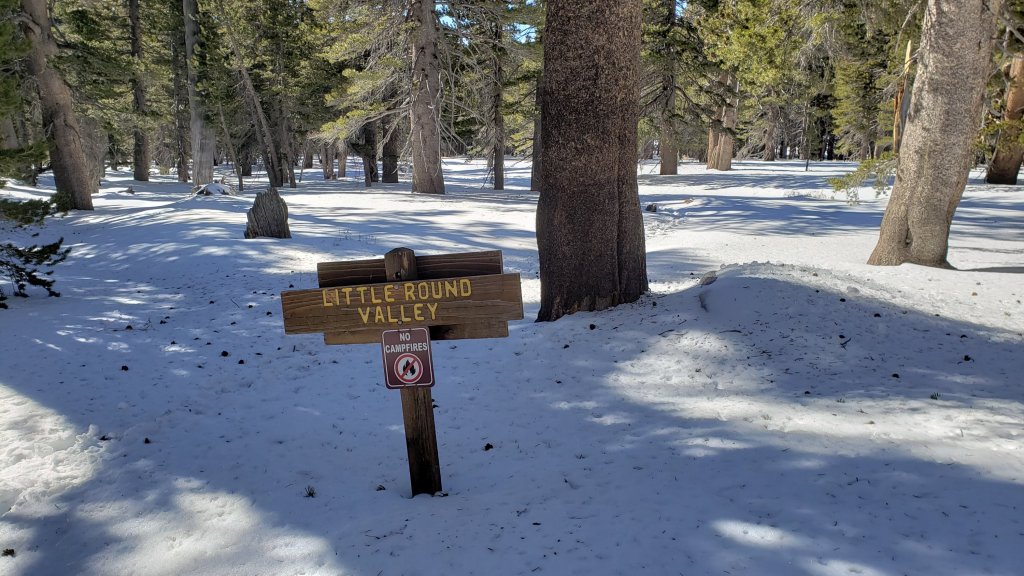
Upper Little Round Valley (9800ft) on 20th December 2021.
WEATHER Temperatures above seasonal averages, such as those we experienced this weekend, will continue until Wednesday 22nd. Forecast resolution remains relatively poor for the rest of December, but unsettled weather into early January is expected, with below average temperatures from 23rd December onwards, plus snow (high country) and moderate rain with dustings of snow (mid elevations). Moderate to heavy precipitation is expected on 23rd-24th, with 12+ inches of snow at the highest peaks and 2-3 inches of rain at Idyllwild elevation. The freeze level may be as high as 7000ft, so snow currently at mid elevations may be washed away by rain. Lighter precipitation is possible again on 25th and from 29th into early January 2022, but frankly could also occur any day for the remainder of December.
At San Jacinto Peak (10,810ft/3295m) on Monday 20th December 2021 at 0940the air temperature was 33.8°F (1°C), with a windchill temperature of 23.4°F (-5°C), 17% relative humidity, and a gentle WSW wind sustained at 6 mph gusting to 10.8 mph.
At the Peak on Wednesday 15th December 2021 at 0640 the air temperature was 22.1°F (-6°C), with a windchill temperature of 0°F (-18°C), 31% relative humidity, and a gusty NW wind sustained at 21 mph gusting to 33.5 mph.
At the Peak on Tuesday 14th December 2021 at 1630 the air temperature was 10.4°F (-12°C), with a windchill temperature of -17.5°F (-27.5°C), 93% relative humidity, and a wild WNW wind sustained at 21 mph gusting to 32.5 mph.
TRAIL CONDITIONS
Note that conditions may change starting 23rd December when significant additional precipitation is possible, potentially adding light powder on top of ice and icy snow in the high country, and ice (initially falling as rain) to surfaces at mid elevations.
All trails above about 6000′ are largely or completely snow- and ice-covered. However, reliable and relatively prominent tracks are in place for almost all major trails as described below.
Tahquitz Peak trail from Chinquapin Flat/PCT Mile 178 has steps to follow through the angled icy snow. These icy slopes are notoriously treacherous. Currently spikes are strongly recommended. Snowshoes are rarely advisable on these slopes due to the angle of the icy snow.
The Ernie Maxwell Trail is almost completely covered with ice and compacted icy snow, and spikes are strongly recommended.
Deer Springs Trail has an excellent track to follow, well-traveled to Little Round Valley following the established trail route. Above Little Round Valley several different tracks meander up to the Peak, none of which accurately follow the actual trail for more than short sections, but several of which are relatively easy to follow.
Devil’s Slide and Marion Mountain trails have very well-traveled tracks to follow.
There are reasonable tracks to follow through the light snow around the Tahquitz meadows trail complex.
The Wellman Trail has been lightly traveled, and involves some uneven postholing through shallow snow, but there are a few tracks to follow.
There is a very well-traveled and consolidated trail from Long Valley through to Wellman Divide, which continues up the Peak Trail.
Spitler Peak Trail [updated 22nd] is virtually clear of snow. However there are six new trees down, all in the upper mile of the trail, including two major obstructions that require caution to get around.
Seven Pines Trail has a reasonable set of tracks to follow through the snow, although the track wanders from the established trail in its uppermost section. Dark Canyon Road is almost completely covered in 1-2 inches of snow, and is 4WD/AWD passable only.
There were no visible hiker tracks on Fuller Ridge Trail as of this afternoon.
May Valley Road is largely clear of snow, however it is largely impassable by vehicles due to multiple trees down (mentioned above, reported to USFS).
There is well-defined track on the Suicide Rock Trail through the snow from Deer Springs Trail.
SNOW DEPTHS measured on 20th December 2021, are as follows. Note that current average total depth is given first, followed in parentheses by the depth after the storm of 14th where known. Due to strong winds accompanying the storm there is extensive drifting, especially in and near the trails. Altitudes are approximate. Locations are listed in descending order by altitude.
San Jacinto Peak (10810ft): 8 inches (very heavily drifted; was 11 inches on 15th)
Little Round Valley (9800ft): 6 inches
Wellman Divide (9700ft): 3 inches (was 6.5 inches on 15th)
Deer Springs Trail at Suicide Rock Trail junction (6950ft): <1 inch (patchy, largely melted)
Devil’s Slide Trail at Humber Park (6520ft): <1 inch (2 inches on 15th)
Idyllwild (at 5550ft): 0.5 inch (very patchy, largely melted, was 1 inch on 15th)
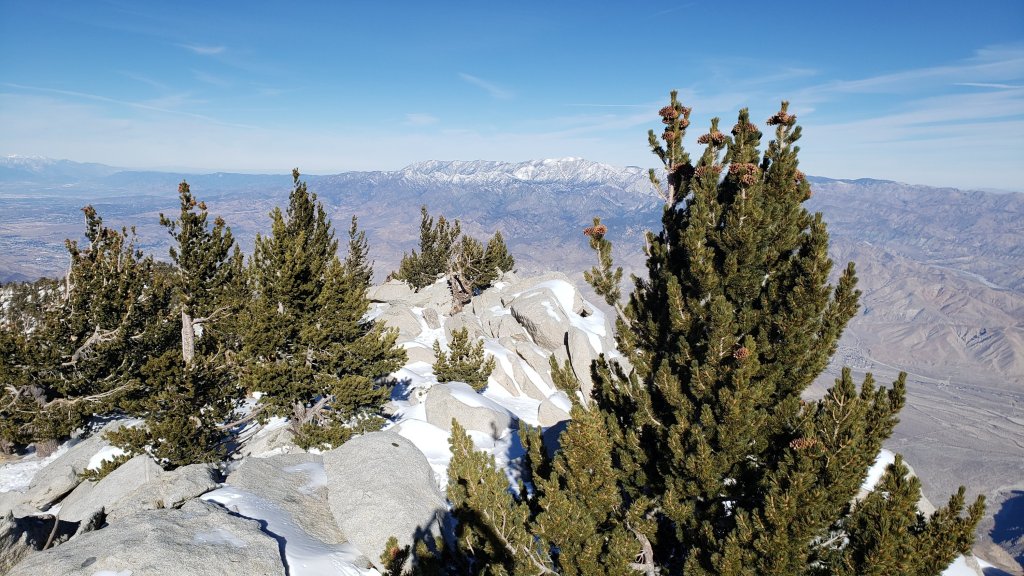
Looking north-west from San Jacinto Peak on 20th December 2021 (above), and the same view on 15th December 2021 (below). Note especially how quickly the snow level has moved upslope on the sun-exposed southern flank of the San Bernardino mountains.
Thank you fellow hikers for taking the time to read this. While all labor and time is volunteered, the San Jacinto Trail Report completely depends on small private donations to cover operating costs. Every year seems to have its challenges and 2021 has been no exception, so every contribution, no matter how small, is truly valuable. If you have found this Report useful, please consider visiting the Donate page. Thank you for your support.
The Peak Trail at 9800ft just above Wellman Divide on 20th December 2021 (above), and the same view five days earlier on 15th December 2021 (below).
This is a summary of conditions following the third – and most substantial – snow storm of winter 2021/22 to date, with all of the snow falling on Tuesday 14th December.
While we have to be grateful for any precipitation received given such a rapidly changing climate, it is hard not to be a little disappointed as snowfall in the high country was about half what was widely forecast. About nine inches fell at San Jacinto Peak (10,810ft), down to about an inch in Idyllwild (at 5550ft). The storm system was cold in its last few hours, with a dusting of snow to 4000ft, e.g., in Garner Valley. Detailed snow depths recorded on my hike on Tuesday 15th are given at the foot of this posting.
I recorded a brief YouTube video at San Jacinto Peak just after sunrise on 15th (available here) which gives a feel for the conditions at that time.
It rained relatively heavily in Idyllwild before the precipitation turned to snow, with 1.43 inches measured at 5550ft. The system was initially warm enough that rainfall occurred to at least 9700ft at Wellman Divide. Branches were heavily laden with ice between about 8000ft and 10,000ft, and I found many broken tree limbs in the trails. Hikers should expect to find many new treefall hazards in burn areas.
The snowfall was associated with persistent, strong, gusty winds, and as a consequence drifting was particularly severe. There are areas around the high peaks where it is possible to find drifts 18-24 inches deep, and on Devil’s Slide Trail for example there are short sections 4-6 inches deep even though only a couple of inches of fresh snow fell yesterday.
Currently very few major trails have been traveled and all are at least partly obscured by snowfall. Fortunately the snow is generally so shallow that navigation should not be a serious problem, but caution is advised. On my descent late this morning I was surprised to see no other tracks beyond Saddle Junction. The significance of this is that there are currently no tracks on Willow Creek Trail, to Chinquapin Flat or Tahquitz Peak, or around the meadows. Beyond Saddle Junction, at the time of writing my snowshoe tracks to San Jacinto Peak are the only traveled high country trail. This situation will likely improve significantly over the next few days, especially at the weekend, as more hikers venture into the snow.
Snow depths are currently adequate for snowshoeing everywhere above about 9000ft, although they are not essential depending on your comfort level with light postholing in relatively shallow snow. Spikes are recommendedeverywhere above about 6000ftfor the foreseeable future as trails become compacted by hiker traffic and undergo freeze-thaw cycles. They will be especially valuable on increasingly consolidated tracks (e.g., Devil’s Slide and Deer Springs trails) on colder mornings when conditions are icy, and for descending.
Hikers should be prepared for temperatures below freezing in the high country, and generally well below freezing when considering wind chill effects (see below for my recent weather observations from San Jacinto Peak).
For details regarding pre-existing (non snow/ice) hazards on the trails, coronavirus issues and ranger station access, please see this recent Report or contact the State Park or Forest Service as indicated on their websites.
The USFS gate at Humber Park closed on 13th December. Even when closed there are nine legal parking spaces this side of the gate (near the upper Ernie Maxwell trailhead). Any vehicles not parked in these spaces may be ticketed and/or towed. If there are signs further down indicating that the road is closed, then the nine spaces are also unavailable for legal parking.
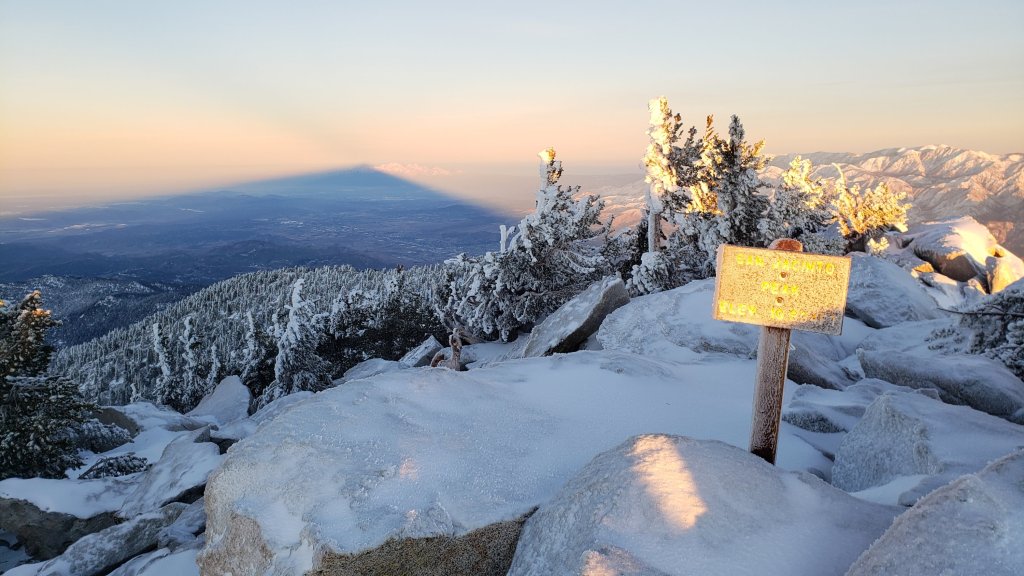
Looking north-west from San Jacinto Peak shortly after sunrise, 15th December 2021. Note the very prominent “San Jac shadow” being cast in front of the San Gabriel mountains on the left, and the snow-clad San Bernardino range on the right.
WEATHER Temperatures are forecast to remain at or slightly below seasonal averages for the next few days at mid elevations (and about seasonal in the high country). Snow melt will initially be slow above 9000ft, and conditions will be increasingly icy with challenging freeze-thaw conditions underfoot at all elevations. Forecasts suggest further unsettled weather for 21st-25th December at least, with the possibility of light to moderate snow (high country) and rain (mid elevations) currently most likely on or around Wednesday 22nd.
At San Jacinto Peak (10,810ft/3295m) on Wednesday 15th December 2021 at 0640 the air temperature was 22.1°F (-6°C), with a windchill temperature of 0.0°F (-18°C), 31% relative humidity, and a gusty NW wind sustained at 21 mph gusting to 33.5 mph.
At the Peak on Tuesday 14th December 2021 at 1630 the air temperature was 10.4°F (-12°C), with a windchill temperature of -17.5°F (-27.5°C), 93% relative humidity, and a wild WNW wind sustained at 21 mph gusting to 32.5 mph.
At the Peak on Monday 13th December 2021 at 1635the air temperature was 27.2°F (-3°C), with a windchill temperature of 10.2°F (-12°C), 81% relative humidity, and a sharp SW wind sustained at 12 mph gusting to 21.9 mph.
SNOW DEPTHS measured on 15th December 2021 are as follows. The first number is the current average total depth, with the storm total following in parentheses. Shallow depths of snow remained from the minor storm the previous week, and these account for the differences. Note that average depth is given; due to strong winds there is extensive drifting, especially in the trails. Altitudes are approximate.
San Jacinto Peak (10810ft): 11 inches (storm total 9 inches, very heavily drifted)
Wellman Divide (9700ft): 6.5 inches (storm total 4.5 inches)
Saddle Junction/approx. PCT Mile 179.9 (8070ft): 3 inches (storm total about 2 inches, there were two inches present on 13th December, but some of this was likely lost to warm rainfall on 14th)
Devil’s Slide Trail at Humber Park (6520ft): 2 inches (at noon today, melting already underway)
Idyllwild (at 5550ft): 1 inch, melting slowly this afternoon.
The Peak Trail at 9800ft just above Wellman Divide on 15th December 2021 (above), and the same view two days earlier on 13th December 2021 (below).
Thank you fellow hikers for taking the time to read this. While all labor and time is volunteered, the San Jacinto Trail Report completely depends on small private donations to cover operating costs. Every year seems to have its challenges and 2021 has been no exception, so every contribution, no matter how small, is truly valuable. If you have found this Report useful, please consider visiting the Donate page. Thank you for your support.
The north spring at Wellman’s Cienega on the morning of 15th December 2021 (above), and on 13th December 2021 (below).
The first significant storm of winter 2021/22 is currently impacting the San Jacinto mountains.
Please continue to check this page for periodic storm updates throughout the next 24 hours.
UPDATE @ 1950 on Tuesday 14th
The moon started appearing on/off from 1830 over San Jacinto Peak and although it continues snowing very lightly, it is unlikely much more than a further inch will accumulate. Storm total at the Peak is currently a heavily drifted 8-9 inches.
In Idyllwild it stopped snowing by 1900. At 5550ft elevation, one inch had settled, in addition to nearly 1.5 inches of rain that fell earlier in the day.
UPDATE @ 1700 on Tuesday 14th
At San Jacinto Peak at 1630 the air temperature was 10.4°F (-12°C), with a windchill temperature of -17.5°F (-27.5°C), 93% relative humidity, and a very gusty WNW wind sustained at 21 mph gusting to 32.5 mph.
Total fresh snow accumulation is about 7-8 inches although it continues to snow steadily, but still in fine rounded grains (which are very slow to accumulate to significant depth). The snow is heavily drifting in a gusty westerly wind, to 12-18 inches in places.
San Jacinto Peak at dusk, 14th December 2021.
UPDATE @ 1550 on Tuesday 14th
In Idyllwild at 5550ft the rain finally turned to snow at about 1500. In an hour about 0.25in has settled. Prior to that, 1.43in of rain fell today.
At San Jacinto Peak, snow accumulation had slowed considerably, to a current storm total of about six inches, with extreme drifting. Long Valley has approximately four inches fresh snow. An intensification is underway, that looks likely to last for another 1-2 hours.
UPDATE @ 1355 on Tuesday 14th
The storm has intensified significantly in the last hour. Rainfall for the day is just over 0.9in in Idyllwild, with currently no sign of it turning to snow.
The snowfall rate is up to at least one inch per hour at San Jacinto Peak, where I just measured a current storm total of about five inches. However the wind is gusting wildly, and some drifts are already 12 inches deep, while wind-exposed rocks remain bare.
Radar outputs suggest a series of bands over the next couple of hours, with waves of strong storm activity alternating with (relative) lulls in intensity.
Fresh snowfall in Long Valley (8600ft) is about 3-4in, on top of 0.5in remaining from last week.
UPDATE @ 1105 on Tuesday 14th
Light rain immediately prior to sunrise had produced 0.19in rain in Idyllwild (at 5550ft) and 0.3in rain in Long Valley (8600ft) by 0730. At about that time the precipitation in Long Valley turned to light snow. By mid morning, total rainfall in Idyllwild was almost exactly 0.5in.
Very light snow, falling as tiny rounded grains, started before dawn at San Jacinto Peak (10,810ft), only accumulating to 0.25in until 0900. (This is on top of a patchy two inches remaining from last week’s minor storm.) Intermittent heavier snow, but still rounded grains, started around 0915, currently accumulating to about one inch in the past two hours.
Current forecasts predict about 18in of snow around the highest peaks, but snowfall rates will have to accelerate rapidly in the next few hours for that to be realized.
Thank you fellow hikers for taking the time to read this. While all labor and time is volunteered, the San Jacinto Trail Report completely depends on small private donations to cover operating costs. Every year seems to have its challenges and 2021 has been no exception, so every contribution, no matter how small, is truly valuable. If you have found this Report useful, please consider visiting the Donate page. Thank you for your support.
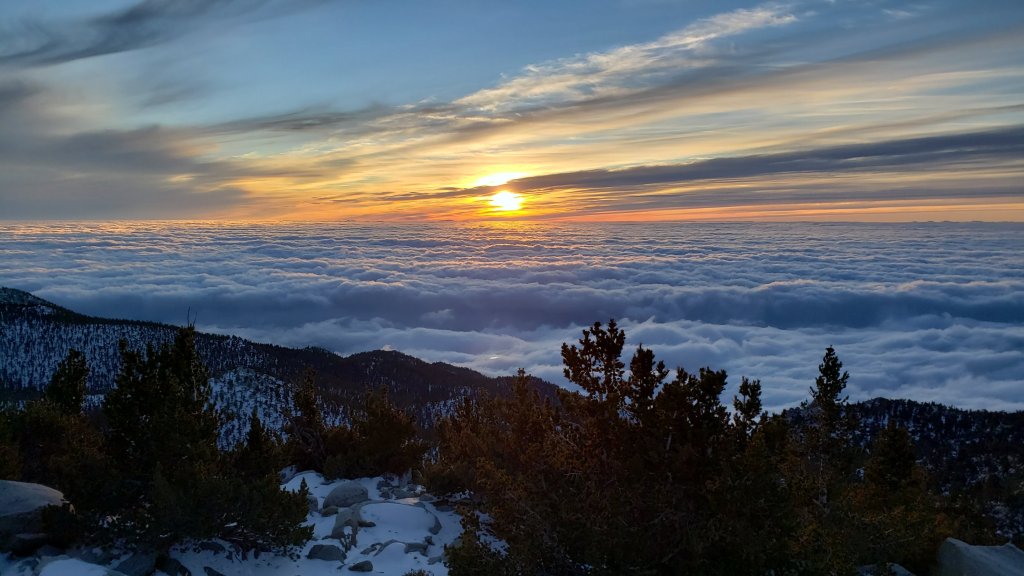
Sunset from San Jacinto Peak, 13th December 2021. The calm before the storm…..
[UPDATED 11th December: the first significant snow storm of the winter is coming (finally!) to the San Jacinto mountains, with rain and snow all day Tuesday 14th. At mid elevations heavy rain (>1in) most of the day will turn to snow on Tuesday evening, with a few inches likely in Idyllwild. Snow level will eventually drop overnight, with a dusting possible as low as 3500ft. The high country is expecting 1-2 feet of snow, heaviest on Tuesday afternoon. Winds will be dangerously strong especially over the peaks and ridges, leading to severe drifting.]
For the first time since late October we had a minor storm system pass through the San Jacinto mountains on Thursday 9th December. It started drizzling in Idyllwild just before sunrise, and by dusk totaled 0.85in of rain (at 5550ft elevation). Just after dark the precipitation briefly turned to snow and dusted in town (<0.25in). The measurable settled snow level was at about 6200ft, with a dusting of 0.5in snow at Devil’s Slide trailhead (6520ft).
The high country was periodically above the cloud in the morning, with occasional drizzle, which turned to light snow at about 1230. Barely one inch of snow fell in Long Valley (8600ft). I was not able to check the high peaks in the afternoon, but estimate 2-3in snow accumulated at most.
Spikes are recommended if you plan on hiking above about 7000ft elevation in the next fewdays. All trails above about 6000ft currently have at least some significant sections of snow and ice. Although warming temperatures this weekend will melt some ice and snow from lower and/or sun-exposed parts of the trail system, higher and shaded sections of trail will remain challenging. Forecast overnight temperatures will result in icy freeze/thaw conditions for the foreseeable future, and considerable additional fresh snow is expected early next week. Snowshoes are not currently required anywhere (although that will likely change after Tuesday 14th).
Hikers should be prepared for temperatures at or below freezing in the high country, and potentially well below freezing when considering wind chilleffects.
For discussion of specific trail condition information (prior to this minor snowfall), please see the previous Report linked here.
Although there have been minor improvements in flow immediately after storms, water conditions in the high country remain poor, with many springs and creeks having dried this summer. Temperatures is the high country are now cold enough, especially overnight, that some of the few remaining water sources are completely frozen. The most recent update of water conditions is available in an earlier Report linked here.
The U.S. Forest Service ranger station in Idyllwild has been closed due to USFS coronavirus protocols since March 2020. Apparently it is unlikely to reopen until 2022. Hiking and camping permits are nevertheless required for USFS lands, and should be available at the kiosk outside the ranger station. The State Park ranger station has been open almost all year, and is the best source in Idyllwild for permits and additional trail information.
WEATHER
Temperatures will be at (or occasionally below) seasonal for December. Consequently almost all areas above about 5000ft will refreeze overnight. The first significant storm system of the winter is expected all day on Tuesday 14th December, with a mix of rain turning to snow at Idyllwild elevation (5000-6000ft), and moderate snowfall in the high country. Current forecast models suggest 3-5 inches of snow (on top of significant rainfall) in Idyllwild, and at least 15 inches of snow above 10,000ft elevation. Snow level may fall as low as 3500ft elevation by early morning on Wednesday 15th.
The subsequent ten days of December remain unsettled with the possibility of further precipitation. There is the tentative forecast of another “atmospheric river” event around 21st-23rd. The meteorological situation for our region in December is detailed in the latest NWS San Diego video.
Thank you fellow hikers for taking the time to read this. While all labor and time is volunteered, the San Jacinto Trail Report completely depends on small private donations to cover operating costs. Every year seems to be challenging and 2021 has been no exception, so every contribution, no matter how small, is truly valuable. If you have found this Report useful, please consider visiting the Donate page. Thank you for your support.
[UPDATED @ 1810 on Thursday 9th December: on/off light drizzle all morning across the San Jacinto mountains turned to rain around noon, with (so far) 0.75in of rain in Idyllwild at 5550ft. The high country was in and out of the cloud this morning, with some drizzle, turning to light snow at about 1230. About 1.0in of snow has fallen in Long Valley (8600ft). On the western slope snow level is at 6200ft with a light dusting of 0.25in at Devil’s Slide trailhead (6520ft). Spikes are now recommended for anyone hiking to the high country, especially as temperatures will result in icy freeze/thaw conditions for the foreseeable future. More substantial snow storms are currently forecast for 14th and 18th December. ]
[UPDATED @ 1530 on Tuesday 7th December: a very light drizzle this morning produced 0.04in of rain in Idyllwild (at 5550ft) and about 0.10in in Long Valley (8600ft).]
The record dry and warm conditions in November 2021 continued into the first week of December. There was no snow anywhere in the San Jacinto mountains at the beginning of December for the first time since systematic records began. The good news is that the next ten days look much more unsettled, with three light to moderate storm systems forecast, as discussed in Weather below.
Hikers should be prepared for temperatures around or below freezing in the high country and potentially well below freezing when considering wind chilleffects. See below for my most recent weather observations from San Jacinto Peak.
Unsurprisingly, water conditions in the high country continue to deteriorate. Many springs and creeks dried months ago. The current status of most key water sources is discussed in detail in the previous Report linked here. This situation will change imminently with some precipitation forecast over the next ten days. With such low flow rates some water sources have started to freeze in the high country.
Fullfire restrictions remain in place on Forest Servicelands, as described here. All campfires anywhere in the San Jacinto mountains, including at all USFS campgrounds and yellow post sites, are prohibited. All forms of campfire are always prohibited in designated wilderness (both State Park and USFS). Currently fire risk remains very high, although that may change soon.
The U.S. Forest Service ranger station in Idyllwild has been closed due to USFS coronavirus protocols since March 2020. Apparently it will not reopen before February 2022. Hiking and camping permits are nevertheless required for USFS lands, and should be self-issued at the kiosk outside the ranger station. The State Park ranger station has been open almost all year, and is the best source in Idyllwild for permits and additional trail information. Forest Service campgrounds are closed for the season, along with the State Park Stone Creek campground. The State Park campground at the Idyllwild Ranger Station normally remains open all year.
WEATHER Forecast models for the next ten days have been quite variable, but the good news is that as many as three systems may bring some precipitation to all elevations over the next ten days. Very light rain (<0.1in) is forecast early on Tuesday 7th, although no snow is expected in this relatively warm system. There is increasing probability of a moderate and cold storm system on Thursday 9th December, producing some snowfall (2-6in) and dusting as low as 6000ft, plus moderate rainfall at mid and lower elevations. There is less clarity on another moderate but warmer storm next week around 14th-15th, with a few more inches of snow possible for the high country (>9000ft), currently most likely on Wednesday 15th.
At San Jacinto Peak (10,810ft/3295m) on Monday 6th December 2021 at 0835 the air temperature was 44.9°F (7°C), witha windchill temperature of 40.9°F (5°C), 40% relative humidity, and a gentle NW breeze sustained at 2 mph gusting to 6.3 mph.
At the Peak on Friday 3rd December 2021 at 0850 the air temperature was 38.7°F (4°C), witha windchill temperature of 31.7°F (0°C), 65% relative humidity, and a light SE wind sustained at 2 mph gusting to 9.8 mph.
At the Peak on Wednesday 1st December 2021 at 0830 the air temperature was 30.7°F (-1°C), with a windchill temperature of 20.1°F (-7°C),31% relative humidity, and a cool NNE wind sustained at 5 mph gusting to 9.1 mph.
TRAIL CONDITIONS
For the first time since systematic records began, there was no settled snow anywhere in the San Jacinto mountains at the beginning of December. Obviously no snow equipment (e.g., spikes) is required at this time. However, this situation is expected to change soon with storm systems expected in the next ten days. The current poor status of most key water sources, that should also change in forthcoming days, is discussed in detail in the previous Report linked here.
The rockslide at PCT Mile 172.5, just north of Antsell Rock, was removed on Monday 14th June 2021. My “before, during, and after” video is available here. This section of the PCT is now safer and is narrow but readily passable with care by hikers (but remains impassable by stock).
Due to greatly reduced maintenance work by the agencies and PCTA during the coronavirus pandemic, many trails have accumulated treefall hazards since late 2019, passable with care by hikers but not for stock. Although reported promptly, regrettably neither Forest Service nor State Park have moved quickly to remove most hazards in 2021. With Santa Ana events and recent storms being accompanied by strong winds, hikers may encounter some new and additional hazards. Some are described below, others include the PCT between Strawberry Cienega and Strawberry Junction (PCT Miles 182-183, at least 7 trees down), and Fuller Ridge Trail near its northern end (PCT Miles 189.1-190.2, three trees).
Willow Creek Trail has at least 33 downed trees between Skunk Cabbage Junction and Hidden Divide. Of these 22 are on the Forest Service section (16 between Willow Creek and the Park boundary), with 11 in the State Park. Most are readily passable by hikers with care. Despite so much work last year by USFS volunteer Bill Rhoads and myself, the whitethorn has grown back rapidly, but still remains much less challenging than in 2019.
Spitler Peak Trail was cleared of multiple tree hazards by the Trail Report in early July, and has been trimmed periodically throughout 2021.
Marion Mountain Trail was cleared of multiple tree hazards by a California Conservation Corps team in late August, along with the adjacent PCT/Deer Springs Trail for 0.6 mile north to the south end of Fuller Ridge Trail. One new tree came down in early November 2021 on the PCT just yards south of its junction with Marion Mountain Trail, but it is easily passable for hikers.
Many treefall hazards from Red Tahquitz to Antsell Rock (PCT Miles 172.5-175) were cleared in June prior to the rockslide removal work mentioned above. Nevertheless about 20 remain, including at least six major obstructions for hikers. Tahquitz Creek to Red Tahquitz (PCT Miles 175-177) was cleared in early June.
Seven Pines Trail has had very limited hiker traffic since November 2018, largely because Dark Canyon Road was closed between February 2019 and early October 2021. The Trail Report has “adopted” Seven Pines Trail as a priority for maintenance work as the trail has had a disproportionate number of lost hiker rescues in recent years. Starting in November 2021, 42 treefall hazards on the lower 3.0 miles of trail have been removed. Most of this section has also been trimmed and cleared, and the trail is now obvious and easy to follow for much of its length. However approximately 18 downed trees remain on the upper 0.7 mile of trail, the route is very obscure in places, and cautious navigationisrequired especially for those who are not very familiar with hiking this trail. Dark Canyon campground remains closed.
The Caramba Trail from near Reeds Meadow through Laws Camp and on to Caramba, and the Cedar Trail from Willow Creek Trail to Laws (which both nominally reopened in late 2018) are optimistically described by the Forest Service as “not maintained”. In reality parts of these trails no longer exist with significant sections of both so heavily overgrown that I strongly advise hikers do not attempt to follow them. Multiple experienced hikers have reported getting lost in this area since summer 2019. An informaluse trail to the Laws Camparea is much more direct and completely avoids all of the challenging bush-whacking of the unmaintained trails (other hikers kindly nicknamed it the “King Trail”). It leaves Willow Creek Trail exactly 1.0 mile from Saddle Junction, 0.45 mile from the Skunk Cabbage turning (trailhead at N33°46’46”, W116°39’32”, WGS84). The cairned use trail descends largely on established deer tracks for 0.9 mile, reaching Willow Creek just upstream of the former site of Laws Camp. From Laws east to Caramba the route of the old Caramba Trail has become increasingly tricky to follow, especially for the first 1.2 miles east of Laws where there are dozens of trees down. Closer to Caramba the trail is relatively obvious (for those familiar with the route prior to the 2013 Mountain Fire). Very cautious navigation is recommended throughout this area.
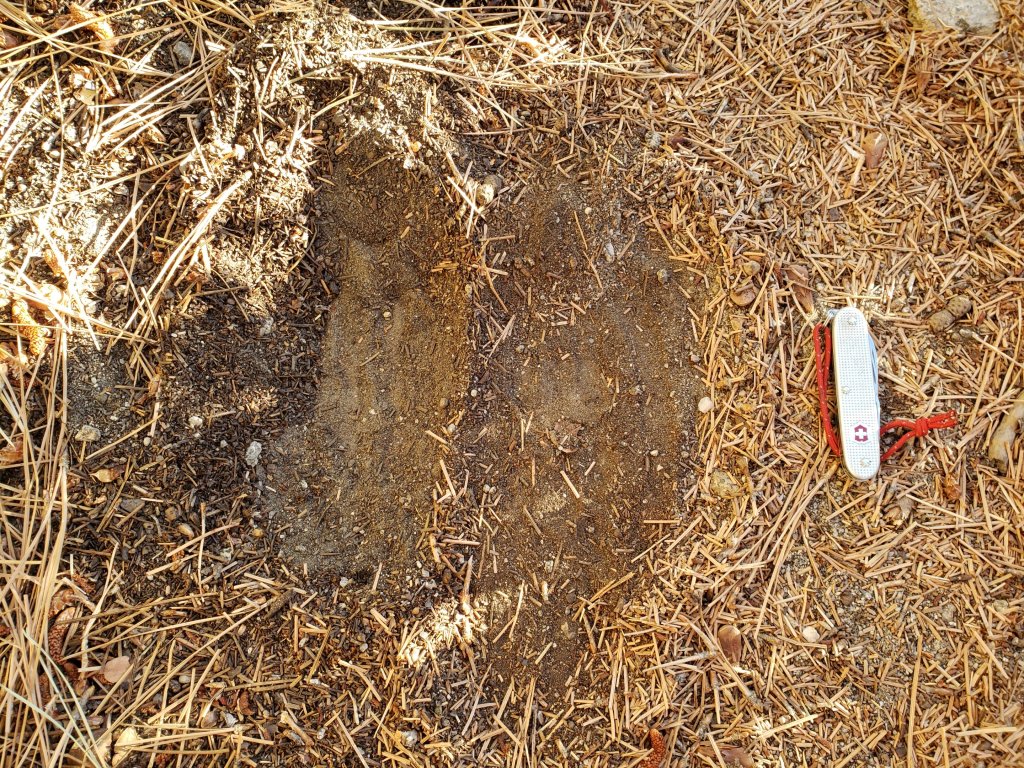
I was treated to an immaculate set of extremely fresh Mountain Lion tracks on Wellman Trail on 3rd December 2021. In the detail view (above) the knife is 3.6in long for scale, suggesting a relatively small lion. The tracks were very prominent on the frosty trail (below, with my boot tracks to the left and the lion tracks to the right).I was able to track the lion prints for an entire mile on Wellman Trail. Where the Mountain Lion left the trail there was a characteristic territorial marking scrape (above). Typically lions urinate (or defecate) at the scrape.
Thank you fellow hikers for taking the time to read this. While all labor and time is volunteered, the San Jacinto Trail Report completely depends on small private donations to cover operating costs. Every year seems to be challenging and 2021 has been no exception, so every contribution, no matter how small, is truly valuable. If you have found this Report useful, please consider visiting the Donate page. Thank you for your support.
With the end of the month passing (and with no clouds on the horizon, literally) November 2021 is confirmed as the driest in recorded history in both the San Jacinto high country and in Idyllwild. There was no recorded precipitation at mid or upper elevations in the entire month. In Idyllwild it was also likely the warmest November on record, pending final data.
Thursday 25th November we were battered by a strong Santa Ana wind event with gusts above 30mph in Idyllwild, so hikers should not be surprised to find new treefall hazards in places on the trail system. Although my route on 29th from Devil’s Slide Trail to San Jacinto Peak had no new trees down, we did find two fresh large treefall hazards on Seven Pines Trail on 28th.
Fullfire restrictions remain in place on Forest Servicelands, as described here. All campfires anywhere in the San Jacinto mountains, including at all USFS campgrounds and yellow post sites, are prohibited. All forms of campfire are always prohibited in designated wilderness (both State Park and USFS). With unseasonably warm, dry conditions, and periodic Santa Ana wind events, fire risk remains very high.
Unsurprisingly, water conditions in the high country continue to deteriorate further. Many springs and creeks dried months ago. The current status of most key water sources is discussed below.
Forest Service campgrounds largely closed for the season earlier in November, along with the State Park Stone Creek campground (Marion Mountain campground will close 1st December). The State Park campground at the Idyllwild Ranger Station normally remains open all year.
Despite recent relatively warm days, hikers should nevertheless be prepared for temperatures near or below freezing around the highest peaks (>10,000ft), and potentially well below freezing when considering wind chilleffects (see below for my most recent weather observations from San Jacinto Peak).
The U.S. Forest Service ranger station in Idyllwild has been closed due to USFS coronavirus protocols since March 2020. Apparently it will not reopen before February 2022. Hiking and camping permits are nevertheless required for USFS lands, and should be self-issued at the kiosk outside the ranger station.
The State Park ranger station has been open almost all year, and is the best source in Idyllwild for permits and additional trail information.
WEATHER Temperatures will remain far above seasonal for at least the next week – in Idyllwild more typical of October than December – before cooling closer to average from about 8th December. About two weeks of dry, predominantly north-east winds are forecast to finally give way to a prevailing westerly air flow from 9th December. There is the possibility of a minor storm system around 10th December and again on 13th-14th.
At San Jacinto Peak (10,810ft/3295m) on Wednesday 1st December 2021 at 0835 the air temperature was 33.4°F (1°C), with a windchill temperature of 18.1°F (-8°C), 31% relative humidity, and a stiff NE wind sustained at 17 mph gusting to 27.2 mph.
At the Peak on Monday 29th November 2021 at 0825 the air temperature was 38.9°F (3°C), with a windchill temperature of 30.7°F (-1°C),43% relative humidity, and a brisk NE wind sustained at 7 mph gusting to 9.5 mph.
At the Peak on Wednesday 24th November 2021 at 0830 the air temperature was 30.7°F (-1°C), with a windchill temperature of 20.1°F (-7°C),31% relative humidity, and a cool NNE wind sustained at 5 mph gusting to 9.1 mph.
TRAIL CONDITIONS
For the first time since systematic records began, there is no settled snow anywhere in the San Jacinto mountains at the beginning of December. Obviously no snow equipment (e.g., spikes) is required at this time.
Water conditions remain challenging despite five minor storms in October, with many springs and creeks already having dried up or having very low flows, as discussed in detail below. To date, temperatures have not been low enough to freeze springs in the high country, although that is possible by mid December.
The rockslide at PCT Mile 172.5, just north of Antsell Rock, was removed on Monday 14th June 2021. My “before, during, and after” video is available here. This section of the PCT is now safer and is narrow but readily passable with care by hikers (but remains impassable by stock).
Due to greatly reduced maintenance work by the agencies and PCTA during the coronavirus pandemic, many trails have accumulated treefall hazards since late 2019, passable with care by hikers but not for stock. Although reported promptly, regrettably neither Forest Service nor State Park have moved quickly to remove most hazards in 2021. With Santa Ana events and recent storms being accompanied by strong winds, hikers may encounter some new and additional hazards. Some are described below, others include the PCT between Strawberry Cienega and Strawberry Junction (PCT Miles 182-183, at least 7 trees down), and Fuller Ridge Trail near its northern end (PCT Miles 189.1-190.2, three trees).
Willow Creek Trail has at least 33 downed trees between Skunk Cabbage Junction and Hidden Divide. Of these 22 are on the Forest Service section (16 between Willow Creek and the Park boundary), with 11 in the State Park. Most are readily passable by hikers with care. Despite so much work last year by USFS volunteer Bill Rhoads and myself, the whitethorn has grown back rapidly, but still remains much less challenging than in 2019.
Spitler Peak Trail was cleared of multiple tree hazards by the Trail Report in early July, and has been trimmed periodically throughout 2021.
Marion Mountain Trail was cleared of multiple tree hazards by a California Conservation Corps team in late August, along with the adjacent PCT/Deer Springs Trail for 0.6 mile north to the south end of Fuller Ridge Trail. One new tree came down in early November 2021 on the PCT just yards south of its junction with Marion Mountain Trail, but it is easily passable for hikers.
Many treefall hazards from Red Tahquitz to Antsell Rock (PCT Miles 172.5-175) were cleared in June prior to the rockslide removal work mentioned above. Nevertheless about 20 remain, including at least six major obstructions for hikers. Tahquitz Creek to Red Tahquitz (PCT Miles 175-177) was cleared in early June.
Seven Pines Trail has had very limited hiker traffic since November 2018, largely because Dark Canyon Road was closed between February 2019 and early October 2021. The Trail Report has recently “adopted” Seven Pines Trail as a priority for maintenance work as the trail has had a disproportionate number of lost hiker rescues in recent years. In November 2021, 36 treefall hazards on the lower 3.0 miles of trail have been removed (although two new trees fell on this section in severe Santa Ana winds on 25th November). The lower 2.0 miles have also been trimmed and cleared, with (so far) less systematic trail rehabilitation for another mile further up. The trail is now obvious and easy to follow in this lower section. However at least 20 treefall hazards remain on the upper 0.7 mile of trail, the route is very obscure in places, and cautious navigation is required for those who are not very familiar with hiking this trail. Dark Canyon campground remains closed.
The Caramba Trail from near Reeds Meadow through Laws Camp and on to Caramba, and the Cedar Trail from Willow Creek Trail to Laws (which both nominally reopened in late 2018) are optimistically described by the Forest Service as “not maintained”. In reality parts of these trails no longer exist with significant sections of both so heavily overgrown that I strongly advise hikers do not attempt to follow them. Multiple experienced hikers have reported getting lost in this area since summer 2019. An informaluse trail to the Laws Camparea is much more direct and completely avoids all of the challenging bush-whacking of the unmaintained trails (other hikers kindly nicknamed it the “King Trail”). It leaves Willow Creek Trail exactly 1.0 mile from Saddle Junction, 0.45 mile from the Skunk Cabbage turning (trailhead at N33°46’46”, W116°39’32”, WGS84). The cairned use trail descends largely on established deer tracks for 0.9 mile, reaching Willow Creek just upstream of the former site of Laws Camp. From Laws east to Caramba the route of the old Caramba Trail has become increasingly tricky to follow, especially for the first 1.2 miles east of Laws where there are dozens of trees down. Closer to Caramba the trail is relatively obvious (for those familiar with the route prior to the 2013 Mountain Fire). Very cautious navigation is recommended throughout this area.
WATER STATUS: Eastern slope
The Round Valley pipe is now trickling only very erratically and is no longer reliable. Creeks in Round Valley and Tamarack Valley were dry in May (in 2020 neither dried until August).
Hidden Lake dried up completely in June.
Both the northern and southern springs at Wellman’s Cienega are flowing gently (but adequately to filter). These are the sources for Willow Creek, which is flowing where it crosses the Willow Creek Trail (the flow remains good for filtering, but is by far the lowest I have ever seen this creek). Sections of the creek are dry near Laws Camp (the creek presumably sustained by subsurface flow).
Tahquitz Creek is flowing at the northern end of Little Tahquitz Meadow. It is also flowing gently further upstream at its source (known colloquially as Grethe Spring) where it crosses the PCT at approx. Mile 177.
The small creek in Tahquitz Valley dried in May, some four months earlier than in 2020.
Candy’s Creek – that flows through Skunk Cabbage Meadow and then crosses the remaining visible section of Caramba Trail near Reeds Meadow – dried up in early July.
WATER STATUS: Western slope
The North Fork of the San Jacinto River continues to flow gently where it crosses the Deer Springs Trail, and also very weakly where it crosses the Fuller Ridge Trail on the PCT (approx. PCT Mile 186.2). Less than two miles further downstream this river is, remarkably, completely dry (see photos in an earlier report here).
The creek in Little Round Valley completely dried up in early July, reminiscent of the extremely dry years of 2014-16. The same creek dried up where it crosses Fuller Ridge Trail (PCT Mile 186.4) in April.
Shooting Star Spring (not far below Little Round Valley but above the North Fork of the San Jacinto River crossing) is flowing weakly and is a very poor option for filtering.
The Deer Springs stream crossingis dry at the PCT/Deer Springs Trail (approx. PCT mile 185.6). (Despite some online mapping to the contrary, this is NOT the source for the North Fork of the San Jacinto River.)
The tiny but perennial spring about 0.4 miles north of Strawberry Junction (known colloquially as Switchback Spring) continues to flow remarkably well. I rework the tiny pool every week when I pass by and there is sufficient depth from which to filter water.
The little creek at Strawberry Cienega (PCT mile 183.0) is dry.
On Devil’s Slide Trail all springs have been dry for many months.
On the Ernie Maxwell Trail, the crossing of Chinquapin Creek just below Humber Park is currently flowing well where it crosses the trail. Even when the creek is dry across the trail, small but invaluable fresh pools remain just upslope from the trail (this creek is an especially useful source of water for the many dogs walked on this trail).
The faucet at Cinco Poses Spring about 4.5 miles up Black Mountain Road continues to flow.
WATER STATUS: Desert Divide
Live Oak Spring (N 33 37 21, W 116 33 24) Flowing. The most reliable water source on the Desert Divide.
Cedar Spring (N 33 40 36, W 116 34 35) Flowing weakly. Easiest access is the trough about 60 yards upstream from the trail to the campsite.
Apache Spring (N 33 43 11, W 116 37 13) Barely trickling, not now reliable.
Spitler Peak Trail Descending the trail from the PCT there are five water crossings. The first two, at 0.9 and 0.95 miles down, cross a tiny side creek which is largely dry and should be ignored. The next crossing, at 1.1 miles down, is Spitler Creek and is the best source of water (currently flowing very gently, but can be filtered). The next two crossings are the same creek, also flowing adequately for filtering.
Antsell Rock Creek (N 33 41 52, W 116 39 08) Right by the Spitler Peak Trail trailhead on Apple Canyon Road, Antsell Rock Creek dried up in July. Even in the very dry years of 2015 and 2016, this source did not dry until the autumn.
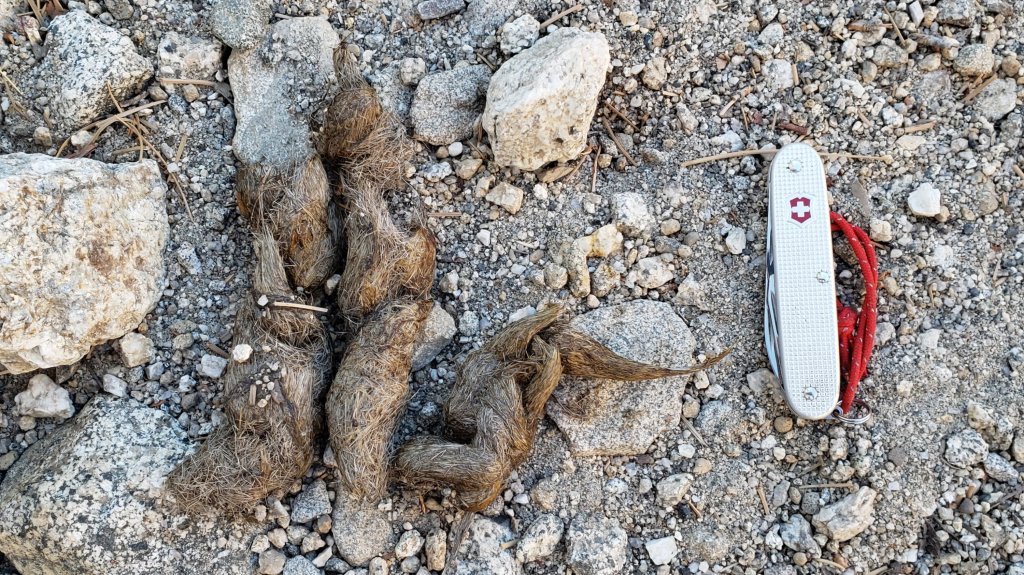
Mountain Lions are very common and widespread in the San Jacinto mountains, albeit rarely seen. I typically find tracks or scat somewhere several times every month. This relatively fresh scat, composed entirely of deer hair, was in the middle of the Wellman Trail at 9450ft elevation on 24th November 2021. The knife is 3.6 inches long for scale. Tracks nearby on the same trail suggested a relatively small lion (likely <100 pounds weight).
Thank you fellow hikers for taking the time to read this. While all labor and time is volunteered, the San Jacinto Trail Report completely depends on small private donations to cover operating costs. Every year seems to be challenging and 2021 has been no exception, so every contribution, no matter how small, is truly valuable. If you have found this Report useful, please consider visiting the Donate page. Thank you for your support.
November 2021 will likely set a number of unwanted meteorological records, most notably being the first November in recorded history with no snowfall in the San Jacinto high country. It will certainly be the driest November, and probably the warmest, since local records began. Although unfortunate for many other reasons, dry conditions with benign temperatures have been ideal for making major progress on trail maintenance, with continued focus on Seven Pines Trail, South Ridge Trail, and Spitler Peak Trail.
Santa Ana wind events peak in frequency in December and January (as discussed in this NWS San Diego video). Another major event is forecast for 24th-26th November, with extremely low humidity expected. Dry north-east winds prevail until 2nd December.
Fullfire restrictions remain in place on Forest Servicelands, as described here. All campfires anywhere in the San Jacinto mountains, including at all USFS campgrounds and yellow post sites, are prohibited. All forms of campfire are always prohibited in wilderness (State Park and USFS lands). With unseasonably warm, dry conditions, and periodic Santa Ana wind events, fire risk remains very high.
The effects of the light precipitation from multiple storms in October rapidly dissipated regionally (as mentioned in another NWS video) and water conditions in the high country continue to deteriorate further. Many springs and creeks dried months ago. The current status of most key water sources is discussed below.
Most major Forest Service campgrounds closed for the season earlier this month, along with the State Park Stone Creek campground (Marion Mountain will close 1st December, no water available). The State Park campground at the Idyllwild Ranger Station normally remains open all year. Black Mountain fire lookout closed on 13th, and Tahquitz Peak lookout on 20th November.
Despite recent relatively warm days, hikers should nevertheless be prepared for temperatures near or below freezing around the highest peaks (>10,000ft), and potentially well below freezing when considering wind chilleffects (see below for most recent weather observations from San Jacinto Peak).
Be bear aware. Although rarely reported, several Black Bears remain active in the San Jacinto mountains. I was fortunate to see a very large (>300lb) uniformly dark brown individual at dawn on 7th September near Humber Park. I was able to get a couple of short, poor quality videos, of which one is available here.
The U.S. Forest Service ranger station in Idyllwild has been closed due to USFS coronavirus protocols since March 2020. Apparently it will not reopen until 2022. Hiking and camping permits are nevertheless required for USFS lands, and should be available at the kiosk outside the ranger station.
The State Park ranger station has been open almost all year, and is the best source in Idyllwild for permits and additional trail information.
WEATHER The current three day cool spell, in which temperatures are around seasonal averages, continues until Thursday 25th November. Thereafter a strong warming trend will bring temperatures far above seasonal for the last few days of November and into the first week of December. North-east winds, accompanied by very low relative humidity, are forecast for the next ten days. Regrettably there continues to be no significant precipitation in the forecast.
At San Jacinto Peak (10,810ft/3295m) on Wednesday 24th November 2021 at 0830 the air temperature was 30.7°F (-1°C), with a windchill temperature of 20.1°F (-7°C),31% relative humidity, and a cool NNE wind sustained at 5 mph gusting to 9.1 mph.
At the Peak (10,810ft/3295m) on Monday 22nd November 2021 at 0905 the air temperature was 38.1°F (3°C), with a windchill temperature of 26.7°F (-3°C),36% relative humidity, and a sharp SSE wind sustained at 9 mph gusting to 17.3 mph.
TRAIL CONDITIONS
Trails throughout the San Jacinto high country cleared several weeks ago of the very light snow that fell in late October, and spikes are not required anywhere. Water conditions remain challenging despite five minor storms in October, with many springs and creeks already having dried up or having very low flows, as discussed in detail below. To date, temperatures have not been low enough to freeze springs in the high country, although on the morning of Monday 22nd most of the North Fork of the San Jacinto River where it crosses Fuller Ridge Trail was solidly frozen (some unfrozen pools remained just upstream).
The rockslide at PCT Mile 172.5, just north of Antsell Rock, was removed on Monday 14th June 2021. My “before, during, and after” video is available here. This section of the PCT is now safer and is narrow but readily passable with care by hikers (but remains impassable by stock).
Due to greatly reduced maintenance work by the agencies and PCTA during the coronavirus pandemic, many trails have accumulated treefall hazards since late 2019, passable with care by hikers but not for stock. Although reported promptly, regrettably neither Forest Service nor State Park have moved quickly to remove most hazards in 2021. With Santa Ana events and recent storms being accompanied by strong winds, hikers may encounter some new and additional hazards. Some are described below, others include the PCT between Strawberry Cienega and Strawberry Junction (PCT Miles 182-183, at least 7 trees down), and Fuller Ridge Trail near its northern end (PCT Miles 189.1-190.2, three trees).
Willow Creek Trail has at least 33 downed trees between Skunk Cabbage Junction and Hidden Divide. Of these 22 are on the Forest Service section (16 between Willow Creek and the Park boundary), with 11 in the State Park. Most are readily passable by hikers with care. Despite so much work last year by USFS volunteer Bill Rhoads and myself, the whitethorn has grown back rapidly, but still remains much less challenging than in 2019.
Spitler Peak Trail was cleared of multiple tree hazards by the Trail Report in early July, and has been trimmed periodically throughout 2021.
Marion Mountain Trail was cleared of multiple tree hazards by a California Conservation Corps team in late August, along with the adjacent PCT/Deer Springs Trail for 0.6 mile north to the south end of Fuller Ridge Trail. One new tree came down in early November 2021 on the PCT just yards south of its junction with Marion Mountain Trail, but it is easily passable for hikers.
Many treefall hazards from Red Tahquitz to Antsell Rock (PCT Miles 172.5-175) were cleared in June prior to the rockslide removal work mentioned above. Nevertheless about 20 remain, including at least six major obstructions for hikers. Tahquitz Creek to Red Tahquitz (PCT Miles 175-177) was cleared in early June.
Seven Pines Trail has had limited hiker traffic since November 2018, largely because Dark Canyon Road was closed between February 2019 and early October 2021. The Trail Report has “adopted” Seven Pines Trail as a priority for maintenance work to improve hiker safety on a trail which has had a disproportionate number of lost hiker rescues in recent years. In November 2021, all 22 major treefall hazards on the lower 2.4 miles of trail have been removed, plus a couple more further up. The lower 1.5 miles have also been trimmed and cleared, with less systematic trimming for another mile further up also. The trail is now obvious and easy to follow in this lower section. However 33 treefall hazards remain on the upper trail, the route is very obscure in places, and cautious navigation is required for those who are not very familiar with hiking this trail. Dark Canyon campground remains closed.
The Caramba Trail from near Reeds Meadow through Laws Camp and on to Caramba, and the Cedar Trail from Willow Creek Trail to Laws (which both nominally reopened in late 2018) are optimistically described by the Forest Service as “not maintained”. In reality parts of these trails no longer exist with significant sections of both so heavily overgrown that I strongly advise hikers do not attempt to follow them. Multiple experienced hikers have reported getting lost in this area since summer 2019. An informaluse trail to the Laws Camparea is much more direct and completely avoids all of the challenging bush-whacking of the unmaintained trails (other hikers kindly nicknamed it the “King Trail”). It leaves Willow Creek Trail exactly 1.0 mile from Saddle Junction, 0.45 mile from the Skunk Cabbage turning (trailhead at N33°46’46”, W116°39’32”, WGS84). The cairned use trail descends largely on established deer tracks for 0.9 mile, reaching Willow Creek just upstream of the former site of Laws Camp. From Laws east to Caramba the route of the old Caramba Trail has become increasingly tricky to follow, especially for the first 1.2 miles east of Laws where there are dozens of trees down. Closer to Caramba the trail is relatively obvious (for those familiar with the route prior to the 2013 Mountain Fire). Very cautious navigation is recommended throughout this area.
WATER STATUS: Eastern slope
The Round Valley pipe is now flowing only intermittently and is no longer reliable. Creeks in Round Valley and Tamarack Valley were dry in May (in 2020 neither dried until August).
Hidden Lake dried up completely in June.
Both the northern and southern springs at Wellman’s Cienega are flowing gently (but adequately to filter). These are the sources for Willow Creek, which is flowing where it crosses the Willow Creek Trail (the flow remains good for filtering, but is the lowest I have ever seen this creek). Sections of the creek are dry near Laws Camp (the creek presumably sustained by subsurface flow).
Tahquitz Creek is flowing at the northern end of Little Tahquitz Meadow. It is also flowing gently further upstream at its source (known colloquially as Grethe Spring) where it crosses the PCT at approx. Mile 177.
The small creek in Tahquitz Valley dried in May, some four months earlier than in 2020.
Candy’s Creek – that flows through Skunk Cabbage Meadow and then crosses the remaining visible section of Caramba Trail near Reeds Meadow – dried up in early July.
WATER STATUS: Western slope
The North Fork of the San Jacinto River continues to flow gently where it crosses the Deer Springs Trail, and also very weakly where it crosses the Fuller Ridge Trail on the PCT (approx. PCT Mile 186.2). Less than two miles further downstream this river is, remarkably, completely dry (see photos in an earlier report here).
The creek in Little Round Valley completely dried up in early July, reminiscent of the extremely dry years of 2014-16. The same creek dried up where it crosses Fuller Ridge Trail (PCT Mile 186.4) in April.
Shooting Star Spring (not far below Little Round Valley but above the North Fork of the San Jacinto River crossing) is flowing weakly and is a very poor option for filtering.
The Deer Springs stream crossingis dry at the PCT/Deer Springs Trail (approx. PCT mile 185.6). (Despite some online mapping to the contrary, this is NOT the source for the North Fork of the San Jacinto River.)
The tiny but perennial spring about 0.4 miles north of Strawberry Junction (known colloquially as Switchback Spring) continues to flow remarkably well. I rework the tiny pool every week when I pass by and there is sufficient depth from which to filter water.
The little creek at Strawberry Cienega (PCT mile 183.0) is dry.
On Devil’s Slide Trail all springs have been dry for many months.
On the Ernie Maxwell Trail, the crossing of Chinquapin Creek just below Humber Park is currently flowing where it crosses the trail. Even when the creek is dry across the trail, small but invaluable fresh pools remain just upslope from the trail (this creek is an especially useful source of water for the many dogs walked on this trail).
The faucet at Cinco Poses Spring about 4.5 miles up Black Mountain Road continues to flow.
WATER STATUS: Desert Divide
Live Oak Spring (N 33 37 21, W 116 33 24) Flowing. The most reliable water source on the Desert Divide.
Cedar Spring (N 33 40 36, W 116 34 35) Flowing weakly. Easiest access is the trough about 60 yards upstream from the trail to the campsite.
Apache Spring (N 33 43 11, W 116 37 13) Barely trickling, not now reliable.
Spitler Peak Trail Descending the trail from the PCT there are five water crossings. The first two, at 0.9 and 0.95 miles down, cross a tiny side creek which is largely dry and should be ignored. The next crossing, at 1.1 miles down, is Spitler Creek and is the best source of water (currently flowing very gently, but can be filtered). The next two crossings are the same creek, also flowing adequately for filtering.
Antsell Rock Creek (N 33 41 52, W 116 39 08) Right by the Spitler Peak Trail trailhead on Apple Canyon Road, Antsell Rock Creek dried up in July. Even in the very dry years of 2015 and 2016, this source did not dry until the autumn.
Trash collected on my eight mile hike route on Tuesday 16th November. Such a haul is not unusual for June, but was very surprising in November. I hiked exactly the same route five days earlier, so almost everything here was from the previous few days. Especially distressing are the dozen sets of visibly used tissue paper, almost all of which were very obvious in or beside the trail, despite some being “buried” under small rocks. Last year I packed out about 90lb of trash from the San Jacinto mountains. This year I am at roughly 130lb with more than a month to go. Clearly we are failing in the basic education of too many of our fellow hikers.
Thank you for taking the time to read this. While all labor and time is volunteered, the San Jacinto Trail Report completely depends on small private donations to cover operating costs. Every year seems to be challenging and 2021 has been no exception, so every contribution, no matter how small, is truly valuable. If you have found this Report useful, please consider visiting the Donate page. Thank you for your support.
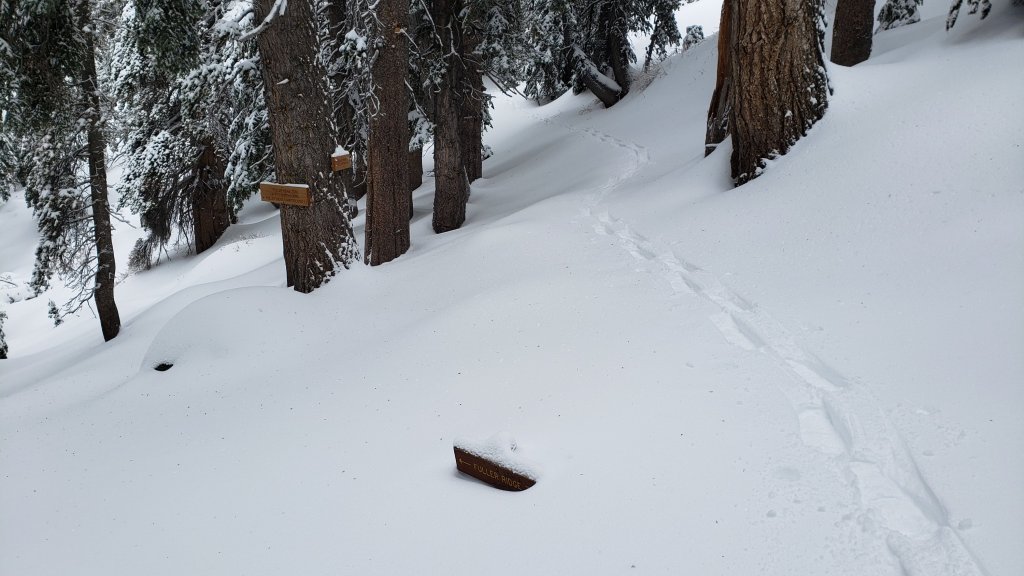
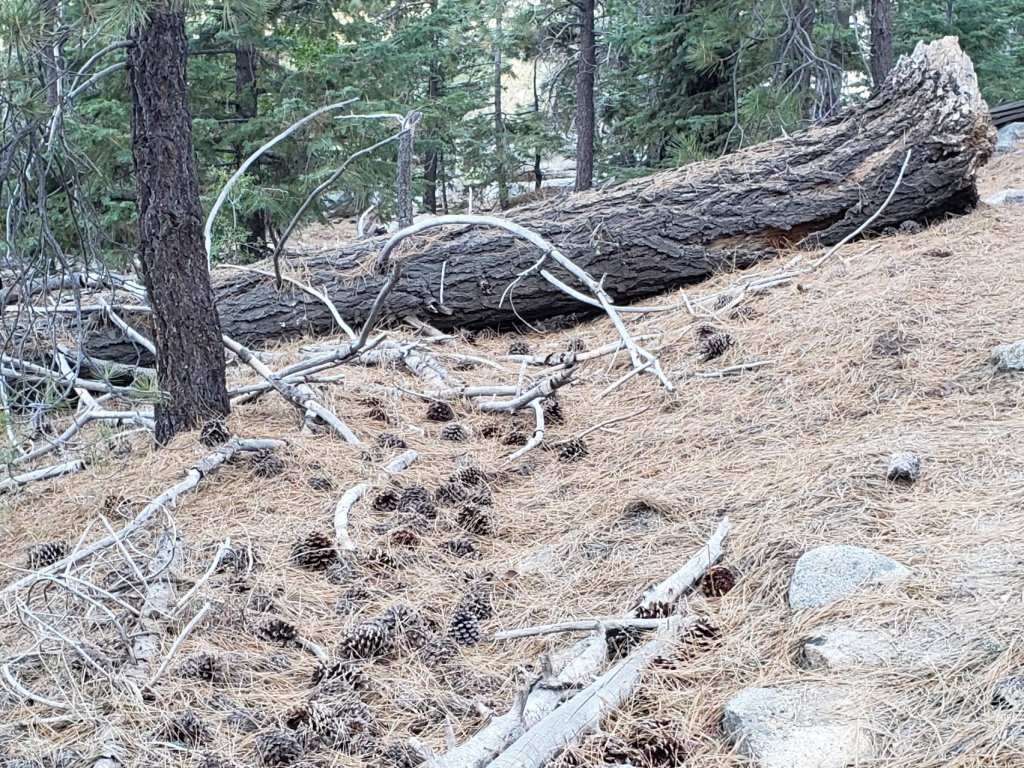
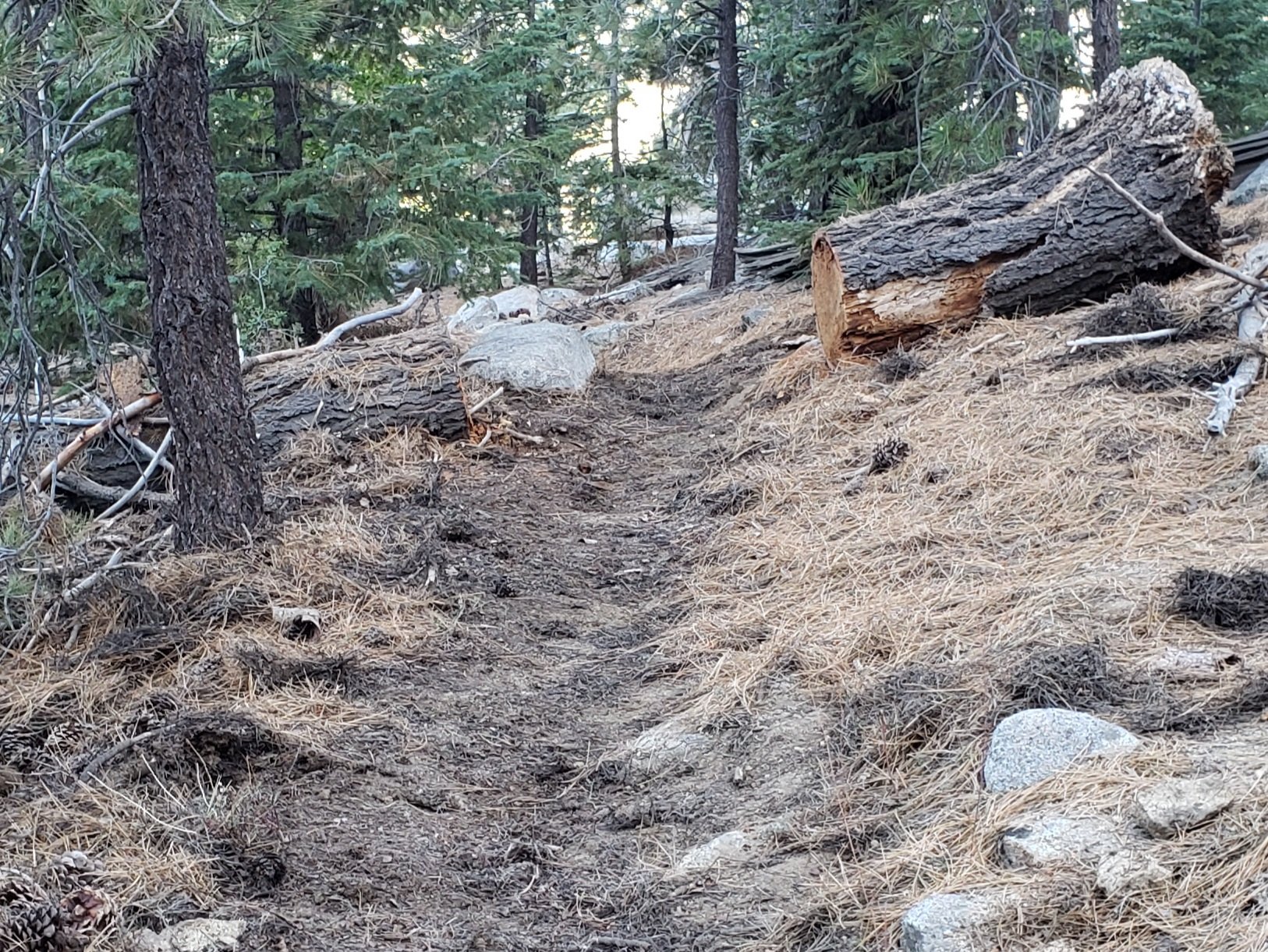
Substantial sections of Seven Pines Trail have been obscured by years of accumulated cones, branches, and fallen trees (above). Slow but steady work is rehabilitating the original route of the trail (below, photos 18th November 2021).
Although it feels pleasantly cool after such a long, hot, summer, this November has so far been very warm and dry across the San Jacinto mountains, and is currently on track to finish as one of the 2-3 hottest in recorded Idyllwild history. Almost every day in the first three weeks of the month has recorded (or will record) well above seasonal temperatures for November. While undertaking trail maintenance work on Saturday 13th, we found wild currant bushes already budding at 7000ft elevation! Perhaps they thought that the cooler October was what passed for winter these days, and that spring has now sprung.
Santa Ana wind events peak in frequency in December and January (as discussed in this recent NWS San Diego video). I spent Thursday and Friday last week as volunteer fire lookout at Tahquitz Peak during a moderate Santa Ana wind event. Another possibly stronger event is tentatively forecast for 24th-25th November. On the plus side, Santa Ana winds produce the clearest visibility conditions of the year, and from Tahquitz Peak on Friday 12th I could clearly see (with binoculars) multiple container ships anchored off the coast.
The effects of the light precipitation from multiple storms in October have dissipated, and water conditions in the high country continue to deteriorate slowly, with many springs and creeks having dried this summer. The current status of most key springs and creeks is described below.
The major Forest Service campgrounds closed for the season this past week, including Fern Basin, Marion Mountain, and Boulder Basin (Dark Canyon campground has been closed since late 2018). The State Park Stone Creek campground also closed. The State Park campground at the Idyllwild Ranger Station normally remains open all year. Black Mountain fire lookout closed on 13th, and Tahquitz Peak lookout is scheduled to close on 20th November.
Fullfire restrictions remain in place on Forest Servicelands, as described here. All campfires anywhere in the San Jacinto mountains, including at all USFS campgrounds and yellow post sites, are prohibited. All forms of campfire are always prohibited in the State Park wilderness. With continuing dry conditions, and potential for Santa Ana wind events, fire risk remains very high.
Despite recent relatively warm days, hikers should nevertheless be prepared for temperatures near or below freezing around the highest peaks (>10,000ft), and potentially well below freezing when considering wind chilleffects (see below for most recent weather observations from San Jacinto Peak).
Be bear aware. Although rarely reported, several Black Bears remain active in the San Jacinto mountains. I was fortunate to see a very large (>300lb) uniformly dark brown individual at dawn on 7th September near Humber Park. I was able to get a couple of short, poor quality videos, of which one is available here.
The U.S. Forest Service ranger station in Idyllwild has been closed due to USFS coronavirus protocols since March 2020. Apparently it is unlikely to reopen until 2022. Hiking and camping permits are nevertheless required for USFS lands, and should be available at the kiosk outside the ranger station.
The State Park ranger station has been open almost all year, and is the best source in Idyllwild for permits and additional trail information.
WEATHER Temperatures will remain above average for November until Tuesday 23rd, cooling trend is forecast, taking temperatures down to about seasonal. Although several days in the next week are forecast to be partly or mostly cloudy, regrettably there is no significant precipitation in the forecast.
At San Jacinto Peak (10,810ft/3295m) on Tuesday 16th November 2021 at 0825 the air temperature was 41.4°F (5°C), with a windchill temperature of 28.2°F (-2°C), 17% relative humidity, and a bitter NW wind sustained at 18 mph gusting to 28.9 mph.
At the Peak on Thursday 11th November 2021 at 0845 the air temperature was 37.8°F (3°C), with a windchill temperature of 25.4°F (-4°C), 42% relative humidity, and a fresh due North wind sustained at 9 mph gusting to 15.8 mph.
TRAIL CONDITIONS
Trails throughout the San Jacinto high country have cleared of the very light snow that fell in late October, and spikes are not required anywhere. Water conditions remain challenging despite five minor storms in October, with many springs and creeks already having dried up or having very low flows, as discussed in detail below. To date, temperatures have not been low enough to freeze springs in the high country.
The rockslide at PCT Mile 172.5, just north of Antsell Rock, was removed on Monday 14th June 2021. My “before, during, and after” video is available here. This section of the PCT is now safer and is narrow but readily passable with care by hikers (but remains impassable by stock).
Due to greatly reduced maintenance work during the coronavirus pandemic, many trails have accumulated treefall hazards since late 2019, passable with care by hikers but not for stock. Although reported promptly, regrettably neither Forest Service nor State Park have moved quickly to remove most hazards in 2021. With Santa Ana events and recent storms being accompanied by strong winds, hikers may encounter new and additional hazards. Some are described below, others include the PCT between Strawberry Cienega and Strawberry Junction (PCT Miles 182-183, at least 7 trees down), and Fuller Ridge Trail near its northern end (PCT Miles 189.1-190.2, three trees).
Spitler Peak Trail was cleared of multiple tree hazards by the Trail Report in early July. Marion Mountain Trail was cleared of multiple tree hazards by a California Conservation Corps team in late August, along with the adjacent PCT/Deer Springs Trail for 0.6 mile north to the south end of Fuller Ridge Trail. One new tree came down in early November 2021 on the PCT just yards south of its junction with Marion Mountain Trail, but it is easily passable for hikers.
Many treefall hazards from Red Tahquitz to Antsell Rock (PCT Miles 172.5-175) were cleared in June prior to the rockslide removal work mentioned above. Nevertheless about 20 remain, including at least six major obstructions for hikers. Tahquitz Creek to Red Tahquitz (PCT Miles 175-177) was cleared in early June.
Willow Creek Trail has at least 33 downed trees between Skunk Cabbage Junction and Hidden Divide. Of these 22 are on the Forest Service section (16 between Willow Creek and the Park boundary), with 11 in the State Park. Most are readily passable by hikers with care. Despite so much work last year by myself and USFS volunteers, the whitethorn has grown back rapidly, but still remains less challenging than in 2019.
Seven Pines Trail has had very limited hiker traffic since November 2018, largely because Dark Canyon Road was closed between February 2019 and early October 2021. The Trail Report has “adopted” Seven Pines Trail as our current focus of trail maintenance work in order to improve hiker safety on this trail that has had a disproportionate number of lost hiker rescues in recent years. Four major treefall hazards on the Forest Service section were removed on 2nd November 2021, and almost all the lower 1.4 miles of trail were trimmed and cleared by mid November. However at least 33 treefall hazards remain on the State Park section, the trail is obscure in places, and cautious navigation is recommended for those who are not very familiar with hiking this trail. Dark Canyon campground remains closed.
The Caramba Trail from near Reeds Meadow through Laws Camp and on to Caramba, and the Cedar Trail from Willow Creek Trail to Laws (which both nominally reopened in late 2018) are optimistically described by the Forest Service as “not maintained”. In reality parts of these trails no longer exist with significant sections of both so heavily overgrown that I strongly advise hikers do not attempt to follow them. Multiple experienced hikers have reported getting lost in this area since summer 2019. An informaluse trail to the Laws Camparea is much more direct and completely avoids all of the challenging bush-whacking of the unmaintained trails (other hikers kindly nicknamed it the “King Trail”). It leaves Willow Creek Trail exactly 1.0 mile from Saddle Junction, 0.45 mile from the Skunk Cabbage turning (trailhead at N33°46’46”, W116°39’32”, WGS84). The cairned use trail descends largely on established deer tracks for 0.9 mile, reaching Willow Creek just upstream of the former site of Laws Camp. From Laws east to Caramba the route of the old Caramba Trail has become increasingly tricky to follow, especially for the first 1.2 miles east of Laws where there are dozens of trees down. Closer to Caramba the trail is relatively obvious (for those familiar with the route prior to the 2013 Mountain Fire). Very cautious navigation is recommended throughout this area.
WATER STATUS: Eastern slope
The Round Valley pipe is now flowing only intermittently and is no longer reliable. There is occasional flow (at about 0.2L/min) but without further precipitation input, this source should no longer be relied upon. Creeks in Round Valley and Tamarack Valley were dry in May (in 2020 neither dried until August).
Hidden Lake dried up completely in June.
Both the northern and southern springs at Wellman’s Cienega are flowing very gently (but adequately to filter). These are the sources for Willow Creek, which is flowing where it crosses the Willow Creek Trail (the flow remains good for filtering, but is the lowest I have ever seen this creek).
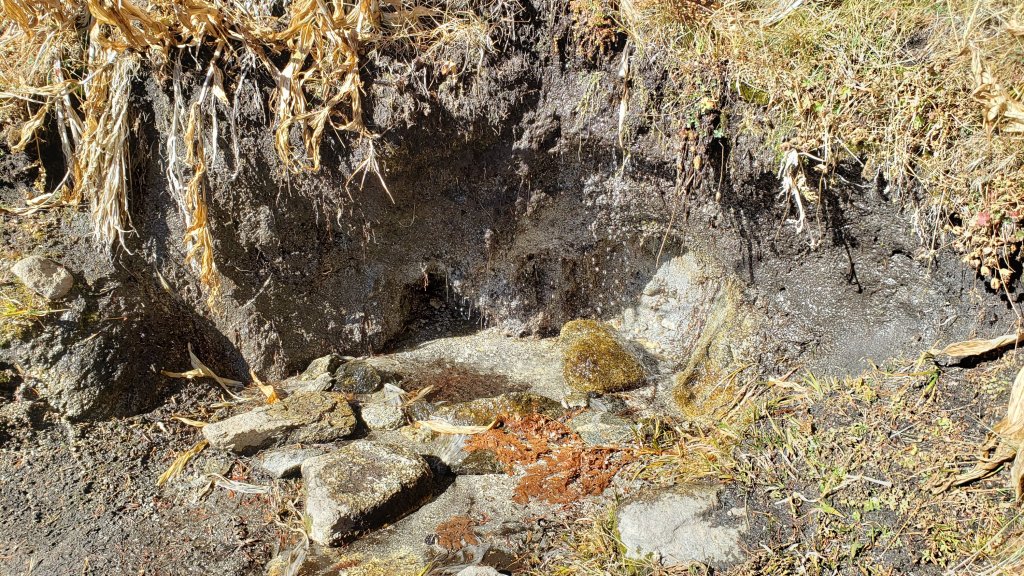
Wellman’s Cienega north spring (9300ft) flowing gently, 11th November 2021.
Tahquitz Creek is flowing at the northern end of Little Tahquitz Meadow. It is also flowing, but very gently, further upstream at its source (known locally as Grethe Spring) where it crosses the PCT at approx. Mile 177.
The small creek in Tahquitz Valley dried in May, some four months earlier than in 2020.
Candy’s Creek – that flows through Skunk Cabbage Meadow and then crosses the remaining visible section of Caramba Trail near Reeds Meadow – dried up in early July.
WATER STATUS: Western slope
The North Fork of the San Jacinto River continues to flow gently where it crosses the Deer Springs Trail, and also very weakly where it crosses the Fuller Ridge Trail on the PCT (approx. PCT Mile 186.2). Less than two miles further downstream this river is, remarkably, completely dry (see photos in an earlier report here).
The creek in Little Round Valley completely dried up in early July, reminiscent of the extremely dry years of 2014-16. The same creek dried up where it crosses Fuller Ridge Trail (PCT Mile 186.4) in April.
Shooting Star Spring (not far below Little Round Valley but above the North Fork of the San Jacinto River crossing) is flowing weakly and is a very poor option for filtering.
The Deer Springs stream crossingis dry at the PCT/Deer Springs Trail (approx. PCT mile 185.6). (Despite some online mapping to the contrary, this is NOT the source for the North Fork of the San Jacinto River.)
The tiny but perennial spring about 0.4 miles north of Strawberry Junction (known colloquially as Switchback Spring) continues to flow remarkably well. I rework the tiny pool every week when I pass by and there is sufficient depth from which to filter water.
The little creek at Strawberry Cienega (PCT mile 183.0) is dry.
On Devil’s Slide Trail all springs have been dry for many months.
On the Ernie Maxwell Trail, the crossing of Chinquapin Creek just below Humber Park is currently flowing where it crosses the trail. Even when the creek is dry across the trail, small but invaluable fresh pools remain just upslope from the trail (this creek is an especially useful source of water for the many dogs walked on this trail).
The faucet at Cinco Poses Spring about 4.5 miles up Black Mountain Road continues to flow.
WATER STATUS: Desert Divide
Live Oak Spring (N 33 37 21, W 116 33 24) Flowing. The most reliable water source on the Desert Divide.
Cedar Spring (N 33 40 36, W 116 34 35) Flowing weakly. Easiest access is the trough about 60 yards upstream from the trail to the campsite.
Apache Spring (N 33 43 11, W 116 37 13) Barely trickling, not now reliable.
Spitler Peak Trail Descending the trail from the PCT there are five water crossings. The first two, at 0.9 and 0.95 miles down, cross a tiny side creek which is largely dry and should be ignored. The next crossing, at 1.1 miles down, is Spitler Creek and is the best source of water (currently flowing very gently, but can be filtered). The next two crossings are the same creek, also flowing adequately for filtering.
Antsell Rock Creek (N 33 41 52, W 116 39 08) Right by the Spitler Peak Trail trailhead on Apple Canyon Road, Antsell Rock Creek dried up in July. Even in the very dry years of 2015 and 2016, this source did not dry until the autumn.
Trash collected on my 16 mile hike on Tuesday 16th November. I hiked exactly the same route five days earlier, so almost everything here was from the past few days. Especially distressing are the dozen sets of visibly used tissue paper, almost all of which were very obvious in or beside the trail, despite some being “buried” under small rocks. Last year I packed out about 90lb of trash from the San Jacinto mountains. This year I am at roughly 130lb with more than a month to go. Clearly we are failing in the basic education of too many of our fellow hikers.
Thank you for taking the time to read this. While all labor and time is volunteered, the San Jacinto Trail Report completely depends on small private donations to cover operating costs. Every year seems to be challenging and 2021 has been no exception, so every contribution, no matter how small, is truly valuable. If you have found this Report useful, please consider visiting the Donate page. Thank you for your support.
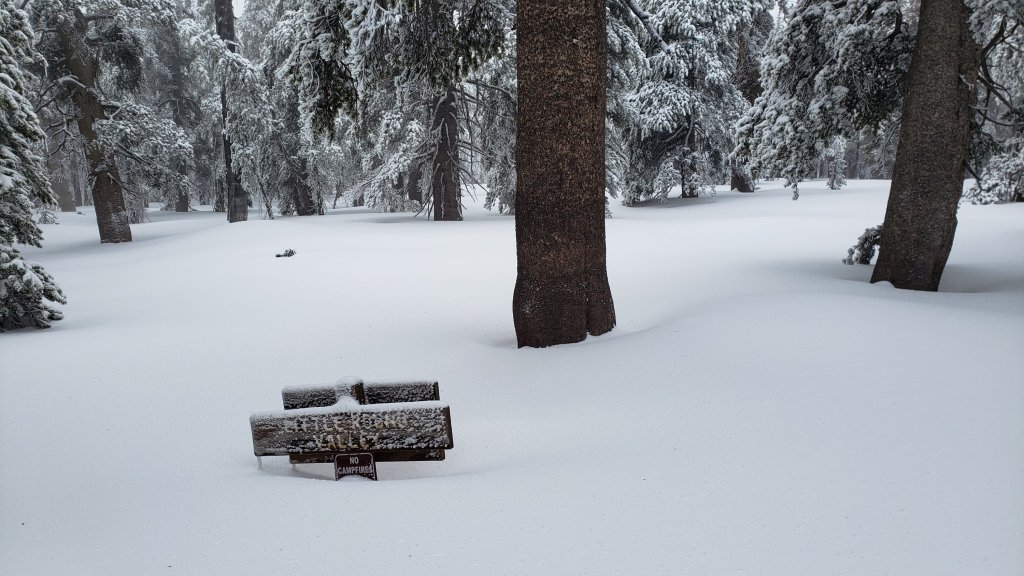
After several recent years in which the summer has persisted very late in the year, then abruptly changed to winter, it is so pleasant to have some genuine autumnal weather this season, ideal for long vigorous hikes. We continue to undertake at least a couple of circuitous hikes of the high country, including the highest peaks, every week, which allow for thorough surveys of the water and trail conditions.
The effects of the light rainfall from multiple storms in October have regrettably already dissipated, and water conditions in the high country continue to deteriorate slowly, with many springs and creeks having dried this summer. The current status of most key springs and creeks is described below.
Despite some recent relatively warm days, hikers should nevertheless be prepared for temperatures near or below freezing in the high country, and potentially well below freezing when considering wind chilleffects (see below for most recent weather observations from San Jacinto Peak).
Be bear aware. Although rarely reported, several Black Bears remain active in the San Jacinto mountains. I was fortunate to see a very large (>300lb), uniformly dark brown individual at dawn on 7th September near Humber Park. I was able to get a couple of short, poor quality videos, of which one is available here.
Fullfire restrictions remain in place on Forest Servicelands, as described here. All campfires anywhere in the San Jacinto mountains, including at all USFS campgrounds and yellow post sites, are prohibited. All forms of campfire are always prohibited in the State Park wilderness. Despite recent cooler temperatures and light precipitation, fire risk remains very high.
The U.S. Forest Service ranger station in Idyllwild has been closed due to USFS coronavirus protocols since March 2020. Apparently it is unlikely to reopen until 2022. Hiking and camping permits are nevertheless required for USFS lands, and should be available at the kiosk outside the ranger station.
The State Park ranger station has been open almost all year, and is the best source in Idyllwild for permits and additional trail information.
WEATHER Temperatures will remain well above average for November until Tuesday 16th, when a significant cooling trend is forecast. Regrettably there is currently no precipitation in the forecast.
At San Jacinto Peak (10,810ft/3295m) on Monday 8th November 2021 at 0845 the air temperature was 39.1°F (4°C), with a windchill temperature of 29.8°F (-1°C), 32% relative humidity, and a fresh WNW wind sustained at 5 mph gusting to 8.9 mph.
At the Peak on Thursday 4th November 2021 at 0840 the air temperature was 46.1°F (8°C), with a windchill temperature of 39.2°F (4°C), 31% relative humidity, and a cool WNW wind sustained at 6 mph gusting to 11.4 mph.
TRAIL CONDITIONS
Trails throughout the San Jacinto high country have cleared of the very light snow that fell in late October. Water conditions remain challenging despite recent autumnal weather, with many springs and creeks already having dried up or having very low flows, as discussed in detail below. To date, temperatures have not been low enough to freeze springs in the high country.
The rockslide at PCT Mile 172.5, just north of Antsell Rock, was removed on Monday 14th June 2021. My “before, during, and after” video is available here. This section of the PCT is now safer and is narrow but readily passable with care by hikers (but remains impassable by stock).
Due to greatly reduced maintenance work during the coronavirus pandemic, many trails have accumulated treefall hazards since late 2019, passable with care by hikers but not for stock. Although reported promptly, regrettably neither Forest Service nor State Park have moved quickly to remove most hazards in 2021. With recent storms being accompanied by strong winds, hikers may encounter new and additional hazards. Some are described below, others include the PCT between Strawberry Cienega and Strawberry Junction (PCT Miles 182-183, at least 7 trees down), and Fuller Ridge Trail near its northern end (PCT Miles 189.1-190.2, three trees).
Spitler Peak Trail was cleared of multiple tree hazards by the Trail Report in early July. Marion Mountain Trail was cleared of multiple tree hazards by a California Conservation Corps team in late August, along with the adjacent PCT/Deer Springs Trail for 0.6 mile north to the south end of Fuller Ridge Trail. One new tree came down in early November 2021 on the PCT just yards south of its junction with Marion Mountain Trail, but it is easily passable for hikers.
Many treefall hazards from Red Tahquitz to Antsell Rock (PCT Miles 172.5-175) were cleared in June prior to the rockslide removal work mentioned above. Nevertheless about 20 remain, including at least six major obstructions for hikers. Tahquitz Creek to Red Tahquitz (PCT Miles 175-177) was cleared in early June.
Willow Creek Trail has at least 33 downed trees between Skunk Cabbage Junction and Hidden Divide. Of these 22 are on the Forest Service section (16 between Willow Creek and the Park boundary), with 11 in the State Park. Most are readily passable by hikers with care. Despite so much work last year by myself and USFS volunteers, the whitethorn has grown back rapidly, but still remains less challenging than in 2019.
Seven Pines Trail has had very limited hiker traffic since November 2018, largely because Dark Canyon Road was closed between February 2019 and early October 2021. There are 33 treefall hazards on the State Park section of the trail. The four major treefall hazards on the Forest Service section were removed by the Trail Report on 2nd November 2021. Cautious navigation is recommended for those who are not very familiar with hiking this trail. Dark Canyon campground remains closed.
The Caramba Trail from near Reeds Meadow through Laws Camp and on to Caramba, and the Cedar Trail from Willow Creek Trail to Laws (which both nominally reopened in late 2018) are optimistically described by the Forest Service as “not maintained”. In reality parts of these trails no longer exist with significant sections of both so heavily overgrown that I strongly advise hikers do not attempt to follow them. Multiple experienced hikers have reported getting lost in this area since summer 2019. An informaluse trail to the Laws Camparea is much more direct and completely avoids all of the challenging bush-whacking of the unmaintained trails (other hikers kindly nicknamed it the “King Trail”). It leaves Willow Creek Trail exactly 1.0 mile from Saddle Junction, 0.45 mile from the Skunk Cabbage turning (trailhead at N33°46’46”, W116°39’32”, WGS84). The cairned use trail descends largely on established deer tracks for 0.9 mile, reaching Willow Creek just upstream of the former site of Laws Camp. From Laws east to Caramba the route of the old Caramba Trail has become increasingly tricky to follow, especially for the first 1.2 miles east of Laws where there are dozens of trees down. Closer to Caramba the trail is relatively obvious (for those familiar with the route prior to the 2013 Mountain Fire). Very cautious navigation is recommended throughout this area.
WATER STATUS: Eastern slope
The Round Valley pipe is now flowing only intermittently and is no longer reliable. There is occasional flow (at about 0.2L/min) but without further precipitation input, this source should no longer be relied upon. Creeks in Round Valley and Tamarack Valley were dry in May (in 2020 neither dried until August).
Hidden Lake dried up completely in June.
Both the northern and southern springs at Wellman’s Cienega are flowing very gently (but adequately to filter). These are the sources for Willow Creek, which is flowing where it crosses the Willow Creek Trail (the flow remains good for filtering, but is the lowest I have ever seen this creek).
Tahquitz Creek is flowing gently at the northern end of Little Tahquitz Meadow. It is also flowing, but very gently, further upstream at its source (known locally as Grethe Spring) where it crosses the PCT at approx. Mile 177.
The small creek in Tahquitz Valley dried in May, some four months earlier than in 2020.
Candy’s Creek – that flows through Skunk Cabbage Meadow and then crosses the remaining visible section of Caramba Trail near Reeds Meadow – dried up in early July.
WATER STATUS: Western slope
The North Fork of the San Jacinto River continues to flow gently where it crosses the Deer Springs Trail, and also very weakly where it crosses the Fuller Ridge Trail on the PCT (approx. PCT Mile 186.2). Less than two miles further downstream this river is, remarkably, completely dry (see photos in earlier report here).
North Fork of the San Jacinto River where it crosses the Deer Springs Trail, 8th November 2021. This is the lowest flow I have ever seen at this point in the River (but thankfully still more than adequate for filtering).
The creek in Little Round Valley completely dried up in early July, reminiscent of the extremely dry years of 2014-16. The same creek dried up where it crosses Fuller Ridge Trail (PCT Mile 186.4) in April.
Shooting Star Spring (not far below Little Round Valley but above the North Fork of the San Jacinto River crossing) is flowing weakly and is a very poor option for filtering.
The Deer Springs stream crossingis dry at the PCT/Deer Springs Trail (approx. PCT mile 185.6). (Despite some online mapping to the contrary, this is NOT the source for the North Fork of the San Jacinto River.)
The tiny but perennial spring about 0.4 miles north of Strawberry Junction (known colloquially as Switchback Spring) continues to flow remarkably well. I rework the tiny pool every week when I pass by and there is sufficient depth from which to filter water.
The little creek at Strawberry Cienega (PCT mile 183.0) is dry.
On Devil’s Slide Trail all springs have been dry for many months.
On the Ernie Maxwell Trail, the crossing of Chinquapin Creek just below Humber Park is currently flowing where it crosses the trail. Even when the creek is dry across the trail, small but invaluable fresh pools remain just upslope from the trail (this creek is an especially useful source of water for the many dogs walked on this trail).
The faucet at Cinco Poses Spring about 4.5 miles up Black Mountain Road continues to flow.
WATER STATUS: Desert Divide
Live Oak Spring (N 33 37 21, W 116 33 24) Flowing. The most reliable water source on the Desert Divide.
Cedar Spring (N 33 40 36, W 116 34 35) Flowing weakly. Easiest access is the trough about 60 yards upstream from the trail to the campsite.
Apache Spring (N 33 43 11, W 116 37 13) Barely trickling, not now reliable.
Spitler Peak Trail Descending the trail from the PCT there are five water crossings. The first two, at 0.9 and 0.95 miles down, cross a tiny side creek which is largely dry and should be ignored. The next crossing, at 1.1 miles down, is Spitler Creek and is the best source of water (currently flowing very gently, but can be filtered). The next two crossings are the same creek, also flowing adequately for filtering.
Antsell Rock Creek (N 33 41 52, W 116 39 08) Right by the Spitler Peak Trail trailhead on Apple Canyon Road, Antsell Rock Creek is now dry. Even in the very dry years of 2015 and 2016, this source did not dry until the autumn.
Thank you fellow hikers for taking the time to read this. While all labor and time is volunteered, the San Jacinto Trail Report completely depends on small private donations to cover operating costs. Every year seems to be challenging and 2021 has been no exception, so every contribution, no matter how small, is truly valuable. If you have found this Report useful, please consider visiting the Donate page. Thank you for your support.
Following an October with five minor storms and warm interludes between those cold systems, November is starting with a week of well-above seasonal temperatures. The dusting of snow in the high country from late October has melted from the trail system, and spikes are no longer needed anywhere.
Although there have been minor improvements in flow immediately after recent storms, water conditions in the high country remain poor, with many springs and creeks having dried this summer. The current status of many key springs and creeks is described below.
Despite some recent relatively warm days, hikers should nevertheless be prepared for temperatures near or below freezing in the high country, and potentially well below freezing when considering wind chilleffects (see below for most recent weather observations from San Jacinto Peak).
Be bear aware. Although rarely reported, several Black Bears remain active in the San Jacinto mountains. I was fortunate to see a very large (>300lb), uniformly dark brown individual at dawn on 7th September near Humber Park. I was able to get a couple of short, poor quality videos, of which one is available here.
The U.S. Forest Service ranger station in Idyllwild has been closed due to USFS coronavirus protocols since March 2020. Apparently it is unlikely to reopen until 2022. Hiking and camping permits are nevertheless required for USFS lands, and should be available at the kiosk outside the ranger station.
The State Park ranger station has been open almost all year, and is the best source in Idyllwild for permits and additional trail information.
WEATHER Temperatures will be above average for the first week of November, before dropping briefly to cooler, seasonal, conditions on 8th-9th. Regrettably there is currently no precipitation in the forecast.
At San Jacinto Peak (10,810ft/3295m) on Monday 1st November 2021 at 0855 the air temperature was 40.1°F (4°C), with a windchill temperature of 31.2°F (-1°C), 28% relative humidity, and a chilly NW wind sustained at 8 mph gusting to 15.3 mph.
At the Peak on Friday 29th October 2021 at 0840 the air temperature was 49.6°F (10°C), with a windchill temperature of 44.2F (7°C), 35% relative humidity, and a gentle SE wind sustained at 5 mph gusting to 9.3 mph.
Sunrise as seen from the PCT about one mile north of Saddle Junction, 1st November 2021.
TRAIL CONDITIONS
Trails throughout the San Jacinto high country have cleared of the light snow that fell last week. Water conditions remain challenging despite recent autumnal weather, with many springs and creeks already having dried up or having very low flows, as discussed in detail below. To date, temperatures have not been low enough to freeze springs in the high country.
The rockslide at PCT Mile 172.5, just north of Antsell Rock, was removed on Monday 14th June 2021. My “before, during, and after” video is available here. This section of the PCT is now safer and is narrow but readily passable with care by hikers (but remains impassable by stock).
Due to greatly reduced maintenance work during the coronavirus pandemic, many trails have accumulated treefall hazards since late 2019, passable with care by hikers but not for stock. Although reported promptly, regrettably neither Forest Service nor State Park have moved quickly to remove most hazards in 2021. With recent storms being accompanied by strong winds, hikers may encounter new and additional hazards. Some are described below, others include the PCT between Strawberry Cienega and Strawberry Junction (PCT Miles 182-183, at least 7 trees down), and Fuller Ridge Trail near its northern end (PCT Miles 189.1-190.2, three trees).
Spitler Peak Trail was cleared of multiple tree hazards by the Trail Report in early July. Marion Mountain Trail was cleared of multiple tree hazards by a California Conservation Corps team in late August, along with the adjacent PCT/Deer Springs Trail for 0.6 mile north to the south end of Fuller Ridge Trail.
Many treefall hazards from Red Tahquitz to Antsell Rock (PCT Miles 172.5-175) were cleared in June prior to the rockslide removal work mentioned above. Nevertheless about 20 remain, including at least six major obstructions for hikers. Tahquitz Creek to Red Tahquitz (PCT Miles 175-177) was cleared in early June.
Willow Creek Trail has at least 33 downed trees between Skunk Cabbage Junction and Hidden Divide. Of these 22 are on the Forest Service section (16 between Willow Creek and the Park boundary), with 11 in the State Park. Most are readily passable by hikers with care. Despite so much work last year by myself and USFS volunteers, the whitethorn has grown back rapidly, but still remains less challenging than in 2019.
Seven Pines Trail has had very limited hiker traffic since November 2018, largely because Dark Canyon Road was closed between February 2019 and early October 2021. There are 33 treefall hazards on the State Park section of the trail. The four major treefall hazards on the Forest Service section were removed on 2nd November 2021. Cautious navigation is recommended for those who are not very familiar with hiking this trail. Dark Canyon campground remains closed.
The Caramba Trail from near Reeds Meadow through Laws Camp and on to Caramba, and the Cedar Trail from Willow Creek Trail to Laws (which both nominally reopened in late 2018) are optimistically described by the Forest Service as “not maintained”. In reality parts of these trails no longer exist with significant sections of both so heavily overgrown that I strongly advise hikers do not attempt to follow them. Multiple experienced hikers have reported getting lost in this area since summer 2019. An informaluse trail to the Laws Camparea is much more direct and completely avoids all of the challenging bush-whacking of the unmaintained trails (other hikers kindly nicknamed it the “King Trail”). It leaves Willow Creek Trail exactly 1.0 mile from Saddle Junction, 0.45 mile from the Skunk Cabbage turning (trailhead at N33°46’46”, W116°39’32”, WGS84). The cairned use trail descends largely on established deer tracks for 0.9 mile, reaching Willow Creek just upstream of the former site of Laws Camp. From Laws east to Caramba the route of the old Caramba Trail has become increasingly tricky to follow, especially for the first 1.2 miles east of Laws where there are dozens of trees down. Closer to Caramba the trail is relatively obvious (for those familiar with the route prior to the 2013 Mountain Fire). Very cautious navigation is recommended throughout this area.
WATER STATUS: Eastern slope
The Round Valley pipe is now flowing only intermittently and is no longer reliable. There is occasional flow (at about 0.2L/min) but without further precipitation input, this source should no longer be relied upon. Creeks in Round Valley and Tamarack Valley were dry in May (in 2020 neither dried until August).
Hidden Lake dried up completely in June.
Both the northern and southern springs at Wellman’s Cienega are flowing very gently (but adequately to filter). These are the sources for Willow Creek, which is flowing where it crosses the Willow Creek Trail (the flow remains good for filtering, but is the lowest I have ever seen this creek).
Tahquitz Creek is flowing gently at the northern end of Little Tahquitz Meadow. It is also flowing, but very gently, further upstream at its source (known locally as Grethe Spring) where it crosses the PCT at approx. Mile 177.
The small creek in Tahquitz Valley dried in May, some four months earlier than in 2020.
Candy’s Creek – that flows through Skunk Cabbage Meadow and then crosses the remaining visible section of Caramba Trail near Reeds Meadow – dried up in early July.
WATER STATUS: Western slope
The North Fork of the San Jacinto River continues to flow gently where it crosses the Deer Springs Trail, and also very weakly where it crosses the Fuller Ridge Trail on the PCT (approx. PCT Mile 186.2). Less than two miles further downstream this river is, remarkably, completely dry (see photos below).
The creek in Little Round Valley completely dried up in early July, reminiscent of the extremely dry years of 2014-16. The same creek dried up where it crosses Fuller Ridge Trail (PCT Mile 186.4) in April.
Shooting Star Spring (not far below Little Round Valley but above the North Fork of the San Jacinto River crossing) is flowing weakly and is a very poor option for filtering.
The Deer Springs stream crossingis dry at the PCT/Deer Springs Trail (approx. PCT mile 185.6). (Despite some online mapping to the contrary, this is NOT the source for the North Fork of the San Jacinto River.)
The tiny but perennial spring about 0.4 miles north of Strawberry Junction (known colloquially as Switchback Spring) continues to flow remarkably well. I rework the tiny pool every week when I pass by and there is just sufficient depth from which to filter water.
The little creek at Strawberry Cienega (PCT mile 183.0) is dry.
On Devil’s Slide Trail, Middle Spring is now dry. All other springs on this trail have been dry for months.
On the Ernie Maxwell Trail, the crossing of Chinquapin Creek just below Humber Park is currently flowing where it crosses the trail. Even when the creek is dry across the trail, small but invaluable fresh pools remain just upslope from the trail (this creek is an especially useful source of water for the many dogs walked on this trail).
The faucet at Cinco Poses Spring about 4.5 miles up Black Mountain Road continues to flow.
WATER STATUS: Desert Divide
Live Oak Spring (N 33 37 21, W 116 33 24) Flowing. The most reliable water source on the Desert Divide.
Cedar Spring (N 33 40 36, W 116 34 35) Flowing weakly. Easiest access is the trough about 60 yards upstream from the trail to the campsite.
Apache Spring (N 33 43 11, W 116 37 13) Barely trickling, not now reliable.
Spitler Peak Trail Descending the trail from the PCT there are five water crossings. The first two, at 0.9 and 0.95 miles down, cross a tiny side creek which is largely dry and should be ignored. The next crossing, at 1.1 miles down, is Spitler Creek and is the best source of water (currently flowing very gently, but can be filtered). The next two crossings are the same creek, also flowing adequately for filtering.
Antsell Rock Creek (N 33 41 52, W 116 39 08) Right by the Spitler Peak Trail trailhead on Apple Canyon Road, Antsell Rock Creek is now dry. Even in the very dry years of 2015 and 2016, this source did not dry until the autumn.
Thank you fellow hikers for taking the time to read this. While all labor and time is volunteered, the San Jacinto Trail Report completely depends on small private donations to cover operating costs. Every year seems to be challenging and 2021 has been no exception, so every contribution, no matter how small, is truly valuable. If you have found this Report useful, please consider visiting the Donate page. Thank you for your support.
The North Fork of the San Jacinto River where it crosses Seven Pines Trail, 27th October 2021 (above). This is the first time I have seen the river completely dry at this location. Particularly discouraging given that this is immediately following five minor rain storms in the previous three weeks. Below, the same location on 22nd May 2021 (with water, but already low flow for spring snowmelt season).
Wednesday 27th October had the clearest visibility from the high country since late April, with the southern Channel Islands clearly visible from San Jacinto Peak. The combination of widespread precipitation two days earlier literally dampening down the smoke and smog, and a shift to Santa Ana winds blowing what remained offshore, led to lovely conditions.
For the fifth time this month, we had a minor storm system pass through the San Jacinto mountains on the afternoon of Monday 25th October. It started drizzling in both Idyllwild and at San Jacinto Peak at about 1600. In the next four hours a total of 0.56in rain fell at 5550ft in Idyllwild. By 1715 the precipitation had turned to very light snow in the high country, accumulating to just under one inch depth at San Jacinto Peak. Snow dusted down to about 8100ft, settling to a depth of 0.25in above 9000ft, and near 1.0in above 10,000ft. Strong winds accompanied the system, with a maximum wind gust recorded at San Jacinto Peak of 37.1mph, but with sustained winds above 20mph for most of the day. Remarkably by early evening skies were completely clear, and only the strong winds remained.
A short video discussion of the storm and trail conditions recorded at San Jacinto Peak early morning on Tuesday 26th October gave a feel for wind and snow conditions at that time (available here).
Due to snow falling on top of rain and ice, rocky areas and trails were deceptively slippery on 26th-27th, especially around the high peaks. Spikes are very useful if you plan on hiking above 9000ft elevation in the next fewdays. With rapidly warming temperatures most ice and icy snow will likely be gone from the trail system by the weekend, but some shaded sections of trail may remain challenging.
Hikers should be prepared for temperatures near or below freezing in the high country, and potentially well below freezing when considering wind chilleffects (see below for recent weather observations from San Jacinto Peak).
Be bear aware. Although rarely reported, several Black Bears remain active in the San Jacinto mountains. I was fortunate to see a very large (>300lb), uniformly dark brown individual at dawn on 7th September near Humber Park. I was able to get a couple of short, poor quality videos, of which one is available here.
Although there have been minor improvements in flow immediately after recent storms, water conditions in the high country remain poor, with many springs and creeks having dried this summer. The current status of most water sources is unchanged from an earlier Report available here.
The U.S. Forest Service ranger station in Idyllwild has been closed due to USFS coronavirus protocols since March 2020. Apparently it is unlikely to reopen until 2022. Hiking and camping permits are nevertheless required for USFS lands, and should be available at the kiosk outside the ranger station.
The State Park ranger station has been open almost all year, and is the best source in Idyllwild for permits and additional trail information.
WEATHER Temperatures have been, and will continue, on something of a rollercoaster ride in October. After frigid conditions on 25th-26th, the last few days of October will be well above average for the month. Temperatures revert to cooler seasonal averages starting Sunday 31st October into the first week of November.
At San Jacinto Peak (10,810ft/3295m) on Wednesday 27th October 2021 at 0925 the air temperature was 36.6°F (2°C), with a windchill temperature of 23.5°F (-5°C), 80% relative humidity, and a fresh NNE wind sustained at 12 mph gusting to 21.0 mph.
At the Peak on Tuesday 26th October 2021 at 0645 the air temperature was 26.5°F (-3°C), with a windchill temperature of 7.9°F (-14°C), 32% relative humidity, and a bitter NW wind sustained at 18 mph gusting to 31.9 mph.
At the Peak on Monday 25th October 2021 at 1025 the air temperature was 32.6°F (0°C), with a windchill temperature of 14.4°F (-10°C),97% relative humidity, and a wild WSW wind sustained at 20 mph gusting to 31.4 mph.
Looking south from San Jacinto Peak just prior to sunrise, 26th October 2021.
TRAIL CONDITIONS
Water conditions remain challenging despite recent autumnal weather, with many springs and creeks already having dried up or having very low flows, as discussed in an earlier Report. To date, temperatures have not been low enough to freeze springs in the high country.
The rockslide at PCT Mile 172.5, just north of Antsell Rock, was removed on Monday 14th June 2021. My “before, during, and after” video is available here. This section of the PCT is now safer and is narrow but readily passable with care by hikers (but remains impassable by stock).
Due to greatly reduced maintenance work during the coronavirus pandemic, many trails have accumulated treefall hazards since late 2019, passable with care by hikers but not for stock. Although reported promptly, regrettably neither Forest Service nor State Park have moved quickly to remove most hazards in 2021. With recent storms being accompanied by strong winds, hikers may encounter new and additional hazards. Some are described below, others include the PCT between Strawberry Cienega and Strawberry Junction (PCT Miles 182-183, at least 7 trees down), and Fuller Ridge Trail near its northern end (PCT Miles 189.1-190.2, three trees).
Spitler Peak Trail was cleared of multiple tree hazards by the Trail Report in early July. Marion Mountain Trail was cleared of multiple tree hazards by a CCC crew in late August, along with the adjacent PCT/Deer Springs Trail for 0.6 mile north to the south end of Fuller Ridge Trail.
Many treefall hazards from Red Tahquitz to Antsell Rock (PCT Miles 172.5-175) were cleared in June prior to the rockslide removal work. Nevertheless about 20 remain, including at least six major obstructions for hikers. Tahquitz Creek to Red Tahquitz (PCT Miles 175-177) was cleared in early June.
Willow Creek Trail has at least 33 downed trees between Skunk Cabbage Junction and Hidden Divide. Of these 22 are on the Forest Service section (16 between Willow Creek and the Park boundary), with 11 in the State Park. Most are readily passable by hikers with care. Despite so much work last year by myself and others, the whitethorn has grown back rapidly, but still remains less challenging than in 2019.
The Caramba Trail from near Reeds Meadow through Laws Camp and on to Caramba, and the Cedar Trail from Willow Creek Trail to Laws (which both nominally reopened in late 2018) are optimistically described by the Forest Service as “not maintained”. In reality parts of these trails no longer exist with significant sections of both so heavily overgrown that I strongly advise hikers do not attempt to follow them. Multiple experienced hikers have reported getting lost in this area since summer 2019. An informaluse trail to the Laws Camparea is much more direct and completely avoids all of the challenging bush-whacking of the unmaintained trails (other hikers kindly nicknamed it the “King Trail”). It leaves Willow Creek Trail exactly 1.0 mile from Saddle Junction, 0.45 mile from the Skunk Cabbage turning (trailhead at N33°46’46”, W116°39’32”, WGS84). The cairned use trail descends largely on established deer tracks for 0.9 mile, reaching Willow Creek just upstream of the former site of Laws Camp. From Laws east to Caramba the route of the old Caramba Trail has become increasingly tricky to follow, especially for the first 1.2 miles east of Laws where there are dozens of trees down. Closer to Caramba the trail is relatively obvious (for those familiar with the route prior to the 2013 Mountain Fire). Very cautious navigation is recommended throughout this area.
Seven Pines Trail has had very limited hiker traffic since November 2018, largely because Dark Canyon Road was closed between February 2019 and early October 2021. There are at least 37 treefall hazards on the trail, four large ones on the short Forest Service section, and the remainder in the State Park, based on my October 2021 survey. Cautious navigation is recommended for those who are not very familiar with hiking this trail. Dark Canyon campground remains closed.
Wavy, pre-lenticular clouds, driven by winds over 30mph, across the San Jacinto high country just after sunrise on 25th October 2021.
Thank you fellow hikers for taking the time to read this. While all labor and time is volunteered, the San Jacinto Trail Report completely depends on small private donations to cover operating costs. Every year seems to be challenging and 2021 has been no exception, so every contribution, no matter how small, is truly valuable. If you have found this Report useful, please consider visiting the Donate page. Thank you for your support.
The North Fork of the San Jacinto River where it crosses Seven Pines Trail, 27th October 2021 (above). This is the first time I have seen the river completely dry at this location. Bear in mind this is immediately following five minor storms in the previous three weeks. Below, the same location on 22nd May 2021 (with water, but already very low flow for spring snowmelt season).
[UPDATE 25th October: it started drizzling in both Idyllwild and at San Jacinto Peak at about 1600 today. By 1715 it had turned to very light snow at the Peak, accumulating at 0.25in/hr. Maximum wind gust recorded this afternoon at San Jacinto Peak has been 37.1mph, with sustained winds at about 20mph.]
[UPDATE 22nd October: an energetic early season storm is expected for the afternoon of Monday 25th. Forecast models vary regarding precipitation amounts, but several inches of snow are possible in the high country, accompanied by near-record wind speeds, with widespread light rainfall (0.5in) below 8000ft.]
Following three minor storm systems in the San Jacinto mountains between 5th and 11th October, we had further stormy weather on Monday 18th. An elevated marine layer on the western side of the mountain range was driven upslope by a very strong West wind, which I measured gusting to 40mph at San Jacinto Peak. There was occasional very light drizzle in Idyllwild, and as we descended the PCT in late morning, at about 8900ft just north of Saddle Junction a few snowflakes were falling (but not settling). The top of the cloud cover was at about 9000ft elevation, and the high country was clear and sunny all day, although cool in the stiff wind. Altogether a perfect morning for a brisk hike.
The minor storm on 11th October was, by just one day, the earliest I have recorded measurable snowfall in the San Jacinto high country in autumn, following an even lighter dusting overnight on 12th October 2018. Within a day, rapid melting meant that there was no snow remaining on the trail system, although today (a week later) a few tiny patches of snow remain in very sheltered locations. Spikes are not currently required anywhere in the high country. This advice may change after a storm expected next Monday 25th.
Hikers should be prepared for temperatures near or below freezing in the high country, and potentially well below freezing when considering wind chilleffects (see below for recent weather observations from San Jacinto Peak).
Fullfire restrictions remain (for now) in place on Forest Servicelands, as described here. All campfires anywhere in the San Jacinto mountains, including at all USFS campgrounds and yellow post sites, are prohibited. All forms of campfire are always prohibited in the State Park wilderness. Despite the rainfall and cooler temperatures, fire risk remains very high.
Be bear aware. Although rarely reported, several Black Bears remain active in the San Jacinto mountains. I was fortunate to see a very large (>300lb), uniformly dark brown individual at dawn on 7th September near Humber Park. I was able to get a couple of short, poor quality videos, of which one is available here.
Water conditions in the high country remain poor, although there have been brief improvements in flow immediately after storms. The current status of many key springs and creeks is unchanged from the earlier Report available here.
The U.S. Forest Service ranger station in Idyllwild has been closed due to USFS coronavirus protocols since March 2020. Apparently it is unlikely to reopen until 2022. Hiking and camping permits are nevertheless required for USFS lands, and should be available at the kiosk outside the ranger station.
The State Park ranger station has been open almost all year, and is the best source in Idyllwild for permits and additional trail information.
WEATHER Temperatures have been, and will continue, on something of a rollercoaster ride in October. After frigid conditions on 18th-19th, rapidly rising temperatures to another brief period of warmth above seasonal norms on 20th-22nd will then give way to cooler-than-average conditions starting on 23rd. The last few days of October will again be warmer than average for the month. There is moderate precipitation forecast for Monday 25thOctober, with light snowfall expected above about 8000ft.
At San Jacinto Peak (10,810ft/3295m) on Monday 18th October 2021 at 0845 the air temperature was 25.3°F (-4°C), with a windchill temperature of 0.8°F (-17°C), 55% relative humidity, and a bitter due West wind sustained at 21 mph gusting to 39.7 mph.
At the Peak on Friday 15th October 2021 at 0915 the air temperature was 39.4°F (4°C), with a windchill temperature of 26.7°F (-3°C), 13% relative humidity, and a steady NE wind sustained at 15 mph gusting to 19.9 mph.
At the Peak on Tuesday 12th October 2021 at 0855 the air temperature was 16.8°F (-8°C), with a windchill temperature of -3.3°F (-20°C), 45% relative humidity, and a gusty NNE wind sustained at 7 mph gusting to 19.3 mph.
Tahquitz Peak and Tahquitz Rock as seen from the PCT just after sunrise on 18th October 2021. An elevated marine layer was being pushed by a west wind that I recorded gusting to 40mph at San Jacinto Peak.
TRAIL CONDITIONS
Water conditions remain challenging despite recent autumnal weather, with many springs and creeks already having dried up or having very low flows, as discussed in an earlier Report. To date, temperatures have not been low enough to freeze springs in the high country.
The rockslide at PCT Mile 172.5, just north of Antsell Rock, was removed on Monday 14th June 2021. My “before, during, and after” video is available here. This section of the PCT is now safer and is narrow but readily passable with care by hikers (but remains impassable by stock).
Due to greatly reduced maintenance work during the coronavirus pandemic, many trails have accumulated treefall hazards since late 2019, passable with care by hikers but not for stock. Although reported promptly, regrettably neither Forest Service nor State Park have moved quickly to remove most hazards in 2021. With recent storms being accompanied by strong winds, hikers may encounter new and additional hazards. Some are described below, others include the PCT between Strawberry Cienega and Strawberry Junction (PCT Miles 182-183, at least 7 trees down), and Fuller Ridge Trail near its northern end (PCT Miles 189.1-190.2, three trees).
Spitler Peak Trail was cleared of multiple tree hazards by the Trail Report in early July. Marion Mountain Trail was cleared of multiple tree hazards by a CCC crew in late August, along with the adjacent PCT/Deer Springs Trail for 0.6 mile north to the south end of Fuller Ridge Trail.
Many treefall hazards from Red Tahquitz to Antsell Rock (PCT Miles 172.5-175) were cleared in June prior to the rockslide removal work. Nevertheless about 20 remain, including at least six major obstructions for hikers. Tahquitz Creek to Red Tahquitz (PCT Miles 175-177) was cleared in early June.
Willow Creek Trail has at least 33 downed trees between Skunk Cabbage Junction and Hidden Divide. Of these 22 are on the Forest Service section (16 between Willow Creek and the Park boundary), with 11 in the State Park. Most are readily passable by hikers with care. Despite so much work last year by myself and others, the whitethorn has grown back rapidly, but still remains less challenging than in 2019.
The Caramba Trail from near Reeds Meadow through Laws Camp and on to Caramba, and the Cedar Trail from Willow Creek Trail to Laws (which both nominally reopened in late 2018) are optimistically described by the Forest Service as “not maintained”. In reality parts of these trails no longer exist with significant sections of both so heavily overgrown that I strongly advise hikers do not attempt to follow them. Multiple experienced hikers have reported getting lost in this area since summer 2019. An informaluse trail to the Laws Camparea is much more direct and completely avoids all of the challenging bush-whacking of the unmaintained trails (other hikers kindly nicknamed it the “King Trail”). It leaves Willow Creek Trail exactly 1.0 mile from Saddle Junction, 0.45 mile from the Skunk Cabbage turning (trailhead at N33°46’46”, W116°39’32”, WGS84). The cairned use trail descends largely on established deer tracks for 0.9 mile, reaching Willow Creek just upstream of the former site of Laws Camp. From Laws east to Caramba the route of the old Caramba Trail has become increasingly tricky to follow, especially for the first 1.2 miles east of Laws where there are dozens of trees down. Closer to Caramba the trail is relatively obvious (for those familiar with the route prior to the 2013 Mountain Fire). Very cautious navigation is recommended throughout this area.
Seven Pines Trail has had very limited hiker traffic since November 2018, largely because Dark Canyon Road was closed between February 2019 and early October 2021. There are 35 treefall hazards on the trail, four large ones on the short Forest Service section, and the remainder in the State Park, based on my most recent 2021 survey. Cautious navigation is recommended for those who are not familiar with hiking this trail. Dark Canyon campground remains closed.
Jean Peak and Marion Mountain as seen from San Jacinto Peak, 18th October 2021. A sea of cloud at about 8000ft is visible behind the high country, with cloud also rising up the west flank of Marion Mountain.
Thank you fellow hikers for taking the time to read this. While all labor and time is volunteered, the San Jacinto Trail Report completely depends on small private donations to cover operating costs. Every year seems to be challenging and 2021 has been no exception, so every contribution, no matter how small, is truly valuable. If you have found this Report useful, please consider visiting the Donate page. Thank you for your support.
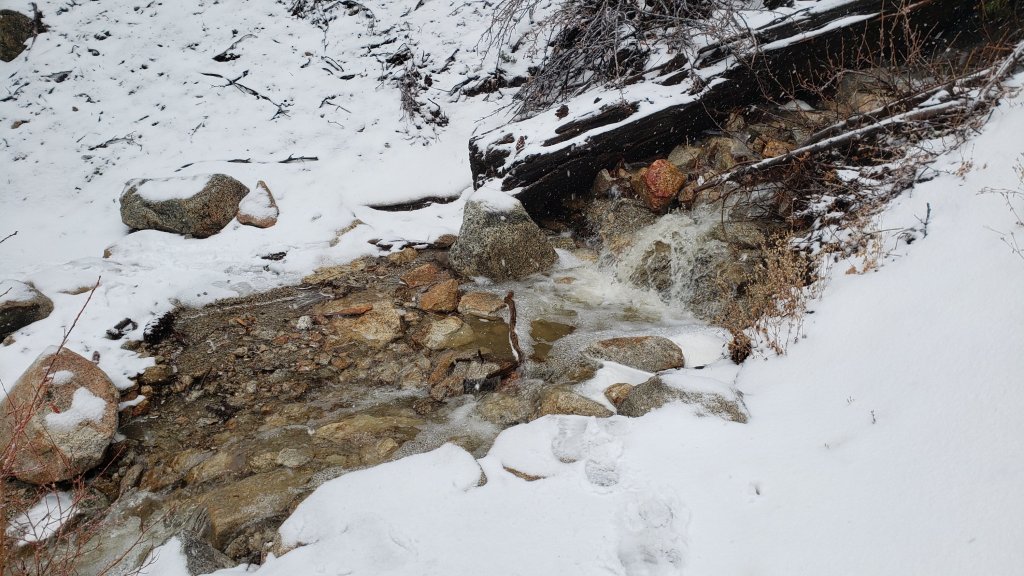
Deer Springs Trail at its junction with the southern end of Fuller Ridge Trail (8970ft elevation), early morning on Tuesday 12th October 2021. About 0.25in of graupel snow fell on 11th, but within a day or so it had completely melted from the trail system, and no traction devices are currently required.
The San Jacinto mountains were treated to a brief but energetic storm system on Monday 11th October that produced a very light dusting of graupel snow in the high country, plus large hail in Idyllwild. My video discussion of the storm from San Jacinto Peak on the morning of the 12th is available here. There was 0.25in depth of snow everywhere above about 8500ft, with drifting (mainly in the trails) to 0.5in above 9700ft. Melting was rapid and widespread during my descent on the Peak Trail and PCT late morning on 12th.
This is – by just one day – the earliest I have recorded measurable snowfall in the San Jacinto high country in autumn, following an even lighter dusting overnight on 12th October 2018.
Unusually for October, this was actually our third storm in a week. Minor storm systems produced rainfall across the San Jacinto mountains on Tuesday 5th and on Friday 8th, with 0.38in and 0.49in of rain recorded at 5500ft elevation in Idyllwild, respectively. Hoping for the first snow of the season I overnighted in the high country on 7th-8th, but only recorded rain with a little brief sleet, totaling an estimated 0.5in at San Jacinto Peak.
Fullfire restrictions remain (for now) in place on Forest Servicelands, as described here. All campfires anywhere in the San Jacinto mountains, including at all USFS campgrounds and yellow post sites, are prohibited. All forms of campfire are always prohibited in the State Park wilderness. Despite the rainfall and cooler temperatures, fire risk remains very high.
Be bear aware. Although rarely reported, several Black Bears remain in the San Jacinto mountains. Earlier reports this summer were from Seven Pines Trail and near Saddle Junction on Willow Creek Trail. I was fortunate to see a very large (>300lb), uniformly dark brown individual at dawn on 7th September near Humber Park. I was able to get a couple of short, poor quality videos, of which one is available here. This was a different individual, based on colour pattern and size, than one I saw on Devil’s Slide Trail in August 2020.
Hikers should be prepared for temperatures near or below freezing in the high country, and potentially well below freezing when considering wind chilleffects (see most recent weather observations from San Jacinto Peak below).
Water conditions in the high country remain poor, although there have been brief improvements in flow immediately after storms. The current status of many key springs and creeks is described in the previous Report available here.
The U.S. Forest Service ranger station in Idyllwild has been closed due to USFS coronavirus protocols since March 2020. Apparently it is unlikely to reopen until 2022. Hiking and camping permits are nevertheless required for USFS lands, and should be available at the kiosk outside the ranger station. The State Park ranger station has been open almost all year.
WEATHER Temperatures well below seasonal at the beginning of this week are forecast to rise to around, or even slightly above, seasonal for October from 16th onwards. There is currently no additional precipitation in the forecasts.
At San Jacinto Peak (10,810ft/3295m) on Tuesday 12th October 2021 at 0855 the air temperature was 16.8°F (-8°C), with a windchill temperature of -3.3°F (-20°C), 45% relative humidity, and a gusty NNE wind sustained at 7 mph gusting to 19.3 mph.
At the Peak on Sunday 10th October 2021 at 0810 the air temperature was 39.4°F (4°C), with a windchill temperature of 31.2°F (0°C), 33% relative humidity, and a light due N wind sustained at 5 mph gusting to 9.9 mph.
Deer Springs Trail at its junction with the southern end of Fuller Ridge Trail (8970ft elevation), early morning 12th October 2021. About 0.25in of graupel fell overnight.
TRAIL CONDITIONS
Water conditions remain a concern despite recent autumnal weather, with many springs and creeks already having dried up or having very low flows, as discussed in last week’s Report. To date, temperatures have not been low enough to freeze springs in the high country.
The rockslide at PCT Mile 172.5, just north of Antsell Rock, was removed on Monday 14th June 2021. My “before, during, and after” video is available here. This section of the PCT is now safer and is narrow but readily passable with care by hikers (but remains impassable by stock).
Many trails have accumulated treefall hazards since late 2019, passable with care by hikers but not for stock. Although reported promptly, regrettably neither Forest Service nor State Park have moved quickly to remove these hazards. With recent storms being accompanied by strong winds, it is likely that hikers may encounter new and additional hazards. Some are described below, others include the PCT between Strawberry Cienega and Strawberry Junction (PCT Miles 182-183, about 7 trees down), and Fuller Ridge Trail near its northern end (PCT Miles 189.1-190.2, three trees).
Spitler Peak Trail was cleared of multiple tree hazards by the Trail Report in early July. Marion Mountain Trail was cleared of multiple tree hazards by a CCC crew in late August, along with the adjacent PCT/Deer Springs Trail for 0.6 mile north to the south end of Fuller Ridge Trail.
Many treefall hazards from Red Tahquitz to Antsell Rock (PCT Miles 172.5-175) were cleared in June prior to the rockslide removal work. Nevertheless about 20 remain, including at least six major obstructions for hikers. Tahquitz Creek to Red Tahquitz (PCT Miles 175-177) was cleared in early June.
Willow Creek Trail has at least 33 downed trees between Skunk Cabbage Junction and Hidden Divide. Of these 22 are on the Forest Service section (16 between Willow Creek and the Park boundary), with 11 in the State Park. Most are readily passable by hikers with care. Despite so much work last year by myself and others, the whitethorn has grown back rapidly, but still remains less challenging than in 2019.
The Caramba Trail from near Reeds Meadow through Laws Camp and on to Caramba, and the Cedar Trail from Willow Creek Trail to Laws (which both nominally reopened in late 2018) are optimistically described by the Forest Service as “not maintained”. In reality parts of these trails no longer exist with significant sections of both so heavily overgrown that I strongly advise hikers do not attempt to follow them. Multiple experienced hikers have reported getting lost in this area since summer 2019. An informaluse trail to the Laws Camparea is much more direct and completely avoids all of the challenging bush-whacking of the unmaintained trails (other hikers kindly nicknamed it the “King Trail”). It leaves Willow Creek Trail exactly 1.0 mile from Saddle Junction, 0.45 mile from the Skunk Cabbage turning (trailhead at N33°46’46”, W116°39’32”, WGS84). The cairned use trail descends largely on established deer tracks for 0.9 mile, reaching Willow Creek just upstream of the former site of Laws Camp. From Laws east to Caramba the route of the old Caramba Trail has become increasingly tricky to follow, especially for the first 1.2 miles east of Laws where there are dozens of trees down. Closer to Caramba the trail is relatively obvious (for those familiar with the route prior to the 2013 Mountain Fire). Very cautious navigation is recommended throughout this area.
Seven Pines Trail has had very limited hiker traffic since November 2018. There are 35 treefall hazards on the trail, four large ones on the short Forest Service section, and the remainder in the State Park, based on my most recent 2021 survey. Cautious navigation is recommended for those who are not familiar with hiking this trail. Dark Canyon Road has been closed since early 2019, and there is currently no vehicular access toSeven Pines trailhead. USFS apparently does not expect Dark Canyon Road to reopen this year.
Sunset as seen from San Jacinto Peak, 7th October 2021, immediately prior to a minor overnight rain storm. Black Mountain and Fuller Ridge are in the foreground.
Thank you for taking the time to read this. While all labor and time is volunteered, the San Jacinto Trail Report completely depends on small private donations to cover operating costs. Every year seems to be challenging and 2021 has been no exception, so every contribution, no matter how small, is truly valuable. If you have found this Report useful, please consider visiting the Donate page. Thank you for your support.
Wellman’s Cienega north spring, with extensive but melting icicles, late morning 12th October 2021.
[UPDATE 8th October 2021: another minor storm system this morning produced 0.49in rain at 5550ft in Idyllwild. Hoping for the first snow of the season I overnighted in the high country, but it fell only as rain with a little brief sleet, totaling an estimated 0.5in at San Jacinto Peak.]
A very pleasant (and much-needed) late season monsoonal storm system produced rainfall across the San Jacinto mountains in two separate events on Tuesday 5th October, with 0.38in (9.7mm) recorded at 5500ft elevation in Idyllwild. Additionally, several days of steady Santa Ana winds either side of the turn of the month has dramatically improved air quality across the San Jacinto mountains and the wider region (see photos below).
Palm Springs Aerial Tramway has been closed since 7th September for annual maintenance and is not due to reopen until Monday 11th October. See their website for details.
Fullfire restrictions remain in place on Forest Servicelands, as described here. All campfires anywhere in the San Jacinto mountains, including at all USFS campgrounds and yellow post sites, are prohibited. All forms of campfire are always prohibited in the State Park wilderness. Despite cooler temperatures, fire risk remains extreme.
Be bear aware. Although rarely reported, several Black Bears remain in the San Jacinto mountains. Earlier reports this summer were from Seven Pines Trail and near Saddle Junction on Willow Creek Trail. I was fortunate to see a very large (>300lb), uniformly dark brown individual at dawn on 7th September near Humber Park. I was able to get a couple of short, poor quality videos, of which one is available here. This was a different individual, based on colour pattern and size, than one I saw on Devil’s Slide Trail in August 2020.
Hikers should be prepared for temperatures around freezing in the high country, and potentially well below freezing when considering wind chilleffects (see recent weather observations from San Jacinto Peak below). In this season, such temperatures could well be accompanied by rain or snow (depending on elevation).
Water conditions in the high country remain poor, although there may be brief improvements in flow immediately after rain. The current status of many key springs and creeks is described below.
The U.S. Forest Service ranger station in Idyllwild has been closed due to USFS coronavirus protocols since March 2020. Apparently it is unlikely to reopen until 2022. Hiking and camping permits are nevertheless required for USFS lands, and should be available at the kiosk outside the ranger station. The State Park ranger station has been open almost all year.
First icicles of the season (on the right) at Wellman’s Cienega north spring, 9300ft elevation, on 1st October 2021.
WEATHER Temperatures are forecast to be below or near seasonal for October. There is the possibility of light precipitation on the morning of Friday 8th October, and again overnight on 11th-12th October. In both cases there is a chance of a light dusting of snow above 10,000ft (a dusting was visible above 11,000ft on Mt. San Gorgonio on 5th October). The latest video discussion from NWS San Diego describes the forthcoming week of weather.
At San Jacinto Peak (10,810ft/3295m) on Monday 4th October 2021 at 0820 the air temperature was 42.8°F (6°C), with a windchill temperature of 36.8°F (3°C), 39% relative humidity, and a light SSW wind sustained at 5 mph gusting to 8.1 mph.
At the Peak on Friday 1st October 2021 at 0905 the air temperature was 38.2°F (3°C), with a windchill temperature of 29.7°F (-2°C), 24% relative humidity, and a moderate NNE wind sustained at 7 mph gusting to 10.7 mph.
At the Peak on Monday 12th July 2021 at 0810 the air temperature was 67.6°F (19.8°C), with a “windchill” temperature of 67.2°F (19.6°C). This the highest air temperature ever reliably recorded at San Jacinto Peak, shattering the previous record temperature of 62.3°F (16.8°C) observed on 19th August 2020.
TRAIL CONDITIONS
Trails throughout the San Jacinto high country cleared of snow by early May. Water conditions are a concern, with many springs and creeks already having dried up or having very low flows, as discussed in detail below.
The rockslide at PCT Mile 172.5, just north of Antsell Rock, was removed on Monday 14th June 2021. My “before, during, and after” video is available here. This section of the PCT is now safer and is narrow but readily passable with care by hikers (but remains impassable by stock).
Many trails have accumulated treefall hazards since late 2019, passable with care by hikers but not for stock. Although reported promptly, regrettably neither Forest Service nor State Park have moved quickly to remove these hazards. Some are described below, others include the PCT between Strawberry Cienega and Strawberry Junction (PCT Miles 182-183, about 7 trees down), and Fuller Ridge Trail near its northern end (PCT Miles 189.1-190.2, three trees).
Spitler Peak Trail was cleared of multiple tree hazards by the Trail Report in early July. Marion Mountain Trail was cleared of multiple tree hazards by a CCC crew in late August, along with the adjacent PCT/Deer Springs Trail for 0.6 mile north to the south end of Fuller Ridge Trail.
Many treefall hazards from Red Tahquitz to Antsell Rock (PCT Miles 172.5-175) were cleared in June prior to the rockslide removal work. Nevertheless about 20 remain, including at least six major obstructions for hikers. Tahquitz Creek to Red Tahquitz (PCT Miles 175-177) was cleared in early June.
Willow Creek Trail has at least 33 downed trees between Skunk Cabbage Junction and Hidden Divide. Of these 22 are on the Forest Service section (16 between Willow Creek and the Park boundary), with 11 in the State Park. Most are readily passable by hikers with care. Despite so much work last year by myself and others, the whitethorn has grown back rapidly, but still remains less challenging than in 2019.
The Caramba Trail from near Reeds Meadow through Laws Camp and on to Caramba, and the Cedar Trail from Willow Creek Trail to Laws (which both nominally reopened in late 2018) are optimistically described by the Forest Service as “not maintained”. In reality parts of these trails no longer exist with significant sections of both so heavily overgrown that I strongly advise hikers do not attempt to follow them. Multiple experienced hikers have reported getting lost in this area since summer 2019. An informaluse trail to the Laws Camparea is much more direct and completely avoids all of the challenging bush-whacking of the unmaintained trails (other hikers kindly nicknamed it the “King Trail”). It leaves Willow Creek Trail exactly 1.0 mile from Saddle Junction, 0.45 mile from the Skunk Cabbage turning (trailhead at N33°46’46”, W116°39’32”, WGS84). The cairned use trail descends largely on established deer tracks for 0.9 mile, reaching Willow Creek just upstream of the former site of Laws Camp. From Laws east to Caramba the route of the old Caramba Trail has become increasingly tricky to follow, especially for the first 1.2 miles east of Laws where there are dozens of trees down. Closer to Caramba the trail is relatively obvious (for those familiar with the route prior to the 2013 Mountain Fire). Very cautious navigation is recommended throughout this area.
Seven Pines Trail has had very limited hiker traffic since November 2018. There are 35 treefall hazards on the trail, four large ones on the short Forest Service section, and the remainder in the State Park, based on my most recent 2021 survey. Cautious navigation is recommended for those who are not familiar with hiking this trail. Dark Canyon Road has been closed since early 2019, and there is currently no vehicular access toSeven Pines trailhead. USFS apparently does not expect Dark Canyon Road to reopen this year.
WATER STATUS: Eastern slope
The Round Valley pipe is now flowing only intermittently and is no longer reliable. There is occasional flow (at about 0.2L/min) but without further precipitation input, this source should no longer be relied upon. Creeks in Round Valley and Tamarack Valley were dry in May (in 2020 neither dried until August).
Hidden Lake dried up completely in June.
Both the northern and southern springs at Wellman’s Cienega are flowing very gently (but adequately to filter). These are the sources for Willow Creek, which is flowing where it crosses the Willow Creek Trail (the flow remains good for filtering, but is the lowest I have ever seen this creek).
Tahquitz Creek is flowing gently at the northern end of Little Tahquitz Meadow. It is also flowing, but very gently, further upstream at its source (known locally as Grethe Spring) where it crosses the PCT at approx. Mile 177.
The small creek in Tahquitz Valley dried in May, some four months earlier than in 2020.
Candy’s Creek – that flows through Skunk Cabbage Meadow and then crosses the remaining visible section of Caramba Trail near Reeds Meadow – dried up in early July.
WATER STATUS: Western slope
The North Fork of the San Jacinto River continues to flow gently where it crosses the Deer Springs Trail but is now functionally dry where it crosses the Fuller Ridge Trail on the PCT (approx. PCT Mile 186.2).
The creek in Little Round Valley completely dried up in early July, reminiscent of the extremely dry years of 2014-16. The same creek dried up where it crosses Fuller Ridge Trail (PCT Mile 186.4) in April.
Shooting Star Spring (not far below Little Round Valley but above the North Fork of the San Jacinto River crossing) is flowing weakly and is a very poor option for filtering.
The Deer Springs stream crossingis dry at the PCT/Deer Springs Trail (approx. PCT mile 185.6). (Despite some online mapping to the contrary, this is NOT the source for the North Fork of the San Jacinto River.)
The tiny but perennial spring about 0.4 miles north of Strawberry Junction (known colloquially as Switchback Spring) continues to flow remarkably well. I rework the tiny pool at least once every week when I pass by and there is just sufficient depth from which to filter water.
The little creek at Strawberry Cienega (PCT mile 183.0) isfunctionally dry.
On Devil’s Slide Trail, Middle Spring is now dry. All other springs on this trail have been dry for months.
On the Ernie Maxwell Trail, the crossing of Chinquapin Creek just below Humber Park is currently flowing where it crosses the trail. Even when the creek is dry across the trail, small but invaluable fresh pools remain just upslope from the trail (this creek is an especially useful source of water for the many dogs walked on this trail).
The faucet at Cinco Poses Spring about 4.5 miles up Black Mountain Road continues to flow.
WATER STATUS: Desert Divide
Live Oak Spring (N 33 37 21, W 116 33 24) Flowing. The most reliable water source on the Desert Divide.
Cedar Spring (N 33 40 36, W 116 34 35) Flowing. Easiest access is the trough about 60 yards upstream from the trail to the campsite.
Apache Spring (N 33 43 11, W 116 37 13) Barely trickling, not now reliable.
Spitler Peak Trail Descending the trail from the PCT there are five water crossings. The first two, at 0.9 and 0.95 miles down, cross a tiny side creek which is largely dry and should be ignored. The next crossing, at 1.1 miles down, is Spitler Creek and is the best source of water (currently flowing very gently, but can be filtered). The next two crossings are the same creek, also flowing adequately for filtering.
Antsell Rock Creek (N 33 41 52, W 116 39 08) Right by the Spitler Peak Trail trailhead on Apple Canyon Road, Antsell Rock Creek is now dry. Even in the very dry years of 2015 and 2016, this source did not dry until the autumn.
Air quality in the high country before (below) and after (above) a Santa Ana wind event. Above, Jean Peak and Marion Mountain as seen from San Jacinto Peak on the morning of 1st October 2021, and below, the same view evening of 27th September.
Thank you for taking the time to read this. While all labor and time is volunteered, the San Jacinto Trail Report completely depends on small private donations to cover operating costs. Every year seems to be challenging and 2021 has been no exception, so every contribution, no matter how small, is truly valuable. If you have found this Report useful, please consider visiting the Donate page. Thank you for your support.
[UPDATE 1st October 2021: three days of steady Santa Ana winds have dramatically improved air quality across the San Jacinto mountains and the wider region. This morning from San Jacinto Peak visibility was the best it has been in a couple of months, with just a narrow band of smoke visible at about 11,000ft elevation far to the west.]
In recent days temperatures have pleasantly dropped to near, or even below, seasonal averages, following about four months of nearly continuous well-above-average heat. This change is being accompanied by strengthening and shifting Santa Ana winds and a drop in humidity. Air quality has been variable but often poor for several weeks with smoke reaching us from fires hundreds of miles to the north. Stronger, shifting winds improved conditions somewhat today, but on 27th the smoke was the thickest I have seen in the San Jacinto high country without a fire burning nearby (see photo below).
The San Bernardino National Forest and the wilderness of Mount San Jacinto State Park reopened on Thursday 23rd September following a widespread closure related to fire conditions. Palm Springs Aerial Tramway has been closed since 7th September for annual maintenance and is not due to reopen until 11th October (note revised later date for reopening). See their website for details.
Fullfire restrictions remain in place on Forest Servicelands, as described here. All campfires anywhere in the San Jacinto mountains, including at all USFS campgrounds and yellow post sites, are prohibited. All forms of campfire are always prohibited in the State Park wilderness. Despite cooler temperatures, fire risk remains extreme.
Be bear aware. Although rarely reported, at least two Black Bears remain in the San Jacinto mountains. Earlier reports this summer were from Seven Pines Trail and near Saddle Junction on Willow Creek Trail. I was fortunate to see a very large (>300lb), uniformly dark brown individual at dawn on 7th September near Humber Park. I was able to get a couple of short, poor quality videos, of which one is available here. This was certainly a different individual, based on colour pattern and size, than one I saw on Devil’s Slide Trail in August 2020.
Hikers should now be prepared for temperatures close to freezing in the high country, and potentially below freezing when considering wind chill effects (see recent weather observations from San Jacinto Peak below).
Water conditions in the high country are poor and continue to deteriorate slowly. The current status of many key springs and creeks is described below.
The U.S. Forest Service ranger station in Idyllwild has been closed due to USFS coronavirus protocols since March 2020. Apparently it is unlikely to reopen until 2022. Hiking and camping permits are nevertheless required for USFS lands, and should be available at the kiosk outside the ranger station. The State Park ranger station has been open almost all year.
Belated “sunrise” as seen from San Jacinto Peak, 28th September 2021, with multiple thick layers of smoke below 12,000ft elevation across the Coachella Valley and San Jacinto high country.
WEATHER Temperatures are generally forecast to be around seasonal and pleasantly autumnal, other than the first few days of October which will be above average for that month. From 2nd October almost every day is forecast to be partly or mostly cloudy, although currently there is no significant precipitation in the forecast. Fire risk remains severe.
The latest video discussion from NWS San Diego describes the forthcoming week of weather in detail.
At San Jacinto Peak (10,810ft/3295m) on Wednesday 29th September 2021 at 0850 the air temperature was 35.8°F (2°C), witha windchill temperature of 21.9°F (-5°C), 62% relative humidity, and a gusty NNE wind sustained at 11 mph gusting to 21.4 mph.
At the Peak on Tuesday 28th September 2021 at 0630 the air temperature was 39.6°F (4°C), with a windchill temperature of 26.3°F (-3°C), 27% relative humidity, and a stiff due West wind sustained at 21 mph gusting to 26.8 mph.
At the Peak on Monday 27th September 2021 at 0955 the air temperature was 49.5°F (10°C), with a windchill temperature of 45.3°F (7°C), 58% relative humidity, and a very light due West wind sustained at 2 mph gusting to 5.3 mph.
At the Peak on Monday 12th July 2021 at 0810 the air temperature was 67.6°F (19.8°C), with a “windchill” temperature of 67.2°F (19.6°C). This the highest air temperature ever reliably recorded at San Jacinto Peak, shattering the previous record temperature of 62.3°F (16.8°C) observed on 19th August 2020.
TRAIL CONDITIONS
Trails throughout the San Jacinto high country cleared of snow by early May. Water conditions are a major concern, with many springs and creeks already having dried up or having very low flows for the time of year, as discussed in detail below.
The rockslide at PCT Mile 172.5, just north of Antsell Rock, was removed on Monday 14th June 2021. My “before, during, and after” video is available here. This section of the PCT is now safer and is narrow but readily passable with care by hikers (but remains impassable by stock).
Many trails have accumulated treefall hazards from the past two winters, passable with care by hikers but not for stock. Although they are reported promptly, regrettably neither Forest Service nor State Park have moved quickly to remove these hazards. Some are described below, others include the PCT between Strawberry Cienega and Strawberry Junction (PCT Miles 182-183, about 7 trees down), and Fuller Ridge Trail near its northern end (PCT Miles 189.1-190.2, three trees).
Spitler Peak Trail was cleared of multiple tree hazards by the Trail Report in early July. Marion Mountain Trail was cleared of multiple tree hazards by a CCC crew in late August, along with the adjacent PCT/Deer Springs Trail for 0.6 mile north to the south end of Fuller Ridge Trail.
Many treefall hazards from Red Tahquitz to Antsell Rock (PCT Miles 172.5-175) were cleared in June. Nevertheless about 20 remain, including at least six major obstructions for hikers. Tahquitz Creek to Red Tahquitz (PCT Miles 175-177) was cleared in early June.
Willow Creek Trail has at least 33 downed trees between Skunk Cabbage Junction and Hidden Divide. Of these 22 are on the Forest Service section (16 between Willow Creek and the Park boundary), with 11 in the State Park. Most are readily passable by hikers with care. Despite so much work last year, the whitethorn has grown back rapidly, especially on the State Park section, but still remains less challenging than in 2019.
The Caramba Trail from near Reeds Meadow through Laws Camp and on to Caramba, and the Cedar Trail from Willow Creek Trail to Laws (which both nominally reopened in late 2018) are optimistically described by the Forest Service as “not maintained”. In reality parts of these trails no longer exist with significant sections of both so heavily overgrown that I strongly advise hikers do not attempt to follow them. Multiple experienced hikers have reported getting lost in this area since summer 2019. An informaluse trail to the Laws Camparea is much more direct and completely avoids all of the challenging bush-whacking of the unmaintained trails (other hikers kindly nicknamed it the “King Trail”). It leaves Willow Creek Trail exactly 1.0 mile from Saddle Junction, 0.45 mile from the Skunk Cabbage turning (trailhead at N33°46’46”, W116°39’32”, WGS84). The cairned use trail descends largely on established deer tracks for 0.9 mile, reaching Willow Creek just upstream of the former site of Laws Camp. From Laws east to Caramba the route of the old Caramba Trail has become increasingly tricky to follow, especially for the first 1.2 miles east of Laws where there are dozens of trees down. Closer to Caramba the trail is relatively obvious (for those familiar with the route prior to the 2013 Mountain Fire). Very cautious navigation is recommended throughout this area.
Seven Pines Trail has had very limited hiker traffic since November 2018. There are 35 treefall hazards on the trail, four large ones on the short Forest Service section, and the remainder in the State Park, based on my most recent 2021 survey. Cautious navigation is recommended for those who are not familiar with hiking this trail. Dark Canyon Road has been closed since early 2019, and there is currently no vehicular access toSeven Pines trailhead. USFS apparently does not expect Dark Canyon Road to reopen this year.
WATER STATUS: Eastern slope
The Round Valley pipe is now flowing only intermittently and is no longer reliable. There is occasional flow (at just 0.2L/min) but without further precipitation input, this source should no longer be relied upon. Creeks in Round Valley and Tamarack Valley were dry in May (in 2020 neither dried until August).
Hidden Lake dried up completely in June.
Both the northern and southern springs at Wellman’s Cienega are flowing very gently (but adequately to filter). These are the sources for Willow Creek, which is flowing where it crosses the Willow Creek Trail (the flow remains good for filtering, but is the lowest I have ever seen this creek).
Tahquitz Creek is flowing gently at the northern end of Little Tahquitz Meadow. It is also flowing, but very gently, further upstream at its source (known locally as Grethe Spring) where it crosses the PCT at approx. Mile 177.
The small creek in Tahquitz Valley dried in May, some four months earlier than in 2020.
Candy’s Creek – that flows through Skunk Cabbage Meadow and then crosses the remaining visible section of Caramba Trail near Reeds Meadow – dried up in early July.
WATER STATUS: Western slope
The North Fork of the San Jacinto River continues to flow gently where it crosses the Deer Springs Trail but is now functionally dry where it crosses the Fuller Ridge Trail on the PCT (approx. PCT Mile 186.2).
The creek in Little Round Valley completely dried up in early July, reminiscent of the extremely dry years of 2014-16. The same creek dried up where it crosses Fuller Ridge Trail (PCT Mile 186.4) in April.
Shooting Star Spring (not far below Little Round Valley but above the North Fork of the San Jacinto River crossing) is flowing weakly and is a very poor option for filtering.
The Deer Springs stream crossingis dry at the PCT/Deer Springs Trail (approx. PCT mile 185.6). (Despite some online mapping to the contrary, this is NOT the source for the North Fork of the San Jacinto River.)
The tiny but perennial spring about 0.4 miles north of Strawberry Junction (known colloquially as Switchback Spring) continues to flow remarkably well. I rework the tiny pool at least once every week when I pass by and there is just sufficient depth from which to filter water.
The little creek at Strawberry Cienega (PCT mile 183.0) isfunctionally dry.
On Devil’s Slide Trail, Middle Spring is now dry. All other springs on this trail have been dry for months.
On the Ernie Maxwell Trail, the crossing of Chinquapin Creek just below Humber Park is currently flowing where it crosses the trail. Even when the creek is dry across the trail, small but invaluable fresh pools remain just upslope from the trail (this creek is an especially useful source of water for the many dogs walked on this trail).
The faucet at Cinco Poses Spring about 4.5 miles up Black Mountain Road continues to flow.
WATER STATUS: Desert Divide
Live Oak Spring (N 33 37 21, W 116 33 24) Flowing. The most reliable water source on the Desert Divide.
Cedar Spring (N 33 40 36, W 116 34 35) Flowing. Easiest access is the trough about 60 yards upstream from the trail to the campsite.
Apache Spring (N 33 43 11, W 116 37 13) Barely trickling, not now reliable.
Spitler Peak Trail Descending the trail from the PCT there are five water crossings. The first two, at 0.9 and 0.95 miles down, cross a tiny side creek which is largely dry and should be ignored. The next crossing, at 1.1 miles down, is Spitler Creek and is the best source of water (currently flowing very gently, but can be filtered). The next two crossings are the same creek, also flowing adequately for filtering.
Antsell Rock Creek (N 33 41 52, W 116 39 08) Right by the Spitler Peak Trail trailhead on Apple Canyon Road, Antsell Rock Creek is now dry. Even in the very dry years of 2015 and 2016, this source did not dry until the autumn.
Thank you hikers for taking the time to read this. While all labor and time is volunteered, the San Jacinto Trail Report completely depends on small private donations to cover operating costs. Every year seems to be challenging and 2021 has been no exception, so every contribution, no matter how small, is truly valuable. If you have found this Report useful, please consider visiting the Donate page. Thank you for your support.
Very fresh Mountain Lion scat at Annie’s Junction, 9070ft elevation, 28th September 2021. The knife is 3.6in long for scale. The scat consisted entirely of deer hair, typical for lion in the San Jacinto mountains.
The San Jacinto Ranger District of the San Bernardino National Forest reopened onThursday 23rd September. Details of the Forest Service reopening are available here. The wilderness of Mount San Jacinto State Park also reopened on the same schedule.
Palm Springs Aerial Tramway has been closed since 7th September for annual maintenance and is not due to reopen until 11th October (note revised later date for reopening). See their website for details.
The Forest and Park closures, in place for 22 days, were indicative of the considerable fire risk and especially the associated resource challenges. Although conditions have apparently ameliorated somewhat, please note that fire risk remains extreme.
Fullfire restrictions remain in place on Forest Servicelands, as described here. All campfires anywhere in the San Jacinto mountains, including at all USFS campgrounds and yellow post sites, are prohibited. All forms of campfire are always prohibited in the State Park wilderness.
Hikers should be prepared for rapidly changing weather conditionsin the high country in late summer and early winter. Thunderstorms with lightning, precipitation, and rapid temperature drops are possible in the high country, usually in the afternoons, even when such storms are not forecast for lower elevations.
Water conditions in the high country are poor and continue to deteriorate slowly. The current status of many key springs and creeks is described below.
The U.S. Forest Service ranger station in Idyllwild remains closed due to USFS coronavirus protocols. Apparently it is unlikely to reopen before October, possibly not until 2022. Hiking and camping permits are nevertheless required for USFS lands, and should be available at the kiosk outside the ranger station. The State Park ranger station reopened about seven months ago.
WEATHER Following several days of temperatures well above seasonal, conditions will cool this weekend to near or even below average into the first couple of days of October, before rising above seasonal yet again. Although several days in the next week or so will be partly or mostly cloudy, and locally an intense thunderstorm is most likely on Friday 24th, otherwise there is no significant precipitation in the forecast. Fire risk remains severe.
At San Jacinto Peak (10,810ft/3295m) on Wednesday 22nd September 2021 at 0905 the air temperature was 55.3°F (13°C), with a windchill temperature of 51.4°F (11°C), 39% relative humidity, and a very light SE wind sustained at 1 mph gusting to 3.7 mph.
At the Peak on Monday 20th September 2021 at 0930 the air temperature was 57.6°F (14°C), with a windchill temperature of 54.1°F (12°C), 25% relative humidity, and a very light SSE breeze sustained at 1 mph gusting to 6.1 mph.
At the Peak on Monday 12th July 2021 at 0810 the air temperature was 67.6°F (19.8°C), with a “windchill” temperature of 67.2°F (19.6°C). This the highest air temperature ever reliably recorded at San Jacinto Peak, shattering the previous record temperature of 62.3°F (16.8°C) observed on 19th August 2020.
TRAIL CONDITIONS
Trails throughout the San Jacinto high country cleared of snow by early May. Water conditions are a major concern, with many springs and creeks already having dried up or having very low flows for the time of year, as discussed in detail below.
The rockslide at PCT Mile 172.5, just north of Antsell Rock, was removed on Monday 14th June 2021. My “before, during, and after” video is available here. This section of the PCT is now safer and is narrow but readily passable with care by hikers (but remains impassable by stock).
Many trails have accumulated treefall hazards from the past two winters, passable with care by hikers but not for stock. Although they are reported promptly, regrettably neither Forest Service nor State Park have moved quickly to remove these hazards. Some are described below, others include the PCT between Strawberry Cienega and Strawberry Junction (PCT Miles 182-183, about 7 trees down), and Fuller Ridge Trail near its northern end (PCT Miles 189.1-190.2, three trees).
Spitler Peak Trail was cleared of multiple tree hazards by the Trail Report in early July. Marion Mountain Trail was cleared of multiple tree hazards by a CCC crew in late August, along with the adjacent PCT/Deer Springs Trail for 0.6 mile north to the south end of Fuller Ridge Trail.
Many treefall hazards from Red Tahquitz to Antsell Rock (PCT Miles 172.5-175) were cleared in June. Nevertheless about 20 remain, including at least six major obstructions for hikers. Tahquitz Creek to Red Tahquitz (PCT Miles 175-177) was cleared in early June.
Willow Creek Trail has at least 33 downed trees between Skunk Cabbage Junction and Hidden Divide. Of these 22 are on the Forest Service section (16 between Willow Creek and the Park boundary), with 11 in the State Park. Most are readily passable by hikers with care. Despite so much work last year, the whitethorn has grown back rapidly, especially on the State Park section, but still remains less challenging than in 2019.
The Caramba Trail from near Reeds Meadow through Laws Camp and on to Caramba, and the Cedar Trail from Willow Creek Trail to Laws (which both nominally reopened in late 2018) are optimistically described by the Forest Service as “not maintained”. In reality parts of these trails no longer exist with significant sections of both so heavily overgrown that I strongly advise hikers do not attempt to follow them. Multiple experienced hikers have reported getting lost in this area since summer 2019. An informaluse trail to the Laws Camparea is much more direct and completely avoids all of the challenging bush-whacking of the unmaintained trails (other hikers kindly nicknamed it the “King Trail”). It leaves Willow Creek Trail exactly 1.0 mile from Saddle Junction, 0.45 mile from the Skunk Cabbage turning (trailhead at N33°46’46”, W116°39’32”, WGS84). The cairned use trail descends largely on established deer tracks for 0.9 mile, reaching Willow Creek just upstream of the former site of Laws Camp. From Laws east to Caramba the route of the old Caramba Trail has become increasingly tricky to follow, especially for the first 1.2 miles east of Laws where there are dozens of trees down. Closer to Caramba the trail is relatively obvious (for those familiar with the route prior to the 2013 Mountain Fire). Very cautious navigation is recommended throughout this area.
Seven Pines Trail has had very limited hiker traffic since November 2018. There are 35 treefall hazards on the trail, four large ones on the short Forest Service section, and the remainder in the State Park, based on my most recent 2021 survey. Cautious navigation is recommended for those who are not familiar with hiking this trail. Dark Canyon Road has been closed since early 2019, and there is currently no vehicular access toSeven Pines trailhead. USFS apparently does not expect Dark Canyon Road to reopen this year.
WATER STATUS: Eastern slope
The Round Valley pipe is now flowing only intermittently and is no longer reliable. There is occasional flow (at just 0.2L/min) but without further precipitation input, this source should no longer be relied upon. Creeks in Round Valley and Tamarack Valley were dry in May (in 2020 neither dried until August).
Hidden Lake dried up completely in June.
Both the northern and southern springs at Wellman’s Cienega are flowing very gently (but adequately to filter). These are the sources for Willow Creek, which is flowing where it crosses the Willow Creek Trail (the flow remains good for filtering, but is the lowest I have ever seen this creek).
Tahquitz Creek is flowing gently at the northern end of Little Tahquitz Meadow. It is also flowing, but very gently, further upstream at its source (known locally as Grethe Spring) where it crosses the PCT at approx. Mile 177.
The small creek in Tahquitz Valley dried in May, some four months earlier than in 2020.
Candy’s Creek – that flows through Skunk Cabbage Meadow and then crosses the remaining visible section of Caramba Trail near Reeds Meadow – dried up in early July.
WATER STATUS: Western slope
The North Fork of the San Jacinto River continues to flow gently where it crosses the Deer Springs Trail but is now functionally dry where it crosses the Fuller Ridge Trail on the PCT (approx. PCT Mile 186.2).
The creek in Little Round Valley completely dried up in early July, reminiscent of the extremely dry years of 2014-16. The same creek dried up where it crosses Fuller Ridge Trail (PCT Mile 186.4) in April.
Shooting Star Spring (not far below Little Round Valley but above the North Fork of the San Jacinto River crossing) is flowing weakly and is a very poor option for filtering.
The Deer Springs stream crossingis dry at the PCT/Deer Springs Trail (approx. PCT mile 185.6). (Despite some online mapping to the contrary, this is NOT the source for the North Fork of the San Jacinto River.)
The tiny but perennial spring about 0.4 miles north of Strawberry Junction (known colloquially as Switchback Spring) continues to flow remarkably well. I rework the tiny pool at least once every week when I pass by and there is just sufficient depth from which to filter water.
The little creek at Strawberry Cienega (PCT mile 183.0) isfunctionally dry.
On Devil’s Slide Trail, Middle Spring is now dry. All other springs on this trail have been dry for months.
On the Ernie Maxwell Trail, the crossing of Chinquapin Creek just below Humber Park is currently flowing where it crosses the trail. Even when the creek is dry across the trail, small but invaluable fresh pools remain just upslope from the trail (this creek is an especially useful source of water for the many dogs walked on this trail).
The faucet at Cinco Poses Spring about 4.5 miles up Black Mountain Road continues to flow.
WATER STATUS: Desert Divide
Live Oak Spring (N 33 37 21, W 116 33 24) Flowing. The most reliable water source on the Desert Divide.
Cedar Spring (N 33 40 36, W 116 34 35) Flowing. Easiest access is the trough about 60 yards upstream from the trail to the campsite.
Apache Spring (N 33 43 11, W 116 37 13) Barely trickling, not now reliable.
Spitler Peak Trail Descending the trail from the PCT there are five water crossings. The first two, at 0.9 and 0.95 miles down, cross a tiny side creek which is largely dry and should be ignored. The next crossing, at 1.1 miles down, is Spitler Creek and is the best source of water (currently flowing very gently, but can be filtered). The next two crossings are the same creek, also flowing adequately for filtering.
Antsell Rock Creek (N 33 41 52, W 116 39 08) Right by the Spitler Peak Trail trailhead on Apple Canyon Road, Antsell Rock Creek is now dry. Even in the very dry years of 2015 and 2016, this source did not dry until the autumn.
[UPDATE 14th September 2021: the closure of San Bernardino National Forest was extended today until midnight on 22nd September, as reflected in the text below, and described in this USFS press release.]
The entire San Jacinto Ranger District of the San Bernardino National Forest closed effective at midnight, Tuesday 31st August 2021. In addition to the forest and trails, this closure includes all campgrounds, picnic sites, trailheads, and forest roads. This step is being taken due to exceptional fire risk and limited available firefighting resources statewide.
The closure includes all parking areas (e.g., Humber Park, Lake Fulmor), and all gated roads are locked (e.g., South Ridge Road, Black Mountain Road, May Valley Road, Azalea Road, Bee Canyon Road, etc.). I know this closure will be frustrating and will present challenges for locals and visitors alike. Regrettably it seems likely, with the direction the climate is heading, that this will be an increasingly common phenomenon in 21st Century California.
Other parts of the San Bernardino NF and other national forests in Southern California are included in this closure (see original USFS press release here, and closure extension here). The initial closure order for two-and-a-half weeks until Friday 17th September has now been extended to Wednesday 22nd September. Bear in mind that last year a similar closure was extended three additional times for a total of 31 days (and camping was then prohibited for about two months after that).
The wilderness of Mount San Jacinto State Park is also closing on the same schedule (see their website here). The State Park campgrounds at Idyllwild and Stone Creek remain open at this time, as do the minor trails in the immediate vicinity of the Palm Springs Aerial Tramway. Hikers will not be allowed beyond Long Valley Ranger Station.
As almost all public trails into the State Park pass through Forest Service land anyway, the USFS closure makes the Park functionally accessible only via the Tram.
The Palm Springs Aerial Tramway is closed for annual maintenance between 7th September and 3rd October 2021 (as described on their website here).
Despite some encouraging thunderous rumblings in recent days, and some localized rain in Garner Valley and elsewhere, sadly forecast monsoon conditions did not result in significant widespread precipitation in the San Jacinto mountains. Further chances for rain are currently forecast for some days in early to mid September.
Minor fires in the Black Mountain area on the afternoon of Monday 30th August originated from dry lightning strikes. They were extinguished promptly while thankfully very small, largely by water-dropping helicopter filling up from Lake Fulmor, in addition to ground crews.
Please stay safe everyone. I will post any new information as soon as it comes available.
Very clear signage at the base of South Ridge Road, 2nd September 2021. Based on my surveys, many forest roads and trailheads have much less obvious signage.
Conditions have thankfully improved now, but the most striking event in the mountains in recent days has been the rapid deterioration in air quality due to smoke from fires in the north of the state. Smoke arrived in the high country on the morning of Monday 23rd August, largely above 7000ft, before steadily descending across the San Jacinto mountains during the course of that afternoon. By the morning of Tuesday 24th the smoke had thickened and sunk into the lower elevations largely below about 8800ft (see photos below), persisting until 25th. This event is especially remarkable given that the nearest major fires are hundreds of miles to the north, and in theory prevailing winds are largely moving the smoke away from us to the north and east. Give some thought to those in the Tahoe basin, where Air Quality Index readings over 800 were reported this week, more than quadruple the “very unhealthy” threshold.
A delightfully cool week has just come to an end, in which temperatures were at times below seasonal for the first time since mid June! On the morning of Thursday 19th August we recorded an overnight low temperature of 42°F (5°C) at 5550ft in Idyllwild. In a “normal” summer that temperature would probably not deserve a mention, but it has been far from a normal summer.
There is a chance of a return to monsoon conditions starting Sunday 29th August, potentially lasting into the first week of September. While grateful for the modest rain and higher humidity that we have received so far this season, given that the monsoon rainfall in Arizona has been among the heaviest ever recorded, we are probably unfortunate not to have had more precipitation so far this summer.
The most significant trail news from the past week is the great work by a small California Conservation Corps (CCC) crew working on some western slope trails in the State Park. Last week they cleared the 7-8 downed trees on Marion Mountain Trail, plus the similar number of tree hazards (including some major obstructions) on Deer Springs Trail between Strawberry Junction and Fuller Ridge Trail (PCT Miles 183-185.5). When I passed them on Saturday 21st, the CCC were working on improving the trail tread just below Strawberry Junction. It was great to be able to thank them in person for their hard work.
Daily wilderness hikes continue to include San Jacinto Peak multiple times per week by a variety of routes, plus various other trails, facilitating regular checks of water sources and trail hazards. On Tuesday 24th, USFS volunteer Bill Rhoads and I finally finished trail trimming on the PCT north of Saddle Junction (approx. Miles 180-181).
Hikers should be prepared for rapidly changing weather conditionsin the high country in summer. Thunderstorms with lightning, precipitation, and rapid temperature drops can occur in the high country even when such storms are not forecast for lower elevations, usually most likely in the afternoons.
Fullfire restrictions are in place on Forest Servicelands, as described here. All campfires anywhere in the San Jacinto mountains, including at all USFS campgrounds and yellow post sites, are now prohibited. The total fire ban has finally been extended to Riverside County lands starting 23rd August, including for example the Hurkey Creek campground (thanks to Dan Roberts for updates on the county situation).
Water conditions in the high country are poor and continue to deteriorate. The current status of many key springs and creeks is described below.
The U.S. Forest Service ranger station in Idyllwild remains closed due to USFS coronavirus protocols. Apparently it is unlikely to reopen before October, possibly much later. Hiking and camping permits are nevertheless required for USFS lands, and should be available at the kiosk outside the ranger station. The State Park ranger station reopened about six months ago.
The density of smoke at elevations below 9000ft was remarkable on the morning of 24th August 2021. Above, Tahquitz Peak just after sunrise as seen looking south from the PCT. Below, not the Great Smoky Mountains, but some very smoky mountains, looking south-east from near San Jacinto Peak down the Desert Divide and on to the Santa Rosa mountains.
WEATHER A few days of temperatures around (or even below!) seasonal for the first time in two months came to an end early this week. Daytime high temperatures will again be above average for August starting Wednesday 25th, with overnight low temperatures in particular being well above seasonal, before cooling again to around average for September in the first week of that month. As mentioned above, monsoonal rains are a possibility from 29th August to at least 3rd September. Fire risk remains severe.
At San Jacinto Peak (10,810ft/3295m) on Tuesday 24th August 2021 at 0805 the air temperature was 50.1°F (9°C), with a windchill temperature of 41.8°F (5°C), 31% relative humidity, and a very gusty SW wind sustained at 6 mph gusting to 16.8 mph.
At the Peak on Saturday 21st August 2021 at 0815 the air temperature was 50.9°F (10°C), with a windchill temperature of 46.2°F (8°C), 16% relative humidity, and a brisk due South breeze sustained at 5 mph gusting to 8.4 mph.
At the Peak on Thursday 19th August 2021 at 0830 the air temperature was 48.9°F (9°C), with a windchill temperature of 41.7°F (5°C), 15% relative humidity, and a light WSW wind sustained at 6 mph gusting to 10.1 mph.
At the Peak on Monday 12th July 2021 at 0810 the air temperature was 67.6°F (19.8°C), with a “windchill” temperature of 67.2°F (19.6°C), 38% relative humidity, and a very light NNE breeze sustained at 2 mph gusting to 7.2 mph. This the highest air temperature ever reliably recorded at San Jacinto Peak, shattering the previous record temperature of 62.3°F (16.8°C) observed on 19th August 2020.
On 23rd August, smoke appeared in the morning at higher elevations, largely above 8000ft, as seen here from near May Valley Road. The San Jacinto high country is partially obscured to the left, with Tahquitz Rock to the right.
TRAIL CONDITIONS
Trails throughout the San Jacinto high country cleared of snow by early May. Water conditions are a major concern, with many springs and creeks already having dried up or having very low flows for the time of year, as discussed in detail below.
The rockslide at PCT Mile 172.5, just north of Antsell Rock, was removed on Monday 14th June. My “before, during, and after” video is available here. This section of the PCT is now safer and is narrow but readily passable with care by hikers (but remains impassable by stock).
Many trails have accumulated treefall hazards from the past two winters, passable with care by hikers but not for stock. Although they are reported promptly, regrettably neither Forest Service nor State Park have moved quickly to remove these hazards. Some are described below, others include the PCT between Strawberry Cienega and Strawberry Junction (PCT Miles 182-183, about 7 trees down), and Fuller Ridge Trail near its northern end (PCT Miles 189.1-190.2, three trees).
Spitler Peak Trail was cleared of multiple tree hazards by the Trail Report in early July. Marion Mountain Trail was cleared of multiple tree hazards by a CCC crew in late August, along with the adjacent PCT/Deer Springs Trail for 0.6 mile north to the south end of Fuller Ridge Trail.
Many treefall hazards from Red Tahquitz to Antsell Rock (PCT Miles 172.5-175) were cleared in June. Nevertheless about 20 remain, including at least six major obstructions for hikers. Tahquitz Creek to Red Tahquitz (PCT Miles 175-177) was cleared in early June.
Willow Creek Trail has at least 33 downed trees between Skunk Cabbage Junction and Hidden Divide. Of these 22 are on the Forest Service section (16 between Willow Creek and the Park boundary), with 11 in the State Park. Most are readily passable by hikers with care. Despite so much work last year, the whitethorn has grown back rapidly, especially on the State Park section, but still remains less challenging than in 2019.
The Caramba Trail from near Reeds Meadow through Laws Camp and on to Caramba, and the Cedar Trail from Willow Creek Trail to Laws (which both nominally reopened in late 2018) are optimistically described by the Forest Service as “not maintained”. In reality parts of these trails no longer exist with significant sections of both so heavily overgrown that I strongly advise hikers do not attempt to follow them. Multiple experienced hikers have reported getting lost in this area since summer 2019. An informaluse trail to the Laws Camparea is much more direct and completely avoids all of the challenging bush-whacking of the unmaintained trails (other hikers kindly nicknamed it the “King Trail”). It leaves Willow Creek Trail exactly 1.0 mile from Saddle Junction, 0.45 mile from the Skunk Cabbage turning (trailhead at N33°46’46”, W116°39’32”, WGS84). The cairned use trail descends largely on established deer tracks for 0.9 mile, reaching Willow Creek just upstream of the former site of Laws Camp. From Laws east to Caramba the route of the old Caramba Trail has become increasingly tricky to follow, especially for the first 1.2 miles east of Laws where there are dozens of trees down. Closer to Caramba the trail is relatively obvious (for those familiar with the route prior to the 2013 Mountain Fire). Very cautious navigation is recommended throughout this area.
Seven Pines Trail has had very limited hiker traffic since November 2018. There are 35 treefall hazards on the trail, four large ones on the short Forest Service section, and the remainder in the State Park, based on my most recent 2021 survey. Cautious navigation is recommended for those who are not familiar with hiking this trail. Dark Canyon Road has been closed since early 2019, and there is currently no vehicular access toSeven Pines trailhead. USFS apparently does not expect Dark Canyon Road to reopen this year.
The biggest of several major tree hazards expertly removed by a CCC crew from Deer Springs Trail in the past week. This one fell in winter 2019/20 on the PCT right at the Deer Springs crossing.
WATER STATUS: Eastern slope
The Round Valley pipe continues to flow weakly (at about 0.4L/min) as of last week. This source may not be reliable beyond August. Creeks in Round Valley and Tamarack Valley were dry in May (in 2020 neither dried until August).
Hidden Lake dried up completely in June.
Both the northern and southern springs at Wellman’s Cienega are flowing very gently (but adequately to filter). These are the sources for Willow Creek, which is flowing where it crosses the Willow Creek Trail (the flow remains good for filtering, but is the lowest I have ever seen this creek).
Tahquitz Creek is flowing gently at the northern end of Little Tahquitz Meadow. It is also flowing, but very gently, further upstream at its source (known locally as Grethe Spring) where it crosses the PCT at approx. Mile 177.
The small creek in Tahquitz Valley dried in May, some four months earlier than in 2020.
Candy’s Creek – that flows through Skunk Cabbage Meadow and then crosses the remaining visible section of Caramba Trail near Reeds Meadow – dried up in early July.
WATER STATUS: Western slope
The North Fork of the San Jacinto River continues to flow gently where it crosses the Deer Springs Trail and also downstream – but even more weakly – where it crosses the Fuller Ridge Trail on the PCT (approx. PCT Mile 186.2).
North Fork of the San Jacinto River where it crosses Deer Springs Trail, 21st August 2021.
The creek in Little Round Valley completely dried up in early July, reminiscent of the extremely dry years of 2014-16. The same creek dried up where it crosses Fuller Ridge Trail (PCT Mile 186.4) in April.
Shooting Star Spring (not far below Little Round Valley but above the North Fork of the San Jacinto River crossing) is flowing weakly and is a very poor option for filtering.
The Deer Springs stream crossingis dry at the PCT/Deer Springs Trail (approx. PCT mile 185.6). (Despite some online mapping to the contrary, this is NOT the source for the North Fork of the San Jacinto River.)
The tiny but perennial spring about 0.4 miles north of Strawberry Junction (known colloquially as Switchback Spring) continues to flow remarkably well. I rework the tiny pool at least once every week when I pass by and there is just sufficient depth from which to filter water.
Tiny but reliable, Switchback Spring continues to flow well just north of Strawberry Junction, 21st August 2021.
The little creek at Strawberry Cienega (PCT mile 183.0) isfunctionally dry.
On Devil’s Slide Trail, Middle Spring is now dry. All other springs on this trail have been dry for months.
On the Ernie Maxwell Trail, the crossing of Chinquapin Creek just below Humber Park is currently flowing where it crosses the trail. Even when the creek is dry across the trail, small but invaluable fresh pools remain just upslope from the trail (this creek is an especially useful source of water for the many dogs walked on this trail).
The faucet at Cinco Poses Spring about 4.5 miles up Black Mountain Road continues to flow.
WATER STATUS: Desert Divide
Live Oak Spring (N 33 37 21, W 116 33 24) Flowing. The most reliable water source on the Desert Divide.
Cedar Spring (N 33 40 36, W 116 34 35) Flowing. Easiest access is the trough about 60 yards upstream from the trail to the campsite.
Apache Spring (N 33 43 11, W 116 37 13) Barely trickling, not now reliable.
Spitler Peak Trail Descending the trail from the PCT there are five water crossings. The first two, at 0.9 and 0.95 miles down, cross a tiny side creek which is largely dry and should be ignored. The next crossing, at 1.1 miles down, is Spitler Creek and is the best source of water (currently flowing very gently, but can be filtered). The next two crossings are the same creek, also flowing adequately for filtering.
Antsell Rock Creek (N 33 41 52, W 116 39 08) Right by the Spitler Peak Trail trailhead on Apple Canyon Road, Antsell Rock Creek is now dry. Even in the very dry years of 2015 and 2016, this source did not dry until the autumn.
Regrettably monsoonal weather conditions in the past week did not produce significant precipitation in the San Jacinto mountains, and the monsoon pattern appears to have shifted away from us for the remainder of August. On the plus side, a major cooling trend for the next few days will take daytime high temperatures below seasonal averages for the first time this summer (discussed in Weather below). Daily wilderness hikes continue to include San Jacinto Peak multiple times per week, and Tahquitz Peak weekly, both by a variety of routes, plus various other trails, facilitating regular checks of water sources and trail conditions.
Hikers should be prepared for rapidly changing weather conditionsin the high country in summer. Thunderstorms with lightning, precipitation, and rapid temperature drops can occur in the high country even when such storms are not forecast for lower elevations, usually most likely in the afternoons.
Fullfire restrictions are in place on Forest Servicelands, as described here. All campfires anywhere in the San Jacinto mountains, including at all USFS campgrounds and yellow post sites, are now prohibited.
Water conditions in the high country are poor and continue to deteriorate. The current status of many key springs and creeks is described below.
The U.S. Forest Service ranger station in Idyllwild remains closed due to USFS coronavirus protocols. Apparently it is unlikely to reopen before October. Hiking and camping permits are nevertheless required for USFS lands, and should be available at the kiosk outside the ranger station. The State Park ranger station reopened many months ago.
WEATHER Daytime high temperatures are falling rapidly to several degrees below seasonal for 18th-21st August. It should feel delightfully cool compared to the past two months! While overnight low temperatures will also fall dramatically compared to recent weeks, they will still largely be at or even slightly above seasonal norms. From Monday 23rd onwards, day and night temperatures will climb again to above average, with another heatwave currently forecast for the last week of August. Fire risk remains severe.
At San Jacinto Peak (10,810ft/3295m) on Thursday 19th August 2021 at 0830 the air temperature was 48.9°F (9°C), with a windchill temperature of 41.7°F (5°C), 15% relative humidity, and a light WSW wind sustained at 6 mph gusting to 10.1 mph.
At the Peak on Monday 16th August 2021 at 0805 the air temperature was 60.2°F (16°C), with a windchill temperature of 56.8°F (14°C), 57% relative humidity, and a pleasant NNW breeze sustained at 3 mph gusting to 8.5 mph.
At the Peak on Monday 12th July 2021 at 0810 the air temperature was 67.6°F (19.8°C), with a “windchill” temperature of 67.2°F (19.6°C), 38% relative humidity, and a very light NNE breeze sustained at 2 mph gusting to 7.2 mph. This the highest air temperature ever reliably recorded at San Jacinto Peak, shattering the previous record temperature of 62.3°F (16.8°C) observed on 19th August 2020.
TRAIL CONDITIONS
Trails throughout the San Jacinto high country cleared of snow by early May. Water conditions are a major concern, with many springs and creeks already having dried up or having very low flows for the time of year, as discussed in detail below.
The rockslide at PCT Mile 172.5, just north of Antsell Rock, was removed on Monday 14th June. My “before, during, and after” video is available here. This section of the PCT is now safer and is readily passable with care by hikers (but still not by stock).
Many trails have accumulated treefall hazards from the past two winters, passable with care by hikers but not for stock. Although they are reported promptly, regrettably neither Forest Service nor State Park have moved quickly to remove these hazards. Some are described below, others include the PCT between Strawberry Cienega and Deer Springs camp (PCT Miles 182-185, about 12 trees down), and Fuller Ridge Trail near its northern end (PCT Miles 189.1-190.2, three trees).
Spitler Peak Trail was cleared of multiple tree hazards by the Trail Report in early July.
Many treefall hazards from Red Tahquitz to Antsell Rock (PCT Miles 172.5-175) were cleared in June. Nevertheless about 20 remain, including at least six major obstructions for hikers. Tahquitz Creek to Red Tahquitz (PCT Miles 175-177) was cleared in early June.
Willow Creek Trail has at least 33 downed trees between Skunk Cabbage Junction and Hidden Divide. Of these 22 are on the Forest Service section (16 between Willow Creek and the Park boundary), with 11 in the State Park. Most are readily passable by hikers with care. Despite so much work last year, the whitethorn has grown back rapidly, especially on the State Park section, but still remains less challenging than in 2019.
The Caramba Trail from near Reeds Meadow through Laws Camp and on to Caramba, and the Cedar Trail from Willow Creek Trail to Laws (which both nominally reopened in late 2018) are optimistically described by the Forest Service as “not maintained”. In reality parts of these trails no longer exist with significant sections of both so heavily overgrown that I strongly advise hikers do not attempt to follow them. Multiple experienced hikers have reported getting lost in this area since summer 2019. An informaluse trail to the Laws Camparea is much more direct and completely avoids all of the challenging bush-whacking of the unmaintained trails (other hikers kindly nicknamed it the “King Trail”). It leaves Willow Creek Trail exactly 1.0 mile from Saddle Junction, 0.45 mile from the Skunk Cabbage turning (trailhead at N33°46’46”, W116°39’32”, WGS84). The cairned use trail descends largely on established deer tracks for 0.9 mile, reaching Willow Creek just upstream of the former site of Laws Camp. From Laws east to Caramba the route of the old Caramba Trail has become increasingly tricky to follow, especially for the first 1.2 miles east of Laws where there are dozens of trees down. Closer to Caramba the trail is relatively obvious (for those familiar with the route prior to the 2013 Mountain Fire). Very cautious navigation is recommended throughout this area.
Seven Pines Trail has had limited hiker traffic since November 2018. There are 35 treefall hazards on the trail, four large ones on the short Forest Service section, and the remainder in the State Park, based on my most recent 2021 survey. Cautious navigation is recommended for those who are not familiar with hiking this trail. Dark Canyon Road has been closed since early 2019, and there is currently no vehicular access toSeven Pines trailhead. USFS apparently does not expect Dark Canyon Road to reopen this year.
WATER STATUS: Eastern slope
The Round Valley pipe continues to flow weakly (at about 0.4L/min) as of last week. This source may not be reliable beyond August. Creeks in Round Valley and Tamarack Valley were dry in May (in 2020 neither dried until August).
Hidden Lake dried up completely in June.
Both the northern and southern springs at Wellman’s Cienega are flowing very gently (but adequately to filter). These are the sources for Willow Creek, which is flowing where it crosses the Willow Creek Trail (on 4th August the flow was good for filtering, but was the lowest I have ever seen this creek).
Tahquitz Creek is flowing gently at the northern end of Little Tahquitz Meadow. It is also flowing, but very gently, further upstream at its source (known locally as Grethe Spring) where it crosses the PCT at approx. Mile 177.
Tahquitz Creek flowing gently at the north end of Little Tahquitz Meadow, 10th August 2021.
The small creek in Tahquitz Valley dried in May, some four months earlier than in 2020.
Candy’s Creek – that flows through Skunk Cabbage Meadow and then crosses the remaining visible section of Caramba Trail near Reeds Meadow – dried up in early July.
WATER STATUS: Western slope
The North Fork of the San Jacinto River continues to flow steadily where it crosses the Deer Springs Trail and also downstream – but much more weakly – where it crosses the Fuller Ridge Trail on the PCT (approx. PCT Mile 186.2).
The creek in Little Round Valley completely dried up in early July, reminiscent of the extremely dry years of 2014-16. The same creek dried up where it crosses Fuller Ridge Trail (PCT Mile 186.4) in April.
Shooting Star Spring (not far below Little Round Valley but above the North Fork of the San Jacinto River crossing) is flowing weakly and is a very poor option for filtering.
The Deer Springs stream crossingis dry at the PCT/Deer Springs Trail (approx. PCT mile 185.6). (Despite some online mapping to the contrary, this is NOT the source for the North Fork of the San Jacinto River.)
The tiny but perennial spring about 0.4 miles north of Strawberry Junction (known colloquially as Switchback Spring) continues to flow well. I rework the tiny pool once or twice every week when I pass by and there is just sufficient depth from which to filter water.
The little creek at Strawberry Cienega (PCT mile 183.0) isfunctionally dry. The tiny pool, just a few inches in diameter, is not adequate for filtering (I nearly drained it dry trying to filter 0.25L in late June!).
On Devil’s Slide Trail, Middle Spring is now dry. All other springs on this trail have been dry for months.
On the Ernie Maxwell Trail, the crossing of Chinquapin Creek just below Humber Park is currently flowing where it crosses the trail. Even when dry across the trail, small but invaluable fresh pools remain just upslope from the trail (this creek is an especially useful source of water for the many dogs walked on this trail).
The faucet at Cinco Poses Spring about 4.5 miles up Black Mountain Road continues to flow.
WATER STATUS: Desert Divide
Live Oak Spring (N 33 37 21, W 116 33 24) Flowing. The most reliable water source on the Desert Divide.
Cedar Spring (N 33 40 36, W 116 34 35) Flowing. Easiest access is the trough about 60 yards upstream from the trail to the campsite.
Apache Spring (N 33 43 11, W 116 37 13) Barely trickling, not now reliable.
Spitler Peak Trail Descending the trail from the PCT there are five water crossings. The first two, at 0.9 and 0.95 miles down, cross a tiny side creek which is largely dry and should be ignored. The next crossing, at 1.1 miles down, is Spitler Creek and is the best source of water (currently flowing very gently, but can be filtered). The next two crossings are the same creek, also flowing adequately for filtering.
Antsell Rock Creek (N 33 41 52, W 116 39 08) Right by the Spitler Peak Trail trailhead on Apple Canyon Road, Antsell Rock Creek is now dry. Even in the very dry years of 2015 and 2016, this source did not dry until the autumn.
The array of challenges facing volunteer rangers is considerable. Above, about 15lb of trash I packed out from an abandoned campsite (complete with illegal fire ring) near Tahquitz Meadow, 10th August 2021. Below, an abandoned “vehicle” on May Valley Road which I reported to Forest Service in July but was still there on 12th August. Bottom, at the top of South Ridge Road someone drove over and flattened bollards designed to prevent vehicle damage to a burn area, 11th August.