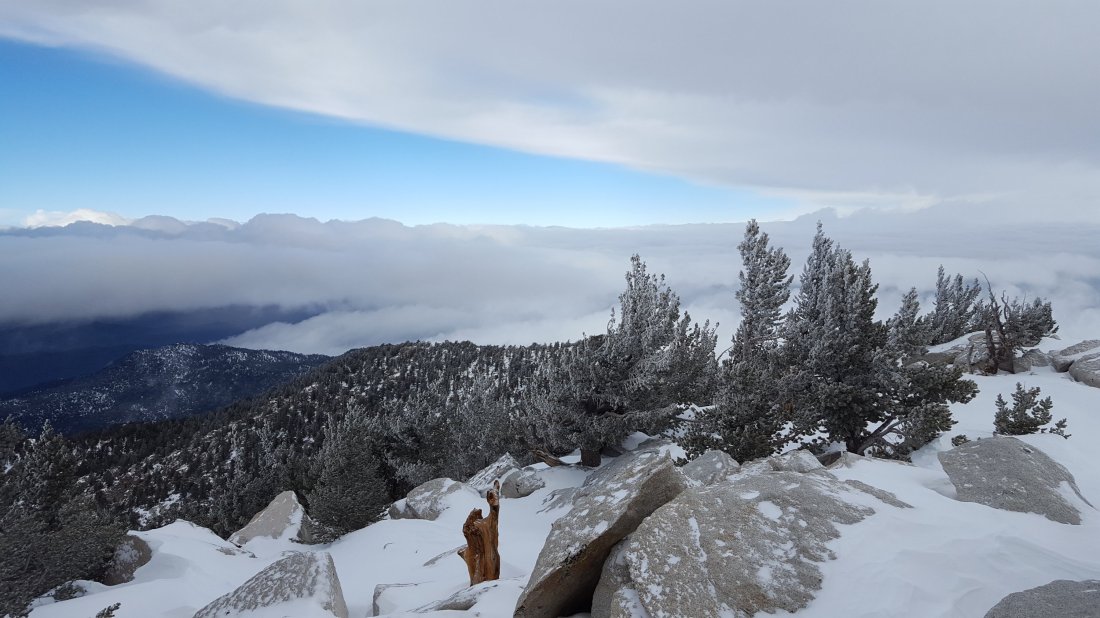
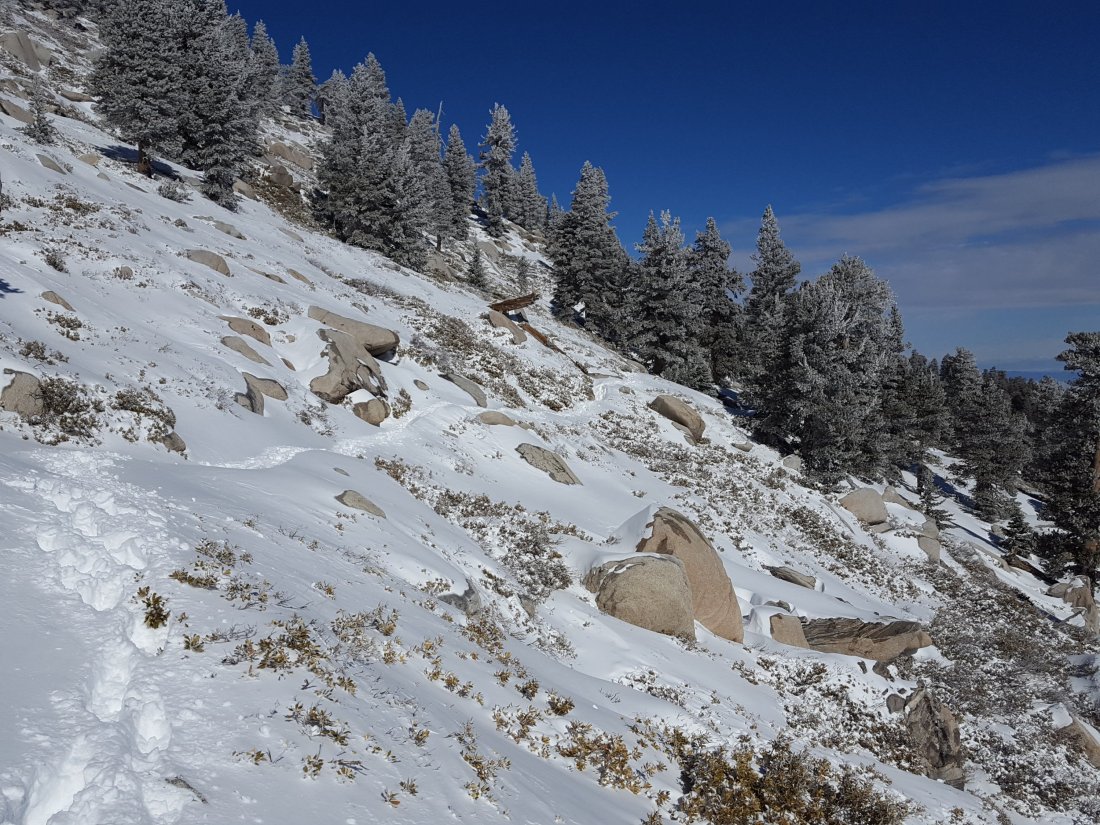
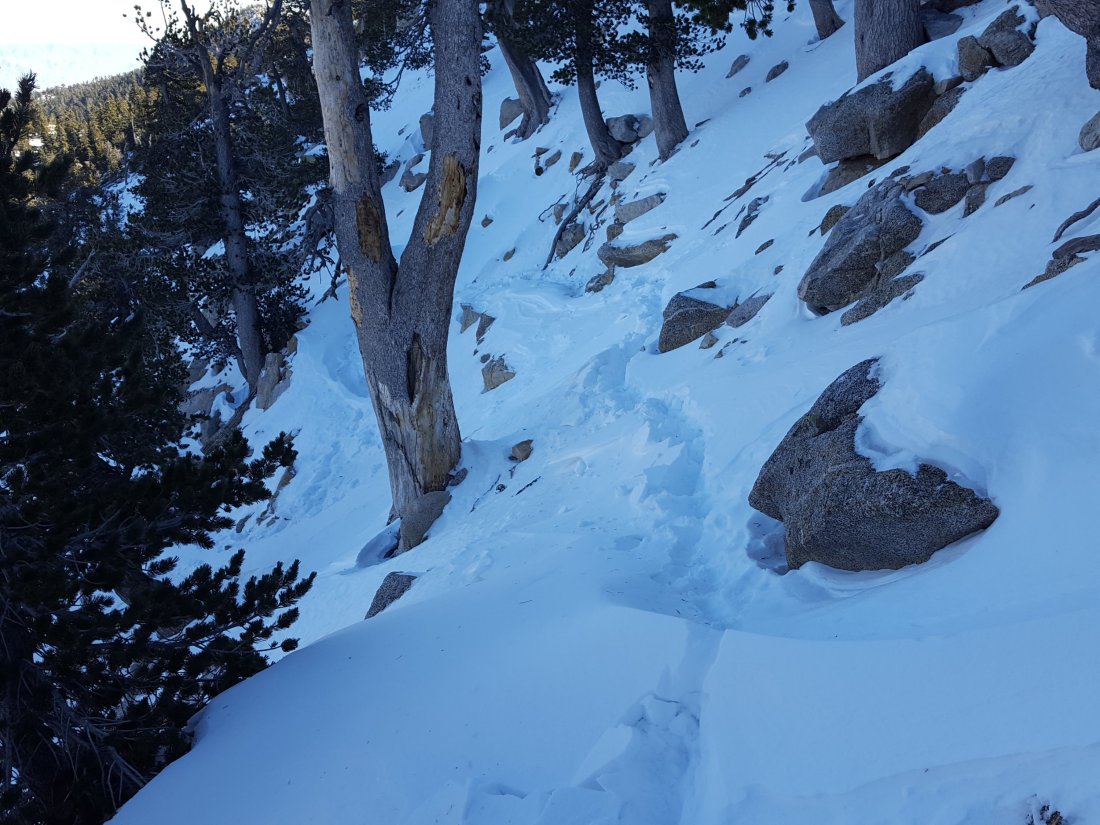
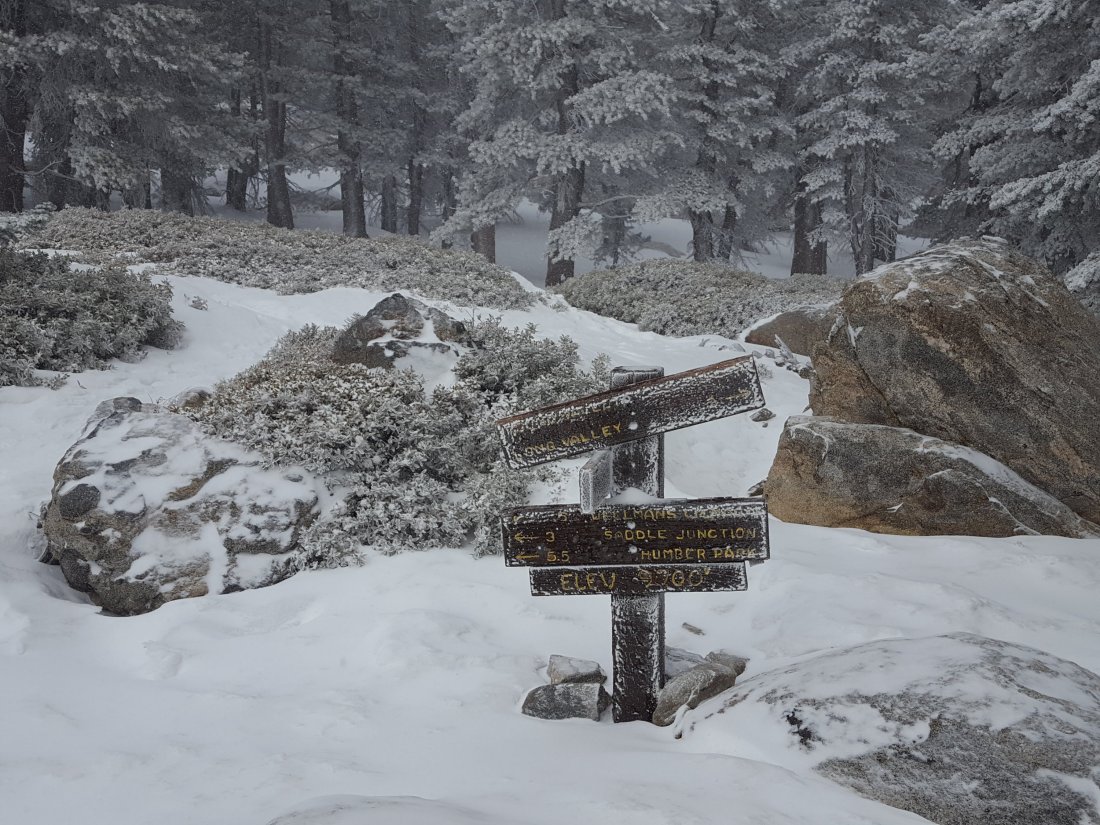
Snow and weather update 28th January 2019

[UPDATE Saturday 2nd February: currently snowing at about 0.5″ per hour here at San Jacinto Peak (1115). About 6-7″ new accumulation since Thursday.]

[UPDATE Thursday 31st January: at 1330 it just started raining here in Idyllwild, and it is snowing lightly in Long Valley. Rainfall is expected up to about 7500′ (maybe 0.5″), with a few inches of snow in the high country. Major precipitation is expected on Saturday, with 2-3 feet of snow likely at San Jacinto Peak, and a mix of rain and light snow down to 5000′ at least. Next major update will be on Sunday 3rd February. Additional light precipitation is forecast for Monday-Tuesday.]

Today I took a long circuitous hike to San Jacinto Peak via Saddle Junction, the Pacific Crest Trail, then Deer Springs Trail through Little Round Valley, before descending via Wellman Divide and back to Humber Park. Snow conditions were pretty rotten in most areas, with changes to microspikes, then snowshoes, and back again, to minimize postholing. I descended in snowshoes all the way to 8900′ on the PCT above Saddle Junction, and there was abundant evidence of hikers having postholed horribly during the weekend.

I recorded the following vlog at San Jacinto Peak this afternoon. By dusk when I returned to Humber Park it had reopened, in contrast to what I say in the video.

Error
This video doesn’t exist

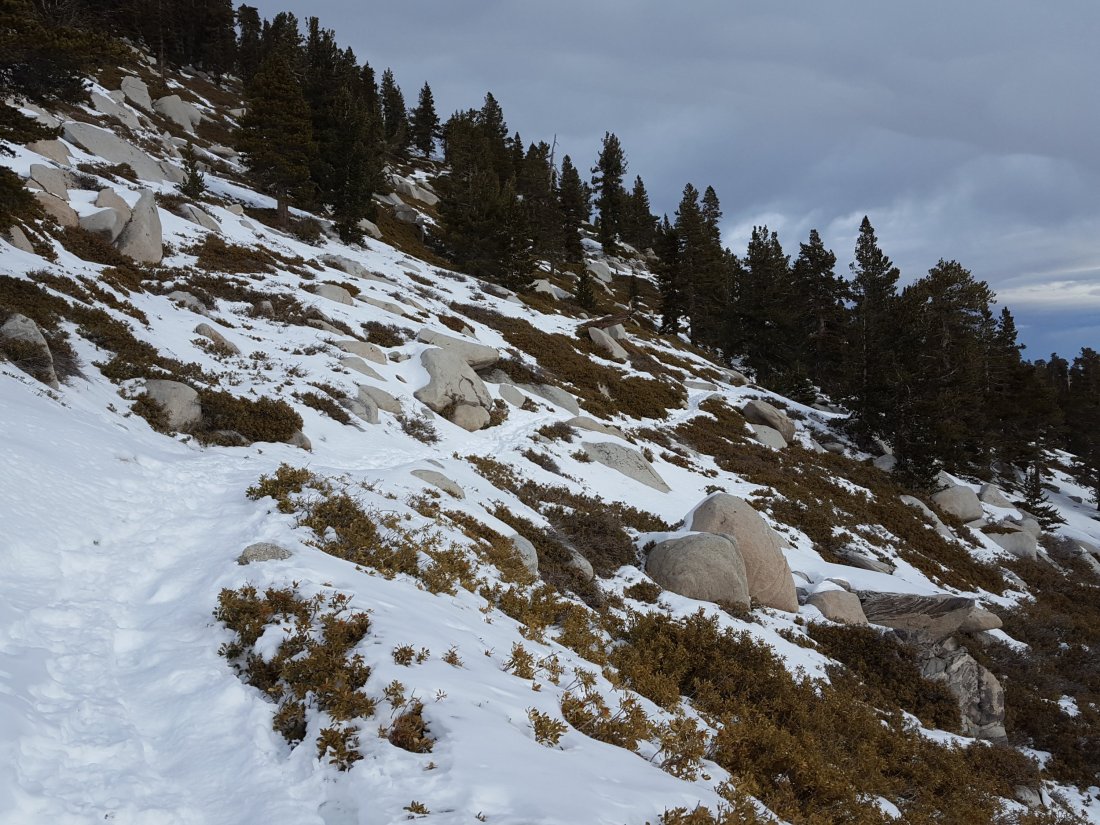
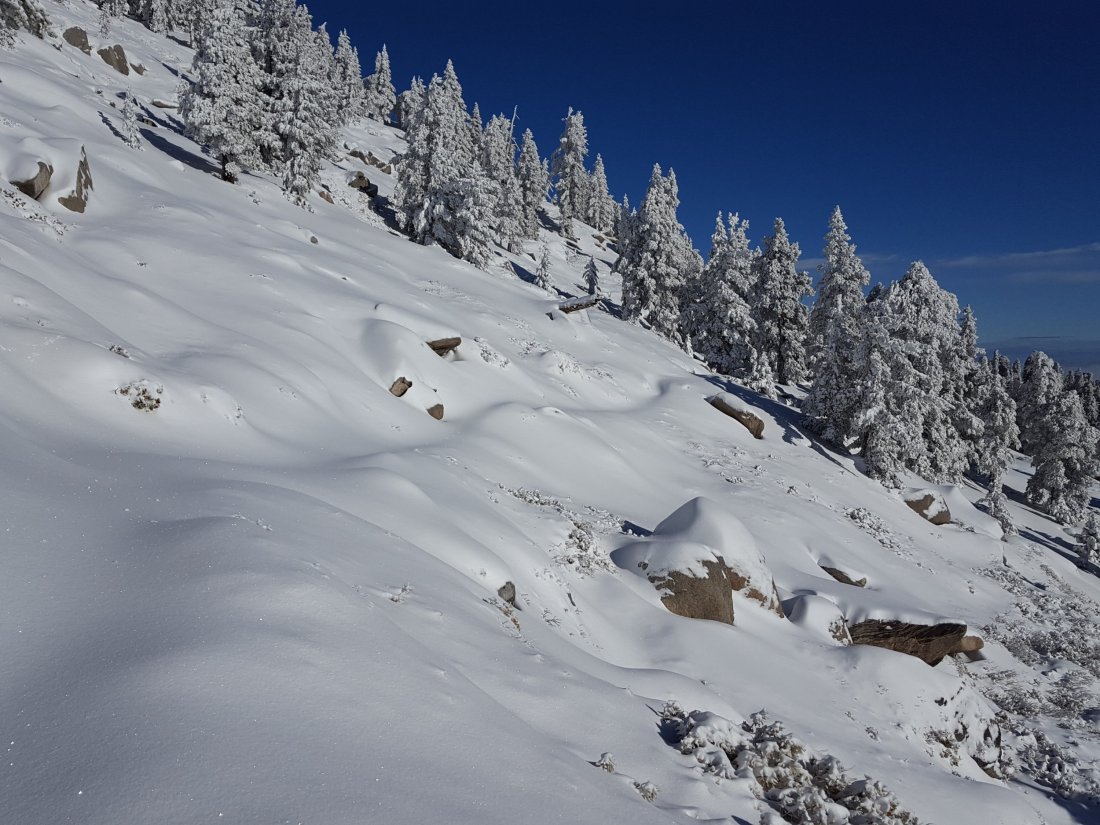
Almost all trails above about 8000′ remain largely or completely snow-covered at this time (individual trail conditions are discussed below). Microspikes are useful but not essential on trails above about 8000′ in the morning when snow is firm, and for descending. Snowshoes are currently very useful above about 9000′, as the snow has softened considerably at all elevations in recent days, and they are strongly recommended for off-trail travel and in warmer afternoons when snow softens. Crampons are a useful alternative to microspikes in the mornings above about 10,000′ (and on the north side of Tahquitz Peak). . Some revised snow depths are at the foot of this posting.

Hikers should be prepared for temperatures at or below freezing in the high country (>8000′) and well below freezing when considering windchill effects (especially at the high peaks).

With the lifting of the federal government shutdown, the U.S. Forest Service Idyllwild Ranger Station and Humber Park are now open. Adventure Passes and wilderness permits are available and are required as usual.

Weather After several mild days, including today, a dramatic change is forecast starting on Thursday 31st January and lasting for the first four days of February. Precipitation is likely on several or all of those five days, with a mix of moderate rainfall and a few inches of snow at the elevation of Idyllwild (5000′-6000′), and with up to a foot of snow possible at San Jacinto Peak on Thursday, and another 2-3 feet on Friday night and Saturday.

At San Jacinto Peak today, Monday 28th January 2019, under completely cloudy skies, at 1315 the air temperature was 39.5°F (4°C), with a windchill temperature of 29.5°F (-1.4°C), 32% relative humidity, and a light 9 mph due North wind gusting to 13.7 mph.

At the Peak on Friday 25th January 2019, at 0955 the air temperature was 35°F (1.7°C), with a windchill temperature of 26.6°F (-3°C), 21% relative humidity, and a gentle 6 mph SSW wind gusting to 8.5 mph.

TRAIL CONDITIONS

The Pacific Crest Trail is almost continuously snow-covered from at least Red Tahquitz (approx. PCT Mile 175) through to at least Mile 191. Immediately north of Saddle Junction, snow is patchy until about 8700′, and then again descending past Strawberry Cienega. Otherwise microspikes are useful in most areas. Fuller Ridge Trail section has not been traveled since November, there is no trail to follow, and it will be treacherous in places. After the forecast snow in the next few days, it will be impassable without ice axe, crampons, and good knowledge of how to use both.

Devil’s Slide Trail is largely clear to about 7700′, then continuous snow cover to Saddle Junction. Ascending is possible without microspikes, but they are useful for descending the uppermost section.

South Ridge Trail is largely clear to Old Lookout Flat (7800′) and no microspikes are required. There is patchy 50% shallow snow cover from there up to Tahquitz Peak. Microspikes are useful in the early morning and for descending, but are not essential.

Deer Springs Trail below Strawberry Junction is largely clear of snow below 8000′ (no microspikes required). The trail is obvious and fairly well compacted above 8800′ (junction with Marion Mountain Trail) and microspikes are fine to Little Round Valley. There is a random scattering of a few unhelpful tracks from Little Round Valley through to San Jacinto Peak, none of which follow the trail route. This section requires snowshoes, at least on warmer days and in the afternoon, and careful route-finding.

Marion Mountain Trail is obvious and well-compacted through to the PCT/Deer Springs Trail junction. Microspikes are sufficient. The trailhead is completely clear of snow..

Tahquitz Peak trail from Chinquapin Flat remains treacherous. On 20th January, I was in microspikes and had to use an ice axe to cut steps across the ice slope. There has been very limited traffic since. Crampons (or microspikes if you are very comfortable with them), an ice axe, and knowledge of how to use both, are strongly recommended.

The Ernie Maxwell Trail is clear of snow.

South Ridge Road is passable with 4WD/AWD but some patches are slippery for hikers.

Suicide Rock Trail has only a few tiny snow patches either side of the Marion Creek crossing (flowing strongly) and close to Suicide Rock. Microspikes are not necessary.

Suicide Rock Climbers Trail is largely clear of snow, except for patches heading around to the North Face.

Measured snow depths are as follows. Only the average depth is given, due to the complexity of past storms, recent melting, and windblown drifts. Much deeper drifts and patches may be encountered. Altitudes are approximate.

San Jacinto Peak (10810′): 2-3′

Little Round Valley (9800′): 20″ (was 36″ on 18th January)

Wellman Divide (9700′): 17″ (was 30″ on 18th January)

Annie’s Junction (State Park boundary north of Saddle Junction) (9050′): 9″ (had been 17″ on 18th January)

Long Valley (8500′): 1-4″ [as reported by State Park]

Strawberry Junction (8100′): 2″ (had been 8″ on 18th January)

Saddle Junction (8100′): 3″ (had been 20″ on 15th January and 8″ on 22nd)

Humber Park (6500′): 0″ (was 4″ on 16th January, and 1″ on 18th)

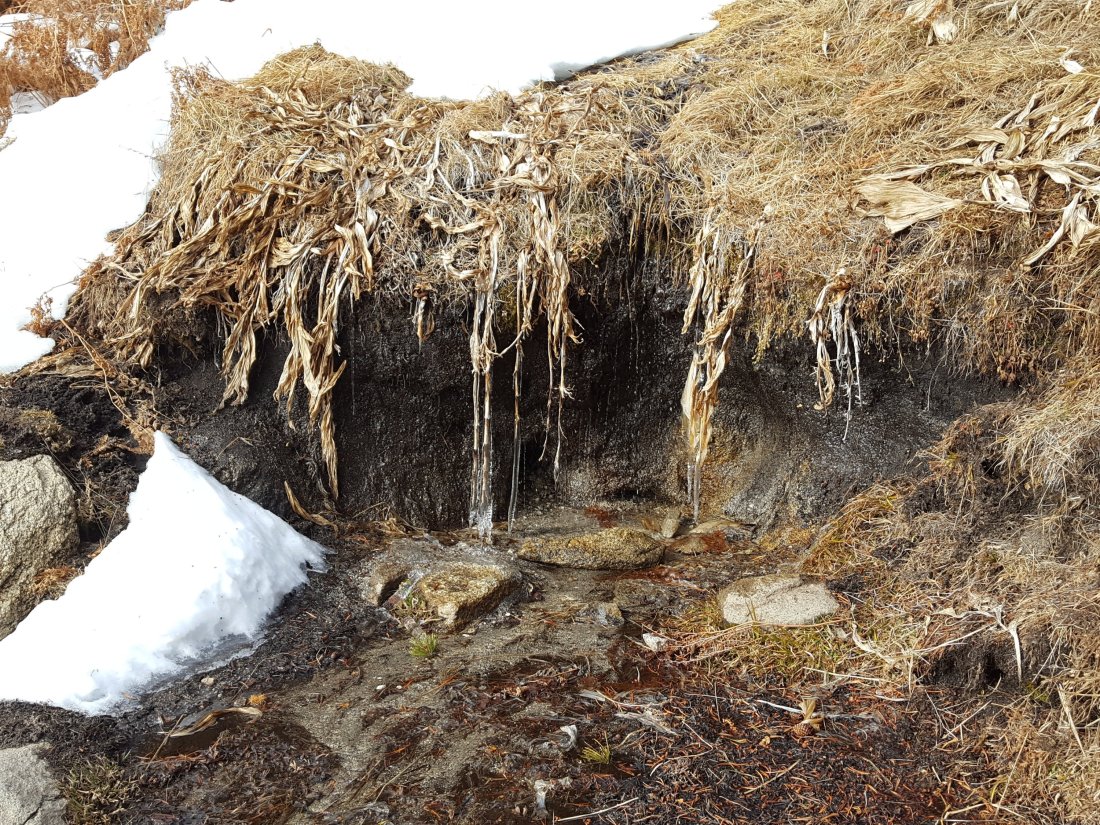
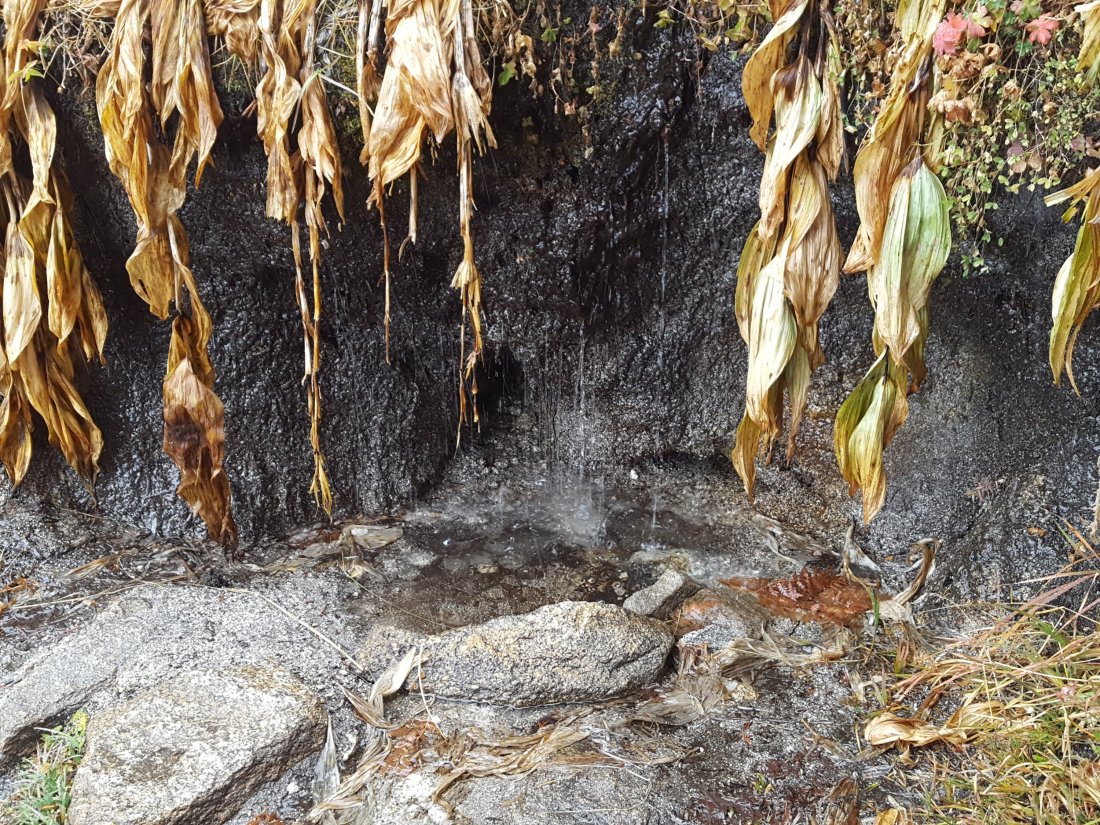
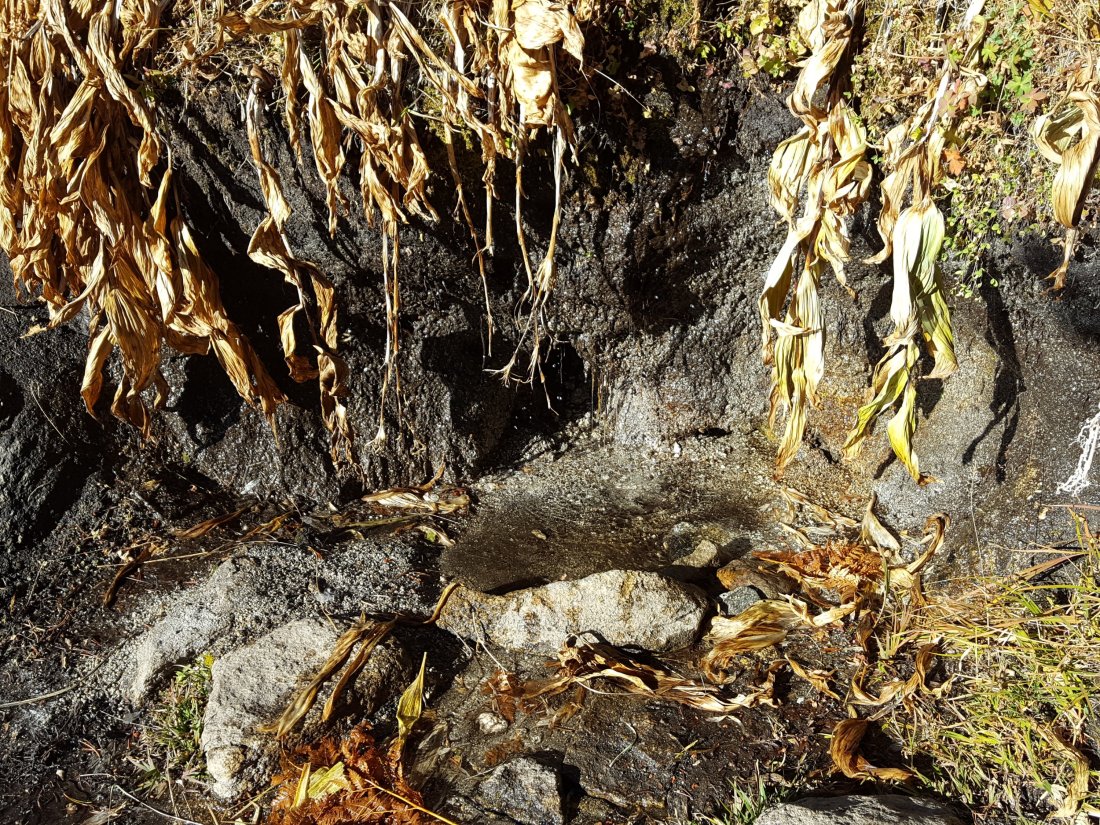
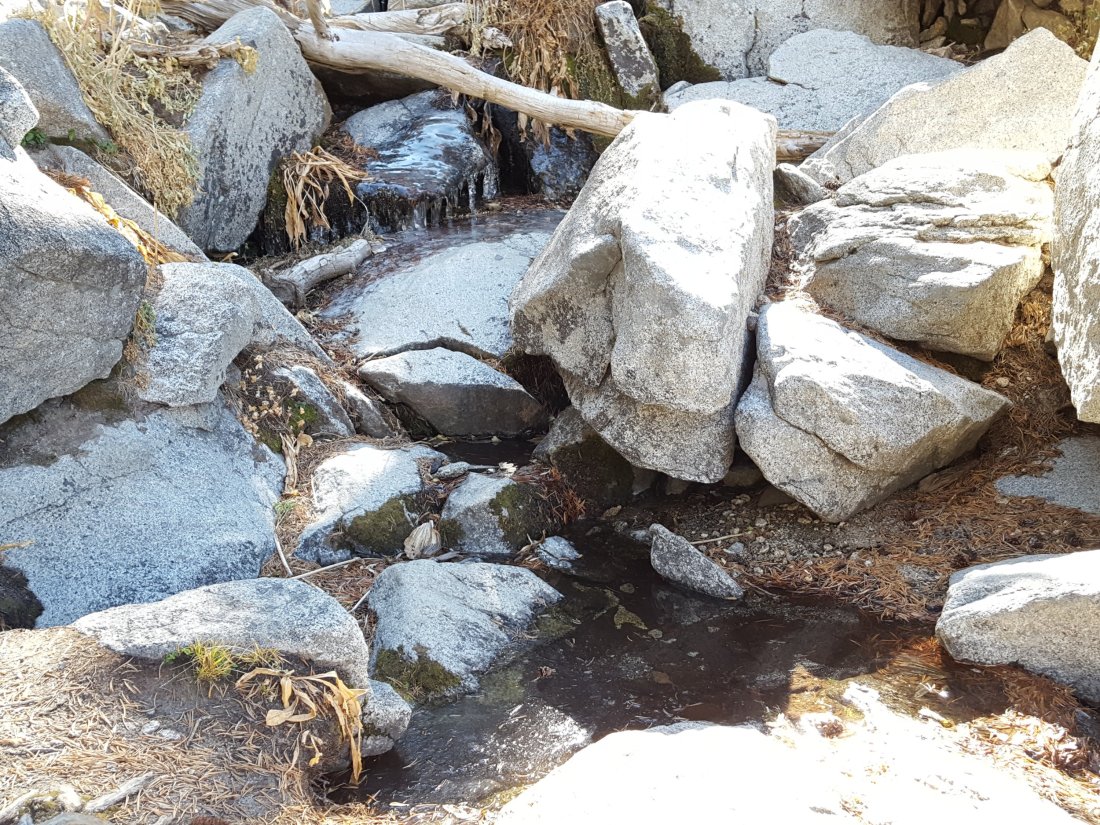
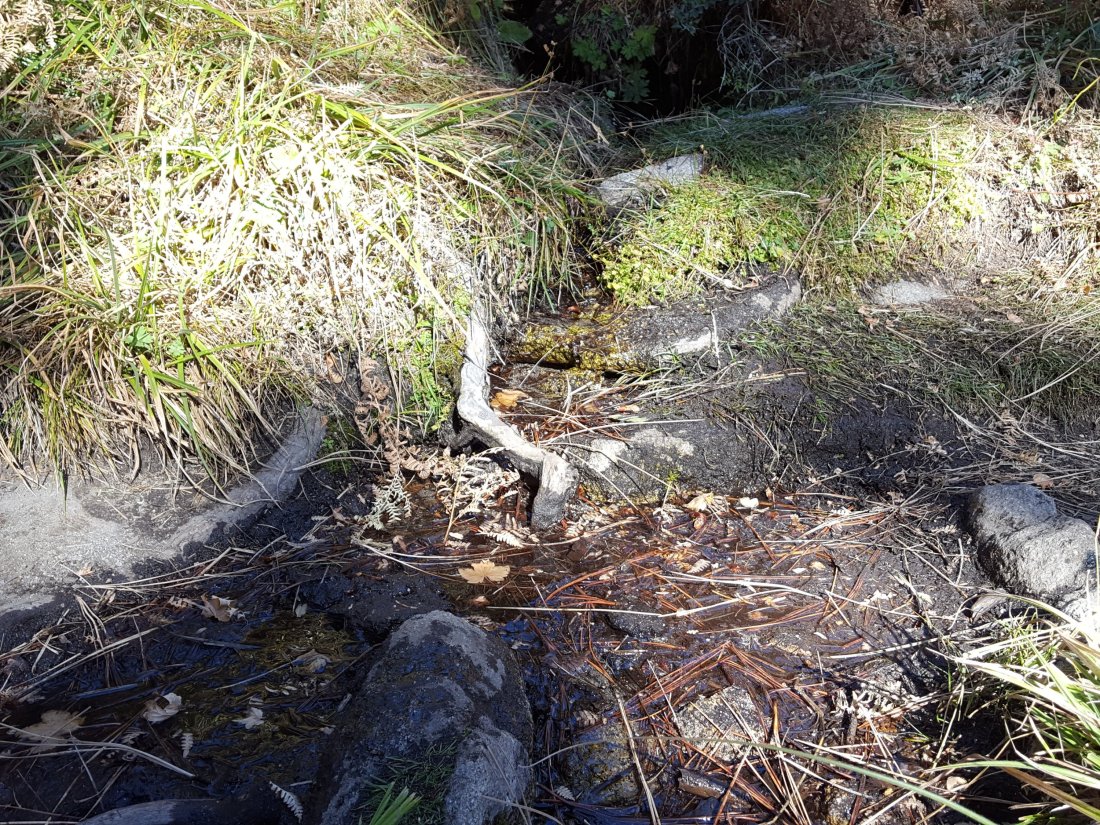
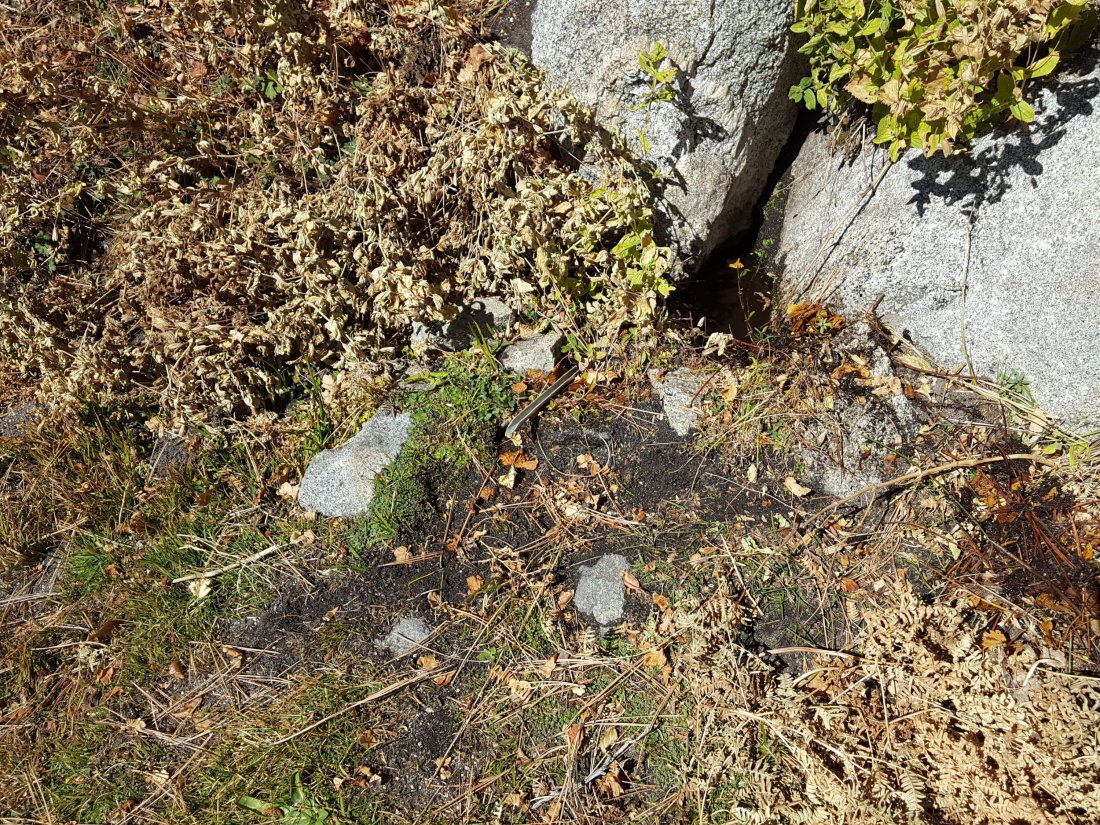
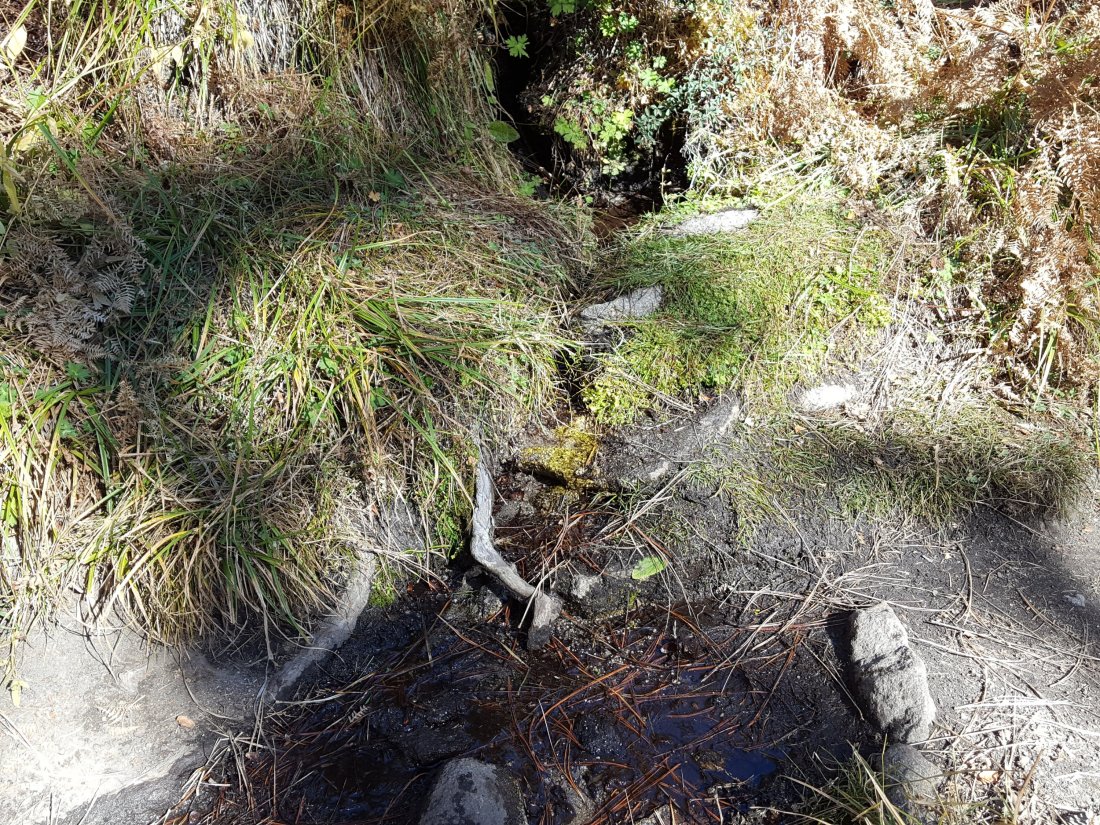
Wellman’s Cienega North spring (above) today Monday 28th January, (below) Friday 25th January, and (bottom) Tuesday 22nd January.

Snow and trail update 22nd January 2019

[UPDATE Saturday 26th: Forest Service Ranger Station in Idyllwild remains closed today. Likely reopening is Monday. Comments on access and passes below still apply.]

[UPDATE Friday 25th January: we hiked Deer Springs Trail to Strawberry Junction yesterday and from Humber Park to San Jacinto Peak this morning. Snow conditions are largely unchanged from the report below. However on the descent today the snow was softening rapidly, and this weekend the snow will be ugly underfoot due to unusually warm weather. Snowshoes will likely be useful in many areas above 8000′, especially after late morning.]

This is a fairly brief update of snow/trail conditions following last week’s major four-day storm. Details of that storm and subsequent snow depths are at the previous posting linked here. Today we hiked briskly to San Jacinto Peak from Humber Park via Wellman Divide and back. Conditions underfoot were perfect for a rapid ascent (an hour faster than on Friday 18th), with very cold weather yesterday and today leading to solid icy snow all the way up, perfect for microspikes only, with no postholing. Some revised snow depths are at the foot of this posting. Special thanks to Brian Clayton for an update on Marion Mountain and upper Deer Springs trails from yesterday, Monday 21st January.

Almost all trails above about 7000′ are largely or completely snow-covered at this time (individual trail conditions are discussed below). Microspikes are very useful on almost all trails above about 7000′, in the morning when snow is firm, and especially for descending. Snowshoes can be useful above 8000′, but currently mainly off-trail and in warmer afternoons when snow softens. They will be more useful this weekend as the snow softens in the unseasonably warm weather. Crampons are a useful alternative to microspikes in the mornings above 10,000′ (and on the north side of Tahquitz Peak).

Despite mild temperatures forecast for much of the remainder of January, hikers should nevertheless be prepared for temperatures near freezing in the high country (and below freezing when considering windchill effects, especially at the high peaks).

Note that during the federal government shutdown, the U.S. Forest Service Idyllwild Ranger Station is closed. The gate to Humber Park is also closed, limiting legal parking to just ten spaces, being patrolled by the Forest Service Law Enforcement Officer during the shutdown. Adventure Passes are currently required to park at Humber Park. Although Idyllwild ran out of passes for sale last weekend (and new ones cannot be issued during the shutdown), Nomad Ventures has located a small supply that will likely last only through next weekend. I have been liaising with the USFS LEO regarding this situation. Those unable to display an alternative pass (e.g., interagency, golden age, veteran, volunteer) could be cited, and are requested to park elsewhere for recreation e.g., Deer Springs Trail, South Ridge, lower end of Ernie Maxwell Trail on Tahquitz View Drive.

Weather After a couple of frigid days yesterday and today, mild weather is forecast for most days until at least 1st February. On some days this will include temperatures above freezing at San Jacinto Peak, and reaching 60°F in Idyllwild. Needless to say, this will result in steady melting at all elevations.

At San Jacinto Peak today, Tuesday 22nd January 2019, at 0940 the air temperature was 13.5°F (-10°C), with a windchill temperature of -13.1°F (-25°C), 28% relative humidity, and a brutal 22 mph due North wind gusting to 32.9 mph.

At the Peak on Friday 18th January 2019, at 1045 the air temperature was 32°F (0°C), with a windchill temperature of 18.7°F (-7°C), 72% relative humidity, and a brisk 11 mph due North wind gusting to 17.8 mph.

TRAIL CONDITIONS

Tahquitz Peak trail from Chinquapin Flat is treacherous (see photo below). On 20th January, I was in microspikes and had to use an ice axe to cut steps across the ice slope. There was no sign of any use since last weeks storms, and there is no trail as such. Crampons (or microspikes if you are very comfortable with them), an ice axe, and knowledge of how to use both, are strongly recommended.

The “trail” between Tahquitz Peak and Chinquapin Flat, early morning Sunday 20th January 2019. The consequences for making a mistake here will be extremely severe.

South Ridge Trail is largely clear to Old Lookout Flat (7800′) and no microspikes are required. More-or-less continuously snow-covered from there up to Tahquitz Peak. Microspikes are useful in the early morning and for descending.

Marion Mountain Trail is obvious and well-compacted through to the PCT/Deer Springs Trail junction. Microspikes are sufficient. The trailhead is completely clear of snow.

Deer Springs Trail below Strawberry Junction is largely clear of snow below 8000′ (no microspikes required). The trail is obvious and compacted above 8800′ (junction with Marion Mountain Trail) and microspikes (or crampons) are fine through Little Round Valley. The “trail” from Little Round Valley through to San Jacinto Peak is indistinct, does not actually follow the trail route, and may require snowshoes, at least in the afternoon.

Devil’s Slide Trail is clear to about 6800′, then with patches of icy compacted snow to 7700′, then continuous snow cover to Saddle Junction. Ascending is possible without microspikes, but they are very useful for descending.

The Ernie Maxwell Trail is clear of snow.

South Ridge Road is passable with 4WD/AWD but some patches are slippery for hikers.

Suicide Rock Trail has only a few short snow patches either side of the Marion Creek crossing (flowing strongly) and near to Suicide Rock. Microspikes are not necessary.

Suicide Rock Climbers Trail is largely clear of snow, except on the branch that leads to the North Face.

Measured snow depths are as follows. Only the average depth is given, due to the complexity of past storms, recent melting, and windblown drifts. Altitudes are approximate.

Wellman Divide (9700′): 24″ (was 30″ on 18th January)

Annie’s Junction (State Park boundary north of Saddle Junction) (9050′): 12″ (had been 17″ on 18th January)

Tahquitz Peak (8836′): 6″, with drifts to 24″ [observations from 20th January]

Saddle Junction (8100′): 8″ (had been 20″ on 15th January and 13″ on 18th) [now at 6-7″ on 25th January]

Humber Park (6500′): 0″ (was 4″ on 16th January, and 1″ on 18th)

The Peak Trail just above Wellman Divide early on morning of Friday 25th January (above) and on Friday 18th January (below)

Major storm update 18th January 2019

[UPDATE Sunday 20th January: I have just updated the condition of the Tahquitz Peak and South Ridge trails in the text below, with photo. The north side is currently very treacherous and passable with crampons/ice axe only.

[UPDATE Saturday 19th January: Idyllwild has completely sold out of Adventure Passes. I have discussed the issue with the Forest Service law enforcement officer. Folks unable to display an alternative pass (interagency, golden age, veteran, volunteer) could still be cited at Humber Park, and are requested to park elsewhere for recreation e.g., Deer Springs Trail, South Ridge, lower end of Ernie Maxwell Trail at Tahquitz View Drive, etc.]

More-or-less exactly as forecast, an unusual sequence of three storms ran into each other over the past four days, Monday 14th – Thursday 17th. This brought almost continuous precipitation to the mid elevations, and started with heavy snowfall in the high country on Monday and Tuesday. The upper mountain was above the cloud for most of Wednesday. Unfortunately the two later storms were very mild systems which brought rain up to about 7500′ (Wednesday) and then heavy rain all the way up to 9300′ elevation (Thursday), plus freezing rain to San Jacinto Peak. This washed/melted much of the snow off trees and turned powder to atrocious slush in many areas below 8000′, and melted and compacted the snow even at the highest peaks. Some pre- and post-storm photos are at the foot of this posting.

Today we hiked to San Jacinto Peak from Humber Park via Wellman Divide, descending Deer Springs Trail to the Suicide Rock Trail, then back to Humber via the Climbers Trail. Specific information for some trails is discussed at the end of this posting. I recorded this vlog in spectacular rime conditions at San Jacinto Peak late this morning.

Error
This video doesn’t exist

At 5550′ elevation in Idyllwild, we ended up with an impressive 4.31″ of rain plus about one inch of snow (which never had the chance to settle) over the four days.

Despite above-average temperatures forecast for much of the remainder of January, hikers should nevertheless be prepared for temperatures near freezing in the high country (and below freezing when considering windchill effects).

Note that during the federal government shutdown, the U.S. Forest Service Idyllwild Ranger Station is closed. The gate to Humber Park is also closed, limiting legal parking to just ten vehicles, and is being patrolled by the Forest Service Law Enforcement Officer during the shutdown. Adventure Passes are currently required to park at Humber Park, although town has largely run out of passes for sale (and new ones cannot be issued during the shutdown!). Currently Nomad Ventures apparently has the only remaining supply of passes in Idyllwild. Once the supply of passes has been exhausted, I will notify the USFS LEO, and presumably they will no longer be enforced.

Measured snow depths are as follows. Only the average depth is given, due to the complexity of past storms and recent melting. Strong winds have led to considerable drifting, mainly above 10,000′, sometimes double the reported depth in places. Altitudes are approximate.

San Jacinto Peak (10,810′): 3-4 feet (with drifts to 5 feet)

Little Round Valley (9800′): 3 feet

Wellman Divide (9700′): 30″

Wellman’s North Cienega (9300′): 18″

Fuller Ridge Trail at junction with Deer Springs Trail (8950′): 24″

Annie’s Junction (State Park boundary north of Saddle Junction) (9050′): 17″

Marion Mountain Trail at junction with Deer Springs Trail (8800′): 21″

Tahquitz Peak (8836′): 6″, with drifts to 24″ [updated 20th January]

Saddle Junction (8100′): 13″ (had been 20″ on 15th)

Strawberry Junction (8100′): 8″

Humber Park (6500′): 1″ (was 4″ on 16th)

The “bowl” at 10,100′ on the Peak Trail, 18th January 2019.

Weather As has been the pattern this winter (in a world of changing climate), a notable warming trend is forecast to follow this week’s storm event. This trend may last into early February, and on some days may include temps above freezing at San Jacinto Peak, and reaching 60°F in Idyllwild. Needless to say, this will result in extensive and rapid melting at all elevations, especially <9000′.

At San Jacinto Peak today, Friday 18th January 2019, at 1045 the air temperature was 32°F (0°C), with a windchill temperature of 18.7°F (-7°C), 72% relative humidity, and a brisk 11 mph due North wind gusting to 17.8 mph.

Popsicles do grow on trees! Peak Trail, 18th January 2019.

TRAIL CONDITIONS

Almost all trails above about 7000′ are largely or completely snow-covered at this time. Measured average snow depths are listed above.

Snowshoes are currently essential everywhere above 8000′. Microspikes are useful on almost all trails above about 7000′.

Waterproof footwear is recommended on the approach trails (below 8000′) due to multiple stream crossings and water flowing in the trails.
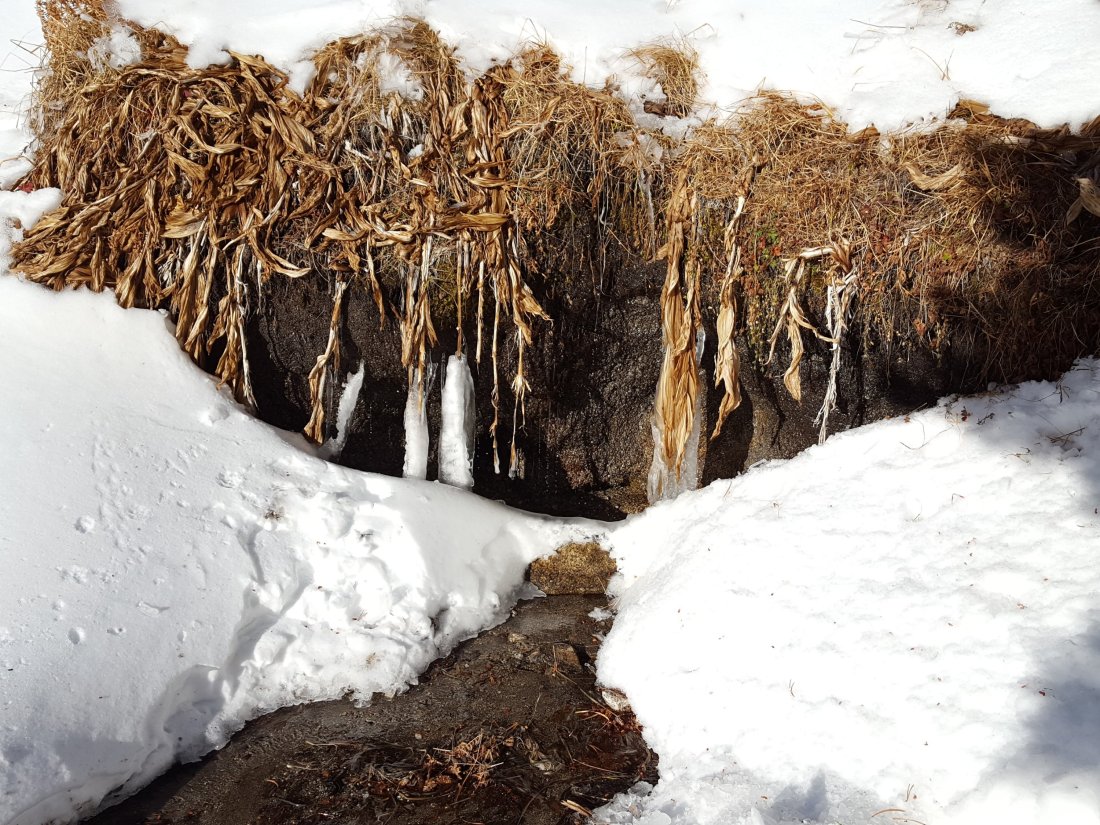
Routefinding will be challenging for those not very familiar with the area. No trails had been broken whatsoever on my circuit of the mountain today. My snowshoe tracks on the east side ascent will be quickly invisible due to melting and ice fall. My tracks on the Deer Springs Trail will be more obvious as I postholed in the soft afternoon snow.

Tahquitz Peak trail from Chinquapin Flat is treacherous (see photo below). On 20th January, I was in microspikes and had to use an ice axe to cut steps across the ice slope. There was no sign of any use since last weeks storms, and there is no trail as such. Crampons (or microspikes if you are very comfortable with their use), in conjunction with an ice axe, and knowledge of how to use them are strongly recommended.

The “trail” between Tahquitz Peak and Chinquapin Flat, early morning Sunday 20th January 2019. The consequences for making a mistake here will be extremely severe.

South Ridge Trail is largely clear to Old Lookout Flat (7800′) and no microspikes are required. More-or-less continuously snow-covered from there up to Tahquitz Peak. Microspikes are useful in the early morning and for descending this section.

Deer Springs Trail below Strawberry Junction was largely clear of snow below 7700′ this afternoon (no microspikes required).

Devil’s Slide Trail was largely clear to about 6800′ early this morning.

Yesterday we hiked the Ernie Maxwell Trail in the pouring rain. It was largely clear of snow, but some of the few areas of compacted icy snow/slush were very slippery.

South Ridge Road is passable with 4WD/AWD but some patches are slippery for hikers.

Suicide Rock Trail has only a few short snow patches either side of the Marion Creek crossing (flowing strongly) and near to Suicide Rock. Microspikes are not necessary.

Suicide Rock Climbers Trail is largely clear of snow, except on the branch that leads to the North Face.

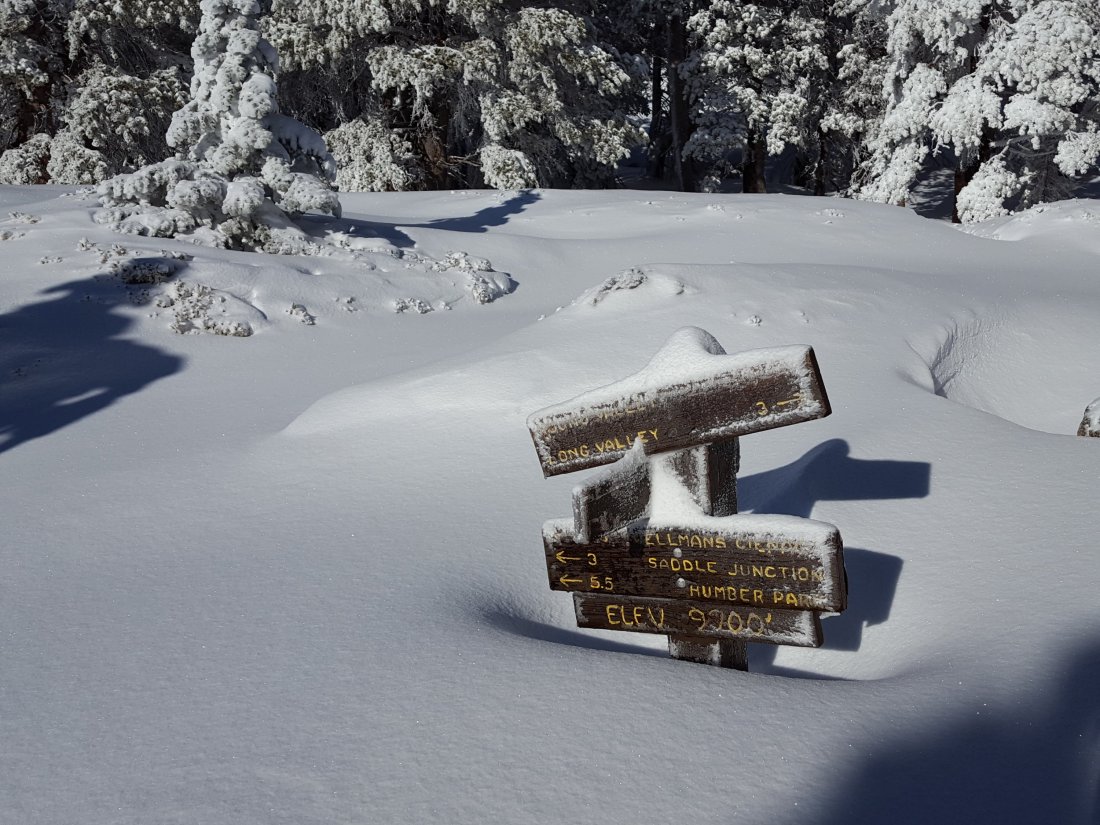
The sign at Wellman Divide (above) today Friday 18th January and (below) on Saturday 12th January.

The sign just below San Jacinto Peak at the junction of the Peak and Deer Springs trails (above) today Friday 18th January and (below) on Saturday 12th January.

Snow update 12th January 2019

[UPDATE Wednesday 16th January 2019 It finally stopped raining (for the time being)this afternoon in Idyllwild. More rain is forecast for tomorrow, with a light dusting of snow for the high country. Current storm total for Idyllwild at 5550′ is 2.50″ rain and about 1″ snow (which did not settle). The system turned much warmer overnight, and it rained to at least 7500′ elevation, washing off or melting all snow from the trees and Tahquitz and Suicide rocks below that elevation. The quality of the snow below about 7000′ is atrocious, basically white slush. Microspikes are very useful above 6000′, and snowshoes invaluable above 7500′. The higher elevations were above the cloud for some of the night and all of today, so new snow accumulations were minimal. Humber Park (6500′) is unchanged at 4″, Saddle Junction (8100′) has 20″, and Long Valley is reporting 22″. The trailhead for South Ridge Trail (top of South Ridge Road, 6500′) had an average of 5″ this afternoon, but with patches to 8″. Please note that South Ridge Road is currently impassable without good 4WD, snow tyres, and/or chains. The status of the high country snow conditions will be updated tomorrow and/or Friday.]

[UPDATE Tuesday 15th January 2019 It won’t stop snowing! I checked Devil’s Slide Trail and Saddle Junction this morning. Saddle Junction (8100′) had a total of 17″ of snow, of which about 8″ were new snowfall since the weekend. Humber Park (6500′) had a total of about 4″ by noon today, of which three inches were new in the past day. However snow was continuing to accumulate at as much as 0.5″ per hour, and it has largely continued to snow lightly all afternoon. Snow level has fluctuated around 6000′ elevation, with mainly rain and occasional sleet in Idyllwild at 5550′. At Long Valley, little precipitation fell overnight (less than an inch of snow added to yesterday’s total), but between 0600-1200 about another 2-3″ were added, for a storm total of about 8″, on top of the existing 4″.]

[UPDATE Monday 14th January 2019 light but steady precipitation started at about 1100 and continued all day. By dusk, Long Valley (8500′) had about 5″ of fresh snowfall, Humber Park (6400′) had less than one inch of snow, and Idyllwild (5550′) had recorded 1.12″ of rain with no settled snow. After dark it continues to drizzle at mid elevations, and lightly snow above about 6500′.]

There was a light snowfall everywhere above about 7000′ overnight, descending to about 5000′ briefly this afternoon. Yesterday afternoon I hiked to San Jacinto Peak up Deer Springs Trail, descending this morning via Wellman Divide to Humber Park. The only other person I saw in the high country today was Kham, friend of the Trail Report, who was postholing up beyond Wellman Divide. I recorded a brief vlog at San Jacinto Peak this morning.

Error
This video doesn’t exist

The snow today came in three phases. In the early hours there was a light snowfall at the higher elevations (mainly above 7000′), totaling about 3″ at San Jacinto Peak, accompanied by howling, bitter southerly winds, ending around 0800. A second snow between 1000-1300 today fell mainly from 6500′ to 10,000′ (the highest elevations were largely above the cloud. Finally a brief but intense snow of larger, wet flakes, fell around 5000′ to 7000′ on the western side (especially around Idyllwild) early this afternoon.

Trail conditions Snowfall was insufficient to completely obscure the established tracks in the snow at all elevations. Details of the trail conditions prior to today’s snowfall are discussed in the previous report linked here. Microspikes are very useful, but not essential, on all trails above about 7000′ at this time (see snow depth details below). Snowshoes are currently very helpful everywhere above about 9000′, and locally above 8000′ (e.g., Tahquitz area meadows, Long Valley).

Hikers should be prepared for temperatures at or below freezing in the high country (>8000′ elevation), and well below freezing at the high peaks (with possible severe cold when considering windchill effects).

Note that during the federal government shutdown, the U.S. Forest Service Idyllwild Ranger Station is closed. Please note that the gate to Humber Park is now closed, limiting parking to just a handful of vehicles, and is being patrolled by the Forest Service Law Enforcement Officer during the shutdown (I had another chat with him there this afternoon). Adventure Passes are required to park in the available places at Humber Park.

Weather Storm systems on Monday 14th and then again on Thursday 17th may produce significant precipitation this week. Forecasts initially suggested as much as 3″ of rain at the elevation of Idyllwild, and snowfall of perhaps more than 1.5 feet at San Jacinto Peak. Most recent estimates forecast much less precipitation however. Most (all?) of the precipitation may occur in the first storm, arriving Monday.

At San Jacinto Peak today, Saturday 12th January 2019, at 0850 the air temperature was 17°F (-9.5°C), with a windchill temperature of 2.0°F (-17°C), 88% relative humidity, and a cool 7 mph due South wind gusting to 11.2 mph.

At the Peak on Friday 11th January, at 1710 the air temperature was 29°F (-1.5°C), with a windchill temperature of 13.8°F (-10°C), a remarkable 14% relative humidity, and a bitter 14 mph SSW wind gusting to 22 mph.

Looking NW from San Jacinto Peak at about 0900 this morning.

Measured snow depths are as follows. The first number is new accumulation measured today, the second (in parentheses) is the maximum depth at that location including the existing snow from earlier storms. Very strong winds led to considerable drifting, mainly above 10,000′ elevation, often double the reported depth in places. Note that with so much melting between storms this winter, the deepest snow is very patchy, and at all elevations there are some bare areas. Altitudes are approximate.

San Jacinto Peak (10,810′): 3-4″ (24″), with drifts >30″

Wellman Divide (9700′): 2″ (12″)

Annie’s Junction (State Park boundary north of Saddle Jn) (9050′): 1.5″ (10″)

Saddle Junction (8100′): 1″ (7″)

Humber Park (6500′): 1″ (2″)

Snow conditions 9th January 2019

I spent all day today in the high country, ascending San Jacinto Peak via Saddle Junction and Wellman Divide, then descending all the way down Deer Springs Trail. I had not intended to record another vlog so soon after the last just three days ago, but I wanted to let folks know about the scrappy state of the snow.

Error
This video doesn’t exist

All high elevation trails (>6800′) remain snow-covered, with thin patchy snow in places down to about 6000′ on many trails (discussed in detail below for those trails I have surveyed). For details of the snow that fell last weekend, see the posting from Sunday 6th January.

Microspikes are useful on all trails above about 6000′ at this time. They are especially helpful in the early morning when snow is icy, and for descending. Snowshoes are currently recommended everywhere above about 9000′, and they are helpful in many areas above about 8000′. There is already rapid melting occurring below 8000′, and even higher on sun-exposed slopes, and this will continue for the next two days as warm temperatures are forecast to continue.

Hikers should be prepared for temperatures at or below freezing in the high country (>8000′ elevation), and well below freezing at the high peaks (with possible severe cold when considering windchill effects).

Note that during the federal government shutdown, the U.S. Forest Service Idyllwild Ranger Station is closed. Adventure passes and wilderness permits are not required (or at least unenforceable) until the shutdown ends. Please note that the gate at Humber Park is now closed, so parking is very limited.

Weather After two more mild days on 10th and 11th, a period of cold conditions with precipitation is forecast for at least one week. A moderate storm seems likely on Friday night, with a few inches of snow forecast for San Jacinto Peak at least. Thereafter, precipitation is possible at all elevations on some or all days from 14th-17th January.

At San Jacinto Peak today, Wednesday 9th January 2019, at 1115 the air temperature was 33°F (0.5°C), with a windchill temperature of 20°F (-7°C), 28% relative humidity, and a cool 11 mph SW wind gusting to 15.7 mph.

At the Peak on Sunday 6th January 2019, at 0730 the air temperature was 15.8°F (-9°C), with a windchill temperature of -5.8°F (-21°C), 100% relative humidity, and a sharp 15 mph WSW wind gusting to 25.6 mph.

TRAIL CONDITIONS

Devil’s Slide Trail is almost continuously covered in 1-2″ snow, increasing to 4-6″ higher up. Microspikes are sufficient.

Pacific Crest Trail north from Saddle Junction has continuous snow cover. Depth at Saddle Junction was down to 7″, and at 9000′ to about 8-9″. Microspikes were adequate to about 9000′, but snowshoes were essential beyond there (to Wellman Divide in fact) as the only set of tracks occasionally visible between drifts were my own from three days earlier.

Peak Trail From Wellman Divide up, this trail has received only a handful of hikers since the snowfall three days ago. With strong winds and heavy drifting, much of the trail was obscured again this morning. Snowshoes were ideal all the way to San Jacinto Peak.

Deer Springs Trail has been relatively well traveled since the snow three days ago. Snow depth is at about 20″ in Little Round Valley, with some deeper drifts nearer San Jacinto Peak. There is a poorly consolidated snowshoe trail for the entire length of Deer Springs Trail above Strawberry Junction. Snow depth at Strawberry Junction averaged 4″. Below Strawberry Junction (8100′) the trail is largely snow-covered (only a few inches deep) above the Suicide Rock Trail junction, and largely clear below that junction. Microspikes are not needed in this section..

Marion Mountain Trail has been relatively well-traveled, with a good snowshoe track to follow. Thin snow starts at the trailhead, increasing to about 7″ at the junction with the PCT/Deer Springs Trail.

Fuller Ridge Trail/PCT and Seven Pines Trail have shown no signs of use since November, so route finding will be very challenging, especially for those not completely familiar with these trails.

Snow update 6th January 2019

There was a heavier-than-forecast snowfall everywhere above about 5000′ overnight. I hiked to San Jacinto Peak yesterday from home via South Ridge Trail, Tahquitz Peak, Saddle Junction, and Wellman Divide, then descended late this morning to Humber Park. Many thanks to Kyle Eubanks who joined me up top, and provided the snow depths for Round and Long valleys on his descent. Credit to the only other people I saw in the high country all day, Monica and Kham, two energetic young ladies who had postholed to Annie’s Junction (9100′). They said very nice things about the Trail Report, including that it had inspired them to come out hiking in the snow today. I recorded the following vlog at San Jacinto Peak late this morning.

Error
This video doesn’t exist

Very fine light snow started at about 1300 yesterday afternoon in the high country, continuing all night, and finally stopping just after sunrise. In Idyllwild at 5550′, we had about 0.25″ rain, followed by 2.0″ snow.

Microspikes are useful, but not essential, on all trails above about 6000′ at this time (see snow depth details below). Snowshoes are currently very useful everywhere above about 8000′. This will continue for at least a couple of days until melting and compacting by foot traffic makes microspikes more practical. There is already rapid melting occurring below 7000′, and this will likely extend higher in the next few days as mild temperatures are forecast.

Hikers should be prepared for temperatures at or below freezing in the high country (>8000′ elevation), and well below freezing at the high peaks (with possible severe cold when considering windchill effects).

Note that during the federal government shutdown, the U.S. Forest Service Idyllwild Ranger Station is closed. Adventure passes and wilderness permits are not required (or at least unenforceable) until the shutdown ends. Please note that Humber Park is being patrolled by the Forest Service Law Enforcement Officer during the shutdown (I had a chat with him there today).

The view from the top. Looking toward Coachella Valley this morning from San Jacinto Peak.

Weather Most of the coming week will be relatively mild, with considerable melting likely below 8000′ and on sun-exposed slopes. Starting on Friday night, further precipitation is forecast at all elevations in the period 12th-15th January. Currently, snowfall in the high country is forecast to be concentrated in the early morning of Saturday 12th and again overnight on Sunday 13th to Monday 14th.

At San Jacinto Peak today, Sunday 6th January 2019, at 0730 the air temperature was 15.8°F (-9°C), with a windchill temperature of -5.8°F (-21°C), 100% relative humidity, and a sharp 15 mph WSW wind gusting to 25.6 mph.

By way of remarkable contrast, at the Peak on Thursday 3rd January, at 0840 the air temperature was 36°F (2°C), with a windchill temperature of 29.3°F (-2°C), 20% relative humidity, and a mellow 4 mph NNE wind gusting to 6.4 mph.

Measured snow depths are as follows. The first number is new accumulation measured today, the second (in parentheses) is the maximum depth at that location including the existing snow from earlier storms. Very strong winds have led to extreme drifting, often double the reported depth in places. Note that with so much melting between storms this winter, the deepest snow is very patchy, and at all elevations there were bare areas until last night. Altitudes are approximate.

San Jacinto Peak (10,810′): 12″ (22″), with drifts of 30-40″ on East Ridge

Wellman Divide (9700′): 8″ (14″)

Round Valley (9100′): 9″ (13″)

Annie’s Junction (State Park boundary north of Saddle Jn) (9050′): 8″ (14″)

Long Valley (8500′): 6″ (8″).

Saddle Junction (8100′): 7″ (8″)

Humber Park (6500′): 4″ (4″)

The Peak Trail at about 9800′ just above Wellman Divide around noon today (above) and yesterday afternoon (below).

Cold! 1st January 2019

[UPDATE 3rd January 2019: Yesterday we hiked South Ridge Trail, then this morning I hiked to San Jacinto Peak via Devil’s Slide Trail. I have incorporated new info from those hikes into the report below. The swing in temperatures has been astounding, with San Jacinto Peak already above freezing early this morning (36°F). Consequently, melting has been very rapid, with many trails below 8000′ clearing fast. Only a handful of hikers have made it to San Jacinto Peak in recent days via all routes, with extremely few tracks visible in the high country, so trails remain a little slow-going in heavily drifted areas. Next full update will be after the snowstorm (fingers crossed) on Sunday.]

If today was a sign of things to come, 2019 will be an exciting year in the San Jacinto mountains! Early this morning I hiked to San Jacinto Peak via Devil’s Slide Trail and Wellman Divide, descending via Deer Springs Trail. Conditions at all elevations were very cold, with a howling northerly gale, and spindrift snow flying in all directions. I observed yet another record low windchill temperature at San Jacinto Peak, as discussed in the video.

Error
This video doesn’t exist

I briefly described the snow that fell yesterday in the final update of 2018. All trails above about 6700′ are snow-covered, with patchy thin snow to 5700′ (discussed in detail below). With such strong winds, drifting has been very widespread, making tracks disappear within minutes, and route-finding complicated at times for those unfamiliar with the area.

Despite the cold conditions in the past week, a remarkable amount of melting had occurred in the days prior to the light snow yesterday. The 1-2″ of snow that fell yesterday may melt quickly on exposed slopes in the warmer temperatures expected for the rest of this week (see Weather below).

Microspikes are useful, but are not essential, on most trails above about 7800′ at this time (see details below). They are most valuable in the early morning when snow is icier, and for descending. Snowshoes are useful for travel off-trail and in some areas of the high country above about 9800′.

In general, hikers should be prepared for temperatures at or near freezing in the high country (>8000′ elevation), and well below freezing at the highest peaks (with potential for severe cold when considering windchill effects).

Note that during the federal government shutdown, the U.S. Forest Service Idyllwild Ranger Station is closed. Adventure passes and wilderness permits are not required (or at least unenforceable) until the shutdown ends.

Weather The next few days may be a microcosm of the highly erratic weather we have experienced so far this winter. The severe cold of the last few days will be replaced by relatively warm weather (with likely extensive melting) for the rest of this week, which may then end abruptly with a snow storm at the weekend. The latter was originally forecast to be comparable to the notable storm of early December 2018, but more recent forecasts have greatly reduced the predicted snow volumes.

At San Jacinto Peak today, Tuesday 1st January 2019, at 0900 the air temperature was 0.7°F (-17°C), with a windchill temperature of -33.4°F (-36°C), 58% relative humidity, and a bitter 25 mph due North wind gusting to 49.7 mph.

At the Peak yesterday, Monday 31st December 2018, at 0930 the air temperature was 16.5°F (-9°C), with a windchill temperature of 0.7°F (-17°C), 100% relative humidity, and a cool 6 mph WSW wind gusting to 12 mph.

TRAIL CONDITIONS

Tahquitz Peak trail from Chinquapin Flat is challenging, and the conditions are described in detail in this earlier report. I have not re-checked this trail since then, but with an inch or so of fresh snow, plus extreme wind-blown drifting, it is certain that conditions will be no less difficult. Crampons (or microspikes if you are very comfortable with their use), in conjunction with hiking poles or preferably an ice axe, are recommended. [I would discourage carrying an ice axe if you aren’t familiar with how to use it.]

South Ridge Trail has barely 1″ depth of patchy snow from the top of South Ridge Road to Old Lookout Flat (the plateau at 7800′). From 7800′ the trail is largely snow-covered at 1-2″ deep, with 3-5″ near Tahquitz Peak. There are some deeper drifts on the upper switchbacks. Due to the nature of the snow, microspikes are not essential, but some hikers will find them useful especially for descending the uppermost switchbacks. [Note that South Ridge Road is very icy, and challenging for both 2WD vehicles and hikers.]

Eastern slope trails The major trails had been well traveled and were fairly well consolidated until 30th December. However minimal hiker traffic and heavy drifting from strong winds since then has made the trails harder to follow. This includes the main Long Valley and Round Valley trails. The East Ridge Trail on San Jacinto Peak, the Sid Davis Trail, and the Old Tamarack Trail, have received no visible traffic, and require caution and snowshoes.

Deer Springs Trail has been lightly traveled since the snow on Christmas Day. Snow depth is at about 8-10″ in Little Round Valley, with deeper drifts nearer San Jacinto Peak. There is no consolidated trail between Little Round Valley and San Jacinto Peak, with tracks of just a few people, and these only approximate to the route of the trail.

Deer Springs Trail below Little Round Valley has continuous snow to Strawberry Junction. At the latter, snow depth is only 1″. Below Strawberry Junction there is very shallow patchy snow, and microspikes are not required in this section.

Marion Mountain Trail has been well traveled today. Thin snow starts at the trailhead, increasing to about 5″ at the junction with the PCT/Deer Springs Trail. Areas that had cleared following the earlier December snows, below about 7800′, are already starting to clear in patches.

Fuller Ridge Trail and Seven Pines Trail show no signs of recent use, so route finding will be very challenging for those not completely familiar with these trails.

Devil’s Slide Trail is largely clear of snow below 7600′. Snow cover is more-or-less continuous above that elevation, but very shallow and not too icy. Snow depth at Saddle Junction averages 2″. Most hikers will find microspikes are not required for the majority of this trail. There is a small but very treacherous patch of black ice at Middle Spring, about 1.4 trail miles above Humber Park.

Ernie Maxwell Trail has only patchy snow at no more than 1″ depth. Microspikes are not required. [Many thanks to Anne and Anabel King for this information.]

Skyline Trail has light patchy snow above about 6000′, which is then more continuous from the Traverse upwards (>7200′) at about 2-4″ deep. The trail is consolidated and fairly obvious. Some hikers are carrying microspikes and poles or ice axes, but report not needing to use them. [Many thanks to various correspondents for this information.]

Pacific Crest Trail north from Saddle Junction currently has only patchy snow to near 9000′. Microspikes are of limited use up to that elevation, but are then helpful from there to Annie’s Junction (the State Park boundary).

Pacific Crest Trail south from Saddle Junction has continuous snow cover (at only 2-4″ deep) to 8300′, and then about 3-6″ deep, but with a clear consolidated track, to 8400′ at Chinquapin Flat. There has been no recent foot traffic on the PCT south from Chinquapin Flat.

Wellmans Cienega North spring, 1st January 2019.

Finally, a huge thank you to all those supporters and donors who helped make 2018 such a remarkably successful year for the San Jacinto Trail Report, far, far beyond my most optimistic expectations for the project. All those supporters are listed here. If you found the Report to be useful to you in the past year, please consider visiting the Donate page. Many thanks. Happy New Year and safe hiking.

Snow update 31st December 2018

Just a brief update prior to a more comprehensive posting tomorrow afternoon. This morning we hiked to San Jacinto Peak from Humber Park, for what was my 126th ascent of the calendar year. On the way up we left the lower elevation cloud behind around 9000′, but it returned and started lightly snowing on us at about 10,000′ elevation. Snowfall at the Peak was erratic, with the cloud level right around 10,800′, and after we left we could see the high country bathed in sunshine again.

It was snowing lightly and intermittently on the descent, and had largely stopped by Saddle Junction. Fresh snowfall totals were: San Jacinto Peak 0.5″, Wellman Divide 1.0″, Wellman’s Cienega 1.5″, Saddle Junction 0.75″, Humber Park 0.5″. Settled snow in Idyllwild was barely 0.25″; although apparently more had fallen (at least 1.0″), it was too mild to settle.

It was chilly at the Peak, although nowhere near as cold as forecast, and much warmer than on Friday as outlined in the previous report. At San Jacinto Peak today at 0930 the air temperature was 16.5°F (-9°C), with a windchill temperature of 0.7°F (-18°C), 100% relative humidity, and a light 6 mph WSW wind gusting to 12 mph.

I recorded a brief video at the Peak this morning, which gives a feel for the conditions.


Finally, a huge thank you to all those supporters and donors who helped make 2018 such a remarkably successful year for the San Jacinto Trail Report, far, far beyond my most optimistic expectations for the project. All those supporters are listed here. If you have found the Report to be useful to you this year, please consider visiting the Donate page. Many thanks. Happy New Year and safe hiking.

Cold and snow update 28th December 2018

I spent yesterday and today in the high country. My descent from San Jacinto Peak today was via Saddle Junction, Tahquitz Peak, and South Ridge Trail. I had anticipated exceptional cold overnight and was not disappointed, as I mention in the video below.


All high elevation trails (>8500′) remain snow-covered, with thin patchy snow in places down to about 6000′ on many trails (discussed in detail below). For details of the snow that fell on Christmas Day, see the previous posting linked here.

Despite the cold conditions, a remarkable amount of melting has occurred in the past few days. The 2-4″ of snow that fell on Christmas Day has largely melted in many of the areas that had previously cleared in December, with the fresh snow mainly remaining only on top of pre-existing snow cover.

Yesterday afternoon as I hiked to San Jacinto Peak, there was a little light snowfall above 9000′. No more than about 0.25″ accumulated, but it was a good example of how unpredictable mountain weather can be, as no precipitation had been forecast whatsoever.

Microspikes are useful, but are not essential, on most trails above about 7800′ at this time (see details below). They are most valuable in the early morning when snow is icier, and for descending. Snowshoes are useful for travel off-trail and in some areas of the high country above about 9800′. The traverse on the north side of Tahquitz Peak is especially challenging, as discussed below.

For the foreseeable future hikers should be prepared for temperatures at or near freezing in the high country (>8000′ elevation), and well below freezing at the highest peaks (with potential for severe cold when considering windchill effects).

Note that during the federal government shutdown, the U.S. Forest Service Idyllwild Ranger Station is closed. Adventure passes and wilderness permits are not required (or at least unenforceable) until the shutdown ends.

Weather Temperatures will remain cold until at least late next week, and there also appears to be a reasonable possibility of precipitation over the first weekend of 2019.

At San Jacinto Peak today, Friday 28th December, at 0640 the air temperature was -0.5°F (-18°C), with a windchill temperature of -30.1°F (-34.5°C), 78% relative humidity, and a blustery 11 mph due North wind gusting to 30 mph.

At the Peak on Tuesday 25th December, at 0810 the air temperature was 16.5°F (-9°C), with a windchill temperature of -1.8°F (-19°C), 100% relative humidity, and a chilly 10 mph WSW wind gusting to 16 mph.

TRAIL CONDITIONS

Tahquitz Peak trail from Chinquapin Flat had been very lightly traveled by midday today. Strong winds overnight had left heavy spindrift across the slope, overlaying more solid (and treacherous) icy snow. The spindrift had a very polystyrene quality, and was carving off in small slabs which were collapsing like mini wind slab avalanches downslope. The average snow depth was about 10-12″, however some drifted sections were 20-24″ deep. Until there has been more foot traffic here, crampons (or microspikes if you are very comfortable with their use), in conjunction with hiking poles or preferably an ice axe, are strongly recommended. [I would discourage carrying an ice axe if you aren’t familiar with how to use it.]

Part of the tail from Chinquapin Flat to Tahquitz Peak, 28th December 2018. If this doesn’t look like fun to you, definitely best to turn back.

South Ridge Trail is largely clear of snow from the top of South Ridge Road to Old Lookout Flat (the plateau at 7800′), although there some extended sections of very shallow (<1″) snow. From 7800′ to Tahquitz Peak the trail is partly snow-covered with 2-4″ near Tahquitz Peak. There are some deeper drifts on the uppermost switchbacks. Due to the nature of the snow, microspikes are not necessary, but some hikers will find them useful especially for descending the uppermost switchbacks. [Note that the upper section of South Ridge Road is very icy, and dangerous for 2WD vehicles and hikers.]

Eastern slope trails All the major trails have been well traveled and are fairly well consolidated. This includes the main Long Valley and Round Valley trails. However the East Ridge Trail on San Jacinto Peak, the Sid Davis Trail, and the Old Tamarack Trail, have received no significant traffic, and require caution and/or snowshoes.

Deer Springs Trail has been very lightly traveled since the snow on Christmas Day. Snow depth is at about 12″ in Little Round Valley, with deeper drifts nearer San Jacinto Peak. There is no consolidated trail between Little Round Valley and San Jacinto Peak, with tracks of just 2-3 people, and these do not approximate to the trail. Snowshoes or mountaineering boots are recommended from Little Round Valley up.

Deer Springs Trail has patchy snow in exposed areas below 8000′, and microspikes are not essential in this section..

Marion Mountain Trail has only been lightly traveled. Thin snow starts at the trailhead, increasing to about 6-8″ at the junction with the PCT/Deer Springs Trail. Areas that had cleared following the earlier December snow, below about 7800′, are already starting to clear in patches.

Fuller Ridge Trail and Seven Pines Trail show no signs of recent use, so route finding will be very challenging for those not completely familiar with these trails.

Devil’s Slide Trail is largely clear of snow below 7600′. However the snow patches below this elevation are heavily compacted and icy. Most hikers will find microspikes are useful for at least the upper elevations of this trail.

Skyline Trail has light patchy snow above about 6500′, which is then more continuous from the Traverse upwards (>7200′) at about 2-4″ deep. The trail is consolidated and obvious. Some hikers are carrying microspikes and poles or ice axes, but report not needing to use them. [Many thanks to various correspondents for this information.]

Pacific Crest Trail north from Saddle Junction has only patchy snow to about 8700′, and then again from near Annie’s Junction to Strawberry Junction.

Pacific Crest Trail south from Saddle Junction has more-or-less continuous snow cover (at only 1-2″ deep) to 8300′, and then about 2-6″ deep, but with a clear consolidated track, to 8400′ at Chinquapin Flat. There has been no recent foot traffic on the PCT south from Chinquapin Flat.

The shadow cast by San Jacinto Peak in the low hazy cloud at sunrise this morning, 28th December 2018, as seen from the Peak.

White Christmas! 25th December 2018

In Idyllwild and the high country we received a light snow today. I hiked to San Jacinto Peak early this morning from Humber Park via Wellman Divide, descending the same way. I recorded the following video at San Jacinto Peak at about 0815 this morning, but some details of snow depths are revised in the text below.


There was snow down to 5000′ that fell between 0700-1200 this morning, with a little rain overnight beforehand. In Idyllwild at 5550′, we had 0.08″ rain, followed by 0.5″ snow.

The snowfall pattern was somewhat unusual as the cloud level was around 10,000-11,000′. Consequently snowfall was intermittent at the higher elevations, and the greatest accumulations (3-4″) were between 9000-9800′.

Microspikes are useful, but not essential, on most trails above about 6000′ at this time (see snow depth details below). There is already rapid melting occurring below 6000′ , and this will likely extend to 7000′ in the next couple of days. However very cold overnight temperatures will result in considerable icing on the trails for the foreseeable future. Microspikes are especially most valuable in the early morning when snow is less soft, and for descending. Snowshoes are currently useful mainly for travel off-trail.

For at least the next week, hikers should be prepared for temperatures at or below freezing in the high country (>8000′ elevation), and well below freezing at the high peaks (with severe cold when considering windchill effects).

Note that during the federal government shutdown, the U.S. Forest Service Idyllwild Ranger Station is closed. Adventure passes and wilderness permits are not required (or at least unenforceable) until the shutdown ends.

Weather Thankfully, after nearly three weeks of above average temperatures, cold weather will predominate for the remainder of December. There is no additional precipitation in the forecasts for the next week or so.

At San Jacinto Peak today, Tuesday 25th December, at 0810 the air temperature was 16.5°F (-9°C), with a windchill temperature of -1.8°F (-19°C), 100% relative humidity, and a chilly 10 mph WSW wind gusting to 16 mph.

At the Peak on Friday 21st December, at 0845 the air temperature was 35.6°F (2°C), with a windchill temperature of 21.5°F (-5.5°C), 24% relative humidity, and a brisk 12 mph West wind gusting to 23 mph.

Measured snow depths are as follows. The first number is new accumulation today, the second (in parentheses) is the maximum depth at that location including the existing snow from earlier storms. Note that with so much melting this month, the deepest snow is very patchy, and at all elevations there were bare areas until this morning. Depths are averages, deeper wind-blown drifts will be encountered, especially at higher elevations. Altitudes are approximate.

San Jacinto Peak (10,810′): 2″ (15″)

10,000′ elevation: 2″ (12″)

Wellman Divide (9700′): 4″ (10″)

Annie’s Junction (State Park boundary north of Saddle Jn) (9050′): 3″ (12′)

Saddle Junction (8100′): 1.5″ (4″)

Humber Park (6500′): 1.5″ (1.5″)

Idyllwild (5550′): 0.5″ (0.5″)

Comparative snow depths at 9700′. Wellman Divide trail junction sign (above) today 25th December 2018, (below) on 21st December, and (bottom) on 7th December!

Snow and trail update 21st December 2018

[UPDATE 24th December: starting tonight until at least the end of the month, very cold conditions should be expected across the high country (>8000′). At the high peaks, air temperatures will be well below freezing, with windchill temperatures about 20-50 degrees below freezing.]

[UPDATE 23rd December: during the federal government shutdown, the U.S. Forest Service Idyllwild Ranger Station is closed. Adventure passes and wilderness permits are not required (or at least unenforceable) until the shutdown ends.]

Happy Winter Solstice! Always a good day for hikers, knowing that we have six months of increasing day length to look forward to. Our hike to San Jacinto Peak this morning ascended from Humber Park via Wellman Divide and back. On Wednesday I spent a long day hiking Blaisdell Ridge and far up Falls Creek on the north face of San Jacinto for SAR work, which allowed me to assess the snow status on that aspect of the mountain.

All high elevation trails (>8500′) remain snow-covered. With unseasonal warm weather since Monday, rapid melting has continued, with many more inches of snow depth lost at all elevations in the past few days.

Snow depth at Saddle Junction is now 1-2″ and patchy (11-12″ just two weeks ago), and about 6″ at Wellman Divide (18″ two weeks ago). At Long Valley, only 1-2″ of snow remains. Snow level is at about 8000′ in Snow Creek, but overall snow is surprisingly sparse there.

Microspikes are useful, but not essential, on most trails above about 8000′ at this time (see details below). They are usually most valuable in the early morning when snow is less soft, and for descending. Snowshoes are currently useful only for extensive travel off-trail.

Starting on Monday 24th, hikers should be prepared for temperatures at or near freezing in the high country (>8000′ elevation), and below freezing at the highest elevations (well below freezing when considering windchill effects).

Weather Thankfully, the previous two weeks of very mild weather will come to an abrupt end next week, and temperatures may even be below average for the remainder of December. Current forecasts suggest the possibility of precipitation for the morning of 25th December, including light snow in the high country, which would be a great Christmas gift for the mountain.

At San Jacinto Peak today, Friday 21st December, at 0845 the air temperature was 35.6°F (2°C), with a windchill temperature of 21.5°F (-5.5°C), 24% relative humidity, and a brisk 12 mph West wind gusting to 23 mph.

At the Peak on Monday 17th December, at 0915 the air temperature was 21.4°F (-6°C), with a windchill temperature of 3.8°F (-16°C), 85% relative humidity, and a fresh 9 mph due West wind gusting to 17 mph.

TRAIL CONDITIONS

Tahquitz Peak trail from Chinquapin Flat has an average depth of about 6-10″ of snow, however some drifted sections remain about 20″ deep. There is a reasonable trail from earlier foot traffic, however the snow is becoming icy, especially in the early mornings. Microspikes (with hiking poles or ice axe) are strongly recommended, especially for descending. [I would discourage carrying an ice axe if you aren’t familiar with how to use it.]

South Ridge Trail is clear of snow from the top of South Ridge Road to Old Lookout Flat (the plateau at 7800′). From 7800′ to Tahquitz Peak the trail is largely snow-covered in patches, with 2-4″ near Tahquitz Peak. There are some deeper drifts on the uppermost switchbacks. Depending on the firmness of the snow, microspikes are not necessary for ascending, but they are useful for descending the uppermost switchbacks.

Eastern slope trails All the main trails have been well traveled and are well consolidated. This includes all the Long Valley and Round Valley trails, and the East Ridge Trail on San Jacinto Peak.

Western slope trails These have still been less traveled than the east side, and as such require more care, but nevertheless largely have clear, firm tracks to follow (with some exceptions discussed below). Snow melt has been a little less dramatic on the western side, which isn’t exposed to the morning sun and is much more heavily forested, especially above about 9000′.

Deer Springs Trail The track between Little Round Valley and San Jacinto Peak is now more obvious (but steep) and microspikes are sufficient (and recommended).

Deer Springs Trail is completely clear of snow below 8200′, and microspikes are not required below 8600′.

Marion Mountain Trail has been heavily traveled, and the trail is largely clear of ice and snow below about 7800′.

Fuller Ridge Trail and Seven Pines Trail show no signs of use since the storm earlier this month, so route finding will be very challenging for those not fully familiar with these trails.

Devil’s Slide Trail is clear of snow below 7800′. Hikers comfortable with moderate snow travel will find microspikes are not required to Saddle Junction.

Pacific Crest Trail north from Saddle Junction is largely clear of snow to about 8800′, and then again from near Annie’s Junction to Strawberry Juntion.

The north spring at Wellman’s Cienega today, 21st December 2018 (above), and two weeks earlier on 7th December (below).

Snow and trail update 17th December 2018

Our hike today to San Jacinto Peak ascended from Humber Park via Wellman Divide and descended Deer Springs Trail. The video below covers the basics, with details in the text.


All high elevation trails (>8000′) remain largely or completely snow-covered. With unusually mild weather (today notwithstanding), melting continues to be extensive, with many more inches of snow depth lost at all elevations in the past few days. Some examples of the snow loss are shown in photos at the end of this blog post.

Microspikes are useful, but not essential, on most trails above about 8000′ at this time (see details below). They are usually most valuable in the early morning when conditions may be icy, and for descending. Snowshoes are currently useful only for travel off-trail.

With the exception of the next few warm days, in general hkers should be prepared for temperatures near freezing at the highest elevations (well below freezing when considering windchill effects). (See weather data below.)

TRAIL CONDITIONS

Tahquitz Peak trail from Chinquapin Flat has an average depth of about 10″ of snow, however some drifted sections are about 20-24″ deep. There is a reasonable trail from foot traffic at the weekend. Conditions are currently so mild overnight that the snow is not icy and the consolidated soft snow conditions are good for traversing this trail in microspikes, preferably with an ice axe. Microspikes (with hiking poles or axe) are recommended. I would discourage carrying an ice axe if you aren’t familiar with how to use it.

South Ridge Trail is almost entirely clear of snow from the top of South Ridge Road to Old Lookout Flat (the plateau at 7800′), and microspikes are not required. From 7800′ to Tahquitz Peak the trail is almost continuously snow-covered, with about 2″ depth lower down, rising to 4-6″ nearer Tahquitz Peak. There are some deeper drifts on the uppermost switchbacks. Depending on the firmness of the snow, microspikes are not necessary for ascending, but they are useful for descending to about 8000′.

Eastern slope trails All the main trails have been well traveled and are well consolidated. This includes all the Long Valley and Round Valley trails, and the East Ridge Trail on San Jacinto Peak.

Western slope trails These have still been less traveled than the east side, and as such require more care, but nevertheless largely have clear, firm tracks to follow (with some exceptions discussed below). Snow melt has been less dramatic on the western side, which isn’t exposed to the morning sun and is much more heavily forested, especially above about 9000′.

Deer Springs Trail The track between Little Round Valley and San Jacinto Peak is now more obvious (but steep) and microspikes are sufficient.

The trail is completely clear of snow below 8000′, and microspikes are not required below 8400′.

Marion Mountain Trail has been heavily traveled, and the trail is largely clear of ice and snow below about 7700′.

Fuller Ridge Trail and Seven Pines Trail still show no signs of use since last week’s storm, so route finding will be very challenging for those not fully familiar with these trails.

Devil’s Slide Trail is largely clear of snow below 7800′. Hikers comfortable with snow travel will find microspikes are not required to Saddle Junction.

Weather Today was a lovely cold winter day on the mountain, but regrettably above-average temperatures will continue for the next few days, before a return to normal next weekend (whatever normal is these days). There is a chance of waking up to a white Christmas, with a possibility of precipitation forecast for the early morning of 25th December.

At San Jacinto Peak today, Monday 17th December, at 0915 the air temperature was 21.4°F (-6°C), with a windchill temperature of 3.8°F (-16°C), 85% relative humidity, and a fresh 9 mph due West wind gusting to 17 mph.

By contrast, at the Peak on Wednesday 12th December, at 0930 the air temperature was 34.6°F (1.5°C), with a windchill temperature of 20.3°F (-6°C), 24% relative humidity, and a moderate 8 mph NW wind gusting to 20 mph.

The Peak Trail just above Wellman Divide (above) today Monday 17th December 2018 and (below) the same view ten days earlier on Friday 7th December.

The trail junction sign at Wellman Divide (above) today Monday 17th December 2018 and (below) the same view ten days earlier on Friday 7th December.

Trail update 14th December 2018

Great news for local hiking! With effect tomorrow, Saturday 15th December, the U.S. Forest Service has reopened the Pacific Crest Trail (from Spitler Peak to Tahquitz Valley) and South Ridge Trail, that had been closed due to the Cranston Fire (the section of the PCT was also previously closed since the July 2013 Mountain Fire). The snow status of the South Ridge Trail is updated below. South Ridge Road is also reopening.

Also reopening are the Caramba and Cedar trails that were closed by the 2013 Mountain Fire. However those will remain unmaintained. They are somewhat overgrown, and navigation will be difficult for those who were not familiar with those trails prior to their closure.

The trail and road system around May Valley remains closed.

Today we took a circuitous hike to Tahquitz Peak (in order to check the trail on it’s north side). On both Wednesday and Monday we hiked to San Jacinto Peak, with diversions to assess side trails. An overview of last week’s storm and initial snow depths is at the 7th December report linked here.

All high elevation trails (>8000′) remain largely or completely snow-covered. With unusually mild weather, melting continues to be extensive, with many inches of snow depth lost at all elevations in the past week. A few challenging sections of trail remain however. Strong winds in the high country in the last few days have caused substantial drifting which has partly obscured some trails that were easily followed just 2-4 days ago. These include all the trails around San Jacinto peak above 10,300′, and the trail to Tahquitz Peak from Chinquapin Flat.

Microspikes are recommended on most trails above about 7500′ at this time (see details below). They are usually most valuable in the early morning when conditions may be most icy, and for descending.

Snowshoes are currently useful only for (I) travel off-trail, (ii) Deer Springs Trail between Little Round Valley and San Jacinto Peak, (iii) and on those trails that have not been traveled since last week (listed below).

Despite relatively mild conditions at present, hikers should nevertheless be prepared for temperatures near freezing at the highest elevations (well below freezing when considering windchill effects). (See weather data below.)

TRAIL CONDITIONS

Tahquitz Peak trail from Chinquapin Flat has an average depth of about 11″ of snow. However there has been heavy drifting in the past couple of days, and some sections are about 20-24″ deep, completely obscuring the consolidated trail from last weekend. Fortunately (or unfortunately, for those of us who want the snow to stick around), conditions are currently so mild overnight that the snow is not icy. This morning, the consolidated soft snow conditions were perfect for traversing this trail in microspikes with an ice axe. By the end of this weekend, another clearer trail may be in place. Microspikes (with poles or preferably an ice axe) are recommended. I would discourage the use of snowshoes on this section (the 35 degree slope makes it very challenging), and do not carry an ice axe if you aren’t familiar with how to use it.

Trail from Chinquapin Flat to Tahquitz Peak mid-morning today, 14th December 2018. If that doesn’t look like fun to you, probably best to turn back.

South Ridge Trail is almost entirely clear of snow from the top of South Ridge Road to Old Lookout Flat (the plateau at 7800′), and microspikes are not required. From 7800′ to Tahquitz Peak the trail is almost continuously snow-covered, with about 2″ depth lower down, rising to 4-6″ nearer Tahquitz Peak. There are some deeper drifts on the uppermost switchbacks. Depending on the firmness of the snow, microspikes are not necessary for ascending, but they are useful for descending to about 8000′.

Eastern slope trails All the main trails have been well traveled and are well consolidated. Consequently snowshoes are not required (except for the situations described above), and microspikes are adequate.

This includes all the Long Valley and Round Valley trails, and the East Ridge Trail on San Jacinto Peak (in fact the latter has been much more heavily traveled and is more consolidated than the Peak Trail).

Western slope trails These have been much less traveled than the east side, and as such require much more care and are slower going.

Based on visible tracks, only a handful of hikers have traversed between Little Round Valley and San Jacinto Peak since last week’s storm, and as such there is no clear, consolidated trail. Snowshoes are advisable.

Fuller Ridge Trail and Seven Pines Trail show no signs of use since last week’s storm, so route finding will be very challenging for those not fully familiar with these trails.

Deer Springs Trail is largely clear of snow below Strawberry Junction (8100′), and microspikes are not essential.

Devil’s Slide Trail is largely clear of snow below 7700′, and some hikers will find microspikes are not required below that elevation. Saddle Junction (now about 5-6″) has lost about half of its snow depth since the storm one week ago.

Weather Regrettably, above-average temperatures will continue for the foreseeable future (they’re even forecast to get a bit warmer next week). The air temperature at San Jacinto Peak on both Monday and Wednesday mornings was slightly warmer than in Idyllwild at dawn! Steady melting will continue, especially on slopes exposed to direct sun.

At San Jacinto Peak on Wednesday 12th December, at 0930 the air temperature was 34.6°F (1.5°C), with a windchill temperature of 20.3°F (-6°C), 24% relative humidity, and a moderate 8 mph NW wind gusting to 20 mph.

At the Peak on Monday 10th December, at 0920 the air temperature was 37.5°F (3°C), with a windchill temperature of 25°F (-4°C), only 9% relative humidity, and a steady 15 mph SW wind gusting to 20 mph.

Trail and snow update 10th December 2018

We hiked to San Jacinto Peak from Humber Park via Wellman Divide this morning, descending via Deer Springs Trail, with several diversions to assess side trails. I used microspikes only, although these were not ideal for uppermost Deer Springs Trail.

An overview of last week’s storm and snow depths is at the previous report linked here.

All high elevation trails (>7500′) remain snow-covered. Melting has been extensive, with several inches of snow depth lost at all elevations in just the past three days.

Microspikes are recommended on all trails above about 7500′ at this time (see details below). They are especially valuable in the morning before diurnal melting has started, and for descending.

Snowshoes are useful only for travel off-trail, for Deer Springs Trail between Little Round Valley and San Jacinto Peak, and on those trails that have not been traveled since last week (listed below).

Despite mild conditions at present, hikers should nevertheless be prepared for temperatures around freezing above about 8000′ (at lower elevations on some days), and below freezing at the highest elevations (well below freezing when considering windchill effects). (See weather data below.)

TRAIL CONDITIONS

Eastern slope trails All the main trails have been well traveled and are well consolidated. Consequently snowshoes are not required (except for the situations described above), and microspikes are adequate.

This includes all the Long Valley and Round Valley trails, the Sid Davis Trail, and the East Ridge Trail on San Jacinto Peak (in fact the latter has been more heavily traveled and is more consolidated than the Peak Trail).

Western slope trails These have been much less traveled than the east side, and as such require much more care and are slower going.

Based on visible tracks, only a handful of hikers have traversed between Little Round Valley and San Jacinto Peak since last week’s storm, and as such there is no clear, consolidated trail. Snowshoes are advisable.

Fuller Ridge Trail and Seven Pines Trail show no signs of use since last week’s storm, so route finding will be very challenging for those not fully familiar with these trails.

Deer Springs Trail is largely clear of snow below Strawberry Junction (8100′), and microspikes are not essential. Strawberry Junction lost about a quarter of its snow depth since Friday (now at about 6″).

Devil’s Slide Trail is largely clear of snow below 7500′, and some hikers will find microspikes are not essential below that elevation. Saddle Junction lost about one third of its snow since Friday (now 7-8″ depth).

Tahquitz Peak trail from Chinquapin Flat has about 12″ of icy snow. It was well traveled at the weekend and has a reasonable trail to follow with extreme care. Microspikes (and poles or an ice axe) are strongly recommended.

Photos: (above) The Peak Trail above Wellman Divide early this morning, 10th December, with (below) the same view from 7th December.

Weather Regrettably, above-average temperatures will continue for the foreseeable future. The air temperature at San Jacinto Peak this morning was slightly warmer than in Idyllwild at dawn! Steady melting will likely continue, especially on exposed slopes and below about 9000′.

There is a slim possibility of light precipitation on Monday 17th, after which a continuing unseasonal warming trend is forecast.

At San Jacinto Peak today, Monday 10th December, at 0920 the air temperature was 37.5°F (3°C), with a windchill temperature of 25°F (-4°C), only 9% relative humidity, and a steady 15 mph SW wind gusting to 20 mph.

At the Peak on Friday 7th December, at 1030 the air temperature was 21°F (-8°C), with a windchill temperature of 5.8°F (-15°C), 100% relative humidity, and a moderate 12 mph NNE wind gusting to at least 14 mph.

More snow! 7th December 2018

I hiked to San Jacinto Peak on the morning of Wednesday 5th (to get some “before storm” photos), and snowshoed up and back today in spectacular conditions. Special thanks to Kyle Eubanks for reporting snow conditions as he descended the west side (while I ascended the east).

The latest Trail Report video:


We got a good storm! Literally the best snowfall up here in two years. All mid- and high-elevation trails are snow-covered at present. Snow accumulated above about 7000′ elevation (see details below). There was about 7-8″ of new snow at 8000′, and around 12″ at and above 9000′.

Snowshoes are useful above about 8000′, and strongly recommended above 9000′.

Microspikes are recommended on all trails above about 6500′ elevation at this time.

Hikers should be prepared for temperatures at or below freezing above about 7000′ (at lower elevations on some days), and below freezing at the highest elevations (well below freezing when considering windchill effects). (See weather data below.)

Measured snow depths are as follows. These are total depths, (including the existing snow from the storm last week). These are averages, deeper wind-blown drifts will be encountered, especially at higher elevatons.

Eastern side: Wellman Divide 22″, Annie’s Junction 18″ (State Park boundary north of Saddle Junction), Saddle Junction 11″, Humber Park 0.5″.

Western side: Strawberry Junction 8″, Marion Mountain Trail (top) 12″, Fuller Ridge Trail at junction with Deer Springs 14″, Little Round Valley 18″.

San Jacinto Peak: 24-30″.

The Peak “trail” above Wellman Divide early this morning, 7th December 2018.

Weather It started snowing lightly at 1000 on Wednesday as I descended past Wellman Divide. It rained almost continuously in Idyllwild from Wednesday morning to Thursday night, for a total of 1.88″ at 5550′ elevation. The weather system was unusually warm, so snowfall was confined to above 7500′ until Thursday night when it descended to 6500′ (but left very little snow at that elevation).

At San Jacinto Peak today, Friday 7th December, at 1030 the air temperature was 21°F (-8°C), with a windchill temperature of 5.8°F (-15°C), 100% relative humidity, and a moderate 12 mph NNE wind gusting to at least 14 mph.

At the Peak on Wednesday 5th December, at 0915 the air temperature was 27.7°F (-3°C), with a windchill temperature of 10°F (-13°C), 48% relative humidity, and a strong 18 mph SW wind gusting to 26 mph.

The bad news is that unusually warm (for December) conditions are forecast for much of the next week or so. Melting was already rapid as I descended below 9000′, and Kyle reported that on lower Deer Springs Trail “the whole trail was a river”. Considerable melting at the lower elevations that currently have snow, and in areas that are exposed to direct sun, is to be expected.

Photos: (above) the view from San Jacinto Peak towards Jean Peak and Marion Mountain on Wednesday morning 5th December, and (below) the same view today.

Photos: (above) the trail junction sign at Wellman Divide (9700′) on Wednesday morning 5th December, and (below) the same view today, 7th December.

Photos: (above) the north spring at Wellman’s Cienega on Wednesday morning 5th December, and (below) the same view today, 7th December.

Snow update 3rd December 2018

[UPDATE Thursday 6th Dec: By 1100 there had been 1.2″ rain at 5550′ in Idyllwild, where it has been raining almost continuously since Wednesday morning. I took a quick hike yesterday morning to San Jacinto Peak, where it started snowing as we descended past Wellman Divide at 10 a.m. Then there was on/off light snow down to Humber Park. However it is a very mild system, coming from the SSW, and it is now raining at Humber Park with the snow level at about 7200′. Current forecasts suggest about 5″ inches of additional snow may fall at San Jacinto Peak today. Next full blog update will be post-storm on Friday 7th December.]

We hiked up to San Jacinto Peak via Devil’s Slide Trail and Wellman’s Divide this morning, and messed around in uppermost Snow Creek, to assess the status of melting and any changes in snow depths.

Trail conditions The snow situation is largely unchanged from the previous report of 30th November linked here. Please read that report for details. Snow depths at locations above 7500′ were largely unchanged.

Sufficient foot traffic on all major trails means that these are now relatively easy to follow. This includes Deer Springs Trail through Little Round Valley, and the Long Valley and Round Valley trails, all through to San Jacinto Peak.

Although it only received about 6″ of snow last week, the north side of Tahquitz Peak is quite treacherous, including the section of trail between Chinquapin Flat and Tahquitz Peak. It can be especially dangerous when descending from Tahquitz Peak, and in the morning when icy.

Extensive melting was taking place below 7500′ later this morning on sections of trail exposed to direct sun, such as lower Devil’s Slide, where the snow was becoming very patchy.

Microspikes are currently recommended on all trails above about 7000′ elevation. They are especially useful in the morning when snow is hard and icy, and when descending.

Weather At San Jacinto Peak today, Monday 3rd December, at 0945 the air temperature was a relatively mild 28°F (-2°C), but with a frigid windchill temperature of 8.3°F (-13°C), 58% relative humidity, and a stiff 18 mph WSW wind gusting to 31 mph.

Hikers should now be prepared for temperatures at or below freezing above about 7000′ (at lower elevations on some days), and below freezing at the highest elevations (but much colder when considering windchill effects).

Water conditions Early this morning both Jolley and Middle springs were flowing on Devil’s Slide Trail, both useful water sources for the many dogs walked on this trail. Wellman’s Cienega (9300′) was partly unfrozen and flowing well at the springs this morning.

Wellman’s Cienega North spring, 3rd December 2018.

Snow! 30th November 2018

[UPDATE 1st December: Anne and Anabel King report about 6″ of icy snow in the Tahquitz Peak area. The snow level started around 7200′, but was melting quickly in areas exposed to direct sun below 8000′. Microspikes were essential in the very icy conditions.]

I spent the last two days around San Jacinto Peak enjoying the storm system that came through yesterday, before I descended this morning via Deer Springs Trail. Many thanks to friend of the Trail Report Kyle Eubanks who joined me at the Peak last night and descended to the Tram this morning, providing the snow depth data for the eastern side.

Error
This video doesn’t exist

Videos: (above) a quick summary of the weather at San Jacinto Peak early this morning, (below) a panorama from the Peak at sunrise today.

Error
This video doesn’t exist

All mid- and high-elevation trails are snow-covered at present. Snow accumulated above about 6000′ elevation on the southern and western sides of the mountain, and above about 7000′ on the eastern side. Very strong westerly winds last night caused heavy drifting on eastern slopes.

Already by noon today, extensive melting was taking place below 8000′ on exposed slopes, and some trails, such as lower Deer Springs and Devil’s Slide, were starting to become a sloppy mess. These areas will become very icy overnight, and microspikes will be invaluable this weekend at least.

Microspikes are recommended on all trails above about 7000′ elevation at this time. Snowshoes may be useful for some hikers above about 9000′ (and possibly at lower elevations depending on personal preference).

Measured snow depths are as follows (these are average accumulations, deeper drifts will be encountered).

Eastern side: Long Valley 6″, Round Valley 6″, Wellman Divide 8″, Annie’s Junction 6.5″ (State Park boundary north of Saddle Junction).

Western side: Saddle Junction 4″, Strawberry Junction 3″, Marion Mountain Trail (top) 4″, Fuller Ridge Trail at junction with Deer Springs 5″, Little Round Valley 6″.

San Jacinto Peak: 12″ (drifts to 18″).

The view south-east from San Jacinto Peak just after sunrise, 30th November 2018.

Weather It started snowing at San Jacinto Peak yesterday at about 0830, continuing until around midnight. In Idyllwild it started raining before sunrise yesterday, accumulating a total of 2.66″ at 5550′ by this morning. All stations at mid elevations on the mountain received about an inch or more of rain, with many recording more than two inches.

At San Jacinto Peak today, Friday 30th November, at 0620 the air temperature was 17°F (-10°C), with a windchill temperature of -8°F (-23°C), 100% relative humidity, and a howling 25 mph WSW wind gusting to at least 39 mph.

Hikers should now be prepared for temperatures at or below freezing above about 7000′ (at lower elevations on some days), and well below freezing at the highest elevations (even colder when considering windchill effects).

There is currently a high probability of precipitation at all elevations next week (5th-6th December).

Water conditions Obviously the water situation is no longer the concern that it has been for the past 6-7 months. Updates will only be given when there is something noteworthy to report (e.g., the Round Valley faucet starts flowing). However, finding flowing water can be a challenge as most water sources above 9000′ may be completely frozen, at least in the morning.

North Fork of the San Jacinto River at Deer Springs Trail, 30th November 2018. The stream at about 9600′ was completely frozen and covered in drifted snow.
Switchback Spring on Deer Springs Trail, 30th November 2018. Water was trickling here at about 8150′ elevation.

Rain and ice 22nd November 2018

[UPDATE Major snowfall is forecast for Thursday 29th November, above about 6500′ elevation. This will be accompanied by extreme westerly winds and severe cold. Snowfall could reach two feet deep in the highest elevations. The Trail Report will be updated on Friday 30th with full details.]

We hiked to San Jacinto Peak today from Humber Park via Wellman’s Divide, then descended via Deer Springs Trail. Earlier in the week we hiked to San Jacinto Peak and Tahquitz Peak on different days.

The first of the videos below describes the weather situation this morning, and the second is a panorama from San Jacinto Peak just after 0900 this morning.

Weather A relatively mild frontal system came through in the early hours of this morning, bringing rain to the entire mountain between about 0200-0800. We had 0.58″ at 5550′ elevation in Idyllwild, but higher elevations received less (only 0.13″ in Long Valley). Rain fell all the way to San Jacinto Peak, but above 9300′ it was freezing rain, and especially above 9900′ everything was plastered with ice (about 0.25″ thick all over San Jacinto Peak). There was a hint of very fine icy snow, mainly above 10,400′, but insufficient to be measured. The sun was already poking through by about 0800 above 9300′ this morning, and ice was already starting to melt at the Peak despite the frigid temperature.

Hikers should anticipate temperatures near freezing in the high country (>8000′) and at or below freezing at the high peaks (well below freezing with windchill).

The possibility of another, colder, frontal system is forecast for the last couple of days of November and the 1st/2nd of December.

At San Jacinto Peak today, Thursday 22nd November, at 0900 the air temperature was 23°F (-5°C), with a windchill temperature of 0.1°F (-18°C), 100% relative humidity, and a bitter 16 mph SW wind gusting to 27.5 mph.

On Sunday 18th November at 0830 conditions were more typical and less severe, as the air temperature was 33°F (0.5°C), with a windchill temperature of 27°F (-3°C), 36% relative humidity, with a light 2 mph WSW wind gusting to 7 mph.

Trail overview The brief rain today will make little difference to the water situation in the high country of the San Jacinto mountains, which remains very poor and largely unchanged from early October. Some water sources above 9000′ were partially frozen this morning, and more extensive freezing is to be expected soon.

Microspikes were very helpful around San Jacinto Peak early this morning, and are advisable now at the highest elevations after any precipitation.

Last week we found that Marion Creek, midway along the Suicide Rock Trail, continues to flow quite well. Cedar Spring on the Desert Divide just to the east of the PCT continues to flow gently, as detailed in a prior report at this link.

Continue to be Bear Aware A full-size adult Black Bear was caught on security video at night at a house near Upper Rim Rock Road in the Fern Valley neighborhood of Idyllwild in the first week of November. I have seen the video, and in both its large size and uniform colour pattern this was clearly a different bear to the one that passed by our own house back in May. [Many thanks to my neighbor Dr. Ken Browning for sharing this information with the Trail Report.]

EASTERN SLOPE WATER FEATURES

The Round Valley faucet has been dry since the summer.

Both the northern and southern springs at Wellman’s Cienega continue to flow, both were stronger this morning during the drizzle.

Wellman’s Cienega North spring, 22nd November 2018.

These springs are the sources for Willow Creek, which has not been flowing where it crosses the Willow Creek Trail since late summer. There may be small pools where water could be filtered just upstream from the crossing. The creek is actually flowing gently a few hundred yards upstream from the trail crossing, but access is not easy. Willow Creek has not previously been known to stop flowing at the trail crossing.

Tahquitz Valley has been completely dry since May.

Tahquitz Creek continues to flow well at the northern (lower) end of Little Tahquitz Meadow. This is the last remaining “reliable” water source in the Tahquitz meadows area.

Tahquitz Creek is only trickling further upstream at its source (known locally as Grethe Spring) where it crosses the PCT at the northern end of the fire closure (approx. PCT Mile 177). Immediately after (barely) crossing the PCT, the creek dries up.

Skunk Cabbage Creek is dry where the trail crosses Skunk Cabbage Meadow at the small wooden bridge.

WESTERN SLOPE WATER FEATURES

The North Fork of the San Jacinto River continues to flow, but poorly, where it crosses the Deer Springs Trail. This morning it was largely frozen. Flow of this major west-side water source this year has been the lowest in known history.

North Fork of the San Jacinto River at Deer Springs Trail, 22nd November 2018.

Just downstream, the North Fork of the San Jacinto River remains dry where it crosses the Pacific Crest Trail on Fuller Ridge (approx. PCT Mile 186). This was the critical water source for PCTers and others hiking to or from Snow Creek, a 22 mile section of trail infamous for being waterless (now waterless for >25 miles). Options for southbound PCT hikers (and other hikers) on this section are all poor. Switchback Spring and Strawberry Cienega (see below) are possibilities staying on the PCT, but both are at extremely low flows. Alternatively, from where the PCT crosses the Black Mountain Road it is possible to descend the road 2.4 miles to the Cinco Poses Spring (a faucet by the roadside, see below). This undulating and exposed road is a descent of about 600′ and ascent of 200′, that would have to be reversed on the way back. PCT hikers who choose to leave the PCT to ascend San Jacinto Peak quickly get access to water at the North Fork on Deer Springs Trail (as described above) and subsequently at Wellman’s Cienega (assuming they choose to descend via the east side).

O’Sullivan Creek (PCT Mile 186.3) on Fuller Ridge Trail has been dry since early May.

The spring in the creek in Little Round Valley has been completely dry since early June.

Shooting Star Spring – 0.28 trail miles below Little Round Valley – continues to trickle gently (it was completely unfrozen this morning). For hikers it is just possible to filter water from the source at the base of the obvious huge rock at the top of the wet area of trail, but a better option is to descend to the North Fork crossing mentioned above.

The Deer Springs stream crossing at the PCT (approx. PCT mile 185.6) is still dry, and the pools just upstream (and downstream) of the trail are also dry. The Deer Springs themselves continue to flow gently, about 0.15 miles upslope from the trail. Unfortunately, almost all the flow is diverted into a pipe for the Deer Springs camp. The Deer Springs camp just downslope from the trail had been occupied by a crew from the California Conservation Corps off-and-on since late May, but they departed at the end of October.

Switchback Spring – the small spring just below the eight switchbacks on Deer Springs Trail about 0.4 miles north of Strawberry Junction – continues to trickle gently, although flow was not noticeably stronger today.

Switchback Spring on Deer Springs Trail, 22nd November 2018.

The little spring at Strawberry Cienega (PCT mile 183) has not been flowing since September. The tiny pool in the crack between the two large rocks is just about useable for emergency filtering.

Cinco Poses Spring on Black Mountain Road (4.7 miles up from Highway 243) still has plenty of water at the faucet. Please do not forget to completely turn off the faucet when you are finished here. This could be an important emergency water source as others dry up throughout the western side of the mountain.

On Devil’s Slide Trail, Middle Spring has been dry since 26th July. Even today during the rain, it was not flowing at all.

On the Ernie Maxwell Trail, Chinquapin Creek just below Humber Park has been periodically diverted by Fern Valley Water District since the summer. Even when the creek is diverted, pools receive a little fresh flow immediately upstream from the trail. This is a very important water source for the many dogs walked on this trail.

Weather & water 15th November 2018

We hiked to San Jacinto Peak today with friend Carolyn Auwaerter, from Humber Park via Wellman’s Divide, then descending via Deer Springs Trail/PCT to the Suicide Rock Trail, then the Suicide Rock climbers trail back to Humber Park.

Weather There is a possibility of light precipitation forecast for Thursday 22nd November. Temperatures are now seasonal, and today it was frigid at the Peak. Hikers should anticipate temperatures near freezing in the high country (>9000′) and at or below freezing at the high peaks (potentially well below freezing with windchill).

At San Jacinto Peak today, Thursday 15th November, at 0930 the air temperature was 34.6°F (1.4°C), with a windchill temperature of 17°F (-8°C), 24% relative humidity, and a potent 25 mph NE (“Santa Ana”) wind gusting to 33.3 mph.

Similarly, on Friday 9th November at 0830 the air temperature was 29°F (-1.7°C), with a windchill temperature of 13.5°F (-10.3°C), 11% relative humidity, and a stiff 16 mph NE wind gusting to 18 mph.

Remarkable hazy cloud at 6000-7000′ this morning looking SE from San Jacinto Peak (Toro Peak is to the upper left).

Trail overview The water situation in the San Jacinto mountains remains very poor and basically unchanged from early October. The water sources above 9000′ were partially frozen this morning, and more extensive freezing is to be expected soon.

This afternoon we found that Marion Creek, midway along the Suicide Rock Trail, continues to flow quite well. Cedar Spring on the Desert Divide just to the east of the PCT continues to flow gently, as detailed in a prior report at this link.

Marion Creek along Suicide Rock Trail, 15th November 2018.

EASTERN SLOPE WATER FEATURES

The Round Valley faucet has been dry since the summer.

Both the northern and southern springs at Wellman’s Cienega continue to flow gently.

Wellman’s Cienega North spring, 15th November 2018.

These springs are the sources for Willow Creek, which has not been flowing where it crosses the Willow Creek Trail since late summer. There may be small pools where water could be filtered just upstream from the crossing. The creek is actually flowing gently a few hundred yards upstream from the trail crossing, but access is not easy. Willow Creek has not previously been known to stop flowing at the trail crossing.

Tahquitz Valley has been completely dry since May.

Tahquitz Creek continues to flow well at the northern (lower) end of Little Tahquitz Meadow. This is the last remaining “reliable” water source in the Tahquitz meadows area.

Tahquitz Creek is barely trickling further upstream at its source (known locally as Grethe Spring) where it crosses the PCT at the northern end of the fire closure (approx. PCT Mile 177). Immediately after (barely) crossing the PCT, the creek dries up.

Skunk Cabbage Creek is dry where the trail crosses Skunk Cabbage Meadow at the small wooden bridge.

WESTERN SLOPE WATER FEATURES

The North Fork of the San Jacinto River continues to flow, but very poorly, where it crosses the Deer Springs Trail. Flow of this major west-side water source this year has been the lowest in known history.

North Fork of the San Jacinto River at Deer Springs Trail, 15th November 2018.

Just downstream, the North Fork of the San Jacinto River remains dry where it crosses the Pacific Crest Trail on Fuller Ridge (approx. PCT Mile 186). This was the critical water source for PCTers and others hiking to or from Snow Creek, a 22 mile section of trail infamous for being waterless (now waterless for >25 miles). Options for southbound PCT hikers (and other hikers) on this section are all poor. Switchback Spring and Strawberry Cienega (see below) are possibilities staying on the PCT, but both are at extremely low flows. Alternatively, from where the PCT crosses the Black Mountain Road it is possible to descend the road 2.4 miles to the Cinco Poses Spring (a faucet by the roadside, see below). This undulating and exposed road is a descent of about 600′ and ascent of 200′, that would have to be reversed on the way back. PCT hikers who choose to leave the PCT to ascend San Jacinto Peak quickly get access to water at the North Fork on Deer Springs Trail (as described above) and subsequently at Wellman’s Cienega (assuming they choose to descend via the east side).

O’Sullivan Creek (PCT Mile 186.3) on Fuller Ridge Trail has been dry since early May.

The spring in the creek in Little Round Valley has been completely dry since early June.

Shooting Star Spring – 0.28 trail miles below Little Round Valley – continues to trickle gently (when not frozen). For hikers it is just possible to filter water from the source at the base of the obvious huge rock at the top of the wet area of trail, but a better option is to descend to the North Fork crossing mentioned above.

The Deer Springs stream crossing at the PCT (approx. PCT mile 185.6) is dry, and the pools just upstream (and downstream) of the trail are also dry. The Deer Springs themselves continue to flow gently, about 0.15 miles upslope from the trail. Unfortunately, almost all the flow is diverted into a pipe for the Deer Springs camp. The Deer Springs camp just downslope from the trail had been occupied by a crew from the California Conservation Corps off-and-on since late May, but they departed at the end of October.

Switchback Spring – the small spring just below the eight switchbacks on Deer Springs Trail about 0.4 miles north of Strawberry Junction – continues to trickle gently, although flow was very weak today. The tiny pool on the upslope side of the trail is now so shallow that filtering is very challenging.

Switchback Spring on Deer Springs Trail, 15th November 2018.

The little spring at Strawberry Cienega (PCT mile 183) has not been flowing since September. The tiny pool in the crack between the two large rocks is just about useable for emergency filtering.

Strawberry Cienega, 9th November 2018. The pool between the rocks has some accessible water (after I had just removed all the leaves and vegetation).

Cinco Poses Spring on Black Mountain Road (4.7 miles up from Highway 243) still has plenty of water at the faucet. Please do not forget to completely turn off the faucet when you are finished here. This could be an important emergency water source as others dry up throughout the western side of the mountain.

On Devil’s Slide Trail, Middle Spring has been dry since 26th July.

On the Ernie Maxwell Trail, Chinquapin Creek just below Humber Park has been periodically diverted by Fern Valley Water District since the summer. Even when the creek is diverted, good pools receive some fresh flow immediately upstream from the trail. This is a very important water source for the many dogs walked on this trail.

Weather and water 9th November 2018

We hiked to San Jacinto Peak three times this week, on 5th, 7th, and today, 9th November, via various routes. Today’s long loop from Humber Park included a full circuit of the mountain and a long section of the PCT. A really pleasant surprise was catching up with local friend and fellow hiker/runner Michele at Wellman Divide, who then joined us to and at San Jacinto Peak.

Weather Still no hint of precipitation for the mountain in short- or medium-term forecasts. Temperatures are finally dropping to near seasonal, and today it was frigid at the Peak, but it had otherwise been unusually mild so far in November, especially as recently as Monday 5th (see below). Hikers should now expect temperatures near freezing in the high country (>9000′), and at or below freezing at the high peaks (potentially well below freezing with windchill).

At San Jacinto Peak today, Friday 9th November, at 0830 the air temperature was 29°F (-1.7°C), with a windchill temperature of 13.5°F (-10.3°C), 11% relative humidity, and a stiff 16 mph NE (“Santa Ana”) wind gusting to 18 mph.

In stark contrast, on Monday 5th November, at 0835 the air temperature at San Jacinto Peak was a balmy 52°F (11°C), 35% relative humidity, and a windchill temperature of 44.7°F (7°C) despite a brisk NNW wind sustained at 11 mph, gusting to over 16 mph. The temperatures on Wednesday 7th were intermediate between the conditions of 5th and 9th, although more similar to the warmth of Monday 5th.

Trail overview The water situation in the San Jacinto mountains remains very poor, and the overall status of water sources is basically unchanged from early October. The water sources above 9000′ were partially frozen this morning, and more extensive freezing is to be expected in this season. With no precipitation forecast, these water conditions will not improve for the foreseeable future. Cedar Spring on the Desert Divide just to the east of the PCT continues to flow gently, as detailed in a prior report at this link.

EASTERN SLOPE WATER FEATURES

The Round Valley faucet has been dry since the summer.

Both the northern and southern springs at Wellman’s Cienega continue to flow gently.

Wellman’s Cienega North spring, 9th November 2018.

These springs are the sources for Willow Creek, which has not been flowing where it crosses the Willow Creek Trail since late summer. There may be small pools where water could be filtered just upstream from the crossing. The creek is actually flowing gently a few hundred yards upstream from the trail crossing, but access is not easy. Willow Creek has not previously been known to stop flowing at the trail crossing.

Tahquitz Valley has been completely dry since May.

Tahquitz Creek continues to flow well at the northern (lower) end of Little Tahquitz Meadow. This is the last remaining “reliable” water source in the Tahquitz meadows area.

Tahquitz Creek at the north end of Little Tahquitz Meadow, 31st October 2018

Tahquitz Creek is barely trickling further upstream at its source (known locally as Grethe Spring) where it crosses the PCT at the northern end of the fire closure (approx. PCT Mile 177). Immediately after (barely) crossing the PCT, the creek dries up.

Skunk Cabbage Creek is dry where the trail crosses Skunk Cabbage Meadow at the small wooden bridge.

WESTERN SLOPE WATER FEATURES

The North Fork of the San Jacinto River continues to flow poorly where it crosses the Deer Springs Trail. Flow rate was well below 0.5 gallons per minute today. Flow of this major west-side water source this year has been the lowest in known history.

Just downstream, the North Fork of the San Jacinto River remains dry where it crosses the Pacific Crest Trail on Fuller Ridge (approx. PCT Mile 186). This was the critical water source for PCTers and others hiking to or from Snow Creek, a 22 mile section of trail infamous for being waterless (now waterless for >25 miles). Options for southbound PCT hikers (and other hikers) on this section are all poor. Switchback Spring and Strawberry Cienega (see below) are possibilities staying on the PCT, but both are at extremely low flows. Alternatively, from where the PCT crosses the Black Mountain Road it is possible to descend the road 2.4 miles to the Cinco Poses Spring (a faucet by the roadside, see below). This undulating and exposed road is a descent of about 600′ and ascent of 200′, that would have to be reversed on the way back. PCT hikers who choose to leave the PCT to ascend San Jacinto Peak quickly get access to water at the North Fork on Deer Springs Trail (as described above) and subsequently at Wellman’s Cienega (assuming they choose to descend via the east side).

O’Sullivan Creek (PCT Mile 186.3) on Fuller Ridge Trail has been dry since early May.

The spring in the creek in Little Round Valley has been completely dry since early June.

Shooting Star Spring – 0.28 trail miles below Little Round Valley – continues to trickle gently (when not frozen). For hikers it is just possible to filter water from the source at the base of the obvious huge rock at the top of the wet area of trail, but a better option is to descend to the North Fork crossing mentioned above.

The Deer Springs stream crossing at the PCT (approx. PCT mile 185.6) is dry, and the pools just upstream (and downstream) of the trail are also dry. The Deer Springs themselves continue to flow gently, about 0.15 miles upslope from the trail. Unfortunately, almost all the flow is diverted into a pipe for the Deer Springs camp. The Deer Springs camp just downslope from the trail had been occupied by a crew from the California Conservation Corps off-and-on since late May, but they departed at the end of October.

Switchback Spring – the small spring just below the eight switchbacks on Deer Springs Trail about 0.4 miles north of Strawberry Junction – continues to trickle gently, although flow was very weak today. The tiny pool on the upslope side of the trail is now so shallow that filtering is very challenging.

Switchback Spring on Deer Springs Trail, 9th November 2018. Note how all the grass near the tiny pool is flattened due to southbound PCT hikers filtering water here!

The little spring at Strawberry Cienega (PCT mile 183) has not been flowing since September. The tiny pool in the crack between the two large rocks is just about useable for emergency filtering.

Strawberry Cienega, 9th November 2018. The pool between the rocks has some accessible water (after I had just removed all the leaves and vegetation).

Cinco Poses Spring on Black Mountain Road (4.7 miles up from Highway 243) still has plenty of water at the faucet. Please do not forget to completely turn off the faucet when you are finished here. This could be an important emergency water source as others dry up throughout the western side of the mountain.

On Devil’s Slide Trail, Middle Spring has been dry since 26th July.

On the Ernie Maxwell Trail, Chinquapin Creek just below Humber Park has been periodically diverted by Fern Valley Water District since the summer. Even when the creek is diverted, good pools receive some fresh flow immediately upstream from the trail. This is a very important water source for the many dogs walked on this trail.