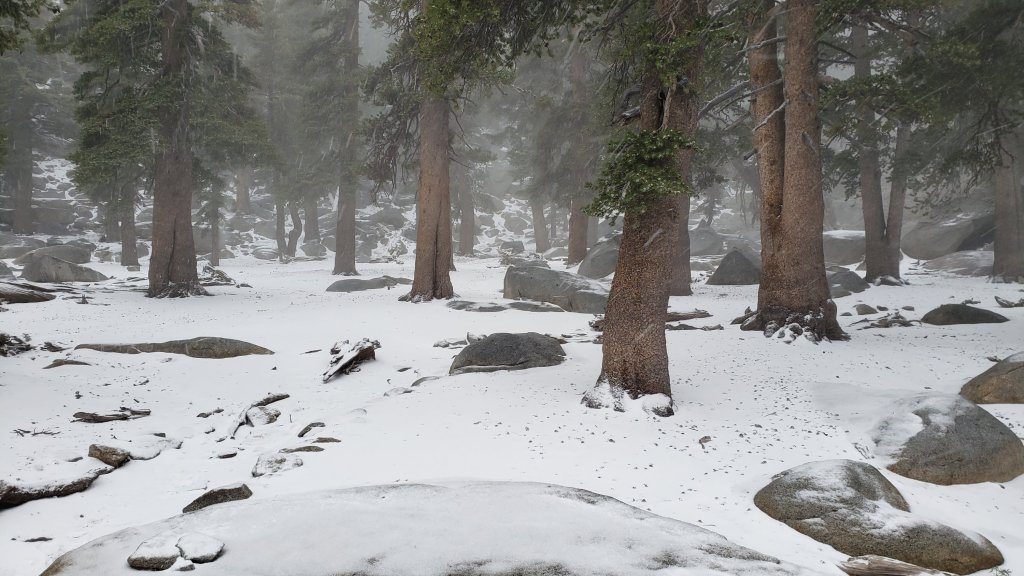
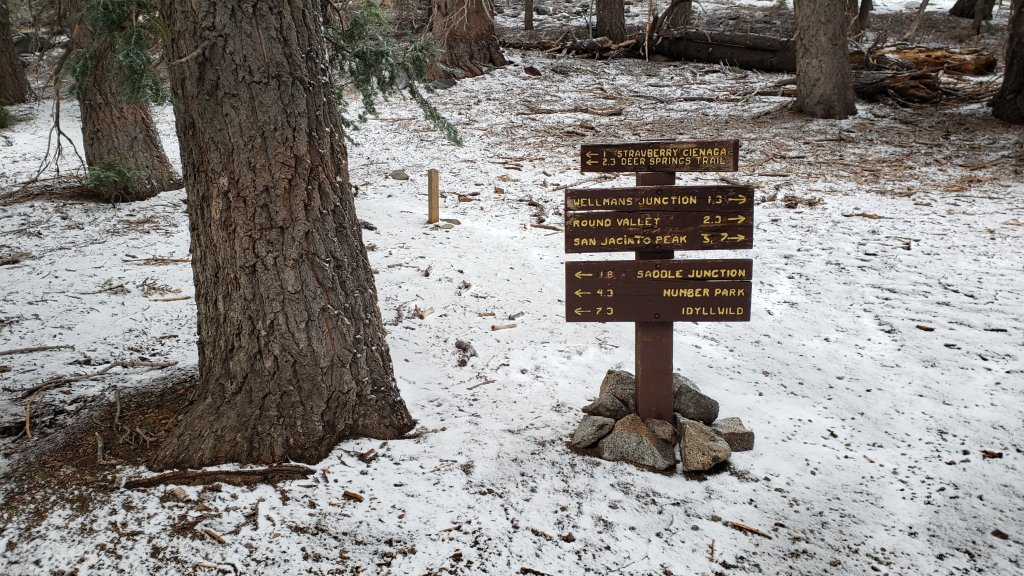
UPDATED Thursday 11th January: A very minor storm overnight produced 0.06 inch of rain and 0.5 inch snow in Idyllwild (at 5550 ft) and a consistent 0.5 inch dusting between Humber Park (6500 ft) and Wellman Divide (9700 ft). There was no evidence of fresh snow at San Jacinto Peak. Strong winds associated with the storm erased all existing tracks and caused major drifting redistributing the snow. Some areas are now 1-2 feet deep, while others are just a couple of inches deep an will melt rapidly. My reasonably well-defined tracks from today are in place where I re-broke trail from Humber Park via Devil’s Slide, Wellman, and Peak trails to/from San Jacinto Peak. Around noon I recorded a short video at San Jacinto Peak (linked here) giving a feel for weather and snow conditions today. A strong warming trend over the next week (at least) will lead to rapid melting at all elevations, especially on sun-exposed slopes. Spikes are recommended everywhere above about 6000 ft.
————————–
In the early hours of 7th January we had our 11th minor storm of this winter, with a very consistent 1-2 inches of fresh snow across all elevations above about 5000 ft, dusting down to 4500 ft. Although remarkably we still haven’t had a major (or even moderate) storm this winter, the cumulative impact on the trails of three minor storms in the past nine days is now similar to one moderate storm.
On the morning of Sunday 7th I broke trail from Humber Park via Devil’s Slide, Wellman, and Peak trails to San Jacinto Peak, joined by friend of the Report and Idyllwild neighbor Bones above Wellman Divide. We both chose to posthole, but snow depths are now sufficient, at least in places and for the next few days (before rapid melting starts) for snowshoeing above 8000 ft, with 5-6 inches total at Saddle Junction (8100 ft) and about 9 inches at San Jacinto Peak. Snow is heavily drifted in trails, for example 12-18 inches deep in a few places on the Wellman and Peak trails, facilitating snowshoeing.
I recorded a short video report from San Jacinto Peak just after noon on Sunday 7th (linked here) giving a feel for the conditions at that time.
On Tuesday 9th January we broke trail across the north side of Tahquitz Peak from Chinquapin Flat (to be fair Anabel did the hard work leading). While average snow depth is only 7-8 inches, it is – as usual – very heavily drifted on that slope, typically 1-3 feet deep. Snow is soft under a thin crust, so postholing is straightforward for which poles are invaluable; many hikers may find spikes or even crampons useful.
Following our hike this morning there are now reliable tracks broken from Saddle Junction through to Tahquitz Peak, and down South Ridge Trail to the top of South Ridge Road. Note Humber Park has reopened and is largely plowed.
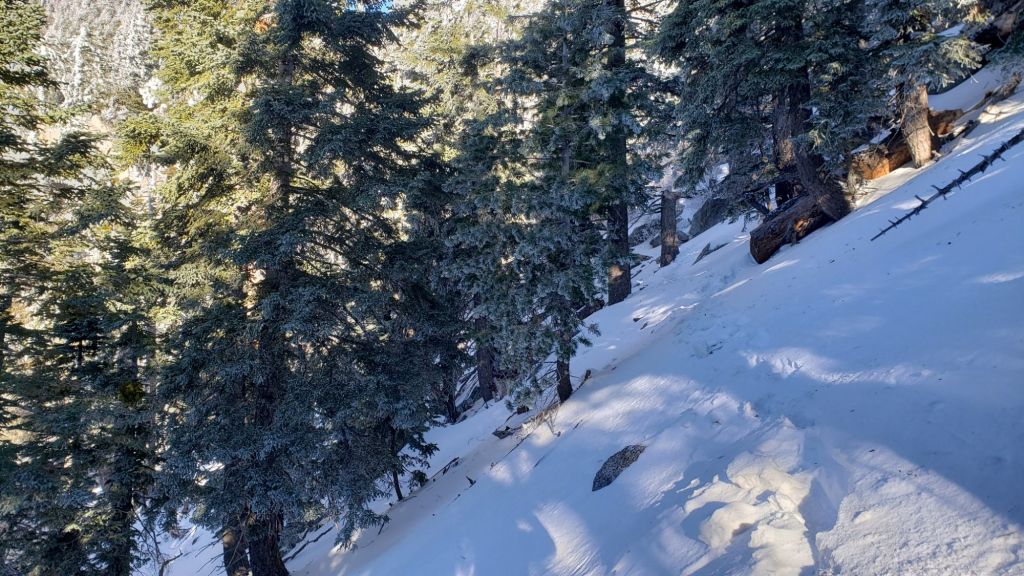
Our fresh posthole tracks across the short section of South Ridge Trail on the north side of Tahquitz Peak, 9th January 2024.
WEATHER
Temperatures will remain below seasonal for the remainder of this week, but a significant warming trend to above seasonal temperatures is forecast after Friday 12th. Two further minor storm systems have been forecast but are not now expected to produce significant precipitation. The next, in the early hours of Thursday 11th January, may produce an inch or two of snow at mid elevations but only a dusting both down to 5000 ft and at higher elevations, and will likely be accompanied by very cold temperatures and strong winds on 11th. Another much warmer system on 13th-14th January may produce light rain at mid elevations, but no snow is expected in the high country, and overall the system is looking increasingly likely to miss the San Jacinto mountains altogether.
In recent weeks, air temperatures above 10,000 ft elevation have been in the 20s Fahrenheit (-6 to -2°C), but lower during and around storm systems. For the first half of January, windchill temperatures at high elevations will generally be well below freezing, potentially below 0°F (-18°C) on days around storm systems. Such conditions require appropriate clothing and equipment for extremely cold conditions.Starting Friday 12th January and continuing into the second half of the month, temperatures at the highest elevations are expected to be well above seasonal, i.e. at or above freezing.
At San Jacinto Peak (3295m/10,810ft) on Sunday 7th January 2024 at 1240 the air temperature was 8.4°F (-13°C),with a windchill temperature of -14.4°F (-26°C), 67% relative humidity, anda fresh WNW wind sustained at 7 mph gusting to 16.1 mph.
At the Peak on Wednesday 3rd January 2024 at 1245 the air temperature was 13.7°F (-10°C),with a windchill temperature of -13.0°F (-25°C), 98% relative humidity, and a bitter WSW wind sustained at 18 mph gusting to 32.4 mph.
At the Peak on Tuesday 2nd January 2024 at 0910 the air temperature was 27.3°F (-3°C), with a windchill temperature of 16.7°F (-8°C), 28% relative humidity, and a fresh due West wind sustained at 6 mph gusting to 8.3 mph.
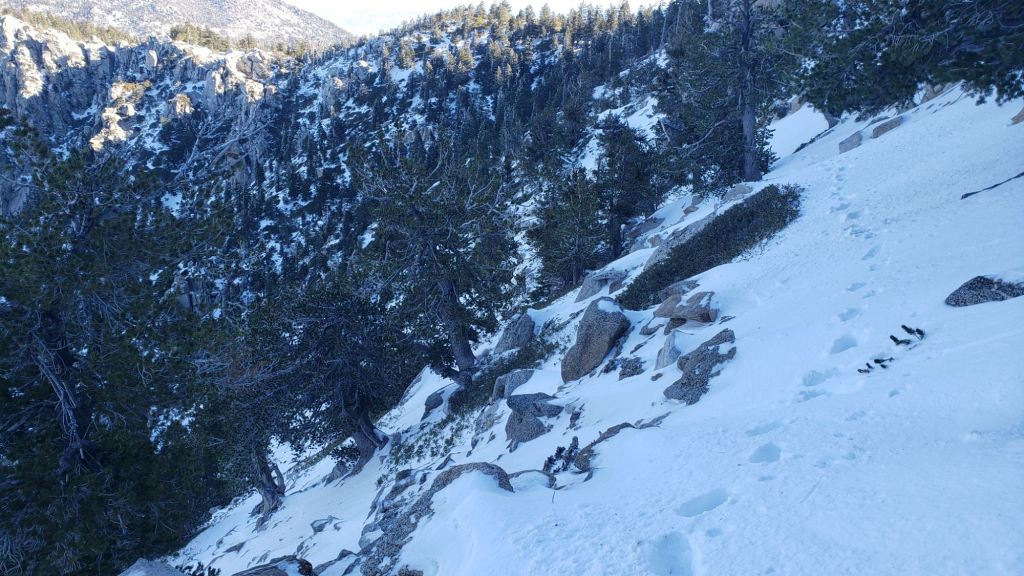
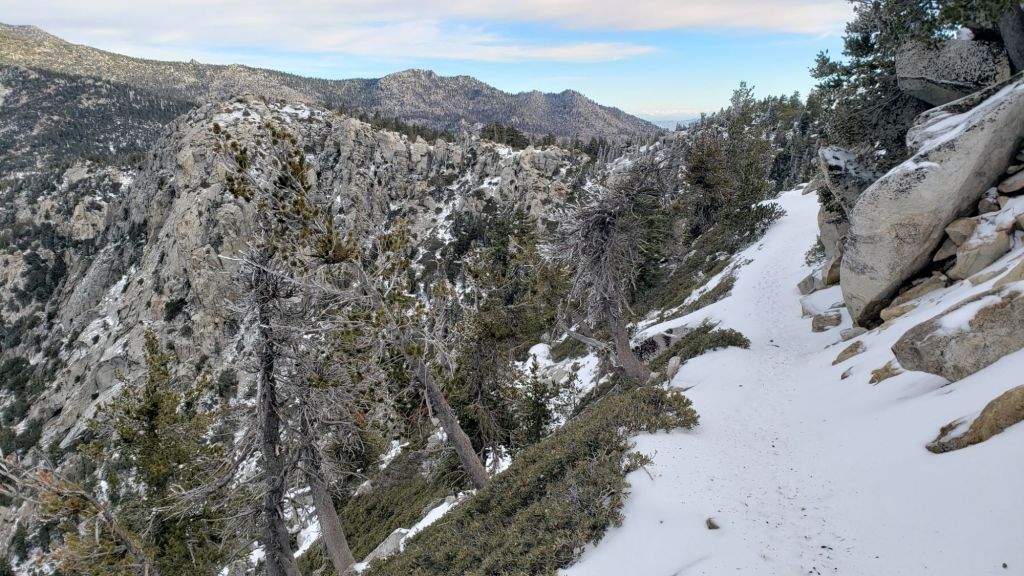
Devil’s Slide Trail at about 7850 ft elevation (between switchbacks 6 and 7), late afternoon on Sunday 7th January 2024. Although average snow depth is only about 5-6 inches in this area, this photo gives a feel for trail conditions in a section prone to heavy drifting. On the morning of 9th January, we had to break sections of this trail again after drifting had largely obscured the route.
TRAIL CONDITIONS
There is continuous light snow cover on all trails above about 5500 ft, becoming moderate (>5 inches) above 8000 ft. Snow depths measured at specific locations are given below.
The only tracks known to be broken through the snow at this time are up Devil’s Slide Trail, onward via the PCT, Wellman and Peak trails to San Jacinto Peak, South Ridge (including on the north side of Tahquitz Peak [photo above]), and the PCT from Saddle south to Chinquapin Flat and north to Annie’s Junction.
Devil’s Slide Trail has been relatively well traveled (photo above) especially in its lower half.
We broke the length of South Ridge Trail on 9th January, including the north side of Tahquitz Peak. The trail south from Tahquitz Peak averages 6-8 inches of snow in the upper switchbacks (obscured by ice fall in places) decreasing to four inches at Old Lookout Flat (7600 ft). Below the Flat the trail is very sun-exposed, snow is only a couple of inches deep, and will clear quickly in warm and sunny days.
The 0.4 mile section of South Ridge Trail between Chinquapin Flat/PCT and Tahquitz Peakhas a single posthole track to follow at this time through 12-30 inches of drifted powder (largely graupel). Spikes are not currently especially helpful due to the soft nature of the snow, but many hikers may consider using them (or even crampons) on this section. Hiking poles are useful.
No tracks were visible on 7th coming up via Deer Springs Trail, nor from Long Valley/Round Valley, either to Wellman Divide or via the Tamarack Valley to join the Peak Trail.
Carrying spikes is recommended everywhere above about 6000 ft at this time. This elevation will rise steadily over the next week or so due to melting especially in sun-exposed areas. Snow depths are now adequate for snowshoes above about 8000 ft. Possible further storms may change these recommendations.
SNOW DEPTHS measured on 7th January 2024 are as follows (or on 9th where indicated). Note that average depth is given; due to strong winds accompanying the storm on 7th, and the mobile nature of graupel, there has been considerable drifting, especially accumulating in trails. Altitudes and PCT mileages are approximate.
San Jacinto Peak (10810 ft): 9 inches (2 inches new snowfall on 7th January)
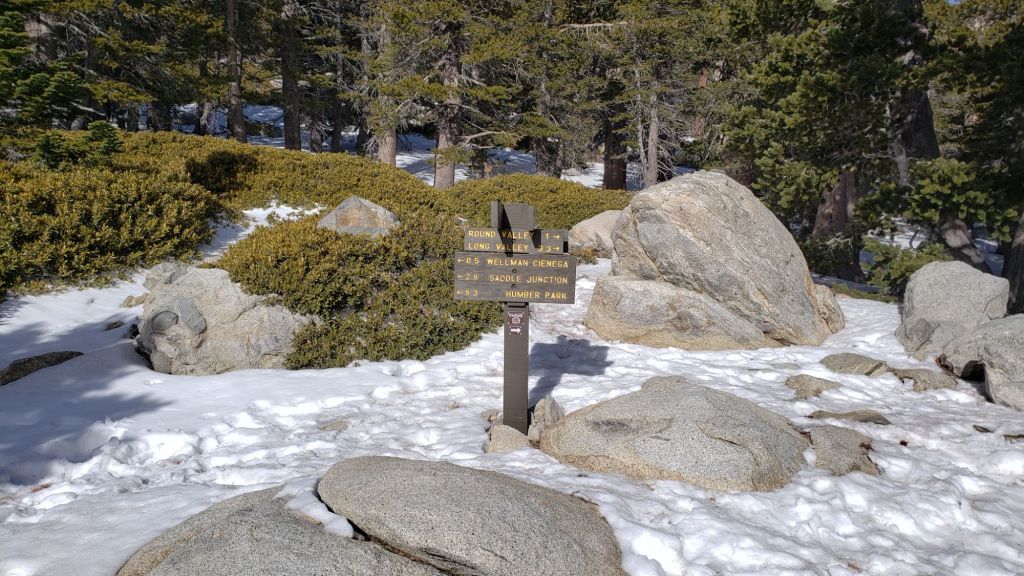
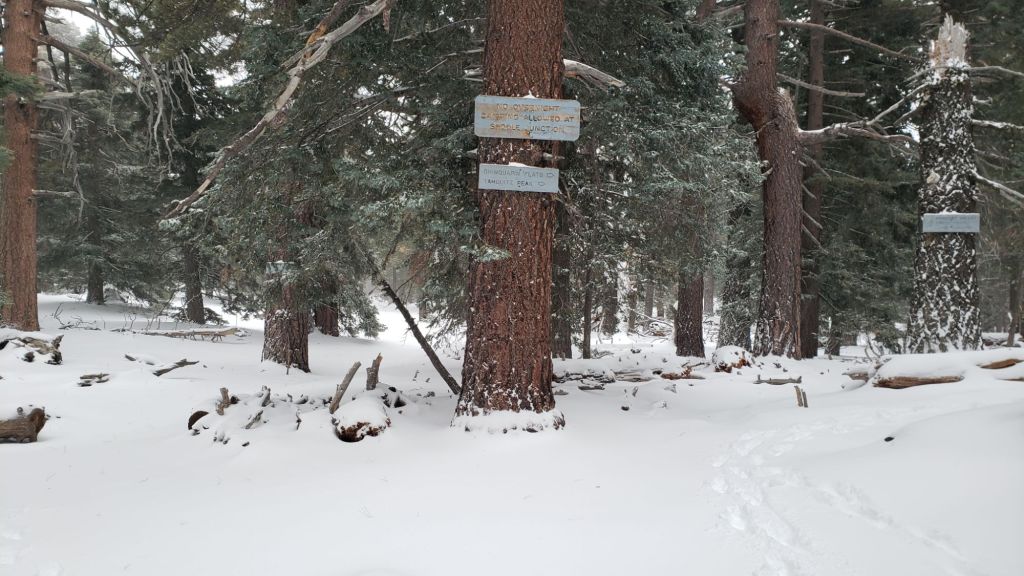
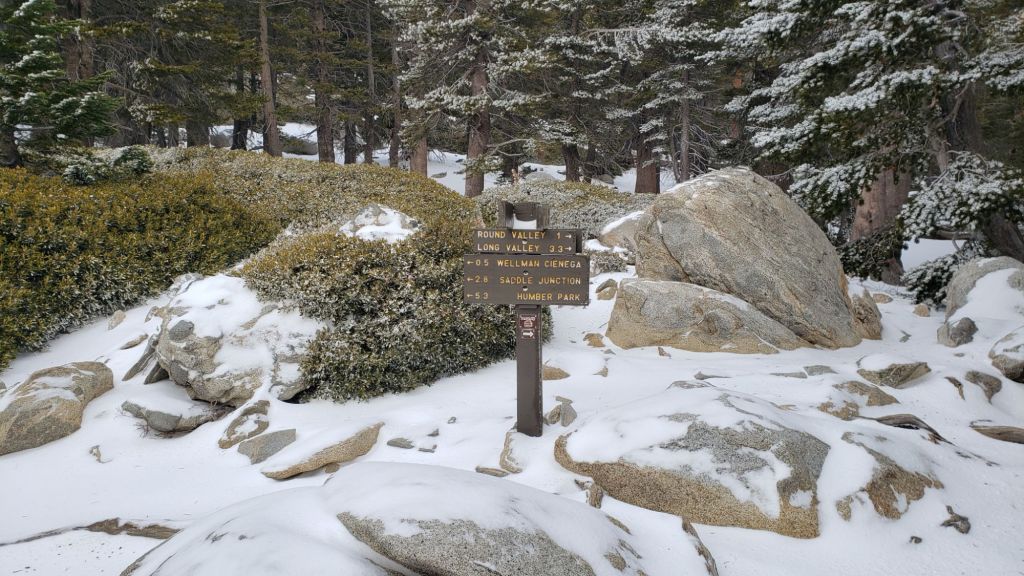
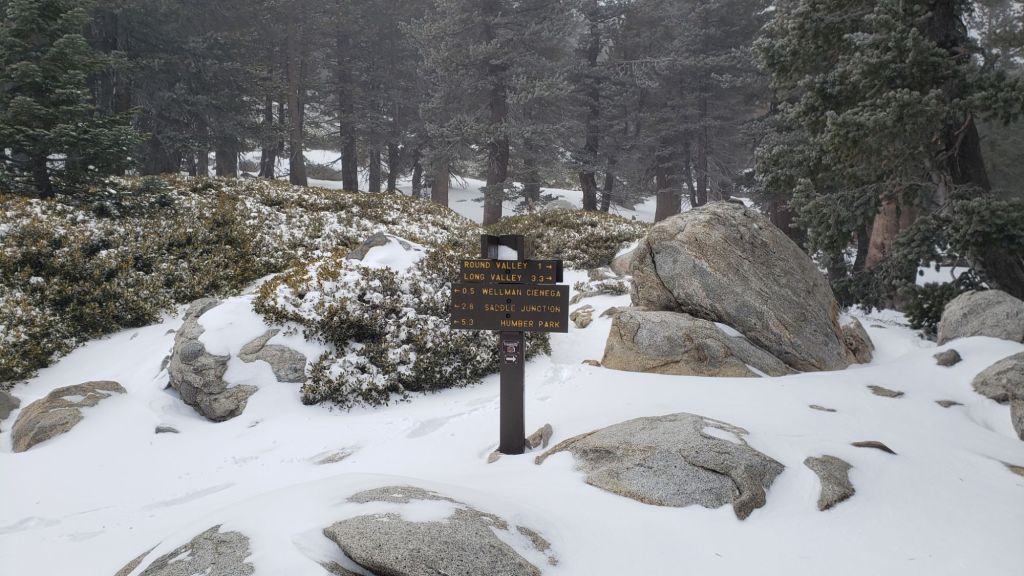
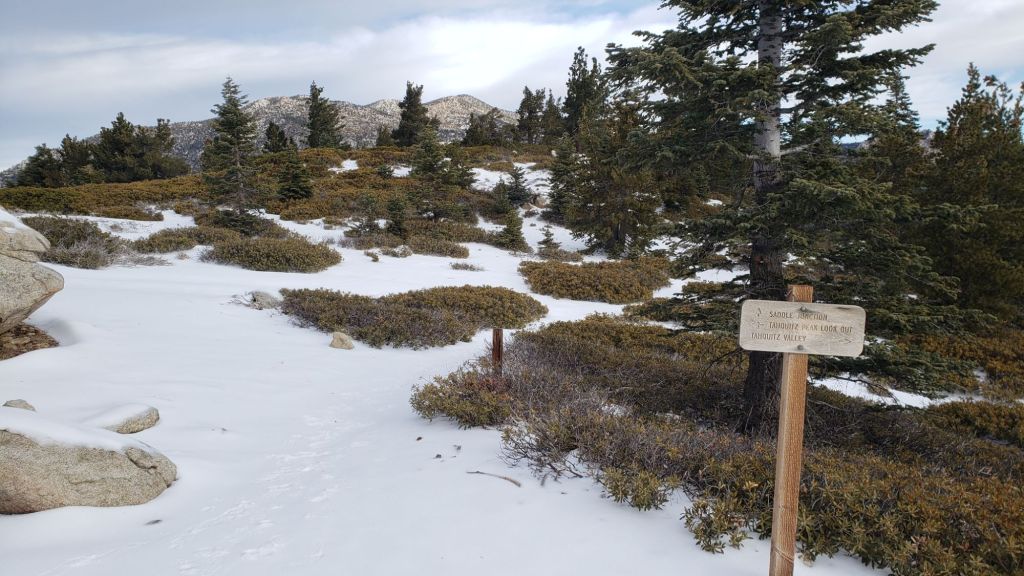
Wellman Divide (9700 ft): 7.5 inches (1.5 inches new snow on 7th, see photo above)
Annie’s Junction/approx. PCT Mile 181.8 (9070 ft): 8 inches (2 inches new snow on 7th), heavily drifted
Tahquitz Peak (8836 ft): 6-7 inches around the Peak itself [measured 9th January]
Saddle Junction/approx. PCT Mile 179.9 (8070 ft): 6 inches (1 inch new snow on 7th)
Old Lookout Flat (7600 ft on South Ridge Trail): 4 inches [measured on 9th January]
Devil’s Slide Trail at Humber Park (6550 ft): 4 inches (2 inches new snow on 7th)
Idyllwild (at 5550 ft): 2 inches, already partly melted by evening of 7th (1.5 inches new snow on 7th)
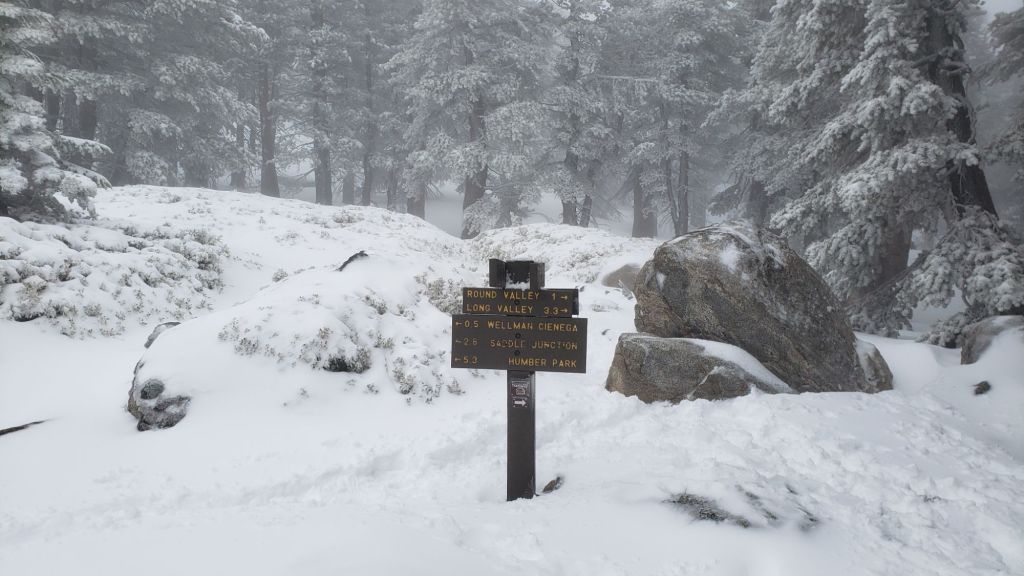
Wellman Divide (9700 ft) with an average snow depth of about 7.5 inches, including 1.5 inches new overnight, late morning 7th January 2024.
While all time and labor is volunteered, the San Jacinto Trail Report uses small private donations to help cover operating costs. Your contribution keeps the Report available to all, free from advertising or paywalls, and independent from agencies. If you have found this Report useful, please consider using this link to the Donate page.Thank you very much for your support.
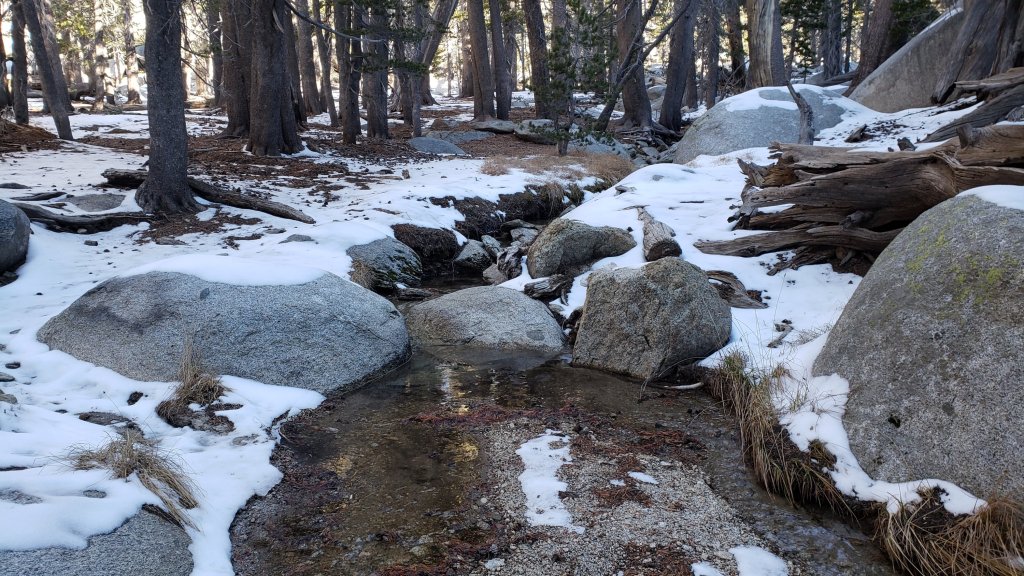
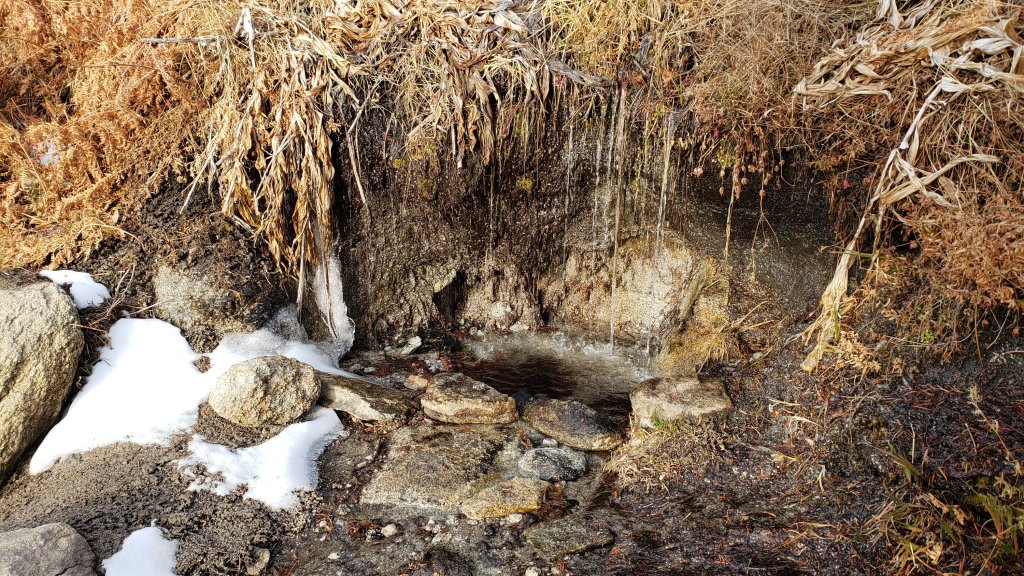
An icy spring at Wellman’s Cienega (9300 ft) still has flowing water, 7th January 2024.Saddle Junction (8100 ft), early morning 7th January 2024. Light snow cover averaging about six inches deep includes an inch that fell in the early hours of that morning.Graupel, the snow equivalent of hail, was a major component of the storms of 3rd and 7th January, phot from north side of Tahquitz Peak, 5th January 2024. Spikes get limited traction in this substrate, hiking poles are often the most valuable piece of equipment in such terrain.The San Jacinto high country as seen from Tahquitz Peak, 5th January 2024. Note the virga (precipitation not reaching the ground) directly above San Jacinto Peak.Spitler Peak Trail at about 6000 ft, 4th January 2024, with an inch of snow on the trail at that elevation. Antsell Rock is in the upper middle and Tahquitz Peak to the distant left in the image.“Bones” and “San Jac Jon”, at a chillier-than-average San Jacinto Peak, noon on 7th January 2024. Photo courtesy of Andrew “Bones” Simpson.
UPDATED Sunday 7th January: overnight we had our 11th minor storm of this winter, with 1.5 inches of fresh snow in Idyllwild and 2.0 inches at San Jacinto Peak. This morning I broke trail from Humber Park via Devil’s Slide, Wellman, and Peak trails to San Jacinto Peak, hiking with friend and neighbor Bones above Wellman Divide. We both chose to posthole, but snow depths are adequate for snowshoeing above 8000 ft, with 5-6 inches total at Saddle Junction (8100 ft) and 10 inches at San Jacinto Peak. Snow is heavily drifted in trails, 12-18 inches deep in places on the Wellman and Peak trails.
Wellman Divide (9700 ft) with an average snow depth of about 8 inches, including 1.5 inches new overnight, late morning 7th January 2024.
UPDATED Friday 5th January: early this morning we broke trail up South Ridge Trail to Tahquitz Peak and across the north side towards Chinquapin Flat (photos below). Snow is shallow south of Tahquitz (3-5 inches) but heavily drifted on the north side (10-20 inches). Snow is soft enough that no traction devices are currently required.
——————————
This is a brief summary of the tenth minor storm of this winter, which impacted the San Jacinto mountains in two phases, in the morning then late afternoon of 3rd January. The main morning storm brought snow to all elevations above about 4800 ft, with two inches in Idyllwild (at 5550 ft) and four inches at San Jacinto Peak. I hiked up through the storm and although it only snowed for about three hours (0730-1030) it was heavy at times, accumulating quickly on top of the remnant 1-2 inches from storms in late December. I recorded a short video report from San Jacinto Peak in the early afternoon (linked here) giving a feel for the conditions at that time.
I had the clearest part of the day around the Peak, but when I left around 1330 more cloud started to roll in. It lightly snowed on/off most of the afternoon and early evening, but then an intense thunderstorm cell passed over the mountain range near dusk as I descended Devil’s Slide Trail. A spectacular hour of “thundersnow” included an intense graupel storm, with many grains 0.25 inch in diameter. As I neared Humber Park, three times in about five minutes I had a remarkable show of sheet lightning reflecting bright bluish light off the immaculate fresh snow all around me. The afternoon storm added another 1-2 inches of snow to upper elevations, and about 0.5 inch in Idyllwild.
The Peak Trail at 10,500 ft looking NNE towards Miller Peak, late morning 3rd January 2024, as the main snow storm cleared.
Humber Park is temporarily closed. There is legal parking for nine vehicles just below the locked gate (an Adventure Pass or equivalent should still be displayed).
WEATHER
Temperatures will remain below seasonal into the second half of January 2024. Two further storm systems are currently forecast. The next, in the early morning of Sunday 7th January, was originally forecast to be a major snow-producing storm, but is now expected to be minor, with only 1-3 inches of snow at upper and mid elevations, and a freeze level again near 5000 ft. Another cold and possibly significant snow-generating storm is tentatively forecast for 11th-14th January; the forecasts remain very uncertain regarding details of timing, depths and elevational distribution of potential snowfall.
Air temperatures above 10,000 ft elevation are now typically in the 20s Fahrenheit (-6 to -2°C), but fall much lower during storm systems. For the first half of January, windchill temperatures at high elevations will generally be far below freezing,often wellbelow 0°F (-18°C) on days during and immediately around storm systems. Such conditions require appropriate clothing and equipment for extremely cold conditions.
At San Jacinto Peak (3295m/10,810ft) on Wednesday 3rd January 2024 at 1245 the air temperature was 13.7°F (-10°C),with a windchill temperature of -13.0°F (-25°C), 98% relative humidity, and a bitter WSW wind sustained at 18 mph gusting to 32.4 mph.
At the Peak on Tuesday 2nd January 2024 at 0910 the air temperature was 27.3°F (-3°C), with a windchill temperature of 16.7°F (-8°C), 28% relative humidity, and a fresh due West wind sustained at 6 mph gusting to 8.3 mph.
The San Jacinto high country as seen from Tahquitz Peak, 5th January 2024. Note the virga (precipitation not reaching the ground) directly above San Jacinto Peak.
TRAIL CONDITIONS
There is continuous light-to-moderate snow cover on all trails above about 5500 ft, with patchy icy snow sections lower in places. Snow depths measured at specific locations are given below.
Tracks known to be broken through the snow at this timeinclude (this is not a comprehensive list): Devil’s Slide Trail via the Wellman and Peak trails to San Jacinto Peak, from Long Valley on the Round Valley Trail to Wellman Divide, South Ridge Trail from South Ridge Road to Tahquitz Peak, most of the trail on the north side of Tahquitz Peak from near Chinquapin Flat to the peak.
Spikes are recommended everywhere above about 6000 ft at this time. This elevation will rise steadily on 4th-6th due to melting especially in sun-exposed areas. Snow depths are adequate (but far from optimal) for snowshoes above about 8000 ft. Depths and snow structure are both generally unsuitable for crampons even at the highest elevations at this time. Further storms forecast for 7th and 11th-13th may change these recommendations.
The 0.4 mile section of South Ridge Trail between Chinquapin Flat/PCT and Tahquitz Peak has a traveled track (photo below) to follow through 10-20 inches of drifted powder (largely graupel). Spikes are not currently helpful due to the soft nature of the snow, but many hikers may find carrying them useful, depending on their comfort level hiking in variable snow conditions.
SNOW DEPTHS measured on 3rd and 5th January 2024 are as follows. Note that average depth is given; due to strong winds accompanying storms, and the mobile nature of graupel, there has been considerable drifting, especially accumulating in trails. Altitudes and PCT mileages are approximate.
San Jacinto Peak (10810 ft): 7 inches (4-5 inches new snowfall on 3rd January)
Wellman Divide (9700 ft): 5 inches (4 inches new snow, see photos below)
Round Valley (9100 ft): 5 inches total [special thanks to Kyle Eubanks for this information]
Old Lookout Flat (7600 ft, 1.9 miles up South Ridge Trail from South Ridge Road): 3.5 inches [measured 5th January]
Devil’s Slide Trail at Humber Park (6550 ft): 3 inches (all new snow on 3rd)
Idyllwild (at 5550 ft): 2.5 inches (all new snow on 3rd)
Short section of South Ridge Trail on the north side of Tahquitz Peak between Chinquapin Flat and the fire lookout, 5th January 2024. Although average snow depth is only about five inches, the graupel dominated snow is heavily drifted, 1-2 feet deep in places.My ascending tracks breaking trail in the upper switchbacks of South Ridge Trail just south of Tahquitz Peak, 5th January 2024.Graupel, the snow equivalent of hail, was a major component of the storm of 3rd January, and currently forms drifts at least one foot deep on the north side of Tahquitz Peak, 5th January 2024. Spikes get limited useful traction in this substrate, hiking poles may be the most valuable piece of equipment in such terrain.
While all time and labor is volunteered, the San Jacinto Trail Report uses small private donations to help cover operating costs. Your contribution keeps the Report available to all, free from advertising or paywalls, and independent from agencies. If you have found this Report useful, please consider using this link to the Donate page.Thank you very much for your support.
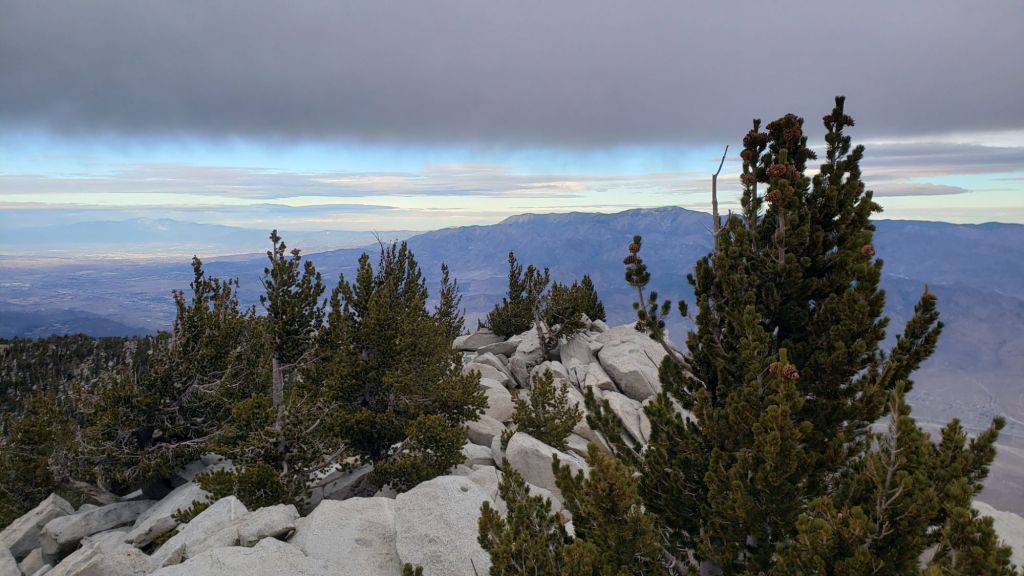
Spitler Peak Trail at about 6000 ft, 4th January 2024, with an inch of snow on the trail at that elevation. Antsell Rock is in the upper middle and Tahquitz Peak to the distant left in the image.The view north-west towards the San Bernardino Mountains from San Jacinto Peak, early afternoon on 3rd January 2024, with a sparsely distributed fresh snowfall of 3-4 inches at that time.Saddle Junction (8100 ft), late afternoon 3rd January 2024. Light snow cover averaging about four inches deep includes an inch that fell on 30th December 2023.Above, Wellman Divide (9700 ft) with just an average of one inch of fresh snow, early morning 31st December 2023, and below, the same view mid afternoon on 3rd January 2024, with an additional fresh snowfall of about four inches, for a total of at least five inches.
UPDATE Wednesday 3rd January 2024: the minor storm this morning brought snow to all elevations above about 4500 ft, with two inches in Idyllwild (at 5550 ft) and four inches here at San Jacinto Peak. I hiked up through the storm and it snowed only for about three hours (0730-1030) but quite heavily at times, accumulating quickly on top of the existing 1-2 inches remaining from storms in late December.
I recorded a short video report from San Jacinto Peak at about 1300 this afternoon (linked here).
The Peak Trail at 10,500 ft looking NNE towards Miller Peak, late morning 3rd January 2024, as the snow storm cleared.
—————————
The San Jacinto mountains are now in or near part of the track of the prevailing jet stream (which averaged much further north throughout November-December) and consequently three storm systems are possible in the first two weeks of January 2024. A minor system on Wednesday 3rd is expected to be much colder than those earlier this winter, with a dusting of snow possible to 5000 ft (i.e., including Idyllwild), and 2-4 inches in the high country. The coldest system of this winter so far is forecast for 6th-7th January, with a snow level near or even below 4000 ft. However, in a dramatic late shift in the forecasts, that storm is now expected to bring much less snow than originally expected, with amounts probably similar to the system on 3rd. Finally another very cold and possibly significant snow storm is forecast for Thursday 11th January, with expected snow amounts perhaps greater than the two previous storms.
The ninth minor storm of this winter so far impacted the San Jacinto mountains on Saturday 30th December. It produced light rain and some hail in Idyllwild adding up to 0.35 inch. A dusting of snow across the high country included 0.25 inch of snow as low as Humber Park (6500 ft), one inch at Saddle Junction (8100 ft) and Wellman Divide (9700 ft) with 1.5 inches at San Jacinto Peak.
Trails are now generally clear of snow below 6700 ft elevation, and are clearing slowly on sun-exposed slopes up to 7500 ft, sometimes higher in places. However trails are becoming increasingly icy higher up as very thin snow is compacted by hiker traffic and following freeze-thaw cycles.Spikes are recommended everywhere above about 7000 ft at this time, although hikers experienced with icy snow travel may find them of limited use. Snow depths are insufficient for snowshoes or crampons even at the highest elevations. This advice may change soon with three snow-producing storms forecast over the next 10-12 days, much lower snow levels, and very cold temperatures.
Daily survey hikes in the San Jacinto mountains include various routes to San Jacinto Peak multiple times per week (most recently on 31st December and 2nd January), Tahquitz Peak and area at least once per week (most recently on 1st January), plus a wide variety of other trails on intervening days.
Water sources such as creeks, pipes, and springs largely continue to flow well for the time of year, thanks to the intensity of last winter plus various storms since August. So far they have not frozen in recent cold weather, however that may change next weekend given the expected temperatures and snowfall.
South Ridge Road (5S11) was graded on 15th October and reopened in mid November. May Valley Road (5S21) was fully graded in October, and is now much more user-friendly for both hikers and bikers. Dark Canyon Road (4S02) remains closed indefinitely, although the dirt section was partly graded in early October.
Black Mountain Road (4S01) was in its poorest condition for at least a decade by June this year. The partial grading undertaken in July improved the situation, but it remains a bumpy drive. Seasonal campgrounds and fire lookouts all closed for the winter by mid November.
A rarely seen but remarkable effect, as clouds from a “desert layer” over the Coachella Valley (left side of the image) spill westwards over the Desert Divide, as seen looking south from Tahquitz Peak, early morning 1st January 2024. It is much more typical to see clouds from the commonly occurring marine layer moving eastwards towards the Coachella Valley. South Peak is in the foreground on the left, and the Santa Rosa mountains are in the distance to the right.
WEATHER
Temperatures are forecast to be largely below seasonal at least into the second week of January 2024. Three cold storm systems are expected in the first half of January 2024. A minor system on Wednesday 3rd will be much colder than those so far this winter, with a dusting of snow possible to 5000 ft (i.e., including Idyllwild), and 2-4 inches in the high country. The coldest system of this winter so far is forecast for 7th January, with several inches of snow possible >10,000 ft elevation and a snow level near or even below 4000 ft. Finally another very cold and possibly significant snow-generating storm is tentatively forecast for Thursday 11th January, with expected snow amounts and elevational distribution expected to be greater than the previous two storms, but much uncertainty remains.
Air temperatures above 10,000 ft elevation are now typically in the 20s Fahrenheit (-6 to -2°C). For the first half of January, windchill temperatures at high elevations will generally be far below freezing,often wellbelow 0°F (-18°C) on days during and immediately around storm systems. Such conditions require appropriate clothing and equipment for extremely cold conditions.
At San Jacinto Peak (3295m/10,810ft) on Tuesday 2nd January 2024 at 0910 the air temperature was 27.3°F (-3°C), with a windchill temperature of 16.7°F (-8°C), 28% relative humidity, and a fresh due West wind sustained at 6 mph gusting to 8.3 mph.
At the Peak on Sunday 31st December 2023 at 0915 the air temperature was 25.4°F (-4°C), with a windchill temperature of 13.3°F (-10°C), 17% relative humidity, and a light but cool due West wind sustained at 7 mph gusting to 10.6 mph.
At the Peak on Wednesday 27th December 2023 at 1015 the air temperature was 33.7°F (1°C), with a windchill temperature of 20.1°F (-7°C), 19% relative humidity, and a chilly WNW wind sustained at 10 mph gusting to 17.8 mph.
The pre-dawn light was spectacular on Wednesday 27th December, even by the high standards of the San Jacinto mountains. San Jacinto Peak is in the distant center of the image, as seen from Black Mountain Road (near the PCT crossing) at 0638 that morning.
TRAIL CONDITIONS
There is continuous thin snow cover on almost all trails above about 7000 ft, with patchy icy snow sections as low as 6500 ft in places. Major trails largely have well-defined tracks through the snow at this time.
Even very thin snow has become icy in places on well-traveled trails due to freeze-thaw cycles and compaction by hiker traffic. Spikes are consequently recommended everywhere above about 7000 ft at this time. Snow depths are insufficient for snowshoes or crampons even at the highest elevations. Snow on sun-exposed slopes below 8000 ft is very thin but is unlikely to melt in the next couple of days.
Deer Springs Trail below Strawberry Junction (8100 ft) is partly clear of snow. From Strawberry Junction to San Jacinto Peak the snow cover is continuous. Spikes are useful, especially for descending the upper trail.
Marion Mountain Trail is largely covered with thin icy snow, with only the lowest 0.5 mile clear of snow. Snow is 0.5 inch deep lower down, increasing to two inches high up. Spikes are useful for descending the upper trail especially.
Devil’s Slide Trail is already largely clear of snow to 7000 ft. Thin snow cover is largely continuous on the middle and upper trail and is becoming very icy. Spikes are useful, especially for descending.
The Wellman and Peak trails, although both largely open and sun-exposed, currently remain snow-covered. A well-traveled track comes up to Wellman Divide from Long and Round valleys, with continuous snow above Round Valley at least.
Trails on the north side of Tahquitz (photo below) and Red Tahquitz peaks, including PCT Miles 175.5-177.5, and around the Tahquitz areameadows, remain fully covered with thin snow. Snow is at its deepest on the north side of Tahquitz Peak (2-4 inches deep) but the trail is neither icy nor angled by drifting. South Ridge Trail south from Tahquitz Peak is almost completely snow-covered down to Old Lookout Flat at 7600 ft (surveyed 1st January) but the snow is very thin and not too icy (spikes are recommended for descending the upper switchbacks at least). The trail is functionally clear of snow below 7600 ft.
Fuller Ridge Trail has continuous snow cover (surveyed 27th December), although nowhere is the snow depth greater than about three inches in the trail. The most sun-exposed sections of the trail are partially clearing of snow.
Tropical Storm Hilary in late August resulted in one or two new treefall hazards on most trails, but only Willow Creek and Fuller Ridge trails were more significantly impacted.
Please see the Trail Conditions section of the previous Report (linked here) for details of the current status of treefall hazards and obstructions on the following trails: Willow Creek Trail, Fuller Ridge Trail, Deer Springs Trail, Skunk Cabbage and Tahquitz area meadows, South Ridge Trail, Marion Mountain Trail, Spitler Peak Trail, Caramba Trail, and Seven Pines Trail.
Elsewhere on the PCT treefall hazards remain a problem in many places, most notably between Apache Peak and Red Tahquitz, where I counted at least 106 between Miles 169-175 in late 2023. Large downed trees make for especially slow-going around Miles 172-175 (a section severely impacted by the July 2013 Mountain Fire).
Well-defined track through 2-4 inches of snow on the short section of South Ridge Trail on the north side of Tahquitz Peak, 1st January 2024. This very sheltered slope traditionally melts slowly, especially at this time of year. Some hikers will find spikes useful on this trail.
SNOW DEPTHS measured on 31st December 2023 are as follows. Note that average depth is given; due to strong winds accompanying storms there has been drifting, often accumulating in the trails. Altitudes and PCT mileages are approximate.
San Jacinto Peak (10810 ft): 2-3 inches (1.5 inches fresh snowfall on 30th December 2023)
Little Round Valley (9750 ft): 3 inches, drifted deeper in places
Wellman Divide (9700 ft): 1.5 inches (1 inch new snow on 30th December)
Annie’s Junction/approx. PCT Mile 181.8 (9070 ft): 2 inches (1.5 inches fresh snowfall on 30th December 2023)
Tahquitz Peak (north side trail, 8700 ft): 2-4 inches, drifted deeper in places [measured 1st January 2024]
Tahquitz Peak (south side trail, 8500-8700 ft): 0.5-1 inch [measured 1st January 2024]
Long Valley (8600 ft): 0.5 inch on 31st December 2023
Saddle Junction/approx. PCT Mile 179.9 (8070 ft): 1.5 inches (1 inch new snow on 30th December)
Devil’s Slide Trail at Humber Park (6550 ft): patchy 0.5 inch on 31st December, already melted
Idyllwild (at 5550 ft): 0 inch
Saddle Junction (8100 ft), 1st January 2024. Thin snow cover averaging two inches deep includes an inch that fell on 30th December 2023.
While all time and labor is volunteered, the San Jacinto Trail Report uses small private donations to help cover operating costs. Your contribution keeps the Report available to all, free from advertising or paywalls, and independent from agencies. If you have found this Report useful, please consider using this link to the Donate page.Thank you very much for your support.
Chinquapin Flat (8500 ft, PCT Mile 177.7), 1st January 2024, under an average of two inches of snow. The San Jacinto high country is visible in the distance.Wellman Divide (9700 ft) with just an average of one inch of fresh snow, early morning 31st December 2023.A very icy (but still flowing) spring at Wellman’s Cienega (9300 ft), 31st December 2023.A typical view of Fuller Ridge Trail conditions, 27th December 2023, near PCT Mile 187.7. Folly Peak is just off behind the trees to the left side of the image.An icy North Fork of the San Jacinto River where it crosses Fuller Ridge Trail at about PCT Mile 186.1, late morning on 27th December 2023. The river was flowing well, albeit largely under the ice.Annie’s Junction (9070 ft, PCT Mile 180.8), early morning on 25th December 2023, with about two inches of average snow depth. Between partial melting and a fresh inch of snow on 30th, this view was essentially unchanged on 31st December.
UPDATE Sunday 31st December@ 0945: yesterday’s minor storm produced light rain and some hail in Idyllwild adding up to 0.35 inch. A dusting of snow across the high country has included 0.25 inch of snow as low as Humber Park (6500 ft), one inch at Saddle Junction (8100 ft) and Wellman Divide (9700 ft) with 1.5 inches at San Jacinto Peak. Carrying spikes is strongly recommended above 6000 ft. Snow depths remain insufficient for crampons or snowshoes. That advice will change next week with three storms forecast over the next 10 days.
—————————
The forecast for the next ten days is unsettled, with three storms of steadily increasing intensities expected. A minor storm is forecast for Saturday 30th December, with light rain (0.3 inch) at mid elevations and light snow (1-3 inches) in the high country. Another minor system on 3rd-4th January is expected to be much colder, with a dusting of snow down to 5000 ft (i.e., likely including Idyllwild), and 2-6 inches in the high country. The most significant system is tentatively forecast for 6th-7th January, with as much as 1-2 feet of snow possible >10,000 ft elevation, several inches of snow at mid elevations, and a snow level near or even below 4000 ft.
A slow-moving, multiday, but ultimately minor storm system impacted the San Jacinto mountains across 18th-22nd December, with the bulk of the light snowfall on 22nd. Thin snow cover remains on the trails (>7700 ft) but is not significantly impacting hiking and most major trails already have well-traveled tracks to follow.
Precipitation totals for the storm were at the bottom end of the ranges given by many forecasts. Idyllwild (at 5550 ft) received 0.61 inch of rain across the five days, while 0.67 inch fell at Saddle Junction (8100 ft) on 18th-21st before turning to snow at that elevation on 22nd. Some of the early days of the system were warm enough that precipitation fell as freezing rain, rather than snow, as high as San Jacinto Peak on both 19th and 20th.
Most snow fell on Friday 22nd, with just very light dustings at the highest elevations on 18th and 20th. Snowfall totals included four inches at San Jacinto Peak, of which 3.5 inches were on 22nd, three inches at Wellman Divide (9700 ft) and Little Round Valley (9750 ft), and two inches at Saddle Junction. Long Valley (8600 ft) had about two inches of snow on 22nd, with light rain in the days prior.
I recorded a short video report from San Jacinto Peak at 0830 on Friday 22nd which gave a feel for conditions immediately following the main snowfall (linked here). As a relatively warm system, no significant snow fell below 7500 ft, with just a dusting down to 7200 ft.
Trails are clear of snow below 7700 ft elevation, and are clearing steadily on sun-exposed slopes up to 8900 ft. Conversely, trails are becoming increasingly icy higher up as very thin snow is compacted by hiker traffic and following freeze-thaw cycles.Spikes are recommended everywhere above about 8000 ft at this time, although hikers experienced with icy snow travel may find them of limited use. Snow depths are insufficient for snowshoes or crampons even at the highest elevations.
Daily survey hikes in the San Jacinto mountains include various routes to San Jacinto Peak multiple times per week (most recently on 20th, 21st, 22nd, 25th, and 27th December), Tahquitz Peak and area at least once per week (most recently on 19th and 24th December), plus a wide variety of other trails on intervening days.
Water sources such as creeks, pipes, and springs largely continue to flow well for the time of year, thanks to the intensity of last winter plus various storms since August, and they have not frozen in recent cold weather. Ephemeral water sources have now largely dried, but campers and hikers will still generally find water wherever they are expecting it.
South Ridge Road (5S11) was graded on 15th October and reopened in mid November. May Valley Road (5S21) was fully graded in October, and is now much more user-friendly for both hikers and bikers. Dark Canyon Road (4S02) remains closed indefinitely, although the dirt section was partly graded in early October.
Black Mountain Road (4S01) was in its poorest condition for at least a decade by June this year. The partial grading undertaken in July improved the situation, but it remains a bumpy drive. Seasonal campgrounds and fire lookouts all closed for the winter by mid November.
Spectacular and complex multi-layer clouds between San Jacinto Peak (foreground left) and San Gorgonio (hidden in the cloud distant right), as seen immediately after the most recent storm passed, early morning 22nd December 2023. At that time, about 2.5 inches of snow had fallen at San Jacinto Peak, and a further inch fell that afternoon.
WEATHER
Temperatures are forecast to be above seasonal until Saturday 30th December, before largely dropping below seasonal at least into the second week of January 2024. While a relatively warm week could facilitate melting, most days for the foreseeable future will be partly or mostly cloudy, potentially slowing snowmelt somewhat.
Thenext minor storm is forecast for Saturday 30th December, with light rain (<0.3 inch) at mid elevations and snow (<3 inches) in the high country. Another minor system on 3rd-4th January is expected to be much colder, with a dusting of snow likely down to Idyllwild, and a few inches in the high country. Yet another system is tentatively forecast for 6th-8th January, and may be both very cold – with a freeze level down to 4000 ft – and bring heavier precipitation (10-20 inches of snow in the high country possible).
Air temperatures above 10,000 ft elevation are now typically in the 20s-mid 30s Fahrenheit (-5 to 3°C). From 30th December into mid January, windchill temperatures at high elevations will generally be far below freezing,below 0°F (-18°C) on most days. Such conditions require appropriate clothing and equipment for very cold conditions.
At San Jacinto Peak (3295m/10,810ft) on Wednesday 27th December 2023 at 1015 the air temperature was 33.7°F (1°C), with a windchill temperature of 20.1°F (-7°C), 19% relative humidity, and a chilly WNW wind sustained at 10 mph gusting to 17.8 mph.
At the Peak on Monday 25th December 2023 at 0910 the air temperature was 31.6°F (0°C), with a windchill temperature of 17.3°F (-8°C), 43% relative humidity, and a sharp NW wind sustained at 11 mph gusting to 18.6 mph.
At the Peak on Friday 22nd December 2023 at 0825 the air temperature was 22.0°F (-6°C), with a windchill temperature of 2.7°F (-16°C), 91% relative humidity, and a bitter due South wind sustained at 13 mph gusting to 24.5 mph.
The pre-dawn light was spectacular on Wednesday 27th December, even by the high standards of the San Jacinto mountains. San Jacinto Peak is in the distant center of the image, as seen from Black Mountain Road (near the PCT crossing) at 0638 that morning.
TRAIL CONDITIONS
There is continuous thin snow cover on almost all trails above about 8500 ft, patchy icy snow sections as low as 7700 ft in places, and trails are completely clear of snow below 7700 ft elevation (higher in places; details below). Major trails have well-defined tracks through the thin remnant snow at this time, with the exception of Seven Pines Trail (as of 25th December).
Even very thin snow has become icy in places on well-traveled trails due to freeze-thaw cycles and compaction by hiker traffic. Spikes are consequently recommended everywhere above about 8000 ft at this time. Snow depths are insufficient for snowshoes or crampons even at the highest elevations.
Snow on sun-exposed slopes below 10,000 ft is very thin and is expected to largely melt in the next couple of days, but the sun angle is so low in late December that melting will be slow in traditionally sheltered areas, such as the north side of Tahquitz Peak, trails 0.4 mile either side of Annie’s Junction (PCT Mile 180.8), and some upper sections of Deer Springs Trail.
Deer Springs Trail below Strawberry Junction (8100 ft) is clear of snow. Thin snow covers about 60% of the trail between Strawberry Junction and the top of Marion Mountain Trail (8700 ft). From the Marion Mountain Trail junction to San Jacinto Peak the snow cover is continuous. Spikes are useful for descending the upper trail.
Marion Mountain Trail is largely clear of snow in its lower third, but thin icy snow remains on the upper tow-thirds. Even very shallow snow traditionally persists in the least exposed central section of the trail for weeks.
Devil’s Slide Trail is now functionally clear of snow to 7700 ft (about 0.5 mile before Saddle Junction). Snow cover is largely continuous on the upper trail and is becoming very icy. Spikes are useful, especially for descending.
The Wellman and Peak trails, both largely open and sun-exposed, currently remain largely snow-covered, but are expected to steadily clear of snow. Persistent areas of snow will remain in forested sections. A well-traveled track comes up to Wellman Divide from Long and Round valleys, with largely continuous snow above Round Valley at least.
Trails on the north side of Tahquitz (photo below) and Red Tahquitz peaks, including PCT Miles 175.5-177.5, and around the Tahquitz areameadows, remain fully covered with thin snow due to their northerly exposure, drifting, and/or forest cover. South Ridge Trail south from Tahquitz Peak is largely clear of snow (surveyed 24th December) but the uppermost switchbacks near the peak have a thin continuous icy snow cover (spikes are recommended for descending those switchbacks).
Fuller Ridge Trail has about 65% snow cover (surveyed 27th December), although nowhere is the snow depth greater than about two inches in the trail. The most sun-exposed sections of the trail are completely clear of snow. There are now reliable tracks to follow through the snow sections along the entire length of the trail.
Tropical Storm Hilary in late August resulted in one or two new treefall hazards on most trails, but only Willow Creek and Fuller Ridge trails were more significantly impacted.
The rough route cleared along Willow Creek Trail in early August remarkably lasted only two weeks before Tropical Storm Hilary brought down 19 new treefall hazards. Of the seven that came down on the Forest Service section, five were removed in early November. One huge trunk remains just east of Willow Creek that most hikers will find challenging to pass. Of the 12 on the State Park section, eight were cut in late August, and there is a cleared route from Long Valley to Hidden Divide, but four remain uncut between the divide and the Forest Service boundary. The whitethorn trimming is inconsistent and scrappy but overall the trail is more passable than it was as recently as July. Eight trees – of the 60+ down after last winter – remain to be cut on the USFS section for the original trail route to be fully restored, but that will not happen this year, if ever.
Fuller Ridge Trail (PCT Miles 185.5-190.5) has 11 treefall hazards, several of which are large and challenging to pass. The Forest Service section (Miles 189-190.5) was largely cleared and thoroughly raked in September, and is in its best condition for a decade. However the huge double treefall just 0.35 mile from the campground remains. Sadly the State Park section (Miles 185.5-189) remains a mess, with considerable debris remaining from the winter and recent storms, including nine significant treefall hazards.
Deer Springs Trail has had a few treefall hazards removed by the State Park in the past month, but at least seven significant problems remain below the Fuller Ridge Trail junction dating back to last winter. Almost all of the 12 downed trees above Fuller Ridge on upper Deer Springs Trail date back some 6-10 years and have been reported to the State Park multiple times (never resulting in meaningful action).
Trails around the Skunk Cabbage and Tahquitz area meadows have some significant treefall hazards remaining from last winter (resurveyed November 2023). There are six on the PCT section north from near Mile 177 (the crossing of Tahquitz Creek) to Saddle Junction (roughly Mile 179.3), three on each side of Chinquapin Flat. There are four significant treefalls, including a couple that are not easy to pass, on the Little Tahquitz Meadow trail between the Caramba Trail and the PCT junction, and three on the Skunk Cabbage Meadow trail.
Fourteen treefall hazards from last winter on South Ridge Trail (above the trailhead at the top of South Ridge Road) were removed by the Trail Report in May, and trail trimming has been undertaken regularly. No significant new treefall hazards resulted from Tropical Storm Hilary on this trail, but one minor new one fell in November. The middle section of South Ridge Trail – between May Valley Road and the top of South Ridge Road – is now clear following removal of 20 trees in two sessions this year (15th July and 30th October).
Marion Mountain Trail has five notable treefall hazards in the State Park (upper) half. One new large stump came down in Hilary low down on the Forest Service section, but it is easy to pass.
Ten new treefall hazards on Spitler Peak Trail, largely caused by Tropical Storm Hilary, were removed by the Trail Report in October and November. This brings to 95 the number of trees removed from this trail since July 2021 by the Trail Report. Several minor washouts from last winter in the upper switchbacks have significantly impacted the tread in places; these are not problematic for hikers, but the trail is impassable to stock.
Elsewhere on the PCT treefall hazards remain a problem in many places, most notably between Apache Peak and Red Tahquitz, where I counted 106 between Miles 169-175 in summer 2023. Large downed trees make for especially slow-going around Miles 172-175 (a section severely impacted by the July 2013 Mountain Fire).
The Caramba Trail from near Reeds Meadow through Laws Camp and on to Caramba, and the Cedar Trail from Willow Creek Trail to Laws, are euphemistically described by the Forest Service as “not maintained”. In reality both trails have been abandoned and functionally no longer exist. They are so heavily overgrown with dense whitethorn, which obscures dozens of downed trees, that I strongly advise hikers do not attempt to follow them (regardless of how much you may trust a certain app). An informaluse trail to Laws is much more direct, well maintained, and avoids the challenging bushwhacking of the unmaintained trails (local Idyllwild hikers dubbed it the “King Trail” when I established the route in 2019). It leaves Willow Creek Trail exactly 1.0 mile from Saddle Junction, 0.46 mile from the Skunk Cabbage turning (trailhead at N 33.7796, W-116.6590). The route descends largely following long-established deer trails for 1.2 miles, meeting Willow Creek about 0.2 mile upstream from the site of the historic Laws Camp (the remains of which were destroyed by the 2013 Mountain Fire plus subsequent flood and treefall damage). The 11 trees down on the King Trail after last winter were removed in June, and the five trees brought down by Hilary were removed or diverted around in November 2023. The tread of the trail received some damage from Tropical Storm Hilary. From Laws east to Caramba the route of the original Caramba Trail has been well-cairned by myself and others and can largely be followed with very careful route-finding. My August 2023 survey counted about 110 trees down on this 2.1 miles of trail. It is especially obscure for the first 0.3 mile east of the Willow Creek crossing, becoming more obvious (but still subtle) as it descends towards Caramba. Very cautious navigation is advised throughout the area.
Seven Pines Trail is largely clear of treefall hazards. Five new trees came down across the trail in Tropical Storm Hilary, all in the central mile, but they are readily passable for hikers. Be advised that the trail in general becomes more obscure in the mile closest to its junction with the PCT. The Trail Report has “adopted” Seven Pines Trail as a priority for maintenance work as the trail has had a disproportionate number of lost hiker rescues in the past decade. Since November 2021, more than 70 downed trees have been removed and the trail is thoroughly trimmed and cleared several times per year. Nevertheless Seven Pines remains a genuine wilderness trail unlike the relatively wide, bare, and obvious routes of, for example, Devil’s Slide or Marion Mountain trails. Cautious navigation remains essential for those without considerable experience of hiking this trail.
Well-defined track through 2-3 inches of snow on the short section of South Ridge Trail on the north side of Tahquitz Peak, 24th December 2023. This very sheltered slope historically melts slowly, especially at this time of year. Many hikers may find spikes useful on this trail.Wellman Divide (9700 ft) under two inches of fresh snow, mid morning 22nd December 2023. More than half of this snow had melted by the morning of 25th December.
While all time and labor is volunteered, the San Jacinto Trail Report uses small private donations to help cover operating costs. Your contribution keeps the Report available to all, free from advertising or paywalls, and independent from agencies. If you have found this Report useful, please consider using this link to the Donate page.Thank you very much for your support.
A typical view of Fuller Ridge Trail conditions at present, 27th December 2023. About 65% of that five mile trail is currently under snow, but rarely more than about two inches deep, as shown here with my ascending and descending tracks, near PCT Mile 187.7. Folly Peak is just off behind the trees to the left side of the image.An icy North Fork of the San Jacinto River where it crosses Fuller Ridge Trail at about PCT Mile 186.1, late morning on 27th December 2023. The river was flowing well, albeit largely under the ice.Upper end of Little Round Valley (9800 ft) with a continuous snow cover averaging about three inches deep, 25th December 2023.The junction of Deer Springs and Fuller Ridge trails (8950 ft, PCT Mile 185.5), with an average snow depth of about two inches, 25th December 2023.Annie’s Junction (9070 ft, PCT Mile 180.8), early morning on 25th December 2023, with about two inches of average snow depth.Strawberry Junction (8050 ft, PCT Mile 183), midday on 25th December 2023, functionally clear of snow.Saddle Junction (8100 ft, approx. PCT Mile 179), early morning 25th December 2023, with an increasingly patchy snow cover of up to two inches deep in places.
UPDATE Sunday 24th December: trails are clear of snow below 7500 ft elevation, but are becoming increasingly icy higher up as very thin snow is compacted by hiker traffic and following freeze-thaw cycles. Spikes are strongly recommended everywhere above about 8000 ft at this time. Snow depths are insufficient for snowshoes or crampons even at the highest elevations.
UPDATE Friday 22nd December @ 2010: Precipitation totals for the storm system were rather disappointing. Overnight Idyllwild (at 5550 ft) received 0.28 inch of rain, followed by another 0.12 inch during the day. Long Valley (8600 ft) had about two inches of snow on 22nd, and San Jacinto Peak has an average depth of about 3.5 inches, drifted deeper in places. I recorded a short video report from San Jacinto Peak at 0830 (available here). Snow level dropped down to 7500 ft on Devil’s Slide Trail, with an average depth of one inch at Saddle Junction (8100 ft). Spikes are now useful and recommended everywhere above about 8000 ft elevation.
Well-defined track through 2-3 inches of snow on the short section of South Ridge Trail on the north side of Tahquitz Peak, 24th December 2023.Spectacular and complex multi-layer clouds between San Jacinto Peak (foreground left) and San Gorgonio hidden in cloud 20 miles to the northwest, early morning 22nd December 2023.Wellman Divide (9700 ft) under two inches of fresh snow, mid morning 22nd December 2023.
‐————————————
A slow-moving storm system over Southern California is producing an unpredictable weather pattern for the remainder of this week. Some precipitation is possible daily on 18th-23rd December. Probabilities increase substantially late on Thursday 21st and throughout Friday 22nd.
On our early morning hike to San Jacinto Peak on Monday 18th, we enjoyed a brief little snow storm up top while there was a very light rain throughout the mid and upper elevations. It snowed between 0910-0930, with 0.25 inch settling above 10,400 ft elevation, plus a dusting down to 9900 ft. Rainfall in Idyllwild (5550 ft) and at Saddle Junction (8100 ft) was barely 0.01 inch.
Brief rains overnight on 18th and occasionally on 19th produced a further 0.21 inch of rain in Idyllwild (5550 ft) by the morning of Wednesday 20th, 0.49 inch at Saddle Junction (8100 ft), and 0.32 inch at Wellman’s Cienega (9300 ft). Above that, it was mild enough that precipitation fell as freezing rain rather than snow, all the way to San Jacinto Peak where rocks were covered in a thin layer of ice.
Another very light rain overnight on 20th produced just 0.02 inch of rain in Idyllwild, and a very light snowfall of 0.25 inch above 10,000 ft in the high country, dusting down to about 9000 ft.
At most elevations, relatively warm rains have finally melted what little patchy snow remained from late November (see for example the photo below from the north side of Tahquitz Peak).
The first significant storm of winter 2023/24 is forecast to bring moderate precipitation to all elevations on 21st-22nd December. However, earlier forecasts suggesting 1-2 inches of rain at mid elevations and 1-2 feet of snow around the highest peaks of the San Jacinto mountains have now largely been replaced by more conservative estimates of an inch or less of rain, and 4-8 inches of snow, respectively.
It appears that the bulk of the energy from this storm system will now be west (and perhaps a little north) of the San Jacinto mountain range, as discussed in the latest National Weather Service video report released on 20th December (linked here).
This will be a mild storm system and the freeze level may remain relatively high, with nearly one inch of rainfall forecast for mid elevations (e.g., Idyllwild), and a mix of rain turning to light snow between about 7000-9000 ft mainly on Friday 22nd. The freeze level may eventually drop as low as 7500 ft, but no significant snowfall is currently forecast below about 7000 ft. Snow forecasts for the high country have varied dramatically from 2-20 inchesabove 10,000 ft, although the most recent models favor the lower end of that spectrum. Light snowfall at high elevations may be scattered across several days from 18th-23rd December, becoming moderate at times on Friday 22nd and accumulating to 6-8 inches.
Remaining snow from the minor storms at the end of November has now largely melted. For specific details of trail conditions please see the previous Report linked here.At this time, no traction devices are required anywhere on the trail system, but this will change during the course of the week, notably on 22nd-23rd, when spikes (at least) will become recommended.
Daily survey hikes in the San Jacinto mountains include various routes to San Jacinto Peak multiple times per week (most recently on 18th, 20th, 21st, and 22nd December), Tahquitz Peak and area at least once per week (most recently on 19th December), plus a wide variety of other trails on intervening days.
Air temperatures above 10,000 ft elevation are now generally in the 20s-low 30s Fahrenheit (-5 to 1°C), with windchill temperatures well below freezing. On 21st-23rd December at least, air and/or windchill temperatures may at times be far below freezing, requiring appropriate equipment for very cold conditions. A slight warming to near seasonal temperatures on 25th-29th December is expected to be followed by further cooling around the turn of the year.
At San Jacinto Peak (3295m/10,810ft) on Wednesday 20th December 2023 at 0905 the air temperature was 27.2°F (-3°C), with a windchill temperature of 13.5°F (-10°C), 39% relative humidity, and a cool SSW wind sustained at 8 mph gusting to 14.9 mph.
At the Peak on Monday 18th December 2023 at 0850 the air temperature was 34.9°F (2°C), with a windchill temperature of 20.5°F (-7°C), 68% relative humidity, and a sharp WSW wind sustained at 13 mph gusting to 21.6 mph.
A patchy 0.25 inch depth of snow that fell on Monday 18th remains in sheltered areas above 10,500 ft around San Jacinto Peak, now with a light coating of freezing rain from Tuesday 19th. Photo taken mid morning 20th December 2023.Mild rain overnight on 18th-19th December largely finished the melting of remnant snow from late November on the trail on the north side of Tahquitz Peak. Photo early morning 19th December 2023. Spikes are no longer required to traverse this slope, but this is expected to change with fresh snowfall on 22nd-23rd December.Looking north-west from San Jacinto Peak, mid morning on 18th December 2023. The dramatic dense layer of nimbostratus cloud just above my head briefly produced light snow starting about five minutes after taking this photo.
While all time and labor is volunteered, the San Jacinto Trail Report uses small private donations to help cover operating costs. Every year has its unique challenges, and 2023 has been no exception. Your contribution keeps the Report available to all, free from advertising or paywalls, and independent from agencies. If you have found this Report useful, please consider using this link to the Donate page. Zelle, Venmo, and PayPal are all options. Thank you very much for your support.
Most of the remaining snow from the minor storms at the end of November has now melted. Patchy areas of thin snow, rarely more than 0.5 inch deep, remain on sheltered, largely north-facing, slopes (see Trail Conditions section and photos below). However freeze-thaw cycles and compaction by hiker traffic has led to persistent patches in trails being icy and some hikers may find spikes useful in places. Temperatures remain well above seasonal for December until Tuesday 19th, and melting of remnant snow will continue slowly.
The first significant storm system of winter 2023/24 is expected to bring moderate precipitation to all elevations on 20th-23rd December. The freeze level may remain relatively high, with 1-2 inches of rainfall forecast for mid elevations, and a mix of rain turning to light snow between 6000-9000 ft spread across four days. The freeze level may eventually drop as low as 6500 ft on Saturday 23rd, but no significant snowfall is currently forecast below about 7000 ft. Snow forecasts for the high country range widely from 6-20 inchesabove 10,000 ft. Light to periodically heavy snowfall at high elevations may be scattered across several days from 20th-23rd December.
Daily survey hikes in the San Jacinto mountains include various routes to San Jacinto Peak multiple times per week (most recently on 7th, 11th, and 15th December), Tahquitz Peak and area at least once per week (most recently on 12th-13th December), plus a wide variety of other trails on intervening days. My recent weather observations from San Jacinto Peak are given in the Weather sectionbelow.
Water sources such as creeks, pipes, and springs largely continue to flow well for the time of year, given the intensity of last winter plus various storms since August, and did not freeze in recent cold weather (example photo below and in the prior Report linked here). Many ephemeral water sources have now dried, but campers and hikers will still generally find water wherever they are expecting it.
South Ridge Road (5S11) was graded on 15th October and reopened in mid November. May Valley Road (5S21) was fully graded in October, and is now much more user-friendly for both hikers and bikers. Dark Canyon Road (4S02) remains closed indefinitely, although the dirt section was partly graded in early October.
Black Mountain Road (4S01) was in its poorest condition for at least a decade by June this year. The partial grading undertaken in July improved the situation somewhat, but it remains a bumpy drive. Seasonal campgrounds and fire lookouts are now all closed for the winter.
Sunrise looking south-east from the summit of Red Tahquitz, 13th December 2023. For a few weeks either side of the winter solstice, the sunrise as seen from the San Jacinto mountains is directly behind the Salton Sea.
WEATHER
Temperatures have remained at or above seasonal since 4th December. Snowmelt has been relatively rapid (given the time of year) in most areas below 8000 ft and those exposed to direct sunlight, but the sun angle is so low in December that melting has been slow in sheltered areas. Most days for the foreseeable future will be at least partly cloudy, slowing the rate of melting, with temperatures dropping to seasonal around Monday 18th December and then below average for several days from 20th December.
A storm system forecast for 20th-23rd December is expected to bringmoderate precipitation to all elevations. The freeze level is currently predicted to remain relatively high, with 0.8-1.5 inches of rainfall at mid elevations spread across three or four days, and a mix of rain becoming light-to-moderate snow between 6000-9000 ft over the same time period. The freeze level may finally drop as low as 6500 ft by 23rd, but with no significant snowfall forecast below 6000 ft.
Snow forecasts for the high country have varied greatly but 8-12 inches are currently expectedabove 10,000 ft. Light snowfall may be scattered across at least 2-3 days, on 20th-22nd December.
Although warmer on 14th-17th December, air temperatures above 10,000 ft elevation are now generally in the 20s-low 30s Fahrenheit (-5 to 0°C), with windchill temperatures usually well below freezing, of course depending on wind speed. On 20th-23rd December, both air and windchill temperatures may be far below freezing, requiring appropriate equipment for very cold conditions.
At San Jacinto Peak (3295m/10,810ft) on Friday 15th December 2023 at 0810 the air temperature was 45.9°F (8°C), with a windchill temperature of 40.3°F (5°C), 4.5% relative humidity, and a steady SE wind sustained at 6 mph gusting to 7.2 mph.
At the Peak on Monday 11th December 2023 at 0850 the air temperature was 39.8°F (4°C), with a windchill temperature of 32.4°F (0°C), 37% relative humidity, and a light SW wind sustained at 6 mph gusting to 7.4 mph.
At the Peak on Thursday 7th December 2023 at 0805 the air temperature was 35.5°F (2°C), with a windchill temperature of 19.4°F (-7°C), 8% relative humidity, and a wild WNW wind sustained at 19 mph gusting to 39.7 mph.
Snow on the 0.4 mile section of South Ridge Trail on the north side of Tahquitz Peak has now largely melted, with only about 0.5-1.0 inch remaining compared to 2-5 inches only ten days earlier. However the remaining very thin snow in the trail is largely continuous, has been compacted by hiker traffic, and is icy. Some hikers will prefer to use spikes for this area. Photo 13th December 2023.
TRAIL CONDITIONS
There is no significant settled snow anywhere in the high country. However a patchy light snow cover persists in places, notably on slopes that at this time of year receive limited or no direct sun. Even very thin snow has become icy in places on well-traveled trails due to freeze-thaw cycles and compaction by hiker traffic.
Traction devices are not currently required anywherebut carrying them is recommended as the few areas with persistent snow in the trails are generally very icy. Starting about Wednesday 20th December, spikes are expected to be strongly recommended everywhere above about 7000 ft, possibly lower.
Deer Springs Trail below Strawberry Junction (8100 ft) is clear of snow, and is now largely clear of snow from there to the high peaks. The few remaining tiny sections of snow are very icy in places however.
Marion Mountain Trail is largely clear of snow, but a few very short sections of thin icy snow remain, mainly in the least exposed central section of the trail. Spikes are not generally required however.
Devil’s Slide Trail is now functionally clear of snow. The Wellman and Peak trails, both largely open and sun-exposed, are almost completely clear of snow, but very small areas of snow remain in forested sections.
Trails on the north side of Tahquitz (photo above) and Red Tahquitz peaks, including PCT Miles 175.5-177.5, and around the Tahquitz areameadows, remain about 50% covered with very thin snow due to their northerly exposure, drifting, and/or forest cover. South Ridge Trail south from Tahquitz Peak is functionally clear of snow (surveyed 13th December).
Tropical Storm Hilary in late August resulted in one or two new treefall hazards on most trails, but only Willow Creek and Fuller Ridge trails were more significantly impacted.
The rough route cleared along Willow Creek Trail in early August remarkably lasted only two weeks before Tropical Storm Hilary brought down 19 new treefall hazards. Of the seven that came down on the Forest Service section, five were removed in early November. One huge trunk remains just east of Willow Creek that most hikers will find challenging to pass. Of the 12 on the State Park section, eight were cut in late August, and there is a cleared route from Long Valley to Hidden Divide, but four remain uncut between the divide and the Forest Service boundary. The whitethorn trimming is inconsistent and scrappy but overall the trail is more passable than it was as recently as July. Eight trees – of the 60+ down after last winter – remain to be cut on the USFS section for the original trail route to be fully restored, but that will not happen this year, if ever.
Fuller Ridge Trail (PCT Miles 185.5-190.5) has 11 treefall hazards, several of which are large and challenging to pass. The Forest Service section (Miles 189-190.5) was largely cleared and thoroughly raked in September, and is in its best condition for a decade. However the huge double treefall just 0.35 mile from the campground remains. Sadly the State Park section (Miles 185.5-189) remains a mess, with considerable debris remaining from the winter and recent storms, including nine significant treefall hazards.
Deer Springs Trail has had a few treefall hazards removed by the State Park in the past month, but at least seven significant problems remain below the Fuller Ridge Trail junction dating back to last winter. Almost all of the 12 downed trees above Fuller Ridge on upper Deer Springs Trail date back some 6-10 years and have been reported to the State Park multiple times (never resulting in meaningful action).
Trails around the Skunk Cabbage and Tahquitz area meadows have some significant treefall hazards remaining from last winter (resurveyed November 2023). There are six on the PCT section north from near Mile 177 (the crossing of Tahquitz Creek) to Saddle Junction (roughly Mile 179.3), three on each side of Chinquapin Flat. There are four significant treefalls, including a couple that are not easy to pass, on the Little Tahquitz Meadow trail between the Caramba Trail and the PCT junction, and three on the Skunk Cabbage Meadow trail.
Fourteen treefall hazards from this past winter on South Ridge Trail (above the trailhead at the top of South Ridge Road) were removed by the Trail Report in May, and trail trimming has been undertaken regularly. No significant new treefall hazards resulted from Tropical Storm Hilary on this trail, but one minor new one fell in November. The middle section of South Ridge Trail – between May Valley Road and the top of South Ridge Road – is now clear following removal of 20 trees in two sessions this season (15th July and 30th October).
Marion Mountain Trail has five notable treefall hazards in the State Park (upper) half. One new large stump came down in Hilary low down on the Forest Service section, but it is easy to pass.
Ten new treefall hazards on Spitler Peak Trail, largely caused by Tropical Storm Hilary, were removed by the Trail Report in October and November. This brings to 95 the number of trees removed from this trail since July 2021 by the Trail Report. Several minor washouts from last winter in the upper switchbacks have significantly impacted the tread in places; these are not problematic for hikers, but the trail is impassable to stock.
Elsewhere on the PCT treefall hazards remain a problem in many places, most notably between Apache Peak and Red Tahquitz, where I counted 106 between Miles 169-175 in summer 2023. Large downed trees make for especially slow-going around Miles 172-175 (a section severely impacted by the July 2013 Mountain Fire).
The Caramba Trail from near Reeds Meadow through Laws Camp and on to Caramba, and the Cedar Trail from Willow Creek Trail to Laws, are euphemistically described by the Forest Service as “not maintained”. In reality both trails have been abandoned and functionally no longer exist. They are so heavily overgrown with dense whitethorn, which obscures dozens of downed trees, that I strongly advise hikers do not attempt to follow them (regardless of how much you may trust a certain app). An informaluse trail to Laws is much more direct, well maintained, and avoids the challenging bushwhacking of the unmaintained trails (local Idyllwild hikers dubbed it the “King Trail” when I established the route in 2019). It leaves Willow Creek Trail exactly 1.0 mile from Saddle Junction, 0.46 mile from the Skunk Cabbage turning (trailhead at N 33.7796, W-116.6590). The route descends largely following long-established deer trails for 1.2 miles, meeting Willow Creek about 0.2 mile upstream from the site of the historic Laws Camp (the remains of which were destroyed by the 2013 Mountain Fire plus subsequent flood and treefall damage). The 11 trees down on the King Trail after last winter were removed in June, and the five trees brought down by Hilary were removed or diverted around in November 2023. The tread of the trail received some damage from Tropical Storm Hilary. From Laws east to Caramba the route of the original Caramba Trail has been well-cairned by myself and others and can largely be followed with very careful route-finding. My August 2023 survey counted about 110 trees down on this 2.1 miles of trail. It is especially obscure for the first 0.3 mile east of the Willow Creek crossing, becoming more obvious (but still subtle) as it descends towards Caramba. Very cautious navigation is advised throughout the area.
Seven Pines Trail is largely clear of treefall hazards. Five new trees came down across the trail in Tropical Storm Hilary, all in the central mile, but they are readily passable for hikers. Be advised that the trail in general becomes more obscure in the mile closest to its junction with the PCT. The Trail Report has “adopted” Seven Pines Trail as a priority for maintenance work as the trail has had a disproportionate number of lost hiker rescues in the past decade. Since November 2021, more than 70 downed trees have been removed and the trail is thoroughly trimmed and cleared several times per year. Nevertheless Seven Pines remains a genuine wilderness trail unlike the relatively wide, bare, and obvious routes of, for example, Devil’s Slide or Marion Mountain trails. Cautious navigation remains essential for those without considerable experience of hiking this trail.
While all time and labor is volunteered, the San Jacinto Trail Report uses small private donations to help cover operating costs. Every year has its unique challenges, and 2023 has been no exception. Your contribution keeps the Report available to all, free from advertising or paywalls, and independent from agencies. If you have found this Report useful, please consider using this link to the Donate page. Zelle, Venmo, and PayPal are all options. Thank you very much for your support.
Tahquitz Creek continuing to flow well just below its source, where it crosses the PCT at Mile 177, 13th December 2023. This forested, north-facing, slope continue to hold a patchy inch (generally less) of icy snow.Looking south from San Jacinto Peak across the San Jacinto mountains high country, 11th December 2023. Although snow has functionally all cleared from exposed slopes such as around the Peak, a patchy thin covering is still visible on the north sides of Jean Peak, Marion Mountain, and Newton Drury Peak (visible looking from left to right in the middle distance).
Minor storms on consecutive nights between 29th November and 1st December resulted in a thin covering of snow everywhere above about 6000 ft and a light dusting down to 5400 ft. On our hike up Marion Mountain and Deer Springs trails on 1st, the snow depth was remarkably consistent from 1.5 inches at the trailhead (6300 ft) to 2.0 inches at San Jacinto Peak, with only Little Round Valley (2.5 inches) having noticeably deeper cover. However drifting in the trails to a few inches deep did slow down hiking pace markedly.
As temperatures have risen in the first few days of December, snow has been melting steadily at all elevations, largely depending on sun exposure of the slope (see Trail Conditions below). However with freeze-thaw cycles and compaction by hiker traffic, remaining patches can be icy and some hikers may find spikes useful. With most of the next ten days forecast to have above seasonal temperatures melting of remnant snow will continue steadily at all elevations, and almost all snow may be gone by mid month.
Daily survey hikes in the San Jacinto mountains include various routes to San Jacinto Peak multiple times per week, most recently on 27th and 30th November and 1st, 4th, and 7th December, Tahquitz Peak and area at least once per week, plus many other trails on intervening days. My recent weather observations from San Jacinto Peak are given in the Weather sectionbelow.
Water sources such as creeks, pipes, and springs largely continue to flow steadily for the time of year, given the intensity of last winter plus various storms since August, and did not freeze in recent cold weather (example photos below). Many ephemeral water sources have finally dried, but campers and hikers will still generally find water wherever they are expecting it.
South Ridge Road (5S11) was graded on 15th October and reopened in mid November. May Valley Road (5S21) was fully graded in October, and is now much more user-friendly for both hikers and bikers. Dark Canyon Road (4S02) remains closed indefinitely, although the dirt section was partly graded in early October.
Black Mountain Road (4S01) was in its poorest condition for at least a decade by June this year. The partial grading undertaken on 17th July improved the situation somewhat, but it remains a bumpy drive. Seasonal campgrounds and fire lookouts are now all closed for the winter.
Looking south across the San Jacinto high country from San Jacinto Peak following a fresh two inch snowfall, Friday 1st December 2023. The snow on rocks around the Peak had largely melted by Monday 4th December, and was almost all gone by Thursday 7th.
WEATHER
After a couple of cool, cloudy, and occasionally stormy weeks, temperatures are rapidly rising to above seasonal on 4th-15th December. Both daytime high and overnight low temperatures are forecast to be 5-10°F above seasonal at mid and upper elevations on most days, melting much of the remnant patchy, thin, snow cover.
There is currently no significant new precipitation in the forecasts prior to late December. This will likely leave the San Jacinto mountains in the rare state of having no significant depth of settled snow in the high country at the middle of December for only the second time in at least the past 15 years. The latest video review from NWS San Diego (linked here) suggests considerable uncertainty about when the first major snow storm may impact our area, and if this winter will prove to be wetter or drier than average.
For the next two weeks, air temperatures above 10,000 ft elevation are expected to be above seasonal, generally in the 30s-low 40s Fahrenheit (1-7°C), with windchill temperatures around or even above freezing.
At San Jacinto Peak (3295m/10,810ft) on Thursday 7th December 2023 at 0805 the air temperature was 35.5°F (2°C), with a windchill temperature of 19.4°F (-7°C), 8% relative humidity, and a wild WNW wind sustained at 19 mph gusting to 39.7 mph.
At the Peak on Monday 4th December 2023 at 0840 the air temperature was 36.8°F (3°C), with a windchill temperature of 30.2°F (-1°C), 44% relative humidity, and a light due North breeze sustained at 4 mph gusting to 5.3 mph.
At the Peak on Friday 1st December 2023 at 0915 the air temperature was 24.8°F (-4°C), with a windchill temperature of 11.7°F (-11°C), 32% relative humidity, and a cool NNW wind sustained at 7 mph gusting to 13.5 mph.
At the Peak on Thursday 30th November 2023 at 0835 the air temperature was 18.8°F (-7°C), with a windchill temperature of -1.9°F (-19°C), 77% relative humidity, and an icy due West wind sustained at 14 mph gusting to 24.1 mph.
Spectacular and complex multi-layer clouds as seen looking south-east from the Peak Trail, immediately following a very light dusting of snow (visible in the foreground), early morning of 30th November 2023. The Salton Sea is in the distance to the far left.
TRAIL CONDITIONS
There is no significant settled snow anywhere in the high country. However a patchy light snow cover persists in places, notably on slopes that at this time of year receive limited or no direct sun. Even very thin snow has become icy in places on well-traveled trails due to freeze-thaw cycles and compaction by hiker traffic. Generally warmer days over the next week or so will continue to clear trails steadily.
Deer Springs Trail below Strawberry Junction (8100 ft) is clear of snow, and is now largely clear of snow from there to the high peaks. The few remaining sections of snow are very icy in places however.
Devil’s Slide Trail is largely clear of snow, but a few short sections of icy snow remain in sheltered areas. The Wellman and Peak trails, both largely open and sun-exposed, are almost completely clear of snow, but small areas of snow remain in forested sections.
Trails on the north side of Tahquitz (photo below) and Red Tahquitz peaks, and around the Tahquitz areameadows, remain largely covered with thin snow due to their northerly exposure, drifting, and/or forest cover. South Ridge Trail south from Tahquitz Peak is almost clear of snow (surveyed 5th December).
Traction devices are not currently required anywherebut carrying them is recommended for at least the next few days. It is clear from my observations of tracks in the snow that no hikers are using spikes at this time, but those less experienced on icy trails may find them helpful.
The short section of South Ridge Trail on the north side of Tahquitz Peak has a well-traveled track through 1-5 inches of drifted snow, 5th December 2023.
Tropical Storm Hilary in late August resulted in one or two new treefall hazards on most trails, but only Willow Creek and Fuller Ridge trails were more significantly impacted.
The rough route cleared along Willow Creek Trail in early August remarkably lasted only two weeks before Tropical Storm Hilary brought down 19 new treefall hazards. Of the seven that came down on the Forest Service section, five were removed in early November. One huge trunk remains just east of Willow Creek that most hikers will find challenging to pass. Of the 12 on the State Park section, eight were cut in late August, and there is a cleared route from Long Valley to Hidden Divide, but four remain uncut between the divide and the Forest Service boundary. The whitethorn trimming is inconsistent and scrappy but overall the trail is more passable than it was as recently as July. Eight trees – of the 60+ down after last winter – remain to be cut on the USFS section for the original trail route to be fully restored, but that will not happen this year, if ever.
Fuller Ridge Trail (PCT Miles 185.5-190.5) has 11 treefall hazards, several of which are large and challenging to pass. The Forest Service section (Miles 189-190.5) was largely cleared and thoroughly raked in September, and is in its best condition for a decade. However the huge double treefall just 0.35 mile from the campground remains. Sadly the State Park section (Miles 185.5-189) remains a mess, with considerable debris remaining from the winter and recent storms, including nine significant treefall hazards.
Deer Springs Trail has had a few treefall hazards removed by the State Park in the past month, but at least seven significant problems remain below the Fuller Ridge Trail junction dating back to last winter. Almost all of the 12 downed trees above Fuller Ridge on upper Deer Springs Trail date back some 6-10 years and have been reported to the State Park multiple times (never resulting in meaningful action).
Trails around the Skunk Cabbage and Tahquitz area meadows have some significant treefall hazards remaining from last winter (resurveyed November 2023). There are six on the PCT section north from near Mile 177 (the crossing of Tahquitz Creek) to Saddle Junction (roughly Mile 179.3), three on each side of Chinquapin Flat. There are four significant treefalls, including a couple that are not easy to pass, on the Little Tahquitz Meadow trail between the Caramba Trail and the PCT junction, and three on the Skunk Cabbage Meadow trail.
Fourteen treefall hazards from this past winter on South Ridge Trail (above the trailhead at the top of South Ridge Road) were removed by the Trail Report in May, and trail trimming has been undertaken regularly. No significant new treefall hazards resulted from Tropical Storm Hilary on this trail, but one minor new one fell in November. The middle section of South Ridge Trail – between May Valley Road and the top of South Ridge Road – is now clear following removal of 20 trees in two sessions this season (15th July and 30th October).
Marion Mountain Trail has five notable treefall hazards in the State Park (upper) half. One new large stump came down in Hilary low down on the Forest Service section, but it is easy to pass.
Ten new treefall hazards on Spitler Peak Trail, largely caused by Tropical Storm Hilary, were removed by the Trail Report in October and November. This brings to 95 the number of trees removed from this trail since July 2021 by the Trail Report. Several minor washouts from last winter in the upper switchbacks have significantly impacted the tread in places; these are not problematic for hikers, but the trail is impassable to stock.
Elsewhere on the PCT treefall hazards remain a problem in many places, most notably between Apache Peak and Red Tahquitz, where I counted 106 between Miles 169-175 in summer 2023. Large downed trees make for especially slow-going around Miles 172-175 (a section severely impacted by the July 2013 Mountain Fire).
The Caramba Trail from near Reeds Meadow through Laws Camp and on to Caramba, and the Cedar Trail from Willow Creek Trail to Laws, are euphemistically described by the Forest Service as “not maintained”. In reality both trails have been abandoned and functionally no longer exist. They are so heavily overgrown with dense whitethorn, which obscures dozens of downed trees, that I strongly advise hikers do not attempt to follow them (regardless of how much you may trust a certain app). An informaluse trail to Laws is much more direct, well maintained, and avoids the challenging bushwhacking of the unmaintained trails (local Idyllwild hikers dubbed it the “King Trail” when I established the route in 2019). It leaves Willow Creek Trail exactly 1.0 mile from Saddle Junction, 0.46 mile from the Skunk Cabbage turning (trailhead at N 33.7796, W-116.6590). The route descends largely following long-established deer trails for 1.2 miles, meeting Willow Creek about 0.2 mile upstream from the site of the historic Laws Camp (the remains of which were destroyed by the 2013 Mountain Fire plus subsequent flood and treefall damage). The 11 trees down on the King Trail after last winter were removed in June, and the five trees brought down by Hilary were removed or diverted around in November 2023. The tread of the trail received some damage from Tropical Storm Hilary. From Laws east to Caramba the route of the original Caramba Trail has been well-cairned by myself and others and can largely be followed with very careful route-finding. My August 2023 survey counted about 110 trees down on this 2.1 miles of trail. It is especially obscure for the first 0.3 mile east of the Willow Creek crossing, becoming more obvious (but still subtle) as it descends towards Caramba. Very cautious navigation is advised throughout the area.
Seven Pines Trail is largely clear of treefall hazards. Five new trees came down across the trail in Tropical Storm Hilary, all in the central mile, but they are readily passable for hikers. Be advised that the trail in general becomes more obscure in the mile closest to its junction with the PCT. The Trail Report has “adopted” Seven Pines Trail as a priority for maintenance work as the trail has had a disproportionate number of lost hiker rescues in the past decade. Since November 2021, more than 70 downed trees have been removed and the trail is thoroughly trimmed and cleared several times per year. Nevertheless Seven Pines remains a genuine wilderness trail unlike the relatively wide, bare, and obvious routes of, for example, Devil’s Slide or Marion Mountain trails. Cautious navigation remains essential for those without considerable experience of hiking this trail.
Thin patchy snow remains in the most sheltered areas of the high country. The junction of Deer Springs Trail and Fuller Ridge Trail at 8950 ft, 7th December 2023.
While all time and labor is volunteered, the San Jacinto Trail Report uses small private donations to help cover operating costs. Every year has its unique challenges, and 2023 has been no exception. Your contribution keeps the Report available to all, free from advertising or paywalls, and independent from agencies. If you have found this Report useful, please consider using this link to the Donate page. Zelle, Venmo, and PayPal are all options. Thank you very much for your support.
Above and below, the creek in Little Round Valley continuing to flow steadily at 9700 ft elevation. Above, on 1st December 2023, with an average of 2.5 inches of fresh snow on the ground from a storm the previous night. Below, the same view six days later on 7th December.An average of about one inch of icy snow remained at Saddle Junction (8100 ft), early morning on Monday 4th December 2023, following very light snowfalls overnight on both Thursday 30th November and Friday 1st December. The snow had almost all melted by 7th December.The well-known spring at Wellman’s Cienega (9300 ft), 4th December 2023, already largely clear of snow and ice from recent minor storms.
UPDATE 1st December 2023: yet another minor snow storm overnight, but this was the most significant of the winter to date. There is a consistent two inches of snow throughout the high country above 7000 ft (up to about 2.5 inches in Little Round Valley). Although it is not icy yet, carrying spikes is recommended for the next couple of days at least. Following several heavy hail storms overnight in Idyllwild, the snow dusted down to 5500 ft, but there is 1-1.5 inches at 6000-6500 ft in Pine Cove. With rapid warming in the next few days, melting is expected to be steady at all elevations. In the rain shadow on the eastern side of the mountains, Long Valley (8700 ft) received only a dusting of snow, already melted by this afternoon.
Looking south from San Jacinto Peak following a fresh two inch snowfall, Friday 1st December 2023.
UPDATE 30th November 2023 at 1215: another very minor storm overnight produced 0.29 inch of rain in Idyllwild and a dusting of snow above 6200 ft. Snow depth is a sparse 0.25 inch, including around the highest peaks, but was a slightly deeper 0.5 inch between 8000-9500 ft, an elevation band that was presumably in the cloud for longer. Windchill temperature at San Jacinto Peak is -2°F (-19°C) so gear for cold weather is essential. By the time I descended late morning, most snow on Devil’s Slide Trail had already melted, as had significant sections as high as Wellman Divide (9700 ft).
Light dusting of 0.5 inch of snow at Saddle Junction (8100 ft), early morning on Thursday 30th November 2023.
————————
The most recent of several minor rain events in the past ten days occurred on the evening of 24th November, when a light rain at mid elevations (0.15 inch in Idyllwild) included a dusting of snow everywhere above about 7000 ft. The snow cover was thin but remarkably uniform, with 0.25 inch throughout the high country, but locally 0.5-1.0 inch, notably near and around Tahquitz Peak, which was enveloped in cloud for much longer than many other areas.
The light snows from that event and earlier dustings on 15th and 18th November (described in detail in the prior Report linked here) have now largely melted. Another minor storm system is tentatively forecast to impact the region across three days on 29th November-1st December. Details are given in Weather below, but light snow may occur across the high country and possibly including a very light dustingas low as Idyllwild.
Our survey hikes every day in the San Jacinto mountains include various routes to San Jacinto Peak multiple times per week, most recently on 20th, 23rd, and 27th November, Tahquitz Peak and area at least once per week, plus a wide range of other trails on intervening days. My recent weather observations from San Jacinto Peak are given in the Weather sectionbelow.
Water sources such as creeks, pipes, and springs largely continue to flow well for the time of year, given the intensity of last winter plus various storms since August. Many ephemeral water sources have finally dried, but campers and hikers will still generally find water wherever they are expecting it (see example photographs below and in the prior Report linked here).
Be bear aware. Although rarely reported, at least three Black Bears have been in the San Jacinto mountains since 2017, and I have had 1-2 sightings annually for the past six years. As I descended upper Marion Mountain Trail at about 8250 ft elevation mid morning on 14th September 2023 I had an excellent observation, initially in the open at 40-50 metres, of what may have been the same very large (>250lb) dark brown individual with a white chest blaze that I had previously seen on Devil’s Slide Trail in July 2022 and September 2021 (a poor quality video from the latter observation is available here).
South Ridge Road (5S11) was graded on 15th October and reopened in mid November. May Valley Road (5S21) was fully graded in October, and is now much more user-friendly for both hikers and bikers. Dark Canyon Road (4S02) remains closed indefinitely, although the dirt section was partly graded in early October.
Black Mountain Road (4S01) was in its poorest condition for at least a decade by June this year. The partial grading undertaken on 17th July improved the situation somewhat, but it remains a bumpy drive. Seasonal campgrounds and fire lookouts are now all closed for the winter.
The San Jacinto high country emerging above the lifted “marine layer” cloud, as seen looking north from Tahquitz Peak, early morning on 24th November 2023. Trees around Tahquitz Peak had a thin coating of rime ice at the time. It snowed very lightly there later that evening.
WEATHER
Recent days have been pleasantly cloudy with below seasonal temperatures, and this pattern is expected to continue for another week.
A minor storm system is tentatively forecast to impact the region across three days on 29th November-1st December. The freeze level is expected to be lower than other minor storms earlier this month, and if it snows a dusting is possible down to 6000 ft or even lower (i.e., potentially including Idyllwild). Otherwise mid elevations are expected to receive light rain, mainly from the afternoon of Thursday 30th and throughout the morning of Friday 1st. Forecasting snowfall for the high country has proven to be problematic, but currently 0-3 inches of snow are possible, spread thinly across the same time period.
Next week temperatures are expected to abruptly rise to well above seasonal on 4th-9th December at least. Both daytime high and overnight low temperatures are currently forecast to be as much as 10°F above seasonal at mid and upper elevations, melting any light snow that may have fallen in the preceding days.
Air temperatures above 10,000 ft elevation are now generally in the upper 20s-low 30s Fahrenheit (-5 to 1°C), with windchill temperatures well below freezing, at times far below freezing depending on wind speed (note temperatures will be warmer on 4th-9th December as described above).
At San Jacinto Peak (3295m/10,810ft) on Monday 27th November 2023 at 0825 the air temperature was 32.5°F (0°C), with a windchill temperature of 19.4°F (-7°C), 7% relative humidity, and a cool SE wind sustained at 8 mph gusting to 13.9 mph.
At the Peak on Thursday 23rd November 2023 at 0810 the air temperature was 32.7°F (0°C), with a windchill temperature of 17.2°F (-8°C), 26% relative humidity, and a blustery due West wind sustained at 18 mph gusting to 31.7 mph.
At the Peak on Monday 20th November 2023 at 0810 the air temperature was 34.6°F (1°C), with a windchill temperature of 13.6°F (-10°C), 7% relative humidity, and a wild due North wind sustained at 20 mph gusting to 45.9 mph.
I originally took this photo because of the interesting cirrus-type clouds, but note the very thin dusting of snow on the north face of Tahquitz Peak, on top of Tahquitz Rock, and patchily down towards Saddle Junction (out of picture to the lower right). Looking south from about one trail mile north of Saddle Junction near Mile 180 on the PCT, shortly before sunrise on 27th November 2023.
TRAIL CONDITIONS
With multiple light rains over the past ten days, trails are pleasantly dust-free, with generally little or no ice (but caution is recommended around springs and water crossings).
There is no significant settled snow anywhere in the high country. However a very thin dusting persists in places, notably on the north side of Tahquitz and Red Tahquitz peaks. Traction devices are not currently required anywhere, but may be useful in the first few days of December above about 9000 ft depending on snowfall from the expected minor storm (see discussion in Weather above).
Tropical Storm Hilary in late August resulted in many minor washouts across the trail system, considerable treefall debris in the trails. Most trails have one or two new treefall hazards, and only Willow Creek and Fuller Ridge trails were more significantly impacted.
The rough route cleared along Willow Creek Trail in early August remarkably lasted only two weeks before Tropical Storm Hilary brought down 19 new treefall hazards. Of the seven that came down on the Forest Service section, five were removed in early November. One huge trunk remains just east of Willow Creek that most hikers will find challenging to pass. Of the 12 on the State Park section, eight were cut in late August, and there is a cleared route from Long Valley to Hidden Divide, but four remain uncut between the divide and the Forest Service boundary. The whitethorn trimming is inconsistent and scrappy but overall the trail is more passable than it was as recently as July. Eight trees – of the 60+ down after last winter – remain to be cut on the USFS section for the original trail route to be fully restored, but that will not happen this year, if ever.
Fuller Ridge Trail (PCT Miles 185.5-190.5) has 11 treefall hazards, several of which are large and challenging to pass. The Forest Service section (Miles 189-190.5) was largely cleared and thoroughly raked in September, and is in its best condition for a decade. However the huge double treefall just 0.35 mile from the campground remains. Sadly the State Park section (Miles 185.5-189) remains a mess, with considerable debris remaining from the winter and recent storms, including nine significant treefall hazards.
Deer Springs Trail has had a few treefall hazards removed by the State Park in the past month, but at least seven significant problems remain below the Fuller Ridge Trail junction dating back to last winter. Almost all of the 12 downed trees above Fuller Ridge on upper Deer Springs Trail date back some 6-10 years and have been reported to the State Park multiple times (never resulting in meaningful action).
Trails around the Skunk Cabbage and Tahquitz area meadows have some significant treefall hazards remaining from last winter (resurveyed November 2023). There are six on the PCT section north from near Mile 177 (the crossing of Tahquitz Creek) to Saddle Junction (roughly Mile 179.3), three on each side of Chinquapin Flat. There are four significant treefalls, including a couple that are not easy to pass, on the Little Tahquitz Meadow trail between the Caramba Trail and the PCT junction, and three on the Skunk Cabbage Meadow trail.
Fourteen treefall hazards from this past winter on South Ridge Trail (above the trailhead at the top of South Ridge Road) were removed by the Trail Report in May, and trail trimming has been undertaken regularly. No significant new treefall hazards resulted from Tropical Storm Hilary on this trail, but one minor new one fell in November. The middle section of South Ridge Trail – between May Valley Road and the top of South Ridge Road – is now clear following removal of 20 trees in two sessions this season (15th July and 30th October).
Marion Mountain Trail has five notable treefall hazards in the State Park (upper) half. One new large stump came down in Hilary low down on the Forest Service section, but it is easy to pass.
Ten new treefall hazards on Spitler Peak Trail, largely caused by Tropical Storm Hilary, were removed by the Trail Report in October and November. This brings to 95 the number of trees removed from this trail since July 2021 by the Trail Report. Several minor washouts from last winter in the upper switchbacks have significantly impacted the tread in places; these are not problematic for hikers, but the trail is impassable to stock.
Elsewhere on the PCT treefall hazards remain a problem in many places, most notably between Apache Peak and Red Tahquitz, where I counted 106 between Miles 169-175 in summer 2023. Large downed trees make for especially slow-going around Miles 172-175 (a section severely impacted by the July 2013 Mountain Fire).
The Caramba Trail from near Reeds Meadow through Laws Camp and on to Caramba, and the Cedar Trail from Willow Creek Trail to Laws, are euphemistically described by the Forest Service as “not maintained”. In reality both trails have been abandoned and functionally no longer exist. They are so heavily overgrown with dense whitethorn, which obscures dozens of downed trees, that I strongly advise hikers do not attempt to follow them (regardless of how much you may trust a certain app). An informaluse trail to Laws is much more direct, well maintained, and avoids the challenging bushwhacking of the unmaintained trails (local Idyllwild hikers dubbed it the “King Trail” when I established the route in 2019). It leaves Willow Creek Trail exactly 1.0 mile from Saddle Junction, 0.46 mile from the Skunk Cabbage turning (trailhead at N 33.7796, W-116.6590). The route descends largely following long-established deer trails for 1.2 miles, meeting Willow Creek about 0.2 mile upstream from the site of the historic Laws Camp (the remains of which were destroyed by the 2013 Mountain Fire plus subsequent flood and treefall damage). The 11 trees down on the King Trail after last winter were removed in June, and the five trees brought down by Hilary were removed or diverted around in November 2023. The tread of the trail received some damage from Tropical Storm Hilary. From Laws east to Caramba the route of the original Caramba Trail has been well-cairned by myself and others and can largely be followed with very careful route-finding. My August 2023 survey counted about 110 trees down on this 2.1 miles of trail. It is especially obscure for the first 0.3 mile east of the Willow Creek crossing, becoming more obvious (but still subtle) as it descends towards Caramba. Very cautious navigation is advised throughout the area.
Seven Pines Trail is largely clear of treefall hazards. Five new trees came down across the trail in Tropical Storm Hilary, all in the central mile, but they are readily passable for hikers. Be advised that the trail in general becomes more obscure in the mile closest to its junction with the PCT. The Trail Report has “adopted” Seven Pines Trail as a priority for maintenance work as the trail has had a disproportionate number of lost hiker rescues in the past decade. Since November 2021, more than 70 downed trees have been removed and the trail is thoroughly trimmed and cleared several times per year. Nevertheless Seven Pines remains a genuine wilderness trail unlike the relatively wide, bare, and obvious routes of, for example, Devil’s Slide or Marion Mountain trails. Cautious navigation remains essential for those without considerable experience of hiking this trail.
While all time and labor is volunteered, the San Jacinto Trail Report uses small private donations to help cover operating costs. Every year has its unique challenges, and 2023 has been no exception. Your contribution keeps the Report available to all, free from advertising or paywalls, and independent from agencies. If you have found this Report useful, please consider using this link to the Donate page. Zelle, Venmo, and PayPal are all options. Thank you very much for your support.
Early morning autumnal vista looking south-east from Wellman’s Cienega toward the Santa Rosa mountains, 23rd November 2023.The best-know spring along the Wellman Trail at Wellman’s Cienega (9300 ft) continuing to flow well despite an impressive number of icicles, early morning on 27th November 2023.Hurkey Creek flowing well where it crosses Bonita Vista Road (5S05) at about 4900 ft elevation, 22nd November 2023.
The secondand third minor storm systems of winter 2023/24 have impacted the San Jacinto mountains in the past week. The more recent of the two, on Saturday 18th November, produced little rain, with 0.31 inch at Saddle Junction (8100 ft) and 0.24 inch in Little Round Valley (9750 ft), but it was cold enough to dust the high country with 0.25 inch of snow everywhere above about 9400 ft (see photo below). The thin snow melted very quickly and no traction devices are required.
The earlier storm on Wednesday 15th produced impressive rainfall totals, with roughly an inch in most mountain locations. Accompanied by relatively mild temperatures and intense thunder and lightning cells, it felt more like a midsummer monsoon than a mid November “winter” storm. Intermittent light rain started at about 1055 in Idyllwild, developing into localized vigorous thunderstorms by late afternoon before tapering off by about 2030 that evening.
With the system coming in from the south-west it was no surprise that the western side of the mountains received more rain than the east. Rainfall totals measured on 16th were (in order of volume): Little Round Valley (9750 ft) 1.30 inches, top of Marion Mountain Trail (8600 ft) 1.25 inches, San Jacinto Peak (10,700 ft) 1.20 inches, Wellman’s Cienega (9300 ft) 1.10 inches, Saddle Junction (8100 ft) 0.92 inch, Idyllwild (at 5550 ft) 0.89 inch, and Long Valley (8600 ft) 0.67 inch.
Temperatures did not fall below freezing at San Jacinto Peak until the precipitation had almost stopped, and there was only the lightest dusting of snow – not even measurable as a fraction of an inch – above 10,500 ft.
The lightning did generate at least one small wildfire at roughly 7000 ft in the Snow Creek drainage on the north side of San Jacinto Peak. Thanks to the help of great friends of the Trail Report Florian Boyd and Kyle Eubanks, I was able to get information about this fire to the relevant agencies promptly, and it was encouraging to see a CalFire helicopter working in the area later in the morning.
Our daily hikes in the San Jacinto mountains include various routes to/from San Jacinto Peak multiple times per week, most recently on 16th, 20th, and 23rd November, Tahquitz Peak and area at least weekly, plus many other trails on intervening days. Recent weather observations from San Jacinto Peak are given in the Weather sectionbelow.
Water sources such as creeks, pipes, and springs largely continue to flow very well for the time of year, given the intensity of last winter plus Tropical Storm Hilary in August (see multiple example photos below). Consequently there has been no need to report water details for specific locations this year. Many ephemeral water sources have finally dried, but campers and hikers will still generally find water wherever they are expecting it.
Be bear aware. Although rarely reported, at least three Black Bears have been in the San Jacinto mountains since 2017, and I have had 1-2 sightings annually for the past six years. As I descended upper Marion Mountain Trail at about 8250 ft elevation mid morning on 14th September 2023 I had an excellent observation, initially in the open at 40-50 metres, of what may have been the same very large (>250lb) dark brown individual with a white chest blaze that I had previously seen on Devil’s Slide Trail in July 2022 and September 2021 (a poor quality video from the latter observation is available here).
South Ridge Road (5S11) was fully graded on 15th October and reopened in mid November. May Valley Road (5S21) was fully graded in October, and is now much more user-friendly for both hikers and bikers. Dark Canyon Road (4S02) remains closed indefinitely, although the dirt section was partly graded in early October.
Black Mountain Road (4S01) was in its poorest condition for at least a decade by June this year. The partial grading undertaken on 17th July improved the situation somewhat, but it remains a bumpy drive. Boulder Basin Campground closed early for the season on 23rd October. Marion Mountain and Fern Basin campgrounds closed in early November. Black Mountain Fire Lookout closed for the season on Sunday 12th and Tahquitz Peak Fire Lookout on Monday 13th November.
Early morning looking south-east from Wellman’s Cienega toward the Santa Rosa mountains, 23rd November 2023.
WEATHER
The mild, minor rain storms that impacted the San Jacinto mountains on 16th and 18th November are described in detail above. Temperatures briefly rise to above seasonal before rapidly dropping back to near or even below average from Friday 24th November into December. On 21st-22nd in particular temperatures around the highest peaks – forecast to be as high as 40-46°F (5-8°C) – will be well above seasonal for late November. Two Santa Ana events – winds predominantly from the north-east – are expected, the first on 20th-21st November, and then again on 25th-27th.
Some forecasts are tentatively suggesting the possibility of a snow storm around 1st-2nd December. As with the storms in mid November however it is proving hard to accurately predict what if any impacts the system will have locally, with high country snow estimates ranging from 0-12 inches at this time.
Air temperatures above 10,000 ft elevation are now generally in the upper 20s-lower 30s Fahrenheit (-5 to +3°C), with windchill temperatures well below freezing, the latter depending on wind speed (note temperatures will average warmer on 21st-22nd November as described above).
At San Jacinto Peak (3295m/10,810ft) on Thursday 23rd November 2023 at 0810 the air temperature was 32.7°F (0°C), with a windchill temperature of 17.2°F (-8°C), 26% relative humidity, and a blustery due West wind sustained at 18 mph gusting to 31.7 mph.
At the Peak on Monday 20th November 2023 at 0810 the air temperature was 34.6°F (1°C), with a windchill temperature of 13.6°F (-10°C), 7% relative humidity, and a wild due North wind sustained at 20 mph gusting to 45.9 mph.
At the Peak on Thursday 16th November 2023 at 0810 the air temperature was 34.2°F (1°C), with a windchill temperature of 24.3°F (-4°C), 17% relative humidity, and a cool WSW wind sustained at 6 mph gusting to 11.4 mph.
TRAIL CONDITIONS
Tropical Storm Hilary in late August resulted in many minor washouts across the trail system, considerable treefall debris – branches, cones, sticks – in the trails, and water flowing across and in the trails. Damage could have been much worse, and few problems are challenging for hikers. Most trails have one or two new treefall hazards, and only Willow Creek and Fuller Ridge trails were more significantly impacted.
The rough route cleared along Willow Creek Trail in early August remarkably lasted only two weeks before Tropical Storm Hilary brought down 19 new treefall hazards. Of the seven that came down on the Forest Service section, five were removed in early November. One huge trunk remains just east of Willow Creek that most hikers will find challenging to pass. Of the 12 on the State Park section, eight were cut in late August, and there is a cleared route from Long Valley to Hidden Divide, but four remain uncut between the divide and the Forest Service boundary. The whitethorn trimming is inconsistent and scrappy but overall the trail is more passable than as recently as July. Eight trees – of the 60+ down after last winter – remain to be cut on the USFS section for the original trail route to be fully restored, but that will not happen this year, if ever.
Fuller Ridge Trail (PCT Miles 185.5-190.5) has 11 treefall hazards, several of which are large and challenging to pass. The Forest Service section (Miles 189-190.5) was largely cleared and thoroughly raked in September, and is in its best condition for a decade. However the huge double treefall just 0.35 mile from the campground remains. Sadly the State Park section (Miles 185.5-189) remains a mess, with considerable debris remaining from the winter and recent storms, including nine significant treefall hazards.
Deer Springs Trail has had some treefall hazards removed by the State Park in the past month, but at least seven significant problems remain below the Fuller Ridge Trail junction dating back to last winter. Almost all of the 12 downed trees above Fuller Ridge on upper Deer Springs Trail date back some 6-10 years and have been reported to the State Park multiple times to no avail.
Trails around the Skunk Cabbage and Tahquitz area meadows have some significant treefall hazards remaining from last winter (resurveyed early November 2023). There are six on the PCT section north from near Mile 177 (the crossing of Tahquitz Creek) to Saddle Junction (roughly Mile 179.3), three on each side of Chinquapin Flat. There are four significant treefalls, including a couple that are not easy to pass, on the Little Tahquitz Meadow trail between the Caramba Trail and the PCT junction.
Fourteen treefall hazards from this past winter on South Ridge Trail (above the trailhead at the top of South Ridge Road) were removed by the Trail Report in May, and trail trimming has been undertaken regularly. No significant new treefall hazards resulted from Tropical Storm Hilary on this trail. The middle section of South Ridge Trail – between May Valley Road and the top of South Ridge Road – is now clear following removal of 20 trees in two sessions this season (15th July and 30th October).
Marion Mountain Trail has five notable treefall hazards in the State Park (upper) half. One new large stump came down in Hilary low down on the Forest Service section, but it is easy to pass.
Of seven new treefall hazards on Spitler Peak Trail caused by Tropical Storm Hilary, the Trail Report removed five in early October (the couple that remain are at about head height and can be easily passed under). This brings to 90 the number of trees removed from this trail since July 2021 by the Trail Report. Several minor washouts from this past winter in the upper switchbacks have significantly impacted the tread in places; these are not problematic for hikers, but the trail is impassable to stock.
Elsewhere on the PCT treefall hazards remain a problem in many places, most notably between Apache Peak and Red Tahquitz, where I counted 106 between Miles 169-175 in summer 2023. Large downed trees make for especially slow-going around Miles 172-175 (a section severely impacted by the July 2013 Mountain Fire).
The Caramba Trail from near Reeds Meadow through Laws Camp and on to Caramba, and the Cedar Trail from Willow Creek Trail to Laws, are euphemistically described by the Forest Service as “not maintained”. In reality both trails have been abandoned and functionally no longer exist. They are so heavily overgrown with dense whitethorn, which obscures dozens of downed trees, that I strongly advise hikers do not attempt to follow them (regardless of how much you may trust a certain app). An informaluse trail to Laws is much more direct, well maintained, and avoids the challenging bushwhacking of the unmaintained trails (local Idyllwild hikers dubbed it the “King Trail” when I established the route in 2019). It leaves Willow Creek Trail exactly 1.0 mile from Saddle Junction, 0.46 mile from the Skunk Cabbage turning (trailhead at N 33.7796, W-116.6590). The route descends largely following long-established deer trails for 1.2 miles, meeting Willow Creek about 0.2 mile upstream from the site of the historic Laws Camp (the remains of which were destroyed by the 2013 Mountain Fire plus subsequent flood and treefall damage). The 11 trees down on the King Trail after last winter were removed in June, and the five trees brought down by Hilary were removed or diverted around in November 2023. The tread of the trail received some damage from Tropical Storm Hilary. From Laws east to Caramba the route of the original Caramba Trail has been well-cairned by myself and others and can largely be followed with very careful route-finding. My August 2023 survey counted about 110 trees down on this 2.1 miles of trail. It is especially obscure for the first 0.3 mile east of the Willow Creek crossing, becoming more obvious (but still subtle) as it descends towards Caramba. Very cautious navigation is advised throughout the area.
Seven Pines Trail is largely clear of treefall hazards. Five new trees came down across the trail in Tropical Storm Hilary, all in the central mile, but they are readily passable for hikers. Be advised that the trail in general becomes more obscure in the mile closest to its junction with the PCT. The Trail Report has “adopted” Seven Pines Trail as a priority for maintenance work as the trail has had a disproportionate number of lost hiker rescues in the past decade. Since November 2021, more than 70 downed trees have been removed and the trail is thoroughly trimmed and cleared several times per year. Nevertheless Seven Pines remains a genuine wilderness trail unlike the relatively wide, bare, and obvious routes of, for example, Devil’s Slide or Marion Mountain trails. Cautious navigation remains essential for those without considerable experience of hiking this trail.
Nominal dusting of snow from 18th-19th November, at 10,500 ft near San Jacinto Peak, photographed 20th November 2023.
While all time and labor is volunteered, the San Jacinto Trail Report uses small private donations to help cover operating costs. Every year has its unique challenges, and 2023 has been no exception. Your contribution keeps the Report available to all, free from advertising or paywalls, and independent from agencies. If you have found this Report useful, please consider using this link to the Donate page. Zelle, Venmo, and PayPal are all options. Thank you very much for your support.
Willow Creek flowing well just upstream from the old Laws Camp, near where it is crossed by the remains of the Caramba Trail and the so-called King Trail, 18th November 2023.Stone Creek where it flows across (and briefly along) Deer Springs Trail/PCT at about Mile 183.5, 16th November 2023.The North Fork of the San Jacinto River flowing gently where it crosses Deer Springs Trail at about 9400 ft, 16th November 2023.The creek in Little Round Valley flowing continuously, since it emerged from the snow in June, photo 20th November 2023.The best-know spring along the Wellman Trail at Wellman’s Cienega (9300 ft) continuing to flow strongly, 23rd November 2023.Hurkey Creek flowing well where it crosses Bonita Vista Road (5S05) at about 4900 ft elevation, 22nd November 2023.
UPDATE 13th November 2023: the storm system predicted for later this week (discussed below) has proven very challenging to forecast accurately. While the coast may be much wetter, precipitation totals this far inland are now expected to be low. Most of the light rain will be in the evening and overnight on Wednesday 15th, but is now expected to be <0.5 inch at mid elevations. Only 1-2 inches of snow are likely around the highest peaks, with a freeze level at or even above 10,000 ft.
—————————–
The seasons are changing swiftly, and we may move quickly through autumnal conditions to wintry weather. Santa Ana winds forecast for 8th-12th November are expected to be strongest on 8th-9th, accompanied by low humidity, cold temperatures, and an elevated fire risk.
The first significant precipitation-producing storm system of winter 2023/24 is tentativelyforecast for 15th-18th November. Rainfall is expected at mid elevations, with 0.2-1.5 inches of light rain forecast in Idyllwild (5000-6000 ft) spread across 3-4 days. Snow in the high country is possiblebut with a high freeze level around 9000 ft, and forecast snow accumulations remain very unclear and range widely from 0-12 inches above 10,000 ft.
Our daily hikes in the San Jacinto mountains include various routes to/from San Jacinto Peak multiple times per week, most recently on 3rd, 7th, and 10th November, Tahquitz Peak and area at least weekly, plus many other trails on intervening days. Recent weather observations from San Jacinto Peak are given in the Weather sectionbelow.
Water sources such as creeks, pipes, and springs largely continue to flow very well for the time of year, given the intensity of last winter, plus Tropical Storm Hilary in August (see multiple example photos in previous Report linked here plus photo below). Consequently there has been no need to report water details for specific locations this year.
Be bear aware. Although rarely reported, at least three Black Bears have been in the San Jacinto mountains since 2017, and I have had 1-2 sightings annually for the past six years. As I descended upper Marion Mountain Trail at about 8250 ft elevation mid morning on 14th September 2023 I had an excellent observation, initially in the open at 40-50 metres, of what may have been the same very large (>250lb) dark brown individual with a white chest blaze that I had previously seen on Devil’s Slide Trail in July 2022 and September 2021 (a poor quality video from the latter observation is available here).
May Valley Road (5S21) was fully graded in October, and is now much more user-friendly for both hikers and bikers. South Ridge Road (5S11) was fully graded on 15th October but remains closed to vehicles. Dark Canyon Road (4S02) remains closed indefinitely, although the dirt section was partly graded in early October.
Black Mountain Road (4S01) was in its poorest condition for at least a decade this spring. The partial grading undertaken on 17th July improved the situation somewhat, but it remains a bumpy drive that deteriorated further following Tropical Storm Hilary. Boulder Basin Campground closed early for the season on 23rd October. Marion Mountain and Fern Basin campgrounds closed in early November. Black Mountain Fire Lookout closes for the season on Sunday 12th November, and Tahquitz Peak Fire Lookout earlier than normal, in light of the weather forecast, on Monday 13th.
WEATHER
Temperatures were above seasonal for the entire first week of November. Temperatures are now dropping to roughly seasonal, initially associated with moderate Santa Ana winds on 8th-12th.
The first potentially significant storm system of winter 2023/24 is forecast for 15th-18th November. Rainfall is expected at mid elevations, with lees than an inch of rain forecast in Idyllwild, and light snow in the high country is possible, with a freeze level dropping (but remaining relatively high) at 8000-9000 ft on Friday 17th. Potential snow accumulations remain very uncertain in the forecast models – depending on if or when the system directly impacts our area – but could range from 0-12 inches above 10,000 ft.
Air temperatures above 10,000 ft elevation are now in the 30s Fahrenheit (-1 to 5°C), with windchill temperatures below freezing. Both air and windchill temperatures are expected to be lower associated with the anticipated passage of the storm system on 15th-18th November.
At San Jacinto Peak (3295m/10,810ft) on Friday 10th November 2023 at 0805 the air temperature was 30.8°F (-1°C), with a windchill temperature of 17.4°F (-8°C), 10% relative humidity, and a fresh NW wind sustained at 8 mph gusting to 15.6 mph.
At the Peak on Tuesday 7th November 2023 at 0820 the air temperature was 35.6°F (2°C), with a windchill temperature of 22.6°F (-5°C), 13% relative humidity, and a blustery WSW wind sustained at 12 mph gusting to 22.9 mph.
At the Peak on Friday 3rd November 2023 at 0845 the air temperature was 44.4°F (7°C), with a windchill temperature of 35.0°F (2°C), 12% relative humidity, and a benign ENE wind sustained at 8 mph gusting to 14.8 mph.
At the Peak on Monday 30th October 2023 at 0815 the air temperature was 34.4°F (1°C), with a windchill temperature of 18.3°F (-8°C), 3% relative humidity, and a potent NE wind sustained at 21 mph gusting to 28.5 mph. The astoundingly low 3.0% relative humidity is well below the previous record for San Jacinto Peak of 5%, recorded twice in July this year.
TRAIL CONDITIONS
Tropical Storm Hilary in late August resulted in many minor washouts across the trail system, considerable treefall debris – branches, cones, sticks – in the trails, and water flowing across and in the trails. Damage could have been much worse, and few problems are challenging for hikers. Most trails have one or two new treefall hazards, and only Willow Creek and Fuller Ridge trails were more significantly impacted.
The rough route cleared along Willow Creek Trail in early August remarkably lasted only two weeks before Tropical Storm Hilary brought down 19 new treefall hazards. Of the seven that came down on the Forest Service section, five were removed in early November. One huge trunk remains just east of Willow Creek that some hikers will find challenging to pass. Of the 12 on the State Park section, eight were cut in late August, and there is a cleared route from Long Valley to Hidden Divide, but four remain uncut between the divide and the Forest Service boundary. The whitethorn trimming is inconsistent and scrappy but overall the trail is more passable than as recently as July. Eight trees – of the 60+ down after last winter – remain to be cut on the USFS section for the original trail route to be fully restored, but that will not happen this year, if ever.
Fuller Ridge Trail (PCT Miles 185.5-190.5) has 11 treefall hazards, several of which are large and challenging to pass. The Forest Service section (Miles 189-190.5) was largely cleared and thoroughly raked in September, and is in its best condition for a decade. However the huge double treefall just 0.35 mile from the campground remains. Sadly the State Park section (Miles 185.5-189) remains a mess, with considerable debris remaining from the winter and recent storms, including nine significant treefall hazards.
Deer Springs Trail has about 17 significant treefall hazards below the Fuller Ridge Trail junction remaining from last winter. Water is flowing very well in Little Round Valley and in all of the springs and creeks along the Deer Springs Trail route. Almost all of the 12 downed trees above Fuller Ridge on Deer Springs Trail date back 5-10 years and have been reported to the State Park multiple times.
Trails around the Skunk Cabbage and Tahquitz area meadows have some significant treefall hazards remaining from last winter (resurveyed early November 2023). There are six on the PCT section north from near Mile 177 (the crossing of Tahquitz Creek) to Saddle Junction (roughly Mile 179.3), three on each side of Chinquapin Flat. There are four significant treefalls, including a couple that are not easy to pass, on the Little Tahquitz Meadow trail between the Caramba Trail and the PCT junction.
Fourteen treefall hazards from this past winter on South Ridge Trail (above the trailhead at the top of South Ridge Road) were removed by the Trail Report in May, and trail trimming has been undertaken regularly. No significant new treefall hazards resulted from Tropical Storm Hilary on this trail. South Ridge Roadremains closed to vehicle traffic and is not expected to reopen until 2024 despite being fully graded in October. The middle section of South Ridge Trail – between May Valley Road and the top of South Ridge Road – is now clear following removal of 20 trees in two sessions this season (15th July and 30th October).
Marion Mountain Trail has five notable treefall hazards in the State Park (upper) half. One new large stump came down in Hilary low down on the Forest Service section, but it is easy to pass.
Of seven new treefall hazards on Spitler Peak Trail caused by Tropical Storm Hilary, the Trail Report removed five in early October (the couple that remain are at about head height and can be easily passed under). This brings to 90 the number of trees removed from this trail since July 2021 by the Trail Report. Several minor washouts from this past winter in the upper switchbacks have significantly impacted the tread in places; these are not problematic for hikers, but the trail is impassable to stock.
Elsewhere on the PCT treefall hazards remain a problem in many places, most notably between Apache Peak and Red Tahquitz, where I counted 106 between Miles 169-175 in June 2023. This section has not yet been resurveyed since T. S. Hilary. Large downed trees make for especially slow-going around Miles 172-175 (a section severely burned in the July 2013 Mountain Fire).
The Caramba Trail from near Reeds Meadow through Laws Camp and on to Caramba, and the Cedar Trail from Willow Creek Trail to Laws, are euphemistically described by the Forest Service as “not maintained”. In reality both trails have been abandoned and functionally no longer exist. They are so heavily overgrown with dense whitethorn, which obscures dozens of downed trees, that I strongly advise hikers do not attempt to follow them (regardless of how much you may trust a certain app). An informaluse trail to Laws is much more direct, well maintained, and avoids the challenging bushwhacking of the unmaintained trails (local Idyllwild hikers dubbed it the “King Trail” when I established the route in 2019). It leaves Willow Creek Trail exactly 1.0 mile from Saddle Junction, 0.46 mile from the Skunk Cabbage turning (trailhead at lat/long N 33.7796, W 116.6590). The route descends largely following established deer trails for 1.2 miles, meeting Willow Creek about 0.2 mile upstream from the site of the historic Laws Camp (the remains of which were destroyed by the 2013 Mountain Fire and subsequent flood and treefall damage). The 11 trees down on the King Trail after this winter were removed in June-July 2023. The tread of the trail received some minor damage from Tropical Storm Hilary. From Laws east to Caramba the route of the original Caramba Trail has been well-cairned by myself and others and can largely be followed with very careful route-finding. My August 2023 survey counted about 110 trees down on this 2.1 miles of trail. It is especially obscure for the first 0.3 mile east of the Willow Creek crossing, becoming more obvious (but still subtle) as it descends towards Caramba. Very cautious navigation is advised throughout the area.
Seven Pines Trail is largely clear of treefall hazards. Five new trees came down across the trail in Tropical Storm Hilary, all in the central mile, but they are readily passable for hikers. Be advised that the trail in general becomes more obscure in the mile closest to its junction with the PCT. The Trail Report has “adopted” Seven Pines Trail as a priority for maintenance work as the trail has had a disproportionate number of lost hiker rescues in the past decade. Since November 2021, some 70 downed trees have been removed and the trail is thoroughly trimmed and cleared several times per year. Nevertheless Seven Pines remains a genuine wilderness trail unlike the relatively wide, bare, and obvious routes of, for example, Devil’s Slide or Marion Mountain trails. Cautious navigation remains essential for those without considerable experience of hiking this trail.
While all time and labor is volunteered, the San Jacinto Trail Report uses small private donations to help cover operating costs. Every year has its unique challenges, and 2023 has been no exception. Your contribution keeps the Report available to all, free from advertising or paywalls, and independent from agencies. If you have found this Report useful, please consider using this link to the Donate page. Zelle, Venmo, and PayPal are all options. Thank you very much for your support.
The best-known spring adjacent to the trail at Wellman’s Cienega, 7th November 2023. Superb flow rates for November are reminiscent of the 1990s, rather than the 2020s.
Temperatures for the last week of October were below seasonal and pleasantly cool at all elevations. Conversely the first week of November is forecast to be significantly warmer than seasonal, before temperatures drop dramatically around 7th to about seasonal for the second week of the month. The astonishingly low 3% relative humidity recorded at San Jacinto Peak on 30th October 2023, associated with a potent Santa Ana wind, was the lowest ever reliably recorded at the Peak, surpassing the 5% recorded twice in early July this year. It is hard to imagine it getting any lower. The previous morning at the same time the relative humidity was measured at a more typical, but still dry, 17%.
Ice is forming around water features in the high country in the morning (see photo below of Wellman’s Cienega on 29th October), but with springs and creeks flowing so well this season, it will be many weeks before freezing becomes a problem for water access.
Daily hikes in the San Jacinto mountains include various routes to/from San Jacinto Peak multiple times per week, most recently on 23rd, 29th, and 30th October, plus many other trails on intervening days. Recent weather observations from San Jacinto Peak are given in the Weather sectionbelow.
Water sources such as creeks, pipes, and springs are generally flowing very well for the time of year, given the intensity of last winter, plus Tropical Storm Hilary in August (see multiple example photos in previous Report linked here). Consequently there has been no need to report water details for specific locations this year.
Be bear aware. Although rarely reported, at least three Black Bears have been in the San Jacinto mountains since 2017. As I descended upper Marion Mountain Trail at about 8250 ft elevation mid morning on 14th September 2023 I had an excellent sighting, initially in the open at 40-50 metres, of what may have been the same very large (>250lb) dark brown individual with a white chest blaze that I had previously seen on Devil’s Slide Trail in July 2022 and September 2021 (a poor quality video from the latter observation is available here).
May Valley Road (5S21) was fully graded in October, and is now much more user-friendly for both hikers and bikers. South Ridge Road (5S11) was fully graded on 15th October but remains closed to vehicles. Dark Canyon Road (4S02) remains closed indefinitely, although the dirt section was partly graded in early October.
Black Mountain Road (4S01) was in its poorest condition for at least a decade this spring. The partial grading undertaken on 17th July improved the situation somewhat, but it remains a bumpy drive that deteriorated further following Tropical Storm Hilary. Boulder Basin Campground closed early for the season on 23rd October. Black Mountain Fire Lookout closes for the season on Sunday 12th November, and Tahquitz Peak Fire Lookout on Sunday 19th.
WEATHER
Temperatures for the last few days of October were below seasonal, but should warm to well above seasonal for the entire first week of November. It is then forecast to rapidly drop back to cool, seasonal conditions starting 7th for at least the entire second week of the month. Air temperatures above 10,000 ft elevation are now generally in the 30s Fahrenheit (0-5°C), with windchill temperatures near or below freezing, but both may average a little warmer in the first week of November. There is no significant precipitation in the forecasts. Santa Ana winds are forecast for 2-3 days around the turn of the month.
Current expectations for the forthcoming winter, expected to be dominated by the prevailing El Niño weather phenomenon, may be broadly average for Southern California, according to the latest December-February projections from NOAA, as discussed in the most recent NWS regional video report (linked here). Precipitation may be near or above average, while temperatures are expected to trend somewhat above average.
At San Jacinto Peak (3295m/10,810ft) on Monday 30th October 2023 at 0815 the air temperature was 34.4°F (1°C), with a windchill temperature of 18.3°F (-8°C), 3% relative humidity, and a potent NE wind sustained at 21 mph gusting to 28.5 mph. The astoundingly low 3.0% relative humidity is well below the previous record for San Jacinto Peak of 5%, recorded twice in July this year.
At the Peak on Sunday 29th October 2023 at 0805 the air temperature was 25.5°F (-4°C), with a windchill temperature of 7.3°F (-14°C), 17% relative humidity, and a sharp NNE wind sustained at 18 mph gusting to 25.6 mph.
At the Peak on Monday 23rd October 2023 at 0845 the air temperature was 30.1°F (-1°C), with a windchill temperature of 15.3°F (-9°C), 48% relative humidity, and a fresh due West wind sustained at 13 mph gusting to 20.4 mph.
One of the well-known springs at 9300 ft in Wellman’s Cienega on the upslope side of the Wellman Trail, late morning of 29th October 2023. Icicles were well-formed, especially in the splash zone around the spring.
TRAIL CONDITIONS
Tropical Storm Hilary in late August resulted in many minor washouts across the trail system, considerable treefall debris – branches, cones, sticks – in the trails, and water flowing across and in the trails. Damage could have been much worse, and few problems are challenging for hikers. Most trails have one or two new treefall hazards, and only Willow Creek and Fuller Ridge trails were more significantly impacted.
The rough route cleared along Willow Creek Trail in early August remarkably lasted only two weeks before Tropical Storm Hilary brought down 19 new treefall hazards. Seven of these are on the Forest Service section, including one huge trunk just east of Willow Creek that some hikers will find challenging to pass. Of the 12 on the State Park section, eight have already been cut; there is now a cleared route from Long Valley to Hidden Divide, but four remain uncut between the divide and the Forest Service boundary. The whitethorn trimming is inconsistent and scrappy but overall the trail is more passable than in July. Eight trees – of the 60+ down after last winter – remain to be cut on the USFS section for the original trail route to be fully restored, but that is unlikely to happen soon, if ever.
Fuller Ridge Trail (PCT Miles 185.5-190.5) has 11 treefall hazards, several of which are large and challenging to pass. The Forest Service section (Miles 189-190.5) was largely cleared and thoroughly raked in September, and is in its best condition for a decade. However the huge double treefall just 0.35 mile from the campground remains (photo below). Sadly the State Park section (Miles 185.5-189) remains a mess, with considerable debris remaining from the winter and recent storms, including nine significant treefall hazards.
Deer Springs Trail has about 17 significant treefall hazards below the Fuller Ridge Trail junction remaining from the winter. Water is flowing very well in Little Round Valley and in all of the springs and creeks along the Deer Springs Trail route. Almost all of the 12 downed trees above Fuller Ridge on Deer Springs Trail date back 5-10 years and have been reported to the State Park multiple times.
Trails around the Skunk Cabbage and Tahquitz area meadows have some significant treefall hazards remaining from last winter (resurveyed early October 2023). There are six on the PCT section north from near Mile 177 (the crossing of Tahquitz Creek) to Saddle Junction (roughly Mile 179.3), three on each side of Chinquapin Flat. There are four significant treefalls, including a couple that are not easy to pass, on the Little Tahquitz Meadow trail between the Caramba Trail and the PCT junction.
Fourteen treefall hazards from this past winter on South Ridge Trail (above the trailhead at the top of South Ridge Road) were removed by the Trail Report in May, and trail trimming has been undertaken regularly. No significant new treefall hazards resulted from Tropical Storm Hilary on this trail. South Ridge Roadremains closed to vehicle traffic and may not now reopen until 2024. The middle section of South Ridge Trail – between May Valley Road and the top of South Ridge Road – is now clear following removal of 20 trees in two sessions this season (15th July and 30th October).
Marion Mountain Trail has five notable treefall hazards in the State Park (upper) half. One new large stump came down in Hilary low down on the Forest Service section, but it is easy to pass.
Of seven new treefall hazards on Spitler Peak Trail caused by Tropical Storm Hilary, the Trail Report removed five in early October (the couple that remain are at about head height and can be easily passed under). This brings to 90 the number of trees removed from this trail since July 2021 by the Trail Report. Several minor washouts from this past winter in the upper switchbacks have significantly impacted the tread in places; these are not problematic for hikers, but the trail is impassable to stock.
Elsewhere on the PCT treefall hazards remain a problem in many places, most notably between Apache Peak and Red Tahquitz, where I counted 106 between Miles 169-175 in June 2023. This section has not yet been resurveyed since T. S. Hilary. Large downed trees make for especially slow-going around Miles 172-175 (a section severely burned in the July 2013 Mountain Fire).
The Caramba Trail from near Reeds Meadow through Laws Camp and on to Caramba, and the Cedar Trail from Willow Creek Trail to Laws, are euphemistically described by the Forest Service as “not maintained”. In reality both trails have been abandoned and functionally no longer exist. They are so heavily overgrown with dense whitethorn, which obscures dozens of downed trees, that I strongly advise hikers do not attempt to follow them (regardless of how much you may trust a certain app). An informaluse trail to Laws is much more direct, well maintained, and avoids the challenging bushwhacking of the unmaintained trails (local Idyllwild hikers dubbed it the “King Trail” when I established the route in 2019). It leaves Willow Creek Trail exactly 1.0 mile from Saddle Junction, 0.46 mile from the Skunk Cabbage turning (trailhead at lat/long N 33.7796, W 116.6590). The route descends largely following established deer trails for 1.2 miles, meeting Willow Creek about 0.2 mile upstream from the site of the historic Laws Camp (the remains of which were destroyed by the 2013 Mountain Fire and subsequent flood and treefall damage). The 11 trees down on the King Trail after this winter were removed in June-July 2023. The tread of the trail received some minor damage from Tropical Storm Hilary. From Laws east to Caramba the route of the original Caramba Trail has been well-cairned by myself and others and can largely be followed with very careful route-finding. My August 2023 survey counted about 110 trees down on this 2.1 miles of trail. It is especially obscure for the first 0.3 mile east of the Willow Creek crossing, becoming more obvious (but still subtle) as it descends towards Caramba. Very cautious navigation is advised throughout the area.
Seven Pines Trail is largely clear of treefall hazards. Five new trees came down across the trail in Tropical Storm Hilary, all in the central mile, but they are readily passable for hikers. Be advised that the trail in general becomes more obscure in the mile closest to its junction with the PCT. The Trail Report has “adopted” Seven Pines Trail as a priority for maintenance work as the trail has had a disproportionate number of lost hiker rescues in the past decade. Since November 2021, about 70 downed trees have been removed and the trail is thoroughly trimmed and cleared several times per year. Nevertheless Seven Pines remains a genuine wilderness trail unlike the relatively wide, bare, and obvious routes of, for example, Devil’s Slide or Marion Mountain trails. Cautious navigation remains essential for those without considerable experience of hiking this trail.
While all time and labor is volunteered, the San Jacinto Trail Report uses small private donations to help cover operating costs. Every year has its unique challenges, and 2023 has been no exception. Your contribution keeps the Report available to all, free from advertising or paywalls, and independent from agencies. If you have found this Report useful, please consider using this link to the Donate page. Zelle, Venmo, and PayPal are all options. Thank you very much for your support.
Partial solar eclipse as seen from Idyllwild, 14th October 2023. Digital image taken at 0914 (sun about 70% obscured) via spotting scope fitted with solar filter.
The pattern of temperatures that has characterized this October – fluctuating from a few days of summer-like warmth to almost wintery days and back again – is forecast to continue. Current above average temperatures will continue until Friday 20th, before dropping markedly to near- or below-average next week (23rd-27th October at least). There is a slim possibility of light precipitation on Monday 23rd.
Daily survey hikes in the San Jacinto mountains include several different routes to/from San Jacinto Peak multiple times per week, most recently on 11th, 17th, and 20th October, plus many other trails on intervening days. Recent weather observations from San Jacinto Peak are given in the Weather sectionbelow. The minor snowfall on the afternoon of Saturday 30th September completely melted within days.
Water sources such as creeks, pipes, and springs are generally flowing remarkably well for the time of year, given the intensity of last winter, plus additional inputs from Tropical Storm Hilary in August, and the light rain and snow on 30th September (see example photos below). Consequently there has been no need to report water details for specific locations this year. The year had already seen the most water on the mountain since at least 1998 (following the great El Niño winter of 1997/98).
Given the intensity of last winter, and the additional wind and rain of Tropical Storm Hilary that passed directly over the San Jacinto mountains on 19th-20th August (as described here), hikers should anticipate encountering treefall hazards, minor washouts and significant debris on trails, as summarized in Trail Conditions below.
Be bear aware. Although rarely reported, up to three Black Bears have been in the San Jacinto mountains since 2017. As I descended upper Marion Mountain Trail at about 8250 ft elevation late morning (0948) on 14th September 2023 I had an excellent sighting, initially in the open at 40-50 metres, of what may have been the same very large (>250lb) dark brown individual with a white chest blaze that I had previously seen on Devil’s Slide Trail in July 2022 and September 2021 (a poor quality video from the latter observation is available here).
Be rattlesnake aware. Southern Pacific Rattlesnakes Crotalus (oreganus) helleri may continue to be active on the trail system during warmer weather, such as that forecast up to about 21st October. Above about 5000 ft, the venom of this rattlesnake species in the San Jacinto mountains is predominantly neurotoxic, almost always fatal for dogs and sometimes for humans (see my 2020 article here). Sightings are most frequent on Devil’s Slide and lower Deer Springs trails, and near Strawberry Cienega, Suicide Rock, and Tahquitz Peak.
Black Mountain Road (4S01) was in its poorest condition for at least a decade this spring. The partial grading undertaken on 17th July improved the situation somewhat, but it remained a bumpy drive that deteriorated further following Tropical Storm Hilary. Dark Canyon Road (4S02) remains closed indefinitely.
South Ridge Road (5S11) was fully graded around 15th October but remains closed to vehicles. Humber Parkreopened on Saturday 14th October, having been closed since Sunday 1st October due to major road work on uppermost Fern Valley Road.
WEATHER
Temperatures in October continue to swing wildly from almost wintery to summer-like, and back again. The minor heatwave of 5th-9th October was followed by cool seasonal temperatures on 11th-13th. Another heatwave is forecast for 15th-20th, with temperatures generally about 10°F above seasonal, and overnight low temperatures in particular 10-15°F above average for October at mid elevations (e.g., Idyllwild). Temperatures will then drop markedly, and on 23rd-27th October (at least) will be near or even below average for late October. There is a slim possibility for light wintry precipitation on Monday 23rd.
Air temperatures above 10,000 ft elevation are now typically in the 40s Fahrenheit (5-10°C) with windchill temperatures around freezing, depending on wind speed. Starting Monday 23rd October air temperatures at these elevations will be in the 30s Fahrenheit (0-5°C), with windchill temperatures below freezing.
At San Jacinto Peak (3295m/10,810ft) on Friday 20th October 2023 at 0820 the air temperature was 46.4°F (8°C), with a windchill temperature of 40.8°F (5°C), 43% relative humidity, and a light NW wind sustained at 3 mph gusting to 8.4 mph.
At the Peak on Tuesday 17th October 2023 at 0805 the air temperature was 49.1°F (9°C), with a “windchill” temperature of 46.6°F (8°C), 12% relative humidity, and a very light NNE wind sustained at 2 mph gusting to 4.0 mph.
At the Peak on Wednesday 11th October 2023 at 0440 the air temperature was 41.6°F (5°C), with a windchill temperature of 29.5°F (-1°C), 14% relative humidity, and a fresh NW wind sustained at 15 mph gusting to 29.4 mph.
TRAIL CONDITIONS
The very light snow that fell on Saturday 30th September above 9000 ft elevation has melted.
Tropical Storm Hilary in late August resulted in many minor washouts across the trail system, considerable treefall debris – branches, cones, sticks – in the trails, and water flowing across and in the trails. Damage could have been much worse, and few problems are challenging for hikers. Most trails have one or two new treefall hazards, and only Willow Creek and Fuller Ridge trails were more significantly impacted.
The rough route cleared along Willow Creek Trail in early August remarkably lasted only two weeks before Tropical Storm Hilary brought down 19 new treefall hazards. Seven of these are on the Forest Service section, including one huge trunk just east of Willow Creek that some hikers will find challenging to pass. Of the 12 on the State Park section, eight have already been cut; there is now a cleared route from Long Valley to Hidden Divide, but four remain uncut between the divide and the Forest Service boundary. The whitethorn trimming is inconsistent and scrappy but overall the trail is more passable than in July. Eight trees – of the 60+ down after last winter – remain to be cut on the USFS section for the original trail route to be fully restored, but that is unlikely to happen soon, if ever.
Fuller Ridge Trail (PCT Miles 185.5-190.5) has 11 treefall hazards, several of which are large and challenging to pass. The Forest Service section (Miles 189-190.5) was largely cleared and thoroughly raked in September, and is in its best condition for a decade. However the huge double treefall just 0.35 mile from the campground remains (photo below). Sadly the State Park section (Miles 185.5-189) remains a mess, with considerable debris remaining from the winter and recent storms, including nine significant treefall hazards.
Deer Springs Trail has about 17 significant treefall hazards below the Fuller Ridge Trail junction remaining from the winter. Water is flowing very well in Little Round Valley and in all of the springs and creeks along the Deer Springs Trail route. Almost all of the 12 downed trees above Fuller Ridge on Deer Springs Trail date back 5-10 years and have been reported to the State Park multiple times.
Trails around the Skunk Cabbage and Tahquitz area meadows have some significant treefall hazards remaining from last winter (resurveyed early October 2023). There are six on the PCT section north from near Mile 177 (the crossing of Tahquitz Creek) to Saddle Junction (roughly Mile 179.3), three on each side of Chinquapin Flat. There are four significant treefalls, including a couple that are not easy to pass, on the Little Tahquitz Meadow trail between the Caramba Trail and the PCT junction.
Fourteen treefall hazards from this past winter on South Ridge Trail (above the trailhead at the top of South Ridge Road) were removed by the Trail Report in May, and trail trimming has been undertaken regularly. No significant new treefall hazards resulted from Tropical Storm Hilary on this trail. South Ridge Roadremains closed to vehicle traffic and is not now expected to reopen until 2024. Eleven of 13 downed trees were removed from the middle section of South Ridge Trail (between May Valley Road and the top of South Ridge Road) on 15th July.
Marion Mountain Trail has five notable treefall hazards in the State Park (upper) half. One new large stump came down in Hilary low down on the Forest Service section, but it is easy to pass.
Of seven new treefall hazards on Spitler Peak Trail caused by Tropical Storm Hilary, the Trail Report removed five in early October (the couple that remain are at about head height and can be easily passed under). This brings to 90 the number of trees removed from this trail since July 2021 by the Trail Report. Several minor washouts from this past winter in the upper switchbacks have significantly impacted the tread in places; these are not problematic for hikers, but the trail is impassable to stock.
Elsewhere on the PCT treefall hazards remain a problem in many places, most notably between Apache Peak and Red Tahquitz, where I counted 106 between Miles 169-175 in June 2023. This section has not yet been resurveyed since T. S. Hilary. Large downed trees make for especially slow-going around Miles 172-175 (a section severely burned in the July 2013 Mountain Fire).
The Caramba Trail from near Reeds Meadow through Laws Camp and on to Caramba, and the Cedar Trail from Willow Creek Trail to Laws, are euphemistically described by the Forest Service as “not maintained”. In reality both trails have been abandoned and functionally no longer exist. They are so heavily overgrown with dense whitethorn, which obscures dozens of downed trees, that I strongly advise hikers do not attempt to follow them (regardless of how much you may trust a certain app). An informaluse trail to Laws is much more direct, well maintained, and avoids the challenging bushwhacking of the unmaintained trails (local Idyllwild hikers dubbed it the “King Trail” when I established the route in 2019). It leaves Willow Creek Trail exactly 1.0 mile from Saddle Junction, 0.46 mile from the Skunk Cabbage turning (trailhead at lat/long N 33.7796, W 116.6590). The route descends largely following established deer trails for 1.2 miles, meeting Willow Creek about 0.2 mile upstream from the site of the historic Laws Camp (the remains of which were destroyed by the 2013 Mountain Fire and subsequent flood and treefall damage). The 11 trees down on the King Trail after this winter were removed in June-July 2023. The tread of the trail received some minor damage from Tropical Storm Hilary. From Laws east to Caramba the route of the original Caramba Trail has been well-cairned by myself and others and can largely be followed with very careful route-finding. My August 2023 survey counted about 110 trees down on this 2.1 miles of trail. It is especially obscure for the first 0.3 mile east of the Willow Creek crossing, becoming more obvious (but still subtle) as it descends towards Caramba. Very cautious navigation is advised throughout the area.
Seven Pines Trail is largely clear of treefall hazards. Five new trees came down across the trail in Tropical Storm Hilary, all in the central mile, but they are readily passable for hikers. Be advised that the trail in general becomes more obscure in the mile closest to its junction with the PCT. The Trail Report has “adopted” Seven Pines Trail as a priority for maintenance work as the trail has had a disproportionate number of lost hiker rescues in the past decade. Since November 2021, about 70 downed trees have been removed and the trail is thoroughly trimmed and cleared several times per year. Nevertheless Seven Pines remains a genuine wilderness trail unlike the relatively wide, bare, and obvious routes of, for example, Devil’s Slide or Marion Mountain trails. Cautious navigation remains essential for those without considerable experience of hiking this trail.
Partial solar eclipse as seen from Idyllwild, 14th October 2023. Digital image taken at 0914 (sun about 70% obscured) via spotting scope fitted with solar filter.
While all time and labor is volunteered, the San Jacinto Trail Report uses small private donations to help cover operating costs. Every year has its unique challenges, and 2023 has been no exception. Your contribution keeps the Report available to all, free from advertising or paywalls, and independent from agencies. If you have found this Report useful, please consider using this link to the Donate page. Zelle, Venmo, and PayPal are all options. Thank you very much for your support.
Major double treefall hazard at about PCT Mile 190.2 on Fuller Ridge Trail, about 0.35 mile from the campground, 11th October 2023. This hazard has been a challenge to pass for hikers for two years.The creek flowing steadily where it crosses the trail in Tahquitz Meadow, 13th October 2023. This creek has dried in spring or early summer almost every year in the past decade.Tahquitz Creek just below its source, where it crosses the PCT at about Mile 177, 13th October 2023.The creek in Little Round Valley flowing strongly, as it has all season, 11th October 2023.The North Fork of the San Jacinto River flowing vigorously where it crosses the PCT at about Mile 186.1 on Fuller Ridge Trail, 11th October 2023. This crossing had dried up in late summer in six of the past nine years.One of the well-known springs adjacent to the trail flowing steadily at Wellman’s Cienega (9300 ft), 17th October 2023.
The earliest significant autumn snowfall in the San Jacinto mountains for a generation fell in the high country on the afternoon of Saturday 30th September, while I was at the Peak and then descending, between 1530 and 1710. One inch fell at San Jacinto Peak, with 0.5 inch all the way down to Wellman Divide (9700 ft), 0.25-0.5 inch to 9000 ft, and a dusting down to 8800 ft. Rainfall measured at Saddle Junction (8100 ft) was 0.22 inch, with a very similar 0.25 inch at 5550 ft in Idyllwild. I recorded a short video from San Jacinto Peak during the heaviest graupel on 30th, linked here.
Humber Park closed to all traffic on Sunday 1st October 2023for at least two weeks due to major road restructuring work at the uppermost end of Fern Valley Road (see photos below). Note that the impacted trails – Devil’s Slide and Ernie Maxwell – remain open, although access to the upper end of the latter is partially obstructed by fill material (relevant agencies have been informed). Hikers have been requested to use the Ernie Maxwell Trail lower trailhead at Tahquitz View Drive to hike between Devil’s Slide Trail and Idyllwild.
Daily survey hikes in the San Jacinto mountains include several different routes to/from San Jacinto Peak multiple times per week, most recently on 26th and 30th September, and 1st October, plus many other trails on intervening days. Recent weather observations from San Jacinto Peak are given in the Weather sectionbelow.
Given the intensity of last winter, and the additional wind and rain of Tropical Storm Hilary that passed directly over the San Jacinto mountains on 19th-20th August (as described here), hikers should anticipate encountering treefall hazards, minor washouts and debris on trails, as summarized in Trail Conditions below.
Water sources such as creeks, pipes, and springs are generally flowing remarkably well for the time of year, given the intensity of the past winter, plus additional inputs from Tropical Storm Hilary in August, and the light rain and snow on 30th September. Consequently I will not be reporting water details for specific locations this season. The summer had already seen the most water on the mountain since at least 1998 (following the great El Niño winter of 1997/98).
Be bear aware. Although rarely reported, up to three Black Bears have been in the San Jacinto mountains since 2017. As I descended upper Marion Mountain Trail at about 8250 ft elevation late morning (0948) on 14th September 2023 I had an excellent sighting, initially in the open at 40-50 metres, of what may have been the same very large (>250lb) dark brown individual with a white chest blaze that I had previously seen on Devil’s Slide Trail in July 2022 and September 2021 (a poor quality video from the latter observation is available here). This is clearly a different individual, based on colour pattern and size, from the “blond” one I saw on Devil’s Slide Trail in August 2020 and had previously filmed walking past our home in Idyllwild in 2018 (video here).
Be rattlesnake aware. Southern Pacific Rattlesnakes Crotalus (oreganus) helleri may continue to be active on warm, sunny days, currently forecast for 4th-12th October (see photos in a prior Report linked here). Above about 5000 ft, the venom of this rattlesnake species in the San Jacinto mountains is predominantly neurotoxic, almost always fatal for dogs and sometimes for humans (see my 2020 article here). Devil’s Slide and lower Deer Springs trails, near Strawberry Cienega, and trails around both Suicide Rock and Tahquitz Peak, tend to be common locations for sightings.
Black Mountain Road (4S01) was in its poorest condition for at least a decade this spring. The partial grading undertaken on 17th July improved the situation somewhat, but it remained a bumpy drive that deteriorated further following Tropical Storm Hilary. Dark Canyon Road (4S02) remains closed indefinitely.
South Ridge Road (5S11) was partially graded in the last week of September 2023. It remained closed as of 1st October but is expected to reopen imminently.
Nearly one inch of snow at 10,100 ft on the Peak Trail, late afternoon 30th September 2023. The first snow of the season is always an uplifting sight, but especially so when it happens in September!
WEATHER
The remarkable rollercoaster of temperatures that has characterized the past four months of 2023 will continue in October. Following the genuinely wintery weather of 30th September-2nd October, a rapid warming is forecast to produce summer-like temperatures again on 5th-9th October, before then cooling somewhat to temperatures more typical for the first half of October. There is currently no significant new precipitation in the forecasts. Air temperatures above 10,000 ft elevation are now typically in the 40s Fahrenheit (5-10°C) with windchill temperatures generally close to freezing, depending on wind speed.
At San Jacinto Peak (10,810ft/3295m) on Sunday 1st October 2023 at 0835 the air temperature was 24.8°F (-4°C), with a windchill temperature of 7.2°F (-14°C), 97% relative humidity, and a bitter SW wind sustained at 14 mph gusting to 22.4 mph.
At the Peak on Saturday 30th September 2023 at 1510 the air temperature was 31.4°F (0°C), with a windchill temperature of 14.0°F (-10°C), 100% relative humidity, and a sharp WSW wind sustained at 12 mph gusting to 22.1 mph.
At the Peak on Tuesday 26th September 2023 at 0805 the air temperature was 51.4°F (11°C), with a “windchill” temperature of 49.6°F (10°C), 10% relative humidity, and a very light WSW breeze sustained at 3 mph gusting to 3.8 mph.
TRAIL CONDITIONS
The very light snow that fell on Saturday 30th September above 9000 ft elevation has melted rapidly and no traction devices are required.
See comments above regarding current restricted access to Devil’s Slide Trail and the upper trailhead for Ernie Maxwell Trail.
Tropical Storm Hilary in late August resulted in many minor washouts across the trail system, considerable treefall debris – branches, cones, sticks – in the trails, and water flowing across and in the trails. Damage could have been much worse, and no problems are especially challenging for hikers. Most trails have one or two new treefall hazards, and only Willow Creek Trail seems to have been more significantly impacted.
The rough route cleared along Willow Creek Trail in early August remarkably lasted only two weeks before Tropical Storm Hilary brought down 19 new treefall hazards. Seven of these are on the Forest Service section, including one huge trunk just east of Willow Creek that some hikers will find challenging to pass. Of the 12 on the State Park section, eight have already been cut; there is now a cleared route from Long Valley to Hidden Divide, but four remain uncut between the divide and the Forest Service boundary. The whitethorn trimming is inconsistent and scrappy but overall the trail is more passable than in July. Eight trees – of the 60+ down after last winter – remain to be cut on the USFS section for the original trail route to be fully restored, but that is unlikely to happen soon, if ever.
Deer Springs Trail has about 17 significant treefall hazards below the Fuller Ridge Trail junction remaining from the winter. Water is flowing very well in Little Round Valley and in all of the springs and creeks along the Deer Springs Trail route. Most of the 12 downed trees above Fuller Ridge on Deer Springs Trail date back many years and have been reported to the State Park multiple times.
Fuller Ridge Trail (PCT Miles 185.5-190.5) has seven treefall hazards, including four on the State Park side. One major hazard near the campground (near Mile 190) can be challenging to pass.
Trails around the Skunk Cabbage and Tahquitz area meadows have some significant treefall hazards throughout remaining from last winter. There are seven across the trails between Little Tahquitz Meadow and Chinquapin Flat and another two on the trail south from Saddle Junction to Chinquapin Flat.
Fourteen treefall hazards from this past winter on South Ridge Trail (above the trailhead at the top of South Ridge Road) were removed by the Trail Report in May, and trail trimming has been undertaken regularly. No significant new treefall hazards resulted from Tropical Storm Hilary on this trail. South Ridge Roadremains closed to vehicle traffic and is not expected to reopen until graded, probably not until 2024. Eleven of 13 downed trees were removed from the middle section of South Ridge Trail (between May Valley Road and the top of South Ridge Road) on 15th July.
Marion Mountain Trail has four notable treefall hazards in the State Park (upper) half. One new large stump came down in Hilary low down on the Forest Service section, but it is easy to pass.
Of seven new treefall hazards on Spitler Peak Trail caused by Tropical Storm Hilary, the Trail Report removed five in early October. The couple that remain can be easily walked under by hikers. This brings to 90 the number of trees removed from this trail since July 2021 by the Trail Report. Several minor washouts from this past winter in the upper switchbacks have significantly impacted the tread in places; these are not problematic for hikers, but the trail is impassable to stock.
On the PCT treefall hazards remain a problem in many places, most notably between Apache Peak and Red Tahquitz, where I counted 106 between Miles 169-175 in June 2023. This section has not yet been resurveyed since T. S. Hilary. Large downed trees make for especially slow-going around Miles 172-175 (a section severely burned in the July 2013 Mountain Fire).
The Caramba Trail from near Reeds Meadow through Laws Camp and on to Caramba, and the Cedar Trail from Willow Creek Trail to Laws, are euphemistically described by the Forest Service as “not maintained”. In reality both trails have been abandoned and functionally no longer exist. They are so heavily overgrown with dense whitethorn, which obscures dozens of downed trees, that I strongly advise hikers do not attempt to follow them (regardless of how much you may trust a certain app). An informaluse trail to Laws is much more direct, well maintained, and avoids the challenging bushwhacking of the unmaintained trails (local Idyllwild hikers dubbed it the “King Trail” when I established the route in 2019). It leaves Willow Creek Trail exactly 1.0 mile from Saddle Junction, 0.46 mile from the Skunk Cabbage turning (trailhead at lat/long N 33.7796, W 116.6590). The route descends largely following established deer trails for 1.2 miles, meeting Willow Creek about 0.2 mile upstream from the site of the historic Laws Camp (the remains of which were destroyed by the 2013 Mountain Fire and subsequent flood and treefall damage). The 11 trees down on the King Trail after this winter were removed in June-July 2023. The tread of the trail received some minor damage from Tropical Storm Hilary. From Laws east to Caramba the route of the original Caramba Trail has been well-cairned by myself and others and can largely be followed with very careful route-finding. My August 2023 survey counted about 110 trees down on this 2.1 miles of trail. It is especially obscure for the first 0.3 mile east of the Willow Creek crossing, becoming more obvious (but still subtle) as it descends towards Caramba. Very cautious navigation is advised throughout the area.
Seven Pines Trail is largely clear of treefall hazards. Five new trees came down across the trail in Tropical Storm Hilary, all in the central mile, but they are readily passable for hikers. Be advised that the trail in general becomes more obscure in the mile closest to its junction with the PCT. The Trail Report has “adopted” Seven Pines Trail as a priority for maintenance work as the trail has had a disproportionate number of lost hiker rescues in the past decade. Since November 2021, about 70 downed trees have been removed and the trail is thoroughly trimmed and cleared several times per year. Nevertheless Seven Pines remains a genuine wilderness trail unlike the relatively wide, bare, and obvious routes of, for example, Devil’s Slide or Marion Mountain trails. Cautious navigation remains essential for those without considerable experience of hiking this trail.
While all time and labor is volunteered, the San Jacinto Trail Report uses small private donations to help cover operating costs. Every year has its unique challenges, and 2023 has been no exception. Your contribution keeps the Report available to all, free from advertising or paywalls, and independent from agencies. If you have found this Report useful, please consider using this link to the Donate page. Zelle, Venmo, and PayPal are all options. Thank you very much for your support.
Uppermost Fern Valley Road immediately below Humber Park on day two of reconstruction work, 2nd October 2023. For obvious reasons access is currently closed, including to hikers/pedestrians.Extracted fill material from the road work is being dumped in Humber Park for later use. On 2nd October this included blocking access to the Ernie Maxwell Trail as shown. The situation remain unchanged two days later on the morning of 4th October.Even as low as Annie’s Junction (9070 ft, PCT Mile 180.8) there was a coating of 0.5 inch of snow on the evening of 30th September 2023.Sunrise looking south from PCT Mile 180 north of Saddle Junction, 1st October 2023. The thick marine layer to the west would soon roll in and cover Idyllwild for the remainder of the day.
UPDATE Saturday 30th September: SNOW! In September! The earliest significant autumn snowfall in the San Jacinto mountains reported in a generation fell in the high country this afternoon, while I was at the Peak and descending between 1530 and 1710. One inch fell at San Jacinto Peak, with 0.5 inch all the way down to Wellman Divide (9700 ft), 0.25-0.5 inch to 9000 ft, and a dusting down to 8800 ft. Rainfall measured at Saddle Junction (8100 ft) and at 5550 ft in Idyllwild was remarkably the same, at 0.22 inch. The snow will not last long, with warm temperatures forecast in a couple of days, but it is fun to see while it lasts. I recorded a short video from San Jacinto Peak during the heaviest graupel, linked here.
Nearly one inch of snow at 10,100 ft on the Peak Trail, late afternoon 30th September 2023.
——————————-
Autumnal weather has arrived in the San Jacinto mountains. On Thursday 21st September, I recorded the lowest windchill temperature – still just a modest 27.3°F (-3°C) – observed at San Jacinto Peak since late June. There was also a very light frost in Little Round Valley as we ascended shortly after dawn. On 22nd, a solidly overcast afternoon in the high country included a very light drizzle – 0.01 inch measured at San Jacinto Peak and 0.02 inch at Wellman’s Cienega – but misty cloud enveloping the peaks dissipated by early morning on 23rd (photos below).
A brief but intense cold front may bring wintry weather to the mountains on Saturday 30th September. Temperatures at the highest elevations will be around freezing, with strong winds leading to windchill values far below freezing. Light rain is forecast on Saturday afternoon at mid elevations (e.g., Idyllwild), and with a freeze level near 10,000 ft elevation, there is the possibility of an exceptionally early light snowfall (<1.0 inch) around the highest peaks. Cold temperatures will persist on Sunday 1st October.
Humber Park will be completely closed 24/7 to all forms of traffic, including pedestrian, for at least two weeks starting at 0600 on Sunday 1st October 2023 due to major road restructuring work at the uppermost end of Fern Valley Road. All hikers, notably PCT hikers, should use the lower Ernie Maxwell Trail access at Tahquitz View Drive to hike between Devil’s Slide Trail and Idyllwild.
Given the intensity of last winter, and the additional wind and rain of Tropical Storm Hilary that passed directly over the San Jacinto mountains on 19th-20th August (as described here), hikers should anticipate encountering treefall hazards, minor washouts and debris on trails, as summarized in Trail Conditions below.
Daily survey hikes in the San Jacinto mountains include several different routes to/from San Jacinto Peak multiple times per week, most recently on 21st, 22nd, 23rd, and 26th September, plus many other trails on intervening days. Recent weather observations from San Jacinto Peak are given in the Weather sectionbelow. The trail system has been clear of snow since mid July.
Water sources such as creeks, pipes, and springs are generally flowing remarkably well for the time of year (see photos below and those in the previous Report linked here). Consequently I will not be reporting water details for specific locations this season. This summer has seen the most water on the mountain since at least 1998 (following the great El Niño winter of 1997/98), even prior to the additional input from Tropical Storm Hilary in late August.
Be bear aware. Although rarely reported, up to three Black Bears have been in the San Jacinto mountains since 2017. As I descended upper Marion Mountain Trail at about 8250 ft elevation late morning (0948) on 14th September 2023 I had an excellent sighting, initially in the open at 40-50 metres, of what may have been the same very large (>250lb) dark brown individual with a white chest blaze that I had previously seen on Devil’s Slide Trail in July 2022 and September 2021 (a poor quality video from the latter observation is available here). This is clearly a different individual, based on colour pattern and size, from the “blond” one I saw on Devil’s Slide Trail in August 2020 and had previously filmed walking past our home in Idyllwild in 2018 (video here).
Be rattlesnake aware. Southern Pacific Rattlesnakes Crotalus (oreganus) helleri have remained active on the trail system even on recent cooler days (see photos in a prior Report linked here). Above about 5000 ft, the venom of this rattlesnake species in the San Jacinto mountains is predominantly neurotoxic, almost always fatal for dogs and sometimes for humans (see my 2020 article here). Devil’s Slide and lower Deer Springs trails, near Strawberry Cienega, and trails around both Suicide Rock and Tahquitz Peak, tend to be common locations for sightings.
Black Mountain Road (4S01) was in its poorest condition for at least a decade this spring. The partial grading undertaken on 17th July improved the situation somewhat, but it remained a bumpy drive that deteriorated further following Tropical Storm Hilary. Dark Canyon Road (4S02) remains closed indefinitely.
South Ridge Road (5S11) was partially graded in the last week of September 2023. It currently remains closed but is expected to reopen by 1st October (except in the event of a federal government shutdown).
WEATHER
Pleasantly cool (and periodically cloudy) autumnal weather has been the theme for most of September. Aside from moderate warming on 26th-27th, temperatures will generally remain near or below seasonal. Air temperatures above 9500 ft elevation are now typically in the 30s-40s Fahrenheit (0-10°C) with windchill temperatures generally a few degrees either side of freezing, depending on wind speed.
Much colder conditions are forecast to briefly accompany a minor cold front on 30th September and 1st October, withwindchill temperatures well below freezing (near or below 10°F/-12°C) around the highest peaks on both days. There is currently no major new precipitation in the forecasts, but a possibility of light rain at mid elevations on the afternoon and evening of Saturday 30th, with some forecasts hinting at the possibility of an exceptionally early light snowfall (<1.0 inch) around the highest peaks. Temperatures are expected to warm quickly from Tuesday 3rd October.
At San Jacinto Peak (10,810ft/3295m) on Tuesday 26th September 2023 at 0805 the air temperature was 51.4°F (11°C), with a “windchill” temperature of 49.6°F (10°C), 10% relative humidity, and a very light WSW breeze sustained at 3 mph gusting to 3.8 mph.
At the Peak on Friday 21st September 2023 at 1850 the air temperature was 40.5°F (5°C), with a windchill temperature of 28.1°F (-2°C), 87% relative humidity, and a fresh WSW wind sustained at 12 mph gusting to 19.9 mph.
At the Peak on Thursday 21st September 2023 at 0900 the air temperature was 39.6°F (4°C), with a windchill temperature of 27.3°F (-3°C), 27% relative humidity, and a cool ESE wind sustained at 14 mph gusting to 22.0 mph.
Sandstorms have been a regular feature this September in the Coachella Valley, as seen here looking east from San Jacinto Peak, 21st September 2023. Debris from the massive flooding during Tropical Storm Hilary in late August was deposited at the north end of the Valley. Now that debris has dried, it is being whipped up by prevailing westerly winds coming through San Gorgonio Pass which then blow dust and sand further south and south-east across the urban areas (left to right in this view).
TRAIL CONDITIONS
The trail system cleared of snow in July. One small icy snow patch has persisted in the Snow Creek drainage (near 9000 ft), but all others have now finally melted.
Tropical Storm Hilary in late August resulted in many minor washouts across the trail system, considerable treefall debris – branches, cones, sticks – in the trails, and water flowing across and in the trails. Damage could have been much worse, and no problems are especially challenging for hikers. Most trails have one or two new treefall hazards, and only Willow Creek Trail seems to have been more significantly impacted.
The rough route cleared along Willow Creek Trail in early August remarkably lasted only two weeks before Tropical Storm Hilary brought down 19 new treefall hazards. Seven of these are on the Forest Service section, including one huge trunk just east of Willow Creek that some hikers will find challenging to pass. Of the 12 on the State Park section, eight have already been cut; there is now a cleared route from Long Valley to Hidden Divide, but four remain uncut between the divide and the Forest Service boundary. The whitethorn trimming is inconsistent and scrappy but overall the trail is more passable than in July. Eight trees – of the 60+ down after last winter – remain to be cut on the USFS section for the original trail route to be fully restored, but that is unlikely to happen soon, if ever.
Deer Springs Trail has about 18 significant treefall hazards below the Fuller Ridge Trail junction remaining from the winter. Water is flowing very well in Little Round Valley and in all of the springs and creeks along the Deer Springs Trail route. Most of the 12 downed trees above Fuller Ridge on Deer Springs Trail date back many years and have been reported to the State Park multiple times.
Fuller Ridge Trail (PCT Miles 185.5-190.5) has seven treefall hazards, including four on the State Park side. One major hazard near the campground (near Mile 190) can be challenging to pass.
Trails around the Skunk Cabbage and Tahquitz area meadows have some significant treefall hazards throughout remaining from last winter. There are seven across the trails between Little Tahquitz Meadow and Chinquapin Flat and another two on the trail south from Saddle Junction to Chinquapin Flat.
Fourteen treefall hazards from this past winter on South Ridge Trail (above the trailhead at the top of South Ridge Road) were removed by the Trail Report in May, and trail trimming has been undertaken regularly. No significant new treefall hazards resulted from Tropical Storm Hilary on this trail. South Ridge Roadremains closed to vehicle traffic and is not expected to reopen until graded, probably not until 2024. Eleven of 13 downed trees were removed from the middle section of South Ridge Trail (between May Valley Road and the top of South Ridge Road) on 15th July.
Marion Mountain Trail has four notable treefall hazards in the State Park (upper) half. One new large stump came down in Hilary low down on the Forest Service section, but it is easy to pass.
The Trail Report removed all 38 treefall hazards from Spitler Peak Trail between late May and early June this year, bringing the total removed to 85+ since July 2021. Several minor washouts from this past winter in the upper switchbacks have significantly impacted the tread in places, and were worsened by Hilary; these are not problematic for hikers, but the trail is impassable to stock.
On the PCT treefall hazards remain a problem in many places, most notably between Apache Peak and Red Tahquitz, where I counted 106 between Miles 169-175 in June 2023. This section has not yet been resurveyed since T. S. Hilary. Large downed trees make for especially slow-going around Miles 172-175 (a section severely burned in the July 2013 Mountain Fire).
The Caramba Trail from near Reeds Meadow through Laws Camp and on to Caramba, and the Cedar Trail from Willow Creek Trail to Laws, are euphemistically described by the Forest Service as “not maintained”. In reality both trails have been abandoned and functionally no longer exist. They are so heavily overgrown with dense whitethorn, which obscures dozens of downed trees, that I strongly advise hikers do not attempt to follow them (regardless of how much you may trust a certain app). An informaluse trail to Laws is much more direct, well maintained, and avoids the challenging bushwhacking of the unmaintained trails (local Idyllwild hikers dubbed it the “King Trail” when I established the route in 2019). It leaves Willow Creek Trail exactly 1.0 mile from Saddle Junction, 0.46 mile from the Skunk Cabbage turning (trailhead at lat/long N 33.7796, W 116.6590). The route descends largely following established deer trails for 1.2 miles, meeting Willow Creek about 0.2 mile upstream from the site of the historic Laws Camp (the remains of which were destroyed by the 2013 Mountain Fire and subsequent flood and treefall damage). The 11 trees down on the King Trail after this winter were removed in June-July 2023. The tread of the trail received some minor damage from Tropical Storm Hilary. From Laws east to Caramba the route of the original Caramba Trail has been well-cairned by myself and others and can largely be followed with very careful route-finding. My August 2023 survey counted about 110 trees down on this 2.1 miles of trail. It is especially obscure for the first 0.3 mile east of the Willow Creek crossing, becoming more obvious (but still subtle) as it descends towards Caramba. Very cautious navigation is advised throughout the area.
Seven Pines Trail is largely clear of treefall hazards. Five new trees came down across the trail in Tropical Storm Hilary, all in the central mile, but they are readily passable for hikers. Be advised that the trail in general becomes more obscure in the mile closest to its junction with the PCT. The Trail Report has “adopted” Seven Pines Trail as a priority for maintenance work as the trail has had a disproportionate number of lost hiker rescues in the past decade. Since November 2021, about 70 downed trees have been removed and the trail is thoroughly trimmed and cleared several times per year. Nevertheless Seven Pines remains a genuine wilderness trail unlike the relatively wide, bare, and obvious routes of, for example, Devil’s Slide or Marion Mountain trails. Cautious navigation remains essential for those without considerable experience of hiking this trail.
Equinoctal sunset (above) and sunrise (below) as seen from San Jacinto Peak on 22nd and 23rd September, respectively. The sunset was photographed during a very light drizzle with solid cloud cover at about 13,000 ft elevation, while the sunrise eventually emerged through somewhat lower cloud that was enveloping the Peak.
While all time and labor is volunteered, the San Jacinto Trail Report uses small private donations to help cover operating costs. Every year has its unique challenges, and 2023 has been no exception. Your contribution keeps the Report available to all, free from advertising or paywalls, and independent from agencies. If you have found this Report useful, please consider using this link to the Donate page. Zelle, Venmo, and PayPal are all options. Thank you very much for your support.
The creek flowing strongly through the meadow in Little Round Valley, early morning 21st September 2023. A light frost is visible on some of the meadow vegetation.The North Fork of the San Jacinto River where it crosses Fuller Ridge Trail at PCT Mile 186.1, about 8850 ft elevation, 14th September 2023. The superb flow here is the strongest in September for at least a generation.
Tropical Storm (formerly Hurricane) Jova passed roughly 1000 miles to the south-west of the San Jacinto mountains last weekend. Despite the great distance, cloud bands from the storm on Sunday 10th September produced some localized light rain, with 0.05 inch in Idyllwild (at 5550 ft), 0.03 inch at Wellman’s Cienega (9300 ft) and 0.04 inch at San Jacinto Peak, but none measurable at Saddle Junction (8100 ft).
Humber Park will be closed to all vehicular and pedestrian traffic for at least two weeks starting 1st October 2023 due to major road work at the uppermost end of Fern Valley Road.All hikers, notably PCT hikers, should use the Ernie Maxwell Trail access via Tahquitz View Drive to get to/from Idyllwild. In addition be prepared for potential disruption accessing trailheads near Idyllwild throughout September-October due to resurfacing work on Fern Valley Road and both North Circle and South Circle drives.
Given the intensity of last winter, and the additional wind and rain of Tropical Storm Hilary that passed directly over the San Jacinto mountains on 19th-20th August (as described here), hikers should anticipate encountering treefall hazards, minor washouts and debris on trails, see Trail Conditions below.
Daily survey hikes in the San Jacinto mountains include several different routes to/from San Jacinto Peak multiple times per week, most recently on 8th, 13th, and 14th September, plus many other trails on intervening days. Recent weather observations from San Jacinto Peak are given in the Weather sectionbelow. The trail system has been clear of snow since mid July.
Water sources such as creeks, pipes, and springs are generally flowing remarkably well for the time of year (see photos below and those in the previous Report linked here). Consequently I am not reporting water details for specific locations at this time. This summer has seen the most water on the mountain since at least 1998 (following the great El Niño winter of 1997/98), even prior to the additional input from Tropical Storm Hilary in late August.
Be rattlesnake aware. Southern Pacific Rattlesnakes Crotalus (oreganus) helleri have been active on the trail system up to 9300 ft, even on recent cooler days (see photos in previous Report linked here). Above about 5000 ft, the venom of this rattlesnake species in the San Jacinto mountains is predominantly neurotoxic, almost always fatal for dogs and sometimes for humans (see my 2020 article here). Devil’s Slide and lower Deer Springs trails, near Strawberry Cienega, and trails around both Suicide Rock and Tahquitz Peak, tend to be common locations for sightings.
Be bear aware. Although rarely reported, up to three Black Bears have been in the San Jacinto mountains since 2017. As I descended upper Marion Mountain Trail at about 8250 ft elevation late morning (0948) on 14th September 2023 I had an excellent sighting, initially in the open at 40-50 metres, of what appears to be the same very large (>250lb) dark brown individual with a white chest blaze that I had previously seen on Devil’s Slide Trail in July 2022 and September 2021 (a poor quality video from the latter observation is available here). This is clearly a different individual, based on colour pattern and size, from the “blond” one I saw on Devil’s Slide Trail in August 2020 and had previously filmed walking past our home in Idyllwild in 2018 (video here).
Black Mountain Road (4S01) was in its poorest condition for at least a decade this spring. The partial grading undertaken on 17th July improved the situation somewhat, but it remained a bumpy drive that deteriorated further following Tropical Storm Hilary. Forest Service roads Dark Canyon Road (4S02) and South Ridge Road (5S11) remain closed to vehicles. Dark Canyon campground and the South Ridge yellow post sites remain closed.
WEATHER
Pleasantly cool (and periodically cloudy) autumnal weather has been, and will continue to be, the theme for most of September. This coming weekend, 15th-17th September, will briefly have above seasonal temperatures, before dropping to near- or below-average temperatures on 18th-23rd at least. Air temperatures above 10,000 ft elevation are now in the 40s Fahrenheit (5-10°C) with windchill temperatures typically a few degrees either side of freezing depending on wind strength. There is no significant new precipitation in the forecasts.
At San Jacinto Peak (10,810ft/3295m) on Thursday 14th September 2023 at 0815 the air temperature was 46.9°F (8°C), with a windchill temperature of 38.1°F (3°C), 72% relative humidity, and a cool ESE wind sustained at 8 mph gusting to 12.2 mph.
At the Peak on Wednesday 13th September 2023 at 0830 the air temperature was 47.7°F (9°C), with a “windchill” temperature of 45.9°F (8°C), 17% relative humidity, and a very light due West breeze sustained at 1 mph gusting to 2.8 mph.
At the Peak on Friday 8th September 2023 at 1005 the air temperature was 56.1°F (13°C), with a “windchill” temperature of 51.4°F (11°C), 47% relative humidity, and a brisk WSW wind sustained at 7 mph gusting to 11.2 mph.
Beautiful altocumulus clouds as seen looking north-west from near South Ridge Trail just below Tahquitz Peak, 12th September 2023.
TRAIL CONDITIONS
The trail system cleared of snow in July. A couple of icy snow patches remaining in the Snow Creek drainage (between 8500-9500 ft) have persisted into September, but others higher up were finally melted by the rains of Tropical Storm Hilary.
Hilary resulted in many minor washouts across the trail system, considerable treefall debris – branches, cones, sticks – in the trails, and water flowing across and in the trails. Damage could have been much worse, and few problems are particularly challenging for hikers. Most trails have one or two new treefall hazards, and only Willow Creek Trail seems to have been more severely impacted.
The rough route cleared along Willow Creek Trail in early August remarkably lasted only two weeks before Tropical Storm Hilary brought down 19 new treefall hazards. Seven of these are on the Forest Service section, including one huge trunk just east of Willow Creek that some hikers will find challenging to pass. Of the 12 on the State Park section, eight have already been cut; there is now a cleared route from Long Valley to Hidden Divide, but four remain uncut between the divide and the Forest Service boundary. The whitethorn trimming is inconsistent and scrappy but overall the trail is more passable than in July. Eight trees – of the 60+ down after last winter – remain to be cut on the USFS section for the original trail route to be fully restored, but that is unlikely to happen soon, if ever.
Deer Springs Trail has about 16 significant treefall hazards remaining from the winter. Water is flowing very well in Little Round Valley and in all of the springs and creeks along the Deer Springs Trail route.
Trails around the Skunk Cabbage and Tahquitz area meadows have some significant treefall hazards throughout remaining from last winter. There are seven across the trails between Little Tahquitz Meadow and Chinquapin Flat and another two on the trail south from Saddle Junction to Chinquapin Flat.
Fourteen treefall hazards from this past winter on South Ridge Trail (above the trailhead at the top of South Ridge Road) were removed by the Trail Report in May, and trail trimming has been undertaken regularly. No significant new treefall hazards resulted from Tropical Storm Hilary on this trail. South Ridge Roadremains closed to vehicle traffic and is not expected to reopen until graded, probably not until 2024. Eleven of 13 downed trees were removed from the middle section of South Ridge Trail (between May Valley Road and the top of South Ridge Road) on 15th July.
Marion Mountain Trail has four notable treefall hazards in the State Park (upper) half. One new huge stump came down in Hilary low down on the Forest Service section, but it is easy to pass. The State Park installed new signage near the USFS/State Park boundary on 23rd August.
The Trail Report removed all 38 treefall hazards from Spitler Peak Trail between late May and early June this year, bringing the total removed to 85+ since July 2021. Several minor washouts from this past winter in the upper switchbacks have significantly impacted the tread in places, and were worsened by Hilary; these are not problematic for hikers, but the trail is impassable to stock.
On the PCT treefall hazards remain a problem in many places, most notably between Apache Peak and Red Tahquitz, where I counted 106 between Miles 169-175 in June 2023. This section has not yet been resurveyed since T. S. Hilary. Large downed trees make for especially slow-going around Miles 172-175 (a section severely burned in the July 2013 Mountain Fire).
The Caramba Trail from near Reeds Meadow through Laws Camp and on to Caramba, and the Cedar Trail from Willow Creek Trail to Laws, are euphemistically described by the Forest Service as “not maintained”. In reality both trails have been abandoned and functionally no longer exist. They are so heavily overgrown with dense whitethorn, which obscures dozens of downed trees, that I strongly advise hikers do not attempt to follow them (regardless of how much you may trust a certain app). An informaluse trail to Laws is much more direct, well maintained, and avoids the challenging bushwhacking of the unmaintained trails (local Idyllwild hikers dubbed it the “King Trail” when I established the route in 2019). It leaves Willow Creek Trail exactly 1.0 mile from Saddle Junction, 0.46 mile from the Skunk Cabbage turning (trailhead at lat/long N 33.7796, W 116.6590). The route descends largely following established deer trails for 1.2 miles, meeting Willow Creek about 0.2 mile upstream from the site of the historic Laws Camp (the remains of which were destroyed by the 2013 Mountain Fire and subsequent flood and treefall damage). The 11 trees down on the King Trail after this winter were removed in June-July 2023. The tread of the trail received some minor damage from Tropical Storm Hilary. From Laws east to Caramba the route of the original Caramba Trail has been well-cairned by myself and others and can largely be followed with very careful route-finding. My August 2023 survey counted about 110 trees down on this 2.1 miles of trail. It is especially obscure for the first 0.3 mile east of the Willow Creek crossing, becoming more obvious (but still subtle) as it descends towards Caramba. Very cautious navigation is advised throughout the area.
Seven Pines Trail is largely clear of treefall hazards. Five new trees came down across the trail in Tropical Storm Hilary, all in the central mile, but they are easily passable for hikers. Be advised that the trail in general becomes more obscure in the mile closest to its junction with the PCT. The Trail Report has “adopted” Seven Pines Trail as a priority for maintenance work as the trail has had a disproportionate number of lost hiker rescues in the past decade. Since November 2021, about 70 downed trees have been removed and the trail is thoroughly trimmed and cleared several times per year. Nevertheless Seven Pines remains a genuine wilderness trail unlike the relatively wide, bare, and obvious routes of, for example, Devil’s Slide or Marion Mountain trails. Cautious navigation remains essential for those without considerable experience of hiking this trail.
While all time and labor is volunteered, the San Jacinto Trail Report uses small private donations to help cover operating costs. Every year has its unique challenges, and 2023 has been no exception. Your contribution keeps the Report available to all, free from advertising or paywalls, and independent from agencies. If you have found this Report useful, please consider using this link to the Donate page. Zelle, Venmo, and PayPal are all options. Thank you very much for your support.
The North Fork of the San Jacinto River where it crosses Fuller Ridge Trail at PCT Mile 186.1, about 8850 ft elevation, 14th September 2023. The superb flow here is the strongest in September for at least a generation.The North Fork of the San Jacinto River flowing strongly where it is crossed by Seven Pines Trail (6900 ft), 8th September 2023.The best known north spring adjacent to the trail at Wellman’s Cienega, 13th September 2023, with a flow rate more typical of June.Deer Springs where they flow across Deer Springs Trail at about PCT Mile 185.3, 14th September 2023.The creek in Little Round Valley flowing strongly, 14th September 2023.
Assessment of almost all trails has been completed since Tropical Storm Hilary passed directly over the San Jacinto mountains on 19th-20th August. Given the intensity of this past winter, and the additional wind and rain of Tropical Storm Hilary, hikers should anticipate encountering treefall hazards, minor washouts and debris on trails, as described in Trail Conditions below.
Daily survey hikes include many different routes to/from San Jacinto Peak multiple times per week, most recently on 1st and 5th September, plus other major trails on intervening days. A sample of my recent weather observations from San Jacinto Peak is given in the Weather sectionbelow. The trail system has been clear of snow since mid July.
In summer (and on 8th-11th September in particular) hikers should be prepared for unseasonably hot weather in the high country. Give considerable extra thought to route choice, start times, clothing, sun protection, and hydration requirements.
Water sources such as creeks, pipes, and springs are generally flowing very well (see example photos below). Consequently I am not reporting water details for specific locations at this time. This summer has seen the most water on the mountain since 1998 (following the great El Niño winter of 1997/98), even prior to the additional input from Tropical Storm Hilary.
Be rattlesnake aware. Southern Pacific Rattlesnakes Crotalus (oreganus) helleri have been active on the trail system up to 9300 ft, even on recent cooler days (photos below). Above about 5000 ft, the venom of this rattlesnake species in the San Jacinto mountains is predominantly neurotoxic, almost always fatal for dogs and sometimes for humans (see my 2020 article here). Devil’s Slide and lower Deer Springs trails, near Strawberry Cienega, and trails around both Suicide Rock and Tahquitz Peak, are common locations for sightings.
Black Mountain Road (4S01) was in its poorest condition for at least a decade this spring. The partial grading undertaken on 17th July improved the situation somewhat, but it remained a bumpy drive, now worsened by the rains of Tropical Storm Hilary. Forest Service roads Dark Canyon Road (4S02) and South Ridge Road (5S11) remain closed to vehicles. Dark Canyon campground and the South Ridge yellow post sites remain closed.
Due to major road work at the uppermost end of Fern Valley Road, Humber Park will be completely closed to all traffic for two weeks starting 1st October 2023 (exact dates tentative at this time).In general be prepared for disruption accessing trailheads near Idyllwild throughout September-October due to resurfacing work on Fern Valley Road and North Circle and South Circle drives.
Two beautiful Southern Pacific Rattlesnakes (Crotalus [oreganus] helleri) on the trail system, 1st September 2023. Above, a sluggish juvenile about 18 inches long at 8600 ft on the PCT just north of Saddle Junction, and below, a much more active four feet long adult at 6600 ft just above Humber Park alongside Devil’s Slide Trail.
WEATHER
Temperatures were pleasantly autumnal for the first five days of September, having dropped well below seasonal. They are expected to rise again to well above average from 8th-11th, before then dropping once again to about seasonal for September from Wednesday 13th. There is no significant new precipitation in the forecasts.
At San Jacinto Peak (10,810ft/3295m) on Tuesday 5th September 2023 at 0800 the air temperature was 51.2°F (11°C), with a windchill temperature of 45.0°F (7°C), 14% relative humidity, and a gusty SSW wind sustained at 4 mph gusting to 11.2 mph.
At the Peak on Friday 1st September 2023 at 0755the air temperature was 47.7°F (9°C), with a windchill temperature of 39.2°F (4°C), 76% relative humidity, and a stiff SSW wind sustained at 12 mph gusting to 17.4 mph.
TRAIL CONDITIONS
The trail system cleared of snow in July. A couple of icy snow patches remaining in the Snow Creek drainage (between 8500-9500 ft) have persisted into September, but others higher up were finally melted by the rains of Tropical Storm Hilary.
Hilary resulted in many minor washouts across the trail system, considerable treefall debris – branches, cones, sticks – in the trails, and water flowing across and in the trails. Damage could have been much worse, and few problems are challenging for hikers. Most trails have one or two new treefall hazards, and only Willow Creek Trail seems to have been more severely impacted.
The route cleared along Willow Creek Trail in early August lasted only two weeks before Tropical Storm Hilary brought down 19 new treefall hazards. Seven of these are on the Forest Service section, including one huge trunk just east of Willow Creek that many hikers may find challenging to pass. Of the 12 on the State Park section, eight have already been cut; there is now a cleared route from Long Valley to Hidden Divide, but four remain uncut between the divide and the Forest Service boundary. The whitethorn trimming is inconsistent and scrappy but overall the trail is more passable than in July. Eight trees – of the 60+ down after last winter – remain to be cut on the USFS section for the original trail route to be fully restored, but that is unlikely to happen soon, if ever.
Deer Springs Trail has about 16 significant treefall hazards remaining from the winter. Water is flowing very well in Little Round Valley and in all of the springs and creeks along the Deer Springs Trail route.
Trails around the Skunk Cabbage and Tahquitz area meadows have some significant treefall hazards throughout remaining from last winter. There are seven across the trails between Little Tahquitz Meadow and Chinquapin Flat and another two on the trail south from Saddle Junction to Chinquapin Flat.
Fourteen treefall hazards from this past winter on South Ridge Trail (above the trailhead at the top of South Ridge Road) were removed by the Trail Report in May, and trail trimming is undertaken regularly. No significant new treefall hazards resulted from Tropical Storm Hilary on this trail. South Ridge Roadremains closed to vehicle traffic and is not expected to reopen until graded, possibly not until 2024. Eleven of 13 downed trees were removed from the middle section of South Ridge Trail (between May Valley Road and the top of South Ridge Road) on 15th July.
Marion Mountain Trail has four notable treefall hazards in the State Park (upper) half. One new huge stump came down in Hilary low down on the Forest Service section. The State Park installed new signage near the USFS/State Park boundary on 23rd August.
The Trail Report removed all 38 treefall hazards from Spitler Peak Trail between late May and early June this year, bringing the total removed to 85+ since July 2021. Several minor washouts from this past winter in the upper switchbacks have significantly impacted the tread in places, and were worsened by Hilary; these are not problematic for hikers, but the trail is impassable to stock.
On the PCT treefall hazards remain a problem in many places, most notably between Apache Peak and Red Tahquitz, where I counted 106 between Miles 169-175 in June 2023. This section has not yet been resurveyed since T. S. Hilary. Large downed trees make for especially slow-going around Miles 172-175 (a section severely burned in the July 2013 Mountain Fire).
The Caramba Trail from near Reeds Meadow through Laws Camp and on to Caramba, and the Cedar Trail from Willow Creek Trail to Laws, are euphemistically described by the Forest Service as “not maintained”. In reality both trails have been abandoned and functionally no longer exist. They are so heavily overgrown with dense whitethorn, which obscures dozens of downed trees, that I strongly advise hikers do not attempt to follow them (regardless of how much you may trust a certain app). An informaluse trail to Laws is much more direct, well maintained, and avoids the challenging bushwhacking of the unmaintained trails (local Idyllwild hikers dubbed it the “King Trail” when I established the route in 2019). It leaves Willow Creek Trail exactly 1.0 mile from Saddle Junction, 0.46 mile from the Skunk Cabbage turning (trailhead at lat/long N 33.7796, W 116.6590). The route descends largely following established deer trails for 1.2 miles, meeting Willow Creek about 0.2 mile upstream from the site of the historic Laws Camp (the remains of which were destroyed by the 2013 Mountain Fire and subsequent flood and treefall damage). The 11 trees down on the King Trail after this winter were removed in June-July 2023. The tread of the trail received some minor damage from Tropical Storm Hilary. From Laws east to Caramba the route of the original Caramba Trail has been well-cairned by myself and others and can largely be followed with very careful route-finding. My August 2023 survey counted about 110 trees down on this 2.1 miles of trail. It is especially obscure for the first 0.3 mile east of the Willow Creek crossing, becoming more obvious (but still subtle) as it descends towards Caramba. Very cautious navigation is advised throughout the area.
Seven Pines Trail is largely clear of treefall hazards. Five new trees came down across the trail in Tropical Storm Hilary, all in the central mile, but they are easily passable for hikers. Be advised that the trail in general becomes more obscure in the mile closest to its junction with the PCT. The Trail Report has “adopted” Seven Pines Trail as a priority for maintenance work as the trail has had a disproportionate number of lost hiker rescues in the past decade. Since November 2021, about 70 downed trees have been removed and the trail is thoroughly trimmed and cleared at least in spring and autumn. Nevertheless Seven Pines remains a genuine wilderness trail unlike the relatively wide, bare, and obvious routes of, for example, Devil’s Slide or Marion Mountain trails. Cautious navigation remains essential for those without considerable experience of hiking this trail.
Tahquitz Ivesia (Ivesia callida) near Tahquitz Peak, 4th September 2023. Possibly the rarest of the 12+ flower species endemic to the San Jacinto mountains, with a population possibly fewer than 2000 plants. Above, the tiny cream flowers measure only about 0.5 inch across. Below, typical location in a crack on a steep granite rock face, with Parish’s Catchfly (Silene parishii) in the background.
While all time and labor is volunteered, the San Jacinto Trail Report uses small private donations to help cover operating costs. Every year has its unique challenges, and 2023 has been no exception. Your contribution keeps the Report available to all, free from advertising or paywalls, and independent from agencies. If you have found this Report useful, please consider using this link to the Donate page. Zelle, Venmo, and PayPal are all options. Thank you very much for your support.
One of about a dozen trees cleared just prior to the Labor Day weekend between the High Trail junction and Hidden Divide on Willow Creek Trail that were brought down during Tropical Storm Hilary. Photo 5th September 2023.Round Valley faucet continuing to flow strongly, 5th September 2023. The creek behind also continues to flow well.The very well known northern spring adjacent to the trail at Wellman’s Cienega, flowing strongly for the time of year, 5th September 2023.The small log bridge across the creek at the lower (east) end of Skunk Cabbage Meadow barely survived Tropical Storm Hilary, and accumulated a lot of tree debris as the flood waters receded. Photo 4th September 2023Tahquitz Creek flowing well where it crosses the PCT at about Mile 177 just downstream from its source, 4th September 2023.Tahquitz Creek flowing strongly for September at the lower (northern) end of Little Tahquitz Meadow, 4th September 2023. Note the flattened grass upstream, and below the rocks in the foreground, evidence of the huge amount of water that flowed through the area two weeks earlier during Tropical Storm Hilary.The small tributary to Tahquitz Creek that flows through Tahquitz Valley where it crosses the meadow trail, 4th September 2023. This is the first year since 2012 that this creek has continued to flow into September.
The full impacts from Tropical Storm Hilary, with its impressive 8-12 inches of rain across the San Jacinto high country, are still being assessed, although almost all trails have now been hiked at least once since the storm. Many minor washouts and considerable treefall debris remain in the trails following Hilary, but frankly the impacts could have been much worse. The only trail with major treefall damage surveyed to date is Willow Creek Trail (details and photos below), which sadly had only two weeks earlier been cleared of 60+ downed trees accumulated over the previous three years. The rainfall from Hilary has thankfully helped suppress and shorten our fire season.
Daily survey hikes include many different routes to San Jacinto Peak multiple times per week, most recently on 25th, 27th, and 29th August, plus many other trails on intervening days. A sample of my recent weather observations from San Jacinto Peak is given in the Weather sectionbelow. The trail system has been clear of snow since mid July.
On 29th-31st Augusthikers should be prepared for temperatures well above seasonal. Give considerable extra thought to route choice, start times, clothing, sun protection, and hydration requirements. Conversely, rapid cooling on 1st-4th September will lead to windchill temperatures below freezing above 10,000 ft elevation. Temperatures will then swing back above seasonal – for September – from 6th-9th.
Hikers should also be prepared for rapidly changing weather conditionsin the high country. Monsoon thunderstorms are always a possibility in summer and early autumn. Lightning, brief but intense precipitation, and rapid temperature drops can occur in the high country even when such storms are not forecast for lower elevations.
Water sources such as creeks, pipes, and springs are flowing very well (see previous Report for some before-and-after storm photos) with flow rates well above the average of the last decade. Consequently I am not reporting water details for specific locations at this time. This summer has seen the most water on the mountain since 1998 (following the great El Niño winter of 1997/98), even prior to the additional input from Tropical Storm Hilary. Hidden Lake was refilled by Hilary, having been about 50% full by volume immediately prior to the storm (photo below).
Given the intensity of this past winter, and the additional wind and rain of Tropical Storm Hilary, hikers will encounter new treefall hazards and considerable fresh debris, on trails. Trails are slowly being cleared, largely by volunteers, as described in Trail Conditions below.
Be rattlesnake aware. Southern Pacific Rattlesnakes Crotalus (oreganus) helleri have been active on the trail system up to 9300 ft, mainly on warm, sunny days. Above about 5000 ft, the venom of this rattlesnake species in the San Jacinto mountains is predominantly neurotoxic, almost always fatal for dogs and sometimes for humans (see my 2020 discussion here). Devil’s Slide and lower Deer Springs trails, Suicide Rock, near Strawberry Cienega, and trails around Tahquitz Peak, are common locations for sightings.
Black Mountain Road (4S01) was in its poorest condition for at least a decade this spring. The partial grading undertaken on 17th July improved the situation somewhat, but it remained a bumpy drive which has been worsened by the rains of Tropical Storm Hilary. Forest Service roads Dark Canyon Road (4S02) and South Ridge Road (5S11) remain closed to vehicles. Dark Canyon campground and the South Ridge yellow post sites remain closed. The State Park campgrounds, temporarily closed following Hilary, have reopened.
The annual maintenance closure of the Palm Springs Aerial Tramway is scheduled to end on Friday 1st September 2023. See the Tramway website for details.
Due to major road work at the uppermost end of Fern Valley Road, Humber Park parking area will be completely closed to all traffic for two weeks in October 2023 (exact dates currently unknown). In general be prepared for disruption accessing trailheads around Idyllwild throughout September-October due to resurfacing work on lower Saunders Meadow and Fern Valley roads and North Circle and South Circle drives.
Hidden Lake, 25th August 2023. Following Tropical Storm Hilary the lake was full, which is exceptional for late August.
WEATHER
Temperatures have been on a rollercoaster ride since Tropical Storm Hilary passed directly over the San Jacinto mountains on 20th August. Conditions were pleasantly cool for several days following the storm, before a brief but potent heatwave arrived on 28th August, forecast to last until the end of the month. Temperatures will then rapidly plunge to well below seasonal in the first four days of September, before rising again to above average from 7th-11th at least. There is no significant new precipitation in the forecasts, but the possibility of a brief monsoonal thunderstorm on Saturday 2nd.
At San Jacinto Peak (10,810ft/3295m) on Tuesday 29th August 2023 at 0755 the air temperature was 56.8°F (13°C), with a “windchill” temperature of 52.2°F (11°C), 50% relative humidity, and a very gusty WNW wind sustained at 4 mph gusting to 13.6 mph.
At the Peak on Sunday 27th August 2023 at 0605 the air temperature was 50.9°F (10°C), with a windchill temperature of 43.3°F (6°C), 37% relative humidity, and a fresh SW wind sustained at 12 mph gusting to 19.9 mph.
At the Peak on Friday 25th August 2023 at 0730 the air temperature was 48.1°F (9°C), with a windchill temperature of 37.8°F (3°C), 45% relative humidity, and a blustery SSW wind sustained at 8 mph gusting to 20.6 mph.
California Toad (Anaxyrus boreas halophilus), Willow Creek Trail, 25th August 2023. A mass emergence of toadlets, all no more than one inch long such as the one shown, made for a very different type of trail hazard in several places along Willow Creek Trail that day, possibly in response to the widespread damp conditions following Tropical Storm Hilary.
TRAIL CONDITIONS
The trail system is clear of snow. A couple of icy snow patches remaining in the Snow Creek drainage (between 8500-9500 ft) will last into September, but others higher up were finally melted by the rains of Tropical Storm Hilary.
Hilary resulted in many minor washouts across the trail system, considerable treefall debris – branches, cones, sticks – in the trails, and water flowing across and in the trails. Damage could have been much worse, and few problems are challenging for hikers. Most trails have one or two new treefall hazards, and only Willow Creek Trail seems to have been more severely impacted.
After three years of neglect by the Forest Service, Willow Creek Trail had a continuous route cleared through in early August, largely by California Conservation Corps, plus volunteers from multiple organizations. Regrettably that relatively clear route lasted only two weeks as Tropical Storm Hilary brought down 19 new treefall hazards, including several very large ones that can be challenging to pass. Seven of these are on the Forest Service section, with 12 on the State Park section, most of the latter near Hidden Divide and the High Trail junction (photos below). In several areas the whitethorn trimming done earlier in August is frankly scrappy but nevertheless the trail is more readily passable than before. Of the 68 trees that were across the trail following the winter (and prior to Hilary), eight remain to be cut on the USFS section for the original course of the trail to be fully restored.
Deer Springs Trail has about 16 significant treefall hazards remaining from the winter. Water is flowing very well in Little Round Valley and in all of the springs and creeks along the Deer Springs Trail route.
Trails around the Skunk Cabbage and Tahquitz area meadows have some significant treefall hazards throughout remaining from last winter. There are seven across the trails between Little Tahquitz Meadow and Chinquapin Flat and another two on the trail south from Saddle Junction to Chinquapin Flat.
Fourteen treefall hazards from this past winter on South Ridge Trail (above the trailhead at the top of South Ridge Road) were removed by the Trail Report in May, and trail trimming is undertaken regularly. South Ridge Road remains closed to vehicle traffic and is not expected to reopen until graded, possibly not until August. Eleven of 13 downed trees were removed from the middle section of South Ridge Trail (between May Valley Road and the top of South Ridge Road) on 15th July.
Marion Mountain Trail has four notable treefall hazards in the State Park (upper) half. One new huge stump came down in Hilary low down on the Forest Service section. The State Park installed new signage near the USFS/State Park boundary on 23rd August.
The Trail Report removed all 38 treefall hazards from Spitler Peak Trail between late May and early June this year, bringing the total removed to 85+ since July 2021. Several minor washouts from this past winter in the upper switchbacks have significantly impacted the tread in places, and were worsened by Hilary; these are not problematic for hikers, but the trail is impassable to stock.
On the PCT treefall hazards remain a problem in many places, most notably between Apache Peak and Red Tahquitz, where I counted 106 between Miles 169-175 in June 2023. This section has not yet been resurveyed since T. S. Hilary. Large downed trees make for especially slow-going around Miles 172-175 (a section severely burned in the July 2013 Mountain Fire).
The Caramba Trail from near Reeds Meadow through Laws Camp and on to Caramba, and the Cedar Trail from Willow Creek Trail to Laws, are euphemistically described by the Forest Service as “not maintained”. In reality both trails have been abandoned and functionally no longer exist. They are so heavily overgrown with dense whitethorn, which obscures dozens of downed trees, that I strongly advise hikers do not attempt to follow them (regardless of how much you may trust a certain app). An informaluse trail to Laws is much more direct, well maintained, and avoids the challenging bushwhacking of the unmaintained trails (local Idyllwild hikers dubbed it the “King Trail” when I established the route in 2019). It leaves Willow Creek Trail exactly 1.0 mile from Saddle Junction, 0.46 mile from the Skunk Cabbage turning (trailhead at lat/long N 33.7796, W 116.6590). The route descends largely following established deer trails for 1.2 miles, meeting Willow Creek about 0.2 mile upstream from the site of the historic Laws Camp (the remains of which were destroyed by the 2013 Mountain Fire and subsequent flood and treefall damage). The 11 trees down on the King Trail after this winter were removed in June-July 2023. From Laws east to Caramba the route of the original Caramba Trail has been well-cairned by myself and others and can largely be followed with very careful route-finding. My May 2023 survey counted just over 100 trees down on this 2.1 miles of trail. It is especially obscure for the first 0.3 mile east of the Willow Creek crossing, becoming more obvious (but still subtle) as it descends towards Caramba. Very cautious navigation is advised throughout the area.
Seven Pines Trail is clear of treefall hazards for about three miles of its 3.7 miles length. The Trail Report has “adopted” Seven Pines Trail as a priority for maintenance work as the trail has had a disproportionate number of lost hiker rescues in the past decade. Since November 2021, 67 downed trees have been removed and almost the entire trail thoroughly trimmed and cleared. Nevertheless Seven Pines remains a genuine wilderness trail unlike the relatively wide, bare, and obvious routes of, for example, Devil’s Slide or Marion Mountain trails. Cautious navigation remains essential for those without considerable experience of hiking this trail.
While all time and labor is volunteered, the San Jacinto Trail Report uses small private donations to help cover operating costs. Every year has its unique challenges, and 2023 has been no exception. Your contribution keeps the Report available to all, free from advertising or paywalls, and independent from agencies. If you have found this Report useful, please consider using this link to the Donate page. Zelle, Venmo, and PayPal are all options. Thank you very much for your support.
Major washout several feet deep on Willow Creek Trail following Tropical Storm Hilary, 25th August 2023. It is easily passed just a few yards upstream, but the damage to the tread is severe.Very large (50 inch diameter) newly downed tree following Tropical Storm Hilary, near the Willow Creek crossing on the Willow Creek Trail, 25th August 2023. This obstruction is relatively tricky for hikers to cross and some caution is required.Above and below, major treefall hazards on the State Park section of Willow Creek Trail, brought down by Tropical Storm Hilary, 25th August 2023. Trust me, the trail is there somewhere under all those branches! Above, on the south side of Hidden Divide, below, on the north side of the Divide near the High Trail junction.A very localized wind event, possibly even a mini tornado, brought down at least 15 trees in a small area around the junction of Willow Creek and High trails, during the passage of Tropical Storm Hilary. Most trees affected had been killed by the 2013 Mountain Fire, such as those shown above, but the wind sadly uprooted full-sized living conifers as well. Photo 25th August 2023.The pipe at Round Valley flowing very strongly, 25th August 2023. Note all the debris piled up against the pipe and signpost following flash flooding that occurred throughout Round and Long valleys during Tropical Storm Hilary.Above and below, two very different views of Middle Spring (7400 ft) on Devil’s Slide Trail. Above, following Tropical Storm Hilary, early morning of 21st August 2023, and below, barely trickling just three days earlier on 18th August 2023.
Tropical Storm Hilary became the first such storm to make landfall in California in 84 years, and its impacts were felt across our region on 19th-20th August. Indeed the remnants of the eye of former Hurricane Hilary actually traveled northward directly over the San Jacinto mountains late on Sunday 20th, bulldozing heavy precipitation ahead of it, along with gusty winds.
Rain that had been forecast to start on Saturday morning ultimately did not impact most of the mountain range until Sunday 20th August. The notable exception was on the east side, where thunderstorms over Long Valley (8600 ft) produced 2.3 inches of rain on 19th, while Idyllwild, only a few miles away, recorded no rain that day.
The southern and western slopes did not receive any rain until the early hours of Sunday 20th, and the rain only intensified in the afternoon of 20th. Nevertheless, the final two day storm rainfall totals were impressive, with 4.30 inches in Idyllwild (measured at 5550 ft), 6.10 inches at Saddle Junction (8100 ft), 8.25 inches at San Jacinto Peak (measured at 10,700 ft), and a remarkable 11.74 inches in Long Valley (8600 ft). The rainfall from Hilary was much appreciated, and has certainly helped suppress and shorten our fire season.
Winds were much less impressive, and did not match those of Tropical Storm Kay that passed offshore Southern California in early September last year. Gusts at 50-55 mph were recorded in Apple Canyon, and just outside our area a gust of 61 mph was measured at Whitewater.
Daily survey hikes include many different routes to San Jacinto Peak multiple times per week, most recently on 21st, 23rd, and 25th August, plus a wide variety of other trails on intervening days. A sample of my recent weather observations from San Jacinto Peak is given in the Weather sectionbelow. The trail system has been clear of snow since mid July.
There is currently a large volume of water and treefall debris in the trails following Tropical Storm Hilary, although the impacts could have been much worse. All trails have minor washouts, but nothing unduly problematic. The only trail surveyed so far with major treefall damage is Willow Creek Trail (details below), which had only just been cleared of nearly 70 trees accumulated over three years of neglect.
Hikers in summer should be prepared for rapidly changing weather conditionsin the high country. Monsoon thunderstorms are forecast as a possibility on several days for the next two weeks. Lightning, brief but intense precipitation, and rapid temperature drops can occur in the high country even when such storms are not forecast for lower elevations.
In the summer (and from 26th-30th August in particular) hikers should also be prepared for temperatures above seasonal in the high country. Give considerable extra thought to route choice, start times, clothing, sun protection, and hydration requirements.
Water sources such as creeks, pipes, and springs are flowing extremely well (see below for some “before-and-after” storm photos, and also photos in the prior Report linked here). Even after the brief boost from the heavy rainfall of recent days subsides, flow rates will continue to be well above the average of the last decade. Consequently in contrast to most recent years I am not reporting water flow details for specific locations at this time. This summer has seen the most water on the mountain since 1998 (following the great El Niño winter of 1997/98), even prior to the effects of Tropical Storm Hilary. Hidden Lake was refilled by Hilary, having been about 50% full by volume immediately prior to the storm (photo below).
Given the intensity of this past winter, and the wind and rain of Tropical Storm Hilary, hikers should expect to encounter new treefall hazards and considerable fresh debris, on trails. Trails are slowly being cleared, largely by volunteers, as described in Trail Conditions below.
Be rattlesnake aware. Southern Pacific Rattlesnakes Crotalus (oreganus) helleri were active on the trail system up to 9300 ft prior to Tropical Storm Hilary, and will likely reappear soon once temperatures warm again in the next few days. Above about 5000 ft, the venom of this rattlesnake species in the San Jacinto mountains is predominantly neurotoxic, almost always fatal for dogs and sometimes for humans (see my 2020 article here for further information). Devil’s Slide and lower Deer Springs trails, Suicide Rock, around Strawberry Cienega, and trails near Tahquitz Peak are common locations for sightings.
Black Mountain Road (4S01) was in its poorest condition for at least a decade this spring. The partial grading undertaken on 17th July improved the situation somewhat, but it remained a bumpy drive which will have been worsened by the rains of Tropical Storm Hilary. Forest Service roads Dark Canyon Road (4S02) and South Ridge Road (5S11) remain closed to vehicles. Dark Canyon campground and the South Ridge yellow post sites remain closed. The State Park campground at Stone Creek is temporarily closed due to maintenance issues following Hilary.
The annual maintenance closure of the Palm Springs Aerial Tramway is currently underway, with a scheduled reopening on 1st September 2023. See the Tramway website for further details.
Due to major road work at the uppermost end of Fern Valley Road, Humber Park parking area will be completely closed to all traffic for two weeks in October 2023 (exact dates currently unknown). In general be prepared for possible disruption accessing trailheads around Idyllwild throughout August-October due to resurfacing work on lower Saunders Meadow and Fern Valley roads and North Circle and South Circle drives.
Beautiful cool, damp, misty conditions on the PCT just north of Saddle Junction, early morning of 21st August 2023. No heat, no snakes, no dust, and water everywhere, all exceptional conditions for August that made Anabel (and me) very happy.
WEATHER
Tropical Storm Hilary produced the heavy rainfall that was widely forecast, and gusty (but not damaging) winds reminiscent of a typical Santa Ana event. The remnants of the eye of former Hurricane Hilary traveled south-north directly across the San Jacinto mountains late on Sunday 20th, bulldozing heavy precipitation ahead. Rain that had been forecast to start on Saturday morning ultimately did not impact most of the mountain range until Sunday 20th. The notable exception was on the east side, where thunderstorms over Long Valley (8600 ft) produced 2.3 inches of rain on 19th, while Idyllwild, only a few miles away, recorded no rain that day.
The southern and western slopes did not receive any rain until about 0200 on Sunday 20th, intensifying in the afternoon of 20th. The final two day storm rainfall totals were impressive, with 4.30 inches in Idyllwild (measured at 5550 ft), 6.10 inches at Saddle Junction (8100 ft), approx. 8.25 inches at San Jacinto Peak (measured at 10,700 ft), and a remarkable 11.74 inches in Long Valley (8600 ft).
Daytime high temperatures remain below seasonal averages for the next few days, although overnight “low” temperatures will be back well above average by Wednesday 23rd. A minor heatwave then follows on 26th-30th August with temperatures far above seasonal for late August. Monsoonal thunderstorms are possible starting Wednesday 30th August into early September. Temperatures are forecast to cool in the first few days of September, but remain above seasonal.
At San Jacinto Peak (10,810ft/3295m) on Friday 25th August 2023 at 0730 the air temperature was 48.1°F (9°C), with a windchill temperature of 37.8°F (3°C), 45% relative humidity, and a blustery SSW wind sustained at 8 mph gusting to 20.6 mph.
At the Peak on Wednesday 23rd August 2023 at 0750 the air temperature was 50.7°F (10°C), with a “windchill” temperature of 43.5°F (6°C), 31% relative humidity, and a pleasant due South wind sustained at 8 mph gusting to 16.2 mph.
At the Peak on Monday 21st August 2023 at 0920 the air temperature was 41.1°F (5°C), with a windchill temperature of 28.4°F (-2°C), 45% relative humidity, and a brisk due South wind sustained at 13 mph gusting to 23.6 mph.
Hidden Lake panorama, 25th August 2023. Following Tropical Storm Hilary the lake is full, which is of course exceptional for late August.
TRAIL CONDITIONS
The trail system is clear of snow. Despite my optimistic predictions earlier in the summer, no snow patches quite survived on or near the trail system into August, with the last few on the East Ridge of San Jacinto Peak finally melting in the last week of July. A couple of icy snow patches remaining in the Snow Creek drainage (between 8500-9500 ft) will last into September, but others higher up were melted by the rains of Tropical Storm Hilary.
Hilary resulted in many minor washouts across the trail system, considerable treefall debris – branches, cones, sticks – in the trails, and water flowing across and in the trails. Damage could have been much worse, and few problems are especially challenging for hikers. Most trails have one or two new treefall hazards, and only Willow Creek Trail seems to have been more severely impacted.
Deer Springs Trail has about 16 significant treefall hazards. Water is flowing very well in Little Round Valley and in all of the springs and creeks along the Deer Springs Trail route.
Trails around the Skunk Cabbage and Tahquitz area meadows have some significant treefall hazards throughout remaining from last winter. There are seven across the trails between Little Tahquitz Meadow and Chinquapin Flat and another two on the trail south from Saddle Junction to Chinquapin Flat.
After three years of neglect by the Forest Service, Willow Creek Trail had a continuous route cleared through in early August, largely by California Conservation Corps plus volunteers from PCTA, State Park, and USFS, among others. Regrettably that relatively clear route lasted only two weeks as Tropical Storm Hilary brought down 19 new treefall hazards, including several very large ones that are challenging to pass. Seven of these are on the Forest Service section, with 12 on the State Park section, most of the latter near Hidden Divide and the High Trail junction (photos below). In several areas the whitethorn trimming done earlier in August is frankly scrappy but nevertheless the trail is more readily passable than before. Of the 68 treefall hazards that were across the trail following the winter, eight remain to be cut on the USFS section for the original course of the trail to be fully restored, but that is unlikely to happen anytime soon, if ever.
Fourteen treefall hazards from this past winter on South Ridge Trail (above the trailhead at the top of South Ridge Road) were removed by the Trail Report in May, and trail trimming is undertaken regularly. South Ridge Road remains closed to vehicle traffic and is not expected to reopen until graded, possibly not until August. Eleven of 13 downed trees were removed from the middle section of South Ridge Trail (between May Valley Road and the top of South Ridge Road) on 15th July.
Marion Mountain Trail has four notable treefall hazards in the State Park (upper) half. One new huge stump came down in Hilary low down on the Forest Service section. The State Park installed a new sign at the USFS/State Park boundary on 23rd August.
The Trail Report removed all 38 treefall hazards from Spitler Peak Trail between late May and early June this year, bringing the total removed to 85+ since July 2021. Several minor washouts from this past winter in the upper switchbacks have significantly impacted the tread in places, and were worsened by Hilary; these are not problematic for hikers, but the trail is impassable to stock.
On the PCT treefall hazards remain a problem in many places, most notably between Apache Peak and Red Tahquitz, where I counted 106 between Miles 169-175 in June 2023. This section has not yet been resurveyed since T. S. Hilary. Large downed trees make for especially slow-going around Miles 172-175 (a section severely burned in the July 2013 Mountain Fire).
The Caramba Trail from near Reeds Meadow through Laws Camp and on to Caramba, and the Cedar Trail from Willow Creek Trail to Laws, are euphemistically described by the Forest Service as “not maintained”. In reality both trails have been abandoned and functionally no longer exist. They are so heavily overgrown with dense whitethorn, which obscures dozens of downed trees, that I strongly advise hikers do not attempt to follow them (regardless of how much you may trust a certain app). An informaluse trail to Laws is much more direct, well maintained, and avoids the challenging bushwhacking of the unmaintained trails (local Idyllwild hikers dubbed it the “King Trail” when I established the route in 2019). It leaves Willow Creek Trail exactly 1.0 mile from Saddle Junction, 0.46 mile from the Skunk Cabbage turning (trailhead at lat/long N 33.7796, W 116.6590). The route descends largely following established deer trails for 1.2 miles, meeting Willow Creek about 0.2 mile upstream from the site of the historic Laws Camp (the remains of which were destroyed by the 2013 Mountain Fire and subsequent flood and treefall damage). The 11 trees down on the King Trail after this winter were removed in June-July 2023. From Laws east to Caramba the route of the original Caramba Trail has been well-cairned by myself and others and can largely be followed with very careful route-finding. My May 2023 survey counted just over 100 trees down on this 2.1 miles of trail. It is especially obscure for the first 0.3 mile east of the Willow Creek crossing, becoming more obvious (but still subtle) as it descends towards Caramba. Very cautious navigation is advised throughout the area.
Seven Pines Trail is clear of treefall hazards for about three miles of its 3.7 miles length. The Trail Report has “adopted” Seven Pines Trail as a priority for maintenance work as the trail has had a disproportionate number of lost hiker rescues in the past decade. Since November 2021, 67 downed trees have been removed and almost the entire trail thoroughly trimmed and cleared. Nevertheless Seven Pines remains a genuine wilderness trail unlike the relatively wide, bare, and obvious routes of, for example, Devil’s Slide or Marion Mountain trails. Cautious navigation remains essential for those without considerable experience of hiking this trail.
Upper Devil’s Slide Trail briefly turned into a creek, early morning of 21st August 2023. Waterproof ankle-high footwear and gaiters are recommended on the high country trails for the next few days, despite the time of year.The lull after the storm. Suicide Rock as seen from upper Devil’s Slide Trail, early morning 21st August 2023.
While all time and labor is volunteered, the San Jacinto Trail Report uses small private donations to help cover operating costs. Every year has its unique challenges, and 2023 has been no exception. Your contribution keeps the Report available to all, free from advertising or paywalls, and independent from agencies. If you have found this Report useful, please consider using this link to the Donate page. Zelle, Venmo, and PayPal are all options. Thank you very much for your support.
Major washout several feet deep on Willow Creek Trail following Tropical Storm Hilary, 25th August 2023. It is easily passed just a few yards upstream, but the damage to the tread is severe.Huge (50 inch diameter) newly downed tree following Tropical Storm Hilary, near the Willow Creek crossing on the Willow Creek Trail, 25th August 2023.Above and below, major treefall hazards on the State Park section of Willow Creek Trail, brought down by Tropical Storm Hilary, 25th August 2023. Trust me, the trail is there somewhere under all those branches! Above, on the south side of Hidden Divide, below, on the north side of the Divide near the High Trail junction.A very localized wind event, possibly even a micro tornado, brought down at least 15 trees in a small area around the junction of Willow Creek and High trails, during the passage of Tropical Storm Hilary. Although many of the trees had been killed by the 2013 Mountain Fire, such as those shown above, the wind uprooted several full-sized living pines and firs as well. Photo 25th August 2023.The pipe at Round Valley flowing very strongly, 25th August 2023. Note all the debris piled up against the pipe and signpost following flash flooding throughout Round and Long valleys during Tropical Storm Hilary.Above and below, two very different views of Middle Spring (7400 ft) on Devil’s Slide Trail. Above, following Tropical Storm Hilary, early morning of 21st August 2023, and below, barely trickling just three days earlier on 18th August 2023.Above and below, the well-known northern spring adjacent to the trail at Wellman’s Cienega (9300 ft). Above, on 21st August 2023 swollen with rainwater from Tropical Storm Hilary, and below, on 18th August 2023, already flowing relatively strongly for the time of year.The creek in Little Round Valley on 21st August 2023. Already flowing very well for late August, the many inches of rainwater input from Tropical Storm Hilary made this creek a rushing torrent.The North Fork of the San Jacinto River where it crosses Deer Springs Trail (c.9400 ft), 21st August 2023.
WEATHER UPDATE 20th August 2023 at 2015: Heavy rains from Tropical Storm Hilary have mainly fallen this afternoon. In Idyllwild the storm total has reached 2.85 inches at 5550 ft. In Long Valley, at 8600 ft on the eastern slope, which was under major thunderstorms yesterday morning, the storm total is currently 10.45 inches, with an impressive 8.23 inches so far today. Winds have been gusty but otherwise generally unremarkable.
WEATHER UPDATE 18th August 2023: Hurricane Hilary continues to churn northwards just west of central Baja. Current projections have Hilary entering California as a Tropical Storm, the first to do so since 1939, on Sunday 20th. Heavy rain is expected to start on Saturday morning and continue into Monday 21st. Rainfall projections are currently 3+ inches for Idyllwild, and 5-6 inches for the high peaks.
————————–
Despite occasional hotter days, August has generally been pleasantly mild and often cloudy, and certainly considerably cooler than July. That trend will largely continue with cool, cloudy, and wet weather forecast starting Saturday 19th and lasting for at least a week.
Tropical Storm Hilary expected to move north over Baja California is provisionally forecast to bring substantial rainfall to the San Jacinto mountains on 19th-21stAugust. Between 1-3 inches are forecast for mid elevations, e.g., Idyllwild-Pine Cove, with considerably more possible in the high country. If rainfall is at the upper end of these forecasts, the impacts could be severe, with localized flash flooding at all elevations and potential damage to mountain roads.
Hikers in summer should be prepared for rapidly changing weather conditionsin the high country. Monsoon (and currently tropical storm) thunderstorms are forecast as a possibility on most days for the next 10-12 days. Lightning, brief but intense precipitation, and rapid temperature drops can occur in the high country even when such storms are not forecast for lower elevations.
In the summer (and on 15th-18th August in particular) hikers should also be prepared for unseasonably hot weather in the high country. Give considerable extra thought to route choice, start times, clothing, sun protection, and hydration requirements.
The trail system has been clear of snow since mid July. Daily survey hikes include many different routes to San Jacinto Peak multiple times per week, most recently on 11th, 14th, and 16th August, plus a wide variety of other trails on intervening days. A sample of my recent weather observations from San Jacinto Peak is given in the Weather sectionbelow.
Water sources such as creeks, pipes, and springs are generally flowing well (see sample photos below and in prior Reports). Consequently in contrast to most recent years I am not reporting water flow details for specific locations at this time. Flow rates are of course now finally dropping, and some ephemeral water sources have recently dried. To date this summer has seen the most water on the mountain since 1998 (following the great El Niño winter of 1997/98).
Given the intensity of this past winter, hikers should expect to encounter new treefall hazards on trails. Trails are slowly being cleared, largely by volunteers, as described in Trail Conditions below.
Be rattlesnake aware. Southern Pacific Rattlesnakes Crotalus (oreganus) helleri are active on the trail system up to 9300 ft elevation (photo below). Above about 5000 ft, the venom of this rattlesnake species in the San Jacinto mountains is predominantly neurotoxic, almost always fatal for dogs and sometimes for humans (see my 2020 article here for further information). Devil’s Slide and lower Deer Springs trails, Suicide Rock, around Strawberry Cienega, and trails near Tahquitz Peak are common locations for sightings.
Black Mountain Road (4S01) was in its poorest condition for at least a decade this spring. The partial grading undertaken on 17th July has improved the situation somewhat, but it remains a bumpy drive. Forest Service roads Dark Canyon Road (4S02) and South Ridge Road (5S11) remain closed to vehicles. Other than Dark Canyon campground and the South Ridge yellow post sites, all Forest and State camping areas have reopened.
The annual maintenance closure of the Palm Springs Aerial Tramway is scheduled for 7th-31st August 2023, a month earlier than usual, as described here.
Due to major road work at the uppermost end of Fern Valley Road, Humber Park parking area will be completely closed to all traffic for two weeks in October 2023 (exact dates currently unknown). In general be prepared for possible disruption accessing trailheads around Idyllwild throughout August-October due to resurfacing work, expected on lower Saunders Meadow Road in August, North Circle and South Circle drives in August-September, and Fern Valley Road in September-October.
A beautiful young Southern Pacific Rattlesnake, only 18 inches long, at about 6600 ft near Deer Springs Trail, 12th August 2023.
WEATHER
Although the middle of this week (15th-17th) may have above-average temperatures, cool and cloudy weather is again forecast starting around Saturday 19th, with tropical monsoonal conditions likely lasting for a week or more. Spin-off from Tropical Storm Hilary moving north along Baja California on 19th-21st may bring substantial tropical moisture to the San Jacinto mountains. The forecasts currently vary greatly regarding quantity of possible rainfall, depending on the exact track of the tropical storm, but could be at least an inch or two at mid elevations, with 4-7 inches possible in the high country. A south-easterly airflow following passage of the tropical storm may bring in monsoonal thunderstorms for several days continuing to at least 25th August.
Monsoonal thunderstorms on Sunday 13th August produced good rains east and west of the San Jacinto mountains, but the intense cells sadly bypassed Idyllwild and the high country. Saddle Junction (8100 ft) received 0.12 inch, with 0.08 inch at Wellman’s Cienega (9300 ft), but only 0.02 inch was recorded both near San Jacinto Peak (10,700 ft) and in Idyllwild (at 5550 ft).
At San Jacinto Peak (10,810ft/3295m) on Wednesday 16th August 2023 at 0825 the air temperature was 63.1°F (17°C), with a “windchill” temperature of 55.8°F (13°C), 52% relative humidity, and a very light ESE breeze sustained at 2 mph gusting to 4.7 mph.
At the Peak on Monday 14th August 2023 at 0740 the air temperature was 49.4°F (10°C), with a windchill temperature of 39.8°F (4°C), 70% relative humidity, and a gusty SE wind sustained at 10 mph gusting to 19.6 mph.
At the Peak on Friday 11th August 2023 at 0755 the air temperature was 46.4°F (8°C), with a “windchill” temperature of 42.3°F (6°C), 56% relative humidity, and a SSW breeze sustained at 2 mph gusting to 5.9 mph.
Altocumulus clouds just before sunrise, with cumulonimbus threatening to form distantly to the south, as seen from about Mile 180 of the PCT, 9th August 2023. Tahquitz Peak is in the lower left of the image.
TRAIL CONDITIONS
The trail system is clear of snow. Despite my optimistic predictions earlier in the summer, no snow patches quite survived on or near the trail system into August, with the last few on the East Ridge of San Jacinto Peak finally melting in the last week of July. A couple of narrow icy snow patches remain in the upper reaches of the Snow Creek drainage.
Deer Springs Trail has about 15 significant treefall hazards. Little Round Valley is now completely clear of snow, water is flowing very well there and in all of the springs and creeks along the Deer Springs Trail route (sample photos in prior Report linked here).
Trails around the Skunk Cabbage and Tahquitz area meadows have some significant treefall hazards throughout. There are seven treefall hazards across the trails between Little Tahquitz Meadow and Chinquapin Flat and another two down on the trail south from Saddle Junction to Chinquapin Flat.
After three years of neglect by the Forest Service, Willow Creek Trail has finally had a continuous route cleared through by a combination of State Park workers and contractors plus volunteers from several organizations, including the Trail Report. In several areas the whitethorn trimming work has been done poorly and the trail remains scrappy, but at least it is readily passable (photo below). Of the 68 treefall hazards that were across the trail following the winter, about eight remain to be cut for the original course of the trail to be fully restored, but that is unlikely to happen anytime soon, if ever.
Fourteen treefall hazards from this past winter on South Ridge Trail (above the trailhead at the top of South Ridge Road) were removed by the Trail Report in May, and trail trimming on that section is undertaken regularly. South Ridge Road remains closed to vehicle traffic and is not expected to reopen until graded, possibly not until August. Eleven of 13 downed trees were removed by volunteers from the middle section of South Ridge Trail (between May Valley Road and the top of South Ridge Road) on 15th July.
Marion Mountain Trail has four notable new treefall hazards in the State Park (upper) half.
The Trail Report removed all 38 treefall hazards from Spitler Peak Trail between late May and early June this year, bringing the total removed to 85+ since July 2021. Several minor washouts from this past winter in the upper switchbacks have significantly impacted the tread in places; these are not problematic for hikers, but the trail is impassable to stock.
The PCT is clear of snow throughout the San Jacinto mountainsbut treefall hazards remain a problem in many places, most notably between Apache Peak and Red Tahquitz, where I counted 106 between Miles 169-175 in June 2023. Large downed trees make for especially slow-going around Miles 172-175 (a section severely burned in the July 2013 Mountain Fire).
The Caramba Trail from near Reeds Meadow through Laws Camp and on to Caramba, and the Cedar Trail from Willow Creek Trail to Laws, are euphemistically described by the Forest Service as “not maintained”. In reality both trails have been abandoned and functionally no longer exist. They are so heavily overgrown with dense whitethorn, which obscures dozens of downed trees, that I strongly advise hikers do not attempt to follow them (regardless of how much you may trust a certain app). An informaluse trail to Laws is much more direct, well maintained, and avoids the challenging bushwhacking of the unmaintained trails (local Idyllwild hikers dubbed it the “King Trail” when I established the route in 2019). It leaves Willow Creek Trail exactly 1.0 mile from Saddle Junction, 0.46 mile from the Skunk Cabbage turning (trailhead at lat/long N 33.7796, W 116.6590). The route descends largely following established deer trails for 1.2 miles, meeting Willow Creek about 0.2 mile upstream from the site of the historic Laws Camp (the remains of which were destroyed by the 2013 Mountain Fire and subsequent flood and treefall damage). The 11 trees down on the King Trail after this winter were removed in June-July 2023. From Laws east to Caramba the route of the original Caramba Trail has been well-cairned by myself and others and can largely be followed with very careful route-finding. My May 2023 survey counted just over 100 trees down on this 2.1 miles of trail. It is especially obscure for the first 0.3 mile east of the Willow Creek crossing, becoming more obvious (but still subtle) as it descends towards Caramba. Very cautious navigation is advised throughout the area.
Seven Pines Trail is clear of treefall hazards for about three miles of its 3.7 miles length. The Trail Report has “adopted” Seven Pines Trail as a priority for maintenance work as the trail has had a disproportionate number of lost hiker rescues in the past decade. Since November 2021, 67 downed trees have been removed and almost the entire trail thoroughly trimmed and cleared. Nevertheless Seven Pines remains a genuine wilderness trail unlike the relatively wide, bare, and obvious routes of, for example, Devil’s Slide or Marion Mountain trails. Cautious navigation remains essential for those without considerable experience of hiking this trail.
Salvia pachyphylla (Blue Sage) in flower, at about 7950 ft on Willow Creek Trail, 9th August 2023. This distinctive sage species is scarce and highly localized in the San Jacinto mountains.
While all time and labor is volunteered, the San Jacinto Trail Report uses small private donations to help cover operating costs. Every year has its unique challenges, and 2023 has been no exception. Your contribution keeps the Report available to all, free from advertising or paywalls, and independent from agencies. If you have found this Report useful, please consider using this link to the Donate page. Zelle, Venmo, and PayPal are all options. Thank you very much for your support.
Route cut with powered tools through whitethorn in early August on the Forest Service section of Willow Creek Trail, 9th August 2023. It isn’t pretty, but it is an improvement.The small creek in Tahquitz Valley flowing well where it is crossed by the meadow trail, 13th August 2023.Tahquitz Creek just below its source, where it crosses the PCT at about Mile 177, 13th August 2023. The creek disappears subsurface just downstream of this point as is typical in summer, before reemerging and flowing well through Little Tahquitz Meadow.The well-known pipe flowing strongly at Round Valley (9100 ft), 9th August 2023. The small Round Valley Creek visible in the upper right also continues to flow steadily.Above and below, the two well-known northern springs adjacent to the trail at Wellman’s Cienega, 14th August 2023, both flowing strongly for the time of year.
A near-record-long heatwave for the San Jacinto mountains lasting most of July was finally broken by humid, monsoonal conditions starting on Monday 31st. Prior to that, 16 days out of 17 between 14th-30th July had recorded high temperatures at or above 90°F in Idyllwild, with 21 consecutive days at or above 56°F overnight since 11th July (seasonal average high and low temperatures for Idyllwild in July are 85°F and 55°F, respectively).
Pleasant monsoon conditions on 31st July and 1st August produced between 0.22-0.64 inch of rain at mid and upper elevations depending on location (details in Weather section below). Dust-free trails and damp bracken made for a few days of delightful hiking. Humid, cloudy weather on 8th-9th August produced only trace amounts of drizzle, but monsoon rain is possible on any day from 11th-15th.
Following another brief heatwave on 5th-6th August, temperatures are below seasonal for a few days, prior to again heating to above average starting around 15th August.
Hikers in summer should be prepared for rapidly changing weather conditionsin the high country. Monsoon thunderstorms are always a possibility, although none are currently forecast in the next week or so. Lightning, brief but intense precipitation, and rapid temperature drops can occur in the high country even when such storms are not forecast for lower elevations.
Despite some cooler, cloudy days, hikers should also be prepared for unseasonably hot weather in the high country. Give considerable extra thought to route choice, start times, clothing, sun protection, and hydration requirements.
The trail system has been clear of snow since mid July. Daily survey hikes include a variety of routes to San Jacinto Peak multiple times per week, most recently on 4th, 7th, and 9th August, plus a wide variety of other trails on intervening days. A sample of my recent weather observations from San Jacinto Peak is given in the Weather sectionbelow.
Water sources such as creeks, pipes, and springs are generally flowing very well (see example photos below). Consequently I am not reporting details for specific locations at this time. Given periodic hot temperatures and record low humidity in recent weeks, this situation will start changing in August. To date this summer has seen the most water on the mountain since 1998 (following the great El Niño winter of 1997/98).
Given the intensity of this past winter, hikers should expect to encounter new treefall hazards on trails. Trails are slowly being cleared, largely by volunteers, as described in Trail Conditions below.
Be rattlesnake aware. Southern Pacific Rattlesnakes Crotalus (oreganus) helleri are active on the trail system up to 9300 ft elevation. Above about 5000 ft, the venom of this rattlesnake species in the San Jacinto mountains is predominantly neurotoxic, typically fatal for dogs and potentially for humans (see my 2020 article here for further information). Devil’s Slide and lower Deer Springs trails, Suicide Rock, around Strawberry Cienega, and trails near Tahquitz Peak are common locations for sightings.
Black Mountain Road (4S01) was in its poorest condition for at least a decade this spring. The partial grading undertaken on 17th July has improved the situation somewhat. Forest Service roads Dark Canyon Road (4S02) and South Ridge Road (5S11) remain closed to vehicles. Other than Dark Canyon campground and the South Ridge yellow post sites, all Forest and State camping areas have reopened.
The annual maintenance closure of the Palm Springs Aerial Tramway is scheduled for 7th-31st August 2023, a month earlier than usual, as described here.
Due to major road work at the uppermost end of Fern Valley Road, Humber Park parking area will be completely closed to all traffic for two weeks in October 2023 (exact dates currently unknown). In general be prepared for disruption accessing trailheads around Idyllwild throughout August-October due to resurfacing work on North Circle Drive, South Circle Drive, and Fern Valley Road, and on lower Saunders Meadow Road in early August.
Spectacular cumulus and altocumulus clouds presaging a few monsoonal rain drops, as seen looking south-east from Willow Creek Trail, 9th August 2023. Sam Fink Peak is in the foreground on the lower right.
WEATHER
Daytime high temperatures across the entire month of July averaged 5.1°F above seasonal in Idyllwild, a dramatic contrast to the six consecutive months of below average temperatures that started 2023. Almost the entire final three weeks of July were in an unusually protracted heatwave, as described in the introduction above.
A couple of days of pleasant monsoon conditions on 31st July and 1st August produced a total of 0.34 inch of rain in Idyllwild at 5550 ft (0.08 inch on 31st, 0.26 inch on 1st) and 0.22 inch at San Jacinto Peak (0.10 inch on 31st, 0.12 inch on 1st). Combined totals for the two days were 0.64 inch at Wellman’s Cienega (9300 ft) and 0.60 inch at Saddle Junction (8100 ft).
Clear, largely sunny, but generally not hot, weather is forecast for this week. Following the brief two day heatwave on 5th-6th August, temperatures will be near or below seasonal until further significant heating is forecast starting Tuesday 15th August. There is the possibility of significant monsoonal precipitation on Sunday 13th. Fire risk remains very high.
At San Jacinto Peak (10,810ft/3295m) on Wednesday 9th August 2023 at 0740 the air temperature was 50.9°F (10°C), with a “windchill” temperature of 46.2°F (8°C), 66% relative humidity, and a light WSW wind sustained at 4 mph gusting to 8.8 mph.
At the Peak on Monday 7th August 2023 at 0825 the air temperature was 55.3°F (13°C), with a “windchill” temperature of 48.1°F (9°C), 7% relative humidity, and a gusty WSW wind sustained at 10 mph gusting to 19.5 mph.
At the Peak on Friday 4th August 2023 at 0730 the air temperature was 56.3°F (13°C), with a “windchill” temperature of 55.4°F (12°C), 9% relative humidity, and a very light due West breeze sustained at 2 mph gusting to 3.6 mph.
The Desert Divide as seen from 10,300 ft on the Peak Trail, early morning Monday 31st July 2023. An unusually humid summer morning, with cloud both above and below the San Jacinto high country. West of the Divide (right side of the image) was a combination of residual smoke from the Bonny Fire plus humidity, while to the east side the Coachella Valley was filled with a mixture of low cloud and humid haze. Toro Peak, the high point of the Santa Rosa mountains, is in the distant left of the image.
TRAIL CONDITIONS
The trail system is clear of snow. Despite my optimistic predictions earlier in the summer, no snow patches quite survived on or near the trail system into August, with the last few on the East Ridge of San Jacinto Peak finally melting in the last week of July. A couple of narrow icy snow patches remain in the upper reaches of the Snow Creek drainage into the second week of August.
Deer Springs Trail has about 15 significant treefall hazards. Little Round Valley is now completely clear of snow. Water is flowing very well there and in all of the springs and creeks along the Deer Springs Trail route (sample photos below).
Trails around the Skunk Cabbage and Tahquitz area meadows have significant treefall hazards throughout. There are seven treefall hazards across the trails between Little Tahquitz Meadow and Chinquapin Flat and another two down on the trail south from Saddle Junction to Chinquapin Flat.
After three years of neglect by the Forest Service, Willow Creek Trail has finally had a continuous route cleared through by a combination of State Park workers and contractors plus volunteers from several organizations, including the Trail Report. In several areas the whitethorn trimming work has been done poorly and the trail remains scrappy, but at least it is readily passable (photo below). Of the 68 treefall hazards that were across the trail following the winter, about eight remain to be cut for the original course of the trail to be fully restored, but that is unlikely to happen anytime soon, if ever.
Fourteen treefall hazards from this past winter on South Ridge Trail (above the trailhead at the top of South Ridge Road) were removed by the Trail Report in May, and trail trimming on that section is undertaken regularly. South Ridge Road remains closed to vehicle traffic and is not expected to reopen until graded, possibly not until August. Eleven of 13 downed trees were removed by volunteers from the middle section of South Ridge Trail (between May Valley Road and the top of South Ridge Road) on 15th July.
Marion Mountain Trail has four notable new treefall hazards in the State Park (upper) half.
The Trail Report removed all 38 treefall hazards from Spitler Peak Trail between late May and early June this year, bringing the total removed to 85+ since July 2021. Several minor washouts from this past winter in the upper switchbacks have significantly impacted the tread in places; these are not problematic for hikers, but the trail is impassable to stock.
The PCT is clear of snow throughout the San Jacinto mountainsbut treefall hazards remain a problem in many places, most notably between Apache Peak and Red Tahquitz, where I counted 106 between Miles 169-175 in June 2023. Large downed trees make for especially slow-going around Miles 172-175 (a section severely burned in the July 2013 Mountain Fire).
The Caramba Trail from near Reeds Meadow through Laws Camp and on to Caramba, and the Cedar Trail from Willow Creek Trail to Laws, are euphemistically described by the Forest Service as “not maintained”. In reality both trails have been abandoned and functionally no longer exist. They are so heavily overgrown with dense whitethorn, which obscures dozens of downed trees, that I strongly advise hikers do not attempt to follow them (regardless of how much you may trust a certain app). An informaluse trail to Laws is much more direct, well maintained, and avoids the challenging bushwhacking of the unmaintained trails (local Idyllwild hikers dubbed it the “King Trail” when I established the route in 2019). It leaves Willow Creek Trail exactly 1.0 mile from Saddle Junction, 0.46 mile from the Skunk Cabbage turning (trailhead at lat/long N 33.7796, W 116.6590). The route descends largely following established deer trails for 1.2 miles, meeting Willow Creek about 0.2 mile upstream from the site of the historic Laws Camp (the remains of which were destroyed by the 2013 Mountain Fire and subsequent flood and treefall damage). The 11 trees down on the King Trail after this winter were removed in June-July 2023. From Laws east to Caramba the route of the original Caramba Trail has been well-cairned by myself and others and can largely be followed with very careful route-finding. My May 2023 survey counted just over 100 trees down on this 2.1 miles of trail. It is especially obscure for the first 0.3 mile east of the Willow Creek crossing, becoming more obvious (but still subtle) as it descends towards Caramba. Very cautious navigation is advised throughout the area.
Seven Pines Trail is clear of treefall hazards for about three miles of its 3.7 miles length. The Trail Report has “adopted” Seven Pines Trail as a priority for maintenance work as the trail has had a disproportionate number of lost hiker rescues in the past decade. Since November 2021, 67 downed trees have been removed and almost the entire trail thoroughly trimmed and cleared. Nevertheless Seven Pines remains a genuine wilderness trail unlike the relatively wide, bare, and obvious routes of, for example, Devil’s Slide or Marion Mountain trails. Cautious navigation remains essential for those without considerable experience of hiking this trail.
Route cut with powered tools through whitethorn in recent days on the Forest Service section of Willow Creek Trail, 9th August 2023. It isn’t pretty, but it is an improvement.Coast Mountain Kingsnake (Lampropeltis multifasciata) at about 7200 ft elevation on Devil’s Slide Trail, 28th July 2023. This juvenile individual was only about 16 inches long. Kingsnakes are non-venomous and not dangerous to humans or dogs, despite the superficial similarity of their coloration to venomous coralsnakes (which do not occur in California).
While all time and labor is volunteered, the San Jacinto Trail Report uses small private donations to help cover operating costs. Every year seems to have its unique challenges, and 2023 has been no exception. Your contribution keeps the Report available to all, free from advertising or paywalls, and independent from agencies. If you have found this Report useful, please consider using this link to the Donate page. Zelle, Venmo, and PayPal are all options. Thank you very much for your support.
The Wild Fire as seen looking west from near May Valley Road, late afternoon on Thursday 27th July 2023, showing the location of the fire relative to the Idyllwild Transfer Station (lower right of the image). The fire was held that evening at about five acres.Willow Creek flowing well where it crosses Willow Creek Trail, 28th July 2023.The well-known pipe flowing strongly at Round Valley (9100 ft), 28th July 2023. The small creek just visible in the upper right also continues to flow.Deer Springs creek where it flows across the PCT/Deer Springs Trail, 1st August 2023. This location had dried up by early summer in seven of the previous eight years. In 2023 it may well flow all year.The North Fork of the San Jacinto River where it crosses Deer Springs Trail at about 9400 ft elevation, 1st August 2023.The creek in Little Round Valley flowing beautifully at the lower (western) end of the valley, 9700 ft elevation, 1st August 2023.One of the well-known springs adjacent to the trail at Wellman’s Cienega flowing strongly for the time of year, 2nd August 2023.