Snow and PCT update 1st April 2021

UPDATED 6th April 2021: a thorough new video survey of Fuller Ridge (PCT Miles 185.5-191) was undertaken today. Spikes are generally recommended for parts of this section, other than for hikers who are very comfortable on angled snow/ice.

UPDATED 2nd April 2021: The PCT through the Snow Fire closure area (approx. Miles 191-207) will reopen on Saturday 3rd April. Only the tread of the Trail has reopened, meaning no camping is permitted along the 16+ mile section.

[Please note that information specific to the Pacific Crest Trail is included at the foot of this Report. However much of the main Report is also applicable to PCT hikers. Important PCT note: We surveyed the challenging north-east flank of Apache Peak (PCT Mile 169.5) on 29th March, as summarised in this video.]

Almost all of our recent daily hikes have focused on parts of the PCT and/or its side trails. We had a swift ascent of San Jacinto Peak this morning via Marion Mountain and Deer Springs trails, and on Sunday 28th via the east side (Devil’s Slide, Wellman, and Peak trails). Spikes were required almost the entire way today, but hardly at all on Sunday.

The weather recorded at San Jacinto Peak this morning is, regrettably, not an April Fool’s joke (details below). With even the “windchill” above freezing, and a relative humidity of only 16%, conditions were more reminiscent of June than of 1st April. The omens for this year’s fire season are not good at all.

We had unusual “thundersnow” events in the San Jacinto mountains on both 21st and 23rd March, then a more conventional dusting mainly in the early morning of 26th. All three events produced just 0.25-1.0 inch of snow, depending on elevation, which promptly largely melted off within hours.

More significantly, we have a major warming spell for the next week (it is 71°F in Idyllwild as I write this). Temperatures will be well above seasonal averages at all elevations. This will be especially pronounced at the highest elevations with air temperatures (even at night) expected to remain at or above freezing at San Jacinto Peak for almost all of the first half of April.

With the obvious exception of the light dusting events of the previous week, snowmelt has been steady at all elevations. Melting will accelerate dramatically over the next week. Sun-exposed slopes in particular are clearing rapidly, with conditions expected to become more reminiscent of a “normal” May or even early June in the first week of April. Spikes are recommended on all well-traveled trails above about 7500ft (lower in places discussed below), especially in the morning and for descending, as established trails are now compacted by hiker traffic and freeze-thaw cycles. Snowshoes are recommended only for off-trail travel above and around about 9000ft.

Despite temperatures well above seasonal norms at upper elevations, hikers should nevertheless be prepared for temperatures near freezing in the high country, and potentially below freezing when considering wind chill effects (see below for weather data recorded recently at San Jacinto Peak).

The USFS gate at Humber Park reopened on 19th March when the area was also plowed.

WEATHER Temperatures are forecast to remain well above seasonal until about Tuesday 6th April, when slight cooling is expected to near average temperatures. There is no significant precipitation in the forecast.

At San Jacinto Peak (10,810ft/3295m) on Thursday 1st April 2021 at 0850 the air temperature was 41.9°F (5°C), with a windchill temperature of 34.3°F (1°C), 16% relative humidity, and a steady (and rare) due South wind sustained at 7 mph gusting to 11.9 mph.

At the Peak on Sunday 28th March 2021 at 0815 the air temperature was 36.1°F (2°C), with a windchill temperature of 28.8°F (-2°C), 26% relative humidity, and a light SE wind sustained at 4 mph gusting to 8.0 mph.

At the Peak on Monday 22nd March 2021 at 0950 the air temperature was 25.5°F (-4°C), with a windchill temperature of 7.2°F (-14°C), 39% relative humidity, and a frigid NW wind sustained at 12 mph gusting to 23.8 mph.
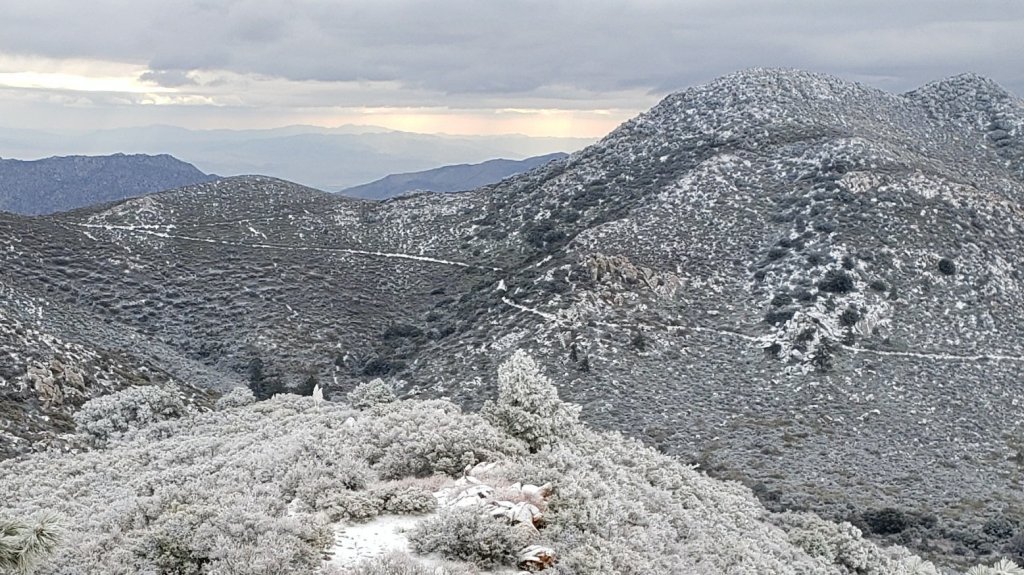
The Pacific Crest Trail (the snow-covered line through the middle of the image) as seen from Butterfly Peak early on 26th March 2021. The dusting melted within a few hours.

TRAIL CONDITIONS

All trails above about 8600ft remain largely or completely snow-covered. Areas below 7500ft are largely clear of snow, with the exception of north-facing slopes (down to about 6500ft). Areas between those elevations are clearing of snow. Rapid clearing at all elevations, especially on sun-exposed slopes, will accelerate this week.

Tahquitz Peak trail from Chinquapin Flat/PCT Mile 178 has no steps to follow through the angled icy snow. These slopes are notoriously treacherous. Currently crampons (or at least spikes) used in conjunction with an ice axe are strongly recommended. Do not attempt to use snowshoes due to the angle of the icy snow.

Devil’s Slide Trail is rapidly clearing of snow to 7600′ with a few extended icy snow patches remaining. Snow is widespread but increasingly patchy above that elevation to Saddle Junction. The trail is hard and icy and spikes are useful.

Deer Springs Trail is essentially clear of snow up to Strawberry Junction and largely clear to about 8600ft. Snow is virtually continuous from there to San Jacinto Peak, with an excellent track to follow. Above Little Round Valley the track through the snow does not follow the trail route to San Jacinto Peak, and is steep and direct. Spikes are recommended, especially for descending, as snow is icy and compacted.

South Ridge Trail [updated 30th March] is clear to Old Lookout Flat at 7600′, with just a couple of tiny icy patches low down. Snow cover is a patchy 40% on the traverse at 7600-7800ft. The 18 switchbacks up to Tahquitz Peak are largely clear, but snow cover is almost continuous on those closest to the Peak. Spikes are useful close to Tahquitz Peak especially for descending. South Ridge Road (open) is clear of snow and ice.

Marion Mountain Trail has extensive, icy, snow cover to the PCT/Deer Springs Trail junction. The trail is largely clear to about 6800ft, but thereafter cover is roughly 50% below 7500ft and again above 8500ft. Icy snow is nearly continuous between those elevations. Spikes are strongly recommended throughout.

Fuller Ridge Trail has tracks to follow through the icy snow. They do not accurately follow the PCT route in several places.

Seven Pines Trail has had no visible hiker traffic this winter, nor since the most recent snowfall, with no tracks or trail to follow. Indeed this trail has been hiked very little since November 2018. Extremely cautious navigation is recommended for those who are not very familiar with hiking this trail. The Forest Service closure of Dark Canyon Road continues, and there is no vehicular access to Seven Pines trailhead.

The Ernie Maxwell Trail is essentially clear of ice and snow, with a few icy snow patches near Humber Park. Spikes are not required.

There is a clear but lightly-traveled track up from Round Valley to Wellman Divide, which does not closely follow the established trail route for much of its length.

Skyline Trail is clear of snow to about 7200ft, thereafter snow is generally shallow and increasingly patchy to Grubb’s Notch (8600ft). There is a well-worn but icy track to follow, spikes are recommended.

Current snow cover on the PCT is minimal from Miles 151 (Highway 74) to about 165, and increasingly patchy, but nevertheless very challenging in places, between Miles 165 and about 175 (Red Tahquitz). Snow is then more-or-less continuous between Miles 175-178. Snow cover is steadily becoming patchy between Miles 178 to 183.5, with the exception of the notoriously stubborn half mile just south of Annie’s Junction at about Mile 181. From Mile 183.5 to 191, snow is largely continuous, although some exposed sections of Fuller Ridge (e.g., parts of Miles 186.5-188.5) are thinning rapidly.

Black Mountain Road (closed to vehicles 1.7 miles from Hwy 243) is clear of snow for 5.0 miles to the Boulder Basin turning. The 3.0 miles to Fuller Ridge campground averages about 10% snow cover, with some lengthy soft snow sections increasing in frequency closer to Fuller Ridge [surveyed 2nd April 2021].

Spitler Peak Trail is clear of snow. Spikes are not required.

Cedar Spring Trail is clear of snow from Morris Ranch Road to the PCT, with some small patches remaining on the east side of the PCT down to the spring itself.

May Valley Road, a major component of the PCT Mile 168.5 alternate route, is clear of snow.
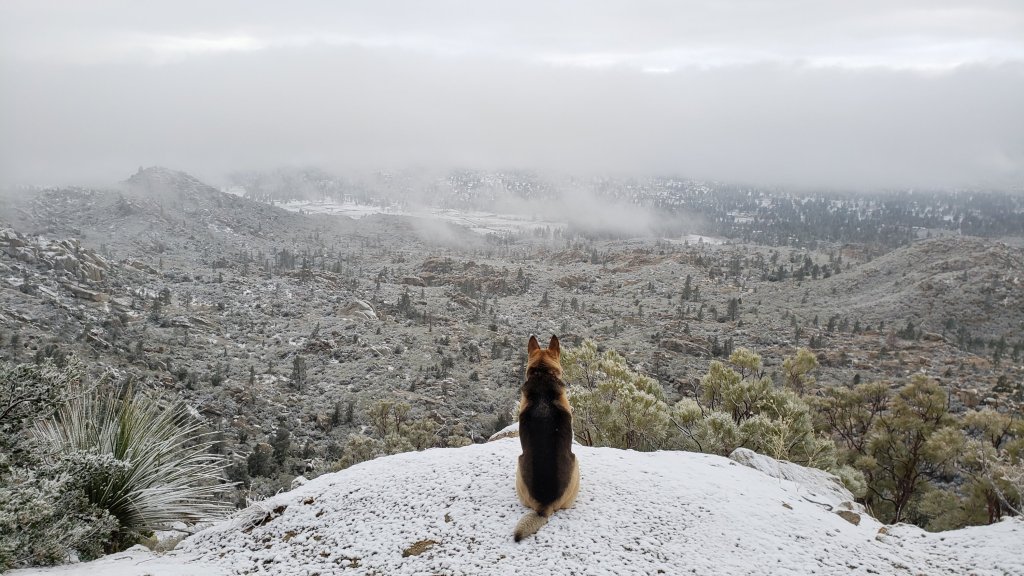
Anabel surveying a snowy Garner Valley from New Hemet Bell Mine, early morning of 26th March 2021.

SNOW DEPTHS measured on 1st April 2021 (San Jacinto Peak and Little Round Valley) or 28th March 2021. Note that average depth is given first, followed in parentheses by the depth recorded on 16th March after the last significant storms on 10th-15th March. Due to past drifting, and variable melting due to differential sun exposure, depths now vary greatly, especially in trails. Altitudes are approximate.

San Jacinto Peak (10810ft): 14 inches (38 inches on 16th March)

Little Round Valley (9800ft): 10 inches (29 inches on 16th March)

Wellman Divide (9700ft): 4 inches (19 inches on 16th March)

Annie’s Junction (9070ft): 18 inches (24 inches on 16th March)

Strawberry Junction (8100ft): <1 inch (8 inches on 16th March)

Saddle Junction/approx. PCT Mile 179.9 (8070ft): 5 inches (17 inches on 16th March)

Devil’s Slide Trail at Humber Park (6550ft): <1 inch (12 inches on 16th March)

Idyllwild (at 5550ft): 0 inches (6 inches on 16th March)

PACIFIC CREST TRAIL

Following a general discussion, this information is organized roughly south to north (all Mile numbers are approximate). The main Report (above) is updated at least weekly or during/after any storm.

Spikes are currently recommended between about Miles 165 and 191, and they are essential if you attempt Miles 169-178 and 185-190 at least. Currently, an ice axe could be very useful in these areas in conjunction with your spikes, but only if you know how to use it. Challenging sections of angled icy snow requiring this equipment exist north of Apache Peak (Mile 169.5), so if you are not comfortable with the snow conditions in that area, use the Spitler Peak Trail alternate. Please always practice safe decision-making based on your own comfort level (not that of your hiking partners), experience, ability, available equipment, time of day (which can greatly affect traction on snow and ice), and current snow and weather conditions.

This has been a well-below average snow year for the San Jacinto high country (but, oddly, above average snowfall for mid elevations, 4000-6000ft). Given accelerating climate change here, depending on your start date there may be relatively little snow and ice by the time you reach the San Jacinto mountains. Nevertheless even small, isolated sections of icy snow can be very perilous. Details of current snow/ice conditions will be clear from updates to the Trail Report over coming weeks.

Coming off at Mile 168.5 (the well-signed Spitler Peak Trail alternate) may be a good option for many this nobo season. In addition to snow/ice issues ahead, there are nearly 60 trees down across the Trail between Miles 169-177, plus the rock slide at Mile 172.5. Spitler Peak Trail itself clears of snow (as is now the case) long before the PCT north of that point.

The detailed video report for PCT Miles 169-179 from 1st March is again accurate to current conditions. Although there will be significant melting over the next week or so, challenging conditions will persist around Apache Peak (and in the 7-8 miles immediately north) for the foreseeable future. Please exercise very cautious decision-making in this area.

The short snow slope on the NE side of Apache Peak (Mile 169.5) that has proved challenging over the years is currently snow-covered. This area was resurveyed on 29th March as discussed in this short video. Snow is hard and icy in the early mornings, but with reasonable steps to follow. Spikes, ideally in combination with an ice axe, and knowledge of how to use this equipment, are currently recommended. Every individual should make their own assessment of whether to cross based on their comfort level on angled snow, their experience, available equipment, time of day, and current snow conditions. If in any doubt whatsoever, turn around and take the very well signed Spitler Peak Trail alternate option at Mile 168.5.

PCT hikers – thanks for taking the time to read this. The San Jacinto Trail Report depends entirely on small private donations to cover its direct costs. With a busy winter overlapping with a complex PCT season, every contribution, no matter how small, is truly valuable. If you have found the Report useful, please consider visiting the Donate page. Thank you, and safe hiking.

The Pacific Crest Trail remains open at the rockslide north of Antsell Rock (Mile 172.5). Reports that the assisting rope around the rockslide is “in tatters” are inaccurate. However the rope is not in new condition, and if you choose to use it, you do so completely at your own risk. USFS has told the Trail Report that responsibility for removing the rockslide is currently with the PCTA, and that there are currently no plans to close this section of the PCT for removal work before summer 2021 at the earliest. The latest video report (recorded on 1st March 2021, starts at minute 9.05) may be useful for deciding whether to hike around the rockslide.

It is possible to regain the PCT from Idyllwild via Devil’s Slide Trail at Saddle Junction (about Mile 179) then hike on through to Mile 190.5 (Fuller Ridge campground). Currently this would involve significant snow travel, but nothing challenging, as snow is relatively shallow and melting steadily, including Fuller Ridge Trail (Miles 185.5-190.5). Do not attempt to regain the PCT via South Ridge Trail as the slope on the north side of Tahquitz Peak is currently ice-covered and is notoriously treacherous.

PCT hikers are reminded that overnight stays are not permitted at or near San Jacinto Peak, including in the historic shelter. Mt. San Jacinto State Park regulations permit overnight stays only in established campgrounds (when open). Strawberry Junction is a good option for thru-hikers.
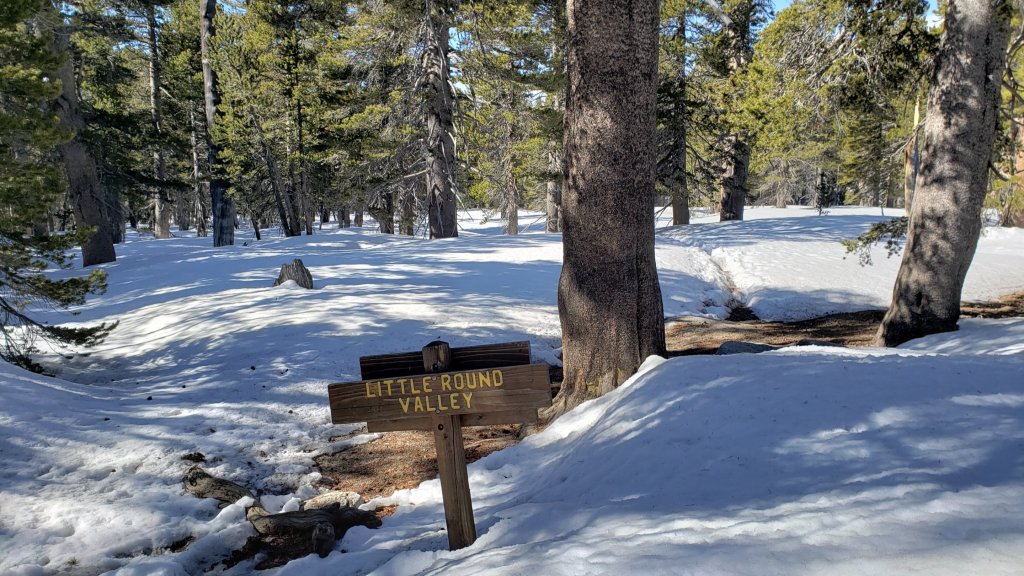
Little Round Valley at 9800ft on 1st April 2021 (above) and a couple of weeks earlier on 16th March (below).
The Peak Trail at 9800ft just above Wellman Divide on 28th March 2021 (above), and the same view just 12 days earlier on 16th March 2021 (below).

Snow and PCT update 22nd March 2021

[Please note that information specific to the Pacific Crest Trail is included at the foot of this Report. However much of the main Report is applicable to PCT hikers also.]

[UPDATE 26th March: a very light dusting of snow last night included 0.5 inch at and above 5000ft, and a very uniform 0.25 inch throughout Garner Valley down to 4000ft. By late morning today, all new snow below 6000ft had already melted, and it was disappearing rapidly at higher elevations in all sun-exposed areas. Equipment recommendations and trail conditions discussed below are unaffected.]

We have continued to hike daily on the mountain this year, with almost all recent hikes focused on subsections of the PCT. We had a relatively easy ascent of San Jacinto Peak on Monday 22nd, ascending via the east side trails (Devil’s Slide, Wellman, and Peak trails) and descending the west side via Deer Springs Trail.. No spikes were required on the ascent, but they were useful on the descent down to about 9000ft.

Yesterday evening we had an unusual “thundersnow” event in the San Jacinto mountains. For less than an hour around 1800 we had a thunderstorm produce a snowfall of up to an inch, with large, wet, snowflakes accumulating even though the temperature was well above 40 degrees Fahrenheit in Idyllwild. At the same time, the temperature plummeted more than ten degrees in about half-an-hour. Snow accumulation in Idyllwild (at 5550ft) was 0.7 inch, and 1.0 inch throughout the high country. Before dusk, we were back to blue skies. The event was a perfect demonstration of how fickle (and potentially perilous) the weather can be in an isolated mountain range. Similar events are forecast to be possible in the evenings of Tuesday 23rd and Thursday 25th.

With the obvious exception of the light dusting yesterday, melting has been steady at all elevations. Sun-exposed slopes in particular are clearing rapidly, with conditions expected to become more reminiscent of a “normal” May in the next week or so. At San Jacinto Peak on 22nd, I measured an average of about 27 inches, a loss of nearly one foot in a week, despite recent temperatures not being notably warm. Spikes are recommended on all well-traveled trails above about 7500ft (lower in places discussed below), especially in the morning and for descending, as established trails are now compacted by hiker traffic and freeze-thaw cycles. Snowshoes are recommended only for off-trail travel above and around about 8000ft.

Hikers should be prepared for temperatures at or below freezing in the high country, and potentially well below freezing when considering wind chill effects (see below for temperatures recorded recently at San Jacinto Peak).

The USFS gate at Humber Park reopened on 19th March when the area was also plowed.

The Santa Rosa mountains as seen from near PCT Mile 153 at sunrise on 20th March 2021. Spectacular cap clouds driven by strong, moist, west winds, adorn the high peaks.

WEATHER Temperatures are forecast to fluctuate around seasonal averages for the next few days, before warming significantly starting Saturday 27th March and continuing into early April. With warm, sunny, days snow melt will rapidly accelerate and will likely be particularly fast below 8000ft and also on sun-exposed slopes at all elevations. There is no significant precipitation in the forecast, although minor precipitation is possible in the afternoon on Tuesday 23rd and Thursday 25th. Medium term forecasts from NWS San Diego suggest above average precipitation is probable in the first half of April.

At San Jacinto Peak (10,810ft/3295m) on Monday 22nd March 2021 at 0950 the air temperature was 25.5°F (-4°C), with a windchill temperature of 7.2°F (-14°C), 39% relative humidity, and a frigid NW wind sustained at 12 mph gusting to 23.8 mph.

At San Jacinto Peak (10,810ft/3295m) on Tuesday 16th March 2021 at 1145 the air temperature was 21.2°F (-6°C), with a windchill temperature of 2.8°F (-16°C), 71% relative humidity, and a gusty NNW wind sustained at 12 mph gusting to 20.7 mph.

TRAIL CONDITIONS

All trails above about 8600ft remain continuously snow-covered. Areas below 7500ft are patchy or rapidly clearing of snow, with the exception of north-facing slopes (down to about 6500ft). Areas between those elevations are largely snow-covered, but with rapid clearing on sun-exposed slopes that will accelerate this week.

Tahquitz Peak trail from Chinquapin Flat/PCT Mile 178 has no steps to follow through the angled icy snow. These slopes are notoriously treacherous. Currently crampons, or at least spikes (used in conjunction with an ice axe) are essential. Do not attempt to use snowshoes due to the angle of the icy snow.

Devil’s Slide Trail is rapidly clearing of snow to 7600′ with a few extended icy snow patches remaining. Snow is largely continuous above that elevation to Saddle Junction. The trail is hard and icy and spikes are useful.

Deer Springs Trail is clear of snow to the Suicide Rock junction, and rapidly clearing of snow up to Strawberry Junction and beyond to about 8500ft. Snow is continuous from there to San Jacinto Peak, with an excellent track to follow. Above Little Round Valley the track I broke last week through the snow does not follow the trail route to San Jacinto Peak, and is steep and direct. Spikes are useful, and invaluable for descending, as snow is icy and compacted.

Marion Mountain Trail has extensive, icy, snow cover to the PCT/Deer Springs Trail junction. Snow cover is roughly 50% below 7000ft and again above 8500ft, but is nearly continuous between those elevations. Spikes are strongly recommended.

Fuller Ridge Trail has not be traveled recently and there are no tracks to follow.

Seven Pines Trail has had no visible hiker traffic this winter, nor since the most recent snowfall, with no tracks or trail to follow. Indeed this trail has been hiked very little since November 2018. Extremely cautious navigation is recommended for those who are not very familiar with hiking this trail. The Forest Service closure of Dark Canyon Road continues, and there is no vehicular access to Seven Pines trailhead.

The Ernie Maxwell Trail is largely clear of ice and snow, with icy snow patches increasingly frequent near Humber Park. Spikes are not required.

South Ridge Trail is essentially clear to Old Lookout Flat at 7600′, with a few persistent icy patches low down. Snow cover is becoming increasingly patchy on the traverse at 7600-7800ft. Snow cover is more extensive in the 18 switchbacks up to Tahquitz Peak, but this will change markedly this week, dropping to less than 50% cover except on the uppermost six switchbacks. Spikes are useful especially for descending, mainly close to Tahquitz Peak. South Ridge Road (open) is clear of snow and ice.

There are now visible tracks up from Round Valley to Wellman Divide, although they do not appear to closely follow the established trail route.

Skyline Trail is clear of snow to near 7000ft, thereafter snow is generally shallow but continuous to Grubb’s Notch (8600ft). There is a well-worn but icy track to follow, spikes are strongly recommended.

Current snow cover on the PCT is minimal from Miles 151 (Highway 74) to about 160, and increasingly patchy, but nevertheless very challenging in places, between Miles 160 and about 175 (Red Tahquitz). Snow is then more-or-less continuous between Miles 175-178. Snow cover is steadily becoming patchy between Miles 178 to 183.5, with the exception of the notoriously stubborn half mile just south of Annie’s Junction at about Mile 181. From Mile 183.5 to 191, snow is largely continuous, although some exposed sections of Fuller Ridge (e.g., parts of Miles 186.5-188.5) will be thinning rapidly.

Spitler Peak Trail is basically clear of snow, with a few icy patches remaining largely on the upper switchbacks.

Cedar Spring Trail is clear of snow from Morris Ranch Road to the PCT, with some small patches remaining on the east side of the PCT down to the spring itself.

May Valley Road, a major component of the PCT Mile 168.5 alternate route, is clear of snow.

SNOW DEPTHS measured on 22nd March 2021. Note that average depth is given first, followed in parentheses by the depth recorded on 16th March after the last notable series of storms from 10th-15th March. Due to past drifting, and variable melting due to differential sun exposure, depths now vary greatly, especially in trails. Altitudes are approximate.

San Jacinto Peak (10810ft): 27 inches (38 inches on 16th March)

Little Round Valley (9800ft): 24 inches (29 inches on 16th March)

Wellman Divide (9700ft): 6 inches (19 inches on 16th March)

Annie’s Junction (9070ft): 20 inches (24 inches on 16th March)

Deer Springs Trail at Seven Pines Trail junction (8700ft): 11 inches (14 inches on 16th March)

Strawberry Junction (8100ft): 3 inches (8 inches on 16th March)

Saddle Junction/approx. PCT Mile 179.9 (8070ft): 13 inches (17 inches on 16th March)

Deer Springs Trail at Suicide Rock Trail junction (6950ft): 0 inches (3 inches on 16th March)

Devil’s Slide Trail at Humber Park (6550ft): 5 inches (12 inches on 16th March)

Idyllwild (at 5550ft): 0 inches (6 inches on 16th March)

PACIFIC CREST TRAIL

Following a general discussion, this information is organized roughly south to north (all Mile numbers are approximate). The main Report (above) is updated at least weekly or during/after any storm.

Spikes are currently recommended between about Miles 163 and 191, and they are essential if you attempt Miles 169-178 at least. Currently, an ice axe could be very useful in these areas in conjunction with your spikes, but only if you know how to use it. Challenging and unpredictable weather is forecast for the next couple of weeks, with two or three minor snow storms possible, but warm weather in between the storm systems. This pattern will result in freeze-thaw cycles that can lead to tricky icy conditions, but also with steady snow melt so this advice may change. Please always practice safe decision-making based on your own comfort level (not that of your hiking partners), experience, ability, available equipment, time of day (which can greatly affect traction on snow and ice), and current snow and weather conditions.

There are complications this season beyond the usual challenges of snow and ice, such as a major fire closure, and the coronavirus crisis, the latter resulting in poorly maintained trails. Some of these factors may change (hopefully for the better) as the spring progresses, probably at short notice. Considerable patience and caution are recommended.

The bottom line is, if everything remains snowy/icy, and if the Snow Fire closure section doesn’t reopen soon (both of which are very big “ifs”), this will be an even more challenging year than usual to hike the PCT through the San Jacinto mountains section. Many folks may choose to skip parts or even all of this section.

To date, this has been a below average snow year for the San Jacinto high country (but, oddly, above average snowfall for mid elevations, 4000-6000ft). Given accelerating climate change here, depending on your start date there may be relatively little snow and ice by the time you reach the San Jacinto mountains. Nevertheless even small, isolated sections of icy snow can be very perilous. Details of current snow/ice conditions will be clear from updates to the Trail Report over coming weeks and months.

Coming off at Mile 168.5 (the well-signed Spitler Peak Trail alternate) may be a good option for many this nobo season. In addition to snow/ice issues ahead, there are nearly 60 trees down across the Trail between Miles 169-177, plus the rock slide at Mile 172.5. Spitler Peak Trail itself often clears of snow long before the PCT north of that point.

On Thursday 18th March I resurveyed Apache Peak. The detailed video report for PCT Miles 168-179 from 1st March is not currently accurate, due to the recent additional snowfall on 10-15th March. However, with significant melting likely over at least the next ten days, that video report will again become increasingly relevant within the next few days. I intend to resurvey the area soon. Unfortunately, as I speculated in the video, the challenging Apache Peak area is currently more tricky, with an unstable layer of fresh snow sitting over, and obscuring, the pre-existing icy snow. Please exercise very cautious decision-making in this area.

The short snow slope on the NE side of Apache Peak (Mile 169.5) that has had incidents in recent years is currently snow-covered. Snow is hard and icy in the early mornings. Spikes and an ice axe, and knowledge of how to use this equipment, are currently very strongly recommended. Every individual should make their own assessment of whether to cross based on their comfort level on angled snow, their experience, available equipment, time of day, and current snow conditions. If in any doubt whatsoever, turn around and take the very well signed Spitler Peak Trail alternate option at Mile 168.5.

PCT hikers – thanks for taking the time to read this. The San Jacinto Trail Report depends entirely on small private donations to cover its direct costs. With a busy winter overlapping with a complex PCT season, every contribution, no matter how small, is truly valuable. If you have found the Report useful, please consider visiting the Donate page. Thank you, and safe hiking.

The Pacific Crest Trail remains open at the rockslide north of Antsell Rock (Mile 172.5). Reports that the assisting rope around the rockslide is “in tatters” are inaccurate. However the rope is not in new condition, and if you choose to use it, you do so completely at your own risk. USFS has told the Trail Report that responsibility for removing the rockslide is currently with the PCTA, and that there are currently no plans to close this section of the PCT for removal work before summer 2021 at the earliest. The latest video report (recorded on 1st March 2021, starts at minute 9.05) may be useful for deciding whether to hike around the rockslide.

It is possible to regain the PCT from Idyllwild via Devil’s Slide Trail at Saddle Junction (about Mile 179) then hike on through to Mile 190.5 (Fuller Ridge campground). Currently this would involve significant snow travel, but nothing challenging, as snow is relatively shallow and melting steadily, including Fuller Ridge Trail (Miles 185.5-190.5). Do not attempt to regain the PCT via South Ridge Trail as the slope on the north side of Tahquitz Peak is currently ice-covered and is notoriously treacherous.

Good news (possibly) regarding the Snow Fire closure (Miles 191-206). US Forest Service has indicated to the Trail Report that if there is no new major weather impact in this area during March, the Pacific Crest Trail through this fire closure area may reopen in April.

Miles 191-206 of the PCT are currently closed, in theory until October 2021, due to the Snow Fire closure (closure order document here). Until this section reopens, it will be necessary to leave the trail at Black Mountain Road (about Mile 191) and hike the eight miles down Black Mountain Road to Highway 243. Currently the upper 3.5 miles of Black Mountain Road are largely snow-covered, with limited patches lower down also.

Black Mountain Road is open to hikers, it is only closed to vehicles at the gate 1.7 miles above Highway 243. This is a seasonal closure, and it might reopen to vehicles again in April (although that is weather dependent).

PCT hikers are reminded that overnight stays are not permitted at or near San Jacinto Peak, including in the historic shelter. Mt. San Jacinto State Park regulations permit overnight stays only in established campgrounds (when open). Strawberry Junction is a good option for thru-hikers.
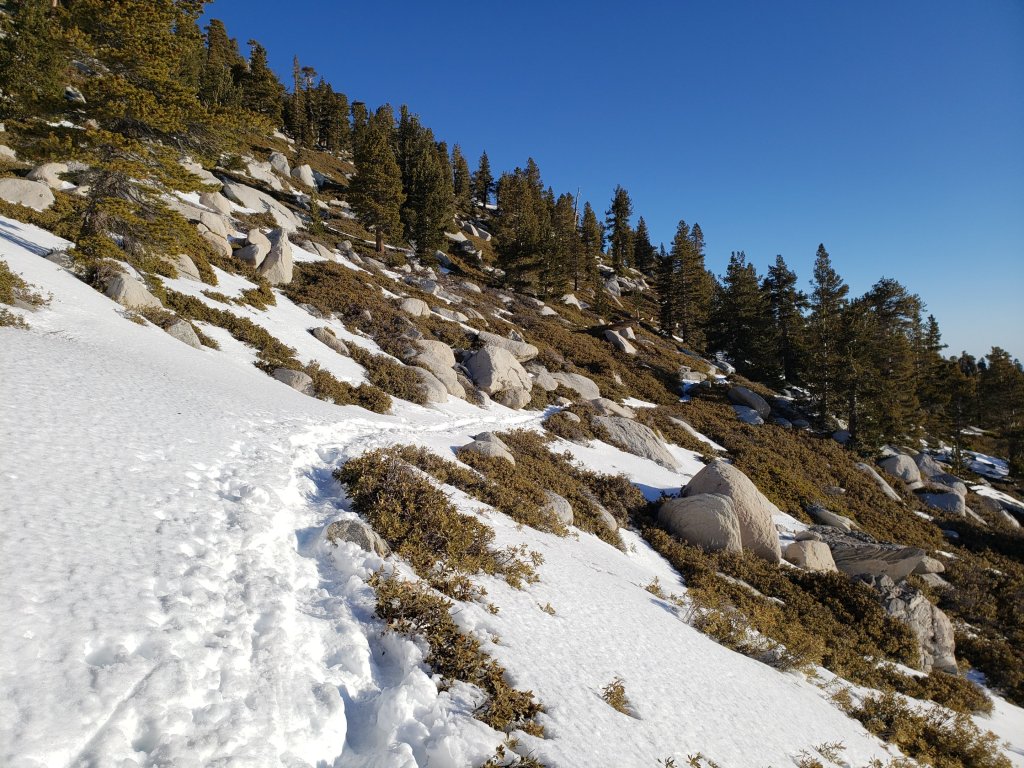
Strawberry Junction (PCT Mile 183; 8100ft) on 22nd March 2021 (above) and the same view on 16th March 2021 (below).

Snow and trail update 16th March 2021

[For information specific to the Pacific Crest Trail please see the dedicated PCT report, updated daily and best used in conjunction with this latest general Report.]

[UPDATED 19th March: Humber Park reopened for all parking this evening.]

[UPDATED 18th March: a short video describing conditions on the PCT at its junction with Spitler Peak Trail (Mile 168.5) is available here.]

The past week has seen the tenth, eleventh, and twelfth snow storms of winter 2020/21, the last of these yesterday. Conditions after the moderate storm of 10th-11th March were summarised in the previous Report. The two most recent storms produced much less precipitation, up to three inches of snow on 12th March, and 1-4 inches of snow yesterday.

This morning I ascended San Jacinto Peak breaking trail via the east side (Devil’s Slide, Wellman, and Peak trails) and descended via Deer Springs Trail. This facilitated survey of the highest parts of the PCT in the San Jacinto mountains (roughly Miles 179-181 and 185.5-183.5) plus several of its feeder trails.

I recorded video on today’s hike to give a feel for current conditions especially at high elevation locations along the PCT (available here on YouTube, special thanks to my neighbour Alex Coleman for expert video production). Although excellent tracks are now in place for some major trails (discussed below), cautious navigation is strongly recommended everywhere for the next few days in particular.

The storm system yesterday was warmer than others this winter, with rain initially as high as 6500ft before turning to snow. Coupled with cold overnight temperatures for the next couple of days, this creates hazardous conditions on slopes, where snow lies on top of ice (frozen rain), itself on top of older snow. Considerable caution and appropriate equipment are currently required everywhere, especially traditionally challenging slopes such as parts of PCT Miles 167-176, north face of Tahquitz Peak, north and east slopes of San Jacinto Peak, and Fuller Ridge, among others.

Current forecasts suggest that there may be no more precipitation for a couple of weeks, with warming and steady melting likely at most elevations. Days of freeze-thaw cycles will make the snow-ice conditions additionally challenging and variable.

As is increasingly the trend with a changed climate in recent years, there was little difference in snowfall between the mid and upper elevations in the storm yesterday, with 2.5 inches measured at Humber Park (at 6500ft) through to about 3.5 inches at San Jacinto Peak (10,810ft). Current overall snow depths for many locations around the mountain are given at the foot of this posting.

Snow conditions are currently ideal for snowshoeing everywhere above about 7000ft, potentially lower on less exposed trails for the next day or two. With steady melting already underway by this afternoon and compaction caused by freeze-thaw cycles and hiker traffic, conditions will deteriorate for snowshoeing over the next few days, especially on more heavily traveled trails below 9000ft. Nevertheless, snowshoes will be valuable anywhere off trail above about 8000ft for the foreseeable future. In addition to snowshoes, and as conditions change, spikes are strongly recommended for the foreseeable future everywhere above about 5500ft. They will be especially valuable on well-consolidated tracks over the next week (e.g., PCT, Devil’s Slide and Deer Springs trails) on colder mornings when conditions are icy, and for descending.

Hikers should be prepared for temperatures at or below freezing in the high country, and well below freezing when considering wind chill effects (see below for recent temperatures at San Jacinto Peak).

Snow depths are currently insufficient for significant avalanche risk in the high country, with the exception of the traditionally unstable north face of San Jacinto Peak (and possibly the north face of Tahquitz Peak).

The USFS gate at Humber Park was closed on 10th March. There is legal parking for nine vehicles only just below the gate. USFS has recently ticketed illegally parked vehicles. On snowy weekends this year the uppermost 0.1 mile of Fern Valley Road has been closed by CHP at its junction with Forest Drive. Although parking is normally legal along Forest Drive, CHP has periodically towed vehicles parked along that street. Exercise considerable caution when parking anywhere in this area especially during weekends.

South Ridge Road remains open, although the road is completely snow-covered and is becoming increasingly icy.

WEATHER Temperatures are forecast to fluctuate around seasonal averages at most elevations (but generally above average in the high country) for the next ten days. With many sunny days snow melt will steadily accelerate and will likely be particularly rapid below 8000ft and on sun-exposed slopes at all elevations. There is no significant precipitation in the forecast.

At San Jacinto Peak (10,810ft/3295m) on Tuesday 16th March 2021 at 1145 the air temperature was 21.2°F (-6°C), with a windchill temperature of 2.8°F (-16°C), 71% relative humidity, and a gusty NNW wind sustained at 12 mph gusting to 20.7 mph.

At the Peak on Friday 12th March 2021 at 1120 the air temperature was 10.2°F (-12°C), with a windchill temperature of 3.4°F (-16°C),100% relative humidity, and a light SW wind sustained at 2 mph gusting to 10.8 mph.

Tahquitz Rock and Tahquitz Peak as seen from near lower Deer Springs Trail, 16th March 2021, with puffy cloud drifting north along South Ridge.

TRAIL CONDITIONS

All trails above about 5500′ are largely or completely snow-covered. By this afternoon, melting was already well underway below 7000′. Reliable tracks are currently only known to be in place for Devil’s Slide Trail through to San Jacinto Peak via Wellman Divide, and the entire Deer Springs Trail. At elevations below 10,000ft by this afternoon snow was softening rapidly, and was taking on the consistency of soft-serve ice cream even in the high country. This makes snowshoes even more valuable.

Tahquitz Peak trail from Chinquapin Flat/PCT Mile 178 has no steps to follow through the steeply angled icy snow. These icy slopes are treacherous. Currently crampons (with an ice axe) are strongly recommended. Snowshoes are not advised due to the angle of the icy snow.

Devil’s Slide Trail has a well-traveled track to follow.

The Ernie Maxwell Trail has a well-defined track to follow along its entire length.

There were no visible hiker tracks on Marion Mountain, Seven Pines, or Fuller Ridge trails, as of this afternoon.

Deer Springs Trail has an excellent snowshoe track to follow, well-traveled to Strawberry Junction, then a single set of tracks to Little Round Valley, all largely following the established trail route. Above Little Round Valley, my snowshoe track down from the Peak is very direct, steep, and would be a challenging ascent.

May Valley Road – a major component of the PCT Mile 168.5 alternate – is clear of snow [updated 17th March].

There is well-defined posthole track on the Suicide Rock Trail through the snow from Deer Springs Trail.

Spitler Peak Trail [updated 18th March] is almost clear of snow below the first creek crossing (about 6500ft elevation), but then snow cover is about 50% in the switchbacks up to the PCT. There is a well-defined track through most of this snow cover.

Current snow cover on the PCT is minimal from Miles 151 (Highway 74) to about 160, and increasingly patchy between Miles 160 and about 175 (Red Tahquitz), concentrated on north-facing slopes e.g., Spitler Peak (Mile 168) and Apache Peak (Mile 169.5-170). Note that in addition to the challenging north-east side of Apache Peak, the off-trail north side of the Apache saddle is also still largely snow-covered (also requiring spikes). Snow is then more-or-less continuous between Miles 175-191. Snow cover will become increasingly patchy between Miles 178 to 183.5 in the next few days, with the exception of the notoriously stubborn half mile just south of Annie’s Junction starting at about Mile 180.3. From Mile 183.5 to 191, snow is largely continuous, although some exposed sections of Fuller Ridge (e.g., parts of Miles 186.5-188.5) are thinning rapidly.

SNOW DEPTHS measured on 16th March 2021, are as follows. Note that current average total depth is given first, followed by added snow from the latest storm in parentheses where known. Note that there was some melting between the previous storm systems, accounting for the discrepancy between depths reported here and last weeks report. Due to strong winds accompanying the storms there is extensive drifting, especially in the trails. Altitudes are approximate.

San Jacinto Peak (10810ft): 38 inches (4 inches new snow in latest storm)

Little Round Valley (9800ft): 29 inches

Wellman Divide (9700ft): 19 inches (3 inches new)

Annie’s Junction/approx. PCT Mile 181.8 (9070ft): 24 inches (3 inches new)

Deer Springs Trail at Seven Pines Trail junction (8700ft): 14 inches

Strawberry Junction (8100ft): 8 inches

Saddle Junction/approx. PCT Mile 179.9 (8070′): 17 inches (3 inches new)

Deer Springs Trail at Suicide Rock Trail junction (6950ft): 3 inches

Devil’s Slide Trail at Humber Park (6550′): 12 inches (2.5 inches new, but melting rapidly)

Idyllwild (at 5550′): 6 inches (1.0 inch new; rapid melting was underway this afternoon)

Upper Little Round Valley (9800ft) with about two feet of snow, 16th March 2021.

San Jacinto Trail Report: available for everyone, funded by readers. The Report completely depends on small private donations to cover its costs. With a busy winter coinciding with a complex PCT season, every contribution is deeply appreciated. If you have found this Report useful, please consider visiting the Donate page. Thank you.

Snow storm summary 12th March 2021

[UPDATE 15th March 2021 @ 0950: A minor snow storm is forecast for this afternoon and evening. We have just returned from Saddle Junction (8100ft, PCT Mile 179) where it was briefly snowing lightly, with occasional drizzle below 6500ft. About 2-5 inches are expected at all elevations above 4500ft. A comprehensive report of high country conditions is planned for tomorrow evening.]

[For additional information specific to the PCT, please see the Pacific Crest Trail report, best used in conjunction with this latest general update.]

Our tenth snow storm of winter 2020/21 fell largely on Wednesday 10th March, with some on/off light snow continuing through much of yesterday,Thursday 11th. In Idyllwild at 5550ft, 12 inches fell in total, ranging through to 17 inches measured today at San Jacinto Peak (10,810ft). Measurements for other locations, with cumulative depths, are given at the foot of this post.

I had a very enjoyable, if occasionally challenging, hike to San Jacinto Peak today, breaking trail the entire way with snowshoes on the east side trails (Devil’s Slide, PCT, Wellman, and Peak trails). Snow conditions were excellent for snowshoeing, especially below 9000ft, with snowshoes only sinking in a few inches rather than feet, but conditions became more spongy higher up. I recorded a YouTube video in late morning at the Peak under spectacular, partly cloudy, skies.

Yet again, there was little difference in snowfall between the mid and upper elevations, probably because the high country was above the clouds for some of the storm system. Although excellent tracks are in place on a few major trails (discussed below), very cautious navigation is strongly recommended everywhere.

I had a few small snowflakes falling on me most of the late morning and early afternoon from moody cumulus clouds around the mountains. As I descended Devil’s Slide Trail into Strawberry Valley in mid afternoon, this turned into a more persistent light snow for an hour or so, accumulating to just over an inch in Idyllwild. This was probably insufficient snowfall to significantly alter trail conditions on the handful of broken tracks in the high country.

Snow depths are currently ideal for snowshoeing everywhere above about 5000ft, potentially lower on less exposed trails for the next day or two. With rapid melting expected after Tuesday 16th March, and compaction caused by freeze-thaw cycles and hiker traffic, conditions will deteriorate for snowshoeing over the next few days, especially on more heavily traveled trails below 8000ft. Nevertheless, snowshoes will be invaluable anywhere off trail above about 8000ft for the foreseeable future. In addition to snowshoes, and as conditions change, spikes are strongly recommended for the foreseeable future everywhere above about 4500ft. They will be especially valuable on well-consolidated tracks (e.g., Devil’s Slide and Deer Springs trails) on colder mornings when conditions are icy, and for descending.

Snow depths are currently insufficient for significant avalanche risk in the high country, with the exception of the traditionally vulnerable locations on the north faces of San Jacinto and Tahquitz peaks.

Hikers should be prepared for temperatures at or below freezing in the high country, and well below freezing when considering wind chill effects, at least until Wednesday 17th, when temperatures at mid and upper elevations will warm to well above seasonal norms.

The USFS gate at Humber Park was closed early on the morning of 10th March. There is legal parking for nine vehicles only just below the gate. USFS has ticketed illegally parked vehicles.. On some snowy weekends this year the uppermost 0.1 mile of Fern Valley Road has been closed by CHP at its junction with Forest Drive. Although parking is normally legal along Forest Drive, CHP has periodically towed vehicles parked along that street. Exercise considerable caution when parking anywhere in this area.

Looking north-east from San Jacinto Peak shortly before noon, 12th March 2021. Thunder was audible from intense storm cells over Yucca Valley and Joshua Tree.

WEATHER Temperatures will remain at or below average for the next four days, and melting of snow will be minimal above about 6000ft. A light dusting of snow is possible on Monday 15th above about 5000ft, with rain possible around and below that elevation. Very strong winds the same day will cause heavy drifting, potentially obscuring broken trails and complicating navigation. A dramatic warming trend starts on Wednesday 17th, with very rapid snowmelt expected at all elevations for at least a week.

At San Jacinto Peak (10,810ft/3295m) today, Friday 12th March 2021 at 1120 the air temperature was 10.2°F (-12°C), with a windchill temperature of 3.4°F (-16°C), 100% relative humidity, and a light SW wind sustained at 2 mph gusting to 10.8 mph.

At the Peak on Monday 8th March 2021 at 0840 the air temperature was 27.0°F (-3°C), with a windchill temperature of 9.9°F (-12°C), 29% relative humidity, and a bitter due West wind sustained at 12 mph gusting to 22.8 mph.

TRAIL CONDITIONS

All trails above about 4000′ are heavily or moderately snow-covered. Snow melt is expected to be minimal for the next few days, so this situation will be largely unchanged, especially above 6000ft. Currently very few major trails have been traveled.

The east side trails from Humber Park to San Jacinto Peak – Devil’s Slide, Saddle Junction to Annie’s Junction, Wellman, and Peak trails – all have a well-defined snowshoe track to follow.

There were no visible hiker tracks on Willow Creek Trail, or the PCT south from Saddle Junction (i.e., toward Tahquitz Peak), as of this afternoon, with a partial snowshoe track at the start of the Caramba Trail.

Tahquitz Peak trail from Chinquapin Flat/PCT Mile 178 currently has no steps to follow through the steeply angled icy snow.. These icy slopes are notoriously treacherous. Currently crampons with an ice axe (and knowledge of how to use this equipment) are required. Snowshoes are not advised due to the angle of the icy snow.

The Ernie Maxwell Trail has a well-defined track to follow through the snow.

SNOW DEPTHS measured on 12th March 2021 are as follows. Note that current average total depth is given first, followed by added snow from the latest storm in parentheses. Due to strong winds accompanying the storm there is extensive drifting, especially in the trails. Altitudes are approximate.

San Jacinto Peak (10810ft): 35 inches (17 inches new snow in latest storm)

Wellman Divide (9700ft): 18 inches (15 inches new)

Annie’s Junction/approx. PCT Mile 181.8 (9070ft): 24 inches (18 inches new)

Saddle Junction/approx. PCT Mile 179.9 (8070′): 17 inches (15 inches new)

Devil’s Slide Trail at Humber Park (6550′): 14 inches (14 inches new, but snowing again this afternoon)

Idyllwild (at 5550′): 12 inches (all new; another inch added so far this afternoon)

The Peak Trail at about 9800ft just above Wellman Divide, 12th March 2021 with my snowshoe tracks (above), and the same view four days earlier on 8th March (below).

San Jacinto Trail Report: available for everyone, funded by readers. While labor and time is volunteered, this Report completely depends on small private donations to cover its costs. As a busy winter transitions into a complex northbound PCT season, every contribution is invaluable. If you have found this Report useful, please consider visiting the Donate page. Thank you.

Minor snow storm update 4th March 2021

[UPDATE 11th March @ 0950: It has snowed lightly from pre-dawn yesterday into this morning, with 11.5 inches accumulating in Idyllwild (at 5550ft). The high country was periodically on the fringe of the cloud, and consequently Long Valley (8600ft) has about 12 inches. The system was a cold one, with snow down to 4000ft, i.e. covering the entire PCT in the San Jacinto mountains from between Mile 151 to about Mile 200. The snow level was at 4500ft on Skyline Trail early this morning (thanks to Florian Boyd). The gate at Humber Park was closed at 0750 yesterday morning, but nine legal parking spaces remain in the area just below the gate. The next detailed Report is expected tomorrow evening, Friday 12th.]

[For information specific to the Pacific Crest Trail, please see the dedicated PCT report, best used in conjunction with the most recent detailed update, available here.]

This morning we broke trail to San Jacinto Peak via Devil’s Slide, Wellman, and Peak trails, descending the same way, to check on the effects of the minor snow storm that passed through yesterday afternoon. I recorded a video report at the Peak that covers most of the same information.

Yesterday, 3rd March 2021, it started snowing in Idyllwild at 1120 and continued until about 1830, accumulating two inches in that time (at 5550ft), although it was often barely cold enough to settle consistently. Judging by snow depths measured on our hike (detailed below) the higher peaks were above the cloud for some of the storm, with the greatest depth recorded around 9000ft. A dusting of snow down to about 4500ft in Garner Valley was visible from the high country, but that is likely largely gone by this evening.

By our descent early this afternoon, snowmelt was astoundingly rapid even by the recent standards of the San Jacinto mountains. Below about 9000ft, we spent half the descent in slush, with much of the remainder on already clearing trail. This was in stark contrast to pleasant continuous 2-4 inch snow cover early this morning. I suspect that by tomorrow afternoon, Friday 5th, which is forecast to be an unseasonably warm day, trail conditions will largely resemble the previous report from a few days ago (available here). Consequently I will not discuss specific trail conditions from this morning in any great detail here. Furthermore, conditions will again change significantly next week, with one or more moderate storm systems forecast (see Weather below), although the relatively light snows predicted may again have a limited effect on long-term conditions.

The detailed video report for PCT Miles 168-179 from 1st March will still be largely valid, as so much melting will take place by 6th March that conditions will soon be back to resembling what I found on Monday 1st. If anything, the challenging Apache Peak area is currently more tricky, with a thin, unstable layer of fresh snow sitting over, and obscuring, the pre-existing icy snow.

Currently spikes are recommended on all trails above about 6500ft. However as discussed above this situation could change significantly with substantial melting in sun-exposed slopes in the next day or so. Snowshoes are recommended only for some off-trail travel above about 9000ft. These recommendations may well change again next week.

Hikers should be prepared for temperatures below freezing in the high country, and potentially far below freezing when considering wind chill effects, especially after this weekend.

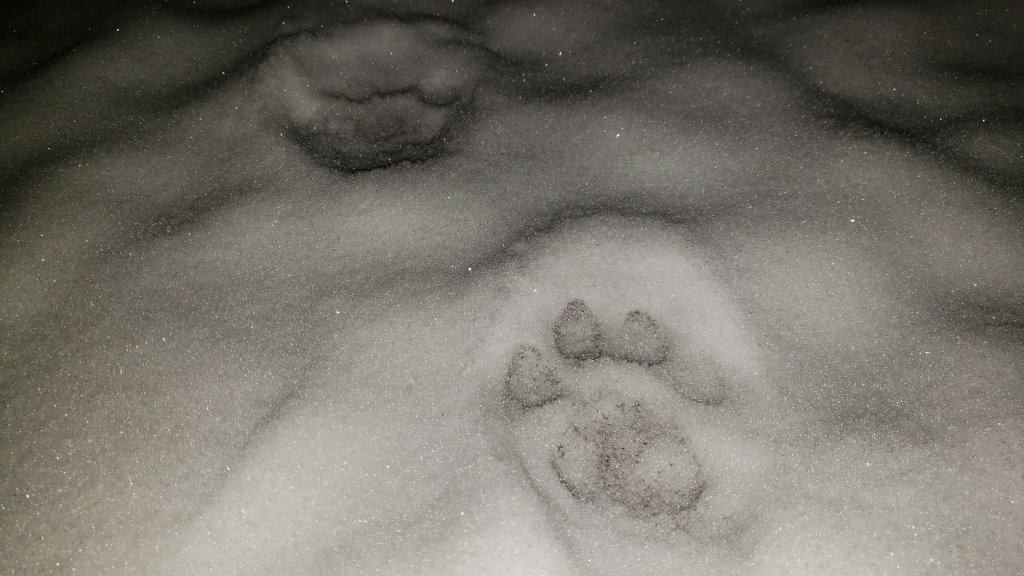
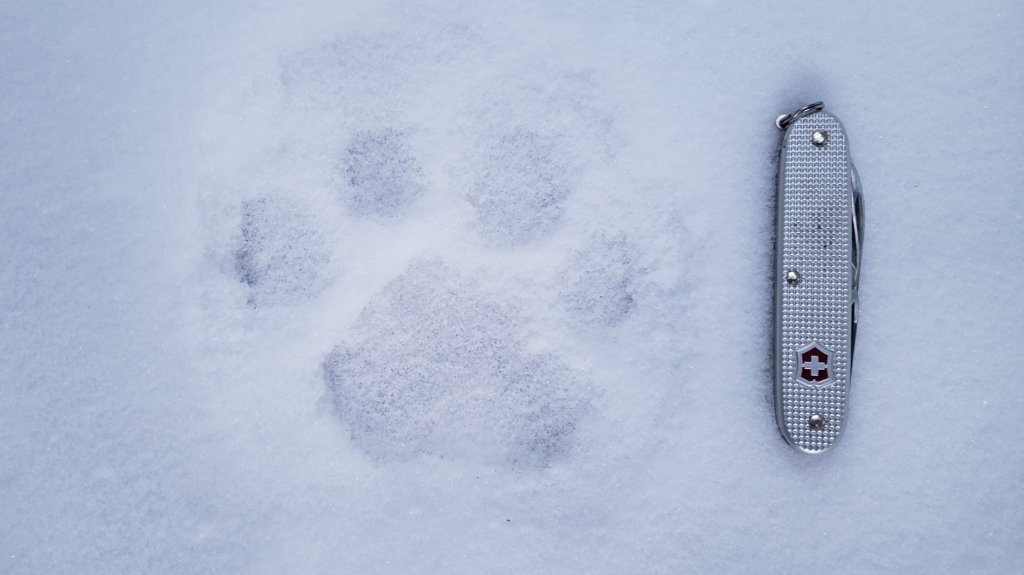
Our pre-dawn start this morning was rewarded with immaculate tracks of not one but two Mountain Lions descending for long sections of Devil’s Slide Trail, both of which started on the PCT just north of Saddle Junction (photos below). The shallow powder was perfect for preserving the tracks so well. I am fortunate to see lions on average a couple of times each year, and have found tracks and scat many dozens of times, but these were some of the cleanest and longest sets of lion prints I have seen in the San Jacinto mountains. It did not appear that the two lions traveled together, although their tracks did overlap for a couple of short segments.

Spectacular clouds portend the arrival of a storm system, as seen from May Valley Road, 3rd March 2021. South Peak is to the right, and Tahquitz Peak to the left.

WEATHER The next three days are forecast to be warmer than average for early March, especially at elevations above 7000ft, resulting in extensive melting of the fresh snow. Starting Tuesday 9th, temperatures at all elevations drop to below seasonal, accompanied by unstable weather for up to a week. Currently the greatest likelihood for snow – roughly three inches in Idyllwild, six inches at the high peaks – is on Wednesday 10th March, but with possibilities for light precipitation for several days thereafter also.

At San Jacinto Peak (10,810ft/3295m) on Thursday 4th March 2021 at 1010 the air temperature was 28.2°F (-2°C), with a windchill temperature of 13.3°F (-11°C), 41% relative humidity, and a fresh NNW wind sustained at 6 mph gusting to 13.3 mph.

At the Peak on Monday 22nd February 2021 at 0910 the air temperature was 39.3°F (4°C), with a windchill temperature of 32.2°F (0°C), 33% relative humidity, and a light SSE breeze sustained at 4 mph gusting to 6.2 mph.

This massive boulder slid into the Peak Trail at about 10,200ft elevation in the past few days.

TRAIL CONDITIONS

Trails above about 8600ft largely remain snow-covered. Areas below 7500ft are generally patchy or clearing of snow, with the exception of north-facing slopes (down to about 5500ft).

Tahquitz Peak trail from Chinquapin Flat/PCT Mile 178 had challenging steps to follow through the angled icy snow, but these are now likely obscured by the fresh, drifted snowfall. These icy slopes are notoriously treacherous. Currently spikes (used in conjunction with at least hiking poles, or preferably an ice axe) are essential. Do not attempt to use snowshoes due to the angle of the icy snow.

Devil’s Slide Trail is largely clear of snow to 7500′. Snow is more extensive above that elevation to Saddle Junction, but clearing rapidly. Spikes can be useful.

SNOW DEPTHS measured at east side locations on 4th March 2021 are as follows. Three numbers are given: the new snow measured from the storm on 3rd March, followed by the current average depth, then finally followed (in parentheses) by the greatest depth of this winter recorded on 31st January. Due to heavy drifting, and variable melting due to differential sun exposure, depths now vary greatly in trails especially. Altitudes are approximate.

San Jacinto Peak (10810ft): 3.5 inches, total 18 inches (40 inches on 31st January)

Wellman Divide (9700ft): 2 inches, total 5 inches (31 inches on 31st January)

Annie’s Junction (9070ft): 4 inches, total 11 inches (29 inches on 31st January)

Saddle Junction/approx. PCT Mile 179.9 (8070′): 3 inches, total 5 inches (29 inches on 31st January)

Devil’s Slide Trail at Humber Park (6550′): 2 inches, total 2 inches (22 inches on 31st January)

Above, fresh Mountain Lion prints at Devil’s Slide trailhead (6500ft) before dawn, 4th March 2021.
Tracks of one of two Mountain Lions that descended parts of Devil’s Slide Trail, 4th March 2021. Above at about 7800ft, below at 7500ft. The knife in the lower image is 3.6 inches long, for scale, suggesting this lion was likely an adult male (width of the print clearly >4 inches)

San Jacinto Trail Report: available for everyone, funded by readers. While labor and time is volunteered, this Report completely depends on small private donations to cover its direct costs. With a busy winter overlapping with an unusually complex PCT season, every contribution is invaluable and deeply appreciated. If you have found this Report useful, please consider visiting the Donate page. Thank you.

Trail update 1st March 2021

[UPDATED 3rd March 2021 @ 1910: It snowed in Idyllwild between 1120 and about 1830, accumulating two inches in that time. A similar depth settled in Long Valley (8600ft). At 5550ft in Idyllwild it was barely cold enough to settle consistently. Some 2-3 inches of fresh snow are expected everywhere above about 5000ft today.]

[For information specific to the Pacific Crest Trail, please see the dedicated PCT report, best used in conjunction with this most recent general update.]

Today we hiked Spitler Peak Trail to the PCT, then went northbound to Saddle Junction, before descending Devil’s Slide Trail. In a detailed video report for PCT Miles 168-179 I discuss the significant hazards in this section, especially the challenging Apache Peak area. [Special thanks to my next door neighbour Alex for his help with video production.]

Daily hikes in recent days have surveyed the PCT north of Highway 74, South Ridge, Marion Mountain, and Deer Springs trails, the north face of Tahquitz Peak, the Tahquitz area meadows, and of course routes to San Jacinto Peak.

Good news (potentially) regarding the Snow Fire closure (Miles 191-206). US Forest Service has indicated to the Trail Report that if there is no new major weather impact in this area during March, the Pacific Crest Trail through this fire closure area will likely reopen in April.

Melting has been steady at all elevations with several recent days of temperatures above average. Sun-exposed slopes in particular are clearing, with conditions more reminiscent of a “normal” April or May. Conditions will change in the next few days with minor storm systems forecast (see Weather below), although the light snows predicted may have a limited and short-term effect on conditions.

Spikes are recommended on all well-traveled trails above about 7500ft (lower in places discussed below), especially in the morning and for descending, as established trails are now compacted by hiker traffic and freeze-thaw cycles. Snowshoes are recommended only for some off-trail travel above about 9000ft, mainly afternoons when snow is softer. These recommendations will likely change later this week.

Hikers should be prepared for temperatures below freezing in the high country, and potentially far below freezing when considering wind chill effects.

The Palm Springs Aerial Tramway reopened on 18th February, with reduced days, hours, and capacity. See their website for details.

The USFS gate at Humber Park reopened on 26th February, as did gates at South Ridge Road and May Valley Road (Cowbell Alley).

The Idyllwild ranger station of Mount San Jacinto State Park reopened on 6th February, and the adjacent campground reopened on 12th February. Wilderness camping in the State Park has also reopened, see the State Park website for further information.

WEATHER A minor storm system is forecast for Wednesday 3rd, with a snow level around 6000ft, and a few inches of snow predicted for the highest peaks. Rainfall at mid elevations will be light (<0.25in). Next week (Monday 8th onwards) is forecast to be very unsettled, with light precipitation possible on several days, and likely much colder with a freeze level below 5000ft on multiple days. In between the systems on 4th-7th, temperatures will swing to above seasonal, creating freeze-thaw conditions, but also melting fresh thin snow cover very rapidly.

February 2021 was the driest February recorded in the high country of the San Jacinto mountains since records began (in the 1940s in Idyllwild, in the 1960s in the high country), with only one very minor storm producing 1-2 inches of snow on 12th. February is typically one of the two wettest months of the year. The previous driest February was, alarmingly, in 2020.

At San Jacinto Peak (10,810ft/3295m) on Monday 22nd February 2021 at 0910 the air temperature was 39.3°F (4°C), with a windchill temperature of 32.2°F (0°C), 33% relative humidity, and a light SSE breeze sustained at 4 mph gusting to 6.2 mph.

Anabel demonstrating how easy it is (for her) to cross the treacherous north face of Tahquitz Peak, 26th February 2021. For us mere mortals lacking four paw drive and built-in spikes, much greater caution (plus good equipment) is strongly recommended.

TRAIL CONDITIONS

Trails above about 8600ft remain extensively snow-covered. Areas below 7500ft are generally very patchy or clear of snow, with the exception of north-facing slopes (down to about 6500ft). Areas between those elevations are variably snow-covered, but largely clear on sun-exposed slopes.

Tahquitz Peak trail from Chinquapin Flat/PCT Mile 178 has challenging steps to follow through the angled icy snow. These icy slopes are notoriously treacherous. Currently spikes (used in conjunction with at least hiking poles, or preferably an ice axe) are essential. Do not attempt to use snowshoes due to the angle of the icy snow.

Devil’s Slide Trail is almost clear of snow to 7700′ with a few dirt-covered icy snow patches remaining. Snow is more extensive above that elevation to Saddle Junction, but clearing rapidly. Spikes can be useful.

Deer Springs Trail is basically clear of snow up to Strawberry Junction and beyond to about 8600ft, but then snow is largely continuous from there to San Jacinto Peak. Above Little Round Valley the posthole track through the snow does not follow the trail route to San Jacinto Peak, and is steep and direct. Spikes are useful, and invaluable for descending, as snow is icy and compacted.

Marion Mountain Trail has extensive, very icy, snow cover to the PCT/Deer Springs Trail junction. Snow cover is roughly 40% below 7000ft and about 50% above 8500ft, but is nearly continuous between those elevations. Spikes are strongly recommended.

Fuller Ridge Trail has not be traveled since the last snow (late January) and there are no tracks to follow.

Seven Pines Trail has had no visible hiker traffic this winter, with no tracks or trail to follow. Indeed this trail has been hiked very little since November 2018. Extremely cautious navigation is recommended for those who are not very familiar with hiking this trail. The Forest Service closure of Dark Canyon Road continues, and there is no vehicular access to Seven Pines trailhead.

The Ernie Maxwell Trail is almost completely clear of ice and snow, a couple of patches remain near Humber Park. Spikes are not required.

South Ridge Trail is essentially clear to Old Lookout Flat at 7600ft, with just a few tiny icy patches below 7000ft. Snow cover averages 30% on the traverse at 7600-7800ft, and then only 10% from there to Tahquitz Peak. Spikes can be useful for descending the longer icy patche close to Tahquitz Peak. South Ridge Road (now open) is basically clear, with a few tiny ice patches remaining.

Skyline Trail is clear of snow to near the start of the Traverse at about 7400ft, thereafter snow is fairly shallow but largely continuous to Grubb’s Notch (8600ft). There is a well-worn but icy track to follow, spikes are recommended.

Current snow cover on the PCT is minimal from Miles 151 (Highway 74) to about 160, and patchy but challenging between Miles 160 and about 175 (Red Tahquitz), mainly concentrated on north-facing slopes e.g., Spitler Peak (Mile 168) and Apache Peak (Mile 169.5-170), but also with many small but tricky patches elsewhere. Note that in addition to the challenging north-east side of Apache Peak, the off-trail north side of the Apache saddle is also still largely snow-covered (also requiring spikes). Snow is then almost continuous between Miles 175-178. Snow cover is increasingly patchy and limited between Miles 178 to 183.5, with the exception of the notoriously stubborn half mile just south of Annie’s Junction at about Mile 181. From Mile 183.5 to 191, snow is largely continuous, although some short exposed sections of Fuller Ridge (e.g., within Miles 186.5-188.5) are clear or thinning rapidly.

Spitler Peak Trail is basically clear of snow, with just a couple of tiny icy patches remaining.

Cedar Spring Trail is clear of snow from Morris Ranch Road to the PCT, with some small patches remaining down to the spring itself.

Relatively fresh Mountain Lion print off trail near PCT Mile 154, 25th February 2021. The knife is 3.6 inches long, for scale.

San Jacinto Trail Report: available for everyone, funded by readers. While labor and time is volunteered, this Report completely depends on small private donations to cover its direct costs. With a busy winter overlapping with an unusually complex PCT season, every contribution is invaluable and deeply appreciated. If you have found this Report useful, please consider visiting the Donate page. Thank you.