Trail update 18th October 2024

Since Friday 11th temperatures have felt pleasantly autumnal at all elevations, albeit slightly above seasonal for mid October. Temperatures briefly fall to well below average on 17th-19th, before quickly rising once again. Windchill temperatures in the high country have generally been around freezing, but below freezing on 18th-19th, e.g., 31.3°F (0°C) at San Jacinto Peak on Friday 11th, and 22.5°F (-5°C) on Friday 18th. Forecasts tentatively suggested the possibility of very light precipitation on Friday 18th, but ultimately there was no measurable drizzle. Between 22nd-25th October temperatures are forecast to rise again to well above seasonal.

With a failed monsoon season in most of Southern California, fire risk remains severe everywhere. A comprehensive fire ban is in place on Forest Service lands throughout the San Jacinto Ranger District (link to USFS order here) and in all Idyllwild campgrounds. Campfires are of course always prohibited throughout both the State Park and National Forest wilderness areas.

Survey hikes by the Trail Report every day year-round in the San Jacinto mountains include varied and often circuitous routes to San Jacinto Peak typically 3-5 times per week, plus a wide variety of other trails on intervening days.

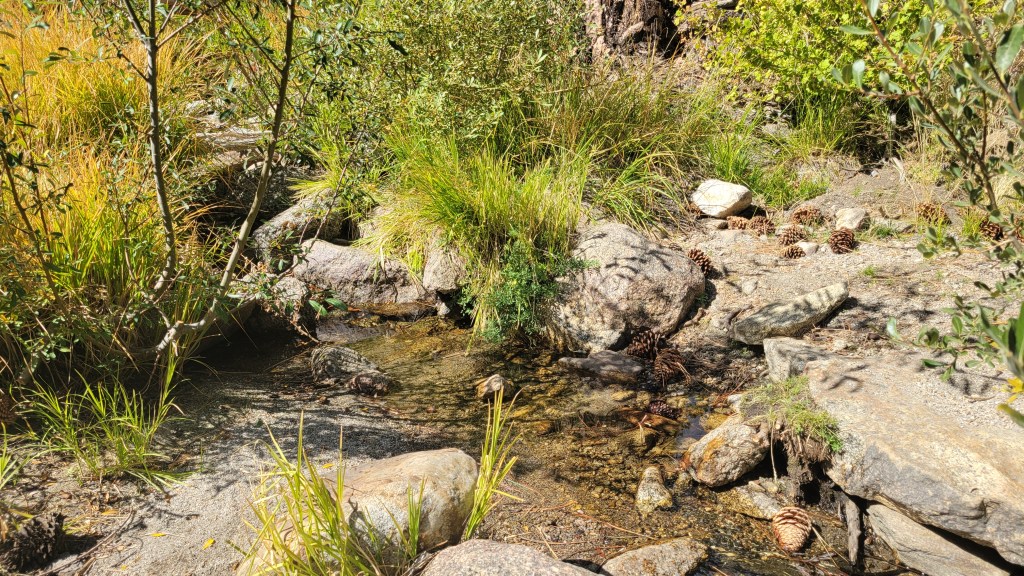
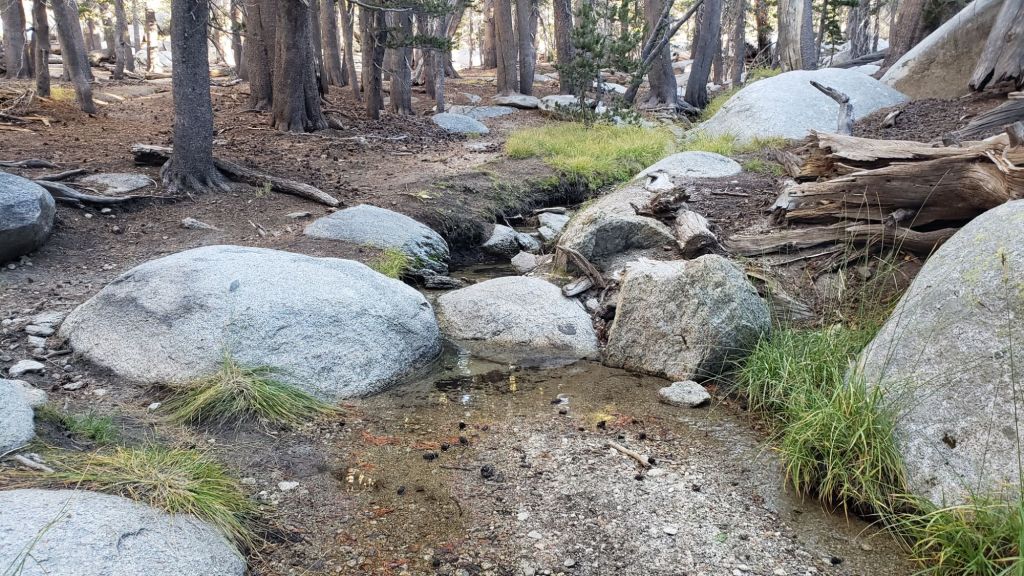
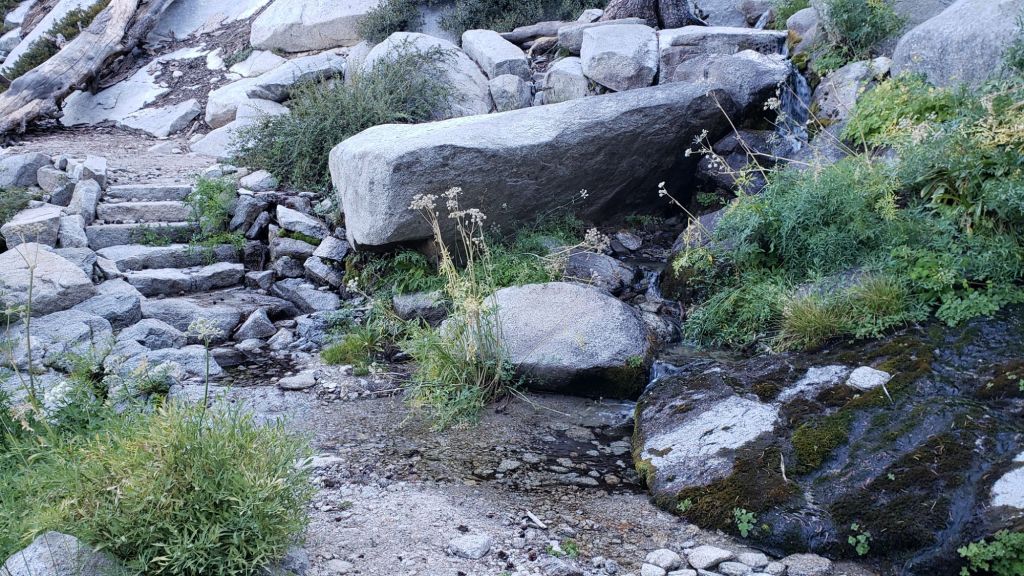
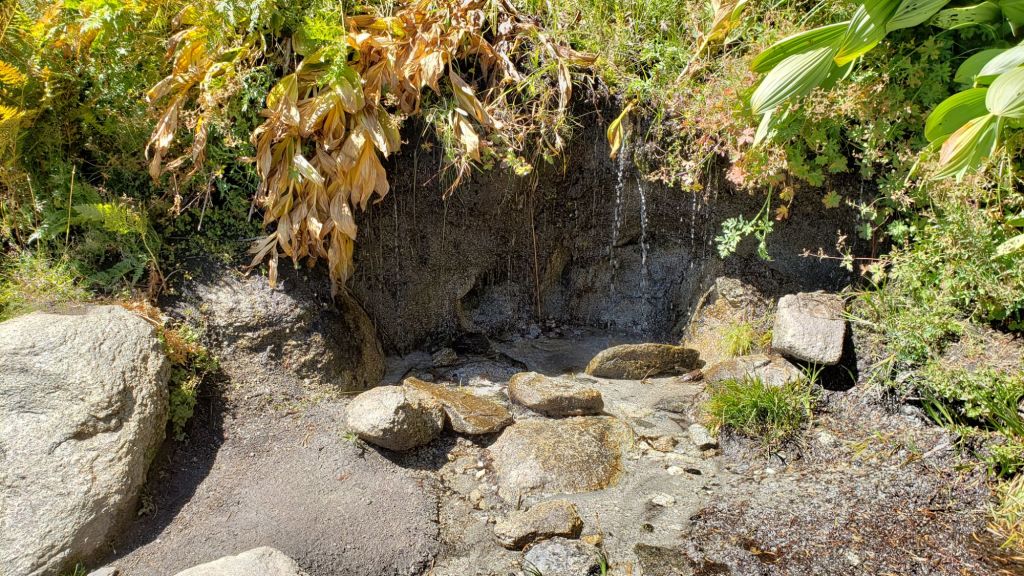
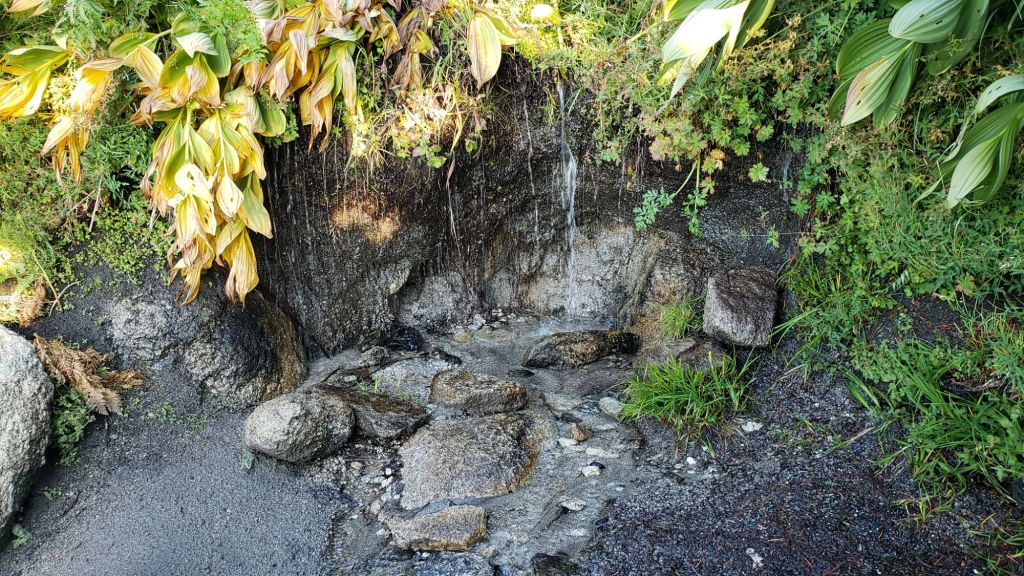
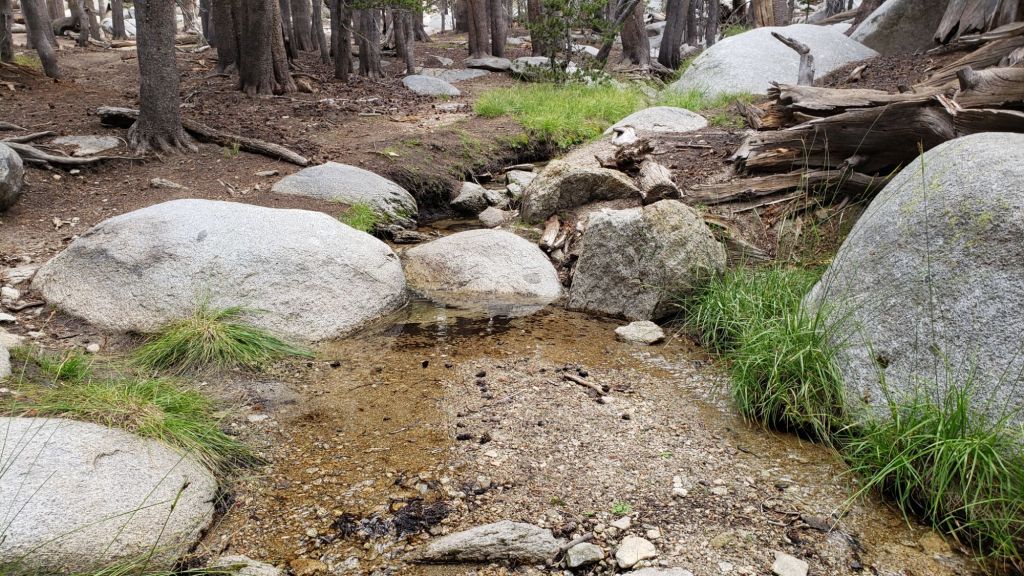
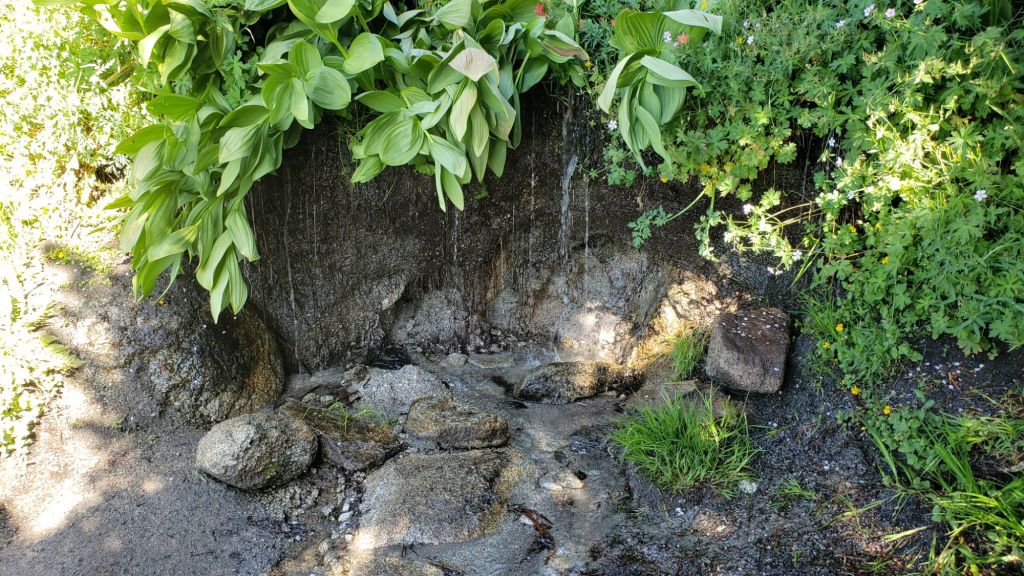
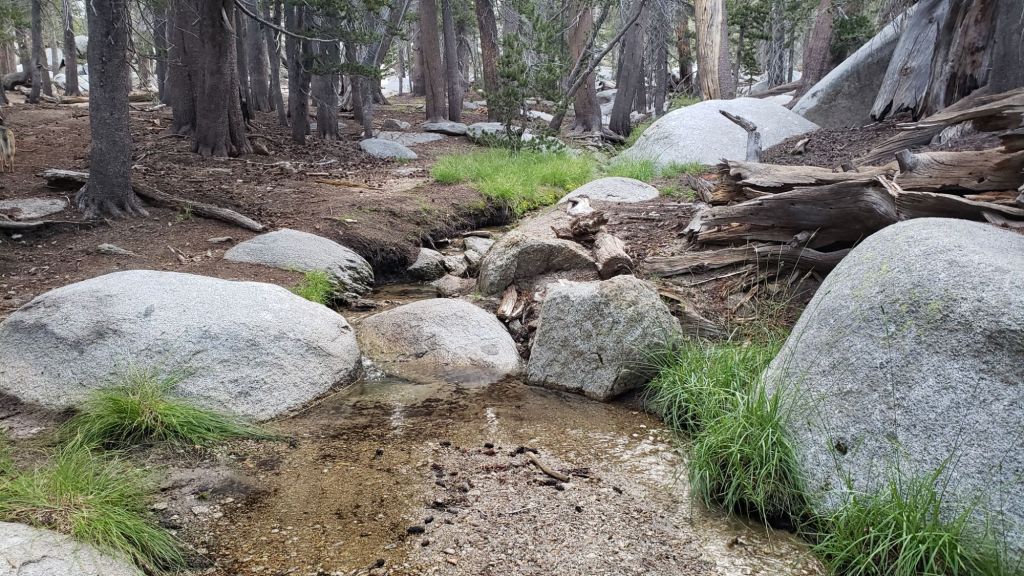
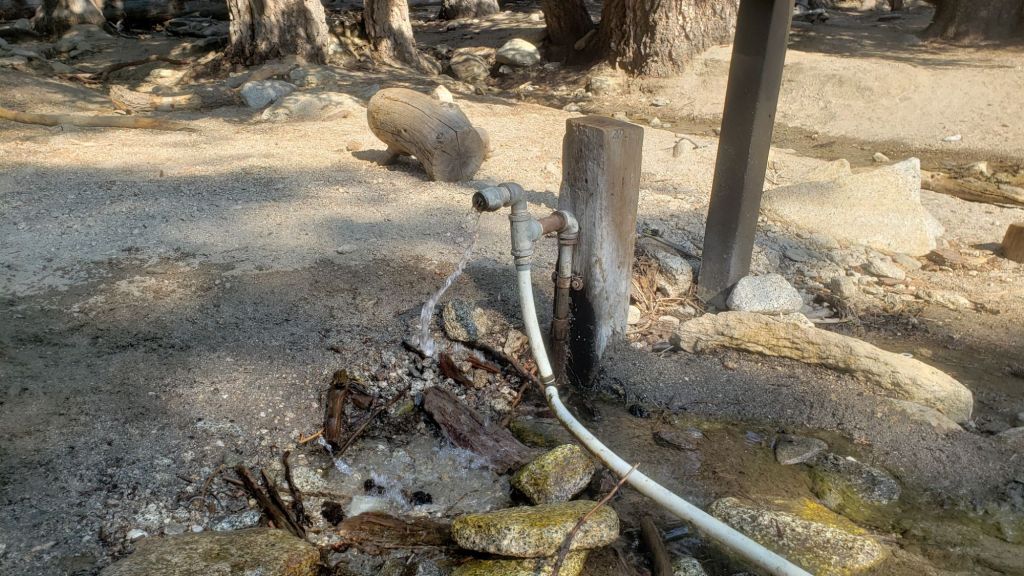
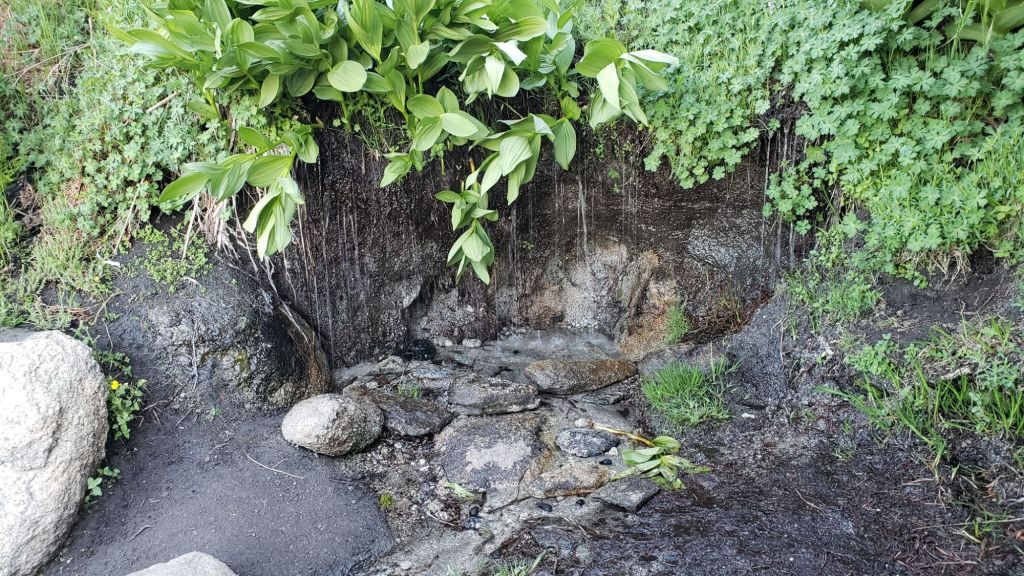
Major springs, creeks, and pipes largely continue to flow at this time (example photos below). Flow rates continue to drop steadily at all elevations and ephemeral water sources have been dry for many weeks or months. The Round Valley faucet continued to flow well as of 9th October. In the Tahquitz area meadows, the minor creek in Skunk Cabbage Meadow continues to just trickle, but the ephemeral creek in Tahquitz Valley is dry. Tahquitz Creek is flowing gently at the northern end of Little Tahquitz Meadow, and near its source where it crosses the PCT at Mile 177. Two tiny springs at Strawberry Cienega just about continue to trickle. Hidden Lake was c.30% full in early October (by surface area, not volume). Stone Creek is no longer flowing where it crosses Deer Springs Trail at about PCT Mile 183.6, and has dried completely downstream of that point.

The Palm Springs Aerial Tramway closed on Monday 9th September 2024 for annual maintenance, and is now scheduled to reopen on Friday 18th October.

According to the State Park Facebook page (linked here) the Skyline Trail remains closed in the section under their jurisdiction (from about 5800 ft to Grubb’s Notch), although no reason is given.

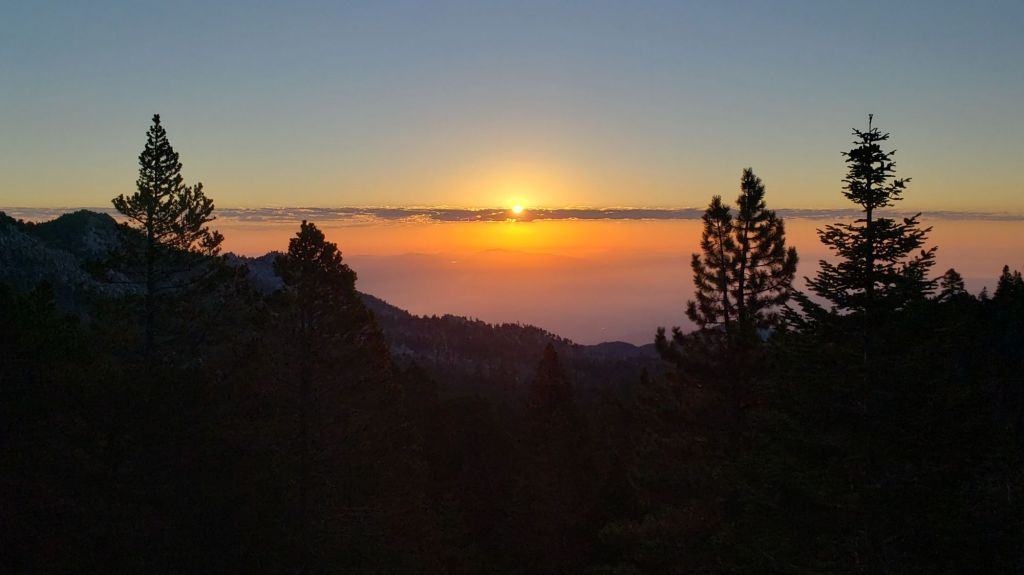
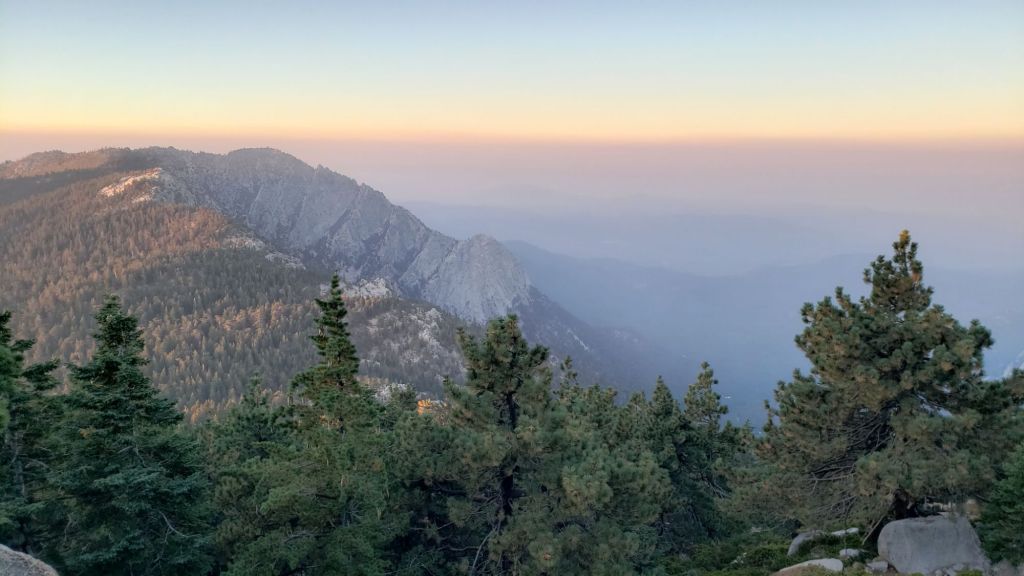
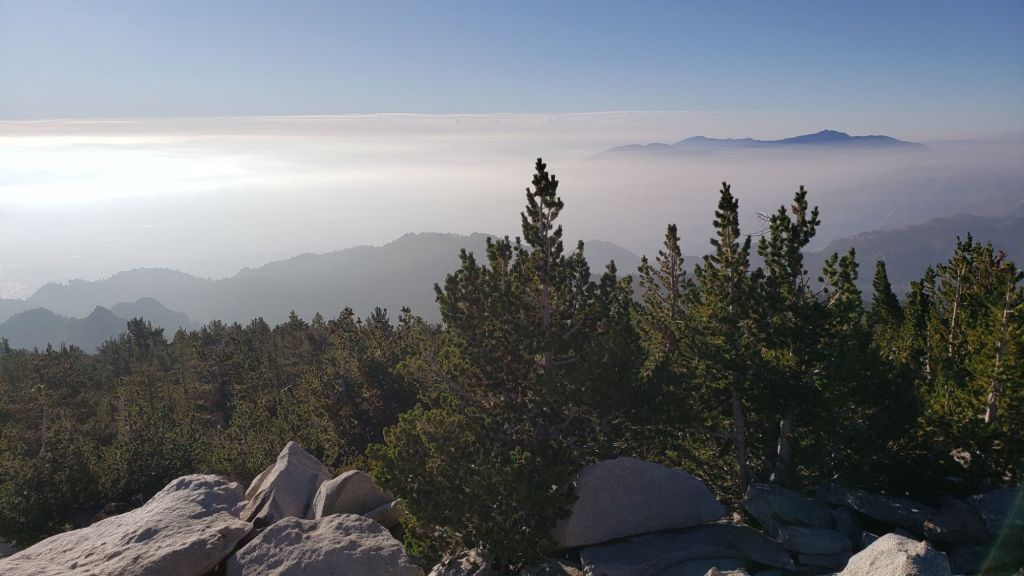
Sunrise as seen from 9150 ft near Wellman’s Cienega, 18th October 2024. Rather than rising over the Chocolate Mountains as is normal at this time of year, the sun instead rose over a thick layer of water vapor mixed with smoke, dust, and doubtless other pollutants that were densely filling the Coachella Valley below 9000 ft elevation.

WEATHER

A cooling trend starting Friday 11th October dropped temperatures to near (generally slightly above) average for mid October. The passage of a brief cold front to the north on 17th-19th is expected drop temperatures to well below average for October. The local precipitation probabilities for those days remain low, but there is a possibility light rain at mid elevations caused by a rising marine layer coming in from the west. Temperatures are forecast to rise yet again, at times to well above seasonal for late October, starting Tuesday 22nd.

At San Jacinto Peak (3295m/10,810ft) on Friday 18th October 2024 at 0805 the air temperature was 35.1°F (2°C), with a windchill temperature of 22.5°F (-5°C), 27% relative humidity, and a variable NE wind sustained at 5 mph gusting to 10.6 mph.

At the Peak on Thursday 17th October 2024 at 0835 the air temperature was 48.3°F (9°C), with a windchill temperature of 40.5°F (5°C), 10% relative humidity, and a very gentle NNE wind sustained at 2 mph gusting to 6.8 mph.

At the Peak on Wednesday 16th October 2024 at 0825 the air temperature was 46.0°F (8°C), with a windchill temperature of 39.4°F (4°C), 29% relative humidity, and a light ESE wind sustained at 4 mph gusting to 9.3 mph.

At the Peak on Friday 11th October 2024 at 0705 the air temperature was 44.0°F (7°C), with a windchill temperature of 31.3°F (0°C), 17% relative humidity, and a potent SSW wind sustained at 29 mph gusting to 36.0 mph.

TRAIL CONDITIONS

Treefall hazards remain a major problem along parts of the Pacific Crest Trail, most notably between Antsell Rock and Red Tahquitz. The disinterest of Forest Service and PCTA in maintaining this section of a world-famous trail for the past five years has been simply unconscionable. The good news is that nearly half of the 132 trees down between Miles 170.5-175.5 have finally been cleared by work in the middle two weeks of October 2024. A concentration of large downed trees make for especially slow-going around Miles 170.5-172 (east side of Antsell Rock), with the other formerly challenging area (Miles 174-175, around Red Tahquitz) now largely cleared. A further 15 smaller trees are down from Miles 168.5-170.5 (Spitler Peak Trail to Zen Center Trail).

The Trail Report has made excellent progress since August heavily trimming the Wellman Trail. Although only a short trail, it forms a significant part of a heavily traveled route to/from the high country peaks, and had become significantly overgrown (having not been trimmed since 2020, also by the Trail Report, as sadly the State Park shows little interest in maintaining this and many other trails in their jurisdiction).

On the Fuller Ridge Trail section of the PCT there are 12 trees down on the State Park section of the trail (Miles 185.5-189), which has not been maintained by that agency for many years. Several of these pose quite significant hazards for hikers. On the Forest Service section, the only treefall hazard is two massive trunks at about Mile 190.1 that has been present for about three years.

Trees down on the Strawberry Trail section of the PCT (Miles 180.8-183, Annie’s Junction to Strawberry Junction) have remained uncut by the Forest Service for 7-10 years now. About six hazards on this section are all relatively easy for hikers to negotiate.

About 12 treefall hazards on Deer Springs Trail include 8-9 in the upper trail that have been down and reported repeatedly for nearly a decade but with no action from the State Park. All but one of the treefall hazards down between Strawberry Junction and the top of Marion Mountain Trail (roughly PCT Miles 183-185) were removed by the Trail Report in late June (example photos in an earlier Report linked here).

Overall Willow Creek Trail is significantly improved and nearing its 2020 condition (the last time the original trail route was fully cleared and passable). Almost all significant treefall hazards on the Forest Service section were cut by mid August (several uncut trees remain that need to be removed to fully restore the original trail route). Whitethorn trimming was largely completed, mainly by volunteers, on the Forest Service side in August and early September. On the State Park side some localized whitethorn trimming of the worst patches was undertaken in September, and the minor treefall hazards new in 2023/24 were removed, leaving just two major long term downed trees (both have simple workarounds for hikers).

The 34 treefall hazards that came down across Spitler Peak Trail during ice storms in February 2024 were cleared by the Trail Report in June. This work brings to 120+ the total number of trees removed by the Report from this trail in the past three years. Note that currently the upper trail in particular is heavily overgrown with lush seasonal vegetation.

The Caramba Trail from near Reeds Meadow through Laws Camp and on to Caramba, and the Cedar Trail from Willow Creek Trail to Laws, are euphemistically described by the Forest Service as “not maintained”. In reality both trails have been abandoned and functionally no longer exist. They are so heavily overgrown with dense whitethorn, which obscures dozens of downed trees, that I strongly advise hikers do not attempt to follow them (regardless of how much you may trust an app). An informal use trail to Laws is much more direct, maintained, and avoids the challenging bushwhacking of the unmaintained trails (local Idyllwild hikers dubbed it the “King Trail” when I established the route in 2019). It leaves Willow Creek Trail exactly 1.0 mile from Saddle Junction, 0.46 mile from the Skunk Cabbage turning (trailhead at N 33.7796, W 116.6590). The route descends largely following established deer trails for 1.2 miles, meeting Willow Creek about 0.2 mile upstream from the site of the historic Laws Camp (the remains of which were destroyed by the 2013 Mountain Fire and subsequent flood and treefall damage). Eleven trees down on the King Trail were removed in June-July 2023. The tread of the trail received some damage from Tropical Storm Hilary last year. From Laws east to Caramba the route of the original Caramba Trail has been well-cairned by myself and others and can largely be followed with very careful route-finding. My 2023 survey counted about 110 trees down on this 2.1 miles of trail. It is especially obscure for the first 0.3 mile east of the Willow Creek crossing, becoming more obvious (but still subtle) as it descends towards Caramba. Very cautious navigation is advised throughout the area.

The Trail Report “adopted” Seven Pines Trail as a priority for maintenance work as the trail had a disproportionate number of lost hiker rescues in the past decade, and both State Park and Forest Service have shown no interest in maintaining the route for years. Since 2020 we have removed 75 downed trees and the trail is thoroughly trimmed and cleared multiple times annually. As of September 2024 the trail is largely clear of treefall hazards, with three down across the trail in its upper section, all easily passable for hikers. A further half-a-dozen downed trees close to the PCT junction would need to be removed to fully restore the original route of the trail. Although the condition of the trail is hugely improved, Seven Pines remains a genuine wilderness trail unlike the wider, bare, obvious routes of, for example, Devil’s Slide or Marion Mountain trails. Cautious navigation remains essential for those without considerable experience of hiking this trail. Be aware in particular that Seven Pines Trail becomes most obscure in the mile closest to its junction with Deer Springs Trail/PCT.

The Zen Center Trail continues its serious deterioration that started following the 2013 Mountain Fire, with a combination of vigorous regrowth and treefall hazards further obscuring the route with each passing season. The lower and upper parts of this trail are partially cairned and not too bad for those who are very familiar with the former route, but even the experienced find navigating the central section tricky. Long trousers, scrambling gloves, and an enjoyment of bush-whacking are all strongly recommended.

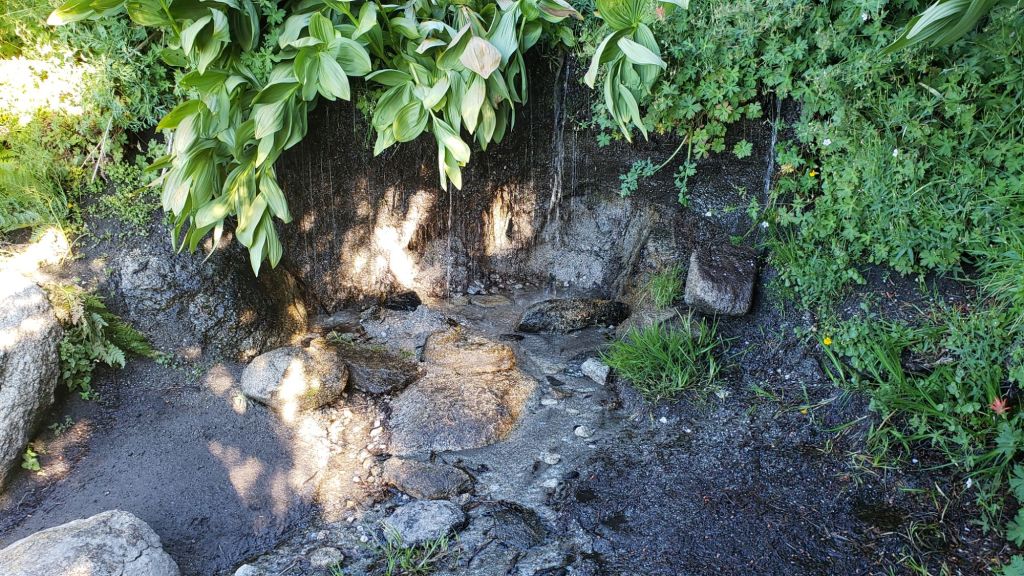
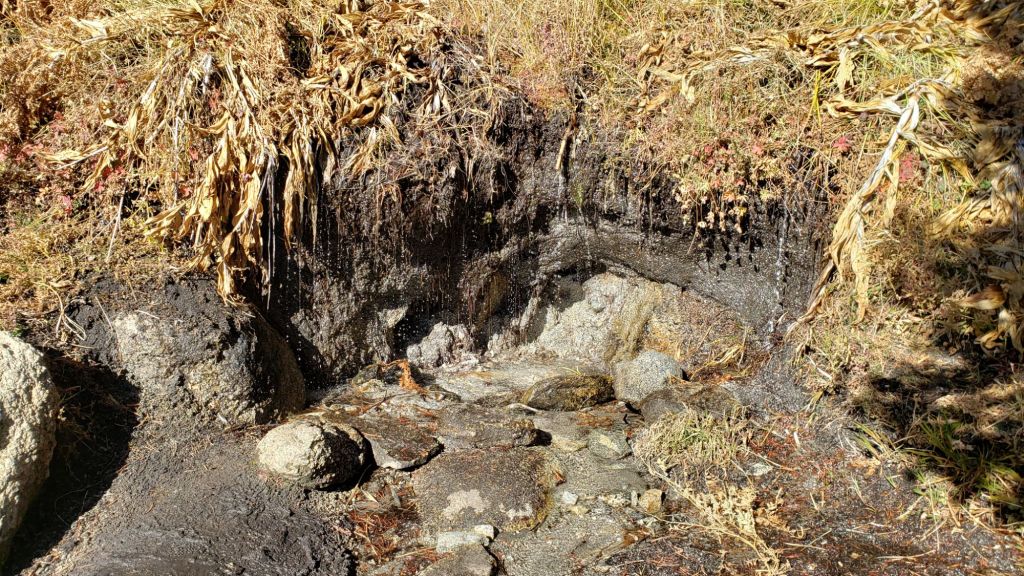
The well-known north spring at Wellman’s Cienega (9300 ft) flowing well for the time of year, mid morning 17th October 2024. Based on many years of past flow rate data, this spring will continue to flow gently into the winter this year.

While all time and labor is volunteered, the San Jacinto Trail Report uses small private donations to help cover operating costs. Your contribution keeps the Report available to all, free from advertising or paywalls, and independent from agencies. If you have found this Report useful, please consider using this link to the Donate page. Thank you very much for your support.

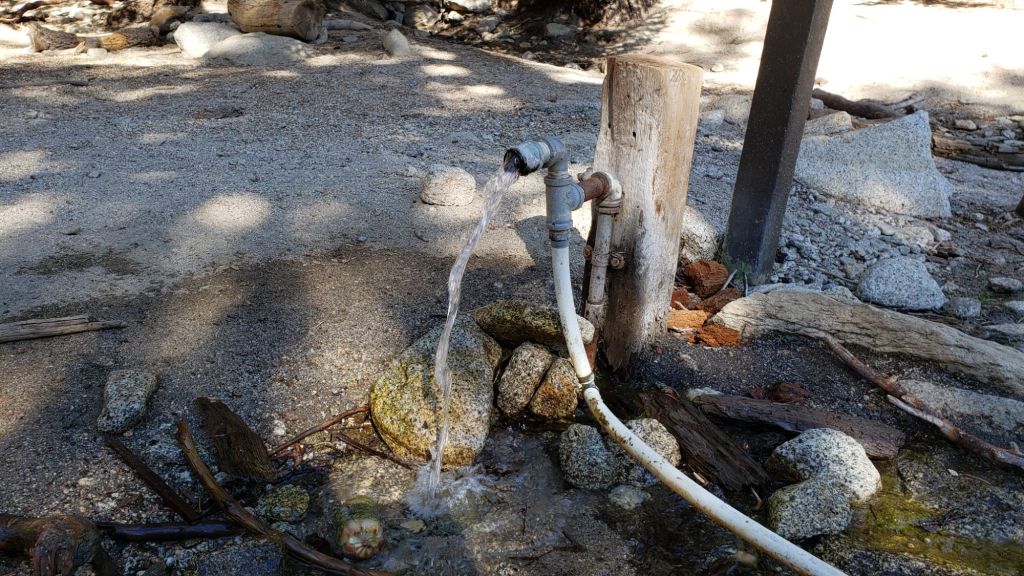
The Round Valley pipe continuing to flow fairly steadily, late morning 5th October 2024.
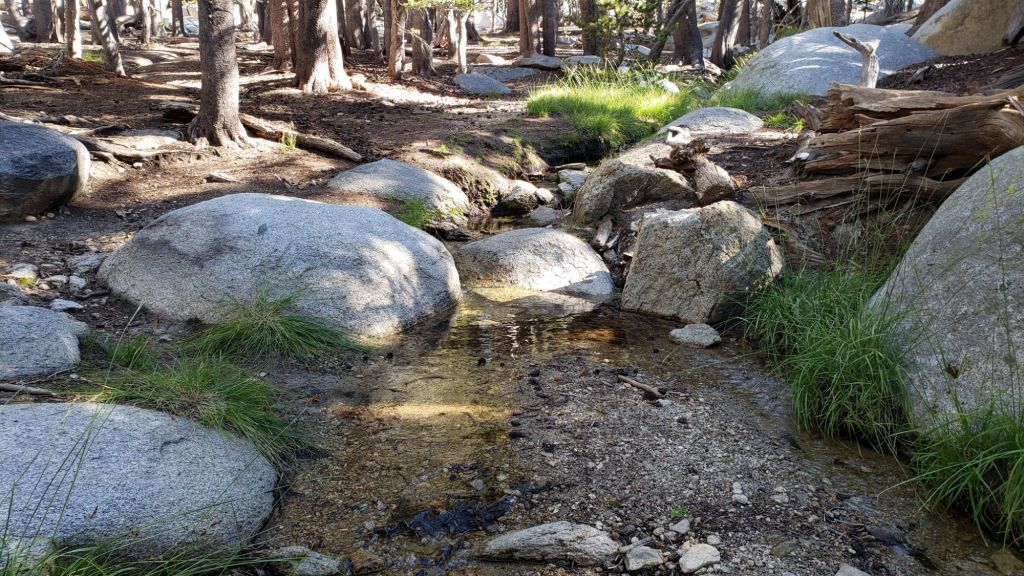
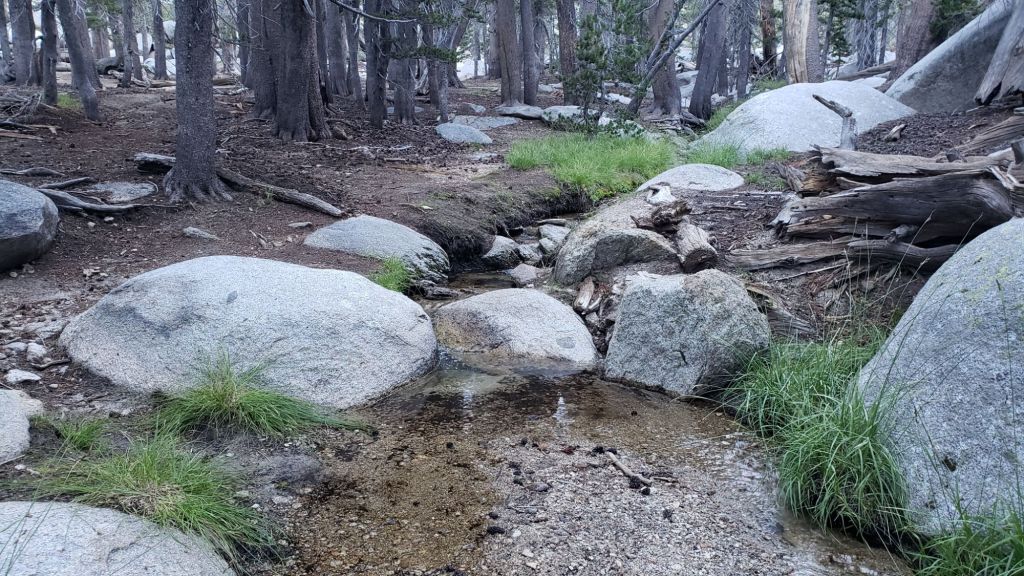
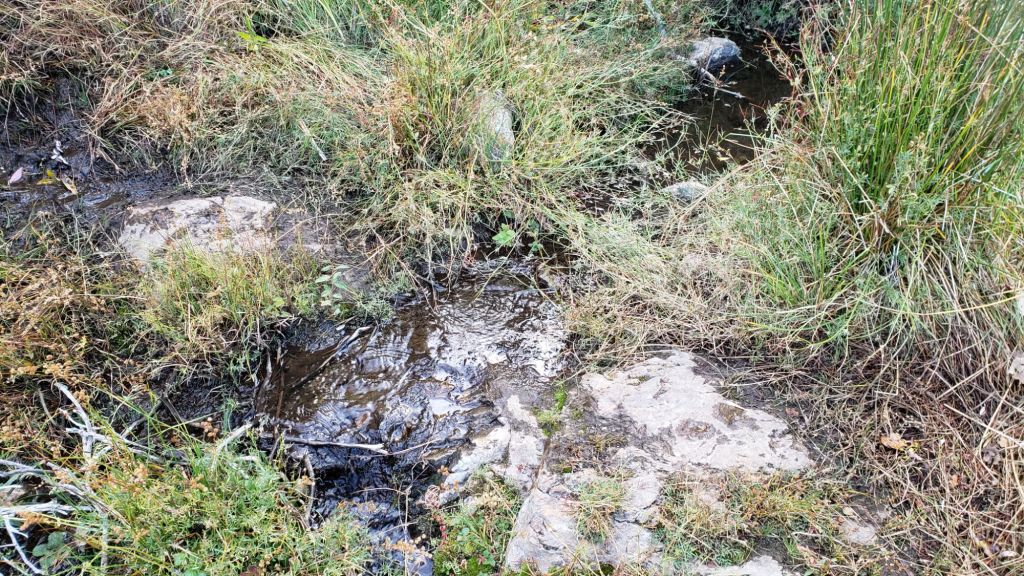
The creek in Little Round Valley (9750 ft) flowing steadily, early morning 11th October 2024. As in 2023, this creek is likely to continue to flow until winter this year, although the flow rate continues to drop slowly.
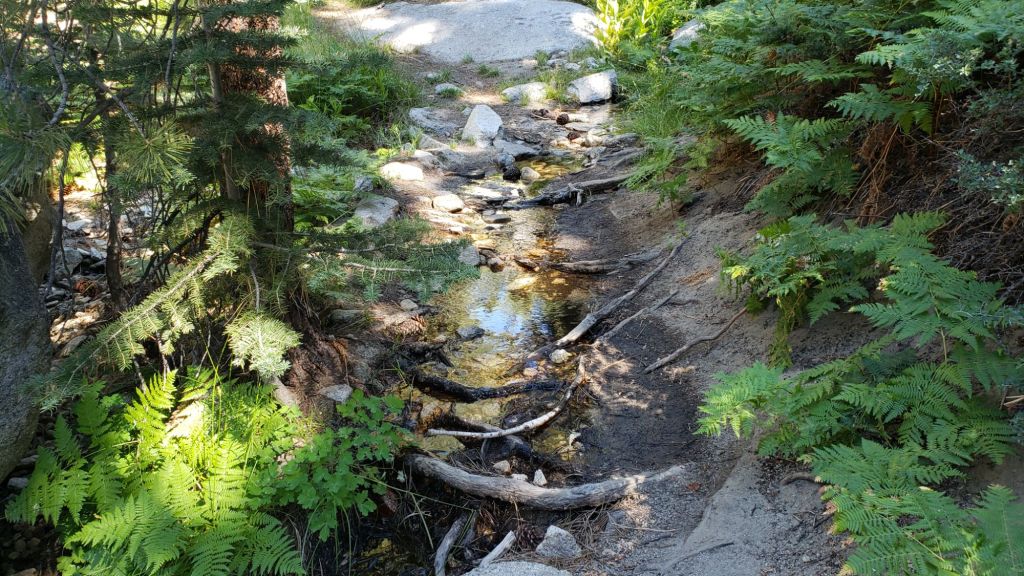
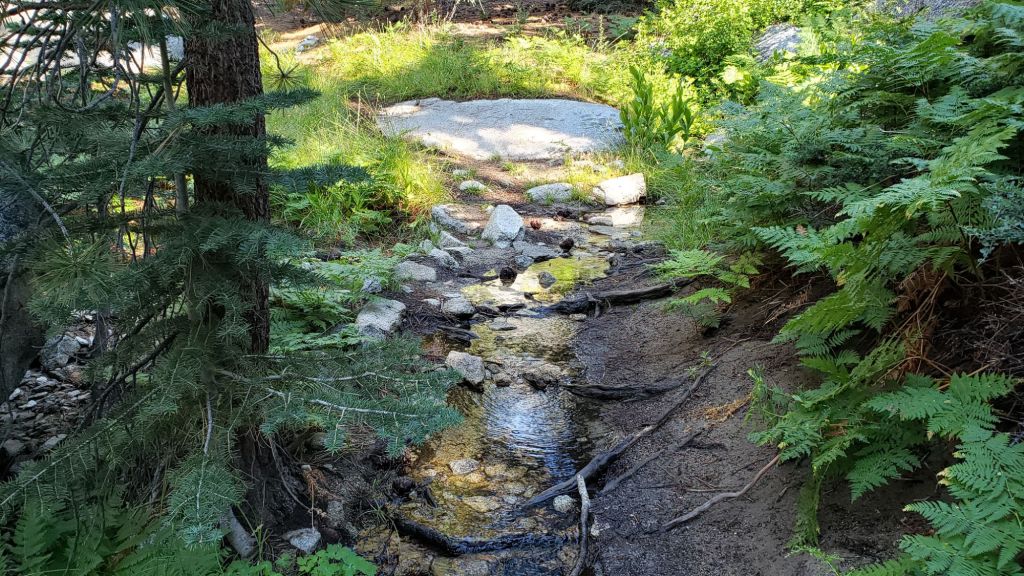
The North Fork of the San Jacinto River where it crosses upper Deer Springs Trail not far below its source (“Bed Springs”), early morning 11th October 2024. One of the few truly perennial water sources on the mountain these days, water will continue flowing at this location until winter, despite its meagre flow this autumn.
Willow Creek flowing only gently where it crosses Willow Creek Trail, late morning 5th October 2024. This creek may continue to flow for the remainder of this year, depending upon when the first winter precipitation arrives.

Trail update 11th October 2024

After four months of largely above average – often far above average – temperatures, autumnal conditions have finally arrived. Starting Friday 11th, temperatures will be near seasonal for October at all elevations, and are even expected to be briefly below average on 17th-19th. Windchill temperatures in the high country are around freezing at times (e.g., 31.3°F [0°C] at San Jacinto Peak on Friday 11th). There is a possibility of light precipitation on Friday 18th, perhaps including a dusting of snow in the high country.

With a failed monsoon season in most of Southern California, fire risk remains severe everywhere. A comprehensive fire ban is in place on Forest Service lands throughout the San Jacinto Ranger District (link to USFS order here) and in all Idyllwild campgrounds. Campfires are of course always prohibited throughout both the State Park and National Forest wilderness areas.

Survey hikes by the Trail Report every day year-round in the San Jacinto mountains include varied and often circuitous routes to San Jacinto Peak currently 3-4 times per week, plus a wide variety of other trails on intervening days.

Major springs, creeks, and pipes largely continue to flow at this time (example photos below). Flow rates continue to drop steadily at all elevations and ephemeral water sources have been dry for many weeks or months. The Round Valley faucet continued to flow well as of 9th October. In the Tahquitz area meadows, the minor creek in Skunk Cabbage Meadow continues to just trickle, but the ephemeral creek in Tahquitz Valley is dry. Tahquitz Creek is flowing gently at the northern end of Little Tahquitz Meadow, and near its source where it crosses the PCT at Mile 177. Two tiny springs at Strawberry Cienega just about continue to trickle. Hidden Lake was c.30% full in early October (by surface area, not volume). Stone Creek is no longer flowing where it crosses Deer Springs Trail at about PCT Mile 183.6, and has dried completely downstream of that point.

The Palm Springs Aerial Tramway closed on Monday 9th September 2024 for annual maintenance, with a (twice) revised, tentative, reopening date of Saturday 19th October.

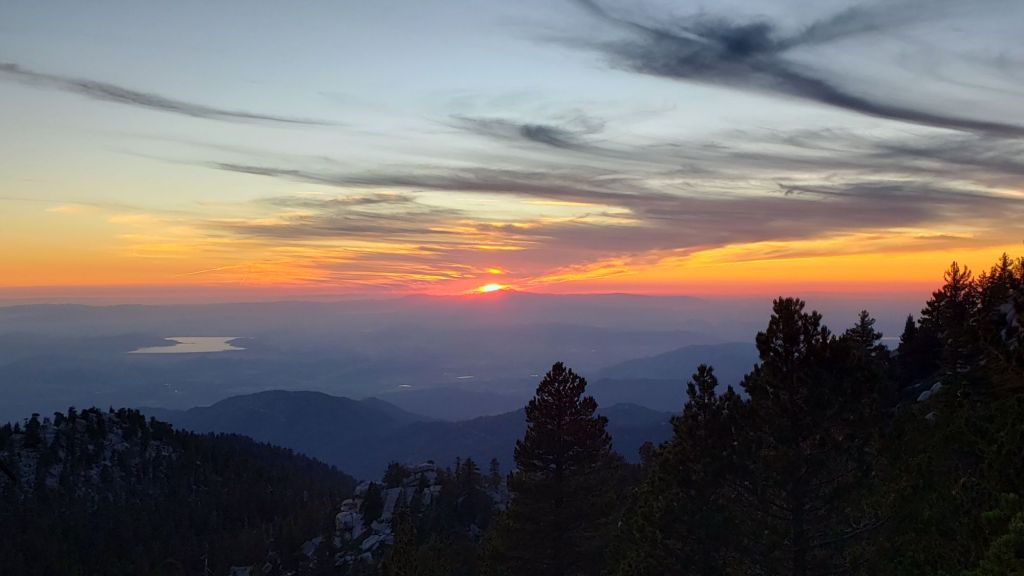
Sunset over Santiago Peak, as seen from upper Deer Springs Trail just below Little Round Valley, 11th October 2024. Diamond Valley Reservoir is visible to the left.

WEATHER

A cooling trend starting Friday 11th October will drop temperatures to near (or slightly above) average for mid October into the third week of the month. The passage of a brief cold front to the north on 17th-19th may drop temperatures to below average for mid October. The local precipitation probabilities for those days remain low, but there is a possibility of very light snow in the high country on Friday 18th. Temperatures are forecast to warm yet again to above seasonal for late October starting Monday 21st.

At San Jacinto Peak (3295m/10,810ft) on Friday 11th October 2024 at 0705 the air temperature was 44.0°F (7°C), with a windchill temperature of 31.3°F (0°C), 17% relative humidity, and a potent SSW wind sustained at 29 mph gusting to 36.0 mph.

At the Peak on Wednesday 9th October 2024 at 0810 the air temperature was 45.4°F (8°C), with a windchill temperature of 34.0°F (1°C), 31% relative humidity, and a stiff SW wind sustained at 16 mph gusting to 30.0 mph.

At the Peak on Monday 7th October 2024 at 0750 the air temperature was 58.6°F (15°C), with a “windchill” temperature of 56.0°F (13°C), 33% relative humidity, and a light ESE breeze sustained at 2 mph gusting to 3.7 mph.

TRAIL CONDITIONS

Treefall hazards remain a major problem along parts of the Pacific Crest Trail, most notably between Antsell Rock and Red Tahquitz, with 132+ recorded in my 2024 surveys between Miles 170.5-175.5. The disinterest of Forest Service and PCTA in maintaining this section of a world-famous trail for the past five years is simply unconscionable. The good news is that work to start to remove downed trees from this section, started last week, will include a focused effort on 13th-18th October. Concentrations of large downed trees make for especially slow-going around Miles 170.5-172 (east side of Antsell Rock) and Miles 174-175 (south and east sides of Red Tahquitz). A further 15 smaller trees are down from Miles 168.5-170.5 (Spitler Peak Trail to Zen Center Trail).

On the Fuller Ridge Trail section of the PCT there are 12 trees down on the State Park section of the trail (Miles 185.5-189), which has not been maintained by that agency for many years. Several of these pose quite significant hazards for hikers. On the Forest Service section, the only treefall hazard is the massive double one at about Mile 190.1 that has been present for about three years.

Trees down on the Strawberry Trail section of the PCT (Miles 180.8-183, Annie’s Junction to Strawberry Junction) have remained uncut by the Forest Service for 7-10 years now. About six hazards on this section are all relatively easy for hikers to negotiate.

About 12 treefall hazards on Deer Springs Trail include 8-9 in the upper trail that have been down and reported repeatedly for years but with no action from the State Park. All but one of the treefall hazards down between Strawberry Junction and the top of Marion Mountain Trail (roughly PCT Miles 183-185) were removed by the Trail Report in late June (example photos in an earlier Report linked here).

Overall Willow Creek Trail is significantly improved and nearing its 2020 condition (the last time the original trail route was fully cleared and passable). Almost all significant treefall hazards on the Forest Service section were cut by mid August (several uncut trees remain that need to be removed to fully restore the original trail route). Whitethorn trimming was largely completed on the Forest Service side in August and early September. On the State Park side some localized whitethorn trimming of the worst patches was undertaken in September, and the minor treefall hazards new in 2023/24 were removed, leaving just two major long term downed trees (both have simple workarounds for hikers).

The 34 treefall hazards that came down across Spitler Peak Trail during ice storms in February 2024 were almost all cleared by the Trail Report in June. The couple of minor stepover branches that remain pose no problem for hikers. This work brings to 120+ the total number of trees removed by the Report from this trail in the past three years. Note that currently the upper trail in particular is heavily overgrown with lush seasonal vegetation.

The Caramba Trail from near Reeds Meadow through Laws Camp and on to Caramba, and the Cedar Trail from Willow Creek Trail to Laws, are euphemistically described by the Forest Service as “not maintained”. In reality both trails have been abandoned and functionally no longer exist. They are so heavily overgrown with dense whitethorn, which obscures dozens of downed trees, that I strongly advise hikers do not attempt to follow them (regardless of how much you may trust an app). An informal use trail to Laws is much more direct, maintained, and avoids the challenging bushwhacking of the unmaintained trails (local Idyllwild hikers dubbed it the “King Trail” when I established the route in 2019). It leaves Willow Creek Trail exactly 1.0 mile from Saddle Junction, 0.46 mile from the Skunk Cabbage turning (trailhead at N 33.7796, W 116.6590). The route descends largely following established deer trails for 1.2 miles, meeting Willow Creek about 0.2 mile upstream from the site of the historic Laws Camp (the remains of which were destroyed by the 2013 Mountain Fire and subsequent flood and treefall damage). Eleven trees down on the King Trail were removed in June-July 2023. The tread of the trail received some damage from Tropical Storm Hilary last year. From Laws east to Caramba the route of the original Caramba Trail has been well-cairned by myself and others and can largely be followed with very careful route-finding. My 2023 survey counted about 110 trees down on this 2.1 miles of trail. It is especially obscure for the first 0.3 mile east of the Willow Creek crossing, becoming more obvious (but still subtle) as it descends towards Caramba. Very cautious navigation is advised throughout the area.

The Trail Report “adopted” Seven Pines Trail as a priority for maintenance work as the trail had a disproportionate number of lost hiker rescues in the past decade, and both State Park and Forest Service have shown no interest in maintaining the route for years. Since 2020 we have removed 75 downed trees and the trail is thoroughly trimmed and cleared multiple times annually. As of September 2024 the trail is largely clear of treefall hazards, with three down across the trail in its upper section, all easily passable for hikers. A further half-a-dozen downed trees close to the PCT junction would need to be removed to fully restore the original route of the trail. Although the condition of the trail is hugely improved, Seven Pines remains a genuine wilderness trail unlike the wider, bare, obvious routes of, for example, Devil’s Slide or Marion Mountain trails. Cautious navigation remains essential for those without considerable experience of hiking this trail. Be aware in particular that Seven Pines Trail becomes most obscure in the mile closest to its junction with Deer Springs Trail/PCT.

The Zen Center Trail continues its serious deterioration that started following the 2013 Mountain Fire, with a combination of vigorous regrowth and treefall hazards further obscuring the route with each passing season. The lower and upper parts of this trail are partially cairned and not too bad for those who are very familiar with the former route, but even the experienced find navigating the central section tricky. Long trousers, scrambling gloves, and an enjoyment of bush-whacking are all strongly recommended.

The well-known north spring at Wellman’s Cienega (9300 ft) flowing well for the time of year, early morning 9th October 2024. Based on years of past flow rate data, this spring is expected to continue to flow gently into the winter this year.

While all time and labor is volunteered, the San Jacinto Trail Report uses small private donations to help cover operating costs. Your contribution keeps the Report available to all, free from advertising or paywalls, and independent from agencies. If you have found this Report useful, please consider using this link to the Donate page. Thank you very much for your support.

The Round Valley pipe continuing to flow fairly steadily, late morning 5th October 2024.
The creek in Little Round Valley (9750 ft) flowing steadily, early morning 11th October 2024. As in 2023, this creek is likely to continue to flow until winter this year, although the flow rate continues to drop slowly.
The North Fork of the San Jacinto River where it crosses upper Deer Springs Trail not far below its source (“Bed Springs”), early morning 11th October 2024. One of the few truly perennial water sources on the mountain these days, water will continue flowing at this location until winter, despite its meagre flow this autumn.
Willow Creek flowing only gently where it crosses Willow Creek Trail, late morning 5th October 2024. This creek may continue to flow for the remainder of this year, depending upon when the first winter precipitation arrives.

Trail update 5th October 2024

A late, persistent, heat dome over the southwestern states is producing a record-breaking heatwave throughout interior Southern California for the first seven days of October 2024. Temperatures, both daytime highs and overnight lows, will be far above average for the time of year in and around the San Jacinto mountains until 8th October.

Hikers should be prepared for unseasonably hot weather, with temperatures 15-25°F above seasonal throughout this week, especially at mid elevations. Please give considerable extra thought to route choice, start times, clothing, sun protection, and hydration requirements.

With a failed monsoon season in most of Southern California, fire risk remains severe everywhere. A comprehensive fire ban is in place on Forest Service lands throughout the San Jacinto Ranger District (link to USFS order here) and in all Idyllwild campgrounds. Campfires are of course always prohibited throughout both the State Park and National Forest wilderness areas.

Survey hikes by the Trail Report every day year-round in the San Jacinto mountains include varied and often circuitous routes to San Jacinto Peak currently 3-5 times per week, plus a wide variety of other trails on intervening days.

Major springs, creeks, and pipes largely continue to flow adequately at this time (example photos below). Flow rates continue to drop steadily at all elevations and ephemeral water sources have been dry for many weeks. The Round Valley faucet continued to flow well as of 5th October. In the Tahquitz area meadows, the minor creek in Skunk Cabbage Meadow continues to just trickle, but the ephemeral creek in Tahquitz Valley is dry. Tahquitz Creek is flowing gently at the northern end of Little Tahquitz Meadow, and near its source where it crosses the PCT at Mile 177. Two tiny springs at Strawberry Cienega continue to trickle. Hidden Lake was c.35% full in mid September (by surface area, not volume). Stone Creek is no longer flowing where it crosses Deer Springs Trail at about PCT Mile 183.6, and has dried completely downstream of that point.

The Palm Springs Aerial Tramway closed on Monday 9th September 2024 for annual maintenance, with a (twice) revised, tentative, reopening date of Saturday 19th October.

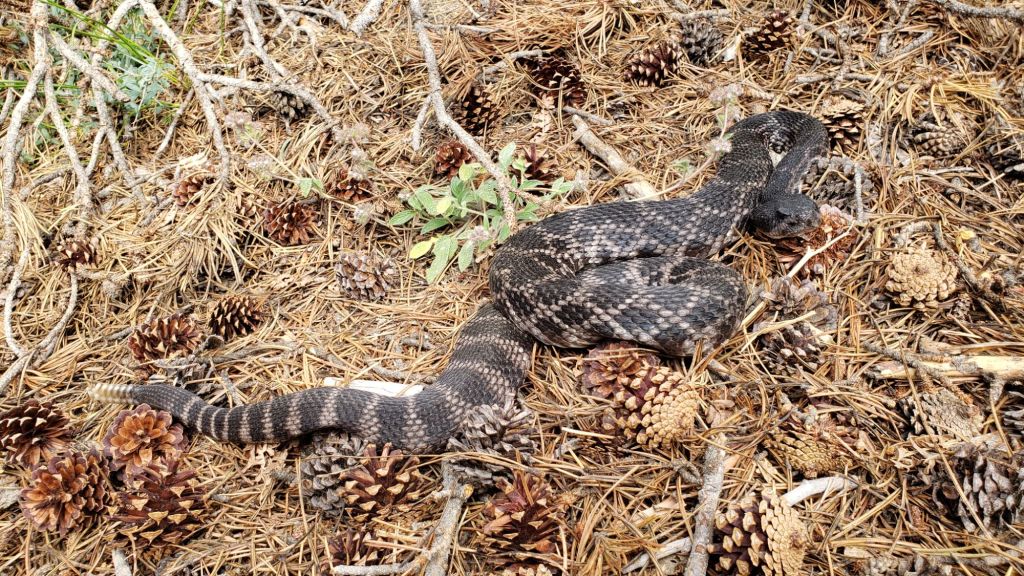
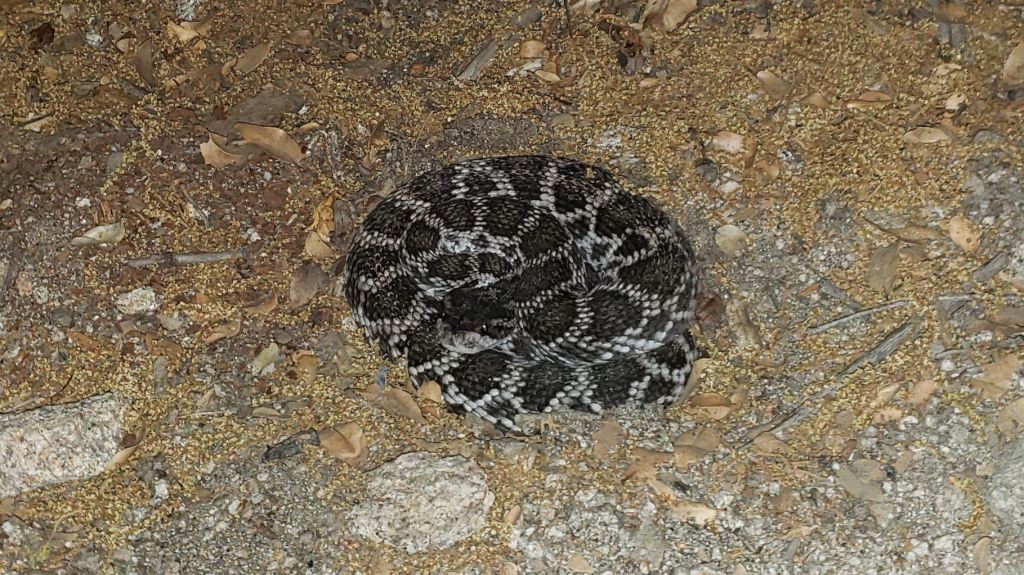
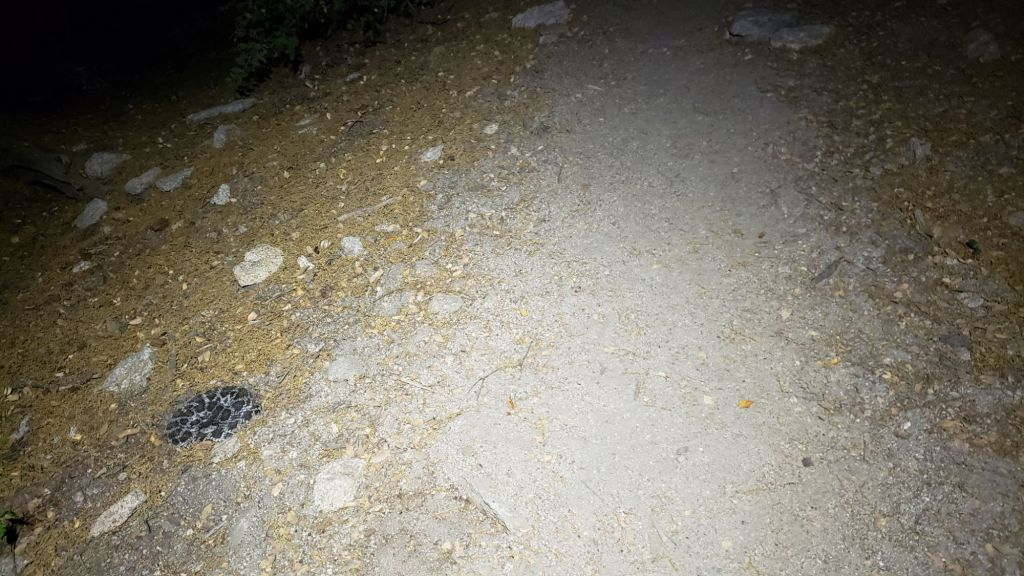
Be rattlesnake aware. Above about 5000 ft elevation, the venom of Southern Pacific Rattlesnakes (Crotalus [oreganus] helleri) in the San Jacinto mountains is predominantly neurotoxic, almost always fatal for dogs and sometimes for humans (see my detailed 2020 article linked here for further information). In recent weeks lower Devil’s Slide Trail has been an especially frequent location for sightings, but rattlesnakes have been recorded everywhere up to 9350 ft.

A secondary sunrise behind a narrow cloud band, as seen from 9100 ft near Wellman’s Cienega, 30th September 2024. Smoke and dust pollution in the Coachella Valley (photo below) produced a markedly orange-toned sunrise that morning.

WEATHER

Temperatures have rapidly risen since Sunday 22nd September to above seasonal. The first week of October is experiencing temperatures above average even for midsummer, that will of course be far above seasonal for October, with highs around 90°F (32°C) in Idyllwild from 1st-7th. Temperatures around 55°F (13°C) at the highest peaks will feel pleasantly cool by comparison, but are also far above average for October at that elevation.

For a detailed discussion of this early October heat wave, and provisional medium-term projections for the remainder of 2024, see the latest video from NWS San Diego (linked here).

A cooling trend is expected starting Wednesday 9th October, although temperatures are forecast to remain above average for mid October into the third week of the month.

In remarkable contrast, temperatures were around freezing in the high country from Monday 16th to Friday 20th September. A cold thunderstorm system on the afternoon of Friday 20th moving over the San Jacinto mountains from the north-east produced rain, intense hail, and the earliest ever recorded autumnal snow, albeit a very light dusting just around the highest peaks. I recorded a short video (linked here) from San Jacinto Peak while enjoying being lightly snowed upon.

At San Jacinto Peak (3295m/10,810ft) on Friday 4th October 2024 at 0810 the air temperature was 55.4°F (13°C), with a “windchill” temperature of 52.9°F (11°C), 35% relative humidity, and a very light SSW breeze sustained at 2 mph gusting to 3.7 mph.

At the Peak on Wednesday 2nd October 2024 at 0805 the air temperature was 55.5°F (13°C), with a windchill temperature of 46.5°F (8°C), 31% relative humidity, and a steady ENE wind sustained at 10 mph gusting to 16.6 mph.

At the Peak on Monday 30th September 2024 at 0800 the air temperature was 53.9°F (12°C), with a windchill temperature of 45.1°F (7°C), 36% relative humidity, and a fresh SE wind sustained at 9 mph gusting to 16.9 mph.

The Coachella Valley largely obscured by a low-lying and relatively dense mix of smoke and dust, as seen looking east from San Jacinto Peak, mid morning Monday 30th September 2024.

TRAIL CONDITIONS

Treefall hazards remain a major problem along parts of the Pacific Crest Trail, most notably between Antsell Rock and Red Tahquitz, with 132 recorded in my 2024 surveys between Miles 170.5-175.5. The disinterest of Forest Service and PCTA in maintaining this section of a world-famous trail for the past five years is simply unconscionable. The good news is that there is finally a plan to start removing downed trees from this section, starting on 13th-18th October. Concentrations of large downed trees make for especially slow-going around Miles 170.5-172 (east side of Antsell Rock) and Miles 174-175 (south and east sides of Red Tahquitz). A further 15 smaller trees are down from Miles 168.5-170.5 (Spitler Peak Trail to Zen Center Trail).

On the Fuller Ridge Trail section of the PCT there are 12 trees down on the State Park section of the trail (Miles 185.5-189), which has not been maintained by that agency for many years. Several of these pose quite significant hazards for hikers. On the Forest Service section, the only treefall hazard is the massive double one at about Mile 190.1 that has been present for about three years.

Trees down on the Strawberry Trail section of the PCT (Miles 180.8-183, Annie’s Junction to Strawberry Junction) have remained uncut by the Forest Service for 7-10 years now. About six hazards on this section are all relatively easy for hikers to negotiate.

About 12 treefall hazards on Deer Springs Trail include 8-9 in the upper trail that have been down and reported repeatedly for years but with no action from the State Park. All but one of the treefall hazards down between Strawberry Junction and the top of Marion Mountain Trail (roughly PCT Miles 183-185) were removed by the Trail Report in late June (example photos in an earlier Report linked here).

Overall Willow Creek Trail is greatly improved and close to its 2020 condition, the last time the original trail route was fully cleared and passable. Almost all significant treefall hazards on the Forest Service section were cut by mid August (several trees remain uncut to fully restore the original trail route but regrettably it seems this may never happen). Whitethorn trimming was largely completed on the Forest Service side in August and early September. On the State Park side some patchy whitethorn trimming of the worst patches was undertaken in September, and the three minor treefall hazards new in 2023/24 were removed, leaving just two major long term downed trees (both with simple workarounds for hikers).

The 34 treefall hazards that came down across Spitler Peak Trail during ice storms in February 2024 were almost all cleared by the Trail Report on 14th June. The couple of minor stepover branches that remain pose no problem for hikers. This work brings to 120+ the total number of trees removed by the Report from this trail in the past three years. Note that currently the upper trail in particular is heavily overgrown with lush seasonal vegetation.

The Caramba Trail from near Reeds Meadow through Laws Camp and on to Caramba, and the Cedar Trail from Willow Creek Trail to Laws, are euphemistically described by the Forest Service as “not maintained”. In reality both trails have been abandoned and functionally no longer exist. They are so heavily overgrown with dense whitethorn, which obscures dozens of downed trees, that I strongly advise hikers do not attempt to follow them (regardless of how much you may trust an app). An informal use trail to Laws is much more direct, maintained, and avoids the challenging bushwhacking of the unmaintained trails (local Idyllwild hikers dubbed it the “King Trail” when I established the route in 2019). It leaves Willow Creek Trail exactly 1.0 mile from Saddle Junction, 0.46 mile from the Skunk Cabbage turning (trailhead at N 33.7796, W 116.6590). The route descends largely following established deer trails for 1.2 miles, meeting Willow Creek about 0.2 mile upstream from the site of the historic Laws Camp (the remains of which were destroyed by the 2013 Mountain Fire and subsequent flood and treefall damage). Eleven trees down on the King Trail were removed in June-July 2023. The tread of the trail received some damage from Tropical Storm Hilary last year. From Laws east to Caramba the route of the original Caramba Trail has been well-cairned by myself and others and can largely be followed with very careful route-finding. My 2023 survey counted about 110 trees down on this 2.1 miles of trail. It is especially obscure for the first 0.3 mile east of the Willow Creek crossing, becoming more obvious (but still subtle) as it descends towards Caramba. Very cautious navigation is advised throughout the area.

The Trail Report “adopted” Seven Pines Trail as a priority for maintenance work as the trail had a disproportionate number of lost hiker rescues in the past decade, and both State Park and Forest Service have shown no interest in maintaining the route for years. Since 2020 we have removed 75 downed trees and the trail is thoroughly trimmed and cleared multiple times annually. As of July 2024 the trail is largely clear of treefall hazards, with three down across the trail in its upper section, all easily passable for hikers. A further half-a-dozen downed trees close to the PCT junction would need to be removed to fully restore the original route of the trail. Although the condition of the trail is hugely improved, Seven Pines remains a genuine wilderness trail unlike the wider, bare, obvious routes of, for example, Devil’s Slide or Marion Mountain trails. Cautious navigation remains essential for those without considerable experience of hiking this trail. Be aware in particular that Seven Pines Trail becomes most obscure in the mile closest to its junction with Deer Springs Trail/PCT.

The Zen Center Trail continues its deterioration that started following the 2013 Mountain Fire, with a combination of vigorous regrowth and treefall hazards further obscuring the route with each passing season. The lower and upper parts of this trail are partially cairned and not too bad for those who are very familiar with the former route, but even the experienced find navigating the central section tricky. Long trousers, scrambling gloves, and an enjoyment of bush-whacking are all strongly recommended.

While all time and labor is volunteered, the San Jacinto Trail Report uses small private donations to help cover operating costs. Your contribution keeps the Report available to all, free from advertising or paywalls, and independent from agencies. If you have found this Report useful, please consider using this link to the Donate page. Thank you very much for your support.

The well-known north spring at Wellman’s Cienega (9300 ft) flowing well for the time of year, early morning 4th October 2024. Based on years of past flow rate data, this spring is expected to continue to flow gently into the winter this year.
The creek in Little Round Valley (9750 ft) flowing steadily, early morning 28th September 2024. As in 2023, this creek is expected to continue to flow until winter this year, although the flow rate continues to drop slowly.
The Round Valley pipe continuing to flow fairly steadily, late morning 5th October 2024.
Willow Creek flowing only gently where it crosses Willow Creek Trail, late morning 5th October 2024. This creek may continue to flow for the remainder of this year, depending upon when the first winter precipitation arrives.
One of two tiny springs still trickling at Strawberry Cienega (approx PCT Mile 182), mid morning 18th September 2024. With patience a solo hiker could filter adequate water, but the flow is insufficient to be useful for a group.
The North Fork of the San Jacinto River where it crosses Fuller Ridge Trail at about PCT Mile 186.2, still flowing steadily, early morning 17th September 2024.
Patchy snow accumulated in the lee of rocks at San Jacinto Peak, early afternoon on Friday 20th September 2024.

Weather and trail update 28th September 2024

After an autumnal – at times almost wintry – week last week, temperatures have quickly risen to above seasonal at all elevations. Temperatures, especially the overnight lows, are forecast to remain well above average for the time of year into the first week of October. Temperatures from 27th September to 3rd October will be far above average, with possible record hot temperatures expected at mid and upper elevations on Tuesday 1st in particular.

In remarkable contrast, temperatures were around freezing in the high country from Monday 16th to Friday 20th. A cold thunderstorm system moving over the San Jacinto mountains from (unusually) the north-east produced rain, intense hail, and the earliest ever recorded autumnal snow on the afternoon of Friday 20th September. I recorded a short video (linked here) from San Jacinto Peak while enjoying being lightly snowed upon. The typically localized nature of such storms meant that Idyllwild (at 5550 ft) recorded 0.37 inch of rain, but there was only 0.11 inch at Saddle Junction (8100 ft) and 0.05 inch at Wellman’s Cienega (9300 ft). The dusting of snow above 9800 ft (photo below) promptly melted by Saturday 21st.

Despite recent light precipitation, with a failed monsoon season in most of Southern California the fire risk remains severe everywhere. A comprehensive fire ban is in place on Forest Service lands throughout the San Jacinto Ranger District (link to USFS order here) and in all Idyllwild campgrounds. Campfires are of course always prohibited throughout both the State Park and National Forest wilderness areas.

Survey hikes by the Trail Report every day year-round in the San Jacinto mountains include varied and often circuitous routes to San Jacinto Peak multiple times per week (e.g., 70 ascents since 1st July 2024), plus a wide variety of other trails on intervening days.

Major springs, creeks, and pipes largely continue to flow adequately at this time (example photos below). Flow rates continue to drop steadily at all elevations and ephemeral water sources are now dry. The Round Valley faucet continued to flow well as of 26th September. In the Tahquitz area meadows, the minor creek in Skunk Cabbage Meadow continues to trickle, but the ephemeral creek in Tahquitz Valley is dry. Tahquitz Creek is flowing steadily at the northern end of Little Tahquitz Meadow, and near its source where it crosses the PCT at Mile 177. Two tiny springs at Strawberry Cienega continue to trickle. Hidden Lake was c.35% full in mid September (by surface area, not volume). Stone Creek is no longer flowing where it crosses Deer Springs Trail at about PCT Mile 183.6, and has dried completely downstream of that point.

The Palm Springs Aerial Tramway closed on Monday 9th September 2024 for annual maintenance, with a revised, tentative, reopening date of Saturday 12th October.

Be rattlesnake aware. Above about 5000 ft elevation, the venom of Southern Pacific Rattlesnakes (Crotalus [oreganus] helleri) in the San Jacinto mountains is predominantly neurotoxic, almost always fatal for dogs and sometimes for humans (see my detailed 2020 article linked here for further information). In the past couple of weeks, despite some cooler weather, lower Devil’s Slide Trail has been an especially frequent location for sightings, but rattlesnakes have been recorded up to 9350 ft.

The famous “San Jac shadow” – the distinctive triangular shadow cast by the mountain by either the rising or setting sun due to the sheer prominence of the Peak – here projected on a canvas of thick marine layer cloud, as seen looking west from the Peak just after sunrise on 19th September 2024. Santiago Peak is just visible as a tiny island emerging from the cloud immediately left of the tip of the shadow.

WEATHER

Temperatures were well above seasonal for the first nine days of September, but then fell below seasonal starting Wednesday 11th September, and then cooled even further in a brief but significant cold snap on 16th-20th. A weak but cold system passing to the north produced temperatures more typical of November, including air temperatures near freezing and windchill temperatures below freezing above 10,000 ft elevation on Monday 16th to Friday 20th. As described above, localized precipitation from thunderstorm cells on 20th September included the earliest ever recorded autumn dusting of snow at San Jacinto Peak (<0.25 inch, photo below), and brief but intense hail especially on the south side of the mountain range.

Temperatures have rapidly risen yet again starting Sunday 22nd to above seasonal for the remainder of September and into the first week of October. Temperatures from 30th September to 3rd October, especially the overnight lows, will be far above average, with possible record hot temperatures forecast for Tuesday 1st at both mid and upper elevations.

At San Jacinto Peak (3295m/10,810ft) on Friday 27th September 2024 at 0755 the air temperature was 55.4°F (13°C), with no measurable windchill, 8% relative humidity, and rare calm conditions.

At the Peak on Wednesday 25th September 2024 at 0830 the air temperature was 51.6°F (10°C), with a windchill temperature of 40.6°F (5°C), 38% relative humidity, and a chilly SSE wind sustained at 12 mph gusting to 20.0 mph.

At the Peak on Monday 23rd September 2024 at 0845 the air temperature was 47.9°F (9°C), with a windchill temperature of 38.7°F (4°C), 49% relative humidity, and a fresh ENE wind sustained at 11 mph gusting to 16.0 mph.

At the Peak on Friday 20th September 2024 at 1425 the air temperature was 32.2°F (0°C), with a windchill temperature of 20.8°F (-7°C), 95% relative humidity, and a steady NE wind sustained at 9 mph gusting to 12.7 mph.

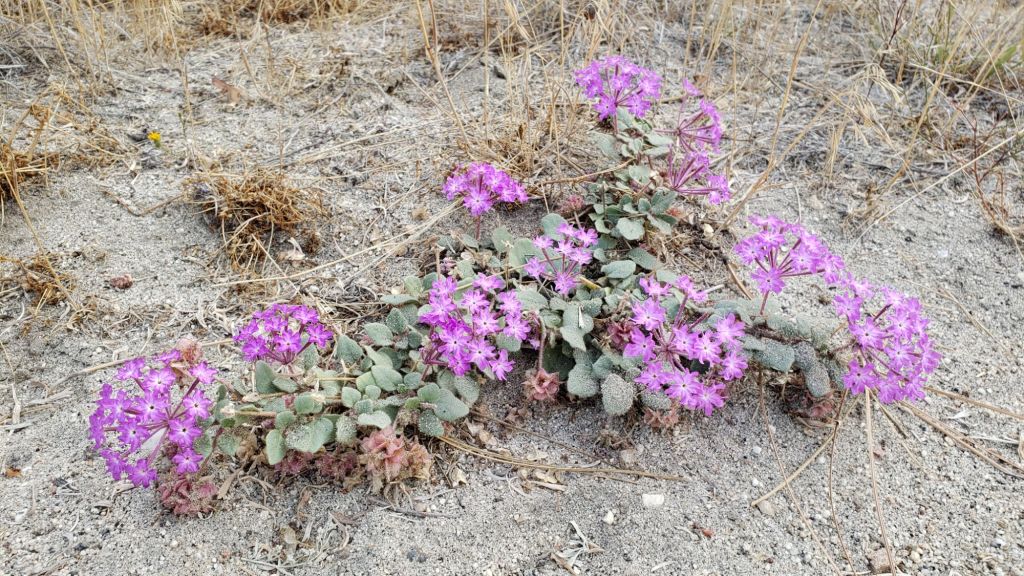
Desert Sand Verbena (Abronia villosa) in full bloom at 4450 ft elevation, Quinn Flat, Garner Valley, 20th September 2024. Well-known as both an early and late bloomer, this is currently the only flowering colour in a sea of dry, brown, vegetation throughout much of Garner Valley.

TRAIL CONDITIONS

Treefall hazards remain a major problem along parts of the Pacific Crest Trail, most notably between Antsell Rock and Red Tahquitz, with 132 recorded in my recent 2024 surveys between Miles 170.5-175.5. The disinterest of Forest Service and PCTA in maintaining this section of a world-famous trail for the past five years is simply unconscionable. Concentrations of large downed trees make for especially slow-going around Miles 170.5-172 (east side of Antsell Rock) and Miles 174-175 (south and east sides of Red Tahquitz). A further 15 smaller trees are down from Miles 168.5-170.5 (Spitler Peak Trail to Zen Center Trail).

On the Fuller Ridge Trail section of the PCT there are 12 trees down on the State Park section of the trail (Miles 185.5-189), which has not been maintained by that agency for many years. Several of these pose quite significant hazards for hikers. On the Forest Service section, the only treefall hazard is the massive double one at about Mile 190.1 that has been present for about three years.

Trees down on the Strawberry Trail section of the PCT (Miles 180.8-183, Annie’s Junction to Strawberry Junction) have remained uncut by the Forest Service for 7-10 years now. About six hazards on this section are all relatively easy for hikers to negotiate.

About 12 treefall hazards on Deer Springs Trail include 8-9 in the upper trail that have been down and reported repeatedly for years but with no action from the State Park. All but one of the treefall hazards down between Strawberry Junction and the top of Marion Mountain Trail (roughly PCT Miles 183-185) were removed by the Trail Report in late June (example photos in an earlier Report linked here).

On Willow Creek Trail notable treefall hazards on the Forest Service section were finally cut by 13th August. Several trees remain uncut to fully restore the trail route to its 2020 condition, but regrettably it seems unlikely that this will ever happen. Whitethorn along the trail is starting to grow back rapidly, and had become a problem on both the Forest Service and State Park sections. Forest Service made progress on trail trimming in late August and early September on their section, but there has been no work on the State Park side. Treefall hazards currently on the State Park side include two large ones remaining from last year, plus three small new ones, but none pose major problems for hikers.

The 34 treefall hazards that came down across Spitler Peak Trail during ice storms in February 2024 were almost all cleared by the Trail Report on 14th June. The couple of minor stepover branches that remain pose no problem for hikers. This work brings to 120+ the total number of trees removed by the Report from this trail in the past three years. Note that currently the upper trail in particular is heavily overgrown with lush seasonal vegetation.

The Caramba Trail from near Reeds Meadow through Laws Camp and on to Caramba, and the Cedar Trail from Willow Creek Trail to Laws, are euphemistically described by the Forest Service as “not maintained”. In reality both trails have been abandoned and functionally no longer exist. They are so heavily overgrown with dense whitethorn, which obscures dozens of downed trees, that I strongly advise hikers do not attempt to follow them (regardless of how much you may trust an app). An informal use trail to Laws is much more direct, maintained, and avoids the challenging bushwhacking of the unmaintained trails (local Idyllwild hikers dubbed it the “King Trail” when I established the route in 2019). It leaves Willow Creek Trail exactly 1.0 mile from Saddle Junction, 0.46 mile from the Skunk Cabbage turning (trailhead at N 33.7796, W 116.6590). The route descends largely following established deer trails for 1.2 miles, meeting Willow Creek about 0.2 mile upstream from the site of the historic Laws Camp (the remains of which were destroyed by the 2013 Mountain Fire and subsequent flood and treefall damage). Eleven trees down on the King Trail were removed in June-July 2023. The tread of the trail received some damage from Tropical Storm Hilary last year. From Laws east to Caramba the route of the original Caramba Trail has been well-cairned by myself and others and can largely be followed with very careful route-finding. My 2023 survey counted about 110 trees down on this 2.1 miles of trail. It is especially obscure for the first 0.3 mile east of the Willow Creek crossing, becoming more obvious (but still subtle) as it descends towards Caramba. Very cautious navigation is advised throughout the area.

The Trail Report “adopted” Seven Pines Trail as a priority for maintenance work as the trail had a disproportionate number of lost hiker rescues in the past decade, and both State Park and Forest Service have shown no interest in maintaining the route for years. Since 2020 we have removed 75 downed trees and the trail is thoroughly trimmed and cleared multiple times annually. As of July 2024 the trail is largely clear of treefall hazards, with three down across the trail in its upper section, all easily passable for hikers. A further half-a-dozen downed trees close to the PCT junction would need to be removed to fully restore the original route of the trail. Although the condition of the trail is hugely improved, Seven Pines remains a genuine wilderness trail unlike the wider, bare, obvious routes of, for example, Devil’s Slide or Marion Mountain trails. Cautious navigation remains essential for those without considerable experience of hiking this trail. Be aware in particular that Seven Pines Trail becomes most obscure in the mile closest to its junction with Deer Springs Trail/PCT.

The Zen Center Trail continues its deterioration that started following the 2013 Mountain Fire, with a combination of vigorous regrowth and treefall hazards further obscuring the route with each passing season. The lower and upper parts of this trail are partially cairned and not too bad for those who are very familiar with the former route, but even the experienced find navigating the central section tricky. Long trousers, scrambling gloves, and an enjoyment of bush-whacking are all strongly recommended.

What a difference a few hours can make in the mountains. Above, looking south from PCT Mile 180 toward Tahquitz Peak (hidden in the cloud) and Tahquitz Rock (emerging imperiously from the cloud) at 1228 on Friday 20th September 2024. Below, the same view just four hours later at 1621, after both the passage of frigid thunderstorms and the marine layer had receded.
Patchy snow accumulated in the lee of rocks at San Jacinto Peak, early afternoon on Friday 20th September 2024.

While all time and labor is volunteered, the San Jacinto Trail Report uses small private donations to help cover operating costs. Your contribution keeps the Report available to all, free from advertising or paywalls, and independent from agencies. If you have found this Report useful, please consider using this link to the Donate page. Thank you very much for your support.
The well-known north spring at Wellman’s Cienega (9300 ft) flowing well for the time of year, early morning 27th September 2024. Although flow here has dropped steadily this summer, the spring is expected to continue to flow gently into the winter this year.
The creek in Little Round Valley (9750 ft) flowing steadily, early morning 28th September 2024. As in 2023, this creek is expected to continue to flow until winter this year, although the flow rate continues to drop slowly.
One of two tiny springs still trickling at Strawberry Cienega (approx PCT Mile 182), mid morning 18th September 2024. With patience a solo hiker could filter adequate water, but the flow is insufficient to be useful for a group.
The Round Valley pipe continuing to flow fairly steadily, early morning 19th September 2024. The adjacent creek dried in late August.
The North Fork of the San Jacinto River where it crosses Fuller Ridge Trail at about PCT Mile 186.2, still flowing steadily, early morning 17th September 2024.

Weather and trail update 19th September 2024

UPDATE Friday 20th September 2024: a cold thunderstorm system moving over the San Jacinto mountains from (unusually) the north-east produced rain, intense hail, and the earliest ever recorded September snow this afternoon! I hiked swiftly up to the high country and recorded a short video from San Jacinto Peak while enjoying being lightly snowed upon (link to video here). The typically localized nature of such storms meant that Idyllwild (at 5550 ft) recorded 0.37 inch of rain, but there was only 0.11 inch at Saddle Junction (8100 ft). Fine, micro grain snow started falling on me at 9800 ft just above Wellman’s Divide and lasted for less than an hour. It only settled significantly on accumulated patches of hail that had fallen a couple of hours earlier, and was melting rapidly by late afternoon.

————————————–

The three major fires burning elsewhere in Southern California – the Airport Fire in the Santa Ana range, the Bridge Fire in the San Gabriels, and the Line Fire in the San Bernardino Mountains – have thankfully all slowed considerably in growth, and smoke pollution across the region is slowly declining. Ultimately the three fires have combined to burn more than 110,000 acres.

Air quality and visibility down in the lowlands, especially the Coachella Valley, had already been generally poor all summer due to the record heat and lack of precipitation, only exacerbated by smoke from recent fires. Air quality has markedly improved in the San Jacinto mountains, following an increase in wind speed, after especially smoky days on 10th and 13th (photos below from the latter). Hiking in the area remains inadvisable for those sensitive to poor air quality.

Thankfully, temperatures fell below seasonal starting Wednesday 11th September, and are forecast to cool even further in a significant cold spell on 16th-20th. A relatively weak but cold system passing to our north will produce temperatures more typical of early winter, including air temperatures near freezing and windchill temperatures well below freezing in the high country on Monday 16th to Friday 20th. There is the possibility of light precipitation on Friday 20th (oddly, especially for the time of year, coming from the north-east).

With a failed monsoon season in most of Southern California, fire risk remains severe everywhere. A comprehensive fire ban is in place on Forest Service lands throughout the San Jacinto Ranger District (link to USFS order here) and in all Idyllwild campgrounds. Campfires are of course always prohibited throughout both the State Park and National Forest wilderness areas.

Survey hikes by the Trail Report every day year-round in the San Jacinto mountains include varied and circuitous routes to San Jacinto Peak multiple times per week (64 ascents this summer since 1st July), plus many other trails on intervening days.

Major springs, creeks, and pipes largely continue to flow adequately at this time (example photos below). However flow rates continue to drop steadily at all elevations and ephemeral water sources are now dry. The Round Valley faucet continued to flow well as of 19th September. In the Tahquitz area meadows, the minor creek in Skunk Cabbage Meadow continues to flow, but the ephemeral creek in Tahquitz Valley is now dry. Tahquitz Creek is flowing steadily at the northern end of Little Tahquitz Meadow, and near its source where it crosses the PCT at Mile 177. Two tiny springs at Strawberry Cienega continue to trickle. Hidden Lake was c.35% full in mid September (by surface area, not volume). Stone Creek is no longer flowing where it crosses Deer Springs Trail at about PCT Mile 183.6, and has dried completely downstream of that point.

The Palm Springs Aerial Tramway closed on Monday 9th September 2024 for annual maintenance, with a tentative reopening date of Monday 7th October.

Sunset behind a deep marine cloud layer from San Jacinto Peak, 16th September 2024. An all-too-brief early hint of winter with an air temperature just above freezing and windchill around 20°F.

WEATHER

Temperatures were well above seasonal for the first nine days of September, but then fell below seasonal starting Wednesday 11th September, and are forecast to cool even further in a brief but significant cold snap on 16th-20th. A weak but cold system passing to our north will produce temperatures more typical of November, including air temperatures near freezing and windchill temperatures below freezing above 10,000 ft elevation on Monday 16th to Friday 20th. Thereafter temperatures are expected to rise rapidly yet again starting Sunday 22nd to above seasonal for the remainder of September.

At San Jacinto Peak (3295m/10,810ft) on Friday 20th September 2024 at 1425 the air temperature was 32.2°F (0°C), with a windchill temperature of 20.8°F (-7°C), 95% relative humidity, and a steady NE wind sustained at 9 mph gusting to 12.7 mph.

At the Peak on Thursday 19th September 2024 at 0640 the air temperature was 39.1°F (4°C), with a windchill temperature of 28.7°F (-2°C), 37% relative humidity, and a brisk SW wind sustained at 8 mph gusting to 13.8 mph.

At the Peak on Wednesday 18th September 2024 at 1230 the air temperature was 49.5°F (10°C), with a windchill temperature of 43.6°F (6°C), 42% relative humidity, and a light SW wind sustained at 3 mph gusting to 5.2 mph.

At the Peak on Tuesday 17th September 2024 at 1615 the air temperature was 48.9°F (9°C), with a windchill temperature of 39.6°F (4°C), 31% relative humidity, and a cool WNW wind sustained at 4 mph gusting to 7.8 mph.

At the Peak on Monday 16th September 2024 at 1100 the air temperature was 35.7°F (2°C), with a windchill temperature of 20.3°F (-7°C), 38% relative humidity, and a frigid WSW wind sustained at 15 mph gusting to 23.3 mph.

Smoke was widespread everywhere below a sharply defined ceiling at 9400 ft in the San Jacinto mountains (and throughout Southern California) on Friday 13th September 2024. Tahquitz Peak and Tahquitz Rock as seen looking south from PCT Mile 180 just after sunrise.

TRAIL CONDITIONS

Treefall hazards remain a major problem along parts of the Pacific Crest Trail, most notably between Antsell Rock and Red Tahquitz, with 132 recorded in my recent 2024 surveys between Miles 170.5-175.5. The disinterest of Forest Service and PCTA in maintaining this section of a world-famous trail for the past five years is simply unconscionable. Concentrations of large downed trees make for especially slow-going around Miles 170.5-172 (east side of Antsell Rock) and Miles 174-175 (south and east sides of Red Tahquitz). A further 15 smaller trees are down from Miles 168.5-170.5 (Spitler Peak Trail to Zen Center Trail).

About 12 treefall hazards on Deer Springs Trail include 8-9 in the upper trail that have been down and reported repeatedly for years but with no action from the State Park. All but one of the treefall hazards down between Strawberry Junction and the top of Marion Mountain Trail (roughly PCT Miles 183-185) were removed by the Trail Report in late June (example photos in an earlier Report linked here).

On Willow Creek Trail notable treefall hazards on the Forest Service section were finally cut by 13th August. Several trees remain uncut to fully restore the trail route to its 2020 condition, but it seems unlikely that they will ever be cut. Whitethorn along the trail is starting to grow back rapidly, and is becoming a problem on both the Forest Service and State Park sections (photo in previous Report linked here). Forest Service made progress on trail trimming on 26th-27th August and 9th September. Treefall hazards currently on the State Park side include two large ones remaining from last year, plus three small new ones, but none pose major problems for hikers, and there is optimism that some may be removed later in September.

The 34 treefall hazards that came down across Spitler Peak Trail during ice storms in February 2024 were almost all cleared by the Trail Report on 14th June. The couple of minor stepover branches that remain pose no problem for hikers. This work brings to 120+ the total number of trees removed by the Report from this trail in the past three years. Note that currently the upper trail in particular is heavily overgrown with lush seasonal vegetation.

The Caramba Trail from near Reeds Meadow through Laws Camp and on to Caramba, and the Cedar Trail from Willow Creek Trail to Laws, are euphemistically described by the Forest Service as “not maintained”. In reality both trails have been abandoned and functionally no longer exist. They are so heavily overgrown with dense whitethorn, which obscures dozens of downed trees, that I strongly advise hikers do not attempt to follow them (regardless of how much you may trust an app). An informal use trail to Laws is much more direct, maintained, and avoids the challenging bushwhacking of the unmaintained trails (local Idyllwild hikers dubbed it the “King Trail” when I established the route in 2019). It leaves Willow Creek Trail exactly 1.0 mile from Saddle Junction, 0.46 mile from the Skunk Cabbage turning (trailhead at N 33.7796, W 116.6590). The route descends largely following established deer trails for 1.2 miles, meeting Willow Creek about 0.2 mile upstream from the site of the historic Laws Camp (the remains of which were destroyed by the 2013 Mountain Fire and subsequent flood and treefall damage). Eleven trees down on the King Trail were removed in June-July 2023. The tread of the trail received some damage from Tropical Storm Hilary last year. From Laws east to Caramba the route of the original Caramba Trail has been well-cairned by myself and others and can largely be followed with very careful route-finding. My 2023 survey counted about 110 trees down on this 2.1 miles of trail. It is especially obscure for the first 0.3 mile east of the Willow Creek crossing, becoming more obvious (but still subtle) as it descends towards Caramba. Very cautious navigation is advised throughout the area.

The Trail Report “adopted” Seven Pines Trail as a priority for maintenance work as the trail had a disproportionate number of lost hiker rescues in the past decade, and both State Park and Forest Service have shown no interest in maintaining the route for years. Since 2020 we have removed 75 downed trees and the trail is thoroughly trimmed and cleared multiple times annually. As of July 2024 the trail is largely clear of treefall hazards, with three down across the trail in its upper section, all easily passable for hikers. A further half-a-dozen downed trees close to the PCT junction would need to be removed to fully restore the original route of the trail. Although the condition of the trail is hugely improved, Seven Pines remains a genuine wilderness trail unlike the wider, bare, obvious routes of, for example, Devil’s Slide or Marion Mountain trails. Cautious navigation remains essential for those without considerable experience of hiking this trail. Be aware in particular that Seven Pines Trail becomes most obscure in the mile closest to its junction with Deer Springs Trail/PCT.

The Zen Center Trail continues its deterioration that started following the 2013 Mountain Fire, with a combination of vigorous regrowth and treefall hazards further obscuring the route with each passing season. The lower and upper parts of this trail are partially cairned and not too bad for those who are very familiar with the former route, but even the experienced find navigating the central section tricky. Long trousers, scrambling gloves, and an enjoyment of bush-whacking are all strongly recommended.

The famous “San Jac shadow” – the distinctive triangular shadow cast by the mountain by either the rising or setting sun due to the sheer prominence of the Peak – on a canvas of thick marine layer cloud, as seen looking west from the Peak just after sunrise on 19th September 2024. Santiago Peak is just visible as a tiny island emerging from the cloud immediately left of the tip of the shadow.

While all time and labor is volunteered, the San Jacinto Trail Report uses small private donations to help cover operating costs. Your contribution keeps the Report available to all, free from advertising or paywalls, and independent from agencies. If you have found this Report useful, please consider using this link to the Donate page. Thank you very much for your support.

The well-known north spring at Wellman’s Cienega (9300 ft) flowing steadily, early afternoon 19th September 2024. Although flow here has dropped dramatically in the past two months, the spring will nevertheless continue to trickle at least into the winter this year.
The creek in Little Round Valley (9750 ft) flowing steadily, late morning 18th September 2024. As in 2023, this creek is expected to continue to flow until winter this year, although the flow rate continues to drop steadily.
One of two tiny springs still trickling at Strawberry Cienega (approx PCT Mile 182), mid morning 18th September 2024. With patience a solo hiker could filter adequate water, but the flow is insufficient to be useful for a group.
The Round Valley pipe continuing to flow fairly steadily, early morning 19th September 2024. The adjacent creek has now been dry for three weeks.
The North Fork of the San Jacinto River where it crosses Fuller Ridge Trail at about PCT Mile 186.2, still flowing steadily, early morning 17th September 2024.
Willow Creek where it crosses the appropriately named Willow Creek Trail (7800 ft), late morning 28th August 2024. While the flow rate here has dropped steadily throughout the summer, the creek now looks likely to continue flowing throughout the autumn (rarely a certainty in the past decade). The two minor creeks within the next mile further east on the trail are now functionally dry.

Weather and trail update 13th September 2024

Tuesday 10th September 2024 will be remembered as one of the darkest days, both literally and figuratively, in the modern history of the mountains of Southern California. Three fires, burning in three different mountain ranges – the Airport Fire in the Santa Ana range, the Bridge Fire in the San Gabriels, and the Line Fire in the San Bernardino Mountains – all grew dramatically that day, in combination burning more than 60,000 acres on that one day alone. The skies of interior Southern California were borderline apocalyptic, smoke partially eclipsing the sun most of the day and with fine ash falling more than 50 miles away from active fire fronts.

Details of the widespread destruction, forest and road closures, and ways to help those impacted, are available elsewhere online. The high country areas of all three of those mountain ranges are of course closed, probably for extended periods. Many well-known trails and routes have been burned over in all three forests. The Line Fire destroyed the fire lookout at Keller Peak on the afternoon of 10th September, having burned in the immediate vicinity of the fire lookout at Morton Peak the previous day, where the lookout structure was remarkably only singed (but everything around it was destroyed).

Air quality and visibility down in the lowlands, especially the Coachella Valley, had already been generally poor all summer due to the lack of precipitation, only exacerbated by smoke from recent fires in the region. Air quality has currently (Friday 13th) deteriorated significantly in the San Jacinto mountains, following a drop and subtle shift in the wind, after two clearer days on 11th-12th. Hiking is not recommended for those sensitive to poor air quality, and all hikers should consider using a mask.

Smoke was widespread everywhere below 9400 ft in the San Jacinto mountains (and throughout Southern California) on Friday 13th September 2024. Tahquitz Peak and Tahquitz Rock as seen looking south from Mile 180 on the PCT just after sunrise.

Thankfully, temperatures fell below seasonal starting Wednesday 11th September, and are forecast to cool even further in a brief cold snap on 16th-19th. With a marked cooling trend associated with prevailing westerly and southwesterly winds, monsoon precipitation is no longer expected.

With a largely failed monsoon season this year in the San Jacinto mountains, and generally hot and dry conditions for the past three months, obviously fire risk is severe everywhere. A comprehensive fire ban is in place on Forest Service lands throughout the San Jacinto Ranger District (link to USFS order here) and in all Idyllwild campgrounds. Campfires are of course always prohibited throughout both the State Park and National Forest wilderness areas.

Survey hikes by the Trail Report every day year-round in the San Jacinto mountains include varied and circuitous routes to San Jacinto Peak multiple times per week (61 ascents this summer since 1st July), plus many other trails on intervening days.

Major springs, creeks, and pipes largely continue to flow adequately at this time (example photos below). However flow rates are dropping steadily at all elevations and ephemeral water sources are now dry. The Round Valley faucet continued to flow well as of 11th September. In the Tahquitz area meadows, the minor creek in Skunk Cabbage Meadow continues to flow, but the ephemeral creek in Tahquitz Valley is now dry. Tahquitz Creek is flowing steadily at the northern end of Little Tahquitz Meadow, and near its source where it crosses the PCT at Mile 177. The creek at Strawberry Cienega is now functionally dry. Hidden Lake remained c.50% full at the end of August (by surface area, not volume).

The Palm Springs Aerial Tramway closed on Monday 9th September 2024 for annual maintenance, with a tentative reopening date of Monday 7th October.

The Line Fire in the southwestern San Bernardino Mountains looked ominous as seen from San Jacinto Peak, early morning 9th September 2024. Conditions would get a lot worse over the following 36 hours. For reference, San Bernardino Peak (10,650 ft) is just visible at the extreme right of the image.

WEATHER

Temperatures were well above seasonal for the first nine days of September, but are forecast to abruptly cool to slightly below seasonal for 11th-15th, and then cool further to well below seasonal on 16th-20th September. Thereafter temperatures are expected to rise rapidly to near seasonal for the latter third of the month.

Little to no cloud cover is expected for the next week or more, with generally light to moderate prevailing onshore winds, so there is no further monsoon precipitation in the forecasts. This season has produced a very weak monsoon, with precipitation in Idyllwild currently only about 10% of average for the summer months.

Highly localized monsoonal thunderstorms on Saturday 7th and Sunday 8th September largely missed the San Jacinto high country, but both pleasantly cooled temperatures and dampened trails. Idyllwild received only 0.03 inch on each day, and rain gauges across the high country recorded less than 0.1 inch on 7th. However an impressive 0.27 inch of rain fell at Wellman’s Cienega (9300 ft) on Sunday 8th, even though nearby San Jacinto Peak was completely dry, and only 0.08 inch fell at Saddle Junction (8100 ft). Another localized but intense monsoon rain fell on Idyllwild as I originally wrote this paragraph on the afternoon of Monday 9th. That produced 0.13 inch of rain in town, but missed the high country altogether and all high elevation rain gauges were dry.

At San Jacinto Peak (3295m/10,810ft) on Wednesday 11th September 2024 at 0830 the air temperature was 47.4°F (9°C), with a windchill temperature of 36.3°F (2°C), 11% relative humidity, and a steady WSW wind sustained at 16 mph gusting to 25.4 mph.

At the Peak on Monday 9th September 2024 at 0825 the air temperature was 58.6°F (15°C), with a windchill temperature of 49.5°F (10°C), 41% relative humidity, and a variable SSE wind sustained at 4 mph gusting to 10.1 mph.

At the Peak on Sunday 8th September 2024 at 0755 the air temperature was 57.0°F (14°C), with a “windchill” temperature of 54.9°F (13°C), 50% relative humidity, and a very light NE wind sustained at 2 mph gusting to 3.6 mph.

Sunrise as seen from the PCT at about Mile 180.5 (just south of Annie’s Junction), 6th September 2024. Discontinuous cloud cover (with, sadly, a little smoke in the air) always makes for the best sunrise and sunset viewing in our mountains.

TRAIL CONDITIONS

Treefall hazards remain a major problem along parts of the Pacific Crest Trail, most notably between Antsell Rock and Red Tahquitz, with 132 recorded in my recent 2024 surveys between Miles 170.5-175.5. The disinterest of Forest Service and PCTA in maintaining this section of a world-famous trail for the past five years is simply unconscionable. Concentrations of large downed trees make for especially slow-going around Miles 170.5-172 (east side of Antsell Rock) and Miles 174-175 (south and east sides of Red Tahquitz). A further 15 smaller trees are down from Miles 168.5-170.5 (Spitler Peak Trail to Zen Center Trail).

About 12 treefall hazards on Deer Springs Trail include 8-9 in the upper trail that have been down and reported repeatedly for years but with no action from the State Park. All but one of the treefall hazards down between Strawberry Junction and the top of Marion Mountain Trail (roughly PCT Miles 183-185) were removed by the Trail Report in late June (example photos in an earlier Report linked here).

On Willow Creek Trail notable treefall hazards on the Forest Service section were finally cut by 13th August. Several trees remain uncut to fully restore the trail route to its 2020 condition, but it seems unlikely that they will ever be cut. Whitethorn along the trail is starting to grow back rapidly, and is becoming a problem on both the Forest Service and State Park sections (photo in previous Report linked here). Forest Service made progress on trail trimming on 26th-27th August and 9th September. Treefall hazards currently on the State Park side include two large ones remaining from last year, plus three small new ones, but none pose major problems for hikers, and there is optimism that some may be removed later in September.

The 34 treefall hazards that came down across Spitler Peak Trail during ice storms in February 2024 were almost all cleared by the Trail Report on 14th June. The couple of minor stepover branches that remain pose no problem for hikers. This work brings to 120+ the total number of trees removed by the Report from this trail in the past three years. Note that currently the upper trail in particular is heavily overgrown with lush seasonal vegetation.

The Caramba Trail from near Reeds Meadow through Laws Camp and on to Caramba, and the Cedar Trail from Willow Creek Trail to Laws, are euphemistically described by the Forest Service as “not maintained”. In reality both trails have been abandoned and functionally no longer exist. They are so heavily overgrown with dense whitethorn, which obscures dozens of downed trees, that I strongly advise hikers do not attempt to follow them (regardless of how much you may trust an app). An informal use trail to Laws is much more direct, maintained, and avoids the challenging bushwhacking of the unmaintained trails (local Idyllwild hikers dubbed it the “King Trail” when I established the route in 2019). It leaves Willow Creek Trail exactly 1.0 mile from Saddle Junction, 0.46 mile from the Skunk Cabbage turning (trailhead at N 33.7796, W 116.6590). The route descends largely following established deer trails for 1.2 miles, meeting Willow Creek about 0.2 mile upstream from the site of the historic Laws Camp (the remains of which were destroyed by the 2013 Mountain Fire and subsequent flood and treefall damage). Eleven trees down on the King Trail were removed in June-July 2023. The tread of the trail received some damage from Tropical Storm Hilary last year. From Laws east to Caramba the route of the original Caramba Trail has been well-cairned by myself and others and can largely be followed with very careful route-finding. My 2023 survey counted about 110 trees down on this 2.1 miles of trail. It is especially obscure for the first 0.3 mile east of the Willow Creek crossing, becoming more obvious (but still subtle) as it descends towards Caramba. Very cautious navigation is advised throughout the area.

The Trail Report “adopted” Seven Pines Trail as a priority for maintenance work as the trail had a disproportionate number of lost hiker rescues in the past decade, and both State Park and Forest Service have shown no interest in maintaining the route for years. Since 2020 we have removed 75 downed trees and the trail is thoroughly trimmed and cleared multiple times annually. As of July 2024 the trail is largely clear of treefall hazards, with three down across the trail in its upper section, all easily passable for hikers. A further half-a-dozen downed trees close to the PCT junction would need to be removed to fully restore the original route of the trail. Although the condition of the trail is hugely improved, Seven Pines remains a genuine wilderness trail unlike the wider, bare, obvious routes of, for example, Devil’s Slide or Marion Mountain trails. Cautious navigation remains essential for those without considerable experience of hiking this trail. Be aware in particular that Seven Pines Trail becomes most obscure in the mile closest to its junction with Deer Springs Trail/PCT.

The Zen Center Trail continues its deterioration that started following the 2013 Mountain Fire, with a combination of vigorous regrowth and treefall hazards further obscuring the route with each passing season. The lower and upper parts of this trail are partially cairned and not too bad for those who are very familiar with the former route, but even the experienced find navigating the central section tricky. Long trousers, scrambling gloves, and an enjoyment of bush-whacking are all strongly recommended.

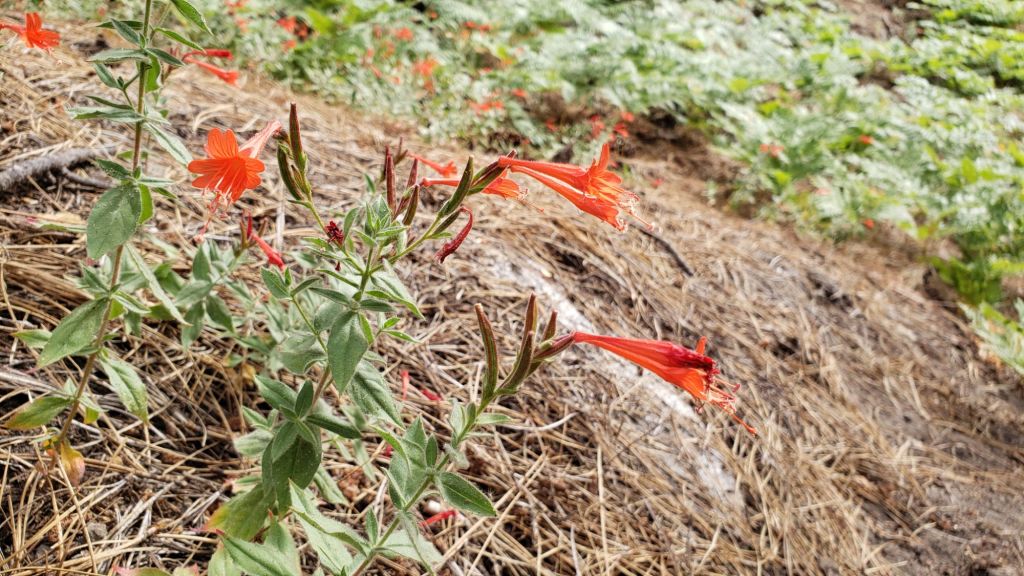
California Fuchsia (Epilobium canum) in riotous full bloom just north of Strawberry Junction, 6th September 2024. A huge patch of this typically late-blooming flower at 8370 ft on Deer Springs Trail (about 0.7 mile north of Strawberry Junction) is currently hosting a large aggregation of Rufous Hummingbirds, which is otherwise a relatively scarce spring and autumn migrant bird in the San Jacinto mountains.

While all time and labor is volunteered, the San Jacinto Trail Report uses small private donations to help cover operating costs. Your contribution keeps the Report available to all, free from advertising or paywalls, and independent from agencies. If you have found this Report useful, please consider using this link to the Donate page. Thank you very much for your support.

The well-known north spring at Wellman’s Cienega (9300 ft) flowing steadily, early morning 9th September 2024. Although the flow rate here has dropped dramatically in the past two months, the spring will nevertheless continue to flow into the winter this year (with a couple of minor monsoon rains in the past ten days being particularly focused on this drainage).
The creek in Little Round Valley (9750 ft) flowing steadily, mid morning 6th September 2024. As in 2023, this creek is expected to continue to flow until winter this year, although the flow rate will continue to drop throughout the autumn.
The Round Valley pipe continuing to flow well, mid morning 28th August 2024. The adjacent creek is now functionally dry.
Stone Creek where it crosses Deer Springs Trail at about PCT Mile 183.6, roughly 0.7 mile north of Strawberry Junction, mid morning 6th September 2024. As predicted, the creek is now dry below this point, and with barely a trickle of flow on and above the trail, insufficient for filtering (for more than one patient hiker anyway).
Willow Creek where it crosses the appropriately named Willow Creek Trail (7800 ft), late morning 28th August 2024. While the flow rate here has dropped steadily throughout the summer, the creek now looks likely to continue flowing throughout the autumn (rarely a certainty in the past decade). The two minor creeks within the next mile further east on the trail are now functionally dry.

Weather and trail update 6th September 2024

Recent events included a highly localized monsoonal thunderstorm on Saturday 31st August. Idyllwild received no more than a few large rain drops that afternoon, and rain gauges at Saddle Junction (dry) and San Jacinto Peak (0.08 inch) barely hinted at the passage of a storm cell. However an impressive 0.70 inch of rain fell at Wellman’s Cienega (9300 ft) and some trails above 9000 ft on the east side of the high country remained damp days later.

On Sunday 1st September, the Record Fire burned just over 500 acres on the extreme westernmost fringe of the San Jacinto mountains, in the foothills just west of Dellamont. Before dawn the following morning a dusting of ash on my truck in Idyllwild was a reminder that distances are small in our mountains, as the ash flies. Two hours after sunrise I was able to see from San Jacinto Peak that the eastward progress of the fire had been halted.

After some distinctly autumnal days in late August – including a sub-freezing windchill recorded at San Jacinto Peak on Sunday 25th – temperatures are forecast to be well above seasonal until 10th September. Thankfully temperatures in the high country have largely stabilized around seasonal averages since mid August, with air temperatures typically 50-55°F (10-13°C). Such temperatures feel pleasantly cool in contrast to the heat lower down the mountain, but will actually be well above seasonal for the highest elevations in the first half of September.

Hikers should continue to be prepared for hot weather on the trail system into the second week of September. Please give considerable extra thought to start times, route choice (considering sun exposure, forest cover, and water availability), appropriate clothing, sun protection, and hydration requirements.

Monsoon conditions are typical in late summer/early autumn, currently forecast as most likely on 7th-8th September, so hikers should always be prepared for the possibility of rapidly changing weather conditions in the high country. Thunderstorms with lightning, intense precipitation, and rapid temperature drops can occur, usually in the afternoon, even when such storms may not be forecast for lower elevations.

Survey hikes by the Trail Report every day year-round in the San Jacinto mountains include varied and often circuitous routes to San Jacinto Peak multiple times per week (58 ascents since 1st July 2024), plus many other trails on intervening days.

With a largely failed monsoon season and generally hot conditions for the past 2-3 months, fire risk is severe everywhere. A comprehensive fire ban is in place on Forest Service lands throughout the San Jacinto Ranger District (link to USFS order here) and in all Idyllwild campgrounds. Campfires are of course always prohibited throughout both the State Park and National Forest wilderness areas.

Major springs, creeks, and pipes largely continue to flow adequately at this time (example photos below). However flow rates are dropping steadily at all elevations and ephemeral water sources are now dry. The Round Valley faucet continued to flow well as of 4th September. In the Tahquitz area meadows, the minor creek in Skunk Cabbage Meadow continues to flow, but the ephemeral creek in Tahquitz Valley is now dry. Tahquitz Creek is flowing steadily at the northern end of Little Tahquitz Meadow, and near its source where it crosses the PCT at Mile 177. The creek at Strawberry Cienega is now functionally dry. Hidden Lake remained c.50% full at the end of August (by surface area, not volume).

The Palm Springs Aerial Tramway closes on Monday 9th September 2024 for annual maintenance, with a tentative reopening date of Monday 7th October.

Be rattlesnake aware. Above about 5000 ft elevation, the venom of Southern Pacific Rattlesnakes (Crotalus [oreganus] helleri) in the San Jacinto mountains is predominantly neurotoxic, almost always fatal for dogs and sometimes for humans (see my detailed 2020 article linked here for further information). Devil’s Slide Trail, lower Deer Springs and lower Marion Mountain trails, Suicide Rock, near Strawberry Cienega, and trails around Tahquitz Peak are frequent locations for sightings, but rattlesnakes have been recorded everywhere to 9350 ft.

Be bear aware. Although rarely reported in recent years, up to three Black Bears have been in the San Jacinto mountains since 2017. I have seen at least one annually for the past six years, most recently on upper Marion Mountain Trail on 14th September 2023. I also found fresh prints in snow on 12th February this year at 9000 ft near PCT Mile 180.5 (photo here). Brief videos from Devil’s Slide Trail in September 2021 (available here) and at home in Idyllwild in 2018 (linked here) show two different individuals. There have been no reports of negative interactions with humans at or near campsites.

Sunrise as seen from the PCT at about Mile 180.5 (just south of Annie’s Junction), 6th September 2024. Discontinuous cloud cover always makes for the best sunrise and sunset viewing in our mountains.

WEATHER

Details of the many local records broken in an exceptionally warm July are given in a prior Report (linked here). So far this season there has been little monsoon rainfall, with precipitation in Idyllwild currently only 10% of average for the summer months.

A strong cold front brought early autumnal temperatures to the mountains on 23rd-26th August (the southern fringe of the same system that dusted extremely early snow on parts of the Sierra Nevada this past weekend). While August has averaged cooler than July, and despite a few pleasantly cool days recently, almost the entire month of August has had temperatures at or above seasonal. As is increasingly the case with a steadily heating climate in the San Jacinto mountains, overnight low temperatures in particular were well above seasonal throughout July and almost all of August.

Temperatures rose steadily at the end of August to above seasonal yet again, and are forecast to be well above seasonal for the first ten days of September at all elevations (although this will be most striking at mid elevations, e.g., Idyllwild area). An especially hot (but brief) heatwave is forecast for 4th-7th September, with temperatures above even midsummer averages. Monsoonal afternoon thunderstorms are currently most likely on 7th-8th September.

At San Jacinto Peak (3295m/10,810ft) on Friday 4th September 2024 at 0805 the air temperature was 58.1°F (14°C), with a “windchill” temperature of 55.2°F (13°C), 35% relative humidity, and a light ENE wind sustained at 4 mph gusting to 6.9 mph.

At the Peak on Wednesday 4th September 2024 at 0755 the air temperature was 57.9°F (14°C), with a “windchill” temperature of 48.3°F (9°C), 52% relative humidity, and a steady ESE wind sustained at 8 mph gusting to 12.7 mph.

California Fuchsia (Epilobium canum) in riotous full bloom just north of Strawberry Junction, 6th September 2024. A huge patch of this classic late-blooming flower at 8370 ft on Deer Springs Trail (about 0.7 mile north of Strawberry Junction) is currently hosting a large migrant group of Rufous Hummingbirds, which is otherwise a relatively scarce migrant bird in the San Jacinto mountains.

TRAIL CONDITIONS

Treefall hazards remain a major problem along parts of the Pacific Crest Trail, most notably between Antsell Rock and Red Tahquitz, with 132 recorded in my recent 2024 surveys between Miles 170.5-175.5. The disinterest of Forest Service and PCTA in maintaining this section of a world-famous trail for the past five years is simply unconscionable. Concentrations of large downed trees make for especially slow-going around Miles 170.5-172 (east side of Antsell Rock) and Miles 174-175 (south and east sides of Red Tahquitz). A further 15 smaller trees are down from Miles 168.5-170.5 (Spitler Peak Trail to Zen Center Trail).

The State Park announced closure of the uppermost section of Skyline Trail – which forms the lower part of the C2C (Cactus-to-clouds route) – in their jurisdiction, i.e. above about 5600 ft, on 12th July due to “dangerously high temperatures impacting the Palm Springs region”. The trail “will continue to be closed until further notice”.

About 12 treefall hazards on Deer Springs Trail include 8-9 in the upper trail that have been down and reported repeatedly for years but with no action from the State Park. All but one of the treefall hazards down between Strawberry Junction and the top of Marion Mountain Trail (roughly PCT Miles 183-185) were removed by the Trail Report in late June (example photos in an earlier Report linked here).

On Willow Creek Trail notable treefall hazards on the Forest Service section were finally cut by 13th August. Several trees remain uncut to fully restore the trail route to its 2020 condition, but it seems unlikely that they will ever be cut. Whitethorn along the trail is starting to grow back rapidly, and is becoming a problem on both the Forest Service and State Park sections (photo in previous Report linked here). Forest Service made progress on trail trimming on 26th-27th August. Treefall hazards currently on the State Park side include two large ones remaining from last year, plus three small new ones, but none pose major problems for hikers, and there is optimism that some may be removed later in September.

The 34 treefall hazards that came down across Spitler Peak Trail during ice storms in February 2024 were almost all cleared by the Trail Report on 14th June. The couple of minor stepover branches that remain pose no problem for hikers. This work brings to 120+ the total number of trees removed by the Report from this trail in the past three years. Note that currently the upper trail in particular is heavily overgrown with lush seasonal vegetation.

The Caramba Trail from near Reeds Meadow through Laws Camp and on to Caramba, and the Cedar Trail from Willow Creek Trail to Laws, are euphemistically described by the Forest Service as “not maintained”. In reality both trails have been abandoned and functionally no longer exist. They are so heavily overgrown with dense whitethorn, which obscures dozens of downed trees, that I strongly advise hikers do not attempt to follow them (regardless of how much you may trust an app). An informal use trail to Laws is much more direct, maintained, and avoids the challenging bushwhacking of the unmaintained trails (local Idyllwild hikers dubbed it the “King Trail” when I established the route in 2019). It leaves Willow Creek Trail exactly 1.0 mile from Saddle Junction, 0.46 mile from the Skunk Cabbage turning (trailhead at N 33.7796, W 116.6590). The route descends largely following established deer trails for 1.2 miles, meeting Willow Creek about 0.2 mile upstream from the site of the historic Laws Camp (the remains of which were destroyed by the 2013 Mountain Fire and subsequent flood and treefall damage). Eleven trees down on the King Trail were removed in June-July 2023. The tread of the trail received some damage from Tropical Storm Hilary last year. From Laws east to Caramba the route of the original Caramba Trail has been well-cairned by myself and others and can largely be followed with very careful route-finding. My 2023 survey counted about 110 trees down on this 2.1 miles of trail. It is especially obscure for the first 0.3 mile east of the Willow Creek crossing, becoming more obvious (but still subtle) as it descends towards Caramba. Very cautious navigation is advised throughout the area.

The Trail Report “adopted” Seven Pines Trail as a priority for maintenance work as the trail had a disproportionate number of lost hiker rescues in the past decade, and both State Park and Forest Service have shown no interest in maintaining the route for years. Since 2020 we have removed 75 downed trees and the trail is thoroughly trimmed and cleared multiple times annually. As of July 2024 the trail is largely clear of treefall hazards, with three down across the trail in its upper section, all easily passable for hikers. A further half-a-dozen downed trees close to the PCT junction would need to be removed to fully restore the original route of the trail. Although the condition of the trail is hugely improved, Seven Pines remains a genuine wilderness trail unlike the wider, bare, obvious routes of, for example, Devil’s Slide or Marion Mountain trails. Cautious navigation remains essential for those without considerable experience of hiking this trail. Be aware in particular that Seven Pines Trail becomes most obscure in the mile closest to its junction with Deer Springs Trail/PCT.

The Zen Center Trail continues its deterioration that started following the 2013 Mountain Fire, with a combination of vigorous regrowth and treefall hazards further obscuring the route with each passing season. The lower and upper parts of this trail are partially cairned and not too bad for those who are very familiar with the former route, but even the experienced find navigating the central section tricky. Long trousers, scrambling gloves, and an enjoyment of bush-whacking are all strongly recommended.

While all time and labor is volunteered, the San Jacinto Trail Report uses small private donations to help cover operating costs. Your contribution keeps the Report available to all, free from advertising or paywalls, and independent from agencies. If you have found this Report useful, please consider using this link to the Donate page. Thank you very much for your support.

The Round Valley pipe continuing to flow well, mid morning 28th August 2024. The adjacent creek is now functionally dry.
The well-known north spring at Wellman’s Cienega (9300 ft) flowing steadily, early morning 6th September 2024. Although the flow rate here has dropped dramatically in the past two months, my decade of detailed observations suggest the spring will nevertheless continue to flow into the late autumn.
The creek in Little Round Valley (9750 ft) flowing steadily, mid morning 6th September 2024. As in 2023, this creek is expected to continue to flow until winter this year, although the flow rate will continue to drop throughout the autumn.
Stone Creek where it crosses Deer Springs Trail at about PCT Mile 183.6, roughly 0.7 mile north of Strawberry Junction, mid morning 6th September 2024. As predicted, the creek is now dry below this point, and with barely a trickle of flow on and above the trail, insufficient for filtering (for more than one patient hiker anyway).
Willow Creek where it crosses the appropriately named Willow Creek Trail (7800 ft), late morning 28th August 2024. While the flow rate here has dropped steadily throughout the summer, the creek now looks likely to continue flowing throughout the autumn (rarely a certainty in the past decade). The two minor creeks within the next mile further east on the trail are now functionally dry.
Woodland (or San Diego) Alligator Lizard (Elgaria multicarinata webbii) on our front steps in Idyllwild at dusk, 1st September 2024. This adult was 12-13 inches long, more than half of which was the enormous tail. (Flash photo.)

Weather and trail update 1st September 2024

After delightful and distinctly autumnal cooling for a few days in late August – including a sub-freezing windchill recorded at San Jacinto Peak on Sunday 25th – temperatures are now forecast to rise and be well above seasonal in the first week of September (i.e. including the holiday weekend).

Thankfully temperatures in the high country have largely stabilized around seasonal averages since mid August, with air temperatures typically 50-55°F (10-13°C). Such temperatures feel pleasantly cool in contrast to the heat lower down the mountain, but they will actually be well above seasonal for the high elevations in the first week of September.

Hikers should continue to be prepared for hot weather on the trail system into the first week of September. Please give considerable extra thought to start times, route choice (considering sun exposure, forest cover, and water availability), appropriate clothing, sun protection, and hydration requirements.

Monsoon conditions can occur in late summer/early autumn, currently forecast as most likely on 7th-8th September, and hikers should always be prepared for the possibility of rapidly changing weather conditions in the high country. Thunderstorms with lightning, intense precipitation, and rapid temperature drops can occur, usually in the afternoon, even when such storms may not be forecast for lower elevations.

Survey hikes by the Trail Report every day year-round in the San Jacinto mountains include varied and often circuitous routes to San Jacinto Peak multiple times per week (55 days since 1st July), plus other trails on intervening days.

With a failed monsoon season (so far) and largely hot conditions for the past two months, fire risk is severe everywhere. A comprehensive fire ban is in place on Forest Service lands throughout the San Jacinto Ranger District (link to USFS order here) and in all Idyllwild campgrounds. Campfires are of course always prohibited throughout both the State Park and National Forest wilderness areas.

Fires are not a problem solely confined to our area of course. An article (linked here) published last weekend highlights the challenges faced by PCT hikers by the sheer number of fire closures along the entire trail route. Sadly it is debatable whether any PCT hiker has been truly able to complete the entire trail along its originally intended route in the past 10-15 years due to fire closures.

Major springs, creeks, and pipes continue to flow adequately at this time (example photos below). However flow rates are dropping steadily at all elevations and ephemeral water sources are now dry. The Round Valley faucet continued to flow well as of 30th August. In the Tahquitz area meadows, the minor creek in Skunk Cabbage Meadow continues to flow, but the ephemeral creek in Tahquitz Valley is now dry. Tahquitz Creek is flowing steadily at the northern end of Little Tahquitz Meadow, and near its source where it crosses the PCT at Mile 177. The creek at Strawberry Cienega is now functionally dry. Hidden Lake remained c.50% full in late August (by surface area, not volume).

Be rattlesnake aware. Above about 5000 ft elevation, the venom of Southern Pacific Rattlesnakes (Crotalus [oreganus] helleri) in the San Jacinto mountains is predominantly neurotoxic, almost always fatal for dogs and sometimes for humans (see my detailed 2020 article linked here for further information). Devil’s Slide Trail, lower Deer Springs and lower Marion Mountain trails, Suicide Rock, near Strawberry Cienega, and trails around Tahquitz Peak are frequent locations for sightings, but rattlesnakes have been recorded everywhere to 9350 ft.

Be bear aware. Although rarely reported in recent years, up to three Black Bears have been in the San Jacinto mountains since 2017. I have seen at least one annually for the past six years, most recently on upper Marion Mountain Trail on 14th September 2023. I also found fresh prints in snow on 12th February this year at 9000 ft near PCT Mile 180.5 (photo here). Brief videos from Devil’s Slide Trail in September 2021 (available here) and at home in Idyllwild in 2018 (linked here) show two different individuals. There have been no reports of negative interactions with humans at or near campsites.

The Palm Springs Aerial Tramway closes on Monday 9th September 2024 for annual maintenance, with a tentative reopening date of Monday 7th October.

WEATHER

Details of the many local records broken in an exceptionally warm July are given in a prior Report (linked here). So far this season there has been no significant monsoon rainfall, with precipitation in Idyllwild currently only 10% of average for the summer months.

A strong cold front brought early autumnal temperatures to the mountains on 23rd-26th August (the southern fringe of the same system that dusted extremely early snow on parts of the Sierra Nevada this past weekend). While August has averaged cooler than July, and despite a few pleasantly cool days recently, almost the entire month of August has had temperatures at or above seasonal. As is increasingly the case with a steadily heating climate in the San Jacinto mountains, overnight low temperatures in particular were well above seasonal throughout July and almost all of August.

Temperatures rose steadily on 26th-30th August to above seasonal yet again, and are now forecast to be far above seasonal for the first week of September at all elevations (although this will be most striking at mid elevations, e.g., Idyllwild area).

At San Jacinto Peak (3295m/10,810ft) on Friday 30th August 2024 at 0805 the air temperature was 54.3°F (12°C), with a windchill temperature of 47.1°F (8°C), 39% relative humidity, and a warm ESE wind sustained at 8 mph gusting to 14.4 mph.

At the Peak on Thursday 29th August 2024 at 0815 the air temperature was 50.8°F (10°C), with a windchill temperature of 41.5°F (5°C), 56% relative humidity, and a brisk SSE wind sustained at 10 mph gusting to 20.5 mph.

At the Peak on Sunday 25th August 2024 at 0740 the air temperature was 40.8°F (5°C), with a windchill temperature of 30.0°F (-1°C), 75% relative humidity, and a moderate WSW wind sustained at 8 mph gusting to 14.9 mph.

A remarkable haze – likely a mix of water vapour, smoke, and pollution held in below 12,000 ft by complex layering in the atmosphere – was visible in all directions from San Jacinto Peak on Saturday 24th August 2024. Looking south-east in this image, the Coachella Valley is completely obscured to the left, while only the peaks of the Santa Rosa Mountains are visible in the distance to the right.

TRAIL CONDITIONS

Snow was completely gone from the high country trails by mid June.

The State Park announced closure of the uppermost section of Skyline Trail – which forms the lower part of the C2C (Cactus-to-clouds route) – in their jurisdiction, i.e. above about 5600 ft, on 12th July due to “dangerously high temperatures impacting the Palm Springs region”. The trail “will continue to be closed until further notice”.

Treefall hazards remain a major problem along parts of the Pacific Crest Trail, most notably between Antsell Rock and Red Tahquitz, with 132 recorded in my recent 2024 surveys between Miles 170.5-175.5. The disinterest of Forest Service and PCTA in maintaining this section of a world-famous trail for the past five years is unconscionable and embarrassing. Concentrations of large downed trees make for especially slow-going around Miles 170.5-172 (east side of Antsell Rock) and Miles 174-175 (south and east sides of Red Tahquitz). A further 15 smaller trees are down from Miles 168.5-170.5 (Spitler Peak Trail to Zen Center Trail).

About 12 treefall hazards on Deer Springs Trail include 8-9 in the upper trail that have been down and reported repeatedly for years but with no action from the State Park. All but one of the treefall hazards down between Strawberry Junction and the top of Marion Mountain Trail (roughly PCT Miles 183-185) were removed by the Trail Report in late June (example photos in an earlier Report linked here).

On Willow Creek Trail all treefall hazards on the Forest Service section were finally cut by 13th August. Whitethorn along the trail is starting to grow back rapidly, and is becoming a problem on both the Forest Service and State Park sections (photo in previous Report linked here). Forest Service made some progress on trail trimming on 26th-27th August. Treefall hazards currently on the State Park side include two large ones remaining from last year, plus three small new ones, but none pose major problems for hikers, and some may be removed in September.

The 34 treefall hazards that came down across Spitler Peak Trail during ice storms in February 2024 were almost all cleared by the Trail Report on 14th June. The couple of minor stepover branches that remain pose no problem for hikers. This work brings to 120+ the total number of trees removed by the Report from this trail in the past three years. Note that currently the upper trail in particular is heavily overgrown with lush seasonal vegetation.

The Caramba Trail from near Reeds Meadow through Laws Camp and on to Caramba, and the Cedar Trail from Willow Creek Trail to Laws, are euphemistically described by the Forest Service as “not maintained”. In reality both trails have been abandoned and functionally no longer exist. They are so heavily overgrown with dense whitethorn, which obscures dozens of downed trees, that I strongly advise hikers do not attempt to follow them (regardless of how much you may trust an app). An informal use trail to Laws is much more direct, maintained, and avoids the challenging bushwhacking of the unmaintained trails (local Idyllwild hikers dubbed it the “King Trail” when I established the route in 2019). It leaves Willow Creek Trail exactly 1.0 mile from Saddle Junction, 0.46 mile from the Skunk Cabbage turning (trailhead at N 33.7796, W 116.6590). The route descends largely following established deer trails for 1.2 miles, meeting Willow Creek about 0.2 mile upstream from the site of the historic Laws Camp (the remains of which were destroyed by the 2013 Mountain Fire and subsequent flood and treefall damage). Eleven trees down on the King Trail were removed in June-July 2023. The tread of the trail received some damage from Tropical Storm Hilary last year. From Laws east to Caramba the route of the original Caramba Trail has been well-cairned by myself and others and can largely be followed with very careful route-finding. My 2023 survey counted about 110 trees down on this 2.1 miles of trail. It is especially obscure for the first 0.3 mile east of the Willow Creek crossing, becoming more obvious (but still subtle) as it descends towards Caramba. Very cautious navigation is advised throughout the area.

The Trail Report “adopted” Seven Pines Trail as a priority for maintenance work as the trail had a disproportionate number of lost hiker rescues in the past decade, and both State Park and Forest Service have shown no interest in maintaining the route for years. Since 2020 we have removed 75 downed trees and the trail is thoroughly trimmed and cleared multiple times annually. As of July 2024 the trail is largely clear of treefall hazards, with three down across the trail in its upper section, all easily passable for hikers. A further half-a-dozen downed trees close to the PCT junction would need to be removed to fully restore the original route of the trail. Although the condition of the trail is hugely improved, Seven Pines remains a genuine wilderness trail unlike the wider, bare, obvious routes of, for example, Devil’s Slide or Marion Mountain trails. Cautious navigation remains essential for those without considerable experience of hiking this trail. Be aware in particular that Seven Pines Trail becomes most obscure in the mile closest to its junction with Deer Springs Trail/PCT.

The Zen Center Trail continues its deterioration that started following the 2013 Mountain Fire, with a combination of vigorous regrowth and treefall hazards further obscuring the route with each passing season. The lower and upper parts of this trail are partially cairned and not too bad for those who are very familiar with the former route, but even the experienced find navigating the central section tricky. Long trousers, scrambling gloves, and an enjoyment of bush-whacking are all strongly recommended.

While all time and labor is volunteered, the San Jacinto Trail Report uses small private donations to help cover operating costs. Your contribution keeps the Report available to all, free from advertising or paywalls, and independent from agencies. If you have found this Report useful, please consider using this link to the Donate page. Thank you very much for your support.

The Round Valley pipe continuing to flow well, mid morning 28th August 2024. The adjacent creek is now functionally dry.
The well-known north spring at Wellman’s Cienega (9300 ft) flowing steadily, early morning 28th August 2024. Although the flow rate here has dropped dramatically in the past two months, my decade of detailed observations suggest the spring will nevertheless continue to flow into the late autumn, even with no monsoon (so far) this year.
The creek in Little Round Valley (9750 ft) flowing steadily, mid morning 29th August 2024. As in 2023, this creek is expected to continue to flow until winter this year, although the flow rate will continue to drop throughout the autumn.
Willow Creek where it crosses the appropriately named Willow Creek Trail (7800 ft), late morning 28th August 2024. While the flow rate here has dropped steadily throughout the summer, the creek now looks likely to continue flowing throughout the autumn (rarely a certainty in the past decade). The two minor creeks within the next mile further east on the trail are now functionally dry.
The North Fork of the San Jacinto River flowing well where it crosses Fuller Ridge Trail (PCT Mile 186.1) at about 8900 ft, 19th August 2024.
Stone Creek flowing weakly where it crosses Deer Springs Trail at about PCT Mile 183.6, roughly half-a-mile north of Strawberry Junction, late morning 19th August 2024. Flow rate here has dropped dramatically since July, and this water source looks likely to dry up in the next month or so with no new precipitation.

Weather and trail update 24th August 2024

Following two months of temperatures above seasonal – and record-breaking heat for much of July – temperatures are now forecast to be around seasonal for the remainder of August. At mid elevations it was again hot on 19th-21st, dropping below seasonal on 23rd-25th, before rising to near or slightly above seasonal on 27th-31st.

Thankfully temperatures in the high country have stabilized around seasonal averages since mid August, generally around 50-55°F (10-13°C). It now feels borderline autumnal above about 9000 ft compared to lower down the mountain, with a pleasantly cool windchill at the Peak of 36°F (2°C) on Friday 23rd August. Stronger winds this weekend will produce similarly cool windchill temperatures around the high peaks on 24th-26th August.

Despite temperatures averaging cooler compared to July, hikers should nevertheless be prepared for hot weather on the trail system on most days into early September. Please give considerable extra thought to start times, route choice (considering sun exposure, forest cover, and water availability), appropriate clothing, sun protection, and hydration requirements. There was one heat-related hiker fatality plus multiple cases of heat exhaustion in the San Jacinto high country in July.

Survey hikes by the Trail Report every day year-round in the San Jacinto mountains include varied and often circuitous routes to San Jacinto Peak multiple times per week (almost daily since 1st July), plus other trails on intervening days.

With a failed monsoon season and hot and dry conditions for the past two months, fire risk is severe everywhere. A comprehensive fire ban is in place on Forest Service lands throughout the San Jacinto Ranger District (link to USFS order here) and in all Idyllwild campgrounds. Campfires are of course always prohibited throughout both the State Park and National Forest wilderness areas.

All major springs, creeks, and pipes continue to flow adequately at this time (example photos below). However flow rates are dropping steadily at all elevations and ephemeral water sources are now dry. The Round Valley faucet continued to flow very well as of 22nd August. In the Tahquitz area meadows, the minor creek in Skunk Cabbage Meadow continues to flow well, but the ephemeral creek in Tahquitz Valley is now functionally dry. Tahquitz Creek is flowing steadily at the northern end of Little Tahquitz Meadow, and near its source where it crosses the PCT at Mile 177.

Be rattlesnake aware. Southern Pacific Rattlesnakes (Crotalus [oreganus] helleri) have been widespread on the trail system this summer. Above about 5000 ft, the venom of this rattlesnake species in these mountains is predominantly neurotoxic, almost always fatal for dogs and sometimes for humans (see my detailed 2020 article linked here for further information). Devil’s Slide Trail, lower Deer Springs and lower Marion Mountain trails, Suicide Rock, near Strawberry Cienega, and trails around Tahquitz Peak are frequent locations for sightings, but rattlesnakes have been recorded everywhere to 9350 ft. (See photo of another individual at foot of this posting.)

Be bear aware. Although rarely reported in recent years, up to three Black Bears have been in the San Jacinto mountains since 2017. I have seen at least one annually for the past six years, most recently on upper Marion Mountain Trail on 14th September 2023. I also found fresh prints in snow on 12th February this year at 9000 ft near PCT Mile 180.5 (photo here). Brief videos from Devil’s Slide Trail in September 2021 (available here) and at home in Idyllwild in 2018 (linked here) show two different individuals. There have been no reports of negative interactions with humans at or near campsites.

The Palm Springs Aerial Tramway closes on Monday 9th September 2024 for annual maintenance, with a tentative reopening date of Monday 7th October.

WEATHER

Details of the many local records broken in a record-hot July are given in a prior Report (linked here). So far this season there has been no significant monsoon rainfall, with precipitation in Idyllwild currently under 20% of average for the summer months.

While August has averaged cooler than July, and as described above temperatures will be variable for the remaining ten days, almost the entire month of August is forecast to have temperatures at or above seasonal. As is increasingly the case with a steadily heating climate in the San Jacinto mountains, overnight low temperatures in particular were well above seasonal throughout July and this will continue throughout August (with the exception of 23rd-26th).

At San Jacinto Peak (3295m/10,810ft) on Friday 23rd August 2024 at 0820 the air temperature was 46.9°F (8°C), with a windchill temperature of 36.1°F (2°C), 22% relative humidity, and an erratic SW wind sustained at 11 mph gusting to 22.0 mph.

At the Peak on Thursday 22nd August 2024 at 0815 the air temperature was 52.6°F (11°C), with a windchill temperature of 43.9°F (7°C), 8% relative humidity, and a moderate SW wind sustained at 9 mph gusting to 19.2 mph.

At the Peak on Wednesday 21st August 2024 at 0750 the air temperature was 53.7°F (12°C), with a windchill temperature of 47.1°F (8°C), 42% relative humidity, and a steady SW wind sustained at 12 mph gusting to 18.0 mph.

White-lined Sphinx Moth (Hyles lineata) in the trail just after dawn on uppermost Marion Mountain Trail, 11th August 2024. Although one of North America’s most widespread hawkmoths, it was interesting to find one at 8600 ft elevation. I safely moved it onto nearby bushes.

TRAIL CONDITIONS

Snow was completely gone from the high country trails by mid June.

The State Park announced closure of the uppermost section of Skyline Trail – which forms the lower part of the C2C (Cactus-to-clouds route) – in their jurisdiction, i.e. above about 5600 ft, on 12th July due to “dangerously high temperatures impacting the Palm Springs region”. The trail “will continue to be closed until further notice”.

Treefall hazards remain a major problem along parts of the Pacific Crest Trail, most notably between Antsell Rock and Red Tahquitz, with 132 recorded in my recent 2024 surveys between Miles 170.5-175.5. The disinterest of Forest Service and PCTA in maintaining this section of a world-famous trail for the past five years is unconscionable and embarrassing. Concentrations of large downed trees make for especially slow-going around Miles 170.5-172 (east side of Antsell Rock) and Miles 174-175 (south and east sides of Red Tahquitz). A further 15 smaller trees are down from Miles 168.5-170.5 (Spitler Peak Trail to Zen Center Trail).

About 12 treefall hazards on Deer Springs Trail include 8-9 in the upper trail that have been down and reported repeatedly for years but with no action from the State Park. All but one of the treefall hazards down between Strawberry Junction and the top of Marion Mountain Trail (roughly PCT Miles 183-185) were removed by the Trail Report in late June (example photos in an earlier Report linked here).

On Willow Creek Trail all treefall hazards on the Forest Service section were finally cut by 13th August. Whitethorn along the trail is starting to grow back rapidly, and is becoming a problem on both the Forest Service and State Park sections (photo in previous Report linked here). Forest Service volunteers plan to start work on whitethorn trimming on 26th-27th August. Treefall hazards currently on the State Park side include two large ones remaining from last year, plus three small new ones, but none pose major problems for hikers, and some (or all) may be removed in September.

The 34 treefall hazards that came down across Spitler Peak Trail during ice storms in February 2024 were almost all cleared by the Trail Report on 14th June. The couple of minor stepover branches that remain pose no problem for hikers. This work brings to 120+ the total number of trees removed by the Report from this trail in the past three years. Note that currently the upper trail in particular is heavily overgrown with lush seasonal vegetation.

The Caramba Trail from near Reeds Meadow through Laws Camp and on to Caramba, and the Cedar Trail from Willow Creek Trail to Laws, are euphemistically described by the Forest Service as “not maintained”. In reality both trails have been abandoned and functionally no longer exist. They are so heavily overgrown with dense whitethorn, which obscures dozens of downed trees, that I strongly advise hikers do not attempt to follow them (regardless of how much you may trust an app). An informal use trail to Laws is much more direct, maintained, and avoids the challenging bushwhacking of the unmaintained trails (local Idyllwild hikers dubbed it the “King Trail” when I established the route in 2019). It leaves Willow Creek Trail exactly 1.0 mile from Saddle Junction, 0.46 mile from the Skunk Cabbage turning (trailhead at N 33.7796, W 116.6590). The route descends largely following established deer trails for 1.2 miles, meeting Willow Creek about 0.2 mile upstream from the site of the historic Laws Camp (the remains of which were destroyed by the 2013 Mountain Fire and subsequent flood and treefall damage). Eleven trees down on the King Trail were removed in June-July 2023. The tread of the trail received some damage from Tropical Storm Hilary last year. From Laws east to Caramba the route of the original Caramba Trail has been well-cairned by myself and others and can largely be followed with very careful route-finding. My 2023 survey counted about 110 trees down on this 2.1 miles of trail. It is especially obscure for the first 0.3 mile east of the Willow Creek crossing, becoming more obvious (but still subtle) as it descends towards Caramba. Very cautious navigation is advised throughout the area.

The Trail Report “adopted” Seven Pines Trail as a priority for maintenance work as the trail had a disproportionate number of lost hiker rescues in the past decade, and both State Park and Forest Service have shown no interest in maintaining the route for years. Since 2020 we have removed 75 downed trees and the trail is thoroughly trimmed and cleared multiple times annually. As of July 2024 the trail is largely clear of treefall hazards, with three down across the trail in its upper section, all easily passable for hikers. A further half-a-dozen downed trees close to the PCT junction would need to be removed to fully restore the original route of the trail. Although the condition of the trail is hugely improved, Seven Pines remains a genuine wilderness trail unlike the wider, bare, obvious routes of, for example, Devil’s Slide or Marion Mountain trails. Cautious navigation remains essential for those without considerable experience of hiking this trail. Be aware in particular that Seven Pines Trail becomes most obscure in the mile closest to its junction with Deer Springs Trail/PCT.

The Zen Center Trail continues its deterioration that started following the 2013 Mountain Fire, with a combination of vigorous regrowth and treefall hazards further obscuring the route with each passing season. The lower and upper parts of this trail are partially cairned and not too bad for those who are very familiar with the former route, but even the experienced find navigating the central section tricky. Long trousers, scrambling gloves, and an enjoyment of bush-whacking are all strongly recommended.

While all time and labor is volunteered, the San Jacinto Trail Report uses small private donations to help cover operating costs. Your contribution keeps the Report available to all, free from advertising or paywalls, and independent from agencies. If you have found this Report useful, please consider using this link to the Donate page. Thank you very much for your support.

The well-known north spring at Wellman’s Cienega (9300 ft) flowing steadily, early morning 23rd August 2024. Although the flow rate here has dropped dramatically since early July, my decade of detailed observations suggest the spring will nevertheless continue to flow deep into the late autumn, even in the absence of monsoonal rainfall.
The creek in Little Round Valley (9750 ft) flowing steadily, early morning 24th August 2024. As in 2023, this creek is expected to continue to flow until winter this year, although the flow rate will drop rapidly throughout the autumn.
The North Fork of the San Jacinto River flowing well where it crosses Fuller Ridge Trail (PCT Mile 186.1) at about 8900 ft, 19th August 2024.
Stone Creek flowing weakly where it crosses Deer Springs Trail at about PCT Mile 183.6, roughly half-a-mile north of Strawberry Junction, late morning 19th August 2024. Flow rate here has dropped dramatically since July, and this water source looks likely to dry up in the next month or so with no new precipitation.

Weather and trail update 15th August 2024

After a record hot July, then some cooler days in the first half of August, temperatures at mid elevations are now forecast to be largely above seasonal for the next week. Temperatures above 10,000 ft elevation have now stabilized around seasonal averages and can feel pleasantly autumnal compared to lower down the mountain. Unusually humid and calm conditions in the high country on Wednesday 7th resulted in a new all-time record high temperature for the month of August at San Jacinto Peak of 64.6°F (18°C). Conversely the windchill at the Peak on Wednesday 14th August was a delightfully cool 38.8°F (4°C).

Despite temperatures averaging slightly cooler compared to July, hikers should still be prepared for hot weather on high country trails. Please give considerable extra thought to start times, route choice (considering sun exposure, forest cover, and water availability), appropriate clothing, sun protection, and hydration requirements. There was one heat-related hiker fatality plus multiple cases of heat exhaustion in the San Jacinto high country in July.

Survey hikes by the Trail Report every day year-round in the San Jacinto mountains include varied and often circuitous routes to San Jacinto Peak multiple times per week (almost daily since 1st July), plus other trails on intervening days.

With generally hot and dry conditions, and a failed monsoon season so far this summer, fire risk is severe everywhere. A comprehensive fire ban is in place on Forest Service lands throughout the San Jacinto Ranger District (link to USFS order here) and in all Idyllwild campgrounds. Campfires are of course always prohibited throughout both the State Park and National Forest wilderness areas.

All major springs, creeks, and pipes continue to flow adequately at this time (example photos below). However flow rates are dropping steadily at upper elevations and ephemeral water sources are now dry. The Round Valley faucet continued to flow very well as of 13th August. In the Tahquitz area meadows, the minor creek in Skunk Cabbage Meadow continues to flow well, but the ephemeral creek in Tahquitz Valley is now functionally dry. Tahquitz Creek is flowing steadily at the northern end of Little Tahquitz Meadow, and near its source where it crosses the PCT near Mile 177.

Be rattlesnake aware. Southern Pacific Rattlesnakes (Crotalus [oreganus] helleri) have been widespread on the trail system this summer. Above about 5000 ft, the venom of this rattlesnake species in these mountains is predominantly neurotoxic, almost always fatal for dogs and sometimes for humans (see my detailed 2020 article linked here for further information). Devil’s Slide Trail, lower Deer Springs and lower Marion Mountain trails, Suicide Rock, near Strawberry Cienega, and trails around Tahquitz Peak are frequent locations for sightings, but rattlesnakes have been recorded everywhere to 9350 ft. (See photo of another individual at foot of this posting.)

Adult Southern Pacific Rattlesnake at 6400 ft just above the campground at Marion Mountain Trail, mid morning 27th July 2024.

Be bear aware. Although rarely reported in recent years, up to three Black Bears have been in the San Jacinto mountains since 2017. I have seen at least one annually for the past six years, most recently on upper Marion Mountain Trail on 14th September 2023. I also found fresh prints in snow on 12th February this year at 9000 ft near PCT Mile 180.5 (photo here). Brief videos from Devil’s Slide Trail in September 2021 (available here) and at home in Idyllwild in 2018 (linked here) show two different individuals. There have been no reports of negative interactions with humans at or near campsites.

The Palm Springs Aerial Tramway closes on Monday 9th September 2024 for annual maintenance, with a tentative reopening date of Monday 7th October.

Altocumulus cloud as seen looking south from about PCT Mile 180 (one mile north of Saddle Junction), just after sunrise on 5th August 2024. Tahquitz Peak is in the lower left corner. On this day the early morning altocumulus did not presage monsoon rain in the afternoon.

WEATHER

After a lengthy and record-breaking heatwave in the first half of July temperatures dropped somewhat between 14th-17th, before a second heat dome rose temperatures again to well above seasonal for another ten days. Details of the many local records broken in a record-hot July are given in the previous Report (linked here).

Some pleasant cooling arrived for 27th July-3rd August, although temperatures nevertheless largely remained at or slightly above seasonal. Both 1st and 2nd August were pleasantly cloudy and cool, albeit humid, days, with just a hint of drizzle on 1st and our first proper (albeit brief) monsoonal rainstorm on Friday 2nd. San Jacinto Peak recorded 0.02 inch of rain on 1st August and 0.31 inch on 2nd. Rainfall was heaviest on both sides of the mountain at 9000-10,000 ft on 2nd, with 0.51 inch in Little Round Valley (9750 ft) and 0.62 inch at Wellman’s Cienega (9300 ft), with less lower down including 0.30 inch at Saddle Junction (8100 ft) and 0.34 inch near the top of Marion Mountain Trail (8650 ft). Further down the mountain Idyllwild at 5550 ft recorded 0.11 inch.

While August has averaged cooler than July, almost the entire month of August is forecast to have temperatures near or above seasonal. As is increasingly the case with a steadily heating climate in the San Jacinto mountains, overnight low temperatures in particular were well above seasonal throughout July and this will continue throughout August.

At San Jacinto Peak (3295m/10,810ft) on Saturday 17th August 2024 at 0755 the air temperature was 50.8°F (10°C), with a windchill temperature of 43.2°F (7°C), 72% relative humidity, and a steady SSW wind sustained at 10 mph gusting to 16.4 mph.

At the Peak on Friday 16th August 2024 at 0800 the air temperature was 51.7°F (11°C), with a windchill temperature of 43.9°F (7°C), 48% relative humidity, and a fresh SSW wind sustained at 12 mph gusting to 22.2 mph.

At the Peak on Thursday 15th August 2024 at 0845 the air temperature was 57.8°F (15°C), with a “windchill” temperature of 53.2°F (12°C), 8% relative humidity, and a warming SW wind sustained at 11 mph gusting to 14.1 mph.

At the Peak on Wednesday 14th August 2024 at 0740 the air temperature was 47.7°F (9°C), with a windchill temperature of 38.8°F (4°C), 30% relative humidity, and a very refreshing WSW wind sustained at 12 mph gusting to 19.3 mph.

White-lined Sphinx Moth (Hyles lineata) in the trail just after dawn on uppermost Marion Mountain Trail, 11th August 2024. Although one of North America’s most widespread hawkmoths, it was interesting to find one at 8600 ft elevation. I safely moved it onto nearby bushes.

TRAIL CONDITIONS

Snow was completely gone from the high country trails by mid June.

The State Park announced closure of the uppermost section of Skyline Trail – which forms the lower part of the C2C (Cactus-to-clouds route) – in their jurisdiction, i.e. above about 5600 ft, on 12th July due to “dangerously high temperatures impacting the Palm Springs region”. The trail “will continue to be closed until further notice”.

Treefall hazards remain a major problem along parts of the Pacific Crest Trail, most notably between Antsell Rock and Red Tahquitz, with 132 recorded in my recent 2024 surveys between Miles 170.5-175.5. The disinterest of Forest Service and PCTA in maintaining this section of a world-famous trail for the past five years is unconscionable. Concentrations of large downed trees make for especially slow-going around Miles 170.5-172 (east side of Antsell Rock) and Miles 174-175 (south and east sides of Red Tahquitz). A further 15 smaller trees are down from Miles 168.5-170.5 (Spitler Peak Trail to Zen Center Trail).

About 12 treefall hazards on Deer Springs Trail include 8-9 in the upper trail that have been down and reported repeatedly for years but with no action from the State Park. All but one of the treefall hazards down between Strawberry Junction and the top of Marion Mountain Trail (roughly PCT Miles 183-185) were removed by the Trail Report in late June (example photos in an earlier Report linked here).

On Willow Creek Trail all treefall hazards on the Forest Service section were finally cut by 13th August. Whitethorn along the trail is starting to grow back rapidly, and is becoming a problem on both the Forest Service and State Park sections (photo in previous Report linked here). Treefall hazards currently on the State Park side include two large ones remaining from last year, plus three small new ones, but none pose major problems for hikers, and some (or all) may be removed in September.

The 34 treefall hazards that came down across Spitler Peak Trail during ice storms in February 2024 were almost all cleared by the Trail Report on 14th June. The couple of minor stepover branches that remain pose no problem for hikers. This work brings to 120+ the total number of trees removed by the Report from this trail in the past three years. Note that currently the upper trail in particular is heavily overgrown with lush seasonal vegetation.

The Caramba Trail from near Reeds Meadow through Laws Camp and on to Caramba, and the Cedar Trail from Willow Creek Trail to Laws, are euphemistically described by the Forest Service as “not maintained”. In reality both trails have been abandoned and functionally no longer exist. They are so heavily overgrown with dense whitethorn, which obscures dozens of downed trees, that I strongly advise hikers do not attempt to follow them (regardless of how much you may trust an app). An informal use trail to Laws is much more direct, maintained, and avoids the challenging bushwhacking of the unmaintained trails (local Idyllwild hikers dubbed it the “King Trail” when I established the route in 2019). It leaves Willow Creek Trail exactly 1.0 mile from Saddle Junction, 0.46 mile from the Skunk Cabbage turning (trailhead at N 33.7796, W 116.6590). The route descends largely following established deer trails for 1.2 miles, meeting Willow Creek about 0.2 mile upstream from the site of the historic Laws Camp (the remains of which were destroyed by the 2013 Mountain Fire and subsequent flood and treefall damage). Eleven trees down on the King Trail were removed in June-July 2023. The tread of the trail received some damage from Tropical Storm Hilary last year. From Laws east to Caramba the route of the original Caramba Trail has been well-cairned by myself and others and can largely be followed with very careful route-finding. My 2023 survey counted about 110 trees down on this 2.1 miles of trail. It is especially obscure for the first 0.3 mile east of the Willow Creek crossing, becoming more obvious (but still subtle) as it descends towards Caramba. Very cautious navigation is advised throughout the area.

The Trail Report “adopted” Seven Pines Trail as a priority for maintenance work as the trail had a disproportionate number of lost hiker rescues in the past decade, and both State Park and Forest Service have shown no interest in maintaining the route for years. Since 2020 we have removed 75 downed trees and the trail is thoroughly trimmed and cleared multiple times annually. As of July 2024 the trail is largely clear of treefall hazards, with three down across the trail in its upper section, all easily passable for hikers. A further half-a-dozen downed trees close to the PCT junction would need to be removed to fully restore the original route of the trail. Although the condition of the trail is hugely improved, Seven Pines remains a genuine wilderness trail unlike the wider, bare, obvious routes of, for example, Devil’s Slide or Marion Mountain trails. Cautious navigation remains essential for those without considerable experience of hiking this trail. Be aware in particular that Seven Pines Trail becomes most obscure in the mile closest to its junction with Deer Springs Trail/PCT.

The Zen Center Trail continues its deterioration that started following the 2013 Mountain Fire, with a combination of vigorous regrowth and treefall hazards further obscuring the route with each passing season. The lower and upper parts of this trail are partially cairned and not too bad for those who are very familiar with the former route, but even the experienced find navigating the central section tricky. Long trousers, scrambling gloves, and an enjoyment of bush-whacking are all strongly recommended.

While all time and labor is volunteered, the San Jacinto Trail Report uses small private donations to help cover operating costs. Your contribution keeps the Report available to all, free from advertising or paywalls, and independent from agencies. If you have found this Report useful, please consider using this link to the Donate page. Thank you very much for your support.

The well-known north spring at Wellman’s Cienega (9300 ft) flowing steadily, early morning 15th August 2024. Although the flow rate here more than halved in July, my past decade of data suggest the spring will nevertheless continue to flow deep into the late autumn, even if there is no significant monsoonal rainfall.
The creek in Little Round Valley (9750 ft) flowing very steadily, early morning 14th August 2024. As in 2023, this creek is expected to continue to flow until winter this year, although the flow rate looks likely to drop rapidly throughout the autumn.
The North Fork of the San Jacinto River flowing very well where it crosses Fuller Ridge Trail (PCT Mile 186.1) at about 8900 ft, 3rd August 2024.
Stone Creek flowing well where it crosses Deer Springs Trail at about PCT Mile 183.6, late morning 3rd August 2024. It is almost hard to recall that this this water source routinely dried before midsummer for many years during the 2010s.
A very mature adult Southern Pacific Rattlesnake at 9350 ft alongside the Wellman Trail just north of Wellman’s Cienega, mid morning 24th July 2024. At four feet long and 3-4 inches wide, this is as big as they get in these mountains. Given its location and age, this could be the same snake that Anabel famously stepped on in July 2020 (as discussed at length in the article linked here).

Weather and trail update 6th August 2024

Thankfully a record hot July finished with a few cooler days, although further hot temperatures well above seasonal averages returned on 3rd August and are forecast to continue until about 13th.

Both 1st and 2nd August were pleasantly cloudy and cool, albeit humid, days, with just a hint of drizzle on 1st (photo below) and our first proper (if brief) monsoonal rainstorm on Friday 2nd. San Jacinto Peak recorded 0.02 inch of rain on 1st August and 0.31 inch on 2nd. Rainfall was heaviest on both sides of the mountain at 9000-10,000 ft on 2nd, with 0.51 inch in Little Round Valley (9750 ft) and 0.62 inch at Wellman’s Cienega (9300 ft), with less lower down including 0.30 inch at Saddle Junction (8100 ft) and 0.34 inch near the top of Marion Mountain Trail (8650 ft). Further down the mountain Idyllwild at 5550 ft recorded 0.11 inch.

Provisional data suggest that July 2024 was the hottest month in recorded Idyllwild history, with all 31 days exceeding the monthly average for overnight low temperatures. The average daytime high temperature of 91.1°F for the entire month greatly exceeds the July average of 85.3°F, but even more striking was the average low of 64.7°F, which remarkably surpassed the July historical average of 55.2°F by nearly ten degrees. Both those high and low averages for July 2024 are likely to be all-time records.

In addition to a plethora of new daily and monthly heat records, Idyllwild surpassed 90°F (32°C) for a record twelve consecutive days from 2nd-13th July. The high country fared no better, as San Jacinto Peak shattered its record for consecutive days of at least 60°F (16°C) with all ten days from 3rd-12th July surpassing that temperature (the prior record was just four days). The 68.7°F (20°C) I measured at San Jacinto Peak on the morning of Monday 22nd July was a new all-time record high temperature there, breaking a record set only two weeks earlier (which itself broke a record from July 2021).

Hikers must be prepared for unseasonably hot weather in the high country on most days from 3rd-13th August, with temperatures above seasonal at all times of day (especially overnight) and at all mountain elevations. Please give considerable extra thought to start times, route choice (considering sun exposure, forest cover, and water availability), appropriate clothing, sun protection, and hydration requirements, or indeed whether it is wise to be hiking at all in such conditions. There was one heat-related hiker fatality plus multiple cases of heat exhaustion in the San Jacinto high country in July 2024.

Survey hikes by the Trail Report every day year-round in the San Jacinto mountains include varied and often circuitous routes to San Jacinto Peak multiple times per week (almost daily since 1st July), plus other trails on intervening days.

Monsoon conditions are forecast as possible for the remainder of the first half of August, currently most likely on 9th-11th. Hikers should be prepared for the possibility of rapidly changing weather conditions in the high country. Thunderstorms with lightning, intense precipitation, and rapid temperature drops can occur, usually in the afternoon, even when such storms may not be forecast for lower elevations.

With such hot and dry conditions, fire risk is severe everywhere. A comprehensive fire ban is in place on Forest Service lands throughout the San Jacinto Ranger District (link to USFS order here) and in all Idyllwild campgrounds. Campfires are of course always prohibited throughout both the State Park and National Forest wilderness areas. The Nixon Fire – held at about 5200 acres – was clearly visible due south of San Jacinto Peak on Tuesday 30th July, with a solid line of smoke blowing eastward over the Santa Rosa mountains and down into the Coachella Valley, but looked far more benign on subsequent days.

All major springs, creeks, and pipes continue to flow adequately at this time (example photos below). However flow rates are dropping steadily at upper elevations and almost all ephemeral water sources are now dry. The Round Valley faucet continued to flow very well as of 5th August.

Be rattlesnake aware. Southern Pacific Rattlesnakes (Crotalus [oreganus] helleri) have been abundant on the trail system this summer. Above about 5000 ft, the venom of this rattlesnake species in these mountains is predominantly neurotoxic, almost always fatal for dogs and sometimes for humans (see my detailed 2020 article linked here for further information). Devil’s Slide Trail, lower Deer Springs and lower Marion Mountain trails, Suicide Rock, near Strawberry Cienega, and trails around Tahquitz Peak are all common locations for sightings, but rattlesnakes have been recorded everywhere to 9350 ft. (See additional photos of another individual at foot of this posting.)

Adult Southern Pacific Rattlesnake at 6400 ft just above the campground at Marion Mountain Trail, mid morning 27th July 2024.

Be bear aware. Although rarely reported in recent years, up to three Black Bears have been in the San Jacinto mountains since 2017. I have seen at least one annually for the past six years, most recently on upper Marion Mountain Trail on 14th September 2023. I also found fresh prints in snow on 12th February this year at 9000 ft near PCT Mile 180.5 (photo here). Brief videos from Devil’s Slide Trail in September 2021 (available here) and at home in Idyllwild in 2018 (linked here) show two different individuals. There have been no reports of negative interactions with humans at or near campsites.

The Palm Springs Aerial Tramway will be closed starting Monday 9th September 2024 for annual maintenance, with a tentative reopening date of Monday 7th October.

Beautiful altocumulus cloud as seen looking south from about PCT Mile 180 (north of Saddle Junction), just after sunrise on 5th August 2024. Tahquitz Peak is in the lower left corner. On this day the early altocumulus did not presage monsoonal rain in the afternoon.

WEATHER

After a lengthy and record-breaking heatwave in the first half of July temperatures dropped somewhat between 14th-17th, before a second heat dome rose temperatures again to well above seasonal for another ten days. Some pleasant cooling arrived for 27th July-2nd August (although temperatures nevertheless largely remained at or slightly above seasonal!).

A third heat dome of the summer moved over the desert south-west around 3rd August, and temperatures will be well above average for 3rd-13th August at least (i.e. generally near or above 90°F in Idyllwild and close to 60°F at San Jacinto Peak). As is increasingly the case with a steadily heating climate in the San Jacinto mountains, overnight low temperatures in particular were well above seasonal throughout July and this will continue throughout the first half of August.

There is currently no significant precipitation in the forecasts, but monsoonal thunderstorms are always a possibility in late summer, generally in afternoons, and currently most likely on August 9th-11th.

At San Jacinto Peak (3295m/10,810ft) on Tuesday 6th August 2024 at 0710 the air temperature was 56.7°F (14°C), with a “windchill” temperature of 54.7°F (13°C), 45% relative humidity, and a gentle WNW wind sustained at 3 mph gusting to 5.5 mph.

At the Peak on Monday 5th August 2024 at 0805 the air temperature was 59.0°F (15°C), with a “windchill” temperature of 54.5°F (12.5°C), 57% relative humidity, and a variable WSW wind sustained at 4 mph gusting to 10.4 mph.

At the Peak on Saturday 3rd August 2024 at 0735 the air temperature was 53.5°F (12°C), with a windchill temperature of 48.3°F (9°C), 52% relative humidity, and a fresh SSE wind sustained at 7 mph gusting to 11.4 mph.

Cloud! And rain! A pleasantly cool and humid morning in the San Jacinto high country, 1st August 2024. Looking south at 0800 from San Jacinto Peak over Jean Peak (near left) and Marion Mountain (right) with distant rain falling in the area of the Nixon Fire. It started drizzling – with occasional lightning off to the east – five minutes later around the Peak.

TRAIL CONDITIONS

Snow was completely gone from the high country trails by mid June.

The State Park announced closure of the uppermost section of Skyline Trail – which forms the lower part of the C2C (Cactus-to-clouds route) – in their jurisdiction, i.e. above about 5600 ft, on 12th July due to “dangerously high temperatures impacting the Palm Springs region”. The trail “will continue to be closed until further notice”.

Treefall hazards remain a major problem along parts of the Pacific Crest Trail, most notably between Antsell Rock and Red Tahquitz, with 132 recorded in my recent 2024 surveys between Miles 170.5-175.5. The disinterest of Forest Service and PCTA in maintaining this section of a world-famous trail for the past five years is unconscionable. Concentrations of large downed trees make for especially slow-going around Miles 170.5-172 (east side of Antsell Rock) and Miles 174-175 (south and east sides of Red Tahquitz). A further 15 smaller trees are down from Miles 168.5-170.5 (Spitler Peak Trail to Zen Center Trail).

About 12 treefall hazards on Deer Springs Trail include 8-9 in the upper trail that have been down and reported repeatedly for years but with no action from the State Park. All but one of the treefall hazards down between Strawberry Junction and the top of Marion Mountain Trail (roughly PCT Miles 183-185) were removed by the Trail Report in late June (example photos in an earlier Report linked here).

On Willow Creek Trail the smaller treefall hazards on the Forest Service section were cut in June. One of the two huge hazards remaining on the Forest Service side was removed in early July, but the larger, more difficult obstruction, remains. An additional four need to be cut to restore the original trail route. Whitethorn along the trail is starting to grow back rapidly, and is becoming a problem on both the Forest Service and State Park sections (photo in previous Report linked here). Treefall hazards currently on the State Park side include two large ones remaining from last year, plus three small new ones, but none pose major problems for hikers.

The 34 treefall hazards that came down across Spitler Peak Trail during ice storms in February 2024 were almost all cleared by the Trail Report on 14th June. The couple of minor stepover branches that remain pose no problem for hikers. This work brings to 120+ the total number of trees removed by the Report from this trail in the past three years. Note that currently the upper trail in particular is heavily overgrown with lush seasonal vegetation.

The Caramba Trail from near Reeds Meadow through Laws Camp and on to Caramba, and the Cedar Trail from Willow Creek Trail to Laws, are euphemistically described by the Forest Service as “not maintained”. In reality both trails have been abandoned and functionally no longer exist. They are so heavily overgrown with dense whitethorn, which obscures dozens of downed trees, that I strongly advise hikers do not attempt to follow them (regardless of how much you may trust an app). An informal use trail to Laws is much more direct, maintained, and avoids the challenging bushwhacking of the unmaintained trails (local Idyllwild hikers dubbed it the “King Trail” when I established the route in 2019). It leaves Willow Creek Trail exactly 1.0 mile from Saddle Junction, 0.46 mile from the Skunk Cabbage turning (trailhead at N 33.7796, W 116.6590). The route descends largely following established deer trails for 1.2 miles, meeting Willow Creek about 0.2 mile upstream from the site of the historic Laws Camp (the remains of which were destroyed by the 2013 Mountain Fire and subsequent flood and treefall damage). Eleven trees down on the King Trail were removed in June-July 2023. The tread of the trail received some damage from Tropical Storm Hilary last year. From Laws east to Caramba the route of the original Caramba Trail has been well-cairned by myself and others and can largely be followed with very careful route-finding. My 2023 survey counted about 110 trees down on this 2.1 miles of trail. It is especially obscure for the first 0.3 mile east of the Willow Creek crossing, becoming more obvious (but still subtle) as it descends towards Caramba. Very cautious navigation is advised throughout the area.

The Trail Report “adopted” Seven Pines Trail as a priority for maintenance work as the trail had a disproportionate number of lost hiker rescues in the past decade, and both State Park and Forest Service have shown no interest in maintaining the route for years. Since 2020 we have removed 75 downed trees and the trail is thoroughly trimmed and cleared multiple times annually. As of July 2024 the trail is largely clear of treefall hazards, with three down across the trail in its upper section, all easily passable for hikers. A further half-a-dozen downed trees close to the PCT junction would need to be removed to fully restore the original route of the trail. Although the condition of the trail is hugely improved, Seven Pines remains a genuine wilderness trail unlike the wider, bare, obvious routes of, for example, Devil’s Slide or Marion Mountain trails. Cautious navigation remains essential for those without considerable experience of hiking this trail. Be aware in particular that Seven Pines Trail becomes most obscure in the mile closest to its junction with Deer Springs Trail/PCT.

The Zen Center Trail continues its deterioration that started following the 2013 Mountain Fire, with a combination of vigorous regrowth and treefall hazards further obscuring the route with each passing season. The lower and upper parts of this trail are partially cairned and not too bad for those who are very familiar with the former route, but even the experienced find navigating the central section tricky. Long trousers, scrambling gloves, and an enjoyment of bush-whacking are all strongly recommended.

While all time and labor is volunteered, the San Jacinto Trail Report uses small private donations to help cover operating costs. Your contribution keeps the Report available to all, free from advertising or paywalls, and independent from agencies. If you have found this Report useful, please consider using this link to the Donate page. Thank you very much for your support.

The well-known north spring at Wellman’s Cienega (9300 ft) flowing well following a monsoonal thunderstorm three days earlier, 5th August 2024. The flow rate more than halved in July, but my past decade of data suggest it will nevertheless have water deep into the autumn.
The creek in Little Round Valley (9750 ft) flowing very steadily, early morning 6th August 2024. As in 2023, this creek is expected to continue to flow until winter this year.
The North Fork of the San Jacinto River flowing very well where it crosses Fuller Ridge Trail (PCT Mile 186.1) at about 8900 ft, 3rd August 2024.
Stone Creek flowing well where it crosses Deer Springs Trail at about PCT Mile 183.6, late morning 3rd August 2024. It is almost hard to recall that this this water source routinely dried before midsummer for many years during the 2010s.
A very mature adult Southern Pacific Rattlesnake at 9350 ft alongside the Wellman Trail just north of Wellman’s Cienega, mid morning 24th July 2024. At four feet long and 3-4 inches wide, this is as big as they get in these mountains. Given its location and age, this could be the same snake that Anabel famously stepped on in July 2020 (as discussed at length in the article linked here).
Above, Southern Pacific Rattlesnake in night roost, 6600 ft on Marion Mountain Trail, 25th July 2024 (flash photo). Below, a view of the trail with the snake at lower left for context (lighting by headlamp).
Bush Chinquapin (Chrysolepsis sempervirens) dominates huge patches of montane chaparral in the San Jacinto high country, here at 9100 ft on the Wellman Trail, 26th July 2024. Once every 3-4 years chinquapin flowering and fruiting is especially abundant, and 2024 is one of those years. The cream-colored catkins are humming with insects and the distinctive spiky fruits, although superficially unpalatable, are very popular with Mule Deer and smaller mammals (and were a seasonal staple of the Cahuilla).

Weather and trail update 26th July 2024

July 2024 started with a record-breaking heatwave, with Idyllwild setting an all-time record by surpassing 90°F (32°C) for 12 consecutive days from 2nd-13th July. Remarkably most of those days peaked in the mid to high 90s. Although temperatures have averaged slightly cooler since, July 2024 is already virtually certain to be the hottest month in recorded Idyllwild history, with all 31 days exceeding the monthly average for overnight low temperatures, and almost all exceeding the average daytime highs also.

Despite some slight cooling on 14th-17th July, temperatures rose further starting Thursday 18th July and will remain well above average until Saturday 27th, with a second consecutive “heat dome” over the region. Overnight low temperatures in particular have been 5-15°F above average for the entire month and are forecast to remain elevated until the last few days of July. Some pleasant cooling is expected for 27th-29th (although temperatures will probably remain at or slightly above seasonal!).

The temperature I measured at San Jacinto Peak on the morning of Monday 22nd July (68.7°F [20°C]) set a new all-time record high for that location, just breaking a record set only two weeks earlier. More significantly San Jacinto Peak shattered its record for consecutive days of at least 60°F (16°C) with all ten days from 3rd-12th July surpassing that temperature (the prior record was just four days, observed three times since 2018).

Hikers must be prepared for unseasonably hot weather in the high country, with temperatures above seasonal at all times of day and at all mountain elevations. Please give considerable extra thought to start times, route choice (factors such as sun exposure, forest cover, water availability), appropriate clothing, sun protection, and hydration requirements, or indeed whether it is wise to be hiking at all in such conditions.

Onset of heat-related health problems can be very rapid but they are almost always entirely avoidable with planning. Earlier this month a 61-year-old PCT section hiker from Chula Vista day hiking on Saturday 6th July in the area of Miles 188-196 (immediately south and north of Fuller Ridge Campground) was found dead on 10th July near Mile 195. While cause of death has not been confirmed, Saturday 6th was the hottest day of the year in the San Jacinto mountains, and that section of trail is extremely sun-exposed chaparral with no shade.

Monsoon conditions are forecast as possible in early August. Consequently hikers should be prepared for rapidly changing weather conditions in the high country. Thunderstorms with lightning, intense precipitation, and rapid temperature drops can occur in the high country, usually in the afternoons, even when such storms are not forecast for lower elevations.

The State Park announced closure of the uppermost section of Skyline Trail – which forms the lower part of the C2C (Cactus-to-clouds route) – in their jurisdiction, i.e. above about 5600 ft, on 12th July due to “dangerously high temperatures impacting the Palm Springs region”. The trail “will continue to be closed until further notice”.

A comprehensive fire ban is in place on Forest Service lands throughout the San Jacinto Ranger District (link to USFS order here). Fires are completely prohibited in all camping areas, including those provided with fire rings. Fires are of course always prohibited throughout both the State Park and National Forest wilderness areas. Fires are now also prohibited in the Idyllwild campgrounds.

Survey hikes by the Trail Report every day year-round in the San Jacinto mountains include varied and often circuitous routes to San Jacinto Peak multiple times per week (most recently daily on 21st-26th July), plus a wide range of other trails on intervening days.

All major springs, creeks, and pipes are flowing adequately at this time (some example photos below). However flow rates are dropping rapidly at upper elevations and almost all ephemeral water sources are now dry. The Round Valley faucet continues to flow well as of 26th July.

Be rattlesnake aware. Southern Pacific Rattlesnakes (Crotalus [oreganus] helleri) have been abundant on the trail system this season. Above about 5000 ft, the venom of this rattlesnake species in these mountains is predominantly neurotoxic, almost always fatal for dogs and sometimes for humans (see my detailed 2020 article linked here for further information). Devil’s Slide Trail, lower Deer Springs and lower Marion Mountains trails, Suicide Rock, near Strawberry Cienega, and trails around Tahquitz Peak are common locations for sightings, but rattlesnakes have been recorded everywhere to 9350 ft. (See additional photos of another individual at foot of this posting.)

A very mature adult Southern Pacific Rattlesnake at 9350 ft alongside the Wellman Trail just north of Wellman’s Cienega, mid morning 24th July 2024. At four feet long and 3-4 inches wide, this is as big as they get in these mountains. Given its location and age, this may well be the same snake that our dog Anabel famously stepped on in July 2020 (as discussed at length in the article linked here).

Be bear aware. Although rarely reported in recent years, up to three Black Bears have been in the San Jacinto mountains since 2017. I have seen at least one annually for the past six years, most recently on upper Marion Mountain Trail on 14th September 2023. I also found fresh prints in snow on 12th February this year at 9000 ft near PCT Mile 180.5 (photo here). Brief videos from Devil’s Slide Trail in September 2021 (available here) and at home in Idyllwild in 2018 (linked here) show two different individuals. There have been no reports of negative interactions with humans at or near campsites.

WEATHER

Remarkably temperatures have been above seasonal almost continuously since 21st June and forecasts suggest that this trend will continue into August. After the lengthy heatwave described above, temperatures dropped somewhat starting Sunday 14th July, although remaining at or above seasonal. From Friday 19th onwards, temperatures rose again (i.e. to 90°F or above in Idyllwild and around 60°F at San Jacinto Peak) and are forecast to generally remain at or above seasonal until the end of July. As is increasingly the case with a steadily heating climate in the San Jacinto mountains, overnight low temperatures in particular will continue to be well above seasonal throughout July.

Temperatures will remain well above seasonal averages until Friday 26th, with a notable (albeit brief) cooling on 27th-30th July. Temperatures may even drop just below average on 27th-29th. Thereafter temperatures are forecast to rise rapidly again to well above average into the first week of August.

There is little relief in the high country, with a record duration of unusually warm temperatures, combined at times with record high temperatures, even above 10,000 ft elevation. There is no significant precipitation in the forecasts, but monsoonal thunderstorms are possible in late summer afternoons, currently forecast as most likely in the first week of August. There is a chance for residual tropical storm rainfall around 5th-7th August, but that is speculative at this time.

At San Jacinto Peak (3295m/10,810ft) on Thursday 25th July 2024 at 0720 the air temperature was 55.3°F (13°C), with a “windchill” temperature of 51.3°F (11°C), 61% relative humidity, and a steady WSW wind sustained at 7 mph gusting to 10.4 mph.

At the Peak on Wednesday 24th July 2024 at 0755 the air temperature was 60.8°F (16°C), with a “windchill” temperature of 57.2°F (14°C), 48% relative humidity, and a very light SSE breeze sustained at 2 mph gusting to 4.7 mph.

At the Peak on Tuesday 23rd July 2024 at 0725 the air temperature was 57.6°F (14°C), with a “windchill” temperature of 53.6°F (12°C), 69% relative humidity, and a light SSE wind sustained at 5 mph gusting to 9.4 mph.

At the Peak on Monday 22nd July 2024 at 0730 the air temperature was 68.7°F (20°C), with no meaningful windchill, 47% relative humidity, and almost calm conditions with an occasional SE breeze gusting to 2.5 mph. As described above, this is an all-time record high temperature for San Jacinto Peak, surpassing the 68.2°F I had recorded exactly two weeks earlier, which itself broke the prior record of 67.6°F I observed during a prior heat dome event on 12th July 2021.

Yellow Monardella (Monardella nana) in full bloom at 8500 ft on Marion Mountain Trail, 25th July 2024. This lovely little plant is found only in the mountains of Riverside and San Diego counties, and just into northern Baja California.

TRAIL CONDITIONS

Snow was gone from the high country trails by mid June.

Treefall hazards remain a major problem along parts of the Pacific Crest Trail, most notably between Antsell Rock and Red Tahquitz, with 132 recorded in my recent 2024 surveys between Miles 170.5-175.5. The disinterest of Forest Service and PCTA in maintaining this section of a world-famous trail for the past five years is unconscionable. Concentrations of large downed trees make for especially slow-going around Miles 170.5-172 (east side of Antsell Rock) and Miles 174-175 (south and east sides of Red Tahquitz). A further 15 smaller trees are down from Miles 168.5-170.5 (Spitler Peak Trail to Zen Center Trail).

About 12 treefall hazards on Deer Springs Trail include 8-9 in the upper trail that have been down and reported repeatedly for years but with no action from the State Park. All but one of the treefall hazards down between Strawberry Junction and the top of Marion Mountain Trail (roughly PCT Miles 183-185) were removed by the Trail Report in late June (example photos in prior Report linked here).

On Willow Creek Trail the smaller treefall hazards on the Forest Service section were cut in June. One of the two huge hazards remaining on the Forest Service side was removed in early July, but the larger, more difficult obstruction, remains. An additional four need to be cut to restore the original trail route. Whitethorn along the trail is starting to grow back rapidly, and is becoming a problem on both the Forest Service and State Park sections (photo below). Treefall hazards currently on the State Park side include two large ones remaining from last year, plus three small new ones, but none pose major problems for hikers.

Willow Creek Trail starting to disappear under overgrown whitethorn (Ceonothus), 11th July 2024. Although this is in the State Park not far below Hidden Divide, the situation is no better in the Forest Service section of the same trail.

The 34 treefall hazards that came down across Spitler Peak Trail during ice storms in February 2024 were almost all cleared by the Trail Report on 14th June. The couple of minor stepover branches that remain pose no problem for hikers. This work brings to 120+ the total number of trees removed by the Report from this trail in the past three years. Note that currently the upper trail in particular is heavily overgrown with lush seasonal vegetation.

The Caramba Trail from near Reeds Meadow through Laws Camp and on to Caramba, and the Cedar Trail from Willow Creek Trail to Laws, are euphemistically described by the Forest Service as “not maintained”. In reality both trails have been abandoned and functionally no longer exist. They are so heavily overgrown with dense whitethorn, which obscures dozens of downed trees, that I strongly advise hikers do not attempt to follow them (regardless of how much you may trust an app). An informal use trail to Laws is much more direct, maintained, and avoids the challenging bushwhacking of the unmaintained trails (local Idyllwild hikers dubbed it the “King Trail” when I established the route in 2019). It leaves Willow Creek Trail exactly 1.0 mile from Saddle Junction, 0.46 mile from the Skunk Cabbage turning (trailhead at N 33.7796, W 116.6590). The route descends largely following established deer trails for 1.2 miles, meeting Willow Creek about 0.2 mile upstream from the site of the historic Laws Camp (the remains of which were destroyed by the 2013 Mountain Fire and subsequent flood and treefall damage). Eleven trees down on the King Trail were removed in June-July 2023. The tread of the trail received some damage from Tropical Storm Hilary last year. From Laws east to Caramba the route of the original Caramba Trail has been well-cairned by myself and others and can largely be followed with very careful route-finding. My 2023 survey counted about 110 trees down on this 2.1 miles of trail. It is especially obscure for the first 0.3 mile east of the Willow Creek crossing, becoming more obvious (but still subtle) as it descends towards Caramba. Very cautious navigation is advised throughout the area.

The Trail Report “adopted” Seven Pines Trail as a priority for maintenance work as the trail had a disproportionate number of lost hiker rescues in the past decade, and both State Park and Forest Service have shown no interest in maintaining the route for years. Since 2020 we have removed 75 downed trees and the trail is thoroughly trimmed and cleared multiple times annually. As of July 2024 the trail is largely clear of treefall hazards, with three down across the trail in its upper section, all easily passable for hikers. A further half-a-dozen downed trees close to the PCT junction would need to be removed to fully restore the original route of the trail. Although the condition of the trail is hugely improved, Seven Pines remains a genuine wilderness trail unlike the wider, bare, obvious routes of, for example, Devil’s Slide or Marion Mountain trails. Cautious navigation remains essential for those without considerable experience of hiking this trail. Be aware in particular that Seven Pines Trail becomes most obscure in the mile closest to its junction with Deer Springs Trail/PCT.

The Zen Center Trail continues its deterioration that started following the 2013 Mountain Fire, with a combination of vigorous regrowth and treefall hazards further obscuring the route with each passing season. The lower and upper parts of this trail are partially cairned and not too bad for those who are very familiar with the former route, but even the experienced find navigating the central section tricky. Long trousers, scrambling gloves, and an enjoyment of bush-whacking are all strongly recommended.

While all time and labor is volunteered, the San Jacinto Trail Report uses small private donations to help cover operating costs. Your contribution keeps the Report available to all, free from advertising or paywalls, and independent from agencies. If you have found this Report useful, please consider using this link to the Donate page. Thank you very much for your support.
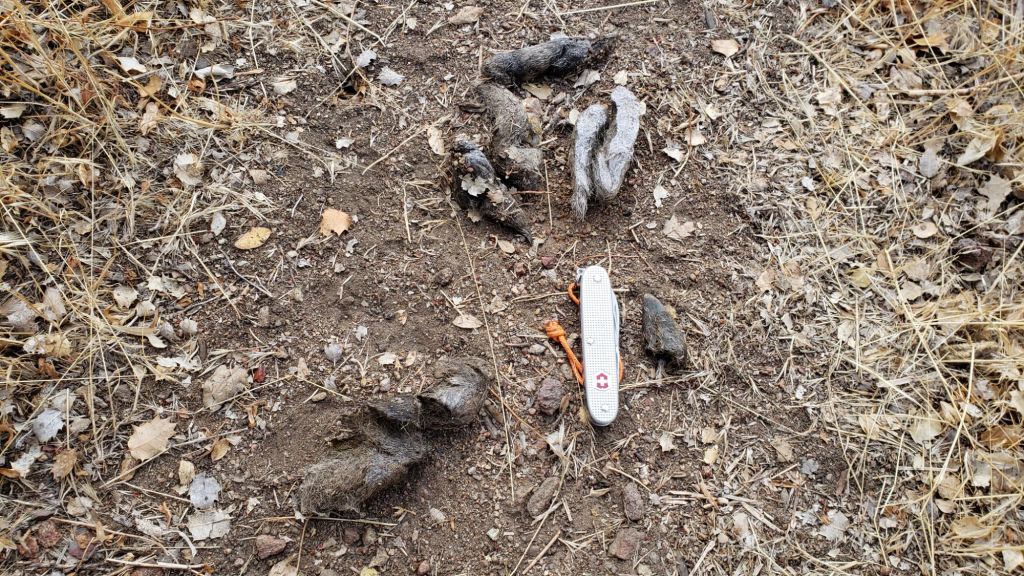
The well-known north spring at Wellman’s Cienega (9300 ft) flowing steadily, 22nd July 2024. The flow rate here has more than halved since the beginning of July.
The creek in Little Round Valley (9750 ft) flowing very steadily, early morning 25th July 2024.
The North Fork of the San Jacinto River flowing well where it crosses Fuller Ridge Trail (PCT Mile 186.1) at about 8900 ft, 21st July 2024.
Willow Creek flowing gently where it crosses Willow Creek Trail, 11th July 2024. Water volume here has more than halved in the past few weeks, and without monsoonal precipitation Willow Creek may well dry up later this year.
The Round Valley faucet (9100 ft) flowing strongly, 11th July 2024. This key water source was still flowing equally well on 26th July.
Above, Southern Pacific Rattlesnake in night roost, 6600 ft on Marion Mountain Trail, 25th July 2024 (flash photo). Below, a view of the trail with the snake at lower left for context (lighting by headlamp).

Weather and trail update 12th July 2024

The San Jacinto mountains have been experiencing a record-breaking heatwave this month. Very hot temperatures well above seasonal even for July are forecast to continue until Saturday 13th. Daytime highs will cool slightly to near or just above seasonal in the third week of July, but overnight low temperatures are expected to remain 5-15°F above average for the remainder of the month. Temperatures are expected to rise again starting Friday 19th July.

Idyllwild has set an all-time record with ten consecutive days with the temperature at or above 90°F (32°C) as of 11th July 2024, with at least one more day of such temperatures expected (the prior record of eight days was set in late June 2017). Worse still, most days have peaked in the mid to high 90s, not merely just above 90°F.

The temperature I measured at San Jacinto Peak – 68.2°F (20°C) – on the morning of Monday 8th July set a new all-time record high for that location. More significantly San Jacinto Peak has shattered its record for consecutive days of at least 60°F (16°C) – previously the record was four days, once each in 2018, 2020, and 2021 – with all ten days since 3rd July 2024 surpassing that temperature. While 60 degrees may sound quite pleasant during the current heatwave, it is worth recalling that the Peak is at 10,810 ft (3295 m) elevation, and although such temperatures are now sadly annual, they were almost completely unrecorded there as recently as ten years ago.

Hikers must be prepared for unseasonably hot weather in the high country, with temperatures well above seasonal at all times of day and at all mountain elevations. Please give considerable extra thought to start times, route choice (issues such as sun exposure, forest cover, water availability), appropriate clothing, sun protection, and hydration requirements, or indeed whether it is wise to be hiking at all in such conditions.

Onset of heat-related health problems can be very rapid but they are almost always entirely avoidable with appropriate planning. Sadly this week a 61-year-old PCT section hiker from Chula Vista who was day hiking on Saturday 6th July in the area of Miles 188-196 (immediately south and north of Fuller Ridge Campground) was found dead on 10th July near Mile 195. While cause of death has not been confirmed at this time, Saturday 6th was the hottest day of the year in the San Jacinto mountains.

The State Park closed the uppermost section of Skyline Trail – which forms the lower part of the C2C (Cactus-to-clouds route) – in their jurisdiction, i.e. above about 5600 ft, starting 12th July due to “dangerously high temperatures impacting the Palm Springs region”. The trail “will continue to be closed until further notice”.

A comprehensive fire ban is now in place on Forest Service lands throughout the San Jacinto Ranger District (link to USFS order here). Fires are completely prohibited in all camping areas, including those provided with fire rings. Fires are of course always prohibited throughout both the State Park and National Forest wilderness areas. Fires are now also prohibited in the Idyllwild campgrounds.

Survey hikes by the Trail Report every day year-round in the San Jacinto mountains include varied and often circuitous routes to San Jacinto Peak multiple times per week (most recently on 7th, 8th, 9th, 11th and 12th July), plus many other trails on intervening days.

All major springs, creeks, and pipes are flowing adequately at this time (some example photos below). However flow rates are dropping steadily at upper elevations and almost all ephemeral water sources are now dry.

Be rattlesnake aware. Southern Pacific Rattlesnakes (Crotalus helleri) have been seen on the trail system up to at least 8800 ft elevation, and may be seen as high as 9300 ft. The volume of early season sightings suggested abundant snake populations this year in the San Jacinto mountains.

Be bear aware. Although rarely reported, up to three Black Bears have been in the San Jacinto mountains since 2017, where I have seen at least one annually for the past six years, most recently on upper Marion Mountain Trail on 14th September 2023. I found fresh prints in snow on 12th February this year at 9000 ft near PCT Mile 180.5 (photo here). Brief videos from Devil’s Slide Trail in September 2021 (available here) and at home in Idyllwild in 2018 (linked here) show two different individuals. There have been no reports of negative interactions with humans at or near campsites.

An unexpected sight at 7100 ft on Devil’s Slide Trail during a night hike was a full-sized scorpion, 5th July 2024. About 3 inches (8 cm) long, I have tentatively identified it as Anuroctonus pococki (Common Swollenstinger Scorpion), one of three species apparently found regularly in the Idyllwild area.

WEATHER

Above seasonal temperatures started on 21st June and this trend will continue well into late July. The first eleven days of July have seen temperatures far above seasonal, and hot weather will continue for the next two weeks (at least). Although temperatures should drop somewhat starting Saturday 13th (i.e. to just below 90°F in Idyllwild and <60°F at San Jacinto Peak), they are forecast to generally remain a few degrees above seasonal throughout the third week of July, before rising again around 19th-20th.

There is no relief in the high country, with record high temperatures combined with record duration of warm temperatures even above 10,000 ft elevation. As is increasingly the case with a steadily heating climate in the San Jacinto mountains, overnight low temperatures in particular will continue to be well above seasonal deep into the second half of July. There is currently no significant precipitation in the forecasts, but a slim chance of light monsoonal rain on 13th-15th, and possibly again after 19th, in both cases most likely around the high peaks.

At San Jacinto Peak (3295m/10,810ft) on Thursday 11th July 2024 at 0750 the air temperature was 67.1°F (20°C), with no meaningful windchill temperature, 21% relative humidity, and a mild ESE breeze sustained at 2 mph gusting to 4.6 mph.

At the Peak on Tuesday 9th July 2024 at 0745 the air temperature was 61.8°F (16°C), with a “windchill” temperature of 59.5°F (15°C), 17% relative humidity, and a steady SW wind sustained at 7 mph gusting to 11.6 mph.

At the Peak on Monday 8th July 2024 at 0755 the air temperature was 68.2°F (20°C), with a “windchill” temperature of 66.9°F (19°C), 17% relative humidity, and a warm ESE breeze sustained at 4 mph gusting to 7.6 mph. As described above, this is an all-time record high temperature for San Jacinto Peak, surpassing the 67.6°F I recorded in the 2021 “heat dome” event that reached its zenith on 12th July that year.

Lemon Lily (Lilium parryi) flowering at 9600 ft in the San Jacinto high country, 8th July 2024. My annual survey data confirm that this has been a very poor year for flowering lilies following several mostly excellent seasons. Bulbs can lay dormant for many years, and most are presumably awaiting the next really wet year.

TRAIL CONDITIONS

Snow was gone from the high country trails by mid June.

About 12 treefall hazards on Deer Springs Trail include 8-9 in the upper trail that have been down and reported repeatedly for years but with no action from the State Park. All but one of the treefall hazards down between Strawberry Junction and the top of Marion Mountain Trail (roughly PCT Miles 183-185) were removed by the Trail Report in late June (example photos in prior Report linked here).

On Willow Creek Trail the smaller treefall hazards on the Forest Service section were cut in June. One of the two huge hazards remaining on the Forest Service side was removed in early July, but the larger, more difficult obstruction, remains. An additional four need to be cut to restore the original trail route. Whitethorn along the trail is starting to grow back rapidly, and is becoming a problem on both the Forest Service and State Park sections. Treefall hazards currently on the State Park side include two large ones remaining from last year, plus three small new ones, but none pose major problems for hikers.

Willow Creek Trail starting to disappear under overgrown whitethorn (Ceonothus), 11th July 2024. Although this is in the State Park not far below Hidden Divide, the situation is no better in the Forest Service section of the same trail.

Treefall hazards remain a major problem along parts of the Pacific Crest Trail, most notably between Antsell Rock and Red Tahquitz, with 132 recorded in my June 2024 survey between Miles 170.5-175.5. The disinterest of Forest Service and PCTA in maintaining this section of a world-famous trail for the past five years is frankly inexcusable. A further 15 smaller trees are down from Miles 168.5-170.5 (Spitler Peak Trail to Zen Center Trail). Concentrations of large downed trees make for especially slow-going around Miles 170.5-172 (east side of Antsell Rock) and Miles 174-175 (south and east sides of Red Tahquitz).

The Trail Report cleared this winter’s accumulated treefall hazards from South Ridge Trail in April and has also undertaken extensive trail trimming in the first half of this year.

The 34 treefall hazards that came down across Spitler Peak Trail during ice storms in February 2024 were almost all cleared by the Trail Report on 14th June. The couple of minor stepover branches that remain pose no problem for hikers. This work brings to 120+ the total number of trees removed by the Report from this trail in the past three years. Currently the upper trail in particular is heavily overgrown with lush seasonal vegetation.

The Caramba Trail from near Reeds Meadow through Laws Camp and on to Caramba, and the Cedar Trail from Willow Creek Trail to Laws, are euphemistically described by the Forest Service as “not maintained”. In reality both trails have been abandoned and functionally no longer exist. They are so heavily overgrown with dense whitethorn, which obscures dozens of downed trees, that I strongly advise hikers do not attempt to follow them (regardless of how much you may trust an app). An informal use trail to Laws is much more direct, maintained, and avoids the challenging bushwhacking of the unmaintained trails (local Idyllwild hikers dubbed it the “King Trail” when I established the route in 2019). It leaves Willow Creek Trail exactly 1.0 mile from Saddle Junction, 0.46 mile from the Skunk Cabbage turning (trailhead at N 33.7796, W 116.6590). The route descends largely following established deer trails for 1.2 miles, meeting Willow Creek about 0.2 mile upstream from the site of the historic Laws Camp (the remains of which were destroyed by the 2013 Mountain Fire and subsequent flood and treefall damage). Eleven trees down on the King Trail were removed in June-July 2023. The tread of the trail received some damage from Tropical Storm Hilary last year. From Laws east to Caramba the route of the original Caramba Trail has been well-cairned by myself and others and can largely be followed with very careful route-finding. My 2023 survey counted about 110 trees down on this 2.1 miles of trail. It is especially obscure for the first 0.3 mile east of the Willow Creek crossing, becoming more obvious (but still subtle) as it descends towards Caramba. Very cautious navigation is advised throughout the area.

The Trail Report “adopted” Seven Pines Trail as a priority for maintenance work as the trail has had a disproportionate number of lost hiker rescues in the past decade, and both State Park and Forest Service have shown no interest in maintaining the route for years. Since 2020 we have removed 75 downed trees and the trail is thoroughly trimmed and cleared multiple times annually. As of July 2024 the trail is largely clear of treefall hazards, with three down across the trail in its upper section, all easily passable for hikers. A further half-a-dozen downed trees close to the PCT junction would need to be removed to fully restore the original route of the trail. Although the condition of the trail is hugely improved, Seven Pines remains a genuine wilderness trail unlike the wider, bare, obvious routes of, for example, Devil’s Slide or Marion Mountain trails. Cautious navigation remains essential for those without considerable experience of hiking this trail. Be aware in particular that Seven Pines Trail becomes most obscure in the mile closest to its junction with Deer Springs Trail/PCT.

The Zen Center Trail continues its deterioration that started following the 2013 Mountain Fire, with a combination of vigorous regrowth and treefall hazards further obscuring the route with each passing season. The lower and upper parts of this trail are partially cairned and not too bad for those who are very familiar with the former route, but even the experienced find navigating the central section tricky. Long trousers, scrambling gloves, and an enjoyment of bush-whacking are all strongly recommended.

While all time and labor is volunteered, the San Jacinto Trail Report uses small private donations to help cover operating costs. Your contribution keeps the Report available to all, free from advertising or paywalls, and independent from agencies. If you have found this Report useful, please consider using this link to the Donate page. Thank you very much for your support.

The well-known north spring at Wellman’s Cienega (9300 ft) flowing steadily, 7th July 2024. The flow rate here has dropped markedly in the past week.
Willow Creek flowing gently where it crosses Willow Creek Trail, 11th July 2024. Water volume here has more than halved in the past few weeks, and without some monsoonal precipitation Willow Creek could dry up later this year.
The small creek in Tahquitz Valley flowing gently where it crosses the meadow trail, 4th July 2024.
The Round Valley faucet (9100 ft) flowing strongly, 11th July 2024.
The creek in Little Round Valley (9750 ft) flowing very well, 12th July 2024.
The North Fork of the San Jacinto River flowing well where it crosses Deer Springs Trail at about 9400 ft, 8th July 2024.
The North Fork of the San Jacinto River flowing well where it crosses Fuller Ridge Trail (approx. PCT Mile 186.1) at about 8900 ft, 28th June 2024.
Above, it never ceases to amaze me how thoughtless a minority of hikers can be in relation to fires, especially now when the fire risk is so obviously elevated. I found this fire ring in Little Round Valley at the end of June, literally a few dozen yards from a “no campfires” sign (fires are of course always prohibited in wilderness). Below, I removed and obscured evidence of the ring, hoping to discourage anyone else from having the same idea, photo 9th July 2024.

Weather and trail update 5th July 2024

Very hot temperatures far above seasonal even for July – close to 100°F (38°C) as high as 6000 ft – are forecast for 3rd-13th, with the hottest days expected to dangerously coincide with the extended holiday weekend. Overnight low temperatures in particular will be at least 15°F above seasonal into mid July. Hikers must be prepared for unseasonably hot weather in the high country, with temperatures well above seasonal at all times of day and at all mountain elevations. Please give considerable extra thought to start times, route choice, clothing, sun protection, and hydration requirements, or indeed whether it is wise to be hiking at all in such conditions.

A comprehensive fire ban is now in place on Forest Service lands throughout the San Jacinto Ranger District (link to USFS order here). Fires are completely prohibited in all camping areas, including those provided with fire rings. Fires are of course always prohibited throughout both the State Park and National Forest wilderness areas.

Survey hikes by the Trail Report every day year-round in the San Jacinto mountains include varied and often circuitous routes to San Jacinto Peak multiple times per week (most recently daily on 1st-5th July), plus many other trails on intervening days.

All major springs, creeks, and pipes are flowing relatively well at this time (example photos below). However flow rates are dropping steadily at upper elevations and most ephemeral water sources are now dry.

Be rattlesnake aware. Southern Pacific Rattlesnakes (Crotalus helleri) have been seen on the trail system up to at least 8800 ft elevation, and may be seen as high as 9300 ft. The volume of early season sightings suggested abundant snake populations this year in the San Jacinto mountains.

Be bear aware. Although rarely reported, up to three Black Bears have been in the San Jacinto mountains since 2017, where I have seen at least one annually for the past six years, most recently on upper Marion Mountain Trail on 14th September 2023. I found fresh prints in snow on 12th February this year at 9000 ft near PCT Mile 180.5 (photo here). Brief videos from Devil’s Slide Trail in September 2021 (available here) and at home in Idyllwild in 2018 (linked here) show two different individuals. There have been no reports of negative interactions with humans at or near campsites.

WEATHER

Above seasonal temperatures started on 21st June and this trend will continue into mid July (at least). Forecast temperatures suggest the first two weeks of July will be very hot and well above average for the month on 2nd-13th at least. There will be little relief in the high country, with near-record temperatures expected even above 10,000 ft elevation on 4th-12th July. As is increasingly the case with a steadily heating climate in the San Jacinto mountains, overnight low temperatures in particular will be well above seasonal into mid July. There is currently no significant precipitation in the forecasts, but a slim chance of light monsoonal rain on 13th-14th most likely around the highest peaks.

The latest video forecast issued on 2nd July by NWS San Diego (linked here) describes in detail the imminent “heat dome” that will impact us in early July, plus expectations for the remainder of the month.

At San Jacinto Peak (3295m/10,810ft) on Friday 5th July 2024 at 0645 the air temperature was 61.6°F (16°C), with a “windchill” temperature of 58.1°F (14°C), 24% relative humidity, and a steady NE wind sustained at 11 mph gusting to 13.5 mph.

At the Peak on Thursday 4th July 2024 at 0750 the air temperature was 64.4°F (18°C), with a “windchill” temperature of 59.8°F (15°C), 33% relative humidity, and a subtle ESE breeze sustained at 2 mph gusting to 4.1 mph.

At the Peak on Wednesday 3rd July 2024 at 0910 the air temperature was 61.4°F (16°C), with a “windchill” temperature of 58.5°F (15°C), 44% relative humidity, and a very light SSE wind sustained at 3 mph gusting to 6.2 mph.

Monarch (Danaus plexippus) caterpillar on Woollypod Milkweed (Asclepias eriocarpa) at about 5600 ft in Idyllwild, 29th June 2024. The western population of Monarch butterflies has declined so rapidly (>90% in the past 40 years) that the species is under consideration for listing as federally endangered. We have been monitoring Monarchs and reporting observations from the San Jacinto mountains for several years.

TRAIL CONDITIONS

Snow was gone from the high country trails by mid June.

About 12 treefall hazards on Deer Springs Trail include 8-9 in the upper trail that have been down and reported repeatedly for years but with no action from the State Park. All but one of the treefall hazards down between Strawberry Junction and the top of Marion Mountain Trail (roughly PCT Miles 183-185) were removed by the Trail Report in late June (example photos below).

Willow Creek Trail is in much more hiker-friendly condition than this time last year. Smaller treefall hazards on the Forest Service section were cut in June. The two huge (c.50 inch diameter) hazards remaining on the Forest Service side are being removed in early July. Whitethorn along the trail has not (yet) grown back significantly, other than a couple of minor areas near Hidden Divide in the State Park section. Treefall hazards currently on the State Park side include two large ones remaining from last year, plus three small new ones, but none pose significant problems for hikers.

Treefall hazards remain a major problem along parts of the Pacific Crest Trail, most notably between Antsell Rock and Red Tahquitz, with 132 recorded in my June 2024 survey between Miles 170.5-175.5. The disinterest of Forest Service and PCTA in maintaining this section of trail for the past five years is unconscionable. A further 15 smaller trees are down from Miles 168.5-170.5 (Spitler Peak Trail to Zen Center Trail). Concentrations of large downed trees make for especially slow-going around Miles 170.5-172 (east side of Antsell Rock) and Miles 174-175 (south and east sides of Red Tahquitz).

The Trail Report cleared this winter’s accumulated treefall hazards from South Ridge Trail in April and has also undertaken extensive trail trimming in the first half of this year.

The 34 treefall hazards that came down across Spitler Peak Trail during ice storms in February 2024 were almost all cleared by the Trail Report on 14th June. The couple of minor stepover branches that remain pose no problem for hikers. This work brings to 120+ the total number of trees removed by the Report from this trail in the past three years. Currently the upper trail in particular is heavily overgrown with lush seasonal vegetation.

The Caramba Trail from near Reeds Meadow through Laws Camp and on to Caramba, and the Cedar Trail from Willow Creek Trail to Laws, are euphemistically described by the Forest Service as “not maintained”. In reality both trails have been abandoned and functionally no longer exist. They are so heavily overgrown with dense whitethorn, which obscures dozens of downed trees, that I strongly advise hikers do not attempt to follow them (regardless of how much you may trust an app). An informal use trail to Laws is much more direct, maintained, and avoids the challenging bushwhacking of the unmaintained trails (local Idyllwild hikers dubbed it the “King Trail” when I established the route in 2019). It leaves Willow Creek Trail exactly 1.0 mile from Saddle Junction, 0.46 mile from the Skunk Cabbage turning (trailhead at N 33.7796, W 116.6590). The route descends largely following established deer trails for 1.2 miles, meeting Willow Creek about 0.2 mile upstream from the site of the historic Laws Camp (the remains of which were destroyed by the 2013 Mountain Fire and subsequent flood and treefall damage). Eleven trees down on the King Trail were removed in June-July 2023. The tread of the trail received some damage from Tropical Storm Hilary last year. From Laws east to Caramba the route of the original Caramba Trail has been well-cairned by myself and others and can largely be followed with very careful route-finding. My 2023 survey counted about 110 trees down on this 2.1 miles of trail. It is especially obscure for the first 0.3 mile east of the Willow Creek crossing, becoming more obvious (but still subtle) as it descends towards Caramba. Very cautious navigation is advised throughout the area.

The Trail Report has “adopted” Seven Pines Trail as a priority for maintenance work as the trail has had a disproportionate number of lost hiker rescues in the past decade, and it has been functionally abandoned by both the State Park and Forest Service for years. Since 2020 about 75 downed trees have been cut and the trail is thoroughly trimmed and cleared annually. As of July 2024 the trail is largely clear of treefall hazards, with three down across the trail in its upper section, all easily passable for hikers. A further half-a-dozen downed trees near the PCT would need to be removed to fully restore the original route of the trail. Although the condition of the trail is literally many times better than just a few years ago, Seven Pines remains a genuine wilderness trail unlike the wider, bare, and obvious routes of, for example, Devil’s Slide or Marion Mountain trails. Cautious navigation remains essential for those without considerable experience of hiking this trail. Be advised that in general Seven Pines Trail becomes most obscure in the mile closest to its junction with the PCT.

The Zen Center Trail continues to deteriorate since the 2013 Mountain Fire, with a combination of vigorous regrowth and treefall hazards further obscuring the route with each passing season. The lower and upper parts of this trail are partially cairned and not too bad for those who are very familiar with the former route, but even the experienced find navigating the central section tricky. Long trousers, scrambling gloves, and an enjoyment of bush-whacking are all strongly recommended.

While all time and labor is volunteered, the San Jacinto Trail Report uses small private donations to help cover operating costs. Your contribution keeps the Report available to all, free from advertising or paywalls, and independent from agencies. If you have found this Report useful, please consider using this link to the Donate page. Thank you very much for your support.
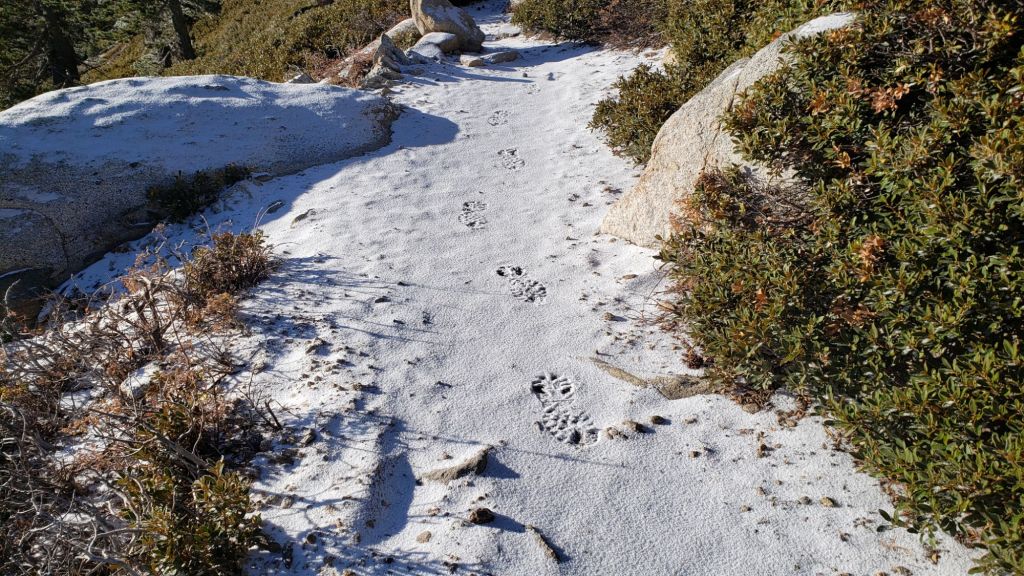
Above and below, examples of work by the Trail Report to restore the route of the PCT north of Strawberry Junction, at about Miles 183.1 and 184.0 respectively, 27th June 2024.
The well-known north spring at Wellman’s Cienega (9300 ft) flowing well, 1st July 2024.
The small creek in Tahquitz Valley flowing gently where it crosses the meadow trail, 4th July 2024.
The creek in Little Round Valley (9750 ft) flowing very well, 2nd July 2024.
Stone Creek flowing gently along Deer Springs Trail at about PCT Mile 183.5 (8350 ft), 27th June 2024.
The North Fork of the San Jacinto River flowing well where it crosses Fuller Ridge Trail (approx. PCT Mile 186.1) at about 8900 ft, 28th June 2024.

Trail update 28th June 2024

Cooler, seasonal, temperatures on 17th-19th June rapidly transitioned to hot summer temperatures from 21st. Very hot temperatures are forecast for 2nd-8th July, dangerously coinciding with the extended holiday weekend. Overnight low temperatures in particular will be far above seasonal into the second week of July at least. Hikers should be prepared for unseasonably hot weather in the high country, with temperatures above seasonal at all times of day and at all mountain elevations. Give considerable extra thought to start times, route choice, clothing, sun protection, and hydration requirements.

We are already in fire season. Fires – thankfully so far all relatively small – are starting almost daily in the surrounding lowlands of interior Southern California. The first to impact the fringe of the San Jacinto mountains was the Tuscany Fire on 17th June on BLM land on the south side of Chino Canyon (near the Tramway road, north-west Palm Springs), contained at 126 acres.

Survey hikes every day in the San Jacinto mountains include varied routes to San Jacinto Peak multiple times per week (most recently on 21st, 24th, and twice on 28th June) plus many other trails on intervening days. I fully surveyed the northern Desert Divide and associated side trails (PCT Miles 170.5-179) on 18th June.

All major springs, creeks, and pipes are flowing well at this time (example photos below). However flow rates are dropping steadily at upper elevations, many ephemeral water sources are dry, and grassy meadows below 7000 ft are already largely dry. A long, hot, dry summer is forecast.

Campgrounds, forest roads, and fire lookouts all opened in time for the Memorial Day weekend, as described in detail in the previous Report (available here).

Be rattlesnake aware. Southern Pacific Rattlesnakes (Crotalus helleri) have been seen on the trail system up to at least 8800 ft elevation already, and may be seen as high as 9300 ft this month. The volume of sightings suggest abundant snake populations this year in the San Jacinto mountains.

Adult Southern Pacific Rattlesnake at 7750 ft on Marion Mountain Trail, early afternoon 7th June 2024. I nearly trod on this one, seeing the tail just in time as I stepped over this downed tree across the trail (I was descending, right to left in the image). Someone at the State Park has been paying attention; five days after I posted this photo and caption, the tree in question (and another further up the trail) had been cut.

Be bear aware. Although rarely reported, up to three Black Bears have been in the San Jacinto mountains since 2017, where I have seen at least one annually for the past six years, most recently on upper Marion Mountain Trail on 14th September 2023. I found fresh prints in snow on 12th February this year at 9000 ft near PCT Mile 180.5 (photo here). Brief videos from Devil’s Slide Trail in September 2021 (available here) and at home in Idyllwild in 2018 (linked here) show two different individuals. There have been no reports of negative interactions with humans at or near campsites.

WEATHER

Temperatures above average for June are forecast starting 21st and continuing to the end of the month. Forecast temperatures suggest the first two weeks of July will be hot, and well above average for that month on 1st-8th at least. As is increasingly the case with a heating climate in the San Jacinto mountains, overnight low temperatures in particular will be well above seasonal in late June and into July. There is currently no significant new precipitation in the forecasts.

This video forecast from NWS San Diego (linked here) details the forthcoming heat dome, and the current projections for July and the remainder of the summer. Below average precipitation and above average temperatures are predicted, with vegetation moisture content (a key indicator of fire risk) already below average in much of interior Southern California.

At San Jacinto Peak (3295m/10,810ft) on Friday 28th June 2024 at 0715 the air temperature was 52.4°F (11°C), with a windchill temperature of 42.8°F (6°C), 11% relative humidity, and a pleasantly fresh WSW wind sustained at 14 mph gusting to 22.7 mph.

At the Peak on Monday 24th June 2024 at 0800 the air temperature was 56.2°F (13°C), with a “windchill” temperature of 50.8°F (10°C), 76% relative humidity, and a light ESE wind sustained at 5 mph gusting to 10.6 mph.

Pink Alumroot (Heuchera rubescens) flowering in a beautiful setting on a near-vertical rock face alongside the PCT on the east side of Antsell Rock, 18th June 2024.

TRAIL CONDITIONS

Snow was gone from the high country trails by mid June.

Trail maintenance has made progress this month, although ultimately less than hoped. An American Conservation Experience (and PCTA-supported) crew worked on Miles 162-165 (south from Fobes Saddle, trimmed plus 17 trees cut), and Miles 177-179 (Tahquitz Creek to Saddle Junction, nine trees cut and tread improved). In mid June several smaller trees were removed from Willow Creek Trail and six trees were cleared from the Little Tahquitz Valley Trail by Forest Service. The Trail Report cleared several trees from the PCT section north of Saddle Junction (Miles 179-181) on 10th June, more than 30 trees from Spitler Peak Trail on 14th, and half-a-dozen more from Deer Springs Trail on 27th.

Deer Springs Trail is clear of snow. About 12 treefall hazards on the trail include 8-9 in the upper trail that have been down and reported repeatedly for years but with no action from the State Park. All but one of the treefall hazards down between Strawberry Junction and the top of Marion Mountain Trail (roughly PCT Miles 183-185) were removed by the Trail Report in late June (example photos below).

The Trail Report cleared this winter’s accumulated treefall hazards from South Ridge Trail in April and has also undertaken extensive trail trimming in the first half of this year.

The 34 treefall hazards that came down across Spitler Peak Trail during ice storms in February 2024 were almost all cleared by the Trail Report on 14th June. The couple of minor stepover branches that remain pose no problem for hikers. This work brings to 120+ the total number of trees removed by the Report from this trail in the past three years. Currently the upper trail in particular is heavily overgrown with lush seasonal vegetation.

Willow Creek Trail is in much more hiker-friendly than this time last year. Several of the smaller trees on the Forest Service section were cut in June. Whitethorn along the trail has not (yet) grown back significantly, other than a couple of minor areas near Hidden Divide in the State Park section. Remaining treefall hazards on the trail include three on the Forest Service section and five on the State Park side (two large ones from last year, plus three small new ones). Unfortunately two of the remaining trees on the Forest Service section are huge (four-plus feet diameter) and some hikers will find them challenging to cross (see photo in previous Report linked here).

The Caramba Trail from near Reeds Meadow through Laws Camp and on to Caramba, and the Cedar Trail from Willow Creek Trail to Laws, are euphemistically described by the Forest Service as “not maintained”. In reality both trails have been abandoned and functionally no longer exist. They are so heavily overgrown with dense whitethorn, which obscures dozens of downed trees, that I strongly advise hikers do not attempt to follow them (regardless of how much you may trust an app). An informal use trail to Laws is much more direct, maintained, and avoids the challenging bushwhacking of the unmaintained trails (local Idyllwild hikers dubbed it the “King Trail” when I established the route in 2019). It leaves Willow Creek Trail exactly 1.0 mile from Saddle Junction, 0.46 mile from the Skunk Cabbage turning (trailhead at N 33.7796, W 116.6590). The route descends largely following established deer trails for 1.2 miles, meeting Willow Creek about 0.2 mile upstream from the site of the historic Laws Camp (the remains of which were destroyed by the 2013 Mountain Fire and subsequent flood and treefall damage). Eleven trees down on the King Trail were removed in June-July 2023. The tread of the trail received some damage from Tropical Storm Hilary last year. From Laws east to Caramba the route of the original Caramba Trail has been well-cairned by myself and others and can largely be followed with very careful route-finding. My 2023 survey counted about 110 trees down on this 2.1 miles of trail. It is especially obscure for the first 0.3 mile east of the Willow Creek crossing, becoming more obvious (but still subtle) as it descends towards Caramba. Very cautious navigation is advised throughout the area.

Seven Pines Trail is largely (by its formerly low standards) clear of treefall hazards, with about ten down across the trail, most in the central mile, but they are easily passable for hikers. Be advised that the trail in general becomes more obscure in the mile closest to its junction with the PCT. The Trail Report has “adopted” Seven Pines Trail as a priority for maintenance work as the trail has had a disproportionate number of lost hiker rescues in the past decade. Since November 2021, 70 downed trees have been removed and the trail is thoroughly trimmed and cleared regularly (but not yet in 2024). Nevertheless Seven Pines remains a genuine wilderness trail unlike the relatively wide, bare, and obvious routes of, for example, Devil’s Slide or Marion Mountain trails. Cautious navigation remains essential for those without considerable experience of hiking this trail.

Treefall hazards remain a major problem along parts of the Pacific Crest Trail, most notably between Antsell Rock and Red Tahquitz, with 132 recorded in my June 2024 survey between Miles 170.5-175.5. The disinterest of Forest Service and PCTA in maintaining this section of trail for the past five years is unconscionable. A further 15 smaller trees are down from Miles 168.5-170.5 (Spitler Peak Trail to Zen Center Trail). Concentrations of large downed trees make for especially slow-going around Miles 170.5-172 (east side of Antsell Rock) and Miles 174-175 (south and east sides of Red Tahquitz).

The Pacific Crest Trail on the south side of Red Tahquitz (approx. Mile 174.4), 18th June 2024. If it looks like it would be hard to follow the trail, it is, even for those of us very familiar with the route who hike it multiple times per year. Letting any trail, least of all one as internationally famous as the PCT, fall into this state of disrepair seems frankly inexcusable.

The Zen Center Trail continues to deteriorate since the 2013 Mountain Fire, with a combination of vigorous regrowth and treefall hazards further obscuring the route with each passing season. The lower and upper parts of this trail are partially cairned and not too bad for those who are very familiar with the route, but even the experienced find navigating the central section tricky. Long trousers and scrambling gloves are strongly recommended.

While all time and labor is volunteered, the San Jacinto Trail Report uses small private donations to help cover operating costs. Your contribution keeps the Report available to all, free from advertising or paywalls, and independent from agencies. If you have found this Report useful, please consider using this link to the Donate page. Thank you very much for your support.

Above and below, examples of work by the Trail Report to restore the route of the PCT north of Strawberry Junction, at about Miles 183.1 and 184 respectively, 27th June 2024.
Spitler Peak Trail, one of the routes “adopted” by the Trail Report due to its importance to PCT hikers as a seasonal safety alternate, has required significant clearing work in recent years following the 2013 Mountain Fire. Above an example of cutting of dead live oak trunks undertaken on 14th June 2024 to keep the trail readily passable.
Stone Creek flowing gently along Deer Springs Trail at about PCT Mile 183.5 (8350 ft), 27th June 2024.
The well-known north spring at Wellman’s Cienega (9300 ft) flowing well, 17th June 2024.
The creek in Little Round Valley (9750 ft) flowing very well, 28th June 2024.
The North Fork of the San Jacinto River flowing well where it crosses Fuller Ridge Trail (approx. PCT Mile 186.1) at about 8900 ft, 28th June 2024.
The North Fork of the San Jacinto River flowing steadily where it crosses upper Deer Springs Trail at about 9400 ft, 17th June 2024.
After a hiatus of a couple of years, which was filled by several short-lived homemade signs, a new State Park sign was placed at the Peak on 15th June 2024. For the first time in many years the name of the mountain is correct, while data from multiple modern technologies suggest that the decades-old official USGS elevation is probably overdue for a new measurement.

Trail update 14th June 2024

Regrettably we are periodically experiencing July-August temperatures in the first half of June. Overnight low temperatures in particular will generally be well above seasonal into late June. Hikers should be prepared for unseasonably warm weather in the high country on most days, with temperatures at or above seasonal at all times of day and at all mountain elevations. Give considerable extra thought to route choice, start times, clothing, sun protection, and hydration requirements.

Prescribed burning actions on Thomas Mountain started on Monday 10th June and are expected to impact access in that area for 7-10 days. Thomas Mountain Road (6S13 to 6S15) and Rouse Ridge Road (5S15) are closed, along with all camping areas on Thomas Mountain. Ramona Trail (3E2) is also closed. Fobes Ranch Road/Quinn Flat is being used for crew staging and as a helicopter base, and may have reduced access.

After years of neglect, there is encouraging news regarding trail maintenance along the PCT on Forest Service lands. An ACE (American Conservation Experience) crew, supported by PCTA, worked last week south from Fobes Saddle, roughly Miles 165-160. Trees were cleared by Forest Service south from Saddle Junction to near Red Tahquitz on 10th-11th June (Miles 179-175), followed by an ACE crew working south from Mile 175 on 12th-18th June down the Desert Divide, the notorious PCT section with 100+ downed trees. The Trail Report cleared several obstructing trees on the PCT section north of Saddle Junction (Miles 179-181) on 10th June, and cut almost all of 35 trees down on Spitler Peak Trail on 14th June.

Snow is gone from the high country trails. Some high elevation areas still hold localized patches (e.g,, north and east flanks of San Jacinto Peak, north side of Jean Peak). Traction devices are no longer required.

Survey hikes every day in the San Jacinto mountains include varied routes to San Jacinto Peak multiple times per week (most recently on 7th, 9th, 10th, and 13th June), Tahquitz Peak and area at least once per week (most recently on 11th June), plus many other trails on intervening days.

All major springs, creeks, and pipes are flowing well at this time. However, flow rates are dropping steadily at upper elevations, many ephemeral water sources are drying, and grassy meadows below 7000 ft are already largely dry. A long, hot summer seems inevitable.

Campgrounds, forest roads, and fire lookouts all opened in time for the Memorial Day weekend, as described in detail in the previous Report (available here).

Be rattlesnake aware. Southern Pacific Rattlesnakes (Crotalus helleri) have been seen on the trail system up to at least 8100 ft elevation already, and may be seen as high as 9300 ft this month. The volume of sightings suggest abundant snake populations this year in the San Jacinto mountains.

Adult Southern Pacific Rattlesnake at 7750 ft on Marion Mountain Trail, early afternoon 7th June 2024. I nearly trod on this one, seeing the tail just in time as I stepped over this downed tree across the trail (I was descending, right to left in the image). Someone at the State Park has been paying attention; five days after I posted this photo and caption, the tree in question (and another further up the trail) had been cut.

WEATHER

Temperatures more typical of midsummer started last week and will persist on some days into mid June (notably on 14th-15th and from 20th onwards). Temperatures will be briefly seasonal (and feel pleasantly cool) on 17th-19th June. As is increasingly the case with a heating climate in the San Jacinto mountains, overnight low temperatures in particular will be above seasonal almost daily into the third week of June. Remaining snow patches will of course disappear rapidly. There is currently no new precipitation in the forecasts.

At San Jacinto Peak (3295m/10,810ft) on Thursday 13th June 2024 at 0750 the air temperature was 46.6°F (8°C), with a windchill temperature of 34.9°F (2°C), 28% relative humidity, and a strong SSW wind sustained at 19 mph gusting to 32.3 mph.

At the Peak on Monday 10th June 2024 at 0800 the air temperature was 54.0°F (12°C), with a “windchill” temperature of 47.3°F (8°C), 18% relative humidity, and a gusty SSE wind sustained at 5 mph gusting to 12.9 mph.

At the Peak on Sunday 9th June 2024 at 0745 the air temperature was 51.3°F (11°C), with a “windchill” temperature of 48.4°F (9°C), 16% relative humidity, and a very light SW breeze sustained at 1 mph gusting to 4.6 mph.

Martin’s Paintbrush (Castilleja applegatei martinii) at 8100 ft on the south flank of Tahquitz Peak, 11th June 2024. Probably the most widespread of several species of “Indian paintbrush” that occur in the San Jacinto mountains. The colored bracts – from which the plants get their common name – are typically bright red, but occasional genetic mutations can produce other colors, such as the yellow plant shown here.

TRAIL CONDITIONS

Trails are clear of snow, with the few tiny remaining patches mentioned below. No notable snow remains below 10,000 ft, and above that elevation only in a handful of less-traveled areas.

South Ridge Trail is clear of snow to Tahquitz Peak. The Trail Report cleared this winter’s accumulated treefall hazards from South Ridge Trail in April and has also undertaken extensive trail trimming in recent months. The notorious 0.4 mile section of South Ridge Trail between Chinquapin Flat/PCT Mile 177 and Tahquitz Peak is now completely clear of snow.

The Peak Trail is clear of snow to its junction with Deer Springs Trail. The area immediately around San Jacinto Peak is now almost entirely snow-free. The East Ridge trail route is now only 10% snow-covered, with the track now largely visible and easy to follow. The Round Valley Trail is now clear of snow.

Deer Springs Trail is clear of snow. The remaining snow patches through and above Little Round Valley have gone in the last few days.

Willow Creek Trail is clear of snow. Overall the trail is in reasonable condition, and certainly far more hiker-friendly than this time last year. Whitethorn along the trail has not (yet) grown back significantly, other than a couple of minor areas near Hidden Divide in the State Park section. Sixteen treefall hazards on the trail include 11 on the Forest Service section (two remaining from last year, plus nine new this winter) and five on the State Park side (two large ones from last year, plus three small new ones). Almost all of the downed trees on the USFS section are north of Willow Creek. Unfortunately two of the hazards on the Forest Service section are huge (four-plus feet diameter) and some hikers will find them challenging to cross (see photo in previous Report linked here).

The Caramba Trail from near Reeds Meadow through Laws Camp and on to Caramba, and the Cedar Trail from Willow Creek Trail to Laws, are euphemistically described by the Forest Service as “not maintained”. In reality both trails have been abandoned and functionally no longer exist. They are so heavily overgrown with dense whitethorn, which obscures dozens of downed trees, that I strongly advise hikers do not attempt to follow them (regardless of how much you may trust an app). An informal use trail to Laws is much more direct, maintained, and avoids the challenging bushwhacking of the unmaintained trails (local Idyllwild hikers dubbed it the “King Trail” when I established the route in 2019). It leaves Willow Creek Trail exactly 1.0 mile from Saddle Junction, 0.46 mile from the Skunk Cabbage turning (trailhead at N 33.7796, W 116.6590). The route descends largely following established deer trails for 1.2 miles, meeting Willow Creek about 0.2 mile upstream from the site of the historic Laws Camp (the remains of which were destroyed by the 2013 Mountain Fire and subsequent flood and treefall damage). Eleven trees down on the King Trail were removed in June-July 2023. The tread of the trail received some damage from Tropical Storm Hilary last year. From Laws east to Caramba the route of the original Caramba Trail has been well-cairned by myself and others and can largely be followed with very careful route-finding. My 2023 survey counted about 110 trees down on this 2.1 miles of trail. It is especially obscure for the first 0.3 mile east of the Willow Creek crossing, becoming more obvious (but still subtle) as it descends towards Caramba. Very cautious navigation is advised throughout the area.

Seven Pines Trail is largely (by its formerly low standards) clear of treefall hazards, with about ten down across the trail, most in the central mile, but they are easily passable for hikers. Be advised that the trail in general becomes more obscure in the mile closest to its junction with the PCT. The Trail Report has “adopted” Seven Pines Trail as a priority for maintenance work as the trail has had a disproportionate number of lost hiker rescues in the past decade. Since November 2021, 70 downed trees have been removed and the trail is thoroughly trimmed and cleared regularly (but not yet in 2024). Nevertheless Seven Pines remains a genuine wilderness trail unlike the relatively wide, bare, and obvious routes of, for example, Devil’s Slide or Marion Mountain trails. Cautious navigation remains essential for those without considerable experience of hiking this trail.

The 34 treefall hazards that came down across Spitler Peak Trail during ice storms in February 2024 were almost all cleared by the Trail Report in mid June. The couple that remain pose no problem for hikers. Note that the upper trail in particular is currently heavily overgrown with lush seasonal vegetation.

The Pacific Crest Trail is now clear of snow through the San Jacinto mountains. Treefall hazards remain a problem in many places, most notably between Apache Peak and Red Tahquitz, with at least 110 down in my most recent survey. Large downed trees make for especially slow-going around Miles 172-175 (a section severely burned in the July 2013 Mountain Fire). However as described above, significant work is expected in this area in June 2024. A crew is working this week on the PCT south from Fobes Saddle, roughly Miles 160-165. Trees should be cleared by Forest Service south from Saddle Junction early next week (Miles 179-175) and then another crew will be working south from Mile 175 from 12th-18th June. The Trail Report cleared the section north of Saddle Junction (PCT Miles 179-181) on 10th June of several trees across the trail from this past winter.

An example of treefall hazard clearance work undertaken by the Trail Report on a short section of the PCT generally overlooked by the agencies (approx. PCT Mile 180.5), just south of Annie’s Junction, 10th June 2024.

While all time and labor is volunteered, the San Jacinto Trail Report uses small private donations to help cover operating costs. Your contribution keeps the Report available to all, free from advertising or paywalls, and independent from agencies. If you have found this Report useful, please consider using this link to the Donate page. Thank you very much for your support.
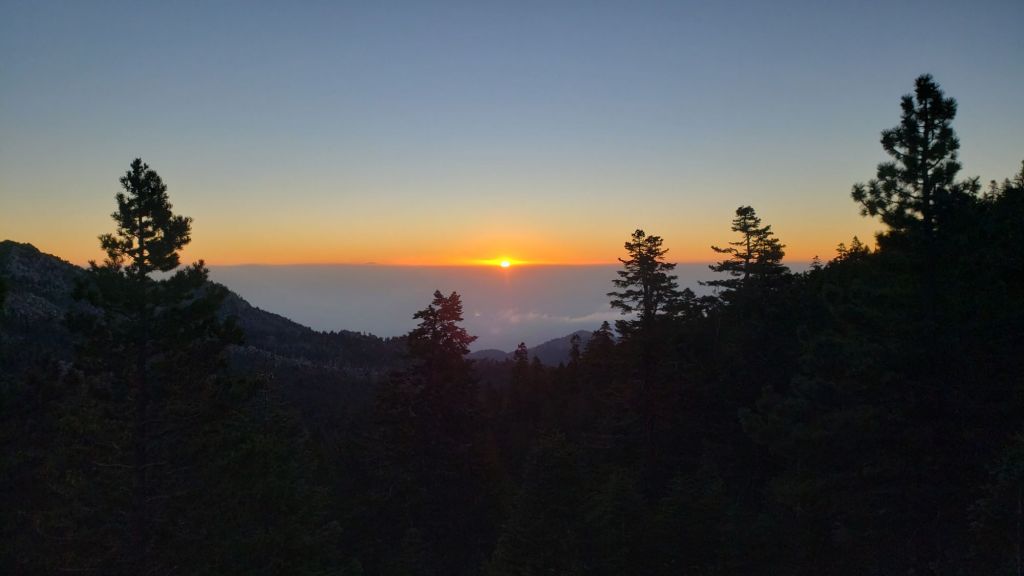
Before you kick that pine cone out of the trail, make sure it isn’t a living plant! The California Groundcone (Kopsiopsis strobilacea) is a parasitic plant that is especially abundant in the San Jacinto mountains this season. As a parasite it has no need for chlorophyll. In our mountains they specialize on parasitizing the roots of manzanita bushes (the leaves to the right of the image) but apparently cause no harm to the host. The image shows the emergent inflorescence, complete with little purplish flowers, that looks remarkably cone-like, photographed at 8300 ft on South Ridge Trail, 29th May 2024.
Pacific (or Canyon) Sweet Pea (Lathyrus vestitus), Ernie Maxwell Trail, 3rd June 2024. This species, with the classic sweet pea flower, is native to coastal California including the San Jacinto mountains, in contrast to the widespread introduced European Sweet Pea (Lathyrus latifolius). The latter typically has a much thicker, vine-like growth form, sometimes choking out native vegetation, generally comes in wider variety of colours, and has much larger, longer (not rounded) leaves.

Snow and trail update 1st June 2024

Most hikers will find it is now straightforward to bareboot all of the established trails, including the entire PCT through the San Jacinto mountains. Hikers with limited experience on patchy icy snow may find that carrying spikes remains a good option locally above about 9000 ft. Spikes tend to be particularly useful for descending, especially later in the day as the snow structure deteriorates, even when they generally not required for ascending. Spikes remain recommended for off-trail travel above 10,000 ft.

Daily survey hikes in the San Jacinto mountains include various routes to San Jacinto Peak multiple times per week (most recently on 20th, 24th, 28th May, and 1st June), Tahquitz Peak and area at least once per week (most recently on 25th and 29th May), plus a wide variety of other routes on intervening days.

I am no longer providing snow depth data, as very little snow remains below 10,000 ft. This does not mean there is no snow in the high country, only that it is too patchy to give meaningful measurements (see photos below). Some high elevation areas still hold 1-2 feet of increasingly patchy snow (e.g,, Little Round Valley, east flank of San Jacinto Peak, north side of Jean Peak)

All major springs, creeks, and pipes (and many ephemeral ones too) are flowing well at this time (example photo below). Flow rates are dropping rapidly however – Middle Spring on Devil’s Slide Trail is already down to just 25% of its early May flow – and a long, hot summer is provisionally forecast (e.g., see NWS San Diego discussion linked here).

Campgrounds reopened in time for the Memorial Day weekend. Black Mountain Road reopened for the season on Wednesday 22nd May. The boulder in the road about 0.5 mile above that gate was removed last week, and Pinewood residents graded the lower 1.7 miles of the road on 18th May. The entire road is clear of snow.

Dark Canyon Road had been closed almost continuously since February 2019, but reopened on 24th May for the summer. Black Mountain fire lookout reopened on 19th May, and Tahquitz Peak fire lookout on 26th May. South Ridge Road reopened for the season on 23rd April. Due to a localized section of mud, the uppermost road is currently best suited to high clearance AWD/4WD vehicles.

Be rattlesnake aware. Southern Pacific Rattlesnakes (Crotalus helleri) have been seen on the trail system up to at least 8100 ft elevation already. The volume of reports and sightings suggest abundant snake populations this year in the San Jacinto mountains. Rattlesnakes will get increasingly active with warmer weather and may be seen anywhere up to about 9300 ft by the end of May.

The Round Valley pipe (9100 ft) flowing very well, 28th May 2024.

WEATHER

Seasonal temperatures in recent days will soon be replaced by hot weather and temperatures more typical of July-August than for late May/early June, starting on Thursday 30th May. Temperatures will be above even midsummer averages on 5th-6th June at least. As is increasingly the case in a heating climate in the San Jacinto mountains, overnight low temperatures in particular will be far above seasonal well into the first week of June. What little snow remains will of course melt rapidly. There is currently no significant precipitation in the forecasts.

At San Jacinto Peak (3295m/10,810ft) on Tuesday 28th May 2024 at 0740 the air temperature was 47.2°F (8°C), with a windchill temperature of 41.0°F (5°C), 13% relative humidity, and a light due South wind sustained at 4 mph gusting to 10.3 mph.

At the Peak on Friday 24th May 2024 at 0800 the air temperature was 35.4°F (2°C), with a windchill temperature of 21.6°F (-6°C), 37% relative humidity, and a fresh due West wind sustained at 16 mph gusting to 22.6 mph.

A field of “suncups” at about 10,600 ft on the East Ridge of San Jacinto Peak, 28th May 2024. Subtle unevenness in the snow surface becomes greatly exaggerated with differential melting, forming this feature that does not make for particularly easy hiking.

TRAIL CONDITIONS

Except where discussed below, trails are clear of snow. All trails below 8000 ft are now clear of snow. Notable snow remains below 9000 ft only in a few sheltered areas. Sun-exposed trails as high as San Jacinto Peak are now largely clear of snow, especially on the Peak’s south flank. Tracks through the remaining snow patches remain hard and icy in places early in the morning, but soften quickly by mid morning, getting sloppy as early as midday.

South Ridge Trail is clear of snow to Tahquitz Peak on its south approach. The Trail Report cleared this winter’s accumulated treefall hazards from South Ridge Trail in April and has also undertaken extensive trail trimming in recent months. The 0.4 mile section of South Ridge Trail between Chinquapin Flat/PCT Mile 177 and Tahquitz Peak is now functionally clear of snow. A couple of remaining tiny snow patches are easy to hike around.

Devil’s Slide Trail is clear of snow. The Trail Report has undertaken extensive trail maintenance work since February to remove many tree limbs in and over the trail damaged by ice storms this winter.

The Peak Trail is now functionally clear of snow to its junction with Deer Springs Trail at 10,500 ft, but a few areas of limited snow patches remain. As usual the most persistent sections of snow patches remain around 9900-10,100 ft, and then above 10,400 ft. The area immediately around San Jacinto Peak is still largely snow-covered on the east approach, but snow-free on the south side. The East Ridge trail route remains 80% snow-covered, and the track is increasingly riddled with suncups (photo above).

Wellman Trail is now clear of snow where it is outside of forest cover, with only patchy 20% snow cover on the forested first 0.25 mile north of Annie’s Junction (the Forest/State Park boundary).

The Round Valley Trail averages only 10% snow cover in its uppermost section, within 0.3 mile of Wellman Divide. The remainder of the trail is clear of snow.

Deer Springs Trail is now functionally clear of snow to its junction with the Peak Trail at 10,500 ft. Snow cover averages only 5% on the trail above 8700 ft (the Marion Mountain Trail junction). In Little Round Valley snow cover averages 30% but is declining daily, and the drifts pose no navigation or traction issues. From the upper end of Little Round Valley to San Jacinto Peak snow cover is now only 10% with most of the trail exposed. Spikes are generally no longer required but some hikers may find them helpful, along with cautious navigation.

Willow Creek Trail is clear of snow. Overall the trail is in reasonable condition, and certainly far more hiker-friendly than this time last year. Whitethorn along the trail has not (yet) grown back significantly, other than a couple of minor areas near Hidden Divide in the State Park section. Sixteen treefall hazards on the trail include 11 on the Forest Service section (two remaining from last year, plus nine new this winter) and five on the State Park side (two large ones from last year, plus three small new ones). Almost all of the downed trees on the USFS section are north of Willow Creek. Unfortunately two of the hazards on the Forest Service section are huge (four-plus feet diameter) and some hikers will find them challenging to cross.

Huge treefall hazard on the USFS section of Willow Creek Trail, new this past winter, photographed 28th May 2024. Some conveniently placed side branches make this easier to cross than another even larger tree down about 0.6 mile further north.

Spitler Peak Trail suffered badly during ice storms in early February, and I found 34 new treefall hazards down during my surveys in late winter, almost all in the upper half. Most are relatively small and readily passable, but a few are larger, and the combined effect is to make for a slower and scrappier hike.

The Caramba Trail from near Reeds Meadow through Laws Camp and on to Caramba, and the Cedar Trail from Willow Creek Trail to Laws, are euphemistically described by the Forest Service as “not maintained”. In reality both trails have been abandoned and functionally no longer exist. They are so heavily overgrown with dense whitethorn, which obscures dozens of downed trees, that I strongly advise hikers do not attempt to follow them (regardless of how much you may trust an app). An informal use trail to Laws is much more direct, well maintained, and avoids the challenging bushwhacking of the unmaintained trails (local Idyllwild hikers dubbed it the “King Trail” when I established the route in 2019). It leaves Willow Creek Trail exactly 1.0 mile from Saddle Junction, 0.46 mile from the Skunk Cabbage turning (trailhead at lat/long N 33.7796, W 116.6590). The route descends largely following established deer trails for 1.2 miles, meeting Willow Creek about 0.2 mile upstream from the site of the historic Laws Camp (the remains of which were destroyed by the 2013 Mountain Fire and subsequent flood and treefall damage). The 11 trees down on the King Trail were removed in June-July 2023. The tread of the trail received some minor damage from Tropical Storm Hilary last year. From Laws east to Caramba the route of the original Caramba Trail has been well-cairned by myself and others and can largely be followed with very careful route-finding. My August 2023 survey counted about 110 trees down on this 2.1 miles of trail. It is especially obscure for the first 0.3 mile east of the Willow Creek crossing, becoming more obvious (but still subtle) as it descends towards Caramba. Very cautious navigation is advised throughout the area.

Seven Pines Trail is largely (by its formerly low standards) clear of treefall hazards, with about ten down across the trail, most in the central mile, but they are easily passable for hikers. A few extended snow patches remain near the junction with Deer Springs Trail. Be advised that the trail in general becomes more obscure in the mile closest to its junction with the PCT. The Trail Report has “adopted” Seven Pines Trail as a priority for maintenance work as the trail has had a disproportionate number of lost hiker rescues in the past decade. Since November 2021, about 70 downed trees have been removed and the trail is thoroughly trimmed and cleared regularly (but not yet in 2024). Nevertheless Seven Pines remains a genuine wilderness trail unlike the relatively wide, bare, and obvious routes of, for example, Devil’s Slide or Marion Mountain trails. Cautious navigation remains essential for those without considerable experience of hiking this trail.

On the PCT treefall hazards remain a problem in many places, most notably between Apache Peak and Red Tahquitz, with at least 110 down in my most recent survey. Large downed trees make for especially slow-going around Miles 172-175 (a section severely burned in the July 2013 Mountain Fire).

The Pacific Crest Trail is now largely clear of snow through the San Jacinto mountains, but hikers less experienced with patchy icy snow may continue to find spikes useful for a few more days. The trail is clear from Miles 151 (Highway 74) to about 174.5. The track on the north side of Red Tahquitz (Miles 175-177) has some persistent snow patches averaging 20% snow cover. The trail is functionally clear of snow to Mile 184.5, with a few snow patches through the sheltered forest at Miles 180-181. The frequency of snow patches is higher, but no longer problematic, between Miles 184.5-190. A few short sections average about 30% snow cover. Large sections of Fuller Ridge Trail are now clear. Traversing this section is now straightforward barebooting but carrying spikes will continue to be preferred by some hikers.

While all time and labor is volunteered, the San Jacinto Trail Report uses small private donations to help cover operating costs. Your contribution keeps the Report available to all, free from advertising or paywalls, and independent from agencies. If you have found this Report useful, please consider using this link to the Donate page. Thank you very much for your support.

Cornus nuttallii, commonly known as Pacific or Mountain Dogwood, in full bloom on Dark Canyon Road, 27th May 2024. This species is highly localized in the San Jacinto mountains, but at least 20 trees flourish in the cool, damp drainages in this area.
Upper Little Round Valley (9800 ft), 24th May 2024, with a rough average of six inches of snow remaining. However as shown here snow depth varies greatly due to past drifting and differential melting, with extensive bare patches alternating with drifts from 1-3 feet deep.
PCT Mile 185.5, the junction of Fuller Ridge Trail (left) with Deer Springs Trail (right), illustrating recent rapid snowmelt. Above, mid morning 24th May 2024, and below, two weeks earlier on 10th May 2024.

Snow and trail update 24th May 2024

Snowmelt has been very rapid in the past week with temperatures generally above seasonal. It is now possible to bareboot all of the established trails, including the entire PCT through the San Jacinto mountains. However for many hikers carrying spikes remains a good option above about 8500 ft. Spikes tend to be particularly useful for descending, especially later in the day as the snow structure deteriorates, even when they generally not required for ascending.

Daily survey hikes in the San Jacinto mountains include various routes to San Jacinto Peak multiple times per week (most recently on 13th, 17th, 20th, and 24th May), Tahquitz Peak and area at least once per week (most recently on 19th May), plus a wide variety of other trails on intervening days.

I am no longer providing snow depth data, as very little snow remains below 9000 ft. Please note that this does not mean there is no snow in the high country, only that it is generally too patchy to give meaningful measurements (see photos below). Indeed some sheltered high elevation areas (e.g,, Little Round Valley) still hold pockets with 2-3 feet of snow.

At this time I am not providing detailed updates on water sources, as all major springs, creeks, and pipes (and many ephemeral ones too) are flowing well and reliably. Flow rates are dropping rapidly however – Middle Spring on Devil’s Slide Trail is already down to just 25% of its early May flow – and a long, hot summer is provisionally forecast (see NWS San Diego discussion linked here).

All campgrounds reopened in time for the Memorial Day weekend. Black Mountain Road reopened for the season on Wednesday 22nd May. The boulder in the road about 0.5 mile above that gate was removed last week, and Pinewood residents graded the lower 1.7 miles of the road on 18th May. The entire road is clear of snow.

South Ridge Road reopened for the season on 23rd April. Due to a localized section of mud, the uppermost road is currently best suited to high clearance AWD/4WD vehicles. Dark Canyon Road has been closed almost continuously since February 2019, but reopened on 24th May for the summer. Black Mountain fire lookout reopened on 19th May, and Tahquitz Peak fire lookout will reopen on 26th May.

Be rattlesnake aware. Southern Pacific Rattlesnakes (Crotalus helleri) have been seen on the trail system up to at least 7100 ft elevation already. Initial sightings suggest abundant snake populations this year in the San Jacinto mountains. Rattlesnakes will get increasingly active with warmer weather next week and may be seen anywhere up to about 9300 ft by the end of May.

Adult Southern Pacific Rattlesnake, Marion Mountain Trail at 7100 ft, early morning on 17th May 2024. This is very rarely how hikers will encounter rattlesnakes, where the snake has used its body to “dig” a bowl in which to spend the night. This is only the second time I have found a rattlesnake “roosting” in the open adjacent to a trail in the San Jacinto mountains. When I descended a few hours later, the snake was still in the same location, likely waiting to warm up in some direct sunlight.

WEATHER

Temperatures will be near (or even slightly below) seasonal until Sunday 26th May, before again rising to well above seasonal starting around Monday 27th. Snowmelt will be steady and widespread, before accelerating rapidly next week. There is currently no significant precipitation in the forecasts.

At San Jacinto Peak (3295m/10,810ft) on Friday 24th May 2024 at 0800 the air temperature was 35.4°F (2°C), with a windchill temperature of 21.6°F (-6°C), 37% relative humidity, and a fresh due West wind sustained at 16 mph gusting to 22.6 mph.

At the Peak on Monday 20th May 2024 at 0755 the air temperature was 31.9°F (0°C), with a windchill temperature of 16.2°F (-9°C), 28% relative humidity, and a stiff due West wind sustained at 18 mph gusting to 26.2 mph.

TRAIL CONDITIONS

Snowmelt has continued to be very rapid in the past week. Trails below 8000 ft are now clear of snow. Significant snow remains below 9000 ft only in sheltered areas. Sun-exposed trails up to 10,500 ft are now largely clear of snow. Clear patches are increasing as high as San Jacinto Peak, especially on the south flank.

Snow quality has deteriorated with warmer weather in recent weeks. Tracks can still be hard and icy in places especially early morning, but then soften quickly by mid morning, getting sloppy as early as midday.

Carrying spikes remains a good option for most hikers everywhere above about 8500 ft. Icy compacted snow – following many freeze-thaw cycles and now that most trails have been well-traveled – is largely ideal for spikes. Snowshoes are no longer recommended anywhere, and are at best of very limited use away from compacted tracks above about 10,000 ft elevation on warm days later in the day on sunny slopes. I see no recent evidence of hikers using snowshoes anywhere on the mountain.

Devil’s Slide Trail is clear of snow to Saddle Junction. The Trail Report has undertaken extensive trail maintenance work since February to remove many tree limbs in and over the trail damaged by ice storms this winter.

South Ridge Trail (on the south side) is clear of snow to Tahquitz Peak. The Trail Report cleared this winter’s accumulated treefall hazards from South Ridge Trail in April and has also undertaken extensive trail trimming in the past month.

The 0.4 mile section of South Ridge Trail between Chinquapin Flat/PCT Mile 177 and Tahquitz Peak is largely clear and has an adequate track to follow through the remaining small icy snow patches at this time [surveyed 20th May]. In many places it is possible to hike around remnant snow patches on adjacent rocks. Most hikers will find that spikes are not required, but it is best to turn around if you are not comfortable traversing this type of exposed terrain.

The Peak Trail is now largely clear of snow. As usual the most persistent lengthy sections of snow remain around 9900-10,100 ft elevation. Where there is a snow track it roughly follows the true trail route. The most heavily-traveled track above 10,400 ft now follows the true Peak Trail route through very sparse snow patches. The area immediately around San Jacinto Peak is still largely snow-covered on the east approach. The East Ridge trail route remains 95% snow-covered, and is increasingly lumpy (due to melting) and unclear (as most hikers now use the Peak Trail proper).

Wellman Trail is now clear of snow where it is outside of forest cover, with only patchy 60% snow cover on the forested first 0.25 mile north of Annie’s Junction.

Deer Springs Trail is clear of snow to Strawberry Junction. Above Strawberry Junction snow cover is now very sparse (averaging only 20%) to the Marion Mountain Trail junction. A well-traveled but largely uneven posthole track, that does not accurately follow the trail route in places, continues through about 40% snow cover thereafter. Above the Fuller Ridge Trail junction (8900 ft) the trail is largely clear and snow cover is now only averages 10%. However in sheltered sections at 9300-9600 ft the track(s) are a mess in places, only roughly following the trail route, and at times diverging into two or even three options. There are places where more than one track passes through Little Round Valley, where snow cover averages 50%. From the upper end of Little Round Valley to San Jacinto Peak snow cover is now only 10% with most of the trail exposed. However in the central part of this section (roughly 10,100-10,300 ft) the icy drifts are more continuous and the trail is obscure in places. Spikes are generally no longer required but some hikers will find them helpful, along with cautious navigation.

Marion Mountain Trail is clear of snow. A couple of tiny icy snow patches remain close to the Deer Springs/PCT junction. Spikes no longer required.

The State Park section of Skyline Trail reopened on Tuesday 7th May. The trail is clear of ice and spikes are not required.

Spitler Peak Trail suffered badly during ice storms in early February, and I found 34 new treefall hazards down during my surveys in late winter, almost all in the upper half. Most are relatively small and readily passable, but a few are larger, and the combined effect is to make for a slower and scrappier hike.

On the PCT treefall hazards remain a problem in many places, most notably between Apache Peak and Red Tahquitz, with at least 110 down in my most recent survey. Large downed trees make for especially slow-going around Miles 172-175 (a section severely burned in the July 2013 Mountain Fire).

The Caramba Trail from near Reeds Meadow through Laws Camp and on to Caramba, and the Cedar Trail from Willow Creek Trail to Laws, are euphemistically described by the Forest Service as “not maintained”. In reality both trails have been abandoned and functionally no longer exist. They are so heavily overgrown with dense whitethorn, which obscures dozens of downed trees, that I strongly advise hikers do not attempt to follow them (regardless of how much you may trust a certain app). An informal use trail to Laws is much more direct, well maintained, and avoids the challenging bushwhacking of the unmaintained trails (local Idyllwild hikers dubbed it the “King Trail” when I established the route in 2019). It leaves Willow Creek Trail exactly 1.0 mile from Saddle Junction, 0.46 mile from the Skunk Cabbage turning (trailhead at lat/long N 33.7796, W 116.6590). The route descends largely following established deer trails for 1.2 miles, meeting Willow Creek about 0.2 mile upstream from the site of the historic Laws Camp (the remains of which were destroyed by the 2013 Mountain Fire and subsequent flood and treefall damage). The 11 trees down on the King Trail after this winter were removed in June-July 2023. The tread of the trail received some minor damage from Tropical Storm Hilary. From Laws east to Caramba the route of the original Caramba Trail has been well-cairned by myself and others and can largely be followed with very careful route-finding. My August 2023 survey counted about 110 trees down on this 2.1 miles of trail. It is especially obscure for the first 0.3 mile east of the Willow Creek crossing, becoming more obvious (but still subtle) as it descends towards Caramba. Very cautious navigation is advised throughout the area.

Seven Pines Trail is largely (by its low standards) clear of treefall hazards, with about ten down across the trail, most in the central mile, but they are easily passable for hikers. Be advised that the trail in general becomes more obscure in the mile closest to its junction with the PCT. The Trail Report has “adopted” Seven Pines Trail as a priority for maintenance work as the trail has had a disproportionate number of lost hiker rescues in the past decade. Since November 2021, about 70 downed trees have been removed and the trail is thoroughly trimmed and cleared regularly (but not yet in 2024). Nevertheless Seven Pines remains a genuine wilderness trail unlike the relatively wide, bare, and obvious routes of, for example, Devil’s Slide or Marion Mountain trails. Cautious navigation remains essential for those without considerable experience of hiking this trail.

PACIFIC CREST TRAIL

The PCT is now largely clear of snow through the San Jacinto mountains, but hikers less experienced with patchy icy snow will continue to find spikes useful.

The trail is clear from Miles 151 (Highway 74) to about 174.5. A handful of tiny patches remain on some north-facing slopes. Apache Peak (Mile 169.5) is now clear of snow.

The track on the north side of Red Tahquitz (Miles 175-177) does not accurately follow the PCT route in a few minor places, through an average of 30% snow cover. Snow cover declines to only about 10% between Miles 178-179. The south-facing slopes at Miles 179-180.3 and 181-183 are now clear of snow, with the exception of a handful of tiny patches.

Snow cover is then locally significant, but with snow-free patches increasing every day, between Miles 184.5-190. There is a well-traveled and reliable posthole track to follow on the remaining snow-covered sections of Fuller Ridge (Miles 185.5-191), averaging about 40% snow cover. Large sections of this trail, especially on top of the ridge and on south- and west-facing slopes, are now clear. Although the posthole track does not always accurately the PCT route in places, following the main track is the safest way to traverse these miles. Traversing this section is now possible barebooting but carrying spikes will continue to be preferred by some hikers.

Hikers wanting to avoid Fuller Ridge can use the Black Mountain Road alternate. Black Mountain Road is open to hikers but not to vehicle traffic at this time. Spikes are not required on Black Mountain Road.

On the PCT treefall hazards remain a problem in many places, most notably between Apache Peak and Red Tahquitz, with at least 110 down in my most recent survey. Large downed trees make for especially slow-going around Miles 172-175 (a section severely burned in the July 2013 Mountain Fire).

PCT hikers are politely reminded that overnight stays are not permitted at or near San Jacinto Peak, including in the historic shelter. Mt. San Jacinto State Park regulations do not permit overnight stays in the shelter, which is dedicated for emergency, SAR, and ranger use.

While all time and labor is volunteered, the San Jacinto Trail Report uses small private donations to help cover operating costs. Your contribution keeps the Report available to all, free from advertising or paywalls, and independent from agencies. If you have found this Report useful, please consider using this link to the Donate page. Thank you very much for your support.

The Peak Trail at 9800 ft elevation north of Wellman Divide. Above, on 20th May 2024, and for comparison the same view one year earlier on 19th May 2023, when an average of about two feet of snow remained at that elevation even on such a sun-exposed slope.

Upper Little Round Valley (9800 ft), 24th May 2024, with a rough average of 6-12 inches of snow remaining. However as shown here snow depth varies greatly due to past drifting and differential melting, with extensive bare patches alternating with drifts as much as 2-3 feet deep.
PCT Mile 185.5, the junction of Fuller Ridge Trail (left) with Deer Springs Trail (right), illustrating recent rapid snowmelt. Above, mid morning 24th May 2024, and below, two weeks earlier on 10th May 2024.

Snow and trail update 17th May 2024

UPDATE Sunday 19th May 2024: the 0.4 mile section of South Ridge Trail on the north side of Tahquitz Peak is now largely clear of snow. Although some icy snow patches remain there are well-defined steps to follow, or it is possible to hike around the patches on adjacent rocks. Most hikers will find that they no longer require spikes on this trail.


Above seasonal temperatures in recent days have greatly accelerated snowmelt. It is now possible to bareboot almost all of the established trail routes, including the entire PCT through the San Jacinto mountains. However, that option is recommended only for those experienced hiking on unevenly distributed icy snow and using appropriate footwear. For many hikers, carrying spikes remains useful everywhere above about 8500 ft. Spikes tend to be particularly useful for descending, especially later in the day as the snow structure deteriorates, even when they not required for ascending.

Daily survey hikes in the San Jacinto mountains include various routes to San Jacinto Peak multiple times per week (most recently on 10th, 13th, and 17th May), Tahquitz Peak and area at least once per week (most recently on 12th and 19th May), plus a wide variety of other trails on intervening days.

Details of snow depths measured at various locations on the trail system are given at the foot of this posting. Note however that snow depth itself is very rarely indicative of the difficulty (or ease) of hiking a particular track or trail. For example a well-traveled and defined track across deep snow is often much easier hiking than a lightly traveled track across shallow, angled, icy snow.

Black Mountain Road remains closed to vehicle traffic due to winter conditions at the gate 1.7 miles up from Highway 243, but is scheduled to reopen on Thursday 23rd May. The boulder in the road about 0.5 mile above that gate was removed this week. The road is clear of snow to Fuller Ridge campground. Black Mountain fire lookout is scheduled to reopen on 18th May and Tahquitz Peak fire lookout on 26th May.

South Ridge Road reopened for the season on 23rd April. Due to a localized section of deep mud, the uppermost road is currently best suited to high clearance AWD/4WD vehicles. Dark Canyon Road has been closed almost continuously for five years, but is expected to reopen in late May 2024.

Be rattlesnake aware. Southern Pacific Rattlesnakes (Crotalus helleri) have emerged even at the upper end of their elevational distribution and have been seen on the trail system up to at least 7100 ft elevation already. Initial sightings suggest an abundant rattlesnake population this year. They will get increasingly active with warmer weather and may be seen anywhere up to about 9300 ft by the end of May.

Adult Southern Pacific Rattlesnake about one metre long, Marion Mountain Trail at 6500 ft (just above the campground), late morning on 10th May 2024. This is typically how hikers will encounter rattlesnakes, sunning in the trail. I measured the air temperature here at only 55°F and this individual was predictably sluggish.

WEATHER

Temperatures remain above seasonal for May for at least the next week, and especially warm on 16th-19th. Temperatures then drop to about average for late May from Monday 20th. Snowmelt will be rapid and widespread. There is no currently no significant precipitation in the forecasts.

NWS San Diego data (linked here) indicates that rainfall in Idyllwild is at 77% of average so far this water year. My provisional data indicate snowfall in Idyllwild has been about 85% of seasonal, but well below average (c.65%) at San Jacinto Peak.

At San Jacinto Peak (3295m/10,810ft) on Friday 17th May 2024 at 0750 the air temperature was 41.6°F (5°C), with a windchill temperature of 33.1°F (1°C), 32% relative humidity, and a steady due West wind sustained at 8 mph gusting to 11.5 mph.

At the Peak on Monday 13th May 2024 at 0750 the air temperature was 44.5°F (7°C), with a windchill temperature of 35.2°F (2°C), 32% relative humidity, and a light SE wind sustained at 6 mph gusting to 10.3 mph.

At the Peak on Friday 10th May 2024 at 0745 the air temperature was 37.0°F (3°C), with no measurable windchill temperature, 56% relative humidity, and essentially calm conditions.

TRAIL CONDITIONS

Snowmelt has continued to be very rapid in the past week. Trails below 8000 ft are now generally clear of snow. Sun-exposed trails up to 9700 ft are now largely clear of snow (e.g., PCT Miles 179-184.5 from Saddle Junction north to near the top of Marion Mountain Trail). Significant snow-free sections of trails as high as 10,400 ft are increasing every day, notably on the sun-exposed eastern side Peak Trail. A few tiny clear patches are even appearing up to 10,700 ft near San Jacinto Peak.

Snow quality has deteriorated with warmer weather in recent weeks. Tracks have largely consolidated due to freeze-thaw cycles and hiker traffic, and can still be hard and icy in places especially early morning, but then soften quickly by mid morning, getting sloppy as early as midday.

Carrying spikes remains useful for most hikers everywhere above about 8000 ft. Icy compacted snow – following many freeze-thaw cycles and now that most trails have been well-traveled – is largely ideal for spikes.

The State Park section of Skyline Trail reopened on Tuesday 7th May. The trail is clear of ice and spikes are not required.

Devil’s Slide Trail is now clear of snow to Saddle Junction. A few tiny icy snow patches remain very close to the Saddle. The Trail Report has undertaken extensive trail maintenance work since February to remove many tree limbs in and over the trail damaged by ice storms this winter.

South Ridge Trail is now clear of snow to Tahquitz Peak. The Trail Report cleared this winter’s accumulated treefall hazards from South Ridge Trail in April and has also undertaken extensive trail trimming in April-May.

The 0.4 mile section of South Ridge Trail between Chinquapin Flat/PCT Mile 177 and Tahquitz Peak has an adequate track to follow through the few remaining small icy snow patches at this time [most recently surveyed 20th May]. Most hikers will find that spikes are not required, but it is best to turn around if you are not comfortable traversing this type of exposed terrain.

The Peak Trail is now largely clear of snow for the 0.5 mile north of Wellman Divide. The snow track has been well-traveled, fairly accurately follows the true trail route, and already has a few short snow-free patches developing to 10,500 ft. The most heavily-traveled track above 10,400 ft now follows the true Peak Trail route, while a completely snow-covered track ascends directly up the East Ridge route.

Wellman Trail is now clear of snow for most of its length where it is outside of forest cover, with only patchy snow on the forested first 0.25 mile north of Annie’s Junction.

Deer Springs Trail is clear of snow to Strawberry Junction. Above Strawberry Junction snow cover is now very sparse to about 8500 ft, within 0.25 mile of the junction with Marion Mountain Trail. A well-traveled but largely uneven posthole track, that does not accurately follow the trail route in many places, continues through about 70% snow cover thereafter. Above the Fuller Ridge Trail junction (8900 ft) snow cover is now only averages 20% on the sun-exposed slopes until 9300 ft. The track(s) are a mess above that elevation, only roughly following the trail route, and at times diverging into two or even three options, through an average of 70% snow cover. All of the tracks ultimately get to Little Round Valley however. The tracks largely coalesce through Little Round Valley where snow cover is 75%. From the upper end of Little Round Valley to San Jacinto Peak snow cover is now only 60% and lengthy sections of the trail are exposed, especially in the upper 0.5 mile. There are several moderately-traveled posthole tracks that meander up the slope, with none accurately following the true trail route. Spikes are no longer required but can be helpful, especially for descending the upper trail, along with cautious navigation.

Marion Mountain Trail is almost entirely clear of snow. A handful of small icy snow patches remain close to the Deer Springs/PCT junction. Spikes are generally no longer required.

Spitler Peak Trail suffered badly during ice storms in early February, and I found 34 new treefall hazards down during my surveys in late winter, almost all in the upper half. Most are relatively small and readily passable, but a few are larger, and the combined effect is to make for a slower and scrappier hike.

PACIFIC CREST TRAIL

The PCT is clear of snow from Miles 151 (Highway 74) to about 174.5. A handful of tiny patches remain on some north-facing slopes. Apache Peak (Mile 169.5) is now functionally clear of snow.

The posthole track on the north side of Red Tahquitz (Miles 175-177) does not accurately follow the PCT route in places, through an average of 50% snow cover. Snow cover declines to only about 20% between Miles 178-179. The south-facing slopes at Miles 179-180.3 and 181-183 are now clear of snow, with the exception of a handful of tiny patches.

Snow cover is then significant, but with snow-free patches increasing every day, between Miles 184.5-190. There is a well-traveled and reliable posthole track to follow on the remaining snow-covered sections of Fuller Ridge (Miles 185.5-191). Large sections of this trail, especially on top of the ridge and on south- and west-facing slopes, are now clear. Although the posthole track does not always accurately the PCT route in places, following the main track is the safest way to traverse these miles. Traversing this section is possible barebooting but carrying spikes will continue to be preferred by most hikers.

Some PCT hikers are continuing to report that Fuller Ridge is challenging for those who are not experienced with icy snow travel. Hikers wanting to avoid Fuller Ridge can use the Black Mountain Road alternate. Black Mountain Road is open to hikers but not to vehicle traffic at this time. Spikes are not required on Black Mountain Road.

PCT hikers are politely reminded that overnight stays are not permitted at or near San Jacinto Peak, including in the historic shelter. Mt. San Jacinto State Park regulations do not permit overnight stays in the shelter, which is dedicated for emergency, SAR, and ranger use.

While all time and labor is volunteered, the San Jacinto Trail Report uses small private donations to help cover operating costs. Your contribution keeps the Report available to all, free from advertising or paywalls, and independent from agencies. If you have found this Report useful, please consider using this link to the Donate page. Thank you very much for your support.

Saddle Junction (8100 ft, approx. PCT Mile 179), early morning Monday 13th May 2024, with snow cover now very limited.

SNOW DEPTHS measured on 13th May 2024 (unless otherwise indicated) are as follows. The first number gives current average total depth, which also accounts for substantial melting between and since winter storms. The number in brackets is the greatest depth at that location this winter (where known). Note that averages are given; due to strong winds during and after most storms there has been considerable drifting, plus often very uneven melting during warm interludes. Altitudes and PCT mileages are approximate.

San Jacinto Peak (10810 ft): 18 inches, ranging from 0-40 inches [60 inches on 1st April]

Little Round Valley (9800 ft): 24 inches, ranging from 0-50 inches, measured 10th May

Wellman Divide (9700 ft): 0 inches, ranging from 0-10 [41-43 inches on 8th February], photos below

Annie’s Junction/approx. PCT Mile 181.8 (9070 ft): 11 inches, ranging from 0-22 [55 inches on 1st April]

Seven Pines Trail junction with Deer Springs Trail/PCT Mile 184.9 (8650 ft): 4 inches, measured 10th May

Long Valley (8400 ft): 0 inch [24 inches on 8th February]

Strawberry Junction/PCT Mile 183 (8100 ft): 0 inch

Saddle Junction/PCT Mile 179.9 (8070 ft): 0 inch, isolated drifts up to 8 inches [32 inches on 1st April]

Devil’s Slide Trail at Humber Park (6550 ft): 0 inch [15 inches on 8th February]

Idyllwild (at 5550 ft): 0 inch [9 inches on 8th February]

Above and below, Wellman Divide (9700 ft), where the Wellman, Round Valley, and Peak trails meet. Above, late morning on 6th May 2024. Below, the same view the previous year on 11th May 2023, when 3-5 feet of snow persisted at that elevation, demonstrating what an historically average snow year should look like (the only one we have experienced in the past 12+ years).

PCT Mile 185.5, the junction of Fuller Ridge Trail (left) with Deer Springs Trail (right), early morning 10th May 2024.
Upper Little Round Valley (9800 ft), 10th May 2024, with an average of about two feet of snow remaining, but as can be seen snow depth varies greatly due to past drifting and differential melting.
Adult Southern Pacific Rattlesnake, Marion Mountain Trail at 6500 ft (just above the campground), late morning on 10th May 2024. The same individual as shown above, after I had gently encouraged it to move off the trail.
The trash that I found and packed down from my hike to San Jacinto Peak on 10th May 2024. More rubbish than an average day for me, but considering that I hike to the Peak multiple times per week, it is certainly not months (or even weeks) worth of accumulation.

Snow and trail update 10th May 2024

UPDATE Wednesday 8th May: the State Park section of Skyline Trail has reopened. The trail is clear of ice and spikes are not required.

I had a delightful hike to San Jacinto Peak early morning Sunday 5th through our 28th storm of winter 2023/24. We only caught the southernmost edge of a more significant system moving through further north and the storm was yet again very minor in terms of precipitation. Light rain started in the early hours and stopped by about 0830. The storm was (relatively) mild and freezing rain plastered the vegetation and rocks as high as 10,100 ft. Although very fine powder dusted down to 9800 ft, there was a barely measurable snow accumulation of 0.25 inch at San Jacinto Peak, with no impact on the trails. Idyllwild recorded a total of 0.18 inch of rain (at 5550 ft).

Daily survey hikes in the San Jacinto mountains include various routes to San Jacinto Peak multiple times per week (most recently on 5th, 6th, and 10th May), Tahquitz Peak and area at least once per week (most recently on 9th and 12th May), plus a wide variety of other trails on intervening days.

With generally warm spring temperatures in recent days, most striking has been the rapid acceleration of snowmelt at all elevations (example photos below). It is now possible to bareboot all of the established trail routes, including the entire PCT through the San Jacinto mountains. However, that option is recommended only for hikers very comfortable and experienced hiking on icy snow and using suitable footwear. For most hikers, given variable conditions at present, carrying spikes remains advised everywhere above about 8000 ft. Spikes tend to be particularly useful for descending, especially later in the day, even when they not required for ascending.

Details of snow depths measured at various locations on the trail system are given at the foot of this posting. Note however that snow depth itself is very rarely indicative of the difficulty (or ease) of hiking a particular track or trail. For example a well-traveled and defined track across deep snow is often much easier hiking than a lightly traveled track across shallow, angled, icy snow.

Black Mountain Road is closed to vehicle traffic due to winter conditions at the gate 1.7 miles up from Highway 243. The new boulder in the road about 0.5 mile above that gate is tentatively planned for removal by late May. The road is now clear of snow to the PCT crossing/Fuller Ridge campground.

South Ridge Road reopened for the season on 23rd April. The upper road is currently suitable only for high clearance AWD/4WD vehicles. Dark Canyon Road has been closed almost continuously for five years, but is expected to reopen in late May 2024. Black Mountain Fire lookout is tentatively scheduled to reopen on 18th May, and Tahquitz Peak Fire lookout on or around 25th May.

Be rattlesnake aware. Despite comments elsewhere in this Report regarding snow and cool temperatures, Southern Pacific Rattlesnakes (Crotalus helleri) are now active and have already been seen on the trail system up to at least 6500 ft elevation. Rattlesnakes will get much more active with hot weather in the next two weeks and may be seen anywhere up to 9300 ft by the end of May.

Adult Southern Pacific Rattlesnake, Marion Mountain Trail at 6500 ft (just above the campground), late morning on 10th May 2024. The air temperature was only about 55 degrees F and this individual sunning itself in the trail was predictably sluggish.

WEATHER

Following the very minor storm on 5th May, spring-like temperatures return to the San Jacinto mountains starting 6th May. Temperatures may then warm even further from Saturday 11th May, and become summer-like, far above seasonal for May, into next week. Snowmelt will be rapid and widespread. There is no currently no further precipitation in the forecasts.

Newly available NWS San Diego data (linked here) indicates that rainfall in Idyllwild is at 77% of average so far this water year. My provisional data indicate snowfall in Idyllwild has been about 85% of seasonal, but well below average (c.65%) at San Jacinto Peak.

At San Jacinto Peak (3295m/10,810ft) on Monday 6th May 2024 at 1425 the air temperature was 39.7°F (5°C), with a windchill temperature of 35.4°F (2°C), 29% relative humidity, and a very light NNE breeze sustained at 2 mph gusting to 6.0 mph.

At the Peak on Sunday 5th May 2024 at 0830 the air temperature was 19.8°F (-7°C), with a windchill temperature of -0.4°F (-18°C), 100% relative humidity, and a bitter WSW wind sustained at 17 mph gusting to 24.8 mph.

The view from above the multi-layer remnant storm cloud, mid morning 5th May 2024. Looking south-south-east from San Jacinto Peak, with Jean Peak on the near-right of the image. Note the rime ice, with a dusting of fresh snow, on the trees around the Peak.

TRAIL CONDITIONS

Snowmelt has been very rapid in the past week or so. Trails below 8000 ft are now generally clear of snow. Sun-exposed trails up to 9000 ft are now largely clear of snow (e.g., PCT Miles 179-184.5 from Saddle Junction north to near the top of Marion Mountain Trail). Significant snow-free sections of trails as high as 9900 ft are increasing every day, notably on the sun-exposed eastern side Wellman and Peak trails. A few tiny clear patches are even appearing up to 10,400 ft on the Peak Trail.

Snow quality has deteriorated with warmer weather in recent weeks. Tracks have largely consolidated due to freeze-thaw cycles and hiker traffic, and can still be hard and icy in places especially early morning.

Carrying spikes remains useful for most hikers everywhere above about 8000 ft. Icy compacted snow – following many freeze-thaw cycles and now that most trails have been well-traveled – is largely ideal for spikes. Crampons are essential for the north side of Tahquitz Peak (discussed below) and could be used as an alternative to spikes anywhere on compacted trails above about 10,000 ft for the next few days until bare patches start to become widespread.

Snowshoes are now only of very limited use away from compacted tracks above about 9000 ft elevation on warm days, especially later in the day on sunny slopes. Snowshoes are no longer useful for on-trail travel anywhere as the established tracks are compacted and quickly clearing of snow.

Devil’s Slide Trail is now functionally clear of snow to Saddle Junction. A few tiny icy snow patches remain very close to the Saddle. The Trail Report has undertaken extensive trail maintenance work since February to remove many tree limbs in and over the trail damaged by ice storms this winter.

South Ridge Trail is now functionally clear of snow to Tahquitz Peak, with only a few tiny icy drifts remaining on the uppermost switchbacks. Spikes are no longer required. The Trail Report cleared this winter’s accumulated treefall hazards from South Ridge Trail in April and has also undertaken extensive trail trimming in the past month.

The 0.4 mile section of South Ridge Trail between Chinquapin Flat/PCT MIle 177 and Tahquitz Peak has no reliable track to follow all the way through at this time [surveyed most recently on 9th May] across patchy angled icy snow. This ice slope is notoriously treacherous. Spikes at least (preferably crampons with an ice axe) are recommended if attempting to follow this trail section at this time, along with the necessary skills and experience to use that equipment in icy, angled terrain with considerable exposure. This section is however clearing rapidly and will likely have a useable track to follow by mid May.

The Peak Trail track has been well-traveled, fairly accurately follows the true trail route, and already has a few short snow-free patches developing. Near Miller Peak at about 10,400 ft the most heavily-traveled track ascends directly up the East Ridge route, rather than following the Peak Trail switchback, as is traditional in winter conditions. However there is now a posthole track on the uppermost Peak Trail. Wellman Trail is already largely clear of snow where it is outside of forest cover, and the track almost entirely follows the true trail route.

Deer Springs Trail is clear of snow to Strawberry Junction. Above Strawberry Junction snow cover is now very sparse to about 8500 ft, within 0.25 mile of the junction with Marion Mountain Trail. A well-traveled but largely uneven posthole track, that does not accurately follow the trail route in many places, continues through largely continuous snow thereafter. Above the Fuller Ridge Trail junction (8900 ft) snow cover is now only 60% on the sun-exposed slopes until 9300 ft. The track(s) are a mess above that elevation, only vaguely following the trail route, and at times diverging into two or even three options, through largely continuous snow cover. All of the tracks ultimately get to Little Round Valley however. The tracks largely coalesce through Little Round Valley where snow cover is 90%. From the upper end of Little Round Valley to San Jacinto Peak snow cover is almost continuous but thinning steadily, and there are several relatively lightly-traveled posthole tracks that all climb directly up the slope, none approximating the true trail route. Spikes are no longer essential but can be helpful, especially for descending the upper trail, along with cautious navigation.

Marion Mountain Trail is almost entirely clear of snow. A handful of small icy snow patches remain, mostly close to the Deer Springs/PCT junction. Some hikers may find spikes are useful for descending the uppermost trail patches.

Spitler Peak Trail suffered badly during ice storms in early February, and I found 34 new treefall hazards down during my surveys earlier this winter, almost all in the upper half. Most are relatively small and readily passable, but a few are larger, and the combined effect is to make for a slower and scrappier hike.

PACIFIC CREST TRAIL

The PCT is functionally clear of snow from Miles 151 (Highway 74) to about 174.5. Old icy snow is now confined to a few tiny patches on north- and east-facing slopes. Apache Peak (Mile 169.5) is now functionally clear of snow. The posthole track on the north side of Red Tahquitz (175-177) does not accurately follow the PCT route in places, through about 80% snow cover.

Snow cover is then significant, but with long snow-free patches increasing every day, between Miles 175-190. The south-facing slopes at Miles 179-180 and 181-183 are now functionally clear of snow.

There is now a reliable posthole track to follow on Fuller Ridge (Miles 185.5-191), and large sections, especially on top of the ridge and on south- and west-facing slopes, are now clear. Although the posthole track does not always accurately the PCT route in places, following the main track is the safest way to traverse these miles. Traversing this section is possible barebooting but spikes may continue to be preferred by most hikers. Also useful are patience, cautious navigation, and an adequate comfort level with hiking on angled icy snow patches.

Hikers wanting to avoid Fuller Ridge can use the Black Mountain Road alternate. Black Mountain Road is open to hikers but not to vehicle traffic at this time. Spikes are not required on Black Mountain Road.

PCT hikers should not attempt to use South Ridge Trail from the PCT at Chinquapin Flat (roughly Mile 177.7) to Idyllwild via Tahquitz Peak, even though this looks temptingly simple on apps and maps. There are no steps to follow through a significant (but diminishing) section of angled and notoriously treacherous ice slopes. Crampons, always with an ice axe, and expert knowledge of how to use this equipment on high angle terrain, remain recommended. Even in below average snow years like 2024 these slopes always take many weeks longer to clear of ice than adjacent areas, and they will not safely clear until mid May.

PCT hikers are politely reminded that overnight stays are not permitted at or near San Jacinto Peak, including in the historic shelter. Mt. San Jacinto State Park regulations do not permit overnight stays in the shelter, which is dedicated for emergency, SAR, and ranger use.

Saddle Junction (8100 ft, approx. PCT Mile 179) in a light drizzle, early morning Sunday 5th May 2024, with snow cover now very patchy.

While all time and labor is volunteered, the San Jacinto Trail Report uses small private donations to help cover operating costs. Every year seems to have its unique challenges, and clearly 2024 will be no exception. Your contribution keeps the Report available to all, free from advertising or paywalls, and independent from agencies. If you have found this Report useful, please consider using this link to the Donate page. Thank you very much for your support.

SNOW DEPTHS measured on 5th May 2024 (unless otherwise indicated) are as follows. The first number gives current average total depth, which also accounts for substantial melting between and since recent storms. The number in brackets is the greatest depth at that location this winter (where known). Note that averages are given; due to strong winds during and after most storms there has been considerable drifting, plus often very uneven melting during warm interludes. Altitudes and PCT mileages are approximate.

San Jacinto Peak (10810 ft): 20-24 inches [60 inches on 1st April]

Little Round Valley (9800 ft): 24 inches, ranging from 0-50 inches, measured 10th May

Wellman Divide (9700 ft): 0 inches, ranging from 0-10 [41-43 inches on 8th February] photos below

Annie’s Junction/approx. PCT Mile 181.8 (9070 ft): 15 inches [55 inches on 1st April]

Seven Pines Trail junction with Deer Springs Trail/PCT Mile 184.9: 4 inches, measured 10th May

Long Valley (8400 ft): 0 inch [24 inches on 8th February]

Strawberry Junction/PCT Mile 183 (8100 ft): 0 inch

Saddle Junction/PCT Mile 179.9 (8070 ft): 2 inches, ranging from 0-12 [32 inches on 1st April]

Devil’s Slide Trail at Humber Park (6550 ft): 0 inch [15 inches on 8th February]

Idyllwild (at 5550 ft): 0 inch [9 inches on 8th February]

Above and below, the same view looking north-west from San Jacinto Peak, mid morning 5th May 2024. When I summited at 0820 the Peak was in the clouds (above), but within 15 minutes the sky cleared leaving a spectacular 360-degree vista (below).

Above and below, Wellman Divide (9700 ft), where the Wellman, Round Valley, and Peak trails meet. Above, late morning on 6th May 2024, and below, the same view about five weeks earlier on 1st April 2024. A sun-exposed location like the Divide lost some four feet of snow to melting in April.
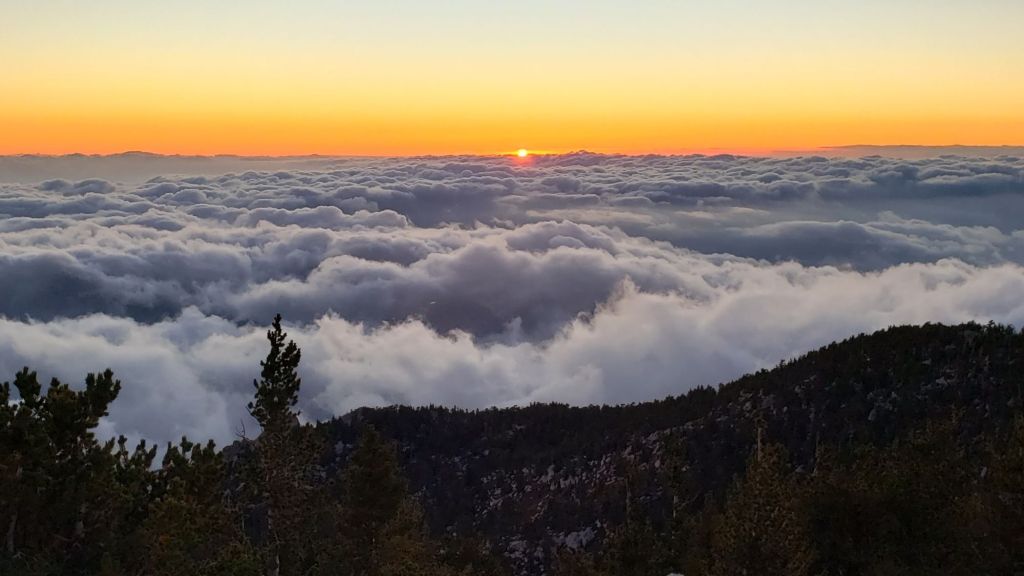
On Sunday 5th May just below San Jacinto Peak the moisture accumulated on my leg hairs from the mist and drizzle as I hiked up through the storm abruptly froze at about 10,500 ft elevation! This phenomenon is much more typical on a beard, as I have illustrated in past Reports over the years. Thankfully my legs are very used to the cold, and I appreciated being in shorts on a sunny descent.
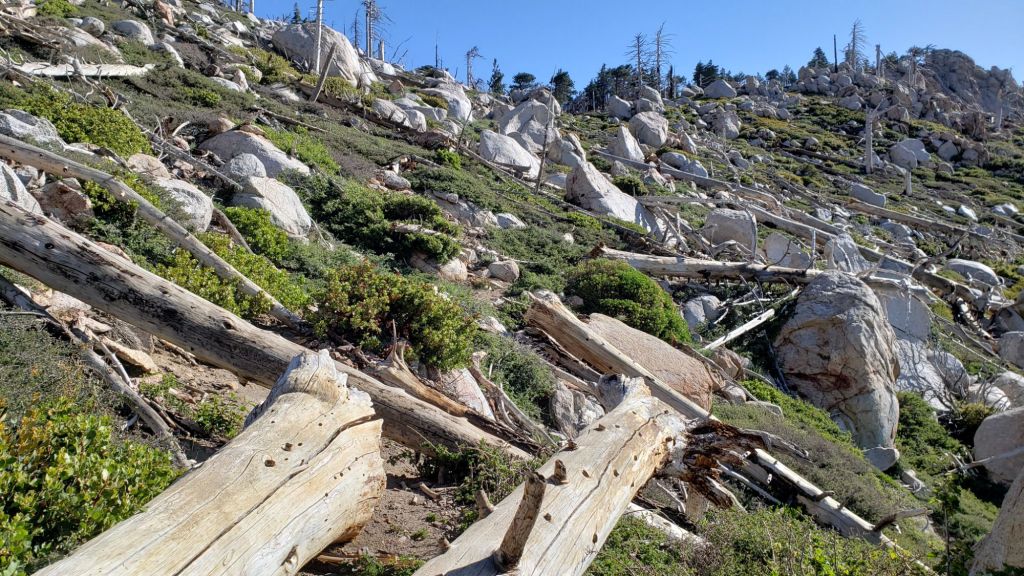
PCT Mile 185.5, the junction of Fuller Ridge Trail (left) with Deer Springs Trail (right), early morning 10th May 2024.
Upper Little Round Valley (9800 ft), 10th May 2024, with an average of about two feet of snow remaining, but as shown the depth varies greatly due to past drifting and differential melting.
Adult Southern Pacific Rattlesnake, Marion Mountain Trail at 6500 ft (just above the campground), late morning on 10th May 2024. The same individual as shown above, after I had gently encouraged it to move off the trail.