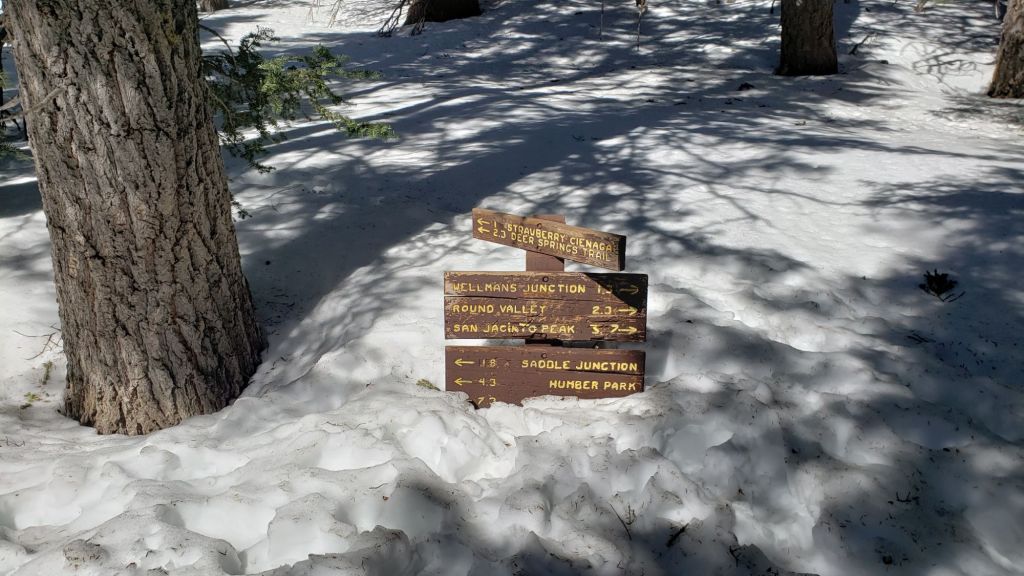
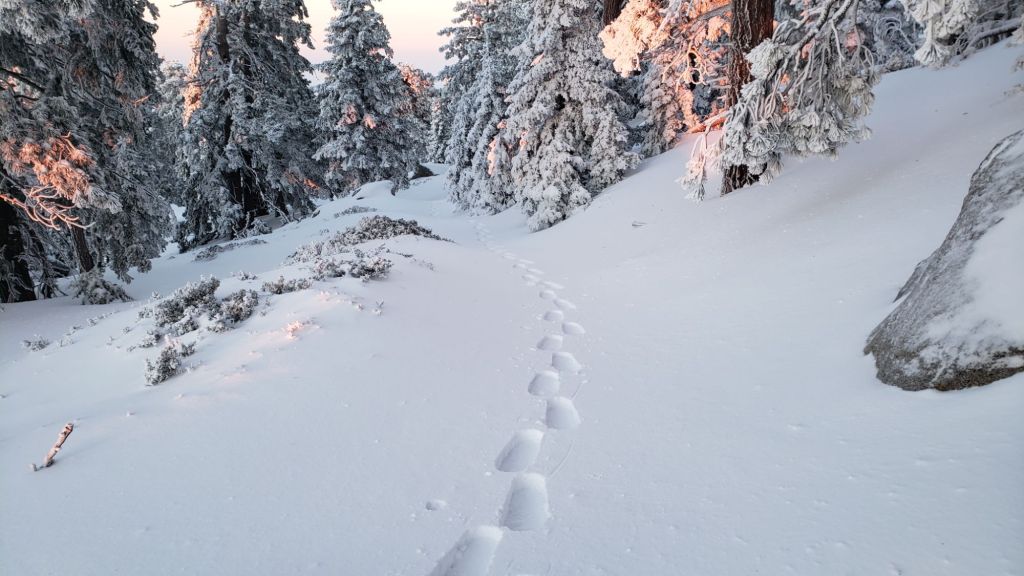
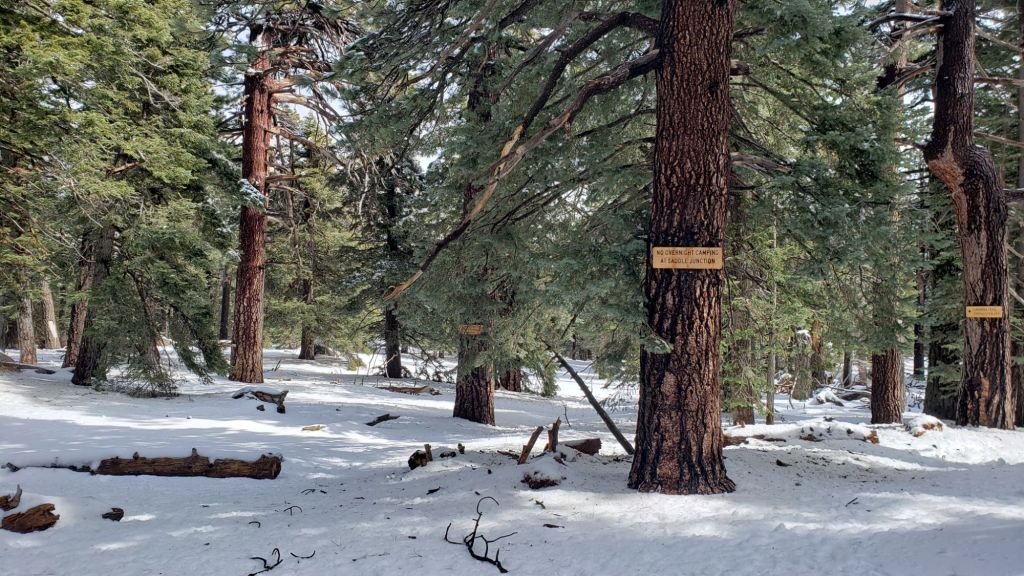
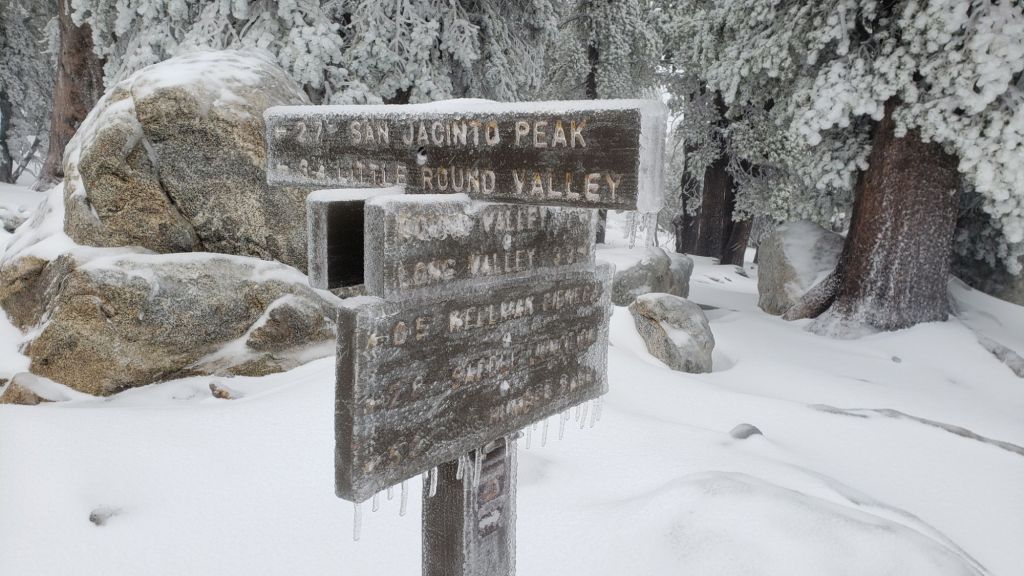
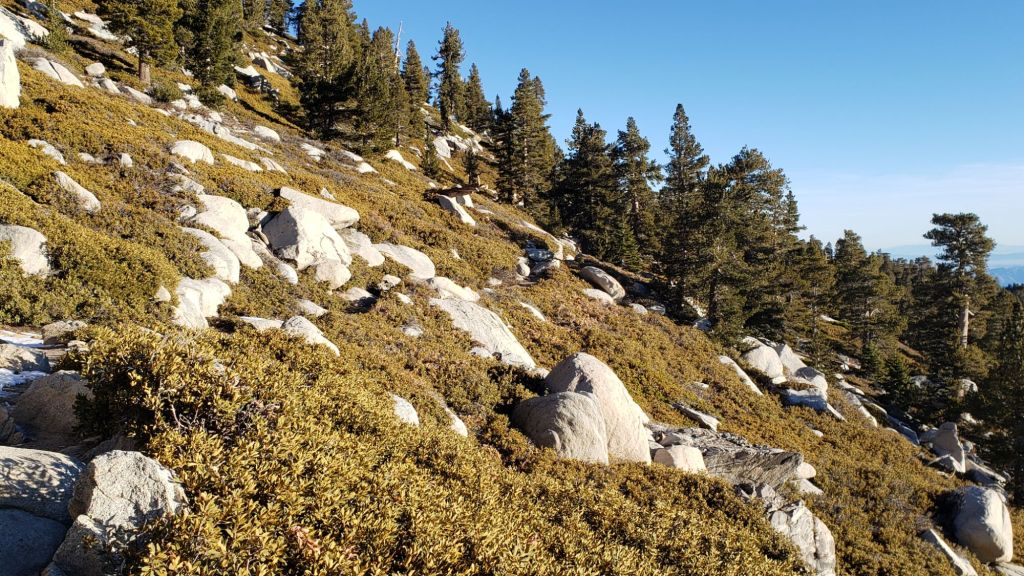
This is a summary of conditions following the only notable (so far) snow storm of winter 2024/25, albeit a minor storm by the standards of the San Jacinto mountains, with snow falling on 26th and 27th January. As is increasingly the trend with a rapidly changing climate in recent years, the snowfall did not fit an obvious altitudinal pattern (in which snow depth generally increases at higher elevations), with storm totals of about four inches at both Idyllwild (at 5550ft) and at San Jacinto Peak (10,810ft). The greatest depths I measured were between 7500 and 9500 ft, peaking at 6.5 inches at Saddle Junction (8100 ft).
The storm system was not a conventional “atmospheric river” originating well to the west, but came from a stalled “cut off” low pressure system around which the jet stream took a sinuous path from northern Canada. Consequently the system was cold, with a dusting of snow below 4000 ft on the morning of 27th, and the slow movement resulted in light snow continuing on/off for most of two days. The bulk of the snowfall was nevertheless concentrated in two phases, in the early hours of Sunday 26th, and then again overnight into the early hours of Monday 27th.
I broke trail to San Jacinto Peak via Devil’s Slide, Wellman, Peak, and East Ridge trails on Sunday 26th January, enjoying the conditions so much that I then repeated the same route, again breaking trail through further fresh snow, on Monday 27th. I recorded short video reports from the Peak on both days (linked here for Sunday 26th, and here for Monday 27th). We broke trail up South Ridge to Tahquitz Peak on 29th, and also put in a trail on the north side of Tahquitz between the peak and Chinquapin Flat.
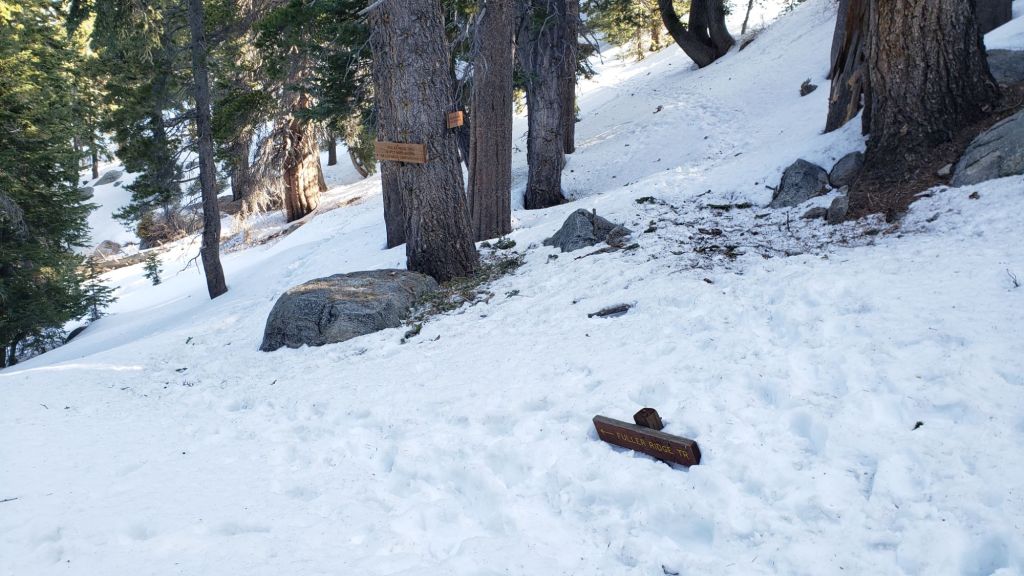
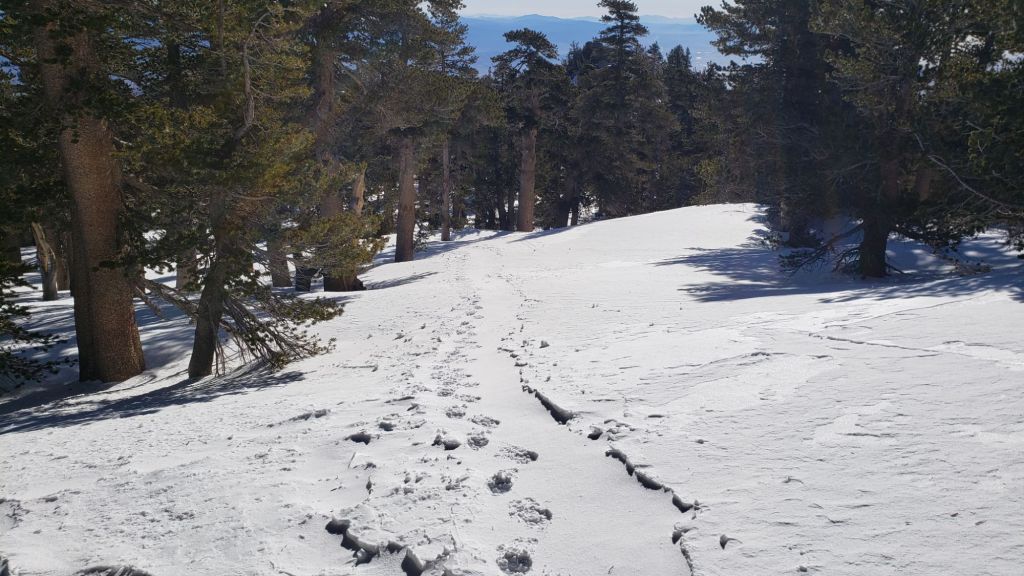
Currently some trails have not been traveled and most are somewhat obscured by light snowfall. On my descent on the afternoon of 27th I noted that apart from Devil’s Slide Trail (and my own tracks on the PCT northbound ultimately heading to San Jacinto Peak) there were no other broken trails away from Saddle Junction. This will change soon with limited hiker traffic, but cautious navigation is recommended everywhere. Snow depths are listed at the foot of this posting, but note that due to drifting, snow is sometimes deeper in the trails themselves.
Snow depth and structure are both currently suitable for spikesabove roughly 7000 ft, and spikes will become increasingly valuable as established trails become consolidated by hiker traffic and undergo freeze-thaw cycles. With rapid melting expected in the next week, the elevation at which spikes are needed will rise quickly. Snow depths are generally insufficient for snowshoes (except possibly around the Tahquitz area meadows for the next day or two) and crampons/ice axe are not required anywhere.
Hikers should be prepared for temperatures below freezing in the high country, and well below freezing when considering wind chill effects until Thursday 30th (see below for my recent weather observations from San Jacinto Peak).
The USFS gate at Humber Park closed on Sunday 26th January. Even when closed there are nine legal parking spaces immediately below the gate. Vehicles not parked in these spaces have been ticketed in past winters. South Ridge Road remains (unexpectedly) open and is readily passable with AWD/4WD vehicles.
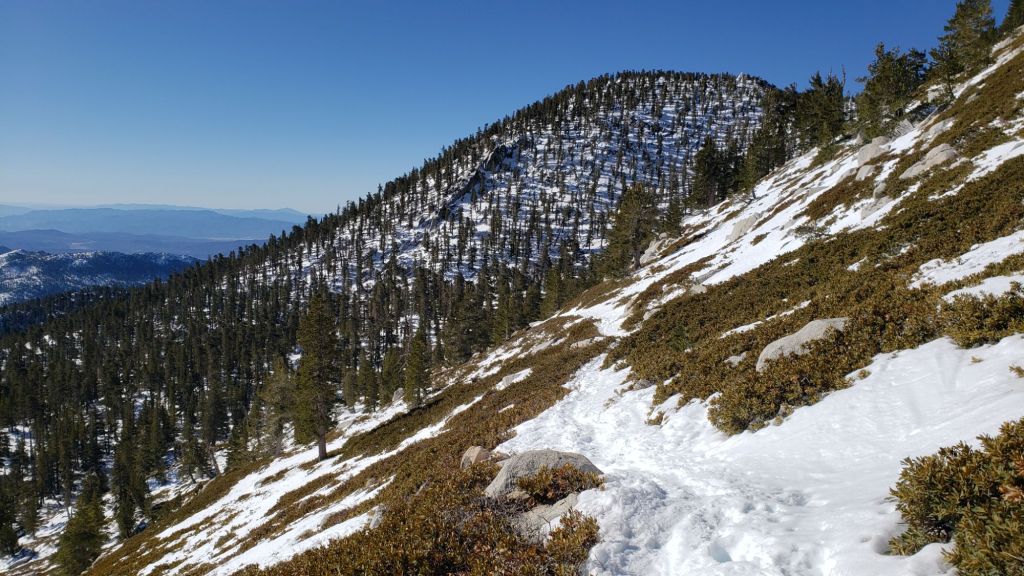
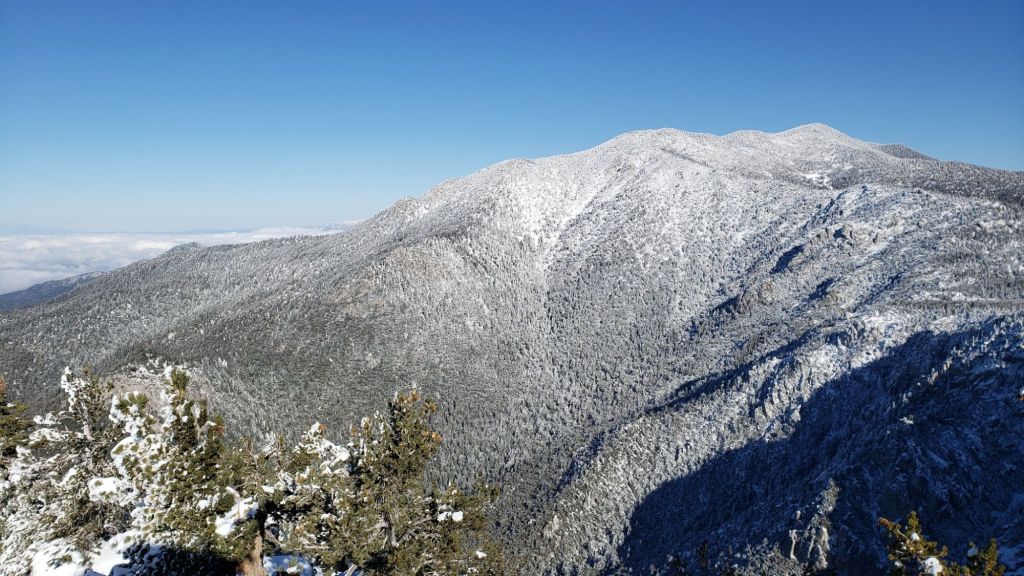
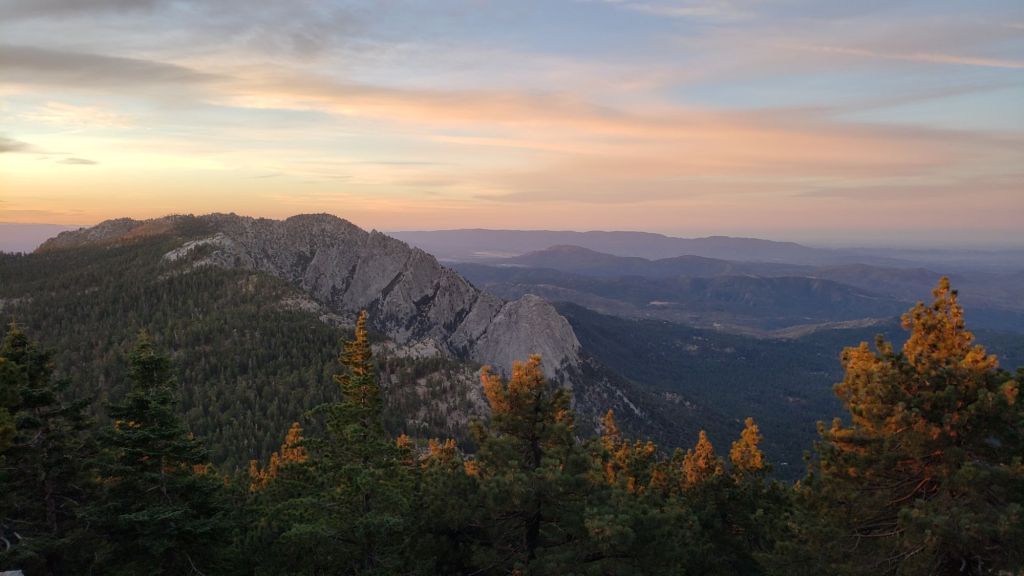
The San Jacinto high country as seen from Tahquitz Peak, early morning 29th January 2025.
WEATHER
Temperatures are forecast to remain below seasonal averages until Thursday 30th, with no significant further precipitation in January, although a possibility of light precipitation on the afternoon of Tuesday 28th. Temperatures are then forecast to rise dramatically to far above seasonalstarting Friday 31st, with both daytime highs and overnight lows 10-15°Fabove average for January/February. The high country will not be spared, with temperatures also some 15°F above normal during the first couple of days of February. This will obviously very rapidly accelerate snowmelt at all elevations.
Temperatures are expected to cool somewhat into the second week of February, with light precipitation currently forecast for Wednesday 5th. This rainfall may be confined to the mid elevations with about 0.25 inch forecast for Idyllwild, with the high country forecast to be above the cloud with no snow expected at this time.
The latest video report from National Weather Service San Diego (linked here) summarizes the recent storm event and describes the weather patterns for the next week.
At San Jacinto Peak (10,810ft/3295m) on Monday 27th January 2025 at 1040 the air temperature was 16.0°F (-9°C), with a windchill temperature of 9.0°F (-13°C), 74% relative humidity, and a remarkably calm hint of a NNW breeze sustained at 0 mph gusting to 2.8 mph.
At the Peak on Sunday 26th January 2025 at 1110 the air temperature was 17.8°F (-8°C), with a windchill temperature of -3.8°F (-20°C), 100% relative humidity, and a cool WSW wind sustained at 9 mph gusting to 15.9 mph.
Tahquitz Peak (center of the image) and the Tahquitz Ridge with a light coverage of snow, as seen from Bonita Vista Road, early morning 28th January 2025. Note the meadow in the foreground looking as dry as in midsummer, rather than midwinter.
TRAIL CONDITIONS
For details of specific trail conditions (and water availability) prior to this latest minor storm, see the previous Report (linked here).
All trails above about 6000 ft are at least partially snow-covered. By the afternoon of 27th melting was already underway below 6500 ft, and this will accelerate rapidly over the next few days. Reliable tracks are currently only known to be in place for Devil’s Slide Trail through to San Jacinto Peak via Wellman Divide.
Devil’s Slide Trail has a relatively well-traveled track to follow.
Deer Springs Trail has a reliable track through the snow all the way to San Jacinto Peak as of Thursday 30th.
South Ridge Trail has a lightly traveled posthole track through to Tahquitz Peak as of Wednesday 29th. On the same day we put through a track on the north side to and from the Peak to Chinquapin Flat, where snow depth averages five inches but is drifted to 8-12 inches in the trail.
The Ernie Maxwell Trail has a well-traveled track to follow.
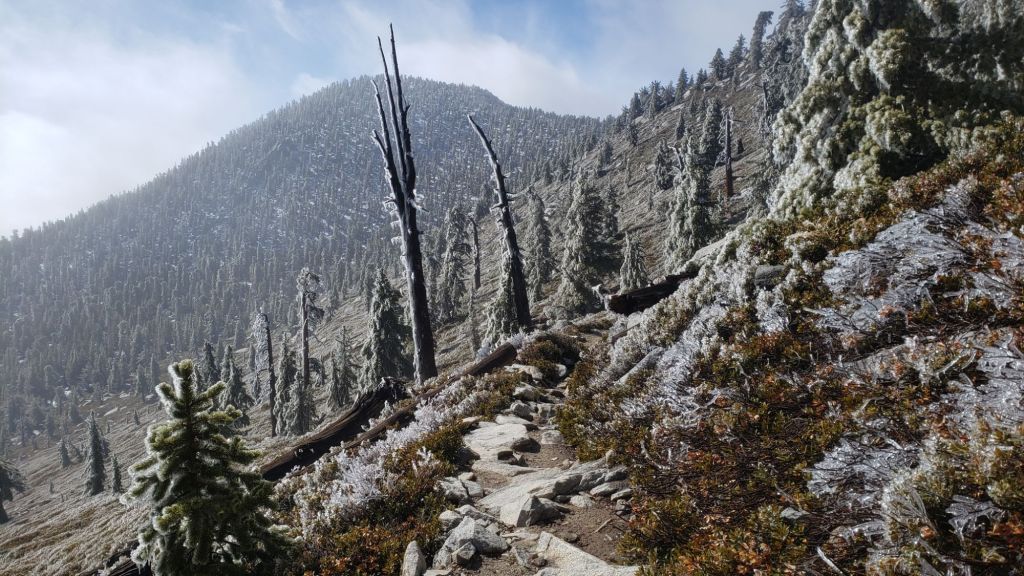
San Jacinto Peak with a paltry 3.5 inches of fresh snow accumulation at the time, late morning 27th January 2025. Predictably, the rocks around the Peak are slick with thin icy snow, and most hikers will find spikes useful here even if not needed elsewhere.
SNOW DEPTHS
Numbers given here are storm totals, measured initially on 26th then again on 27th January 2025, after each of the two main periods of snowfall. Note that average depth is given; some drifting and accumulation has occurred, especially in trails. Altitudes and PCT Miles are approximate.
Devil’s Slide Trail at Humber Park (6550 ft): 5.0 inches (largely melted by 29th)
Idyllwild (at 5550 ft): 4.0 inches, largely melted by afternoon of 27th.
Suicide Rock appearing out of moody low cloud as seen just before sunrise from upper Devil’s Slide Trail, 27th January 2025.
While all time and labor is volunteered, the San Jacinto Trail Report uses small private donations to help cover operating costs. Your contribution keeps the Report available to all, free from advertising or paywalls, and independent from agencies. If you have found this Report useful, please consider using this link to the Donate page.Thank you very much for your support.
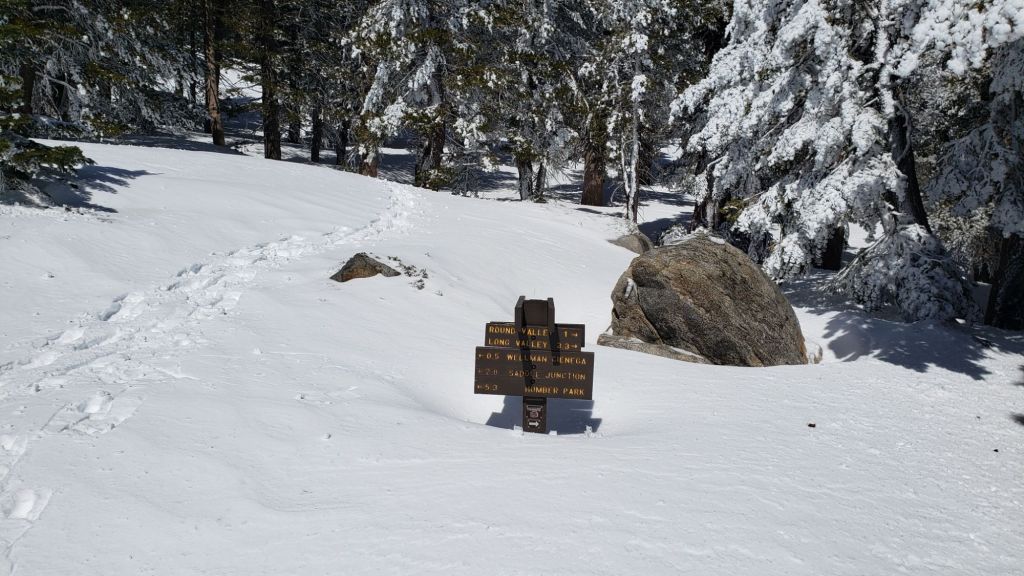
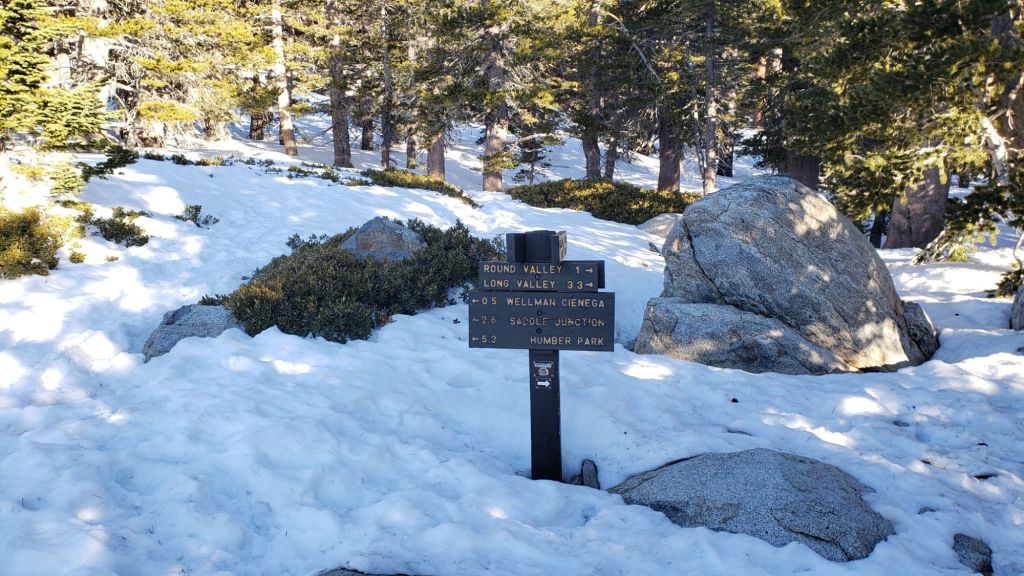
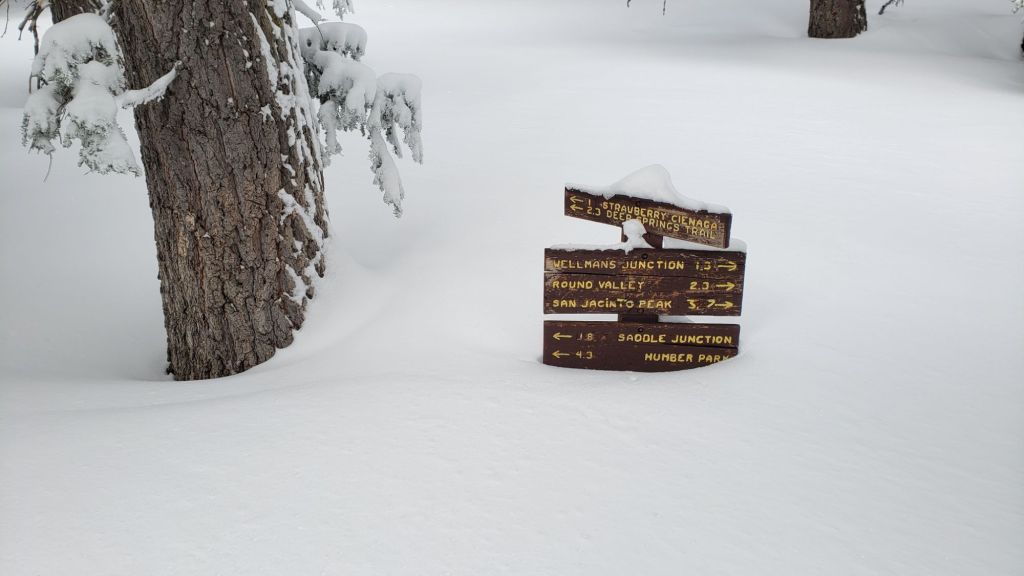
Above and below, Wellman Divide (9700 ft elevation), mid morning on Monday 27th January 2025 following about five inches of fresh snowfall in the previous 30 hours (above), and the same view mid morning on Friday 24th January 2025 for comparison (below).Annie’s Junction (9020 ft, PCT Mile 180.8), the high point of the PCT in Southern California, with an average of about five inches of fresh snow, early morning on 27th January 2025.Saddle Junction (8100 ft, PCT Mile 179), mid afternoon 27th January 2025. Due to its location at the head of the south-west facing Strawberry Valley, this location accumulated the most snow during this rather atypical storm sequence, with at least 6.5 inches of fresh powder.
UPDATE Monday 27th Januaryat 1130: I hiked back up to San Jacinto Peak this morning, recording another short video report (linked here). Snow last night dusted down to 4000 ft, but otherwise was a consistent 2-2.5 inches everywhere, in addition to what remained from yesterday. Greatest depth is at Saddle Junction (8100 ft) with 6.5 inches, but a paltry 3.5 inches at San Jacinto Peak. Storm total for Idyllwild is four inches, but most of yesterday’s snow had already melted by Sunday evening. I hope topublish a full update to the Report this evening.
UPDATE Sunday 26th Januaryat 1620: I hiked to San Jacinto Peak this morning and recorded a short video report from there late morning (linked here). Light snow started in the early hours of this morning, so far accumulating to 1.5 inch in Idyllwild (but already largely melted this afternoon) and one inch at San Jacinto Peak, but with 4.0 inches at Saddle Junction (8100 ft) and 3.5 inches at 9000 ft, suggesting the high country was above the cloud for some of the first wave of snow. Current forecasts expect 2-3 more inches everywhere by tomorrow morning. At this time carrying traction devices such as microspikes is recommended everywhere on the trail system above 7000 ft, and cautious navigation is required for those who are not very familiar with the trails in snow conditions.
—————————————–
Southern California is experiencing the driest start to a winter since records began in 1850, as discussed in a recent National Weather Service San Diego video report (linked here). Riverside County, along with much of the rest of southern California, is currently under 5% of average precipitation for the water year (i.e. since 1st October). December 2024 was the first time in recorded history that no snow fell in the San Jacinto high country in December, by far the latest into any winter on record with no settled snow in these mountains. Total snowfall at San Jacinto Peak since September 2024 has been a laughable 3.6 inches. Consequently at this time hikers will find spikes are not required anywhere on the trail system, however this is expected to change significantly this weekend.
A minor-to-moderate storm system is now forecast for 25th-27th January. With a complex and dramatic jet stream flow bringing an air mass originating in central Canada directly to Southern California, this is expected to be a cold system with a dusting of snow possibly as low as 4000 ft. Precipitation estimates have varied from one to 14 inches of snow above 10,000 ft, with about 5-7 inches currently most likely. Snow at mid elevations is expected from the evening of Saturday 25th throughout Sunday 26th, with up to four inches possible between 5000-6000 ft (e.g., Idyllwild-Pine Cove).
Survey hikes by the Trail Report every single day throughout the year in the San Jacinto mountains include varied routes to the high peaks including San Jacinto Peak typically 2-3 times per week (more frequently during storms), Tahquitz Peak and area 1-2 times per week, plus a wide variety of other trails on intervening days.
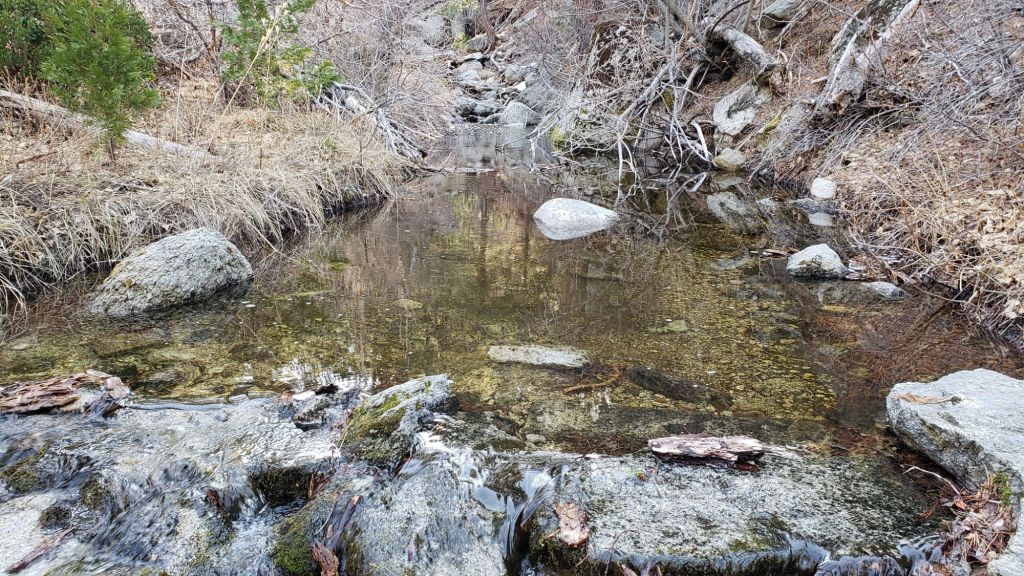
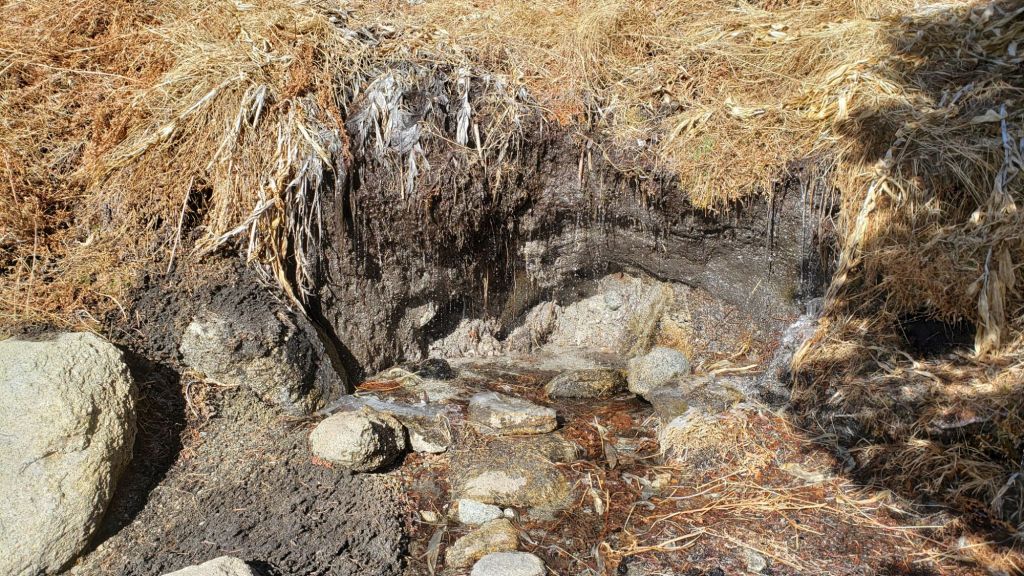
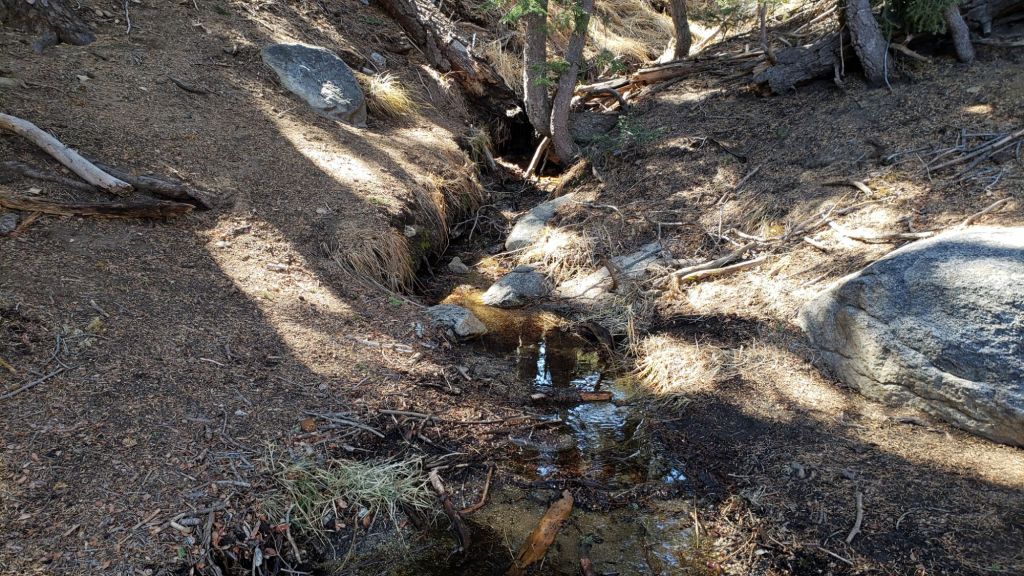
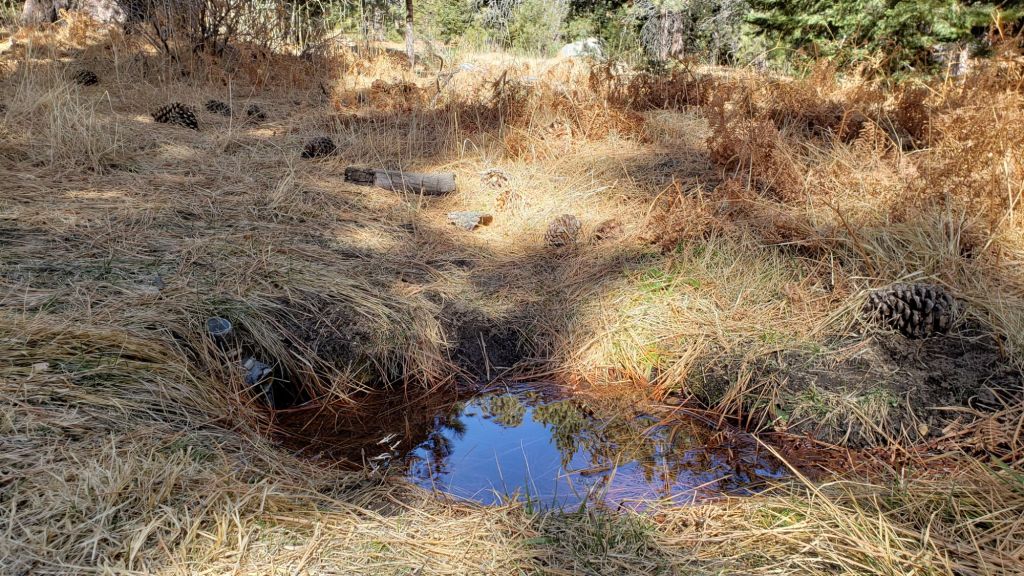
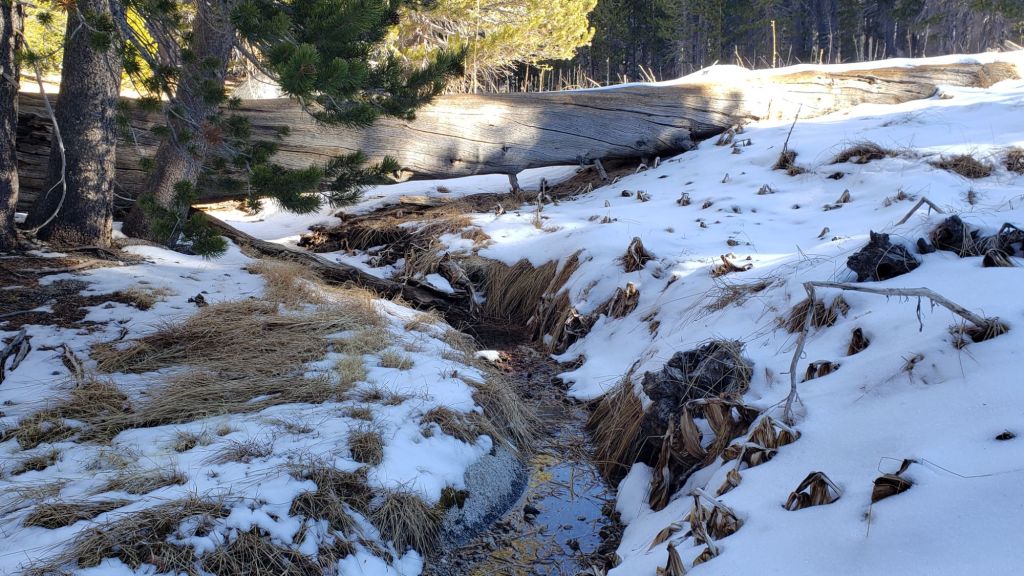
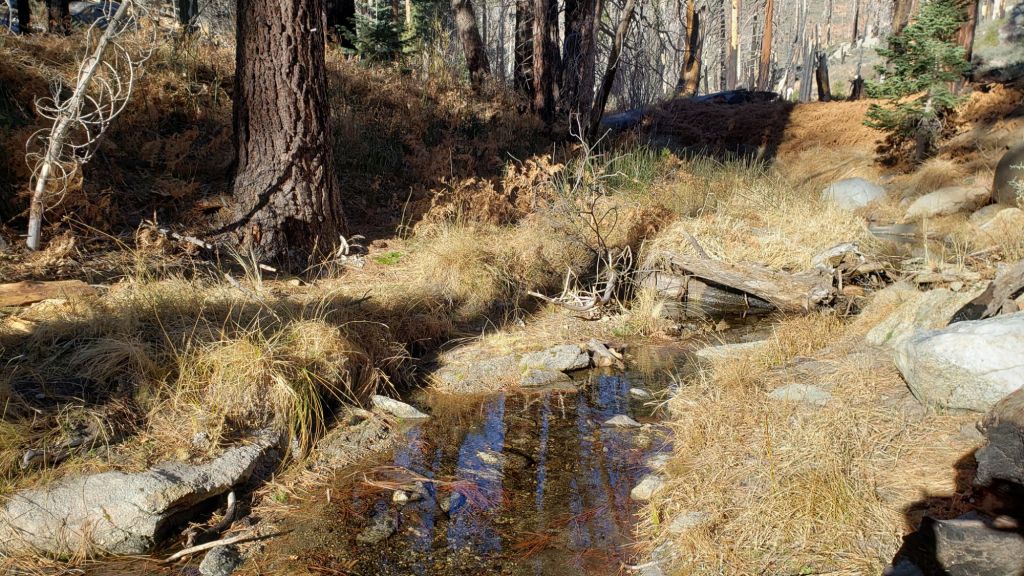
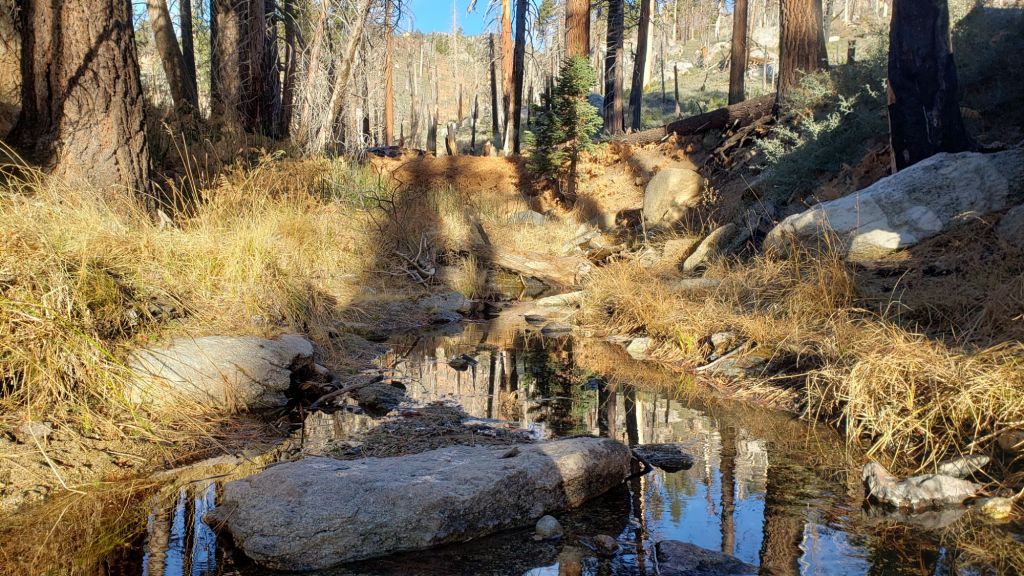
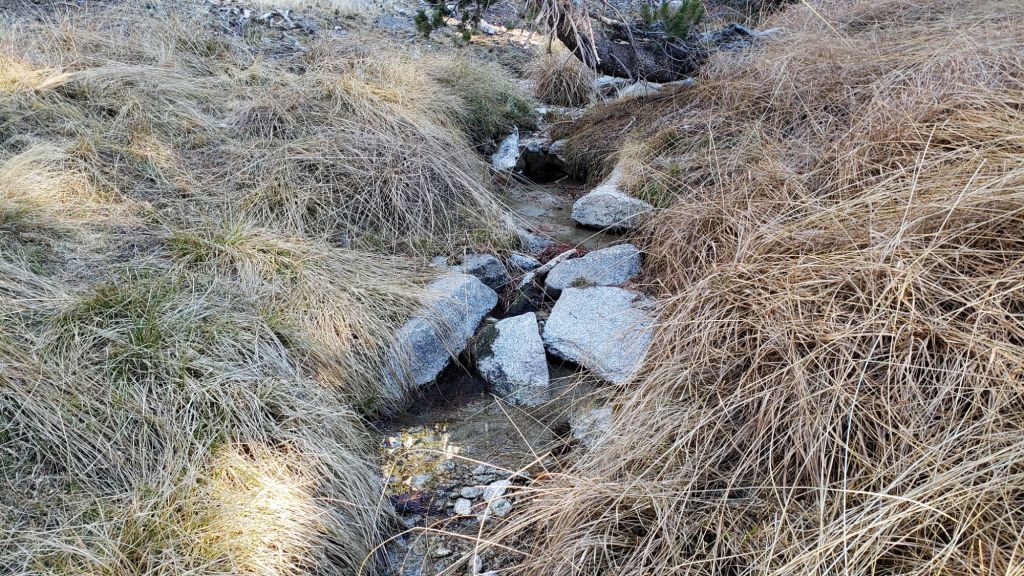
Despite a failed monsoon in 2024 and below-average precipitation both last winter and – very obviously – so far this season, most major springs, creeks, and pipeslargely continue to flow at this time, surviving for now off the above average precipitation from September 2022 to August 2023 (sample photos below and in a prior Report linked here). Note that many of these water sources may freeze temporarily in the coming days.
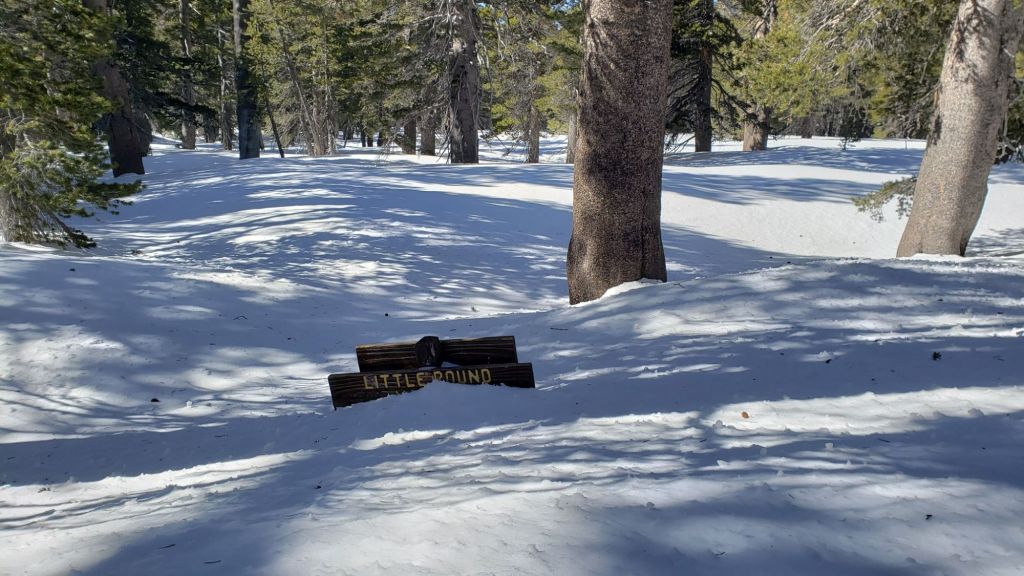
The Round Valley faucet continued to flow well as of 19th January 2025. The creek in Little Round Valley largely dried up in early January 2025but is still flowing gently – when unfrozen – in its central section (photo below). In the Tahquitz area meadows, the Tahquitz Valley pipe (for those who know where it is) continues to flow well. Tahquitz Creek is flowing at the northern end of Little Tahquitz Meadow, and adjacent to its source where it crosses the PCT at Mile 177. Strawberry Cienega is dry. Stone Creek is dry where it crosses Deer Springs Trail at about PCT Mile 183.6. Bud Spring near 9900 ft, just north-west of Marion Mountain, is flowing. Cedar Spring is flowing gently. Tool Box Spring (at the top of Ramona Trail) continues to flow well as of mid January.
WEATHER
Prior to the arrival of the winter storm on 25th, moderate to strong Santa Ana winds (i.e. largely from northeasterly directions) are forecast for 20th-21st. Gusts to 55 mph are possible in the high country and 30 mph around Idyllwild-Pine Cove. Even though much of this winter has been unusually mild, air temperatures are nevertheless often near or below freezing above 10,000 ft, where strong winds (>20 mph) greatly influence the feel of temperatures and hence associated risks. At this time of year, hikers must always be prepared for winter temperatures in the high country regardless of forecasts and/or how relatively mild it may feel at trailheads (see my sample Peak weather observations below).
Temperatures have been largely above average for months dating back to last summer. After the passage of the Santa Ana winds, temperatureswill quickly warm to well above average at all elevations on 22nd-24th, before falling dramatically on Saturday 25th.
A minor-to-moderate storm system is now expected on 25th-27th January. As described above this is expected to be a cold system with light snow possible down to 4000 ft. Temperatures at the highest elevations on 25th-27th are forecast to be severely cold, with air temperatures near or below 10°F/-12°C, and windchills wellbelow 0°F/-18°C.
Light snowfall is expected for at least 24 hours between the evening of Saturday 25th until the evening of Sunday 26th, perhaps continuing into Monday 27th. Precipitation estimates currently suggest 5-9 inches of snow above 10,000 ft, and 2-4 inches at mid elevations (5000-6000 ft).
Following passage of the storm, temperatures are forecast to quickly rise yet again, and by the first week of February may be well above seasonal (i.e. significantly above freezing in the high country).
A minor storm on Tuesday 7th January briefly brought light snow throughout the mountains with a dusting down to 6500 ft and about an inch above 9000 ft. Three inches settled at San Jacinto Peak where I recorded a short video report that evening (linked here). Remainingsnow is now largely melted and what little remains is very thin and patchy.
The latest National Weather Service San Diego video report (linked here) released on 20th January describes in detail the weather patterns expected over the next ten days.
At San Jacinto Peak (3295m/10,810ft) on Monday 20th January 2025 at 0830the air temperature was 11.4°F (-11°C), with a windchill temperature of -13.9°F (-26°C), 58% relative humidity, and a frigid due North wind sustained at 20 mph gusting to 28.3 mph.
At the Peak on Friday 17th January 2025 at 0800the air temperature was 24.0°F (-4°C), with a windchill temperature of 8.6°F (-13°C), 22% relative humidity, and a fresh NW wind sustained at 8 mph gusting to 15.8 mph.
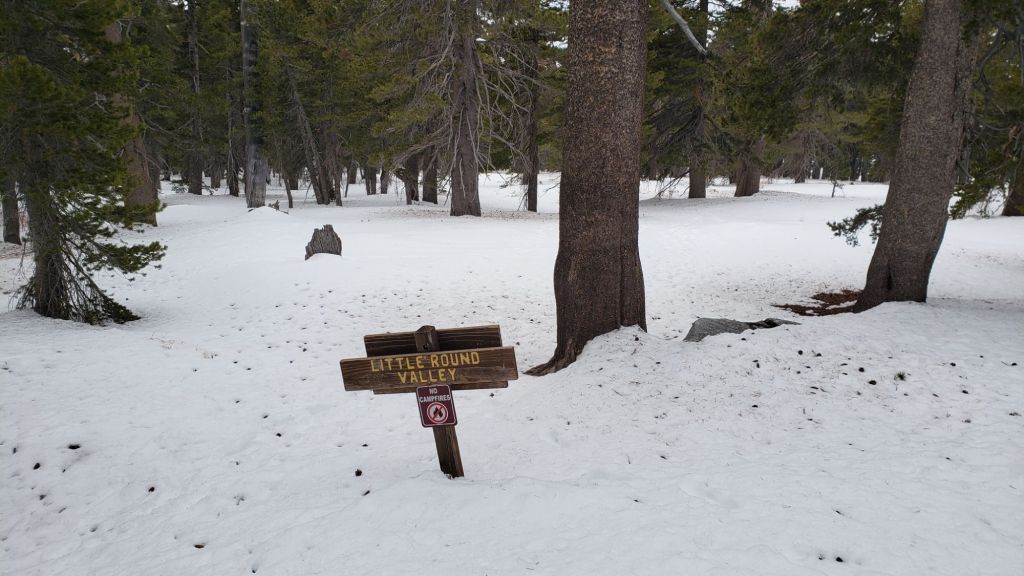
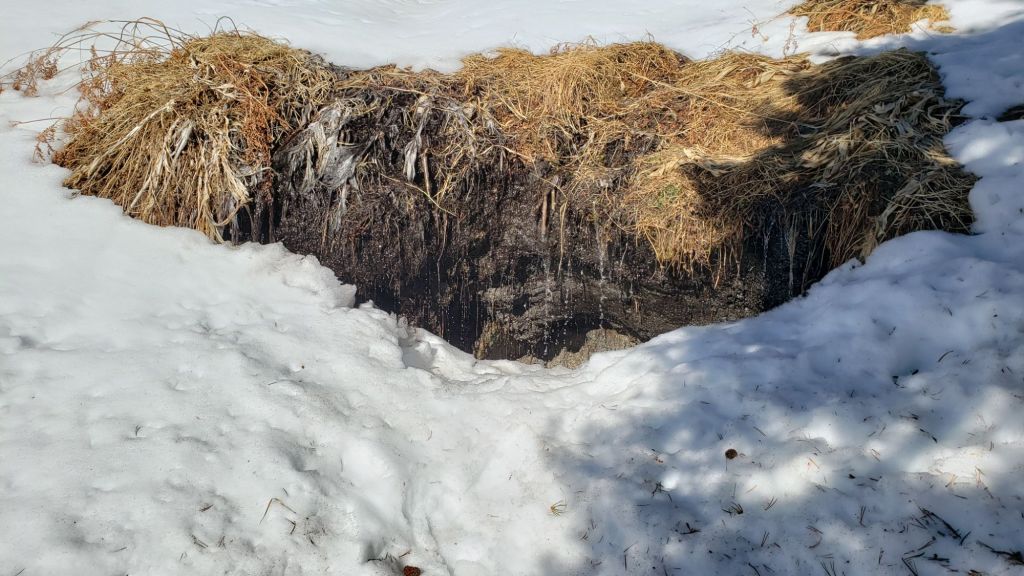
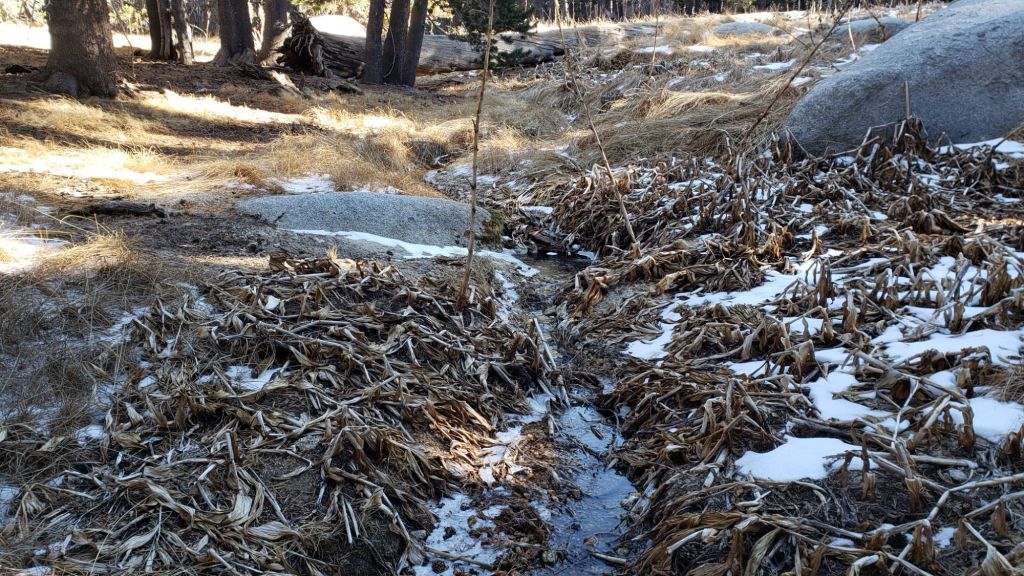
The small creek in Little Round Valley is largely dry but started flowing again in one short central section after a couple of weeks of being fully frozen, 9750 ft elevation, mid morning 20th January 2025. Even in sheltered areas snow from the minor storm on 7th January is almost completely gone.
TRAIL CONDITIONS
There is currently no continuous settled snow in the San Jacinto mountains, a truly unprecedented situation in recorded history this far into the winter months. The thin covering above 9000 ft that fell on 7th January only lasted for a few days despite cold temperatures (photos in previous Report linked here). There is functionally no snow on trails below 9900 ft on the eastern side trails, with thin but locally icy patches at 9900-10,100 ft on the Peak Trail and around San Jacinto Peak. The East Ridge Trail (Miller-San Jacinto peaks) is still 50% snow-covered. Snow is gone on Deer Springs Trail below 9500 ft, and is sparse and patchy above that. Few if any hikers will find that traction devices are required anywhere on the trail system. As described above, the snow situation is expected to change significantly in the next week.
Although the situation has improved somewhat in recent months, treefall hazards remain a significant problem along parts of the Pacific Crest Trail, most notably between Antsell Rock and South Peak. Some 56 trees are down across the trail between PCT Miles 170.5-174, with 37 of these, including several serious obstructions that make for slow-going, between Miles 172.5-174 (around and immediately south of South Peak). A further nine smaller obstructions are down from Miles 168.5-170.5 (Spitler Peak Trail to Zen Center Trail). Significant sections of Miles 168.5-175 are also badly overgrown with brush and are in urgent need of major trimming work (surveyed January 2025).
On the Fuller Ridge Trail section of the PCT there are 12 trees down on the State Park section of the trail (Miles 185.5-189, which have not been maintained by that agency for many years). Several of these pose quite significant hazards for hikers. On the Forest Service section (Miles 189.3-190.5) five significant treefall hazards were removed by USFS late in 2024.
On the section of Deer Springs Trail between Strawberry Junction and the top of Marion Mountain Trail (roughly PCT Miles 183-185) most of the tricky treefall hazards that came down in strong winds earlier in the month were removed on 22nd January 2025, following an urgent request from the Trail Report. About ten further trees on the upper trail (above Fuller Ridge) have been down and reported repeatedly for more than a decade but with no action from the State Park.
Trees down on the Strawberry Trail section of the PCT (Annie’s Junction to Strawberry Junction, Miles 180.8-183) have remained uncut by the Forest Service for nearly a decade. About six hazards on this section are thankfully all relatively easy for hikers to negotiate.
The Trail Report heavily trimmed the formerly overgrown Wellman Trail (Annie’s Junction to Wellman Divide) in September-December 2024 and this work continues in January 2025. We continue to trim South Ridge Trail year-round, but with increased effort in December-January 2024/25.
The Trail Report removed almost all the obstructive whitethorn from Spitler Peak Trail in December 2024, largely in the central portion of the trail (miles 2.0-3.2 from the trailhead). Another 37 treefall hazards were cleared by the Trail Report in 2024, bringing to 123+ the total number of downed trees removed by the Report from this trail in recent years. While more brush trimming work is always required, in general the trail is currently in its best condition since at least mid 2023. Spitler Creek continues to flow gently at its various crossings in the upper switchbacks, and Antsell Rock Creek starting flowing gently again in November but will likely dry again soon.
The Caramba Trail from near Reeds Meadow through Laws Camp and on to Caramba, and the Cedar Trail from Willow Creek Trail to Laws, are euphemistically (and potentially dangerously) described by the Forest Service as “not maintained”. In reality both trails have been abandoned and no longer exist. They are so heavily overgrown, largely with dense whitethorn, which obscures dozens of downed trees, that hikers should not attempt to follow them (regardless of how much you may trust an app). An informaluse trail to Laws is much more direct, well maintained, and avoids the bushwhacking of the unmaintained trails (some local Idyllwild hikers dubbed it the “King Trail” when I established the route in 2019). It leaves Willow Creek Trail exactly 1.0 mile from Saddle Junction, 0.46 mile from the Skunk Cabbage turning (trailhead at N 33.7796, W 116.6590). The route descends largely following established deer trails for 1.2 miles, meeting Willow Creek about 0.2 mile upstream from the site of the historic Laws Camp (the remains of which were destroyed by the 2013 Mountain Fire and subsequent flood and treefall damage). One huge tree fell in late 2024 across the King Trail about midway down and requires a minor scramble underneath (that tree will not be cut soon). Another five recently downed trees were either removed or worked around in January 2025, when the trail was thoroughly trimmed and cleared. From Laws east to Caramba the route of the original Caramba Trail has been cairned by myself and others and can largely be followed with very careful route-finding. My first 2025 survey counted about 120 trees down on this 2.1 miles of trail. It is especially obscure for the first 0.3 mile east of the Willow Creek crossing, becoming more obvious (but still subtle) as it descends towards Caramba. Very cautious navigation is advised throughout the area.
Willow Creek Trail is nearing its 2020 condition, the last time the original trail route was fully cleared and passable. Almost all significant treefall hazards on the Forest Service section were cut by mid August (several uncut trees remain that need to be removed to fully restore the original trail route). Whitethorn trimming was largely completed, mainly by volunteers, on the Forest Service side in August and early September 2024. On the State Park side some localized whitethorn trimming of the worst patches was undertaken in September, and the minor treefall hazards new in 2023/24 were removed, leaving just two major long term downed trees (both have simple workarounds for hikers).
The Trail Report “adopted” Seven Pines Trail as a priority for maintenance work as the trail had a disproportionate number of lost hiker rescues in the past decade, and both State Park and Forest Service have shown no interest in maintaining the route for years. Since 2020 we have removed 75 downed trees and the trail is trimmed and cleared multiple times annually. As of late 2024 the trail is largely clear of treefall hazards, with three down across the trail in its upper section, all easily passable for hikers. A further half-a-dozen downed trees close to the PCT junction would need to be removed to fully restore the original route of the trail. Although the condition of the trail is hugely improved, Seven Pines remains a genuine wilderness trail unlike the wider, bare, obvious routes of, for example, Devil’s Slide or Marion Mountain trails. Cautious navigation remains essential for those without considerable experience of hiking this trail. Be aware in particular that Seven Pines Trail becomes most obscure in the mile closest to its junction with Deer Springs Trail/PCT.
The Zen Center Trail continues its serious deterioration that started following the 2013 Mountain Fire, with a combination of vigorous regrowth and treefall hazards further obscuring the route with each passing season. The lower and upper thirds of this trail are partially cairned and not too bad for those who are very familiar with the former route, but even the experienced find navigating the central section tricky. Long trousers, scrambling gloves, and an enjoyment of bush-whacking are all strongly recommended.
While all time and labor is volunteered, the San Jacinto Trail Report uses small private donations to help cover operating costs. Your contribution keeps the Report available to all, free from advertising or paywalls, and independent from agencies. If you have found this Report useful, please consider using this link to the Donate page.Thank you very much for your support.
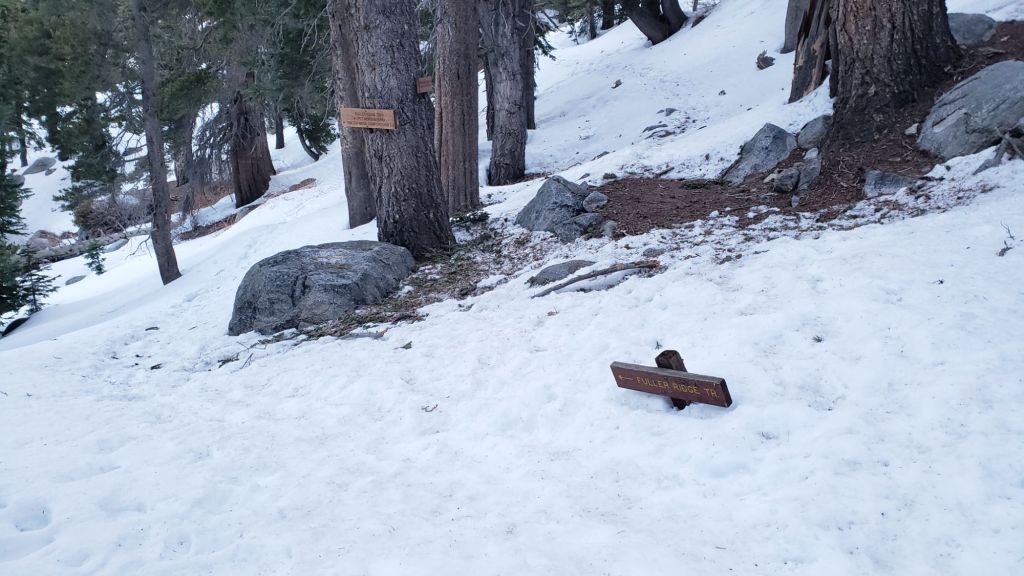
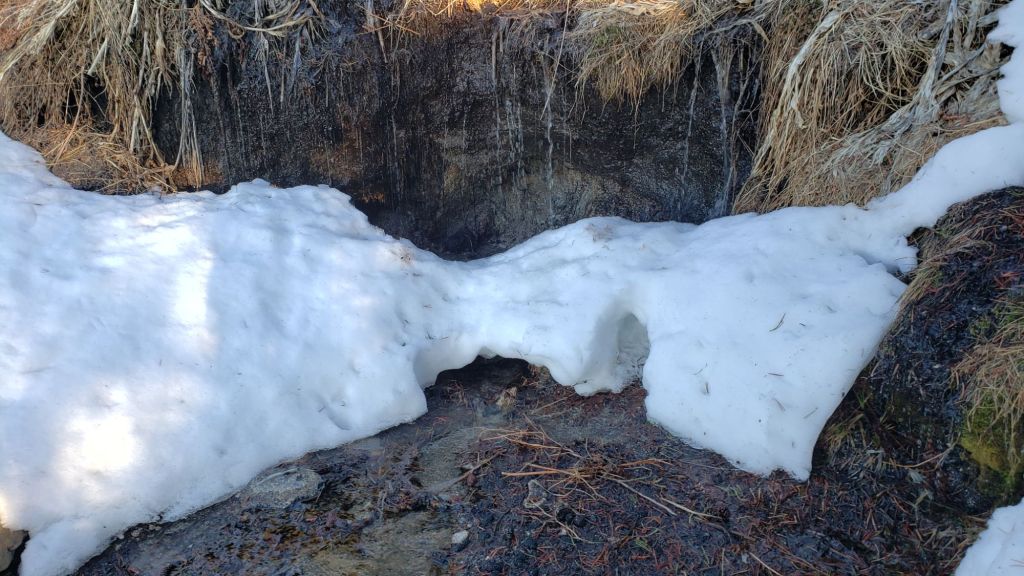
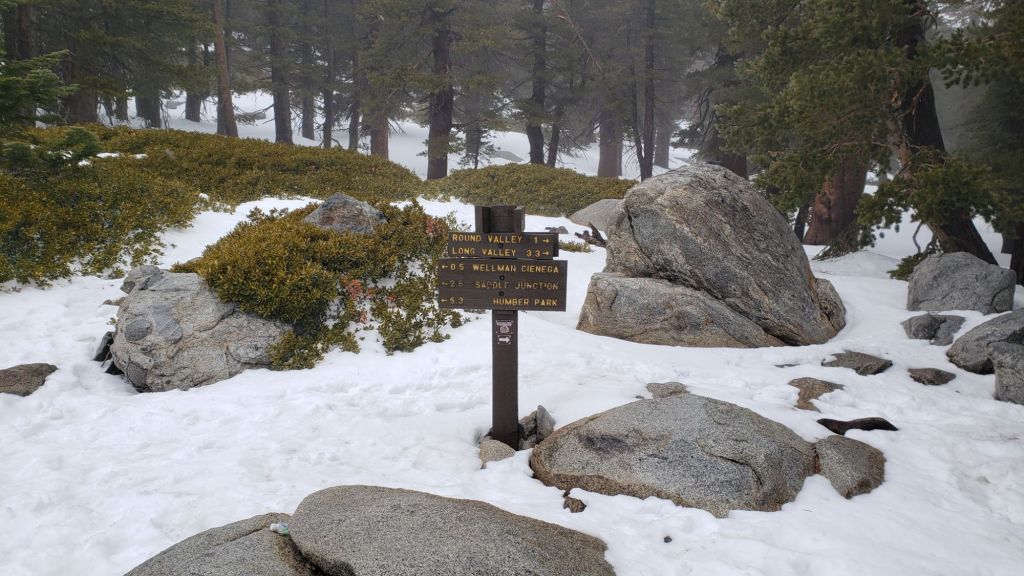
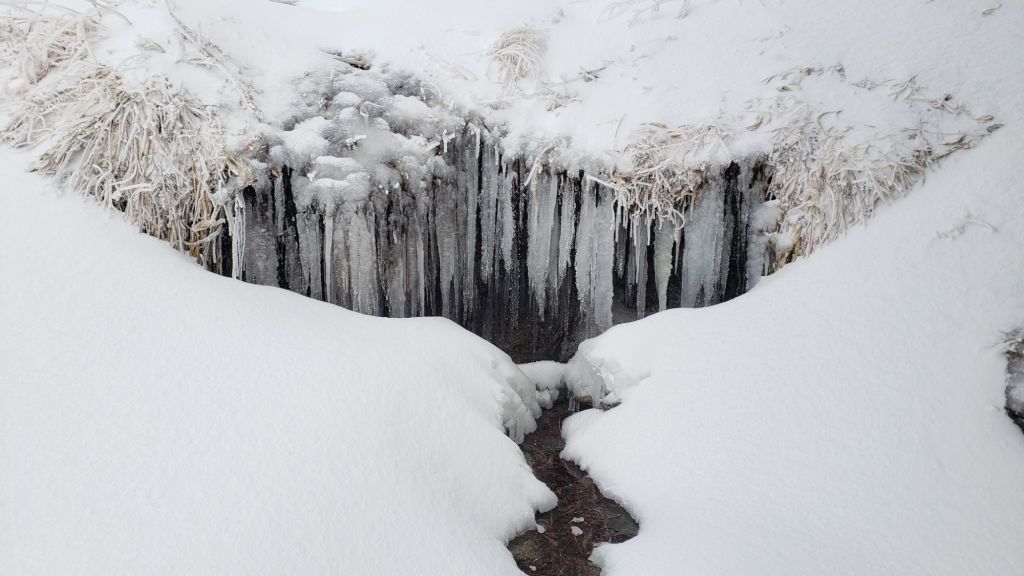
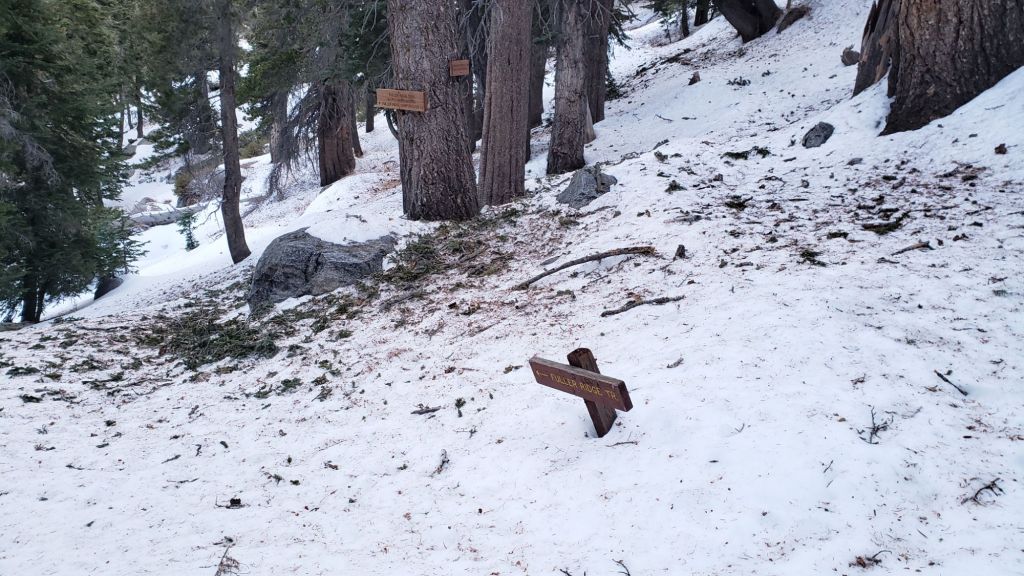
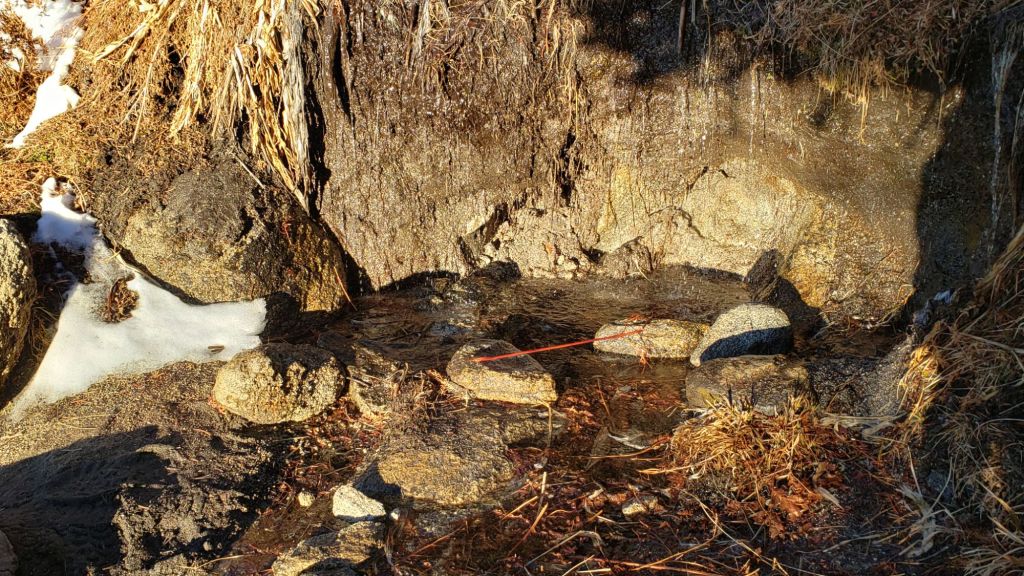
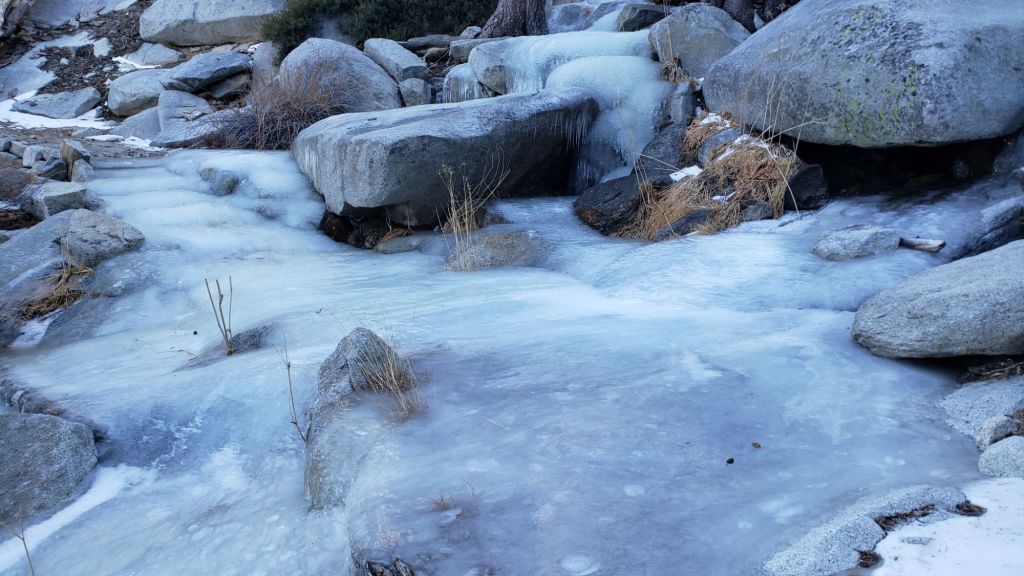
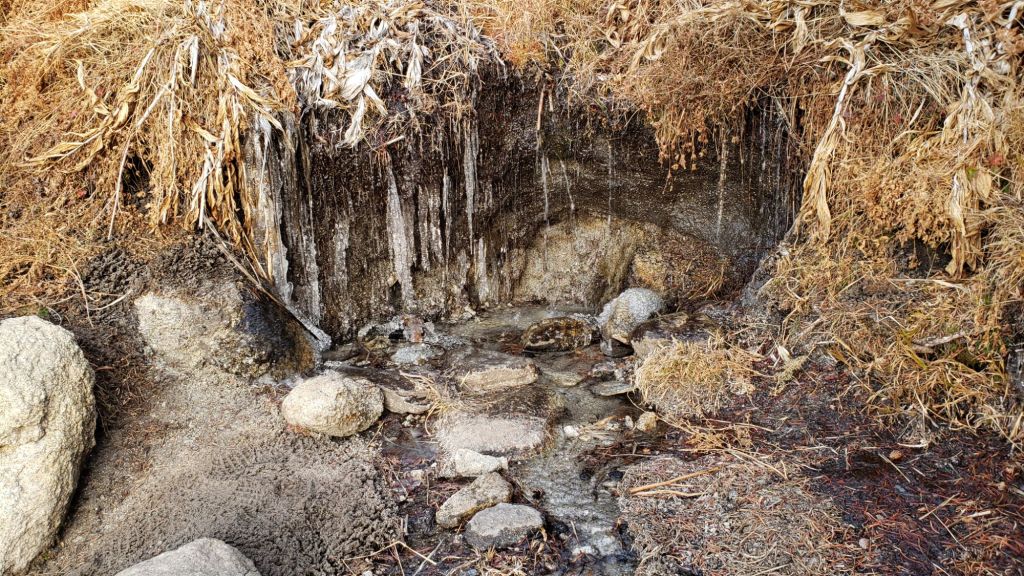
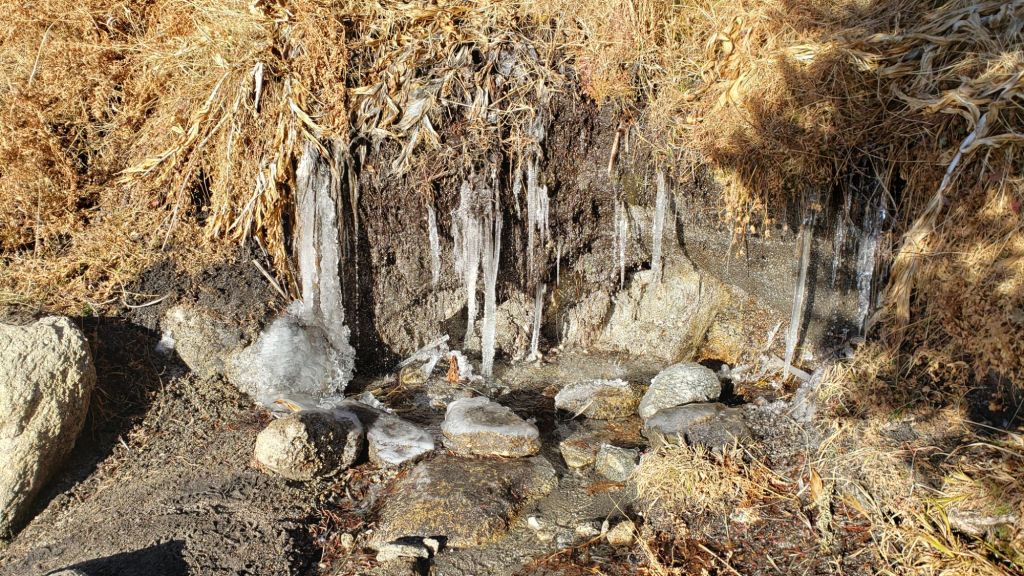
One of the outlets of the well-known north spring at Wellman’s Cienega (9300 ft) adjacent to the Wellman Trail, flowing well for the time of year, and with extensive icicles typical of most days in recent weeks, early morning 20th January 2025.Remarkably thick ice formation on the North Fork of the San Jacinto River where it crosses Fuller Ridge Trail at about PCT Mile 186.2, mid morning 20th January 2025. The volume of ice, already impressive, has almost doubled in the past week. Despite appearances the trail is readily passable by rock-hopping immediately downstream of the ice sheet.The junction of the Deer Springs Trail (to the right) with Fuller Ridge Trail (to the left) at approx. PCT Mile 185.5, mid morning 20th January 2025. Even in most low snow years, the short sign in the foreground is typically buried by snow in late January. Not this year, yet.Willow Creek flowing gently where it is crossed by the use trail known as the King Trail and what little remains of the Caramba Trail, about 0.2 mile upstream of the site of the old Laws camp, 11th January 2025.A fresh track of a relatively small Mountain Lion at about 6600 ft near Deer Springs Trail, late morning 20th January 2025. The knife is 3.6 inches long for scale. My survey data indicate that Mountain Lions are common and widespread throughout the San Jacinto mountains, and very common around the mid elevation fringes of Idyllwild (such as around lower Deer Springs Trail).
Southern California is experiencing the driest start to a winter since records began in 1850, as discussed in a recent National Weather Service San Diego video report (linked here). Riverside County, along with much of the rest of southern California, is currently under 5% of average precipitation for the water year (i.e. since 1st October).
There is only limited evidence for a significant change in the weather. The jet stream and associated atmospheric rivers are being forced generally to our north by a “Rex block” – an obstructive high/low pressure combination – which typically lasts for days, but has potential to persist for months. There is the possibility of a minor storm system bringing some precipitation on 25th-27th January.
December 2024 was the first time in recorded history that no snow fell in the San Jacinto high country in December, by far the latest into any winter on record with no settled snow in these mountains. Total snowfall at San Jacinto Peak since September 2024 has been a laughable 3.6 inches.
A minor storm on Tuesday 7th January briefly brought light snow throughout the mountains with a dusting down to 6500 ft and about an inch above 9000 ft. Three inches settled at San Jacinto Peak where I recorded a short video report that evening (linked here). Unfortunately the dusting below 9000 ft had largely melted already on sun-exposed slopes within 24 hours. Remainingsnow is now largely melted and what little remains is thin and patchy. Most hikers will find spikes are not required anywhere on the trail system.
Survey hikes by the Trail Report every single day throughout the year in the San Jacinto mountains include varied routes to the high peaks including San Jacinto Peak typically 2-3 times per week (more frequently during storms), Tahquitz Peak and area 1-2 times per week, plus a wide variety of other trails on intervening days.
Despite a failed monsoon in 2024 and below-average precipitation both last winter and – very obviously – so far this season, most major springs, creeks, and pipeslargely continue to flow at this time, surviving for now off the above average precipitation from September 2022 to August 2023 (see photos below and in the previous Report linked here). The Round Valley faucet continued to flow well as of 13th January 2025. The creek in Little Round Valley finally dried up in early January 2025. In the Tahquitz area meadows, the Tahquitz Valley pipe (for those who know where it is) continues to flow well. Tahquitz Creek is flowing at the northern end of Little Tahquitz Meadow, and adjacent to its source where it crosses the PCT at Mile 177. Strawberry Cienega is dry. Stone Creek is dry where it crosses Deer Springs Trail at about PCT Mile 183.6. Bud Spring near 9900 ft, just north-west of Marion Mountain, is flowing (photo in an earlier Report linked here). Cedar Spring is flowing gently. Tool Box Spring (at the top of Ramona Trail) continues to flow well as of mid January.
Jean Peak (to the right) at sunset, 7th January 2025, as seen from 10,300 ft on the Peak Trail, with a light dusting of about two inches of fresh snow in the foreground (closer to one inch around the more distant lower peaks).
WEATHER
Temperatures have been largely above average for months dating back to last summer. Temperatures are currently forecast to be around or below seasonal until about Tuesday 21st, when they will quickly warm to well above average at all elevations on 22nd-24th, before falling again around Saturday 25th.
Temperatures in the high country will be near or below freezing for the next week, with cold windchills around the high peaks. A cold air storm system may pass over starting Saturday 25th and bring cold temperatures at the highest elevations on 25th-27th (air temperatures well below 20°F/-9°C, windchills potentially far below 0°F/-18°C).
Moderate to strong Santa Ana winds (i.e. largely from northeasterly directions) are forecast for 20th-23rd, especially severe on 20th-21st. Even though much of this winter has been unusually mild, air temperatures are nevertheless often near freezing above 10,000 ft, where strong winds (>20 mph) greatly influence the feel of temperatures and hence associated risks. At this time of year, hikers should always be prepared for winter temperatures in the high country regardless of forecasts and/or how relatively mild it may feel at trailheads (see my sample Peak weather observations below).
While prospects for precipitation into early February are slim, there is the possibility of a minor storm system bringing some precipitation on 25th-26th January. At this time it is too early to be confident about snow or rain probabilities or quantities associated with that possible storm system.
The latest National Weather Service San Diego video report (linked here) released on 17th January describes in detail the weather patterns expected over the next week and beyond.
At San Jacinto Peak (3295m/10,810ft) on Friday 17th January 2025 at 0800the air temperature was 24.0°F (-4°C), with a windchill temperature of 8.6°F (-13°C), 22% relative humidity, and a fresh NW wind sustained at 8 mph gusting to 15.8 mph.
At the Peak on Monday 13th January 2025 at 0850the air temperature was 17.8°F (-8°C), with a windchill temperature of 2.7°F (-16°C), 17% relative humidity, and a light due North wind sustained at 7 mph gusting to 11.6 mph.
At the Peak on Wednesday 8th January 2025 at 1115the air temperature was 12.5°F (-11°C), with a windchill temperature of -14.3°F (-26°C), 86% relative humidity, and a frigid NNE wind sustained at 23 mph gusting to 33.9 mph.
The meadow in Little Round Valley (9750 ft) with an average depth of two inches of snow, 9th January 2025. The snow was almost all gone by 13th January. The small creek through the valley (centre of the image) dried up at the beginning of the month.
TRAIL CONDITIONS
There is currently no continuous settled snow in the San Jacinto mountains, a truly unprecedented situation in recorded history this far into the winter months. The thin covering above 9000 ft that fell on 7th January only lasted for a few days despite cold temperatures (photos above and below). There is functionally no snow on trails below 9900 ft on the eastern side trails, with thin but locally icy patches at 9900-10,100 ft on the Peak Trail and around San Jacinto Peak. The East Ridge Trail (Miller-San Jacinto peaks) is still largely snow-covered. Snow is gone on Deer Springs Trail below 9500 ft, and is sparse and patchy above that. Few if any hikers will find that traction devices are required anywhere on the trail system.
Treefall hazards remain a significant problem along parts of the Pacific Crest Trail, most notably between Antsell Rock and South Peak. Some 56 trees are down across the trail between PCT Miles 170.5-174, with 37 of these, including several serious obstructions that make for slow-going, between Miles 172.5-174 (around and immediately south of South Peak). A further nine smaller obstructions are down from Miles 168.5-170.5 (Spitler Peak Trail to Zen Center Trail). Significant sections of Miles 168.5-175 are also badly overgrown with brush and are in urgent need of major trimming work (surveyed late 2024).
On the Fuller Ridge Trail section of the PCT there are 12 trees down on the State Park section of the trail (Miles 185.5-189, which have not been maintained by that agency for many years). Several of these pose quite significant hazards for hikers. On the Forest Service section (Miles 189.3-190.5) five significant treefall hazards were removed by USFS late in 2024.
On the section of Deer Springs Trail between Strawberry Junction and the top of Marion Mountain Trail (roughly PCT Miles 183-185) five new major treefall hazards came down in strong winds in early January 2025, bringing to seven the number of major downed trees on this section. These have been reported to the State Park. A further 8-9 trees are on the upper trail (above Fuller Ridge) have been down and reported repeatedly for a decade but with no action from the State Park.
Trees down on the Strawberry Trail section of the PCT (Annie’s Junction to Strawberry Junction, Miles 180.8-183) have remained uncut by the Forest Service for nearly a decade. About six hazards on this section are thankfully all relatively easy for hikers to negotiate.
The Trail Report heavily trimmed the formerly overgrown Wellman Trail (Annie’s Junction to Wellman Divide) in September-December 2024 and this work continues in January 2025. We continue to trim South Ridge Trail year-round, but with increased effort in December-January 2024/25.
The Trail Report removed almost all the obstructive whitethorn from Spitler Peak Trail in December 2024, largely in the central portion of the trail (miles 2.0-3.2 from the trailhead). Another 37 treefall hazards were cleared by the Trail Report in 2024, bringing to 123+ the total number of downed trees removed by the Report from this trail in recent years. While more brush trimming work is always required, in general the trail is currently in its best condition since at least mid 2023. Spitler Creek continues to flow gently at its various crossings in the upper switchbacks, and Antsell Rock Creek starting flowing gently again in November but will likely dry again soon.
The Caramba Trail from near Reeds Meadow through Laws Camp and on to Caramba, and the Cedar Trail from Willow Creek Trail to Laws, are euphemistically (and potentially dangerously) described by the Forest Service as “not maintained”. In reality both trails have been abandoned and no longer exist. They are so heavily overgrown, largely with dense whitethorn, which obscures dozens of downed trees, that hikers should not attempt to follow them (regardless of how much you may trust an app). An informaluse trail to Laws is much more direct, well maintained, and avoids the bushwhacking of the unmaintained trails (some local Idyllwild hikers dubbed it the “King Trail” when I established the route in 2019). It leaves Willow Creek Trail exactly 1.0 mile from Saddle Junction, 0.46 mile from the Skunk Cabbage turning (trailhead at N 33.7796, W 116.6590). The route descends largely following established deer trails for 1.2 miles, meeting Willow Creek about 0.2 mile upstream from the site of the historic Laws Camp (the remains of which were destroyed by the 2013 Mountain Fire and subsequent flood and treefall damage). One huge tree fell in late 2024 across the King Trail about midway down and requires a minor scramble underneath (that tree will not be cut soon). Another five recently downed trees were either removed or worked around in early January 2025, when the trail was thoroughly trimmed and raked. From Laws east to Caramba the route of the original Caramba Trail has been cairned by myself and others and can largely be followed with very careful route-finding. My first 2025 survey counted about 120 trees down on this 2.1 miles of trail. It is especially obscure for the first 0.3 mile east of the Willow Creek crossing, becoming more obvious (but still subtle) as it descends towards Caramba. Very cautious navigation is advised throughout the area.
Willow Creek Trail is nearing its 2020 condition, the last time the original trail route was fully cleared and passable. Almost all significant treefall hazards on the Forest Service section were cut by mid August (several uncut trees remain that need to be removed to fully restore the original trail route). Whitethorn trimming was largely completed, mainly by volunteers, on the Forest Service side in August and early September 2024. On the State Park side some localized whitethorn trimming of the worst patches was undertaken in September, and the minor treefall hazards new in 2023/24 were removed, leaving just two major long term downed trees (both have simple workarounds for hikers).
The Trail Report “adopted” Seven Pines Trail as a priority for maintenance work as the trail had a disproportionate number of lost hiker rescues in the past decade, and both State Park and Forest Service have shown no interest in maintaining the route for years. Since 2020 we have removed 75 downed trees and the trail is trimmed and cleared multiple times annually. As of late 2024 the trail is largely clear of treefall hazards, with three down across the trail in its upper section, all easily passable for hikers. A further half-a-dozen downed trees close to the PCT junction would need to be removed to fully restore the original route of the trail. Although the condition of the trail is hugely improved, Seven Pines remains a genuine wilderness trail unlike the wider, bare, obvious routes of, for example, Devil’s Slide or Marion Mountain trails. Cautious navigation remains essential for those without considerable experience of hiking this trail. Be aware in particular that Seven Pines Trail becomes most obscure in the mile closest to its junction with Deer Springs Trail/PCT.
The Zen Center Trail continues its serious deterioration that started following the 2013 Mountain Fire, with a combination of vigorous regrowth and treefall hazards further obscuring the route with each passing season. The lower and upper thirds of this trail are partially cairned and not too bad for those who are very familiar with the former route, but even the experienced find navigating the central section tricky. Long trousers, scrambling gloves, and an enjoyment of bush-whacking are all strongly recommended.
Above and below, the same view of upper Little Round Valley at 9800 ft. Above, on Monday 13th January 2025, and below, on Wednesday 8th January 2025 after a fresh snowfall of about two inches the previous day. Despite cold temperatures, melting has been rapid.
While all time and labor is volunteered, the San Jacinto Trail Report uses small private donations to help cover operating costs. Your contribution keeps the Report available to all, free from advertising or paywalls, and independent from agencies. If you have found this Report useful, please consider using this link to the Donate page.Thank you very much for your support.
The well-known north spring at Wellman’s Cienega (9300 ft), flowing well for the time of year, and with extensive icicles typical of many days in recent weeks, mid morning 17th January 2025.Spectacular ice formation on the North Fork of the San Jacinto River where it crosses Fuller Ridge Trail at about PCT Mile 186.2, mid morning 13th January 2025. There is accessible flowing water just upstream (upper right of image), and despite appearances the trail is readily passable by rock-hopping both upstream and downstream.The junction of the Deer Springs Trail (to the right) with Fuller Ridge Trail (to the left) at approx. PCT Mile 185.5, 13th January 2025. Even in most low snow years, the short sign in the foreground is typically buried by snow in January. Not this year.Willow Creek flowing gently where it is crossed by the use trail known as the King Trail and what little remains of the Caramba Trail, about 0.2 mile upstream of the site of the old Laws camp, 11th January 2025.Above and below, fresh sign of Mountain Lion on the so-called King Trail (that runs between Willow Creek Trail and Laws Camp area), 11th January 2025. Above, a fresh track at about 7400 ft, below, very fresh scat (entirely composed of deer hair) at about 7600 ft. In both cases the knife is 3.6 inches long for scale. The Tahquitz and Willow creek drainages have a well-established high density of Mountain Lions.
UPDATE Friday 10th January 2025 at 1700: Due to high fire risk, power has been shut off in Fern Valley since Tuesday evening. It may be restored tonight. Consequently bandwidth is limited for updating the Trail Report, and a full update is now unlikely before Monday 13th. I took the opportunity to hike to San Jacinto Peak again on 8th, putting in tracks through the shallow snow on east and west sides of the mountain for others to follow. We hiked the Tahquitz Peak area on 9th. Snow has largely gone everywhere below 9000 ft, with, for example, no snow on the trails to Tahquitz Peak. Snow is thin, patchy, and steadily melting at higher elevations. Most hikers will find spikes are not required.
UPDATE Tuesday 7th January 2025 at 2050: We finally have a little settled snow this winter! Cold, strong Santa Ana winds (i.e. coming in from the north-east) started early this morning, and produced minor – but much needed – precipitation, with light snow throughout the mountains above 6500 ft. Three inches settled at San Jacinto Peak, and I measured two inches at Wellman Divide (9700 ft), and 0.75 inch above 9000 ft. Locations on the north-east (windward) side received a little more snow, with at least an inch in Long Valley (8500 ft). Snow has drifted in trails due to the strong accompanying winds which have strengthened further this evening. The dusting below 9000 ft has largely melted already on sun-exposed slopes. I recorded a short video report from San Jacinto Peak on my hike this evening (linked here). The air temperature at the Peak was 13.3°F (-10°C) at 1600, with a windchill temperature of -13.5°F (-25°C). Similar temperatures are expected tomorrow morning.
Jean Peak (to the right) at sunset, 7th January 2025, as seen from 10,300 ft on the Peak Trail, with a light dusting of about two inches of fresh snow in the foreground (closer to one inch in the more distant lower elevations).The meadow in Little Round Valley (9750 ft) with an average depth of two inches of snow, 9th January 2025. The small creek froze and then was covered in snow but may well thaw and flow again by the weekend.
———————————–
December 2024 was the first time in recorded history that no snow fell in the San Jacinto high country in December, nor was there any settled snow remaining from prior storms. It is consequently by far the latest into any winter on record with no snow in these mountains. Total snowfall – using that term very generously – at San Jacinto Peak since September 2024 has been 0.6 inch, the sum of three very light dustings all of which promptly melted.
Almost all of Riverside County, along with many other parts of south-east California, is currently under 5% of average precipitation for the water year (i.e. since 1st October), and the other Southern California ranges – the Santa Ana, San Gabriel, and San Bernardino mountains – also have no settled snow (other than artificial snow made at ski resorts).
There is currently no evidence of a significant change on the way. The jet stream and associated atmospheric rivers continue to track generally to our north. Even when the jet stream tracks across Southern California (on 7th-9th January), we will remain in the dry portion of the air mass. Note that temperatures in the high country will be far below freezing on 7th and 8th January, with severely cold windchill temperatures (below 0°F/-18°C) and the possibility of very light precipitation.
Survey hikes by the Trail Report every day throughout the year in the San Jacinto mountains include varied routes to the high peaks including San Jacinto Peak typically 2-3 times per week, Tahquitz Peak and area 1-2 times per week, plus a wide variety of other trails on intervening days.
Unusual recent weather – unseasonably warm and dry so deep into the winter months – has led to an exceptionally active tick season. Some trails are predictably tick-prone, such as Cedar Springs Trail where the lower section currently has cattle ranging on and near the trail, and wood ticks (genus Dermacentor) are abundant. Even trails such as lower Deer Springs Trail are producing tick encounters (deer ticks, Ixodes, appropriately enough). Hikers with dogs in particular should take necessary precautions and check thoroughly for ticks post-hike.
Despite a failed monsoon earlier this year and below-average precipitation both last winter and – very obviously – so far this season, major springs, creeks, and pipeslargely continue to flow at this time, surviving for now off the above average precipitation from September 2022 to August 2023 (see photos below and in a previous Report linked here). The Round Valley faucet continued to flow well as of 1st January 2025. In the Tahquitz area meadows, the Tahquitz Valley pipe (for those who know where it is) continues to flow well. Tahquitz Creek is flowing steadily at the northern end of Little Tahquitz Meadow, and near its source where it crosses the PCT at Mile 177. Strawberry Cienega is dry. Stone Creek is dry where it crosses Deer Springs Trail at about PCT Mile 183.6. Bud Spring near 9900 ft, just north-west of Marion Mountain, is flowing (photo in prior Report linked here). Cedar Spring is flowing well for the time of year.
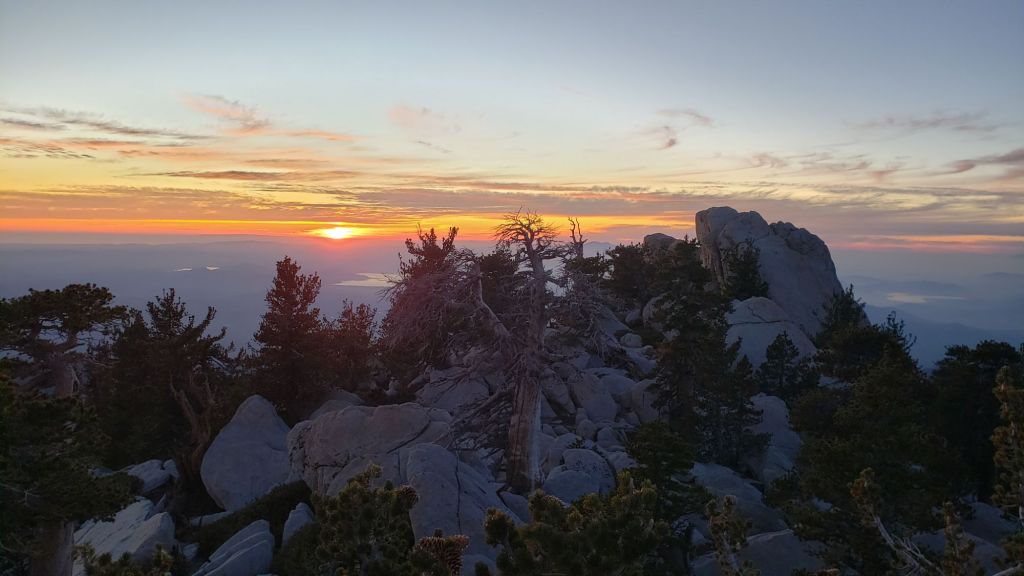
The dawn of a new calendar year. Sunrise over the north end of the Salton Sea as seen from 9000 ft elevation near PCT Mile 180, 1st January 2025.
WEATHER
Other than fluctuating either side of seasonal during the second week of the month, temperatures were above average for most of December. They are currently forecast to continue to be above seasonal for the first half of January, albeit briefly dipping close to seasonal on 6th-8th before rising again.Temperatures in the high country will be well below freezing on 7th and 8th January, with windchill temperatures potentially dangerously cold (likely below 0°F [approx. -20°C]).
Strong winds are currently forecast for the high country almost every day in the first two weeks of January. Strong – at times very strong – Santa Ana winds (i.e. largely from northeasterly directions) are forecast for 7th-9th and again on 14th-15th January. Even though much of this winter has been unusually mild, air temperatures are nevertheless often near freezing above 10,000 ft, and strong winds (>20 mph) greatly influence the feel of temperatures and hence associated risks. At this time of year, hikers should always be prepared for winter temperatures in the high country regardless of forecasts and/or how mild it may feel at trailheads (see my sample Peak weather observations below).
Many days for the foreseeable future will be at least partly cloudy. There was no significant precipitation in December 2024 at mid or upper elevations, and there is currently no significant precipitation in the forecasts until at least mid January.
The latest video report from NWS San Diego (linked here) gives a thorough explanation of the weather conditions expected for the week of 6th-10th January.
At San Jacinto Peak (3295m/10,810ft) on Wednesday 1st January 2025 at 0815the air temperature was 39.3°F (4°C), with a windchill temperature of 23.5°F (-5°C), 23% relative humidity, and a variable due West wind sustained at 10 mph gusting to 22.3 mph.
At the Peak on Sunday 29th December 2024 at 0840the air temperature was 38.8°F (4°C), with a windchill temperature of 25.2°F (-4°C), 12% relative humidity, and a blustery WNW wind sustained at 13 mph gusting to 23.7 mph.
The view south-east from Tahquitz Peak along the Desert Divide with the Santa Rosa mountains in the distance, early morning 28th December 2024. Garner Valley is to the right and the Salton Sea is just visible to the far left. Lots of lovely cloud, but no hint of moisture.
TRAIL CONDITIONS
There is currently no settled snow anywherein the San Jacinto mountains (sadly for the first time in recorded history into January).
Treefall hazards remain a significant problem along parts of the Pacific Crest Trail, most notably between Antsell Rock and South Peak. Some 56 trees are down across the trail between PCT Miles 170.5-174, with 37 of these, including several serious obstructions that make for slow-going, between Miles 172.5-174 (around and immediately south of South Peak). A further nine smaller obstructions are down from Miles 168.5-170.5 (Spitler Peak Trail to Zen Center Trail). Significant sections of Miles 168.5-175 are also badly overgrown with brush and are in urgent need of major trimming work (surveyed late 2024).
On the Fuller Ridge Trail section of the PCT there are 12 trees down on the State Park section of the trail (Miles 185.5-189), which has not been maintained by that agency for many years. Several of these pose quite significant hazards for hikers. On the Forest Service section (Miles 189.3-190.5) five significant treefall hazards were removed by USFS late in 2024.
Trees down on the Strawberry Trail section of the PCT (Annie’s Junction to Strawberry Junction, Miles 180.8-183) have remained uncut by the Forest Service for nearly a decade. About six hazards on this section are thankfully all relatively easy for hikers to negotiate.
The Trail Report heavily trimmed the formerly overgrown Wellman Trail (Annie’s Junction to Wellman Divide) in September-December 2024. We continue to trim South Ridge Trail year-round, but with increased effort in December 2024.
The Trail Report focused on removing almost all the obstructive whitethorn from Spitler Peak Trail in December 2024, largely in the central portion of the trail (miles 2.0-3.2 from the trailhead). Another 37 treefall hazards were cleared by the Trail Report in 2024, bringing to 123+ the total number of downed trees removed by the Report from this trail in recent years. While more brush trimming work is always required, in general the trail is currently in its best condition since at least mid 2023. Spitler Creek continues to flow gently at its various crossings in the upper switchbacks, and Antsell Rock Creek starting flowing gently again in November.
About 12 treefall hazards on Deer Springs Trail include 8-9 in the upper trail that have been down and reported repeatedly for a decade but with no action from the State Park. All but two of the treefall hazards down between Strawberry Junction and the top of Marion Mountain Trail (roughly PCT Miles 183-185) were removed by the Trail Report in late June.
Willow Creek Trail is nearing its 2020 condition, the last time the original trail route was fully cleared and passable. Almost all significant treefall hazards on the Forest Service section were cut by mid August (several uncut trees remain that need to be removed to fully restore the original trail route). Whitethorn trimming was largely completed, mainly by volunteers, on the Forest Service side in August and early September 2024. On the State Park side some localized whitethorn trimming of the worst patches was undertaken in September, and the minor treefall hazards new in 2023/24 were removed, leaving just two major long term downed trees (both have simple workarounds for hikers).
The Caramba Trail from near Reeds Meadow through Laws Camp and on to Caramba, and the Cedar Trail from Willow Creek Trail to Laws, are euphemistically (and potentially dangerously) described by the Forest Service as “not maintained”. In reality both trails have been abandoned and no longer exist. They are so heavily overgrown, largely with dense whitethorn, which obscures dozens of downed trees, that hikers should not attempt to follow them (regardless of how much you may trust an app). An informaluse trail to Laws is much more direct, well maintained, and avoids the bushwhacking of the unmaintained trails (some local Idyllwild hikers dubbed it the “King Trail” when I established the route in 2019). It leaves Willow Creek Trail exactly 1.0 mile from Saddle Junction, 0.46 mile from the Skunk Cabbage turning (trailhead at N 33.7796, W 116.6590). The route descends largely following established deer trails for 1.2 miles, meeting Willow Creek about 0.2 mile upstream from the site of the historic Laws Camp (the remains of which were destroyed by the 2013 Mountain Fire and subsequent flood and treefall damage). One huge tree fell in late 2024 across the King Trail about midway down and requires a minor scramble underneath (that tree will not be cut soon). Another five recently downed trees were either removed or worked around in early January 2025, when the trail was thoroughly trimmed and raked. From Laws east to Caramba the route of the original Caramba Trail has been cairned by myself and others and can largely be followed with very careful route-finding. My first 2025 survey counted about 120 trees down on this 2.1 miles of trail. It is especially obscure for the first 0.3 mile east of the Willow Creek crossing, becoming more obvious (but still subtle) as it descends towards Caramba. Very cautious navigation is advised throughout the area.
The Trail Report “adopted” Seven Pines Trail as a priority for maintenance work as the trail had a disproportionate number of lost hiker rescues in the past decade, and both State Park and Forest Service have shown no interest in maintaining the route for years. Since 2020 we have removed 75 downed trees and the trail is trimmed and cleared multiple times annually. As of late 2024 the trail is largely clear of treefall hazards, with three down across the trail in its upper section, all easily passable for hikers. A further half-a-dozen downed trees close to the PCT junction would need to be removed to fully restore the original route of the trail. Although the condition of the trail is hugely improved, Seven Pines remains a genuine wilderness trail unlike the wider, bare, obvious routes of, for example, Devil’s Slide or Marion Mountain trails. Cautious navigation remains essential for those without considerable experience of hiking this trail. Be aware in particular that Seven Pines Trail becomes most obscure in the mile closest to its junction with Deer Springs Trail/PCT.
The Zen Center Trail continues its serious deterioration that started following the 2013 Mountain Fire, with a combination of vigorous regrowth and treefall hazards further obscuring the route with each passing season. The lower and upper thirds of this trail are partially cairned and not too bad for those who are very familiar with the former route, but even the experienced find navigating the central section tricky. Long trousers, scrambling gloves, and an enjoyment of bush-whacking are all strongly recommended.
While all time and labor is volunteered, the San Jacinto Trail Report uses small private donations to help cover operating costs. Your contribution keeps the Report available to all, free from advertising or paywalls, and independent from agencies. If you have found this Report useful, please consider using this link to the Donate page.Thank you very much for your support.
The well-known north spring at Wellman’s Cienega (9300 ft), flowing well for the time of year, and with some ice typical of almost every day in the past couple of months, mid morning 1st January 2025.Willow Creek flowing steadily where it is crossed by what remains of the Caramba Trail and the so-called King Trail, about 0.2 mile upstream of the site of the old Laws camp, 3rd January 2025.Tahquitz Creek flowing well for the time of year just below its source (“Grethe Spring”) where it crosses the PCT at about Mile 177, 3rd January 2025.Tahquitz Creek flowing well at the lower (north) end of Little Tahquitz Meadow, 3rd January 2025.For those who know where it is, the pipe in Tahquitz Valley continues to flow well, 3rd January 2025.The little creek in Skunk Cabbage Meadow, remarkably still flowing gently where it passes under the small log bridge, 3rd January 2025.
There is no settled snow anywhere in the San Jacinto high country, the latest into a winterin recorded history by many weeks without snow in these mountains. Total snowfall – using that term very generously – at San Jacinto Peak since September is 0.6 inch.
There is very little evidence of a change on the way. The storm to our north on the afternoon of Tuesday 24th December brought only brief drizzle to mid elevations, with the high peaks remaining above the cloud. There is the possibility of more unsettled weather in the first week of January.
Survey hikes by the Trail Report literally every day of the year in the San Jacinto mountains include varied routes throughout the high peaks including San Jacinto Peak averaging 2-4 times per week, Tahquitz Peak and area 1-2 times per week, plus a wide variety of other trails on intervening days.
Unusual recent weather – warm and dry so late in the year – has led to an exceptionally active tick season. Some trails are predictably tick-prone, such as Cedar Springs Trail where the lower section currently has cattle ranging on and near the trail, and wood ticks (genus Dermacentor) are abundant. Even trails such as lower Deer Springs Trail are producing multiple tick encounters (deer ticks, Ixodes, appropriately enough). Hikers with dogs in particular should take necessary precautions and check thoroughly for ticks post-hike.
Despite a failed monsoon earlier this year and below-average precipitation both last winter and – obviously – so far this season, major springs, creeks, and pipeslargely continue to flow at this time (example photos below and in a previous Report linked here). The Round Valley faucet continued to flow well as of 23rd December. In the Tahquitz area meadows, the Tahquitz Valley pipe (for those who know where it is) continues to flow very well. Tahquitz Creek is flowing at the northern end of Little Tahquitz Meadow, and near its source where it crosses the PCT at Mile 177. Strawberry Cienega is functionally dry. Stone Creek is dry where it crosses Deer Springs Trail at about PCT Mile 183.6. Bud Spring near 9900 ft, just north-west of Marion Mountain, is still flowing steadily (photo below). Cedar Spring is flowing well for the time of year.
The view south-east from Tahquitz Peak down the Desert Divide with the Santa Rosa mountains in the distance, early morning 28th December 2024. Garner Valley is to the right and the Salton Sea is just visible to the far left. Lots of lovely cloud, but no hint of moisture.
WEATHER
Temperatures have been above average for almost all of December, but fluctuated either side of seasonal during the second week of the month. They are now forecast to largely above seasonal for the remainder of December, potentially dropping closer to seasonal for the first week of January. Most days for the foreseeable future will be at least partly cloudy.
Temperatures dropped to seasonal on Wednesday 25th, but windchills were well below freezing at higher elevations on Tuesday 24th. The minor storm on 24th produced only 0.02 inch of rain as high as Saddle Junction (8100 ft), a trace of rain to Wellman’s Cienega (9300 ft), but no precipitation at all at San Jacinto Peak (10,810 ft).
Strong winds are currently forecast for the high country on most days into the first week of January. Even though much of December 2024 has been unusually mild, air temperatures are often near freezing above 10,000 ft, and strong winds (>20 mph) greatly influence the feel of temperatures and hence associated risks. At this time of year, hikers should always be prepared for winter temperatures in the high country regardless of forecasts and/or how mild it may feel at trailheads (see my sample Peak weather observations below).
The latest video weather review from NWS San Diego released on Monday 23rd (linked here) does not suggest an encouraging outlook for precipitation into early January.
At San Jacinto Peak (3295m/10,810ft) on Wednesday 25th December 2024 at 0830the air temperature was 34.8°F (1°C), with a windchill temperature of 19.4°F (-7°C), 17% relative humidity, and a sharp NW wind sustained at 16 mph gusting to 26.3 mph.
At the Peak on Monday 23rd December 2024 at 0900the air temperature was 37.6°F (2°C), with a windchill temperature of 27.5°F (-2°C), 37% relative humidity, and a light NNW wind sustained at 7 mph gusting to 11.8 mph.
At the Peak on Thursday 19th December 2024 at 0805the air temperature was 44.1°F (8°C), with a windchill temperature of 34.0°F (1°C), 33% relative humidity, and a moderate SE wind sustained at 7 mph gusting to 13.8 mph.
A near-solstice sunrise over the north end of the Salton Sea, as seen from Jean Peak, 19th December 2024.
TRAIL CONDITIONS
There is currently no settled snow anywherein the San Jacinto mountains (sadly for the first time in recorded history in December).
Treefall hazards remain a significant problem along parts of the Pacific Crest Trail, most notably between Antsell Rock and South Peak. Some 56 trees are down across the trail between PCT Miles 170.5-174, with 37 of these, including several serious obstructions that make for slow-going, between Miles 172.5-174 (around and immediately south of South Peak). A further nine smaller obstructions are down from Miles 168.5-170.5 (Spitler Peak Trail to Zen Center Trail). Significant sections of Miles 168.5-175 are also badly overgrown with brush and are in urgent need of major trimming work (surveyed late 2024).
On the Fuller Ridge Trail section of the PCT there are 12 trees down on the State Park section of the trail (Miles 185.5-189), which has not been maintained by that agency for many years. Several of these pose quite significant hazards for hikers. On the Forest Service section (Miles 189.3-190.5) five significant treefall hazards were removed by USFS late in 2024.
Trees down on the Strawberry Trail section of the PCT (Annie’s Junction to Strawberry Junction, Miles 180.8-183) have remained uncut by the Forest Service for nearly a decade. About six hazards on this section are thankfully all relatively easy for hikers to negotiate.
The Trail Report heavily trimmed the formerly overgrown Wellman Trail (Annie’s Junction to Wellman Divide) in September-December 2024. We continue to trim South Ridge Trail year-round, but with increased attention this December.
The Trail Report has worked hard on Spitler Peak Trail in December to remove most of the obstructive whitethorn, largely in the central portion of the trail. Another 37 treefall hazards were cleared by the Trail Report in 2024, bringing to 123+ the total number of downed trees removed by the Report from this trail in recent years. While more brush trimming work is always required, in general the trail is currently in its best condition since mid 2023. Spitler Creek continues to flow gently at its various crossings in the upper switchbacks, and Antsell Rock Creek starting flowing gently again in November.
About 12 treefall hazards on Deer Springs Trail include 8-9 in the upper trail that have been down and reported repeatedly for a decade but with no action from the State Park. All but two of the treefall hazards down between Strawberry Junction and the top of Marion Mountain Trail (roughly PCT Miles 183-185) were removed by the Trail Report in late June.
Willow Creek Trail is nearing its 2020 condition, the last time the original trail route was fully cleared and passable. Almost all significant treefall hazards on the Forest Service section were cut by mid August (several uncut trees remain that need to be removed to fully restore the original trail route). Whitethorn trimming was largely completed, mainly by volunteers, on the Forest Service side in August and early September 2024. On the State Park side some localized whitethorn trimming of the worst patches was undertaken in September, and the minor treefall hazards new in 2023/24 were removed, leaving just two major long term downed trees (both have simple workarounds for hikers).
The Caramba Trail from near Reeds Meadow through Laws Camp and on to Caramba, and the Cedar Trail from Willow Creek Trail to Laws, are euphemistically described by the Forest Service as “not maintained”. In reality both trails have been abandoned and functionally no longer exist. They are so heavily overgrown with dense whitethorn, which obscures dozens of downed trees, that I strongly advise hikers do not attempt to follow them (regardless of how much you may trust an app). An informaluse trail to Laws is much more direct, maintained, and avoids the challenging bushwhacking of the unmaintained trails (local Idyllwild hikers dubbed it the “King Trail” when I established the route in 2019). It leaves Willow Creek Trail exactly 1.0 mile from Saddle Junction, 0.46 mile from the Skunk Cabbage turning (trailhead at N 33.7796, W 116.6590). The route descends largely following established deer trails for 1.2 miles, meeting Willow Creek about 0.2 mile upstream from the site of the historic Laws Camp (the remains of which were destroyed by the 2013 Mountain Fire and subsequent flood and treefall damage). Eleven trees down on the King Trail were removed in June-July 2023. The tread of the trail received some damage from Tropical Storm Hilary last year. From Laws east to Caramba the route of the original Caramba Trail has been well-cairned by myself and others and can largely be followed with very careful route-finding. My 2023 survey counted about 110 trees down on this 2.1 miles of trail. It is especially obscure for the first 0.3 mile east of the Willow Creek crossing, becoming more obvious (but still subtle) as it descends towards Caramba. Very cautious navigation is advised throughout the area.
The Trail Report “adopted” Seven Pines Trail as a priority for maintenance work as the trail had a disproportionate number of lost hiker rescues in the past decade, and both State Park and Forest Service have shown no interest in maintaining the route for years. Since 2020 we have removed 75 downed trees and the trail is trimmed and cleared multiple times annually. As of late 2024 the trail is largely clear of treefall hazards, with three down across the trail in its upper section, all easily passable for hikers. A further half-a-dozen downed trees close to the PCT junction would need to be removed to fully restore the original route of the trail. Although the condition of the trail is hugely improved, Seven Pines remains a genuine wilderness trail unlike the wider, bare, obvious routes of, for example, Devil’s Slide or Marion Mountain trails. Cautious navigation remains essential for those without considerable experience of hiking this trail. Be aware in particular that Seven Pines Trail becomes most obscure in the mile closest to its junction with Deer Springs Trail/PCT.
The Zen Center Trail continues its serious deterioration that started following the 2013 Mountain Fire, with a combination of vigorous regrowth and treefall hazards further obscuring the route with each passing season. The lower and upper thirds of this trail are partially cairned and not too bad for those who are very familiar with the former route, but even the experienced find navigating the central section tricky. Long trousers, scrambling gloves, and an enjoyment of bush-whacking are all strongly recommended.
Looking south from PCT Mile 180.2 across Tahquitz Peak and Tahquitz Rock at sunrise, 23rd December 2024.
While all time and labor is volunteered, the San Jacinto Trail Report uses small private donations to help cover operating costs. Your contribution keeps the Report available to all, free from advertising or paywalls, and independent from agencies. If you have found this Report useful, please consider using this link to the Donate page.Thank you very much for your support.
One of the two main outflows of the well-known north spring at Wellman’s Cienega (9300 ft), flowing remarkably well for the time of year, and adorned with the thick icicles typical of almost every day in recent weeks, early morning 25th December 2024.Bud Spring, at 9880 ft immediately north-west of Marion Mountain, flowing remarkably well for the time of year with delicious and beautifully clear spring water, late afternoon 18th December 2024.New summit register and box provided by the Trail Report placed on the summit block of Marion Mountain, 18th December 2024. The previous register container was apparently dropped into a deep crack in November. The San Jacinto high country – strikingly devoid of snow – provides the background, with San Jacinto Peak itself in the upper middle of the image.
With no storms passing close to our area this month, there continues to be no settled snow in the San Jacinto high country, by far the latest into a winterin recorded history without snow in these mountains. We are not alone in this predicament. Rainfall for almost all of Riverside County is only 5% of average for the current water year (i.e. since 1st October). San Diego is experiencing its 7th driest water year to date, in a sample size of 174 years (since 1850; NWS data in video report linked here).
At San Jacinto Peak on the afternoon of Thursday 12th winds from the west (as a storm system passed through central California) were not as strong as expected, but still generated some impressive cloud formations (video and photo below), and a few tiny snowflakes flew by.
Temperatures are now forecast to be well above seasonal for the remainder of December. Frankly it was remarkable to be sat at San Jacinto Peak on the morning of Thursday 19th in mild conditions with an air temperature of 44°F – far above seasonal for mid December – and (for me) completely comfortable in just a shirt and shorts.
Another storm is forecast to pass by largely to the north on 24th-25th December, bringing strong winds to the high country and cooler temperatures to all elevations. At this time very limited precipitation is forecast.
Survey hikes by the Trail Report every day of the year in the San Jacinto mountains include varied and often circuitous routes throughout the high peaks including San Jacinto Peak averaging 2-3 times per week, Tahquitz Peak weekly, plus a wide variety of other trails on intervening days.
Unusual recent weather – warm and dry so late in the year – has led to an exceptionally active tick season. Some trails are predictably tick-prone, such as Cedar Springs Trail where the lower section currently has cattle ranging on and near the trail, and hence wood ticks (genus Dermacentor) are abundant. Even trails such as South Ridge, Ernie Maxwell, and lower Deer Springs Trail are producing multiple tick encounters (deer ticks, Ixodes, appropriately enough). Hikers with dogs in particular should take necessary precautions and check thoroughly for ticks post-hike.
Despite a failed monsoon earlier this year and below-average precipitation both last winter and – obviously – so far this season, major springs, creeks, and pipeslargely continue to flow at this time (example photos below and in previous Report linked here). The Round Valley faucet continued to flow well as of 16th December. In the Tahquitz area meadows, the Tahquitz Valley pipe (for those who know where it is) continues to flow very well. Tahquitz Creek is flowing at the northern end of Little Tahquitz Meadow, and near its source where it crosses the PCT at Mile 177. Strawberry Cienega is functionally dry. Stone Creek is no longer flowing where it crosses Deer Springs Trail at about PCT Mile 183.6, and has dried downstream of that point. Bud Spring near 9900 ft (just north-west of Marion Mountain) is still flowing steadily. Cedar Spring is flowing well for the time of year.
A near-solstice sunrise over the north end of the Salton Sea, as seen from Jean Peak, 19th December 2024.
WEATHER
Temperatures were well above average for the first week of December, fluctuated either side of seasonal for the second week, and are now forecast to be well above seasonal yet again at all elevations almost daily for the remainder of December.Temperatures drop to near seasonal on Wednesday 25th, but windchills may be well below freezing at higher elevations on Tuesday 24th.
Most days for the foreseeable future will be at least partly cloudy. The next storm probably passing largely to our north is expected to produce strong mountain winds and lower temperatures on 24th-25th December. Some very light precipitation is possible at all elevations, but it is expected to be mild enough to rain even around the highest peaks.
Strong winds are currently forecast for the high country on 24th and most days from 26th-31st December. Even though much of December 2024 has been unusually mild, air temperatures are often near freezing above 10,000 ft, and strong winds (>20 mph) greatly influence the feel of temperatures and hence associated risks. At this time of year, hikers should always be prepared for winter temperatures in the high country regardless of forecasts and/or how mild it may feel at trailheads (see my sample Peak weather observations below).
The latest video weather review from NWS San Diego released on Monday 16th (linked here) does not suggest an encouraging outlook for precipitation for the remainder of December.
At San Jacinto Peak (3295m/10,810ft) on Thursday 19th December 2024 at 0805the air temperature was 44.1°F (8°C), with a windchill temperature of 34.0°F (1°C), 33% relative humidity, and a moderate SE wind sustained at 7 mph gusting to 13.8 mph.
At the Peak on Monday 16th December 2024 at 0820the air temperature was 42.0°F (6°C), with a “windchill” temperature of 38.6°F (4°C), 12% relative humidity, and a barely discernable WNW breeze sustained at 1 mph gusting to 3.7 mph.
At the Peak on Friday 13th December 2024 at 0920 the air temperature was 30.8°F (-1°C), with a windchill temperature of 12.6°F (-11°C), 28% relative humidity, and a stiff NW wind sustained at 17 mph gusting to 31.3 mph.
At the Peak on Thursday 12th December 2024 at 1300 the air temperature was 24.0°F (-5°C), with a windchill temperature of 3.7°F (-16°C), 25% relative humidity, and a frigid WSW wind sustained at 20 mph gusting to 27.6 mph.
Remnants of stratus cloud, looking east from San Jacinto Peak, early afternoon 12th December 2024. As the marine layer was forced from 6000 ft by a strong WSW wind up and over the 10,000+ ft peaks, the cloud largely fragmented and vortices twisted it into spectacular wispy aerial waves. See also the video clip below.
TRAIL CONDITIONS
There is currently no settled snow anywherein the San Jacinto mountains (sadly for the first time in recorded history this far into December).
Treefall hazards remain a significant problem along parts of the Pacific Crest Trail, most notably between Antsell Rock and South Peak. Some 56 trees are down across the trail between PCT Miles 170.5-174, with 37 of these, including several serious obstructions that make for slow-going, between Miles 172.5-174 (around and immediately south of South Peak). A further nine smaller obstructions are down from Miles 168.5-170.5 (Spitler Peak Trail to Zen Center Trail). Significant sections of Miles 168.5-175 are also badly overgrown with brush and are in urgent need of major trimming work (surveyed late November 2024).
On the Fuller Ridge Trail section of the PCT there are 12 trees down on the State Park section of the trail (Miles 185.5-189), which has not been maintained by that agency for many years. Several of these pose quite significant hazards for hikers. On the Forest Service section (Miles 189.3-190.5) five significant treefall hazards have been removed by USFS in the past month.
Trees down on the Strawberry Trail section of the PCT (Miles 180.8-183, Annie’s Junction to Strawberry Junction) have remained uncut by the Forest Service for nearly a decade. About six hazards on this section are thankfully all relatively easy for hikers to negotiate.
The Trail Report heavily trimmed the Wellman Trail in September-December 2024.
About 12 treefall hazards on Deer Springs Trail include 8-9 in the upper trail that have been down and reported repeatedly for nearly a decade but with no action from the State Park. All but two of the treefall hazards down between Strawberry Junction and the top of Marion Mountain Trail (roughly PCT Miles 183-185) were removed by the Trail Report in late June.
Willow Creek Trail is nearing its 2020 condition, the last time the original trail route was fully cleared and passable. Almost all significant treefall hazards on the Forest Service section were cut by mid August (several uncut trees remain that need to be removed to fully restore the original trail route). Whitethorn trimming was largely completed, mainly by volunteers, on the Forest Service side in August and early September. On the State Park side some localized whitethorn trimming of the worst patches was undertaken in September, and the minor treefall hazards new in 2023/24 were removed, leaving just two major long term downed trees (both have simple workarounds for hikers).
The 34 treefall hazards that came down across Spitler Peak Trail during ice storms earlier in 2024 were cleared by the Trail Report in June, with three further trees more recently removed. This brings to at least 123 the total number of downed trees removed by the Report from this trail in recent years. While another round of brush trimming work is required, in general the trail is currently in its best condition for more than a year. Spitler Creek continues to flow gently at its various crossings in the upper switchbacks (photo below), but Antsell Rock Creek adjacent to the trailhead has been dry for a couple of months.
The Caramba Trail from near Reeds Meadow through Laws Camp and on to Caramba, and the Cedar Trail from Willow Creek Trail to Laws, are euphemistically described by the Forest Service as “not maintained”. In reality both trails have been abandoned and functionally no longer exist. They are so heavily overgrown with dense whitethorn, which obscures dozens of downed trees, that I strongly advise hikers do not attempt to follow them (regardless of how much you may trust an app). An informaluse trail to Laws is much more direct, maintained, and avoids the challenging bushwhacking of the unmaintained trails (local Idyllwild hikers dubbed it the “King Trail” when I established the route in 2019). It leaves Willow Creek Trail exactly 1.0 mile from Saddle Junction, 0.46 mile from the Skunk Cabbage turning (trailhead at N 33.7796, W 116.6590). The route descends largely following established deer trails for 1.2 miles, meeting Willow Creek about 0.2 mile upstream from the site of the historic Laws Camp (the remains of which were destroyed by the 2013 Mountain Fire and subsequent flood and treefall damage). Eleven trees down on the King Trail were removed in June-July 2023. The tread of the trail received some damage from Tropical Storm Hilary last year. From Laws east to Caramba the route of the original Caramba Trail has been well-cairned by myself and others and can largely be followed with very careful route-finding. My 2023 survey counted about 110 trees down on this 2.1 miles of trail. It is especially obscure for the first 0.3 mile east of the Willow Creek crossing, becoming more obvious (but still subtle) as it descends towards Caramba. Very cautious navigation is advised throughout the area.
The Trail Report “adopted” Seven Pines Trail as a priority for maintenance work as the trail had a disproportionate number of lost hiker rescues in the past decade, and both State Park and Forest Service have shown no interest in maintaining the route for years. Since 2020 we have removed 75 downed trees and the trail is thoroughly trimmed and cleared multiple times annually. As of September 2024 the trail is largely clear of treefall hazards, with three down across the trail in its upper section, all easily passable for hikers. A further half-a-dozen downed trees close to the PCT junction would need to be removed to fully restore the original route of the trail. Although the condition of the trail is hugely improved, Seven Pines remains a genuine wilderness trail unlike the wider, bare, obvious routes of, for example, Devil’s Slide or Marion Mountain trails. Cautious navigation remains essential for those without considerable experience of hiking this trail. Be aware in particular that Seven Pines Trail becomes most obscure in the mile closest to its junction with Deer Springs Trail/PCT.
The Zen Center Trail continues its serious deterioration that started following the 2013 Mountain Fire, with a combination of vigorous regrowth and treefall hazards further obscuring the route with each passing season. The lower and upper thirds of this trail are partially cairned and not too bad for those who are very familiar with the former route, but even the experienced find navigating the central section tricky. Long trousers, scrambling gloves, and an enjoyment of bush-whacking are all strongly recommended.
New summit register and box provided by the Trail Report placed on the summit block of Marion Mountain, 18th December 2024. The previous register container was apparently dropped into a deep crack in November. The San Jacinto high country provides the background, with San Jac Peak itself in the upper middle of the image.
While all time and labor is volunteered, the San Jacinto Trail Report uses small private donations to help cover operating costs. Your contribution keeps the Report available to all, free from advertising or paywalls, and independent from agencies. If you have found this Report useful, please consider using this link to the Donate page.Thank you very much for your support.
Spectacular clouds passing over and around San Jacinto Peak at about 30 mph as a storm system passes to the north, early afternoon 12th December 2024.The well-known north spring at Wellman’s Cienega (9300 ft), flowing well for the time of year, complete with icicles typical of almost every day in recent weeks, early morning 16th December 2024.Bud Spring, at 9880 ft immediately north-west of Marion Mountain, flowing remarkably well for the time of year with delicious and beautifully clear spring water, late afternoon 18th December 2024.Cedar Spring is flowing gently (but well for December), both where it crosses the trail into the camping area, and further upstream (as shown), 4th December 2024.Very fresh Mountain Lion scat, comprised entirely of deer hair, in the middle of Wellman Trail at 9250 ft, late morning 19th December 2024. It is rare for lions and deer to still be at such high elevation in December (based on my observations over many years both typically descend to mid elevations in October-November). The knife is 3.6 inches long for scale.Above and below, a hazardous double-trunked tree that came down in high winds on the afternoon of 12th December across the PCT at Mile 180.2, a little over one mile north of Saddle Junction. The Trail Report removed it the next morning; photos 13th December 2024.
We are now by far the deepest into December in recorded history with no settled snow in the San Jacinto high country. The flow of storm systems continues to track well to the north of our area, and this is forecast to continue into late December. Such a pattern has become increasingly common with global heating this century, and consequently 12 of the past 13 winters have had below average snowfall in the San Jacinto mountains high country (a statistic that looks increasingly likely to become 13 out of 14 winters). Rainfall for almost all of Riverside County is at only 5% of average for the current water year (i.e. since 1st October).
Strong Santa Ana winds have led to a Red Flag Warning (in mid December!). At San Jacinto Peak on the morning of Tuesday 10th, the north-east wind was sustained at nearly 30 mph, accompanied by just 11% relative humidity. At the Peak on the afternoon of Thursday 12th winds from the west (as a storm system moved through to our north) were not as strong as expected, but still generated some impressive cloud formations (video and photo below), and I briefly had a few tiny snowflakes flying by. Further storms may pass by north of us on 14th-15th and then again on 24th-25th, bringing strong winds to the high country, but currently little or no precipitation is forecast.
Survey hikes by the Trail Report every day of the year in the San Jacinto mountains include varied and often circuitous routes through the high country to San Jacinto Peak currently 2-3 times per week, Tahquitz Peak weekly, plus a wide variety of other trails on intervening days.
Unusual recent weather – warm and dry so late in the year – has led to an exceptionally active tick season. Some trails are predictably tick-prone, such as Cedar Springs Trail, where the lower section currently has cattle ranging on and near the trail, and wood ticks (genus Dermacentor) are abundant. However, even trails such as South Ridge, Ernie Maxwell, and lower Deer Springs Trail are producing multiple tick encounters (deer ticks, Ixodes, appropriately enough). Hikers with dogs in particular should take necessary precautions and check thoroughly for ticks post-hike.
Despite a failed monsoon earlier this year and below-average precipitation both last winter and – obviously – so far this season, major springs, creeks, and pipeslargely continue to flow at this time (example photos below). Middle Spring on Devil’s Slide Trail finally dried up by 10th November. The Round Valley faucet continued to flow well as of 1st December at least. In the Tahquitz area meadows, the ephemeral creek in Tahquitz Valley is dry, however the Tahquitz Valley pipe (for those who know where it is) continues to flow very well. The creek in Skunk Cabbage Meadow continues to trickle where it is crossed by the meadow trail. Tahquitz Creek is flowing at the northern end of Little Tahquitz Meadow, and near its source where it crosses the PCT at Mile 177 (photos below). Strawberry Cienega is functionally dry. Stone Creek is no longer flowing where it crosses Deer Springs Trail at about PCT Mile 183.6, and has dried downstream of that point. Bud Spring at 9900 ft (just north-west of Marion Mountain) is still flowing gently. Cedar Spring is flowing well for the time of year (photo below).
Forest Service campgrounds and the State Park Stone Creek campground all closed for the season last month. Fire lookouts at Black Mountain and Tahquitz Peak also closed in November.
Remnants of stratus cloud, looking east from San Jacinto Peak, early afternoon 12th December 2024. As the marine layer was forced from 6000 ft by a strong WSW wind up and over the 10,000+ ft peaks, the cloud largely fragmented and vortices twisted it into spectacular wispy aerial waves. See also the video clip below.
WEATHER
Temperatures were well above average for the first week of December, but have now dropped to closer to seasonal. Temperatures are forecast to be well above seasonal yet again at all elevations on 16th-23rd December. The cloud-dominated days of late November return for 11th-17th December. Strong prevailing westerly winds on Thursday 12th raised the marine layer sufficiently to bring a hint of light drizzle to the mountain (and briefly a few tiny snowflakes up high!), but otherwise there continues to be no precipitation in the forecasts for the next ten days at least. Storms passing well to our north are expected to produce strong mountain winds on 14th and 24th-25th December.
Even though much of December 2024 has been unusually mild, air temperatures continue to be around freezing above 10,000 ft and when winds are strong (>20 mph) they greatly influence the feel of temperatures and associated risks. At this time of year, hikers should always be prepared for winter temperatures in the high country regardless of forecasts and how mild it may feel at trailheads (see Peak weather observations below).
The latest video weather review from NWS San Diego released on Tuesday 10th (linked here) does not suggest an encouraging outlook for precipitation for most of the remainder of December.
At San Jacinto Peak (3295m/10,810ft) on Friday 13th December 2024 at 0920 the air temperature was 30.8°F (-1°C), with a windchill temperature of 12.6°F (-11°C), 28% relative humidity, and a stiff NW wind sustained at 17 mph gusting to 31.3 mph.
At the Peak on Thursday 12th December 2024 at 1300 the air temperature was 24.0°F (-5°C), with a windchill temperature of 3.7°F (-16°C), 25% relative humidity, and a frigid WSW wind sustained at 20 mph gusting to 27.6 mph.
At the Peak on Tuesday 10th December 2024 at 0910 the air temperature was 32.7°F (0°C), with a windchill temperature of 14.9°F (-10°C), 11% relative humidity, and a potent NE wind sustained at 27 mph gusting to 33.9 mph.
Sunset as seen from Marion Mountain, Monday 2nd December 2024. The famous summit block of Marion Mountain is on the right.
TRAIL CONDITIONS
There is currently no settled snow anywherein the San Jacinto mountains (sadly for the first time in recorded history into December).
Treefall hazards remain a significant problem along parts of the Pacific Crest Trail, most notably between Antsell Rock and South Peak. Some 56 trees are down across the trail between PCT Miles 170.5-174, with 37 of these, including several serious obstructions that make for slow-going, between Miles 172.5-174 (around and immediately south of South Peak). A further nine smaller obstructions are down from Miles 168.5-170.5 (Spitler Peak Trail to Zen Center Trail). Significant sections of Miles 168.5-175 are also badly overgrown with brush and are in urgent need of major trimming work (surveyed late November 2024).
On the Fuller Ridge Trail section of the PCT there are 12 trees down on the State Park section of the trail (Miles 185.5-189), which has not been maintained by that agency for many years. Several of these pose quite significant hazards for hikers. On the Forest Service section (Miles 189.3-190.5) five significant treefall hazards have been removed by USFS in the past month.
Trees down on the Strawberry Trail section of the PCT (Miles 180.8-183, Annie’s Junction to Strawberry Junction) have remained uncut by the Forest Service for nearly a decade. About six hazards on this section are thankfully all relatively easy for hikers to negotiate.
The Trail Report heavily trimmed the Wellman Trail in September-December 2024.
About 12 treefall hazards on Deer Springs Trail include 8-9 in the upper trail that have been down and reported repeatedly for nearly a decade but with no action from the State Park. All but two of the treefall hazards down between Strawberry Junction and the top of Marion Mountain Trail (roughly PCT Miles 183-185) were removed by the Trail Report in late June.
Willow Creek Trail is nearing its 2020 condition, the last time the original trail route was fully cleared and passable. Almost all significant treefall hazards on the Forest Service section were cut by mid August (several uncut trees remain that need to be removed to fully restore the original trail route). Whitethorn trimming was largely completed, mainly by volunteers, on the Forest Service side in August and early September. On the State Park side some localized whitethorn trimming of the worst patches was undertaken in September, and the minor treefall hazards new in 2023/24 were removed, leaving just two major long term downed trees (both have simple workarounds for hikers).
The 34 treefall hazards that came down across Spitler Peak Trail during ice storms earlier in 2024 were cleared by the Trail Report in June, with three further trees more recently removed. This brings to at least 123 the total number of downed trees removed by the Report from this trail in recent years. While another round of brush trimming work is required, in general the trail is currently in its best condition for more than a year. Spitler Creek continues to flow gently at its various crossings in the upper switchbacks (photo below), but Antsell Rock Creek adjacent to the trailhead has been dry for a couple of months.
The Caramba Trail from near Reeds Meadow through Laws Camp and on to Caramba, and the Cedar Trail from Willow Creek Trail to Laws, are euphemistically described by the Forest Service as “not maintained”. In reality both trails have been abandoned and functionally no longer exist. They are so heavily overgrown with dense whitethorn, which obscures dozens of downed trees, that I strongly advise hikers do not attempt to follow them (regardless of how much you may trust an app). An informaluse trail to Laws is much more direct, maintained, and avoids the challenging bushwhacking of the unmaintained trails (local Idyllwild hikers dubbed it the “King Trail” when I established the route in 2019). It leaves Willow Creek Trail exactly 1.0 mile from Saddle Junction, 0.46 mile from the Skunk Cabbage turning (trailhead at N 33.7796, W 116.6590). The route descends largely following established deer trails for 1.2 miles, meeting Willow Creek about 0.2 mile upstream from the site of the historic Laws Camp (the remains of which were destroyed by the 2013 Mountain Fire and subsequent flood and treefall damage). Eleven trees down on the King Trail were removed in June-July 2023. The tread of the trail received some damage from Tropical Storm Hilary last year. From Laws east to Caramba the route of the original Caramba Trail has been well-cairned by myself and others and can largely be followed with very careful route-finding. My 2023 survey counted about 110 trees down on this 2.1 miles of trail. It is especially obscure for the first 0.3 mile east of the Willow Creek crossing, becoming more obvious (but still subtle) as it descends towards Caramba. Very cautious navigation is advised throughout the area.
The Trail Report “adopted” Seven Pines Trail as a priority for maintenance work as the trail had a disproportionate number of lost hiker rescues in the past decade, and both State Park and Forest Service have shown no interest in maintaining the route for years. Since 2020 we have removed 75 downed trees and the trail is thoroughly trimmed and cleared multiple times annually. As of September 2024 the trail is largely clear of treefall hazards, with three down across the trail in its upper section, all easily passable for hikers. A further half-a-dozen downed trees close to the PCT junction would need to be removed to fully restore the original route of the trail. Although the condition of the trail is hugely improved, Seven Pines remains a genuine wilderness trail unlike the wider, bare, obvious routes of, for example, Devil’s Slide or Marion Mountain trails. Cautious navigation remains essential for those without considerable experience of hiking this trail. Be aware in particular that Seven Pines Trail becomes most obscure in the mile closest to its junction with Deer Springs Trail/PCT.
The Zen Center Trail continues its serious deterioration that started following the 2013 Mountain Fire, with a combination of vigorous regrowth and treefall hazards further obscuring the route with each passing season. The lower and upper thirds of this trail are partially cairned and not too bad for those who are very familiar with the former route, but even the experienced find navigating the central section tricky. Long trousers, scrambling gloves, and an enjoyment of bush-whacking are all strongly recommended.
Spectacular clouds passing over and around San Jacinto Peak at about 30 mph as a storm system passes to the north, early afternoon 12th December 2024.
While all time and labor is volunteered, the San Jacinto Trail Report uses small private donations to help cover operating costs. Your contribution keeps the Report available to all, free from advertising or paywalls, and independent from agencies. If you have found this Report useful, please consider using this link to the Donate page.Thank you very much for your support.
The San Jacinto high country as seen looking north from Tahquitz Peak, early morning 7th December 2024. It is still striking to me that there is no snow anywhere in December, even though I hike in the mountains every day.The well-known north spring at Wellman’s Cienega (9300 ft), flowing well for the time of year, and with the daily icicles typical of recent weeks, early morning 13th December 2024.Cedar Spring is flowing gently (but well for December), both where it crosses the trail into the camping area, and further upstream (as shown), 4th December 2024.The creek in Little Round Valley (9750 ft) flowing gently, in early morning cloud, 25th November 2024.Tahquitz Creek flowing steadily for the time of year just below its source (“Grethe Spring”) where it crosses the PCT at about Mile 177, early morning 28th November 2024.For those who know where it is, the pipe in Tahquitz Valley continues to flow very well, early morning 28th November 2024.Spitler Creek continuing to flow gently, here at its lowest crossing of Spitler Peak Trail about three miles up from the trailhead, late morning 28th November 2024.Above and below, a hazardous double-trunked tree that came down in high winds on the afternoon of 12th December across the PCT at Mile 180.2, a little over one mile north of Saddle Junction. The Trail Report removed it the next morning; photos 13th December 2024.
Although the high country was in the cloud frequently in the last week of November, there has been no further precipitation since the minor rain on 23rd. The first week of December is forecast to be dry and unusually warm (for the time of year), with temperatures above seasonal at all elevations. This “winter” now holds the dubious distinction of being the latest into December in recorded history that there has been no settled snow in the San Jacinto high country. Cold fronts passing to the north on 9th-10th and again around 14th will substantially drop temperatures and strengthen winds, but are not currently forecast to bring significant precipitation.
Survey hikes by the Trail Report every day of the year in the San Jacinto mountains include varied and often circuitous routes through the high country to San Jacinto Peak currently 2-3 times per week, Tahquitz Peak weekly, plus a wide variety of other trails on intervening days.
Unusual recent weather – warm and dry so late in the year – has led to an exceptionally active tick season. Some trails are predictably tick-prone, such as Cedar Springs Trail, where the lower section currently has cattle ranging on and near the trail, and wood ticks (genus Dermacentor) are abundant. However, even higher elevation trails such as lower Deer Springs Trail are producing many tick encounters (deer ticks, Ixodes, appropriately enough). Hikers with dogs in particular should take all necessary precautions and check thoroughly for ticks post-hike.
Despite a failed monsoon this year and below-average precipitation last winter (and almost none so far this season), major springs, creeks, and pipeslargely continue to flow at this time (example photos below). Middle Spring on Devil’s Slide Trail finally dried up by 10th November. The Round Valley faucet continued to flow well as of 1st December. In the Tahquitz area meadows, the ephemeral creek in Tahquitz Valley is dry, however the Tahquitz Valley pipe (for those who know where it is) continues to flow very well. The creek in Skunk Cabbage Meadow continues to trickle where it is crossed by the meadow trail. Tahquitz Creek is flowing at the northern end of Little Tahquitz Meadow, and near its source where it crosses the PCT at Mile 177 (photos below). Strawberry Cienega is functionally dry. Stone Creek is no longer flowing where it crosses Deer Springs Trail at about PCT Mile 183.6, and has dried downstream of that point. Bud Spring at 9900 ft (just north-west of Marion Mountain) is still flowing gently. Cedar Spring is flowing well for the time of year (photo below).
Forest Service campgrounds and the State Park Stone Creek campground all closed for the season last month. Fire lookouts at Black Mountain and Tahquitz Peak also closed in November.
Early morning hikers to the high country on Sunday 1st December were treated to an especially scenic dawn. Looking south just before sunrise across Tahquitz Peak and Tahquitz Rock from near PCT Mile 180, with the sky dominated by altocumulus clouds.
WEATHER
Temperatures have risen to well above average for the first week of December, which is also forecast to be dry. The cloud-dominated days of late November will be replaced by largely clear days until about Wednesday 11th. Winds are forecast to be relatively calm for the first week of December. Winds in the high country strengthen significantly again starting Sunday 8th.The passage of a cold front to the north on 9th-10th December will produce stronger winds, cooler air temperatures, and windchill temperatures well below freezing. The next possible cold front is tentatively forecast for 13th-15th December.
Even though December 2024 is starting unusually mild, air temperatures continue to be around freezing above 10,000 ft and when winds are strong (>20 mph) they significantly influence the feel of temperatures and associated risks. At this time of year, hikers should always be prepared for winter temperatures in the high country regardless of forecasts.
At San Jacinto Peak (3295m/10,810ft) on Tuesday 3rd December 2024 at 0850 the air temperature was 36.5°F (2°C), with a windchill temperature of 26.6°F (-3°C), 51% relative humidity, and a cool SE wind sustained at 5 mph gusting to 9.5 mph.
At the Peak on Sunday 1st December 2024 at 0830 the air temperature was 43.4°F (6°C), with a windchill temperature of 35.1°F (2°C), 38% relative humidity, and a pleasantly cool SSE wind sustained at 6 mph gusting to 9.1 mph.
At the Peak on Friday 29th November 2024 at 0835 the air temperature was 38.5°F (3°C), with a windchill temperature of 31.1°F (0°C), 11% relative humidity, and a light WNW wind sustained at 4 mph gusting to 7.3 mph.
Sunrise over the north end of the Salton Sea as seen from the summit of Marion Mountain, Tuesday 3rd December 2024. The Santa Rosa mountains are in the distance to the right, with Toro Peak on the far right.
TRAIL CONDITIONS
There is currently no settled snow anywherein the San Jacinto mountains (sadly for the first time in recorded history into December).
Treefall hazards remain a significant problem along parts of the Pacific Crest Trail, most notably between Antsell Rock and South Peak. Some 56 trees are down across the trail between PCT Miles 170.5-174, with 37 of these, including several serious obstructions that make for slow-going, between Miles 172.5-174 (around and immediately south of South Peak). A further nine smaller obstructions are down from Miles 168.5-170.5 (Spitler Peak Trail to Zen Center Trail). Significant sections of Miles 168.5-175 are also badly overgrown with brush and are in urgent need of major trimming work (surveyed late November 2024).
On the Fuller Ridge Trail section of the PCT there are 12 trees down on the State Park section of the trail (Miles 185.5-189), which has not been maintained by that agency for many years. Several of these pose quite significant hazards for hikers. On the Forest Service section (Miles 189.3-190.5) five significant treefall hazards, present for several years, have been cut by USFS in the past month.
Trees down on the Strawberry Trail section of the PCT (Miles 180.8-183, Annie’s Junction to Strawberry Junction) have remained uncut by the Forest Service for nearly a decade. About six hazards on this section are thankfully all relatively easy for hikers to negotiate.
The Trail Report largely completed trimming the Wellman Trail in September-November 2024.
About 12 treefall hazards on Deer Springs Trail include 8-9 in the upper trail that have been down and reported repeatedly for nearly a decade but with no action from the State Park. All but two of the treefall hazards down between Strawberry Junction and the top of Marion Mountain Trail (roughly PCT Miles 183-185) were removed by the Trail Report in late June.
Willow Creek Trail is nearing its 2020 condition, the last time the original trail route was fully cleared and passable. Almost all significant treefall hazards on the Forest Service section were cut by mid August (several uncut trees remain that need to be removed to fully restore the original trail route). Whitethorn trimming was largely completed, mainly by volunteers, on the Forest Service side in August and early September. On the State Park side some localized whitethorn trimming of the worst patches was undertaken in September, and the minor treefall hazards new in 2023/24 were removed, leaving just two major long term downed trees (both have simple workarounds for hikers).
The 34 treefall hazards that came down across Spitler Peak Trail during ice storms earlier in 2024 were cleared by the Trail Report in June, with three further trees more recently removed. This brings to at least 123 the total number of downed trees removed by the Report from this trail in recent years. While another round of brush trimming work is required, in general the trail is currently in its best condition for more than a year. Spitler Creek continues to flow gently at its various crossings in the upper switchbacks (photo below), but Antsell Rock Creek adjacent to the trailhead has been dry for a couple of months.
The Caramba Trail from near Reeds Meadow through Laws Camp and on to Caramba, and the Cedar Trail from Willow Creek Trail to Laws, are euphemistically described by the Forest Service as “not maintained”. In reality both trails have been abandoned and functionally no longer exist. They are so heavily overgrown with dense whitethorn, which obscures dozens of downed trees, that I strongly advise hikers do not attempt to follow them (regardless of how much you may trust an app). An informaluse trail to Laws is much more direct, maintained, and avoids the challenging bushwhacking of the unmaintained trails (local Idyllwild hikers dubbed it the “King Trail” when I established the route in 2019). It leaves Willow Creek Trail exactly 1.0 mile from Saddle Junction, 0.46 mile from the Skunk Cabbage turning (trailhead at N 33.7796, W 116.6590). The route descends largely following established deer trails for 1.2 miles, meeting Willow Creek about 0.2 mile upstream from the site of the historic Laws Camp (the remains of which were destroyed by the 2013 Mountain Fire and subsequent flood and treefall damage). Eleven trees down on the King Trail were removed in June-July 2023. The tread of the trail received some damage from Tropical Storm Hilary last year. From Laws east to Caramba the route of the original Caramba Trail has been well-cairned by myself and others and can largely be followed with very careful route-finding. My 2023 survey counted about 110 trees down on this 2.1 miles of trail. It is especially obscure for the first 0.3 mile east of the Willow Creek crossing, becoming more obvious (but still subtle) as it descends towards Caramba. Very cautious navigation is advised throughout the area.
The Trail Report “adopted” Seven Pines Trail as a priority for maintenance work as the trail had a disproportionate number of lost hiker rescues in the past decade, and both State Park and Forest Service have shown no interest in maintaining the route for years. Since 2020 we have removed 75 downed trees and the trail is thoroughly trimmed and cleared multiple times annually. As of September 2024 the trail is largely clear of treefall hazards, with three down across the trail in its upper section, all easily passable for hikers. A further half-a-dozen downed trees close to the PCT junction would need to be removed to fully restore the original route of the trail. Although the condition of the trail is hugely improved, Seven Pines remains a genuine wilderness trail unlike the wider, bare, obvious routes of, for example, Devil’s Slide or Marion Mountain trails. Cautious navigation remains essential for those without considerable experience of hiking this trail. Be aware in particular that Seven Pines Trail becomes most obscure in the mile closest to its junction with Deer Springs Trail/PCT.
The Zen Center Trail continues its serious deterioration that started following the 2013 Mountain Fire, with a combination of vigorous regrowth and treefall hazards further obscuring the route with each passing season. The lower and upper thirds of this trail are partially cairned and not too bad for those who are very familiar with the former route, but even the experienced find navigating the central section tricky. Long trousers, scrambling gloves, and an enjoyment of bush-whacking are all strongly recommended.
While all time and labor is volunteered, the San Jacinto Trail Report uses small private donations to help cover operating costs. Your contribution keeps the Report available to all, free from advertising or paywalls, and independent from agencies. If you have found this Report useful, please consider using this link to the Donate page.Thank you very much for your support.
On Sunday 1st December 2024, Jon (founder of the Trail Report, in orange, holding sign) celebrated his record-extending 1000th ascent of San Jacinto Peak with mountain regulars and great friends of the Report – from left to right – Kyle Eubanks, Dan Mullins, Shari Rodarte (with Anabel), and Chris Rodarte, with the photo taken by Andrew “Bones” Simpson.The well-known north spring at Wellman’s Cienega (9300 ft), flowing well for the time of year, and with the daily icicles typical of recent weeks already melted, mid morning 3rd December 2024.The creek in Little Round Valley (9750 ft) flowing gently, in early morning cloud, 25th November 2024.Tahquitz Creek flowing steadily for the time of year just below its source (“Grethe Spring”) where it crosses the PCT at about Mile 177, early morning 28th November 2024.For those who know where it is, the pipe in Tahquitz Valley continues to flow very well, early morning 28th November 2024.Spitler Creek continuing to flow gently, here at its lowest crossing of Spitler Peak Trail about three miles up from the trailhead, late morning 28th November 2024.Cedar Spring is flowing gently (but well for December), both where it crosses the trail into the camping area, and further upstream (as shown), 4th December 2024.The North Fork of the San Jacinto River where it crosses Fuller Ridge Trail at about PCT Mile 186.2, still flowing gently, albeit largely under a truly prodigious cover of thick ice, mid morning 25th November 2024.
In keeping with the theme of this winter so far, last weekend’s storm to the north almost completely missed the San Jacinto mountains. The system was sufficiently warm to produce light rain (rather than snow) as high as San Jacinto Peak on the evening of Saturday 23rd, with 0.15 inch there, and similar amounts at Wellman’s Cienega (0.11 inch at 9300 ft) and Saddle Junction (0.12 inch at 8100 ft). Rainfall was very limited elsewhere, with just 0.03 inch in Idyllwild, and 0.05 inch in Little Round Valley (9800 ft).
Although the high country has been in the cloud on/off in recent days, there has been no further precipitation. The high country was in the cloud above 9000 ft during my ascent on Monday 25th, with pleasantly damp trails from all the mist dripping off the trees, and with rocks around the highest peaks starting to get icy.
Air temperatures continue to be near freezing above 10,000 ft, although winds are now generally weaker than in recent weeks with much less severe windchills. Hikers should nevertheless be prepared for winter temperatures in the high country (prior to a significant warming in the first week of December).
Survey hikes by the Trail Report every day of the year in the San Jacinto mountains include varied and often circuitous routes to San Jacinto Peak currently 3-4 times per week, Tahquitz Peak weekly, plus a wide variety of other trails on intervening days.
Despite a failed monsoon this year and below-average winter precipitation last season (and far below average so far this season), major springs, creeks, and pipeslargely continue to flow at this time (example photos below). Middle Spring on Devil’s Slide Trail finally dried up by 10th November. The Round Valley faucet continued to flow well as of 29th November. In the Tahquitz area meadows, the ephemeral creek in Tahquitz Valley is dry, however the Tahquitz Valley pipe (for those who know where it is) continues to flow well. The creek in Skunk Cabbage Meadow continues to trickle where it is crossed by the meadow trail. Tahquitz Creek is flowing gently at the northern end of Little Tahquitz Meadow, and near its source where it crosses the PCT at Mile 177 (photos below). Strawberry Cienega is functionally dry. Stone Creek is no longer flowing where it crosses Deer Springs Trail at about PCT Mile 183.6, and has dried downstream of that point.
Forest Service campgrounds at Boulder Basin, Dark Canyon, Marion Mountain, and Fern Basin all closed for the season earlier in November. The State Park Stone Creek campground is also now closed. Fire lookouts at Black Mountain and Tahquitz Peak closed on 14th and 22nd November, respectively.
The Desert Divide and San Jacinto high country as seen looking northwards from the PCT just north of Apache Peak (approx. Mile 169.7), on a pleasantly cool and clear morning, 28th November 2024. The highest summits to the upper right are Jean and San Jacinto peaks.
WEATHER
Temperatures dropped below seasonal on Saturday 23rd and are now expected to remain near or below average until the end of November. Temperatures then rise to well above average for the first week of December, which is also expected to be dry. The last week of November will be largely cloudy every day with a possibility of minor precipitation in the early hours of Wednesday 27th November.
Winds are strong (>20 mph) almost daily in the high country for the remainder of November, significantly influencing the feel of temperatures and associated risks. Air temperatures are near or below freezing above 10,000 ft daily, and consequently windchill temperatures are below (often well below) freezing. Winds are forecast to calm significantly for most of the first ten days of December.
At San Jacinto Peak (3295m/10,810ft) on Friday 29th November 2024 at 0835 the air temperature was 38.5°F (3°C), with a windchill temperature of 31.1°F (0°C), 11% relative humidity, and a light WNW wind sustained at 4 mph gusting to 7.3 mph.
At the Peak on Wednesday 27th November 2024 at 0820 the air temperature was 31.5°F (0°C), with a windchill temperature of 14.7°F (-10°C), 100% relative humidity, and a biting WNW wind sustained at 17 mph gusting to 29.0 mph.
At the Peak on Monday 25th November 2024 at 0845 the air temperature was 31.3°F (0°C), with a windchill temperature of 16.3°F (-9°C), 100% relative humidity, and a steady due West wind sustained at 12 mph gusting to 21.3 mph.
At the Peak on Sunday 24th November 2024 at 0830 the air temperature was 27.3°F (-3°C), with a windchill temperature of 5.7°F (-5°C), 65% relative humidity, and a wild due West wind sustained at 20 mph gusting to 37.1 mph.
The North Fork of the San Jacinto River where it crosses Fuller Ridge Trail at about PCT Mile 186.2, still flowing gently, albeit largely under a truly prodigious cover of thick ice, mid morning 25th November 2024.
TRAIL CONDITIONS
There is currently no settled snow anywherein the San Jacinto mountains.
Treefall hazards remain a significant problem along parts of the Pacific Crest Trail, most notably between Antsell Rock and South Peak. About 56 trees are down across the trail between PCT Miles 170.5-174, with 37 of these, including several serious obstructions, that make for slow-going around Miles 172.5-174 (around and immediately south of South Peak). A further nine smaller obstructions are down from Miles 168.5-170.5 (Spitler Peak Trail to Zen Center Trail). Significant sections of Miles 168.5-175 are also badly overgrown with brush and are in urgent need of major trimming work (surveyed late November 2024).
On the Fuller Ridge Trail section of the PCT there are 12 trees down on the State Park section of the trail (Miles 185.5-189), which has not been maintained by that agency for many years. Several of these pose quite significant hazards for hikers. On the Forest Service section, the two major trunks at about Mile 190.1, present for about three years, were cut by USFS on 5th November.
Trees down on the Strawberry Trail section of the PCT (Miles 180.8-183, Annie’s Junction to Strawberry Junction) have remained uncut by the Forest Service for nearly a decade. About six hazards on this section are thankfully all relatively easy for hikers to negotiate.
The Trail Report largely completed trimming the Wellman Trail in September-November 2024.
About 12 treefall hazards on Deer Springs Trail include 8-9 in the upper trail that have been down and reported repeatedly for nearly a decade but with no action from the State Park. All but two of the treefall hazards down between Strawberry Junction and the top of Marion Mountain Trail (roughly PCT Miles 183-185) were removed by the Trail Report in late June.
Willow Creek Trail is nearing its 2020 condition, the last time the original trail route was fully cleared and passable. Almost all significant treefall hazards on the Forest Service section were cut by mid August (several uncut trees remain that need to be removed to fully restore the original trail route). Whitethorn trimming was largely completed, mainly by volunteers, on the Forest Service side in August and early September. On the State Park side some localized whitethorn trimming of the worst patches was undertaken in September, and the minor treefall hazards new in 2023/24 were removed, leaving just two major long term downed trees (both have simple workarounds for hikers).
The 34 treefall hazards that came down across Spitler Peak Trail during ice storms earlier in 2024 were cleared by the Trail Report in June, with three further trees more recently removed. This brings to at least 123 the total number of downed trees removed by the Report from this trail in recent years. While another round of brush trimming work is required, in general the trail is currently in its best condition for more than a year. Spitler Creek continues to flow gently at its various crossings in the upper switchbacks (photo below), but Antsell Rock Creek adjacent to the trailhead has been dry for a couple of months.
The Caramba Trail from near Reeds Meadow through Laws Camp and on to Caramba, and the Cedar Trail from Willow Creek Trail to Laws, are euphemistically described by the Forest Service as “not maintained”. In reality both trails have been abandoned and functionally no longer exist. They are so heavily overgrown with dense whitethorn, which obscures dozens of downed trees, that I strongly advise hikers do not attempt to follow them (regardless of how much you may trust an app). An informaluse trail to Laws is much more direct, maintained, and avoids the challenging bushwhacking of the unmaintained trails (local Idyllwild hikers dubbed it the “King Trail” when I established the route in 2019). It leaves Willow Creek Trail exactly 1.0 mile from Saddle Junction, 0.46 mile from the Skunk Cabbage turning (trailhead at N 33.7796, W 116.6590). The route descends largely following established deer trails for 1.2 miles, meeting Willow Creek about 0.2 mile upstream from the site of the historic Laws Camp (the remains of which were destroyed by the 2013 Mountain Fire and subsequent flood and treefall damage). Eleven trees down on the King Trail were removed in June-July 2023. The tread of the trail received some damage from Tropical Storm Hilary last year. From Laws east to Caramba the route of the original Caramba Trail has been well-cairned by myself and others and can largely be followed with very careful route-finding. My 2023 survey counted about 110 trees down on this 2.1 miles of trail. It is especially obscure for the first 0.3 mile east of the Willow Creek crossing, becoming more obvious (but still subtle) as it descends towards Caramba. Very cautious navigation is advised throughout the area.
The Trail Report “adopted” Seven Pines Trail as a priority for maintenance work as the trail had a disproportionate number of lost hiker rescues in the past decade, and both State Park and Forest Service have shown no interest in maintaining the route for years. Since 2020 we have removed 75 downed trees and the trail is thoroughly trimmed and cleared multiple times annually. As of September 2024 the trail is largely clear of treefall hazards, with three down across the trail in its upper section, all easily passable for hikers. A further half-a-dozen downed trees close to the PCT junction would need to be removed to fully restore the original route of the trail. Although the condition of the trail is hugely improved, Seven Pines remains a genuine wilderness trail unlike the wider, bare, obvious routes of, for example, Devil’s Slide or Marion Mountain trails. Cautious navigation remains essential for those without considerable experience of hiking this trail. Be aware in particular that Seven Pines Trail becomes most obscure in the mile closest to its junction with Deer Springs Trail/PCT.
The Zen Center Trail continues its serious deterioration that started following the 2013 Mountain Fire, with a combination of vigorous regrowth and treefall hazards further obscuring the route with each passing season. The lower and upper thirds of this trail are partially cairned and not too bad for those who are very familiar with the former route, but even the experienced find navigating the central section tricky. Long trousers, scrambling gloves, and an enjoyment of bush-whacking are all strongly recommended.
While all time and labor is volunteered, the San Jacinto Trail Report uses small private donations to help cover operating costs. Your contribution keeps the Report available to all, free from advertising or paywalls, and independent from agencies. If you have found this Report useful, please consider using this link to the Donate page.Thank you very much for your support.
The well-known north spring at Wellman’s Cienega (9300 ft), flowing well for the time of year, and with icicles typical of most days in recent weeks, early morning 29th November 2024. The creek in Little Round Valley (9750 ft) flowing gently, in early morning cloud, 25th November 2024.Tahquitz Creek flowing steadily for the time of year just below its source (“Grethe Spring”) where it crosses the PCT at about Mile 177, early morning 28th November 2024.For those who know where it is, the pipe in Tahquitz Valley continues to flow very well, early morning 28th November 2024.Spitler Creek continuing to flow gently, here at its lowest crossing of Spitler Peak Trail about three miles up from the trailhead, late morning 28th November 2024.On Sunday 1st December 2024, founder of the Trail Report Jon (in orange, holding the sign) celebrated his record-extending 1000th ascent of San Jacinto Peak with mountain regulars and great friends of the Report – from left to right – Kyle Eubanks, Dan Mullins, Shari Rodarte, and Chris Rodarte, with the photo kindly taken by Andrew “Bones” Simpson.
UPDATE Sunday 24th November 2024: in keeping with the theme of the winter so far, the major storm to the north almost completely missed the San Jacinto mountains. It was mild enough to produce light rain – rather than snow – as high as San Jacinto Peak, with 0.15 inch there, and similar amounts at Wellman’s Cienega (0.11 inch at 9300 ft) and Saddle Junction (0.12 inch at 8100 ft). The next week will be almost completely cloudy, with possibilities for minor precipitation on 26th, 27th, and 30th.
_______________________
Our third storm of the season brought cold temperatures, but sadly almost no precipitation, to the San Jacinto mountains on 15th-16th November. A dusting of snow (0.1 inch) fell above 9000 ft on Friday 15th. I recorded a short video report from San Jacinto Peak that morning (linked here). Further precipitation that night was much more widespread than the previous day, but still minimal, and on 16th I recorded another 0.1 inch of snow everywhere above 6400 ft. Snow cover was most consistent from 8000-9500 ft, but so thin as to be barely measurable (photos below). The mid morning air temperature at San Jacinto Peak (13.6°F/-10°C) on 16th was several degrees colder than the previous day, but without an accompanying strong wind overall it felt milder.
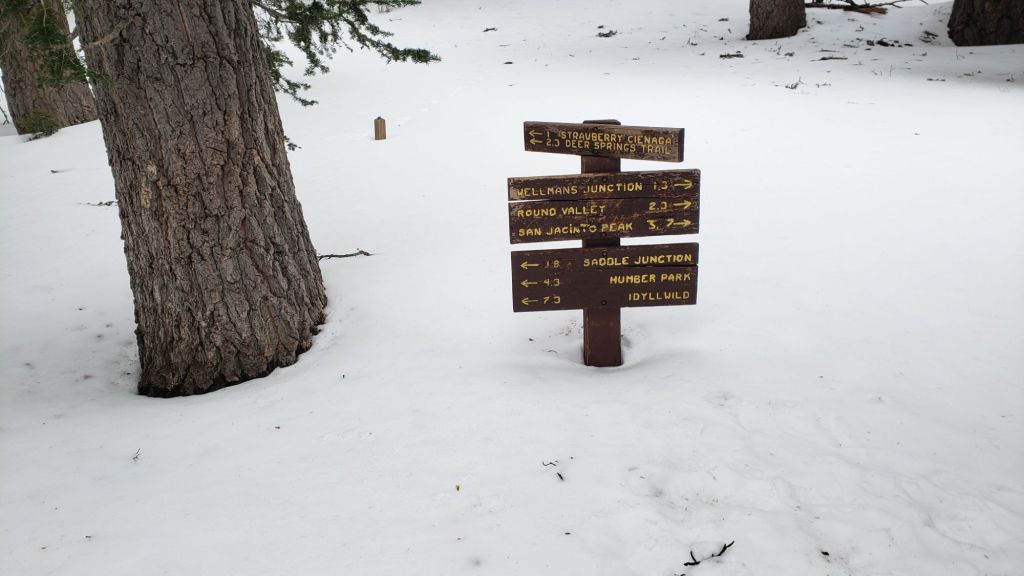
There is a possibility of minor snowfall spread across several days starting at the weekend (Saturday 23rd-Tuesday 26th November), as a dramatic storm passes well to our north. It remains unclear when (or even if) the storm impacts the San Jacinto mountains, with high country snow forecasts now only 0-2 inches. The relatively warm system will result in a high snow level near or even well above 9000 ft. Rainfall is expected to total less than 0.25 inch at mid elevations, potentially spread across more than two days.
Air temperatures will be near or below freezing above 10,000 ft from Saturday 23rd onward, with strong winds every day and hence windchill temperatures around the highest peaks generally well below freezing. Hikers should be prepared for winter temperatures in the high country.
Survey hikes by the Trail Report every day of the year in the San Jacinto mountains include varied and often circuitous routes to San Jacinto Peak currently 3-4 times per week, Tahquitz Peak weekly, plus a wide variety of other trails on intervening days.
Despite a failed monsoon this year and below-average winter precipitation last season (and so far this season), major springs, creeks, and pipeslargely continue to flow at this time (example photos in the previous Report linked here). Ephemeral water sources have been dry for months. Middle Spring on Devil’s Slide Trail finally dried up by 10th November. The Round Valley faucet continued to flow well as of 19th November. In the Tahquitz area meadows, the ephemeral creek in Tahquitz Valley is dry, however the Tahquitz Valley pipe (for those who know where it is) continues to flow well. The creek in Skunk Cabbage Meadow continues to trickle where it is crossed by the meadow trail. Tahquitz Creek is flowing gently at the northern end of Little Tahquitz Meadow, and near its source where it crosses the PCT at Mile 177 (photos below). Strawberry Cienega is functionally dry. Hidden Lake was 10% full in mid November (by surface area, not volume). Stone Creek is no longer flowing where it crosses Deer Springs Trail at about PCT Mile 183.6, and has dried downstream of that point.
Forest Service campgrounds at Boulder Basin, Dark Canyon, Marion Mountain, and Fern Basin all closed for the season earlier in November. The State Park Stone Creek campground is also now closed for the season. The fire lookout at Black Mountain closed for the season on 14th November, and Tahquitz Peak lookout will close on Friday 22nd.
The full beaver moon at dawn on 16th November 2024, about to set behind Marion Ridge as seen from Devil’s Slide Trail. So-called as indigenous peoples determined that this full moon typically coincided with beavers retreating to their lodges for the winter. Trees above about 7000 ft show a beautiful covering of rime ice on their windward (westerly) sides in the early morning light.
WEATHER
Temperatures have fluctuated wildly in November, and that pattern looks likely to continue for the remainder of the month. They were near or below seasonal the first few days of November before rising to above seasonal on 9th-14th. Temperatures dropped rapidly again from 15th, and are forecast to remain below seasonal until 19th.
Temperatures will be well above average on 20th-23rd, with 21st and 22nd in particular far warmer than seasonal for late November. Both of those days will be at least partly cloudy. Temperatures then drop rapidly on Saturday 23rd, associated with the passage of a cold front mainly to our north, then remaining below average until the end of November.
A major multi-day storm system passes to the northstarting this weekend (Saturday 23rd-Tuesday 26th November). As a relatively warm system, there will be a consequently high snow level at or even above 9000 ft. High country snow forecasts have ranged from 0-12 inches,but are now expected to be at the lower end of that range. Rainfall may be limited to less than 0.25 inch at mid elevations, spread across 2-3 days, mostly falling overnight on Saturday 24th, and perhaps throughout 25th-26th.
A further minor storm is tentatively forecast for 29th-30th November, but details remain unclear at this time, other than the likelihood that it will again be relatively mild, with a very high freeze level.
Winds are now strong (>20 mph) daily in the high country, significantly influencing the feel of temperatures and associated risks. Air temperatures will be near or below freezing above 10,000 ft until Tuesday 19th, and again from 23rd-29th (at least), hence windchill temperatures around the highest peaks will typically be well below freezing.
At San Jacinto Peak (3295m/10,810ft) on Tuesday 19th November 2024 at 1045 the air temperature was 31.3°F (0°C), with a windchill temperature of 16.1°F (-9°C), 26% relative humidity, and a moderate WNW wind sustained at 14 mph gusting to 24.1 mph.
At the Peak on Monday 18th November 2024 at 0820 the air temperature was 29.9°F (-1°C), with a windchill temperature of 10.8°F (-12°C), 22% relative humidity, and a steady WNW wind sustained at 18 mph gusting to 31.4 mph.
At the Peak on Saturday 16th November 2024 at 0835 the air temperature was 13.6°F (-10°C), with a windchill temperature of 0.5°F (-18°C), 100% relative humidity, and a cool NNE wind sustained at 5 mph gusting to 9.5 mph.
At the Peak on Friday 15th November 2024 at 0910 the air temperature was 17.8°F (-8°C), with a windchill temperature of -6.9°F (-22°C), 100% relative humidity, and a bitter WSW wind sustained at 16 mph gusting to 30.3 mph.
Wellman Divide (9700 ft), early morning on Friday 15th November 2024, with trees and bushes plastered in rime ice, plus an extremely light dusting of fine granular snow on the ground.
TRAIL CONDITIONS
There is currently no significant settled snow anywherein the San Jacinto mountains (this may change starting late on Saturday 23rd November, as discussed above).
Treefall hazards remain a problem along parts of the Pacific Crest Trail, most notably between Antsell Rock and South Peak. The disinterest of Forest Service and PCTA in maintaining this section of a world-famous trail for the five years prior to this summer was simply unconscionable. The good news is that at least half of the 132 trees down between Miles 170.5-175.5 have finally been cleared by work undertaken mainly in October 2024. A concentration of large downed trees still make for slow-going around Miles 170.5-172 (east side of Antsell Rock). A further 15 smaller trees are down from Miles 168.5-170.5 (Spitler Peak Trail to Zen Center Trail).
The Trail Report has largely completed trimming the formerly overgrown Wellman Trail in the past two months. Although only a short trail, it forms a major part of a well-traveled route to/from the high country peaks. It was last trimmed in 2020, also by the Trail Report, as sadly the State Park shows little interest in maintaining most trails in their jurisdiction.
On the Fuller Ridge Trail section of the PCT there are 12 trees down on the State Park section of the trail (Miles 185.5-189), which has not been maintained by that agency for many years. Several of these pose quite significant hazards for hikers. On the Forest Service section, the two major trunks at about Mile 190.1, present for about three years, were cut by USFS on 5th November.
Trees down on the Strawberry Trail section of the PCT (Miles 180.8-183, Annie’s Junction to Strawberry Junction) have remained uncut by the Forest Service for nearly a decade. About six hazards on this section are thankfully all relatively easy for hikers to negotiate.
About 12 treefall hazards on Deer Springs Trail include 8-9 in the upper trail that have been down and reported repeatedly for nearly a decade but with no action from the State Park. All but two of the treefall hazards down between Strawberry Junction and the top of Marion Mountain Trail (roughly PCT Miles 183-185) were removed by the Trail Report in late June.
Willow Creek Trail is nearing its 2020 condition, the last time the original trail route was fully cleared and passable. Almost all significant treefall hazards on the Forest Service section were cut by mid August (several uncut trees remain that need to be removed to fully restore the original trail route). Whitethorn trimming was largely completed, mainly by volunteers, on the Forest Service side in August and early September. On the State Park side some localized whitethorn trimming of the worst patches was undertaken in September, and the minor treefall hazards new in 2023/24 were removed, leaving just two major long term downed trees (both have simple workarounds for hikers).
The 34 treefall hazards that came down across Spitler Peak Trail during ice storms earlier in 2024 were cleared by the Trail Report in June, with two further trees recently removed in October. This brings to at least 122 the total number of downed trees removed by the Report from this trail in recent years. While another round of brush trimming work is required, in general the trail is currently in its best condition for more than a year. Spitler Creek continues to flow gently at its various crossings in the upper switchbacks (photo below), but Antsell Rock Creek adjacent to the trailhead has been dry for a couple of months.
The Caramba Trail from near Reeds Meadow through Laws Camp and on to Caramba, and the Cedar Trail from Willow Creek Trail to Laws, are euphemistically described by the Forest Service as “not maintained”. In reality both trails have been abandoned and functionally no longer exist. They are so heavily overgrown with dense whitethorn, which obscures dozens of downed trees, that I strongly advise hikers do not attempt to follow them (regardless of how much you may trust an app). An informaluse trail to Laws is much more direct, maintained, and avoids the challenging bushwhacking of the unmaintained trails (local Idyllwild hikers dubbed it the “King Trail” when I established the route in 2019). It leaves Willow Creek Trail exactly 1.0 mile from Saddle Junction, 0.46 mile from the Skunk Cabbage turning (trailhead at N 33.7796, W 116.6590). The route descends largely following established deer trails for 1.2 miles, meeting Willow Creek about 0.2 mile upstream from the site of the historic Laws Camp (the remains of which were destroyed by the 2013 Mountain Fire and subsequent flood and treefall damage). Eleven trees down on the King Trail were removed in June-July 2023. The tread of the trail received some damage from Tropical Storm Hilary last year. From Laws east to Caramba the route of the original Caramba Trail has been well-cairned by myself and others and can largely be followed with very careful route-finding. My 2023 survey counted about 110 trees down on this 2.1 miles of trail. It is especially obscure for the first 0.3 mile east of the Willow Creek crossing, becoming more obvious (but still subtle) as it descends towards Caramba. Very cautious navigation is advised throughout the area.
The Trail Report “adopted” Seven Pines Trail as a priority for maintenance work as the trail had a disproportionate number of lost hiker rescues in the past decade, and both State Park and Forest Service have shown no interest in maintaining the route for years. Since 2020 we have removed 75 downed trees and the trail is thoroughly trimmed and cleared multiple times annually. As of September 2024 the trail is largely clear of treefall hazards, with three down across the trail in its upper section, all easily passable for hikers. A further half-a-dozen downed trees close to the PCT junction would need to be removed to fully restore the original route of the trail. Although the condition of the trail is hugely improved, Seven Pines remains a genuine wilderness trail unlike the wider, bare, obvious routes of, for example, Devil’s Slide or Marion Mountain trails. Cautious navigation remains essential for those without considerable experience of hiking this trail. Be aware in particular that Seven Pines Trail becomes most obscure in the mile closest to its junction with Deer Springs Trail/PCT.
The Zen Center Trail continues its serious deterioration that started following the 2013 Mountain Fire, with a combination of vigorous regrowth and treefall hazards further obscuring the route with each passing season. The lower and upper thirds of this trail are partially cairned and not too bad for those who are very familiar with the former route, but even the experienced find navigating the central section tricky. Long trousers, scrambling gloves, and an enjoyment of bush-whacking are all strongly recommended.
Saddle Junction (8100 ft), early morning on 16th November 2024, with a patchy dusting of about 0.1 inch of snow. Evidence of this snowfall was gone by the following day.
While all time and labor is volunteered, the San Jacinto Trail Report uses small private donations to help cover operating costs. Your contribution keeps the Report available to all, free from advertising or paywalls, and independent from agencies. If you have found this Report useful, please consider using this link to the Donate page.Thank you very much for your support.
The well-known north spring at Wellman’s Cienega (9300 ft), with an impressive array of icicles but nevertheless continuing to flow well for the time of year, early morning 16th November 2024.
UPDATE 16th November 2024: further precipitation overnight was much more widespread than the previous day, but still minimal, with 0.1 inch of snow from 6400 ft elevation to San Jacinto Peak. Snow cover was most consistent from 8000-9500 ft, but again so thin as to be barely measurable. The mid morning air temperature at San Jacinto Peak (13.6°F/-10°C) was several degrees colder than on 15th, but without the strong wind of the previous day overall it felt milder. The San Bernardino range was more directly in the path of storm cells, and looked to have received 1-2 inches of snow.
UPDATE 15th November 2024: very minor precipitation overnight included the lightest dusting of snow (0.1 inch) above 9000 ft. I recorded a short video report from San Jacinto Peak following my morning ascent (linked here) that gives a feel for current conditions.
Wellman Divide (9700 ft), early morning on Friday 15th November 2024, with trees and bushes plastered in rime ice, plus an extremely light dusting of snow on the ground.
Temperatures have been pleasantly mild and largely above seasonal (for November) since Friday 8th. This is expected to change dramatically on Friday 15th, with temperatures dropping well below seasonal at all elevations until Tuesday 19th. Air temperatures will be well below freezing above 10,000 ft on 15th-18th, with strong winds most days and hence windchill temperatures around the highest peaks 0-10°F (-18° to -12°C). Hikers must be appropriately prepared for genuine winter temperatures. Precipitation is expected to be minimal, with perhaps an inch of snow at the highest elevations, and light rain (with a hint of snow possible) at mid elevations.
Survey hikes by the Trail Report every day of the year in the San Jacinto mountains include varied and often circuitous routes to San Jacinto Peak currently 3-4 times per week, Tahquitz Peak weekly, plus a wide variety of other trails on intervening days.
Despite a failed monsoon this year and below-average winter precipitation last season, major springs, creeks, and pipeslargely continue to flow at this time (example photos below). Ephemeral water sources have been dry for months. Middle Spring on Devil’s Slide Trail finally dried up by 10th November. The Round Valley faucet continued to flow well as of 11th November. In the Tahquitz area meadows, the ephemeral creek in Tahquitz Valley is dry, however the Tahquitz Valley pipe (for those who know where it is) continues to flow well. The creek in Skunk Cabbage Meadow continues to trickle where it is crossed by the meadow trail. Tahquitz Creek is flowing gently at the northern end of Little Tahquitz Meadow, and near its source where it crosses the PCT at Mile 177 (photos below). Two tiny springs at Strawberry Cienega are now functionally dry. Hidden Lake was 25% full in mid October (by surface area, not volume). Stone Creek is no longer flowing where it crosses Deer Springs Trail at about PCT Mile 183.6, and has dried downstream of that point.
Forest Service campgrounds at Boulder Basin and Dark Canyon are now closed for the season, Marion Mountain and Fern Basin campgrounds close after Tuesday 12th November. The State Park Stone Creek campground is also now closed for the season. The fire lookout at Black Mountain closed for the season on 14th November, and Tahquitz Peak lookout is expected to close on Saturday 23rd.
WEATHER
Temperatures were near or below seasonal the first few days of November before rising to above seasonal on 9th-14th. On a calm day, temperatures can be far above seasonal in the high country (for example see observations for 10th November at San Jacinto Peak below). Temperatures drop rapidly again from 15th, remaining well below seasonal until at least 20th.
Winds are now moderate or strong on most days in the high country, significantly influencing the feel of temperatures and associated risks. Strong westerly winds on 14th-15th herald the passage of a significant cold front, and consequently air temperatures will be well below freezing above 10,000 ft on 15th-18th, with windchill temperatures around the highest peaks around -5 to +10°F (-20° to -12°C). Conversely, strong Santa Ana – generally northerly – winds on 18th-21st may result in another significant warming (relatively speaking) on 21st-23rd.
Currently there is no significant new precipitation in the forecasts, although very light precipitation (possibly even a hint of snow) is expected at mid elevations on Friday 15th, with <2 inches of snow around the highest peaks tentatively forecast for Saturday 16th.
The highly changeable weather expected over the next few days is described in detail in the latest video (linked here) from NWS San Diego.
At San Jacinto Peak (3295m/10,810ft) on Monday 11th November 2024 at 0830 the air temperature was 37.1°F (3°C), with a windchill temperature of 24.1°F (-4°C), 22% relative humidity, and a stiff SW wind sustained at 14 mph gusting to 21.1 mph.
At the Peak on Sunday 10th November 2024 at 0840 the air temperature was 44.1°F (7°C), with a “windchill” temperature of 40.3°F (5°C), 20% relative humidity, and a barely discernable WNW breeze sustained at 1 mph gusting to 2.4 mph.
TRAIL CONDITIONS
There is currently no settled snow anywherein the San Jacinto mountains (and none in the forecast at present).
Treefall hazards remain a problem along parts of the Pacific Crest Trail, most notably between Antsell Rock and South Peak. The disinterest of Forest Service and PCTA in maintaining this section of a world-famous trail for the five years prior to this summer was simply unconscionable. The good news is that at least half of the 132 trees down between Miles 170.5-175.5 have finally been cleared by work undertaken mainly in October 2024. A concentration of large downed trees still make for slow-going around Miles 170.5-172 (east side of Antsell Rock). A further 15 smaller trees are down from Miles 168.5-170.5 (Spitler Peak Trail to Zen Center Trail).
The Trail Report has largely completed trimming the formerly overgrown Wellman Trail in the past two months. Although only a short trail, it forms a major part of a well-traveled route to/from the high country peaks. It was last trimmed in 2020, also by the Trail Report, as sadly the State Park shows little interest in maintaining most trails in their jurisdiction.
On the Fuller Ridge Trail section of the PCT there are 12 trees down on the State Park section of the trail (Miles 185.5-189), which has not been maintained by that agency for many years. Several of these pose quite significant hazards for hikers. On the Forest Service section, the two major trunks at about Mile 190.1, present for about three years, were cut by USFS on 5th November.
Trees down on the Strawberry Trail section of the PCT (Miles 180.8-183, Annie’s Junction to Strawberry Junction) have remained uncut by the Forest Service for nearly a decade. About six hazards on this section are thankfully all relatively easy for hikers to negotiate.
About 12 treefall hazards on Deer Springs Trail include 8-9 in the upper trail that have been down and reported repeatedly for nearly a decade but with no action from the State Park. All but two of the treefall hazards down between Strawberry Junction and the top of Marion Mountain Trail (roughly PCT Miles 183-185) were removed by the Trail Report in late June (example photos in an earlier Report linked here).
Willow Creek Trail is nearing its 2020 condition, the last time the original trail route was fully cleared and passable. Almost all significant treefall hazards on the Forest Service section were cut by mid August (several uncut trees remain that need to be removed to fully restore the original trail route). Whitethorn trimming was largely completed, mainly by volunteers, on the Forest Service side in August and early September. On the State Park side some localized whitethorn trimming of the worst patches was undertaken in September, and the minor treefall hazards new in 2023/24 were removed, leaving just two major long term downed trees (both have simple workarounds for hikers).
The 34 treefall hazards that came down across Spitler Peak Trail during ice storms earlier in 2024 were cleared by the Trail Report in June, with two further trees recently removed in October. This brings to at least 122 the total number of downed trees removed by the Report from this trail in recent years. While another round of brush trimming work is required, in general the trail is currently in its best condition for more than a year. Spitler Creek continues to flow gently at its various crossings in the upper switchbacks (photo below), but Antsell Rock Creek adjacent to the trailhead has been dry for a couple of months.
The Caramba Trail from near Reeds Meadow through Laws Camp and on to Caramba, and the Cedar Trail from Willow Creek Trail to Laws, are euphemistically described by the Forest Service as “not maintained”. In reality both trails have been abandoned and functionally no longer exist. They are so heavily overgrown with dense whitethorn, which obscures dozens of downed trees, that I strongly advise hikers do not attempt to follow them (regardless of how much you may trust an app). An informaluse trail to Laws is much more direct, maintained, and avoids the challenging bushwhacking of the unmaintained trails (local Idyllwild hikers dubbed it the “King Trail” when I established the route in 2019). It leaves Willow Creek Trail exactly 1.0 mile from Saddle Junction, 0.46 mile from the Skunk Cabbage turning (trailhead at N 33.7796, W 116.6590). The route descends largely following established deer trails for 1.2 miles, meeting Willow Creek about 0.2 mile upstream from the site of the historic Laws Camp (the remains of which were destroyed by the 2013 Mountain Fire and subsequent flood and treefall damage). Eleven trees down on the King Trail were removed in June-July 2023. The tread of the trail received some damage from Tropical Storm Hilary last year. From Laws east to Caramba the route of the original Caramba Trail has been well-cairned by myself and others and can largely be followed with very careful route-finding. My 2023 survey counted about 110 trees down on this 2.1 miles of trail. It is especially obscure for the first 0.3 mile east of the Willow Creek crossing, becoming more obvious (but still subtle) as it descends towards Caramba. Very cautious navigation is advised throughout the area.
The Trail Report “adopted” Seven Pines Trail as a priority for maintenance work as the trail had a disproportionate number of lost hiker rescues in the past decade, and both State Park and Forest Service have shown no interest in maintaining the route for years. Since 2020 we have removed 75 downed trees and the trail is thoroughly trimmed and cleared multiple times annually. As of September 2024 the trail is largely clear of treefall hazards, with three down across the trail in its upper section, all easily passable for hikers. A further half-a-dozen downed trees close to the PCT junction would need to be removed to fully restore the original route of the trail. Although the condition of the trail is hugely improved, Seven Pines remains a genuine wilderness trail unlike the wider, bare, obvious routes of, for example, Devil’s Slide or Marion Mountain trails. Cautious navigation remains essential for those without considerable experience of hiking this trail. Be aware in particular that Seven Pines Trail becomes most obscure in the mile closest to its junction with Deer Springs Trail/PCT.
The Zen Center Trail continues its serious deterioration that started following the 2013 Mountain Fire, with a combination of vigorous regrowth and treefall hazards further obscuring the route with each passing season. The lower and upper thirds of this trail are partially cairned and not too bad for those who are very familiar with the former route, but even the experienced find navigating the central section tricky. Long trousers, scrambling gloves, and an enjoyment of bush-whacking are all strongly recommended.
The well-known north spring at Wellman’s Cienega (9300 ft), now fringed with ice early in the morning every day, flowing well for the time of year, mid morning 11th November 2024.
While all time and labor is volunteered, the San Jacinto Trail Report uses small private donations to help cover operating costs. Your contribution keeps the Report available to all, free from advertising or paywalls, and independent from agencies. If you have found this Report useful, please consider using this link to the Donate page.Thank you very much for your support.
The creek in Little Round Valley (9750 ft) flowing steadily, early morning 1st November 2024. As in 2023, this creek is expected to flow until winter this year, although the flow rate has dropped substantially in the past month.The North Fork of the San Jacinto River where it crosses Fuller Ridge Trail at about PCT Mile 186.2, still flowing gently (albeit icily at the margins), mid morning 1st November 2024.Spitler Creek continuing to flow gently, here at its lowest crossing of Spitler Peak Trail about three miles up from the trailhead, 30th October 2024.Tahquitz Creek flowing steadily for the time of year just below its source (“Grethe Spring”) where it crosses the PCT at about Mile 177, 25th October 2024.Tahquitz Creek flowing well at the lower (north) end of Little Tahquitz Meadow, 25th October 2024.Willow Creek flowing weakly – but it should keep going until winter – where it crosses Willow Creek Trail, 25th October 2024. The creek in Skunk Cabbage Meadow just about flowing where it passes under the little log bridge, 25th October 2024.For those who know where it is, the pipe in Tahquitz Valley continues to flow very well, 25th October 2024.Wellman Divide (9700 ft) with a fresh overnight dusting of barely 0.25 inch of snow, early morning 29th October 2024. Almost all the snow had melted at that location when I returned that way just two hours later.
Temperatures in the first few days of November have been near or below seasonal. They are now forecast to be above seasonal (for November) starting Friday 8th for at least a week. The extremely light dusting of snow in the high country on 29th October was gone by Thursday 31st. The minor storm system tentatively forecast for 2nd-3rd November failed to materialize, with Idyllwild recording only 0.01 inch of drizzle and the high country staying above the cloud.
Survey hikes by the Trail Report every day of the year in the San Jacinto mountains include varied and often circuitous routes to San Jacinto Peak currently 2-4 times per week, Tahquitz Peak weekly, plus a wide variety of other trails on intervening days.
Despite a failed monsoon this year and below-average winter precipitation last season, major springs, creeks, and pipeslargely continue to flow at this time (example photos below). Ephemeral water sources have been dry for months. The Round Valley faucet continued to flow well as of 3rd November. In the Tahquitz area meadows, the ephemeral creek in Tahquitz Valley is dry, however the Tahquitz Valley pipe (for those who know where it is) continues to flow well. The creek in Skunk Cabbage Meadow continues to trickle where it is crossed by the meadow trail. Tahquitz Creek is flowing gently at the northern end of Little Tahquitz Meadow, and near its source where it crosses the PCT at Mile 177 (photos below). Two tiny springs at Strawberry Cienega are now barely trickling and not useful for filtering. Hidden Lake was 25% full in mid October (by surface area, not volume). Stone Creek is no longer flowing where it crosses Deer Springs Trail at about PCT Mile 183.6, and has dried downstream of that point.
Forest Service campgrounds at Boulder Basin and Dark Canyon are now closed for the season, Marion Mountain and Fern Basin campgrounds close after Tuesday 12th November. The State Park Stone Creek campground is also now closed for the season.
WEATHER
Although temperatures had initially been forecast to be near or below seasonal throughout the first third of November – and this has indeed been true of the first few days of the month – they will rise to above seasonal on 9th-14th before dropping rapidly again. The very light drizzle tentatively forecast on the evening of Monday 11th at mid elevations is now looking unlikely. Currently there is no significant new precipitation in the forecasts.
The weather for this week – including the possibility of some critical fire weather associated with Santa Ana winds – are described in more detail in the latest NWS San Diego video forecast (linked here). Santa Ana winds are expected to affect the San Jacinto mountains on 4th and 7th November.
At San Jacinto Peak (3295m/10,810ft) on Friday 8th November 2024 at 0830 the air temperature was 32.1°F (0°C), with a windchill temperature of 17.1°F (-8°C), 52% relative humidity, and a moderate NNE wind sustained at 9 mph gusting to 19.7 mph.
At the Peak on Wednesday 6th November 2024 at 0810 the air temperature was 27.9°F (-2°C), with a windchill temperature of 10.9°F (-12°C), 56% relative humidity, and a stiff WNW wind sustained at 15 mph gusting to 22.2 mph.
At the Peak on Monday 4th November 2024 at 0805 the air temperature was 30.5°F (-1°C), with a windchill temperature of 12.8°F (-11°C), 24% relative humidity, and a variable due North wind sustained at 10 mph gusting to 19.5 mph.
TRAIL CONDITIONS
According to the State Park Facebook page (linked here) the Skyline Trail reopened on 4th November. It is frankly unsurprising to note in the text that the State Park doesn’t appear to understand the difference between the Skyline Trail and Cactus-to-Clouds (C2C) route.
Treefall hazards remain a problem along parts of the Pacific Crest Trail, most notably between Antsell Rock and South Peak. The disinterest of Forest Service and PCTA in maintaining this section of a world-famous trail for the five years prior to this summer was simply unconscionable. The good news is that at least half of the 132 trees down between Miles 170.5-175.5have finally been cleared by work mainly in October 2024. A concentration of large downed trees make for especially slow-going around Miles 170.5-172 (east side of Antsell Rock), with the other formerly challenging area (Miles 174-175, east and south of Red Tahquitz) now cleared. A further 15 smaller trees are down from Miles 168.5-170.5 (Spitler Peak Trail to Zen Center Trail).
The Trail Report has largely completed trimming the formerly overgrown Wellman Trail in the past two months. Although only a short trail, it forms a major part of a well-traveled route to/from the high country peaks. It was last trimmed in 2020, also by the Trail Report, as sadly the State Park shows little interest in maintaining most trails in their jurisdiction.
On the Fuller Ridge Trail section of the PCT there are 12 trees down on the State Park section of the trail (Miles 185.5-189), which has not been maintained by that agency for many years. Several of these pose quite significant hazards for hikers. On the Forest Service section, the two major trunks at about Mile 190.1, present for about three years, were cut by USFS on 5th November.
Trees down on the Strawberry Trail section of the PCT (Miles 180.8-183, Annie’s Junction to Strawberry Junction) have remained uncut by the Forest Service for nearly a decade now. About six hazards on this section are thankfully all relatively easy for hikers to negotiate.
About 12 treefall hazards on Deer Springs Trail include 8-9 in the upper trail that have been down and reported repeatedly for nearly a decade but with no action from the State Park. All but two of the treefall hazards down between Strawberry Junction and the top of Marion Mountain Trail (roughly PCT Miles 183-185) were removed by the Trail Report in late June (example photos in an earlier Report linked here).
Willow Creek Trail is significantly improved and nearing its 2020 condition (the last time the original trail route was fully cleared and passable). Almost all significant treefall hazards on the Forest Service section were cut by mid August (several uncut trees remain that need to be removed to fully restore the original trail route). Whitethorn trimming was largely completed, mainly by volunteers, on the Forest Service side in August and early September. On the State Park side some localized whitethorn trimming of the worst patches was undertaken in September, and the minor treefall hazards new in 2023/24 were removed, leaving just two major long term downed trees (both have simple workarounds for hikers).
The 34 treefall hazards that came down across Spitler Peak Trail during ice storms earlier in 2024 were cleared by the Trail Report in June, with two further trees recently removed in October. This brings to at least 122 the total number of downed trees removed by the Report from this trail in recent years. While another round of brush trimming work is required, in general the trail is currently in its best condition for more than a year. Spitler Creek continues to flow gently at its various crossings in the upper switchbacks (photo below), but Antsell Rock Creek adjacent to the trailhead has been dry for a couple of months.
The Caramba Trail from near Reeds Meadow through Laws Camp and on to Caramba, and the Cedar Trail from Willow Creek Trail to Laws, are euphemistically described by the Forest Service as “not maintained”. In reality both trails have been abandoned and functionally no longer exist. They are so heavily overgrown with dense whitethorn, which obscures dozens of downed trees, that I strongly advise hikers do not attempt to follow them (regardless of how much you may trust an app). An informaluse trail to Laws is much more direct, maintained, and avoids the challenging bushwhacking of the unmaintained trails (local Idyllwild hikers dubbed it the “King Trail” when I established the route in 2019). It leaves Willow Creek Trail exactly 1.0 mile from Saddle Junction, 0.46 mile from the Skunk Cabbage turning (trailhead at N 33.7796, W 116.6590). The route descends largely following established deer trails for 1.2 miles, meeting Willow Creek about 0.2 mile upstream from the site of the historic Laws Camp (the remains of which were destroyed by the 2013 Mountain Fire and subsequent flood and treefall damage). Eleven trees down on the King Trail were removed in June-July 2023. The tread of the trail received some damage from Tropical Storm Hilary last year. From Laws east to Caramba the route of the original Caramba Trail has been well-cairned by myself and others and can largely be followed with very careful route-finding. My 2023 survey counted about 110 trees down on this 2.1 miles of trail. It is especially obscure for the first 0.3 mile east of the Willow Creek crossing, becoming more obvious (but still subtle) as it descends towards Caramba. Very cautious navigation is advised throughout the area.
The Trail Report “adopted” Seven Pines Trail as a priority for maintenance work as the trail had a disproportionate number of lost hiker rescues in the past decade, and both State Park and Forest Service have shown no interest in maintaining the route for years. Since 2020 we have removed 75 downed trees and the trail is thoroughly trimmed and cleared multiple times annually. As of September 2024 the trail is largely clear of treefall hazards, with three down across the trail in its upper section, all easily passable for hikers. A further half-a-dozen downed trees close to the PCT junction would need to be removed to fully restore the original route of the trail. Although the condition of the trail is hugely improved, Seven Pines remains a genuine wilderness trail unlike the wider, bare, obvious routes of, for example, Devil’s Slide or Marion Mountain trails. Cautious navigation remains essential for those without considerable experience of hiking this trail. Be aware in particular that Seven Pines Trail becomes most obscure in the mile closest to its junction with Deer Springs Trail/PCT.
The Zen Center Trail continues its serious deterioration that started following the 2013 Mountain Fire, with a combination of vigorous regrowth and treefall hazards further obscuring the route with each passing season. The lower and upper thirds of this trail are partially cairned and not too bad for those who are very familiar with the former route, but even the experienced find navigating the central section tricky. Long trousers, scrambling gloves, and an enjoyment of bush-whacking are all strongly recommended.
The well-known north spring at Wellman’s Cienega (9300 ft), with now daily icicles, flowing well for the time of year, early morning 6th November 2024.
While all time and labor is volunteered, the San Jacinto Trail Report uses small private donations to help cover operating costs. Your contribution keeps the Report available to all, free from advertising or paywalls, and independent from agencies. If you have found this Report useful, please consider using this link to the Donate page.Thank you very much for your support.
The creek in Little Round Valley (9750 ft) flowing steadily, early morning 1st November 2024. As in 2023, this creek is expected to flow until winter this year, although the flow rate has dropped substantially in the past month.The North Fork of the San Jacinto River where it crosses Fuller Ridge Trail at about PCT Mile 186.2, still flowing gently (albeit icily at the margins), mid morning 1st November 2024.Spitler Creek continuing to flow gently, here at its lowest crossing of Spitler Peak Trail about three miles up from the trailhead, 30th October 2024.Tahquitz Creek flowing steadily for the time of year just below its source (“Grethe Spring”) where it crosses the PCT at about Mile 177, 25th October 2024.Tahquitz Creek flowing well at the lower (north) end of Little Tahquitz Meadow, 25th October 2024.Willow Creek flowing weakly – but it should keep going until winter – where it crosses Willow Creek Trail, 25th October 2024. The creek in Skunk Cabbage Meadow just about flowing where it passes under the little log bridge, 25th October 2024.For those who know where it is, the pipe in Tahquitz Valley continues to flow very well, 25th October 2024.Relatively fresh Mountain Lion scat in the middle of upper Spitler Peak Trail (6900 ft elevation), 30th October 2024. I noticed the scat contained an entire half hoof of a deer, and placed it immediately right of the knife for clarity. It is rare for lions to eat deer legs – which have very little flesh – let alone the hooves. The knife is 3.6 inches long for scale.Wellman Divide (9700 ft) with a fresh overnight dusting of barely 0.25 inch of snow, early morning 29th October 2024. Almost all the snow had melted at that location when I returned that way two hours later.
After a mild October largely dominated by warm, dry weather, temperatures abruptly dropped to below seasonal on Monday 28th. The passage of a minor storm system that night produced a light dusting of snow above 9000 ft, the first widespread snow of the season, although barely measuring 0.25 inch at its deepest on San Jacinto Peak. My short video report from the Peak on the morning of Tuesday 29th is linked here. Idyllwild recorded only 0.02 inch of drizzle, but damp trails and cold temperatures made for a very welcome change. Most snow below 10,000 ft had already melted by late morning on 29th, and was gone around the highest peaks by Thursday 31st.
Another minor storm system was tentatively forecast for the weekend on 2nd-3rd November, but now appears most likely to largely pass to the north and east of our region, with very little precipitation now expected. Nevertheless, hikers heading to the high country on 2nd-3rd November should be prepared for air temperatures below freezing, and windchills well below freezing. The next forecast precipitation events are possible minor storms around 6th-7th and 12th-13th November.
Survey hikes by the Trail Report every day of the year in the San Jacinto mountains include varied and often circuitous routes to San Jacinto Peak currently 2-4 times per week, Tahquitz Peak weekly, plus a wide variety of other trails on intervening days.
Despite a failed monsoon this year and below-average winter precipitation last season, major springs, creeks, and pipeslargely continue to flow at this time (example photos below). Ephemeral water sources have been dry for months. The Round Valley faucet continued to flow well as of 31st October. In the Tahquitz area meadows, the ephemeral creek in Tahquitz Valley is dry, however the Tahquitz Valley pipe (for those who know where it is) continues to flow well. The creek in Skunk Cabbage Meadow continues to trickle where it is crossed by the meadow trail. Tahquitz Creek is flowing gently at the northern end of Little Tahquitz Meadow, and near its source where it crosses the PCT at Mile 177 (photos below). Two tiny springs at Strawberry Cienega are now barely trickling and not useful for filtering. Hidden Lake was 25% full in mid October (by surface area, not volume). Stone Creek is no longer flowing where it crosses Deer Springs Trail at about PCT Mile 183.6, and has dried downstream of that point.
The faintest dusting of snow on 29th October 2024 at 9000 ft on the PCT around Mile 180.6 was sufficient to record some very fresh Mountain Lion tracks, photo taken just after sunrise.
WEATHER
The shift from (too) many months of hot, dry, summer weather into wintery temperatures has been rapid, with a token autumn lasting no more than a week or two. Temperatures are forecast to be near or below seasonal for the remaining days of October and throughout the first third of November (at least). Some days may feel even cooler, as they will be partly or mostly cloudy.
The next minor storm system is expected on 2nd-3rd November, but may now pass largely to the north of the San Jacinto mountains. Light rain (at mid elevations) is possible at anytime from late morning Saturday into Sunday, most likely on Saturday evening, with less than 0.1 inch forecast in Idyllwild. Very light snowfall (in the high country) is possible, also most likely on Saturday evening, but is not now expected to total more than 0.5 inch at most around the highest peaks. Further minor storm systems are tentatively forecast around 7th and 12th November.
The weather patterns for the next week – including the possibility of some critical fire weather associated with Santa Ana winds between the minor storm systems – are described in more detail in the latest NWS San Diego video forecast (linked here).
At San Jacinto Peak (3295m/10,810ft) on Friday 1st November 2024 at 0820 the air temperature was 36.8°F (3°C), with a windchill temperature of 25.5°F (-4°C), 13% relative humidity, and a steady due West wind sustained at 11 mph gusting to 14.8 mph.
At the Peak on Thursday 31st October 2024 at 0840 the air temperature was 32.8°F (0°C), with a windchill temperature of 19.9°F (-6°C), 17% relative humidity, and a fresh due West wind sustained at 9 mph gusting to 14.3 mph.
At the Peak on Tuesday 29th October 2024 at 0900 the air temperature was 22.4°F (-5°C), with a windchill temperature of 2.8°F (-16°C), 35% relative humidity, and a chilly WNW wind sustained at 8 mph gusting to 18.8 mph.
My first boot tracks of the winter through snow, albeit less than 0.25 inch deep, at 9800 ft on the Peak Trail, early morning 29th October 2024. Only bare ground and some rocks were cold enough for snow to settle, with the bushes and trees remaining snow-free (although exposed trees had a reasonable covering of rime ice).
TRAIL CONDITIONS
According to the State Park Facebook page (linked here) the Skyline Trail remains closed in the section under their jurisdiction (from about 5800 ft to Grubb’s Notch). No reason has been given, and at this time of year it is clearly neither because of hot weather nor snow/ice conditions. In the absence of an explanation there has been speculation that the State Park is trying to permanently shut the trail.
Treefall hazards remain a significant problem along parts of the Pacific Crest Trail, most notably between Antsell Rock and South Peak. The disinterest of Forest Service and PCTA in maintaining this section of a world-famous trail for the five years prior to this summer was simply unconscionable. The good news is that nearly half of the 132 trees down between Miles 170.5-175.5have finally been cleared by work in the middle two weeks of October 2024. The remainder are scheduled for removal in early November. A concentration of large downed trees make for especially slow-going around Miles 170.5-172 (east side of Antsell Rock), with the other formerly challenging area (Miles 174-175, east and south of Red Tahquitz) now largely cleared. A further 15 smaller trees are down from Miles 168.5-170.5 (Spitler Peak Trail to Zen Center Trail).
The Trail Report has largely completed trimming the formerly overgrown Wellman Trail in the past two months. Although only a short trail, it forms a major part of a well-traveled route to/from the high country peaks. It was last trimmed in 2020, also by the Trail Report, as sadly the State Park shows little interest in maintaining this trail (and too many other trails) in their jurisdiction.
On the Fuller Ridge Trail section of the PCT there are 12 trees down on the State Park section of the trail (Miles 185.5-189), which has not been maintained by that agency for many years. Several of these pose quite significant hazards for hikers. On the Forest Service section, the only treefall hazard is two massive trunks at about Mile 190.1 that has been present for about three years.
Trees down on the Strawberry Trail section of the PCT (Miles 180.8-183, Annie’s Junction to Strawberry Junction) have remained uncut by the Forest Service for nearly a decade now. About six hazards on this section are thankfully all relatively easy for hikers to negotiate.
About 12 treefall hazards on Deer Springs Trail include 8-9 in the upper trail that have been down and reported repeatedly for nearly a decade but with no action from the State Park. All but two of the treefall hazards down between Strawberry Junction and the top of Marion Mountain Trail (roughly PCT Miles 183-185) were removed by the Trail Report in late June (example photos in an earlier Report linked here).
Willow Creek Trail is significantly improved and nearing its 2020 condition (the last time the original trail route was fully cleared and passable). Almost all significant treefall hazards on the Forest Service section were cut by mid August (several uncut trees remain that need to be removed to fully restore the original trail route). Whitethorn trimming was largely completed, mainly by volunteers, on the Forest Service side in August and early September. On the State Park side some localized whitethorn trimming of the worst patches was undertaken in September, and the minor treefall hazards new in 2023/24 were removed, leaving just two major long term downed trees (both have simple workarounds for hikers).
The 34 treefall hazards that came down across Spitler Peak Trail during ice storms earlier in 2024 were cleared by the Trail Report in June, with two further trees recently removed in October. This brings to about 122 the total number of downed trees removed by the Report from this trail in recent years. While another round of brush trimming work is required, in general the trail is currently in its best condition for more than a year. Spitler Creek continues to flow gently at its various crossings in the upper switchbacks (photo below), but Antsell Rock Creek adjacent to the trailhead has been dry for a couple of months.
The Caramba Trail from near Reeds Meadow through Laws Camp and on to Caramba, and the Cedar Trail from Willow Creek Trail to Laws, are euphemistically described by the Forest Service as “not maintained”. In reality both trails have been abandoned and functionally no longer exist. They are so heavily overgrown with dense whitethorn, which obscures dozens of downed trees, that I strongly advise hikers do not attempt to follow them (regardless of how much you may trust an app). An informaluse trail to Laws is much more direct, maintained, and avoids the challenging bushwhacking of the unmaintained trails (local Idyllwild hikers dubbed it the “King Trail” when I established the route in 2019). It leaves Willow Creek Trail exactly 1.0 mile from Saddle Junction, 0.46 mile from the Skunk Cabbage turning (trailhead at N 33.7796, W 116.6590). The route descends largely following established deer trails for 1.2 miles, meeting Willow Creek about 0.2 mile upstream from the site of the historic Laws Camp (the remains of which were destroyed by the 2013 Mountain Fire and subsequent flood and treefall damage). Eleven trees down on the King Trail were removed in June-July 2023. The tread of the trail received some damage from Tropical Storm Hilary last year. From Laws east to Caramba the route of the original Caramba Trail has been well-cairned by myself and others and can largely be followed with very careful route-finding. My 2023 survey counted about 110 trees down on this 2.1 miles of trail. It is especially obscure for the first 0.3 mile east of the Willow Creek crossing, becoming more obvious (but still subtle) as it descends towards Caramba. Very cautious navigation is advised throughout the area.
The Trail Report “adopted” Seven Pines Trail as a priority for maintenance work as the trail had a disproportionate number of lost hiker rescues in the past decade, and both State Park and Forest Service have shown no interest in maintaining the route for years. Since 2020 we have removed 75 downed trees and the trail is thoroughly trimmed and cleared multiple times annually. As of September 2024 the trail is largely clear of treefall hazards, with three down across the trail in its upper section, all easily passable for hikers. A further half-a-dozen downed trees close to the PCT junction would need to be removed to fully restore the original route of the trail. Although the condition of the trail is hugely improved, Seven Pines remains a genuine wilderness trail unlike the wider, bare, obvious routes of, for example, Devil’s Slide or Marion Mountain trails. Cautious navigation remains essential for those without considerable experience of hiking this trail. Be aware in particular that Seven Pines Trail becomes most obscure in the mile closest to its junction with Deer Springs Trail/PCT.
The Zen Center Trail continues its serious deterioration that started following the 2013 Mountain Fire, with a combination of vigorous regrowth and treefall hazards further obscuring the route with each passing season. The lower and upper thirds of this trail are partially cairned and not too bad for those who are very familiar with the former route, but even the experienced find navigating the central section tricky. Long trousers, scrambling gloves, and an enjoyment of bush-whacking are all strongly recommended.
Wellman Divide (9700 ft) with a fresh overnight dusting of barely 0.25 inch of snow, early morning 29th October 2024. Almost all the snow had melted at that location when I returned that way two hours later.
While all time and labor is volunteered, the San Jacinto Trail Report uses small private donations to help cover operating costs. Your contribution keeps the Report available to all, free from advertising or paywalls, and independent from agencies. If you have found this Report useful, please consider using this link to the Donate page.Thank you very much for your support.
The well-known north spring at Wellman’s Cienega (9300 ft), complete with a fresh array of icicles, flowing well for the time of year, early morning 29th October 2024.The creek in Little Round Valley (9750 ft) flowing steadily, early morning 1st November 2024. As in 2023, this creek is expected to flow until winter this year, although the flow rate has dropped substantially in the past month.The North Fork of the San Jacinto River where it crosses Fuller Ridge Trail at about PCT Mile 186.2, still flowing gently (albeit icily at the margins), mid morning 1st November 2024.Spitler Creek continuing to flow gently, here at its lowest crossing of Spitler Peak Trail about three miles up from the trailhead, 30th October 2024.Tahquitz Creek flowing steadily for the time of year just below its source (“Grethe Spring”) where it crosses the PCT at about Mile 177, 25th October 2024.Tahquitz Creek flowing well at the lower (north) end of Little Tahquitz Meadow, 25th October 2024.Willow Creek flowing weakly – but it should keep going until winter – where it crosses Willow Creek Trail, 25th October 2024. The creek in Skunk Cabbage Meadow just about flowing where it passes under the little log bridge, 25th October 2024.For those who know where it is, the pipe in Tahquitz Valley continues to flow very well, 25th October 2024.Relatively fresh Mountain Lion scat in the middle of upper Spitler Peak Trail (6900 ft elevation), 30th October 2024. I noticed the scat contained an entire half hoof of a deer, and placed it immediately right of the knife for clarity. It is rare for lions to eat deer legs – which have very little flesh – let alone the hooves. The knife is 3.6 inches long for scale.
UPDATE Tuesday 29th October 2024: a light dusting of snow above 9000 ft overnight is described in more detail in a short video report linked here. A further update and photos to follow this afternoon.
____________________________
Temperatures remain well above seasonal for late October until Monday 28th. While an air temperature of 52.0°F (11°C) at San Jacinto Peak in the early morning of Wednesday 23rd may not sound especially warm, it is about 15-20°F above normal (based on my decade of past data), and it was remarkable to be completely comfortable in just a t-shirt and shorts at 10,800 ft elevation in late October. Thankfully next week temperatures drop dramatically to truly autumnal temperatures, hopefully this time staying that way until winter (details under Weather below).
With a failed monsoon season in most of Southern California, fire risk remains severe everywhere, at least until temperatures drop markedly and humidity rises. A comprehensive fire ban is in place on Forest Service lands throughout the San Jacinto Ranger District (link to USFS order here) and in all Idyllwild campgrounds. Campfires are of course always prohibited throughout both the State Park and National Forest wilderness areas.
Survey hikes by the Trail Report every day year-round in the San Jacinto mountains include varied and often circuitous routes to San Jacinto Peak typically 2-4 times per week, Tahquitz Peak weekly, plus a wide variety of other trails on intervening days.
Major springs, creeks, and pipes largely continue to flow at this time (example photos below). Flow rates continue to drop steadily at all elevations and ephemeral water sources have been dry for months. The Round Valley faucet continued to flow well as of 25th October. In the Tahquitz area meadows, the ephemeral creek in Tahquitz Valley is dry, however the Tahquitz Valley pipe (for those who know where it is) continues to flow well. The creek in Skunk Cabbage Meadow continues to trickle where it is crossed by the meadow trail. Tahquitz Creek is flowing gently at the northern end of Little Tahquitz Meadow, and near its source where it crosses the PCT at Mile 177 (photos below). Two tiny springs at Strawberry Cienega are now barely trickling and not useful for filtering. Hidden Lake was 25% full in mid October (by surface area, not volume). Stone Creek is no longer flowing where it crosses Deer Springs Trail at about PCT Mile 183.6, and has dried downstream of that point.
Sunrise as seen from 9150 ft near Wellman’s Cienega, 18th October 2024. Rather than rising over the Chocolate Mountains as is normal at this time of year, the sun instead rose over a thick layer of water vapor mixed with smoke, dust, and doubtless other pollutants that were densely filling the Coachella Valley below 9000 ft elevation. Air quality has improved greatly in more recent days.
WEATHER
A major cooling trend starts Monday 28th October, replacing above average temperatures that have prevailed in recent days with temperatures that may be well below seasonal into the first few days of November. From 29th October to at least 2nd November temperatures will be below seasonal at mid elevations (but about average in the high country), with a slim chance of light precipitation tentatively forecast for 29th-30th. Throughout next week, air temperatures in the high country will be near freezing, with windchill temperatures around the high peaks below freezing.
At San Jacinto Peak (3295m/10,810ft) on Wednesday 23rd October 2024 at 0800 the air temperature was 52.0°F (11°C), with a “windchill” temperature of 51.6°F (11°C), 13% relative humidity, and a hint of a NE breeze sustained at 1 mph gusting to 2.0 mph.
At the Peak on Monday 21st October 2024 at 0825 the air temperature was 43.6°F (6°C), with a windchill temperature of 41.2°F (5°C), 26% relative humidity, and a very gentle due West breeze sustained at 1 mph gusting to 2.7 mph.
TRAIL CONDITIONS
According to the State Park Facebook page (linked here) the Skyline Trail remains closed in the section under their jurisdiction (from about 5800 ft to Grubb’s Notch), although no reason is given.
Treefall hazards remain a significant problem along parts of the Pacific Crest Trail, most notably between Antsell Rock and South Peak. The disinterest of Forest Service and PCTA in maintaining this section of a world-famous trail for the five years prior to this summer was simply unconscionable. The good news is that nearly half of the 132 trees down between Miles 170.5-175.5have finally been cleared by work in the middle two weeks of October 2024. A concentration of large downed trees make for especially slow-going around Miles 170.5-172 (east side of Antsell Rock), with the other formerly challenging area (Miles 174-175, east and south of Red Tahquitz) now largely cleared. A further 15 smaller trees are down from Miles 168.5-170.5 (Spitler Peak Trail to Zen Center Trail).
The Trail Report has been trimming the formerly overgrown Wellman Trail since August. Although only a short trail, it forms a major part of a well-traveled route to/from the high country peaks. It was last trimmed in 2020, also by the Trail Report, as sadly the State Park shows little interest in maintaining this trail (and too many other trails) in their jurisdiction.
On the Fuller Ridge Trail section of the PCT there are 12 trees down on the State Park section of the trail (Miles 185.5-189), which has not been maintained by that agency for many years. Several of these pose quite significant hazards for hikers. On the Forest Service section, the only treefall hazard is two massive trunks at about Mile 190.1 that has been present for about three years.
Trees down on the Strawberry Trail section of the PCT (Miles 180.8-183, Annie’s Junction to Strawberry Junction) have remained uncut by the Forest Service for nearly a decade now. About six hazards on this section are thankfully all relatively easy for hikers to negotiate.
About 12 treefall hazards on Deer Springs Trail include 8-9 in the upper trail that have been down and reported repeatedly for nearly a decade but with no action from the State Park. All but two of the treefall hazards down between Strawberry Junction and the top of Marion Mountain Trail (roughly PCT Miles 183-185) were removed by the Trail Report in late June (example photos in an earlier Report linked here).
Willow Creek Trail is significantly improved and nearing its 2020 condition (the last time the original trail route was fully cleared and passable). Almost all significant treefall hazards on the Forest Service section were cut by mid August (several uncut trees remain that need to be removed to fully restore the original trail route). Whitethorn trimming was largely completed, mainly by volunteers, on the Forest Service side in August and early September. On the State Park side some localized whitethorn trimming of the worst patches was undertaken in September, and the minor treefall hazards new in 2023/24 were removed, leaving just two major long term downed trees (both have simple workarounds for hikers).
The 34 treefall hazards that came down across Spitler Peak Trail during ice storms in February 2024 were cleared by the Trail Report in June. This work brings to 120+ the total number of trees removed by the Report from this trail in the past three years. Note that currently the upper trail in particular is heavily overgrown with lush seasonal vegetation.
The Caramba Trail from near Reeds Meadow through Laws Camp and on to Caramba, and the Cedar Trail from Willow Creek Trail to Laws, are euphemistically described by the Forest Service as “not maintained”. In reality both trails have been abandoned and functionally no longer exist. They are so heavily overgrown with dense whitethorn, which obscures dozens of downed trees, that I strongly advise hikers do not attempt to follow them (regardless of how much you may trust an app). An informaluse trail to Laws is much more direct, maintained, and avoids the challenging bushwhacking of the unmaintained trails (local Idyllwild hikers dubbed it the “King Trail” when I established the route in 2019). It leaves Willow Creek Trail exactly 1.0 mile from Saddle Junction, 0.46 mile from the Skunk Cabbage turning (trailhead at N 33.7796, W 116.6590). The route descends largely following established deer trails for 1.2 miles, meeting Willow Creek about 0.2 mile upstream from the site of the historic Laws Camp (the remains of which were destroyed by the 2013 Mountain Fire and subsequent flood and treefall damage). Eleven trees down on the King Trail were removed in June-July 2023. The tread of the trail received some damage from Tropical Storm Hilary last year. From Laws east to Caramba the route of the original Caramba Trail has been well-cairned by myself and others and can largely be followed with very careful route-finding. My 2023 survey counted about 110 trees down on this 2.1 miles of trail. It is especially obscure for the first 0.3 mile east of the Willow Creek crossing, becoming more obvious (but still subtle) as it descends towards Caramba. Very cautious navigation is advised throughout the area.
The Trail Report “adopted” Seven Pines Trail as a priority for maintenance work as the trail had a disproportionate number of lost hiker rescues in the past decade, and both State Park and Forest Service have shown no interest in maintaining the route for years. Since 2020 we have removed 75 downed trees and the trail is thoroughly trimmed and cleared multiple times annually. As of September 2024 the trail is largely clear of treefall hazards, with three down across the trail in its upper section, all easily passable for hikers. A further half-a-dozen downed trees close to the PCT junction would need to be removed to fully restore the original route of the trail. Although the condition of the trail is hugely improved, Seven Pines remains a genuine wilderness trail unlike the wider, bare, obvious routes of, for example, Devil’s Slide or Marion Mountain trails. Cautious navigation remains essential for those without considerable experience of hiking this trail. Be aware in particular that Seven Pines Trail becomes most obscure in the mile closest to its junction with Deer Springs Trail/PCT.
The Zen Center Trail continues its serious deterioration that started following the 2013 Mountain Fire, with a combination of vigorous regrowth and treefall hazards further obscuring the route with each passing season. The lower and upper thirds of this trail are partially cairned and not too bad for those who are very familiar with the former route, but even the experienced find navigating the central section tricky. Long trousers, scrambling gloves, and an enjoyment of bush-whacking are all strongly recommended.
The well-known north spring at Wellman’s Cienega (9300 ft) flowing well for the time of year, late morning 25th October 2024, This spring will continue to flow gently into the winter this year.
While all time and labor is volunteered, the San Jacinto Trail Report uses small private donations to help cover operating costs. Your contribution keeps the Report available to all, free from advertising or paywalls, and independent from agencies. If you have found this Report useful, please consider using this link to the Donate page.Thank you very much for your support.
Tahquitz Creek flowing steadily for the time of year just below its source (“Grethe Spring”) where it crosses the PCT at about Mile 177, 25th October 2024.Tahquitz Creek flowing well at the lower (north) end of Little Tahquitz Meadow, 25th October 2024.The creek in Little Round Valley (9750 ft) flowing steadily, early morning 11th October 2024. As in 2023, this creek is likely to continue to flow until winter this year, although the flow rate continues to drop slowly.Willow Creek flowing weakly – but it should keep going until winter – where it crosses Willow Creek Trail, 25th October 2024. The creek in Skunk Cabbage Meadow just about flowing where it passes under the little log bridge, 25th October 2024.For those who know where it is, the pipe in Tahquitz Valley continues to flow very well, 25th October 2024.The North Fork of the San Jacinto River where it crosses upper Deer Springs Trail not far below its source (“Bed Springs”), early morning 11th October 2024. One of the few truly perennial water sources on the mountain these days, water will continue flowing at this location until winter, despite its meagre flow this autumn.
Since Friday 11th temperatures have felt pleasantly autumnal at all elevations, albeit slightly above seasonal for mid October. Temperatures briefly fall to well below average on 17th-19th, before quickly rising once again. Windchill temperatures in the high country have generally been around freezing, but below freezing on 18th-19th, e.g., 31.3°F (0°C) at San Jacinto Peak on Friday 11th, and 22.5°F (-5°C) on Friday 18th. Forecasts tentatively suggested the possibility of very light precipitation on Friday 18th, but ultimately there was no measurable drizzle. Between 22nd-25th October temperatures are forecast to rise again to well above seasonal.
With a failed monsoon season in most of Southern California, fire risk remains severe everywhere. A comprehensive fire ban is in place on Forest Service lands throughout the San Jacinto Ranger District (link to USFS order here) and in all Idyllwild campgrounds. Campfires are of course always prohibited throughout both the State Park and National Forest wilderness areas.
Survey hikes by the Trail Report every day year-round in the San Jacinto mountains include varied and often circuitous routes to San Jacinto Peak typically 3-5 times per week, plus a wide variety of other trails on intervening days.
Major springs, creeks, and pipes largely continue to flow at this time (example photos below). Flow rates continue to drop steadily at all elevations and ephemeral water sources have been dry for many weeks or months. The Round Valley faucet continued to flow well as of 9th October. In the Tahquitz area meadows, the minor creek in Skunk Cabbage Meadow continues to just trickle, but the ephemeral creek in Tahquitz Valley is dry. Tahquitz Creek is flowing gently at the northern end of Little Tahquitz Meadow, and near its source where it crosses the PCT at Mile 177. Two tiny springs at Strawberry Cienega just about continue to trickle. Hidden Lake was c.30% full in early October (by surface area, not volume). Stone Creek is no longer flowing where it crosses Deer Springs Trail at about PCT Mile 183.6, and has dried completely downstream of that point.
The Palm Springs Aerial Tramway closed on Monday 9th September 2024 for annual maintenance, and is now scheduled to reopen on Friday 18th October.
According to the State Park Facebook page (linked here) the Skyline Trail remains closed in the section under their jurisdiction (from about 5800 ft to Grubb’s Notch), although no reason is given.
Sunrise as seen from 9150 ft near Wellman’s Cienega, 18th October 2024. Rather than rising over the Chocolate Mountains as is normal at this time of year, the sun instead rose over a thick layer of water vapor mixed with smoke, dust, and doubtless other pollutants that were densely filling the Coachella Valley below 9000 ft elevation.
WEATHER
A cooling trend starting Friday 11th October dropped temperatures to near (generally slightly above) average for mid October. The passage of a brief cold front to the north on 17th-19th is expected drop temperatures to well below average for October. The local precipitation probabilities for those days remain low, but there is a possibility light rain at mid elevations caused by a rising marine layer coming in from the west. Temperatures are forecast to rise yet again, at times to well above seasonal for late October, starting Tuesday 22nd.
At San Jacinto Peak (3295m/10,810ft) on Friday 18th October 2024 at 0805 the air temperature was 35.1°F (2°C), with a windchill temperature of 22.5°F (-5°C), 27% relative humidity, and a variable NE wind sustained at 5 mph gusting to 10.6 mph.
At the Peak on Thursday 17th October 2024 at 0835 the air temperature was 48.3°F (9°C), with a windchill temperature of 40.5°F (5°C), 10% relative humidity, and a very gentle NNE wind sustained at 2 mph gusting to 6.8 mph.
At the Peak on Wednesday 16th October 2024 at 0825 the air temperature was 46.0°F (8°C), with a windchill temperature of 39.4°F (4°C), 29% relative humidity, and a light ESE wind sustained at 4 mph gusting to 9.3 mph.
At the Peak on Friday 11th October 2024 at 0705 the air temperature was 44.0°F (7°C), with a windchill temperature of 31.3°F (0°C), 17% relative humidity, and a potent SSW wind sustained at 29 mph gusting to 36.0 mph.
TRAIL CONDITIONS
Treefall hazards remain a major problem along parts of the Pacific Crest Trail, most notably between Antsell Rock and Red Tahquitz. The disinterest of Forest Service and PCTA in maintaining this section of a world-famous trail for the past five years has been simply unconscionable. The good news is that nearly half of the 132 trees down between Miles 170.5-175.5have finally been cleared by work in the middle two weeks of October 2024. A concentration of large downed trees make for especially slow-going around Miles 170.5-172 (east side of Antsell Rock), with the other formerly challenging area (Miles 174-175, around Red Tahquitz) now largely cleared. A further 15 smaller trees are down from Miles 168.5-170.5 (Spitler Peak Trail to Zen Center Trail).
The Trail Report has made excellent progress since August heavily trimming the Wellman Trail. Although only a short trail, it forms a significant part of a heavily traveled route to/from the high country peaks, and had become significantly overgrown (having not been trimmed since 2020, also by the Trail Report, as sadly the State Park shows little interest in maintaining this and many other trails in their jurisdiction).
On the Fuller Ridge Trail section of the PCT there are 12 trees down on the State Park section of the trail (Miles 185.5-189), which has not been maintained by that agency for many years. Several of these pose quite significant hazards for hikers. On the Forest Service section, the only treefall hazard is two massive trunks at about Mile 190.1 that has been present for about three years.
Trees down on the Strawberry Trail section of the PCT (Miles 180.8-183, Annie’s Junction to Strawberry Junction) have remained uncut by the Forest Service for 7-10 years now. About six hazards on this section are all relatively easy for hikers to negotiate.
About 12 treefall hazards on Deer Springs Trail include 8-9 in the upper trail that have been down and reported repeatedly for nearly a decade but with no action from the State Park. All but one of the treefall hazards down between Strawberry Junction and the top of Marion Mountain Trail (roughly PCT Miles 183-185) were removed by the Trail Report in late June (example photos in an earlier Report linked here).
Overall Willow Creek Trail is significantly improved and nearing its 2020 condition (the last time the original trail route was fully cleared and passable). Almost all significant treefall hazards on the Forest Service section were cut by mid August (several uncut trees remain that need to be removed to fully restore the original trail route). Whitethorn trimming was largely completed, mainly by volunteers, on the Forest Service side in August and early September. On the State Park side some localized whitethorn trimming of the worst patches was undertaken in September, and the minor treefall hazards new in 2023/24 were removed, leaving just two major long term downed trees (both have simple workarounds for hikers).
The 34 treefall hazards that came down across Spitler Peak Trail during ice storms in February 2024 were cleared by the Trail Report in June. This work brings to 120+ the total number of trees removed by the Report from this trail in the past three years. Note that currently the upper trail in particular is heavily overgrown with lush seasonal vegetation.
The Caramba Trail from near Reeds Meadow through Laws Camp and on to Caramba, and the Cedar Trail from Willow Creek Trail to Laws, are euphemistically described by the Forest Service as “not maintained”. In reality both trails have been abandoned and functionally no longer exist. They are so heavily overgrown with dense whitethorn, which obscures dozens of downed trees, that I strongly advise hikers do not attempt to follow them (regardless of how much you may trust an app). An informaluse trail to Laws is much more direct, maintained, and avoids the challenging bushwhacking of the unmaintained trails (local Idyllwild hikers dubbed it the “King Trail” when I established the route in 2019). It leaves Willow Creek Trail exactly 1.0 mile from Saddle Junction, 0.46 mile from the Skunk Cabbage turning (trailhead at N 33.7796, W 116.6590). The route descends largely following established deer trails for 1.2 miles, meeting Willow Creek about 0.2 mile upstream from the site of the historic Laws Camp (the remains of which were destroyed by the 2013 Mountain Fire and subsequent flood and treefall damage). Eleven trees down on the King Trail were removed in June-July 2023. The tread of the trail received some damage from Tropical Storm Hilary last year. From Laws east to Caramba the route of the original Caramba Trail has been well-cairned by myself and others and can largely be followed with very careful route-finding. My 2023 survey counted about 110 trees down on this 2.1 miles of trail. It is especially obscure for the first 0.3 mile east of the Willow Creek crossing, becoming more obvious (but still subtle) as it descends towards Caramba. Very cautious navigation is advised throughout the area.
The Trail Report “adopted” Seven Pines Trail as a priority for maintenance work as the trail had a disproportionate number of lost hiker rescues in the past decade, and both State Park and Forest Service have shown no interest in maintaining the route for years. Since 2020 we have removed 75 downed trees and the trail is thoroughly trimmed and cleared multiple times annually. As of September 2024 the trail is largely clear of treefall hazards, with three down across the trail in its upper section, all easily passable for hikers. A further half-a-dozen downed trees close to the PCT junction would need to be removed to fully restore the original route of the trail. Although the condition of the trail is hugely improved, Seven Pines remains a genuine wilderness trail unlike the wider, bare, obvious routes of, for example, Devil’s Slide or Marion Mountain trails. Cautious navigation remains essential for those without considerable experience of hiking this trail. Be aware in particular that Seven Pines Trail becomes most obscure in the mile closest to its junction with Deer Springs Trail/PCT.
The Zen Center Trail continues its serious deterioration that started following the 2013 Mountain Fire, with a combination of vigorous regrowth and treefall hazards further obscuring the route with each passing season. The lower and upper parts of this trail are partially cairned and not too bad for those who are very familiar with the former route, but even the experienced find navigating the central section tricky. Long trousers, scrambling gloves, and an enjoyment of bush-whacking are all strongly recommended.
The well-known north spring at Wellman’s Cienega (9300 ft) flowing well for the time of year, mid morning 17th October 2024. Based on many years of past flow rate data, this spring will continue to flow gently into the winter this year.
While all time and labor is volunteered, the San Jacinto Trail Report uses small private donations to help cover operating costs. Your contribution keeps the Report available to all, free from advertising or paywalls, and independent from agencies. If you have found this Report useful, please consider using this link to the Donate page.Thank you very much for your support.
The Round Valley pipe continuing to flow fairly steadily, late morning 5th October 2024.The creek in Little Round Valley (9750 ft) flowing steadily, early morning 11th October 2024. As in 2023, this creek is likely to continue to flow until winter this year, although the flow rate continues to drop slowly.The North Fork of the San Jacinto River where it crosses upper Deer Springs Trail not far below its source (“Bed Springs”), early morning 11th October 2024. One of the few truly perennial water sources on the mountain these days, water will continue flowing at this location until winter, despite its meagre flow this autumn.Willow Creek flowing only gently where it crosses Willow Creek Trail, late morning 5th October 2024. This creek may continue to flow for the remainder of this year, depending upon when the first winter precipitation arrives.
After four months of largely above average – often far above average – temperatures, autumnal conditions have finally arrived. Starting Friday 11th, temperatures will be near seasonal for October at all elevations, and are even expected to be briefly below average on 17th-19th. Windchill temperatures in the high country are around freezing at times (e.g., 31.3°F [0°C] at San Jacinto Peak on Friday 11th). There is a possibility of light precipitation on Friday 18th, perhaps including a dusting of snow in the high country.
With a failed monsoon season in most of Southern California, fire risk remains severe everywhere. A comprehensive fire ban is in place on Forest Service lands throughout the San Jacinto Ranger District (link to USFS order here) and in all Idyllwild campgrounds. Campfires are of course always prohibited throughout both the State Park and National Forest wilderness areas.
Survey hikes by the Trail Report every day year-round in the San Jacinto mountains include varied and often circuitous routes to San Jacinto Peak currently 3-4 times per week, plus a wide variety of other trails on intervening days.
Major springs, creeks, and pipes largely continue to flow at this time (example photos below). Flow rates continue to drop steadily at all elevations and ephemeral water sources have been dry for many weeks or months. The Round Valley faucet continued to flow well as of 9th October. In the Tahquitz area meadows, the minor creek in Skunk Cabbage Meadow continues to just trickle, but the ephemeral creek in Tahquitz Valley is dry. Tahquitz Creek is flowing gently at the northern end of Little Tahquitz Meadow, and near its source where it crosses the PCT at Mile 177. Two tiny springs at Strawberry Cienega just about continue to trickle. Hidden Lake was c.30% full in early October (by surface area, not volume). Stone Creek is no longer flowing where it crosses Deer Springs Trail at about PCT Mile 183.6, and has dried completely downstream of that point.
The Palm Springs Aerial Tramway closed on Monday 9th September 2024 for annual maintenance, with a (twice) revised, tentative, reopening date of Saturday 19th October.
Sunset over Santiago Peak, as seen from upper Deer Springs Trail just below Little Round Valley, 11th October 2024. Diamond Valley Reservoir is visible to the left.
WEATHER
A cooling trend starting Friday 11th October will drop temperatures to near (or slightly above) average for mid October into the third week of the month. The passage of a brief cold front to the north on 17th-19th may drop temperatures to below average for mid October. The local precipitation probabilities for those days remain low, but there is a possibility of very light snow in the high country on Friday 18th. Temperatures are forecast to warm yet again to above seasonal for late October starting Monday 21st.
At San Jacinto Peak (3295m/10,810ft) on Friday 11th October 2024 at 0705 the air temperature was 44.0°F (7°C), with a windchill temperature of 31.3°F (0°C), 17% relative humidity, and a potent SSW wind sustained at 29 mph gusting to 36.0 mph.
At the Peak on Wednesday 9th October 2024 at 0810 the air temperature was 45.4°F (8°C), with a windchill temperature of 34.0°F (1°C), 31% relative humidity, and a stiff SW wind sustained at 16 mph gusting to 30.0 mph.
At the Peak on Monday 7th October 2024 at 0750 the air temperature was 58.6°F (15°C), with a “windchill” temperature of 56.0°F (13°C), 33% relative humidity, and a light ESE breeze sustained at 2 mph gusting to 3.7 mph.
TRAIL CONDITIONS
Treefall hazards remain a major problem along parts of the Pacific Crest Trail, most notably between Antsell Rock and Red Tahquitz, with 132+ recorded in my 2024 surveys between Miles 170.5-175.5. The disinterest of Forest Service and PCTA in maintaining this section of a world-famous trail for the past five years is simply unconscionable. The good news is that work to start to remove downed trees from this section, started last week, will include a focused effort on 13th-18th October. Concentrations of large downed trees make for especially slow-going around Miles 170.5-172 (east side of Antsell Rock) and Miles 174-175 (south and east sides of Red Tahquitz). A further 15 smaller trees are down from Miles 168.5-170.5 (Spitler Peak Trail to Zen Center Trail).
On the Fuller Ridge Trail section of the PCT there are 12 trees down on the State Park section of the trail (Miles 185.5-189), which has not been maintained by that agency for many years. Several of these pose quite significant hazards for hikers. On the Forest Service section, the only treefall hazard is the massive double one at about Mile 190.1 that has been present for about three years.
Trees down on the Strawberry Trail section of the PCT (Miles 180.8-183, Annie’s Junction to Strawberry Junction) have remained uncut by the Forest Service for 7-10 years now. About six hazards on this section are all relatively easy for hikers to negotiate.
About 12 treefall hazards on Deer Springs Trail include 8-9 in the upper trail that have been down and reported repeatedly for years but with no action from the State Park. All but one of the treefall hazards down between Strawberry Junction and the top of Marion Mountain Trail (roughly PCT Miles 183-185) were removed by the Trail Report in late June (example photos in an earlier Report linked here).
Overall Willow Creek Trail is significantly improved and nearing its 2020 condition (the last time the original trail route was fully cleared and passable). Almost all significant treefall hazards on the Forest Service section were cut by mid August (several uncut trees remain that need to be removed to fully restore the original trail route). Whitethorn trimming was largely completed on the Forest Service side in August and early September. On the State Park side some localized whitethorn trimming of the worst patches was undertaken in September, and the minor treefall hazards new in 2023/24 were removed, leaving just two major long term downed trees (both have simple workarounds for hikers).
The 34 treefall hazards that came down across Spitler Peak Trail during ice storms in February 2024 were almost all cleared by the Trail Report in June. The couple of minor stepover branches that remain pose no problem for hikers. This work brings to 120+ the total number of trees removed by the Report from this trail in the past three years. Note that currently the upper trail in particular is heavily overgrown with lush seasonal vegetation.
The Caramba Trail from near Reeds Meadow through Laws Camp and on to Caramba, and the Cedar Trail from Willow Creek Trail to Laws, are euphemistically described by the Forest Service as “not maintained”. In reality both trails have been abandoned and functionally no longer exist. They are so heavily overgrown with dense whitethorn, which obscures dozens of downed trees, that I strongly advise hikers do not attempt to follow them (regardless of how much you may trust an app). An informaluse trail to Laws is much more direct, maintained, and avoids the challenging bushwhacking of the unmaintained trails (local Idyllwild hikers dubbed it the “King Trail” when I established the route in 2019). It leaves Willow Creek Trail exactly 1.0 mile from Saddle Junction, 0.46 mile from the Skunk Cabbage turning (trailhead at N 33.7796, W 116.6590). The route descends largely following established deer trails for 1.2 miles, meeting Willow Creek about 0.2 mile upstream from the site of the historic Laws Camp (the remains of which were destroyed by the 2013 Mountain Fire and subsequent flood and treefall damage). Eleven trees down on the King Trail were removed in June-July 2023. The tread of the trail received some damage from Tropical Storm Hilary last year. From Laws east to Caramba the route of the original Caramba Trail has been well-cairned by myself and others and can largely be followed with very careful route-finding. My 2023 survey counted about 110 trees down on this 2.1 miles of trail. It is especially obscure for the first 0.3 mile east of the Willow Creek crossing, becoming more obvious (but still subtle) as it descends towards Caramba. Very cautious navigation is advised throughout the area.
The Trail Report “adopted” Seven Pines Trail as a priority for maintenance work as the trail had a disproportionate number of lost hiker rescues in the past decade, and both State Park and Forest Service have shown no interest in maintaining the route for years. Since 2020 we have removed 75 downed trees and the trail is thoroughly trimmed and cleared multiple times annually. As of September 2024 the trail is largely clear of treefall hazards, with three down across the trail in its upper section, all easily passable for hikers. A further half-a-dozen downed trees close to the PCT junction would need to be removed to fully restore the original route of the trail. Although the condition of the trail is hugely improved, Seven Pines remains a genuine wilderness trail unlike the wider, bare, obvious routes of, for example, Devil’s Slide or Marion Mountain trails. Cautious navigation remains essential for those without considerable experience of hiking this trail. Be aware in particular that Seven Pines Trail becomes most obscure in the mile closest to its junction with Deer Springs Trail/PCT.
The Zen Center Trail continues its serious deterioration that started following the 2013 Mountain Fire, with a combination of vigorous regrowth and treefall hazards further obscuring the route with each passing season. The lower and upper parts of this trail are partially cairned and not too bad for those who are very familiar with the former route, but even the experienced find navigating the central section tricky. Long trousers, scrambling gloves, and an enjoyment of bush-whacking are all strongly recommended.
The well-known north spring at Wellman’s Cienega (9300 ft) flowing well for the time of year, early morning 9th October 2024. Based on years of past flow rate data, this spring is expected to continue to flow gently into the winter this year.
While all time and labor is volunteered, the San Jacinto Trail Report uses small private donations to help cover operating costs. Your contribution keeps the Report available to all, free from advertising or paywalls, and independent from agencies. If you have found this Report useful, please consider using this link to the Donate page.Thank you very much for your support.
The Round Valley pipe continuing to flow fairly steadily, late morning 5th October 2024.The creek in Little Round Valley (9750 ft) flowing steadily, early morning 11th October 2024. As in 2023, this creek is likely to continue to flow until winter this year, although the flow rate continues to drop slowly.The North Fork of the San Jacinto River where it crosses upper Deer Springs Trail not far below its source (“Bed Springs”), early morning 11th October 2024. One of the few truly perennial water sources on the mountain these days, water will continue flowing at this location until winter, despite its meagre flow this autumn.Willow Creek flowing only gently where it crosses Willow Creek Trail, late morning 5th October 2024. This creek may continue to flow for the remainder of this year, depending upon when the first winter precipitation arrives.
A late, persistent, heat dome over the southwestern states is producing a record-breaking heatwave throughout interior Southern California for the first seven days of October 2024. Temperatures, both daytime highs and overnight lows, will be far above average for the time of year in and around the San Jacinto mountains until 8th October.
Hikers should be prepared for unseasonably hot weather, with temperatures 15-25°F above seasonal throughout this week, especially at mid elevations. Please give considerable extra thought to route choice, start times, clothing, sun protection, and hydration requirements.
With a failed monsoon season in most of Southern California, fire risk remains severe everywhere. A comprehensive fire ban is in place on Forest Service lands throughout the San Jacinto Ranger District (link to USFS order here) and in all Idyllwild campgrounds. Campfires are of course always prohibited throughout both the State Park and National Forest wilderness areas.
Survey hikes by the Trail Report every day year-round in the San Jacinto mountains include varied and often circuitous routes to San Jacinto Peak currently 3-5 times per week, plus a wide variety of other trails on intervening days.
Major springs, creeks, and pipes largely continue to flow adequately at this time (example photos below). Flow rates continue to drop steadily at all elevations and ephemeral water sources have been dry for many weeks. The Round Valley faucet continued to flow well as of 5th October. In the Tahquitz area meadows, the minor creek in Skunk Cabbage Meadow continues to just trickle, but the ephemeral creek in Tahquitz Valley is dry. Tahquitz Creek is flowing gently at the northern end of Little Tahquitz Meadow, and near its source where it crosses the PCT at Mile 177. Two tiny springs at Strawberry Cienega continue to trickle. Hidden Lake was c.35% full in mid September (by surface area, not volume). Stone Creek is no longer flowing where it crosses Deer Springs Trail at about PCT Mile 183.6, and has dried completely downstream of that point.
The Palm Springs Aerial Tramway closed on Monday 9th September 2024 for annual maintenance, with a (twice) revised, tentative, reopening date of Saturday 19th October.
Be rattlesnake aware. Above about 5000 ft elevation, the venom of Southern Pacific Rattlesnakes (Crotalus [oreganus] helleri) in the San Jacinto mountains is predominantly neurotoxic, almost always fatal for dogs and sometimes for humans (see my detailed 2020 article linked here for further information). In recent weeks lower Devil’s Slide Trail has been an especially frequent location for sightings, but rattlesnakes have been recorded everywhere up to 9350 ft.
A secondary sunrise behind a narrow cloud band, as seen from 9100 ft near Wellman’s Cienega, 30th September 2024. Smoke and dust pollution in the Coachella Valley (photo below) produced a markedly orange-toned sunrise that morning.
WEATHER
Temperatures have rapidly risen since Sunday 22nd September to above seasonal. The first week of October is experiencing temperatures above average even for midsummer, that will of course be far above seasonal for October, with highs around 90°F (32°C) in Idyllwild from 1st-7th. Temperatures around 55°F (13°C) at the highest peaks will feel pleasantly cool by comparison, but are also far above average for October at that elevation.
For a detailed discussion of this early October heat wave, and provisional medium-term projections for the remainder of 2024, see the latest video from NWS San Diego (linked here).
A cooling trend is expected starting Wednesday 9th October, although temperatures are forecast to remain above average for mid October into the third week of the month.
In remarkable contrast, temperatures were around freezing in the high country from Monday 16th to Friday 20th September. A cold thunderstorm system on the afternoon of Friday 20th moving over the San Jacinto mountains from the north-east produced rain, intense hail, and the earliest ever recorded autumnal snow, albeit a very light dusting just around the highest peaks. I recorded a short video (linked here) from San Jacinto Peak while enjoying being lightly snowed upon.
At San Jacinto Peak (3295m/10,810ft) on Friday 4th October 2024 at 0810 the air temperature was 55.4°F (13°C), with a “windchill” temperature of 52.9°F (11°C), 35% relative humidity, and a very light SSW breeze sustained at 2 mph gusting to 3.7 mph.
At the Peak on Wednesday 2nd October 2024 at 0805 the air temperature was 55.5°F (13°C), with a windchill temperature of 46.5°F (8°C), 31% relative humidity, and a steady ENE wind sustained at 10 mph gusting to 16.6 mph.
At the Peak on Monday 30th September 2024 at 0800 the air temperature was 53.9°F (12°C), with a windchill temperature of 45.1°F (7°C), 36% relative humidity, and a fresh SE wind sustained at 9 mph gusting to 16.9 mph.
The Coachella Valley largely obscured by a low-lying and relatively dense mix of smoke and dust, as seen looking east from San Jacinto Peak, mid morning Monday 30th September 2024.
TRAIL CONDITIONS
Treefall hazards remain a major problem along parts of the Pacific Crest Trail, most notably between Antsell Rock and Red Tahquitz, with 132 recorded in my 2024 surveys between Miles 170.5-175.5. The disinterest of Forest Service and PCTA in maintaining this section of a world-famous trail for the past five years is simply unconscionable. The good news is that there is finally a plan to start removing downed trees from this section, starting on 13th-18th October. Concentrations of large downed trees make for especially slow-going around Miles 170.5-172 (east side of Antsell Rock) and Miles 174-175 (south and east sides of Red Tahquitz). A further 15 smaller trees are down from Miles 168.5-170.5 (Spitler Peak Trail to Zen Center Trail).
On the Fuller Ridge Trail section of the PCT there are 12 trees down on the State Park section of the trail (Miles 185.5-189), which has not been maintained by that agency for many years. Several of these pose quite significant hazards for hikers. On the Forest Service section, the only treefall hazard is the massive double one at about Mile 190.1 that has been present for about three years.
Trees down on the Strawberry Trail section of the PCT (Miles 180.8-183, Annie’s Junction to Strawberry Junction) have remained uncut by the Forest Service for 7-10 years now. About six hazards on this section are all relatively easy for hikers to negotiate.
About 12 treefall hazards on Deer Springs Trail include 8-9 in the upper trail that have been down and reported repeatedly for years but with no action from the State Park. All but one of the treefall hazards down between Strawberry Junction and the top of Marion Mountain Trail (roughly PCT Miles 183-185) were removed by the Trail Report in late June (example photos in an earlier Report linked here).
Overall Willow Creek Trail is greatly improved and close to its 2020 condition, the last time the original trail route was fully cleared and passable. Almost all significant treefall hazards on the Forest Service section were cut by mid August (several trees remain uncut to fully restore the original trail route but regrettably it seems this may never happen). Whitethorn trimming was largely completed on the Forest Service side in August and early September. On the State Park side some patchy whitethorn trimming of the worst patches was undertaken in September, and the three minor treefall hazards new in 2023/24 were removed, leaving just two major long term downed trees (both with simple workarounds for hikers).
The 34 treefall hazards that came down across Spitler Peak Trail during ice storms in February 2024 were almost all cleared by the Trail Report on 14th June. The couple of minor stepover branches that remain pose no problem for hikers. This work brings to 120+ the total number of trees removed by the Report from this trail in the past three years. Note that currently the upper trail in particular is heavily overgrown with lush seasonal vegetation.
The Caramba Trail from near Reeds Meadow through Laws Camp and on to Caramba, and the Cedar Trail from Willow Creek Trail to Laws, are euphemistically described by the Forest Service as “not maintained”. In reality both trails have been abandoned and functionally no longer exist. They are so heavily overgrown with dense whitethorn, which obscures dozens of downed trees, that I strongly advise hikers do not attempt to follow them (regardless of how much you may trust an app). An informaluse trail to Laws is much more direct, maintained, and avoids the challenging bushwhacking of the unmaintained trails (local Idyllwild hikers dubbed it the “King Trail” when I established the route in 2019). It leaves Willow Creek Trail exactly 1.0 mile from Saddle Junction, 0.46 mile from the Skunk Cabbage turning (trailhead at N 33.7796, W 116.6590). The route descends largely following established deer trails for 1.2 miles, meeting Willow Creek about 0.2 mile upstream from the site of the historic Laws Camp (the remains of which were destroyed by the 2013 Mountain Fire and subsequent flood and treefall damage). Eleven trees down on the King Trail were removed in June-July 2023. The tread of the trail received some damage from Tropical Storm Hilary last year. From Laws east to Caramba the route of the original Caramba Trail has been well-cairned by myself and others and can largely be followed with very careful route-finding. My 2023 survey counted about 110 trees down on this 2.1 miles of trail. It is especially obscure for the first 0.3 mile east of the Willow Creek crossing, becoming more obvious (but still subtle) as it descends towards Caramba. Very cautious navigation is advised throughout the area.
The Trail Report “adopted” Seven Pines Trail as a priority for maintenance work as the trail had a disproportionate number of lost hiker rescues in the past decade, and both State Park and Forest Service have shown no interest in maintaining the route for years. Since 2020 we have removed 75 downed trees and the trail is thoroughly trimmed and cleared multiple times annually. As of July 2024 the trail is largely clear of treefall hazards, with three down across the trail in its upper section, all easily passable for hikers. A further half-a-dozen downed trees close to the PCT junction would need to be removed to fully restore the original route of the trail. Although the condition of the trail is hugely improved, Seven Pines remains a genuine wilderness trail unlike the wider, bare, obvious routes of, for example, Devil’s Slide or Marion Mountain trails. Cautious navigation remains essential for those without considerable experience of hiking this trail. Be aware in particular that Seven Pines Trail becomes most obscure in the mile closest to its junction with Deer Springs Trail/PCT.
The Zen Center Trail continues its deterioration that started following the 2013 Mountain Fire, with a combination of vigorous regrowth and treefall hazards further obscuring the route with each passing season. The lower and upper parts of this trail are partially cairned and not too bad for those who are very familiar with the former route, but even the experienced find navigating the central section tricky. Long trousers, scrambling gloves, and an enjoyment of bush-whacking are all strongly recommended.
While all time and labor is volunteered, the San Jacinto Trail Report uses small private donations to help cover operating costs. Your contribution keeps the Report available to all, free from advertising or paywalls, and independent from agencies. If you have found this Report useful, please consider using this link to the Donate page.Thank you very much for your support.
The well-known north spring at Wellman’s Cienega (9300 ft) flowing well for the time of year, early morning 4th October 2024. Based on years of past flow rate data, this spring is expected to continue to flow gently into the winter this year.The creek in Little Round Valley (9750 ft) flowing steadily, early morning 28th September 2024. As in 2023, this creek is expected to continue to flow until winter this year, although the flow rate continues to drop slowly.The Round Valley pipe continuing to flow fairly steadily, late morning 5th October 2024.Willow Creek flowing only gently where it crosses Willow Creek Trail, late morning 5th October 2024. This creek may continue to flow for the remainder of this year, depending upon when the first winter precipitation arrives.One of two tiny springs still trickling at Strawberry Cienega (approx PCT Mile 182), mid morning 18th September 2024. With patience a solo hiker could filter adequate water, but the flow is insufficient to be useful for a group.The North Fork of the San Jacinto River where it crosses Fuller Ridge Trail at about PCT Mile 186.2, still flowing steadily, early morning 17th September 2024.Patchy snow accumulated in the lee of rocks at San Jacinto Peak, early afternoon on Friday 20th September 2024.
After an autumnal – at times almost wintry – week last week, temperatures have quickly risen to above seasonal at all elevations. Temperatures, especially the overnight lows, are forecast to remain well above average for the time of year into the first week of October. Temperatures from 27th September to 3rd October will be far above average, with possible record hot temperatures expected at mid and upper elevations on Tuesday 1st in particular.
In remarkable contrast, temperatures were around freezing in the high country from Monday 16th to Friday 20th. A cold thunderstorm system moving over the San Jacinto mountains from (unusually) the north-east produced rain, intense hail, and the earliest ever recorded autumnal snowon the afternoon of Friday 20thSeptember. I recorded a short video (linked here) from San Jacinto Peak while enjoying being lightly snowed upon. The typically localized nature of such storms meant that Idyllwild (at 5550 ft) recorded 0.37 inch of rain, but there was only 0.11 inch at Saddle Junction (8100 ft) and 0.05 inch at Wellman’s Cienega (9300 ft). The dusting of snow above 9800 ft (photo below) promptly melted by Saturday 21st.
Despite recent light precipitation, with a failed monsoon season in most of Southern California the fire risk remains severe everywhere. A comprehensive fire ban is in place on Forest Service lands throughout the San Jacinto Ranger District (link to USFS order here) and in all Idyllwild campgrounds. Campfires are of course always prohibited throughout both the State Park and National Forest wilderness areas.
Survey hikes by the Trail Report every day year-round in the San Jacinto mountains include varied and often circuitous routes to San Jacinto Peak multiple times per week (e.g., 70 ascents since 1st July 2024), plus a wide variety of other trails on intervening days.
Major springs, creeks, and pipes largely continue to flow adequately at this time (example photos below). Flow rates continue to drop steadily at all elevations and ephemeral water sources are now dry. The Round Valley faucet continued to flow well as of 26th September. In the Tahquitz area meadows, the minor creek in Skunk Cabbage Meadow continues to trickle, but the ephemeral creek in Tahquitz Valley is dry. Tahquitz Creek is flowing steadily at the northern end of Little Tahquitz Meadow, and near its source where it crosses the PCT at Mile 177. Two tiny springs at Strawberry Cienega continue to trickle. Hidden Lake was c.35% full in mid September (by surface area, not volume). Stone Creek is no longer flowing where it crosses Deer Springs Trail at about PCT Mile 183.6, and has dried completely downstream of that point.
The Palm Springs Aerial Tramway closed on Monday 9th September 2024 for annual maintenance, with a revised, tentative, reopening date of Saturday 12th October.
Be rattlesnake aware. Above about 5000 ft elevation, the venom of Southern Pacific Rattlesnakes (Crotalus [oreganus] helleri) in the San Jacinto mountains is predominantly neurotoxic, almost always fatal for dogs and sometimes for humans (see my detailed 2020 article linked here for further information). In the past couple of weeks, despite some cooler weather, lower Devil’s Slide Trail has been an especially frequent location for sightings, but rattlesnakes have been recorded up to 9350 ft.
The famous “San Jac shadow” – the distinctive triangular shadow cast by the mountain by either the rising or setting sun due to the sheer prominence of the Peak – here projected on a canvas of thick marine layer cloud, as seen looking west from the Peak just after sunrise on 19th September 2024. Santiago Peak is just visible as a tiny island emerging from the cloud immediately left of the tip of the shadow.
WEATHER
Temperatures were well above seasonal for the first nine days of September, but thenfell below seasonal starting Wednesday 11th September, and then cooled even further in a brief but significant cold snap on 16th-20th. A weak but cold system passing to the north produced temperatures more typical of November, including air temperatures near freezing and windchill temperatures below freezing above 10,000 ft elevation on Monday 16th to Friday 20th. As described above, localized precipitation from thunderstorm cells on 20th September included the earliest ever recorded autumn dusting of snow at San Jacinto Peak (<0.25 inch, photo below), and brief but intense hail especially on the south side of the mountain range.
Temperatures have rapidly risen yet again starting Sunday 22nd to above seasonal for the remainder of September and into the first week of October. Temperatures from 30th September to 3rd October, especially the overnight lows, will be far above average, with possible record hot temperatures forecast for Tuesday 1st at both mid and upper elevations.
At San Jacinto Peak (3295m/10,810ft) on Friday 27th September 2024 at 0755 the air temperature was 55.4°F (13°C), with no measurable windchill, 8% relative humidity, and rare calm conditions.
At the Peak on Wednesday 25th September 2024 at 0830 the air temperature was 51.6°F (10°C), with a windchill temperature of 40.6°F (5°C), 38% relative humidity, and a chilly SSE wind sustained at 12 mph gusting to 20.0 mph.
At the Peak on Monday 23rd September 2024 at 0845 the air temperature was 47.9°F (9°C), with a windchill temperature of 38.7°F (4°C), 49% relative humidity, and a fresh ENE wind sustained at 11 mph gusting to 16.0 mph.
At the Peak on Friday 20th September 2024 at 1425 the air temperature was 32.2°F (0°C), with a windchill temperature of 20.8°F (-7°C), 95% relative humidity, and a steady NE wind sustained at 9 mph gusting to 12.7 mph.
Desert Sand Verbena (Abronia villosa) in full bloom at 4450 ft elevation, Quinn Flat, Garner Valley, 20th September 2024. Well-known as both an early and late bloomer, this is currently the only flowering colour in a sea of dry, brown, vegetation throughout much of Garner Valley.
TRAIL CONDITIONS
Treefall hazards remain a major problem along parts of the Pacific Crest Trail, most notably between Antsell Rock and Red Tahquitz, with 132 recorded in my recent 2024 surveys between Miles 170.5-175.5. The disinterest of Forest Service and PCTA in maintaining this section of a world-famous trail for the past five years is simply unconscionable. Concentrations of large downed trees make for especially slow-going around Miles 170.5-172 (east side of Antsell Rock) and Miles 174-175 (south and east sides of Red Tahquitz). A further 15 smaller trees are down from Miles 168.5-170.5 (Spitler Peak Trail to Zen Center Trail).
On the Fuller Ridge Trail section of the PCT there are 12 trees down on the State Park section of the trail (Miles 185.5-189), which has not been maintained by that agency for many years. Several of these pose quite significant hazards for hikers. On the Forest Service section, the only treefall hazard is the massive double one at about Mile 190.1 that has been present for about three years.
Trees down on the Strawberry Trail section of the PCT (Miles 180.8-183, Annie’s Junction to Strawberry Junction) have remained uncut by the Forest Service for 7-10 years now. About six hazards on this section are all relatively easy for hikers to negotiate.
About 12 treefall hazards on Deer Springs Trail include 8-9 in the upper trail that have been down and reported repeatedly for years but with no action from the State Park. All but one of the treefall hazards down between Strawberry Junction and the top of Marion Mountain Trail (roughly PCT Miles 183-185) were removed by the Trail Report in late June (example photos in an earlier Report linked here).
On Willow Creek Trail notable treefall hazards on the Forest Service section were finally cut by 13th August. Several trees remain uncut to fully restore the trail route to its 2020 condition, but regrettably it seems unlikely that this will ever happen. Whitethorn along the trail is starting to grow back rapidly, and had become a problem on both the Forest Service and State Park sections. Forest Service made progress on trail trimming in late August and early September on their section, but there has been no work on the State Park side. Treefall hazards currently on the State Park side include two large ones remaining from last year, plus three small new ones, but none pose major problems for hikers.
The 34 treefall hazards that came down across Spitler Peak Trail during ice storms in February 2024 were almost all cleared by the Trail Report on 14th June. The couple of minor stepover branches that remain pose no problem for hikers. This work brings to 120+ the total number of trees removed by the Report from this trail in the past three years. Note that currently the upper trail in particular is heavily overgrown with lush seasonal vegetation.
The Caramba Trail from near Reeds Meadow through Laws Camp and on to Caramba, and the Cedar Trail from Willow Creek Trail to Laws, are euphemistically described by the Forest Service as “not maintained”. In reality both trails have been abandoned and functionally no longer exist. They are so heavily overgrown with dense whitethorn, which obscures dozens of downed trees, that I strongly advise hikers do not attempt to follow them (regardless of how much you may trust an app). An informaluse trail to Laws is much more direct, maintained, and avoids the challenging bushwhacking of the unmaintained trails (local Idyllwild hikers dubbed it the “King Trail” when I established the route in 2019). It leaves Willow Creek Trail exactly 1.0 mile from Saddle Junction, 0.46 mile from the Skunk Cabbage turning (trailhead at N 33.7796, W 116.6590). The route descends largely following established deer trails for 1.2 miles, meeting Willow Creek about 0.2 mile upstream from the site of the historic Laws Camp (the remains of which were destroyed by the 2013 Mountain Fire and subsequent flood and treefall damage). Eleven trees down on the King Trail were removed in June-July 2023. The tread of the trail received some damage from Tropical Storm Hilary last year. From Laws east to Caramba the route of the original Caramba Trail has been well-cairned by myself and others and can largely be followed with very careful route-finding. My 2023 survey counted about 110 trees down on this 2.1 miles of trail. It is especially obscure for the first 0.3 mile east of the Willow Creek crossing, becoming more obvious (but still subtle) as it descends towards Caramba. Very cautious navigation is advised throughout the area.
The Trail Report “adopted” Seven Pines Trail as a priority for maintenance work as the trail had a disproportionate number of lost hiker rescues in the past decade, and both State Park and Forest Service have shown no interest in maintaining the route for years. Since 2020 we have removed 75 downed trees and the trail is thoroughly trimmed and cleared multiple times annually. As of July 2024 the trail is largely clear of treefall hazards, with three down across the trail in its upper section, all easily passable for hikers. A further half-a-dozen downed trees close to the PCT junction would need to be removed to fully restore the original route of the trail. Although the condition of the trail is hugely improved, Seven Pines remains a genuine wilderness trail unlike the wider, bare, obvious routes of, for example, Devil’s Slide or Marion Mountain trails. Cautious navigation remains essential for those without considerable experience of hiking this trail. Be aware in particular that Seven Pines Trail becomes most obscure in the mile closest to its junction with Deer Springs Trail/PCT.
The Zen Center Trail continues its deterioration that started following the 2013 Mountain Fire, with a combination of vigorous regrowth and treefall hazards further obscuring the route with each passing season. The lower and upper parts of this trail are partially cairned and not too bad for those who are very familiar with the former route, but even the experienced find navigating the central section tricky. Long trousers, scrambling gloves, and an enjoyment of bush-whacking are all strongly recommended.
What a difference a few hours can make in the mountains. Above, looking south from PCT Mile 180 toward Tahquitz Peak (hidden in the cloud) and Tahquitz Rock (emerging imperiously from the cloud) at 1228 on Friday 20th September 2024. Below, the same view just four hours later at 1621, after both the passage of frigid thunderstorms and the marine layer had receded.Patchy snow accumulated in the lee of rocks at San Jacinto Peak, early afternoon on Friday 20th September 2024.
While all time and labor is volunteered, the San Jacinto Trail Report uses small private donations to help cover operating costs. Your contribution keeps the Report available to all, free from advertising or paywalls, and independent from agencies. If you have found this Report useful, please consider using this link to the Donate page.Thank you very much for your support.
The well-known north spring at Wellman’s Cienega (9300 ft) flowing well for the time of year, early morning 27th September 2024. Although flow here has dropped steadily this summer, the spring is expected to continue to flow gently into the winter this year.The creek in Little Round Valley (9750 ft) flowing steadily, early morning 28th September 2024. As in 2023, this creek is expected to continue to flow until winter this year, although the flow rate continues to drop slowly.One of two tiny springs still trickling at Strawberry Cienega (approx PCT Mile 182), mid morning 18th September 2024. With patience a solo hiker could filter adequate water, but the flow is insufficient to be useful for a group.The Round Valley pipe continuing to flow fairly steadily, early morning 19th September 2024. The adjacent creek dried in late August.The North Fork of the San Jacinto River where it crosses Fuller Ridge Trail at about PCT Mile 186.2, still flowing steadily, early morning 17th September 2024.
UPDATE Friday 20th September 2024: a cold thunderstorm system moving over the San Jacinto mountains from (unusually) the north-east produced rain, intense hail, and the earliest ever recorded September snow this afternoon! I hiked swiftly up to the high country and recorded a short video from San Jacinto Peak while enjoying being lightly snowed upon (link to video here). The typically localized nature of such storms meant that Idyllwild (at 5550 ft) recorded 0.37 inch of rain, but there was only 0.11 inch at Saddle Junction (8100 ft). Fine, micro grain snow started falling on me at 9800 ft just above Wellman’s Divide and lasted for less than an hour. It only settled significantly on accumulated patches of hail that had fallen a couple of hours earlier, and was melting rapidly by late afternoon.
————————————–
The three major fires burning elsewhere in Southern California – the Airport Fire in the Santa Ana range, the Bridge Fire in the San Gabriels, and the Line Fire in the San Bernardino Mountains – have thankfully all slowed considerably in growth, and smoke pollution across the region is slowly declining. Ultimately the three fires have combined to burn more than 110,000 acres.
Air quality and visibility down in the lowlands, especially the Coachella Valley, had already been generally poor all summer due to the record heat and lack of precipitation, only exacerbated by smoke from recent fires. Air quality has markedly improved in the San Jacinto mountains, following an increase in wind speed, after especially smoky days on 10th and 13th (photos below from the latter). Hiking in the area remains inadvisable for those sensitive to poor air quality.
Thankfully, temperatures fell below seasonal starting Wednesday 11th September, and are forecast to cool even further in a significant cold spell on 16th-20th. A relatively weak but cold system passing to our north will produce temperatures more typical of early winter, including air temperatures near freezing and windchill temperatures well below freezing in the high country on Monday 16th to Friday 20th. There is the possibility of light precipitation on Friday 20th (oddly, especially for the time of year, coming from the north-east).
With a failed monsoon season in most of Southern California, fire risk remains severe everywhere. A comprehensive fire ban is in place on Forest Service lands throughout the San Jacinto Ranger District (link to USFS order here) and in all Idyllwild campgrounds. Campfires are of course always prohibited throughout both the State Park and National Forest wilderness areas.
Survey hikes by the Trail Report every day year-round in the San Jacinto mountains include varied and circuitous routes to San Jacinto Peak multiple times per week (64 ascents this summer since 1st July), plus many other trails on intervening days.
Major springs, creeks, and pipes largely continue to flow adequately at this time (example photos below). However flow rates continue to drop steadily at all elevations and ephemeral water sources are now dry. The Round Valley faucet continued to flow well as of 19th September. In the Tahquitz area meadows, the minor creek in Skunk Cabbage Meadow continues to flow, but the ephemeral creek in Tahquitz Valley is now dry. Tahquitz Creek is flowing steadily at the northern end of Little Tahquitz Meadow, and near its source where it crosses the PCT at Mile 177. Two tiny springs at Strawberry Cienega continue to trickle. Hidden Lake was c.35% full in mid September (by surface area, not volume). Stone Creek is no longer flowing where it crosses Deer Springs Trail at about PCT Mile 183.6, and has dried completely downstream of that point.
The Palm Springs Aerial Tramway closed on Monday 9th September 2024 for annual maintenance, with a tentative reopening date of Monday 7th October.
Sunset behind a deep marine cloud layer from San Jacinto Peak, 16th September 2024. An all-too-brief early hint of winter with an air temperature just above freezing and windchill around 20°F.
WEATHER
Temperatures were well above seasonal for the first nine days of September, but then fell below seasonal starting Wednesday 11th September, and are forecast to cool even further in a brief but significant cold snap on 16th-20th. A weak but cold system passing to our north will produce temperatures more typical of November, including air temperatures near freezing and windchill temperatures below freezing above 10,000 ft elevation on Monday 16th to Friday 20th. Thereafter temperatures are expected to rise rapidly yet again starting Sunday 22nd to above seasonal for the remainder of September.
At San Jacinto Peak (3295m/10,810ft) on Friday 20th September 2024 at 1425 the air temperature was 32.2°F (0°C), with a windchill temperature of 20.8°F (-7°C), 95% relative humidity, and a steady NE wind sustained at 9 mph gusting to 12.7 mph.
At the Peak on Thursday 19th September 2024 at 0640 the air temperature was 39.1°F (4°C), with a windchill temperature of 28.7°F (-2°C), 37% relative humidity, and a brisk SW wind sustained at 8 mph gusting to 13.8 mph.
At the Peak on Wednesday 18th September 2024 at 1230 the air temperature was 49.5°F (10°C), with a windchill temperature of 43.6°F (6°C), 42% relative humidity, and a light SW wind sustained at 3 mph gusting to 5.2 mph.
At the Peak on Tuesday 17th September 2024 at 1615 the air temperature was 48.9°F (9°C), with a windchill temperature of 39.6°F (4°C), 31% relative humidity, and a cool WNW wind sustained at 4 mph gusting to 7.8 mph.
At the Peak on Monday 16th September 2024 at 1100 the air temperature was 35.7°F (2°C), with a windchill temperature of 20.3°F (-7°C), 38% relative humidity, and a frigid WSW wind sustained at 15 mph gusting to 23.3 mph.
Smoke was widespread everywhere below a sharply defined ceiling at 9400 ft in the San Jacinto mountains (and throughout Southern California) on Friday 13th September 2024. Tahquitz Peak and Tahquitz Rock as seen looking south from PCT Mile 180 just after sunrise.
TRAIL CONDITIONS
Treefall hazards remain a major problem along parts of the Pacific Crest Trail, most notably between Antsell Rock and Red Tahquitz, with 132 recorded in my recent 2024 surveys between Miles 170.5-175.5. The disinterest of Forest Service and PCTA in maintaining this section of a world-famous trail for the past five years is simply unconscionable. Concentrations of large downed trees make for especially slow-going around Miles 170.5-172 (east side of Antsell Rock) and Miles 174-175 (south and east sides of Red Tahquitz). A further 15 smaller trees are down from Miles 168.5-170.5 (Spitler Peak Trail to Zen Center Trail).
About 12 treefall hazards on Deer Springs Trail include 8-9 in the upper trail that have been down and reported repeatedly for years but with no action from the State Park. All but one of the treefall hazards down between Strawberry Junction and the top of Marion Mountain Trail (roughly PCT Miles 183-185) were removed by the Trail Report in late June (example photos in an earlier Report linked here).
On Willow Creek Trail notable treefall hazards on the Forest Service section were finally cut by 13th August. Several trees remain uncut to fully restore the trail route to its 2020 condition, but it seems unlikely that they will ever be cut. Whitethorn along the trail is starting to grow back rapidly, and is becoming a problem on both the Forest Service and State Park sections (photo in previous Report linked here). Forest Service made progress on trail trimming on 26th-27th August and 9th September. Treefall hazards currently on the State Park side include two large ones remaining from last year, plus three small new ones, but none pose major problems for hikers, and there is optimism that some may be removed later in September.
The 34 treefall hazards that came down across Spitler Peak Trail during ice storms in February 2024 were almost all cleared by the Trail Report on 14th June. The couple of minor stepover branches that remain pose no problem for hikers. This work brings to 120+ the total number of trees removed by the Report from this trail in the past three years. Note that currently the upper trail in particular is heavily overgrown with lush seasonal vegetation.
The Caramba Trail from near Reeds Meadow through Laws Camp and on to Caramba, and the Cedar Trail from Willow Creek Trail to Laws, are euphemistically described by the Forest Service as “not maintained”. In reality both trails have been abandoned and functionally no longer exist. They are so heavily overgrown with dense whitethorn, which obscures dozens of downed trees, that I strongly advise hikers do not attempt to follow them (regardless of how much you may trust an app). An informaluse trail to Laws is much more direct, maintained, and avoids the challenging bushwhacking of the unmaintained trails (local Idyllwild hikers dubbed it the “King Trail” when I established the route in 2019). It leaves Willow Creek Trail exactly 1.0 mile from Saddle Junction, 0.46 mile from the Skunk Cabbage turning (trailhead at N 33.7796, W 116.6590). The route descends largely following established deer trails for 1.2 miles, meeting Willow Creek about 0.2 mile upstream from the site of the historic Laws Camp (the remains of which were destroyed by the 2013 Mountain Fire and subsequent flood and treefall damage). Eleven trees down on the King Trail were removed in June-July 2023. The tread of the trail received some damage from Tropical Storm Hilary last year. From Laws east to Caramba the route of the original Caramba Trail has been well-cairned by myself and others and can largely be followed with very careful route-finding. My 2023 survey counted about 110 trees down on this 2.1 miles of trail. It is especially obscure for the first 0.3 mile east of the Willow Creek crossing, becoming more obvious (but still subtle) as it descends towards Caramba. Very cautious navigation is advised throughout the area.
The Trail Report “adopted” Seven Pines Trail as a priority for maintenance work as the trail had a disproportionate number of lost hiker rescues in the past decade, and both State Park and Forest Service have shown no interest in maintaining the route for years. Since 2020 we have removed 75 downed trees and the trail is thoroughly trimmed and cleared multiple times annually. As of July 2024 the trail is largely clear of treefall hazards, with three down across the trail in its upper section, all easily passable for hikers. A further half-a-dozen downed trees close to the PCT junction would need to be removed to fully restore the original route of the trail. Although the condition of the trail is hugely improved, Seven Pines remains a genuine wilderness trail unlike the wider, bare, obvious routes of, for example, Devil’s Slide or Marion Mountain trails. Cautious navigation remains essential for those without considerable experience of hiking this trail. Be aware in particular that Seven Pines Trail becomes most obscure in the mile closest to its junction with Deer Springs Trail/PCT.
The Zen Center Trail continues its deterioration that started following the 2013 Mountain Fire, with a combination of vigorous regrowth and treefall hazards further obscuring the route with each passing season. The lower and upper parts of this trail are partially cairned and not too bad for those who are very familiar with the former route, but even the experienced find navigating the central section tricky. Long trousers, scrambling gloves, and an enjoyment of bush-whacking are all strongly recommended.
The famous “San Jac shadow” – the distinctive triangular shadow cast by the mountain by either the rising or setting sun due to the sheer prominence of the Peak – on a canvas of thick marine layer cloud, as seen looking west from the Peak just after sunrise on 19th September 2024. Santiago Peak is just visible as a tiny island emerging from the cloud immediately left of the tip of the shadow.
While all time and labor is volunteered, the San Jacinto Trail Report uses small private donations to help cover operating costs. Your contribution keeps the Report available to all, free from advertising or paywalls, and independent from agencies. If you have found this Report useful, please consider using this link to the Donate page.Thank you very much for your support.
The well-known north spring at Wellman’s Cienega (9300 ft) flowing steadily, early afternoon 19th September 2024. Although flow here has dropped dramatically in the past two months, the spring will nevertheless continue to trickle at least into the winter this year.The creek in Little Round Valley (9750 ft) flowing steadily, late morning 18th September 2024. As in 2023, this creek is expected to continue to flow until winter this year, although the flow rate continues to drop steadily.One of two tiny springs still trickling at Strawberry Cienega (approx PCT Mile 182), mid morning 18th September 2024. With patience a solo hiker could filter adequate water, but the flow is insufficient to be useful for a group.The Round Valley pipe continuing to flow fairly steadily, early morning 19th September 2024. The adjacent creek has now been dry for three weeks.The North Fork of the San Jacinto River where it crosses Fuller Ridge Trail at about PCT Mile 186.2, still flowing steadily, early morning 17th September 2024.Willow Creek where it crosses the appropriately named Willow Creek Trail (7800 ft), late morning 28th August 2024. While the flow rate here has dropped steadily throughout the summer, the creek now looks likely to continue flowing throughout the autumn (rarely a certainty in the past decade). The two minor creeks within the next mile further east on the trail are now functionally dry.
Tuesday 10th September 2024 will be remembered as one of the darkest days, both literally and figuratively, in the modern history of the mountains of Southern California. Three fires, burning in three different mountain ranges – the Airport Fire in the Santa Ana range, the Bridge Fire in the San Gabriels, and the Line Fire in the San Bernardino Mountains – all grew dramatically that day, in combination burning more than 60,000 acres on that one day alone. The skies of interior Southern California were borderline apocalyptic, smoke partially eclipsing the sun most of the day and with fine ash falling more than 50 miles away from active fire fronts.
Details of the widespread destruction, forest and road closures, and ways to help those impacted, are available elsewhere online. The high country areas of all three of those mountain ranges are of course closed, probably for extended periods. Many well-known trails and routes have been burned over in all three forests. The Line Fire destroyed the fire lookout at Keller Peak on the afternoon of 10th September, having burned in the immediate vicinity of the fire lookout at Morton Peak the previous day, where the lookout structure was remarkably only singed (but everything around it was destroyed).
Air quality and visibility down in the lowlands, especially the Coachella Valley, had already been generally poor all summer due to the lack of precipitation, only exacerbated by smoke from recent fires in the region. Air quality has currently (Friday 13th) deteriorated significantly in the San Jacinto mountains, following a drop and subtle shift in the wind, after two clearer days on 11th-12th. Hiking is not recommended for those sensitive to poor air quality, and all hikers should consider using a mask.
Smoke was widespread everywhere below 9400 ft in the San Jacinto mountains (and throughout Southern California) on Friday 13th September 2024. Tahquitz Peak and Tahquitz Rock as seen looking south from Mile 180 on the PCT just after sunrise.
Thankfully, temperatures fell below seasonal starting Wednesday 11th September, and are forecast to cool even further in a brief cold snap on 16th-19th. With a marked cooling trend associated with prevailing westerly and southwesterly winds, monsoon precipitation is no longer expected.
With a largely failed monsoon season this year in the San Jacinto mountains, and generally hot and dry conditions for the past three months, obviously fire risk is severe everywhere. A comprehensive fire ban is in place on Forest Service lands throughout the San Jacinto Ranger District (link to USFS order here) and in all Idyllwild campgrounds. Campfires are of course always prohibited throughout both the State Park and National Forest wilderness areas.
Survey hikes by the Trail Report every day year-round in the San Jacinto mountains include varied and circuitous routes to San Jacinto Peak multiple times per week (61 ascents this summer since 1st July), plus many other trails on intervening days.
Major springs, creeks, and pipes largely continue to flow adequately at this time (example photos below). However flow rates are dropping steadily at all elevations and ephemeral water sources are now dry. The Round Valley faucet continued to flow well as of 11th September. In the Tahquitz area meadows, the minor creek in Skunk Cabbage Meadow continues to flow, but the ephemeral creek in Tahquitz Valley is now dry. Tahquitz Creek is flowing steadily at the northern end of Little Tahquitz Meadow, and near its source where it crosses the PCT at Mile 177. The creek at Strawberry Cienega is now functionally dry. Hidden Lake remained c.50% full at the end of August (by surface area, not volume).
The Palm Springs Aerial Tramway closed on Monday 9th September 2024 for annual maintenance, with a tentative reopening date of Monday 7th October.
The Line Fire in the southwestern San Bernardino Mountains looked ominous as seen from San Jacinto Peak, early morning 9th September 2024. Conditions would get a lot worse over the following 36 hours. For reference, San Bernardino Peak (10,650 ft) is just visible at the extreme right of the image.
WEATHER
Temperatures were well above seasonal for the first nine days of September, but are forecast to abruptly cool to slightly below seasonal for 11th-15th, and then cool further to well below seasonal on 16th-20thSeptember. Thereafter temperatures are expected to rise rapidly to near seasonal for the latter third of the month.
Little to no cloud cover is expected for the next week or more, with generally light to moderate prevailing onshore winds, so there is no further monsoon precipitation in the forecasts. This season has produced a very weak monsoon, with precipitation in Idyllwild currently only about 10% of average for the summer months.
Highly localized monsoonal thunderstorms on Saturday 7th and Sunday 8th September largely missed the San Jacinto high country, but both pleasantly cooled temperatures and dampened trails. Idyllwild received only 0.03 inch on each day, and rain gauges across the high country recorded less than 0.1 inch on 7th. However an impressive 0.27 inch of rain fell at Wellman’s Cienega (9300 ft) on Sunday 8th, even though nearby San Jacinto Peak was completely dry, and only 0.08 inch fell at Saddle Junction (8100 ft). Another localized but intense monsoon rain fell on Idyllwild as I originally wrote this paragraph on the afternoon of Monday 9th. That produced 0.13 inch of rain in town, but missed the high country altogether and all high elevation rain gauges were dry.
At San Jacinto Peak (3295m/10,810ft) on Wednesday 11th September 2024 at 0830 the air temperature was 47.4°F (9°C), with a windchill temperature of 36.3°F (2°C), 11% relative humidity, and a steady WSW wind sustained at 16 mph gusting to 25.4 mph.
At the Peak on Monday 9th September 2024 at 0825 the air temperature was 58.6°F (15°C), with a windchill temperature of 49.5°F (10°C), 41% relative humidity, and a variable SSE wind sustained at 4 mph gusting to 10.1 mph.
At the Peak on Sunday 8th September 2024 at 0755 the air temperature was 57.0°F (14°C), with a “windchill” temperature of 54.9°F (13°C), 50% relative humidity, and a very light NE wind sustained at 2 mph gusting to 3.6 mph.
Sunrise as seen from the PCT at about Mile 180.5 (just south of Annie’s Junction), 6th September 2024. Discontinuous cloud cover (with, sadly, a little smoke in the air) always makes for the best sunrise and sunset viewing in our mountains.
TRAIL CONDITIONS
Treefall hazards remain a major problem along parts of the Pacific Crest Trail, most notably between Antsell Rock and Red Tahquitz, with 132 recorded in my recent 2024 surveys between Miles 170.5-175.5. The disinterest of Forest Service and PCTA in maintaining this section of a world-famous trail for the past five years is simply unconscionable. Concentrations of large downed trees make for especially slow-going around Miles 170.5-172 (east side of Antsell Rock) and Miles 174-175 (south and east sides of Red Tahquitz). A further 15 smaller trees are down from Miles 168.5-170.5 (Spitler Peak Trail to Zen Center Trail).
About 12 treefall hazards on Deer Springs Trail include 8-9 in the upper trail that have been down and reported repeatedly for years but with no action from the State Park. All but one of the treefall hazards down between Strawberry Junction and the top of Marion Mountain Trail (roughly PCT Miles 183-185) were removed by the Trail Report in late June (example photos in an earlier Report linked here).
On Willow Creek Trail notable treefall hazards on the Forest Service section were finally cut by 13th August. Several trees remain uncut to fully restore the trail route to its 2020 condition, but it seems unlikely that they will ever be cut. Whitethorn along the trail is starting to grow back rapidly, and is becoming a problem on both the Forest Service and State Park sections (photo in previous Report linked here). Forest Service made progress on trail trimming on 26th-27th August and 9th September. Treefall hazards currently on the State Park side include two large ones remaining from last year, plus three small new ones, but none pose major problems for hikers, and there is optimism that some may be removed later in September.
The 34 treefall hazards that came down across Spitler Peak Trail during ice storms in February 2024 were almost all cleared by the Trail Report on 14th June. The couple of minor stepover branches that remain pose no problem for hikers. This work brings to 120+ the total number of trees removed by the Report from this trail in the past three years. Note that currently the upper trail in particular is heavily overgrown with lush seasonal vegetation.
The Caramba Trail from near Reeds Meadow through Laws Camp and on to Caramba, and the Cedar Trail from Willow Creek Trail to Laws, are euphemistically described by the Forest Service as “not maintained”. In reality both trails have been abandoned and functionally no longer exist. They are so heavily overgrown with dense whitethorn, which obscures dozens of downed trees, that I strongly advise hikers do not attempt to follow them (regardless of how much you may trust an app). An informaluse trail to Laws is much more direct, maintained, and avoids the challenging bushwhacking of the unmaintained trails (local Idyllwild hikers dubbed it the “King Trail” when I established the route in 2019). It leaves Willow Creek Trail exactly 1.0 mile from Saddle Junction, 0.46 mile from the Skunk Cabbage turning (trailhead at N 33.7796, W 116.6590). The route descends largely following established deer trails for 1.2 miles, meeting Willow Creek about 0.2 mile upstream from the site of the historic Laws Camp (the remains of which were destroyed by the 2013 Mountain Fire and subsequent flood and treefall damage). Eleven trees down on the King Trail were removed in June-July 2023. The tread of the trail received some damage from Tropical Storm Hilary last year. From Laws east to Caramba the route of the original Caramba Trail has been well-cairned by myself and others and can largely be followed with very careful route-finding. My 2023 survey counted about 110 trees down on this 2.1 miles of trail. It is especially obscure for the first 0.3 mile east of the Willow Creek crossing, becoming more obvious (but still subtle) as it descends towards Caramba. Very cautious navigation is advised throughout the area.
The Trail Report “adopted” Seven Pines Trail as a priority for maintenance work as the trail had a disproportionate number of lost hiker rescues in the past decade, and both State Park and Forest Service have shown no interest in maintaining the route for years. Since 2020 we have removed 75 downed trees and the trail is thoroughly trimmed and cleared multiple times annually. As of July 2024 the trail is largely clear of treefall hazards, with three down across the trail in its upper section, all easily passable for hikers. A further half-a-dozen downed trees close to the PCT junction would need to be removed to fully restore the original route of the trail. Although the condition of the trail is hugely improved, Seven Pines remains a genuine wilderness trail unlike the wider, bare, obvious routes of, for example, Devil’s Slide or Marion Mountain trails. Cautious navigation remains essential for those without considerable experience of hiking this trail. Be aware in particular that Seven Pines Trail becomes most obscure in the mile closest to its junction with Deer Springs Trail/PCT.
The Zen Center Trail continues its deterioration that started following the 2013 Mountain Fire, with a combination of vigorous regrowth and treefall hazards further obscuring the route with each passing season. The lower and upper parts of this trail are partially cairned and not too bad for those who are very familiar with the former route, but even the experienced find navigating the central section tricky. Long trousers, scrambling gloves, and an enjoyment of bush-whacking are all strongly recommended.
California Fuchsia (Epilobium canum) in riotous full bloom just north of Strawberry Junction, 6th September 2024. A huge patch of this typically late-blooming flower at 8370 ft on Deer Springs Trail (about 0.7 mile north of Strawberry Junction) is currently hosting a large aggregation of Rufous Hummingbirds, which is otherwise a relatively scarce spring and autumn migrant bird in the San Jacinto mountains.
While all time and labor is volunteered, the San Jacinto Trail Report uses small private donations to help cover operating costs. Your contribution keeps the Report available to all, free from advertising or paywalls, and independent from agencies. If you have found this Report useful, please consider using this link to the Donate page.Thank you very much for your support.
The well-known north spring at Wellman’s Cienega (9300 ft) flowing steadily, early morning 9th September 2024. Although the flow rate here has dropped dramatically in the past two months, the spring will nevertheless continue to flow into the winter this year (with a couple of minor monsoon rains in the past ten days being particularly focused on this drainage).The creek in Little Round Valley (9750 ft) flowing steadily, mid morning 6th September 2024. As in 2023, this creek is expected to continue to flow until winter this year, although the flow rate will continue to drop throughout the autumn.The Round Valley pipe continuing to flow well, mid morning 28th August 2024. The adjacent creek is now functionally dry.Stone Creek where it crosses Deer Springs Trail at about PCT Mile 183.6, roughly 0.7 mile north of Strawberry Junction, mid morning 6th September 2024. As predicted, the creek is now dry below this point, and with barely a trickle of flow on and above the trail, insufficient for filtering (for more than one patient hiker anyway).Willow Creek where it crosses the appropriately named Willow Creek Trail (7800 ft), late morning 28th August 2024. While the flow rate here has dropped steadily throughout the summer, the creek now looks likely to continue flowing throughout the autumn (rarely a certainty in the past decade). The two minor creeks within the next mile further east on the trail are now functionally dry.