UPDATED Friday 2nd February 2024 at 0655: it continued to snow lightly all night at San Jacinto Peak, adding another four inches for a storm total of about 14 inches (total depth 29 inches). Long Valley added a couple of inches for a total of about 8 inches. Snow level overnight was down to 5000 ft, with one inch in Idyllwild at 5550 ft (in addition to 1.2 inches of rain yesterday).
UPDATED Thursday 1st February 2024 at 1655: it started raining in Idyllwild and snowing in the high country at about 0745. On my high country hike I was impressed by the speed of accumulation – at least an inch per hour – with heavy drifting already above 9000 ft. Current new snow accumulation at San Jacinto Peak is 9.5 inches (for a current average total depth of 25 inches), accumulation having slowed in the past hour. Snow depth is about five inches in Long Valley (8600ft), and 1.17 inches of rain at 5550 ft in Idyllwild.
———————
Variable and unpredictable weather looks set to continue well into February. A mild double storm between Saturday 20th and Monday 22nd January produced two-and-a-half inches of rain in Idyllwild and snow above about 6000 ft with 16 inches at San Jacinto Peak (as described in the previous Report available here). Warm, potent Santa Ana winds brought temperatures far above seasonal for January on 27th-29th, melting and softening snow throughout the mountains.
The first half of February is forecast to be unsettled and dominated by colder air and multiple precipitation-producing storm systems. At this time a significant double storm is predicted on 1st-2nd then 4th-9th February.
Forecasts have a high degree of confidence for the storm on 1st-2nd February, with 8-12 inches of snow likely at the highest elevations, and rain all day on Thursday 1st at mid elevations turning to snow overnight and into Friday 2nd (1-3 inches possible in Idyllwild with a snow level near 5000 ft).
Forecast confidence is steadily increasing for a major and slow-moving second storm on 4th-8th February. Predictions suggest an initially warmer system (“pineapple express”), with a snow level starting well above 6000 ft, but producing more rain and snow than earlier storms at mid and upper elevations, respectively, with 2-4 feet of snow possible in the high country. The freeze level may eventually drop to (or even below) 5000 ft by 7th-9th February.
Judging by my hike to San Jacinto Peak on 29th January, recent very warm air temperatures have had a detrimental effect on current snow quality, especially below 10,000 ft elevation. Although the snow was firm in the early morning, by mid morning melting was already well underway and snow everywhere was relatively soft and “greasy” on the surface. Of course snow conditions (and depths) are expected to change significantly over the next few weeks starting on 1st February.
Snow depths measured at various locations are detailed below. Note however that depths are extremely variable even within a small area, due to differential melting and drifting during the unusual sequence of minor storms in January 2024.
Tracks have been broken on most major trails at this time, but bear in mind these will disappear under new snowfall starting Thursday 1st February.
Spikes are useful everywhere above about 7000 ft, especially for descending well-compacted trails. Crampons are required on the north side of Tahquitz Peak, as discussed below. Snowshoes are no longer especially useful on-trail, which are now generally too well-traveled and compacted, but they remain useful everywhere above about 8000 ft elevation for off-trail travel at this time. Snowshoes will likely be strongly recommended from 2nd February onwards.
Humber Park is open and is clear of snow. South Ridge Road remains open at this time.
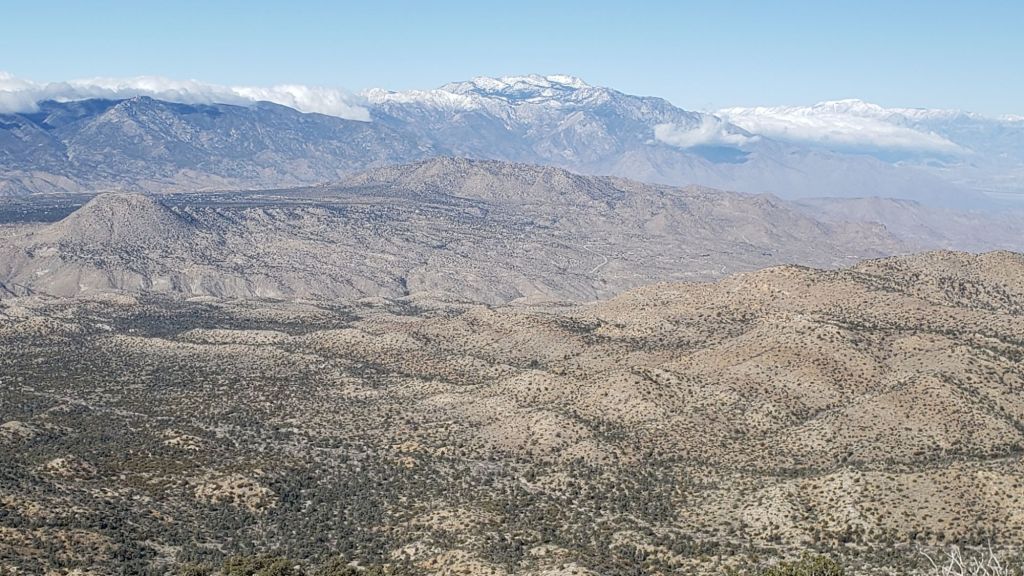
WEATHER
Temperatures plunge dramatically over the next week, from their current level well above seasonal for January, to well below seasonal starting 1st February. The next storm to impact our region is expected on 1st-2nd February, and will be relatively cold, with moderate snow currently forecast everywhere above about 5000 ft, with 10-12 inches of snow likely at the highest elevations. Rain on Thursday 1st at mid elevations will quickly turn to snow overnight and into Friday 2nd (with potentially 1-4 inches in Idyllwild and perhaps a dusting in Garner Valley).
At this time a second, warmer, protracted, system is forecast for 4th-7th February. Forecast confidence is steadily increasing for this system to be warmer than the storm at the beginning of the month, with moderate snow down to 7000 ft, and more snow at higher elevations, likely 1-3 feet across the high country (depending on elevation).
The second and third weeks of February remain unsettled, with another cold storm (or two) tentatively forecast in the middle of the month.
At San Jacinto Peak (3295m/10,810ft) on Monday 29th January 2024 at 0850 the air temperature was 38.1°F (3°C), with a windchill temperature of 26.2°F (-3°C), 46% relative humidity, and a steady SE wind sustained at 13 mph gusting to 17.9 mph.
At the Peak on Tuesday 23rd January 2024 at 0630 the air temperature was 19.9°F (-7°C), with a windchill temperature of 5.6°F (-15°C), 86% relative humidity, and a light NW wind sustained at 5 mph gusting to 10.9 mph.

TRAIL CONDITIONS
There is largely continuous light snow cover on all trails above about 7500 ft, becoming moderate (>6 inches) above about 8000 ft. Snow depths measured at specific locations are given below.
Spikes are useful everywhere above about 7000 ft, especially for descending well-compacted trails. Crampons are required on the north side of Tahquitz Peak, as discussed below. Snowshoes are no longer especially useful on-trail, which are now generally too well-traveled and compacted, but they remain useful everywhere above about 8000 ft elevation for off-trail travel at this time. Snowshoes will likely be strongly recommended from 2nd February onwards.
Tracks known to be broken through the snow at this time are up Devil’s Slide Trail, onward via the PCT, Wellman and Peak trails to San Jacinto Peak, from Long Valley through to Wellman Divide, around the Tahquitz area meadows, the PCT from Saddle south to Chinquapin Flat and north to Annie’s Junction, and South Ridge Trail from South Ridge Road to Tahquitz Peak. Deer Springs Trail is broken to about Little Round Valley, but there is no track through from there to San Jacinto Peak.
Ernie Maxwell Trail is functionally clear of snow, with just a handful of tiny icy snow patches remaining near the upper (Humber Park) end of the trail.
Devil’s Slide Trail has been heavily traveled to Saddle Junction. The trail is largely clear of snow below 7500 ft, and icy snow patches are thin until very close to Saddle Junction. Spikes can be useful for descending the upper trail.
I finished breaking trail up South Ridge Trail to Tahquitz Peak on Friday 26th. Snow has largely cleared up to about 7300 ft (just below Old Lookout Flat) and what remains is very patchy and softening rapidly by late morning. From Old Lookout Flat (7600 ft) to Tahquitz Peak, icy snow is functionally continuous. There is a relatively well-broken track to within six switchbacks of Tahquitz Peak, however above that the snow is very icy with limited posthole tracks. Spikes are strongly recommended to complete the uppermost switchbacks to the peak, ideally in conjunction with hiking poles or even an ice axe. South Ridge Road is completely clear of snow and ice.
The 0.4 mile section of South Ridge Trail between Chinquapin Flat/PCT and Tahquitz Peak has no track to follow at this time through 2-4 feet of heavily drifted and angled ice and icy snow (photo below). Neither snowshoes nor spikes are especially helpful at this time, due to the angled slope and structure of the snow, respectively. Crampons (always with an ice axe) are recommended on this section at this time, along with the necessary skills and experience to use that equipment in icy, angled terrain.

SNOW DEPTHS measured on 29th January 2024. The first number gives current average depth, followed (in parentheses) by the depth following the last storm on 23rd January. The snow lost in those six days is due to melting in unusually warm temperatures. Note that average depth is given; due to strong winds accompanying several storms this January, there has been considerable drifting, often especially accumulating in trails. Altitudes and PCT mileages are approximate.
San Jacinto Peak (10810 ft): 16 inches (20 inches on 23rd January)
Wellman Divide (9700 ft): 8 inches (14 inches on 23rd January)
Annie’s Junction/approx. PCT Mile 181.8 (9070 ft): 13 inches (15 inches on 23rd January)
Long Valley (8600 ft): 2 inches (6 inches on 23rd January)
Saddle Junction/approx. PCT Mile 179.9 (8070 ft): 6 inches (12 inches on 23rd January)
Devil’s Slide Trail at Humber Park (6550 ft): 0 inch (1 inch on 23rd January)
Idyllwild (at 5550 ft): 0 inch (0 inch on 23rd January)
While all time and labor is volunteered, the San Jacinto Trail Report uses small private donations to help cover operating costs. Your contribution keeps the Report available to all, free from advertising or paywalls, and independent from agencies. If you have found this Report useful, please consider using this link to the Donate page. Thank you very much for your support.




 San Jacinto Trail Report