Trail update 1st June 2022

A special thank you to Steve Holldber, owner of Idyllwild Heating and Cooling, for hosting our successful fundraising sale on Saturday 28th May. Many thanks to Anne for tasty treats (visitors commented that they had never seen “free” baked goods and coffee at a yard sale before!), to Florian for publicizing the event on social media, and to the many neighbors and friends, new and old, who came by to say hello and support us.

The trail system has been clear of snow for a few weeks and spikes have not been required on the trails since April. Current conditions for individual trails are discussed in detail below where known.

In addition to ascending San Jacinto Peak by different routes on average every three days, we have surveyed large segments of the PCT, its side trails, and a few Forest roads. Trails surveyed in recent days have included Deer Springs, Fuller Ridge, Seven Pines, Marion Mountain, Spitler Peak, and South Ridge, among others.

Due to the exceptionally dry state of the mountain already, there is a brief summary of water conditions where known at the foot of this Report. A short video report (available here) was issued on 10th May giving a visual overview of water conditions in the high country. Air quality and visibility down in the lowlands, especially the Coachella Valley, has been poor all year, likely due to the lack of rainfall combined with windier than average conditions.

National Weather Service San Diego issued this very informative video on 29th May. Some of the data presented are remarkable, if generally very discouraging.

Full fire restrictions were introduced on Thursday 26th May on Forest Service lands, as described in detail here. Campfires on all USFS lands in the San Jacinto mountains (including in fire rings at campgrounds and yellow post sites) are prohibited for the remainder of the year.

Be rattlesnake aware. Southern Pacific Rattlesnakes (Crotalus helleri) have already been seen on the trail system up to at least 8800 ft elevation (near Tahquitz Peak). As usual, the lower two-thirds of Devil’s Slide Trail seems to be a particular hotspot (e.g., see photos in previous Report).

Black Mountain Road (4S01) reopened on 11th May. South Ridge Road was partially graded in mid April, smoothing the worst sections. Santa Rosa Road (7S02) reopened on 7th April. Dark Canyon Road (5S02) remains in “winter closure”.

Forest Service seasonal campgrounds reopened on Thursday 26th May (Boulder Basin, Marion Mountain, Fern Basin). Note the full fire restrictions described above. The State Park Stone Creek Campground reopened for the season on 6th May.

The spectacular northwest face of Folly Peak as seen from Fuller Ridge, 24th May 2022. The major drainage in the centre of the image is the East Branch of the West Fork of Snow Creek. It is exceptional for these steep, north-facing canyons to be almost completely free of snow as early as May.

WEATHER

Following a couple of pleasantly cool days this weekend, temperatures are generally forecast to be above, or well above, seasonal for 1st-7th June, coolest next weekend (3rd-5th June). Overnight low temperatures in particular may average 5-15°F above seasonal at mid elevations. Preliminary forecasts suggest temperatures will be far above seasonal, more reminiscent of August than early June, about starting 8th June. There is no precipitation in the forecasts.

Short-, medium-, and long-term weather projections are summarized in the latest NWS San Diego video (available here), along with very informative data regarding the past couple of years of weather and fire seasons.

At San Jacinto Peak (10,810ft/3295m) on Monday 30th May 2022 at 0710 the air temperature was 39.5°F (4°C), with a windchill temperature of 27.3°F (-3°C), 18% relative humidity, and a brisk WNW wind sustained at 12 mph gusting to 20.5 mph.

At the Peak on Friday 27th May 2022 at 0740 the air temperature was 51.5°F (11°C), with a windchill temperature of 44.3°F (7°C), 23% relative humidity, and a gentle SW wind sustained at 6 mph gusting to 9.9 mph.

TRAIL CONDITIONS

The trail system, including the entire PCT throughout the San Jacinto mountains, has been clear of snow for several weeks.

Due to greatly reduced maintenance work by the agencies and PCTA during the coronavirus pandemic, many trails have accumulated treefall hazards since late 2019, passable with care by hikers but not for stock. Although reported promptly, most hazards were not removed in 2021. With storms this season being accompanied by strong winds and heavy ice loads, hikers should expect to encounter many new and additional hazards, especially in vulnerable burn areas (e.g., Willow Creek Trail, PCT Miles 170-177).

Although some treefall hazards from Red Tahquitz to Antsell Rock (PCT Miles 172.5-175) were cleared in June 2021 prior to the rockslide removal work, the situation has badly deteriorated since. In my most recent survey I counted at least 72 treefall hazards between PCT Miles 170-175. At least a third of these are major hazards that require scrambling over or around.

A significant new treefall hazard that fell across Devil’s Slide Trail over Memorial Day weekend about two miles up from Humber Park was immediately reported to the Forest Service.

The trail route on the East Ridge of San Jacinto Peak is now functionally clear of snow.

Marion Mountain Trail has one huge new treefall hazard across the trail exactly at the State Park/Forest Service boundary.

Deer Springs Trail is now clear of snow. Three new trees came down in late 2021 on the PCT/Deer Springs Trail just south of its junction with Marion Mountain Trail, but they are readily passable for hikers (but not for stock).

The middle section of South Ridge Trail (between May Valley Road and the top of South Ridge Road) has several trees down which are significant obstructions.

Willow Creek Trail has more than 40 downed trees between Skunk Cabbage Junction and Hidden Divide, 30 of these on the Forest Service section.

Spitler Peak Trail is currently in its most hiker-friendly condition since the 2013 Mountain Fire. Forty downed trees, most from an ice storm in late December 2021, plus dozens of additional trunks and branches in the trail, were removed by the Trail Report from this trail in early 2022.

Fuller Ridge Trail has 14 treefall hazards (May 2022 survey) obstructing the trail, but all are readily passable by agile hikers. Eleven of these are in the 1.5 mile section closest to Fuller Ridge Campground (approx PCT Miles 189-190.5).

The Caramba Trail from near Reeds Meadow through Laws Camp and on to Caramba, and the Cedar Trail from Willow Creek Trail to Laws, are optimistically described by the Forest Service as “not maintained”. In reality both trails no longer exist and are so heavily overgrown I advise hikers do not attempt to follow them. An informal use trail to Laws is much more direct and avoids all of the very challenging bushwhacking of the unmaintained trails (some local hikers dubbed it the “King Trail” when I established the route in 2019). It leaves the Willow Creek Trail exactly 1.0 mile from Saddle Junction (0.46 mile from the Skunk Cabbage turning), descending largely on established deer trails for 1.2 miles, meeting Willow Creek just upstream from the old Laws Camp. From Laws east to Caramba the route of the original Caramba Trail has been well-cairned by myself and others and can largely be followed with very careful route-finding. My February 2022 survey counted 97 trees down on this 2.1 miles of trail. It is especially obscure 0.1-0.3 mile east of the Willow Creek crossing, becoming clearer near Caramba. Cautious navigation is advised throughout the area.

Seven Pines Trail has had very limited hiker traffic since November 2018, largely because Dark Canyon Road was closed from February 2019 to early October 2021, and again since December 2021. The Trail Report has “adopted” Seven Pines Trail as a priority for maintenance work as the trail has had a disproportionate number of lost hiker rescues in recent years. Between November 2021 and May 2022, 61 downed trees have been removed and almost the entire trail has been thoroughly trimmed and cleared. Despite this very considerable effort, Seven Pines remains a genuine wilderness trail and is nothing like the relatively wide, bare routes of, for example, Devil’s Slide or Marion Mountain trails. Cautious navigation remains required for those who do not have substantial experience of hiking this trail.

North Fork of the San Jacinto River where it is crossed by Seven Pines Trail, 29th May 2022.

WATER CONDITIONS

On Monday 23rd May, the flow rate at Wellman’s Cienega had dropped by a remarkable 50% since the previous week, although it is largely unchanged in the week since. While I expect sufficient water to continue to trickle here for another couple of months at least, this gives an idea of the poor state of water resources on the mountain this year, and the rate at which they can change.

This is not a comprehensive review of the status of all mountain water sources. In the high country there are still patches of snow available for melting, and several less well-known minor springs are flowing. Sadly however – given that it’s still only May – I have already been getting many questions regarding water availability on the mountain. I have checked all of these water sources personally in recent days.

This video gives an overview of major water sources in the high country as of 10th May.

Water sources currently flowing include: Wellman’s Cienega (flowing weakly on 30th May), Round Valley faucet (flowing well on 30th May), North Fork of the San Jacinto River (both where it crosses Deer Springs Trail and on Fuller Ridge Trail at PCT Mile 186), Deer Springs (PCT Mile 185.4, very weak flow), Willow Creek crossing on Willow Creek Trail, Tahquitz Creek (PCT Mile 177 and also Little Tahquitz Meadow), Skunk Cabbage Meadow creek, Strawberry Cienega (very weak), Apache Spring (weak), Cedar Spring, Live Oak Spring, Antsell Rock Creek (at the Spitler Peak trailhead), Spitler Creek (on Spitler Peak Trail, very weak flow).

Water sources known to be dry: Tahquitz Valley pipe, Penrod Canyon (approx. PCT Mile 154), Little Round Valley creek (isolated pools only and almost dry on 27th May).

Thank you for taking the time to read this. While all time and labor is volunteered, the San Jacinto Trail Report depends on your small private donations to cover our costs. Your contribution keeps the Report available to all, free from advertising or paywalls, and independent from agencies. If you have found this Report useful, please use this link to the Donate page. Zelle, Venmo, and PayPal are all options. Thank you so much for your support.

Alpine Shooting Star (Primula tetrandra) flowering at Shooting Star Spring, 9600 ft elevation on Deer Springs Trail, 27th May 2022.

Trail update 25th May 2022

The Trail Report is holding a small fundraising sale on the morning of Saturday 28th May, very kindly hosted by Idyllwild Heating and Cooling on North Circle Drive in Idyllwild (near Cafe Aroma). There will be a variety of good condition hiking, camping, and outdoor gear. Also “free” (with your modest donation!) will be some of Anne’s delicious fresh baked treats, plus Pacific Crest Trail stickers, trail markers, and map posters. Thanks for your support!

The trail system has been clear of snow for a few weeks and spikes have not been required on the trails since April. Current conditions for individual trails are discussed in detail below where known.

In addition to multiple ascents of San Jacinto Peak by different routes in recent days we have surveyed large segments of the PCT, its side trails, and a few Forest roads. Trails surveyed in recent days have included Deer Springs, Fuller Ridge, Seven Pines, Marion Mountain, Spitler Peak, and South Ridge, among others.

Due to the exceptionally dry state of the mountain already, there is a brief summary of water conditions where known at the foot of this Report. A short video report (available here) was issued on 10th May giving a visual overview of water conditions in the high country. Air quality and visibility down in the lowlands, especially the Coachella Valley, has been poor all year, likely due to the lack of rainfall combined with windier than average conditions.

Full fire restrictions begin on Thursday 26th May on Forest Service lands, as described here. Campfires on all USFS lands in the San Jacinto mountains (including in fire rings at all campgrounds and yellow post sites) will then be prohibited for the remainder of the year.

Be rattlesnake aware. Southern Pacific Rattlesnakes (Crotalus helleri) have already been seen on the trail system up to at least 7000 ft elevation. As usual, the lower two-thirds of Devil’s Slide Trail seems to be a particular hotspot (see photos below).

South Ridge Road was partially graded in mid April, smoothing the worst sections. Santa Rosa Road (7S02) reopened on 7th April. Dark Canyon Road (5S02) remains in winter closure.

Black Mountain Road (4S01) reopened on 11th May.

Forest Service campgrounds seasonally closed for the winter will reopen on Thursday 26th May (Boulder Basin, Marion Mountain, Fern Basin). Note the full fire restrictions described above.

The State Park Stone Creek Campground reopened for the season on 6th May. The Forest Service ranger station in Idyllwild, closed for more than two years (originally due to the coronavirus pandemic), reopened on Saturday 21st May 2022.

WEATHER

Temperatures are generally forecast to remain well above seasonal for the remainder of May, though briefly pleasantly cooler on 28th-30th. Overnight low temperatures in particular may average 10-15°F above seasonal at mid elevations. There is no precipitation in the forecasts.

At San Jacinto Peak (10,810ft/3295m) on Monday 23rd May 2022 at 0725 the air temperature was 51.0°F (11°C), with a windchill temperature of 43.7°F (6°C), 31% relative humidity, and a pleasantly cool NNE wind sustained at 4 mph gusting to 8.8 mph.

At the Peak on Wednesday 18th May 2022 at 0740 the air temperature was 45.1°F (7°C), with a windchill temperature of 33.8°F (1°C), 37% relative humidity, and a pleasantly cool NE wind sustained at 10 mph gusting to 19.8 mph.

TRAIL CONDITIONS

All major trails are clear of snow, including for example the notoriously hazardous 0.4 mile section of South Ridge Trail from Chinquapin Flat/PCT Mile 178 to Tahquitz Peak. The PCT is now clear of snow throughout the San Jacinto mountains.

Skyline Trail reopened on 10th May having been closed from the State Park boundary (5800 ft) up to Grubb’s Notch since 1st February.

Due to greatly reduced maintenance work by the agencies and PCTA during the coronavirus pandemic, many trails have accumulated treefall hazards since late 2019, passable with care by hikers but not for stock. Although reported promptly, most hazards were not removed in 2021. With storms this season being accompanied by strong winds and heavy ice loads, hikers should expect to encounter many new and additional hazards, especially in vulnerable burn areas (e.g., Willow Creek Trail, PCT Miles 170-177).

Although some treefall hazards from Red Tahquitz to Antsell Rock (PCT Miles 172.5-175) were cleared in June 2021 prior to the rockslide removal work, the situation has badly deteriorated since. In my most recent survey I counted at least 72 treefall hazards between PCT Miles 170-175. At least a third of these are major hazards that require scrambling over or around.

The trail route on the East Ridge of San Jacinto Peak still has 20% snow cover but spikes are not required. The Wellman and Peak trails are clear of snow.

Marion Mountain Trail is clear of snow. There is one huge new treefall hazard across the trail exactly at the State Park/Forest Service boundary.

Deer Springs Trail is functionally clear of snow. A few tiny patches remain on the traverse near the North Fork of the San Jacinto River around 9400 ft elevation. Patchy snow cover is now <10% in Little Round Valley. Icy snow patches cover <5% of the trail from Little Round Valley to San Jacinto Peak. (Three new trees came down in late 2021 on the PCT/Deer Springs Trail just south of its junction with Marion Mountain Trail, but they are readily passable for hikers.)

South Ridge Trail (south of Tahquitz Peak) is clear of snow to Tahquitz Peak. The middle section of South Ridge Trail (between May Valley Road and the top of South Ridge Road) has several trees down which are significant obstructions.

Willow Creek Trail is clear of snow. However there are at least 40 downed trees between Skunk Cabbage Junction and Hidden Divide, nearly 30 of these on the Forest Service section.

Spitler Peak Trail is clear of snow. Forty downed trees, most from an ice storm in late December 2021, plus dozens of additional trunks and branches in the trail, have been removed by the Trail Report from this trail in early 2022.

Fuller Ridge Trail is clear of snow. There are 14 treefall hazards (May 2022 survey) obstructing the trail, but all are readily passable by agile hikers. Eleven of these are in the 1.5 mile section closest to Fuller Ridge Campground (approx PCT Miles 189-190.5).

The Caramba Trail from near Reeds Meadow through Laws Camp and on to Caramba, and the Cedar Trail from Willow Creek Trail to Laws, are optimistically described by the Forest Service as “not maintained”. In reality both trails no longer exist and are so heavily overgrown I advise hikers do not attempt to follow them. An informal use trail to Laws is much more direct and avoids all of the very challenging bushwhacking of the unmaintained trails (some local hikers dubbed it the “King Trail” when I established the route in 2019). It leaves the Willow Creek Trail exactly 1.0 mile from Saddle Junction (0.46 mile from the Skunk Cabbage turning), descending largely on established deer trails for 1.2 miles, meeting Willow Creek just upstream from the old Laws Camp. From Laws east to Caramba the route of the original Caramba Trail has been well-cairned by myself and others and can largely be followed with very careful route-finding. My February 2022 survey counted 97 trees down on this 2.1 miles of trail. It is especially obscure 0.1-0.3 mile east of the Willow Creek crossing, becoming clearer near Caramba. Cautious navigation is advised throughout the area.

Seven Pines Trail is functionally clear of snow, a few tiny patches remain on the uppermost 0.5 mile. This trail has had very limited hiker traffic since November 2018, largely because Dark Canyon Road was closed from February 2019 to early October 2021, and again since December 2021. The Trail Report has “adopted” Seven Pines Trail as a priority for maintenance work as the trail has had a disproportionate number of lost hiker rescues in recent years. Between November 2021 and May 2022, 57 downed trees have been removed. Almost all of the lower 3.0 miles has also been thoroughly trimmed and cleared, and the trail is now obvious and easy to follow for much of its length. While downed trees have now been removed from the upper 0.7 mile of trail, thorough clearing and trimming has not been finished, the route remains somewhat obscure in places, and cautious navigation is required for those who do not have experience of hiking this trail. Dark Canyon campground remains closed.

North Fork of the San Jacinto River where it crosses Deer Springs Trail at about 9400 ft elevation, 18th May 2022. One of the most reliable and, even in the past challenging decade, genuinely perennial water sources in the San Jacinto mountains.

WATER CONDITIONS

On Monday 23rd May, the flow rate at Wellman’s Cienega had dropped by a remarkable 50% since the previous week. Although I expect sufficient water to continue to trickle here for another couple of months at least, this gives an idea of the poor state of water resources on the mountain this year, and the rate at which they can change.

This is not a comprehensive review of the status of all mountain water sources. In the high country there are still patches of snow available for melting, and several less well-known minor springs are flowing. Sadly however – given that it’s only May – I have already been getting many questions regarding water availability on the mountain. I have checked all of these water sources personally in recent days.

This video gives an overview of major water sources in the high country as of 10th May.

Water sources currently flowing include: Wellman’s Cienega, Round Valley faucet, Little Round Valley Creek (at west end of valley, very weak), North Fork of the San Jacinto River (both where it crosses Deer Springs Trail and on Fuller Ridge Trail at PCT Mile 186), Deer Springs (PCT Mile 185.4, very weak flow), Willow Creek crossing on Willow Creek Trail, Tahquitz Creek (PCT Mile 177 and also Little Tahquitz Meadow), Skunk Cabbage Meadow creek, Strawberry Cienega (weak), Apache Spring (weak), Cedar Spring, Live Oak Spring, Antsell Rock Creek (at the Spitler Peak trailhead), Spitler Creek (on Spitler Peak Trail).

Water sources known to be dry: Tahquitz Valley pipe, Penrod Canyon (approx. PCT Mile 154).

Thank you for taking the time to read this. While all time and labor is volunteered, the San Jacinto Trail Report depends on your small private donations to cover our costs. Your contribution keeps the Report available to all, free from advertising or paywalls, and independent from agencies. If you have found this Report useful, please use this link to the Donate page. Zelle, Venmo, and PayPal are all options. Thank you so much for your support.

Juvenile Southern Pacific Rattlesnake (Crotalus helleri), Devil’s Slide Trail at about 6700 ft elevation, late morning on 23rd May 2022. Only 10 inches (25 cm) long, this tiny individual was surprisingly hard to see in the pale grey sand of the trail. Although adults are predominantly blackish, juveniles are mainly off-white with black markings. Eventually (below) the snake adopted a defensive posture, at which point we left it in peace.
Annie’s Junction (approx. PCT Mile 180.8) on 23rd May 2022 (above). Following an historically “average” or “normal” winter, the same location might look like the photo below, taken on the same date exactly four years earlier, 23rd May 2019.

Trail update 18th May 2022

The trail system is now functionally clear of snow. Spikes have not been required on the trail system for several weeks. Current conditions for individual trails are discussed in detail below where known.

The USFS Humber Park trailhead and parking lot, which includes the Devil’s Slide Trail (3E05) trailhead and the upper trailhead for the Ernie Maxwell Scenic Trail (3E07), was originally closed between Monday 16th May and Friday 20th May due to insecticide spraying operations. However, due to early completion of the work, Humber Park is now expected to reopen on the afternoon of Wednesday 18th May. Closure notices at Saddle Junction may not be removed until Thursday 19th.

The State Park section of Skyline Trail reopened on 10th May having been closed since 1st February.

In addition to multiple ascents of San Jacinto Peak by different routes in recent days we have surveyed large segments of the PCT, its side trails, and a few Forest roads. Trails surveyed in recent days have included all of the Tahquitz area meadows, Spitler Peak, South Ridge, Marion Mountain, Seven Pines, Willow Creek, and Deer Springs trails.

Due to the exceptionally dry state of the mountain already, there is a brief summary of water conditions where known at the foot of this Report. A short video report (available here) was published on 10th May giving a visual overview of current water conditions in the high country. Air quality and visibility down in the lowlands, especially the Coachella Valley, has been poor all year, likely due to the lack of rainfall combined with windier than average conditions.

South Ridge Road was partially graded in mid April, smoothing the worst sections. Santa Rosa Road (7S02) reopened on 7th April. Dark Canyon Road (5S02) remains in winter closure.

Black Mountain Road (4S01) reopened on 11th May. Forest Service campgrounds seasonally closed for the winter are expected to reopen in the week before the Memorial Day weekend (including Boulder Basin, scheduled to reopen 26th May). The State Park Stone Creek Campground reopened for the season on 6th May.

The Forest Service ranger station in Idyllwild, closed for more than two years (originally due to the coronavirus pandemic), is scheduled to reopen on Saturday 21st May 2022.

Signage at Humber Park on Monday 16th May 2022. Humber Park and its associated trailheads are now expected to reopen on the afternoon of Wednesday 17th May.

WEATHER

After a couple of pleasantly seasonal days at the beginning and end of this week, temperatures are forecast to rise to far above seasonal from 21st to at least 26th May. Overnight low temperatures in particular will average 10-15°F above seasonal at mid elevations. Temperatures in the high country on 24th-29th will more closely resemble July/August than May. There is no precipitation in the forecasts.

At San Jacinto Peak (10,810ft/3295m) on Wednesday 18th May 2022 at 0740 the air temperature was 45.1°F (7°C), with a windchill temperature of 33.8°F (1°C), 37% relative humidity, and a pleasantly cool NE wind sustained at 10 mph gusting to 19.8 mph.

At the Peak on Monday 16th May 2022 at 0750 the air temperature was 43.3°F (6°C), with a windchill temperature of 34.7°F (1°C), 29% relative humidity, and a fresh due West wind sustained at 10 mph gusting to 13.7 mph.

At the Peak on Wednesday 11th May 2022 at 0820 the air temperature was 21.9°F (-6°C), with a windchill temperature of 2.7°F (-16°C), 13% relative humidity, and a gusty due West wind sustained at 13 mph gusting to 26.7 mph.

Antsell Rock Creek near the Spitler Peak Trail trailhead at Apple Canyon Road, 12th May 2022. Flow is between one third to one half of average for May. Apache Peak is in the distance in the upper left, with Spitler Peak to the right.

TRAIL CONDITIONS

All major trails are functionally clear of snow. Some tiny icy snow patches remain in a handful of places above about 9000 ft elevation as mentioned below. Named trails are completely clear of snow/ice unless discussed below.

Skyline Trail reopened on 10th May having been closed from the State Park boundary (5800 ft) up to Grubb’s Notch since 1st February.

Due to greatly reduced maintenance work by the agencies and PCTA during the coronavirus pandemic, many trails have accumulated treefall hazards since late 2019, passable with care by hikers but not for stock. Although reported promptly, most hazards were not removed in 2021. With storms this season being accompanied by strong winds and heavy ice loads, hikers should expect to encounter many new and additional hazards, especially in vulnerable burn areas (e.g., Willow Creek Trail, PCT Miles 170-177).

Although some treefall hazards from Red Tahquitz to Antsell Rock (PCT Miles 172.5-175) were cleared in June 2021 prior to the rockslide removal work, the situation has badly deteriorated since. In my most recent survey I counted at least 72 treefall hazards between PCT Miles 170-175. At least a third of these are major hazards that require scrambling over or around.

The notoriously hazardous 0.4 mile section of South Ridge Trail from Chinquapin Flat/PCT Mile 178 to Tahquitz Peak is now functionally clear of icy snow, and spikes are no longer required.

The PCT is now functionally clear of snow throughout the San Jacinto mountains. A few tiny patches remain just south of Annie’s Junction starting at about Mile 180.3, as do a few on the most sheltered sections of Fuller Ridge (Miles 188-189.5)

Snow cover now averages <5% on the Peak Trail, persisting in patches in two short traditionally persistent areas around 10,000 ft and 10,100 ft. Spikes are not required. The trail route on the East Ridge still has 40% snow cover but spikes are not required. The Wellman Trail is functionally clear of snow.

Marion Mountain Trail is clear of snow. There is one huge new treefall hazard across the trail exactly at the State Park/Forest Service boundary.

Deer Springs Trail is functionally clear of snow. A few tiny patches remain on the traverse near the North Fork of the San Jacinto River around 9400 ft elevation. Patchy snow cover is now <10% in Little Round Valley. Icy snow patches cover <5% of the trail from Little Round Valley to San Jacinto Peak. (Three new trees came down in late 2021 on the PCT/Deer Springs Trail just south of its junction with Marion Mountain Trail, but they are readily passable for hikers.)

South Ridge Trail (south of Tahquitz Peak) is clear of snow to Tahquitz Peak. The middle section of South Ridge Trail (between May Valley Road and the top of South Ridge Road) has several trees down which are significant obstructions.

Willow Creek Trail is clear of snow. However there are at least 40 downed trees between Skunk Cabbage Junction and Hidden Divide, nearly 30 of these on the Forest Service section.

Spitler Peak Trail is clear of snow. Forty downed trees, most from an ice storm in late December 2021, plus dozens of additional trunks and branches in the trail, have been removed by the Trail Report from this trail in early 2022.

The Caramba Trail from near Reeds Meadow through Laws Camp and on to Caramba, and the Cedar Trail from Willow Creek Trail to Laws, are optimistically described by the Forest Service as “not maintained”. In reality both trails no longer exist and are so heavily overgrown I advise hikers do not attempt to follow them. An informal use trail to Laws is much more direct and avoids all of the very challenging bushwhacking of the unmaintained trails (some local hikers dubbed it the “King Trail” when I established the route in 2019). It leaves the Willow Creek Trail exactly 1.0 mile from Saddle Junction (0.46 mile from the Skunk Cabbage turning), descending largely on established deer trails for 1.2 miles, meeting Willow Creek just upstream from the old Laws Camp. From Laws east to Caramba the route of the original Caramba Trail has been well-cairned by myself and others and can largely be followed with very careful route-finding. My February 2022 survey counted 97 trees down on this 2.1 miles of trail. It is especially obscure 0.1-0.3 mile east of the Willow Creek crossing, becoming clearer near Caramba. Cautious navigation is advised throughout the area.

Seven Pines Trail is functionally clear of snow. This trail has had very limited hiker traffic since November 2018, largely because Dark Canyon Road was closed from February 2019 to early October 2021, and again since December 2021. The Trail Report has “adopted” Seven Pines Trail as a priority for maintenance work as the trail has had a disproportionate number of lost hiker rescues in recent years. Starting in November 2021, 42 downed trees on the lower 3.0 miles of trail have been removed. Almost all of this section has also been thoroughly trimmed and cleared, and the trail is now obvious and easy to follow for much of its length (when clear of snow). However at least 18 downed trees remain on the upper 0.7 mile of trail, the route is very obscure in places, and cautious navigation is essential for those who do not have extensive experience of hiking this trail. Dark Canyon campground remains closed.

North Fork of the San Jacinto River where it crosses Deer Springs Trail at about 9400 ft elevation, 18th May 2022. One of the most reliable and, even in the past challenging decade, genuinely perennial water sources in the San Jacinto mountains.

WATER CONDITIONS

This is not a comprehensive review of the status of all mountain water sources. In the high country there are still patches of snow available for melting, and several less well-known minor springs are flowing. Sadly however – given that it’s only May – I have already been getting many questions regarding water availability on the mountain. I have checked all of these water sources personally in recent days.

This video gives an overview of major water sources in the high country as of 10th May.

Water sources currently flowing include: Wellman’s Cienega, Round Valley faucet, Little Round Valley Creek (at west end of valley, very weak), North Fork of the San Jacinto River (both where it crosses Deer Springs Trail and on Fuller Ridge Trail at PCT Mile 186), Deer Springs (PCT Mile 185.4, very weak flow), Willow Creek crossing on Willow Creek Trail, Tahquitz Creek (PCT Mile 177 and also Little Tahquitz Meadow), Skunk Cabbage Meadow creek, Strawberry Cienega (weak), Apache Spring (weak), Cedar Spring, Live Oak Spring, Antsell Rock Creek (at the Spitler Peak trailhead), Spitler Creek (on Spitler Peak Trail).

Water sources known to be dry: Tahquitz Valley pipe, Penrod Canyon (approx. PCT Mile 154).

Thank you for taking the time to read this. While all labor and time is volunteered, the San Jacinto Trail Report completely depends on your small private donations to cover our modest costs. Your contribution keeps the Report available to all, free from advertising or paywalls, and independent from agencies. If you have found this Report useful, please visit the Donate page. Zelle, Venmo, and PayPal are all now donation options. Thank you so much for your support.

Coast Patch-nosed Snake (Salvadora hexalepsis virgultea) at about 5100 ft on Spitler Peak Trail, 12th May 2022 (photo: Anne King).
Very fresh Mountain Lion scat in the middle of Spitler Peak Trail at about 6800 ft elevation, 12th May 2022. The scat appeared to be entirely composed of deer hair. The lion was estimated to weigh 70-100 lbs based on the scat size.

Trail update 11th May 2022

Major trails are now completely (or functionally) clear of snow. Spikes are no longer required on the trail system. Some hikers may find that spikes remain useful in a handful of limited areas (mentioned below) depending on individual comfort level and experience on small patches of icy snow. Current conditions for individual trails are discussed in detail below where known.

Skyline Trail reopened on 10th May having been closed from the State Park boundary (5800 ft) up to Grubb’s Notch since 1st February.

In addition to multiple ascents of San Jacinto Peak by different routes in recent days we have surveyed large segments of the PCT, its side trails, and a few Forest roads. Trails surveyed in recent days have included all of the Tahquitz area meadows, Spitler Peak, South Ridge, Marion Mountain, Seven Pines, Willow Creek, Caramba, and Deer Springs.

As snow is now so patchy and limited, I am no longer reporting snow depths. This does not mean there is no snow in the high country, only that in the locations for which I typically report depths, averages are zero. Snow patches remain in areas above 9000 ft, largely off established trails and on north-facing slopes.

Air quality and visibility down in the lowlands, especially the Coachella Valley, has been poor all year, likely due to the lack of rainfall combined with windier than average conditions. Of my 34 ascents of San Jacinto Peak so far this year, the Salton Sea has not been visible for a third of them (including on 9th May), and the north shore has been indistinct at best for most.

Due to the exceptionally dry state of the mountain already, there is a brief summary of water conditions where known at the foot of this Report. A short video report (available here) was published on 10th May giving a visual overview of current water conditions in the high country.

Despite periodic warm spells, hikers should continue to be prepared for temperatures near freezing in the high country, and below freezing when considering wind chill effects (see below for some of my most recent weather observations from San Jacinto Peak).

The USFS Humber Park trailhead and parking lot, which includes the Devil’s Slide Trail (3E05) trailhead and the upper trailhead for the Ernie Maxwell Scenic Trail (3E07), will be closed from the afternoon of Monday 16th May to Friday 20th May due to tree management work.

South Ridge Road was partially graded in mid April, smoothing the worst sections. Santa Rosa Road (7S02) reopened on 7th April. Dark Canyon Road (5S02) remains in winter closure.

Black Mountain Road (4S01) reopened on 11th May, as did the Forest Service campgrounds seasonally closed for the winter (except Boulder Basin, scheduled to reopen 26th May). The State Park Stone Creek Campground reopened for the season on 6th May.

The Forest Service ranger station in Idyllwild, closed for more than two years (originally due to the coronavirus pandemic), is now tentatively scheduled to reopen later in May 2022.

WEATHER

Temperatures are forecast to be well below seasonal on 9th-11th May. Temperatures then rise dramatically to well above seasonal for 13th-19th May (temperatures may be more typical of July than May) before then falling to closer to seasonal. There is no precipitation in the forecasts.

At San Jacinto Peak (10,810ft/3295m) on Wednesday 11th May 2022 at 0820 the air temperature was 21.9°F (-6°C), with a windchill temperature of 2.7°F (-16°C), 13% relative humidity, and a gusty due West wind sustained at 13 mph gusting to 26.7 mph.

At the Peak on Monday 9th May 2022 at 0825 the air temperature was 32.6°F (0°C), with a windchill temperature of 16.7°F (-9°C), 31% relative humidity, and a bitter due West wind sustained at 14 mph gusting to 25.7 mph.

At the Peak on Thursday 5th May 2022 at 0740 the air temperature was 47.4°F (9°C), with a windchill temperature of 43.0°F (6°C), 8% relative humidity, and a light WNW wind sustained at 4 mph gusting to 7.3 mph.

TRAIL CONDITIONS

All major trails are functionally clear of snow. Some small icy snow patches remain in places above about 9000 ft elevation as mentioned below. Named trails are completely clear of snow/ice unless discussed below.

Skyline Trail reopened on 10th May having been closed from the State Park boundary (5800 ft) up to Grubb’s Notch since 1st February.

Due to greatly reduced maintenance work by the agencies and PCTA during the coronavirus pandemic, many trails have accumulated treefall hazards since late 2019, passable with care by hikers but not for stock. Although reported promptly, most hazards were not removed in 2021. With storms this season being accompanied by strong winds and heavy ice loads, hikers should expect to encounter many new and additional hazards, especially in vulnerable burn areas (e.g., Willow Creek Trail, PCT Miles 170-177).

Although some treefall hazards from Red Tahquitz to Antsell Rock (PCT Miles 172.5-175) were cleared in June 2021 prior to the rockslide removal work, the situation has badly deteriorated this winter. In March 2022 I counted at least 72 treefall hazards between PCT Miles 170-175. At least a third of these are major hazards that require scrambling over or around.

The notoriously hazardous 0.4 mile section of South Ridge Trail from Chinquapin Flat/PCT Mile 178 to Tahquitz Peak is now functionally clear of icy snow. Two tiny patches remain but these have well-defined steps through the very short stretches of snow. Most hikers are finding spikes are no longer required.

The PCT is clear of snow from Mile 151 to 175 (Red Tahquitz). Snow cover remains about 10% between Miles 175-177, but very few hikers are finding that spikes remain necessary in that area. Snow cover is now very limited between Miles 178 to 184, with the exception of the notoriously stubborn half mile just south of Annie’s Junction starting at about Mile 180.3 (about 10% snow cover). Some snow patches remain on the sheltered sections of Fuller Ridge (notably Miles 188-189.5)

Snow cover now averages only 5% on the Peak Trail, persisting in patches in two short traditionally persistent areas around 10,000 ft and 10,100 ft. Spikes are generally not required. The trail route on the East Ridge still has 60% snow cover but is clearing steadily.

The Wellman Trail is almost clear of snow, other than 20% cover on the first 0.3 mile north of Annie’s Junction.

Marion Mountain Trail is clear of snow. There is one huge new treefall hazard across the trail exactly at the State Park/Forest Service boundary.

Deer Springs Trail is functionally clear of snow. A few patches remain on the traverse near the North Fork of the San Jacinto River around 9400 ft elevation. Patchy snow cover remains about 20% in Little Round Valley. Icy snow patches only cover <5% of the trail from Little Round Valley to San Jacinto Peak. (Three new trees came down in late 2021 on the PCT/Deer Springs Trail just south of its junction with Marion Mountain Trail, but they are readily passable for hikers.)

South Ridge Trail (south of Tahquitz Peak) is clear of snow to Tahquitz Peak. The middle section of South Ridge Trail (between May Valley Road and the top of South Ridge Road) has several trees down which are significant obstructions.

Willow Creek Trail is clear of snow. However there are at least 40 downed trees between Skunk Cabbage Junction and Hidden Divide, nearly 30 of these on the Forest Service section.

Spitler Peak Trail is clear of snow. Forty downed trees, most from an ice storm in late December 2021, plus dozens of additional trunks and branches in the trail, have been removed by the Trail Report from this trail in early 2022.

The Caramba Trail from near Reeds Meadow through Laws Camp and on to Caramba, and the Cedar Trail from Willow Creek Trail to Laws, are optimistically described by the Forest Service as “not maintained”. In reality both trails no longer exist and are so heavily overgrown I advise hikers do not attempt to follow them. An informal use trail to Laws is much more direct and avoids all of the very challenging bushwhacking of the unmaintained trails (some local hikers dubbed it the “King Trail” when I established the route in 2019). It leaves the Willow Creek Trail exactly 1.0 mile from Saddle Junction (0.46 mile from the Skunk Cabbage turning), descending largely on established deer trails for 1.2 miles, meeting Willow Creek just upstream from the old Laws Camp. From Laws east to Caramba the route of the original Caramba Trail has been well-cairned by myself and others and can largely be followed with very careful route-finding. My February 2022 survey counted 97 trees down on this 2.1 miles of trail. It is especially obscure 0.1-0.3 mile east of the Willow Creek crossing, generally becoming clearer near Caramba. Cautious navigation is advised throughout the area.

Seven Pines Trail is functionally clear of snow. This trail has had very limited hiker traffic since November 2018, largely because Dark Canyon Road was closed from February 2019 to early October 2021, and again since December 2021. The Trail Report has “adopted” Seven Pines Trail as a priority for maintenance work as the trail has had a disproportionate number of lost hiker rescues in recent years. Starting in November 2021, 42 downed trees on the lower 3.0 miles of trail have been removed. Almost all of this section has also been thoroughly trimmed and cleared, and the trail is now obvious and easy to follow for much of its length (when clear of snow). However at least 18 downed trees remain on the upper 0.7 mile of trail, the route is very obscure in places, and cautious navigation is essential for those who do not have extensive experience of hiking this trail. Dark Canyon campground remains closed.

WATER CONDITIONS

This is not a comprehensive review of the status of all mountain water sources. In the high country there are still many patches of snow available for melting, and several less well-known minor springs are flowing. Sadly however – given that it’s only May – I have already been getting many questions regarding water availability on the mountain. I have checked all of these water sources personally in the past few days.

This video gives an overview of major water sources in the high country as of 10th May.

Water sources currently flowing include: Wellman’s Cienega, Round Valley faucet, Little Round Valley Creek (at west end of valley, very weak), North Fork of the San Jacinto River (both where it crosses Deer Springs Trail and on Fuller Ridge Trail at PCT Mile 186), Deer Springs (PCT Mile 185.4, very weak flow), Willow Creek crossing on Willow Creek Trail, Tahquitz Creek (PCT Mile 177 and also Little Tahquitz Meadow), Skunk Cabbage Meadow creek, Strawberry Cienega (weak), Apache Spring (weak), Cedar Spring, Live Oak Spring.

Water sources known to be dry: Tahquitz Valley pipe, Penrod Canyon (approx. PCT Mile 154).

Thank you for taking the time to read this. While all labor and time is volunteered, the San Jacinto Trail Report completely depends on your small private donations to cover our modest costs. Your contribution helps to keep the Report active, free from advertising, and independent from agencies. If you have found this Report useful, please visit the Donate page. Zelle, Venmo, and PayPal are all now available options. Thank you so much for your support.

Above, Little Round Valley (9800ft) on 9th May 2022, and for comparison the same view about two weeks earlier on 25th April below.

Trail update 3rd May 2022

Melting of remaining snow has continued steadily and most major trails are now largely or completely clear of snow. Many hikers have found spikes unnecessary for the past couple of weeks, and hardly any of the 130 PCT hikers I have seen and talked with in the past ten days were using (or even carrying) spikes. Current conditions for individual trails are discussed in detail below where known.

Early on Monday 2nd May we ascended San Jacinto Peak via Devil’s Slide, PCT, Wellman’s, and Peak trails, descending the same way. In addition to multiple ascents of San Jacinto Peak by different routes in recent days we have surveyed multiple segments of the PCT, its side trails, and a few Forest roads. Trails surveyed in recent days have included South Ridge (twice), Marion Mountain, Seven Pines, Willow Creek, Laws and Caramba, and Deer Springs.

In general spikes are no longer required, especially on extensively melted and/or well-traveled trails with defined snow steps. Hikers may find spikes remain useful in a handful of small areas above about 8500 ft (generally discussed below), depending on individual comfort level and experience on patches of icy snow, where snow on trails is compacted by hiker traffic and following freeze-thaw cycles. Spikes are generally most useful for descending.

As snow is now so patchy and limited, I am no longer reporting snow depths. This does not mean there is no snow in the high country, only that in the locations for which I typically report depths, averages are zero or functionally zero. Significant snow remains in areas above 9000 ft, largely off established trails, in sheltered forested areas, and on north-facing slopes.

Despite mostly warmer days, hikers should continue to be prepared for temperatures near freezing in the high country, and below freezing when considering wind chill effects, especially on 10th-12th May. See below for some of my most recent weather observations from San Jacinto Peak.

The USFS gates at Humber Park and South Ridge Road are open. South Ridge Road was partially graded in mid April, smoothing the worst sections. Santa Rosa Road (7S02) reopened on 7th April. Black Mountain (4S01) and Dark Canyon (5S02) roads remain in winter closure (for vehicle traffic only).

The Forest Service ranger station in Idyllwild, closed for more than two years (originally due to the coronavirus pandemic), is now tentatively scheduled to reopen later in May 2022.

The drainage in Little Round Valley, 29th April 2022. Although this formerly perennial creek has dried up with increasing frequency in summer or autumn of some recent years, in 2022 it was already completely dry in April.

WEATHER

Temperatures are forecast to be at or above seasonal (in particular overnight lows) for the first week of May. It will be especially warm on 4th-7th May. Temperatures then drop below seasonal for most of the second week of the month, including temperatures below freezing in the high country on 10th-12th May. Temperatures rise to (or above) seasonal again starting 13th May. There is no significant precipitation in the forecasts.

The first three months of the year combined to be the second driest ever here in Riverside County, and the driest on record for the entire northern half of California (NWS data). The Sierra snowpack, at an impressive 160% of average on 1st January, was only 38% of average by 1st April. In the San Jacinto mountains precipitation has been below average in the high country for the tenth consecutive winter (and eight of those ten winters, including the past three seasons, have been well below average).

At San Jacinto Peak (10,810ft/3295m) on Monday 2nd May 2022 at 0815 the air temperature was 44.4°F (7°C), with a windchill temperature of 36.9°F (3°C), 10% relative humidity, and a brisk WNW wind sustained at 7 mph gusting to 12.3 mph.

At the Peak on Friday 29th April 2022 at 0815 the air temperature was 43.5°F (6°C), with a windchill temperature of 36.1°F (2°C), 8% relative humidity, and a light NNW wind sustained at 4 mph gusting to 8.3 mph.

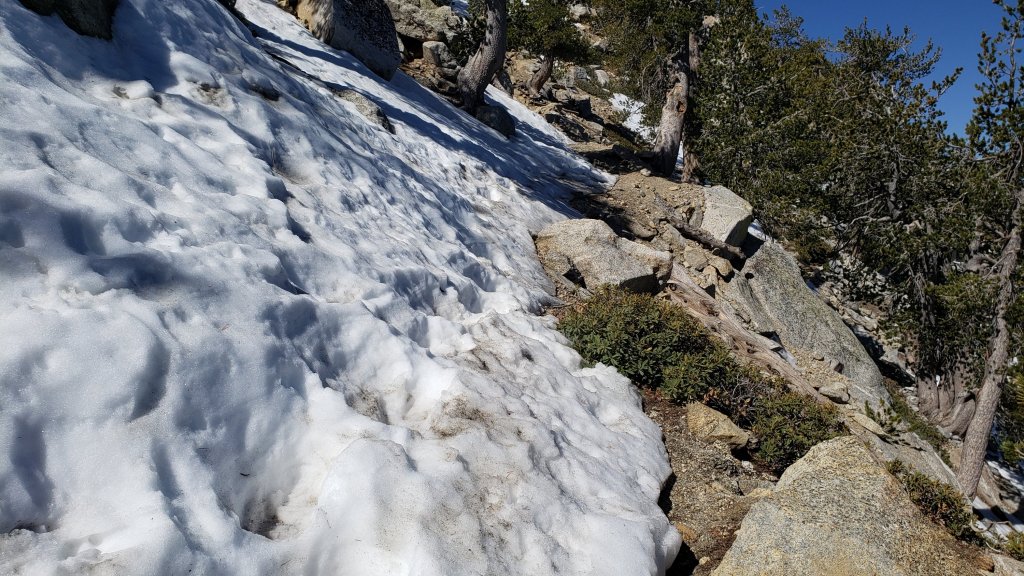
Angled icy snow remaining on the north side of Tahquitz Peak, 1st May 2022. Most hikers will find that spikes are no longer required to cross this very short section on South Ridge Trail to/from Tahquitz Peak and Chinquapin Flat/PCT Mile 178.

TRAIL CONDITIONS

Trails below about 8600 ft elevation are clear of snow. Thin patchy snow cover is rapidly becoming very limited on the trails above that elevation.

Effective Tuesday 1st February 2022 the State Park closed the section of Skyline Trail that falls within its jurisdiction, above 5800 ft elevation, “due to dangerous ice accumulation” (Skyline Trail forms the lower two-thirds of the “Cactus-to-Clouds” [C2C] route). The Superintendent stated on 25th April “we are monitoring weather conditions and the route and hope to reopen in the coming weeks”. The State Park boundary on Skyline is not marked but is near the site of the old Florian’s Cache, below Flat Rock.

Due to greatly reduced maintenance work by the agencies and PCTA during the coronavirus pandemic, many trails have accumulated treefall hazards since late 2019, passable with care by hikers but not for stock. Although reported promptly, most hazards were not removed in 2021. With storms this season being accompanied by strong winds and heavy ice loads, hikers should expect to encounter many new and additional hazards, especially in vulnerable burn areas (e.g., Willow Creek Trail, PCT Miles 170-177).

Although some treefall hazards from Red Tahquitz to Antsell Rock (PCT Miles 172.5-175) were cleared in June 2021 prior to the rockslide removal work, the situation has badly deteriorated this winter. In a full survey in March 2022, I counted at least 72 treefall hazards between PCT Miles 170-175. At least a third of these are major hazards that require scrambling over or around.

The 0.4 mile section of South Ridge Trail from Chinquapin Flat/PCT Mile 178 to Tahquitz Peak has cleared rapidly [updated 1st May]. Two tiny patches of icy snow remain to cross, but these have well-defined steps through the snow (see photos above and below). Most hikers will find spikes are no longer required.

The following trails below 8800 ft elevation are completely clear of snow/ice: Ernie Maxwell, Devil’s Slide, Suicide Rock, South Ridge (south from Tahquitz Peak), all Garner Valley trails.

The PCT is clear of snow from Mile 151 to 175 (Red Tahquitz). Snow cover remains about 30% between Miles 175-177, but very few hikers are finding that spikes remain necessary in that area. Snow cover is now very limited between Miles 178 to 184, with the exception of the notoriously stubborn half mile just south of Annie’s Junction starting at about Mile 180.3 (about 50% snow cover). Some snow patches remain on the sheltered sections of Fuller Ridge (notably Miles 188-189.5)

Snow cover now averages only 5% on the Peak Trail, persisting in two short traditional areas at 10,000 ft and 10,100 ft. Spikes are generally not required. The snow route on the East Ridge still has >80% snow cover but is clearing steadily.

The Wellman Trail is almost clear of snow, other than 60% cover on the first 0.3 mile north of Annie’s Junction.

Marion Mountain Trail is clear of snow [updated 29th April]. There is one huge new treefall hazard across the trail exactly at the State Park/Forest Service boundary.

Deer Springs Trail is clear of snow to just south of the Marion Mountain Trail junction. Thereafter snow cover is a patchy 10% to about 9300 ft. Above that elevation snow cover currently averages 30%, but will continue to melt rapidly in the next few days. Snow is most extensive (50%) in Little Round Valley. Above Little Round Valley snow cover averages 20%. Some hikers may find spikes useful in places, especially for descending. (Three new trees came down in late 2021 on the PCT/Deer Springs Trail just south of its junction with Marion Mountain Trail, but they are readily passable for hikers.)

South Ridge Trail (south of Tahquitz Peak) is clear of snow to Tahquitz Peak. The middle section of South Ridge Trail (between May Valley Road and the top of South Ridge Road) has several trees down which are significant obstructions.

Willow Creek Trail is clear of snow. However there are at least 40 downed trees between Skunk Cabbage Junction and Hidden Divide, nearly 30 of these on the Forest Service section.

Spitler Peak Trail is clear of snow. Forty downed trees, most from an ice storm in late December 2021, plus dozens of additional trunks and branches in the trail, have been removed by the Trail Report from this trail in early 2022.

The Caramba Trail from near Reeds Meadow through Laws Camp and on to Caramba, and the Cedar Trail from Willow Creek Trail to Laws, are optimistically described by the Forest Service as “not maintained”. In reality both trails no longer exist and are so heavily overgrown I advise hikers do not attempt to follow them. An informal use trail to Laws is much more direct and avoids all of the very challenging bushwhacking of the unmaintained trails (some local hikers dubbed it the “King Trail” when I established the route in 2019). It leaves the Willow Creek Trail exactly 1.0 mile from Saddle Junction (0.46 mile from the Skunk Cabbage turning), descending largely on established deer trails for 1.2 miles, meeting Willow Creek just upstream from the old Laws Camp. From Laws east to Caramba the route of the original Caramba Trail has been well-cairned by myself and others and can largely be followed with very careful route-finding. My February 2022 survey counted 97 trees down on this 2.1 miles of trail. It is especially obscure 0.1-0.3 mile east of the Willow Creek crossing, generally becoming clearer near Caramba. Cautious navigation is advised throughout the area.

Seven Pines Trail is clear of snow to 7500 ft. Above that elevation snow cover is a patchy 10%. This trail has had very limited hiker traffic since November 2018, largely because Dark Canyon Road was closed from February 2019 to early October 2021, and again since December 2021. The Trail Report has “adopted” Seven Pines Trail as a priority for maintenance work as the trail has had a disproportionate number of lost hiker rescues in recent years. Starting in November 2021, 42 downed trees on the lower 3.0 miles of trail have been removed. Almost all of this section has also been thoroughly trimmed and cleared, and the trail is now obvious and easy to follow for much of its length (when clear of snow). However at least 18 downed trees remain on the upper 0.7 mile of trail, the route is very obscure in places, and cautious navigation is essential for those who do not have extensive experience of hiking this trail. Dark Canyon campground remains closed.

It’s northbound PCT season! Please consider helping the Trail Report at our busiest time of the year. While all labor and time is volunteered, the San Jacinto Trail Report completely depends on your small private donations to cover costs. Your contribution helps to keep the Report active, free from advertising, and independent from agencies. If you have found this Report useful, please visit the Donate page. Zelle, Venmo, and PayPal are all now options. Thank you for your support.

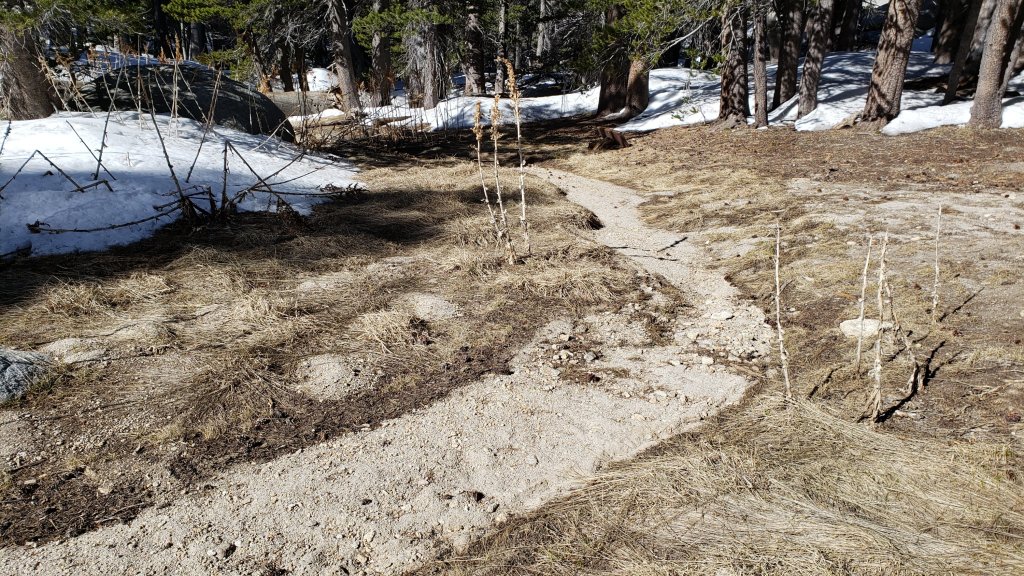
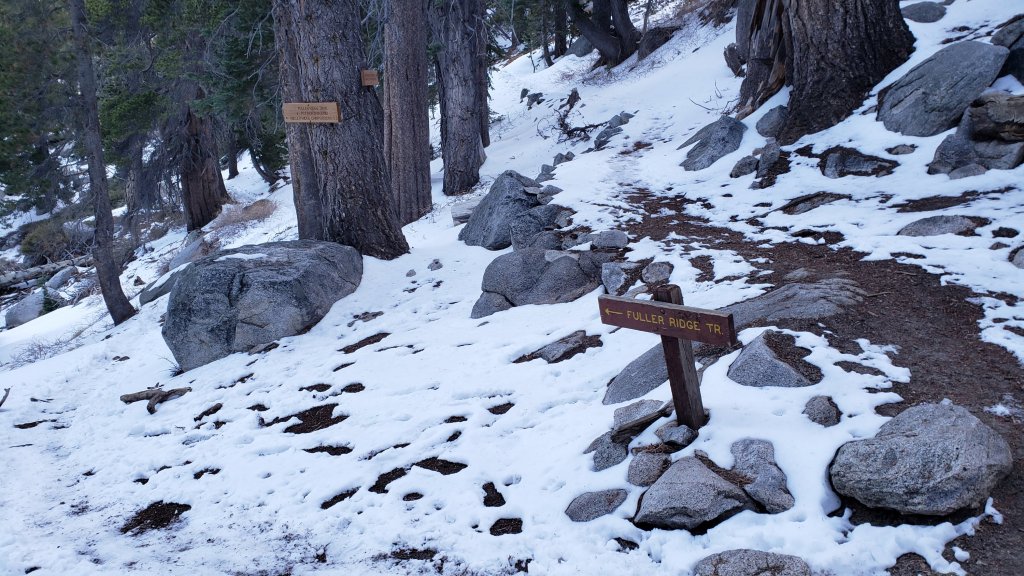
PCT Mile 185.6, the south end of Fuller Ridge Trail at its junction with Deer Springs Trail (8970ft). Above on 29th April 2022, and below just four days earlier on 25th April, when some snow remained from a minor snow storm on 22nd April. Eastern slopes more exposed to direct sun largely cleared on 24th and 25th April (as illustrated in the previous Report).
The other patch of angled icy snow remaining on the trail on the north side of Tahquitz Peak, 1st May 2022 (see also above). Spikes are no longer required to cross this very short section on South Ridge Trail to/from Tahquitz Peak and Chinquapin Flat/PCT Mile 178.
Special thanks to great friend (and social media coordinator) of the Trail Report Charles Phelan who leaves Idyllwild-Pine Cove for New England this month in part to be closer to family. We hiked to Tahquitz Peak on 1st May 2022, where we had worked together as fire lookouts since Charles joined the program in 2016. Safe hiking Charles!