Trail update 27th February 2020

[UPDATE 1st March @ 1845: It snowed gently in Idyllwild today from 1530 to 1730, just under 1.0″ settling at 5550′ elevation. It was lightly snowing in Long Valley from 1300 to 1700 (also about 1.0″ total). At San Jacinto Peak this morning I recorded a windchill of -4°F (-20°C) although the high peaks remained largely above the cloud all morning at least. The full extent of this minor storm will be updated tomorrow. ]

We have hiked to San Jacinto Peak six of the last nine days, including today, affording a check of snow and trail conditions on most major routes around the mountain. South Ridge and the Tahquitz Peak area were hiked on 25th, and the PCT on the Desert Divide on 26th.

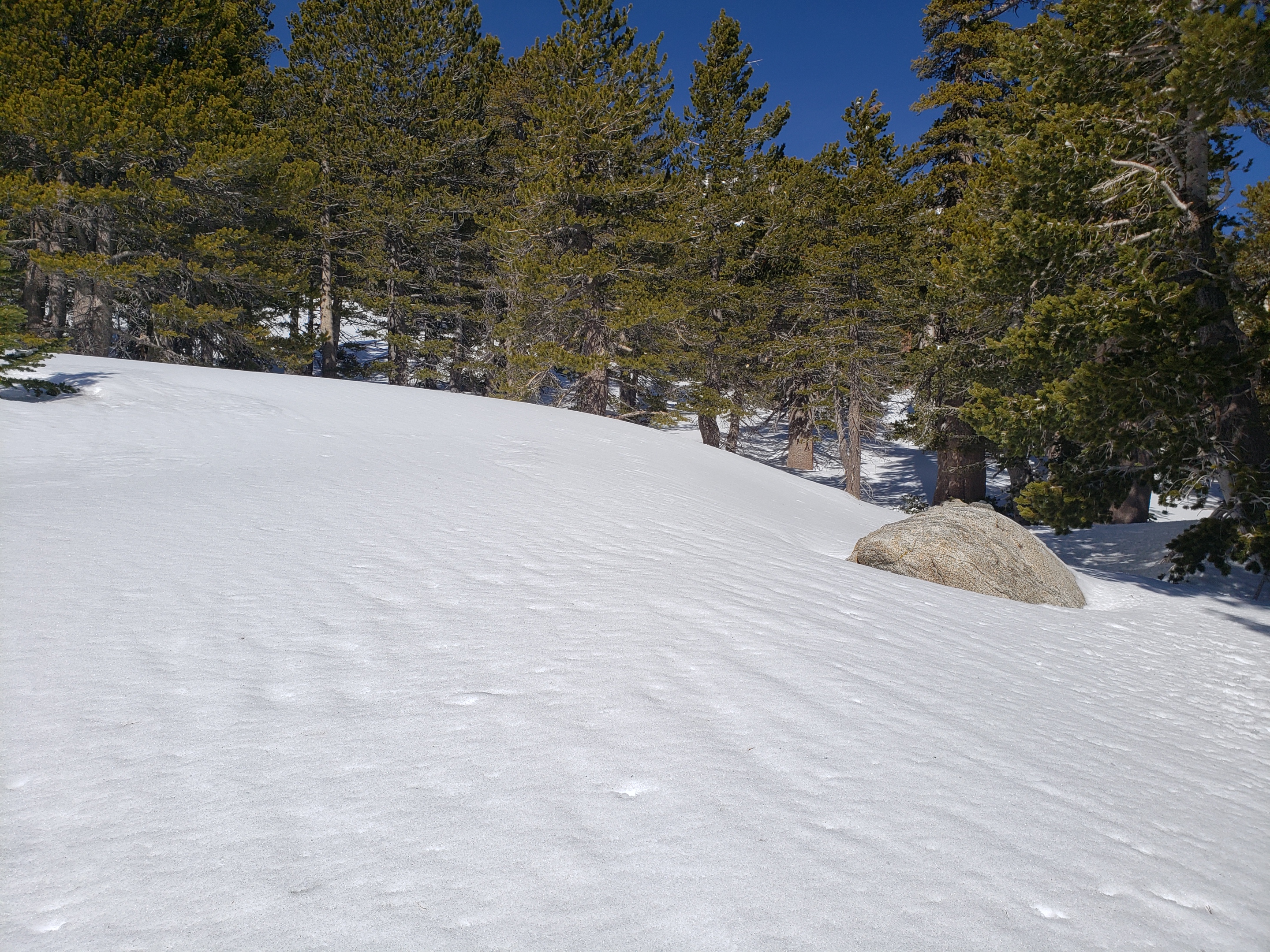
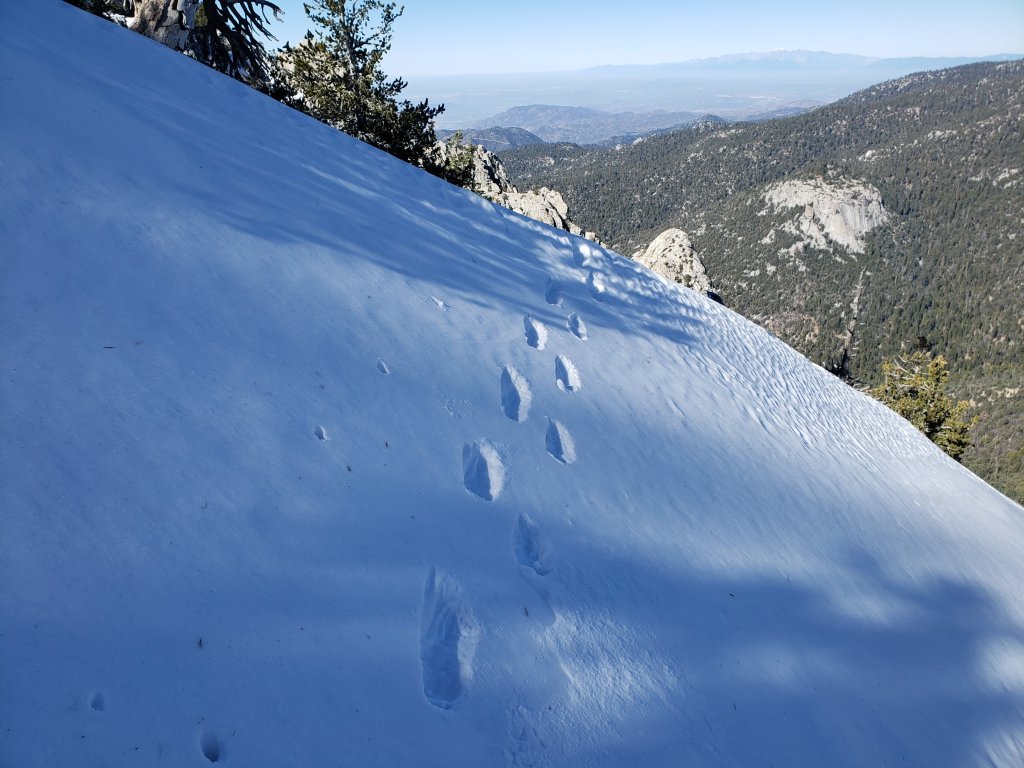
Temperatures far above historic averages – it was an astonishing 47°F (9°C) in Idyllwild at dawn yesterday – have meant that compacted icy snow below 8000′ (e.g., Devil’s Slide Trail) is slick in places. Unseasonably warm temperatures make the snow soft by mid morning at all elevations, the only positive being that postholing renders microspikes of limited use. The light snow that fell on 22nd February was almost completely gone within two days. Intense melting this week rapidly reduced snow depths to their lowest of the winter at all elevations.


Snow depths measured today are listed at the foot of this posting. Very strong Santa Ana winds in the high country yesterday caused spindrift to obscure parts of even heavily traveled trails. Cautious navigation is recommended everywhere.

Microspikes remain useful in some areas (see below) for hikers who are less comfortable on snow and ice, on compacted well-traveled trails, in particular for descending. Hikers with suitable footwear (plus hiking poles as preferred) will largely not need any additional traction, depending on temperature as discussed above. Shallow snow depths largely preclude any use for snowshoes now, even in areas off-trail above about 9500′ elevation.

Despite warm conditions on most days, hikers should be prepared for temperatures near or below freezing in the high country, and potentially well below freezing when considering windchill effects, especially on 1st-2nd March (see below for weather recorded recently at San Jacinto Peak).

Note that the USFS gate at Humber Park reopened on 5th February.

WEATHER Above average temperatures this week will continue until Friday 29th. A minor storm system is forecast to impact the San Jacinto mountains over the weekend (1st-2nd March) with the possibility of light precipitation including a couple of inches of snow in the high country. However temperatures will recover to well-above-seasonal immediately after the storm, so impacts to the trails will likely be limited to a day or two at most.

At San Jacinto Peak (10,810ft/3295m) today, Thursday 27th February 2020, at 0840 the air temperature was 32.4°F (0°C), with a windchill of 18.7°F (-8°C), 30% relative humidity, and a persistent NE wind sustained at 17 mph gusting to 21.0 mph.

At the Peak on Monday 24th February 2020, at 0945 the air temperature was 31.6°F (0°C), with a windchill of 21.9°F (-6°C), 54% relative humidity, and a light due North wind sustained at 4 mph gusting to 8.6 mph.

PACIFIC CREST TRAIL

The Pacific Crest Trail remains open at the rockslide just north of Antsell Rock (Mile 172.5). USFS has told the Trail Report that there are currently no plans to close this section of the PCT during spring 2020. The video report (available here) can be useful for deciding whether to try to hike around the rockslide or take an alternate route.

Microspikes may be useful on some of the PCT for patchy snow travel between approximately Miles 168 and 191, depending upon your comfort level on icy snow. Most thru hikers using poles will probably find spikes unnecessary however. See below for conditions on some specifc sections of the PCT and the many side trails.

Current snow cover on the PCT is very limited between Miles 165 and about 175 (Red Tahquitz), mainly confined to certain north-facing slopes e.g., Spitler Peak (Mile 168) and Apache Peak (Mile 169.5). Snow is then largely continuous between Miles 175-179 (to near Saddle Junction). The Trail is then largely clear to about Mile 184, except for a stubborn section of 0.5 mile approaching Annie’s Junction (Mile 180.8) which is always among the last areas to clear every spring. Most of Miles 184-191 is snow-covered, although exposed sections of Fuller Ridge (e.g., Miles 186.5-188.5) are clearing rapidly. North from about Mile 191 to Snow Creek is clear.

PCT hikers are reminded that overnight stays are not permitted at or near San Jacinto Peak, including in the historic shelter. Mt. San Jacinto State Park regulations permit overnight stays only in established campgrounds. Options for thru-hikers are Strawberry Junction and Little Round Valley.

Currently I am not updating the water situation in the San Jacinto mountains as the main springs and creeks are all flowing adequately. This may change soon as extremely low precipitation so far in 2020 is already causing flow rates far below average.

TRAIL CONDITIONS

All trails above about 9000′ remain largely snow-covered, with depth depending on elevation (see below) but sun exposed slopes are clearing rapidly (e.g., around Wellman’s Cienega). Some sections of trails above about 7700′ have limited icy snow cover.

Deer Springs Trail is largely clear of snow to Strawberry Junction with just a few patches close to the junction (microspikes not required). The PCT section from here to Fuller Ridge is largely clear of snow to about 8700′ elevation (just south of the Marion Mountain Trail junction), then there is extensive snow cover thereafter, with a well-traveled, consolidated track to follow. A track above 9000′ to Little Round Valley is consolidated, but be advised that it does not follow the established trail in places. Above Little Round Valley there is a direct (i.e. steep) track to follow to San Jacinto Peak. Microspikes can be useful for descending.

Fuller Ridge Trail (PCT Miles 185.5-190.5) has been clearing quickly, especially on sun-exposed slopes, mainly Miles 186.5-188.5. There are tracks to follow through the snow.

Marion Mountain Trail has been traveled and has a consolidated track to follow. Microspikes are useful, but not required, for descending the uppermost 0.5 mile. Note the road to Marion Mountain trailhead has been open all winter and is clear of snow.

Round Valley Trail from the Tram through to Wellman Divide has been well-traveled and a good track through the snow is easy to follow, onward to San Jacinto Peak.

Devil’s Slide Trail has limited icy snow cover in patches, mainly in the 0.5 mile nearest to Saddle Junction. Due to snow and ice compaction caused by hiker traffic, microspikes are helpful in some areas above 7700′, especially for descending, but are not required.

Ernie Maxwell Trail is virtually clear of snow, with just a few tiny patches, mainly near Humber Park.

The notoriously treacherous Tahquitz Peak trail from Chinquapin Flat/PCT Mile 178 is clearing surprisingly quickly, the snow drifts are softening (on warm days), and crampons are no longer required. There is a good set of tracks to follow. Microspikes are strongly recommended, in conjunction with an ice axe (if you know how to use it). In the morning, overnight wind conditions and the freeze-thaw cycle can partially obscure the existing steps through the angled icy snow for 0.1-0.2 mile.

South Ridge Trail is almost clear to Old Lookout Flat at 7600′, but with some remnant short, thin snow patches. Snow cover is fairly patchy (<20%) higher up, and the small patches are easily hiked. Microspikes are not required. South Ridge Road is clear of ice.

Seven Pines Trail has had no hiker traffic so far this winter, with no tracks or trail to follow. Indeed this trail has only been hiked a handful of times since November 2018. Extremely cautious navigation is recommended for those who are not very familiar with hiking this trail. The Forest Service closure of Dark Canyon Road continues, and there is no vehicular access to Seven Pines trailhead.


SNOW DEPTHS measured on 27th February 2020. Note that average depth is given, drifts can be much deeper in places. Altitudes are approximate.

San Jacinto Peak (10810′): 11″ (was 47″ on 27th December 2019)

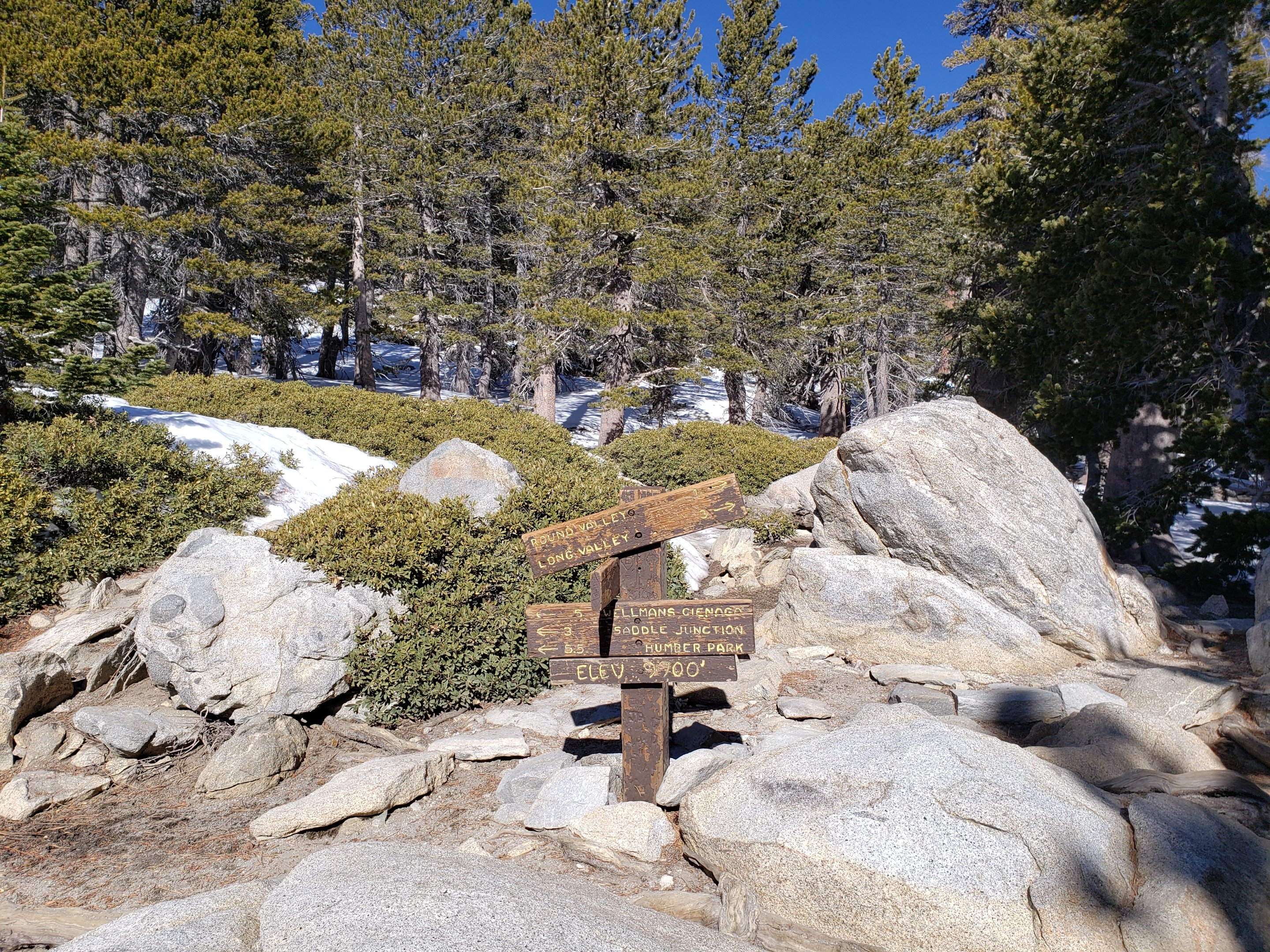
Wellman Divide (9700′): 1″ (was 27″ on 27th December 2019)

Annie’s Junction (9070′): 7″ (was 25″ on 27th December 2019)

Long Valley (8600′): 1″

Strawberry Junction (8100′): 0″

Saddle Junction (8070′): 1″ (was 19″ on 27th December 2019)

Devil’s Slide trailhead at Humber Park (6550′): 0″ (was 11″ on 27th December 2019)
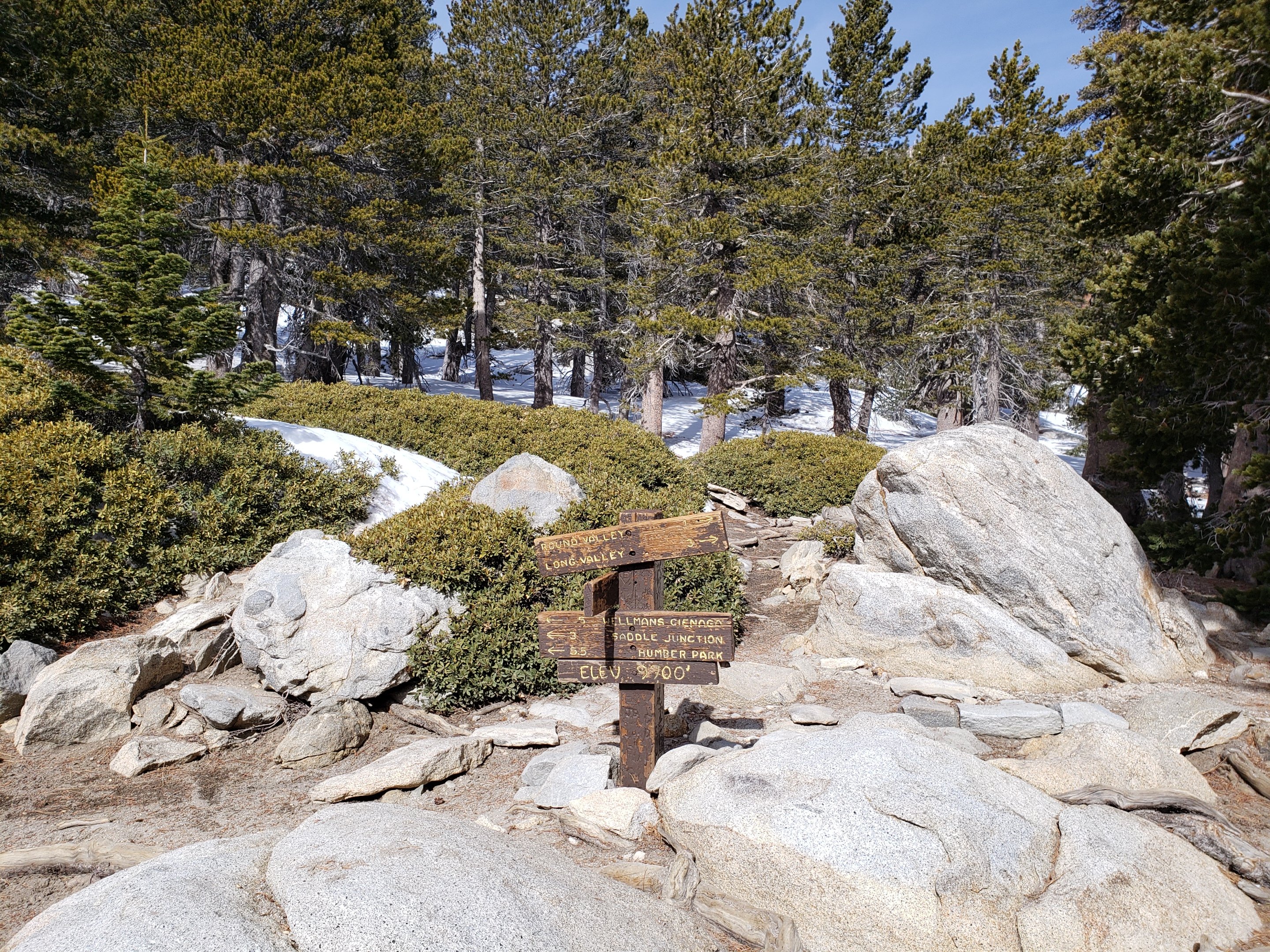
Wellman Divide (9700′) today 27th February 2020 (above), and the same view almost exactly one year earlier on 25th February 2019 (below).
San Jacinto Trail Report: available for everyone, funded by readers. While thousands of hours of labor are volunteered, the Report depends on small private donations to cover its direct costs (e.g., gear, gas, web space). With a busy PCT season underway, every contribution is invaluable, and your donation helps subsidise the thousands of thru-hikers who also use the Report. If you have found this Report useful, please consider visiting the Donate page. Thank you.

Minor snow storm update 23rd February 2020

[UPDATE 24th February: our hike this morning to San Jacinto Peak showed that melting has been even faster than expected. Most trail conditions already more closely resemble the Report from 17th Feb available below. Note that due to compaction by hiker traffic over the weekend Devil’s Slide Trail had tricky ice in patches, especially early this morning.]

Just a brief update on the twelfth storm of this winter (the fifth of 2020) which passed over the San Jacinto mountains yesterday, 22nd February. Melting is happening so fast that conditions will largely revert to similar to the previous report (linked here) within a couple of days, so I will not go in to too much detail.

A short video from San Jacinto Peak this morning discusses current and future conditions.

Snowfall was 2-4″ in the high country (depending on location more than elevation), and just over an inch at Idyllwild, where we also had a mix of rain (0.2″) and hail (0.25″). Unlike the storm 12 days earlier, the snow was very wet, with large flakes, and there was much less wind associated with the storm, so drifting was minimal.


Snow depths measured today are listed at the foot of this posting. Most major trails have already been traveled and melting is so rapid already today that few trails are obscured by snowfall. Nevertheless cautious navigation is strongly recommended everywhere.


I ascended and descended San  Jacinto Peak from Humber Park in just boots this morning, as the footing in 2-4″ of fresh snow was reasonable. Although large sections of trail, especially below 9000′, are already wet and slushy, these are not expected to refreeze overnight this week. Consequently ice formation should be limited and the need for additional traction minimal. Hiking poles are currently more useful than spikes.

Microspikes may be useful, but are not required, above about 7500′ elevation, especially on the snow overlying compacted icy trails. Exposed trails with southerly aspects (e.g., South Ridge, PCT north of Saddle Junction, lower Deer Springs) are melting very rapidly up to 8600′. Snowshoes may be of limited use off-trail above about 9500′ elevation.

Despite unseasonably warm temperatures this week, hikers should nevertheless be prepared for temperatures near or below freezing in the high country, and potentially well below freezing when considering windchil effects (see below for weather recorded recently at San Jacinto Peak).

Note that the USFS gate at Humber Park reopened on 5th February.

North face of Tahquitz Rock at dusk on 22nd February 2020.

WEATHER Temperatures will be well above seasonal for the next week, and very rapid snow melt is expected, especially on sun-exposed slopes. A potentially significant snow storm is currently forecast for 1st-2nd March. The remainder of the spring (March to May) is otherwise expected to be warmer and drier than average, as discussed in the latest NWS San Diego video.

At San Jacinto Peak (10,810ft/3295m) today, Sunday 23rd February 2020, at 0910 the air temperature was 24.8°F (-4°C), with a windchill of 9.8°F (-12°C), 82% relative humidity, and a moderate NNW wind sustained at 5 mph gusting to 15.6 mph.

At the Peak on Friday 21st February 2020 at 0825 the air temperature was 30.8°F (-1°C), with a windchill of 15.4°F (-9°C), 55% relative humidity, and a sharp SSE wind sustained at 12 mph gusting to 22.2 mph.

PACIFIC CREST TRAIL

The Pacific Crest Trail remains open at the rockslide just north of Antsell Rock (Mile 172.5). USFS has stated there are currently no plans to close this section of the PCT during spring 2020. The video report from 7th October (available here) can be useful for deciding whether to try to hike around the rockslide or take an alternate route.

Microspikes are not required, but may be useful (especially cold early mornings) on the PCT for increasingly patchy snow travel between approximately Miles 158 and 192, depending upon your comfort level on fresh powder and icy snow.

PCT hikers are reminded that overnight stays are not permitted at or near San Jacinto Peak, including in the historic shelter. Mt. San Jacinto State Park regulations permit overnight stays only in established campgrounds. Options for thru-hikers are Strawberry Junction and Little Round Valley.

TRAIL CONDITIONS

All trails above about 6500′ are snow-covered. However melting is rapid today, and will be even faster over the next few days, so conditions will ameliorate very quickly.

Reliable tracks are currently in place for Devil’s Slide Trail, Saddle Junction to San Jacinto Peak, from the Tram through to Wellman Divide, Deer Springs Trail to at least Strawberry Junction, and Marion Mountain Trail to Deer Springs Trail and onward to San Jacinto Peak.

Devil’s Slide Trail has a good track to follow, and microspikes are useful but not required.

Ernie Maxwell Trail is largely clear of snow. A few patches remain, mainly near Humber Park. No spikes required.

South Ridge Trail is rapidly clearing to Old Lookout Flat at 7600′, but with some remnant snow patches. Snow cover is becoming fairly patchy (<50%) higher up, and the soft thin snow is easily hiked. Microspikes are not required.

Tahquitz Peak trail from Chinquapin Flat/PCT Mile 178 is clearing surprisingly quickly, snow drifts are softening, and crampons are no longer required (but some hikers may prefer them). Microspikes are strongly recommended, in conjunction with an ice axe (if you know how to use it). In the morning, overnight wind conditions and the freeze-thaw cycle may well have covered the existing steps through the angled icy snow for 0.1-0.2 mile.

SNOW DEPTHS measured today are as follows, with snow accumulation from this latest storm given first, followed by current total average depth in parentheses. Please note that averages are given; drifts are much deeper in places. Altitudes are approximate.

San Jacinto Peak (10810′): 3″ (17″)

Wellman Divide (9700′): 2″ (4″)(already largely melted)

Annie’s Junction (9070′): 4″ (13″)

Long Valley (8600′): 2″ (3″)(already largely melted)

Saddle Junction (8070′): 3″ (4″)

Devil’s Slide trailhead at Humber Park (6520′): 2″ (2″) (already largely melted)

Idyllwild (at 5550′): 1.2″ (completely melted by this afternoon)

Wellman Divide early this morning 23rd February 2020 (above), and for comparison on Friday 21st February 2020 (below).


San Jacinto Trail Report: available for everyone, funded by readers. While thousands of hours of labor are volunteered, the Report is wholly dependent on small private donations to cover its direct costs (e.g., gear, gas, web space). With a busy PCT season coming soon, every contribution is invaluable, and your donation helps subsidise the thousands of thru-hikers who also use the Report. If you have found this Report useful, please consider visiting the Donate page. Thank you.

Trail update 17th February 2020

[UPDATE 22nd February @ 1730: a minor storm system is passing over the San Jacinto mountains today. Two inches of snow had fallen at San Jacinto Peak by dusk today. In Idyllwild (at 5550′) there was a mix of rain, hail, and snow, currently about 1.3″ of the latter. Snow accumulation on lower Devil’s Slide Trail this evening was only 1.0″. Long Valley (8600′) has had a couple of brief dustings of snow totalling <1″. Very rapid warming (and therefore melting) over the next couple of days means that the conditions described below will still apply.]

I have hiked to San Jacinto Peak three of the past six mornings, including today, affording a check of snow and trail conditions on most major routes. South Ridge and the Tahquitz Peak area have also been hiked twice in the same period. I hope to fully survey the PCT again this week.

Cool early mornings like Saturday make for pleasant hiking on firm snow, and I ascended San Jacinto Peak without microspikes. In contrast this morning very mild temperatures – 40°F in Idyllwild – meant that icy snow below 8000′ (e.g., Devil’s Slide Trail) was very slick in places. Unseasonably warm temperatures make the snow soft by late morning at all elevations, the only positive being that postholing renders microspikes of limited use.

The light snow that fell a week ago in the early hours of the morning of Monday 10th was almost completely gone within days. Rapid melting this weekend has already reduced snow depths to the levels seen in early February at all elevations.

Snow depths measured today are listed at the foot of this posting. Strong winds in the high country may cause spindrift to obscure parts of even heavily traveled trails. Cautious navigation is recommended everywhere.

Microspikes remain useful in some areas (see below) for hikers inexperienced on snow and ice, on compacted, well-traveled trails, in particular for descending. Hikers with suitable footwear (plus hiking poles as preferred) will largely not need any additional traction, depending on temperature as discussed above. Snowshoes may be useful in some areas off-trail above about 9500′ elevation.

Hikers should be prepared for temperatures near or below freezing in the high country, and potentially well below freezing when considering windchill effects (see below for weather recorded recently at San Jacinto Peak).

Note that the USFS gate at Humber Park reopened on 5th February.

WEATHER Temperatures will remain above average this week, cooling to below seasonal next week (after 24th February). There is a possibility of light precipitation overnight on Friday 21st into early Saturday 22nd, including perhaps a couple of inches of snow in the high country. Otherwise there is little sign of precipitation into March.

The latest video report from NWS San Diego (issued on 14th February) describes the dire moisture situation we are now experiencing. Having been at c.200% of average at the end of 2019, the two wettest months of the water year (January and February) have been so poor in 2020, at <10% of average, that overall the San Jacinto mountains have dropped far below average precpitation already. The Sierra Nevada is faring no better, with snowpack at only 50-60% of average.

At San Jacinto Peak (10,810ft/3295m) today, Monday 17th February 2020, at 0750 the air temperature was 33.8°F (1°C), with a windchill of 18°F (-8°C), 42% relative humidity, and a very gusty NW wind sustained at 9 mph gusting to 28.7 mph.

At the Peak on Saturday 15th February 2020, at 0800 the air temperature was 32.4°F (0°C), with a windchill of 17.7°F (-8°C), 23% relative humidity, and a chilly WNW wind sustained at 18 mph gusting to 23.3 mph.

PACIFIC CREST TRAIL

The Pacific Crest Trail remains open at the rockslide just north of Antsell Rock (Mile 172.5). USFS has told the Trail Report that there are currently no plans to close this section of the PCT during spring 2020. The video report (available here) can be useful for deciding whether to try to hike around the rockslide or take an alternate route.

Microspikes may be useful on some of the PCT for patchy snow travel between approximately Miles 168 and 191, depending upon your comfort level on icy snow. Most thru hikers using poles will probably find spikes unnecessary however. See below for conditions on some specifc sections of the PCT and the many side trails.

Current snow cover on the PCT is very limited between Miles 151 (Highway 74) and about 175 (Red Tahquitz), mainly confined to certain north-facing slopes e.g., Spitler Peak (Mile 168) and Apache Peak (Mile 169.5). Snow is then largely continuous between Miles 175-179 (to near Saddle Junction). The Trail is then largely clear to about Mile 184, except for a stubborn section of 0.5 mile approaching Annie’s Junction (Mile 180.8) which is always among the last areas to clear every spring. Most of Miles 184-191 is snow-covered, although exposed sections of Fuller Ridge (e.g., Miles 186.5-188.5) are clearing rapidly. North from about Mile 191 to Snow Creek is clear.

PCT hikers are reminded that overnight stays are not permitted at or near San Jacinto Peak, including in the historic shelter. Mt. San Jacinto State Park regulations permit overnight stays only in established campgrounds. Options for thru-hikers are Strawberry Junction and Little Round Valley.

Currently I am not updating the water situation in the San Jacinto mountains as the main springs and creeks are all flowing adequately. This may change soon as extremely low precipitation so far in 2020 is already causing flow rates far below average.

TRAIL CONDITIONS

All trails above about 9000′ remain largely snow-covered, with depth depending on elevation (see below) but sun exposed slopes are clearing rapidly (e.g., around Wellman’s Cienega). Some sections of trails above about 7700′ have limited snow cover.

Deer Springs Trail is largely clear of snow to Strawberry Junction with just a few patches close to the junction (microspikes not required). The PCT section from here to Fuller Ridge is quickly clearing of snow to about 8700′ elevation (just south of the Marion Mountain Trail junction), then there is continuous snow cover thereafter, with a well-traveled, consolidated track to follow. A track above 9000′ to Little Round Valley is consolidated, but be advised that it does not follow the established trail in places. Above Little Round Valley there is a direct (i.e. steep) track to follow to San Jacinto Peak. Microspikes can be useful for descending.

Fuller Ridge Trail (PCT Miles 185.5-190.5) has been clearing quickly, especially on sun-exposed slopes, mainly Miles 186.5-188.5. There are tracks to follow through the snow.

Marion Mountain Trail has been traveled and has a consolidated track to follow. Microspikes are useful, but not required, for descending the uppermost 0.5 mile. Note the road to Marion Mountain trailhead has been open all winter and is clear of snow.

Round Valley Trail from the Tram through to Wellman Divide has been well-traveled and a good track through the snow is easy to follow, onward to San Jacinto Peak.

Devil’s Slide Trail has limited icy snow cover in patches, mainly in the 0.5 mile nearest to Saddle Junction. Microspikes may be helpful in some areas above 7700′, especially for descending, but are not required.

Ernie Maxwell Trail is virtually clear of snow, with just a few tiny patches, mainly near Humber Park.

The parts of Willow Creek Trail and Caramba Trail nearest to Saddle Junction have well-defined tracks, likely heading around Skunk Cabbage Meadow.

The notoriously treacherous Tahquitz Peak trail from Chinquapin Flat/PCT Mile 178 is clearing surprisingly quickly, the snow drifts are softening (on warm days), and crampons are no longer required. Microspikes are strongly recommended, in conjunction with an ice axe (if you know how to use it). In the morning, overnight wind conditions and the freeze-thaw cycle often cover the existing steps through the angled icy snow for 0.1-0.2 mile. Please do not attempt to cross this section without adequate equipment and knowledge. The consequences of a fall here can be very severe.

South Ridge Trail is clear to Old Lookout Flat at 7600′, but with some remnant very thin snow patches. Snow cover is fairly patchy (<50%) higher up, and the soft thin snow is easily hiked. Microspikes are not required. South Ridge Road is clear of ice.

Seven Pines Trail has had no hiker traffic so far this winter, with no tracks or trail to follow. Indeed this trail has only been hiked a handful of times since November 2018. Extremely cautious navigation is recommended for those who are not very familiar with hiking this trail.

The Forest Service closure of Dark Canyon Road continues, and there is no vehicular access to Seven Pines trailhead.

SNOW DEPTHS measured on 17th February 2020. Note that average depth is given, drifts can be much deeper in places. Altitudes are approximate.

San Jacinto Peak (10810′): 16″ (was 47″ on 27th December)

Little Round Valley (9800′): 16″

Wellman Divide (9700′): 2″ (was 27″ on 27th December)

Annie’s Junction (9070′): 11″ (was 25″ on 27th December)

Fuller Ridge Trail (PCT Mile 185.5) at junction with Deer Springs Trail (8950′): 12″

Long Valley (8600′): 1″

Strawberry Junction (8100′): <1″

Saddle Junction (8070′): 1″ (was 19″ on 27th December)

Devil’s Slide trailhead at Humber Park (6550′): 0″ (was 11″ on 27th December)

Wellman Divide (9700′) today 17th February 2020 (above), and one week earlier on 10th February 2020 (below).

San Jacinto Trail Report: available for everyone, funded by readers. While thousands of hours of labor are volunteered, the Report depends on small private donations to cover its direct costs (e.g., gear, gas, web space). With a busy PCT season underway, every contribution is invaluable, and your donation helps subsidise the thousands of thru-hikers who also use the Report. If you have found this Report useful, please consider visiting the Donate page. Thank you.
Snow storm 10th February 2020

[UPDATED 13th February: current status of trails either side of Tahquitz Peak is updated below, based on our hike up from home this morning.]

[UPDATED 12th February: I have amended gear advice below following my hike today to San Jacinto Peak, when I broke trail from Saddle Junction to the Peak, almost entirely just in boots (with no additional traction gear). Melting has been even more rapid than expected, and conditions may start to resemble the Report from 4th February (below) perhaps as soon as this weekend.]

A brief update on the eleventh storm of this winter (but the first significant storm of 2020) which hit the San Jacinto mountains overnight and this morning. A short video from San Jacinto Peak this morning gives a feel for current conditions.

In general forecasters had a terrible time accurately predicting the timing and impact of this storm due to its unusual track and fragmentation in storm cells. Overall snowfall was less than had been expected, with fewer than 6″ in the high country, and less than an inch at Idyllwild, but snowfall may vary more by location than elevation.

Winds were very strong so drifting in trails is considerable. Snow fell as graupel and rounded grains, and as we descended this morning Kyle Eubanks accurately described it as like walking through bird seed. Depths were not sufficient to completely obscure tracks in most places. However winds remain strong for the next 24+ hours, so extensive drifting is expected.

Snow depths measured today are listed at the foot of this posting. Currently most major trails have not been traveled and may be partly obscured by snowfall. Cautious navigation is strongly recommended everywhere.

Microspikes are useful, but not required, above about 7500′ elevation, especially on the snow overlying compacted icy trails. Exposed trails with southerly aspects (e.g., South Ridge, PCT north of Saddle Junction, lower Deer Springs) are melting very rapidly up to 8500′, and spikes may not be needed much below 9000′. [Updated 15th Feb: I ascended San Jacinto Peak easily with no microspikes early this morning.]

Crampons (with an ice axe) may be useful, but certainly not required, in compacted areas above about 9500′. Snowshoes are of limited use only off-trail above about 9500′ elevation.

Hikers should be prepared for temperatures below freezing in the high country, and potentially well below freezing when considering windchil effects (see below for weather recorded recently at San Jacinto Peak).

Note that the USFS gate at Humber Park reopened on 5th February. Humber Park has been plowed, so it is unlikely that the gate will be closed again soon.

WEATHER Temperatures are forecast to be at or even slightly below seasonal for the next week. Steady daytime snow melt is expected, especially on exposed slopes. No additional precipitation is in the forecast.

At San Jacinto Peak (10,810ft/3295m) today, Monday 10th February 2020, at 0845 the air temperature was 15.3°F (-9°C), with a windchill of -7.8°F (-22°C), 99% relative humidity, and a sharp NNE wind sustained at 14 mph gusting to 28.1 mph.

In marked contrast, at the Peak on Thursday 6th February 2020 at 0955 the air temperature was 31.9°F (0°C), with a windchill of 23.7°F (-5°C), 69% relative humidity, and a light WSW wind sustained at 5 mph gusting to 9.0 mph.

PACIFIC CREST TRAIL

The Pacific Crest Trail remains open at the rockslide just north of Antsell Rock (Mile 172.5). USFS has stated there are currently no plans to close this section of the PCT during spring 2020. The video report from 7th October (available here) can be useful for deciding whether to try to hike around the rockslide or take an alternate route.

Microspikes are not required, but may be useful (especially cold early mornings) on the PCT for increasingly patchy snow travel between approximately Miles 158 and 192, depending upon your comfort level on fresh powder and icy snow.

PCT hikers are reminded that overnight stays are not permitted at or near San Jacinto Peak, including in the historic shelter. Mt. San Jacinto State Park regulations permit overnight stays only in established campgrounds. Options for thru-hikers are Strawberry Junction and Little Round Valley.


TRAIL CONDITIONS

All trails above about 6500′ are snow-covered, with depth depending on elevation (see below).

Reliable tracks are currently in place only for Devil’s Slide Trail. From Saddle Junction to San Jacinto Peak, and from the Tram through to Wellman Divide, trails have been hiked but tracks will be largely obscured by wind-driven snow.

Devil’s Slide Trail has a good track to follow, and microspikes are useful but not required.

Ernie Maxwell Trail is largely clear of snow. A few tiny icy patches remain, mainly near Humber Park. No spikes required.

South Ridge Trail [updated 13th Feb] is  clear to Old Lookout Flat at 7600′, but with some remnant very thin snow patches. Snow cover is fairly patchy (<50%) higher up, and the soft thin snow is easily hiked. Microspikes are not required.


Tahquitz Peak trail from Chinquapin Flat/PCT Mile 178 [updated 13th Feb] is clearing surprisingly quickly, snow drifts are softening, and crampons are no longer required (but some hikers may prefer them). Microspikes are strongly recommended, in conjunction with an ice axe (if you know how to use it). In the morning, overnight wind conditions and the freeze-thaw cycle may well have covered the existing steps through the angled icy snow for 0.1-0.2 mile.


SNOW DEPTHS measured today are as follows, with snow accumulation from this latest storm given first, followed by total average depth in parentheses. Please note that averages are given; drifts are much deeper in places. Altitudes are approximate.
Many thanks to Kyle Eubanks for data from Round and Long valleys.

San Jacinto Peak (10810′): 5″ (21″)

Wellman Divide (9700′): 4″ (6″)

Round Valley (9100′): 4″ (8″)

Annie’s Junction (9070′): 3.5″ (14″)

Long Valley (8600′): 4″ (5″)

Saddle Junction (8070′): 2″ (3″)

Devil’s Slide trailhead at Humber Park (6520′): 1.5″ (1.5″)

Idyllwild (at 5550′): 0.5″ (already melted by this afternoon)
Wellman Divide late morning today, 10th February 2020 (above), and the afternoon of the previous day, 9th February 2020 (below).

San Jacinto Trail Report: available for everyone, funded by readers. While thousands of hours of labor are volunteered, the Report is wholly dependent on small private donations to cover its direct costs (e.g., gear, gas, web space). With a busy PCT season coming soon, every contribution is invaluable, and your donation helps subsidise the thousands of thru-hikers who also use the Report. If you have found this Report useful, please consider visiting the Donate page. Thank you.

Trails and weather 4th February 2020

[UPDATED 7th February to include the latest forecast for the storm on 9th-10th, and new information from my hike today around Tahquitz Peak, and from yesterday to San Jacinto Peak.]

We have hiked to San Jacinto Peak four of the past five mornings, affording a check of most major routes. South Ridge and the Tahquitz Peak area have also been hiked twice in the past four days. Delightfully frigid temperatures made for solid hiking on icy snow yesterday and today. Chilly conditions at San Jacinto Peak this morning are discussed in a short video available on YouTube.

In the early hours of the morning of Monday 3rd, we had 0.04″ rain in Idyllwild, with <0.25″ snow between 6400′-9100′ elevation. There was no fresh snowfall in the high country, which was above the cloud. By the time I descended from the Peak late morning, the fresh snow had already disappeared below 7600′, and almost all of it was gone today.

Snow depths measured today are listed at the foot of this posting. Strong winds in the high country may cause spindrift to obscure parts of even the heavily traveled trails. Cautious navigation is recommended everywhere.

Microspikes remain useful in some areas (see below) for hikers inexperienced on snow and ice, on compacted, well-traveled trails, in particular for descending. Hikers with suitable footwear and hiking poles will likely not need spikes. Snowshoes may be useful in limited areas off-trail above about 9500′ elevation. This information only applies through Sunday 9th (when fresh snowfall is expected).

Despite unseaonably warm weather on some days, hikers should nevertheless be prepared for temperatures near or below freezing in the high country, and potentially far below freezing when considering windchil effects (see below for weather recorded recently at San Jacinto Peak).

Note that the USFS gate at Humber Park reopened on 5th February.

WEATHER Following the current short but severe cold spell, there will be yet another rapid swing to above average temperatures (mainly 7th-8th February). The new video from NWS San Diego (issued on 7th Feb) indicates a good chance of precipitation at the beginning and end of next week (9th-14th February), before a return to warmer, dry conditions in the second half of the month. Current forecasts anticipate a light snowfall above about 4000′, with a few inches possible in the high country, mainly on 9th-10th February.

At San Jacinto Peak (10,810ft/3295m) today, Wednesday 4th February 2020, at 1010 the air temperature was 2.5°F (-16°C), with a windchill of -28.1°F (-33°C), 52% relative humidity, and a sharp due North wind sustained at 15 mph gusting to 29.8 mph.

At the Peak on Monday 3rd February 2020, at 0910 the air temperature was 18.4°F (-7°C), with a windchill of -2.5°F (-19°C), 22% relative humidity, and a chilly WSW wind sustained at 11 mph gusting to 23.9 mph.

PACIFIC CREST TRAIL

The Pacific Crest Trail remains open at the rockslide just north of Antsell Rock (Mile 172.5). USFS has stated there are currently no plans to close this section of the PCT during spring 2020. The video report from 7th October (available here) can be useful for deciding whether to try to hike around the rockslide or take an alternate route.

Microspikes may be useful, but certainly not essential, on some of the PCT for patchy snow travel between approximately Miles 165 and 191, depending upon your comfort level on icy snow. See below for conditions on some specifc sections of the PCT and the many side trails.

PCT hikers are reminded that overnight stays are not permitted at or near San Jacinto Peak, including in the historic shelter. Mt. San Jacinto State Park regulations permit overnight stays only in established campgrounds. Options for thru-hikers are Strawberry Junction and Little Round Valley.

TRAIL CONDITIONS

All trails above about 9000′ remain largely snow-covered, with depth depending on elevation (see below). Some sections of trails above about 7800′ may have limited snow cover.

Deer Springs Trail is clear of snow to Strawberry Junction with just a few tiny patches close to the junction (microspikes not required). The PCT section from here to Fuller Ridge is almost clear of snow to about 8700′ elevation (just south of the Marion Mountain Trail junction), then there is  continuous snow cover thereafter, with a well-traveled, consolidated track to follow. A track above 9000′ to Little Round Valley is consolidated, but be advised that it does not follow the established trail in places. Above Little Round Valley there is a direct (i.e. steep) track to follow to San Jacinto Peak. Microspikes are useful for descending.

Fuller Ridge Trail (PCT Miles 185.5-190.5) has been clearing quickly, especially on sun-exposed slopes, mainly Miles 186.5-188.5. There are tracks to follow through the snow.

Marion Mountain Trail has been heavily traveled and has a good consolidated track to follow. Microspikes are useful, but not required, for descending the uppermost 0.5 mile. Note the road to Marion Mountain trailhead has been open all winter and is clear of snow.

Round Valley Trail from the Tram through to Wellman Divide has been well-traveled and a good track through the snow is easy to follow, on to San Jacinto Peak.

Devil’s Slide Trail has limited icy snow cover in patches, mainly in the 0.1 mile nearest to Saddle Junction. Microspikes may be helpful in some areas above 7700′, but are not required.

Ernie Maxwell Trail is clear of snow.

The parts of Willow Creek Trail and Caramba Trail nearest to Saddle Junction have well-defined tracks, likely heading around Skunk Cabbage Meadow.

The PCT southbound from Saddle Junction has been traveled to Chinquapin Flat.

Tahquitz Peak trail from Chinquapin Flat/PCT Mile 178 is clearing surprisingly quickly, the snow drifts are softening (on warm days), and crampons are no longer required. Microspikes are strongly recommended, in conjunction with an ice axe (if you know how to use it). In the morning, overnight wind conditions and the freeze-thaw cycle may well have covered the existing steps through the angled icy snow for 0.1-0.2 mile.

My freshly cut steps 0.2 mile north of Tahquitz Peak, mid morning on 7th February 2020.

South Ridge Road is clear of ice. South Ridge Trail is basically clear to Tahquitz Peak, but with a few easily-traversed tiny remnant icy snow patches. Microspikes are no longer required.

Seven Pines Trail has had no hiker traffic so far this winter, with no tracks or trail to follow. Indeed this trail has only been hiked a handful of times since November 2018. Extremely cautious navigation is recommended for those who are not very familiar with hiking this trail in snow.

The Forest Service closure of Dark Canyon Road remains in place, hence there is no vehicular access to Seven Pines trailhead.

SNOW DEPTHS measured on 4th February 2020 (except where otherwise indicated). Note that average depth is given, drifts can be much deeper in places. Altitudes are approximate.

San Jacinto Peak (10810′): 20″ (was 47″ on 27th December)

Little Round Valley (9800′): 19″ (on 29th January 2020)

Wellman Divide (9700′): 2″ (was 27″ on 27th December)

Annie’s Junction (9070′): 11″ (was 25″ on 27th December)

Fuller Ridge Trail (PCT Mile 185.5) at junction with Deer Springs Trail (8950′): 12″ (on 29th January 2020)

Long Valley (8600′): <1″

Strawberry Junction (8100′): 0″

Saddle Junction (8070′): 1″ (was 19″ on 27th December)

Devil’s Slide trailhead at Humber Park (6520′): 0″ (was 11″ on 27th December)

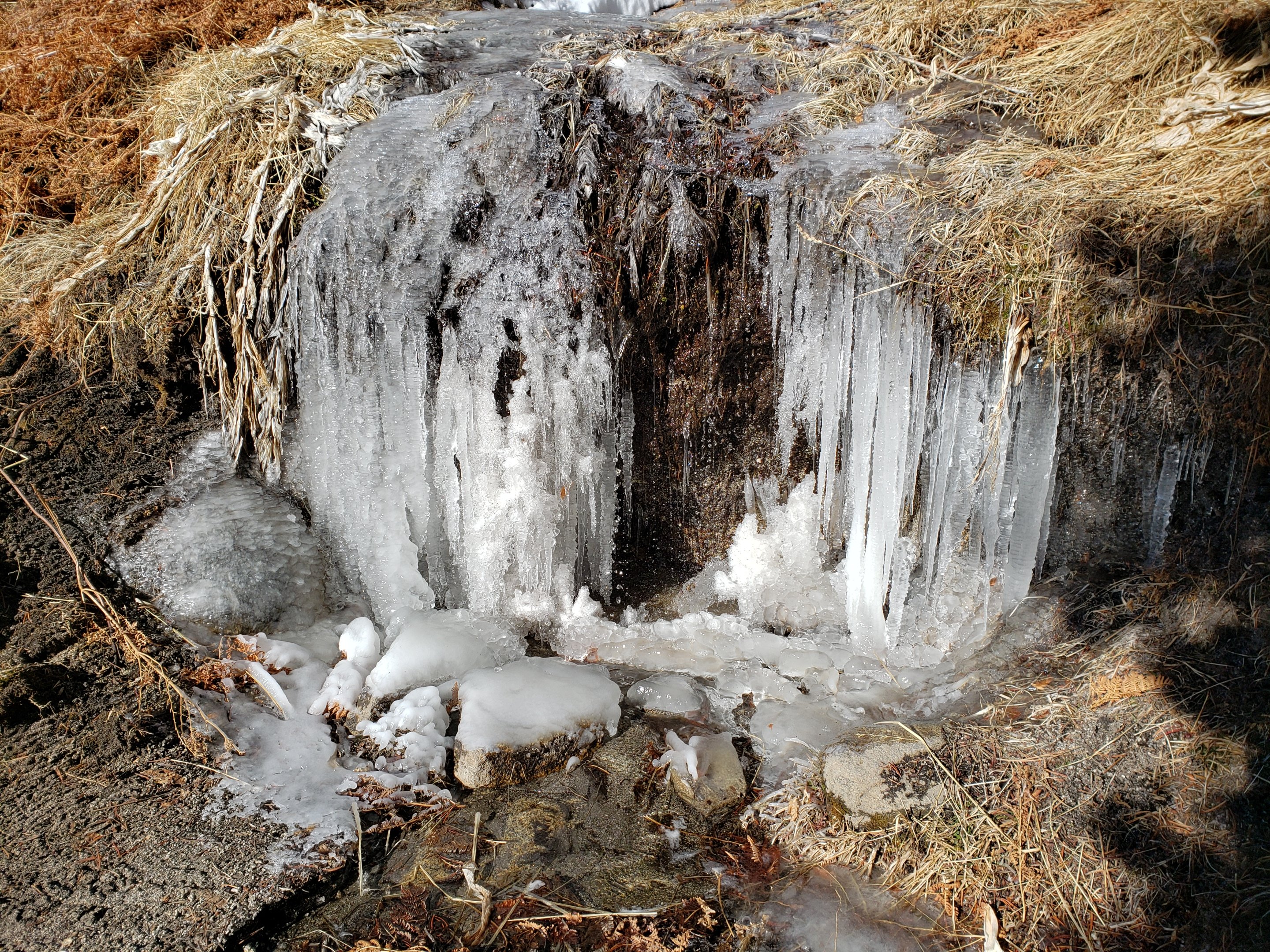
A very icy north spring at Wellman’s Cienega early this morning, 4th February 2020.


San Jacinto Trail Report: available for everyone, funded by readers. While thousands of hours of labor are volunteered, the Report is wholly dependent on small private donations to cover its direct costs (e.g., gear, gas, web space). With a busy PCT season coming soon, every contribution is invaluable, and your donation helps subsidise the thousands of thru-hikers who also use the Report. If you have found this Report useful, please consider visiting the Donate page. Thank you.