Snow and weather update 20th December 2025

The major blocking high pressure area over the south-west of the country continues to generate very warm and dry conditions for our region. Forecasts are increasingly confident that an atmospheric river system will impact Southern California on 23rd-28th December. While precipitation volumes and timing remain somewhat uncertain, the system is expected to arrive with a high freeze level, with moderate snowfall initially only above 8000 ft before dropping, possibly as low as 6500 ft, by 28th, but with substantial rainfall (2.5-4.0 inches across five days) throughout mid elevations.

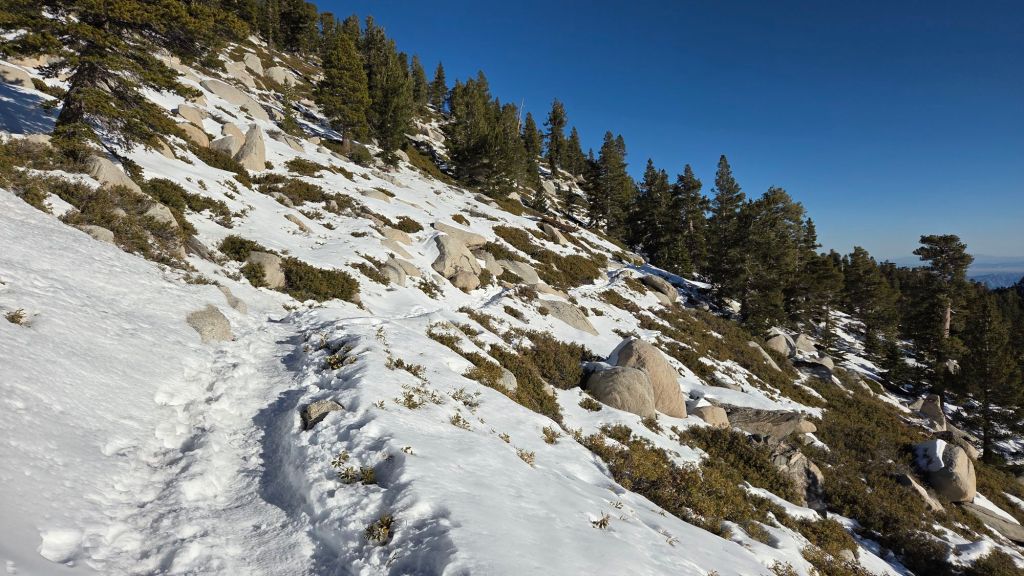
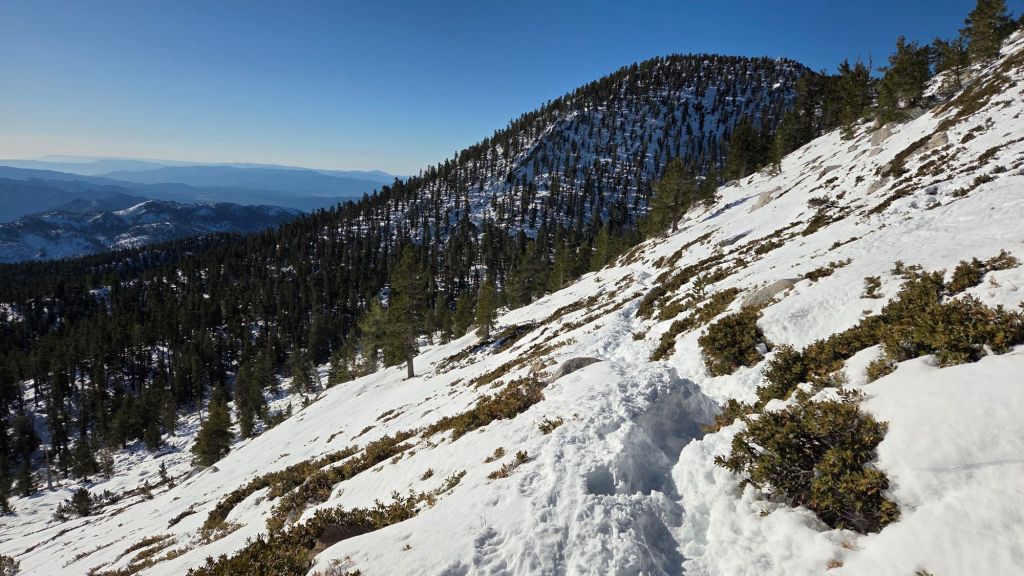
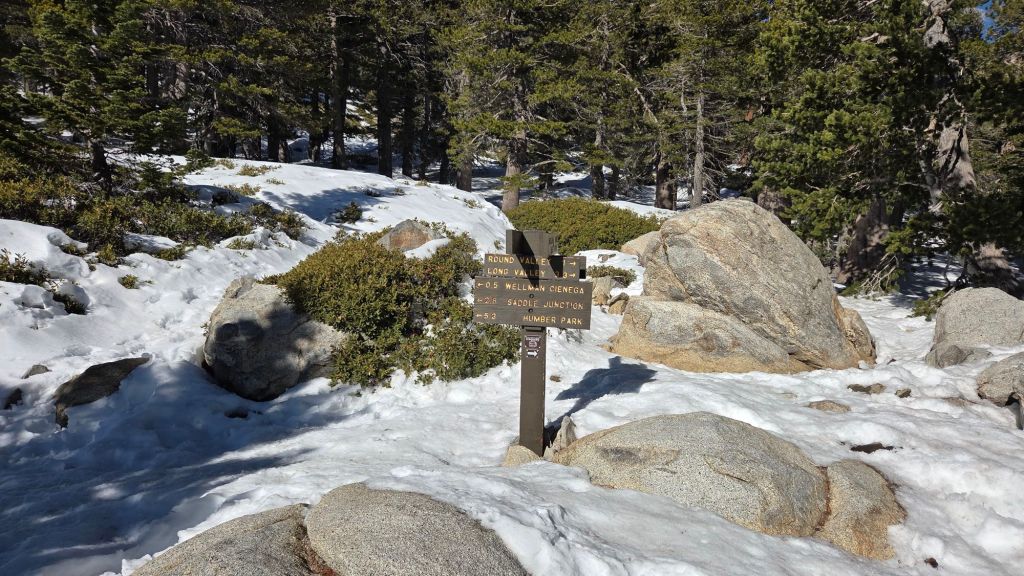
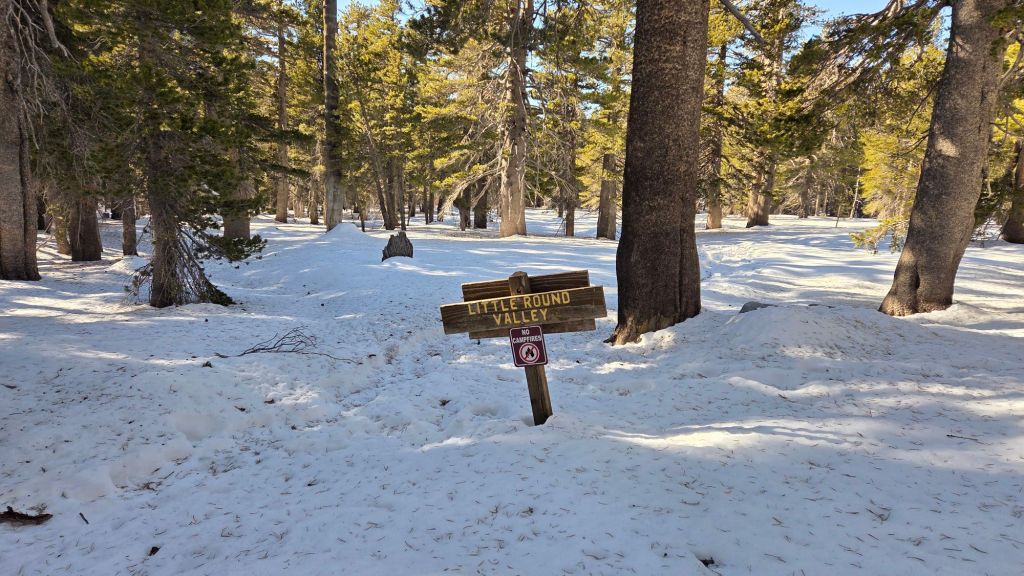
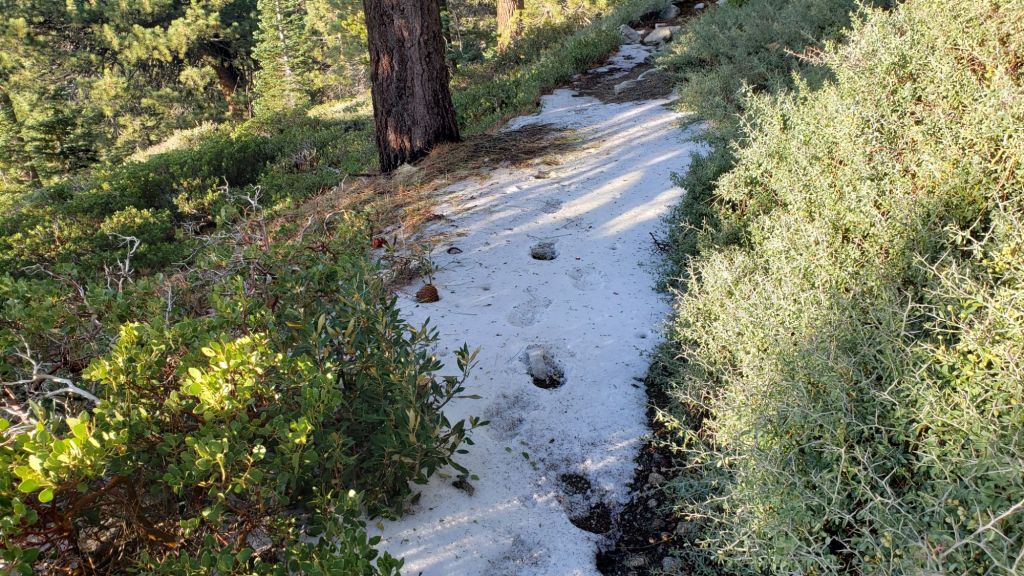
Since the minor snow storms that impacted the region for nine days in mid November – discussed in detail in a prior Report linked here – temperatures generally well above seasonal have led to very rapid snow melt for the time of year (photos below).

The air temperature of 52.2°F (11°C) that I recorded at San Jacinto Peak on Thursday 11th December 2025 shattered (by 3°F) the previous high temperature knowingly recorded at the Peak in the month of December.

Once temperatures drop markedly after 22nd December – and thereafter are expected to remain seasonally cool into early January – hikers should be prepared for temperatures below freezing at high elevations, and potentially far below freezing when considering wind chill effects. See the Weather section below for my recent observations from San Jacinto Peak.

The conditions forecast for 24th-26th December are similar to those on 15th November which resulted in multiple significant hypothermia cases in the San Jacinto high country (the overlap with a holiday period adding a further complication) to which I briefly alluded in a prior report linked here. Hikers – most notably those from the Tramway where such conditions are rarely anticipated – may be ascending through rain, before encountering snow, strong winds, and significant windchills at the highest elevations. Being fully prepared for the challenging combination of both genuine winter conditions and very wet weather will be critical (at a minimum, having fully wind- and waterproof clothing, plus multiple dry layers, hats, and gloves stored in a truly waterproof pack system, is very strongly advised). A clear recognition of when to turn around in such conditions is also invaluable.

Details are given below under Trail Conditions, but most hikers will find that carrying spikes remains advisable in areas above about 9000 ft, although experienced hikers will find they are generally no longer needed on established trails even well above that elevation. Spikes tend to be especially helpful for descending, even when they seem to be of limited use for ascending.

Current snow depths measured at various locations on the trail system are given near the foot of this posting. Note however that snow depth itself is rarely indicative of the difficulty (or ease) of hiking a particular track or trail. For example a firm, well-compacted track across snow feet deep is often much easier hiking than traversing across just a few inches depth of, for example, angled virgin icy snow. Conversely, just a one inch covering of icy snow at mid-elevations (where there have been many freeze-thaw cycles) can be among the most treacherous surfaces to hike.

Black Mountain Road (4S01) closed to vehicle traffic in mid November at the gate 1.7 miles up from Highway 243. Despite being clear of snow it is now expected to remain closed for the winter season, per Forest Service.

Daily survey hikes by the Trail Report year-round in the San Jacinto mountains include multiple routes to the highest peaks including San Jacinto Peak typically at least twice per week (much more frequently during stormy weather and in winter), Tahquitz Peak and area at least once per week, plus a wide variety of other trails on intervening days.

WEATHER

Temperatures have generally been well above seasonal since the last week of November (with the brief exception of 1st-4th December). They are forecast to remain far above seasonal until 22nd December, after which there is an increasing likelihood that the current “blocking” high pressure system moves east, allowing a storm system flow to return (perhaps only briefly) to Southern California.

Significant rainfall is expected at mid elevations, with more than three inches of rain forecast between 23rd and 28th December at 5000-6000 ft. Rainfall will be heaviest and probably continuous on Wednesday 24th and Thursday 25th.

Snowfall predictions for the high country have varied significantly, but most recent forecast models suggest 10-25 inches of snow are possible in the high country of the San Jacinto mountains, largely on Wednesday 24th but continuing with a secondary peak on 27th-28th. Regardless of precise snow volumes, the system is expected to be relatively mild, at least initially, with freeze levels largely remaining above 8000 ft, and hence little (or possibly even no) snowfall expected at mid elevations until 27th-28th. It is most likely that any snowfall in the mid elevations will accumulate as the coldest part of the storm system moves through on Saturday 27th and Sunday 28th, when 1-4 inches are possible in Pine Cove and Fern Valley, with perhaps a dusting in Idyllwild.

The second, third, and fourth storm systems of winter 2025/26 all impacted the San Jacinto mountains in quick succession, on 14th-16th, 17th-18th, and 20th-22nd November, respectively. All three storms were relatively mild, with high freeze levels and very limited snow below 7000 ft. The storm sequence and precipitation outcomes were described in detail in an earlier Report (linked here).

At San Jacinto Peak (10,811ft/3295m) on Thursday 18th December 2025 at 0840 the air temperature was 44.3°F (7°C), with a windchill temperature of 34.5°F (1°C), 44% relative humidity, and a fresh NW wind sustained at 10 mph gusting to 15.6 mph.

At the Peak on Monday 15th December 2025 at 0830 the air temperature was 40.4°F (5°C), with a windchill temperature of 34.5°F (1°C), 22% relative humidity, and a very light due North wind sustained at 2 mph gusting to 5.5 mph.

At the Peak on Thursday 11th December 2025 at 0830 the air temperature was 52.2°F (11°C), with a “windchill” temperature of 48.4°F (9°C), 15% relative humidity, and a barely discernable SE wind sustained at 2 mph gusting to 3.5 mph. This is the first time I have ever recorded an air temperature exceeding 50°F in December at the Peak, and this is undoubtedly a record high for the month at that location.

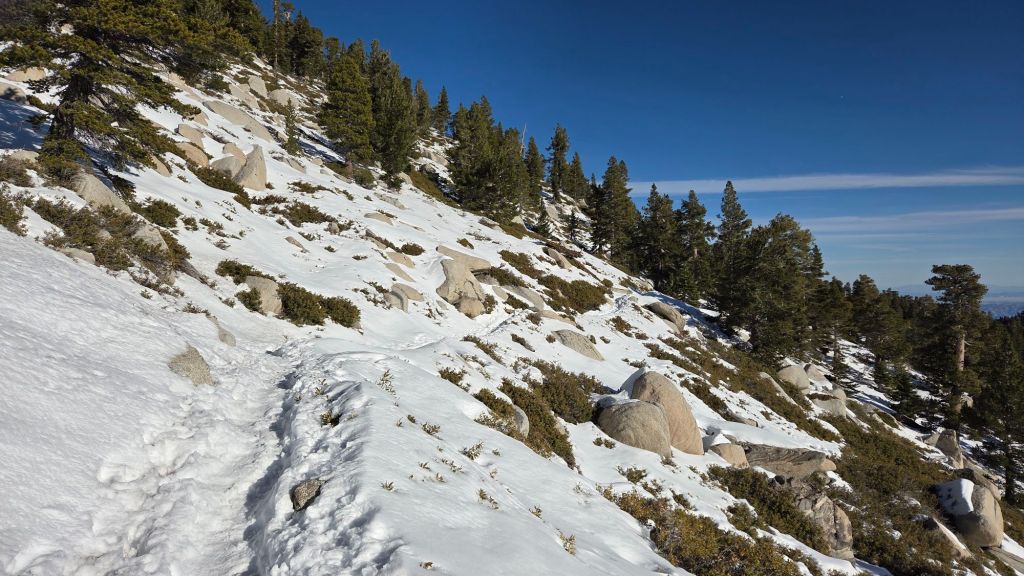
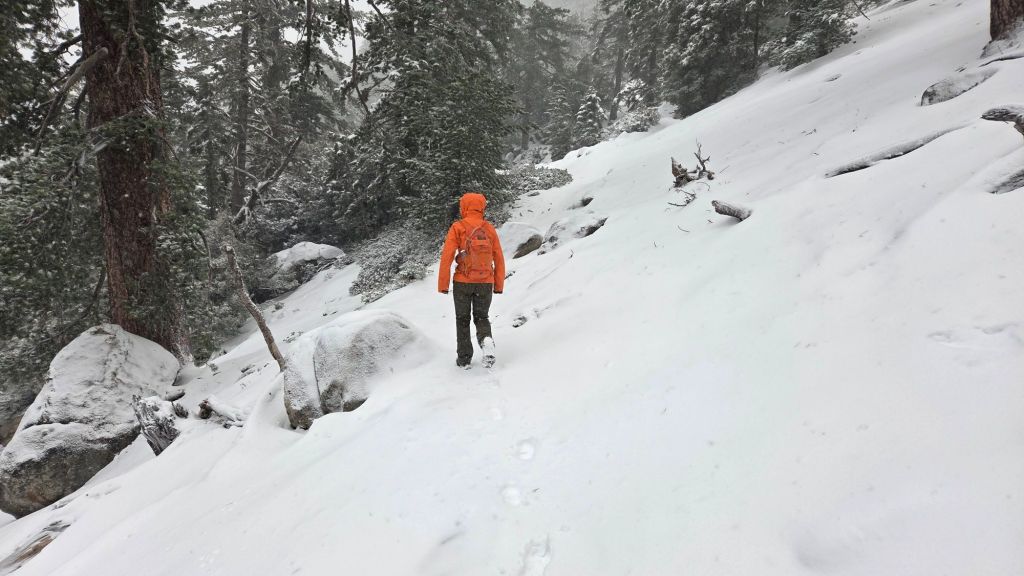
The 0.4 mile section of South Ridge Trail that crosses the north face of Tahquitz Peak from Chinquapin Flat has a well-traveled track through largely continuous icy snow, being expertly traversed by Anabel, early morning 20th December 2025. Spikes remain useful, but even with traction devices this route may not be a comfortable option for all hikers.

TRAIL CONDITIONS

Trails above about 9500 ft remain largely snow-covered (details below), especially on the less-exposed western slope trails, although the frequency and extent of snow-free patches has increased rapidly this week. With above seasonal temperatures almost continuously since 24th November, melting has been unusually rapid for the time of year, especially on sun-exposed slopes. This melting will continue with warm temperatures forecast to persist until 22nd December.

Spikes can be useful above about 9000 ft, locally as low as 7700 ft, as established trails have become consolidated by hiker traffic and undergone freeze-thaw cycles. They are especially useful for descending parts of heavily traveled tracks where the snow persists (most notably uppermost Deer Springs trails). Snow depth and condition is no longer suitable for snowshoes, even for off-trail travel at the highest elevations.

Devil’s Slide Trail [updated 18th December] is now functionally clear of icy snow. A few small, persistent, icy snow patches remain above 7700 ft, but most are so dirt-covered at this time that underfoot traction is rarely a concern. Most hikers will find that spikes are no longer required.

There is a well-traveled, compacted track on the PCT south from Saddle Junction to Chinquapin Flat/PCT Mile 178 [updated 18th December]. Snow cover has dropped markedly this week, to about 40%.

The section of South Ridge Trail from Chinquapin Flat to Tahquitz Peak [updated 20th December] has a very well-traveled track to follow through increasingly patchy angled icy snow. These icy slopes on the north side of Tahquitz Peak are notoriously treacherous, and see so little direct sunlight in December and January that conditions change slowly at this time of year. That said, some cleared patches have appeared this week, especially at the Chinquapin Flat (northern) end. Spikes are recommended for most hikers, but even then parts of the route may not be comfortable for all (photo above).

South Ridge Trail south of Tahquitz Peak [updated 20th December] is now clear of snow to Tahquitz Peak, with a few tiny icy patches remaining above 8500 ft (switchback 9).

The Strawberry Trail (PCT Miles 180.8-183) is functionally clear of snow, other than patches that persist for 0.1 mile at its eastern end, and in a handful of forested sections nearer Strawberry Junction.

Willow Creek Trail [updated 18th December] averages less than 10% thin snow cover to Hidden Divide.

There are well-traveled and compacted tracks on Round Valley Trail through Long and Round valleys to Wellman Divide, and on the “Sid Davis” route, the latter emerging at the Peak Trail near 10,000 ft [updated 15th December]. Both routes are starting to have extensive bare patches appear in their most exposed sections.

The PCT north from Saddle Junction [updated 18th December] is now functionally clear of snow to 9000 ft elevation, with just a few small icy snow patches persisting on this very sun-exposed south-facing slope. From 9000 ft, where the trail enters forest, to Annie’s Junction, has cleared dramatically in the past few days, and now averages only 20% snow cover. Most hikers will find spikes are not required.

The Wellman Trail [updated 18th December] averages only 10% snow cover, concentrated in the forested section at its southern end (closest to Annie’s Junction). Spikes are not required.

The Peak Trail [updated 18th December] has a rapidly diminishing 60% cover of softening and generally thin snow. There is a split in hiker traffic – as is traditional in winter – near Miller Peak at 10,400 ft. The East Ridge route is a somewhat meandering (but well-compacted) route through 95% continuous snow cover to San Jacinto Peak. The Peak Trail itself above 10,400 ft now has a defined but often lumpy posthole track to follow through 70% snow cover. Trails just below San Jacinto Peak proper have largely consolidated into 3-4 alternate routes, all of which ultimately reach the peak. Most hikers are clearly using spikes on this trail, but they are no longer essential for those with extensive experience of snow hiking. Snow cover on the exposed south- and east-facing slopes around San Jacinto Peak is now only 50%, and averages just 1-5 inches in most places, with drifts to 10 inches.

Deer Springs Trail [updated 15th December] is clear of snow to 8500 ft (just 0.4 mile south of the Marion Mountain Trail junction). Although snow cover still averages about 90% thereafter all the way to San Jacinto Peak, lengthy bare patches are starting to appear even as high as 10,500 ft in the most sun-exposed areas, and these will expand steadily over the next week. After the Marion junction, the track is well-traveled and compacted to Little Round Valley, almost entirely following the trail route accurately (spikes useful for descending). Above Little Round Valley there are myriad posthole track options, but the most heavily traveled now almost entirely follows the actual trail route. The other, more direct tracks, are now harder to follow as they encounter rocks and vegetation in the rapidly expanding snow-free areas.

Marion Mountain Trail [updated 15th December] is now largely clear of snow to the junction with the PCT/Deer Springs Trail. Nevertheless, two sections of persistent icy snow sections remain, one for about 0.4 mile in the central (most sheltered) portion of the trail, and the other the final 0.1 mile closest to the PCT. Some hikers will find that spikes remain very useful, especially for descending, as some of the icy snow patches are treacherous. The Trail Report removed one new blowdown from the lower trail on 9th, but there is another significant one about 0.7 mile from the top (with a fairly easy workaround).

Seven Pines Trail [updated 15th December] has no tracks to follow through the patchy snow on its uppermost section.

Fuller Ridge Trail (PCT Miles 185.5-190.5) [updated 15th December] has a lightly traveled but accurate posthole track to follow through the remaining 20% snow cover in its most sheltered sections. Sun-exposed areas (notably Miles 186-186.6 and 187.5-188.5) and those closest to Black Mountain Road (north from Mile 189.5) are now clear of snow.

Black Mountain Trail (2E35) was functionally clear of snow by 3rd December, with just a few tiny icy snow patches near the top. Four medium-sized treefall hazards include three within 0.1 mile of one another about 1.5 miles up from the trailhead, plus another just below the top of the trail, but all have easy workarounds. The climbers trail section that continues from the top of the trail to the fire lookout still has about 20% icy snow cover, as does the uppermost access road to the tower.

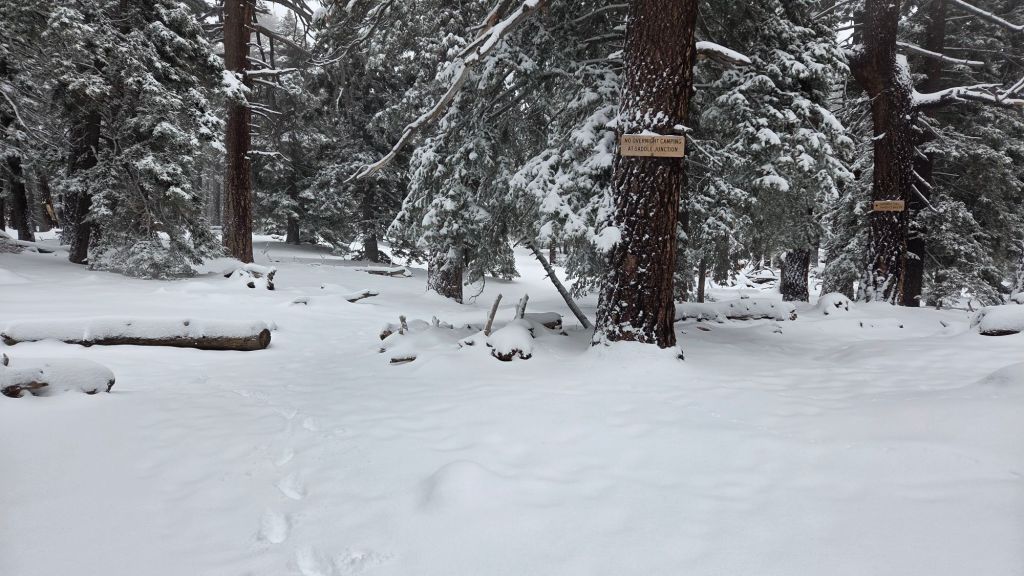
Annie’s Junction (9020 ft, PCT Mile 180.8), early morning 18th December 2025. This area tends to accumulate drifting snow and is well forested, and for both reasons it is notoriously slow to melt off even in spring. It is a remarkable indication of how warm it has been that this section of trail has cleared in late December, when the Sun is at its annual nadir.

SNOW DEPTHS

Snow depths measured on 15th December 2025 are as follows. Current total depth is the first number given, followed (in parentheses) by the total measured in November following the most recent storms. Altitudes and PCT mileages are approximate.

San Jacinto Peak (10811 ft): 3-4 inches (was 17 inches on 24th November)

Little Round Valley (9800 ft): 4-5 inches (was 15-18 inches in late November)

Wellman Divide (9700 ft): 0-1 inch (was 11 inches on 24th November)

Annie’s Junction/PCT Mile 180.8 (9020 ft): 0-2 inches (was 12 inches on 24th November)

Fuller Ridge Trail junction with Deer Springs Trail/PCT Mile 185.5 (8900 ft): 2-3 inches (was 10-12 inches in late November)

Long Valley (8500 ft): 0-2 inches (was 8 inches on 24th November)

Saddle Junction/PCT Mile 179 (8070 ft): 0 inch (was 8 inches on 24th November)

Strawberry Junction/PCT Mile 183 (8050 ft): 0 inches (was 6 inches in late November)

Devil’s Slide Trail at Humber Park (6550 ft): 0 inch by 24th November.

While all time and labor is volunteered, the San Jacinto Trail Report uses small private donations to help cover operating costs. Your contribution keeps the Report available to all, free from advertising or paywalls, and independent from agencies. If you have found this Report useful, please consider using this link to the Donate page. Thank you very much for your support.

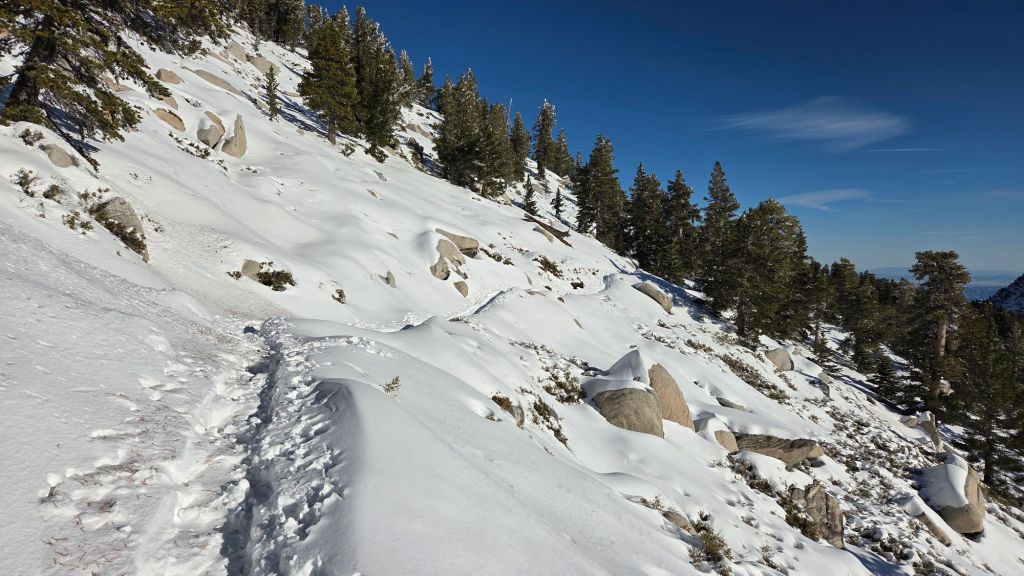
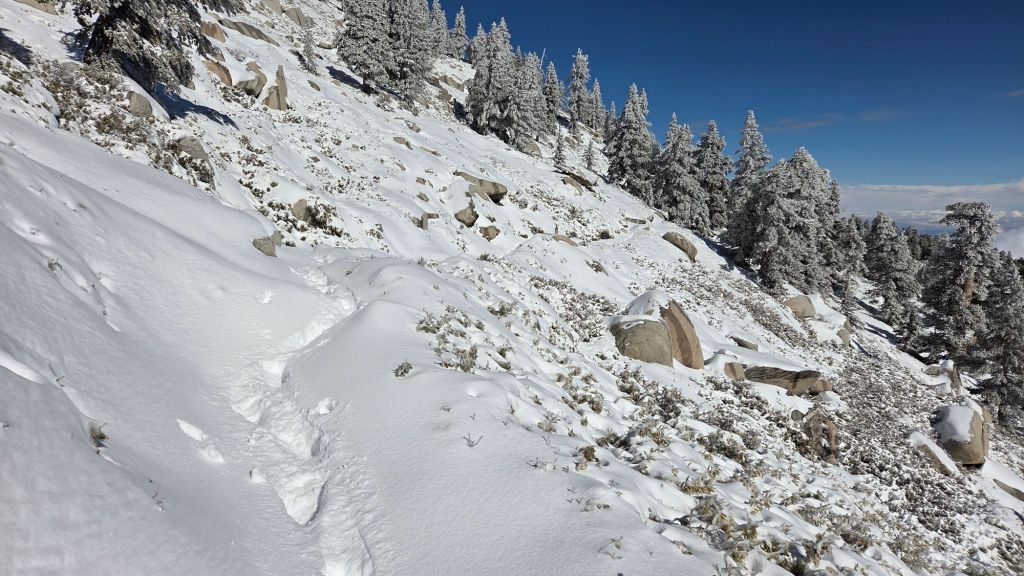
Above and below, the Peak Trail at 9800 ft elevation in late 2025. Above, mid morning on 18th December, and below, three-plus weeks earlier on 22nd November immediately following the last snow storm. Melting has been very rapid for the time of year and widespread snow-free sections have been developing in the highest elevation trails
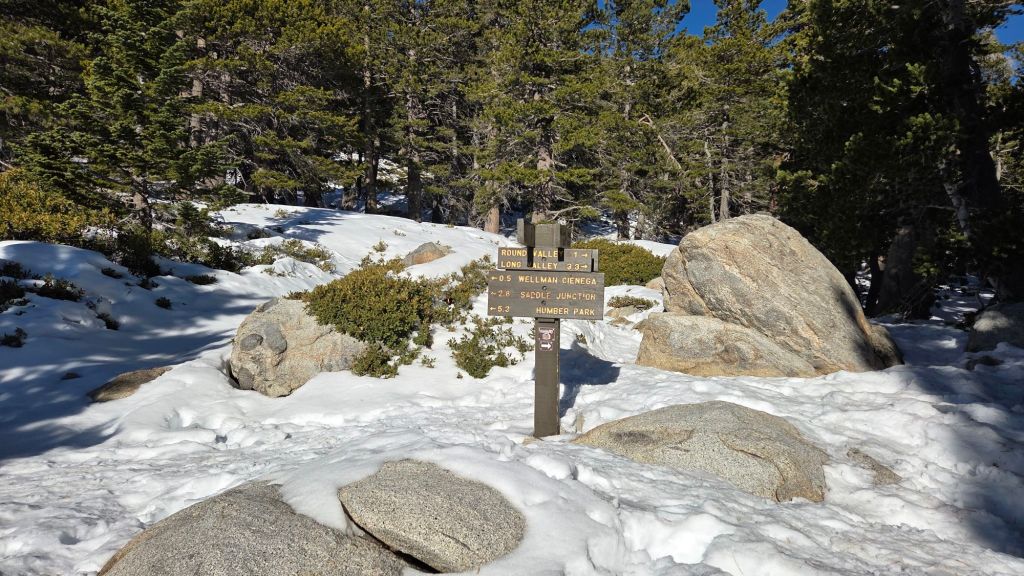
Wellman Divide (9700 ft) now functionally clear of snow, mid morning 18th December 2025 under a largely cloudy sky, having been under roughly one foot of snow just three weeks earlier in late November.
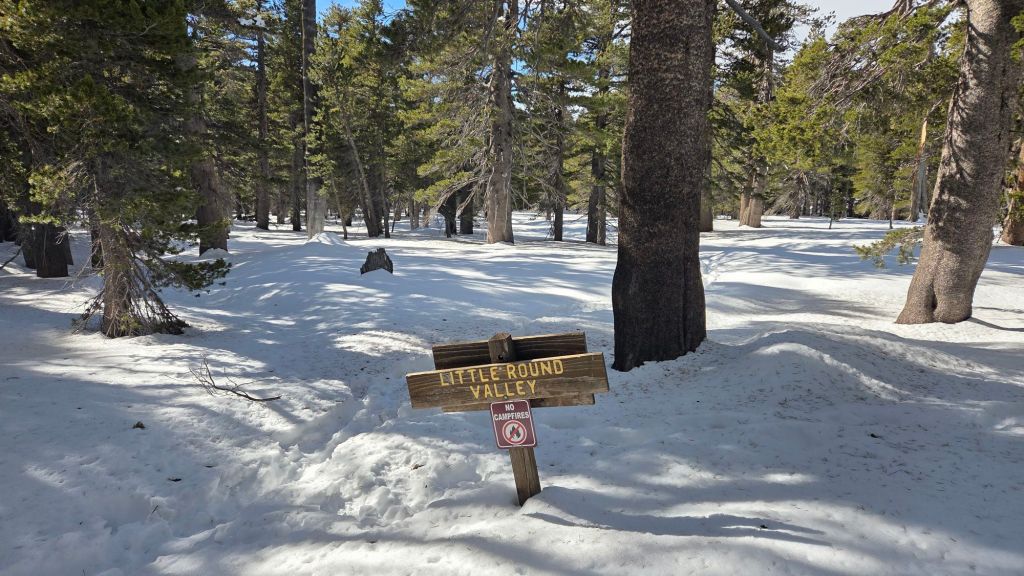
Upper Little Round Valley (9800 ft) with a reasonable posthole track (lower left) through typical depths of a few inches of snow, early morning 15th December 2025. Note the snow-free patches that are developing even in such a cool and sheltered location.
PCT Mile 185.5, the southern end of Fuller Ridge Trail where it splits from Deer Springs Trail, early morning 15th December 2025. Deer Springs Trail (to the right) has a well-worn, compacted track with significant snow-free patches developing, while Fuller Ridge Trail (left) has a rather lightly-traveled posthole track only.
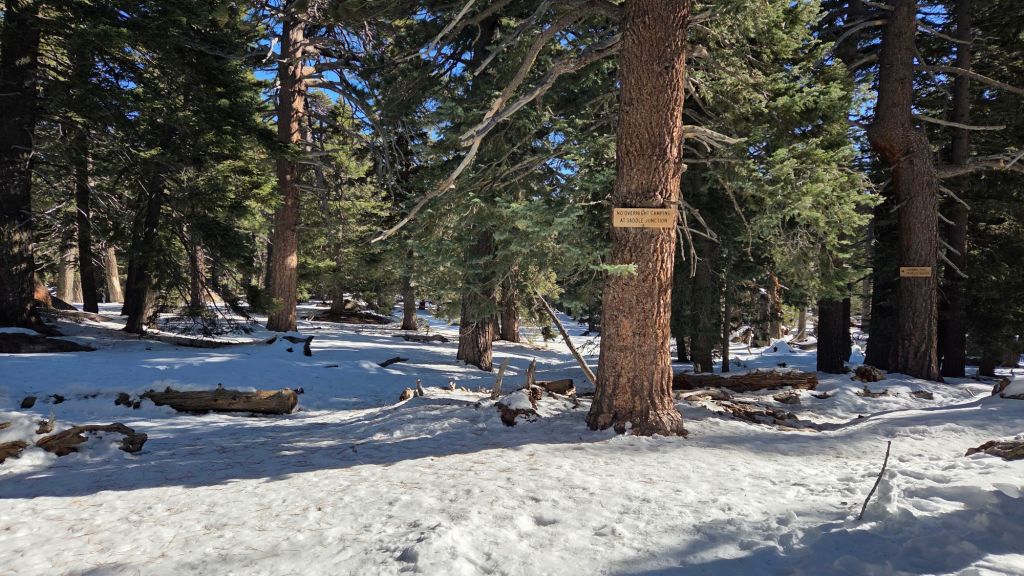
Saddle Junction (8090 ft) now functionally clear of snow, late morning on 18th December 2025.

Snow and trail update 13th December 2025

A major blocking high pressure system just west of California will continue to generate warm, relatively calm, and extremely dry conditions for our region into the second half of December. There are tentative forecasts suggesting the jet stream may return to Southern California late in December, around 22nd-26th. Three minor snow storms impacted the San Jacinto mountains in nine days in mid November, as discussed in detail in a prior Report (linked here). Since then, temperatures generally well above seasonal have led to rapid snow melt (for the time of year, given the Sun is at its weakest of the year).

The air temperature of 52.2°F (11°C) that I recorded at San Jacinto Peak on Thursday 11th December 2025 shattered (by 3°F) the previous high temperature knowingly recorded at the Peak in the month of December. Forecasts suggest that the new record could even be exceeded again early next week.

Details are given below under Trail Conditions, but most hikers will find that spikes remain useful in many areas above about 9000 ft, although experienced hikers may find they are no longer essential on established trails even well above that elevation. Despite rapid melting, challenging icy patches persist as low as 7700 ft, notably on Devil’s Slide and Marion Mountain trails. Spikes tend to be especially helpful for descending, even when they seem unnecessary for ascending.

Snow depths measured at various locations on the trail system are given near the foot of this posting. Note however that snow depth itself is rarely indicative of the difficulty (or ease) of hiking a particular track or trail. For example a firm, well-compacted track across snow feet deep is often much easier hiking than traversing across just a few inches depth of, for example, angled virgin icy snow. Conversely, just a one inch covering of icy snow at mid-elevations (where there have been many freeze-thaw cycles) can be among the most treacherous surfaces to hike.

Temperatures are forecast to be far above seasonal into the second half of December. Nevertheless, it is (nominally) winter and hikers should be prepared for temperatures near freezing above 10,000 ft elevation, and periodically below freezing when considering wind chill effects. This advisory may be especially important after 20th December. See the Weather section below for my recent observations from San Jacinto Peak.

Black Mountain Road (4S01) closed to vehicle traffic in mid November at the gate 1.7 miles up from Highway 243. Despite being clear of snow it is now expected to remain closed for the winter season, according to Forest Service.

Be bear aware. Although generally rarely reported, at least six individually identifiable Black Bears have been observed in the San Jacinto mountains since 2017 (I have personally encountered at least one annually for the past seven years). A full-sized adult bear with a right ear tag has been seen in multiple locations from Willow Creek to Fern Valley since August (see my video from a trail cam on 14th September available here, and images from Fern Valley in late August in a prior Report linked here). A smaller, second individual has been reliably reported at least twice, most recently in late September in lower Fern Valley. My brief videos from Devil’s Slide Trail in September 2021 (linked here) and one walking past our house in 2018 (linked here) show two further individuals. There have been no reports of negative interactions with humans in the high country, at or near campsites, or on trails, but bear-safe storage of food when camping is recommended.

Daily survey hikes by the Trail Report year-round in the San Jacinto mountains include multiple routes to the highest peaks including San Jacinto Peak typically at least twice per week (much more frequently during stormy weather and in winter), Tahquitz Peak and area at least once per week, plus a wide variety of other trails on intervening days.

Sunrise over the Salton Sea, 4th December 2025, as seen from the PCT just north of Saddle Junction.

WEATHER

Temperatures were well above seasonal in the last week of November, and following a few days of cooler seasonal temperatures on 1st-4th, they again warmed to well above average starting Friday 5th. Temperatures are forecast to remain far above seasonal until 20th December, after which there is a possibility that the current “blocking” high pressure system moves away, allowing the jet stream flow to return to Southern California (although details of possible precipitation remain unclear at this time).

The second, third, and fourth storm systems of winter 2025/26 all impacted the San Jacinto mountains in quick succession, on 14th-16th, 17th-18th, and 20th-22nd November, respectively. All three storms were relatively mild, with high freeze levels and very limited snow below 7000 ft. The storm sequence and precipitation outcomes were described in detail in an earlier Report (linked here).

At San Jacinto Peak (10,811ft/3295m) on Thursday 11th December 2025 at 0830 the air temperature was 52.2°F (11°C), with a “windchill” temperature of 48.4°F (9°C), 15% relative humidity, and a barely discernable SE wind sustained at 2 mph gusting to 3.5 mph. This is the first time I have ever recorded an air temperature exceeding 50°F in December at the Peak, and this is undoubtedly a record high for the month at that location.

At the Peak on Tuesday 9th December 2025 at 0750 the air temperature was 40.5°F (5°C), with a windchill temperature of 29.5°F (-1°C), 16% relative humidity, and a persistent NNE wind sustained at 15 mph gusting to 21.6 mph.

At the Peak on Monday 8th December 2025 at 0820 the air temperature was 37.2°F (3°C), with a windchill temperature of 28.0°F (-2°C), 31% relative humidity, and a light NNW wind sustained at 4 mph gusting to 10.5 mph.

At the Peak on Thursday 4th December 2025 at 0840 the air temperature was 24.5°F (-4°C), with a windchill temperature of 8.2°F (-13°C), 13% relative humidity, and a remarkably steady NE wind sustained at 15 mph gusting to 17.7 mph.

The Peak Trail at about 10,450 ft looking south, early morning 8th December 2025. This uppermost section of the trail is now reasonably well-traveled, but remains a somewhat lumpy posthole track. Jean Peak is in the middle distance.

TRAIL CONDITIONS

All trails above about 8500 ft remain largely snow-covered (details below), although the frequency and extent of snow-free patches has increased rapidly this week. With above seasonal temperatures almost continuously since 24th November, melting has been unusually rapid for the time of year, especially on sun-exposed slopes. This melting will accelerate further with unusually warm temperatures forecast for the next week at least.

Spikes can be useful above about 9000 ft, locally as low as 7700 ft, as established trails have become consolidated by hiker traffic and undergone freeze-thaw cycles. They are especially useful for descending parts of heavily traveled tracks where the snow has become compacted and icy (e.g., Devil’s Slide, Wellman, Peak, Round Valley, Marion Mountain, and uppermost Deer Springs trails).

Snow depths are marginally suitable for snowshoes above about 9500 ft, but only for off-trail travel. They are no longer useful on established high country trails which are all now heavily compacted. Snow depths everywhere are dropping steadily, and snowshoes will be of little or no use, even off-trail, by mid December.

Devil’s Slide Trail [updated 11th December] is clear of icy snow to about 7700 ft. Above that elevation average ice cover is now only 20% to Saddle Junction. Nevertheless some of the small, persistent, icy snow patches are treacherous, especially those closest to Saddle Junction, and many hikers will continue to find traction devices are helpful on the uppermost trail, especially for descending.

There is a well-traveled, compacted track on the PCT south from Saddle Junction to Chinquapin Flat/PCT Mile 178 [updated 11th December]. Snow cover has dropped markedly this week, to about 80%.

The section of South Ridge Trail from Chinquapin Flat to Tahquitz Peak [updated 13th December] now has a well-traveled track to follow through the angled icy snow. These icy slopes on the north side of Tahquitz Peak are notoriously treacherous, and see no direct sunlight in December and January, so conditions change very slowly at this time of year. Spikes are recommended for most hikers, but even then the route will not be comfortable for all (photo below).

South Ridge Trail south of Tahquitz Peak [updated 13th December] is functionally clear of snow to Tahquitz Peak, with a limited number of small icy patches remaining mainly above 8500 ft (switchback 9). Most hikers will find spikes are no longer needed.

There is a lightly-traveled posthole track to follow through shallow and rapidly melting snow on the Strawberry Trail (PCT Miles 180.8-183). The bulk of this trail is very sun-exposed and snow cover now averages only 10% on this trail.

Willow Creek Trail [updated 11th December] has a lightly traveled track to follow through shallow and patchy snow to Skunk Cabbage Meadow. Thereafter the trail is largely clear of snow to Hidden Divide.

There are well-traveled and compacted tracks on Round Valley Trail through Long and Round valleys to Wellman Divide, and on the “Sid Davis” route, the latter emerging at the Peak Trail near 10,000 ft [updated 11th December]. Both routes are starting to have extensive bare patches appear in their most exposed sections.

The PCT north from Saddle Junction [updated 11th December] is now largely clear of snow to 9000 ft elevation, with just a few small icy snow patches persisting on this very sun-exposed south-facing slope. From 9000 ft, where the trail enters forest, there is a well-traveled, compacted, track through light snow cover (now about 90%) to Annie’s Junction and north onto the Wellman Trail.

The Wellman Trail [updated 11th December] averages only about 30% snow cover, concentrated in the most forested sections. The remaining, sun-exposed, areas are clearing rapidly.

The Peak Trail [updated 11th December] has a well-traveled, compacted, track through 90% snow cover that accurately follows the trail route. Several snow-free patches have appeared in the past few days, and these will expand considerably in the next week. There is a split in hiker traffic – as is traditional in winter – near Miller Peak at 10,400 ft, with two equally prominent tracks, one taking the East Ridge on a somewhat meandering (but well-compacted) route to San Jacinto Peak, and the Peak Trail itself above 10,400 ft now having a defined but often lumpy posthole track to follow (photo above). Trails just below San Jacinto Peak proper have largely consolidated into 3-4 alternate routes, all of which ultimately reach the peak. Most hikers are clearly using spikes on this trail, but they are no longer essential for those with extensive experience of snow hiking.

Deer Springs Trail [updated 9th December] is clear of snow to Strawberry Junction. Above Strawberry Junction snow cover has rapidly thinned and largely cleared to 8500 ft (just 0.5 miles south of the Marion Mountain Trail junction). Although snow cover averages 90% thereafter all the way to San Jacinto Peak, lengthy bare patches are starting to appear even as high as 9650 ft in the most sun-exposed areas, and these will expand steadily over the next week or two. Where snow remains between Strawberry Junction and the top of Marion Mountain Trail (approx. PCT Miles 183-185) there is only a moderately traveled posthole track but the snow is thin and easy underfoot. After the Marion junction, the track is well-traveled and compacted to Little Round Valley, almost entirely following the trail route accurately (spikes useful for descending). Above Little Round Valley there are myriad posthole track options, one of which largely follows the actual trail route, but it is rarely the most heavily traveled, most compacted, or indeed the best option, but eventually all the tracks seem to ultimately make their way up towards the Peak (example photo below).

Marion Mountain Trail [updated 9th December] is completely clear of snow to 7700 ft, a little above midway to the junction with the PCT/Deer Springs Trail. In the upper half of the trail snow cover now averages only 30%, but note that some of the persistent snow sections are lengthy and very icy. Spikes remain very useful, especially for descending, as some of the icy snow patches are treacherous. The Trail Report removed one new blowdown from the lower trail on 9th, but there is another significant one about 0.7 mile from the top (with a fairly easy workaround).

Seven Pines Trail [updated 9th December] has no tracks to follow through the snow on its upper section.

Fuller Ridge Trail (PCT Miles 185.5-190.5) [updated 9th December] has a lightly traveled but accurate posthole track to follow through the remaining 30% snow cover in its most sheltered sections. Sun-exposed areas (notably Miles 186-186.6 and 187.5-188.5) and those closest to Black Mountain Road (north from Mile 189.5) are now functionally clear of snow.

Black Mountain Trail (2E35)[updated 3rd December 2025] is functionally clear of snow, with just a few tiny icy snow patches near the top. Four medium-sized treefall hazards include three within 0.1 mile of one another about 1.5 miles up from the trailhead, plus another just below the top of the trail, but all have easy workarounds. The climbers trail section that continues from the top of the trail to the fire lookout still has about 40% icy snow cover, as does the uppermost access road to the tower.

The 0.4 mile section of South Ridge Trail that crosses the north face of Tahquitz Peak from Chinquapin Flat has a well-traveled track through continuous icy snow, early morning 13th December 2025. Spikes remain very useful, but even with traction devices this route may not be a comfortable option for all hikers.

SNOW DEPTHS

Snow depths measured on 9th December (Deer Springs Trail locations) and 8th December 2025 (elsewhere) are as follows. Current total depth is the first number given, followed (in parentheses) by the total measured in November following the most recent storms. Altitudes and PCT mileages are approximate.

San Jacinto Peak (10811 ft): 7-8 inches (was 17 inches on 24th November)

Little Round Valley (9800 ft): 5-7 inches (was 15-18 inches in late November)

Wellman Divide (9700 ft): 1-2 inches (was 11 inches on 24th November)

Annie’s Junction/PCT Mile 180.8 (9020 ft): 2 inches (was 12 inches on 24th November)

Fuller Ridge Trail junction with Deer Springs Trail/PCT Mile 185.5 (8900 ft): 5 inches (was 10-12 inches in late November)

Long Valley (8500 ft): 2-3 inches (was 8 inches on 24th November)

Saddle Junction/PCT Mile 179 (8070 ft): 0-2 inches (was 8 inches on 24th November)

Strawberry Junction/PCT Mile 183 (8050 ft): 0 inches (was 6 inches in late November)

Devil’s Slide Trail at Humber Park (6550 ft): 0 inch by 24th November.

Above and below, the Peak Trail at 9800 ft elevation in late 2025. Above, mid morning on 11th December, and below, nearly three weeks earlier on 22nd November immediately following the last snow storm. Melting has been rapid for the time of year, and the track is well consolidated at this elevation. Widespread snow-free sections of trail are developing in hot (relatively, for December) weather this week.

While all time and labor is volunteered, the San Jacinto Trail Report uses small private donations to help cover operating costs. Your contribution keeps the Report available to all, free from advertising or paywalls, and independent from agencies. If you have found this Report useful, please consider using this link to the Donate page. Thank you very much for your support.
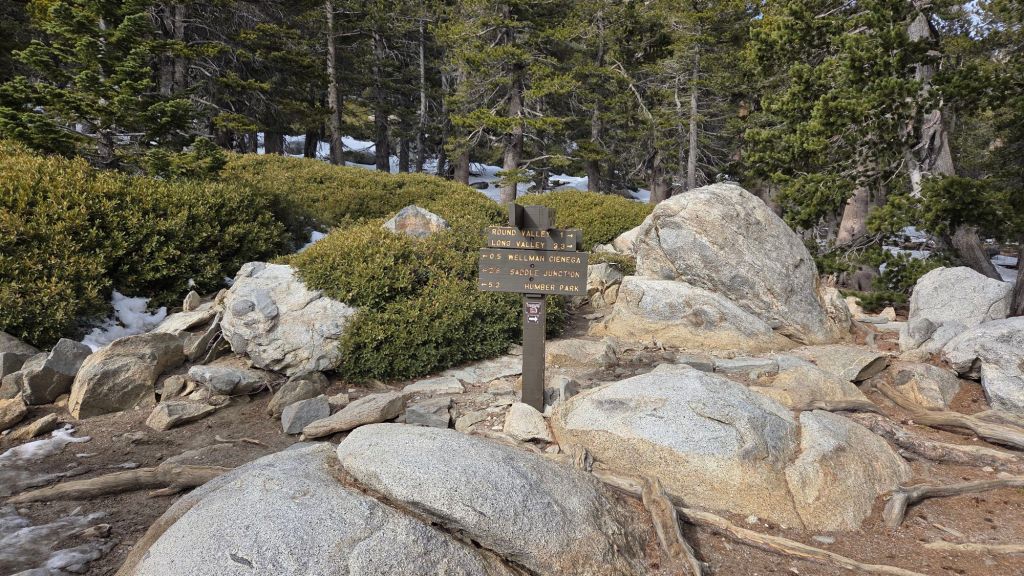
Wellman Divide (9700 ft) with an increasingly patchy average depth of barely an inch of snow, mid morning 11th December 2025, having been under roughly one foot of snow just two-and-a-half weeks earlier on 24th November.
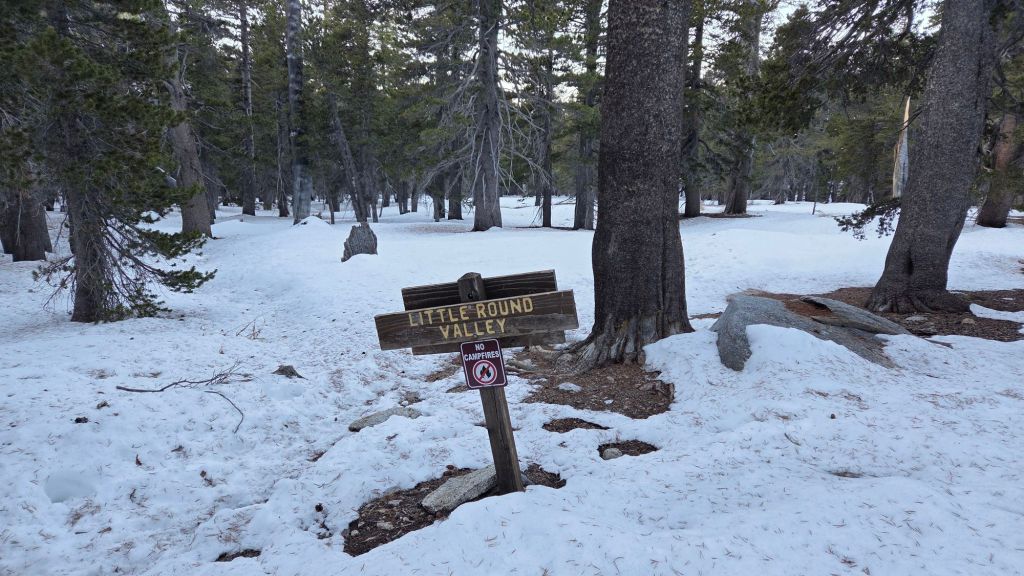
Upper Little Round Valley (9800 ft) with a reasonable posthole track (lower left) through typical depths of 5-7 inches of snow, 9th December 2025.
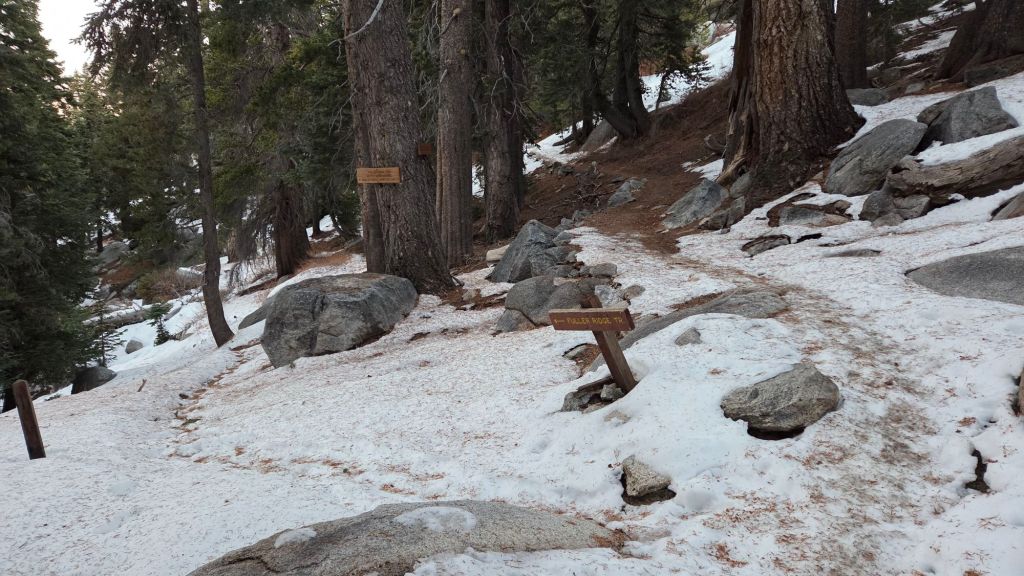
PCT Mile 185.5, the southern end of Fuller Ridge Trail where it splits from Deer Springs Trail, early morning 9th December 2025. Deer Springs Trail (to the right) has a well-worn, compacted track, while Fuller Ridge Trail (left) has a lightly-traveled posthole track only.
Saddle Junction (8090 ft) under a patchy one inch of snow, mid morning on 11th December 2025. Snow depth here has dropped roughly 90% in the past two weeks.
Strawberry Junction (8050 ft) with increasingly patchy, thin, softening snow cover, late morning 27th November 2025.
The well-known northern spring at Wellman’s Cienega (9300 ft) looking genuinely wintry, but with some flow remaining a reliable water source for hikers and campers alike, early morning 4th December 2025. At the same time of day on 8th December, the spring was ice-free.
One of the steep and relatively uneven posthole tracks ascending from Little Round Valley towards San Jacinto Peak, most of which rarely follow the actual uppermost Deer Springs Trail route, mid morning 4th December 2025.
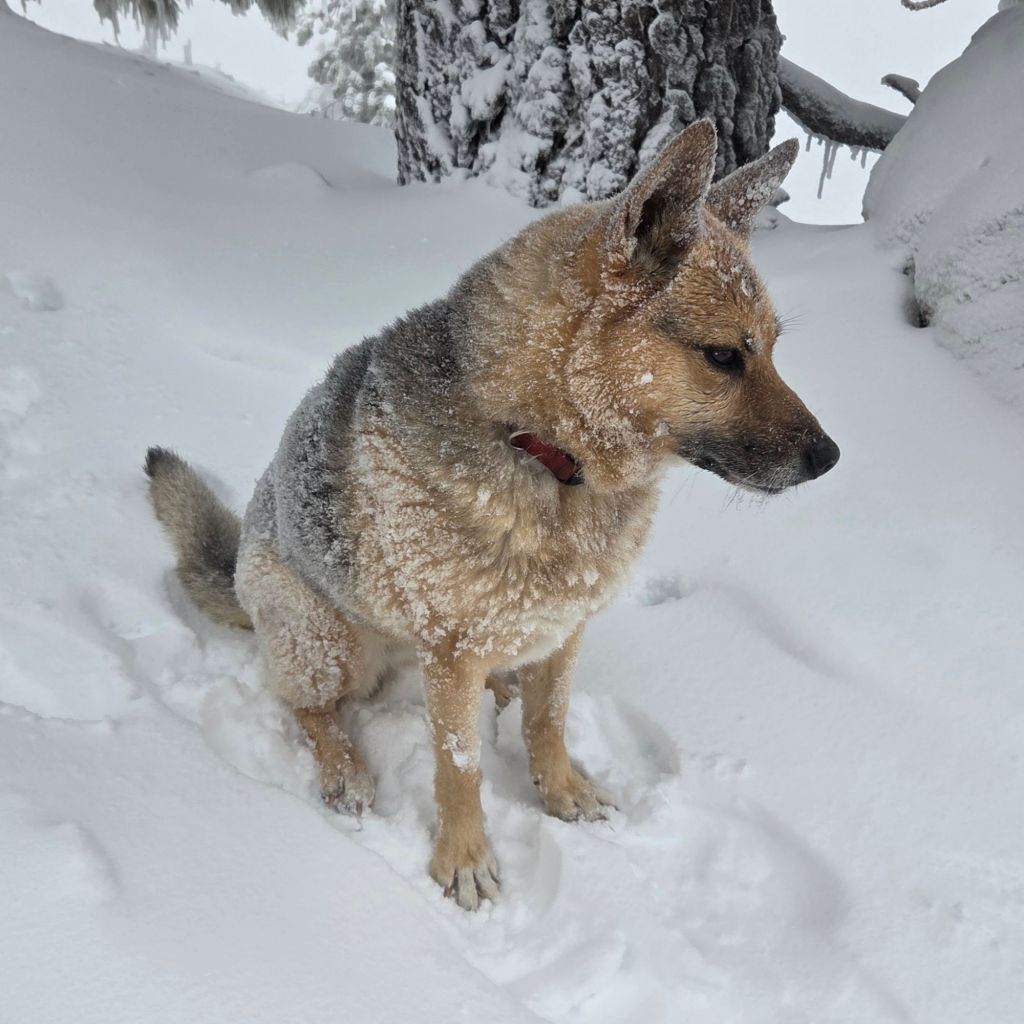
A pensive Anabel – perhaps contemplating the dearth of snow, but more likely the absence of a deer leg to chew on – at Butterfly Peak, early morning 5th December 2025.

Snow and trail update 6th December 2025

Three minor snow storms impacted the San Jacinto mountains in nine days in mid November, as discussed in detail in the previous Report (linked here). Since then, a week of above seasonal temperatures has led to relatively rapid melting (for the time of year). Although this week is cooling to about seasonal, further dry, warm, weather is expected to return and persist into mid December, with currently no significant additional precipitation in the forecasts.

Details are given below under Trail Conditions, but spikes remain valuable in many areas above about 8000 ft, although experienced hikers may find they are no longer essential on established trails even well above that elevation. Despite rapid melting, treacherous icy patches persist as low as 7700 ft, notably on Devil’s Slide and Marion Mountain trails. Spikes tend to be especially helpful for descending, even when they are unnecessary for ascending. Snow depths are locally suitable for snowshoes above about 9500 ft, but generally only off-trail. They are no longer useful on established trails which are now heavily compacted (and hence ideal for spikes) such as Round Valley Trail, Peak Trail, Wellman Trail, and the posthole route on upper Deer Springs Trail.

Snow depths measured at various locations on the trail system are given towards the end of this posting. Note however that snow depth itself is rarely indicative of the difficulty (or ease) of hiking a particular track or trail. For example a firm, well-compacted track across snow feet deep is often much easier hiking than traversing across just a few inches depth of, for example, angled virgin icy snow. Conversely, just a one inch covering of icy snow at mid-elevations (where there have been many freeze-thaw cycles) can be the most treacherous surface to hike.

Temperatures are forecast to be generally above seasonal into mid December. Nevertheless, hikers should be prepared for temperatures near or below freezing above 10,000 ft elevation, and at times well below freezing when considering wind chill effects, the latter in particular during the passage of a cold front to the north on 3rd-4th December. See the Weather section below for my recent observations from San Jacinto Peak.

Be bear aware. Although generally rarely reported, at least six individually identifiable Black Bears have been observed in the San Jacinto mountains since 2017 (I have personally encountered at least one annually for the past seven years). A full-sized adult bear with a right ear tag has been seen in multiple locations from Willow Creek to Fern Valley since August (see my video from a trail cam on 14th September available here, and images from Fern Valley in late August in a prior Report linked here). A smaller, second individual has been reliably reported at least twice, most recently in late September in lower Fern Valley. My brief videos from Devil’s Slide Trail in September 2021 (linked here) and one walking past our house in 2018 (linked here) show two further individuals. There have been no reports of negative interactions with humans in the high country, at or near campsites, or on trails, but bear-safe storage of food when camping is recommended.

Daily survey hikes by the Trail Report year-round in the San Jacinto mountains include multiple routes to the highest peaks including San Jacinto Peak typically at least twice per week (much more frequently during stormy weather and in winter), Tahquitz Peak and area at least once per week, plus a wide variety of other trails on intervening days.

Sunrise as seen looking south-east from near Mile 180 on the PCT, 4th December 2025. Near the winter solstice, the Sun rises over, and reflects off, the north end of the Salton Sea. Red Tahquitz is the peak on the near ridge just left of center.

WEATHER

Temperatures were well above seasonal in the last week of November, and following a few seasonal days on 1st-4th, will again be well above average starting Friday 5th, then potentially far above average on 8th-12th December. During the latter period, temperatures will be especially mild in the high country (more akin to early April than early December), and melting of snow is expected to be steady throughout, and rapid on sun-exposed slopes.

The second, third, and fourth storm systems of winter 2025/26 all impacted the San Jacinto mountains in quick succession, on 14th-16th, 17th-18th, and 20th-22nd November, respectively. All three storms were relatively mild, with high freeze levels and very limited snow below 7000 ft. The storm sequence and precipitation outcomes were described in detail in the previous Report (linked here).

All three storms underperformed their snow forecasts, but given the climate change crisis, any snow on the ground prior to December should probably be considered something of a bonus. Indeed, at 18.5 inches total snowfall at San Jacinto Peak by the end of November 2025, this winter is second only to 2019/20 in the past eight years for the most snowfall before 1st December (some may remember the spectacular Thanksgiving storm of 2019 that produced almost three feet of snow in three days in late November that year).

At San Jacinto Peak (10,811ft/3295m) on Thursday 4th December 2025 at 0840 the air temperature was 24.5°F (-4°C), with a windchill temperature of 8.2°F (-13°C), 13% relative humidity, and an exceptionally steady NE wind sustained at 15 mph gusting to 17.7 mph.

At the Peak on Monday 1st December 2025 at 0840 the air temperature was 30.6°F (-1°C), with a windchill temperature of 22.8°F (-5°C), 44% relative humidity, and a light NNE wind sustained at 2 mph gusting to 5.8 mph.

At the Peak on Saturday 29th November 2025 at 0755 the air temperature was 36.1°F (2°C), with a windchill temperature of 24.4°F (-4°C), 31% relative humidity, and a benign WNW wind sustained at 6 mph gusting to 11.2 mph.

At the Peak on Thursday 27th November 2025 at 0850 the air temperature was 41.6°F (5°C), with a windchill temperature of 35.2°F (2°C), 18% relative humidity, and a steady SE wind sustained at 6 mph gusting to 7.9 mph.

It was an appropriate day to be thankful for cloud cover, light winds, and the clearest views of the year. Looking south-east from the upper Peak Trail towards the Santa Rosa Mountains and the Salton Sea, early morning 27th November 2025. From San Jacinto Peak to the WNW it was easy to see individual skyscrapers in the CBD of Los Angeles, while the Algodones Dunes were visible far beyond the Salton Sea.

TRAIL CONDITIONS

All trails above about 8500 ft are largely – or above about 9500 ft completely – snow-covered. With above seasonal temperatures since 24th, melting has been unusually rapid, especially on sun-exposed slopes.

Spikes can be useful above about 8000 ft, locally somewhat lower, as established trails have become consolidated by hiker traffic and undergone freeze-thaw cycles. They are especially useful for descending heavily traveled tracks where the snow has become compacted and icy (e.g., Devil’s Slide, Wellman, Peak, Round Valley, and uppermost Deer Springs trails).

Snow depths are locally suitable for snowshoeing above 9500 ft, but only off-trail or when breaking trail on routes that have so far been largely untraveled. Snow depths are dropping steadily, and snowshoes will be of very limited use by the second week of December.

Devil’s Slide Trail [updated 4th December] is functionally clear of icy snow to about 7700 ft. Above that elevation, there is a heavily compacted and icy track to follow through increasingly patchy thin snow (average ice cover now only 30% to Saddle Junction). Some hikers will find that traction devices are helpful on the upper trail, especially for descending.

There is a well-traveled, compacted track on the PCT south from Saddle Junction to Chinquapin Flat/PCT Mile 178 [updated 4th December]. The track is somewhat less well traveled and requires some minor postholing about 0.3 mile from Chinquapin Flat.

The section of South Ridge Trail from Chinquapin Flat to Tahquitz Peak [updated 6th December] now has a well-traveled track to follow through the angled icy snow, with significant compaction over the holiday weekend in late November, plus minor melting. Some of the track remains covered by fallen ice. These icy slopes on the north side of Tahquitz Peak are notoriously treacherous. Spikes are recommended for most hikers, but even then the route will not be comfortable for all (photo below).

South Ridge Trail south of Tahquitz Peak [updated 6th December] is functionally clear of snow to 8500 ft (switchback 9) with just a couple of tiny icy patches below that elevation. Thereafter icy snow cover averages about 40% to Tahquitz Peak, but it is diminishing rapidly with coverage having halved in the past four days. Some hikers will find spikes useful for descending the upper trail.

As of Sunday 30th November, there is a simple posthole track to follow through shallow and rapidly melting snow on the Strawberry Trail (PCT Miles 180.8-183). The bulk of this trail is very sun-exposed and snow cover averages only 30% on this trail.

Willow Creek Trail [updated 1st December] has a lightly traveled track to follow through shallow and patchy snow, at least to Skunk Cabbage Meadow.

There are well-traveled and compacted tracks on Round Valley Trail through Long and Round valleys to Wellman Divide, and on the “Sid Davis” route, the latter emerging at the Peak Trail near 10,000 ft [updated 4th December].

The PCT north from Saddle Junction, continuing onto the Wellman Trail, has a well-traveled and increasingly compacted track through light snow cover to Wellman Divide [updated 1st December]. Melting has been rapid on the most sun-exposed section immediately north of Saddle Junction (“Angel’s Glide”) with some lengthy snow-free sections already appearing, and the first mile north of Saddle Junction now averages only 50% snow cover.

The Peak Trail [updated 4th December] has a well-traveled, compacted, posthole track through continuous snow cover that accurately follows the trail route to near Miller Peak at 10,400 ft. Thereafter there is a split in hiker traffic – as is traditional in winter – with two equally prominent tracks, one taking the East Ridge on a somewhat meandering route to San Jacinto Peak, and the Peak Trail itself above 10,400 ft now having a defined compacted track to follow. Trails just below San Jacinto Peak proper are starting to consolidate into less of a shambolic maze of alternate routes, but there has been some infilling with spindrift in strong winds on 3rd-4th December, reducing the visibility of some tracks, notably that on the East Ridge.

Deer Springs Trail [updated 4th December] is clear of snow to Strawberry Junction. Above Strawberry Junction snow cover has rapidly thinned and is increasingly patchy to 8500 ft (about 0.5 miles south of the Marion Mountain Trail junction). Although snow cover is functionally continuous thereafter all the way to San Jacinto Peak, small bare patches are starting to appear even as high as 9650 ft. There is only a moderately traveled posthole track between Strawberry Junction and the top of Marion Mountain Trail (approx. PCT Miles 183-185), but the snow is thin and easy underfoot. After the Marion junction, the track is well-traveled and compacted to Little Round Valley, almost entirely following the trail route accurately (spikes useful for descending). Above Little Round Valley there are multiple posthole track options, none of which consistently follow the actual trail route, most of which ascend steeply, some of which are more heavily traveled than others, but all of which seem to ultimately make their way up towards the Peak (example photo below).

Marion Mountain Trail [updated 4th December] is completely clear of snow to 7600 ft, roughly midway to the junction with the PCT/Deer Springs Trail. In the upper half of the trail snow cover averages 60%, with extensive bare patches in the most sun-exposed areas, but also some lengthy and very icy sections too. Spikes are very useful, especially for descending.

Seven Pines Trail [updated 4th December] has no tracks to follow through the snow on its upper section.

Fuller Ridge Trail [updated 4th December] has a lightly traveled but accurate posthole track to follow through light snow cover along its entire length (PCT Miles 185.5-190.5). Sun-exposed areas (notably Miles 187.5-188.5) and those closest to Black Mountain Road (Mile 190 north) are now largely clear of snow.

Black Mountain Trail (2E35)[updated 3rd December 2025] is functionally clear of snow, with just a few tiny icy snow patches near the top. Four medium-sized treefall hazards include three within 0.1 mile of one another about 1.5 miles up from the trailhead, plus another just below the top of the trail, but all have easy workarounds. The climbers trail section that continues from the top of the trail to the fire lookout still has about 40% icy snow cover, as does the uppermost access road to the tower.

The 0.4 mile section of South Ridge Trail that crosses the north face of Tahquitz Peak from Chinquapin Flat now has a reasonably defined track through the icy snow, early morning 2nd December 2025. Spikes are useful, but even with traction devices this route will not be comfortable for all hikers.

SNOW DEPTHS

Snow depths measured on 1st December 2025 are as follows. Current total depth is the first number given, followed (in parentheses) by the total measured on 24th November following the most recent storms. Altitudes and PCT mileages are approximate.

San Jacinto Peak (10811 ft): 11-12 inches (17 inches on 24th November)

Wellman Divide (9700 ft): 5 inches (was 11 inches on 24th)

Annie’s Junction/PCT Mile 180.8 (9020 ft): 10 inches (was 12 inches on 24th)

Long Valley (8500 ft): 3-4 inches (was 8 inches on 24th)

Saddle Junction/approx. PCT Mile 179 (8070 ft): 3-4 inches (was 8 inches on 24th)

Devil’s Slide Trail at Humber Park (6550 ft): 0 inch by 24th November.

Above and below, the Peak Trail at 9800 ft elevation in late 2025. Above, early morning on 1st December, and below, just ten days earlier on 22nd November, immediately following the last snow storm. Melting has been rapid for the time of year, and the track is now very well consolidated, allowing for fast hiking, especially in spikes.

While all time and labor is volunteered, the San Jacinto Trail Report uses small private donations to help cover operating costs. Your contribution keeps the Report available to all, free from advertising or paywalls, and independent from agencies. If you have found this Report useful, please consider using this link to the Donate page. Thank you very much for your support.
The well-traveled and compacted snow track on the upper Peak Trail (10,350 ft), mid morning 29th November 2025. Jean Peak is in the foreground on the right.
Wellman Divide (9700 ft) with an average depth of only about four inches of snow (drifted in places), 1st December 2025, having been completely snow-free on 14th November, but with nearly one foot of snow just a week ago on 24th November.
Upper Little Round Valley (9800 ft) with a relatively rough posthole track (lower left) through typical depths of 8-10 inches of snow, 4th December 2025.
Strawberry Junction (8050 ft) with increasingly patchy, thin, softening snow cover, late morning 27th November 2025.
Saddle Junction (8090 ft) under an average depth of about three inches of snow, mid morning on 1st December 2025. Snow depth has more than halved in the past week.
One of the relatively steep and uneven posthole tracks ascending from Little Round Valley towards San Jacinto Peak, all of which rarely follow the actual uppermost Deer Springs Trail route, mid morning 4th December 2025.
The well-known northern spring at Wellman’s Cienega (9300 ft) looking genuinely wintry, but with some flow remaining a reliable water source for hikers and campers alike, early morning 4th December 2025.

Snow and trail update 29th November 2025

Details are given below under Trail Conditions, but carrying spikes is now generally advisable everywhere above about 8000 ft. Despite rapid melting, treacherous icy patches persist as low as 7700 ft, notably on Devil’s Slide Trail. Spikes tend to be especially helpful for descending, even when they do not seem necessary for ascending. Snow depths are currently suitable for snowshoes above about 9000 ft, but they are only of use on untraveled trails and off-trail. They are no longer useful on established trails which are now heavily compacted (and hence ideal for spikes) such as Round Valley Trail, Peak Trail, Wellman Trail, and the posthole route on upper Deer Springs Trail.

The second, third, and fourth storm systems of winter 2025/26 all recently impacted the San Jacinto mountains in quick succession, on 14th-16th, 17th-18th, and 20th-22nd November, respectively. More detail on each is given in the Weather section below.

All three storms underperformed their snow forecasts, but given the climate change crisis, any snow on the ground prior to December should probably be considered something of a bonus. Indeed, at 18.5 inches total snowfall at San Jacinto Peak by the end of November 2025, this winter is second only to 2019/20 in the past eight years for the most snowfall before 1st December (some may remember the spectacular Thanksgiving storm of 2019 that produced almost three feet of snow in three days in late November that year).

The most recent storm resulted in arguably the biggest weather forecasting error in the past decade in these mountains, when the first wave of the storm late on Friday 21st November produced only four inches of snow at San Jacinto Peak, in contrast to the 10-25 inches that was widely predicted. The situation was partially salvaged when the rotational movement of the system brought it back around on Saturday 22nd, this time coming in from easterly directions, with locations on the east slope, including the Peak, receiving 3-4 more inches. The easterly winds accompanying the rotation were strong and especially gusty, resulting in prodigious drifting.

Snow depths measured at various locations on the trail system are given towards the end of this posting. Note however that snow depth itself is rarely indicative of the difficulty (or ease) of hiking a particular track or trail. For example a firm, well-compacted track across snow feet deep is often much easier hiking than traversing across just a few inches depth of angled virgin icy snow.

Temperatures are now expected to be above seasonal into early December. Nevertheless, hikers should be prepared for temperatures near freezing above 10,000 ft elevation, and below freezing when considering wind chill effects, in particular around 4th and 7th-8th December. At this time, the next possible precipitation is tentatively forecast for 3rd-4th December. See the Weather section below for my recent observations from San Jacinto Peak.

Be bear aware. Although generally rarely reported, at least six individually identifiable Black Bears have been observed in the San Jacinto mountains since 2017 (I have personally encountered at least one annually for the past seven years). A full-sized adult bear with a right ear tag has been seen in multiple locations from Willow Creek to Fern Valley since August (see my video from a trail cam on 14th September available here, and images from Fern Valley in late August in a prior Report linked here). A smaller, second individual has been reliably reported at least twice, most recently in late September in lower Fern Valley. My brief videos from Devil’s Slide Trail in September 2021 (linked here) and one walking past our house in 2018 (linked here) show two further individuals. There have been no reports of negative interactions with humans in the high country, at or near campsites, or on trails, but bear-safe storage of food when camping is recommended.

Daily survey hikes by the Trail Report year-round in the San Jacinto mountains include multiple routes to the highest peaks including San Jacinto Peak typically at least twice per week (much more frequently during stormy weather and in winter), Tahquitz Peak and area at least once per week, plus a wide variety of other trails on intervening days.

It was an appropriate day to be thankful for cloud cover, light winds, and the clearest views of the year. Looking south-east from the upper Peak Trail towards the Santa Rosa Mountains and the Salton Sea, early morning 27th November 2025. From the Peak to the WNW it was easy to see individual skyscrapers in the CBD of Los Angeles, while the Algodones Dunes were visible far beyond the Salton Sea.

WEATHER

Three storm systems impacted the San Jacinto mountains in nine days from 14th-22nd November. All three storms were relatively mild, with high freeze levels and very limited snow below 7000 ft.

An “atmospheric river” on 14th-16th started extremely warm for the season, with a freeze level initially above 11,000 ft and rain throughout the highest peaks for the first day of the storm, before turning to snow early on Saturday 15th. Even then, the snow level remained high, with little more than a dusting below 7000 ft. This warmth of course limited snow at all elevations, with seven inches at San Jacinto Peak, down to three inches at Saddle Junction (8100 ft). Accumulated rainfall was impressive at mid elevations, with 2.70 inches in Idyllwild (at 5550 ft).

The system on 17th-18th was colder, with a freeze level dropping to 6000 ft. However this cooling happened largely after the passage of the main precipitation, so snowfall at mid elevations was extremely limited, with just one inch at Humber Park (6500 ft)(which lasted only hours before melting) and barely a dusting below that. Fresh snowfall in the high country was more limited than the prior storm (four inches at San Jacinto Peak), but more uniformly distributed across all elevations above 8000 ft (2-4 inches throughout). Rainfall in Idyllwild was 0.51 inch.

The third system, on 20th-22nd, initially moved across the region from the south-west. Universally forecast to produce heavy snow, in the San Jacinto mountains the accumulation rate of 0.25 inch/hour at the highest elevations overnight on 20th produced only four inches by first light the next day as the storm moved away, with a dusting down to 6500 ft. Thankfully the rotation of the system brought it back around from the east with a vengeance the next day, with fine snowfall accompanied by sustained winds of 20 mph with gusts nearly double that speed. Snowfall accumulation on 22nd roughly matched that on 20th-21st, especially on the eastern slope of the mountain (e.g,, from Red Tahquitz to Long Valley, including the east flanks of the high peaks), with three inches at San Jacinto Peak for a nine day total accumulation of 17-18 inches.

Temperatures are rising rapidly to above seasonal this week, especially at upper elevations. This is expected to result in steady snowmelt at all elevations, and consequent deterioration in trail conditions of snowy tracks. Minor storm systems provisionally forecast to arrive overnight on Saturday 29th November and another on 3rd-4th December now look like to pass too far to the north to impact the San Jacinto mountains, other than causing brief and modest drops in temperatures.

At San Jacinto Peak (10,811ft/3295m) on Saturday 29th November 2025 at 0755 the air temperature was 36.1°F (2°C), with a windchill temperature of 24.4°F (-4°C), 31% relative humidity, and a benign WNW wind sustained at 6 mph gusting to 11.2 mph.

At the Peak on Thursday 27th November 2025 at 0850 the air temperature was 41.6°F (5°C), with a windchill temperature of 35.2°F (2°C), 18% relative humidity, and a steady SE wind sustained at 6 mph gusting to 7.9 mph.

At the Peak on Monday 24th November 2025 at 0910 the air temperature was 35.5°F (2°C), with a windchill temperature of 25.0°F (-4°C), 47% relative humidity, and a light NNE wind sustained at 4 mph gusting to 10.2 mph.

At the Peak on Friday 21st November 2025 at 0820 the air temperature was 18.7°F (-7°C), with a windchill temperature of 1.9°F (-17°C), 56% relative humidity, and a cool SSW wind sustained at 11 mph gusting to 14.8 mph.

Anabel expertly traversing the snow track on the short section of South Ridge Trail that crosses the north face of Tahquitz Peak from Chinquapin Flat, early morning 26th November 2025. This narrow and lightly traveled track is currently covered in loose ice and is not recommended for most hikers.

TRAIL CONDITIONS

All trails above about 8000 ft are largely – or above 9000 ft completely – snow-covered. With above seasonal temperatures since 24th, melting has been unusually rapid, especially on sun-exposed slopes.

Spikes can be useful everywhere above about 8000 ft, locally lower in places, as established trails have become consolidated by hiker traffic and undergone freeze-thaw cycles. They are especially useful for descending heavily traveled trails where they have become compacted and icy (e.g., Devil’s Slide, Wellman, Peak, and Round Valley trails).

Snow depths are suitable for snowshoeing above 9000 ft, but only off-trail or when breaking trail on routes that have so far been untraveled.

Devil’s Slide Trail [updated Saturday 29th] is functionally clear of icy snow to about 7600 ft. Above that elevation, there is a heavily compacted and icy track to follow through increasingly patchy thin snow (average snow cover now 50% to Saddle Junction). Most hikers will find that traction devices are very helpful on the upper trail, especially for descending.

There is a well-traveled, compacted track most of the way on the PCT south from Saddle Junction to Chinquapin Flat/PCT Mile 178 [updated Wednesday 26th]. The track is less well traveled and requires some minor postholing about 0.3 mile from Chinquapin Flat.

The section of South Ridge Trail from Chinquapin Flat to Tahquitz Peak [updated Wednesday 26th] currently has a lightly traveled, uneven track to follow through the angled icy snow. Much of the track is covered by fallen ice. These icy slopes on the north side of Tahquitz Peak are notoriously treacherous. Currently spikes (with hiking poles at a minimum) are strongly recommended, but the route is probably not suitable for most hikers (photo above).

South Ridge Trail [updated Wednesday 26th] is clear of snow to 0.5 mile beyond Old Lookout Flat to about 7800 ft. Snow cover is increasingly patchy to 8500 ft, but the patches are invariably icy. There is a well-defined but icy track through continuous snow above 8500 ft to Tahquitz Peak. Rocks around the Peak are also largely icy, but the tower is now almost completely clear of ice. Spikes are recommended for the upper trail.

As of Saturday 29th, there were no tracks to follow through shallow and rapidly melting snow on the Strawberry Trail (PCT Miles 180.8-183).

Willow Creek Trail [updated Saturday 29th] now has a lightly traveled track to follow through shallow and patchy snow, at least to Skunk Cabbage Meadow.

There are well-traveled and compacted tracks on Round Valley Trail through Long and Round valleys to Wellman Divide, and on the “Sid Davis” route, the latter emerging at the Peak Trail near 10,000 ft [updated Saturday 29th].

The PCT north from Saddle Junction, continuing onto the Wellman Trail, has a well-traveled and increasingly compacted track through light to moderate snow cover to Wellman Divide [updated Saturday 29th]. Melting has been rapid on the most sun-exposed section immediately north of Saddle Junction (“Angel’s Glide”) with some lengthy snow-free sections already appearing.

The Peak Trail [updated Saturday 29th] has a well-traveled, compacted, posthole track through continuous snow cover that accurately follows the trail route to near Miller Peak at 10,400 ft. Thereafter the majority of hiker traffic – as is traditional in winter – takes the East Ridge on a meandering route to San Jacinto Peak. The Peak Trail itself above 10,400 ft has seen more traffic this weekend, but remains a more uneven postholing route. Tracks just below San Jacinto Peak proper are starting to consolidate into less of a shambolic maze of alternate routes, but it is still easy to wander well off track on less obvious options.

Deer Springs Trail [updated Thursday 27th] is functionally clear of snow to Strawberry Junction, with just a few tiny patches of soft snow close to the junction (spikes not required). Above Strawberry Junction snow cover is very thin and increasingly patchy to 8500 ft, becoming functionally continuous thereafter all the way to San Jacinto Peak. There is only a very lightly traveled posthole track between Strawberry Junction and the top of Marion Mountain Trail (approx. PCT Miles 183-185), but the snow is thin and easy underfoot. After the Marion junction, the track is well-traveled and compacted to Little Round Valley, almost entirely following the trail route accurately (spikes useful, mainly for descending). Above Little Round Valley there are two options, a lightly traveled and uneven posthole track that ascends steeply (as is traditional in winter), or my snowshoe track that largely follows the trail route. The latter (photograph below) is an easier ascent, but only if followed with snowshoes (or skis), as it would otherwise involve severe postholing.

Marion Mountain Trail [updated Thursday 27th] has a well-traveled and compacted track that accurately follows the trail route through the snow on its upper section. Patchy snow cover starts at 7000 ft and is largely continuous above 7500 ft, with bare patches higher in the most sun-exposed areas. Spikes are useful, especially for descending.

Seven Pines Trail [updated Thursday 27th] has no tracks to follow through the snow on its upper section.

Fuller Ridge Trail [updated Thursday 27th] has a lightly traveled but accurate posthole track to follow through light-to-moderate snow cover along its entire length (PCT Miles 185.5-190.5).

My snowshoe tracks breaking trail on upper Deer Springs Trail, at about 10,200 ft midway between Little Round Valley and San Jacinto Peak, mid morning 27th November 2025, through average depths of 12-20 inches of snow (depending on drifting).

SNOW DEPTHS

Snow depths measured on 24th November 2025 are as follows. Current total depth is the first number given, followed (in parentheses) by details of the snowfall in the storm of 21st-22nd November. For details of the snowfall in the two preceding storms see the prior Report (linked here). Altitudes and PCT mileages are approximate. [Update on Saturday 29th November: all of these locations have lost 20-40% of these depths to melting in the past five days. I expect to issue revised measurements on Monday 1st December.]

San Jacinto Peak (10811 ft): 17-18 inches (4 inches added by 21st November, plus three on 22nd)

Wellman Divide (9700 ft): 11 inches (4 inches new on 21st-22nd)

Annie’s Junction/PCT Mile 180.8 (9020 ft): 12 inches (6 inches new on 21st-22nd)

Long Valley (8500 ft): 8 inches

Saddle Junction/approx. PCT Mile 179 (8070 ft): 8 inches (3 inches new on 21st-22nd)

Devil’s Slide Trail at Humber Park (6550 ft): 0 inch on 24th, with single inches on 18th and 21st already completely melted

Idyllwild (at 5550 ft): 0 inch snow, 0.56 inch rain 21st-23rd November

While all time and labor is volunteered, the San Jacinto Trail Report uses small private donations to help cover operating costs. Your contribution keeps the Report available to all, free from advertising or paywalls, and independent from agencies. If you have found this Report useful, please consider using this link to the Donate page. Thank you very much for your support.
The well-traveled and compacted snow track on the upper Peak Trail (10,350 ft), mid morning 29th November 2025. Jean Peak is in the foreground on the right.
The snow track accurately following the Peak Trail at 9800 ft on 29th November 2025, with a depth now of only 6-10 inches of snow at this elevation. The track is now well-compacted and makes for easy hiking.
Wellman Divide (9700 ft) with a depth of 6-8 inches of snow (but heavily drifted in places), 29th November 2025, having been completely snow-free on 14th, but with nearly one foot of snow on 24th.
Upper Little Round Valley (9800 ft) with a rough posthole track through an average depth of 12-15 inches of snow, 27th November 2025.
Strawberry Junction (8050 ft) with increasingly patchy, thin, softening snow cover, late morning 27th November 2025.
Saddle Junction (8090 ft) under an average depth of about four inches of snow, mid morning on 29th November 2025. Snow depth has roughly halved in the past five days.
Devil’s Slide Trail at 8000 ft just below Saddle Junction, with an average snow depth of 6-8 inches, 24th November 2025. Compacted icy snow on such a well-defined trail is quite grippy in the early mornings when cold, but becomes more watery (and hence slippery) with sun exposure and melting during the course of the day. By 29th, this section was close to clearing of snow.
Anne breaking trail through 2-4 inches of snow at about 7900 ft elevation in stormy conditions on South Ridge Trail, 22nd November 2025.
Anabel at Tahquitz Peak, in a bitter snowstorm – just how she likes it – on 22nd November 2025. It was the most energetic we had seen her in months. The ultimate snow dog, there is nothing like a fresh storm to bring out her inner puppy.

Snow storms update 19th November 2025

UPDATE Saturday 22nd November 2025 at 1150: as seems to be more frequent in recent years, the rotational movement of yesterday’s storm system has brought it back around, this time coming in from easterly directions. Consequently the east side of the range has received modest snowfall this morning, with about four inches in Long Valley (for a total depth of about eight inches). The highest elevations remained above the cloud for much of the morning. The easterly winds have been strong and very gusty, resulting in extensive drifting, and unfortunately the (at least partial) removal of tracks broken yesterday. We broke trail up South Ridge this morning to Tahquitz Peak, from where I recorded a short video report (linked here). The snow level remained high at about 7000 ft, with just light drizzle in Idyllwild, and total accumulation at Tahquitz is a modest 4-6 inches, but this is obscured by severe drifting everywhere above about 8000 ft. Further fresh snow is possible this afternoon.

UPDATE Friday 21st November 2025: in the biggest weather forecasting error in the past decade in these mountains, the storm overnight – our third in eight days – that was widely forecast to produce 10-25 inches of snow around the highest peaks instead resulted in only three inches at San Jacinto Peak, with one inch at both Saddle Junction and Long Valley, and barely a dusting below 7000 ft. It was however a gorgeous morning in the high country, as seen in a short video report I recorded from San Jacinto Peak early today (linked here). As of this morning, well-defined, accurate tracks are in place on Devil’s Slide Trail, north from there via the Wellman and Peak trails to San Jacinto Peak, and also on the Round Valley Trail from Long Valley to Wellman Divide (broken above 9000 ft with snowshoes by myself and Kyle Eubanks). Spikes are useful everywhere above about 8000 ft, potentially lower in places. While we both used snowshoes this morning above about 9000 ft, they will not be required even above that elevation on traveled tracks (they would however be useful on upper Deer Springs Trail, which does not have a freshly broken track as of Friday morning).

Uppermost Peak Trail (10,450 ft) looking north-east, 21st November 2025, following a couple of inches of fresh and heavily drifted snowfall overnight. Miller Peak is in the middle distance.

————————————–

This is a summary of conditions following the second and third storm systems of winter 2025/26 that impacted the San Jacinto mountains on 14th-16th and 17th-18th November, respectively. I recorded a video report from San Jacinto Peak on the morning on Tuesday 18th (linked here) which gives a feel for current conditions in the high country.

This Report is intentionally brief as the next storm system, the third in a week, arrives late on Thursday 20th with precipitation expected to last into Saturday 22nd November. That storm will again be relatively cool, similar to the storm on 17th-18th, with a freeze level dropping to near 6000 ft, and potentially two feet of snow forecast above 10,000 ft elevation. Consequently snow and trail conditions are expected to change markedly again by Saturday 22nd, although the changes should be limited to upper elevations, with predominantly rain expected below about 6500 ft.

Both of the recent storms were ultimately less impactful than forecasts had suggested, partly due to the difficulty of predicting the exact paths of complex rotating “atmospheric rivers”, and partly because the first storm was so mild that the very high freeze level significantly restricted the quantity of snowfall (it rained all the way up to San Jacinto Peak for the first 20 hours of the storm throughout 14th November). It is interesting to speculate that if the front of that earlier storm system had been just a couple of degrees colder, with a freeze level consequently hundreds of feet lower overnight on Friday 14th, the snow depth around the highest peaks could easily have been double what we ultimately experienced.

Further details are given below under Trail Conditions, but in summary, carrying spikes is now recommended everywhere above about 7500 ft. Snow depths are currently marginal anywhere for snowshoes, although they could be used above about 9500 ft on untraveled trails. That advice is expected to change by Saturday 22nd with significant additional fresh snowfall.

Details of snow depths measured at various locations on the trail system are given towards the end of this posting. Note however that snow depth itself is rarely indicative of the difficulty (or ease) of hiking a particular track or trail. For example a firm, well-compacted track across snow several feet deep is often much easier hiking than traversing across just a few inches depth of angled virgin icy snow.

Below seasonal temperatures followed the passage of the storm system on Tuesday 18th November and will persist until Sunday 23rd. Hikers must be prepared for temperatures well below freezing at higher elevations, and far below freezing when considering wind chill effects. See the Weather section below for my recent observations from San Jacinto Peak.

Be bear aware. Although generally rarely reported, at least six individually identifiable Black Bears have been observed in the San Jacinto mountains since 2017 (I have personally encountered at least one annually for the past seven years). A full-sized adult bear with a right ear tag has been seen in multiple locations from Willow Creek to Fern Valley since August (see my video from a trail cam on 14th September available here, and images from Fern Valley in late August in a prior Report linked here). A smaller, second individual has been reliably reported at least twice, most recently in late September in lower Fern Valley. My brief videos from Devil’s Slide Trail in September 2021 (linked here) and one walking past our house in 2018 (linked here) show two further individuals. There have been no reports of negative interactions with humans in the high country, at or near campsites, or on trails, but bear-safe storage of food when camping is recommended.

Daily survey hikes by the Trail Report year-round in the San Jacinto mountains include multiple routes to the highest peaks including San Jacinto Peak typically at least twice per week (more frequently during stormy weather), Tahquitz Peak and area at least once per week, plus a wide variety of other trails on intervening days.

Looking south-south-east from San Jacinto Peak, early morning 18th November 2025, with an average of about 11 inches of snow around the Peak, and a dusting as low as 6000 ft on the Desert Divide (just visible in the middle distance). The overnight storm system is still visible to the distant left moving off to the east.

WEATHER

The second storm system of the season (and the first since 14th October) impacted the region on 14th-16th November. The “atmospheric river” system was extremely warm for the season, with a freeze level initially above 11,000 ft and rain throughout the highest peaks for the first day of the storm, before turning to snow early on Saturday 15th. Even then, the snow level remained high throughout the storm, with little more than a dusting below 7000 ft. Inevitably this limited snow at all elevations, with seven inches at San Jacinto Peak, down to three inches at Saddle Junction (8100 ft). Accumulated rainfall was impressive at mid elevations, with 2.70 inches in Idyllwild (at 5550 ft).

The system on 17th-18th was palpably colder, with a freeze level dropping to 6000 ft. However this rapid cooling happened largely after the passage of the main precipitation, so snowfall at mid elevations was extremely limited, with just one inch at Humber Park (6500 ft)(which lasted only hours before melting) and barely a dusting below that. Fresh snowfall in the high country was more limited than the prior storm (four inches at San Jacinto Peak), but more uniformly distributed across all elevations above 8000 ft (2-4 inches throughout). Rainfall in Idyllwild was 0.51 inch.

The third system in a week, due on 20th-21st, is expected to be similar in temperature to the storm of 17th-18th. with a freeze level near 6000 ft. About one inch of rain is forecast for Idyllwild. Although snow forecasts have varied widely in recent days, at least 10-12 inches, possibly much more, is now expected above 10,000 ft.

Starting Sunday 23rd November, temperatures are tentatively forecast to rise rapidly to above seasonal, especially at upper elevations. This is expected to result in rapid snowmelt at all elevations, and of course consequent steady changes in trail conditions.

The first (very minor) winter storm of the season impacted the region on Tuesday 14th October 2025, as described in detail in a prior Report (linked here).

At San Jacinto Peak (10,811ft/3295m) on Tuesday 18th November 2025 at 0650 the air temperature was 15.9°F (-9°C), with a windchill temperature of -3.7°F (-20°C), 38% relative humidity, and a sharp SSW wind sustained at 14 mph gusting to 20.7 mph.

At the Peak on Monday 17th November 2025 at 1420 the air temperature was 25.0°F (-4°C), with a windchill temperature of 16.0°F (-9°C), 66% relative humidity, and a frigid SW wind sustained at 14 mph gusting to 26 mph.

At the Peak on Friday 14th November 2025 at 1610 the air temperature was 36.0°F (2°C), with a windchill temperature of 23.5°F (-4°C), 100% relative humidity, and a steady due South wind sustained at 14 mph gusting to 17.4 mph.

Wellman Divide (9700 ft) with an average depth of about seven inches of snow (but heavily drifted in places), 18th November 2025, having been completely snow-free on 14th.

TRAIL CONDITIONS

All trails above about 7500 ft are largely or completely snow-covered. By the afternoon of 18th, melting was already well underway below 9000 ft. The powder on 18th was so light and fine that drifting in the trails has been dramatic above 9000 ft, which is not reflected in the snow depths given below. Trails above 10,000 ft have snow up to 25 inches deep in the trail routes in places.

Spikes are potentially useful everywhere above about 7500 ft, lower in places, especially as established trails become consolidated by hiker traffic and undergo freeze-thaw cycles. They are especially useful for descending trails when they become icy and compacted (e.g. Devil’s Slide and lower Deer Springs trails). Snow depths are suitable for snowshoeing above 10,000 ft, but this elevation is expected to drop significantly after 22nd November.

Ernie Maxwell Trail is completely clear of snow.

Devil’s Slide Trail has a well-traveled track to follow through largely continuous thin icy snow above 7000 ft.

Deer Springs Trail is largely clear of snow to the Suicide Rock junction with just a few patches close to the junction (spikes not required). Above Strawberry Junction snow cover is continuous, but at this time there is no track to follow to Little Round Valley or beyond to San Jacinto Peak.

Saddle Junction (8050 ft) under an average depth of five inches of snow, noon on 18th November 2025. At that time the only fresh tracks were on Devil’s Slide Trail and to/from San Jacinto Peak via the Wellman and Peak trails.

SNOW DEPTHS

Snow depths measured on 18th November 2025 are as follows. Current total depth is the first number given, followed (in parentheses) by the snowfall in the storm of 14th-16th November and then the snowfall in the storm of 17th-18th November). Altitudes and PCT mileages are approximate.

San Jacinto Peak (10811 ft): 11 inches (7 inches by 16th November/4 inches added by 18th November)

Wellman Divide (9700 ft): 7 inches (4 inches/3 inches)

Annie’s Junction/PCT Mile 180.8 (9020 ft): 6 inches (3 inches/3 inches)

Saddle Junction/approx. PCT Mile 179 (8070 ft): 5 inches (3 inches/2 inches)

Devil’s Slide Trail at Humber Park (6550 ft): 1 inch on 18th, already completely melted later that day

Idyllwild (village center at 5400 ft): 0 inches

While all time and labor is volunteered, the San Jacinto Trail Report uses small private donations to help cover operating costs. Your contribution keeps the Report available to all, free from advertising or paywalls, and independent from agencies. If you have found this Report useful, please consider using this link to the Donate page. Thank you very much for your support.
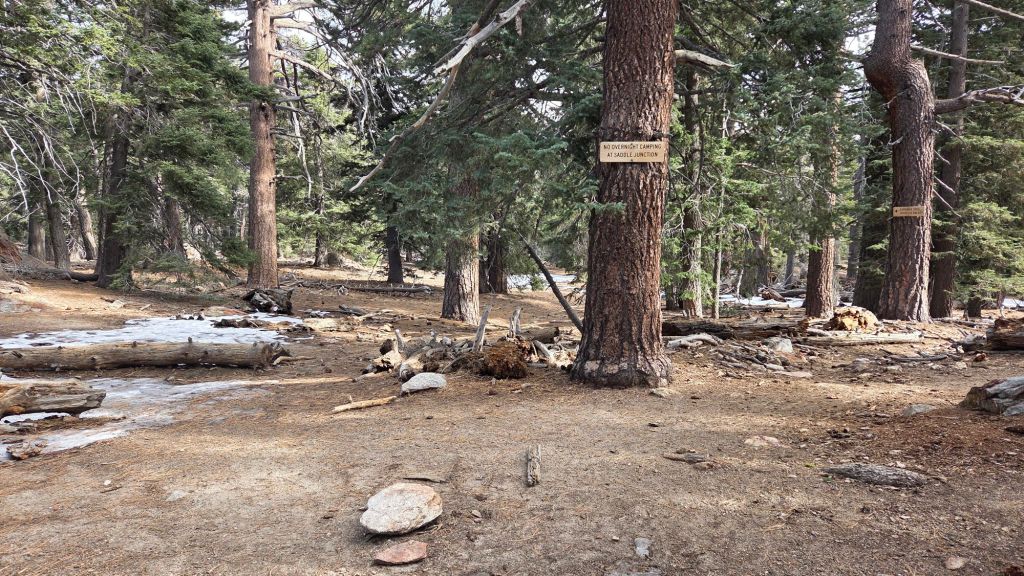
Above and below, the Peak Trail at 9800 ft elevation. Above, on 18th November 2025, following about three inches of fresh snowfall overnight. Below, on the 15th, during a minor snow storm that ultimately produced about four inches of snow at that elevation. In the upper image, note how the fine powder has heavily drifted into the trail route.

Storm updates 18th November 2025

The first significant storms of winter 2025/26 – three systems in eight days – are forecast to impact the San Jacinto mountains from Friday 14th to Friday 21st November 2025.

Please check this page for periodic updates – the most recent is at the top – throughout the multiday storm sequence. The next comprehensive Report update, summarizing conditions during and after the first two of the three storms, is tentatively scheduled for Wednesday 19th.

UPDATE Tuesday 18th November at 0800

The minor storm that moved through swiftly overnight produced a further three inches of snow at San Jacinto Peak – for a total on the ground of about 10 inches – and dusted locally as low as 6000 ft. The snow quality was perfect, a light powder, but that did drift heavily in gusty overnight winds, so tracks are obscured above 10,000 ft and snow in trails can be much deeper than expected.

At this time snow depths are marginal for snowshoes. That is expected to change, at least above about 9500 ft, following the next storm on Friday 21st.

Rainfall in Idyllwild totaled 0.51 inch, with no evidence of snow in Pine Cove (to 6300 ft).

I recorded a video report from San Jacinto Peak early this morning (linked here) which gives a good feel for current conditions.

UPDATE Monday 17th November at 1545

On my afternoon hike, snow conditions were poor and slushy to nearly 9000 ft, before improving above that elevation. Snow depths at Annie’s Junction (9020 ft) and Wellman Divide (9700 ft) are four and five inches, respectively.

At San Jacinto Peak (10,811ft/3295m) on Monday 17th November 2025 at 1515 the air temperature was 24.1°F (-4°C), with a windchill temperature of 5.5°F (-15°C), 72% relative humidity, and a fresh WSW wind sustained at 15 mph gusting to 23.9 mph.

Upper Devil’s Slide Trail, late morning 17th November 2025. The mist effect is caused by the volume of droplets melting off the trees. Underlying the snow track is an inch or more of slush.

UPDATE Monday 17th November at 1130

There was no further precipitation overnight. The second storm arrives tonight and is forecast to move through relatively quickly overnight, with several inches of additional snow in the high country and just under 0.5 inch of rain at mid elevations.

The current snow level is as low as 7000 ft in Strawberry Valley with a dusting down to 6600 ft. Snow depth increases steadily with three inches at 8000 ft (Saddle Junction) up to seven inches at San Jacinto Peak.

Devil’s Slide Trail for example has largely continuous snow in the trail above 7200 ft, which is currently slushy, but will freeze again overnight.

Carrying spikes is recommended everywhere above about 7000 ft at this time, along with the necessary clothing and equipment for genuine winter conditions. The storm coming in tonight is considerably colder, with high country air temperatures well below freezing and windchills far below freezing for the remainder of this week.

While all time and labor is volunteered, the San Jacinto Trail Report uses small private donations to help cover operating costs. Your contribution keeps the Report available to all, free from advertising or paywalls, and independent from agencies. If you have found this Report useful, please consider using this link to the Donate page. Thank you very much for your support.
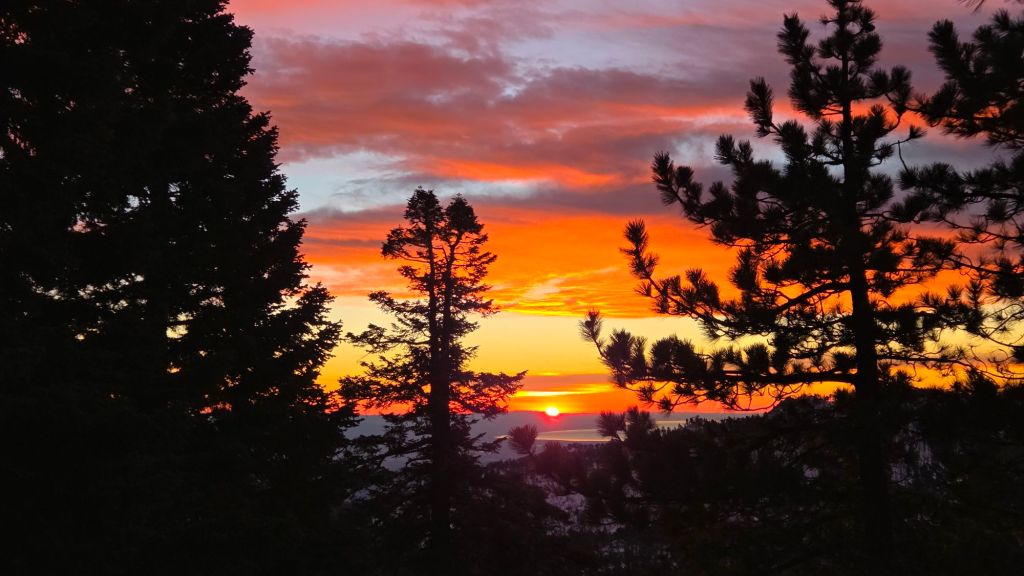
UPDATE Sunday 16th November at 1900

Until it largely stopped at dusk, the rain was almost continuous in Idyllwild today, with an additional 0.84 inch in the past 12 hours for a storm total of 2.70 inches.

Periodic snowfall restarted in the high country by 1200, with the snow level remaining high (>7500 ft), but with only modest accumulation (struggling to reach 0.25 inch/hour) by the time it stopped in mid afternoon.

UPDATE Sunday 16th November at 0940

Periodic rain overnight at mid elevations produced another half inch in Idyllwild, for an impressive storm total at 5550 ft (since Friday 14th) of 1.86 inches by 0700 this morning (and it continues to rain steadily). Light snow overnight and into this morning has added about two inches at the elevation of Long Valley (8500 ft), with total depth at San Jacinto Peak now near six inches. The snow level has remained stubbornly around 7500 ft, with all elevations above that level having added an inch or two of snow since yesterday.

By 0930 it stopped snowing throughout most of the high country, with the cloud cover rapidly clearing on the eastern side of the mountain range. All forecasts are indicating relatively minimal further precipitation today as this first storm system moves away to the east, however rain-producing cloud often remains socked into the west slope valleys long after the high country has cleared.

UPDATE Saturday 15th November at 1830

Apologies for the delayed updating. As described below, it was a challenging day around the Peak. Snowfall at San Jacinto Peak was three inches by early afternoon, likely 4-5 inches by this evening, with two inches at Wellman Divide (9700 ft). There has been a dusting as low as 8000 ft (just below Saddle Junction), with a slushy 0.5 inch from there to 9000 ft elevation.

An additional 0.9 inch of rain in Idyllwild today brings the storm total at 5550 ft to 1.41 inches. Rainfall accumulation at Saddle Junction was 1.29 inches before turning to sleet/light snow.

We dealt with three cases of hypothermia in two separate hiker groups at San Jacinto Peak today, occupying most of the daylight hours. All cases were basically caused by hikers getting wet in the rain on their ascents and then running into the cold, wind, and snow at the highest elevations. Two women I assisted this afternoon exhibited serious symptoms, and I helped get them dry, provided them with extra clothing that I had, made hot beverages, and ultimately guided them part way back down the mountain. The good news is that I have had messages from both groups that everyone eventually got home safely. A tough day, but a great learning experience for those who ventured into the high country today.

Brittany (in my parka) and Maggie descending the Peak Trail at 10,200 ft, early afternoon 15th November 2025, giving a feel for the trail and weather conditions during the first notable storm system of this winter.

UPDATE Saturday 15th November at 0930

The bad news from the top of the mountain is that it rained gently throughout the night at San Jacinto Peak, with the freeze level remaining stubbornly above 11,000 ft. Storm total rainfall by 0700 was 1.09 inches.

The good news is that it steadily turned to snow after 0700, accumulating to 0.75 inch by 0930. Currently the snow level is reported to be around Wellman Divide (9700 ft).

Rainfall storm total in Idyllwild up to 0700 this morning was 0.51 inch.

UPDATE Friday 14th November at 2020

The temperature at San Jacinto Peak has remained around 36°F all day, with consequently no snow but 0.79 inch of rain accumulating by 2015. It is forecast to turn to light snow overnight.

On our hike up this afternoon, there was intermittent light rain at all elevations above 6000 ft.

Total rainfall in Idyllwild in the past 24 hours has been an unexpectedly low 0.28 inch, most of which fell overnight.

UPDATE Friday 14th November at 1030

Rain accumulation overnight by 0700 was 0.20 inch in Idyllwild (at 5550 ft), with 0.05 inch in Long Valley (8500 ft). The start of the system was so mild – well above freezing even above 10,000 ft – that light rain fell at all elevations including around the highest peaks.

Weather and trail update 12th November 2025

The first significant winter storm of the 2025/26 winter will impact the San Jacinto mountains on 14th-16th November. A second storm system will follow so close behind, on 17th-18th, that the gap between the two may be hard to discern, especially at mid elevations where it is expected to rain more-or-less continuously for five days (14th-18th).

The first system will be warm for the season, with initial rainfall potentially above 10,000 ft before the freeze level drops down to around 8000 ft. Rain is expected to persist at mid elevations for at least three days (Friday-Sunday), heaviest on Saturday 15th, and may reach (or even exceed) three inches. Current forecasts indicate 10-15 inches of snow around the highest peaks, mainly focused on the morning of 15th. Due to the warmth of the system, snowfall may be only 4-6 inches at the elevations of Strawberry and Saddle junctions (both around 8000 ft) as these areas will predominantly receive rain. A dusting of snow is possible at elevations as low as Pine Cove and Fern Valley.

Uncertainty persists regarding the second storm system tentatively forecast for 17th-19th. The system is expected to be much colder, with a freeze level dropping as low as 5500 ft, hence light snow in Pine Cove and Idyllwild is more likely. Atmospheric instability continues throughout those days, with a likelihood of periodic light rain at mid elevations (roughly an additional one inch forecast), but snow estimates for the high country have ranged widely from 0-12 inches, with about the middle of that range most likely.

A third storm system tentatively forecast for 20th-21st will also be relatively cold. At this time further light rain is forecast for mid elevations, nut little or no snow for the high country.

Water flows have deteriorated again despite inches of rain in recent months (some example photos below) although this situation may become academic later this week. Most key hiker water sources remain flowing. All ephemeral sources that dried in the summer but temporarily flowed again earlier this month are now dry again. Wellman’s Cienega and the pipe in Round Valley are flowing steadily and will now maintain useable flow into the winter. The creek in Little Round Valley has dried again both where it passes through the meadow and also where it crosses Deer Springs Trail, but continues to flow patchily in its central section. Deer Springs creek (PCT Mile 185.4) dried up in late July where it crosses the trail of the same name, and although it has intermittently flowed again twice during recent rains, is now functionally dry again. The North Fork of the San Jacinto River is flowing where it crosses both Fuller Ridge (PCT Mile 186) and Deer Springs trails, but is largely dry where it crosses Seven Pines Trail. Stone Creek has now dried again where it crosses Deer Springs Trail (near PCT Mile 183.6). Marion Creek is flowing steadily where it crosses the Suicide Rock Trail. Strawberry Cienega (approx PCT Mile 181.9), has dried again.

Willow Creek is flowing weakly again where it crosses the Willow Creek Trail, having dried in August. Hidden Lake functionally dried by the end of June. Long Valley Creek is dry where it passes through Round Valley, as is the nearby creek in Tamarack Valley. Water is flowing reliably in Tahquitz Creek at PCT Mile 177 and again further downstream at the north end of Little Tahquitz Meadow (although it is dry between those two locations)(photos below). The pipe in Tahquitz Meadow dried in mid July. Skunk Cabbage Meadow creek is functionally dry. Middle Spring on Devil’s Slide Trail has been functionally dry since 1st August, but I maintain a tiny pool there from which dogs can drink.

Be bear aware. Although generally rarely reported, at least six individually identifiable Black Bears have been observed in the San Jacinto mountains since 2017 (I have personally encountered at least one annually for the past seven years). A full-sized adult bear with a right ear tag has been seen in multiple locations from Willow Creek to Fern Valley since August (see my video from a trail cam on 14th September available here, and images from Fern Valley in late August in a prior Report linked here). A smaller, second individual has been reliably reported at least twice, most recently in late September in lower Fern Valley. My brief videos from Devil’s Slide Trail in September 2021 (linked here) and one walking past our house in 2018 (linked here) show two further individuals. There have been no reports of negative interactions with humans in the high country, at or near campsites, or on trails, but bear-safe storage of food when camping is recommended.

Daily survey hikes by the Trail Report year-round in the San Jacinto mountains include multiple routes to the highest peaks including San Jacinto Peak typically at least twice per week (more frequently during stormy weather), Tahquitz Peak and area at least once per week, plus a wide variety of other trails on intervening days.

The lull before the storm. A perfect (largely) cloudy day on Wednesday 12th November 2025, as seen looking north-west from the summit block of Marion Mountain. Note the new summit register box in the lower left, donated by the Trail Report. Mount St Ellen’s is in the milky sun in the foreground, Fuller Ridge and Black Mountain in the middle distance, and the San Bernardino Mountains on the distant right.

WEATHER

Temperatures throughout early November were generally above seasonal at all elevations, with warm, dry (but thankfully weak) easterly winds in recent days. Temperatures cool markedly after Tuesday 11th with the anticipated passage of back-to-back minor winter storms on 13th-19th November.

Winter storm systems are forecast for 14th-16th November (high degree of confidence), 17th-18th November (some uncertainty), and 20th-21st (considerable uncertainty). The first system will be relatively mild, with a freeze level likely above 7000 ft. Steady rain from late Thursday 13th into Sunday 16th is forecast to total at least two inches at mid elevations (e.g., Idyllwild). Currently 8-15 inches of snow are forecast around the highest peaks, but due to the warmth of the system, possibly fewer than six inches at the elevations of Strawberry and Saddle junctions (around 8000 ft).

National Weather Service San Diego published a detailed, revised, video forecast of the upcoming storm system on 12th November (linked here).

The second system on 17th-18th will be colder, with several inches of snowfall mainly on Monday 17th in the high country even though rainfall at mid elevations could be less than one inch, the latter mainly in the afternoon/evening of Monday 17th. Due to the temperature of the storm, light snow is possible at elevations as low as Pine Cove and Fern Valley (a dusting at 5000 ft, 1-3 inches near 6000 ft).

Details remain unclear for the third system, due on 20th-21st, at this time, although it is expected to be as cold as the storm on 17th-18th, but possibly fast moving, and hence with minimal precipitation.

The first (very minor) winter storm of the season impacted the region on Tuesday 14th October. Snow fell intermittently at San Jacinto Peak most of the afternoon, accumulating to about 1.5 inches. Snow dusted as low as 9000 ft, averaging about one inch above 9500 ft. Rainfall in Idyllwild (5550 ft) totaled an impressive 0.76 inch for the day, with 0.85 inch at Saddle Junction (8100 ft).

That storm was a dramatic contrast from the relatively mild, humid, weather experienced since late August. The San Jacinto mountains had a remarkable sequence of tropical and monsoonal autumnal rains spread across ten distinct rain events between 22nd August and 10th October. San Jacinto Peak recorded an impressive 8.74 inches of rainfall, with 4.58 inches recorded in Idyllwild (at 5550 ft).

At San Jacinto Peak (10,811ft/3295m) on Wednesday 12th November 2025 at 1020 the air temperature was 39.9°F (4°C), with a windchill temperature of 28.0°F (-2°C), 48% relative humidity, and a fresh WSW wind sustained at 12 mph gusting to 18.5 mph.

At the Peak on Friday 7th November 2025 at 0945 the air temperature was 46.1°F (8°C), with a windchill temperature of 39.6°F (4°C), 35% relative humidity, and a cool NNE wind sustained at 6 mph gusting to 9.7 mph.

At the Peak on Monday 3rd November 2025 at 0840 the air temperature was 44.1°F (7°C), with a windchill temperature of 36.5°F (2°C), 16% relative humidity, and a remarkably steady SW wind sustained at 9 mph gusting to 10.9 mph.

At the Peak on Friday 31st October 2025 at 0910 the air temperature was 45.3°F (7°C), with a “windchill” temperature of 43.0°F (6°C), 36% relative humidity, and a very light NNE breeze sustained at 0 mph gusting to 3.0 mph.

At the Peak on Wednesday 29th October 2025 at 0945 the air temperature was 56.2°F (13°C), with a “windchill” temperature of 50.7°F (10°C), 30% relative humidity, and a barely discernable NW breeze sustained at 0 mph gusting to 2.2 mph.

TRAIL CONDITIONS

Temperatures will be relatively cold in the high country during the passage of dual storm systems between 13th-19th November. Hikers must be prepared for temperatures well below freezing at higher elevations, and far below freezing when considering wind chill effects, especially on 14th, 15th, 18th, and 19th. It is expected that spikes may be needed above about 9000 ft elevation after 14th.

Trails have cleared of the icy snow that fell three weeks ago. Thankfully most trails suffered relatively minor tread erosion from intense rains in August-October. Neither the Wolf Fire in late June nor the Rosa Fire in early August had major impacts on the trail system, although the latter did burn the southernmost 0.5 mile of the Palm Canyon trail.

For the first time in nearly a decade, Deer Springs Trail from its trailhead to Little Round Valley is now completely clear of blowdowns, with 26 trees removed since the middle of last year (of which 70% were cut by the Trail Report). A joint Eastern Sierra Conservation Corps/State Park crew working in early October trimmed encroaching vegetation along Deer Springs Trail just above the Fuller Ridge Trail junction to about 9300 ft.

On PCT Miles 170-175 (roughly Apache Peak to Red Tahquitz) most blowdowns have been removed but six trees remain to be cut around South Peak (Miles 173.5-174) of which most are significant obstructions for hikers. Sections of the trail are badly overgrown with brush and in their worst condition in decades, especially most of Miles 168-174.

The two large downed trees near PCT Mile 180 were removed by the Trail Report this spring. The Strawberry Trail (PCT Miles 180.8-183.1) has had long-term blowdowns removed this month by Forest Service volunteers. The brush along Miles 181-181.7 has become heavily overgrown since it was last trimmed by the Trail Report in 2021, but there is a plan for trimming work in the next few months.

The maintenance condition of the Fuller Ridge (Miles 185.5-190.5) section of the PCT improved significantly in July 2025, with the Trail Report clearing most of the 15 blowdowns and a PCTA volunteer crew cutting the remainder the following week.

On the Wellman Trail, Wellman’s Cienega is flowing well compared to earlier in the autumn (photo below). The Trail Report continues the work it started last year to keep this trail well-maintained (after it had become badly overgrown by early 2024).

Dark Canyon Road (4S02) had some effective basic maintenance on its dirt section in the spring. The associated Dark Canyon campground is closed for the year (apparently due to federal budget cuts).

For the first time in about 20 years Seven Pines Trail has a continuous route completely cleared of blowdown trees, with the trail also as faithful to the original route as possible. The Trail Report “adopted” Seven Pines as a priority for maintenance work nearly a decade ago due to a disproportionate number of lost hiker rescues (with State Park and Forest Service evidently no longer maintaining the route). Since 2019 we have now removed exactly 100 downed trees – including 25 since April of this year – and the trail is largely trimmed and cleared semi-annually. Although our work has restored this delightful trail, Seven Pines remains a genuine wilderness trail unlike the wider, bare, obvious routes of, for example, Devil’s Slide or Marion Mountain trails. Cautious navigation remains invaluable for those without extensive experience of hiking this trail.

Black Mountain Road is open and in its typical non-graded condition, i.e. lumpy but readily passable in any moderate clearance vehicle. The tap at Cinco Poses Spring currently has reliable water (located alongside the road 0.2 mile below the Boulder Basin turning).

On Willow Creek Trail whitethorn urgently needs trimming again especially near the boundary between the two agencies. The two large trees remaining uncut in the State Park section from several years ago have easy workarounds.

The Caramba Trail from near Reeds Meadow through Laws Camp and on to Caramba, and the Cedar Trail from Willow Creek Trail to Laws, are euphemistically (and arguably dangerously) described by the Forest Service as “not maintained”. In reality both trails have been abandoned for more than a decade and no longer exist. They are so heavily overgrown, largely with dense whitethorn which obscures dozens of downed trees, that hikers should not attempt to follow them (regardless of how much you may trust any particular app).

An informal use trail to Laws is much more direct, generally well maintained, and avoids the bushwhacking of the abandoned trails (some local Idyllwild hikers dubbed it the “King Trail” when I established the route in 2019). It leaves Willow Creek Trail exactly 1.0 mile from Saddle Junction, 0.46 mile from the Skunk Cabbage turning (trailhead at N 33.7796, W 116.6590). The route descends following former deer trails for 1.2 miles, meeting Willow Creek about 0.15 mile upstream from the site of the historic Laws Camp (the remains of which were destroyed by the 2013 Mountain Fire and subsequent flood and treefall damage). One huge pine tree fell in late 2024 across the King Trail about midway down that requires a minor scramble underneath, but nine additional blowdowns have been removed since January 2025, with the trail trimmed and cleaned three times this year.

From Laws east to Caramba the original Caramba Trail has been cairned by myself and others and can largely be followed with skilled route-finding. My most recent 2025 survey counted 120 trees down on this 2.1 miles of trail. It is extremely obscure for the first 0.5 mile east of the Willow Creek crossing, becoming more obvious (but still subtle) as it descends towards Caramba. Very cautious navigation is strongly recommended throughout the area.

Stormy weather this autumn brought down another seven trees across Spitler Peak Trail. All were removed by the Trail Report on 20th October, bringing to 169 the total number of trees we have removed from this route in the past seven years. One very large burned cedar is the only tree that remains across the trail, immediately after the first creek crossing 3.2 miles up from the trailhead.

The Zen Center Trail continues its serious deterioration that started following the 2013 Mountain Fire, with a combination of vigorous regrowth and treefall hazards further obscuring the route with each passing season. The lower and upper thirds of this trail are partially cairned and not too bad for those who are very familiar with the former route, but even the experienced find navigating the central section tricky. Long trousers, scrambling gloves, and a genuine enjoyment of bush-whacking are all strongly recommended.

While all time and labor is volunteered, the San Jacinto Trail Report uses small donations to help cover modest operating costs. Your contribution keeps the Report available to all, free from advertising or paywalls, and independent from agencies. If you have found this Report useful, please consider using this link to the Donate page. Thank you very much for your support.
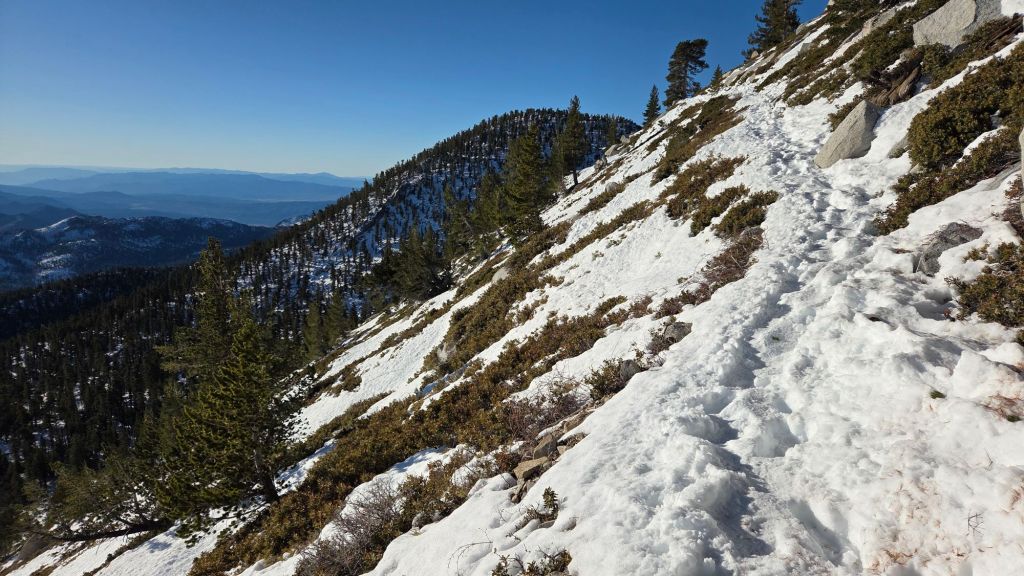
The best-known north spring on the Wellman Trail at Wellman’s Cienega (9300 ft), early morning 3rd November 2025. The flow is quite reasonable for the time of year, augmented by rain and snow in recent months.
The crossing of the North Fork of the San Jacinto River continues to flow gently but reliably on upper Deer Springs Trail (9400 ft elevation), 10th October 2025. The flow was somewhat reduced but still steady as of 3rd November.
Above and below, the creek in Little Round Valley, mid morning 3rd November 2025. Above, it is dry where it passes through the meadow, having previously dried up here in mid August but it then flowed between 25th August and late September following monsoonal rains. Weak, intermittent flow persists in the central section, most notably near the sign for Campsite 2 as shown below. Further downstream the lower section is now dry again where it crosses Deer Springs Trail.
The tiny Switchback Spring adjacent to Deer Springs Trail roughly 0.4 mile north of Strawberry Junction (near PCT Mile 183.4), 3rd November 2025. Despite its size, one of the few truly perennial water sources on the mountain, maintaining flow even in the driest of years.
Tahquitz Creek flowing gently where it crosses the PCT near Mile 177 just below its source (Grethe Spring), 4th November 2025.
Tahquitz Creek flowing at the lower (northern) end of Little Tahquitz Meadow, 4th November 2025.
The North Fork of the San Jacinto River where it crosses Seven Pines Trail at 6900 ft elevation, 7th November 2025. Although dry here, there are pools and gently flowing sections immediately upstream and downstream.
Spitler Creek at its lowest crossing of the Spitler Peak Trail, about 3.2 miles up from the trailhead, 20th October 2025. The creek is flowing surprisingly well for the time of year, doubtless augmented by rains in recent months.

Trail and water update 8th November 2025

Temperatures in early November have been broadly above seasonal at all elevations. They are expected to remain above average into the second week of November, before cooling from 12th. Forecasts are suggesting back-to-back minor winter storm systems on 13th-14th and 17th-19th November. The first system will be mild, with rain potentially as high as 9,000 ft (before possibly transitioning to light snow). Rain may persist at mid elevations for 1-2 days, starting on the afternoon of 13th. The system on 18th will be colder, with a dusting of snow as low as 6500 ft possible. For the first storm, snowfall is forecast to be limited to no more than 1-2 inches around the highest peaks, while estimates for the later storm have ranged widely from 1-12 inches.

Water flows have deteriorated again despite inches of rain in recent months (some example photos below). However most key hiker water sources are flowing. All ephemeral sources that dried in the summer but temporarily flowed again earlier this month are now dry again. Wellman’s Cienega and the pipe in Round Valley are flowing steadily and will now maintain useable flow into the winter. The creek in Little Round Valley has dried again both where it passes through the meadow and also where it crosses Deer Springs Trail, but continues to flow patchily in its central section. Deer Springs creek (PCT Mile 185.4) dried up in late July where it crosses the trail of the same name, and although it has intermittently flowed again twice during recent rains, is now functionally dry again. The North Fork of the San Jacinto River is flowing where it crosses both Fuller Ridge (PCT Mile 186) and Deer Springs trails, but is largely dry where it crosses Seven Pines Trail. Stone Creek has now dried again where it crosses Deer Springs Trail (near PCT Mile 183.6). Marion Creek is flowing steadily where it crosses the Suicide Rock Trail. Strawberry Cienega (approx PCT Mile 181.9), has dried again.

Willow Creek is flowing weakly again where it crosses the Willow Creek Trail, having dried in August. Hidden Lake functionally dried by the end of June. Long Valley Creek is dry where it passes through Round Valley, as is the nearby creek in Tamarack Valley. Water is flowing reliably in Tahquitz Creek at PCT Mile 177 and again further downstream at the north end of Little Tahquitz Meadow (although it is dry between those two locations)(photos below). The pipe in Tahquitz Meadow dried in mid July. Skunk Cabbage Meadow creek is functionally dry. Middle Spring on Devil’s Slide Trail has been functionally dry since 1st August, but I maintain a tiny pool there from which dogs can drink.

During the federal government shutdown, the Forest Service Idyllwild Ranger Station is closed. Unlike the 2018-19 shutdown which occurred in the winter months of December-January, gates on Forest Service roads and USFS campgrounds have remained open (for now).

Be bear aware. Although generally rarely reported, at least six individually identifiable Black Bears have been observed in the San Jacinto mountains since 2017 (I have personally encountered at least one annually for the past seven years). A full-sized adult bear with a right ear tag has been seen in multiple locations from Willow Creek to Fern Valley since August (see my video from a trail cam on 14th September available here, and images from Fern Valley in late August in a prior Report linked here). A smaller, second individual has been reliably reported at least twice, most recently in late September in lower Fern Valley. My brief videos from Devil’s Slide Trail in September 2021 (linked here) and one walking past our house in 2018 (linked here) show two further individuals. There have been no reports of negative interactions with humans in the high country, at or near campsites, or on trails, but bear-safe storage of food when camping is recommended.

The fire lookout at Black Mountain is closed indefinitely due to issues identified in a May 2025 safety inspection. Tahquitz Peak lookout reopened (likely only for a few weeks) on 7th November having been closed all season to date.

Daily survey hikes by the Trail Report year-round in the San Jacinto mountains include multiple routes to the highest peaks including San Jacinto Peak typically at least twice per week (more frequently during stormy weather), Tahquitz Peak and area at least once per week, plus a wide variety of other trails on intervening days.

WEATHER

Temperatures remain generally above seasonal throughout early November, before cooling markedly after Tuesday 11th.

Consecutive winter storm systems are forecast (with increasing reliability) for 13th-15th and 18th November. The first system will be relatively mild for the season, with a freeze level above 7000 ft and initial rainfall possibly near 10,000 ft (before turning to very light snow). Steady light rain from late on Thursday 13th into Saturday 15th could total one inch at mid elevations (e.g., Idyllwild). Only 1-3 inches of snow are currently forecast around the highest peaks, with a dusting possible at elevations as low as Pine Cove and upper Fern Valley.

The system on 18th is forecast to be colder, with a freeze level potentially dropping to 6000 ft and hence a dusting of snow as low as Idyllwild possible. Snowfall in the high country is expected to be somewhat greater with the second storm than the first, but still only 2-4 inches, falling throughout the day on Tuesday 18th.

The first (very minor) winter storm of the season impacted the region on Tuesday 14th October. Snow fell intermittently at San Jacinto Peak most of the afternoon, accumulating to about 1.5 inches. Snow dusted as low as 9000 ft, averaging about one inch above 9500 ft. Rainfall in Idyllwild (5550 ft) totaled an impressive 0.76 inch for the day, with 0.85 inch at Saddle Junction (8100 ft).

That storm was a dramatic contrast from the relatively mild, humid, weather experienced since late August. The San Jacinto mountains had a remarkable sequence of tropical and monsoonal autumnal rains spread across ten distinct rain events between 22nd August and 10th October. San Jacinto Peak recorded an impressive 8.74 inches of rainfall, with 4.58 inches recorded in Idyllwild (at 5550 ft).

One interesting consequence of the climate change crisis is the increasing prevalence of tropical, rather than monsoonal, rainfall in the San Jacinto mountains. In three of the four most recent years (2022-2025) the majority of rainfall in our region between August-October has come from tropical sources (generally from the south or south-west) as opposed to the historically much more frequent monsoonal storms (originating from easterly directions).

At San Jacinto Peak (10,811ft/3295m) on Friday 7th November 2025 at 0945 the air temperature was 46.1°F (8°C), with a windchill temperature of 39.6°F (4°C), 35% relative humidity, and a cool NNE wind sustained at 6 mph gusting to 9.7 mph.

At the Peak on Monday 3rd November 2025 at 0840 the air temperature was 44.1°F (7°C), with a windchill temperature of 36.5°F (2°C), 16% relative humidity, and a remarkably steady SW wind sustained at 9 mph gusting to 10.9 mph.

At the Peak on Friday 31st October 2025 at 0910 the air temperature was 45.3°F (7°C), with a “windchill” temperature of 43.0°F (6°C), 36% relative humidity, and a very light NNE breeze sustained at 0 mph gusting to 3.0 mph.

At the Peak on Wednesday 29th October 2025 at 0945 the air temperature was 56.2°F (13°C), with a “windchill” temperature of 50.7°F (10°C), 30% relative humidity, and a barely discernable NW breeze sustained at 0 mph gusting to 2.2 mph.

TRAIL CONDITIONS

Trails have cleared of the icy snow that fell three weeks ago. Thankfully most trails suffered relatively minor tread erosion from intense rains in August-October. Neither the Wolf Fire in late June nor the Rosa Fire in early August had major impacts on the trail system, although the latter did burn the southernmost 0.5 mile of the Palm Canyon trail.

For the first time in nearly a decade, Deer Springs Trail from its trailhead to Little Round Valley is now completely clear of blowdowns, with 26 trees removed since the middle of last year (of which 70% were cut by the Trail Report). A joint Eastern Sierra Conservation Corps/State Park crew working in early October trimmed encroaching vegetation along Deer Springs Trail just above the Fuller Ridge Trail junction to about 9300 ft.

On PCT Miles 170-175 (roughly Apache Peak to Red Tahquitz) most blowdowns have been removed but six trees remain to be cut around South Peak (Miles 173.5-174) of which most are significant obstructions for hikers. Sections of the trail are badly overgrown with brush and in their worst condition in decades, especially most of Miles 168-174.

The two large downed trees near PCT Mile 180 were removed by the Trail Report this spring. The Strawberry Trail (PCT Miles 180.8-183.1) has had long-term blowdowns removed this month by Forest Service volunteers. The brush along Miles 181-181.7 has become heavily overgrown since it was last trimmed by the Trail Report in 2021, but there is a plan for trimming work in the next few months.

The maintenance condition of the Fuller Ridge (Miles 185.5-190.5) section of the PCT improved significantly in July 2025, with the Trail Report clearing most of the 15 blowdowns and a PCTA volunteer crew cutting the remainder the following week.

On the Wellman Trail, Wellman’s Cienega is flowing well compared to earlier in the autumn (photo below). The Trail Report continues the work it started last year to keep this trail well-maintained (after it had become badly overgrown by early 2024).

Dark Canyon Road (4S02) had some effective basic maintenance on its dirt section in the spring. The associated Dark Canyon campground is closed for the year (apparently due to federal budget cuts).

For the first time in about 20 years Seven Pines Trail has a continuous route completely cleared of blowdown trees, with the trail also as faithful to the original route as possible. The Trail Report “adopted” Seven Pines as a priority for maintenance work nearly a decade ago due to a disproportionate number of lost hiker rescues (with State Park and Forest Service evidently no longer maintaining the route). Since 2019 we have now removed exactly 100 downed trees – including 25 since April of this year – and the trail is largely trimmed and cleared semi-annually. Although our work has restored this delightful trail, Seven Pines remains a genuine wilderness trail unlike the wider, bare, obvious routes of, for example, Devil’s Slide or Marion Mountain trails. Cautious navigation remains invaluable for those without extensive experience of hiking this trail.

Black Mountain Road is open and in its typical non-graded condition, i.e. lumpy but readily passable in any moderate clearance vehicle. The tap at Cinco Poses Spring currently has reliable water (located alongside the road 0.2 mile below the Boulder Basin turning).

On Willow Creek Trail whitethorn urgently needs trimming again especially near the boundary between the two agencies. The two large trees remaining uncut in the State Park section from several years ago have easy workarounds.

The Caramba Trail from near Reeds Meadow through Laws Camp and on to Caramba, and the Cedar Trail from Willow Creek Trail to Laws, are euphemistically (and arguably dangerously) described by the Forest Service as “not maintained”. In reality both trails have been abandoned for more than a decade and no longer exist. They are so heavily overgrown, largely with dense whitethorn which obscures dozens of downed trees, that hikers should not attempt to follow them (regardless of how much you may trust any particular app).

An informal use trail to Laws is much more direct, generally well maintained, and avoids the bushwhacking of the abandoned trails (some local Idyllwild hikers dubbed it the “King Trail” when I established the route in 2019). It leaves Willow Creek Trail exactly 1.0 mile from Saddle Junction, 0.46 mile from the Skunk Cabbage turning (trailhead at N 33.7796, W 116.6590). The route descends following former deer trails for 1.2 miles, meeting Willow Creek about 0.15 mile upstream from the site of the historic Laws Camp (the remains of which were destroyed by the 2013 Mountain Fire and subsequent flood and treefall damage). One huge pine tree fell in late 2024 across the King Trail about midway down that requires a minor scramble underneath, but nine additional blowdowns have been removed since January 2025, with the trail trimmed and cleaned three times this year.

From Laws east to Caramba the original Caramba Trail has been cairned by myself and others and can largely be followed with skilled route-finding. My most recent 2025 survey counted 120 trees down on this 2.1 miles of trail. It is extremely obscure for the first 0.5 mile east of the Willow Creek crossing, becoming more obvious (but still subtle) as it descends towards Caramba. Very cautious navigation is strongly recommended throughout the area.

Stormy weather this autumn brought down another seven trees across Spitler Peak Trail. All were removed by the Trail Report on 20th October, bringing to 169 the total number of trees we have removed from this route in the past seven years. One very large burned cedar is the only tree that remains across the trail, immediately after the first creek crossing 3.2 miles up from the trailhead.

The Zen Center Trail continues its serious deterioration that started following the 2013 Mountain Fire, with a combination of vigorous regrowth and treefall hazards further obscuring the route with each passing season. The lower and upper thirds of this trail are partially cairned and not too bad for those who are very familiar with the former route, but even the experienced find navigating the central section tricky. Long trousers, scrambling gloves, and a genuine enjoyment of bush-whacking are all strongly recommended.

While all time and labor is volunteered, the San Jacinto Trail Report uses small donations to help cover modest operating costs. Your contribution keeps the Report available to all, free from advertising or paywalls, and independent from agencies. If you have found this Report useful, please consider using this link to the Donate page. Thank you very much for your support.
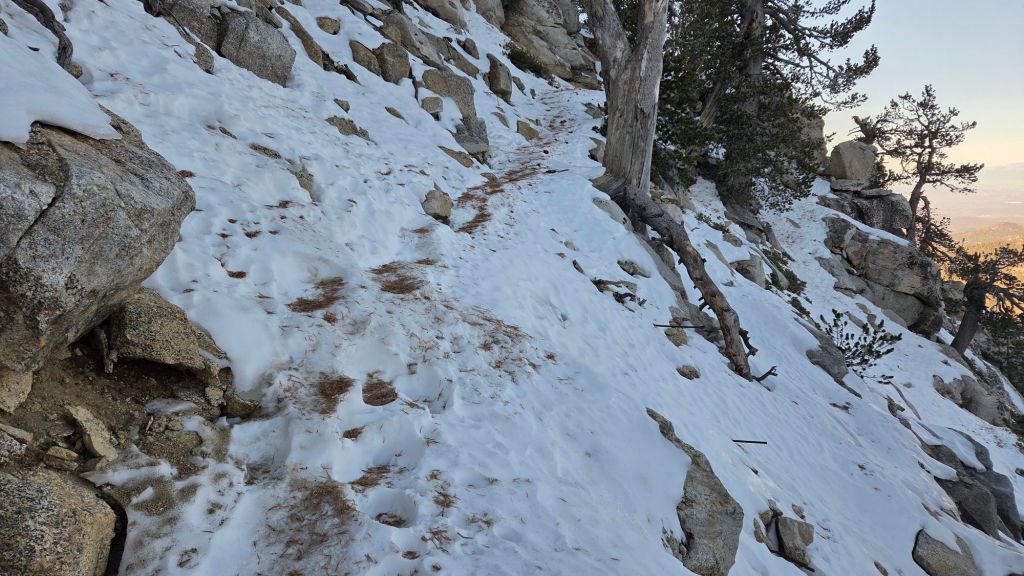
The best-known north spring on the Wellman Trail at Wellman’s Cienega (9300 ft), early morning 3rd November 2025. The flow is quite reasonable for the time of year, augmented by rain and snow in recent months.
The crossing of the North Fork of the San Jacinto River continues to flow gently but reliably on upper Deer Springs Trail (9400 ft elevation), 10th October 2025. The flow was somewhat reduced but still steady as of 3rd November.
Above and below, the creek in Little Round Valley, mid morning 3rd November 2025. Above, it is dry where it passes through the meadow, having previously dried up here in mid August but it then flowed between 25th August and late September following monsoonal rains. Weak, intermittent flow persists in the central section, most notably near the sign for Campsite 2 as shown below. Further downstream the lower section is now dry again where it crosses Deer Springs Trail.
The tiny Switchback Spring adjacent to Deer Springs Trail roughly 0.4 mile north of Strawberry Junction (near PCT Mile 183.4), 3rd November 2025. Despite its size, one of the few truly perennial water sources on the mountain, maintaining flow even in the driest of years.
Tahquitz Creek flowing gently where it crosses the PCT near Mile 177 just below its source (Grethe Spring), 4th November 2025.
Tahquitz Creek flowing at the lower (northern) end of Little Tahquitz Meadow, 4th November 2025.
The North Fork of the San Jacinto River where it crosses Seven Pines Trail at 6900 ft elevation, 7th November 2025. Although dry here, there are pools and gently flowing sections immediately upstream and downstream.
Spitler Creek at its lowest crossing of the Spitler Peak Trail, about 3.2 miles up from the trailhead, 20th October 2025. The creek is flowing surprisingly well for the time of year, doubtless augmented by rains in recent months.

Trail update 22nd October 2025

The first winter storm of the season impacted the region on Tuesday 14th October, with precipitation starting about 1130 and lasting until near dusk. Snow fell intermittently at San Jacinto Peak most of the afternoon, accumulating to about 1.5 inches, but with a periodic mix of drizzle and sleet, and finishing with a thick icy coating from late freezing rain. Snow dusted as low as 9000 ft, averaging about one inch above 9500 ft. Rainfall in Idyllwild (5550 ft) totaled an impressive 0.76 inch for the day, with 0.85 inch at Saddle Junction (8100 ft). I posted a short video report from San Jacinto Peak early on 15th, linked here. Despite a steady warming trend in recent days, on Wednesday 22nd thin icy snow still persisted in patches in the most shaded areas above 9900 ft elevation, although spikes are no longer required anywhere.

This storm was a dramatic contrast from the relatively mild, humid, weather we have generally experienced since late August. The San Jacinto mountains had a remarkable sequence of tropical and monsoonal autumnal rains in the past eight weeks. San Jacinto Peak recorded an impressive 8.74 inches of rainfall spread across ten distinct rain events between 22nd August and 10th October, with 4.58 inches recorded in Idyllwild (at 5550 ft) over the same period.

The most recent tropical rains, on 9th-10th October, were concentrated on the western flank of the mountain range. The junction of Marion Mountain and Deer Springs trails at 8600 ft recorded 2.23 inches of rain, with 1.67 inches at 9800 ft in Little Round Valley, in contrast to just 0.36 inch at Saddle Junction (located on the southern flank of the high country).

Water flows have improved following the rain events of recent weeks, although many rapidly returned to their mid-August condition (see photos below). Some key hiker water sources are flowing reasonably well. All ephemeral sources dried in the summer but some are temporarily flowing again, especially those on the western side of the mountains. Wellman’s Cienega and the pipe in Round Valley are flowing and should now maintain useable flow into the winter. The creek in Little Round Valley has already dried again both where it passes through the meadow and also where it crosses Deer Springs Trail, but continues to flow patchily in its central section. Deer Springs creek dried up in late July where it crosses the trail of the same name, and although it has intermittently flowed again twice during recent rains, it will dry again soon. The North Fork of the San Jacinto River is flowing where it crosses both Fuller Ridge and Deer Springs trails. Stone Creek is temporarily trickling again where it crosses Deer Springs Trail (near PCT Mile 183.6). Marion Creek is flowing steadily where it crosses the Suicide Rock Trail. Strawberry Cienega (approx PCT Mile 181.9), which dried in midsummer, is temporarily trickling again, but not sufficiently to filter any useful volume of water.

Willow Creek is flowing again where it crosses the Willow Creek Trail, having dried in August. Hidden Lake dried by the end of June (although it temporarily holds a tiny pond from recent rains). Long Valley Creek is dry where it passes through Round Valley, as is the nearby creek in Tamarack Valley. Water is flowing reliably in Tahquitz Creek at PCT Mile 177 and again further downstream at the north end of Little Tahquitz Meadow (although it is dry between those two locations). The pipe in Tahquitz Meadow dried up in mid July. Skunk Cabbage Meadow creek is functionally dry and no longer useful for filtering. Middle Spring on Devil’s Slide Trail has been functionally dry since 1st August, but I maintain a tiny pool there from which dogs can drink.

During the federal government shutdown, the Forest Service Idyllwild Ranger Station is closed. Unlike the 2018-19 shutdown which occurred in the winter months of December-January, gates on Forest Service roads and USFS campgrounds have remained open (for now).

Fire lookouts at Black Mountain and Tahquitz Peak are closed indefinitely due to issues identified in a May 2025 safety inspection at Black Mountain. Neither tower is now expected to reopen until 2026.

Be bear aware. Although generally rarely reported, up to six individually identifiable Black Bears have been observed in the San Jacinto mountains since 2017, and I have personally seen at least one annually for the past seven years. A full-sized adult bear with an ear tag has been seen in multiple locations from Laws to Fern Valley since late August (see my video from 14th September available here, and images from late August in a prior Report linked here). My other brief videos from Devil’s Slide Trail in September 2021 (linked here) and one walking through our property in Idyllwild in 2018 (linked here) show two other individuals. There have been no reports of negative interactions with humans in the high country, at or near campsites, or on trails.

Daily survey hikes by the Trail Report year-round in the San Jacinto mountains include multiple routes to the highest peaks including San Jacinto Peak typically at least twice per week (more frequently during stormy weather), Tahquitz Peak and area at least once per week, plus a wide variety of other trails on intervening days.

San Jacinto Peak at sunrise, 15th October 2025, with the snowclad San Bernardino Mountains in the background. The icicles are indicative of the freezing rain that fell on the evening of 14th, both during and after the minor snowfall. creating (temporarily) very icy conditions at the highest elevations.

WEATHER

Temperatures plunged to well below seasonal for October on 13th-16th with the passage of a cold front associated with the first winter storm of the season on Tuesday 14th. Strong winds associated with passage of the cold front briefly dropped windchill temperatures close to 0°F (-18°C) at the highest peaks.

Temperatures warm quickly this week, especially at mid elevations, and will be above seasonal for late October on most days from 18th to the end of the month. The last few days of October are forecast to be unusually warm for the season.

The San Jacinto mountains received valuable monsoonal and tropical rainfall in ten distinct events since late August, as described in more detail in the previous Report and links therein (linked here). The most recent tropical rains, on 9th-10th October, were associated with the breakdown of former Hurricane Priscilla far to our south. Locations on the western side of the high country received the bulk of the the intense rainfall, with 2.23 inches of rain recorded at the junction of Marion Mountain and Deer Springs trails at 8600 ft, and 1.67 inches at 9800 ft in Little Round Valley. In contrast, locations to the south of the high country received much less rain, with Saddle Junction recording just 0.36 inch, and Idyllwild 0.49 inch, while higher elevation locations on the east side fell between those extremes (1.21 inches at Wellman’s Cienega). San Jacinto Peak recorded 1.43 inches.

One interesting consequence of the climate change crisis is the increasing prevalence of tropical, rather than monsoonal, rainfall in the San Jacinto mountains. In three of the four most recent years (2022-2025) the majority of rainfall in our region between August-October has come from tropical sources (generally from the south or south-west) as opposed to the historically much more frequent monsoonal storms (originating from easterly directions).

At San Jacinto Peak (10,811ft/3295m) on Wednesday 22nd October 2025 at 0930 the air temperature was 37.8°F (3°C), with a windchill temperature of 21.9°F (-6°C), 46% relative humidity, and a chilly SW wind sustained at 12 mph gusting to 21.4 mph.

At the Peak on Friday 17th October 2025 at 0940 the air temperature was 31.7°F (0°C), with a windchill temperature of 17.6°F (-8°C), 47% relative humidity, and a cool NNE wind sustained at 8 mph gusting to 14.9 mph.

At the Peak on Wednesday 15th October 2025 at 0645 the air temperature was 22.5°F (-5°C), with a windchill temperature of 5.5°F (-15°C), 100% relative humidity, and a frigid due West wind sustained at 14 mph gusting to 22.0 mph.

At the Peak on Tuesday 14th October 2025 at 1045 the air temperature was 30.3°F (-1°C), with a windchill temperature of 14.0°F (-10°C), 93% relative humidity, and a bitter SW wind sustained at 10 mph gusting to 20.6 mph.

A lunch spot with a view. From left to right, Tahquitz Peak, Tahquitz Rock, Strawberry Valley, and Suicide Rock, as seen looking south-south-west from near PCT Mile 180, late morning 10th October, with storm clouds derived from former Hurricane Priscilla.

TRAIL CONDITIONS

Icy snow was almost continuous on trails above 9300 ft on 15th October, with a patchy mix of ice, snow, and sleet down to 8800 ft. Spikes were useful, but not essential for those very familiar with hiking in such conditions, above about 9500 ft. These conditions will improve steadily with a warming trend over 16th-19th October, with melting most rapid at lower elevations (initially below 10,000 ft) and on the most sun-exposed trails. As of Friday 17th, very thin icy snow was still widespread in the sheltered sections of the Peak Trail above 9900 ft, and as low as 9300 ft on the least sun-exposed sections of Deer Springs Trail. With caution, spikes are generally not required, although there is little harm with carrying them of course.

Thankfully most trails have suffered relatively minor tread erosion from recent intense rains. Neither the Wolf Fire in late June nor the Rosa Fire in early August had major impacts on the trail system, although the latter did burn the southernmost 0.5 mile of the Palm Canyon trail.

For the first time in nearly a decade, Deer Springs Trail from its trailhead to Little Round Valley is now completely clear of blowdowns, with 26 trees removed since the middle of last year, of which 70% were cut by the Trail Report. A joint Eastern Sierra Conservation Corps/State Park crew working in early October made good progress trimming encroaching vegetation along Deer Springs Trail just above the Fuller Ridge Trail junction to about 9300 ft.

On PCT Miles 170-175 (roughly Apache Peak to Red Tahquitz) most blowdowns have been removed but six trees remain to be cut around South Peak (Miles 173.5-174) of which most are significant obstructions for hikers. Sections of the trail are badly overgrown with brush and in their worst condition in decades, especially most of Miles 168-174.

The two large downed trees near PCT Mile 180 were removed by the Trail Report this spring. The Strawberry Trail (PCT Miles 180.8-183.1) has had several of its decade-old blowdowns removed this month by Forest Service volunteers. The brush along Miles 181-181.7 has become heavily overgrown since it was last trimmed by the Trail Report in 2021, but there is a plan for trimming work in the next few months.

The maintenance condition of the Fuller Ridge (Miles 185.5-190.5) section of the PCT improved significantly in July 2025, with the Trail Report clearing most of the 15 blowdowns and a PCTA volunteer crew cutting the remainder the following week.

On the Wellman Trail, Wellman’s Cienega is flowing well compared to earlier in the autumn (photo below). The Trail Report continues the work it started last year to keep this trail clear (after it had become badly overgrown by early 2024).

Dark Canyon Road (4S02) had some effective basic maintenance on its dirt section in the spring. The associated Dark Canyon campground is closed for the year (apparently due to federal budget cuts).

For the first time in about 20 years Seven Pines Trail has a continuous route completely cleared of blowdown trees, with the trail also as faithful to the original route as possible. The Trail Report “adopted” Seven Pines as a priority for maintenance work nearly a decade ago due to a disproportionate number of lost hiker rescues (with State Park and Forest Service evidently no longer maintaining the route). Since 2019 we have now removed exactly 100 downed trees – including 25 since April of this year – and the trail is largely trimmed and cleared annually. Although our work has restored this delightful trail, Seven Pines remains a genuine wilderness trail unlike the wider, bare, obvious routes of, for example, Devil’s Slide or Marion Mountain trails. Cautious navigation remains invaluable for those without extensive experience of hiking this trail.

Black Mountain Road is open and in its typical non-graded condition, i.e. lumpy but readily passable in any moderate clearance vehicle. The tap at Cinco Poses Spring currently has reliable water (located alongside the road 0.2 mile below the Boulder Basin turning).

On Willow Creek Trail whitethorn urgently needs trimming again especially near the boundary between the two agencies. The two large trees remaining uncut in the State Park section from several years ago have easy workarounds.

The Caramba Trail from near Reeds Meadow through Laws Camp and on to Caramba, and the Cedar Trail from Willow Creek Trail to Laws, are euphemistically (and arguably dangerously) described by the Forest Service as “not maintained”. In reality both trails have been abandoned for more than a decade and no longer exist. They are so heavily overgrown, largely with dense whitethorn which obscures dozens of downed trees, that hikers should not attempt to follow them (regardless of how much you may trust any particular app).

An informal use trail to Laws is much more direct, generally well maintained, and avoids the bushwhacking of the abandoned trails (some local Idyllwild hikers dubbed it the “King Trail” when I established the route in 2019). It leaves Willow Creek Trail exactly 1.0 mile from Saddle Junction, 0.46 mile from the Skunk Cabbage turning (trailhead at N 33.7796, W 116.6590). The route descends following former deer trails for 1.2 miles, meeting Willow Creek about 0.15 mile upstream from the site of the historic Laws Camp (the remains of which were destroyed by the 2013 Mountain Fire and subsequent flood and treefall damage). One huge pine tree fell in late 2024 across the King Trail about midway down that requires a minor scramble underneath, but nine additional blowdowns have been removed since January 2025, with the trail trimmed and cleaned three times this year.

From Laws east to Caramba the original Caramba Trail has been cairned by myself and others and can largely be followed with skilled route-finding. My most recent 2025 survey counted 120 trees down on this 2.1 miles of trail. It is extremely obscure for the first 0.5 mile east of the Willow Creek crossing, becoming more obvious (but still subtle) as it descends towards Caramba. Very cautious navigation is strongly recommended throughout the area.

Stormy weather this autumn brought down another seven trees across Spitler Peak Trail. All were removed by the Trail Report on 20th October, bringing to 169 the total number of trees we have removed from this route in the past seven years. One very large burned cedar is the only tree that remains across the trail, immediately after the first creek crossing 3.2 miles up from the trailhead.

The Zen Center Trail continues its serious deterioration that started following the 2013 Mountain Fire, with a combination of vigorous regrowth and treefall hazards further obscuring the route with each passing season. The lower and upper thirds of this trail are partially cairned and not too bad for those who are very familiar with the former route, but even the experienced find navigating the central section tricky. Long trousers, scrambling gloves, and a genuine enjoyment of bush-whacking are all strongly recommended.

While all time and labor is volunteered, the San Jacinto Trail Report uses small donations to help cover modest operating costs. Your contribution keeps the Report available to all, free from advertising or paywalls, and independent from agencies. If you have found this Report useful, please consider using this link to the Donate page. Thank you very much for your support.
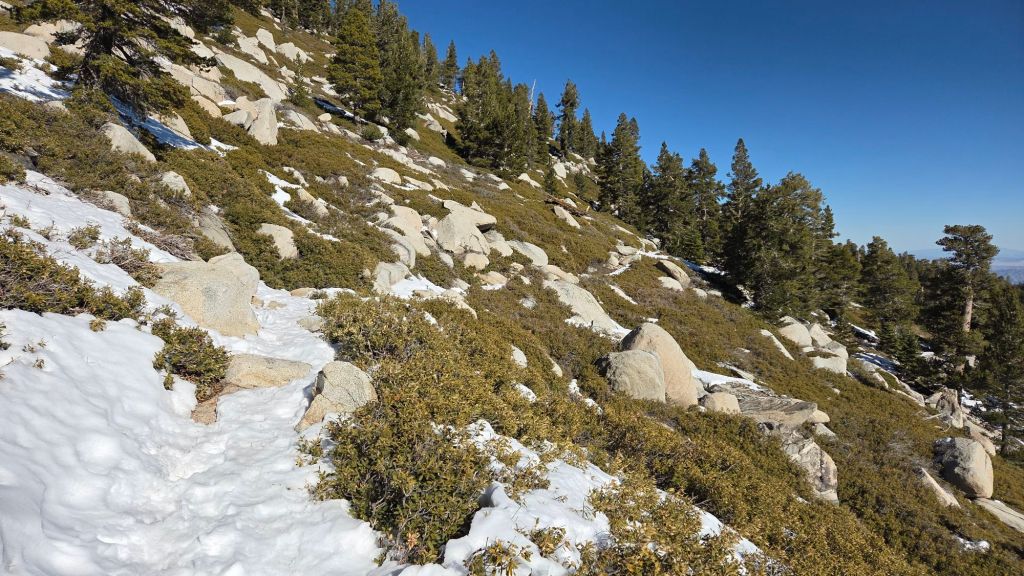
The best-known north spring on the Wellman Trail at Wellman’s Cienega (9300 ft), late morning 12th October 2025. The flow is good for the time of year, augmented by recent rains.
The pipe in Round Valley (9050 ft) flowing steadily, early morning 3rd October 2025. The flow was similar as of 12th October.
The crossing of the North Fork of the San Jacinto River continues to flow gently but reliably on upper Deer Springs Trail (9400 ft elevation), 10th October 2025.
Above and below, the creek in Little Round Valley, mid morning 6th October 2025. Above, the creek is again dry where it passes through the meadow, having previously dried up here in mid August but it then flowed between 25th August and late September following monsoonal rains. Intermittent flow persists in the central section, most notably near the sign for Campsite 2 (Owl’s Hootch) as shown below. Further downstream the lower section is briefly flowing where it crosses Deer Springs Trail, but may dry again within days.
The tiny Switchback Spring adjacent to Deer Springs Trail roughly 0.4 mile north of Strawberry Junction (near PCT Mile 183.4), 10th October 2025. Despite its size, one of the few truly perennial water sources on the mountain, maintaining flow even in the driest of years.
The tiny spring at Strawberry Cienega (near PCT Mile 182), late morning 28th September 2025. Having dried in July, recent rains have stimulated a gentle flow. This source may dry again in October, but regardless it is insufficient for anything other than emergency filtering.

Trail and water update 10th October 2025

The San Jacinto mountains have experienced a remarkable sequence of tropical and monsoonal autumnal rains in the past eight weeks, as described in more detail in the Weather section below. San Jacinto Peak has recorded an impressive 7.46 inches of rainfall since 22nd August, with 4.20 inches recorded in Idyllwild (at 5550 ft) over the same period.

Further tropical moisture fell on 9th and 10th October (included in the numbers above). A storm system passing largely to the north of our region next week – mainly overnight on 14th-15th October – is associated with a cold front and will be the first winter storm of the season, in dramatic contrast to the warm, humid, tropical storms of recent weeks. Light precipitation starting in the afternoon of Tuesday 14th may include a dusting of snow above 10,000 ft elevation, but limited rainfall everywhere below that level.

Palm Springs Aerial Tramway closed for scheduled annual maintenance for five weeks starting 8th September, with a tentative reopening on 13th October 2025.

Water flows improved only briefly following the rain events of recent weeks, and many have already returned to their mid-August condition (example photos below). Some key hiker water sources are flowing reasonably well, but all ephemeral sources dried in the summer. Wellman’s Cienega and the pipe in Round Valley are flowing steadily and should now maintain useable flow deep into the autumn. Ephemeral sources along Marion Mountain Trail are all dry for the first time in more than two years. The creek in Little Round Valley has already dried again where it passes through the meadow and also where it crosses Deer springs Trail, but continues to flow patchily in its central section. Deer Springs creek dried up in late July where it crosses the trail of the same name, and has dried again following very brief flow last month. The North Fork of the San Jacinto River is flowing where it crosses both Fuller Ridge and Deer Springs trails. Marion Creek is flowing steadily where it crosses the Suicide Rock Trail. Strawberry Cienega (approx PCT Mile 181.9), which dried in midsummer, is temporarily trickling again, but not sufficiently to filter any useful volume of water.

Willow Creek is flowing (weakly) again where it crosses the Willow Creek Trail, having dried in August. All other minor creeks that cross Willow Creek Trail remain dry however. Hidden Lake dried by the end of June (although it temporarily holds a tiny pond from recent rains). Long Valley Creek is dry where it passes through Round Valley, as is the nearby creek in Tamarack Valley. Water is flowing reliably in Tahquitz Creek at PCT Mile 177 and again further downstream at the north end of Little Tahquitz Meadow (although it is dry between those two locations). The pipe in Tahquitz Meadow dried up in mid July. Skunk Cabbage Meadow creek is functionally dry and no longer useful for filtering. Middle Spring on Devil’s Slide Trail has been functionally dry since 1st August, but I maintain a tiny pool there from which dogs can drink.

Full fire restrictions began on Tuesday 1st July 2025 on Forest Service lands, as described on the USFS website linked here. Campfires throughout USFS lands in the San Jacinto Mountains, including all campgrounds and yellow post sites, are prohibited.

Note that during the federal government shutdown, the U.S. Forest Service Idyllwild Ranger Station is closed. Adventure passes and wilderness permits are not required (or are at least unenforceable) until the shutdown ends. Unlike the 2018-19 shutdown which occurred in the winter months of December-January, gates on Forest Service roads and USFS campgrounds have remained open (for now).

Fire lookouts at Black Mountain and Tahquitz Peak are closed indefinitely due to issues identified in a May 2025 safety inspection of Black Mountain lookout. Regrettably it is now unlikely that either will reopen this year.

Be bear aware. Although generally rarely reported, 4-5 individually identifiable Black Bears have been observed in the San Jacinto mountains since 2017, and I have personally seen at least one annually for the past six years. Two bears have been seen in multiple locations in Fern Valley since late August, a large, chestnut-colored adult (images in the previous Report linked here) initially seen on Willow Creek Trail, plus a smaller immature dark-colored individual. My brief videos from Devil’s Slide Trail in September 2021 (linked here) and one walking through our property in Idyllwild in 2018 (linked here) show two other individuals. There have been no reports of negative interactions with humans in the high country, at or near campsites, or on trails.

Survey hikes by the Trail Report daily and year-round in the San Jacinto mountains include multiple routes to the highest peaks including San Jacinto Peak typically at least twice per week (more frequently during stormy weather), Tahquitz Peak and area at least once per week, plus a wide variety of other trails on intervening days.

WEATHER

Temperatures stabilized at (or even slightly below) seasonal for the last week of September. They are now forecast to remain near seasonal for the first half of October, with a warming trend on 7th-10th. There is currently only light precipitation in the forecasts, as described above associated with the breakdown of Hurricane Priscilla, most likely on 9th-10th October. Typical autumnal temperatures forecast for the high country may include temperatures close to freezing around the highest peaks in October, most notably associated with the passage of a cold front after Monday 13th.

The San Jacinto mountains received valuable monsoonal and tropical rainfall in late August and early September, as described in detail in an earlier Report (linked here). Subsequently the heaviest rainfall was on 18th September, as described in the previous Report (linked here). Additional rainfall fell on Saturday 27th September when a highly localized storm cell – at that time it wasn’t even raining in nearby Pine Cove – produced 0.57 inch of rain in Idyllwild in just an hour early in the afternoon. A spectacular thunderstorm that evening was more widespread, with a further 0.38 inch of rain in Idyllwild, and very heavy rain in Garner Valley. Some parts of the high country received reasonable rainfall (0.61 inch at San Jacinto Peak and 0.41 inch at Wellman’s Cienega) but other areas missed the most intense precipitation (only 0.1 inch in Long Valley all day).

At San Jacinto Peak (10,811ft/3295m) on Friday 10th October 2025 at 1015 the air temperature was 50.6°F (10°C), with a windchill temperature of 42.4°F (6°C), 82% relative humidity, and a steady SSW wind sustained at 6 mph gusting to 10.6 mph.

At the Peak on Monday 6th October 2025 at 0900 the air temperature was 48.7°F (9°C), with a windchill temperature of 41.0°F (5°C), 31% relative humidity, and a light SSW wind sustained at 3 mph gusting to 9.0 mph.

At the Peak on Friday 3rd October 2025 at 0640 the air temperature was 38.5°F (4°C), with a windchill temperature of 23.5°F (-5°C), 37% relative humidity, and a stiff SW wind sustained at 19 mph gusting to 33.4 mph.

TRAIL CONDITIONS

The established trail system was completely clear of snow by late May. Most trails have suffered only minor tread erosion from recent intense rains. Neither the Wolf Fire in late June nor the Rosa Fire in early August had major impacts on the trail system, although the latter did burn the southernmost 0.5 mile of the Palm Canyon trail.

For the first time in a decade, upper Deer Springs Trail – between the top of Marion Mountain Trail and Little Round Valley – is now clear of blowdowns, with the Trail Report having removed nine trees this year, including the two major hazards at PCT Mile 185.3 that came down this past winter.

A joint Eastern Sierra Conservation Corps/State Park crew working on 2nd-6th October made good progress trimming Deer Springs Trail just above the Fuller Ridge Trail junction to about 9300 ft. While some progress was made cutting a few trees lower down on Deer Springs Trail, they unfortunately failed to clear the long-term major blowdowns located 0.25 mile north of Strawberry Junction, and about 0.9 mile south of Strawberry Junction.

On PCT Miles 170-175 (roughly Apache Peak to Red Tahquitz) most blowdowns have been removed but six trees remain to be cut around South Peak (Miles 173.5-174) of which most are significant obstructions for hikers. Sections of the trail are badly overgrown with brush and in their worst condition in decades, especially most of Miles 168-174.

The two large downed trees near PCT Mile 180 were removed by the Trail Report this spring. The Strawberry Trail (PCT Miles 180.8-183.1) has ten blowdowns, none of which pose major hazards to hikers. Of the eight on the Forest Service section, several have been down for 8-10 years and reported repeatedly but with no action. The brush along Miles 181-181.7 has become heavily overgrown since it was last trimmed in 2021.

The maintenance condition of the Fuller Ridge (Miles 185.5-190.5) section of the PCT improved in July 2025, with the Trail Report clearing most of the 15 blowdowns and a PCTA volunteer crew cutting the remainder the following week.

On the Wellman Trail, Wellman’s Cienega is flowing relatively well compared to earlier in the autumn (photo below). The Trail Report continues the work it started last year to keep this trail clear (after it had become badly overgrown by early 2024).

Dark Canyon Road (4S02) had some effective basic maintenance on its dirt section in the spring. The associated Dark Canyon campground is closed for the year (apparently due to federal budget cuts).

For the first time in about 20 years Seven Pines Trail has a continuous route completely cleared of blowdown trees, with the trail also as faithful to the original route as possible. The Trail Report “adopted” Seven Pines as a priority for maintenance work nearly a decade ago due to a disproportionate number of lost hiker rescues (with State Park and Forest Service evidently no longer maintaining the route). Since 2019 we have now removed exactly 100 downed trees – including 25 since April of this year – and the trail is largely trimmed and cleared annually. Although our work has restored this delightful trail, Seven Pines remains a genuine wilderness trail unlike the wider, bare, obvious routes of, for example, Devil’s Slide or Marion Mountain trails. Cautious navigation remains invaluable for those without extensive experience of hiking this trail.

Black Mountain Road is open and in its typical non-graded condition, i.e. lumpy but readily passable in any moderate clearance vehicle. The tap at Cinco Poses Spring currently has reliable water (located alongside the road 0.2 mile below the Boulder Basin turning).

On Willow Creek Trail whitethorn urgently needs trimming again especially near the boundary between the two agencies. The two large trees remaining uncut in the State Park section from several years ago have easy workarounds.

The Caramba Trail from near Reeds Meadow through Laws Camp and on to Caramba, and the Cedar Trail from Willow Creek Trail to Laws, are euphemistically (and arguably dangerously) described by the Forest Service as “not maintained”. In reality both trails have been abandoned for more than a decade and no longer exist. They are so heavily overgrown, largely with dense whitethorn which obscures dozens of downed trees, that hikers should not attempt to follow them (regardless of how much you may trust any particular app).

An informal use trail to Laws is much more direct, generally well maintained, and avoids the bushwhacking of the abandoned trails (some local Idyllwild hikers dubbed it the “King Trail” when I established the route in 2019). It leaves Willow Creek Trail exactly 1.0 mile from Saddle Junction, 0.46 mile from the Skunk Cabbage turning (trailhead at N 33.7796, W 116.6590). The route descends following former deer trails for 1.2 miles, meeting Willow Creek about 0.15 mile upstream from the site of the historic Laws Camp (the remains of which were destroyed by the 2013 Mountain Fire and subsequent flood and treefall damage). One huge pine tree fell in late 2024 across the King Trail about midway down that requires a minor scramble underneath, but nine additional blowdowns have been removed since January 2025, with the trail already trimmed and cleared twice this year.

From Laws east to Caramba the original Caramba Trail has been cairned by myself and others and can largely be followed with skilled route-finding. My most recent 2025 survey counted 120 trees down on this 2.1 miles of trail. It is extremely obscure for the first 0.5 mile east of the Willow Creek crossing, becoming more obvious (but still subtle) as it descends towards Caramba. Very cautious navigation is strongly recommended throughout the area.

Storms early in 2025 brought down another 34 trees across Spitler Peak Trail. All but one were removed by the Trail Report, bringing to 162 the total number of trees we have removed from this route in the past seven years. One very large burned cedar remains across the trail immediately after the first creek crossing 3.2 miles up from the trailhead. A couple of other much more recent blowdowns are small and easily stepped over.

The Zen Center Trail continues its serious deterioration that started following the 2013 Mountain Fire, with a combination of vigorous regrowth and treefall hazards further obscuring the route with each passing season. The lower and upper thirds of this trail are partially cairned and not too bad for those who are very familiar with the former route, but even the experienced find navigating the central section tricky. Long trousers, scrambling gloves, and a genuine enjoyment of bush-whacking are all strongly recommended.

The famous “San Jac shadow”, early morning Friday 19th September 2025. The sheer prominence of San Jacinto Peak results in a well demarcated shadow being cast by the Sun immediately after sunrise, especially when hazy conditions to the west – in this case from the heavy rain the previous day – provide a suitable canvas. Low clouds push up against Black Mountain (lower right).
For comparison, the “San Gorg shadow”, cast at sunrise by San Gorgonio Mountain, photographed just a few days after the image above, 25th September 2025. Due to the east-west orientation of the San Bernardino Mountains, the San Gorgonio shadow is muted in midsummer and in winter, but is relatively prominent around the equinoxes, in contrast to the San Jac shadow which is prominent year-round.

While all time and labor is volunteered, the San Jacinto Trail Report uses small donations to help cover modest operating costs. Your contribution keeps the Report available to all, free from advertising or paywalls, and independent from agencies. If you have found this Report useful, please consider using this link to the Donate page. Thank you very much for your support.
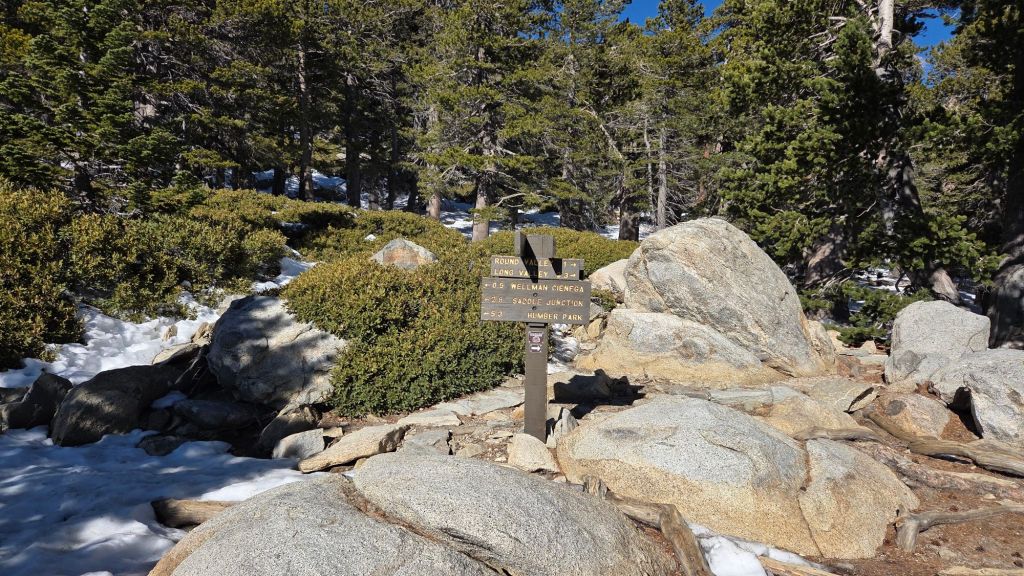
The best-known north spring on the Wellman Trail at Wellman’s Cienega (9300 ft), early morning 3rd October 2025. The flow is (at least temporarily) good for autumn, augmented by recent rains.
The pipe in Round Valley (9050 ft) flowing steadily, early morning 3rd October 2025.
The creek at the Deer Springs crossing (approx. PCT Mile 185.3) is now dry again, having flowed intermittently following rains between late August and late September.
The crossing of the North Fork of the San Jacinto River continues to flow gently but reliably on upper Deer Springs Trail (9400 ft elevation).
Above and below, the creek in Little Round Valley, mid morning 6th October 2025. Above, the creek is again dry where it passes through the meadow, having previously dried up here in mid August but it then flowed between 25th August and late September following monsoonal rains. Intermittent flow persists in the central section, most notably near the sign for Campsite 2 (Owl’s Hootch) as shown below. Further downstream the lower section is again dry where it crosses Deer Springs Trail.
Willow Creek flowing gently where it crosses the trail of the same name, mid morning 21st September 2025. Having dried completely by mid August, rains in recent weeks have allowed the creek to flow again, albeit perhaps only temporarily.
The tiny spring at Strawberry Cienega (near PCT Mile 182), late morning 28th September 2025. Having dried in July, recent rains have stimulated a gentle flow. This source will likely dry again in October, but regardless it is insufficient for anything other than emergency filtering.
The tiny “Switchback Spring” adjacent to Deer Springs Trail less than a mile north of Strawberry Junction (near PCT Mile 183.6), 30th September 2025. Despite its size, one of the few truly perennial water sources on the mountain, maintaining flow even in the driest of years.
Bud Spring, located at 9990 ft at the very head of the Deer Springs drainage and just 0.1 mile north of Mt. Saint Ellen’s, flowing gently but reliably, 17th September 2025.

Trail and water update 23rd September 2025

UPDATE Saturday 27th September 2025: a highly localized storm cell – it wasn’t even raining in nearby Pine Cove – produced 0.57 inch of rain in Idyllwild in just an hour early in the afternoon. A spectacular thunderstorm in the evening was more widespread, with a further 0.38 inch of rain in Idyllwild, and very heavy rain in Garner Valley, but large parts of the high country missed the most intense precipitation (e.g., only 0.1 inch in Long Valley for the entire day).

———————————-

After nearly eight months of well-below-average precipitation to start 2025, the San Jacinto mountains have received multiple waves of excellent monsoonal and tropical rainfall since late August. Rainfall at San Jacinto Peak totaled 6.70 inches between 22nd August and 21st September, with 2.66 inches recorded in Idyllwild (at 5550 ft) over the same period.

The most intense rainfall fell on Thursday last week. Moisture drawn north from former Tropical Storm Mario generated two phases of rain on 18th September, totaling 3.13 inches at San Jacinto Peak in under 24 hours, with 1.49 inches also measured in Idyllwild. I was hiking near the Peak during a spectacular afternoon thunderstorm that day, with 1.40 inches of rain measured at the Peak in just 40 minutes, including slushy hail above 10,000 ft. Idyllwild recorded 0.67 inch in the same storm. Earlier in the day the system produced more steady rain up to 0800, with 1.34 inches measured at San Jacinto Peak, 1.39 inches in Little Round Valley, and 0.82 inch in Idyllwild.

Further rains are possible over the next week, currently forecast as most likely on 26th-28th, as disorganized tropical moisture to our south may generate more cloud flowing northwards, with any possible precipitation intensity as always depending upon localized thunderstorm activity. After Wednesday 24th, temperatures are forecast to be at (or even below) seasonal for the remainder of September.

Palm Springs Aerial Tramway closed for scheduled annual maintenance for five weeks starting 8th September, with a tentative reopening on 13th October 2025.

Water flows have briefly improved, given the rain events of recent days (and weeks). Although many key hiker water sources are temporarily flowing reasonably well, all ephemeral sources dried in the summer. Wellman’s Cienega, the pipe in Round Valley, and the creek in Little Round Valley, are flowing steadily and should now maintain useable flow into the autumn. Ephemeral sources along Marion Mountain Trail are all dry for the first time in more than two years. Deer Springs creek dried up in late July where it crosses the trail of the same name (and remains dry even after recent rains). The North Fork of the San Jacinto River is flowing where it crosses both Fuller Ridge and Deer Springs trails. Marion Creek is flowing steadily where it crosses the Suicide Rock Trail.

Willow Creek is flowing again where it crosses the Willow Creek Trail, having dried in August. All other minor creeks that cross Willow Creek Trail are dry however. Hidden Lake dried by the end of June (although it temporarily holds a small pond from recent rains). Long Valley Creek is dry where it passes through Round Valley, as is the nearby creek in Tamarack Valley. Water is flowing reliably in Tahquitz Creek at PCT Mile 177 and again further downstream at the north end of Little Tahquitz Meadow (although it is dry between those two locations). The pipe in Tahquitz Meadow dried up in mid July. Skunk Cabbage Meadow creek is functionally dry and no longer useful for filtering. Strawberry Cienega is functionally dry despite some recent rainwater flows. Middle Spring on Devil’s Slide Trail has been functionally dry since 1st August, but a tiny pool persists from which dogs can drink.

Full fire restrictions began on Tuesday 1st July 2025 on Forest Service lands, as described on the USFS website linked here. Campfires throughout USFS lands in the San Jacinto Mountains, including all campgrounds and yellow post sites, are prohibited.

Fire lookouts at Black Mountain and Tahquitz Peak are closed indefinitely due to issues identified in a May 2025 safety inspection of Black Mountain lookout. Neither lookout will reopen before October, and regrettably it is unclear whether either will reopen this year.

Be bear aware. Although generally rarely reported, 3-5 individually identifiable Black Bears have been observed in the San Jacinto mountains since 2017, and I have personally seen at least one annually for the past six years. An adult-sized, light chestnut-colored bear has been reported multiple times since early July, initially from Willow Creek Trail, and subsequently in multiple locations in Fern Valley since late August (images in the previous Report linked here). My brief videos from Devil’s Slide Trail in September 2021 (linked here) and one walking through our property in Idyllwild in 2018 (linked here) show two other individuals. There have been no reports of negative interactions with humans in the high country, at or near campsites, or on trails.

Survey hikes by the Trail Report daily and year-round in the San Jacinto mountains include multiple routes to the highest peaks including San Jacinto Peak typically 2-3 times per week (more frequently during stormy weather), Tahquitz Peak and area at least once per week, plus a wide variety of other trails on intervening days.

Sunrise as seen from San Jacinto Peak, 17th September 2025. Early morning high altitude clouds portended heavy rain the next day derived from the remnants of former Tropical Storm Mario.

WEATHER

Temperatures that were predominantly above seasonal for nearly four months since 20th May may finally stabilize at (or even below) seasonal for the last week of September. After a couple of warmer days, temperatures drop and remain relatively cool on 25th-30th September.

The San Jacinto mountains received valuable monsoonal and tropical rainfall in late August and early September, as described in detail in the previous Report (linked here). Subsequently the heaviest rainfall was on 18th September, as described above. Forecasts are currently suggesting that there may be further tropical rainfall later this week, most likely on 26th-28th. Further atmospheric instability is very tentatively forecast into the first few days of October.

At San Jacinto Peak (10,811ft/3295m) on Monday 22nd September 2025 at 0920 the air temperature was 47.3°F (8°C), with a windchill temperature of 42.3°F (6°C), 74% relative humidity, and a very light SW wind sustained at 2 mph gusting to 5.6 mph.

At the Peak on Friday 19th September 2025 at 0635 the air temperature was 39.5°F (4°C), with a windchill temperature of 29.1°F (-2°C), 97% relative humidity, and a fresh SW wind sustained at 8 mph gusting to 17.0 mph.

At the Peak on Tuesday 16th September 2025 at 1010 the air temperature was 61.0°F (16°C), with a windchill temperature of 47.5°F (9°C), 65% relative humidity, and a variable SSW wind sustained at 2 mph gusting to 8.1 mph. This remarkable air temperature is a record high for the Peak in September.

Poorly structured lenticular clouds forming over Antsell Rock (to the lower right), as seen from upper South Ridge Trail, early morning Sunday 21st September 2025. South Peak is in the lower left of the image.

TRAIL CONDITIONS

The established trail system was completely clear of snow by late May. While most trails have suffered nothing more that minor tread erosion from recent intense rains, it possible that some sections have suffered more significant damage as not all trails have been surveyed at this time. Neither the Wolf Fire in late June nor the Rosa Fire in early August had major impacts on the trail system, although the latter did burn the southernmost 0.5 mile of the Palm Canyon trail.

On PCT Miles 170-175 (roughly Apache Peak to Red Tahquitz) most blowdowns have been removed but six trees remain to be cut around South Peak (Miles 173.5-174) of which most are significant obstructions for hikers. Lengthy sections of the trail are badly overgrown with brush and in their worst condition in decades, especially most of Miles 168-174.

The two large downed trees near PCT Mile 180 were removed by the Trail Report in May. The Strawberry Trail (PCT Miles 180.8-183.1) has ten blowdowns, none of which pose major hazards to hikers. Of the eight on the Forest Service section, several have been down for 8-10 years and reported repeatedly but with no action. The brush along Miles 181-181.7 has become heavily overgrown since it was last trimmed in 2021.

Five further blowdowns remain on the Deer Springs Trail portion of the PCT (Miles 183-185), some of which are major obstructions, albeit with workarounds. For the first time in a decade, upper Deer Springs Trail – between the top of Marion Mountain Trail and Little Round Valley – is now clear of blowdowns, with the Trail Report having removed eight trees earlier this year, including the two major hazards at PCT Mile 185.3 that came down this past winter.

The maintenance condition of the Fuller Ridge (Miles 185.5-190.5) section of the PCT improved in July 2025, with the Trail Report clearing most of the 15 blowdowns and a PCTA volunteer crew cutting the remainder the following week.

On the Wellman Trail, Wellman’s Cienega is flowing relatively gently (photo below) but there is still plenty of water for hikers for now. The Trail Report continues the work it started last year to keep this trail clear (after it had become badly overgrown by early 2024).

Dark Canyon Road (4S02) reopened in May and the dirt section has had some effective basic maintenance. The associated Dark Canyon campground is closed for the year (federal budget cuts).

For the first time in about 20 years Seven Pines Trail has a continuous route completely cleared of blowdown trees, with the trail also as faithful to the original route as possible. The Trail Report “adopted” Seven Pines as a priority for maintenance work nearly a decade ago due to a disproportionate number of lost hiker rescues (with State Park and Forest Service evidently no longer maintaining the route). Since 2019 we have now removed exactly 100 downed trees – including 25 since April of this year – and the trail is largely trimmed and cleared annually. Although our work has restored this delightful trail, Seven Pines remains a genuine wilderness trail unlike the wider, bare, obvious routes of, for example, Devil’s Slide or Marion Mountain trails. Cautious navigation remains invaluable for those without extensive experience of hiking this trail.

Black Mountain Road is open and in its typical non-graded condition, i.e. lumpy but readily passable in any moderate clearance vehicle. The tap at Cinco Poses Spring currently has reliable water (located alongside the road 0.2 mile below the Boulder Basin turning).

Willow Creek Trail is in its best condition since it was thoroughly cleared in 2020, although whitethorn urgently needs trimming again especially near the boundary between the two agencies. The two large trees remaining uncut in the State Park section from several years ago have easy workarounds.

The Caramba Trail from near Reeds Meadow through Laws Camp and on to Caramba, and the Cedar Trail from Willow Creek Trail to Laws, are euphemistically (and arguably dangerously) described by the Forest Service as “not maintained”. In reality both trails have been abandoned for more than a decade and no longer exist. They are so heavily overgrown, largely with dense whitethorn which obscures dozens of downed trees, that hikers should not attempt to follow them (regardless of how much you may trust any particular app).

An informal use trail to Laws is much more direct, generally well maintained, and avoids the bushwhacking of the abandoned trails (some local Idyllwild hikers dubbed it the “King Trail” when I established the route in 2019). It leaves Willow Creek Trail exactly 1.0 mile from Saddle Junction, 0.46 mile from the Skunk Cabbage turning (trailhead at N 33.7796, W 116.6590). The route descends following former deer trails for 1.2 miles, meeting Willow Creek about 0.15 mile upstream from the site of the historic Laws Camp (the remains of which were destroyed by the 2013 Mountain Fire and subsequent flood and treefall damage). One huge pine tree fell in late 2024 across the King Trail about midway down that requires a minor scramble underneath, but nine additional blowdowns have been removed since January 2025, with the trail already trimmed and cleared twice this year.

From Laws east to Caramba the original Caramba Trail has been cairned by myself and others and can largely be followed with skilled route-finding. My most recent 2025 survey counted 120 trees down on this 2.1 miles of trail. It is extremely obscure for the first 0.5 mile east of the Willow Creek crossing, becoming more obvious (but still subtle) as it descends towards Caramba. Very cautious navigation is strongly recommended throughout the area.

Storms early in 2025 brought down another 34 trees across Spitler Peak Trail. All but one were removed by the Trail Report, bringing to 162 the total number of trees we have removed from this route in the past seven years. One very large burned cedar remains across the trail immediately after the first creek crossing 3.2 miles up from the trailhead. A couple of other much more recent blowdowns are small and easily stepped over.

The Zen Center Trail continues its serious deterioration that started following the 2013 Mountain Fire, with a combination of vigorous regrowth and treefall hazards further obscuring the route with each passing season. The lower and upper thirds of this trail are partially cairned and not too bad for those who are very familiar with the former route, but even the experienced find navigating the central section tricky. Long trousers, scrambling gloves, and a genuine enjoyment of bush-whacking are all strongly recommended.

The famous “San Jac shadow”, early morning Friday 19th September 2025. The sheer prominence of San Jacinto Peak results in a well demarcated shadow being cast by the Sun immediately after sunrise, especially when hazy conditions to the west – from the heavy rain the previous day – provide a suitable canvas. Low clouds push up against Black Mountain (lower right).

While all time and labor is volunteered, the San Jacinto Trail Report uses small donations to help cover modest operating costs. Your contribution keeps the Report available to all, free from advertising or paywalls, and independent from agencies. If you have found this Report useful, please consider using this link to the Donate page. Thank you very much for your support.

Upper Deer Springs “Trail” at 10,200 ft in the midst of a severe thunderstorm, early afternoon 18th September 2025. Less than an hour after the rain stopped, there was no water flowing in the trail at all.
The best-known north spring on the Wellman Trail at Wellman’s Cienega (9300 ft), early morning 22nd September 2025. The flow had already dropped and was similar to the rate of late August, prior to recent rains.
The pipe in Round Valley (9050 ft) flowing steadily, early morning 11th September 2025. The flow remained similar when checked again on Sunday 21st September.
The creek in Little Round Valley, early afternoon 18th September 2025, just as an intense rain storm was starting. Having dried up here where it crosses Deer Springs Trail at the mouth of the valley in mid August, the creek started flowing again on 25th August following monsoonal rains. Nevertheless the flow rate is already dropping and the creek could again dry in this location in October.
Willow Creek flowing gently where it crosses the trail of the same name, mid morning 21st September 2025. Having dried completely by mid August, rains in recent weeks have allowed the creek to flow again, albeit perhaps only temporarily.
Bud Spring, located at 9990 ft at the very head of the Deer Springs drainage and just 0.1 mile north of Mt. Saint Ellen’s, flowing gently but reliably, 17th September 2025.

Trail and water update 20th September 2025

After eight months of below-average precipitation to start 2025, the San Jacinto mountains have received four separate periods of excellent monsoonal and tropical rainfall since late August. San Jacinto Peak received 3.5 inches between 22nd August and 2nd September, and despite some trail erosion during intense thunderstorms, the rain pleasantly refreshed the forest and dampened hiking routes.

Moisture drawn north from former Tropical Storm Mario generated two phases of rain on Thursday 18th September 2025, totaling an additional 3.13 inches at San Jacinto Peak in less than a day, with 1.49 inches also measured in Idyllwild (at 5550 ft). I was hiking near the Peak during a spectacular afternoon thunderstorm, with 1.40 inches of rain falling at the Peak in about 40 minutes, including slushy hail above 10,000 ft. Idyllwild recorded 0.67 inch in the same storm. Earlier in the day the system produced steady rain up to 0800, with 1.34 inches measured at San Jacinto Peak, 1.39 inches in Little Round Valley, and 0.82 inch in Idyllwild.

Daytime temperatures are now forecast to remain largely around seasonal for the remainder of September, but with overnight low temperatures still tending to be above average. Further tropical rains are possible over the next week, as a disorganized possible tropical depression south of Baja California may generate more moisture flowing northwards, with intensity depending as always upon localized thunderstorm activity. Rains will briefly result in lower daytime temperatures.

Palm Springs Aerial Tramway closed for scheduled annual maintenance for five weeks starting 8th September, with a tentative reopening on 13th October 2025.

Water flows markedly improved in recent days, with four different monsoonal/tropical rain events since late August. Although many key hiker water sources are temporarily flowing well, all ephemeral sources dried in the summer. Wellman’s Cienega, the pipe in Round Valley, and the creek in Little Round Valley, are flowing steadily and should now maintain useable flow well into the autumn. Ephemeral sources along Marion Mountain Trail are all dry for the first time in more than two years. Deer Springs creek dried up in late July where it crosses the trail of the same name (and remains dry even after recent rains). The North Fork of the San Jacinto River is flowing where it crosses both Fuller Ridge and Deer Springs trails. Marion Creek is flowing steadily where it crosses the Suicide Rock Trail.

Willow Creek is flowing again where it crosses the Willow Creek Trail, having dried in August. All other minor creeks that cross Willow Creek Trail remain dry however. Hidden Lake dried by the end of June (although it temporarily holds a small pond from recent rains). Long Valley Creek is dry where it passes through Round Valley, as is the nearby creek in Tamarack Valley. Water is flowing reliably in Tahquitz Creek at PCT Mile 177 and again further downstream at the north end of Little Tahquitz Meadow (although it is dry between those two locations). The pipe in Tahquitz Meadow dried up in mid July. Skunk Cabbage Meadow creek is functionally dry and no longer useful for filtering. Strawberry Cienega is dry. Middle Spring on Devil’s Slide Trail was functionally dry by 1st August, but a tiny pool persists from which dogs can drink.

Full fire restrictions began on Tuesday 1st July 2025 on Forest Service lands, as described on the USFS website linked here. Campfires throughout USFS lands in the San Jacinto Mountains, including all campgrounds and yellow post sites, are prohibited.

Fire lookouts at Black Mountain and Tahquitz Peak are closed indefinitely due to issues identified in a May 2025 safety inspection of Black Mountain lookout. Neither lookout will reopen before October, and regrettably it is unclear whether either will reopen this year.

Be bear aware. Although generally rarely reported, 3-5 individually identifiable Black Bears have been observed in the San Jacinto mountains since 2017, and I have personally seen at least one annually for the past six years. Most recently, an adult-sized, light chestnut-colored bear was reliably reported from Willow Creek Trail adjacent to Skunk Cabbage Meadow on 12th July 2025. What is almost certainly the same individual has been seen in multiple locations in Fern Valley since late August (photos below). My brief videos from Devil’s Slide Trail in September 2021 (available here) and one walking through our property in Idyllwild in 2018 (linked here) show two other individuals. There have been no reports of negative interactions with humans at or near campsites or on trails.

Survey hikes by the Trail Report every single day throughout the year in the San Jacinto mountains include multiple routes to various high peaks including San Jacinto Peak typically 2-3 times per week (more frequently during stormy weather), Tahquitz Peak and area at least once per week, plus a wide variety of other trails on intervening days.

Sunrise as seen from San Jacinto Peak, 17th September 2025. Early morning high altitude clouds were the vanguard of tropical moisture from former Tropical Storm Mario that produced heavy rain on 18th September

WEATHER

Temperatures have been predominantly above seasonal for nearly four months since 20th May, with overnight low temperatures in particular generally well above average. Although feeling pleasantly cooler compared to midsummer, temperatures have remained above seasonal for much of September, and temperature near or above seasonal will continue until late in the month.

The San Jacinto mountains received some valuable monsoonal and tropical rainfall in late August and early September, as described in detail in the previous Report (linked here). Subsequently the heaviest rainfall was on 18th September, as described above. Forecasts are currently suggesting that there may be further tropical rainfall this week, possibly accompanying thunderstorms.

At San Jacinto Peak (10,811ft/3295m) on Thursday 18th September 2025 at 0940 the air temperature was 46.2°F (8°C), with a windchill temperature of 35.6°F (2°C), 100% relative humidity, and a blustery due South wind sustained at 10 mph gusting to 19.9 mph.

At the Peak on Tuesday 16th September 2025 at 1010 the air temperature was 61.0°F (16°C), with a windchill temperature of 47.5°F (9°C), 65% relative humidity, and a variable SSW wind sustained at 2 mph gusting to 8.1 mph. This remarkable air temperature is a record high for the Peak in September.

At the Peak on Thursday 11th September 2025 at 0635 the air temperature was 41.8°F (5°C), with a windchill temperature of 30.6°F (-1°C), 21% relative humidity, and a steady SW wind sustained at 14 mph gusting to 21.9 mph.

At the Peak on Wednesday 10th September 2025 at 1000 the air temperature was 47.4°F (9°C), with a windchill temperature of 34.3°F (1°C), 21% relative humidity, and a fresh WSW wind sustained at 9 mph gusting to 18.7 mph.

Upper Deer Springs “Trail” at 10,100 ft in the midst of a severe thunderstorm, early afternoon 18th September 2025.

TRAIL CONDITIONS

The established trail system was completely clear of snow by late May. Neither the Wolf Fire in late June nor the Rosa Fire in early August had major impacts on the trail system, although the latter did burn the southernmost 0.5 mile of the Palm Canyon trail.

On PCT Miles 170-175 (roughly Apache Peak to Red Tahquitz) most blowdowns have been removed but six trees remain to be cut around South Peak (Miles 173.5-174) of which most are significant obstructions for hikers. Lengthy sections of the trail are badly overgrown with brush and in their worst condition in decades, especially most of Miles 168-174.

The two large downed trees near PCT Mile 180 were removed by the Trail Report in May. The Strawberry Trail (PCT Miles 180.8-183.1) has ten blowdowns, none of which pose major hazards to hikers. Of the eight on the Forest Service section, several have been down for 8-10 years and reported repeatedly but with no action. The brush along Miles 181-181.7 has become heavily overgrown since it was last trimmed in 2021.

Five further blowdowns remain on the Deer Springs Trail portion of the PCT (Miles 183-185), some of which are major obstructions, albeit with workarounds. For the first time in a decade, upper Deer Springs Trail – between the top of Marion Mountain Trail and Little Round Valley – is now clear of blowdowns, with the Trail Report having removed eight trees earlier this year, including the two major hazards at PCT Mile 185.3 that came down this past winter.

The maintenance condition of the Fuller Ridge (Miles 185.5-190.5) section of the PCT improved in July 2025, with the Trail Report clearing most of the 15 blowdowns and a PCTA volunteer crew cutting the remainder the following week.

On the Wellman Trail, Wellman’s Cienega is flowing relatively gently (photo below) but there is still plenty of water for hikers for now. The Trail Report continues the work it started last year to keep this trail clear (after it had become badly overgrown by early 2024).

Dark Canyon Road (4S02) reopened in May and the dirt section has had some effective basic maintenance. The associated Dark Canyon campground is closed for the year (federal budget cuts).

For the first time in about 20 years Seven Pines Trail has a continuous route completely cleared of blowdown trees, with the trail also as faithful to the original route as possible. The Trail Report “adopted” Seven Pines as a priority for maintenance work nearly a decade ago due to a disproportionate number of lost hiker rescues (with State Park and Forest Service evidently no longer maintaining the route). Since 2019 we have now removed exactly 100 downed trees – including 25 since April of this year – and the trail is largely trimmed and cleared annually. Although our work has restored this delightful trail, Seven Pines remains a genuine wilderness trail unlike the wider, bare, obvious routes of, for example, Devil’s Slide or Marion Mountain trails. Cautious navigation remains invaluable for those without extensive experience of hiking this trail.

Black Mountain Road is open and in its typical non-graded condition, i.e. lumpy but readily passable in any moderate clearance vehicle. The tap at Cinco Poses Spring currently has reliable water (located alongside the road 0.2 mile below the Boulder Basin turning).

Willow Creek Trail is in its best condition since it was thoroughly cleared in 2020, although whitethorn urgently needs trimming again especially near the boundary between the two agencies. The two large trees remaining uncut in the State Park section from several years ago have easy workarounds.

The Caramba Trail from near Reeds Meadow through Laws Camp and on to Caramba, and the Cedar Trail from Willow Creek Trail to Laws, are euphemistically (and arguably dangerously) described by the Forest Service as “not maintained”. In reality both trails have been abandoned for more than a decade and no longer exist. They are so heavily overgrown, largely with dense whitethorn which obscures dozens of downed trees, that hikers should not attempt to follow them (regardless of how much you may trust any particular app).

An informal use trail to Laws is much more direct, generally well maintained, and avoids the bushwhacking of the abandoned trails (some local Idyllwild hikers dubbed it the “King Trail” when I established the route in 2019). It leaves Willow Creek Trail exactly 1.0 mile from Saddle Junction, 0.46 mile from the Skunk Cabbage turning (trailhead at N 33.7796, W 116.6590). The route descends following former deer trails for 1.2 miles, meeting Willow Creek about 0.15 mile upstream from the site of the historic Laws Camp (the remains of which were destroyed by the 2013 Mountain Fire and subsequent flood and treefall damage). One huge pine tree fell in late 2024 across the King Trail about midway down that requires a minor scramble underneath, but nine additional blowdowns have been removed since January 2025, with the trail already trimmed and cleared twice this year.

From Laws east to Caramba the original Caramba Trail has been cairned by myself and others and can largely be followed with skilled route-finding. My most recent 2025 survey counted 120 trees down on this 2.1 miles of trail. It is extremely obscure for the first 0.5 mile east of the Willow Creek crossing, becoming more obvious (but still subtle) as it descends towards Caramba. Very cautious navigation is strongly recommended throughout the area.

Storms early in 2025 brought down another 34 trees across Spitler Peak Trail. All but one were removed by the Trail Report, bringing to 162 the total number of trees we have removed from this route in the past seven years. One very large burned cedar remains across the trail immediately after the first creek crossing 3.2 miles up from the trailhead. A couple of other much more recent blowdowns are small and easily stepped over.

The Zen Center Trail continues its serious deterioration that started following the 2013 Mountain Fire, with a combination of vigorous regrowth and treefall hazards further obscuring the route with each passing season. The lower and upper thirds of this trail are partially cairned and not too bad for those who are very familiar with the former route, but even the experienced find navigating the central section tricky. Long trousers, scrambling gloves, and a genuine enjoyment of bush-whacking are all strongly recommended.

Still images from video of an adult Black Bear in Fern Valley, 24th August 2025, recorded by Jason Boetcher. Thanks so much to Jason for permission to reproduce these images, and also to Keith McCabe for his assistance.

While all time and labor is volunteered, the San Jacinto Trail Report uses small donations to help cover modest operating costs. Your contribution keeps the Report available to all, free from advertising or paywalls, and independent from agencies. If you have found this Report useful, please consider using this link to the Donate page. Thank you very much for your support.

The best-known north spring at Wellman’s Cienega (9300 ft), mid morning 2nd September 2025, in full flow during an intense monsoonal thunderstorm. See photo below to compare with the flow rate just days later.
The pipe in Round Valley (9050 ft) flowing steadily, early morning 11th September 2025.
The creek in Little Round Valley, mid morning 4th September 2025. Having dried up here where it crosses Deer Springs Trail at the mouth of the valley in mid August, the creek started flowing again on 25th August following monsoonal rains. Despite further rains, the flow rate is dropping, and the creek may dry again in this location later in September (if there is no further input from monsoonal rains).
The best-known north spring on the Wellman Trail at Wellman’s Cienega (9300 ft), early morning 4th September 2025. The flow had already dropped back to the rate of late August, prior to recent rains, significantly weaker than at the comparable time of year in 2023 and 2024.
The North Fork of the San Jacinto River continues to flow steadily where it crosses Deer Springs Trail (9400 ft) about 0.6 mile below Little Round Valley, 26th August 2025. The flow remained similar on 4th September, largely unaffected by recent rains.
Willow Creek flowing gently where it crosses the trail of the same name, mid morning 11th September 2025. Having dried completely by mid August, rains in the past few weeks have allowed the creek to flow again, albeit perhaps temporarily.
So-called Bud Spring, located at 9990 ft just 0.1 mile north of Mt. Saint Ellen’s, flowing gently but remarkably reliably, 17th September 2025.
Switchback Spring, about 0.6 mile north on the PCT from Strawberry Junction, continues to flow reliably where it crosses Deer Springs Trail at about PCT Mile 183.7, mid morning 18th August 2025. The flow was similar on 4th September. Although truly perennial, the flow is gentle and it is tough to filter significant volume from this spring.
The creek that flows from the Deer Springs dry where it crosses Deer Springs Trail at about PCT Mile 185.3, 25th July 2025.
The North Fork of the San Jacinto River flowing very gently at 8800 ft where it crosses Fuller Ridge Trail near PCT Mile 186.0, mid morning 25th August 2025, even though it is dry downstream at 6900 ft.

Trail and water update 11th September 2025

Temperatures dropped markedly starting Tuesday 2nd September, but remained above seasonal with unusually high humidity. Autumnal temperatures, i.e. seasonal for September, finally arrived starting Tuesday 9th, accompanied by fresh westerly winds and low humidity. This may only be a temporary reprieve however, with warm conditions forecast again for next week (at least 15th-19th September).

After eight months of below-average precipitation to start 2025, the San Jacinto mountains finally received some monsoonal and tropical rainfall in late August and early September, described in detail under Weather below. The rainfall totals have been satisfying – San Jacinto Peak received 3.5 inches between 22nd August and 2nd September – and despite some trail erosion during intense thunderstorms, the rain has done a great job of refreshing the forest and dampening hiking routes.

Palm Springs Aerial Tramway closed for scheduled annual maintenance for five weeks starting 8th September, with a tentative reopening on 13th October 2025.

Water flows everywhere remain low – illustrated by some photos below – with ephemeral sources now dry. Recent rains have briefly augmented stream flow, but past experience suggests the effects will be short-lived, perhaps only a week or two in most locations. The descriptions below largely reflect the long-term situation, which is likely to be the default again by mid-September.

Key hiker water sources such as Wellman’s Cienega and the pipe in Round Valley are flowing gently but steadily and will now maintain useable flow into the autumn. Ephemeral sources along Marion Mountain Trail are all dry for the first time in more than two years. Deer Springs creek dried up in late July where it crosses the trail of the same name (and remains dry even after recent rains). Flow in the creek in Little Round Valley has dropped dramatically since late July. While the creek is running briefly again, the flow is low and it may well be dry again by next week. The North Fork is dry where it crossed by Seven Pines Trail, but is flowing gently higher up where it crosses both Fuller Ridge and Deer Springs trails. Marion Creek is flowing steadily where it crosses the Suicide Rock Trail.

Willow Creek is now flowing again where it crosses the Willow Creek Trail, having dried in August. All other minor creeks that cross Willow Creek Trail remain dry however. Hidden Lake had dried by the end of June (although it currently holds a small pond from recent rains). Long Valley Creek is dry where it passes through Round Valley, as is the nearby creek in Tamarack Valley. Water is flowing reliably in Tahquitz Creek at PCT Mile 177 and again further downstream at the north end of Little Tahquitz Meadow (although it is dry between those two locations). The pipe in Tahquitz Meadow dried up in mid July. Skunk Cabbage Meadow creek is functionally dry and no longer useful for filtering. Strawberry Cienega is dry. Middle Spring on Devil’s Slide Trail was functionally dry by 1st August, but a tiny pool persists from which dogs can drink.

Full fire restrictions began on Tuesday 1st July 2025 on Forest Service lands, as described on the USFS website linked here. Campfires throughout USFS lands in the San Jacinto Mountains, including all campgrounds and yellow post sites, are now prohibited.

Fire lookouts at Black Mountain and Tahquitz Peak are closed indefinitely due to issues identified in a May 2025 safety inspection of Black Mountain lookout. Neither lookout will reopen before October, and regrettably it is unclear whether either will reopen this year.

Be bear aware. Although rarely reported in recent years, 3-5 individually identifiable Black Bears have been observed in the San Jacinto mountains since 2017, and I have personally seen at least one annually for the past six years. One adult-sized, light chestnut-colored individual was reliably reported from Willow Creek Trail adjacent to Skunk Cabbage Meadow on 12th July 2025. What was almost certainly the same individual was seen in Fern Valley in late August (photo below). My brief videos from Devil’s Slide Trail in September 2021 (available here) and one walking through our property in Idyllwild in 2018 (linked here) show two other individuals. There have been no reports of negative interactions with humans at or near campsites or on trails.

Be rattlesnake aware. Above about 5000 ft elevation, the venom of Southern Pacific Rattlesnakes (Crotalus [oreganus] helleri) in the San Jacinto mountains is predominantly neurotoxic, almost always fatal for dogs and sometimes for humans (see my detailed article linked here for further information describing our dogs’ survival after a July 2020 neurotoxic bite). Devil’s Slide Trail, lower Deer Springs and lower Marion Mountain trails, Suicide Rock, near Strawberry Cienega, and trails around Tahquitz Peak are frequent locations for sightings, but rattlesnakes have been recorded widely up to 9350 ft (see example photos of an adult and a juvenile in a previous Report linked here). Encounters with rattlesnakes are rapidly declining with cooling temperatures in recent days, especially above 6000 ft.

Survey hikes by the Trail Report every single day throughout the year in the San Jacinto mountains include multiple routes to various high peaks including San Jacinto Peak typically 2-3 times per week (more frequently during stormy weather), Tahquitz Peak and area at least once per week, plus a wide variety of other trails on intervening days.

The best-known north spring at Wellman’s Cienega (9300 ft), mid morning 2nd September 2025, in full flow during an intense monsoonal thunderstorm. See photo below to compare with the flow rate just two days later.

WEATHER

Temperatures have been generally above seasonal for three months from 20th May to 24th August, with overnight low temperatures in particular well above average, with notable heatwaves between 10th-20th June, in the second week of July, and again in both the second and third weeks of August.

The hot temperatures of the holiday weekend at the turn of the month thankfully cool starting on Tuesday 2nd September (although they remained above seasonal for the month during the first week of September). A further drop in temperatures, to average for the month, is forecast starting Tuesday 9th September.

The San Jacinto mountains received some monsoonal and tropical rainfall in late August and early September. The most recent monsoon storm was on Tuesday 2nd September when more than one inch of rain fell across the high country in just half-an-hour around 0730-0800, with lighter rain persisting until noon. I had the good fortune to be out in the thick of the storm as I hiked cautiously toward San Jacinto Peak, through trails that had (briefly) turned into whitewater creeks and with extremely vigorous thunder and lightning all around. Recorded rainfall on 2nd was 1.51 inches at San Jacinto Peak (10,810 ft), 1.49 inches at Wellman’s Cienega (9300 ft), 0.70 inch at Little Round Valley (9800 ft), and 0.72 inch at Saddle Junction (8100 ft). In Idyllwild (at 5550 ft) total rainfall was an impressive 0.80 inch.

The first measurable monsoonal precipitation of the summer in these mountains fell on 22nd-25th August. Although there was some rain on all four days, the most spectacular thunderstorms were on Monday 25th August. A localized storm cell lingered over the high country in the early afternoon, initially producing heavy hail above 8900 ft on the eastern slope (photo below) and above 9600 ft on the western slope. Rainfall just that afternoon was 1.21 inches at San Jacinto Peak. The same storm storm reportedly produced over two inches of rain in just one hour in Long Valley. In contrast, rainfall in Idyllwild measured barely 0.02 inch. Total rain accumulation for the four days was 1.75 inches at San Jacinto Peak, 1.40 inches in Little Round Valley (9800 ft), 1.22 inches at the junction of Marion Mountain and Deer Springs trails (8700 ft), 0.71 inches at Wellman’s Cienega (9300 ft), and 0.43 inch at Saddle Junction (8100 ft). In Idyllwild (at 5550 ft) total rainfall was 0.25 inch, most of which fell on Saturday 23rd.

On Thursday 28th August we had a fully overcast day with many hours of light rain. This came not from monsoonal storms originating to our east, but from the remains of an offshore tropical storm to the south-west. Recorded rainfall was 0.27 inch at San Jacinto Peak (10,810 ft), 0.32 inch at Wellman’s Cienega (9300 ft), and 0.25 inch at Saddle Junction (8100 ft). In Idyllwild (at 5550 ft) total rainfall was 0.11 inch.

At San Jacinto Peak (10,810ft/3295m) on Thursday 11th September 2025 at 0635 the air temperature was 41.8°F (5°C), with a windchill temperature of 30.6°F (-1°C), 21% relative humidity, and a steady SW wind sustained at 14 mph gusting to 21.9 mph.

At the Peak on Wednesday 10th September 2025 at 1000 the air temperature was 47.4°F (9°C), with a windchill temperature of 34.3°F (1°C), 21% relative humidity, and a fresh WSW wind sustained at 9 mph gusting to 18.7 mph.

At the Peak on Tuesday 9th September 2025 at 0900 the air temperature was 50.2°F (10°C), with a windchill temperature of 44.8°F (7°C), 14% relative humidity, and a cool WSW wind sustained at 5 mph gusting to 8.2 mph.

Sunrise as seen from San Jacinto Peak, 11th September 2025. Conditions were oddly hazy after the previous day had been the clearest from the Peak in several months.

TRAIL CONDITIONS

The established trail system was completely clear of snow by late May. Neither the Wolf Fire in late June nor the Rosa Fire in early August had major impacts on the trail system, although the latter did burn the southernmost 0.5 mile of the Palm Canyon trail.

Recent work has largely resolved the backlog of downed trees on PCT Miles 170-175 (roughly Apache Peak to Red Tahquitz) accumulated during years of agency neglect. Six trees remain to be cut around South Peak (Miles 173.5-174) of which most are significant obstructions for hikers. Lengthy sections of the trail are badly overgrown with brush and in their worst condition in decades, especially most of Miles 168-174, but PCTA/Forest Service show little interest in improving this situation. Regrettably post-fire erosion has created a loose, rocky, and uneven tread in some parts of the same section, requiring caution in places. The trail is not passable by stock.

The two large downed trees near PCT Mile 180 were removed by the Trail Report in May. The Strawberry Trail (PCT Miles 180.8-183.1) has ten blowdowns, none of which pose major hazards to hikers. Of the eight on the Forest Service section, several have been down for 8-10 years and reported repeatedly but with no action. The brush between the cienega and Annie’s Junction (roughly Miles 181-181.7) has become heavily overgrown since it was last trimmed in 2021.

Five further blowdowns remain on the Deer Springs Trail portion of the PCT (Miles 183-185), some of which are major obstructions, albeit with workarounds. For the first time in a decade, upper Deer Springs Trail – between the top of Marion Mountain Trail and Little Round Valley – is now clear of blowdowns, with the Trail Report having removed eight trees earlier this year, including the two major hazards at PCT Mile 185.3 that came down this past winter. [About ten further trees would need to be cut to restore the original route of Deer Springs Trail above Little Round Valley, but the State Park has shown zero interest in maintaining this trail for more than a decade. That section of trail, despite many minor workarounds, remains relatively easy to follow.]

The maintenance condition of the Fuller Ridge (Miles 185.5-190.5) section of the PCT improved in July 2025, having been in very poor condition earlier in the year. The Trail Report cleared nine of 15 blowdowns mid-month. A PCTA volunteer crew the following week largely removed the remaining six trees and undertook some brush trimming and clearing of debris.

On the Wellman Trail, Wellman’s Cienega is flowing relatively gently (photo below) but there is still plenty of water for hikers for now. The Trail Report continues the work it started last year to keep this trail clear (after it had become badly overgrown by early 2024).

Dark Canyon Road (4S02) reopened in May and the dirt section has had some effective basic maintenance. The associated Dark Canyon campground is closed for the year due to federal budget issues.

For the first time in about 20 years Seven Pines Trail has a continuous route completely cleared of blowdown trees, with the trail also as faithful to the original route as possible. The Trail Report “adopted” Seven Pines as a priority for maintenance work nearly a decade ago due to a disproportionate number of lost hiker rescues (with State Park and Forest Service evidently no longer maintaining the route). Since 2019 we have now removed exactly 100 downed trees – including 25 since April of this year – and the trail is largely trimmed and cleared annually. Although our work has restored this delightful trail, Seven Pines remains a genuine wilderness trail unlike the wider, bare, obvious routes of, for example, Devil’s Slide or Marion Mountain trails. Cautious navigation remains invaluable for those without extensive experience of hiking this trail.

Black Mountain Road is open and in its typical non-graded condition, i.e. lumpy but readily passable in any moderate clearance vehicle. The tap at Cinco Poses Spring currently has reliable water but this may not last beyond September (located alongside the road 0.2 mile below the Boulder Basin turning).

Willow Creek Trail is in its best condition since it was thoroughly cleared in 2020, although whitethorn urgently needs trimming again especially near the boundary between the two agencies. The two large trees remaining uncut in the State Park section from several years ago have easy workarounds.

The Caramba Trail from near Reeds Meadow through Laws Camp and on to Caramba, and the Cedar Trail from Willow Creek Trail to Laws, are euphemistically (and arguably dangerously) described by the Forest Service as “not maintained”. In reality both trails have been abandoned for more than a decade and no longer exist. They are so heavily overgrown, largely with dense whitethorn which obscures dozens of downed trees, that hikers should not attempt to follow them (regardless of how much you may trust any particular app).

An informal use trail to Laws is much more direct, generally well maintained, and avoids the bushwhacking of the abandoned trails (some local Idyllwild hikers dubbed it the “King Trail” when I established the route in 2019). It leaves Willow Creek Trail exactly 1.0 mile from Saddle Junction, 0.46 mile from the Skunk Cabbage turning (trailhead at N 33.7796, W 116.6590). The route descends following former deer trails for 1.2 miles, meeting Willow Creek about 0.15 mile upstream from the site of the historic Laws Camp (the remains of which were destroyed by the 2013 Mountain Fire and subsequent flood and treefall damage). One huge pine tree fell in late 2024 across the King Trail about midway down that requires a minor scramble underneath, but nine additional blowdowns have been removed since January 2025, with the trail already trimmed and cleared twice this year.

From Laws east to Caramba the original Caramba Trail has been cairned by myself and others and can largely be followed with skilled route-finding. My most recent 2025 survey counted 120 trees down on this 2.1 miles of trail. It is extremely obscure for the first 0.5 mile east of the Willow Creek crossing, becoming more obvious (but still subtle) as it descends towards Caramba. Very cautious navigation is strongly recommended throughout the area.

Storms early in 2025 brought down another 34 trees across Spitler Peak Trail. All but one were removed by the Trail Report, bringing to 162 the total number of trees we have removed from this route in the past seven years. One very large burned cedar remains across the trail immediately after the first creek crossing 3.2 miles up from the trailhead. A couple of other much more recent blowdowns are small and easily stepped over.

The Zen Center Trail continues its serious deterioration that started following the 2013 Mountain Fire, with a combination of vigorous regrowth and treefall hazards further obscuring the route with each passing season. The lower and upper thirds of this trail are partially cairned and not too bad for those who are very familiar with the former route, but even the experienced find navigating the central section tricky. Long trousers, scrambling gloves, and a genuine enjoyment of bush-whacking are all strongly recommended.

Still image from video of adult Black Bear in upper Fern Valley, late August 2025, courtesy of Keith McCabe. I hope to have higher resolution imagery available shortly.

While all time and labor is volunteered, the San Jacinto Trail Report uses small donations to help cover modest operating costs. Your contribution keeps the Report available to all, free from advertising or paywalls, and independent from agencies. If you have found this Report useful, please consider using this link to the Donate page. Thank you very much for your support.
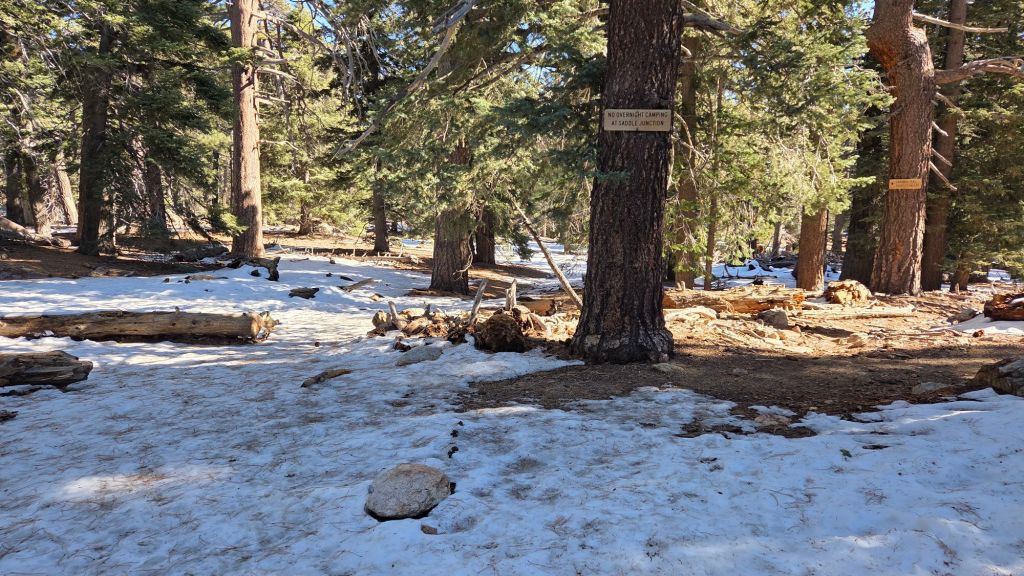
The pipe in Round Valley (9050 ft) flowing gently but steadily, early morning 11th September 2025.
The creek in Little Round Valley, mid morning 4th September 2025. Having dried up here where it crosses Deer Springs Trail at the mouth of the valley in mid August, the creek started flowing again on 25th August following monsoonal rains. Despite further rains, the flow rate is dropping, and the creek is expected to dry again in this location later in September. Some water may remain accessible for hikers/campers a little further upstream however.
The best-known north spring on the Wellman Trail at Wellman’s Cienega (9300 ft), early morning 4th September 2025. The flow had already dropped back to the rate of late August, prior to recent rains, significantly weaker than at the comparable time of year in 2023 and 2024.
The North Fork of the San Jacinto River continues to flow steadily where it crosses Deer Springs Trail (9400 ft) about 0.6 mile below Little Round Valley, 26th August 2025. The flow remained similar on 4th September, largely unaffected by recent rains.
Willow Creek flowing gently where it crosses the trail of the same name, mid morning 11th September 2025. Having dried completely by mid August, rains in the past few weeks have allowed the creek to flow again, albeit perhaps temporarily.
Switchback Spring, about 0.6 mile north on the PCT from Strawberry Junction, continues to flow reliably where it crosses Deer Springs Trail at about PCT Mile 183.7, mid morning 18th August 2025. The flow was similar on 4th September. Although truly perennial, the flow is gentle and it is tough to filter significant volume from this spring.
The creek that flows from the Deer Springs dry where it crosses Deer Springs Trail at about PCT Mile 185.3, 25th July 2025.
The North Fork of the San Jacinto River flowing very gently at 8800 ft where it crosses Fuller Ridge Trail near PCT Mile 186.0, mid morning 25th August 2025, even though it is dry downstream at 6900 ft.

Trail and water update 28th August 2025

UPDATE Friday 29th August 2025: in addition to the rain (and hail) described below, on Thursday 28th we had a fully overcast day with many hours of light rain. This came from the remains of an offshore tropical storm to our south-west, not from monsoonal conditions to the east. Although rainfall totals were unremarkable, the steady, wetting, drizzle did a good job of dampening trails and refreshing the forest. Recorded rainfall was 0.27 inch at San Jacinto Peak (10,810 ft), 0.32 inch at Wellman’s Cienega (9300 ft), and 0.25 inch at Saddle Junction (8100 ft). In Idyllwild (at 5550 ft) total rainfall was 0.12 inch. Hot temperatures are forecast for this weekend, followed by encouraging probabilities of monsoonal thunderstorm activity every afternoon from 2nd-8th September.

————————————-

The San Jacinto mountains received their first measurable monsoonal precipitation of the summer on 22nd-25th August. There was little more than 0.02 inch on the afternoon of Friday 22nd, but rainfall on Saturday 23rd was intense at times. I experienced the best of it firsthand at San Jacinto Peak that morning with rain, periodically accompanied by impressive thunder and lightning, steady from 0900, before thinning to light drizzle about 1130. Rainfall was heaviest from 0900-1000, with 0.26 inch falling in just that hour see photo below). Further rainfall on the afternoon of Sunday 24th was highly localized, with only 0.04 inch in Idyllwild.

The most spectacular thunderstorms were on Monday 25th August. An intense storm cell lingered over the high country in the early afternoon, initially producing heavy hail above 8900 ft on the eastern slope (photo below) and above 9600 ft on the western slope. Rainfall that afternoon was a further 1.21 inches at San Jacinto Peak, and 1.02 inches at the junction of Marion Mountain and Deer Springs trails. The same storm storm reportedly produced over two inches of rain in just one hour in Long Valley. In contrast, rainfall in Idyllwild measured barely 0.02 inch.

Total rain accumulation for the four days was 1.75 inches at San Jacinto Peak, 1.40 inches in Little Round Valley (9800 ft), 1.22 inches at the junction of Marion Mountain and Deer Springs trails (8700 ft), 0.71 inches at Wellman’s Cienega (9300 ft), and 0.43 inch at Saddle Junction (8100 ft). In Idyllwild (at 5550 ft) total rainfall was 0.25 inch, most of which fell on Saturday 23rd.

Palm Springs Aerial Tramway reopened on Saturday 16th following a seven day closure for emergency maintenance. The scheduled annual maintenance closure is for five weeks from 8th September until at least 12th October 2025.

Water flows everywhere remain low – illustrated by multiple photos below – with ephemeral sources now dry. Recent rains will briefly augment stream flow, but past experience suggests the effects will be short-lived, a few days to a week in most locations. The descriptions below largely reflect the long-term situation, which is likely to be the default again by the first week of September.

Key hiker water sources such as Wellman’s Cienega and the pipe in Round Valley are flowing gently but steadily and are likely to maintain useable flow into the autumn. Ephemeral sources along Marion Mountain Trail are all dry for the first time in more than two years. Deer Springs creek dried up in late July where it crosses the trail of the same name. Flow in the creek in Little Round Valley has dropped dramatically since late July. While the creek was running briefly again on 26th August, the day before only a few tiny pools persisted for filtering by campers. It is likely it will dry again by next week. The North Fork is completely dry where it crossed by Seven Pines Trail, but is flowing gently higher up where it crosses both Fuller Ridge and Deer Springs trails. Marion Creek is flowing steadily where it crosses the Suicide Rock Trail.

Willow Creek is now dry where it crosses the Willow Creek Trail, although there are some minor pools about 100 yards downstream. All other minor creeks that cross Willow Creek Trail are also dry. Hidden Lake dried by the end of June. Long Valley Creek is dry where it passes through Round Valley, as is the nearby creek in Tamarack Valley. Water is flowing reliably in Tahquitz Creek at PCT Mile 177 and again further downstream at the north end of Little Tahquitz Meadow (although it is dry between those two locations). The pipe in Tahquitz Meadow dried up in mid July. Skunk Cabbage Meadow creek is functionally dry and no longer useful for filtering. Strawberry Cienega is dry. Middle Spring on Devil’s Slide Trail was functionally dry by 1st August, but a tiny pool persists from which dogs can drink.

Full fire restrictions began on Tuesday 1st July 2025 on Forest Service lands, as described on the USFS website linked here. Campfires throughout USFS lands in the San Jacinto Mountains, including all campgrounds and yellow post sites, are now prohibited.

Fire lookouts at Black Mountain and Tahquitz Peak are closed indefinitely due to issues identified in a May 2025 safety inspection of Black Mountain lookout. USFS has informed the Trail Report that Tahquitz Peak lookout may reopen by October if upgrades to its lightning conductor array are completed, but it is unlikely Black Mountain lookout will reopen this season.

Be rattlesnake aware. Above about 5000 ft elevation, the venom of Southern Pacific Rattlesnakes (Crotalus [oreganus] helleri) in the San Jacinto mountains is predominantly neurotoxic, almost always fatal for dogs and sometimes for humans (see my detailed article linked here for further information describing our dogs’ survival after a July 2020 neurotoxic bite). Devil’s Slide Trail, lower Deer Springs and lower Marion Mountain trails, Suicide Rock, near Strawberry Cienega, and trails around Tahquitz Peak are frequent locations for sightings, but rattlesnakes have been recorded widely up to 9350 ft (see example photos of an adult and a juvenile in a previous Report linked here).

Be bear aware. Although rarely reported in recent years, at least three individually identifiable Black Bears have been in the San Jacinto mountains since 2017, and I have personally seen at least one annually for the past six years. One adult-sized, light chestnut-colored individual was reliably reported – with photographs – from Willow Creek Trail adjacent to Skunk Cabbage Meadow on 12th July 2025 (information courtesy of Mike Meyer). I photographed fresh tracks in snow on 12th February 2024 at 9000 ft near PCT Mile 180.5 (photo linked here), and my brief videos from Devil’s Slide Trail in September 2021 (available here) and one walking through our property in Idyllwild in 2018 (linked here) show two different individuals. There have been no reports of negative interactions with humans at or near campsites or on trails.

Dark Canyon Road (4S02) reopened in May and the dirt section has had some effective basic maintenance. The associated Dark Canyon campground is closed for the year due to federal budget issues.

Survey hikes by the Trail Report every single day throughout the year in the San Jacinto mountains include multiple routes to various high peaks including San Jacinto Peak typically 2-3 times per week (more frequently during stormy weather), Tahquitz Peak and area at least once per week, plus a wide variety of other trails on intervening days.

Thick hail accumulated in the Wellman Trail at 9200 ft, early morning 26th August 2025, from an intense storm the previous afternoon. On the Wellman and Peak trails, hail was 1-2 inches deep in the track almost continuously for about four miles.

WEATHER

Temperatures have been generally above seasonal for three months from 20th May to 24th August, with notable heatwaves between 10th-20th June, in the second week of July, and again in the second and third weeks of August. Interestingly the perception among friends and neighbors in Idyllwild is of a relatively mild summer. This is perhaps due – thankfully – to the lack of severe heatwaves (e.g., temperatures pushing close to 100°F [38°C]) but sadly may simply be indicative of habituation to steadily warmer average temperatures.

Temperatures were about seasonal from 14th-19th August, but then again above seasonal until 25th, with overnight low temperatures in particular well above average. For the remainder of the month, 25th-29th at least, temperatures are expected to be about seasonal for late August.

Monsoon conditions have largely failed in the desert south-west this season, however as described above we finally experienced some rainfall in the San Jacinto mountains associated with thunderstorms on 22nd-25th August. Further rainfall is forecast as a possibility on several days in the remainder of August, most likely early- to mid-afternoon, with probabilities currently highest on Thursday 28th, and then again for 2nd-8th September (at least).

At San Jacinto Peak (10,810ft/3295m) on Friday 29th August 2025 at 0850 the air temperature was 48.6°F (9°C), with a windchill temperature of 38.8°F (4°C), 73% relative humidity, and a cool NNE wind sustained at 5 mph gusting to 11.2 mph.

At the Peak on Tuesday 26th August 2025 at 0845 the air temperature was 58.5°F (15°C), with a “windchill” temperature of 47.3°F (8°C), 71% relative humidity, and a barely discernable WNW wind sustained at 1 mph gusting to 3.2 mph.

At the Peak on Monday 25th August 2025 at 0755 the air temperature was 52.3°F (11°C), with a windchill temperature of 44.8°F (7°C), 65% relative humidity, and a fresh SSE wind sustained at 9 mph gusting to 15.3 mph.

At the Peak on Saturday 23rd August 2025 at 0855 the air temperature was 52.8°F (11°C), with a windchill temperature of 45.9°F (8°C), 67% relative humidity, and a pleasantly cool SE wind sustained at 10 mph gusting to 16.2 mph.

The view south from San Jacinto Peak at about 0850 on Saturday 23rd August 2025, with rainfall working its way towards me across the mountain range from the south-east.

TRAIL CONDITIONS

The established trail system was completely clear of snow by late May. Neither the Wolf Fire in late June nor the Rosa Fire in early August had major impacts on the trail system, although the latter did burn the southernmost 0.5 mile of the Palm Canyon trail.

Recent work has largely resolved the backlog of downed trees on PCT Miles 170-175 (roughly Apache Peak to Red Tahquitz) accumulated during 5+ years of agency neglect. Six trees remain to be cut around South Peak (Miles 173.5-174) of which most are significant obstructions for hikers. Lengthy sections of the trail are badly overgrown with brush and in their worst condition in decades, especially most of Miles 168-174, but PCTA/Forest Service show little interest in improving this situation. Regrettably post-fire erosion has created a loose, rocky, and uneven tread in some parts of the same section, requiring caution in places. The trail is not passable by stock.

The two large downed trees near PCT Mile 180 were removed by the Trail Report in May. The Strawberry Trail (PCT Miles 180.8-183.1) has ten blowdowns, none of which pose major hazards to hikers. Of the eight on the Forest Service section, several have been down for 8-10 years and reported repeatedly but with no action. The brush between the cienega and Annie’s Junction (roughly Miles 181-181.7) has become heavily overgrown since it was last trimmed in 2021.

Five further blowdowns remain on the Deer Springs Trail portion of the PCT (Miles 183-185), some of which are major obstructions, albeit with workarounds. For the first time in a decade, upper Deer Springs Trail – between the top of Marion Mountain Trail and Little Round Valley – is now clear of blowdowns, with the Trail Report having removed eight trees this spring, including the two major hazards at PCT Mile 185.3 that came down this past winter. [About ten further trees would need to be cut to restore the original route of Deer Springs Trail above Little Round Valley, but there is no prospect of that happening soon, if ever. That section of trail, despite too many minor workarounds, remains relatively easy to follow.]

The maintenance condition of the Fuller Ridge (Miles 185.5-190.5) section of the PCT improved in July 2025, having been in very poor condition earlier in the year. The Trail Report cleared nine of 15 blowdowns mid-month. A PCTA volunteer crew the following week largely removed the remaining six trees and undertook some brush trimming and clearing of debris, but sadly the opportunity was missed to comprehensively trim this trail.

On the Wellman Trail, Wellman’s Cienega is flowing relatively poorly (photo below) but there is still plenty of water for hikers for now. The Trail Report continues the work it started last year to keep this trail clear (after it had become badly overgrown by early 2024).

For the first time in more than 15 years Seven Pines Trail has a continuous route completely cleared of blowdown trees, with the trail also as faithful to the original route as possible. The Trail Report “adopted” Seven Pines as a priority for maintenance work nearly a decade ago due to a disproportionate number of lost hiker rescues (with State Park and Forest Service evidently no longer maintaining the route). Since 2019 we have now removed exactly 100 downed trees – including 25 since April of this year – and the trail is largely trimmed and cleared annually. Although our work has restored this delightful trail, Seven Pines remains a genuine wilderness trail unlike the wider, bare, obvious routes of, for example, Devil’s Slide or Marion Mountain trails. Cautious navigation remains invaluable for those without extensive experience of hiking this trail.

Black Mountain Road is open and in its typical non-graded condition, i.e. lumpy but readily passable in any moderate clearance vehicle. The tap at Cinco Poses Spring currently has reliable water but this may not last beyond August (located alongside the road 0.2 mile below the Boulder Basin turning).

Willow Creek Trail is in its best condition since it was thoroughly cleared in 2020. The four new trees that came down on the Forest Service section in January 2025 were cut in June-July. Whitethorn badly needs trimming again especially near the boundary between the two agencies, but is not as overgrown as it was in 2022-23. The two large trees remaining uncut in the State Park section from several years ago have easy workarounds.

The Caramba Trail from near Reeds Meadow through Laws Camp and on to Caramba, and the Cedar Trail from Willow Creek Trail to Laws, are euphemistically (and arguably dangerously) described by the Forest Service as “not maintained”. In reality both trails have been abandoned for more than a decade and no longer exist. They are so heavily overgrown, largely with dense whitethorn which obscures dozens of downed trees, that hikers should not attempt to follow them (regardless of how much you may trust any particular app).

An informal use trail to Laws is much more direct, generally well maintained, and avoids the bushwhacking of the abandoned trails (some local Idyllwild hikers dubbed it the “King Trail” when I established the route in 2019). It leaves Willow Creek Trail exactly 1.0 mile from Saddle Junction, 0.46 mile from the Skunk Cabbage turning (trailhead at N 33.7796, W 116.6590). The route descends following former deer trails for 1.2 miles, meeting Willow Creek about 0.15 mile upstream from the site of the historic Laws Camp (the remains of which were destroyed by the 2013 Mountain Fire and subsequent flood and treefall damage). One huge pine tree fell in late 2024 across the King Trail about midway down that requires a minor scramble underneath, but nine additional blowdowns have been removed since January 2025, with the trail already trimmed and cleared twice this year.

From Laws east to Caramba the original Caramba Trail has been cairned by myself and others and can largely be followed with skilled route-finding. My most recent 2025 survey counted 120 trees down on this 2.1 miles of trail. It is extremely obscure for the first 0.5 mile east of the Willow Creek crossing, becoming more obvious (but still subtle) as it descends towards Caramba. Very cautious navigation is strongly recommended throughout the area.

Storms in February-March brought down another 34 trees across Spitler Peak Trail. All but one were removed in March by the Trail Report, bringing to 162 the total number of trees we have removed from this route in the past seven years. One very large burned cedar remains across the trail immediately after the first creek crossing 3.2 miles up from the trailhead. A couple of other recent blowdowns are small and easily stepped over.

The Zen Center Trail continues its serious deterioration that started following the 2013 Mountain Fire, with a combination of vigorous regrowth and treefall hazards further obscuring the route with each passing season. The lower and upper thirds of this trail are partially cairned and not too bad for those who are very familiar with the former route, but even the experienced find navigating the central section tricky. Long trousers, scrambling gloves, and a genuine enjoyment of bush-whacking are all strongly recommended.

The pipe in Round Valley (9050 ft) flowing gently but steadily, mid morning 11th August 2025. The pipe maintained a similar flow as of 23rd August, but it has probably increased (temporarily) in the past few days following strong rains in the area.

While all time and labor is volunteered, the San Jacinto Trail Report uses small donations to help cover modest operating costs. Your contribution keeps the Report available to all, free from advertising or paywalls, and independent from agencies. If you have found this Report useful, please consider using this link to the Donate page. Thank you very much for your support.

The creek in Little Round Valley, mid morning 26th August 2025, briefly flowing again where it crosses Deer Springs Trail at the mouth of the valley following an intense rain storm the previous afternoon. I had passed by the same spot 24 hours earlier and it was completely dry. It will likely dry again within a week or so in the absence of further monsoonal rainfall.
The best-known north spring on the Wellman Trail at Wellman’s Cienega (9300 ft), early morning 26th August 2025. Flow rate has roughly doubled in the past few days following rainfall, but the current flow remains weaker than at the comparable time of year in 2023 and 2024.
The North Fork of the San Jacinto River continues to flow steadily where it crosses Deer Springs Trail (9400 ft) about 0.6 mile below Little Round Valley, 26th August 2025, with flow rate largely unaffected by recent rains.
Switchback Spring, about 0.6 mile north on the PCT from Strawberry Junction, continues to flow reliably where it crosses Deer Springs Trail at about PCT Mile 183.7, mid morning 18th August 2025. Although truly perennial, the flow is gentle and it is tough to filter significant volume from this spring.
The creek that flows from the Deer Springs dry where it crosses Deer Springs Trail at about PCT Mile 185.3, 25th July 2025.
The North Fork of the San Jacinto River flowing very gently at 8800 ft where it crosses Fuller Ridge Trail near PCT Mile 186.0, mid morning 25th August 2025, even though it is dry downstream at 6900 ft.
For those who know where it is, the pipe in Tahquitz Valley finally dried up in mid July, photographed 23rd July 2025.
Fresh track of adult Mountain Lion, Wellman’s Cienega at 9300 ft, early morning 15th August 2025. The lip balm is 2.6 inches long for scale.

Trail and water update 15th August 2025

Air quality remains mediocre in the San Jacinto mountains, although this is hardly surprising given no precipitation for months and smoke from numerous fires spreading throughout Southern California, most notably the huge Gifford Fire to our north-west. Conditions have however improved compared to mid July and earlier in August (e.g., photos in previous Report linked here).

The Rosa Fire on the south-east fringe of the San Jacinto mountains was contained by 8th August. The fire started alongside Highway 74 west of Ribbonwood just after noon on 4th August, quickly spreading to 1700 acres. Highway 74, closed for five days in the vicinity of the fire, reopened late on Friday 8th.

Palm Springs Aerial Tramway closed for emergency maintenance starting Friday 8th August but is expected to reopen on Saturday 16th. The annual scheduled maintenance closure is for five weeks from 8th September until at least 12th October 2025.

Hikers should be prepared for unseasonably hot weather on 20th-24th August, with temperatures above seasonal even for midsummer. Please give considerable extra thought to route choice, start times, clothing, sun protection, and water requirements (the latter especially challenging in this dry year).

Water flows everywhere are low – illustrated by multiple photos below – with ephemeral sources now dry. Key hiker water sources such as Wellman’s Cienega and the pipe in Round Valley are flowing gently but steadily and may maintain useable flow into the autumn. Ephemeral sources along Marion Mountain Trail are all dry for the first time in more than two years. Deer Springs creek dried up in late July where it crosses the trail of the same name. Flow in the creek in Little Round Valley has dropped dramatically since late July, and while a few small pools persist for filtering by campers, it is largely dry, other than about a hundred yards in the middle of the valley (most accessible by the sign for campsite 2). The North Fork is completely dry where it crossed by Seven Pines Trail, but is flowing gently higher up where it crosses both Fuller Ridge and Deer Springs trails.

Willow Creek is now dry where it crosses the Willow Creek Trail, although there are some minor pools about 100 yards downstream. All other minor creeks that cross Willow Creek Trail are also dry. Hidden Lake dried by the end of June. Long Valley Creek is dry where it passes through Round Valley, as is the nearby creek in Tamarack Valley. Water is flowing reliably in Tahquitz Creek at PCT Mile 177 and again further downstream at the north end of Little Tahquitz Meadow (although it is dry between those two locations). The pipe in Tahquitz Meadow dried up in mid July. Skunk Cabbage Meadow creek is functionally dry and no longer useful for filtering. Strawberry Cienega is dry. Middle Spring on Devil’s Slide Trail was functionally dry by 1st August, but a tiny pool persists from which dogs can drink.

It should be clear from the paragraphs above that fire risk is currently severe. Full fire restrictions began on Tuesday 1st July 2025 on Forest Service lands, as described on the USFS website linked here. Campfires throughout USFS lands in the San Jacinto Mountains, including all campgrounds and yellow post sites, are now prohibited.

Fire lookouts at Black Mountain and Tahquitz Peak are closed indefinitely due to issues identified in a May 2025 safety inspection of Black Mountain lookout. USFS has informed the Trail Report that Tahquitz Peak lookout could reopen by September once upgrades to its lightning conductor array are completed, but there is little optimism that Black Mountain lookout will reopen this season.

Be rattlesnake aware. Above about 5000 ft elevation, the venom of Southern Pacific Rattlesnakes (Crotalus [oreganus] helleri) in the San Jacinto mountains is predominantly neurotoxic, almost always fatal for dogs and sometimes for humans (see my detailed article linked here for further information describing our dogs’ survival after a July 2020 neurotoxic bite). Devil’s Slide Trail, lower Deer Springs and lower Marion Mountain trails, Suicide Rock, near Strawberry Cienega, and trails around Tahquitz Peak are frequent locations for sightings, but rattlesnakes have been recorded widely up to 9350 ft (see example photos of an adult and a juvenile in a previous Report linked here).

Be bear aware. Although rarely reported in recent years, at least three individually identifiable Black Bears have been in the San Jacinto mountains since 2017, and I have personally seen at least one annually for the past six years. One adult-sized, light chestnut-colored individual was reliably reported – with photographs – from Willow Creek Trail adjacent to Skunk Cabbage Meadow on 12th July 2025 (information courtesy of Mike Meyer). I photographed fresh tracks in snow on 12th February 2024 at 9000 ft near PCT Mile 180.5 (photo linked here), and my brief videos from Devil’s Slide Trail in September 2021 (available here) and one walking through our property in Idyllwild in 2018 (linked here) show two different individuals. There have been no reports of negative interactions with humans at or near campsites or on trails.

Dark Canyon Road (4S02) reopened in May and the dirt section has had some effective basic maintenance. The associated Dark Canyon campground will be closed for the year due to federal budget issues.

Survey hikes by the Trail Report every single day throughout the year in the San Jacinto mountains include multiple routes to various high peaks including San Jacinto Peak typically 2-3 times per week (more frequently during stormy weather), Tahquitz Peak and area at least once per week, plus a wide variety of other trails on intervening days.

The pipe in Round Valley (9050 ft) flowing gently but steadily, mid morning 11th August 2025.

WEATHER

Temperatures have been generally above seasonal for almost three months since 20th May, with notable heatwaves between 10th-20th June, in the second week of July, and again in the second week of August. Interestingly the perception among friends and neighbors in Idyllwild is of a relatively mild summer. This is perhaps due to the lack of severe heatwaves (e.g., temperatures pushing close to 100°F [38°C]) but sadly may simply be indicative of habituation to warmer average temperatures.

Temperatures are forecast to remain above seasonal even for midsummer until 14th August, before cooling (briefly) to about average for a few days, and then rising again by 20th.

Monsoon conditions have largely failed in the desert south-west this season, however there are currently small probabilities for rain in the forecast for 21st-25th August.

At San Jacinto Peak (10,810ft/3295m) on Friday 15th August 2025 at 0825 the air temperature was 48.1°F (9°C), with a windchill temperature of 43.7°F (6°C), 29% relative humidity, and a gentle WNW wind sustained at 3 mph gusting to 6.8 mph.

At the Peak on Monday 11th August 2025 at 0830 the air temperature was 60.5°F (16°C), with a “windchill” temperature of 52.9°F (12°C), 51% relative humidity, and a light SW wind sustained at 6 mph gusting to 9.3 mph.

At the Peak on Friday 8th August 2025 at 0830 the air temperature was 56.8°F (14°C), with a “windchill” temperature of 50.9°F (11°C), 37% relative humidity, and a pleasantly cool WSW wind sustained at 8 mph gusting to 14.7 mph.

Looking south-east into the Coachella Valley from the uppermost Peak Trail at 10,500 ft, early morning 15th August 2025. Although the high country was pleasantly clear, smoke and other smog remained thick everywhere below a well-defined band at 7000 ft elevation. On the far right, Toro Peak is the high point of the Santa Rosa Mountains at 8717 ft.

TRAIL CONDITIONS

The established trail system was completely clear of snow by late May. Neither the Wolf Fire in late June nor the Rosa Fire in early August had major impacts on the trail system, although the latter did burn the southernmost 0.5 mile of the Palm Canyon trail.

Work from mid 2024 to early 2025 by various crews largely resolved the backlog of downed trees on PCT Miles 170-175 (roughly Apache Peak to Red Tahquitz) accumulated during 5+ years of agency neglect. Six trees remain to be cut around South Peak (Miles 173.5-174) of which most are significant obstructions for hikers. Lengthy sections of the trail are badly overgrown with brush and in their worst condition in decades, especially most of Miles 168-174, but PCTA/Forest Service show little interest in improving this situation. Regrettably post-fire erosion has created a loose, rocky, and uneven tread in some parts of the same section, requiring caution in places. The trail is not passable by stock.

The two large downed trees near PCT Mile 180 were removed by the Trail Report in May. The Strawberry Trail (PCT Miles 180.8-183.1) has ten blowdowns, none of which pose major hazards to hikers. Of the eight on the Forest Service section, several have been down for 8-10 years and reported repeatedly but with no action. The brush between the cienega and Annie’s Junction (roughly Miles 181-181.7) has become heavily overgrown since it was last trimmed in 2021.

Five further blowdowns remain on the Deer Springs Trail portion of the PCT (Miles 183-185), some of which are major obstructions, albeit with workarounds. For the first time in a decade, upper Deer Springs Trail – between the top of Marion Mountain Trail and Little Round Valley – is now clear of blowdowns, with the Trail Report having removed eight trees this spring, including the two major hazards at PCT Mile 185.3 that came down this past winter. [About ten further trees would need to be cut to restore the original route of Deer Springs Trail above Little Round Valley, but there is no prospect of that happening soon, if ever. That section of trail, despite too many minor workarounds, remains relatively easy to follow.]

The maintenance condition of the Fuller Ridge (Miles 185.5-190.5) section of the PCT improved in July 2025, having been in very poor condition earlier in the year. The Trail Report cleared nine of 15 blowdowns mid-month. A PCTA volunteer crew the following week largely removed the remaining six trees and undertook some brush trimming and clearing of debris, but sadly the opportunity was missed to comprehensively trim this trail.

On the Wellman Trail, Wellman’s Cienega is flowing relatively poorly (photo below) but there is still plenty of water for hikers for now. The Trail Report continues the work it started last year to keep this trail clear (after it had become badly overgrown by early 2024).

For the first time in more than 15 years Seven Pines Trail has a continuous route completely cleared of blowdown trees, with the trail also as faithful to the original route as possible. The Trail Report “adopted” Seven Pines as a priority for maintenance work nearly a decade ago due to a disproportionate number of lost hiker rescues (with State Park and Forest Service evidently no longer maintaining the route). Since 2019 we have now removed exactly 100 downed trees – including 25 since April of this year – and the trail is largely trimmed and cleared annually. Although our work has restored this delightful trail, Seven Pines remains a genuine wilderness trail unlike the wider, bare, obvious routes of, for example, Devil’s Slide or Marion Mountain trails. Cautious navigation remains invaluable for those without extensive experience of hiking this trail.

Black Mountain Road is open and in its typical non-graded condition, i.e. lumpy but readily passable in any moderate clearance vehicle. The tap at Cinco Poses Spring currently has reliable water but this may not last beyond August (located alongside the road 0.2 mile below the Boulder Basin turning).

Willow Creek Trail is in its best condition since it was thoroughly cleared in 2020. The four new trees that came down on the Forest Service section in January 2025 were cut in June-July. Whitethorn badly needs trimming again especially near the boundary between the two agencies, but is not as overgrown as it was in 2022-23. The two large trees remaining uncut in the State Park section from several years ago have easy workarounds.

The Caramba Trail from near Reeds Meadow through Laws Camp and on to Caramba, and the Cedar Trail from Willow Creek Trail to Laws, are euphemistically (and arguably dangerously) described by the Forest Service as “not maintained”. In reality both trails have been abandoned for more than a decade and no longer exist. They are so heavily overgrown, largely with dense whitethorn which obscures dozens of downed trees, that hikers should not attempt to follow them (regardless of how much you may trust any particular app).

An informal use trail to Laws is much more direct, generally well maintained, and avoids the bushwhacking of the abandoned trails (some local Idyllwild hikers dubbed it the “King Trail” when I established the route in 2019). It leaves Willow Creek Trail exactly 1.0 mile from Saddle Junction, 0.46 mile from the Skunk Cabbage turning (trailhead at N 33.7796, W 116.6590). The route descends following former deer trails for 1.2 miles, meeting Willow Creek about 0.15 mile upstream from the site of the historic Laws Camp (the remains of which were destroyed by the 2013 Mountain Fire and subsequent flood and treefall damage). One huge pine tree fell in late 2024 across the King Trail about midway down that requires a minor scramble underneath, but nine additional blowdowns have been removed since January 2025, with the trail already trimmed and cleared twice this year.

From Laws east to Caramba the original Caramba Trail has been cairned by myself and others and can largely be followed with skilled route-finding. My most recent 2025 survey counted 120 trees down on this 2.1 miles of trail. It is extremely obscure for the first 0.5 mile east of the Willow Creek crossing, becoming more obvious (but still subtle) as it descends towards Caramba. Very cautious navigation is strongly recommended throughout the area.

Storms in February-March brought down another 34 trees across Spitler Peak Trail. All but one were removed in March by the Trail Report, bringing to 162 the total number of trees we have removed from this route in the past seven years. One very large burned cedar remains across the trail immediately after the first creek crossing 3.2 miles up from the trailhead. A couple of other recent blowdowns are small and easily stepped over.

The Zen Center Trail continues its serious deterioration that started following the 2013 Mountain Fire, with a combination of vigorous regrowth and treefall hazards further obscuring the route with each passing season. The lower and upper thirds of this trail are partially cairned and not too bad for those who are very familiar with the former route, but even the experienced find navigating the central section tricky. Long trousers, scrambling gloves, and a genuine enjoyment of bush-whacking are all strongly recommended.

Fresh track of an adult Mountain Lion, Wellman’s Cienega at 9300 ft, early morning 15th August 2025. The lip balm is 2.6 inches long for size reference.

While all time and labor is volunteered, the San Jacinto Trail Report uses small donations to help cover modest operating costs. Your contribution keeps the Report available to all, free from advertising or paywalls, and independent from agencies. If you have found this Report useful, please consider using this link to the Donate page. Thank you very much for your support.
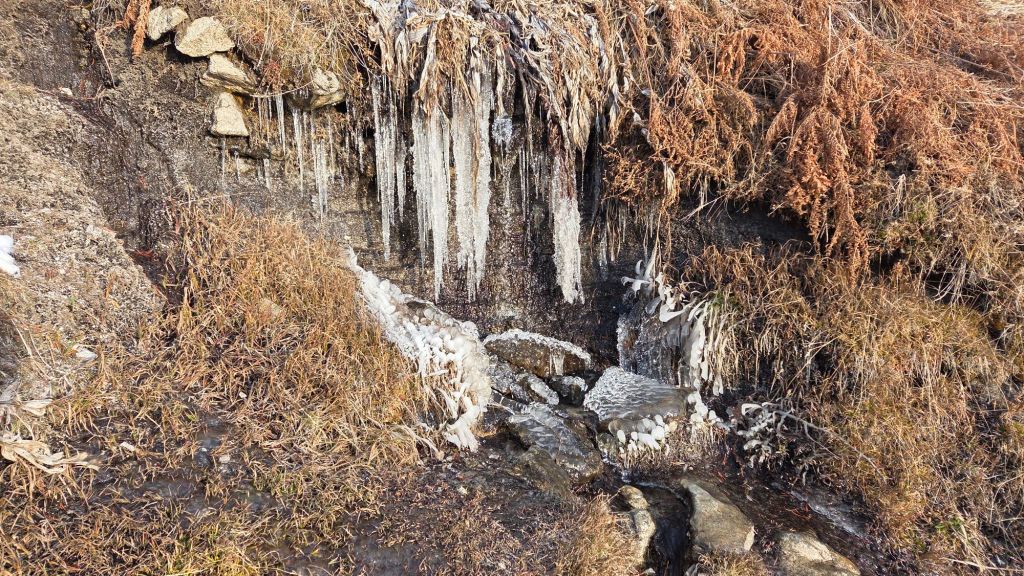
The best-known north spring on the Wellman Trail at Wellman’s Cienega (9300 ft), early morning 15th August 2025. A great source of water on this route, but the current flow is far weaker than in 2023 and 2024.
Above and below, the creek in Little Round Valley, 8th August 2025. Above, the creek is now dry where it crosses Deer Springs Trail at the mouth of the valley. Below, a short flowing section persists with small pools, notably near the sign for campsite 2 (Owl’s Hootch).
The North Fork of the San Jacinto River continues to flow steadily where it crosses Deer Springs Trail (9400 ft) about 0.6 mile below Little Round Valley.
The creek that flows from the Deer Springs is dry where it crosses Deer Springs Trail at about PCT Mile 185.3, 25th July 2025.
The North Fork of the San Jacinto River flowing gently at 8800 ft where it crosses Fuller Ridge Trail near PCT Mile 186.0, mid morning 31st July 2025, even though it is dry downstream at 6900 ft.
For those who know where it is, the pipe in Tahquitz Valley finally dried up in mid July, photographed 23rd July 2025.
Tahquitz Creek flowing steadily for the time of year immediately below its source (“Grethe Spring”) where it crosses the PCT at about Mile 177, 26th June 2025.
Tahquitz Creek flowing well at the lower (north) end of Little Tahquitz Meadow, 26th June 2025.
Willow Creek at 7450 ft flowing gently where the so-called King Trail meets what remains of the old Caramba Trail, 15th July 2025, but flow is now inconsistent and largely subsurface.
Switchback Spring, about 0.6 mile north on the PCT from Strawberry Junction, continues to flow reliably where it crosses Deer Springs Trail at about PCT Mile 183.7, late morning 11th July 2025. Although truly perennial, the flow is so gentle that this tiny spring really only functions as an emergency water source.

Trail and water update 8th August 2025

The Rosa Fire on the south-east fringe of the San Jacinto mountains is now largely under control. The fire started alongside Highway 74 west of Ribbonwood just after noon on 4th August, quickly spreading to 1700 acres. Highway 74, closed for five days in the vicinity of the fire, reopened at midnight on Friday 8th.

Palm Springs Aerial Tramway closed indefinitely for emergency maintenance starting Friday 8th August, and is expected to remain closed until at least Tuesday 12th. The annual scheduled 2025 maintenance closure is from 8th September until at least 12th October.

Air quality improved on 5th August after two very poor days, with smoke enveloping the San Jacinto mountains (photos below) starting on Sunday 3rd, mainly from the huge Gifford Fire far to our north-west. Early morning on Monday 4th the smoke had settled in the flatlands below 7000 ft, and hiking in the high country was the place to be, but by late morning the smoke was again climbing over 9000 ft and well into Strawberry Valley (where Idyllwild is located). Sunlight on both days was muted – like a partial solar eclipse – similar to the impact of the Grand Canyon fires in mid July.

Temperatures are again heating to above seasonal for the first two weeks of August, with modest cooling not forecast until Friday 15th. Temperatures that had been at or above seasonal since late May finally dropped to near seasonal starting 16th July. In the third week of July we were treated to a hint of September, with temperatures at all elevations below seasonal for several days, exemplified by the windchill temperature of 35.4°F (2°C) I recorded at San Jacinto Peak on Friday 25th July.

Hikers should be prepared for unseasonably hot weather, especially on 6th-14th August, with temperatures well above seasonal even for midsummer. Please give considerable extra thought to route choice, start times, clothing, sun protection, and water requirements (the latter especially challenging in this dry year).

Water flows everywhere are low (many photos below) with ephemeral sources now dry. Key hiker water sources such as Wellman’s Cienega and the pipe in Round Valley are flowing and may maintain useable flow into the autumn. Ephemeral sources along Marion Mountain Trail are all dry for the first time in more than two years. Deer Springs creek dried up in late July where it crosses the trail of the same name. Flow in the creek in Little Round Valley has dropped dramatically since late July, and while a few small pools persist for filtering by campers, it is largely dry now, other than about a hundred yards in the middle of the valley (most accessible by the sign for campsite 2). The North Fork is completely dry where it crossed by Seven Pines Trail, but is flowing gently higher up where it crosses both Fuller Ridge and Deer Springs trails. Hidden Lake dried by the end of June. Long Valley Creek is dry where it passes through Round Valley. Water is flowing reliably in Tahquitz Creek at PCT Mile 177 and again further downstream at the north end of Little Tahquitz Meadow (although it is dry between those two locations). The pipe in Tahquitz Meadow dried up in mid July. Skunk Cabbage Meadow creek is close to drying and no longer has sufficient depth for filtering. Strawberry Cienega is now dry. Middle Spring on Devil’s Slide Trail was functionally dry by 1st August, but a tiny pool persists from which dogs can drink.

It should be clear from the paragraphs above that fire risk is currently severe. Full fire restrictions began on Tuesday 1st July 2025 on Forest Service lands, as described on the USFS website linked here. Campfires throughout USFS lands in the San Jacinto Mountains, including all campgrounds and yellow post sites, are now prohibited.

Fire lookouts at Black Mountain and Tahquitz Peak are closed indefinitely due to issues identified in a May 2025 safety inspection of Black Mountain lookout. USFS has informed the Trail Report that Tahquitz Peak lookout could reopen by September once upgrades to its lightning conductor array are completed, but there is little optimism that Black Mountain lookout will reopen this season.

Be rattlesnake aware. Above about 5000 ft elevation, the venom of Southern Pacific Rattlesnakes (Crotalus [oreganus] helleri) in the San Jacinto mountains is predominantly neurotoxic, almost always fatal for dogs and sometimes for humans (see my detailed article linked here for further information describing our dogs’ survival after a July 2020 neurotoxic bite). Devil’s Slide Trail, lower Deer Springs and lower Marion Mountain trails, Suicide Rock, near Strawberry Cienega, and trails around Tahquitz Peak are frequent locations for sightings, but rattlesnakes have been recorded widely up to 9350 ft (see example photos of an adult and a juvenile in the previous Report linked here).

Be bear aware. Although rarely reported in recent years, at least three individually identifiable Black Bears have been in the San Jacinto mountains since 2017, and I have personally seen at least one annually for the past six years. One adult-sized, light chestnut-colored individual was reliably reported – with photographs – from Willow Creek Trail adjacent to Skunk Cabbage Meadow on 12th July 2025 (information courtesy of Mike Meyer). I photographed fresh tracks in snow on 12th February 2024 at 9000 ft near PCT Mile 180.5 (photo linked here), and my brief videos from Devil’s Slide Trail in September 2021 (available here) and one walking through our property in Idyllwild in 2018 (linked here) show two different individuals. There have been no reports of negative interactions with humans at or near campsites or on trails.

Dark Canyon Road (4S02) reopened in May and the dirt section has had some effective basic maintenance. The associated Dark Canyon campground will be closed for the year due to federal budget issues.

Survey hikes by the Trail Report every single day throughout the year in the San Jacinto mountains include multiple routes to various high peaks including San Jacinto Peak typically 2-3 times per week (more frequently during stormy weather), Tahquitz Peak and area at least once per week, plus a wide variety of other trails on intervening days.

The San Bernardino mountains and the San Gorgonio Pass as seen from San Jacinto Peak, mid morning Monday 4th August 2025, at which time smoke was confined below about 7000 ft. The Coachella Valley was completely obscured by smoke.

WEATHER

Temperatures were generally above seasonal for nearly two months from 20th May until mid July, with heatwaves above even midsummer averages between 10th-20th June and again in the second week of July. Daytime high temperatures were then somewhat below average for the month starting Thursday 17th July for ten days.

Temperatures warmed again to slightly above seasonal starting Tuesday 29th July and then to well above seasonal starting Saturday 2nd August. Temperatures are now forecast to be well above seasonal even for midsummer on at least 7th-14th August.

Monsoon conditions have largely failed in the desert south-west so far this season, with no significant precipitation forecast for the San Jacinto mountains for the foreseeable future. Localized monsoonal thunderstorms on 17th-18th July produced some intense rain at lower elevations along the Highway 74 corridor and to the north of the San Jacinto mountains, but there was no measurable precipitation anywhere above 5000 ft, and only a few raindrops in Idyllwild.

The air temperature of 64.4°F (18°C) at San Jacinto Peak on Monday 14th July was the hottest this year and the seventh highest I have ever recorded at that location. Notably, five of the six higher temperatures ever were all from 2024, indicative of the strong heating trend increasingly affecting the high country in recent years.

At San Jacinto Peak (10,810ft/3295m) on Friday 8th August 2025 at 0830 the air temperature was 56.8°F (14°C), with a “windchill” temperature of 50.9°F (11°C), 37% relative humidity, and a pleasantly cool WSW wind sustained at 8 mph gusting to 14.7 mph.

At the Peak on Monday 4th August 2025 at 0830 the air temperature was 55.1°F (13°C), with a “windchill” temperature of 48.9°F (9°C), 9% relative humidity, and a moderate due West wind sustained at 10 mph gusting to 16.3 mph.

At the Peak on Friday 1st August 2025 at 0850 the air temperature was 57.5°F (14°C), with a “windchill” temperature of 49.1°F (10°C), 16% relative humidity, and a variable SW wind sustained at 7 mph gusting to 12.0 mph.

Looking southwards from near PCT Mile 180, late morning Monday 4th August 2025. with Tahquitz Peak and Tahquitz Rock to the east (left). By that time, smoke was starting to rise back into Strawberry Valley (center of image) and up to at least 9000 ft elevation, driven by a moderate West wind. The flatlands (and hills) west of the San Jacinto mountains were completely obscured by thick smoke.

TRAIL CONDITIONS

The established trail system was completely clear of snow by late May. The Wolf Fire in late June had no significant impact on the trail system.

Work from mid 2024 to early 2025 by various crews largely resolved the backlog of downed trees on PCT Miles 170-175 (roughly Apache Peak to Red Tahquitz) accumulated during 5+ years of agency neglect. Six trees remain to be cut around South Peak (Miles 173.5-174) of which most are significant obstructions for hikers. Lengthy sections of the trail are badly overgrown with brush and in their worst condition in decades, especially most of Miles 168-174, but PCTA/Forest Service seem to show little interest in improving this situation. Regrettably post-fire erosion has created a loose, rocky, and uneven tread in some parts of the same section, requiring caution in places.

The two large downed trees near PCT Mile 180 were removed by the Trail Report in May. The Strawberry Trail (PCT Miles 180.8-183.1) has ten blowdowns, none of which pose major hazards to hikers. Of the eight on the Forest Service section, several have been down for 8-10 years and reported repeatedly but with no action. The brush between the cienega and Annie’s Junction (roughly Miles 181-181.7) has become heavily overgrown since it was last trimmed in 2021.

Five further blowdowns remain on the Deer Springs Trail portion of the PCT (Miles 183-185), some of which are major obstructions, albeit with workarounds. For the first time in a decade, upper Deer Springs Trail – between the top of Marion Mountain Trail and Little Round Valley – is now clear of blowdowns, with the Trail Report having removed eight trees this spring, including the two major hazards at PCT Mile 185.3 that came down this past winter. [About ten further trees would need to be cut to restore the original route of Deer Springs Trail above Little Round Valley, but there is no prospect of that happening soon, if ever. That section of trail, despite too many minor workarounds, remains relatively easy to follow.]

The maintenance condition of the Fuller Ridge (Miles 185.5-190.5) section of the PCT improved in July 2025, having been in very poor condition earlier in the year. The Trail Report cleared nine of 15 blowdowns mid-month (example photo below). A PCTA volunteer crew the following week largely removed the remaining six trees and undertook some brush trimming and clearing of debris, but sadly the opportunity was missed to comprehensively clear and trim this trail.

On the Wellman Trail, Wellman’s Cienega is flowing relatively poorly (photo below) but there is still plenty of water for hikers for now. The Trail Report continues the work it started last year to keep this trail clear (after it had become badly overgrown by early 2024).

For the first time in more than 15 years Seven Pines Trail has a continuous route completely cleared of blowdown trees, with the trail also as faithful to the original route as possible. The Trail Report “adopted” Seven Pines as a priority for maintenance work nearly a decade ago due to a disproportionate number of lost hiker rescues (with State Park and Forest Service evidently no longer maintaining the route). Since 2019 we have now removed exactly 100 downed trees – including 25 since April of this year – and the trail is largely trimmed and cleared annually. Although our work has restored this delightful trail, Seven Pines remains a genuine wilderness trail unlike the wider, bare, obvious routes of, for example, Devil’s Slide or Marion Mountain trails. Cautious navigation remains invaluable for those without extensive experience of hiking this trail.

Black Mountain Road is open and in its typical non-graded condition, i.e. lumpy but readily passable in any moderate clearance vehicle. The tap at Cinco Poses Spring currently has reliable water but this may not last beyond August (located alongside the road 0.2 mile below the Boulder Basin turning).

Willow Creek Trail is in its best condition since it was thoroughly cleared in 2020. The four new trees that came down on the Forest Service section in January 2025 were cut in June-July. Whitethorn needs trimming again especially near the boundary between the two agencies, but is not as overgrown as it was in 2022-23. Two new trees down on the State Park side are minor and easily passed, and the two large ones remaining uncut from several years ago also have easy workarounds.

The Caramba Trail from near Reeds Meadow through Laws Camp and on to Caramba, and the Cedar Trail from Willow Creek Trail to Laws, are euphemistically (and arguably dangerously) described by the Forest Service as “not maintained”. In reality both trails have been abandoned for more than a decade and no longer exist. They are so heavily overgrown, largely with dense whitethorn which obscures dozens of downed trees, that hikers should not attempt to follow them (regardless of how much you may trust any particular app).

An informal use trail to Laws is much more direct, generally well maintained, and avoids the bushwhacking of the abandoned trails (some local Idyllwild hikers dubbed it the “King Trail” when I established the route in 2019). It leaves Willow Creek Trail exactly 1.0 mile from Saddle Junction, 0.46 mile from the Skunk Cabbage turning (trailhead at N 33.7796, W 116.6590). The route descends following former deer trails for 1.2 miles, meeting Willow Creek about 0.15 mile upstream from the site of the historic Laws Camp (the remains of which were destroyed by the 2013 Mountain Fire and subsequent flood and treefall damage). One huge pine tree fell in late 2024 across the King Trail about midway down that requires a minor scramble underneath, but nine additional blowdowns have been removed since January 2025, with the trail already trimmed and cleared twice this year.

From Laws east to Caramba the original Caramba Trail has been cairned by myself and others and can largely be followed with skilled route-finding. My most recent 2025 survey counted 120 trees down on this 2.1 miles of trail. It is extremely obscure for the first 0.5 mile east of the Willow Creek crossing, becoming more obvious (but still subtle) as it descends towards Caramba. Very cautious navigation is strongly recommended throughout the area.

Storms in February-March brought down another 34 trees across Spitler Peak Trail. All but one were removed in March by the Trail Report, bringing to 162 the total number of trees we have removed from this route in the past seven years. One very large burned cedar remains across the trail immediately after the first creek crossing 3.2 miles up from the trailhead. A couple of other recent blowdowns are small and easily stepped over.

The Zen Center Trail continues its serious deterioration that started following the 2013 Mountain Fire, with a combination of vigorous regrowth and treefall hazards further obscuring the route with each passing season. The lower and upper thirds of this trail are partially cairned and not too bad for those who are very familiar with the former route, but even the experienced find navigating the central section tricky. Long trousers, scrambling gloves, and a genuine enjoyment of bush-whacking are all strongly recommended.

While all time and labor is volunteered, the San Jacinto Trail Report uses small donations to help cover modest operating costs. Your contribution keeps the Report available to all, free from advertising or paywalls, and independent from agencies. If you have found this Report useful, please consider using this link to the Donate page. Thank you very much for your support.
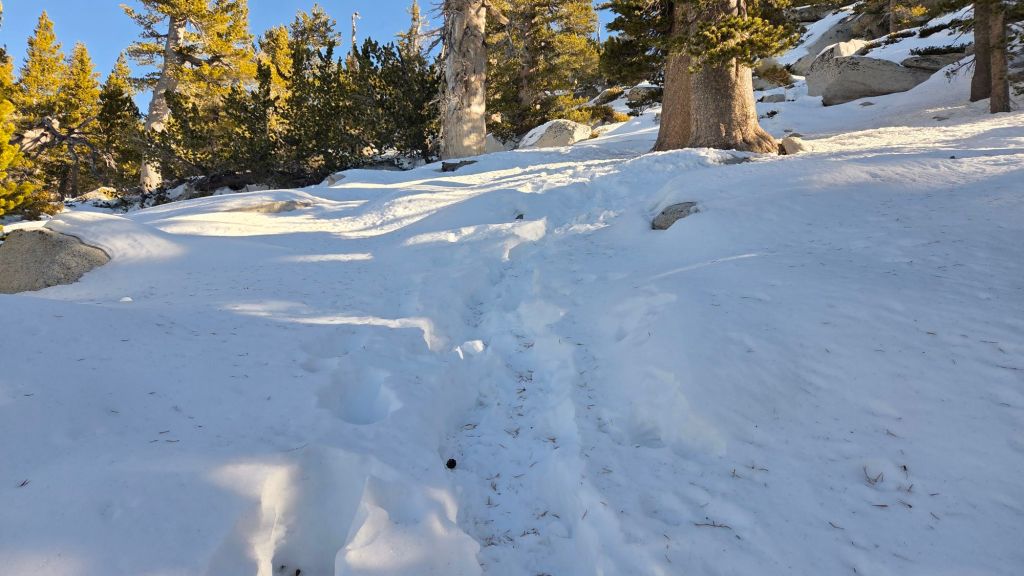
The best-known north spring immediately adjacent to the Wellman Trail at Wellman’s Cienega (9300 ft), early morning 4th August 2025. A great source of water on this route, but the current flow is far weaker than the strong flows of 2023 and 2024.
The creek in Little Round Valley where it crosses Deer Springs Trail at the west end of the valley (9700 ft), early morning 31st July 2025. Flow in this key stream has dropped dramatically in the past week, and it is no longer flowing continuously. While adequate water remains available for hikers and campers at this time, that may not be the case throughout August.
The creek that flows from the Deer Springs is now dry where it crosses Deer Springs Trail at about PCT Mile 185.3, 25th July 2025.
The North Fork of the San Jacinto River is flowing gently at 8800 ft where it crosses Fuller Ridge Trail near PCT Mile 186.0, mid morning 31st July 2025, even though it is now functionally dry downstream at 6900 ft (photo below).
The small creek in Skunk Cabbage Meadow is close to drying where it is crossed by the trail on the east side of the meadow, 23rd July 2025, and the flow is now insufficient for filtering by hikers.
For those who know where it is, the pipe in Tahquitz Valley finally dried up in mid July, photo taken 23rd July 2025.
Tahquitz Creek flowing steadily for the time of year immediately below its source (“Grethe Spring”) where it crosses the PCT at about Mile 177, 26th June 2025.
Tahquitz Creek flowing well at the lower (north) end of Little Tahquitz Meadow, 26th June 2025.
Willow Creek at 7450 ft flowing gently where the so-called King Trail meets what remains of the old Caramba Trail, 15th July 2025.
Switchback Spring, about 0.6 mile north on the PCT from Strawberry Junction, continues to flow reliably where it crosses Deer Springs Trail at about PCT Mile 183.7, late morning 11th July 2025. Although truly perennial, the flow is so gentle that this tiny spring really only functions as an emergency water source.
Above and below, the North Fork of the San Jacinto River where it crosses Seven Pines Trail. Above, early morning on 22nd July 2025, with the river completely dry at this point (although a few small pools persisted both up- and downstream). Below, flowing steadily just six weeks earlier on 6th June 2025.
Above and below, the before and after of trail recovery work undertaken by the Trail Report on Fuller Ridge (PCT Mile 186.8), 16th July 2025.
Trail maintenance work by the Trail Report continues year-round, here on the use trail to Laws (the so-called “King Trail”), 24th July 2025.

Trail and water update 25th July 2025

The air temperature of 64.4°F (18°C) at San Jacinto Peak on Monday 14th July was the hottest this year and the seventh highest I have ever recorded at that location. Notably, five of the six higher temperatures were all from 2024, indicative of the strong heating trend increasingly affecting the high country in recent years.

The heatwave throughout the first half of July has abated with temperatures dropping to near seasonal starting Wednesday 16th. This week we have been treated to a hint of September, with temperatures at all elevations below seasonal. The windchill temperature of 35.4°F (2°C) at San Jacinto Peak on Friday 25th July felt truly refreshing.

Air quality in our region, which had been poor for much of July, has improved dramatically in the last couple of days, with unusually good visibility for July from the high peaks on 25th thanks to a steady westerly wind. Smoke from the nearby Wolf Fire at the end of June briefly impacted air quality, which then deteriorated further on 14th-16th (photo below) due to smoke from major fires burning in Arizona. Sunlight on 14th-17th was remarkably weak, more reminiscent of a partial solar eclipse than midsummer.

Water flows everywhere are low for July (see photos below) with almost all ephemeral sources now dry. Key hiker water sources such as Wellman’s Cienega and the pipe in Round Valley are flowing and are expected to maintain some flow into the autumn. Ephemeral sources along Marion Mountain Trail are all dry for the first time in more than two years. Deer Springs creek dried up in late July where it crosses the trail of the same name. The creek in Little Round Valley is close to drying in its upper section, but may persist for the remainder of the summer where it crosses Deer Springs Trail near the mouth of the valley. The North Fork is completely dry where it crossed by Seven Pines Trail (“before and after” photos below), but is flowing gently higher up where it crosses both Fuller Ridge and Deer Springs trails. Hidden Lake dried by the end of June. Long Valley Creek is dry where it passes through Round Valley. Water is flowing reliably in Tahquitz Creek at PCT Mile 177 and again further downstream at the north end of Little Tahquitz Meadow (although it is dry between those two locations). The pipe in Tahquitz Meadow dried up in mid July. Skunk Cabbage Meadow creek is close to drying and no longer has sufficient depth for filtering. Strawberry Cienega is now dry. Middle Spring on Devil’s Slide Trail continues to just trickle.

Full fire restrictions began on Tuesday 1st July 2025 on Forest Service lands, as described on the USFS website linked here. Campfires throughout USFS lands in the San Jacinto Mountains, including all campgrounds and yellow post sites, are now prohibited.

Fire lookouts at Black Mountain and Tahquitz Peak are closed indefinitely due to issues identified in a May 2025 safety inspection of Black Mountain lookout. USFS has indicated to the Trail Report that Tahquitz Peak lookout could reopen by September once upgrades to its lightning conductor array are completed, but there is much less optimism that Black Mountain lookout will reopen this season.

Dark Canyon Road (4S02) reopened in May and the dirt section has had some effective basic maintenance. The associated Dark Canyon campground will be closed for the year due to federal budget issues.

Be rattlesnake aware. Above about 5000 ft elevation, the venom of Southern Pacific Rattlesnakes (Crotalus [oreganus] helleri) in the San Jacinto mountains is predominantly neurotoxic, almost always fatal for dogs and sometimes for humans (see my detailed article linked here for further information describing our dogs’ survival after a July 2020 neurotoxic bite). Devil’s Slide Trail, lower Deer Springs and lower Marion Mountain trails, Suicide Rock, near Strawberry Cienega, and trails around Tahquitz Peak are frequent locations for sightings, but rattlesnakes have been recorded widely up to 9350 ft (see example photos of an adult and a juvenile in the previous Report linked here).

Be bear aware. Although rarely reported in recent years, at least three individually identifiable Black Bears have been in the San Jacinto mountains since 2017, and I have personally seen at least one annually for the past six years. One adult-sized, light chestnut-colored individual was reliably reported – with photographs – from Willow Creek Trail adjacent to Skunk Cabbage Meadow on 12th July 2025 (information courtesy of Mike Meyer). I photographed fresh tracks in snow on 12th February 2024 at 9000 ft near PCT Mile 180.5 (photo linked here), and my brief videos from Devil’s Slide Trail in September 2021 (available here) and one walking through our property in Idyllwild in 2018 (linked here) show two different individuals. There have been no reports of negative interactions with humans at or near campsites or on trails.

Survey hikes by the Trail Report every single day throughout the year in the San Jacinto mountains include multiple routes to various high peaks including San Jacinto Peak typically 2-3 times per week (more frequently during storms), Tahquitz Peak and area at least once per week, plus a wide variety of other trails on intervening days.

Sunrise on 16th July 2025 as seen from about PCT Mile 189.5 on Fuller Ridge. Southern California had been enveloped in a smoky haze for the previous three days likely originating from major fires burning in northern Arizona.

WEATHER

Temperatures were generally above seasonal for nearly two months from 20th May until mid July, with heatwaves above even midsummer averages between 10th-20th June and again in the second week of July.

Daytime high temperatures are currently forecast to be near (or even slightly below) average for the month starting Thursday 17th July for about ten days. Temperatures are then forecast to warm again to near or slightly above seasonal by Monday 28th July.

Localized monsoonal thunderstorms on 17th-18th July produced some intense rain at lower elevations along the Highway 74 corridor and to the north of the San Jacinto mountains, but there was no measurable precipitation anywhere above 5000 ft, with little more than a few raindrops in Idyllwild.

At San Jacinto Peak (10,810ft/3295m) on Friday 25th July 2025 at 0810 the air temperature was 45.0°F (8°C), with a windchill temperature of 35.4°F (2°C), 48% relative humidity, and a cool WSW wind sustained at 9 mph gusting to 14.4 mph.

At the Peak on Monday 21st July 2025 at 0810 the air temperature was 47.7°F (9°C), with a windchill temperature of 41.5°F (5°C), 53% relative humidity, and a light WSW wind sustained at 4 mph gusting to 8.0 mph.

At the Peak on Saturday 19th July 2025 at 0740 the air temperature was 49.6°F (10°C), with a windchill temperature of 41.5°F (5°C), 62% relative humidity, and a steady SE wind sustained at 7 mph gusting to 13.4 mph.

Lemon Lily (Lilium parryi) in full bloom at 9100 ft, San Jacinto high country, 14th July 2025. Generally this has been a poor year for this species in the mountains, but bulbs can lay dormant for more than a decade waiting for suitably wet conditions.

TRAIL CONDITIONS

The established trail system was completely clear of snow by late May. The Wolf Fire in late June had no significant impact on the trail system.

Work since mid 2024 by PCTA-USFS-ACE crews has largely resolved the backlog of downed trees on PCT Miles 170-175 (roughly Apache Peak to Red Tahquitz) accumulated during years of agency neglect. Six trees remain to be cut around South Peak (Miles 173.5-174) of which most are significant obstructions for hikers [surveyed June 2025]. Lengthy sections of the trail are badly overgrown with brush and in urgent need of trimming, especially most of Miles 168-174. Regrettably post-fire erosion has created a loose, rocky, and uneven tread in parts of the same section, requiring caution in places.

The two large downed trees near PCT Mile 180 were removed by the Trail Report in May. The Strawberry Trail (PCT Miles 180.8-183.1) has ten blowdowns, none of which pose major hazards to hikers. Of the eight on the Forest Service section, several have been down for 8-10 years and reported repeatedly but with no action. The brush between the cienega and Annie’s Junction (roughly Miles 181-181.7) has become heavily overgrown since it was last trimmed in 2021.

Five further blowdowns remain on the Deer Springs Trail portion of the PCT (Miles 183-185), some of which are major obstructions, albeit with workarounds. For the first time in a decade, upper Deer Springs Trail – between the top of Marion Mountain Trail and Little Round Valley – is now clear of blowdowns, with the Trail Report having removed eight trees this spring, including the two major hazards at PCT Mile 185.3 that came down this past winter. About ten further trees would need to be cut to restore the original route of Deer Springs Trail above Little Round Valley, but there is no prospect of that happening soon, if ever. That section of trail, despite dozens of minor workarounds, remains easy to follow.

The maintenance condition of the Fuller Ridge (Miles 185.5-190.5) section of the PCT has improved significantly this month, having previously been the poorest I had seen in well over a decade. The Trail Report cleared nine of 15 blowdowns mid-month (example photo below). A PCTA volunteer crew scheduled to work on this section in late July will hopefully remove the remaining six, trim overgrown bushes, and clear much of the accumulated winter debris in this section of the trail.

On the Wellman Trail, Wellman’s Cienega is flowing relatively poorly (photo below) but there is still plenty of water for hikers for now. The Trail Report continues the work it started last year to maintain this trail (having become badly overgrown by early 2024).

Black Mountain Road is open and in its typical non-graded condition, i.e. lumpy but readily passable in any moderate clearance vehicle. South Ridge Road is in similar condition.

Storms in February-March brought down another 34 trees across Spitler Peak Trail. All but one were removed in late March by the Trail Report, bringing to 162 the total number of trees we have removed from this route in the past seven years. One very large burned cedar remains across the trail immediately after the first creek crossing 3.2 miles up from the trailhead. Another new but thankfully small tree came down very recently close to the PCT but is easily stepped over.

For the first time in more than 15 years Seven Pines Trail has a continuous route completely cleared of blowdown trees, with the trail also as faithful to the original route as possible. The Trail Report “adopted” Seven Pines as a priority for maintenance work nearly a decade ago due to a disproportionate number of lost hiker rescues, with State Park and Forest Service evidently no longer maintaining the route. Since 2019 we have now removed exactly 100 downed trees – including 25 cut since April of this year – and the trail is steadily trimmed and cleared annually. Although our work has restored this delightful trail, Seven Pines remains a genuine wilderness trail unlike the wider, bare, obvious routes of, for example, Devil’s Slide or Marion Mountain trails. Cautious navigation remains invaluable for those without extensive experience of hiking this trail.

After considerable work (mainly on the Forest Service side) Willow Creek Trail is in much better condition than this time last year. Of the four new trees that came down on the Forest Service section in January, three were removed in June, and the other is expected to be cut soon. Whitethorn needs trimming again especially near the boundary between the two agencies, but is not as bad as in 2022-23. Two new trees on the State Park side are minor and easily passed, and thankfully the two large ones remaining uncut from years ago are also easily passed.

The Caramba Trail from near Reeds Meadow through Laws Camp and on to Caramba, and the Cedar Trail from Willow Creek Trail to Laws, are euphemistically (and potentially dangerously) described by the Forest Service as “not maintained”. In reality both trails have been abandoned for more than a decade and no longer exist. They are so heavily overgrown, largely with dense whitethorn which obscures dozens of downed trees, that hikers should not attempt to follow them (regardless of how much you may trust any particular app). An informal use trail to Laws is much more direct, generally well maintained, and avoids the bushwhacking of the abandoned trails (some local Idyllwild hikers dubbed it the “King Trail” when I established the route in 2019). It leaves Willow Creek Trail exactly 1.0 mile from Saddle Junction, 0.46 mile from the Skunk Cabbage turning (trailhead at N 33.7796, W 116.6590). The route descends largely following former deer trails for 1.2 miles, meeting Willow Creek about 0.15 mile upstream from the site of the historic Laws Camp (the remains of which were destroyed by the 2013 Mountain Fire and subsequent flood and treefall damage). One huge pine tree fell in late 2024 across the King Trail about midway down that requires a minor scramble underneath, but nine additional blowdowns have been removed since January 2025, with the trail already trimmed and cleared twice this year.

From Laws east to Caramba the original Caramba Trail has been cairned by myself and others and can largely be followed with careful route-finding. My most recent 2025 survey counted 120 trees down on this 2.1 miles of trail. It is extremely obscure for the first 0.5 mile east of the Willow Creek crossing, becoming more obvious (but still subtle) as it descends towards Caramba. Very cautious navigation is strongly recommended throughout the area.

The Zen Center Trail continues its serious deterioration that started following the 2013 Mountain Fire, with a combination of vigorous regrowth and treefall hazards further obscuring the route with each passing season. The lower and upper thirds of this trail are partially cairned and not too bad for those who are very familiar with the former route, but even the experienced find navigating the central section tricky. Long trousers, scrambling gloves, and a genuine enjoyment of bush-whacking are all strongly recommended.

Above, a large Monarch butterfly (Danaus plexippus) caterpillar feeding voraciously on Woollypod Milkweed (Asclepias eriocarpa) at 5600 ft near Idyllwild, 5th July 2025. Below, a Monarch chrysalis found the same morning. The distinctive wing pattern was just visible through the translucent casing, and a check the next day found that this butterfly had emerged and flown.

While all time and labor is volunteered, the San Jacinto Trail Report uses small donations to help cover modest operating costs. Your contribution keeps the Report available to all, free from advertising or paywalls, and independent from agencies. If you have found this Report useful, please consider using this link to the Donate page. Thank you very much for your support.
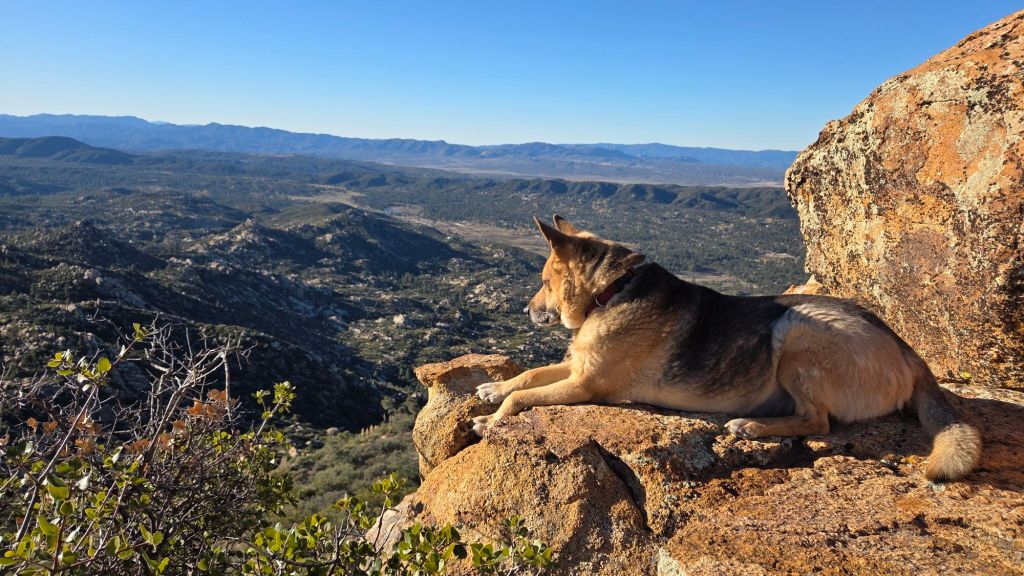
The best-known north springs immediately adjacent to the trail at Wellman’s Cienega (9300 ft), early morning 19th July 2025. A great source of water on this route but the relatively low flow is reminiscent of the dry years of 2014-2016, rather than the strong flows of 2023-2024.
The creek in Little Round Valley where it crosses Deer Springs Trail at the west end of the valley (9700 ft), early morning 25th July 2025. Although flowing gently here, the creek is steadily drying further upstream where it passes through the meadow.
The creek that flows from the Deer Springs is now dry where it crosses Deer Springs Trail at about PCT Mile 185.3, 25th July 2025.
The North Fork of the San Jacinto River is flowing gently at 8800 ft where it crosses Fuller Ridge Trail at PCT Mile 186, 25th July 2025, even though it is now functionally dry downstream at 6900 ft (photo below).
The small creek in Skunk Cabbage Meadow is close to drying where it is crossed by the trail on the east side of the meadow, 23rd July 2025, and the flow is now insufficient for filtering by hikers.
For those who know where it is, the pipe in Tahquitz Valley finally dried up in mid July, photo taken 23rd July 2025.
Tahquitz Creek flowing steadily for the time of year immediately below its source (“Grethe Spring”) where it crosses the PCT at about Mile 177, 26th June 2025.
Tahquitz Creek flowing well at the lower (north) end of Little Tahquitz Meadow, 26th June 2025.
Willow Creek at 7450 ft flowing gently where the so-called King Trail meets what remains of the old Caramba Trail, 15th July 2025.
Switchback Spring, about 0.6 mile north on the PCT from Strawberry Junction, continues to flow reliably where it crosses Deer Springs Trail at about PCT Mile 183.7, late morning 11th July 2025. Although truly perennial, the flow is so gentle that this tiny spring really only functions as an emergency water source.
Above and below, the before and after of trail recovery work undertaken by the Trail Report on Fuller Ridge (PCT Mile 186.8), 16th July 2025.
Above and below, the North Fork of the San Jacinto River where it crosses Seven Pines Trail. Above, early morning on 22nd July 2025, with the river completely dry at this point (although a few small pools persisted both up- and downstream). Below, flowing gently just six weeks earlier on 6th June 2025.
Trail maintenance work by the Trail Report continues year-round, as shown here on the use trail down to Laws (the so-called King Trail), 24th July 2025.

Trail update 9th July 2025

Hikers should be prepared for hot weather from Tuesday 8th onwards, with forecast temperatures above seasonal even for July, and overnight low temperatures in particular as much as 10°F above average. At the elevation of Idyllwild (5300 ft), high and low temperatures are forecast to be around or above 90°F and 60°F, respectively, for at least six consecutive days (9th-14th July). Please give considerable extra thought to route choice, start times, clothing, sun protection, and water requirements.

The Wolf Fire started on the afternoon of Sunday 29th June in the extreme north-west corner of the San Jacinto mountains (just south of Banning) and rapidly spread to the east, burning across Mount Edna, closing Highway 243, and threatening the Twin Pines area. By that evening, thick smoke enveloped the mountains, including all of Idyllwild and Pine Cove, and the fire had expanded to 1200 acres. Thankfully the wind shifted dramatically overnight (from westerly to south-east) which helped slow fire progress, moved the fire away from the most populous areas of the San Jacinto mountains, and cleared the smoke from the high country. By 1st July the fire had been held at about 2410 acres and Highway 243 reopened on the evening of Thursday 3rd July.

Although smoke from the Wolf Fire dissipated promptly, in the absence of strong winds and any hint of precipitation, there has again been a deterioration in air quality in our region. Although not as bad as during the third week of June (see photo in prior Report linked here), visibility from San Jacinto Peak on Friday 4th July was once again very poor, with a prominent smoke/smog band below 10,000 ft.

Water flows everywhere are low for July, with many ephemeral sources already dry (multiple example photos below). Key hiker water sources such as Wellman’s Cienega and the pipe in Round Valley are currently flowing but may dry up in the autumn. Ephemeral sources along Marion Mountain Trail are now all dry for the first time in more than two years. The Deer Springs creek is now dry where it crosses the trail of the same name. The creek in Little Round Valley may be only weeks from drying in its upper section, but could persist for a couple of months where it crosses Deer Springs Trail at the mouth of the valley. Hidden Lake was dry by the end of June. Long Valley Creek is dry where it passes through Round Valley, but Tamarack Creek just to the north is trickling. Water is flowing relatively well, for now, in Skunk Cabbage Meadow, and reliably in Tahquitz Creek at PCT Mile 177 and again further downstream at the north end of Little Tahquitz Meadow (although it is completely dry at the surface between those two locations). Middle Spring on Devil’s Slide Trail continues to trickle.

Full fire restrictions began on Tuesday 1st July 2025 on Forest Service lands, as described on the USFS website linked here. Campfires throughout USFS lands in the San Jacinto Mountains, including all campgrounds and yellow post sites, are now prohibited.

Fire lookouts at Black Mountain and Tahquitz Peak are sadly closed indefinitely due to issues identified in a May safety inspection, and are not expected to reopen before August at the earliest. Dark Canyon Road (4S02) reopened in May and the dirt section has had some effective basic maintenance. The associated Dark Canyon campground will be closed for the year due to staffing/budget challenges.

Be rattlesnake aware. Above about 5000 ft elevation, the venom of Southern Pacific Rattlesnakes (Crotalus [oreganus] helleri) in the San Jacinto mountains is predominantly neurotoxic, almost always fatal for dogs and sometimes for humans (see my detailed article linked here for further information describing our dogs’ survival after a July 2020 neurotoxic bite). Devil’s Slide Trail, lower Deer Springs and lower Marion Mountain trails, Suicide Rock, near Strawberry Cienega, and trails around Tahquitz Peak are frequent locations for sightings, but rattlesnakes have been recorded widely up to 9350 ft (see photos below).

Be bear aware. Although rarely reported in recent years, at least three individually identifiable Black Bears have been in the San Jacinto mountains since 2017, and I have personally seen at least one annually for the past six years. One adult-sized, light chestnut-colored individual was reliably reported – with multiple photographs – from Willow Creek Trail alongside Skunk Cabbage Meadow on 12th July 2025 (information courtesy of Mike Meyer). I photographed fresh tracks in snow on 12th February 2024 at 9000 ft near PCT Mile 180.5 (photo linked here), and my brief videos from Devil’s Slide Trail in September 2021 (available here) and one on our property in Idyllwild in 2018 (linked here) show two different individuals. There have been no reports of negative interactions with humans at or near campsites or on trails.

Survey hikes by the Trail Report literally daily throughout the year in the San Jacinto mountains include multiple routes to various high peaks including San Jacinto Peak typically 2-3 times per week (more frequently during storms), Tahquitz Peak and area at least once per week, plus a wide variety of other trails on intervening days.

Above, a large adult Southern Pacific Rattlesnake (SPR) at 8100 ft next to the meadow trail between Little Tahquitz Meadow and the PCT, 26th June 2025. This snake was very sluggish at only 0740 on a relatively cool morning, but had enough energy to rattle at me when I stepped to within about two feet (Anabel was safely behind me). Below, a juvenile SPR just 10 inches long, at 7900 ft by upper Devil’s Slide Trail, late morning 30th June 2025. Young SPRs darken rapidly in their second and third years in the San Jacinto mountains, but generally remain pale into adulthood below about 5000 ft.

WEATHER

Temperatures were consistently above seasonal for a month starting on 20th May, and peaked above even midsummer averages between 10th-20th June, with multiple daytime highs at or above 90°F recorded. There were five pleasantly cool days starting 21st June, with temperatures briefly below seasonal, before then rising yet again to above average for June by Thursday 26th.

Temperatures in the first few days of July were about seasonal for midsummer, before rising to above seasonal for July starting around Tuesday 8th. Temperatures are currently forecast to be at or above average for the month until at least 20th July. At the elevation of Idyllwild (5300 ft) daytime high and overnight low temperatures will be around or may even exceed 90°F and 60°F, respectively, for at least six consecutive days (9th-14th July). There is no significant precipitation in the forecasts, with monsoon conditions not well developed in the desert south-west at this time.

At San Jacinto Peak (10,810ft/3295m) on Friday 11th July 2025 at 0815 the air temperature was 55.6°F (13°C), with a “windchill” temperature of 49.5°F (10°C), 8% relative humidity, and a steady due West wind sustained at 13 mph gusting to 19.9 mph.

At the Peak on Tuesday 8th July 2025 at 0745 the air temperature was 54.0°F (12°C), with a “windchill” temperature of 47.1°F (8°C), 10% relative humidity, and a brisk SSW wind sustained at 10 mph gusting to 18.8 mph.

At the Peak on Friday 4th July 2025 at 0740 the air temperature was 48.4°F (9°C), with a “windchill” temperature of 44.1°F (7°C), 49% relative humidity, and a steady WSW wind sustained at 5 mph gusting to 7.2 mph.

Tahquitz Ivesia (Ivesia callida) in full bloom, near Tahquitz Peak, 3rd July 2025. The Ivesia is one of the rarest and most range-restricted of the dozen or so plant species endemic to the San Jacinto Mountains. Flowering is at least one month earlier in 2025 than average.

TRAIL CONDITIONS

The established trail system was completely clear of snow by late May. The Wolf Fire did not have any significant impact on the trail system.

Work since mid 2024 by various PCTA-USFS-ACE crews has largely resolved the backlog of downed trees on PCT Miles 170-175 (roughly Apache Peak to Red Tahquitz) accumulated during several years of agency neglect. Six trees remain to be cut around South Peak (Miles 173.5-174) of which most are significant obstructions for hikers [surveyed June 2025]. Lengthy sections of the trail are overgrown with brush and in urgent need of trimming, especially most of Miles 168-174. Regrettably post-fire erosion has created a loose, rocky, and uneven tread in parts of the same section, requiring significant caution in places.

The two large downed trees near PCT Mile 180 were removed by the Trail Report on 21st May (photo in a prior Report linked here). The Strawberry Trail (PCT Miles 180.8-183.1) has ten blowdowns, none of which pose major hazards to hikers. Of the eight on the Forest Service section, several have been down for 8-10 years and reported repeatedly but with no action. The brush between the cienega and Annie’s Junction (roughly Miles 181-181.7) has become heavily overgrown since it was last trimmed in 2021.

Five further blowdowns remain on the Deer Springs Trail portion of the PCT (Miles 183-185), some of which are major obstructions, albeit with workarounds. For the first time in a decade, upper Deer Springs Trail, between the top of Marion Mountain Trail and Little Round Valley, is now clear of blowdowns, with the Trail Report having removed eight trees this spring, including the two major hazards at PCT Mile 185.3 that came down this past winter. About ten further trees would need to be cut to restore the original route of Deer Springs Trail above Little Round Valley, but there is no prospect of that happening soon, if ever. The trail, despite dozens of minor alternates, is easy to follow.

Sadly the maintenance condition of the Fuller Ridge (Miles 185.5-190.5) section of the PCT is the poorest I have ever seen. The State Park has not attempted to maintain their section (Miles 185.5-189) for more than a dozen years. Treefall hazards were cut by PCTA in 2019, and vegetation was thoroughly trimmed by the Trail Report in 2020, but repeating these tasks is now long overdue and there are 12 trees down on that section of which five present major obstructions. Needless to say the trail is impassable with stock. The tread is a mess of debris (sticks, branches, rocks, cones) and shortcut switchbacks. Thankfully reporting of these problems has led to the scheduling of a PCTA volunteer crew to work on this section in late July 2025. By contrast the Forest Service section (north from Mile 189) has been relatively well maintained in recent years, with just three (thankfully all small) new trees coming down on that section this past winter.

On the Wellman Trail, Wellman’s Cienega is flowing relatively poorly (photo below) but there is still plenty of water for hikers for now. The Trail Report continues the work it started last year to maintain this trail (having become badly overgrown by early 2024).

Black Mountain Road is open and in its typical non-graded condition, i.e. lumpy but readily passable in any moderate clearance vehicle. South Ridge Road is in similar condition.

Storms in February-March brought down another 34 trees across Spitler Peak Trail. All but one were removed in late March by the Trail Report, bringing to 162 the total number of trees we have removed from this route in the past six years. One very large burned cedar remains across the trail immediately after the first creek crossing 3.2 miles up from the trailhead. Another new but thankfully small tree came down very recently close to the PCT but is easily stepped over.

As of 16th June 2025, for the first time in at least 15 years Seven Pines Trail has a continuous route completely cleared of blowdown trees (the route is now also as faithful to the original trail as possible). Since April this year a further 25 treefall hazards have been removed, and with slow but steady work continuing on clearing accumulated winter debris, to date mainly below 8200 ft. The Trail Report “adopted” Seven Pines as a priority for maintenance work nearly a decade ago due to a disproportionate number of lost hiker rescues, with State Park and Forest Service no longer maintaining the route. Since 2019 we have now removed exactly 100 downed trees and the trail is largely trimmed and cleared at least annually. Although our work has functionally restored this delightful trail, note that Seven Pines remains a genuine wilderness trail unlike the wider, bare, obvious routes of, for example, Devil’s Slide or Marion Mountain trails. Cautious navigation remains invaluable for those without extensive experience of hiking this trail.

After considerable work (mainly on the Forest Service side) Willow Creek Trail is in much better condition than this time last year. Of the four new trees that came down on the Forest Service section in January, three were removed in June, and the other is expected to be cut soon. Whitethorn needs trimming again especially near the boundary between the two agencies, but is not as bad as in 2022-23. Two new trees on the State Park side are minor and easily passed, and thankfully the two large ones remaining uncut from years ago are also easily passed.

The Caramba Trail from near Reeds Meadow through Laws Camp and on to Caramba, and the Cedar Trail from Willow Creek Trail to Laws, are euphemistically (and potentially dangerously) described by the Forest Service as “not maintained”. In reality both trails have been abandoned and no longer exist. They are so heavily overgrown, largely with dense whitethorn which obscures dozens of downed trees, that hikers should not attempt to follow them (regardless of how much you may trust an app). An informal use trail to Laws is much more direct, generally well maintained, and avoids the bushwhacking of the unmaintained trails (some local Idyllwild hikers dubbed it the “King Trail” when I established the route in 2019). It leaves Willow Creek Trail exactly 1.0 mile from Saddle Junction, 0.46 mile from the Skunk Cabbage turning (trailhead at N 33.7796, W 116.6590). The route descends largely following established deer trails for 1.2 miles, meeting Willow Creek about 0.2 mile upstream from the site of the historic Laws Camp (the remains of which were destroyed by the 2013 Mountain Fire and subsequent flood and treefall damage). One huge tree fell in late 2024 across the King Trail about midway down and requires a minor scramble underneath (that tree may not be cut soon), while another fell in January 2025 close to the bottom of the trail that is relatively easy to cross over. Another five recently downed trees were either removed or worked around in January 2025, when the trail was thoroughly trimmed and cleared. From Laws east to Caramba the original Caramba Trail has been cairned by myself and others and can largely be followed with careful route-finding. My February 2025 survey counted about 120 trees down on this 2.1 miles of trail. It is extremely obscure for the first 0.5 mile east of the Willow Creek crossing, becoming more obvious (but still subtle) as it descends towards Caramba. Very cautious navigation is advised throughout the area.

The Zen Center Trail continues its serious deterioration that started following the 2013 Mountain Fire, with a combination of vigorous regrowth and treefall hazards further obscuring the route with each passing season. The lower and upper thirds of this trail are partially cairned and not too bad for those who are very familiar with the former route, but even the experienced find navigating the central section tricky. Long trousers, scrambling gloves, and a genuine enjoyment of bush-whacking are all strongly recommended.

The best-known north springs immediately adjacent to the trail at Wellman’s Cienega (9300 ft), early morning 11th July 2025. A great source of water on this route but the relatively low flow is reminiscent of the dry years of 2014-2016, rather than the strong flows of 2023-2024.

While all time and labor is volunteered, the San Jacinto Trail Report uses small donations to help cover modest operating costs. Your contribution keeps the Report available to all, free from advertising or paywalls, and independent from agencies. If you have found this Report useful, please consider using this link to the Donate page. Thank you very much for your support.

The creek in Little Round Valley where it crosses Deer Springs Trail at the west end of the valley (9700 ft), mid morning 11th July 2025. Although flowing gently here, the creek is close to drying up further upstream where it passes through the meadow, and the low flow for early summer suggests this creek could dry in the autumn.
The small creek in Skunk Cabbage Meadow flowing relatively well where it is crossed by the trail on the east side of the meadow, 26th June 2025.
For those who know where it is, the pipe in Tahquitz Valley continues to flow well, 26th June 2025.
Tahquitz Creek flowing steadily for the time of year immediately below its source (“Grethe Spring”) where it crosses the PCT at about Mile 177, 26th June 2025.
Tahquitz Creek flowing well at the lower (north) end of Little Tahquitz Meadow, 26th June 2025.
Switchback Spring, about 0.6 mile north on the PCT from Strawberry Junction, continues to flow reliably where it crosses Deer Springs Trail at about PCT Mile 183.7, late morning 11th July 2025. Although truly perennial, the flow is so gentle that this tiny spring really only functions as an emergency water source.
The North Fork of the San Jacinto River where it crosses Seven Pines Trail, 6th June 2025. Although it looks idyllic, the flow is low for June and it will be touch-and-go as to whether the river dries here by August-September.

Trail update 26th June 2025

UPDATE Monday 30th June at 1200: The wind shifted dramatically overnight (from westerly to south-east) which thankfully both limited the progress of the Wolf Fire, and moved it away from the populated areas of the San Jacinto mountains. While I could clearly see smoke from San Jacinto Peak this morning, and burned areas right up to Highway 243, the acreage has held at 1400.

UPDATE Sunday 29th June at 1900: Air quality – which as I described below was already poor – has deteriorated dramatically this afternoon with smoke from the Wolf Fire covering the San Jacinto mountains. The fire, currently 1200 acres, is in the far north-west of the mountain range, just west of the Twin Pines area. Highway 243 between Banning and Idyllwild has been impacted and is closed.

——————————————–

Humans and wildlife enjoyed some respite from the summer heat with a unexpected, albeit brief, taste of spring in late June. Temperatures fell markedly to slightly below average for the month on 21st June, and remained relatively cool until Thursday 26th, before being forecast to rapidly rise again to near or above seasonal for the next week.

In the absence of strong winds and any hint of precipitation, there has been a serious deterioration in air quality in our region. Visibility in all directions from San Jacinto Peak on Sunday 22nd was as poor as I have ever seen – other than days with fire smoke of course – with Palm Springs completely obscured by haze (photo below).

Water flows everywhere are low for this early in the summer, but currently holding steady (multiple example photos below). Key hiker water sources such as Wellman’s Cienega, Strawberry Cienega, and the pipe in Round Valley are all flowing but one or more may dry up later this summer. Ephemeral sources along Marion Mountain Trail are now all dry for the first time in more than two years. The creek in Little Round Valley may be only weeks from drying in its upper section, but could persist for a couple of months where it crosses Deer Springs Trail at the mouth of the valley. Hidden Lake is functionally dry by the end of June. Long Valley Creek is dry where it passes through Round Valley, but Tamarack Creek just to the north is trickling. Water is flowing relatively well, for now, in Skunk Cabbage Meadow, and reliably in Tahquitz Creek at PCT Mile 177 and again further downstream at the north end of Little Tahquitz Meadow (although it is completely dry between those two locations).

Hikers should be prepared for unseasonably hot weather from Thursday 26th onwards, with temperatures well above seasonal for June, overnight low temperatures in particular as much as 10°F above average. Please give considerable extra thought to route choice, start times, clothing, sun protection, and water requirements (the latter especially challenging in this dry year).

Dark Canyon Road (4S02) reopened in May and the dirt section has had some effective basic maintenance. The associated Dark Canyon campground will be closed for the year due to staffing/budget challenges. Fire lookouts at Black Mountain and Tahquitz Peak, expected to reopen in May, are sadly closed indefinitely due to issues identified in a recent safety inspection.

Be rattlesnake aware. Above about 5000 ft elevation, the venom of Southern Pacific Rattlesnakes (Crotalus [oreganus] helleri) in the San Jacinto mountains is predominantly neurotoxic, almost always fatal for dogs and sometimes for humans (see my detailed 2020 article linked here for further information). Devil’s Slide Trail, lower Deer Springs and lower Marion Mountain trails, Suicide Rock, near Strawberry Cienega, and trails around Tahquitz Peak are frequent locations for sightings, but rattlesnakes have been recorded widely up to 9350 ft (see photos below).

Survey hikes by the Trail Report every single day throughout the year in the San Jacinto mountains include multiple routes to various high peaks including San Jacinto Peak typically 2-3 times per week (most frequently during storms), Tahquitz Peak and area at least once per week, plus a wide variety of other trails on intervening days.

A large adult Southern Pacific Rattlesnake next to the meadow trail between Little Tahquitz Meadow and the PCT, early morning 26th June 2025. The air temperature was only about 55F (much cooler in shaded areas) and this snake was very sluggish, but had enough energy to rattle at me when I stepped to within about two feet (Anabel was behind me). The image below shows its location relative to the trail, but as we were coming from the opposite direction the snake was impossible to see until I was right next to it.

WEATHER

Temperatures were consistently above seasonal for a month starting on 20th May, and peaked above even midsummer averages between 10th-20th June, with multiple daytime highs at or above 90°F recorded. Finally temperatures dropped markedly starting 21st June, to below seasonal, and will remain pleasantly cool in the first half of this week before then rising yet again to above average for June by Thursday 26th. Temperatures in the first week of July are expected to be about seasonal for that month.

There is no significant precipitation in the forecasts, with monsoon conditions not well developed in the desert south-west at this time.

At San Jacinto Peak (10,810ft/3295m) on Sunday 22nd June 2025 at 0900 the air temperature was 46.0°F (8°C), with a windchill temperature of 36.9°F (3°C), 14% relative humidity, and a light WNW wind sustained at 6 mph gusting to 10.1 mph.

At the Peak on Friday 20th June 2025 at 0830 the air temperature was 46.8°F (8°C), with a windchill temperature of 35.4°F (2°C), 29% relative humidity, and a steady WNW wind sustained at 19 mph gusting to 31.5 mph.

The “view” of the Coachella Valley looking south-east from San Jacinto Peak, mid morning on Sunday 22nd June 2025. Thick haze enshrouded all of lowland Southern California, with a ceiling near 9000 ft elevation. Toro Peak (8717 ft), the high point of the Santa Rosa Mountains, is the distant prominent peak to the upper right.

TRAIL CONDITIONS

The established trail system was completely clear of snow by late May.

Work since mid 2024 by various PCTA-USFS-ACE crews has largely resolved the backlog of downed trees on PCT Miles 170-175 (roughly Apache Peak to Red Tahquitz) accumulated during several years of agency neglect. Six trees remain to be cut around South Peak (Miles 173.5-174) of which most are significant obstructions for hikers [surveyed June 2025]. Lengthy sections of the trail are overgrown with brush and in urgent need of trimming, especially most of Miles 168-174. Regrettably post-fire erosion has created a loose, rocky, and uneven tread in parts of the same section, requiring significant caution in places.

The two large downed trees near PCT Mile 180 were removed by the Trail Report on 21st May (photo in a prior Report linked here). The Strawberry Trail (PCT Miles 180.8-183.1) has ten blowdowns, none of which pose major hazards to hikers. Of the eight on the Forest Service section, several have been down for 8-10 years and reported repeatedly but with no action. The brush between the cienega and Annie’s Junction (roughly Miles 181-181.7) has become heavily overgrown since it was last trimmed in 2021.

Five further blowdowns remain on the Deer Springs Trail portion of the PCT (Miles 183-185), some of which are major obstructions, albeit with workarounds. Two of the most significant blowdowns on this section, at Mile 185.3, were removed by the Trail Report last week (photo in previous Report linked here).

Sadly the maintenance condition of the Fuller Ridge (Miles 185.5-190.5) section of the PCT is the poorest I have ever seen. The State Park has not attempted to maintain their section (Miles 185.5-189) for more than a dozen years. Treefall hazards were cut by PCTA in 2019, and vegetation was thoroughly trimmed by the Trail Report in 2020, but repeating these tasks is now long overdue and there are 12 trees down on that section of which five present major obstructions. Needless to say the trail is impassable with stock. The tread is a mess of debris (sticks, branches, rocks, cones) and shortcut switchbacks. Thankfully our reporting of these problems has led to the scheduling of a PCTA volunteer crew to work on this section in late July. By contrast the Forest Service section (north from Mile 189) has been relatively well maintained in recent years, with just three (thankfully all small) new trees coming down on that section this past winter.

On the Wellman Trail, Wellman’s Cienega is flowing poorly for this early in the season (photo below) but there is still plenty of water for hikers for now. The Trail Report continues the work it started in mid 2024 to heavily trim this formerly overgrown trail.

Black Mountain Road is open and in its typical non-graded condition, i.e. lumpy but readily passable in any moderate clearance vehicle. South Ridge Road is in very similar condition.

Storms in February-March brought down another 34 trees across Spitler Peak Trail. All but one were removed in late March by the Trail Report, bringing to 162 the total number of trees we have removed from this route in the past six years. One very large burned cedar remains across the trail immediately after the first creek crossing 3.2 miles up from the trailhead. Another new but thankfully small tree came down very recently close to the PCT but is easily stepped over.

As of 16th June 2025, for the first time in at least 15 years Seven Pines Trail has a continuous route completely cleared of blowdown trees (the route is now also as faithful to the original trail as possible). Since April this year a further 25 treefall hazards have been removed, and with slow but steady work continuing on clearing accumulated winter debris, to date mainly below 8200 ft. The Trail Report “adopted” Seven Pines as a priority for maintenance work nearly a decade ago due to a disproportionate number of lost hiker rescues, with State Park and Forest Service no longer maintaining the route. Since 2019 we have now removed exactly 100 downed trees and the trail is largely trimmed and cleared at least annually. Although our work has functionally restored this delightful trail, note that Seven Pines remains a genuine wilderness trail unlike the wider, bare, obvious routes of, for example, Devil’s Slide or Marion Mountain trails. Cautious navigation remains invaluable for those without extensive experience of hiking this trail.

After considerable work (mainly on the Forest Service side) Willow Creek Trail is in much better condition than this time last year. Of the four new trees that came down on the Forest Service section in January, three were removed in June, and the other is expected to be cut soon. Whitethorn needs trimming again especially near the boundary between the two agencies, but is not as bad as in 2022-23. Two new trees on the State Park side are minor and easily passed, and thankfully the two large ones remaining uncut from years ago are also easily passed.

The Caramba Trail from near Reeds Meadow through Laws Camp and on to Caramba, and the Cedar Trail from Willow Creek Trail to Laws, are euphemistically (and potentially dangerously) described by the Forest Service as “not maintained”. In reality both trails have been abandoned and no longer exist. They are so heavily overgrown, largely with dense whitethorn which obscures dozens of downed trees, that hikers should not attempt to follow them (regardless of how much you may trust an app). An informal use trail to Laws is much more direct, generally well maintained, and avoids the bushwhacking of the unmaintained trails (some local Idyllwild hikers dubbed it the “King Trail” when I established the route in 2019). It leaves Willow Creek Trail exactly 1.0 mile from Saddle Junction, 0.46 mile from the Skunk Cabbage turning (trailhead at N 33.7796, W 116.6590). The route descends largely following established deer trails for 1.2 miles, meeting Willow Creek about 0.2 mile upstream from the site of the historic Laws Camp (the remains of which were destroyed by the 2013 Mountain Fire and subsequent flood and treefall damage). One huge tree fell in late 2024 across the King Trail about midway down and requires a minor scramble underneath (that tree may not be cut soon), while another fell in January 2025 close to the bottom of the trail that is relatively easy to cross over. Another five recently downed trees were either removed or worked around in January 2025, when the trail was thoroughly trimmed and cleared. From Laws east to Caramba the original Caramba Trail has been cairned by myself and others and can largely be followed with careful route-finding. My February 2025 survey counted about 120 trees down on this 2.1 miles of trail. It is extremely obscure for the first 0.5 mile east of the Willow Creek crossing, becoming more obvious (but still subtle) as it descends towards Caramba. Very cautious navigation is advised throughout the area.

The Zen Center Trail continues its serious deterioration that started following the 2013 Mountain Fire, with a combination of vigorous regrowth and treefall hazards further obscuring the route with each passing season. The lower and upper thirds of this trail are partially cairned and not too bad for those who are very familiar with the former route, but even the experienced find navigating the central section tricky. Long trousers, scrambling gloves, and a genuine enjoyment of bush-whacking are all strongly recommended.

The best-known north spring immediately adjacent to the trail at Wellman’s Cienega (9300 ft), early morning 14th June 2025. A great source of water on this route but the low flow is reminiscent of the dry years of 2014-2016, rather than the recent steady flows of 2023-2024.

While all time and labor is volunteered, the San Jacinto Trail Report uses small donations to help cover modest operating costs. Your contribution keeps the Report available to all, free from advertising or paywalls, and independent from agencies. If you have found this Report useful, please consider using this link to the Donate page. Thank you very much for your support.
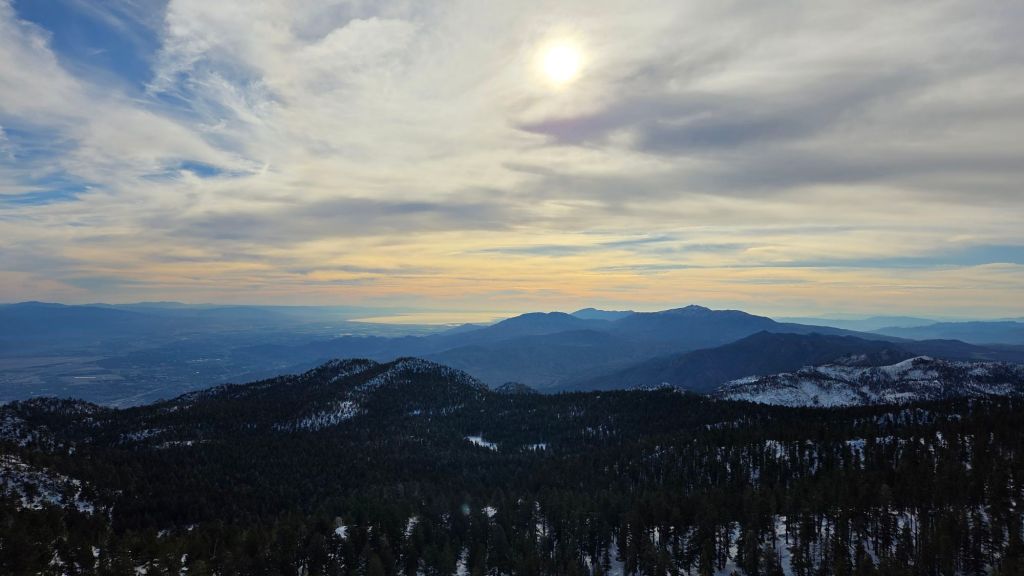
The creek in Little Round Valley where it crosses Deer Springs Trail at the west end of the valley (9700 ft), mid morning 22nd June 2025. Although flowing gently here, the creek is close to drying up further upstream where it passes through the meadow, and the low flow for mid June suggests this creek may dry by late summer.
The small creek in Skunk Cabbage Meadow flowing relatively well where it is crossed by the trail on the east side of the meadow, 26th June 2025.
For those who know where it is, the pipe in Tahquitz Valley continues to flow well, 26th June 2025.
Tahquitz Creek flowing steadily for the time of year immediately below its source (“Grethe Spring”) where it crosses the PCT at about Mile 177, 26th June 2025.
Tahquitz Creek flowing well at the lower (north) end of Little Tahquitz Meadow, 26th June 2025.
The North Fork of the San Jacinto River where it crosses Seven Pines Trail, 6th June 2025. Although it looks idyllic, the flow is low for June and it will be touch-and-go as to whether the river dries here by August-September.

Trail update 20th June 2025

Water flows in most “perennial” sources are low, or even very low, for this early in the summer. Key hiker water sources such as Wellman’s Cienega, Strawberry Cienega, and the pipe in Round Valley (sample photos below) are currently flowing but may dry up later this summer. The creek in Little Round Valley is only weeks from drying in its upper section, but may persist for a month or two where it crosses Deer Springs Trail at the mouth of the valley. Hidden Lake was so low in late May that it is likely to dry completely by the end of June. Long Valley Creek is dry where it passes through Round Valley, but Tamarack Creek just to the north is trickling. Water is flowing surprisingly well, for now, in Skunk Cabbage Meadow, and reliably in Tahquitz Creek at PCT Mile 177 and again further downstream at the north end of Little Tahquitz Meadow (photos below).

Hikers should be prepared for unseasonably hot weather until Friday 20th (and from Thursday 26th onwards), with temperatures well above seasonal for June, overnight low temperatures in particular as much as 10-15°F above average. Please give considerable extra thought to route choice, start times, clothing, sun protection, and water requirements (the latter especially challenging in this dry year).

Dark Canyon Road (4S02) reopened in May and the dirt section has had some effective basic maintenance. The associated Dark Canyon campground will be closed for the year due to staffing/budget challenges. Fire lookouts at Black Mountain and Tahquitz Peak, expected to reopen in May, are sadly closed indefinitely due to issues identified in a recent safety inspection.

Be rattlesnake aware. Rattlesnakes are now active, although so far populations appear to be low this season. Above about 5000 ft elevation, the venom of Southern Pacific Rattlesnakes (Crotalus [oreganus] helleri) in the San Jacinto mountains is predominantly neurotoxic, almost always fatal for dogs and sometimes for humans (see my detailed 2020 article linked here for further information). Devil’s Slide Trail, lower Deer Springs and lower Marion Mountain trails, Suicide Rock, near Strawberry Cienega, and trails around Tahquitz Peak are frequent locations for sightings, but rattlesnakes have been recorded throughout up to 9350 ft.

Survey hikes by the Trail Report every single day throughout the year in the San Jacinto mountains include varied routes to the high peaks including San Jacinto Peak typically 2-3 times per week (more frequently during storms), Tahquitz Peak and area 1-2 times per week, plus a wide variety of other trails on intervening days.

Ceanothus palmeri (Palmer Whitethorn is one of several common names) in spectacular bloom, PCT Mile 170.5 on the Desert Divide, 5th June 2025. A lovely aroma and impressively packed with insects, the only negative (as shown here) is that the whitethorn is heavily overgrowing the trail and hikers have to push through head high bushes in many places on this section.

WEATHER

Temperatures have been consistently above seasonal since 20th May and are forecast to remain that way until about 20th June. Temperatures will be more typical of July-August between 10th-20th June.

Temperatures are forecast to drop quite rapidly on 21st-25th June, to near or even below seasonal, before then rising yet again to above average for June by Thursday 26th. There is no significant precipitation in the forecasts.

Thunderstorms on the afternoon and evening of Tuesday 3rd June were accompanied by remarkably early monsoonal moisture. Locations on the east side of the mountain range received the most rain, with 0.38 inch at Wellman’s Cienega (9300 ft) and 0.35 inch at Saddle Junction (8100 ft). San Jacinto Peak recorded just 0.16 inch, with similar amounts in Little Round Valley and at the top of Marion Mountain Trail, and only 0.13 inch in Idyllwild (at 5550 ft).

Total accumulated snowfall this past winter at San Jacinto Peak – 72.6 inches – was the lowest in recorded history (the three driest winters have all been in the past five years). For context, this is approximately 40% of what was average snowfall for the Peak less than 50 years ago.

At San Jacinto Peak (10,810ft/3295m) on Friday 20th June 2025 at 0830 the air temperature was 46.8°F (8°C), with a windchill temperature of 35.4°F (2°C), 29% relative humidity, and a steady WNW wind sustained at 19 mph gusting to 31.5 mph.

At the Peak on Monday 16th June 2025 at 0930 the air temperature was 59.2°F (15°C), with a “windchill” temperature of 57.2°F (14°C), 15% relative humidity, and a light WNW breeze sustained at 3 mph gusting to 5.5 mph.

At the Peak on Sunday 14th June 2025 at 0740 the air temperature was 53.9°F (12°C), with a “windchill” temperature of 47.3°F (8°C), 13% relative humidity, and a moderate WSW wind sustained at 7 mph gusting to 15.1 mph.

Cane Cholla (Cylindropuntia californica var. parkeri) in flower, at 5200 ft on lower Spitler Peak Trail, 5th June 2025. A nice patch of color in an otherwise poor year for semi-desert flowers in our region.

TRAIL CONDITIONS

The established trail system was completely clear of snow by late May.

Work since mid 2024 by various PCTA-USFS-ACE crews has largely resolved the backlog of downed trees on PCT Miles 170-175 (broadly Apache Peak to Red Tahquitz) accumulated during several years of agency neglect. Six trees remain to be cut around South Peak (Miles 173.5-174) of which most are significant obstructions for hikers [surveyed 5th June]. Lengthy sections of the trail are overgrown with brush and in urgent need of trimming, especially most of Miles 168-174. Regrettably post-fire erosion has created a loose, rocky, and uneven tread in parts of the same section, requiring significant caution in places.

The two large downed trees near PCT Mile 180 were removed by the Trail Report on 21st May (photo in a prior Report linked here). The Strawberry Trail (PCT Miles 180.8-183.1) has ten blowdowns, none of which pose major hazards to hikers. Of the eight on the Forest Service section, several have been down for 8-10 years and reported repeatedly but with no action. The brush between the cienega and Annie’s Junction (roughly Miles 181-181.7) has become heavily overgrown since it was last trimmed in 2021.

Five further blowdowns remain on the Deer Springs Trail portion of the PCT (Miles 183-185), some of which are major obstructions, albeit with workarounds. Two of the most significant blowdowns on this section, at Mile 185.3, were removed by the Trail Report earlier this week (photo below).

Sadly the maintenance condition of the Fuller Ridge (Miles 185.5-190.5) section of the PCT is the poorest I have ever seen. The State Park has not attempted to maintain their section (Miles 185.5-189) for more than a dozen years. Treefall hazards were cut by PCTA in 2019, and vegetation was thoroughly trimmed by the Trail Report in 2020, but repeating these tasks is now long overdue and there are 12 trees down on that section of which five present major obstructions. Needless to say the trail is impassable with stock. The tread is a mess of debris (sticks, branches, rocks, cones) and shortcut switchbacks. By contrast the Forest Service section (north from Mile 189) has been relatively well maintained in recent years, with just three (thankfully all small) new trees coming down on that section this past winter.

On the Wellman Trail, Wellman’s Cienega is flowing poorly for this early in the season (photo below) but there is still plenty of water for now. The Trail Report continues the work it started in mid 2024 to heavily trim this formerly overgrown trail.

The East Ridge Trail route to San Jacinto Peak starting at 10,400 ft near Miller Peak has finally cleared of snow cover, with a couple of tiny patches lingering into mid June. The old trail can now be followed for its entire length.

Black Mountain Road is open and in its typical non-graded condition, i.e. lumpy but readily passable in any moderate clearance vehicle. South Ridge Road is in very similar condition.

Storms in February-March brought down another 34 trees across Spitler Peak Trail. All but one were removed in late March by the Trail Report, bringing to 162 the total number of trees we have removed from this route in the past six years. One very large burned cedar remains across the trail immediately after the first creek crossing 3.2 miles up from the trailhead. Another new but thankfully small tree came down very recently close to the PCT but is easily passed over [surveyed 5th June].

As of 16th June 2025, for the first time in at least 15 years Seven Pines Trail has a continuous route completely cleared of blowdown trees (the route is also largely faithful to the original trail). Since April this year a further 25 treefall hazards have been removed, with slow but steady progress made on clearing of accumulated winter debris in the trail, especially below 8200 ft. The Trail Report “adopted” Seven Pines as a priority for maintenance work nearly a decade ago due to a disproportionate number of lost hiker rescues, with State Park and Forest Service no longer maintaining the route. Since 2019 we have now removed exactly 100 blowdowns and the trail is generally trimmed and cleared at least annually. Although our work has functionally restored this delightful trail, note that Seven Pines remains a genuine wilderness trail unlike the wider, bare, obvious routes of, for example, Devil’s Slide or Marion Mountain trails. Cautious navigation remains invaluable for those without extensive experience of hiking this trail.

After considerable work (mainly on the Forest Service side) Willow Creek Trail is in much better condition than this time last year. Four new trees came down on the Forest Service section in January, two of which are very large and somewhat tricky to pass (located about 0.5 mile south of Willow Creek, and 0.3 mile north of the creek). It is hoped that these will be removed in mid June. Whitethorn needs trimming again especially near the boundary between the two agencies, but is not as bad as in 2022-23. Two new trees on the State Park side are minor and easily passed, and thankfully the two large ones remaining uncut from years ago are also easily passed.

The Caramba Trail from near Reeds Meadow through Laws Camp and on to Caramba, and the Cedar Trail from Willow Creek Trail to Laws, are euphemistically (and potentially dangerously) described by the Forest Service as “not maintained”. In reality both trails have been abandoned and no longer exist. They are so heavily overgrown, largely with dense whitethorn which obscures dozens of downed trees, that hikers should not attempt to follow them (regardless of how much you may trust an app). An informal use trail to Laws is much more direct, generally well maintained, and avoids the bushwhacking of the unmaintained trails (some local Idyllwild hikers dubbed it the “King Trail” when I established the route in 2019). It leaves Willow Creek Trail exactly 1.0 mile from Saddle Junction, 0.46 mile from the Skunk Cabbage turning (trailhead at N 33.7796, W 116.6590). The route descends largely following established deer trails for 1.2 miles, meeting Willow Creek about 0.2 mile upstream from the site of the historic Laws Camp (the remains of which were destroyed by the 2013 Mountain Fire and subsequent flood and treefall damage). One huge tree fell in late 2024 across the King Trail about midway down and requires a minor scramble underneath (that tree may not be cut soon), while another fell in January 2025 close to the bottom of the trail that is relatively easy to cross over. Another five recently downed trees were either removed or worked around in January 2025, when the trail was thoroughly trimmed and cleared. From Laws east to Caramba the original Caramba Trail has been cairned by myself and others and can largely be followed with careful route-finding. My February 2025 survey counted about 120 trees down on this 2.1 miles of trail. It is extremely obscure for the first 0.5 mile east of the Willow Creek crossing, becoming more obvious (but still subtle) as it descends towards Caramba. Very cautious navigation is advised throughout the area.

The Zen Center Trail continues its serious deterioration that started following the 2013 Mountain Fire, with a combination of vigorous regrowth and treefall hazards further obscuring the route with each passing season. The lower and upper thirds of this trail are partially cairned and not too bad for those who are very familiar with the former route, but even the experienced find navigating the central section tricky. Long trousers, scrambling gloves, and a genuine enjoyment of bush-whacking are all strongly recommended.

The best-known north spring immediately adjacent to the trail at Wellman’s Cienega (9300 ft), early morning 14th June 2025. A great source of water on this route but the low flow is reminiscent of the dry years of 2014-2016, rather than the recent steady flows of 2023-2024.

While all time and labor is volunteered, the San Jacinto Trail Report uses small donations to help cover modest operating costs. Your contribution keeps the Report available to all, free from advertising or paywalls, and independent from agencies. If you have found this Report useful, please consider using this link to the Donate page. Thank you very much for your support.

The creek in Little Round Valley where it crosses Deer Springs Trail at the west end of the valley (9700 ft), mid morning 16th June 2025. Although flowing gently here, the creek is close to drying up further upstream where it passes through the meadow, and the low flow for mid June suggests this creek may well dry by late summer.
The pipe at Round Valley (9050 ft) flowing steadily on 23rd May 2025, and still flowing well as of 14th June.
Strawberry Creek flowing surprisingly well where it crosses the PCT at Strawberry Cienega (8600 ft, approx. Mile 181.8), 29th May 2025. This water source will likely dry up this summer, but perhaps not until July.
Stone Creek flowing gently where it crosses Deer Springs Trail (8350 ft) at about PCT Mile 183.7, roughly 0.6 mile north of Strawberry Junction, 29th May 2025.
The North Fork of the San Jacinto River flowing steadily where it crosses Fuller Ridge Trail at PCT Mile 186.1 (8900 ft), mid morning 2nd June 2025. An invaluable water source for thru hikers and day hikers alike, but one which has dried in summer in comparably low snow years in the past decade.
For those who know where it is, the pipe in Tahquitz Valley continues to flow well, 5th June 2025.
Tahquitz Creek flowing steadily for the time of year immediately below its source (“Grethe Spring”) where it crosses the PCT at about Mile 177, 5th June 2025.
Tahquitz Creek flowing well at the lower (north) end of Little Tahquitz Meadow, 5th June 2025.
Spitler Creek continuing to flow gently, here at its lowest crossing of Spitler Peak Trail about 3.2 miles up from the trailhead, 5th June 2025.
The North Fork of the San Jacinto River where it crosses Seven Pines Trail, 6th June 2025. Although it looks idyllic, the flow is low for June and it will be touch-and-go as to whether the river dries here in July-August.
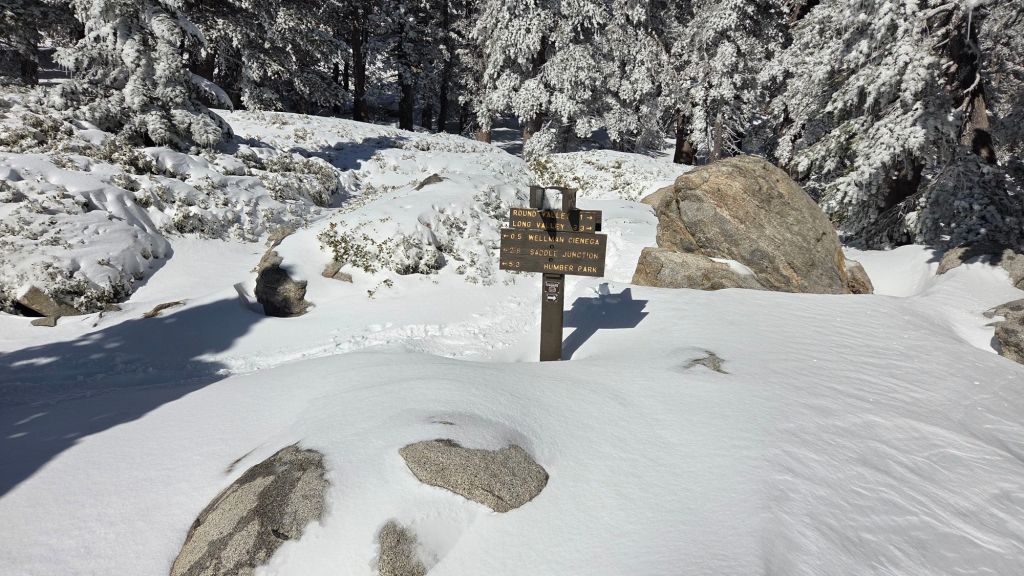
Trail maintenance work by the Trail Report continues steadily throughout the mountain range. Above, on Seven Pines Trail, 6th June 2025, and below, the major double blowdown removed at PCT Mile 185.3, 16th June 2025.