A major blocking high pressure system just west of California will continue to generate warm, relatively calm, and extremely dry conditions for our region into the second half of December. There are tentative forecasts suggesting the jet stream may return to Southern California late in December, around 22nd-26th. Three minor snow storms impacted the San Jacinto mountains in nine days in mid November, as discussed in detail in a prior Report (linked here). Since then, temperatures generally well above seasonal have led to rapid snow melt (for the time of year, given the Sun is at its weakest of the year).
The air temperature of 52.2°F (11°C) that I recorded at San Jacinto Peak on Thursday 11th December 2025 shattered (by 3°F) the previous high temperature knowingly recorded at the Peak in the month of December. Forecasts suggest that the new record could even be exceeded again early next week.
Details are given below under Trail Conditions, but most hikers will find that spikes remain useful in many areas above about 9000 ft, although experienced hikers may find they are no longer essential on established trails even well above that elevation. Despite rapid melting, challenging icy patches persist as low as 7700 ft, notably on Devil’s Slide and Marion Mountain trails. Spikes tend to be especially helpful for descending, even when they seem unnecessary for ascending.
Snow depths measured at various locations on the trail system are given near the foot of this posting. Note however that snow depth itself is rarely indicative of the difficulty (or ease) of hiking a particular track or trail. For example a firm, well-compacted track across snow feet deep is often much easier hiking than traversing across just a few inches depth of, for example, angled virgin icy snow. Conversely, just a one inch covering of icy snow at mid-elevations (where there have been many freeze-thaw cycles) can be among the most treacherous surfaces to hike.
Temperatures are forecast to be far above seasonal into the second half of December. Nevertheless, it is (nominally) winter and hikers should be prepared for temperatures near freezing above 10,000 ft elevation, and periodically below freezing when considering wind chill effects. This advisory may be especially important after 20th December. See the Weather section below for my recent observations from San Jacinto Peak.
Black Mountain Road (4S01) closed to vehicle traffic in mid November at the gate 1.7 miles up from Highway 243. Despite being clear of snow it is now expected to remain closed for the winter season, according to Forest Service.
Be bear aware. Although generally rarely reported, at least six individually identifiable Black Bears have been observed in the San Jacinto mountains since 2017 (I have personally encountered at least one annually for the past seven years). A full-sized adult bear with a right ear tag has been seen in multiple locations from Willow Creek to Fern Valley since August (see my video from a trail cam on 14th September available here, and images from Fern Valley in late August in a prior Report linked here). A smaller, second individual has been reliably reported at least twice, most recently in late September in lower Fern Valley. My brief videos from Devil’s Slide Trail in September 2021 (linked here) and one walking past our house in 2018 (linked here) show two further individuals. There have been no reports of negative interactions with humans in the high country, at or near campsites, or on trails, but bear-safe storage of food when camping is recommended.
Daily survey hikes by the Trail Report year-round in the San Jacinto mountains include multiple routes to the highest peaks including San Jacinto Peak typically at least twice per week (much more frequently during stormy weather and in winter), Tahquitz Peak and area at least once per week, plus a wide variety of other trails on intervening days.
WEATHER
Temperatures were well above seasonal in the last week of November, and following a few days of cooler seasonal temperatures on 1st-4th, they again warmed to well above average starting Friday 5th. Temperatures are forecast to remain far above seasonal until 20th December, after which there is a possibility that the current “blocking” high pressure system moves away, allowing the jet stream flow to return to Southern California (although details of possible precipitation remain unclear at this time).
The second, third, and fourth storm systems of winter 2025/26 all impacted the San Jacinto mountains in quick succession, on 14th-16th, 17th-18th, and 20th-22nd November, respectively. All three storms were relatively mild, with high freeze levels and very limited snow below 7000 ft. The storm sequence and precipitation outcomes were described in detail in an earlier Report (linked here).
At San Jacinto Peak (10,811ft/3295m) on Thursday 11th December 2025 at 0830 the air temperature was 52.2°F (11°C), with a “windchill” temperature of 48.4°F (9°C), 15% relative humidity, and a barely discernable SE wind sustained at 2 mph gusting to 3.5 mph. This is the first time I have ever recorded an air temperature exceeding 50°F in December at the Peak, and this is undoubtedly a record high for the month at that location.
At the Peak on Tuesday 9th December 2025 at 0750 the air temperature was 40.5°F (5°C), with a windchill temperature of 29.5°F (-1°C), 16% relative humidity, and a persistent NNE wind sustained at 15 mph gusting to 21.6 mph.
At the Peak on Monday 8th December 2025 at 0820 the air temperature was 37.2°F (3°C), with a windchill temperature of 28.0°F (-2°C), 31% relative humidity, and a light NNW wind sustained at 4 mph gusting to 10.5 mph.
At the Peak on Thursday 4th December 2025 at 0840 the air temperature was 24.5°F (-4°C), with a windchill temperature of 8.2°F (-13°C), 13% relative humidity, and a remarkably steady NE wind sustained at 15 mph gusting to 17.7 mph.
TRAIL CONDITIONS
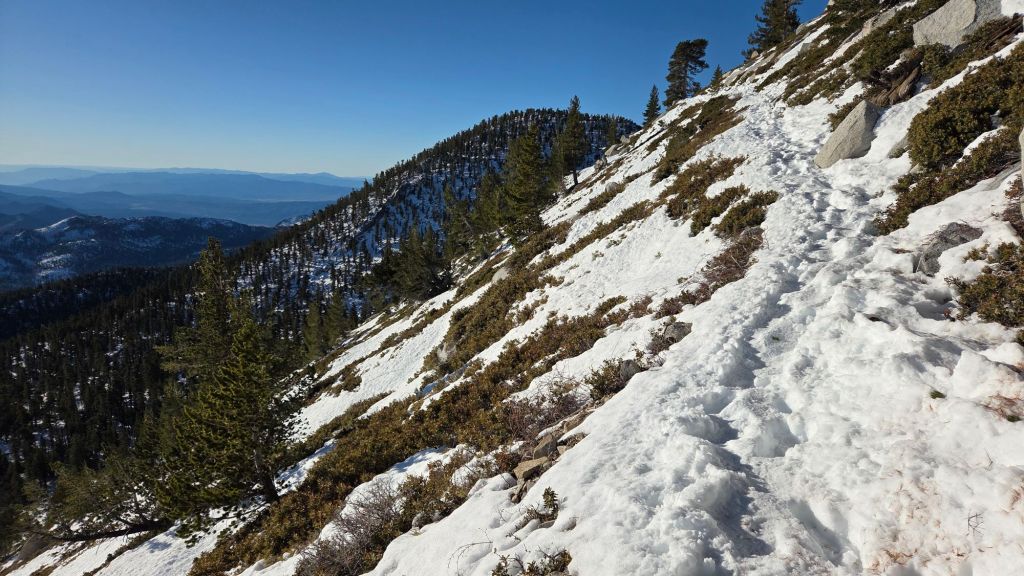
All trails above about 8500 ft remain largely snow-covered (details below), although the frequency and extent of snow-free patches has increased rapidly this week. With above seasonal temperatures almost continuously since 24th November, melting has been unusually rapid for the time of year, especially on sun-exposed slopes. This melting will accelerate further with unusually warm temperatures forecast for the next week at least.
Spikes can be useful above about 9000 ft, locally as low as 7700 ft, as established trails have become consolidated by hiker traffic and undergone freeze-thaw cycles. They are especially useful for descending parts of heavily traveled tracks where the snow has become compacted and icy (e.g., Devil’s Slide, Wellman, Peak, Round Valley, Marion Mountain, and uppermost Deer Springs trails).
Snow depths are marginally suitable for snowshoes above about 9500 ft, but only for off-trail travel. They are no longer useful on established high country trails which are all now heavily compacted. Snow depths everywhere are dropping steadily, and snowshoes will be of little or no use, even off-trail, by mid December.
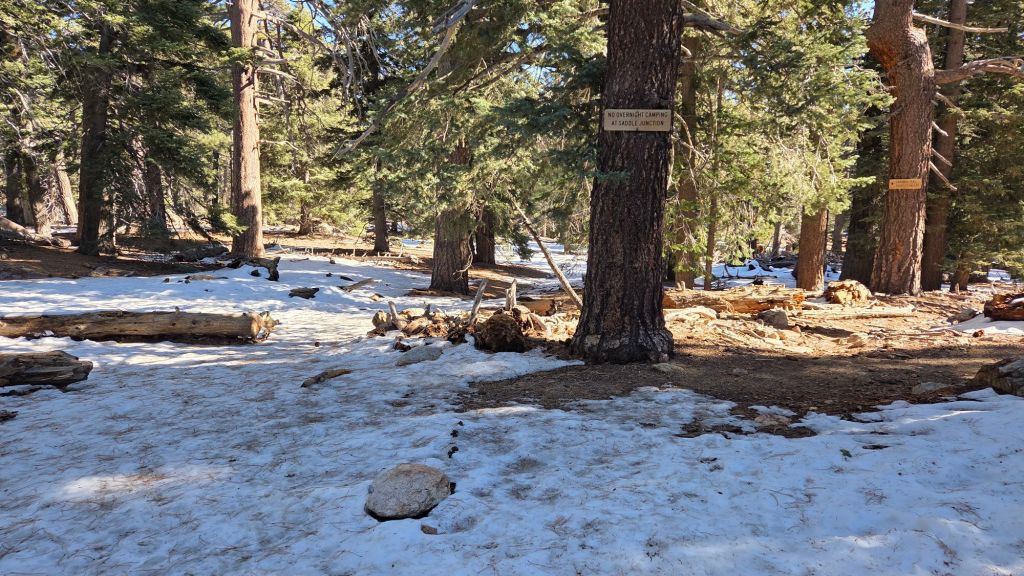
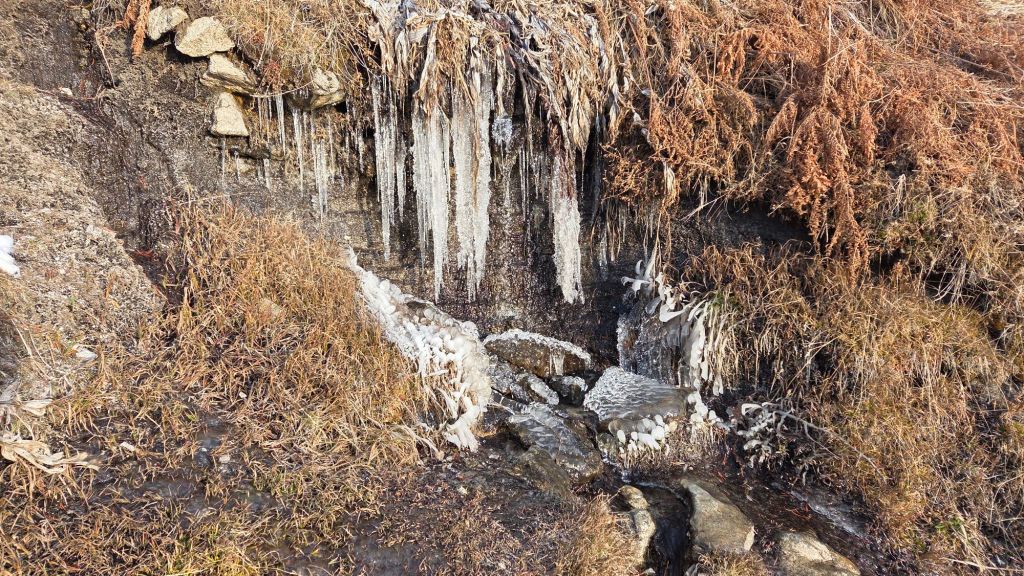
Devil’s Slide Trail [updated 11th December] is clear of icy snow to about 7700 ft. Above that elevation average ice cover is now only 20% to Saddle Junction. Nevertheless some of the small, persistent, icy snow patches are treacherous, especially those closest to Saddle Junction, and many hikers will continue to find traction devices are helpful on the uppermost trail, especially for descending.
There is a well-traveled, compacted track on the PCT south from Saddle Junction to Chinquapin Flat/PCT Mile 178 [updated 11th December]. Snow cover has dropped markedly this week, to about 80%.
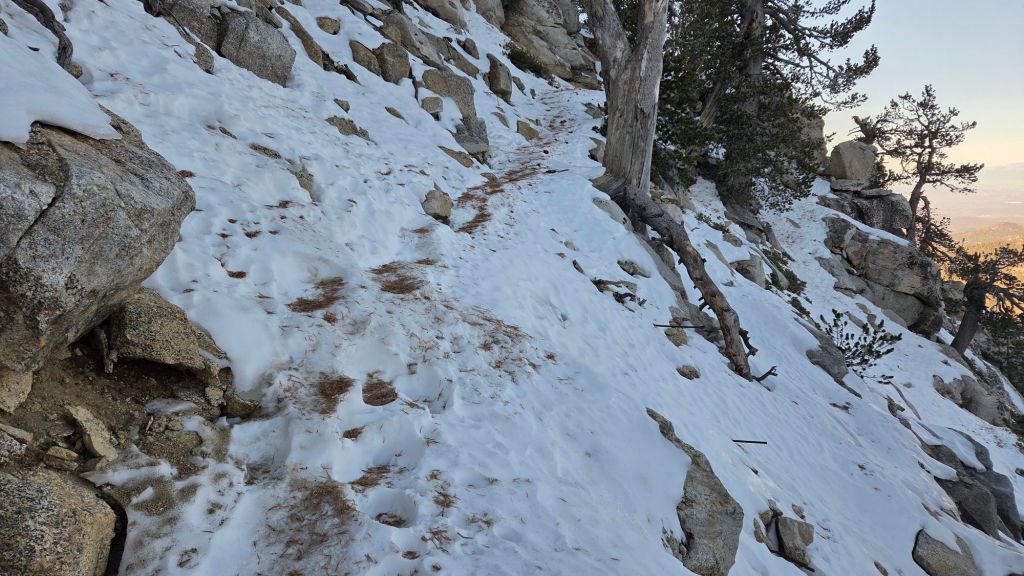
The section of South Ridge Trail from Chinquapin Flat to Tahquitz Peak [updated 13th December] now has a well-traveled track to follow through the angled icy snow. These icy slopes on the north side of Tahquitz Peak are notoriously treacherous, and see no direct sunlight in December and January, so conditions change very slowly at this time of year. Spikes are recommended for most hikers, but even then the route will not be comfortable for all (photo below).
South Ridge Trail south of Tahquitz Peak [updated 13th December] is functionally clear of snow to Tahquitz Peak, with a limited number of small icy patches remaining mainly above 8500 ft (switchback 9). Most hikers will find spikes are no longer needed.
There is a lightly-traveled posthole track to follow through shallow and rapidly melting snow on the Strawberry Trail (PCT Miles 180.8-183). The bulk of this trail is very sun-exposed and snow cover now averages only 10% on this trail.
Willow Creek Trail [updated 11th December] has a lightly traveled track to follow through shallow and patchy snow to Skunk Cabbage Meadow. Thereafter the trail is largely clear of snow to Hidden Divide.
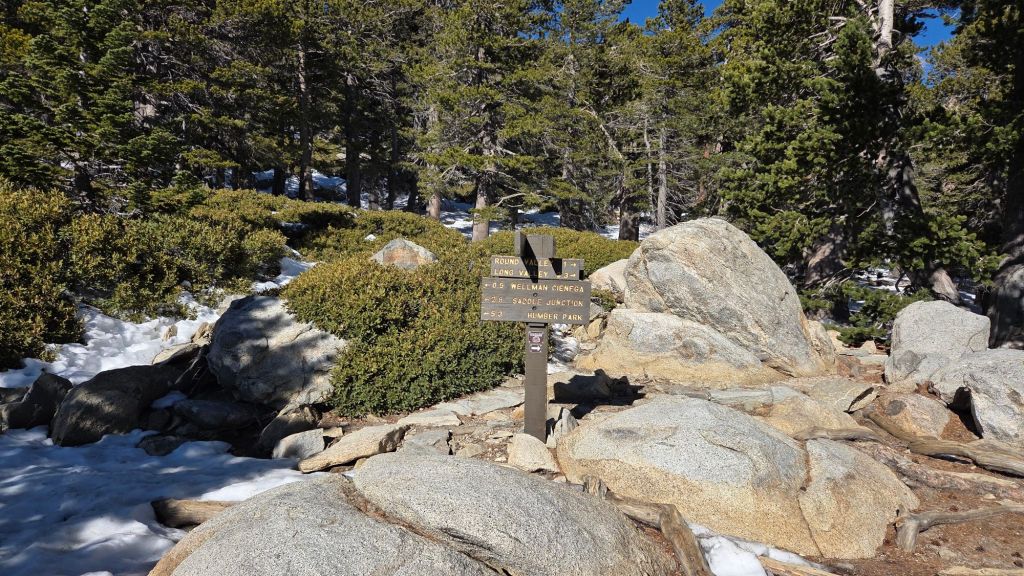
There are well-traveled and compacted tracks on Round Valley Trail through Long and Round valleys to Wellman Divide, and on the “Sid Davis” route, the latter emerging at the Peak Trail near 10,000 ft [updated 11th December]. Both routes are starting to have extensive bare patches appear in their most exposed sections.
The PCT north from Saddle Junction [updated 11th December] is now largely clear of snow to 9000 ft elevation, with just a few small icy snow patches persisting on this very sun-exposed south-facing slope. From 9000 ft, where the trail enters forest, there is a well-traveled, compacted, track through light snow cover (now about 90%) to Annie’s Junction and north onto the Wellman Trail.
The Wellman Trail [updated 11th December] averages only about 30% snow cover, concentrated in the most forested sections. The remaining, sun-exposed, areas are clearing rapidly.
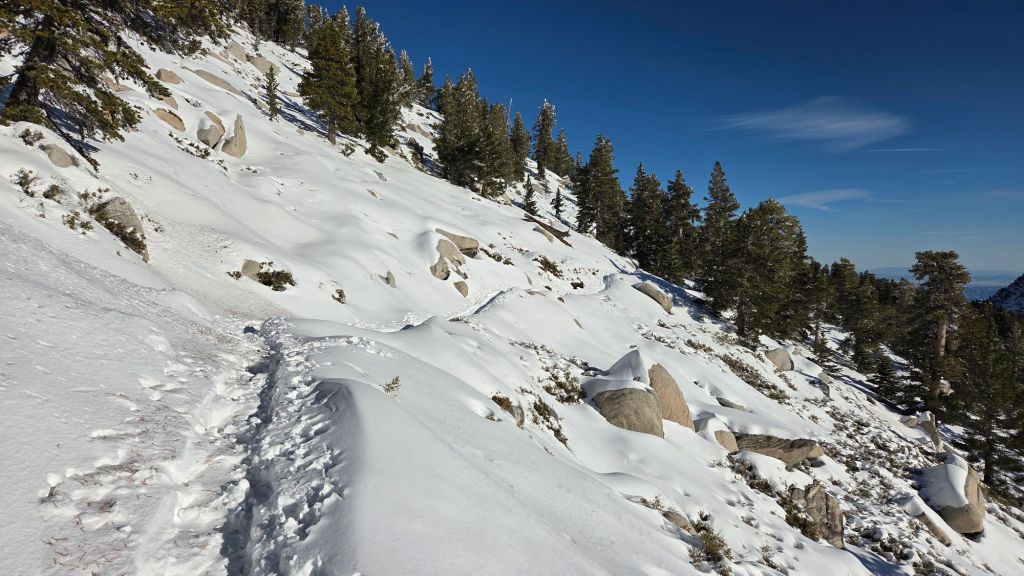
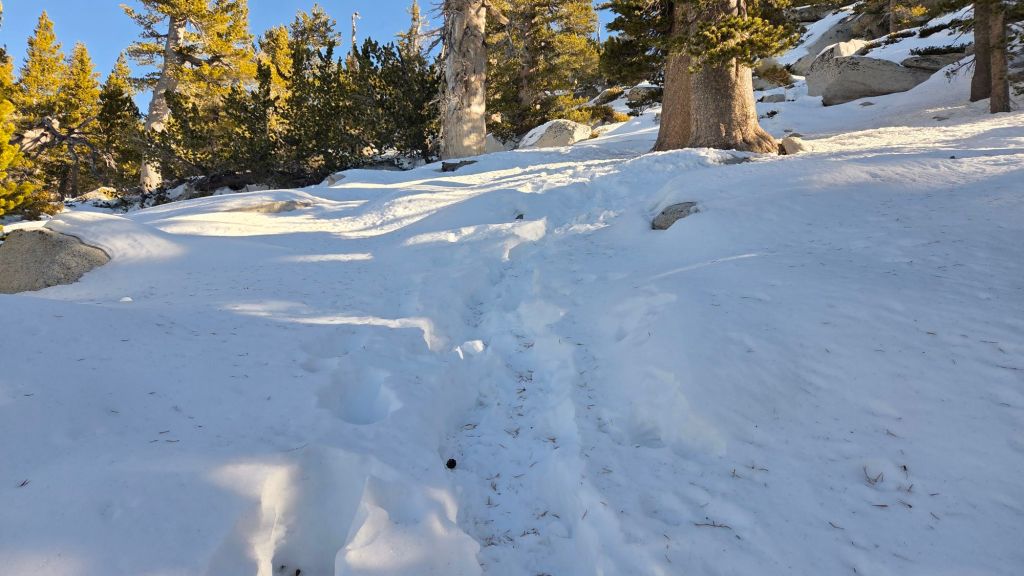
The Peak Trail [updated 11th December] has a well-traveled, compacted, track through 90% snow cover that accurately follows the trail route. Several snow-free patches have appeared in the past few days, and these will expand considerably in the next week. There is a split in hiker traffic – as is traditional in winter – near Miller Peak at 10,400 ft, with two equally prominent tracks, one taking the East Ridge on a somewhat meandering (but well-compacted) route to San Jacinto Peak, and the Peak Trail itself above 10,400 ft now having a defined but often lumpy posthole track to follow (photo above). Trails just below San Jacinto Peak proper have largely consolidated into 3-4 alternate routes, all of which ultimately reach the peak. Most hikers are clearly using spikes on this trail, but they are no longer essential for those with extensive experience of snow hiking.
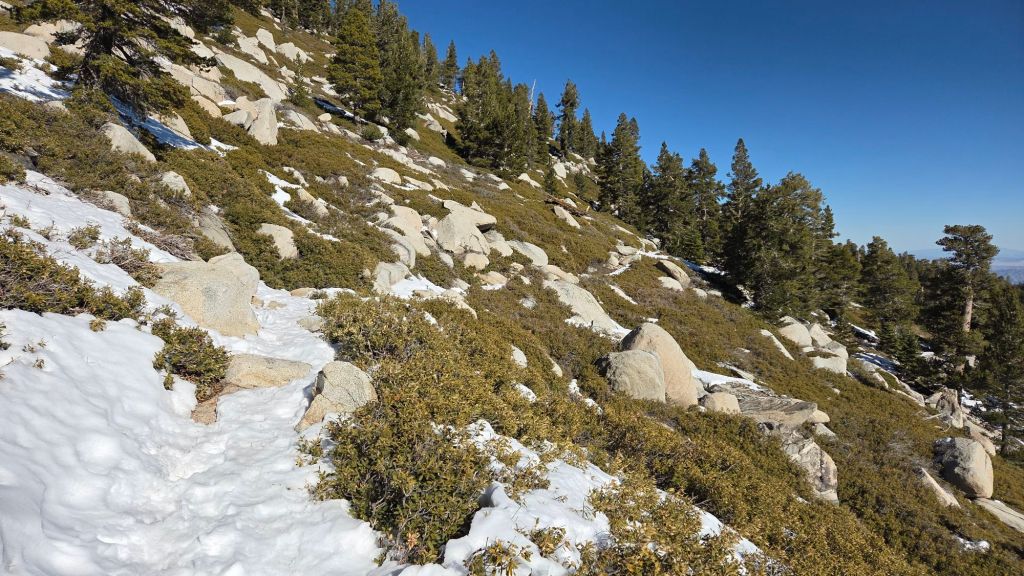
Deer Springs Trail [updated 9th December] is clear of snow to Strawberry Junction. Above Strawberry Junction snow cover has rapidly thinned and largely cleared to 8500 ft (just 0.5 miles south of the Marion Mountain Trail junction). Although snow cover averages 90% thereafter all the way to San Jacinto Peak, lengthy bare patches are starting to appear even as high as 9650 ft in the most sun-exposed areas, and these will expand steadily over the next week or two. Where snow remains between Strawberry Junction and the top of Marion Mountain Trail (approx. PCT Miles 183-185) there is only a moderately traveled posthole track but the snow is thin and easy underfoot. After the Marion junction, the track is well-traveled and compacted to Little Round Valley, almost entirely following the trail route accurately (spikes useful for descending). Above Little Round Valley there are myriad posthole track options, one of which largely follows the actual trail route, but it is rarely the most heavily traveled, most compacted, or indeed the best option, but eventually all the tracks seem to ultimately make their way up towards the Peak (example photo below).
Marion Mountain Trail [updated 9th December] is completely clear of snow to 7700 ft, a little above midway to the junction with the PCT/Deer Springs Trail. In the upper half of the trail snow cover now averages only 30%, but note that some of the persistent snow sections are lengthy and very icy. Spikes remain very useful, especially for descending, as some of the icy snow patches are treacherous. The Trail Report removed one new blowdown from the lower trail on 9th, but there is another significant one about 0.7 mile from the top (with a fairly easy workaround).
Seven Pines Trail [updated 9th December] has no tracks to follow through the snow on its upper section.
Fuller Ridge Trail (PCT Miles 185.5-190.5) [updated 9th December] has a lightly traveled but accurate posthole track to follow through the remaining 30% snow cover in its most sheltered sections. Sun-exposed areas (notably Miles 186-186.6 and 187.5-188.5) and those closest to Black Mountain Road (north from Mile 189.5) are now functionally clear of snow.
Black Mountain Trail (2E35)[updated 3rd December 2025] is functionally clear of snow, with just a few tiny icy snow patches near the top. Four medium-sized treefall hazards include three within 0.1 mile of one another about 1.5 miles up from the trailhead, plus another just below the top of the trail, but all have easy workarounds. The climbers trail section that continues from the top of the trail to the fire lookout still has about 40% icy snow cover, as does the uppermost access road to the tower.
SNOW DEPTHS
Snow depths measured on 9th December (Deer Springs Trail locations) and 8th December 2025 (elsewhere) are as follows. Current total depth is the first number given, followed (in parentheses) by the total measured in November following the most recent storms. Altitudes and PCT mileages are approximate.
San Jacinto Peak (10811 ft): 7-8 inches (was 17 inches on 24th November)
Little Round Valley (9800 ft): 5-7 inches (was 15-18 inches in late November)
Wellman Divide (9700 ft): 1-2 inches (was 11 inches on 24th November)
Annie’s Junction/PCT Mile 180.8 (9020 ft): 2 inches (was 12 inches on 24th November)
Fuller Ridge Trail junction with Deer Springs Trail/PCT Mile 185.5 (8900 ft): 5 inches (was 10-12 inches in late November)
Long Valley (8500 ft): 2-3 inches (was 8 inches on 24th November)
Saddle Junction/PCT Mile 179 (8070 ft): 0-2 inches (was 8 inches on 24th November)
Strawberry Junction/PCT Mile 183 (8050 ft): 0 inches (was 6 inches in late November)
Devil’s Slide Trail at Humber Park (6550 ft): 0 inch by 24th November.
While all time and labor is volunteered, the San Jacinto Trail Report uses small private donations to help cover operating costs. Your contribution keeps the Report available to all, free from advertising or paywalls, and independent from agencies. If you have found this Report useful, please consider using this link to the Donate page. Thank you very much for your support.




 San Jacinto Trail Report