Details are given below under Trail Conditions, but carrying spikes is now generally advisable everywhere above about 8000 ft. Despite rapid melting, treacherous icy patches persist as low as 7700 ft, notably on Devil’s Slide Trail. Spikes tend to be especially helpful for descending, even when they do not seem necessary for ascending. Snow depths are currently suitable for snowshoes above about 9000 ft, but they are only of use on untraveled trails and off-trail. They are no longer useful on established trails which are now heavily compacted (and hence ideal for spikes) such as Round Valley Trail, Peak Trail, Wellman Trail, and the posthole route on upper Deer Springs Trail.
The second, third, and fourth storm systems of winter 2025/26 all recently impacted the San Jacinto mountains in quick succession, on 14th-16th, 17th-18th, and 20th-22nd November, respectively. More detail on each is given in the Weather section below.
All three storms underperformed their snow forecasts, but given the climate change crisis, any snow on the ground prior to December should probably be considered something of a bonus. Indeed, at 18.5 inches total snowfall at San Jacinto Peak by the end of November 2025, this winter is second only to 2019/20 in the past eight years for the most snowfall before 1st December (some may remember the spectacular Thanksgiving storm of 2019 that produced almost three feet of snow in three days in late November that year).
The most recent storm resulted in arguably the biggest weather forecasting error in the past decade in these mountains, when the first wave of the storm late on Friday 21st November produced only four inches of snow at San Jacinto Peak, in contrast to the 10-25 inches that was widely predicted. The situation was partially salvaged when the rotational movement of the system brought it back around on Saturday 22nd, this time coming in from easterly directions, with locations on the east slope, including the Peak, receiving 3-4 more inches. The easterly winds accompanying the rotation were strong and especially gusty, resulting in prodigious drifting.
Snow depths measured at various locations on the trail system are given towards the end of this posting. Note however that snow depth itself is rarely indicative of the difficulty (or ease) of hiking a particular track or trail. For example a firm, well-compacted track across snow feet deep is often much easier hiking than traversing across just a few inches depth of angled virgin icy snow.
Temperatures are now expected to be above seasonal into early December. Nevertheless, hikers should be prepared for temperatures near freezing above 10,000 ft elevation, and below freezing when considering wind chill effects, in particular around 4th and 7th-8th December. At this time, the next possible precipitation is tentatively forecast for 3rd-4th December. See the Weather section below for my recent observations from San Jacinto Peak.
Be bear aware. Although generally rarely reported, at least six individually identifiable Black Bears have been observed in the San Jacinto mountains since 2017 (I have personally encountered at least one annually for the past seven years). A full-sized adult bear with a right ear tag has been seen in multiple locations from Willow Creek to Fern Valley since August (see my video from a trail cam on 14th September available here, and images from Fern Valley in late August in a prior Report linked here). A smaller, second individual has been reliably reported at least twice, most recently in late September in lower Fern Valley. My brief videos from Devil’s Slide Trail in September 2021 (linked here) and one walking past our house in 2018 (linked here) show two further individuals. There have been no reports of negative interactions with humans in the high country, at or near campsites, or on trails, but bear-safe storage of food when camping is recommended.
Daily survey hikes by the Trail Report year-round in the San Jacinto mountains include multiple routes to the highest peaks including San Jacinto Peak typically at least twice per week (much more frequently during stormy weather and in winter), Tahquitz Peak and area at least once per week, plus a wide variety of other trails on intervening days.
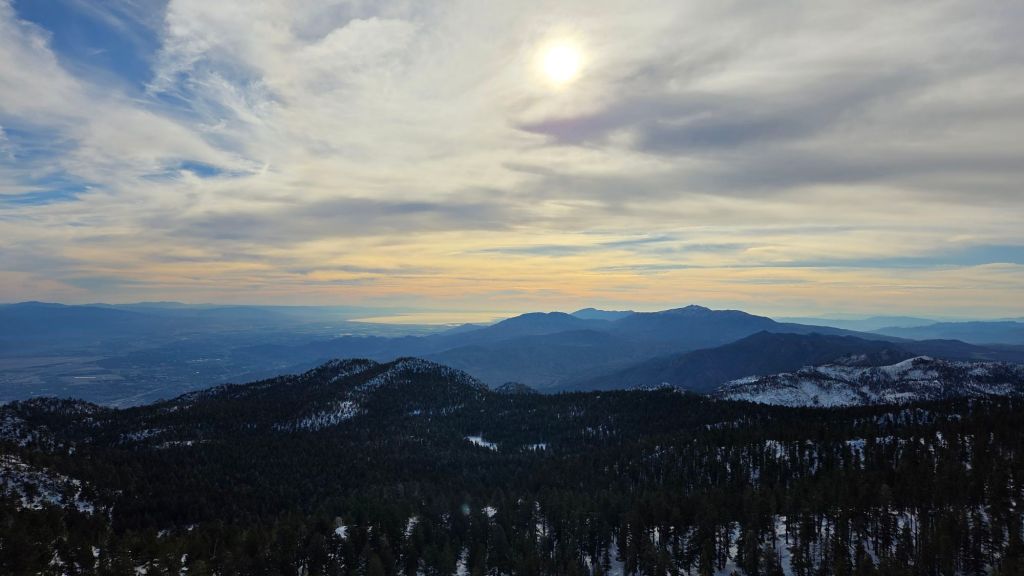
WEATHER
Three storm systems impacted the San Jacinto mountains in nine days from 14th-22nd November. All three storms were relatively mild, with high freeze levels and very limited snow below 7000 ft.
An “atmospheric river” on 14th-16th started extremely warm for the season, with a freeze level initially above 11,000 ft and rain throughout the highest peaks for the first day of the storm, before turning to snow early on Saturday 15th. Even then, the snow level remained high, with little more than a dusting below 7000 ft. This warmth of course limited snow at all elevations, with seven inches at San Jacinto Peak, down to three inches at Saddle Junction (8100 ft). Accumulated rainfall was impressive at mid elevations, with 2.70 inches in Idyllwild (at 5550 ft).
The system on 17th-18th was colder, with a freeze level dropping to 6000 ft. However this cooling happened largely after the passage of the main precipitation, so snowfall at mid elevations was extremely limited, with just one inch at Humber Park (6500 ft)(which lasted only hours before melting) and barely a dusting below that. Fresh snowfall in the high country was more limited than the prior storm (four inches at San Jacinto Peak), but more uniformly distributed across all elevations above 8000 ft (2-4 inches throughout). Rainfall in Idyllwild was 0.51 inch.
The third system, on 20th-22nd, initially moved across the region from the south-west. Universally forecast to produce heavy snow, in the San Jacinto mountains the accumulation rate of 0.25 inch/hour at the highest elevations overnight on 20th produced only four inches by first light the next day as the storm moved away, with a dusting down to 6500 ft. Thankfully the rotation of the system brought it back around from the east with a vengeance the next day, with fine snowfall accompanied by sustained winds of 20 mph with gusts nearly double that speed. Snowfall accumulation on 22nd roughly matched that on 20th-21st, especially on the eastern slope of the mountain (e.g,, from Red Tahquitz to Long Valley, including the east flanks of the high peaks), with three inches at San Jacinto Peak for a nine day total accumulation of 17-18 inches.
Temperatures are rising rapidly to above seasonal this week, especially at upper elevations. This is expected to result in steady snowmelt at all elevations, and consequent deterioration in trail conditions of snowy tracks. Minor storm systems provisionally forecast to arrive overnight on Saturday 29th November and another on 3rd-4th December now look like to pass too far to the north to impact the San Jacinto mountains, other than causing brief and modest drops in temperatures.
At San Jacinto Peak (10,811ft/3295m) on Saturday 29th November 2025 at 0755 the air temperature was 36.1°F (2°C), with a windchill temperature of 24.4°F (-4°C), 31% relative humidity, and a benign WNW wind sustained at 6 mph gusting to 11.2 mph.
At the Peak on Thursday 27th November 2025 at 0850 the air temperature was 41.6°F (5°C), with a windchill temperature of 35.2°F (2°C), 18% relative humidity, and a steady SE wind sustained at 6 mph gusting to 7.9 mph.
At the Peak on Monday 24th November 2025 at 0910 the air temperature was 35.5°F (2°C), with a windchill temperature of 25.0°F (-4°C), 47% relative humidity, and a light NNE wind sustained at 4 mph gusting to 10.2 mph.
At the Peak on Friday 21st November 2025 at 0820 the air temperature was 18.7°F (-7°C), with a windchill temperature of 1.9°F (-17°C), 56% relative humidity, and a cool SSW wind sustained at 11 mph gusting to 14.8 mph.

TRAIL CONDITIONS
All trails above about 8000 ft are largely – or above 9000 ft completely – snow-covered. With above seasonal temperatures since 24th, melting has been unusually rapid, especially on sun-exposed slopes.
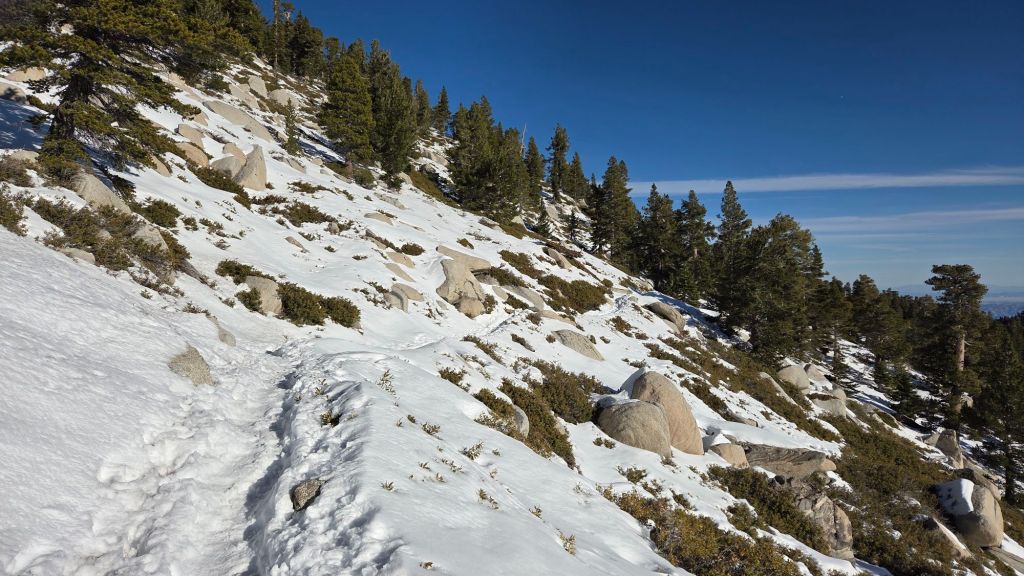
Spikes can be useful everywhere above about 8000 ft, locally lower in places, as established trails have become consolidated by hiker traffic and undergone freeze-thaw cycles. They are especially useful for descending heavily traveled trails where they have become compacted and icy (e.g., Devil’s Slide, Wellman, Peak, and Round Valley trails).
Snow depths are suitable for snowshoeing above 9000 ft, but only off-trail or when breaking trail on routes that have so far been untraveled.
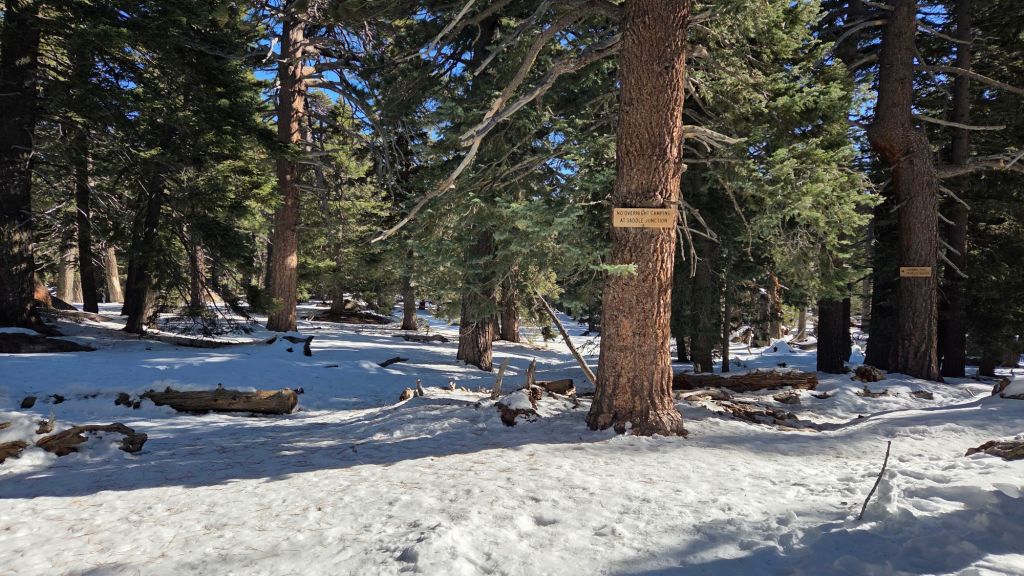
Devil’s Slide Trail [updated Saturday 29th] is functionally clear of icy snow to about 7600 ft. Above that elevation, there is a heavily compacted and icy track to follow through increasingly patchy thin snow (average snow cover now 50% to Saddle Junction). Most hikers will find that traction devices are very helpful on the upper trail, especially for descending.
There is a well-traveled, compacted track most of the way on the PCT south from Saddle Junction to Chinquapin Flat/PCT Mile 178 [updated Wednesday 26th]. The track is less well traveled and requires some minor postholing about 0.3 mile from Chinquapin Flat.
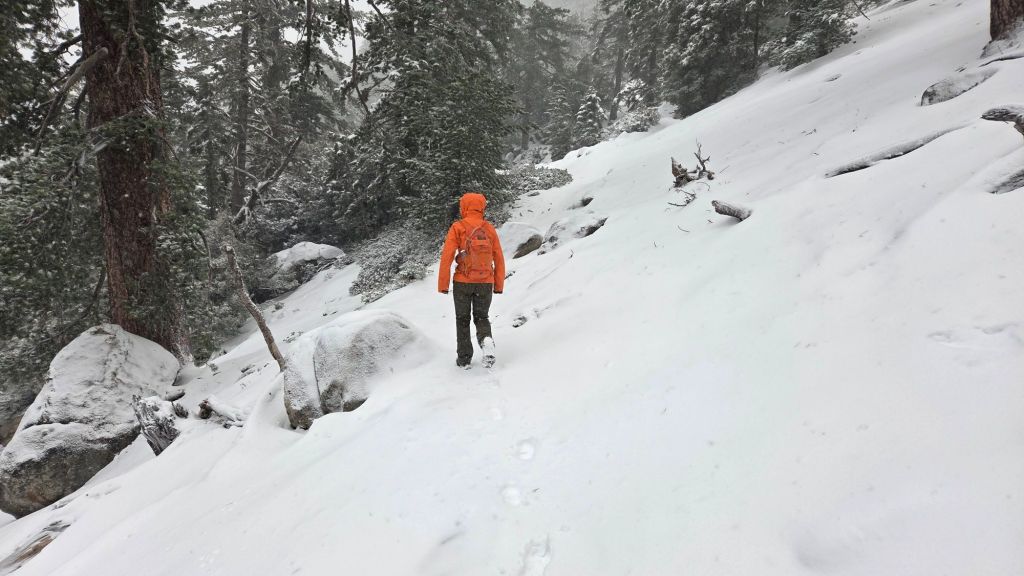
The section of South Ridge Trail from Chinquapin Flat to Tahquitz Peak [updated Wednesday 26th] currently has a lightly traveled, uneven track to follow through the angled icy snow. Much of the track is covered by fallen ice. These icy slopes on the north side of Tahquitz Peak are notoriously treacherous. Currently spikes (with hiking poles at a minimum) are strongly recommended, but the route is probably not suitable for most hikers (photo above).
South Ridge Trail [updated Wednesday 26th] is clear of snow to 0.5 mile beyond Old Lookout Flat to about 7800 ft. Snow cover is increasingly patchy to 8500 ft, but the patches are invariably icy. There is a well-defined but icy track through continuous snow above 8500 ft to Tahquitz Peak. Rocks around the Peak are also largely icy, but the tower is now almost completely clear of ice. Spikes are recommended for the upper trail.
As of Saturday 29th, there were no tracks to follow through shallow and rapidly melting snow on the Strawberry Trail (PCT Miles 180.8-183).
Willow Creek Trail [updated Saturday 29th] now has a lightly traveled track to follow through shallow and patchy snow, at least to Skunk Cabbage Meadow.
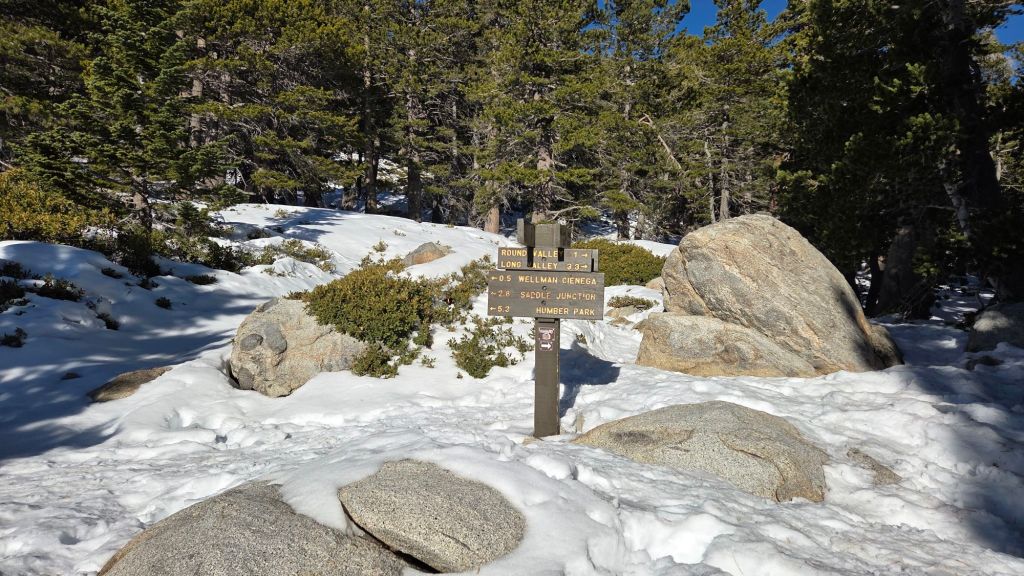
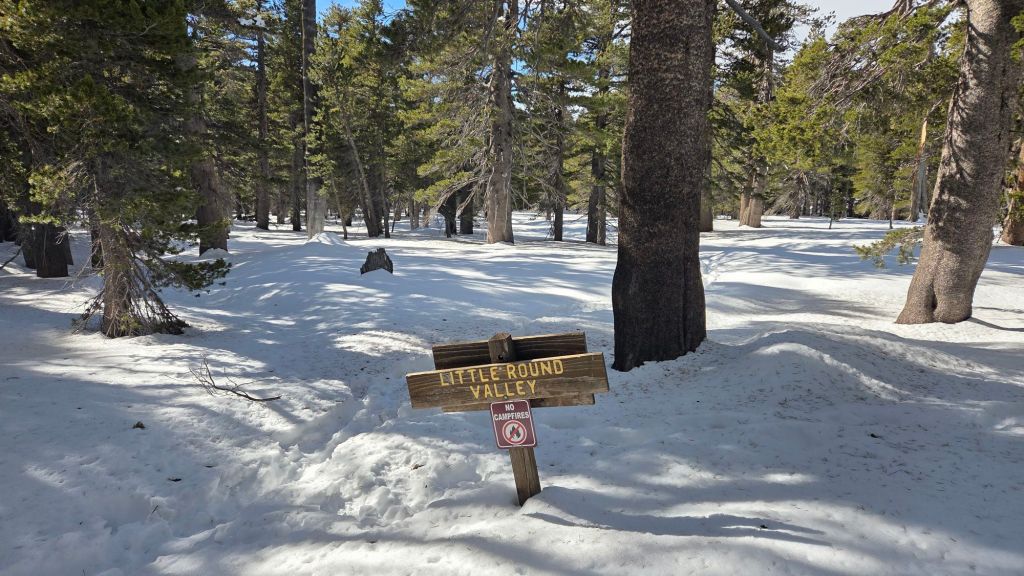
There are well-traveled and compacted tracks on Round Valley Trail through Long and Round valleys to Wellman Divide, and on the “Sid Davis” route, the latter emerging at the Peak Trail near 10,000 ft [updated Saturday 29th].
The PCT north from Saddle Junction, continuing onto the Wellman Trail, has a well-traveled and increasingly compacted track through light to moderate snow cover to Wellman Divide [updated Saturday 29th]. Melting has been rapid on the most sun-exposed section immediately north of Saddle Junction (“Angel’s Glide”) with some lengthy snow-free sections already appearing.
The Peak Trail [updated Saturday 29th] has a well-traveled, compacted, posthole track through continuous snow cover that accurately follows the trail route to near Miller Peak at 10,400 ft. Thereafter the majority of hiker traffic – as is traditional in winter – takes the East Ridge on a meandering route to San Jacinto Peak. The Peak Trail itself above 10,400 ft has seen more traffic this weekend, but remains a more uneven postholing route. Tracks just below San Jacinto Peak proper are starting to consolidate into less of a shambolic maze of alternate routes, but it is still easy to wander well off track on less obvious options.
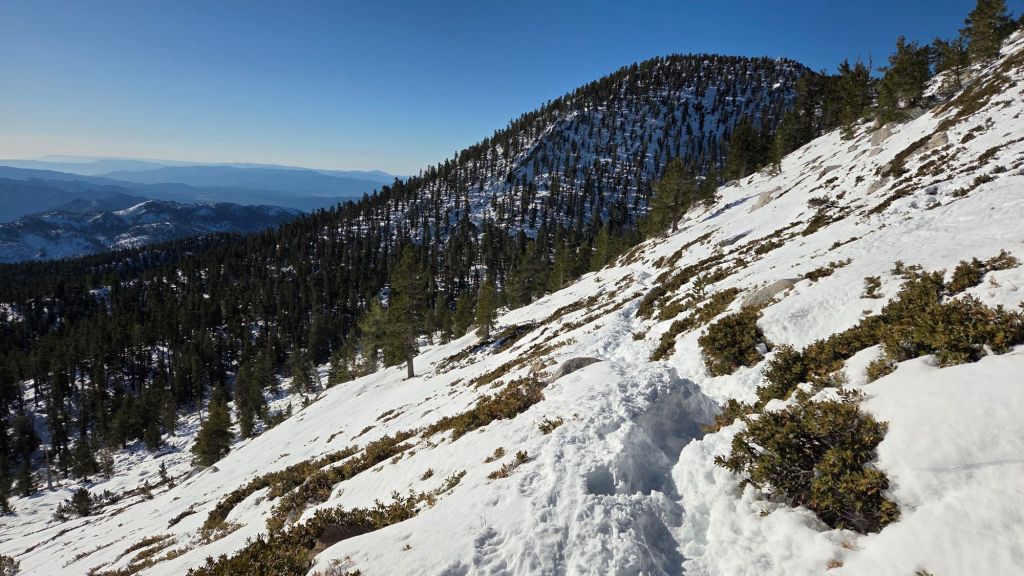
Deer Springs Trail [updated Thursday 27th] is functionally clear of snow to Strawberry Junction, with just a few tiny patches of soft snow close to the junction (spikes not required). Above Strawberry Junction snow cover is very thin and increasingly patchy to 8500 ft, becoming functionally continuous thereafter all the way to San Jacinto Peak. There is only a very lightly traveled posthole track between Strawberry Junction and the top of Marion Mountain Trail (approx. PCT Miles 183-185), but the snow is thin and easy underfoot. After the Marion junction, the track is well-traveled and compacted to Little Round Valley, almost entirely following the trail route accurately (spikes useful, mainly for descending). Above Little Round Valley there are two options, a lightly traveled and uneven posthole track that ascends steeply (as is traditional in winter), or my snowshoe track that largely follows the trail route. The latter (photograph below) is an easier ascent, but only if followed with snowshoes (or skis), as it would otherwise involve severe postholing.
Marion Mountain Trail [updated Thursday 27th] has a well-traveled and compacted track that accurately follows the trail route through the snow on its upper section. Patchy snow cover starts at 7000 ft and is largely continuous above 7500 ft, with bare patches higher in the most sun-exposed areas. Spikes are useful, especially for descending.
Seven Pines Trail [updated Thursday 27th] has no tracks to follow through the snow on its upper section.
Fuller Ridge Trail [updated Thursday 27th] has a lightly traveled but accurate posthole track to follow through light-to-moderate snow cover along its entire length (PCT Miles 185.5-190.5).

SNOW DEPTHS
Snow depths measured on 24th November 2025 are as follows. Current total depth is the first number given, followed (in parentheses) by details of the snowfall in the storm of 21st-22nd November. For details of the snowfall in the two preceding storms see the prior Report (linked here). Altitudes and PCT mileages are approximate. [Update on Saturday 29th November: all of these locations have lost 20-40% of these depths to melting in the past five days. I expect to issue revised measurements on Monday 1st December.]
San Jacinto Peak (10811 ft): 17-18 inches (4 inches added by 21st November, plus three on 22nd)
Wellman Divide (9700 ft): 11 inches (4 inches new on 21st-22nd)
Annie’s Junction/PCT Mile 180.8 (9020 ft): 12 inches (6 inches new on 21st-22nd)
Long Valley (8500 ft): 8 inches
Saddle Junction/approx. PCT Mile 179 (8070 ft): 8 inches (3 inches new on 21st-22nd)
Devil’s Slide Trail at Humber Park (6550 ft): 0 inch on 24th, with single inches on 18th and 21st already completely melted
Idyllwild (at 5550 ft): 0 inch snow, 0.56 inch rain 21st-23rd November
While all time and labor is volunteered, the San Jacinto Trail Report uses small private donations to help cover operating costs. Your contribution keeps the Report available to all, free from advertising or paywalls, and independent from agencies. If you have found this Report useful, please consider using this link to the Donate page. Thank you very much for your support.



 San Jacinto Trail Report