The first winter storm of the season impacted the region on Tuesday 14th October, with precipitation starting about 1130 and lasting until near dusk. Snow fell intermittently at San Jacinto Peak most of the afternoon, accumulating to about 1.5 inches, but with a periodic mix of drizzle and sleet, and finishing with a thick icy coating from late freezing rain. Snow dusted as low as 9000 ft, averaging about one inch above 9500 ft. Rainfall in Idyllwild (5550 ft) totaled an impressive 0.76 inch for the day, with 0.85 inch at Saddle Junction (8100 ft). I posted a short video report from San Jacinto Peak early on 15th, linked here. Despite a steady warming trend in recent days, on Wednesday 22nd thin icy snow still persisted in patches in the most shaded areas above 9900 ft elevation, although spikes are no longer required anywhere.
This storm was a dramatic contrast from the relatively mild, humid, weather we have generally experienced since late August. The San Jacinto mountains had a remarkable sequence of tropical and monsoonal autumnal rains in the past eight weeks. San Jacinto Peak recorded an impressive 8.74 inches of rainfall spread across ten distinct rain events between 22nd August and 10th October, with 4.58 inches recorded in Idyllwild (at 5550 ft) over the same period.
The most recent tropical rains, on 9th-10th October, were concentrated on the western flank of the mountain range. The junction of Marion Mountain and Deer Springs trails at 8600 ft recorded 2.23 inches of rain, with 1.67 inches at 9800 ft in Little Round Valley, in contrast to just 0.36 inch at Saddle Junction (located on the southern flank of the high country).
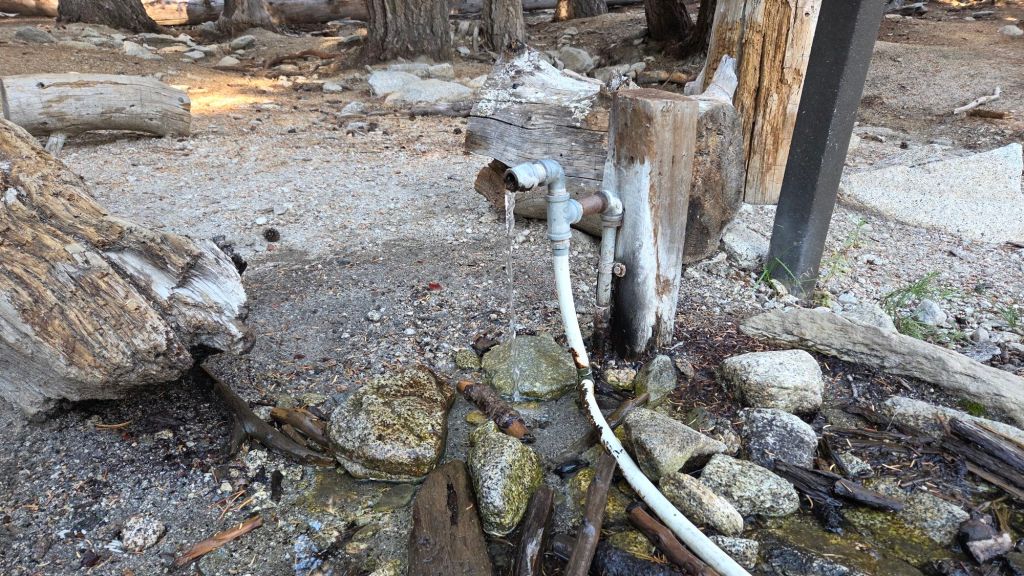
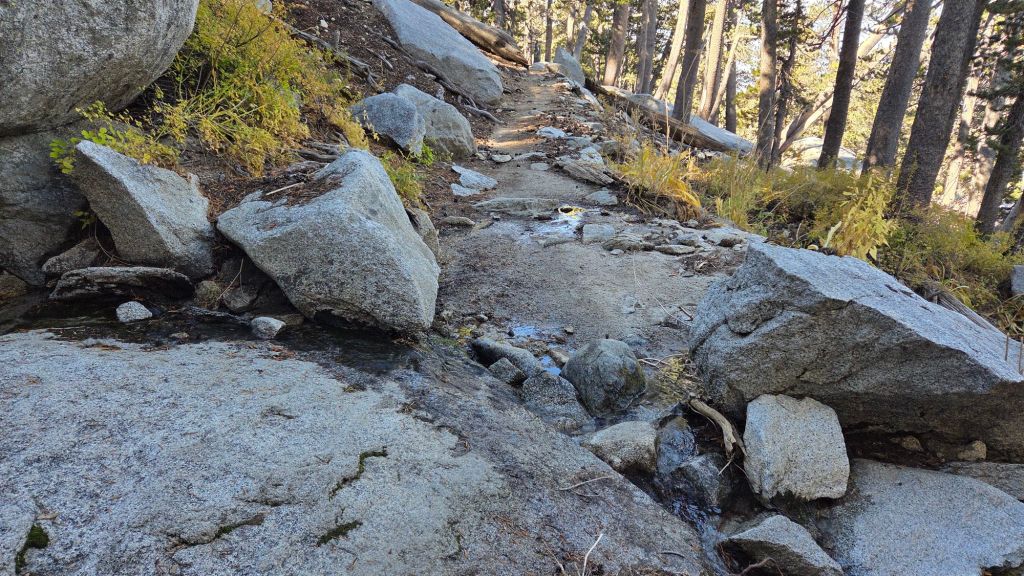
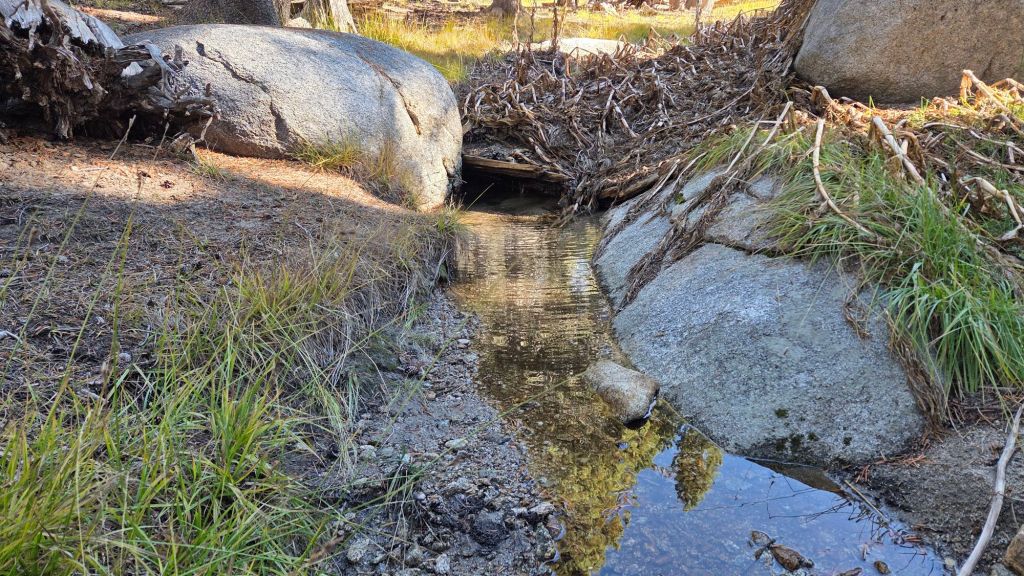
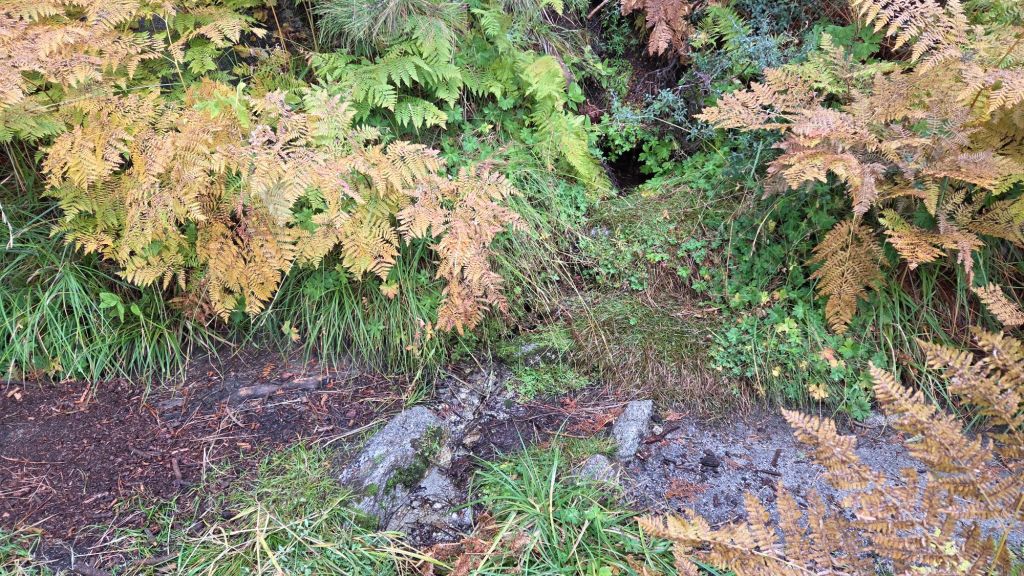
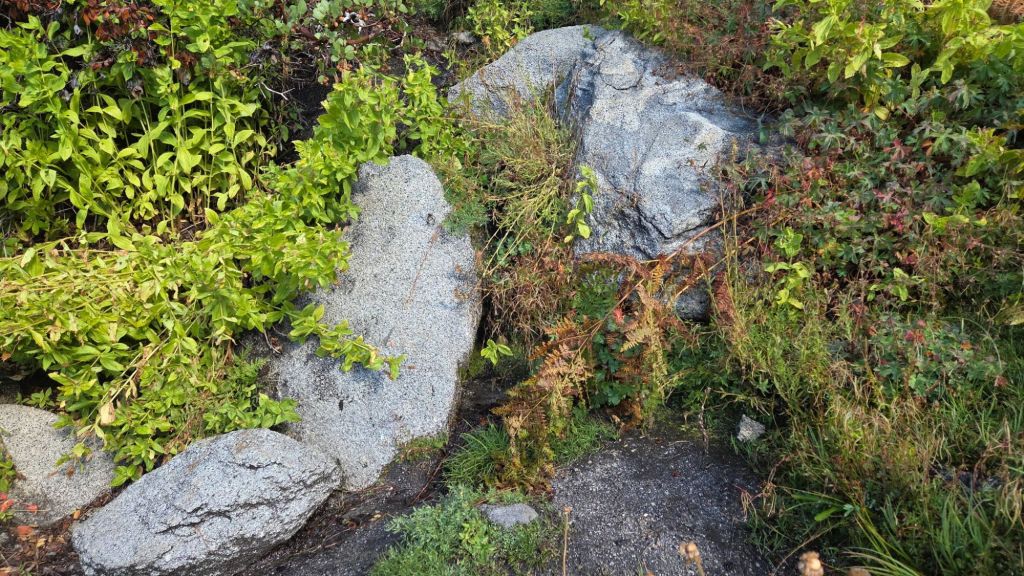
Water flows have improved following the rain events of recent weeks, although many rapidly returned to their mid-August condition (see photos below). Some key hiker water sources are flowing reasonably well. All ephemeral sources dried in the summer but some are temporarily flowing again, especially those on the western side of the mountains. Wellman’s Cienega and the pipe in Round Valley are flowing and should now maintain useable flow into the winter. The creek in Little Round Valley has already dried again both where it passes through the meadow and also where it crosses Deer Springs Trail, but continues to flow patchily in its central section. Deer Springs creek dried up in late July where it crosses the trail of the same name, and although it has intermittently flowed again twice during recent rains, it will dry again soon. The North Fork of the San Jacinto River is flowing where it crosses both Fuller Ridge and Deer Springs trails. Stone Creek is temporarily trickling again where it crosses Deer Springs Trail (near PCT Mile 183.6). Marion Creek is flowing steadily where it crosses the Suicide Rock Trail. Strawberry Cienega (approx PCT Mile 181.9), which dried in midsummer, is temporarily trickling again, but not sufficiently to filter any useful volume of water.
Willow Creek is flowing again where it crosses the Willow Creek Trail, having dried in August. Hidden Lake dried by the end of June (although it temporarily holds a tiny pond from recent rains). Long Valley Creek is dry where it passes through Round Valley, as is the nearby creek in Tamarack Valley. Water is flowing reliably in Tahquitz Creek at PCT Mile 177 and again further downstream at the north end of Little Tahquitz Meadow (although it is dry between those two locations). The pipe in Tahquitz Meadow dried up in mid July. Skunk Cabbage Meadow creek is functionally dry and no longer useful for filtering. Middle Spring on Devil’s Slide Trail has been functionally dry since 1st August, but I maintain a tiny pool there from which dogs can drink.
During the federal government shutdown, the Forest Service Idyllwild Ranger Station is closed. Unlike the 2018-19 shutdown which occurred in the winter months of December-January, gates on Forest Service roads and USFS campgrounds have remained open (for now).
Fire lookouts at Black Mountain and Tahquitz Peak are closed indefinitely due to issues identified in a May 2025 safety inspection at Black Mountain. Neither tower is now expected to reopen until 2026.
Be bear aware. Although generally rarely reported, up to six individually identifiable Black Bears have been observed in the San Jacinto mountains since 2017, and I have personally seen at least one annually for the past seven years. A full-sized adult bear with an ear tag has been seen in multiple locations from Laws to Fern Valley since late August (see my video from 14th September available here, and images from late August in a prior Report linked here). My other brief videos from Devil’s Slide Trail in September 2021 (linked here) and one walking through our property in Idyllwild in 2018 (linked here) show two other individuals. There have been no reports of negative interactions with humans in the high country, at or near campsites, or on trails.
Daily survey hikes by the Trail Report year-round in the San Jacinto mountains include multiple routes to the highest peaks including San Jacinto Peak typically at least twice per week (more frequently during stormy weather), Tahquitz Peak and area at least once per week, plus a wide variety of other trails on intervening days.

WEATHER
Temperatures plunged to well below seasonal for October on 13th-16th with the passage of a cold front associated with the first winter storm of the season on Tuesday 14th. Strong winds associated with passage of the cold front briefly dropped windchill temperatures close to 0°F (-18°C) at the highest peaks.
Temperatures warm quickly this week, especially at mid elevations, and will be above seasonal for late October on most days from 18th to the end of the month. The last few days of October are forecast to be unusually warm for the season.
The San Jacinto mountains received valuable monsoonal and tropical rainfall in ten distinct events since late August, as described in more detail in the previous Report and links therein (linked here). The most recent tropical rains, on 9th-10th October, were associated with the breakdown of former Hurricane Priscilla far to our south. Locations on the western side of the high country received the bulk of the the intense rainfall, with 2.23 inches of rain recorded at the junction of Marion Mountain and Deer Springs trails at 8600 ft, and 1.67 inches at 9800 ft in Little Round Valley. In contrast, locations to the south of the high country received much less rain, with Saddle Junction recording just 0.36 inch, and Idyllwild 0.49 inch, while higher elevation locations on the east side fell between those extremes (1.21 inches at Wellman’s Cienega). San Jacinto Peak recorded 1.43 inches.
One interesting consequence of the climate change crisis is the increasing prevalence of tropical, rather than monsoonal, rainfall in the San Jacinto mountains. In three of the four most recent years (2022-2025) the majority of rainfall in our region between August-October has come from tropical sources (generally from the south or south-west) as opposed to the historically much more frequent monsoonal storms (originating from easterly directions).
At San Jacinto Peak (10,811ft/3295m) on Wednesday 22nd October 2025 at 0930 the air temperature was 37.8°F (3°C), with a windchill temperature of 21.9°F (-6°C), 46% relative humidity, and a chilly SW wind sustained at 12 mph gusting to 21.4 mph.
At the Peak on Friday 17th October 2025 at 0940 the air temperature was 31.7°F (0°C), with a windchill temperature of 17.6°F (-8°C), 47% relative humidity, and a cool NNE wind sustained at 8 mph gusting to 14.9 mph.
At the Peak on Wednesday 15th October 2025 at 0645 the air temperature was 22.5°F (-5°C), with a windchill temperature of 5.5°F (-15°C), 100% relative humidity, and a frigid due West wind sustained at 14 mph gusting to 22.0 mph.
At the Peak on Tuesday 14th October 2025 at 1045 the air temperature was 30.3°F (-1°C), with a windchill temperature of 14.0°F (-10°C), 93% relative humidity, and a bitter SW wind sustained at 10 mph gusting to 20.6 mph.
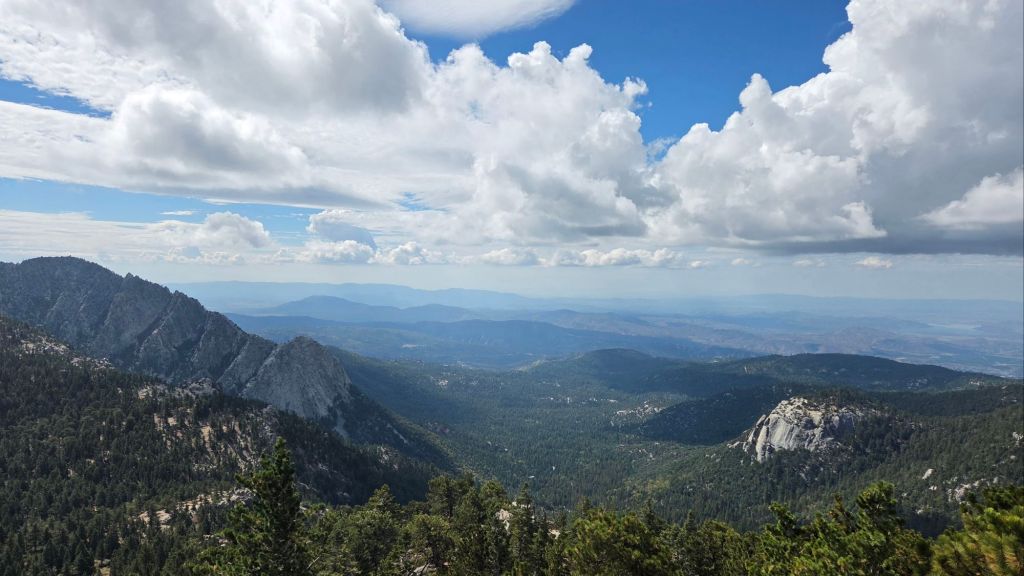
TRAIL CONDITIONS
Icy snow was almost continuous on trails above 9300 ft on 15th October, with a patchy mix of ice, snow, and sleet down to 8800 ft. Spikes were useful, but not essential for those very familiar with hiking in such conditions, above about 9500 ft. These conditions will improve steadily with a warming trend over 16th-19th October, with melting most rapid at lower elevations (initially below 10,000 ft) and on the most sun-exposed trails. As of Friday 17th, very thin icy snow was still widespread in the sheltered sections of the Peak Trail above 9900 ft, and as low as 9300 ft on the least sun-exposed sections of Deer Springs Trail. With caution, spikes are generally not required, although there is little harm with carrying them of course.
Thankfully most trails have suffered relatively minor tread erosion from recent intense rains. Neither the Wolf Fire in late June nor the Rosa Fire in early August had major impacts on the trail system, although the latter did burn the southernmost 0.5 mile of the Palm Canyon trail.
For the first time in nearly a decade, Deer Springs Trail from its trailhead to Little Round Valley is now completely clear of blowdowns, with 26 trees removed since the middle of last year, of which 70% were cut by the Trail Report. A joint Eastern Sierra Conservation Corps/State Park crew working in early October made good progress trimming encroaching vegetation along Deer Springs Trail just above the Fuller Ridge Trail junction to about 9300 ft.
On PCT Miles 170-175 (roughly Apache Peak to Red Tahquitz) most blowdowns have been removed but six trees remain to be cut around South Peak (Miles 173.5-174) of which most are significant obstructions for hikers. Sections of the trail are badly overgrown with brush and in their worst condition in decades, especially most of Miles 168-174.
The two large downed trees near PCT Mile 180 were removed by the Trail Report this spring. The Strawberry Trail (PCT Miles 180.8-183.1) has had several of its decade-old blowdowns removed this month by Forest Service volunteers. The brush along Miles 181-181.7 has become heavily overgrown since it was last trimmed by the Trail Report in 2021, but there is a plan for trimming work in the next few months.
The maintenance condition of the Fuller Ridge (Miles 185.5-190.5) section of the PCT improved significantly in July 2025, with the Trail Report clearing most of the 15 blowdowns and a PCTA volunteer crew cutting the remainder the following week.
On the Wellman Trail, Wellman’s Cienega is flowing well compared to earlier in the autumn (photo below). The Trail Report continues the work it started last year to keep this trail clear (after it had become badly overgrown by early 2024).
Dark Canyon Road (4S02) had some effective basic maintenance on its dirt section in the spring. The associated Dark Canyon campground is closed for the year (apparently due to federal budget cuts).
For the first time in about 20 years Seven Pines Trail has a continuous route completely cleared of blowdown trees, with the trail also as faithful to the original route as possible. The Trail Report “adopted” Seven Pines as a priority for maintenance work nearly a decade ago due to a disproportionate number of lost hiker rescues (with State Park and Forest Service evidently no longer maintaining the route). Since 2019 we have now removed exactly 100 downed trees – including 25 since April of this year – and the trail is largely trimmed and cleared annually. Although our work has restored this delightful trail, Seven Pines remains a genuine wilderness trail unlike the wider, bare, obvious routes of, for example, Devil’s Slide or Marion Mountain trails. Cautious navigation remains invaluable for those without extensive experience of hiking this trail.
Black Mountain Road is open and in its typical non-graded condition, i.e. lumpy but readily passable in any moderate clearance vehicle. The tap at Cinco Poses Spring currently has reliable water (located alongside the road 0.2 mile below the Boulder Basin turning).
On Willow Creek Trail whitethorn urgently needs trimming again especially near the boundary between the two agencies. The two large trees remaining uncut in the State Park section from several years ago have easy workarounds.
The Caramba Trail from near Reeds Meadow through Laws Camp and on to Caramba, and the Cedar Trail from Willow Creek Trail to Laws, are euphemistically (and arguably dangerously) described by the Forest Service as “not maintained”. In reality both trails have been abandoned for more than a decade and no longer exist. They are so heavily overgrown, largely with dense whitethorn which obscures dozens of downed trees, that hikers should not attempt to follow them (regardless of how much you may trust any particular app).
An informal use trail to Laws is much more direct, generally well maintained, and avoids the bushwhacking of the abandoned trails (some local Idyllwild hikers dubbed it the “King Trail” when I established the route in 2019). It leaves Willow Creek Trail exactly 1.0 mile from Saddle Junction, 0.46 mile from the Skunk Cabbage turning (trailhead at N 33.7796, W 116.6590). The route descends following former deer trails for 1.2 miles, meeting Willow Creek about 0.15 mile upstream from the site of the historic Laws Camp (the remains of which were destroyed by the 2013 Mountain Fire and subsequent flood and treefall damage). One huge pine tree fell in late 2024 across the King Trail about midway down that requires a minor scramble underneath, but nine additional blowdowns have been removed since January 2025, with the trail trimmed and cleaned three times this year.
From Laws east to Caramba the original Caramba Trail has been cairned by myself and others and can largely be followed with skilled route-finding. My most recent 2025 survey counted 120 trees down on this 2.1 miles of trail. It is extremely obscure for the first 0.5 mile east of the Willow Creek crossing, becoming more obvious (but still subtle) as it descends towards Caramba. Very cautious navigation is strongly recommended throughout the area.
Stormy weather this autumn brought down another seven trees across Spitler Peak Trail. All were removed by the Trail Report on 20th October, bringing to 169 the total number of trees we have removed from this route in the past seven years. One very large burned cedar is the only tree that remains across the trail, immediately after the first creek crossing 3.2 miles up from the trailhead.
The Zen Center Trail continues its serious deterioration that started following the 2013 Mountain Fire, with a combination of vigorous regrowth and treefall hazards further obscuring the route with each passing season. The lower and upper thirds of this trail are partially cairned and not too bad for those who are very familiar with the former route, but even the experienced find navigating the central section tricky. Long trousers, scrambling gloves, and a genuine enjoyment of bush-whacking are all strongly recommended.
While all time and labor is volunteered, the San Jacinto Trail Report uses small donations to help cover modest operating costs. Your contribution keeps the Report available to all, free from advertising or paywalls, and independent from agencies. If you have found this Report useful, please consider using this link to the Donate page. Thank you very much for your support.



 San Jacinto Trail Report