UPDATE Friday 29th August 2025: in addition to the rain (and hail) described below, on Thursday 28th we had a fully overcast day with many hours of light rain. This came from the remains of an offshore tropical storm to our south-west, not from monsoonal conditions to the east. Although rainfall totals were unremarkable, the steady, wetting, drizzle did a good job of dampening trails and refreshing the forest. Recorded rainfall was 0.27 inch at San Jacinto Peak (10,810 ft), 0.32 inch at Wellman’s Cienega (9300 ft), and 0.25 inch at Saddle Junction (8100 ft). In Idyllwild (at 5550 ft) total rainfall was 0.12 inch. Hot temperatures are forecast for this weekend, followed by encouraging probabilities of monsoonal thunderstorm activity every afternoon from 2nd-8th September.
————————————-
The San Jacinto mountains received their first measurable monsoonal precipitation of the summer on 22nd-25th August. There was little more than 0.02 inch on the afternoon of Friday 22nd, but rainfall on Saturday 23rd was intense at times. I experienced the best of it firsthand at San Jacinto Peak that morning with rain, periodically accompanied by impressive thunder and lightning, steady from 0900, before thinning to light drizzle about 1130. Rainfall was heaviest from 0900-1000, with 0.26 inch falling in just that hour see photo below). Further rainfall on the afternoon of Sunday 24th was highly localized, with only 0.04 inch in Idyllwild.
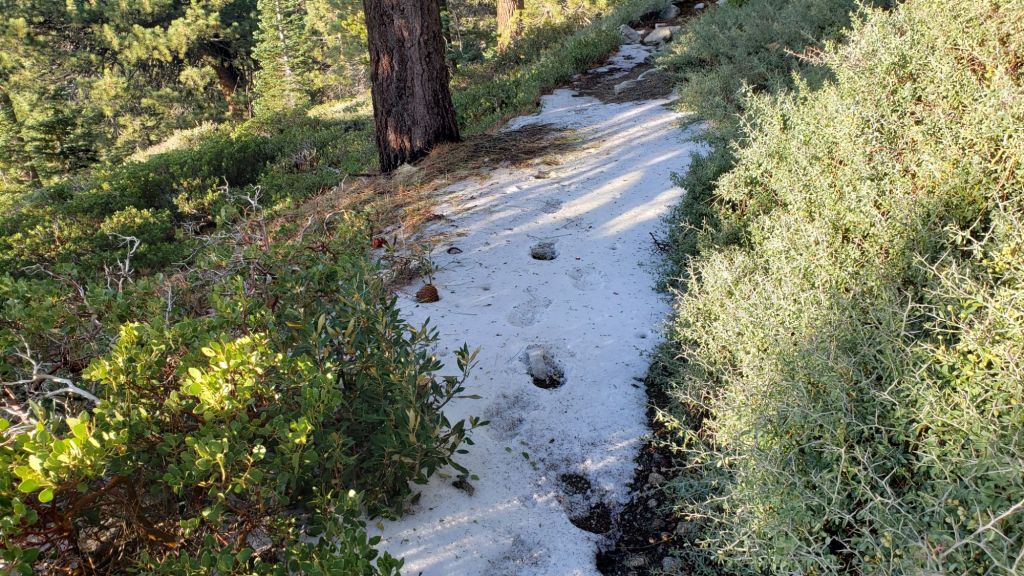
The most spectacular thunderstorms were on Monday 25th August. An intense storm cell lingered over the high country in the early afternoon, initially producing heavy hail above 8900 ft on the eastern slope (photo below) and above 9600 ft on the western slope. Rainfall that afternoon was a further 1.21 inches at San Jacinto Peak, and 1.02 inches at the junction of Marion Mountain and Deer Springs trails. The same storm storm reportedly produced over two inches of rain in just one hour in Long Valley. In contrast, rainfall in Idyllwild measured barely 0.02 inch.
Total rain accumulation for the four days was 1.75 inches at San Jacinto Peak, 1.40 inches in Little Round Valley (9800 ft), 1.22 inches at the junction of Marion Mountain and Deer Springs trails (8700 ft), 0.71 inches at Wellman’s Cienega (9300 ft), and 0.43 inch at Saddle Junction (8100 ft). In Idyllwild (at 5550 ft) total rainfall was 0.25 inch, most of which fell on Saturday 23rd.
Palm Springs Aerial Tramway reopened on Saturday 16th following a seven day closure for emergency maintenance. The scheduled annual maintenance closure is for five weeks from 8th September until at least 12th October 2025.
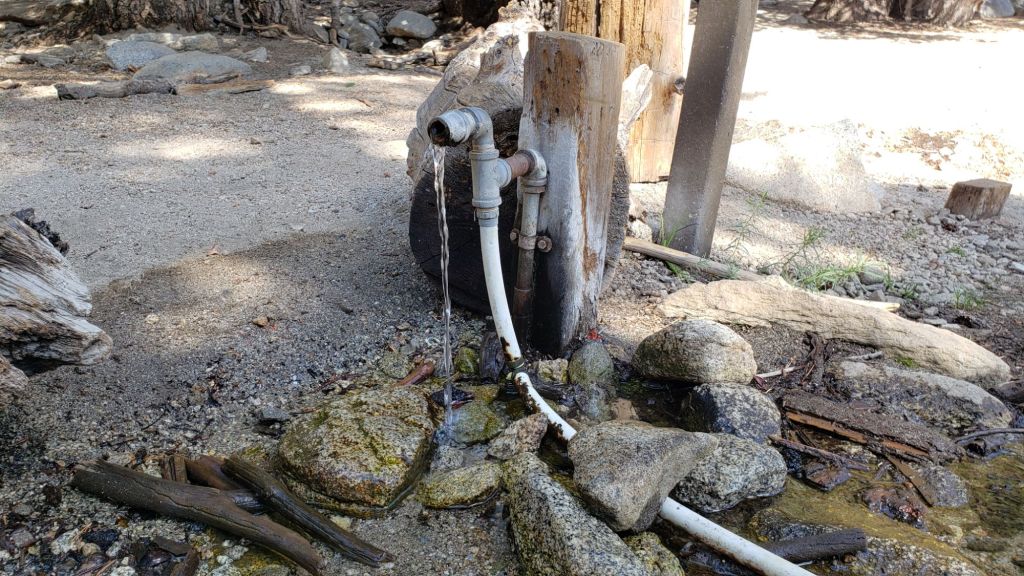
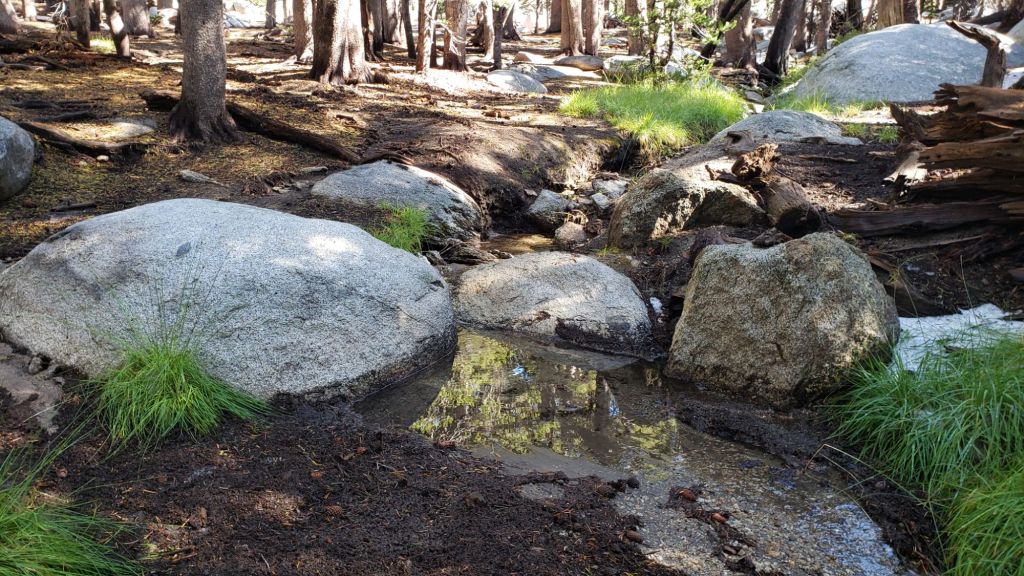
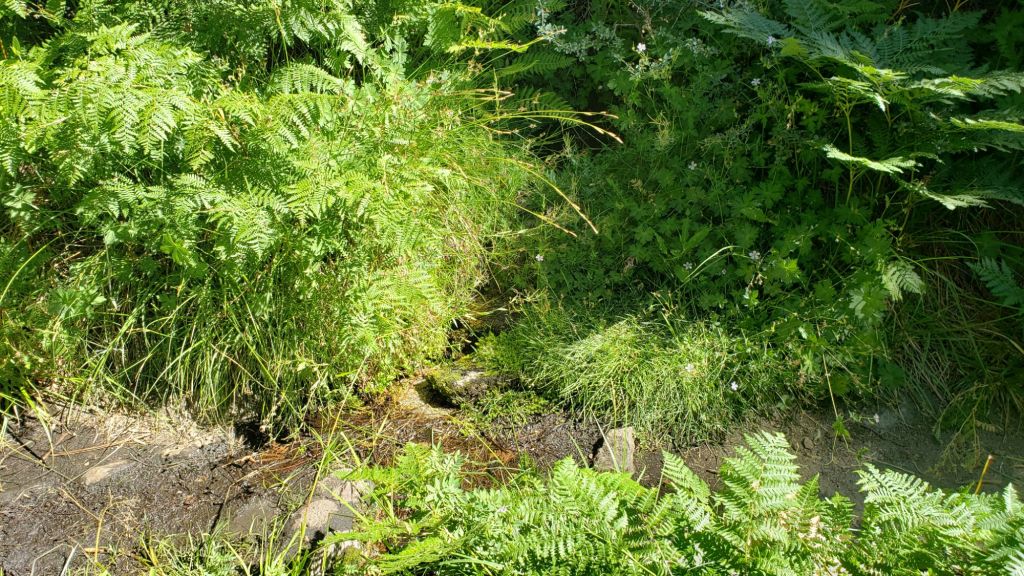
Water flows everywhere remain low – illustrated by multiple photos below – with ephemeral sources now dry. Recent rains will briefly augment stream flow, but past experience suggests the effects will be short-lived, a few days to a week in most locations. The descriptions below largely reflect the long-term situation, which is likely to be the default again by the first week of September.
Key hiker water sources such as Wellman’s Cienega and the pipe in Round Valley are flowing gently but steadily and are likely to maintain useable flow into the autumn. Ephemeral sources along Marion Mountain Trail are all dry for the first time in more than two years. Deer Springs creek dried up in late July where it crosses the trail of the same name. Flow in the creek in Little Round Valley has dropped dramatically since late July. While the creek was running briefly again on 26th August, the day before only a few tiny pools persisted for filtering by campers. It is likely it will dry again by next week. The North Fork is completely dry where it crossed by Seven Pines Trail, but is flowing gently higher up where it crosses both Fuller Ridge and Deer Springs trails. Marion Creek is flowing steadily where it crosses the Suicide Rock Trail.
Willow Creek is now dry where it crosses the Willow Creek Trail, although there are some minor pools about 100 yards downstream. All other minor creeks that cross Willow Creek Trail are also dry. Hidden Lake dried by the end of June. Long Valley Creek is dry where it passes through Round Valley, as is the nearby creek in Tamarack Valley. Water is flowing reliably in Tahquitz Creek at PCT Mile 177 and again further downstream at the north end of Little Tahquitz Meadow (although it is dry between those two locations). The pipe in Tahquitz Meadow dried up in mid July. Skunk Cabbage Meadow creek is functionally dry and no longer useful for filtering. Strawberry Cienega is dry. Middle Spring on Devil’s Slide Trail was functionally dry by 1st August, but a tiny pool persists from which dogs can drink.
Full fire restrictions began on Tuesday 1st July 2025 on Forest Service lands, as described on the USFS website linked here. Campfires throughout USFS lands in the San Jacinto Mountains, including all campgrounds and yellow post sites, are now prohibited.
Fire lookouts at Black Mountain and Tahquitz Peak are closed indefinitely due to issues identified in a May 2025 safety inspection of Black Mountain lookout. USFS has informed the Trail Report that Tahquitz Peak lookout may reopen by October if upgrades to its lightning conductor array are completed, but it is unlikely Black Mountain lookout will reopen this season.
Be rattlesnake aware. Above about 5000 ft elevation, the venom of Southern Pacific Rattlesnakes (Crotalus [oreganus] helleri) in the San Jacinto mountains is predominantly neurotoxic, almost always fatal for dogs and sometimes for humans (see my detailed article linked here for further information describing our dogs’ survival after a July 2020 neurotoxic bite). Devil’s Slide Trail, lower Deer Springs and lower Marion Mountain trails, Suicide Rock, near Strawberry Cienega, and trails around Tahquitz Peak are frequent locations for sightings, but rattlesnakes have been recorded widely up to 9350 ft (see example photos of an adult and a juvenile in a previous Report linked here).
Be bear aware. Although rarely reported in recent years, at least three individually identifiable Black Bears have been in the San Jacinto mountains since 2017, and I have personally seen at least one annually for the past six years. One adult-sized, light chestnut-colored individual was reliably reported – with photographs – from Willow Creek Trail adjacent to Skunk Cabbage Meadow on 12th July 2025 (information courtesy of Mike Meyer). I photographed fresh tracks in snow on 12th February 2024 at 9000 ft near PCT Mile 180.5 (photo linked here), and my brief videos from Devil’s Slide Trail in September 2021 (available here) and one walking through our property in Idyllwild in 2018 (linked here) show two different individuals. There have been no reports of negative interactions with humans at or near campsites or on trails.
Dark Canyon Road (4S02) reopened in May and the dirt section has had some effective basic maintenance. The associated Dark Canyon campground is closed for the year due to federal budget issues.
Survey hikes by the Trail Report every single day throughout the year in the San Jacinto mountains include multiple routes to various high peaks including San Jacinto Peak typically 2-3 times per week (more frequently during stormy weather), Tahquitz Peak and area at least once per week, plus a wide variety of other trails on intervening days.
WEATHER
Temperatures have been generally above seasonal for three months from 20th May to 24th August, with notable heatwaves between 10th-20th June, in the second week of July, and again in the second and third weeks of August. Interestingly the perception among friends and neighbors in Idyllwild is of a relatively mild summer. This is perhaps due – thankfully – to the lack of severe heatwaves (e.g., temperatures pushing close to 100°F [38°C]) but sadly may simply be indicative of habituation to steadily warmer average temperatures.
Temperatures were about seasonal from 14th-19th August, but then again above seasonal until 25th, with overnight low temperatures in particular well above average. For the remainder of the month, 25th-29th at least, temperatures are expected to be about seasonal for late August.
Monsoon conditions have largely failed in the desert south-west this season, however as described above we finally experienced some rainfall in the San Jacinto mountains associated with thunderstorms on 22nd-25th August. Further rainfall is forecast as a possibility on several days in the remainder of August, most likely early- to mid-afternoon, with probabilities currently highest on Thursday 28th, and then again for 2nd-8th September (at least).
At San Jacinto Peak (10,810ft/3295m) on Friday 29th August 2025 at 0850 the air temperature was 48.6°F (9°C), with a windchill temperature of 38.8°F (4°C), 73% relative humidity, and a cool NNE wind sustained at 5 mph gusting to 11.2 mph.
At the Peak on Tuesday 26th August 2025 at 0845 the air temperature was 58.5°F (15°C), with a “windchill” temperature of 47.3°F (8°C), 71% relative humidity, and a barely discernable WNW wind sustained at 1 mph gusting to 3.2 mph.
At the Peak on Monday 25th August 2025 at 0755 the air temperature was 52.3°F (11°C), with a windchill temperature of 44.8°F (7°C), 65% relative humidity, and a fresh SSE wind sustained at 9 mph gusting to 15.3 mph.
At the Peak on Saturday 23rd August 2025 at 0855 the air temperature was 52.8°F (11°C), with a windchill temperature of 45.9°F (8°C), 67% relative humidity, and a pleasantly cool SE wind sustained at 10 mph gusting to 16.2 mph.

TRAIL CONDITIONS
The established trail system was completely clear of snow by late May. Neither the Wolf Fire in late June nor the Rosa Fire in early August had major impacts on the trail system, although the latter did burn the southernmost 0.5 mile of the Palm Canyon trail.
Recent work has largely resolved the backlog of downed trees on PCT Miles 170-175 (roughly Apache Peak to Red Tahquitz) accumulated during 5+ years of agency neglect. Six trees remain to be cut around South Peak (Miles 173.5-174) of which most are significant obstructions for hikers. Lengthy sections of the trail are badly overgrown with brush and in their worst condition in decades, especially most of Miles 168-174, but PCTA/Forest Service show little interest in improving this situation. Regrettably post-fire erosion has created a loose, rocky, and uneven tread in some parts of the same section, requiring caution in places. The trail is not passable by stock.
The two large downed trees near PCT Mile 180 were removed by the Trail Report in May. The Strawberry Trail (PCT Miles 180.8-183.1) has ten blowdowns, none of which pose major hazards to hikers. Of the eight on the Forest Service section, several have been down for 8-10 years and reported repeatedly but with no action. The brush between the cienega and Annie’s Junction (roughly Miles 181-181.7) has become heavily overgrown since it was last trimmed in 2021.
Five further blowdowns remain on the Deer Springs Trail portion of the PCT (Miles 183-185), some of which are major obstructions, albeit with workarounds. For the first time in a decade, upper Deer Springs Trail – between the top of Marion Mountain Trail and Little Round Valley – is now clear of blowdowns, with the Trail Report having removed eight trees this spring, including the two major hazards at PCT Mile 185.3 that came down this past winter. [About ten further trees would need to be cut to restore the original route of Deer Springs Trail above Little Round Valley, but there is no prospect of that happening soon, if ever. That section of trail, despite too many minor workarounds, remains relatively easy to follow.]
The maintenance condition of the Fuller Ridge (Miles 185.5-190.5) section of the PCT improved in July 2025, having been in very poor condition earlier in the year. The Trail Report cleared nine of 15 blowdowns mid-month. A PCTA volunteer crew the following week largely removed the remaining six trees and undertook some brush trimming and clearing of debris, but sadly the opportunity was missed to comprehensively trim this trail.
On the Wellman Trail, Wellman’s Cienega is flowing relatively poorly (photo below) but there is still plenty of water for hikers for now. The Trail Report continues the work it started last year to keep this trail clear (after it had become badly overgrown by early 2024).
For the first time in more than 15 years Seven Pines Trail has a continuous route completely cleared of blowdown trees, with the trail also as faithful to the original route as possible. The Trail Report “adopted” Seven Pines as a priority for maintenance work nearly a decade ago due to a disproportionate number of lost hiker rescues (with State Park and Forest Service evidently no longer maintaining the route). Since 2019 we have now removed exactly 100 downed trees – including 25 since April of this year – and the trail is largely trimmed and cleared annually. Although our work has restored this delightful trail, Seven Pines remains a genuine wilderness trail unlike the wider, bare, obvious routes of, for example, Devil’s Slide or Marion Mountain trails. Cautious navigation remains invaluable for those without extensive experience of hiking this trail.
Black Mountain Road is open and in its typical non-graded condition, i.e. lumpy but readily passable in any moderate clearance vehicle. The tap at Cinco Poses Spring currently has reliable water but this may not last beyond August (located alongside the road 0.2 mile below the Boulder Basin turning).
Willow Creek Trail is in its best condition since it was thoroughly cleared in 2020. The four new trees that came down on the Forest Service section in January 2025 were cut in June-July. Whitethorn badly needs trimming again especially near the boundary between the two agencies, but is not as overgrown as it was in 2022-23. The two large trees remaining uncut in the State Park section from several years ago have easy workarounds.
The Caramba Trail from near Reeds Meadow through Laws Camp and on to Caramba, and the Cedar Trail from Willow Creek Trail to Laws, are euphemistically (and arguably dangerously) described by the Forest Service as “not maintained”. In reality both trails have been abandoned for more than a decade and no longer exist. They are so heavily overgrown, largely with dense whitethorn which obscures dozens of downed trees, that hikers should not attempt to follow them (regardless of how much you may trust any particular app).
An informal use trail to Laws is much more direct, generally well maintained, and avoids the bushwhacking of the abandoned trails (some local Idyllwild hikers dubbed it the “King Trail” when I established the route in 2019). It leaves Willow Creek Trail exactly 1.0 mile from Saddle Junction, 0.46 mile from the Skunk Cabbage turning (trailhead at N 33.7796, W 116.6590). The route descends following former deer trails for 1.2 miles, meeting Willow Creek about 0.15 mile upstream from the site of the historic Laws Camp (the remains of which were destroyed by the 2013 Mountain Fire and subsequent flood and treefall damage). One huge pine tree fell in late 2024 across the King Trail about midway down that requires a minor scramble underneath, but nine additional blowdowns have been removed since January 2025, with the trail already trimmed and cleared twice this year.
From Laws east to Caramba the original Caramba Trail has been cairned by myself and others and can largely be followed with skilled route-finding. My most recent 2025 survey counted 120 trees down on this 2.1 miles of trail. It is extremely obscure for the first 0.5 mile east of the Willow Creek crossing, becoming more obvious (but still subtle) as it descends towards Caramba. Very cautious navigation is strongly recommended throughout the area.
Storms in February-March brought down another 34 trees across Spitler Peak Trail. All but one were removed in March by the Trail Report, bringing to 162 the total number of trees we have removed from this route in the past seven years. One very large burned cedar remains across the trail immediately after the first creek crossing 3.2 miles up from the trailhead. A couple of other recent blowdowns are small and easily stepped over.
The Zen Center Trail continues its serious deterioration that started following the 2013 Mountain Fire, with a combination of vigorous regrowth and treefall hazards further obscuring the route with each passing season. The lower and upper thirds of this trail are partially cairned and not too bad for those who are very familiar with the former route, but even the experienced find navigating the central section tricky. Long trousers, scrambling gloves, and a genuine enjoyment of bush-whacking are all strongly recommended.
While all time and labor is volunteered, the San Jacinto Trail Report uses small donations to help cover modest operating costs. Your contribution keeps the Report available to all, free from advertising or paywalls, and independent from agencies. If you have found this Report useful, please consider using this link to the Donate page. Thank you very much for your support.






 San Jacinto Trail Report