There is no settled snow anywhere in the San Jacinto high country, the latest into a winter in recorded history by many weeks without snow in these mountains. Total snowfall – using that term very generously – at San Jacinto Peak since September is 0.6 inch.
There is very little evidence of a change on the way. The storm to our north on the afternoon of Tuesday 24th December brought only brief drizzle to mid elevations, with the high peaks remaining above the cloud. There is the possibility of more unsettled weather in the first week of January.
Survey hikes by the Trail Report literally every day of the year in the San Jacinto mountains include varied routes throughout the high peaks including San Jacinto Peak averaging 2-4 times per week, Tahquitz Peak and area 1-2 times per week, plus a wide variety of other trails on intervening days.
Unusual recent weather – warm and dry so late in the year – has led to an exceptionally active tick season. Some trails are predictably tick-prone, such as Cedar Springs Trail where the lower section currently has cattle ranging on and near the trail, and wood ticks (genus Dermacentor) are abundant. Even trails such as lower Deer Springs Trail are producing multiple tick encounters (deer ticks, Ixodes, appropriately enough). Hikers with dogs in particular should take necessary precautions and check thoroughly for ticks post-hike.
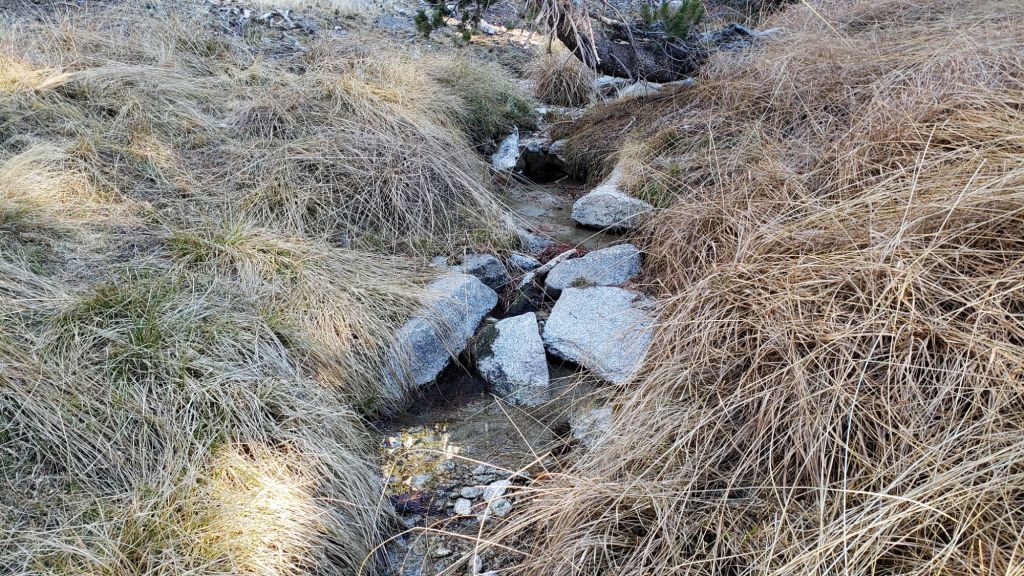
Despite a failed monsoon earlier this year and below-average precipitation both last winter and – obviously – so far this season, major springs, creeks, and pipes largely continue to flow at this time (example photos below and in a previous Report linked here). The Round Valley faucet continued to flow well as of 23rd December. In the Tahquitz area meadows, the Tahquitz Valley pipe (for those who know where it is) continues to flow very well. Tahquitz Creek is flowing at the northern end of Little Tahquitz Meadow, and near its source where it crosses the PCT at Mile 177. Strawberry Cienega is functionally dry. Stone Creek is dry where it crosses Deer Springs Trail at about PCT Mile 183.6. Bud Spring near 9900 ft, just north-west of Marion Mountain, is still flowing steadily (photo below). Cedar Spring is flowing well for the time of year.

WEATHER
Temperatures have been above average for almost all of December, but fluctuated either side of seasonal during the second week of the month. They are now forecast to largely above seasonal for the remainder of December, potentially dropping closer to seasonal for the first week of January. Most days for the foreseeable future will be at least partly cloudy.
Temperatures dropped to seasonal on Wednesday 25th, but windchills were well below freezing at higher elevations on Tuesday 24th. The minor storm on 24th produced only 0.02 inch of rain as high as Saddle Junction (8100 ft), a trace of rain to Wellman’s Cienega (9300 ft), but no precipitation at all at San Jacinto Peak (10,810 ft).
Strong winds are currently forecast for the high country on most days into the first week of January. Even though much of December 2024 has been unusually mild, air temperatures are often near freezing above 10,000 ft, and strong winds (>20 mph) greatly influence the feel of temperatures and hence associated risks. At this time of year, hikers should always be prepared for winter temperatures in the high country regardless of forecasts and/or how mild it may feel at trailheads (see my sample Peak weather observations below).
The latest video weather review from NWS San Diego released on Monday 23rd (linked here) does not suggest an encouraging outlook for precipitation into early January.
At San Jacinto Peak (3295m/10,810ft) on Wednesday 25th December 2024 at 0830 the air temperature was 34.8°F (1°C), with a windchill temperature of 19.4°F (-7°C), 17% relative humidity, and a sharp NW wind sustained at 16 mph gusting to 26.3 mph.
At the Peak on Monday 23rd December 2024 at 0900 the air temperature was 37.6°F (2°C), with a windchill temperature of 27.5°F (-2°C), 37% relative humidity, and a light NNW wind sustained at 7 mph gusting to 11.8 mph.
At the Peak on Thursday 19th December 2024 at 0805 the air temperature was 44.1°F (8°C), with a windchill temperature of 34.0°F (1°C), 33% relative humidity, and a moderate SE wind sustained at 7 mph gusting to 13.8 mph.

TRAIL CONDITIONS
There is currently no settled snow anywhere in the San Jacinto mountains (sadly for the first time in recorded history in December).
Treefall hazards remain a significant problem along parts of the Pacific Crest Trail, most notably between Antsell Rock and South Peak. Some 56 trees are down across the trail between PCT Miles 170.5-174, with 37 of these, including several serious obstructions that make for slow-going, between Miles 172.5-174 (around and immediately south of South Peak). A further nine smaller obstructions are down from Miles 168.5-170.5 (Spitler Peak Trail to Zen Center Trail). Significant sections of Miles 168.5-175 are also badly overgrown with brush and are in urgent need of major trimming work (surveyed late 2024).
On the Fuller Ridge Trail section of the PCT there are 12 trees down on the State Park section of the trail (Miles 185.5-189), which has not been maintained by that agency for many years. Several of these pose quite significant hazards for hikers. On the Forest Service section (Miles 189.3-190.5) five significant treefall hazards were removed by USFS late in 2024.
Trees down on the Strawberry Trail section of the PCT (Annie’s Junction to Strawberry Junction, Miles 180.8-183) have remained uncut by the Forest Service for nearly a decade. About six hazards on this section are thankfully all relatively easy for hikers to negotiate.
The Trail Report heavily trimmed the formerly overgrown Wellman Trail (Annie’s Junction to Wellman Divide) in September-December 2024. We continue to trim South Ridge Trail year-round, but with increased attention this December.
The Trail Report has worked hard on Spitler Peak Trail in December to remove most of the obstructive whitethorn, largely in the central portion of the trail. Another 37 treefall hazards were cleared by the Trail Report in 2024, bringing to 123+ the total number of downed trees removed by the Report from this trail in recent years. While more brush trimming work is always required, in general the trail is currently in its best condition since mid 2023. Spitler Creek continues to flow gently at its various crossings in the upper switchbacks, and Antsell Rock Creek starting flowing gently again in November.
About 12 treefall hazards on Deer Springs Trail include 8-9 in the upper trail that have been down and reported repeatedly for a decade but with no action from the State Park. All but two of the treefall hazards down between Strawberry Junction and the top of Marion Mountain Trail (roughly PCT Miles 183-185) were removed by the Trail Report in late June.
Willow Creek Trail is nearing its 2020 condition, the last time the original trail route was fully cleared and passable. Almost all significant treefall hazards on the Forest Service section were cut by mid August (several uncut trees remain that need to be removed to fully restore the original trail route). Whitethorn trimming was largely completed, mainly by volunteers, on the Forest Service side in August and early September 2024. On the State Park side some localized whitethorn trimming of the worst patches was undertaken in September, and the minor treefall hazards new in 2023/24 were removed, leaving just two major long term downed trees (both have simple workarounds for hikers).
The Caramba Trail from near Reeds Meadow through Laws Camp and on to Caramba, and the Cedar Trail from Willow Creek Trail to Laws, are euphemistically described by the Forest Service as “not maintained”. In reality both trails have been abandoned and functionally no longer exist. They are so heavily overgrown with dense whitethorn, which obscures dozens of downed trees, that I strongly advise hikers do not attempt to follow them (regardless of how much you may trust an app). An informal use trail to Laws is much more direct, maintained, and avoids the challenging bushwhacking of the unmaintained trails (local Idyllwild hikers dubbed it the “King Trail” when I established the route in 2019). It leaves Willow Creek Trail exactly 1.0 mile from Saddle Junction, 0.46 mile from the Skunk Cabbage turning (trailhead at N 33.7796, W 116.6590). The route descends largely following established deer trails for 1.2 miles, meeting Willow Creek about 0.2 mile upstream from the site of the historic Laws Camp (the remains of which were destroyed by the 2013 Mountain Fire and subsequent flood and treefall damage). Eleven trees down on the King Trail were removed in June-July 2023. The tread of the trail received some damage from Tropical Storm Hilary last year. From Laws east to Caramba the route of the original Caramba Trail has been well-cairned by myself and others and can largely be followed with very careful route-finding. My 2023 survey counted about 110 trees down on this 2.1 miles of trail. It is especially obscure for the first 0.3 mile east of the Willow Creek crossing, becoming more obvious (but still subtle) as it descends towards Caramba. Very cautious navigation is advised throughout the area.
The Trail Report “adopted” Seven Pines Trail as a priority for maintenance work as the trail had a disproportionate number of lost hiker rescues in the past decade, and both State Park and Forest Service have shown no interest in maintaining the route for years. Since 2020 we have removed 75 downed trees and the trail is trimmed and cleared multiple times annually. As of late 2024 the trail is largely clear of treefall hazards, with three down across the trail in its upper section, all easily passable for hikers. A further half-a-dozen downed trees close to the PCT junction would need to be removed to fully restore the original route of the trail. Although the condition of the trail is hugely improved, Seven Pines remains a genuine wilderness trail unlike the wider, bare, obvious routes of, for example, Devil’s Slide or Marion Mountain trails. Cautious navigation remains essential for those without considerable experience of hiking this trail. Be aware in particular that Seven Pines Trail becomes most obscure in the mile closest to its junction with Deer Springs Trail/PCT.
The Zen Center Trail continues its serious deterioration that started following the 2013 Mountain Fire, with a combination of vigorous regrowth and treefall hazards further obscuring the route with each passing season. The lower and upper thirds of this trail are partially cairned and not too bad for those who are very familiar with the former route, but even the experienced find navigating the central section tricky. Long trousers, scrambling gloves, and an enjoyment of bush-whacking are all strongly recommended.
While all time and labor is volunteered, the San Jacinto Trail Report uses small private donations to help cover operating costs. Your contribution keeps the Report available to all, free from advertising or paywalls, and independent from agencies. If you have found this Report useful, please consider using this link to the Donate page. Thank you very much for your support.



 San Jacinto Trail Report
I hiked to Spitler Pk for the first time in a couple of years the other day. It’s encouraging to see the regrowth after the fire. Thank you for the work you have done to restore the trail. Jane
LikeLike
good aft SJJ- is section hiking from Campo to San Jacinto in mid-January foolhardy?
LikeLike
Not necessarily this year. May depend on what you mean by mid January. Forecast looks clear to about 15th, but there *may* be something brewing just after that. Regardless of the weather you would be fine as far as Mile 151 (Hwy 74 crossing). I have hiked Miles 0-151 multiple times in Jan-Feb when it is cool and quiet. Make sure you know where your water options are, that may be the biggest concern. Safe hiking, Jon.
LikeLike