This is a summary of conditions since the 25th storm system of winter 2023/24 on Friday 5th April. First published on 6th April, this Report has been updated daily as I survey additional trails.
As often the case in this unusual winter, two distinct phases characterized the storm. The first, in the morning of Friday 5th, produced light powder everywhere above about 4000 ft, starting in the early hours and continuing steadily all morning, adding up to about 2.5 inches in Idyllwild. I measured at 1.5 inches by 0930 at Saddle Junction on a recon hike (which evidently increased to about three inches by midday).
After clearing at about noon on Friday, it appeared that the storm was over. However the second phase materialized later in the afternoon, when an intense thunderstorm – with minimal actual thunder – deposited an inch or more of graupel snow throughout the mountains in the space of less than an hour.
Total new snow accumulations were five inches at San Jacinto Peak, about four each at elevations from Wellman Divide down to Saddle Junction, 3.5 inches in Idyllwild, and 1-2 inches as low as 4500 ft. Especially above about 6000 ft the impacts of the storm were very significant on the tracks and trails due to the combination of very mobile graupel plus strong winds completely erasing pre-existing tracks. Wind loading was especially striking on the East Ridge of San Jacinto Peak, powered by wild westerly winds, with two feet depth of fresh powder in places generated from only a few inches of actual snowfall.
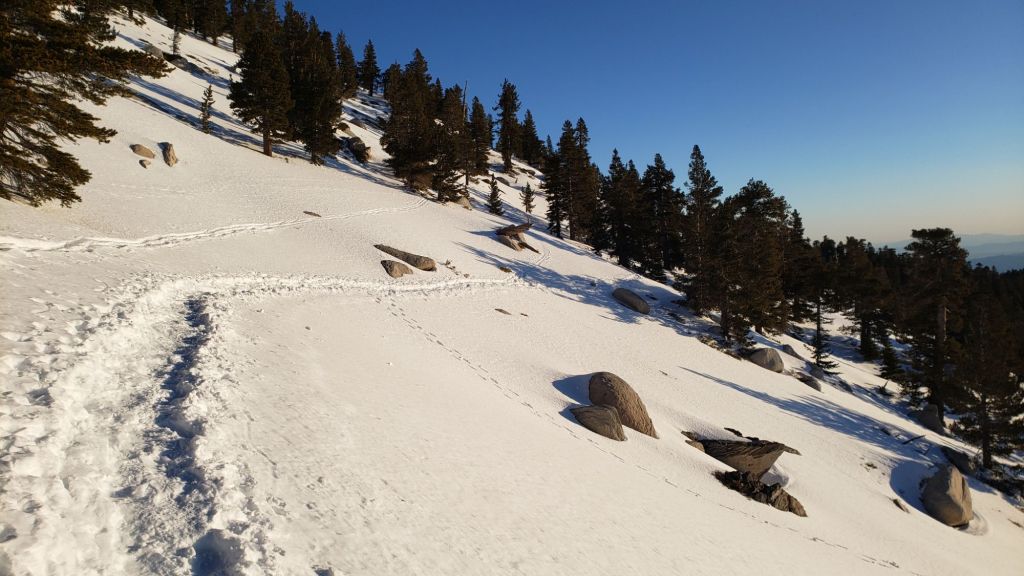
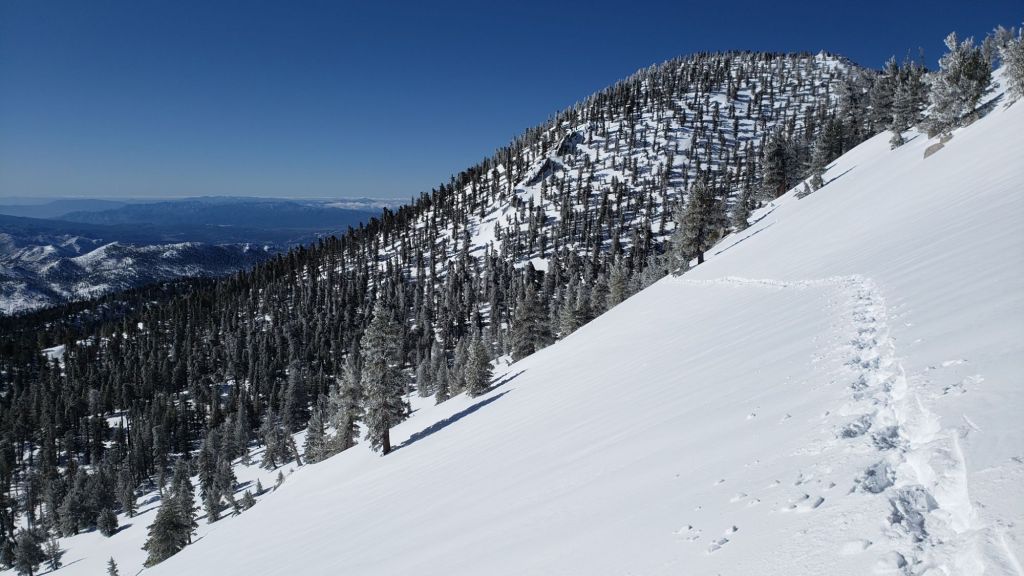
On Saturday 6th April I broke trail snowshoeing – through delightfully frigid “bluebird” conditions – all the way to San Jacinto Peak via Devil’s Slide, PCT, Wellman, Peak, and East Ridge trails to assess the snowfall and impact to the tracks. A warm spring sun by late morning started rapid melting below 8000 ft. I discussed current conditions, especially for PCT hikers, in a short video report recorded at San Jacinto Peak mid morning on Saturday 6th April following my early morning ascent (linked here).
We repeated that route early on Tuesday 9th. With a well-traveled and demarcated track, I was able to comfortably bareboot all the way to and from San Jacinto Peak (I carried spikes and crampons, and most hikers will prefer to use the former).
Yet another storm system, expected to be minor in terms of expected precipitation, is forecast for 13th-14th April. Snowfall in the high country – about 1-2 inches on both Saturday 13th and Sunday 14th – is not expected to be sufficient to completely eliminate current broken tracks.
Survey hikes every day in the San Jacinto mountains include different routes to San Jacinto Peak multiple times per week (most recently on 1st, 6th, and 9th April), Tahquitz Peak and area at least once per week (most recently on 4th, 8th, and 12th April), Apache Peak area regularly during PCT season, plus a wide variety of other trails on intervening days.
Tracks remain very icy in places under the fresh powder and have now consolidated due to freeze-thaw cycles and hiker traffic. For the next few days at least – until extensive thawing is expected to be well underway – spikes at a minimum (preferably crampons in some areas) are recommended everywhere above 7500 ft. Crampons are required on the north side of Tahquitz Peak and strongly recommended on Fuller Ridge, as discussed below.
Snowshoes are useful above about 9000 ft elevation, especially on warm days as snow softens rapidly. They have quickly become less useful as tracks have become compacted and increasingly suited to spikes and/or crampons. However, snowshoes will continue to be invaluable for any off-trail travel above about 8000 ft throughout April at least.
Details of snow depths measured at various locations on the trail system are given at the foot of this posting. Note however that snow depth itself is very rarely indicative of the difficulty (or ease) of hiking a particular track or trail. For example a well-traveled and defined track across deep snow is often much easier hiking than a lightly traveled track across just a few inches of angled icy snow.
Black Mountain Road is closed to vehicle traffic due to winter conditions at the gate 1.7 miles up from Highway 243. The road will very quickly clear of snow as far as the turning to Boulder Basin five miles from the highway. Snow cover on the road will more slowly melt from there for the next three miles to the PCT crossing/Fuller Ridge campground during April.
Humber Park reopened on 10th April following tree maintenance work. Even when closed there are nine legal parking spaces just below the gate (Adventure Pass or equivalent still required). South Ridge Road remains closed due to winter conditions but is clear of snow and should reopen soon. Dark Canyon Road has been closed almost continuously for the past five years.

WEATHER
Temperatures quickly warm to well above seasonal for 10th-11th April, with sunny days also forecast, so melting will be very rapid everywhere below 9000 ft and on sun-exposed slopes at higher elevations. Temperatures are expected to be at or above freezing even >10,000 ft from 9th April onwards, which is unusually warm for mid April. A minor storm is tentatively forecast for Saturday-Sunday 13th-14th April, although snow/rain quantities are not now expected to be significant. Temperatures are expected to again rise to above seasonal for April after passage of that storm.
At San Jacinto Peak (3295m/10,810ft) on Tuesday 9th April 2024 at 0745 the air temperature was 21.1°F (-6°C), with a windchill temperature of -2.0°F (-19°C), 29% relative humidity, and a frigid NNE wind sustained at 29 mph gusting to 36.2 mph.
At the Peak on Saturday 6th April 2024 at 0950 the air temperature was 17.2°F (-8°C), with a windchill temperature of 0.9°F (-18°C), 25% relative humidity, and a light but cool NNW wind sustained at 7 mph gusting to 11.1 mph.

TRAIL CONDITIONS
There was largely continuous snow cover on all trails above about 4500 ft on the morning of 6th April, but with rapid melting it has already largely disappeared below 7500 ft on the most sun-exposed slopes. Under the fresh powder, the remaining deeper old snow is locally firm and icy. Icy snow requires considerably more caution plus specialist equipment (and different physical and mental skillsets) than soft, postholing snow. Snow quality will improve with cold conditions over the weekend, but then generally deteriorate with a strong warming trend after 15th April and widespread rapid melting at all elevations.
Many major tracks have been broken through the snow at this time including South Ridge Trail (south of Tahquitz Peak), Devil’s Slide Trail, onward via the PCT, Wellman, Peak, and East Ridge trails to San Jacinto Peak, the Round Valley Trail from Long Valley through to Wellman Divide, the PCT from Highway 74 north to Saddle Junction, Marion Mountain Trail, and all of Deer Springs Trail (although the track does not accurately follow the trail route above the Marion Mountain Trail junction).
Carrying spikes is strongly recommended everywhere above about 7000 ft. Icy compacted snow – once the trails become well-traveled – will be largely ideal for spikes, although as discussed above crampons can be an excellent option until next week at least, especially in some locations above about 7700 ft. Crampons are strongly recommended if attempting Fuller Ridge and essential for the north side of Tahquitz Peak (discussed below).
Snowshoes can be valuable everywhere away from compacted tracks above about 8000 ft elevation. On warm days (10th-12th April and after 15th) and later in the day on sunny slopes they will become increasingly helpful. They will quickly become less useful for on-trail travel below 9000 ft as the established tracks become well compacted. Snowshoes are recommended for any significant off-trail travel away from the defined tracks in the high country throughout April.
Despite limited snow this season and being readily passable with the appropriate skills and equipment for angled icy snow (currently crampons plus ice axe recommended), the State Park closed the uppermost section of Skyline Trail in their jurisdiction (above about 5600 ft) starting 21st February due to perceived unsafe conditions.
Although covered with light to moderate depth virgin snow early on the morning of Saturday 6th, Devil’s Slide Trail [resurveyed 9th April] is already largely clear below 7300 ft (just below Middle Spring). Icy snow cover is about 80% from there to Saddle Junction. The track is already very well-defined. Note that at about 7700-7900 ft especially icy conditions remain around switchbacks 6-8. Spikes are useful for the snow patches on this trail, especially for descending, although they are not essential. The Trail Report undertook extensive trail maintenance work in February to remove many damaged tree limbs in and over the trail resulting from an early February ice storm.
The Ernie Maxwell Trail [surveyed 7th April] is largely clear of snow. Some lengthy snow patches remain throughout the trail’s length, but most hikers will find that spikes are not required.
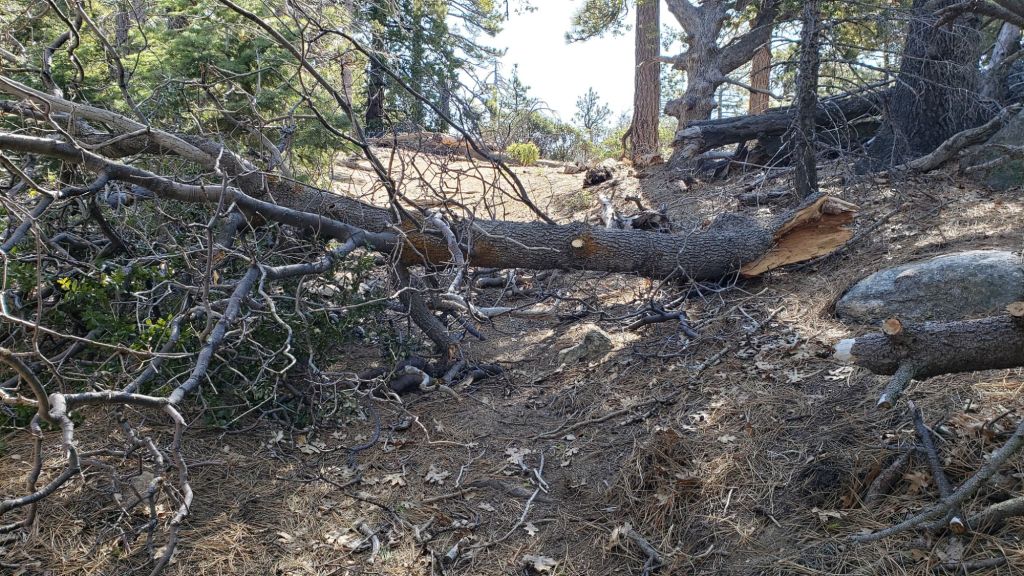
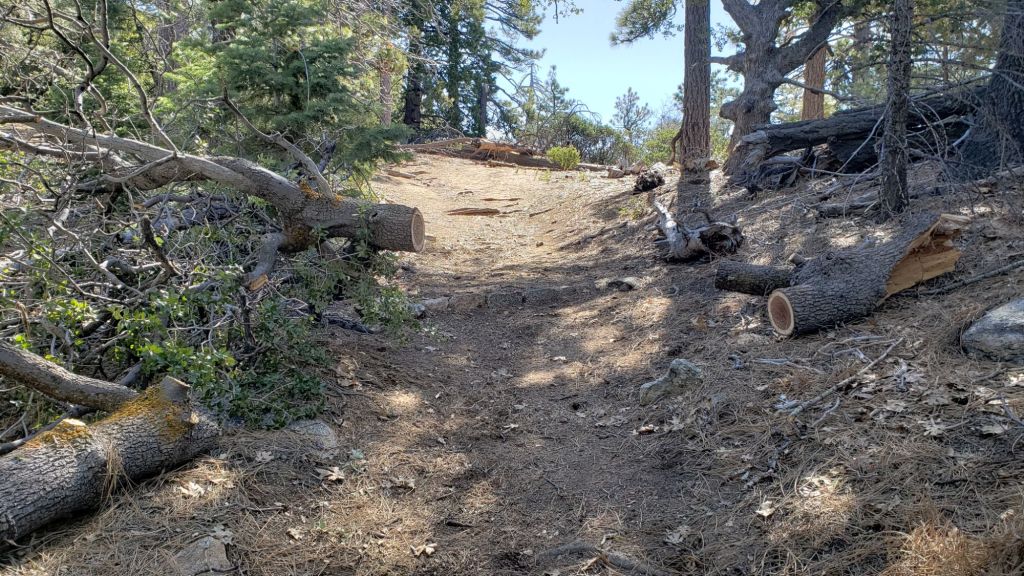
South Ridge Trail [surveyed 8th and 12th April] is clear of snow to Old Lookout Flat (7500 ft). Snow cover is about 50% on the traverse to 7800 ft but is then largely continuous to Tahquitz Peak with small cleared patches increasing daily. There is a well-traveled posthole track to 8500 ft (switchback 12, for those very familiar with this trail) at which point the track largely goes directly to the Peak, rarely following the established trail route. Most hikers will find spikes and/or an ice axe very useful on the upper trail. The Trail Report cleared the significant treefall hazards on South Ridge Trail in mid April.
The Peak Trail track that I broke on 6th April was well-traveled that weekend and fairly accurately follows the true trail route. However near Miller Peak at about 10,400 ft the track ascends directly up the East Ridge route, rather than following the Peak Trail switchback, as is traditional in winter conditions. The East Ridge section gets covered over regularly by light spindrift whenever winds are strong, but the underlying track remains largely visible.
The 0.4 mile section of South Ridge Trail between Chinquapin Flat/PCT MIle 177 and Tahquitz Peak has no track to follow at this time [surveyed multiple times in April] through several feet of heavily drifted and angled ice and icy snow. This ice slope is notoriously treacherous. Neither snowshoes nor spikes are helpful at this time, due to the angled slope and structure of the snow, respectively. Crampons with an ice axe are essential on this section at this time, along with the necessary skills and experience to use that equipment in icy, angled terrain with considerable exposure.
Spitler Peak Trail suffered badly during ice storms in early February, and I found 34 new treefall hazards down during my surveys in late February, almost all in the upper half. Most are relatively small and readily passable, but a few are larger, and the combined effect is to make for a slower and scrappier hike.


PACIFIC CREST TRAIL
Snow cover on the PCT has already largely melted from Miles 151 (Highway 74) to about 163. Underlying snow is then thin, with old snow largely confined to north- and east-facing slopes, until about Mile 174. Note that many of these patches remain icy and require considerable caution, especially when obscured by overlying new snow. See comments below regarding specific conditions around Apache Peak (Mile 169.5). Snow cover is then largely continuous between Miles 174-193. There are currently no reliable tracks to follow on Fuller Ridge (Miles 185.5-191) and traversing this section requires crampons, an ice axe, and appropriate snow skills.
At this time, nobo hikers may want to consider taking the alternate at Spitler Peak Trail (Mile 168.5) to avoid the worst of the icy snow slopes from Miles 169-177, and the 100+ downed treefall hazards in the same section. This situation is improving daily with warming and rapid melting expected most days.
It is recommended that hikers wanting to avoid Fuller Ridge until the ice conditions improve (now unlikely before mid April) use the Black Mountain Road alternate. Black Mountain Road is open to hikers but not to vehicle traffic at this time. Spikes can be useful (but not essential) on the upper three miles of Black Mountain Road.
A small but significant icy snow slope remains on the north-east side of Apache Peak. Spikes at a minimum, but preferably crampons, plus an ice axe, and crucially the skills and experience to use this equipment on angled icy snow, are required to traverse this short section using the PCT route. At this time the best option for nobo hikers is to go up and over the saddle between the double peaks of Apache to avoid this traverse, but note that there are some additional icy chutes and slopes in the next few miles, especially at present around Red Tahquitz (Miles 174-175.5), some of which have proven to be equally problematic in past seasons. The alternate at Mile 168.5 is recommended if you are not completely comfortable traversing some moderate angled snow terrain.
PCT hikers should not attempt to use South Ridge Trail from the PCT at Chinquapin Flat (roughly Mile 177.7) to Idyllwild via Tahquitz Peak, even though this looks temptingly simple on apps and maps. There are no steps to follow through a lengthy section of steeply angled (and notoriously treacherous) ice slopes. Crampons, always with an ice axe, and expert knowledge of how to use this equipment on high angle terrain, are critical. Even in low-to-moderate snow years like 2024 these slopes always take many weeks longer to clear of ice than adjacent areas, and they will remain challenging into late April this year, possibly even May.
PCT hikers are politely reminded that overnight stays are not permitted at or near San Jacinto Peak, including in the historic shelter. Mt. San Jacinto State Park regulations do not permit overnight stays in the shelter, which is dedicated for emergency, SAR, and ranger use.
Although just outside the region covered by the Trail Report (and my area of expertise) I understand that northbound hikers are experiencing significant problems due to storm damaged trail in the Mission Creek area of roughly Miles 225-250. More details are available at this link.
While all time and labor is volunteered, the San Jacinto Trail Report uses small private donations to help cover operating costs. Every year seems to have its unique challenges, and clearly 2024 will be no exception. Your contribution keeps the Report available to all, free from advertising or paywalls, and independent from agencies. If you have found this Report useful, please consider using this link to the Donate page. Thank you very much for your support.
SNOW DEPTHS measured on 6th April 2024 are as follows. The first number gives current average total depth, which also accounts for significant melting between recent storms. The number in parentheses gives new snow recorded in the storm on 5th April, while the number in brackets is the greatest depth at that location this winter (where known). Note that averages are given; due to strong winds during and after most storms there has been considerable drifting, plus often very uneven melting during warm interludes. Altitudes and PCT mileages are approximate.
San Jacinto Peak (10810 ft): 60 inches (5 inches new snow 5th April)[60 inches on 1st April]
Wellman Divide (9700 ft): 39 inches (4 inches new 5th April) [41-43 inches on 8th February]
Annie’s Junction/approx. PCT Mile 181.8 (9070 ft): 52-54 inches (4 inches new on 5th April)[55 inches on 1st April]
Long Valley (8400 ft): 0-14 inches, very uneven melting (4 inches new 5th April)[24 inches on 8th February]
Saddle Junction/PCT Mile 179.9 (8070 ft): 30 inches (4.5 inches new on 5th April)[32 inches on 1st April]
Devil’s Slide Trail at Humber Park (6550 ft): 0-6 inches, already largely melted (4 inches new on 5th April)[15 inches on 8th February]
Idyllwild (at 5550 ft): 0-2 inches, already largely melting (3.5 inches new on 5th April)[9 inches on 8th February]
Mountain Center (4400 ft): 0-1 inch, melted (2-3 inches new on 5th April)[3 inches on 9th February and 25th March]



 San Jacinto Trail Report