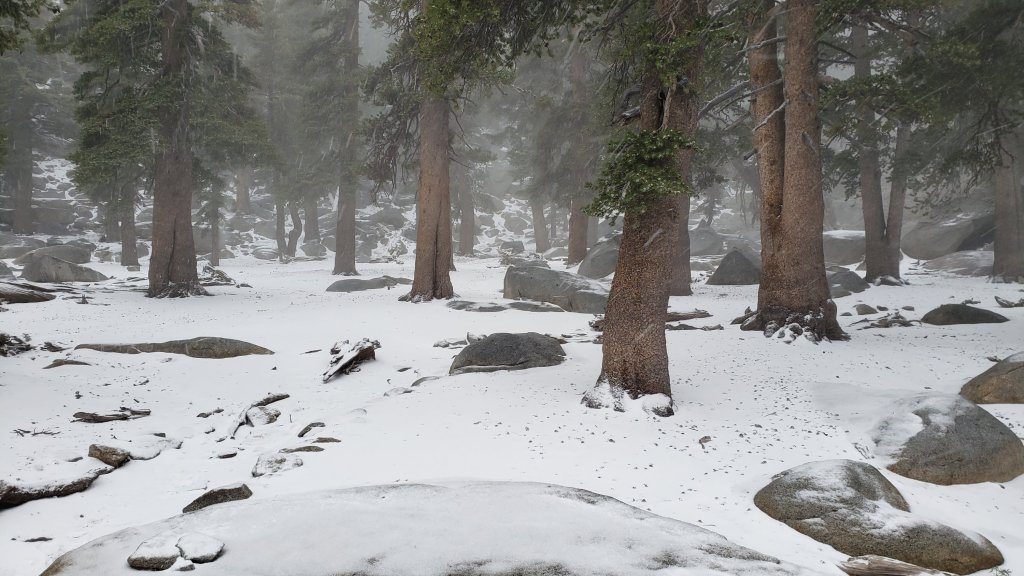
UPDATE Saturday 30th September: SNOW! In September! The earliest significant autumn snowfall in the San Jacinto mountains reported in a generation fell in the high country this afternoon, while I was at the Peak and descending between 1530 and 1710. One inch fell at San Jacinto Peak, with 0.5 inch all the way down to Wellman Divide (9700 ft), 0.25-0.5 inch to 9000 ft, and a dusting down to 8800 ft. Rainfall measured at Saddle Junction (8100 ft) and at 5550 ft in Idyllwild was remarkably the same, at 0.22 inch. The snow will not last long, with warm temperatures forecast in a couple of days, but it is fun to see while it lasts. I recorded a short video from San Jacinto Peak during the heaviest graupel, linked here.
——————————-
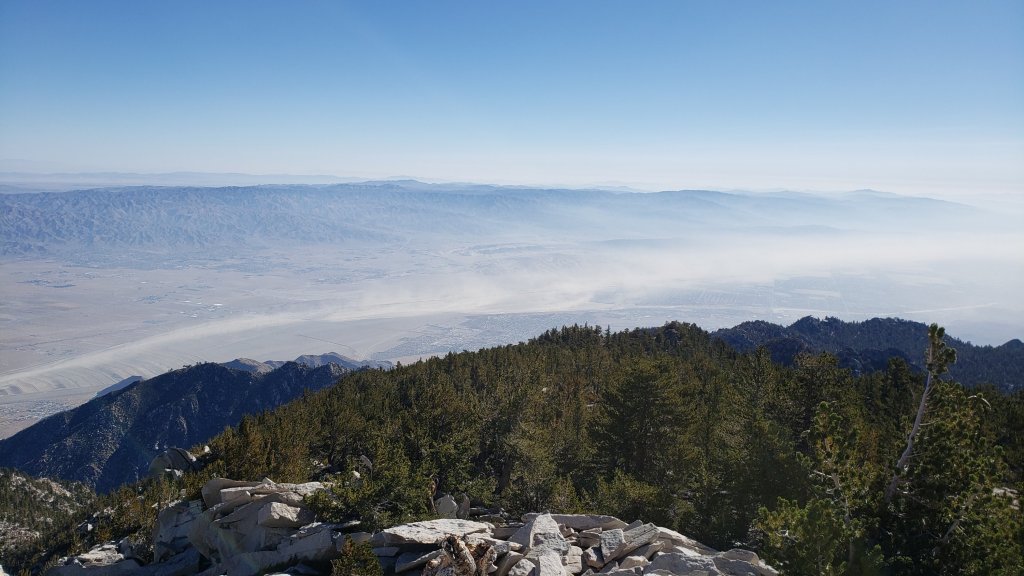
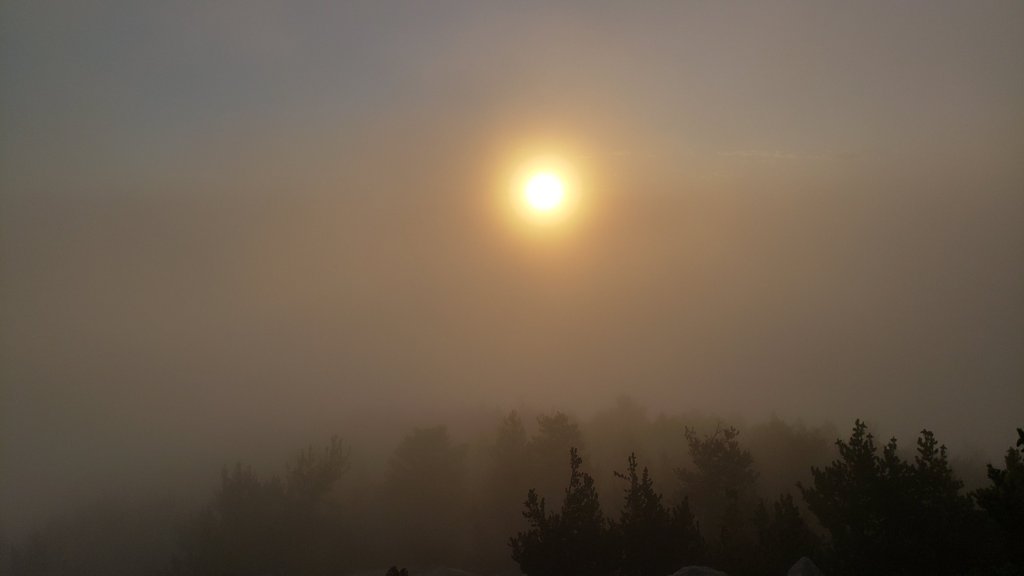
Autumnal weather has arrived in the San Jacinto mountains. On Thursday 21st September, I recorded the lowest windchill temperature – still just a modest 27.3°F (-3°C) – observed at San Jacinto Peak since late June. There was also a very light frost in Little Round Valley as we ascended shortly after dawn. On 22nd, a solidly overcast afternoon in the high country included a very light drizzle – 0.01 inch measured at San Jacinto Peak and 0.02 inch at Wellman’s Cienega – but misty cloud enveloping the peaks dissipated by early morning on 23rd (photos below).
A brief but intense cold front may bring wintry weather to the mountains on Saturday 30th September. Temperatures at the highest elevations will be around freezing, with strong winds leading to windchill values far below freezing. Light rain is forecast on Saturday afternoon at mid elevations (e.g., Idyllwild), and with a freeze level near 10,000 ft elevation, there is the possibility of an exceptionally early light snowfall (<1.0 inch) around the highest peaks. Cold temperatures will persist on Sunday 1st October.
Humber Park will be completely closed 24/7 to all forms of traffic, including pedestrian, for at least two weeks starting at 0600 on Sunday 1st October 2023 due to major road restructuring work at the uppermost end of Fern Valley Road. All hikers, notably PCT hikers, should use the lower Ernie Maxwell Trail access at Tahquitz View Drive to hike between Devil’s Slide Trail and Idyllwild.
Given the intensity of last winter, and the additional wind and rain of Tropical Storm Hilary that passed directly over the San Jacinto mountains on 19th-20th August (as described here), hikers should anticipate encountering treefall hazards, minor washouts and debris on trails, as summarized in Trail Conditions below.
Daily survey hikes in the San Jacinto mountains include several different routes to/from San Jacinto Peak multiple times per week, most recently on 21st, 22nd, 23rd, and 26th September, plus many other trails on intervening days. Recent weather observations from San Jacinto Peak are given in the Weather section below. The trail system has been clear of snow since mid July.
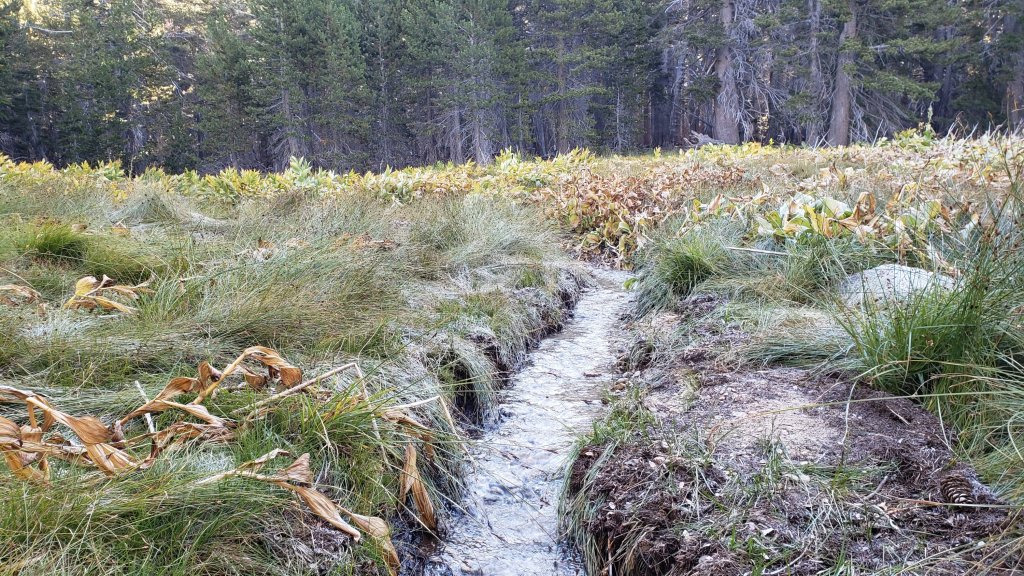
Water sources such as creeks, pipes, and springs are generally flowing remarkably well for the time of year (see photos below and those in the previous Report linked here). Consequently I will not be reporting water details for specific locations this season. This summer has seen the most water on the mountain since at least 1998 (following the great El Niño winter of 1997/98), even prior to the additional input from Tropical Storm Hilary in late August.
Be bear aware. Although rarely reported, up to three Black Bears have been in the San Jacinto mountains since 2017. As I descended upper Marion Mountain Trail at about 8250 ft elevation late morning (0948) on 14th September 2023 I had an excellent sighting, initially in the open at 40-50 metres, of what may have been the same very large (>250lb) dark brown individual with a white chest blaze that I had previously seen on Devil’s Slide Trail in July 2022 and September 2021 (a poor quality video from the latter observation is available here). This is clearly a different individual, based on colour pattern and size, from the “blond” one I saw on Devil’s Slide Trail in August 2020 and had previously filmed walking past our home in Idyllwild in 2018 (video here).
Be rattlesnake aware. Southern Pacific Rattlesnakes Crotalus (oreganus) helleri have remained active on the trail system even on recent cooler days (see photos in a prior Report linked here). Above about 5000 ft, the venom of this rattlesnake species in the San Jacinto mountains is predominantly neurotoxic, almost always fatal for dogs and sometimes for humans (see my 2020 article here). Devil’s Slide and lower Deer Springs trails, near Strawberry Cienega, and trails around both Suicide Rock and Tahquitz Peak, tend to be common locations for sightings.
Black Mountain Road (4S01) was in its poorest condition for at least a decade this spring. The partial grading undertaken on 17th July improved the situation somewhat, but it remained a bumpy drive that deteriorated further following Tropical Storm Hilary. Dark Canyon Road (4S02) remains closed indefinitely.
South Ridge Road (5S11) was partially graded in the last week of September 2023. It currently remains closed but is expected to reopen by 1st October (except in the event of a federal government shutdown).
WEATHER
Pleasantly cool (and periodically cloudy) autumnal weather has been the theme for most of September. Aside from moderate warming on 26th-27th, temperatures will generally remain near or below seasonal. Air temperatures above 9500 ft elevation are now typically in the 30s-40s Fahrenheit (0-10°C) with windchill temperatures generally a few degrees either side of freezing, depending on wind speed.
Much colder conditions are forecast to briefly accompany a minor cold front on 30th September and 1st October, with windchill temperatures well below freezing (near or below 10°F/-12°C) around the highest peaks on both days. There is currently no major new precipitation in the forecasts, but a possibility of light rain at mid elevations on the afternoon and evening of Saturday 30th, with some forecasts hinting at the possibility of an exceptionally early light snowfall (<1.0 inch) around the highest peaks. Temperatures are expected to warm quickly from Tuesday 3rd October.
At San Jacinto Peak (10,810ft/3295m) on Tuesday 26th September 2023 at 0805 the air temperature was 51.4°F (11°C), with a “windchill” temperature of 49.6°F (10°C), 10% relative humidity, and a very light WSW breeze sustained at 3 mph gusting to 3.8 mph.
At the Peak on Friday 21st September 2023 at 1850 the air temperature was 40.5°F (5°C), with a windchill temperature of 28.1°F (-2°C), 87% relative humidity, and a fresh WSW wind sustained at 12 mph gusting to 19.9 mph.
At the Peak on Thursday 21st September 2023 at 0900 the air temperature was 39.6°F (4°C), with a windchill temperature of 27.3°F (-3°C), 27% relative humidity, and a cool ESE wind sustained at 14 mph gusting to 22.0 mph.
TRAIL CONDITIONS
The trail system cleared of snow in July. One small icy snow patch has persisted in the Snow Creek drainage (near 9000 ft), but all others have now finally melted.
Tropical Storm Hilary in late August resulted in many minor washouts across the trail system, considerable treefall debris – branches, cones, sticks – in the trails, and water flowing across and in the trails. Damage could have been much worse, and no problems are especially challenging for hikers. Most trails have one or two new treefall hazards, and only Willow Creek Trail seems to have been more significantly impacted.
The rough route cleared along Willow Creek Trail in early August remarkably lasted only two weeks before Tropical Storm Hilary brought down 19 new treefall hazards. Seven of these are on the Forest Service section, including one huge trunk just east of Willow Creek that some hikers will find challenging to pass. Of the 12 on the State Park section, eight have already been cut; there is now a cleared route from Long Valley to Hidden Divide, but four remain uncut between the divide and the Forest Service boundary. The whitethorn trimming is inconsistent and scrappy but overall the trail is more passable than in July. Eight trees – of the 60+ down after last winter – remain to be cut on the USFS section for the original trail route to be fully restored, but that is unlikely to happen soon, if ever.
Deer Springs Trail has about 18 significant treefall hazards below the Fuller Ridge Trail junction remaining from the winter. Water is flowing very well in Little Round Valley and in all of the springs and creeks along the Deer Springs Trail route. Most of the 12 downed trees above Fuller Ridge on Deer Springs Trail date back many years and have been reported to the State Park multiple times.
Fuller Ridge Trail (PCT Miles 185.5-190.5) has seven treefall hazards, including four on the State Park side. One major hazard near the campground (near Mile 190) can be challenging to pass.
Trails around the Skunk Cabbage and Tahquitz area meadows have some significant treefall hazards throughout remaining from last winter. There are seven across the trails between Little Tahquitz Meadow and Chinquapin Flat and another two on the trail south from Saddle Junction to Chinquapin Flat.
Fourteen treefall hazards from this past winter on South Ridge Trail (above the trailhead at the top of South Ridge Road) were removed by the Trail Report in May, and trail trimming has been undertaken regularly. No significant new treefall hazards resulted from Tropical Storm Hilary on this trail. South Ridge Road remains closed to vehicle traffic and is not expected to reopen until graded, probably not until 2024. Eleven of 13 downed trees were removed from the middle section of South Ridge Trail (between May Valley Road and the top of South Ridge Road) on 15th July.
Marion Mountain Trail has four notable treefall hazards in the State Park (upper) half. One new large stump came down in Hilary low down on the Forest Service section, but it is easy to pass.
The Trail Report removed all 38 treefall hazards from Spitler Peak Trail between late May and early June this year, bringing the total removed to 85+ since July 2021. Several minor washouts from this past winter in the upper switchbacks have significantly impacted the tread in places, and were worsened by Hilary; these are not problematic for hikers, but the trail is impassable to stock.
On the PCT treefall hazards remain a problem in many places, most notably between Apache Peak and Red Tahquitz, where I counted 106 between Miles 169-175 in June 2023. This section has not yet been resurveyed since T. S. Hilary. Large downed trees make for especially slow-going around Miles 172-175 (a section severely burned in the July 2013 Mountain Fire).
The Caramba Trail from near Reeds Meadow through Laws Camp and on to Caramba, and the Cedar Trail from Willow Creek Trail to Laws, are euphemistically described by the Forest Service as “not maintained”. In reality both trails have been abandoned and functionally no longer exist. They are so heavily overgrown with dense whitethorn, which obscures dozens of downed trees, that I strongly advise hikers do not attempt to follow them (regardless of how much you may trust a certain app). An informal use trail to Laws is much more direct, well maintained, and avoids the challenging bushwhacking of the unmaintained trails (local Idyllwild hikers dubbed it the “King Trail” when I established the route in 2019). It leaves Willow Creek Trail exactly 1.0 mile from Saddle Junction, 0.46 mile from the Skunk Cabbage turning (trailhead at lat/long N 33.7796, W 116.6590). The route descends largely following established deer trails for 1.2 miles, meeting Willow Creek about 0.2 mile upstream from the site of the historic Laws Camp (the remains of which were destroyed by the 2013 Mountain Fire and subsequent flood and treefall damage). The 11 trees down on the King Trail after this winter were removed in June-July 2023. The tread of the trail received some minor damage from Tropical Storm Hilary. From Laws east to Caramba the route of the original Caramba Trail has been well-cairned by myself and others and can largely be followed with very careful route-finding. My August 2023 survey counted about 110 trees down on this 2.1 miles of trail. It is especially obscure for the first 0.3 mile east of the Willow Creek crossing, becoming more obvious (but still subtle) as it descends towards Caramba. Very cautious navigation is advised throughout the area.
Seven Pines Trail is largely clear of treefall hazards. Five new trees came down across the trail in Tropical Storm Hilary, all in the central mile, but they are readily passable for hikers. Be advised that the trail in general becomes more obscure in the mile closest to its junction with the PCT. The Trail Report has “adopted” Seven Pines Trail as a priority for maintenance work as the trail has had a disproportionate number of lost hiker rescues in the past decade. Since November 2021, about 70 downed trees have been removed and the trail is thoroughly trimmed and cleared several times per year. Nevertheless Seven Pines remains a genuine wilderness trail unlike the relatively wide, bare, and obvious routes of, for example, Devil’s Slide or Marion Mountain trails. Cautious navigation remains essential for those without considerable experience of hiking this trail.

While all time and labor is volunteered, the San Jacinto Trail Report uses small private donations to help cover operating costs. Every year has its unique challenges, and 2023 has been no exception. Your contribution keeps the Report available to all, free from advertising or paywalls, and independent from agencies. If you have found this Report useful, please consider using this link to the Donate page. Zelle, Venmo, and PayPal are all options. Thank you very much for your support.


 San Jacinto Trail Report
Hi Jennifer, your question didn’t come through, please try again.
LikeLike
Hi! My son wants to backpack from Cedar Springs to San J. Is there water flowing inbetween Cedar Springs and the Saddle?
LikeLike
Hi Jennifer, there are two reliable options. At Mile 169, Apache Spring about 0.5 mile off trail to east, and at Mile 177, the crossing of Tahquitz Creek. Safe hiking, Jon.
LikeLike