A heatwave in the first few days of July produced above seasonal temperatures at mid elevations, and well-above average temperatures at upper elevations. Daytime highs reached 80°F (27°C) at 8600 ft elevation in Long Valley for three consecutive days on 1st-3rd July, where there is considerable weather influence from the Coachella Valley.
After a brief cooling this week to temperatures a little below average for July, a more severe heatwave is forecast for next week, with temperatures well above seasonal at all elevations, and near-record heat in the high country. A sample of my recent weather observations from San Jacinto Peak are given below in the Weather section.
With the exception of heavily drifted areas that traditionally melt late (notably the East Ridge of San Jacinto Peak) the trail system is now clear of snow. Spikes are no longer required. Melting has been dramatic in Little Round Valley in the past week, and it is now largely clear (photos below). For readers interested in snow depths recorded in the San Jacinto mountains during this past remarkable winter, they were last listed in a recent Report available here.
Daily survey hikes include a variety of routes to San Jacinto Peak multiple times per week, most recently on 4th and 5th July, plus a wide variety of other trails on intervening days.
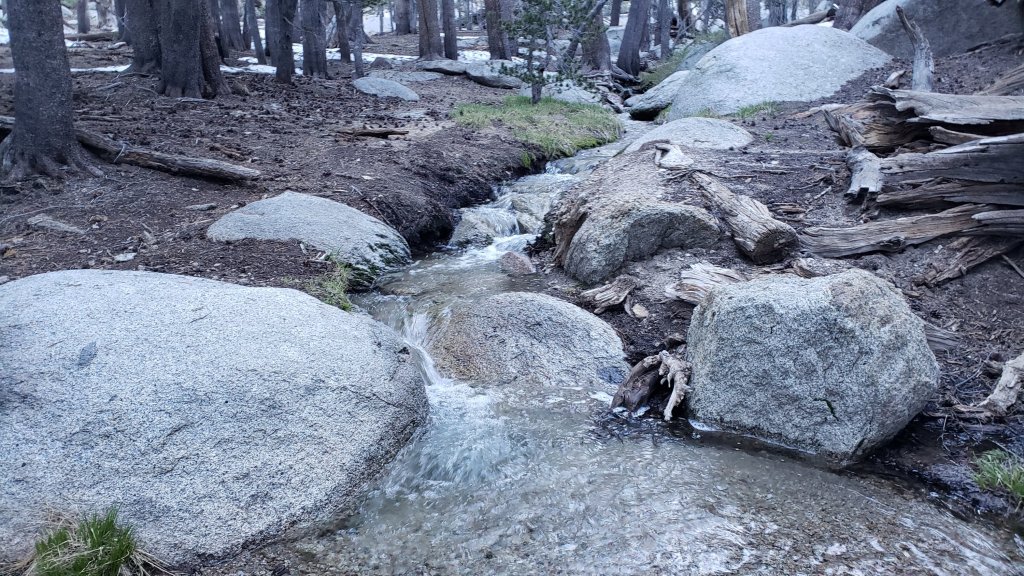
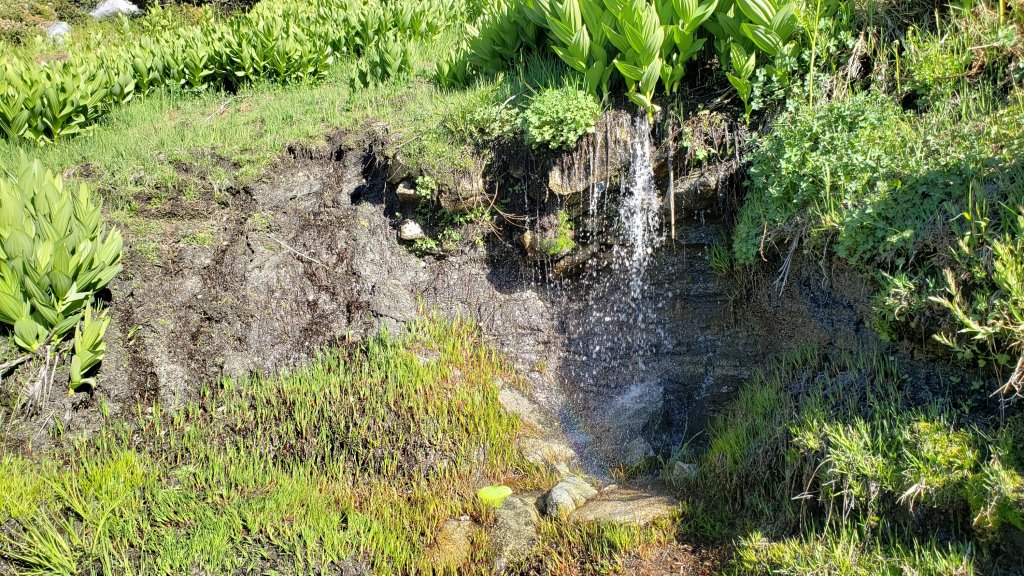
Currently perennial creeks, pipes, and springs are flowing well (e.g., see photos below), as are most ephemeral springs and creeks, although some of the latter are starting to dry. This summer has seen the most water on the mountain since 1998, following the great El Niño winter of 1997/98.
Given the intensity of this past winter, hikers will encounter new treefall hazards on trails. Trails are steadily being cleared by volunteers. In recent weeks the Trail Report has cleared South Ridge and Spitler Peak trails (14 and 38 trees, respectively), the PCT between Saddle and Annie’s junctions (approx. PCT Miles 179-181, eight trees), and largely cleared Seven Pines Trail and the informal use trail from Willow Creek Trail to Laws. In June 33 trees – from a total of about 68 – have been cut from Willow Creek Trail by volunteers, steadily making progress on the condition of that challenging trail.
Be rattlesnake aware. Southern Pacific Rattlesnakes (Crotalus [oreganus] helleri) are now widespread on the trail system up to at least 8800 ft elevation. Above about 5000 ft, the venom of this rattlesnake species in these mountains is largely neurotoxic, typically fatal for dogs and sometimes for humans (see article linked here for further information). Devil’s Slide and lower Deer Springs trails, Suicide Rock, around Strawberry Cienega, and trails near Tahquitz Peak are common locations for sightings, but rattlesnakes occur up to at least 9300 ft, often favoring warm, sun-exposed slopes.
Tahquitz Peak fire lookout reopened for the season on 4th June. Black Mountain fire lookout is currently not expected to reopen until the road is graded, possibly in July.
Black Mountain Road (4S01) is in its poorest condition for at least a decade and until the road is graded 4WD and/or high clearance are recommended. Forest Service roads Dark Canyon Road (4S02) and South Ridge Road (5S11) remain closed to vehicles. Other than Dark Canyon, all Forest and State campgrounds have now reopened.
The annual maintenance closure of the Palm Springs Aerial Tramway is scheduled for 7th-31st August 2023, a month earlier than usual.
WEATHER
Six delightful months of below average temperatures to start 2023 ended abruptly this past weekend with a brief heatwave, with temperatures, especially overnight lows, well above seasonal even for July.
After a brief cooling this week to temperatures a little below average for the month, a more severe heatwave is forecast for next week. Temperatures will be well above average for July at all elevations, with overnight “low” temperatures in particular at least 10°F above seasonal at mid elevations. The high country will not be spared, with near-record temperatures currently forecast around the highest peaks for 12th-17th July.
There is no significant new precipitation in the forecasts. The fire danger in the San Jacinto mountains is currently categorized as high or very high.
At San Jacinto Peak (10,810ft/3295m) on Wednesday 5th July 2023 at 0745 the air temperature was 55.8°F (13°C), with a “windchill” temperature of 53.2°F (12°C), 5% relative humidity, and a light but steady SW wind sustained at 5 mph gusting to 6.3 mph. This relative humidity measurement of only 5% is the lowest ever reliably recorded at San Jacinto Peak.
At the Peak on Tuesday 4th July 2023 at 0655 the air temperature was 47.1°F (8°C), with a windchill temperature of 36.0°F (2°C), 16% relative humidity, and a harsh WSW wind sustained at 20 mph gusting to 30.2 mph.
At the Peak on Monday 26th June 2023 at 0750 the air temperature was 41.6°F (5°C), with a windchill temperature of 29.3°F (-2°C), 37% relative humidity, and a very fresh SW wind sustained at 16 mph gusting to 27.5 mph.
TRAIL CONDITIONS
The trail system is now functionally clear of snow. Traction devices are no longer required.
Deer Springs Trail is clear of snow up to Little Round Valley (just a handful of easily traversed patches remain). Snow cover is now <10% through Little Round Valley following very rapid melting in the past week. The designated camping areas are now clear. Above Little Round Valley only a handful of drifted snow patches remain, but they have obvious tracks up and over, or they can be hiked around.
Snow cover averages about 20% around San Jacinto Peak, ranging from <10% on the south facing slopes to 40% on the north and east slopes. With careful route-finding – such as ascending the Peak via southern rather than eastern routes – spikes are not required.
Trails around the Skunk Cabbage and Tahquitz area meadows are clear of snow, but with significant treefall hazards throughout. There are seven treefall hazards across the trails between Little Tahquitz Meadow and Chinquapin Flat, four major trees down across Willow Creek Trail between Saddle Junction and the Skunk Cabbage Meadow junction, and another four down on the trail south from Saddle Junction to Chinquapin Flat.
The Wellman Trail has a couple of small snow patches remaining on its southernmost sheltered 0.4 mile north from Annie’s Junction, but is otherwise clear.
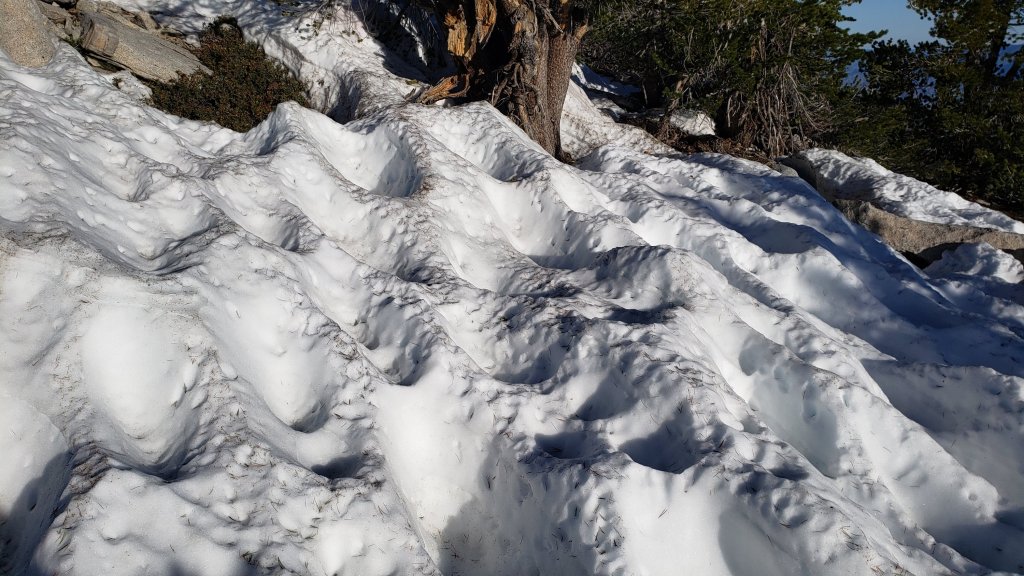
The Peak Trail has very limited patchy snow. The initial traverse north from Wellman Divide to 9900 ft is clear and the track now follows the trail route. For about 0.6 mile between 9900-10,100 ft snow cover is <10% and the trail is obvious but in a couple of places diverts around some icy drifts. The ascending switchbacks above 10,100 ft are functionally clear, with just a couple of minor snow patches to traverse. The East Ridge Trail remains partly obscured under about 40% snow cover, but the remaining snow is heavily drifted and has melted very unevenly (forming “sun cups”, photo above).
South Ridge Trail is clear of snow both north and south of Tahquitz Peak. Fourteen treefall hazards from this past winter on the trail were removed by the Trail Report in May, and trail trimming is undertaken regularly. South Ridge Road remains closed to vehicle traffic and is not expected to reopen until graded, possibly in July.
Marion Mountain Trail is clear of snow. There is significant water flowing in the trail in places in its uppermost mile, and there are four notable treefall hazards.
Willow Creek Trail remains been a slow, messy hike for a couple of miles due to treefall hazards and whitethorn overgrowth, but thanks to the work of volunteers the situation has improved in recent weeks. As of the end of June 2023, about 35 treefall hazards remain across the trail, most of which are large and some are challenging to hike around (or over). There are four large trees down between Saddle Junction and the Skunk Cabbage Meadow junction, and then a further 25 trees down on the next 1.5 mile Forest Service section until the State Park boundary. Another six trees are down on the State Park section of trail up to Hidden Divide. Some of the trail with the most trees down – between Willow Creek and the State Park boundary – is also disappearing under thick whitethorn. The considerable amount of work that Bill Rhoads and I undertook to clear whitethorn along this trail in 2020 was not completely in vain and parts of the trail would have largely disappeared by now otherwise, but the whitethorn does make some treefall hazards more complicated to negotiate.
The Trail Report removed all 38 treefall hazards from Spitler Peak Trail between late May and early June this year, bringing the total removed to 85+ since July 2021. Trail trimming is undertaken regularly. Several minor washouts from this past winter in the upper switchbacks have significantly impacted the tread in places; these are not problematic for hikers, but the trail is impassable to stock.
Overall, the PCT is now functionally clear of snow throughout the San Jacinto mountains. Treefall hazards are a problem in many places but most notably between Apache Peak and Red Tahquitz, where I counted 106 between Miles 169-175 in June 2023. Many large downed trees make for especially slow-going around Miles 172-175.
Trails clear of both snow and treefall hazards include Black Mountain Trail, Ernie Maxwell Trail, and Devil’s Slide Trail.
The Caramba Trail from near Reeds Meadow through Laws Camp and on to Caramba, and the Cedar Trail from Willow Creek Trail to Laws, are euphemistically described by the Forest Service as “not maintained”. In reality both trails have been abandoned and no longer exist. They are so heavily overgrown with dense whitethorn that I strongly advise hikers do not attempt to follow them (regardless of how much you may trust a certain app). An informal use trail to Laws is much more direct, well maintained by the Trail Report, and avoids the challenging bushwhacking of the unmaintained trails (some Idyllwild hikers dubbed it the “King Trail” when I established the route in 2019). It leaves the Willow Creek Trail exactly 1.0 mile from Saddle Junction (0.46 mile from the Skunk Cabbage turning), descending largely on established deer trails for 1.2 miles, meeting Willow Creek just upstream from the old Laws Camp. Of 11 trees down on the King Trail after this winter, ten were removed in June and the one remaining large trunk is easy to pass. From Laws east to Caramba the route of the original Caramba Trail has been well-cairned by myself and others and can largely be followed with very careful route-finding. My May 2023 survey counted just over 100 trees down on this 2.1 miles of trail. It is especially obscure for the first 0.3 mile east of the Willow Creek crossing, becoming more obvious as it descends towards Caramba. Very cautious navigation is advised throughout the area.
Seven Pines Trail is now functionally clear of snow. The crossing of the very swollen North Fork of the San Jacinto River at 1.5 miles (just after the State Park boundary) is currently perilous and not recommended for most hikers. This will remain a tricky crossing into July. The Trail Report has “adopted” Seven Pines Trail as a priority for maintenance work as the trail has had a disproportionate number of lost hiker rescues in the past decade. Since November 2021, 67 downed trees have been removed and almost the entire trail thoroughly trimmed and cleared. Nevertheless Seven Pines remains a genuine wilderness trail unlike the relatively wide, bare, and obvious routes of, for example, Devil’s Slide or Marion Mountain trails. Cautious navigation remains essential for those without considerable experience of hiking this trail.


While all time and labor is volunteered, the San Jacinto Trail Report uses small private donations to help cover operating costs. Every year seems to have its unique challenges, and 2023 is clearly no exception. Your contribution keeps the Report available to all, free from advertising or paywalls, and independent from agencies. If you have found this Report useful, please consider using this link to the Donate page. Zelle, Venmo, and PayPal are all options. Thank you very much for your support.



 San Jacinto Trail Report