Minor storm update 28th April 2021

[Information specific to the Pacific Crest Trail is included at the foot of this Report. However much of the main Report is also applicable to PCT hikers.]

The past two days were a pleasant reminder of what April should feel like, with light precipitation at all elevations on/off on Monday 26th, followed by further brief precipitation on the afternoon of Tuesday 27th. Snowfall was minimal on both days, with about 0.5 inch at San Jacinto Peak on 26th (described in this short video), and about the same on 27th. By the time we descended the east slope from the high country late morning on 26th, some of what had settled below 10,000ft had already melted. On 27th snow dusted patchily down to about 6300ft on the west slope of the mountain, but struggled to settle below 9000ft on the eastern side. Total rainfall in Idyllwild across the two days was 0.3 inch. Although the high country had a dusting of about an inch of fresh snow, temperatures well above seasonal starting Thursday 29th April will cause very rapid melting, and will also accelerate melting of what little snow remains from earlier in the winter.

Daily hikes have continued to survey many of the major trails in the high country, including San Jacinto Peak most recently on 26th and 28th April, plus the PCT throughout the San Jacinto mountains and some of its side trails.

April 2021 will likely be the driest for that month in recorded history in the San Jacinto high country, and among the warmest and driest recorded in Idyllwild. Drying of ephemeral creeks and springs has continued steadily, and water conditions in the high country are already worryingly reminiscent of the extremely dry years of 2015 and 2016.

Carrying spikes will remain useful for some hikers on some traveled trails, mainly above about 8700ft, but is no longer required depending on individual comfort level on patchy compacted or soft snow.

WEATHER Temperatures rise rapidly starting 28th April to well above seasonal averages, and largely stay atypically warm throughout the first week of May. Temperatures at all elevations on 30th April and 1st May are forecast to be more typical of midsummer.

At San Jacinto Peak (10,810ft/3295m) on Wednesday 28th April 2021 at 0840 the air temperature was 27.3°F (-3°C), with a windchill temperature of 13.9°F (-10°C), 61% relative humidity, and a gusty due North wind sustained at 8 mph gusting to 12.5 mph.

At the Peak on Monday 26th April 2021 at 0855 the air temperature was 20.1°F (-7°C), with a windchill temperature of 2.8°F (-17°C), 99% relative humidity, and a bitter due West wind sustained at 11 mph gusting to 16.4 mph.

TRAIL CONDITIONS

Once the light dusting of fresh snow has melted, trails on the east and south flanks of the high country will be completely or largely clear of snow to San Jacinto Peak. Trails on the west side are clear to near 8700ft, with snow cover increasingly patchy from there to San Jacinto Peak. There are some exceptions discussed below. See “Pacific Crest Trail” below for details of that trail.

Tahquitz Peak trail from Chinquapin Flat/PCT Mile 178 [updated 30th April] no longer requires spikes between the PCT and Tahquitz Peak, depending on your comfort level hiking on angled icy snow. Hiking poles are useful. There are good steps to follow through the small remaining patches for which some hikers will be more comfortable using spikes.

Devil’s Slide Trail is clear of snow to Saddle Junction.

Deer Springs Trail is clear of snow past Strawberry Junction to about 8650ft, near its junction with Marion Mountain Trail. Snow is increasingly patchy from there to Little Round Valley, averaging only about 10% cover, but with several extended icy snow sections. Snow cover is 70% through Little Round Valley. Above Little Round Valley to San Jacinto Peak the trail has cleared very rapidly and is easy to follow, averaging only 10% snow cover. Some hikers will find spikes useful, especially for descending.

South Ridge Trail is clear to Tahquitz Peak. South Ridge Road is open.

Black Mountain Road reopened on 23rd April. There is patchy snow that may be challenging for vehicles (but not for hikers) beyond Farview Point.

Wellman Trail (from Annie’s Junction to Wellman Divide) is largely clear of snow, except for nearly continuous snow for about 0.3 mile immediately north of Annie’s Junction.

The Peak Trail (Wellman Divide to San Jacinto Peak) is clear of snow except for the 0.2 mile patch between 9900-10,100ft, where snow cover is about 60% and some hikers may find spikes useful.

The East Ridge Trail on the east flank of San Jacinto Peak remains about 60% snow-covered. There is an ugly posthole track to follow, but it can be easier to hike across the top of the compacted icy snow (at least in the early morning and on cold days).

Marion Mountain Trail is clear of snow to the PCT.

Fuller Ridge Trail has snow along about 30% of its 5.0 miles length. Stubborn sections in particular remain around the crossing of the North Fork of the San Jacinto River (Mile 186), and on the northerly slopes of Fuller Ridge (approx. Miles 187.5-187.8 and 188.6-190.4).

Seven Pines Trail has had no visible hiker traffic this winter, with no tracks to follow where small snow patches remain. Indeed this trail has been hiked very little since November 2018. Very cautious navigation is recommended for those who are not completely familiar with hiking this trail. The Forest Service closure of Dark Canyon Road continues, and there is no vehicular access to Seven Pines trailhead.

The Round Valley Trail to Wellman Divide has about 30% patchy snow cover. Long Valley is clear of snow.

Skyline Trail is virtually clear of snow. Spikes are no longer required.

Snow cover on the PCT: The PCT is clear of snow from Miles 151 (Highway 74) to about 175 (Red Tahquitz). A few small snow patches remain between Miles 175-177. Miles 177 to 185 are almost clear of snow with the exception of the notoriously stubborn 0.5 mile just south of Annie’s Junction at about Mile 180.8. Snow cover is about 60% from Mile 184 to 185.5, although spikes are not required. From Mile 185.5 to 191, snow is increasingly patchy. Stubborn sections remain around the crossing of the North Fork of the San Jacinto River (Mile 186), and on the northerly slopes of Fuller Ridge Trail (approx. Miles 187.5-187.8 and 188.6-190.4). Miles 191-207 are clear of snow.

Additional trails completely clear of snow include: all Garner Valley trails, Ernie Maxwell Trail, Spitler Peak Trail, Cedar Spring Trail, and May Valley Road.

SNOW DEPTHS measured on 26th April 2021. Note that average depth is given first, followed in parentheses by the depth recorded on 16th March after the last significant storms on 10th-15th March. Due to past drifting, and variable melting due to differential sun exposure, depths now vary greatly even in small areas. Altitudes are approximate.

San Jacinto Peak (10810ft): 0-2 inches (38 inches on 16th March)

Little Round Valley (9800ft): 0-6 inches (29 inches on 16th March)

Wellman Divide (9700ft): 0 inches (19 inches on 16th March)

Annie’s Junction (9070ft): 0-2 inches (24 inches on 16th March)

Deer Springs Trail at Seven Pines Trail junction/approx. PCT Mile 184.9 (8700ft): 0-2 inches (14 inches on 16th March)

Strawberry Junction/approx. PCT Mile 183.1 (8100ft): 0 inch (8 inches on 16th March)

Saddle Junction/approx. PCT Mile 179.9 (8070ft): 0 inch (17 inches on 16th March)

Devil’s Slide Trail at Humber Park (6550ft): 0 inch (12 inches on 16th March)

PACIFIC CREST TRAIL

All Mile numbers are approximate. The main Report (above) is updated at least weekly or during/after any storm and contains significant additional information relevant to PCT hikers.

PCT hikers are reminded that overnight stays are not permitted at or near San Jacinto Peak, including in the historic shelter. This is especially critical during the coronavirus pandemic as it is impossible to adequately clean and sterilize the shelter. Mt. San Jacinto State Park regulations permit overnight stays only in established campgrounds. Strawberry Junction (approx. Mile 183) is a good option for thru-hikers.

This has been a far below average snow year for the San Jacinto high country. Given accelerating climate change here, depending on your start date there may be relatively little snow and ice by the time you reach the San Jacinto mountains. Nevertheless even small, isolated sections of icy snow can be perilous. Details of current snow/ice conditions will be clear from updates to the Trail Report over coming weeks.

Spikes remain useful for those hikers less comfortable hiking on snow for parts of the Trail between about Miles 165 and 191, although at this time most individuals hiking with poles will find spikes unnecessary. Please always practice safe decision-making based on your own comfort level (not that of your hiking partners), experience, ability, available equipment, time of day (which can greatly affect traction on snow and ice), and current snow and weather conditions.

The PCT through the Snow Fire closure area (approx. Miles 191-207) reopened on Saturday 3rd April. Only the tread of the Trail has reopened, USFS is not permitting camping along the 16+ mile section.

PCT hikers – thanks for taking the time to read this. The San Jacinto Trail Report depends entirely on small private donations to cover its direct costs. With a busy winter overlapping with a complex PCT season, every contribution, no matter how small, is truly valuable. If you have found the Report useful, please consider visiting the Donate page. Thank you, and safe hiking.

We undertook a thorough survey of the Fuller Ridge section (Miles 185.5-191) of the PCT on 6th April 2021, discussed in detail in this video. Considerable additional melting has occurred since then. Spikes are not required for hikers comfortable with travel across moderate patches of snow.

We surveyed the PCT section from Spitler Peak Trail to Saddle Junction (approx. Miles 168.5-179.5) on 9th April, as described in this video. Spikes are no longer required around Apache Peak, or elsewhere on this section, although some hikers might find spikes useful for increasingly patchy snow travel on Miles 175-178.

Coming off at Mile 168.5 (the well-signed Spitler Peak Trail alternate) may still be a good option for some this nobo season. In addition to any possible snow/ice issues ahead, there are nearly 60 trees down across the Trail between Miles 169-177, plus the rock slide at Mile 172.5. Spitler Peak Trail itself clears of snow (as is now the case) long before the PCT north of that point. The short snow slope on the NE side of Apache Peak (Mile 169.5) that has proved challenging over the years is now clear of snow, with good steps to follow. Spikes are no longer required, although hiking poles and caution are always useful.

The Pacific Crest Trail remains open at the rockslide north of Antsell Rock (Mile 172.5). Reports that the assisting rope around the rockslide is “in tatters” are completely misleading. However the rope is not in new condition, and if you choose to use it, you do so completely at your own risk. USFS has told the Trail Report that responsibility for removing the rockslide is currently with the PCTA, and that there are currently no plans to close this section of the PCT for removal work before summer 2021 at the earliest. This video report (recorded on 1st March 2021, starts at minute 9.05) may be useful for deciding whether to hike around the rockslide.

If you take an alternate further south, it is possible to regain the PCT from Idyllwild via Devil’s Slide Trail at Saddle Junction (about Mile 179). Do not attempt to regain the PCT via South Ridge Trail as the slope on the north side of Tahquitz Peak remains partly ice-covered and is notoriously treacherous.

Wellman Divide (9700ft) at about 0800 on 26th April 2021. About two hours later the dusting of snow and rime on the trees had largely melted.

Trail update 21st April 2021

UPDATED Monday 26th April: A very minor storm is passing over the San Jacinto mountains today. Snowfall has been minimal (<0.5 inch), as I report from San Jacinto Peak in this short video. By the time we descended late morning, most of what had settled below 10,000ft had already melted. The next full update to the Report is expected tomorrow or on Wednesday.

[Information specific to the Pacific Crest Trail is included at the foot of this Report. However much of the main Report is also applicable to PCT hikers.]

A full schedule of daily hikes has included most of the major trails in the high country, including San Jacinto Peak on 20th April ascending via east side trails (Devil’s Slide, Wellman, and Peak) then descending Deer Springs Trail, plus the PCT throughout the San Jacinto mountains and several of its side trails. Snow conditions have not changed substantially (and certainly not for the worse) since the thorough survey of the PCT section from Spitler Peak Trail to Saddle Junction (Miles 168.5-179.5) on 9th April, as described in this video, nor on Fuller Ridge (Miles 185.5-191) as discussed in the video available here from 6th April.

April 2021 is on track to be the warmest and driest for that month in recorded history in Idyllwild and the San Jacinto high country. Snow melt, and the drying of ephemeral creeks and springs, has continued steadily with conditions now more reminiscent of late May or June. Carrying spikes remains useful for some hikers on traveled trails above about 8700ft but is no longer required depending on individual comfort level on patchy compacted or soft snow (with some important caveats discussed below). Off trail travel currently involves post-holing in areas that retain extensive snow cover.

Despite temperatures periodically above seasonal, hikers should be prepared for temperatures near or below freezing in the high country, and potentially well below freezing when considering wind chill effects (see below for weather data recorded recently at San Jacinto Peak).

WEATHER The remainder of April will be something of a rollercoaster ride for temperatures. The 21st and 22nd will be somewhat cloudy with temperatures below seasonal, followed by a quick return to typical April warmth on 23rd-25th. A cold day on Monday 26th April might be accompanied by very light precipitation. Any moisture will have no significant impact however as temperatures immediately rise to well above seasonal, with the last few days of April forecast to be more reminiscent of midsummer.

At San Jacinto Peak (10,810ft/3295m) on Sunday 18th April 2021 at 0755 the air temperature was 22.7°F (-5°C), with a windchill temperature of -0.2°F (-18°C), 58% relative humidity, and a sharp NNE wind sustained at 20 mph gusting to 31.0 mph.

At the Peak on Tuesday 13th April 2021 at 0850 the air temperature was 33.8°F (1°C), with a windchill temperature of 18.7°F (-7°C), 28% relative humidity, and a chilly due West wind sustained at 15 mph gusting to 26.0 mph.

TRAIL CONDITIONS

Trails on the east and south flanks of the high country are completely or largely clear of snow to San Jacinto Peak. Trails on the west side are clear to near 8700ft, with snow cover increasingly patchy from there to San Jacinto Peak. There are some important exceptions discussed below. See “Pacific Crest Trail” below for details of that trail.

Tahquitz Peak trail from Chinquapin Flat/PCT Mile 178 has challenging steps to follow through the angled icy snow, the route in places not following the trail. These slopes are notoriously treacherous. Spikes remain strongly recommended.

Devil’s Slide Trail is clear of snow to Saddle Junction.

Deer Springs Trail is clear of snow past Strawberry Junction to about 8650ft, near its junction with Marion Mountain Trail. Snow is increasingly patchy from there to Little Round Valley, averaging only about 20% cover, but with several extended icy snow sections. Snow cover is 80% through Little Round Valley. Above Little Round Valley to San Jacinto Peak the trail has cleared very rapidly and is easy to follow, averaging only 30% snow cover. Some hikers will find spikes useful, especially for descending.

South Ridge Trail is clear to Tahquitz Peak. South Ridge Road is open.

Wellman Trail (from Annie’s Junction to Wellman Divide) is largely clear of snow, except for nearly continuous snow for about 0.3 mile immediately north of Annie’s Junction.

The Peak Trail (Wellman Divide to San Jacinto Peak) is clear of snow except for a nearly continuous 0.2 mile patch between 9900-10,100ft, where some will find spikes useful.

The East Ridge Trail on the east flank of San Jacinto Peak remains about 80% snow-covered. There is an ugly posthole track to follow, but it is easier to hike across the top of the compacted icy snow (at least in the early morning).

Marion Mountain Trail is almost completely clear of snow to the PCT, with a few small icy patches between 7500-8500ft. Spikes are not required for ascending, some hikers may find them useful in places for descending.

Fuller Ridge Trail has snow along about 30% of its 5.0 miles length. Stubborn sections in particular remain around the crossing of the North Fork of the San Jacinto River (Mile 186), and on the northerly slopes of Fuller Ridge (approx. Miles 187.5-187.8 and 188.6-190.4). See the detailed video survey conducted on 6th April for more information.

Seven Pines Trail has had no visible hiker traffic this winter, with no tracks to follow where small snow patches remain. Indeed this trail has been hiked very little since November 2018. Very cautious navigation is recommended for those who are not completely familiar with hiking this trail. The Forest Service closure of Dark Canyon Road continues, and there is no vehicular access to Seven Pines trailhead.

The Round Valley Trail to Wellman Divide has about 50% patchy snow cover. Long Valley is essentially clear of snow.

Skyline Trail is virtually clear of snow. Spikes are no longer required.

Snow cover on the PCT: The PCT is clear of snow from Miles 151 (Highway 74) to about 175 (Red Tahquitz). Snow is patchy but extensive between Miles 175-177. Miles 177 to 185 are almost clear of snow with the exception of the notoriously stubborn 0.5 mile just south of Annie’s Junction at about Mile 180.8. Snow cover is about 80% from Mile 184 to 185.5, although spikes are not required. From Mile 185.5 to 191, snow is increasingly patchy. Stubborn sections remain around the crossing of the North Fork of the San Jacinto River (Mile 186), and on the northerly slopes of Fuller Ridge Trail (approx. Miles 187.5-187.8 and 188.6-190.4). See the video review of this section from 6th April for details, and to decide whether the Black Mountain Road alternate is a better option for hikers less comfortable on extended angled snow. Miles 191-207 are clear of snow.

Black Mountain Road reopened on 23rd April. There is snow challenging for vehicles beyond Farview Point.

Additional trails completely clear of snow include: all Garner Valley trails, Ernie Maxwell Trail, Spitler Peak Trail, Cedar Spring Trail, and May Valley Road.

SNOW DEPTHS measured on 18th April 2021. Note that average depth is given first, followed in parentheses by the depth recorded on 16th March after the last significant storms on 10th-15th March. Due to past drifting, and variable melting due to differential sun exposure, depths now vary greatly even in small areas. Altitudes are approximate.

San Jacinto Peak (10810ft): 4 inches (38 inches on 16th March)

Little Round Valley (9800ft): 6 inches (29 inches on 16th March)

Wellman Divide (9700ft): 0 inches (19 inches on 16th March)

Annie’s Junction (9070ft): 3 inches (24 inches on 16th March)

Deer Springs Trail at Seven Pines Trail junction/approx. PCT Mile 184.9 (8700ft): 2 inches (14 inches on 16th March)

Strawberry Junction/approx. PCT Mile 183.1 (8100ft): 0 inch (8 inches on 16th March)

Saddle Junction/approx. PCT Mile 179.9 (8070ft): 0 inch (17 inches on 16th March)

Devil’s Slide Trail at Humber Park (6550ft): 0 inch (12 inches on 16th March)

PACIFIC CREST TRAIL

All Mile numbers are approximate. The main Report (above) is updated at least weekly or during/after any storm and contains significant additional information relevant to PCT hikers.

PCT hikers are reminded that overnight stays are not permitted at or near San Jacinto Peak, including in the historic shelter. This is especially critical during the coronavirus pandemic as it is impossible to adequately clean and sterilize the shelter. Mt. San Jacinto State Park regulations permit overnight stays only in established campgrounds. Strawberry Junction (approx. Mile 183) is a good option for thru-hikers.

Spikes remain useful for those hikers less comfortable hiking on snow for parts of the Trail between about Miles 165 and 191, although at this time most individuals hiking with poles will find spikes unnecessary. Please always practice safe decision-making based on your own comfort level (not that of your hiking partners), experience, ability, available equipment, time of day (which can greatly affect traction on snow and ice), and current snow and weather conditions.

The PCT through the Snow Fire closure area (approx. Miles 191-207) reopened on Saturday 3rd April. Only the tread of the Trail has reopened, USFS is not permitting camping along the 16+ mile section.

We undertook a thorough survey of the Fuller Ridge section (Miles 185.5-191) of the PCT on 6th April 2021, discussed in detail in this video. Spikes are not required for hikers comfortable with travel across moderate patches of snow.

We surveyed the PCT section from Spitler Peak Trail to Saddle Junction (approx. Miles 168.5-179.5) on 9th April, as described in this video. Spikes are no longer required around Apache Peak, or elsewhere on this section, although some hikers may find spikes useful for snow travel on Miles 175-178.

PCT hikers – thanks for taking the time to read this. The San Jacinto Trail Report depends entirely on small private donations to cover its direct costs. With a busy winter overlapping with a complex PCT season, every contribution, no matter how small, is truly valuable. If you have found the Report useful, please consider visiting the Donate page. Thank you, and safe hiking.

This has been a far below average snow year for the San Jacinto high country. Given accelerating climate change here, depending on your start date there may be relatively little snow and ice by the time you reach the San Jacinto mountains. Nevertheless even small, isolated sections of icy snow can be perilous. Details of current snow/ice conditions will be clear from updates to the Trail Report over coming weeks.

Coming off at Mile 168.5 (the well-signed Spitler Peak Trail alternate) may still be a good option for some this nobo season. In addition to any possible snow/ice issues ahead, there are nearly 60 trees down across the Trail between Miles 169-177, plus the rock slide at Mile 172.5. Spitler Peak Trail itself clears of snow (as is now the case) long before the PCT north of that point. The short snow slope on the NE side of Apache Peak (Mile 169.5) that has proved challenging over the years is now clear of snow, with good steps to follow. Spikes are no longer required, although hiking poles and caution are always useful.

The Pacific Crest Trail remains open at the rockslide north of Antsell Rock (Mile 172.5). Reports that the assisting rope around the rockslide is “in tatters” are completely misleading. However the rope is not in new condition, and if you choose to use it, you do so completely at your own risk. USFS has told the Trail Report that responsibility for removing the rockslide is currently with the PCTA, and that there are currently no plans to close this section of the PCT for removal work before summer 2021 at the earliest. This video report (recorded on 1st March 2021, starts at minute 9.05) may be useful for deciding whether to hike around the rockslide.

If you take an alternate further south, it is possible to regain the PCT from Idyllwild via Devil’s Slide Trail at Saddle Junction (about Mile 179). Do not attempt to regain the PCT via South Ridge Trail as the slope on the north side of Tahquitz Peak is currently ice-covered and is notoriously treacherous.
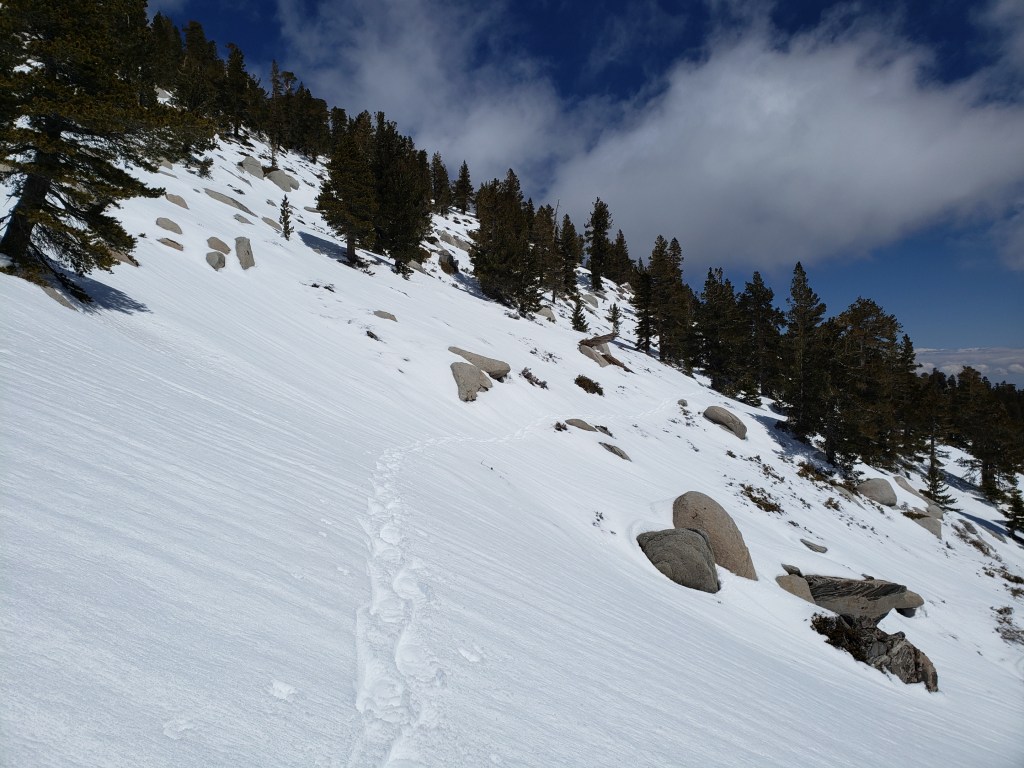
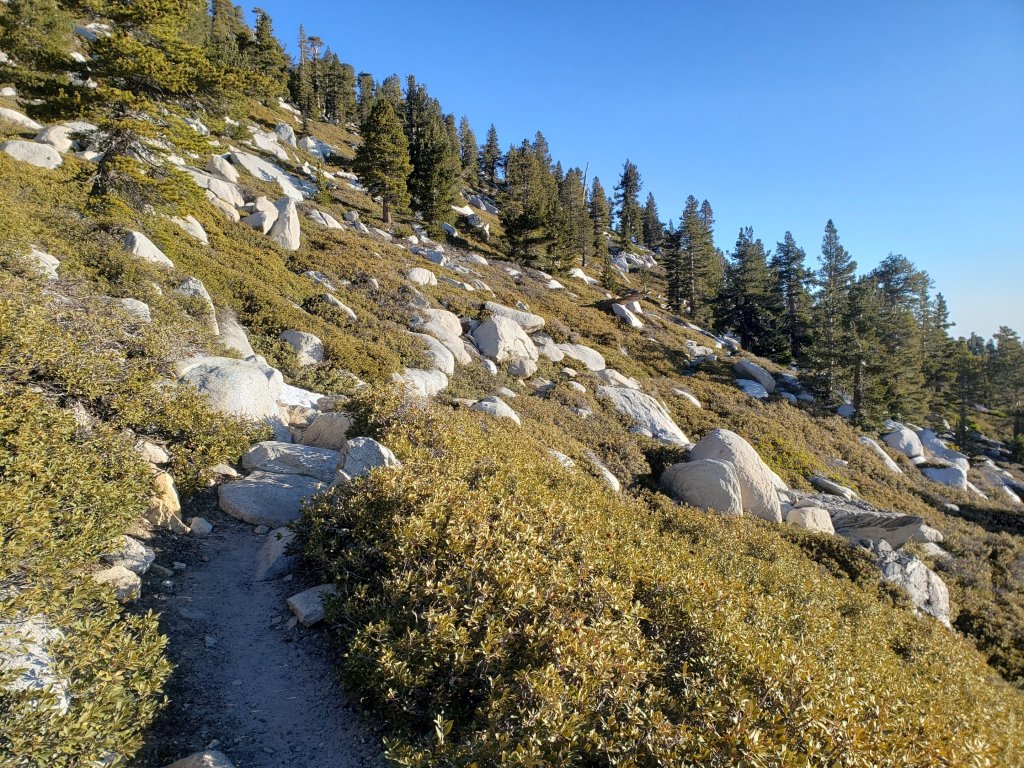
Snow cover on the PCT: The PCT is clear of snow from Miles 151 (Highway 74) to about 175 (Red Tahquitz). Snow is patchy but extensive between Miles 175-177. Miles 177 to 185 are almost clear of snow with the exception of the notoriously stubborn 0.5 mile just south of Annie’s Junction at about Mile 180.8. Snow cover is about 80% from Mile 184 to 185.5, although spikes are not required. From Mile 185.5 to 191, snow is increasingly patchy. Stubborn sections remain around the crossing of the North Fork of the San Jacinto River (Mile 186), and on the northerly slopes of Fuller Ridge Trail (approx. Miles 187.5-187.8 and 188.6-190.4). See the video review of this section from 6th April for details, and to decide whether the Black Mountain Road alternate is a better option for hikers less comfortable on extended angled snow. Miles 191-207 are clear of snow.

Last winter was dry, but this winter has been far worse. The Peak Trail at about 9800ft just above Wellman Divide on 18th April 2021 (above), and the same view exactly one year earlier, 18th April 2020 (below).

Trail update 15th April 2021

[Information specific to the Pacific Crest Trail is included at the foot of this Report. However much of the main Report is also applicable to PCT hikers.]

A busy past week or so of daily hikes has included a loop from home of Tahquitz Peak on 15th, San Jacinto Peak on 13th April ascending via east side trails (Devil’s Slide, Wellman, and Peak) then descending Deer Springs Trail, South Ridge Trail on 10th and 11th, a thorough survey of the PCT section from Spitler Peak Trail to Saddle Junction (Miles 168.5-179.5) on 9th April, as described in this video, and Marion Mountain Trail plus Fuller Ridge (Miles 185.5-191) of the PCT on 6th April, the latter discussed in detail in the video available here.

Pending final data, the first half of April may have been the warmest in recorded history in Idyllwild and the San Jacinto high country. Melting has of course been very rapid with conditions now more reminiscent of May or even June. Further warm temperatures forecast for next week will simply accelerate the process. Carrying spikes remains useful on traveled trails above about 8700ft but is no longer required depending on individual comfort level on compacted or soft snow (with some important caveats discussed below). Off trail travel currently involves post-holing in areas that retain extensive snow cover.

Despite temperatures above seasonal averages at upper elevations, hikers should nevertheless be prepared for temperatures near freezing in the high country, and potentially below freezing when considering wind chill effects (see below for weather data recorded recently at San Jacinto Peak).

Southern Pacific Rattlesnake at 5100ft near Idyllwild on 10th April 2021. Just a baby at ten inches long, this was our first of the season. Unsurprising to see one given recent temperatures but depressingly early at this elevation nonetheless.

WEATHER Following an unusually warm first couple of weeks of April, we are being treated to a very pleasant (if all too brief) cooling for a few days until about Friday 16th, when temperatures are forecast to warm once again to above seasonal. There is no precipitation in the forecast.

At San Jacinto Peak (10,810ft/3295m) on Tuesday 13th April 2021 at 0850 the air temperature was 33.8°F (1°C), with a windchill temperature of 18.7°F (-7°C), 28% relative humidity, and a chilly due West wind sustained at 15 mph gusting to 26.0 mph.

At the Peak on Wednesday 7th April 2021 at 0825 the air temperature was 38.8°F (4°C), with a windchill temperature of 24.9°F (-4°C), 58% relative humidity, and a strong WNW wind sustained at 22 mph gusting to 31.2 mph.

TRAIL CONDITIONS

Trails on the east and south flanks of the high country are completely or largely clear of snow to San Jacinto Peak. Trails on the west side are clear to near 8700ft, with snow cover increasingly patchy from there to San Jacinto Peak. There are some important exceptions discussed below. See “Pacific Crest Trail” below for details of that trail.

Tahquitz Peak trail from Chinquapin Flat/PCT Mile 178 has very challenging steps to follow through the angled icy snow, the route in places not following the trail. These slopes are notoriously treacherous. Spikes are very strongly recommended, preferably used in conjunction with an ice axe.

Devil’s Slide Trail is clear of snow to Saddle Junction.

Deer Springs Trail is clear of snow past Strawberry Junction to about 8650ft, shortly before the junction with Marion Mountain Trail. Snow is increasingly patchy from there to Little Round Valley, averaging only about 30% cover, but with several extended icy snow sections. Snow cover is 90% through Little Round Valley. Above Little Round Valley to San Jacinto Peak the trail has cleared very rapidly and is easy to follow, averaging only 40% snow cover. Some hikers will find spikes useful, especially for descending.

South Ridge Trail is essentially clear to Tahquitz Peak, with just a few tiny snow patches on the half-a-dozen switchbacks closest to the Peak. Spikes are no longer required. South Ridge Road is open.

Wellman Trail (from Annie’s Junction to Wellman Divide) is largely clear of snow, except for nearly continuous snow for about 0.3 mile immediately north of Annie’s Junction.

The Peak Trail (Wellman Divide to San Jacinto Peak) is clear of snow except for a nearly continuous 0.2 mile patch between 9900-10,100ft, where some will find spikes useful.

The East Ridge Trail on the east flank of San Jacinto Peak remains about 60% snow-covered but there is a reasonable track to follow.

Marion Mountain Trail is clear below 7500ft and again above 8500ft, with about 20% patchy snow cover between those elevations. Spikes are not required for ascending, but can be useful in places for descending.

Fuller Ridge Trail has snow along about 35% of its 5.0 miles length. Stubborn sections in particular remain around the crossing of the North Fork of the San Jacinto River (Mile 186), and on the northerly slopes of Fuller Ridge (approx. Miles 187.5-187.8 and 188.6-190.4). See the detailed video survey conducted on 6th April for more information.

Seven Pines Trail has had no visible hiker traffic this winter, with no tracks to follow where snow remains. Indeed this trail has been hiked very little since November 2018. Very cautious navigation is recommended for those who are not completely familiar with hiking this trail. The Forest Service closure of Dark Canyon Road continues, and there is no vehicular access to Seven Pines trailhead.

Where the trail is not readily visible, there is a clear track through the snow up from Round Valley to Wellman Divide. In addition Long Valley is largely clear of snow.

Skyline Trail is clear of snow to about 7200ft, thereafter there are small, shallow snow patches to Grubb’s Notch (8600ft). Spikes are no longer required.

The PCT is clear of snow from Miles 151 (Highway 74) to about 175 (Red Tahquitz). Snow is then more-or-less continuous between Miles 175-177 (see this video review of that section from 9th April). Snow cover is very patchy between Miles 177 to 185, with the exception of the notoriously stubborn 0.5 mile just south of Annie’s Junction at about Mile 180.8. Snow cover is almost continuous from Mile 184 to 185.5, although spikes are not essential. From Mile 185.5 to 191, snow is increasingly patchy. Stubborn sections remain around the crossing of the North Fork of the San Jacinto River (Mile 186), and on the northerly slopes of Fuller Ridge Trail (approx. Miles 187.5-187.8 and 188.6-190.4). See the video review of this section for details, and to decide whether the Black Mountain Road alternate is a better option for hikers less comfortable on extended angled snow. Miles 191-207 are clear of snow.

Black Mountain Road (closed to vehicles 1.7 miles from Hwy 243) is clear of snow for 5.0 miles to the Boulder Basin turning. The 3.0 miles to Fuller Ridge campground average only 5% snow cover, with a few short soft snow sections increasing in frequency closer to Fuller Ridge.

Trails completely clear of snow include: all Garner Valley trails, Ernie Maxwell Trail, Spitler Peak Trail, Cedar Spring Trail, and May Valley Road.

SNOW DEPTHS measured on 13th April 2021. Note that average depth is given first, followed in parentheses by the depth recorded on 16th March after the last significant storms on 10th-15th March. Due to past drifting, and variable melting due to differential sun exposure, depths now vary greatly even in small areas. Altitudes are approximate.

San Jacinto Peak (10810ft): 5 inches (38 inches on 16th March)

Little Round Valley (9800ft): 8 inches (29 inches on 16th March)

Wellman Divide (9700ft): 0 inches (19 inches on 16th March)

Annie’s Junction (9070ft): 4 inches (24 inches on 16th March)

Deer Springs Trail at Seven Pines Trail junction/approx. PCT Mile 184.9 (8700ft): 3 inches (14 inches on 16th March)

Strawberry Junction/approx. PCT Mile 183.1 (8100ft): 0 inch (8 inches on 16th March)

Saddle Junction/approx. PCT Mile 179.9 (8070ft): 0 inch (17 inches on 16th March)

Devil’s Slide Trail at Humber Park (6550ft): 0 inch (12 inches on 16th March)

PACIFIC CREST TRAIL

All Mile numbers are approximate. The main Report (above) is updated at least weekly or during/after any storm and contains much additional information relevant to PCT hikers.

PCT hikers are reminded that overnight stays are not permitted at or near San Jacinto Peak, including in the historic shelter. This is especially critical during the coronavirus pandemic as it is impossible to adequately clean and sterilize the shelter. Mt. San Jacinto State Park regulations permit overnight stays only in established campgrounds. Strawberry Junction (approx. Mile 183) is a good option for thru-hikers.

The PCT through the Snow Fire closure area (approx. Miles 191-207) reopened on Saturday 3rd April. Only the tread of the Trail has reopened, USFS is not permitting camping along the 16+ mile section.

We undertook a thorough survey of the Fuller Ridge section (Miles 185.5-191) of the PCT on 6th April 2021, discussed in detail in this video.

We surveyed the PCT section from Spitler Peak Trail to Saddle Junction (approx. Miles 168.5-179.5) on 9th April, as described in this video. Spikes are no longer required around Apache Peak, or elsewhere on this section, although some hikers may find spikes useful for snow travel on Miles 175-178.

Spikes remain useful for those hikers less comfortable hiking on snow for parts of the Trail between about Miles 165 and 191, although at this time most hikers will find spikes unnecessary. Please always practice safe decision-making based on your own comfort level (not that of your hiking partners), experience, ability, available equipment, time of day (which can greatly affect traction on snow and ice), and current snow and weather conditions.

PCT hikers – thanks for taking the time to read this. The San Jacinto Trail Report depends entirely on small private donations to cover its direct costs. With a busy winter overlapping with a complex PCT season, every contribution, no matter how small, is truly valuable. If you have found the Report useful, please consider visiting the Donate page. Thank you, and safe hiking.

This has been a far below average snow year for the San Jacinto high country. Given accelerating climate change here, depending on your start date there may be relatively little snow and ice by the time you reach the San Jacinto mountains. Nevertheless even small, isolated sections of icy snow can be very perilous. Details of current snow/ice conditions will be clear from updates to the Trail Report over coming weeks.

Coming off at Mile 168.5 (the well-signed Spitler Peak Trail alternate) may still be a good option for some this nobo season. In addition to snow/ice issues ahead, there are nearly 60 trees down across the Trail between Miles 169-177, plus the rock slide at Mile 172.5. Spitler Peak Trail itself clears of snow (as is now the case) long before the PCT north of that point.

The short snow slope on the NE side of Apache Peak (Mile 169.5) that has proved challenging over the years is virtually clear of snow, with good steps to follow. Spikes are no longer required, although hiking poles and caution are always useful. Every individual should make their own assessment of whether to cross based on their comfort level on angled snow, their experience, available equipment, time of day, and current snow conditions. If in any doubt whatsoever, turn around and take the very well signed Spitler Peak Trail alternate option at Mile 168.5.

The Pacific Crest Trail remains open at the rockslide north of Antsell Rock (Mile 172.5). Reports that the assisting rope around the rockslide is “in tatters” are completely misleading. However the rope is not in new condition, and if you choose to use it, you do so completely at your own risk. USFS has told the Trail Report that responsibility for removing the rockslide is currently with the PCTA, and that there are currently no plans to close this section of the PCT for removal work before summer 2021 at the earliest. This video report (recorded on 1st March 2021, starts at minute 9.05) may be useful for deciding whether to hike around the rockslide.

If you take an alternate further south, it is possible to regain the PCT from Idyllwild via Devil’s Slide Trail at Saddle Junction (about Mile 179). Do not attempt to regain the PCT via South Ridge Trail as the slope on the north side of Tahquitz Peak is currently ice-covered and is notoriously treacherous.

Current snow cover on the PCT is minimal from Miles 151 (Highway 74) to about 175 (Red Tahquitz). Snow is then more-or-less continuous between Miles 175-177 (see this video review of that section from 9th April). Snow cover is very patchy between Miles 177 to 185, with the exception of the notoriously stubborn 0.5 mile just south of Annie’s Junction at about Mile 180.8. Snow cover is almost continuous from Mile 184 to 185.5, although spikes are not essential. From Mile 185.5 to 191, snow is increasingly patchy. Stubborn sections remain around the crossing of the North Fork of the San Jacinto River (Mile 186), and on the northerly slopes of Fuller Ridge Trail (approx. Miles 187.5-187.8 and 188.6-190.4). See the video review of this section for details, and to decide whether the Black Mountain Road alternate is a better option for hikers less comfortable on extended angled snow. Miles 191-207 are clear of snow.

Little Round Valley (9800ft) on 13th April 2021 (above) and the same view less than a month earlier on 16th March (below).
Cardamine californica on Spitler Peak Trail, 9th April 2021. Typically the flower is white or whitish, this deep pink form is known only from Spitler Peak.

PCT and snow update 9th April 2021

[Please note that information specific to the Pacific Crest Trail is included at the foot of this Report. However much of the main Report is also applicable to PCT hikers.]

We undertook a thorough survey of the PCT section from Spitler Peak Trail to Saddle Junction (approx. Miles 168.5-179.5) on 9th April, as described in this video. Spikes are no longer required around Apache Peak, or elsewhere on this section, although some hikers may find spikes useful for snow travel on Miles 175-178.

We also surveyed the Fuller Ridge section (Miles 185.5-191) of the PCT on Tuesday 6th April, discussed in detail in the video available here.

The PCT through the Snow Fire closure area (approx. Miles 191-207) reopened on Saturday 3rd April. Only the tread of the Trail has reopened, and USFS is not permitting camping along the 16+ mile section.

Our hikes every day this year have focused on parts of the PCT and/or its side trails for the past two months or so. We had a swift ascent of San Jacinto Peak on 7th April via the east side (Devil’s Slide, PCT, Wellman, Peak, and East Ridge trails).

We have had a major warm spell in the first week of April. Temperatures are forecast to remain at or above seasonal averages at all elevations for at least the next week. Snowmelt has been rapid at all elevations, with sun-exposed slopes in particular clearing rapidly. Conditions have already become more reminiscent of a “normal” May or even early June. Carrying spikes remains recommended on well-traveled trails above about 8500ft (lower in places discussed below). They can be useful in the morning and for descending, as established trails are icy and compacted by hiker traffic and freeze-thaw cycles.

Despite temperatures well above seasonal norms at upper elevations, hikers should nevertheless be prepared for temperatures near freezing in the high country, and potentially below freezing when considering wind chill effects (see below for weather data recorded recently at San Jacinto Peak).

The USFS gate at Humber Park reopened on 19th March when the area was also plowed.

WEATHER Temperatures are forecast to remain above seasonal until about Tuesday 13th, when they drop slightly to average for April (but remaining relatively warm and dry). There is no significant precipitation in the forecast.

At San Jacinto Peak (10,810ft/3295m) on Wednesday 7th April 2021 at 0825 the air temperature was 38.8°F (4°C), with a windchill temperature of 24.9°F (-4°C), 58% relative humidity, and a strong WNW wind sustained at 22 mph gusting to 31.2 mph.

At the Peak on Thursday 1st April 2021 at 0850 the air temperature was 41.9°F (5°C), with a windchill temperature of 34.3°F (1°C), 16% relative humidity, and a steady (and rare) due South wind sustained at 7 mph gusting to 11.9 mph.

TRAIL CONDITIONS

Trails below about 8600ft are completely or largely clear of snow (with some important exceptions discussed below). On sun-exposed slopes, substantial sections of trail at higher elevations are also partly or largely clearing of snow.

Tahquitz Peak trail from Chinquapin Flat/PCT Mile 178 has limited steps to follow through the angled icy snow. These slopes are notoriously treacherous. Spikes (or even crampons) used in conjunction with an ice axe remain strongly recommended. Do not attempt to use snowshoes due to the angle of the icy snow.

Devil’s Slide Trail is essentially clear of snow to Saddle Junction, with just a few dirty snow patches remaining. Some hikers may continue to find spikes useful.

Deer Springs Trail is clear of snow to Strawberry Junction and essentially clear to about 8600ft. Snow is largely continuous from there to San Jacinto Peak, with an excellent track to follow. Above Little Round Valley the track through the snow does not follow the trail route to San Jacinto Peak, and is steep and direct. Spikes are recommended, especially for descending.

South Ridge Trail is clear to Old Lookout Flat at 7600′, with just a couple of tiny icy patches low down. Snow cover is a patchy 20% on the traverse at 7600-7800ft. The 18 switchbacks up to Tahquitz Peak are largely clear, but snow cover is about 60% on the half-a-dozen switchbacks closest to the Peak. Spikes can be useful close to Tahquitz Peak especially for descending. South Ridge Road is open.

Wellman Trail (from Annie’s Junction to Wellman Divide) is largely clear of snow, except for continuous snow for about 0.3 mile immediately north of Annie’s Junction.

The Peak Trail (Wellman Divide to San Jacinto Peak) is largely clear of snow, except for extended sections between 9900-10,100ft, and again above 10,500ft. Many hikers may find spikes useful in these areas.

The East Ridge Trail on the east flank of San Jacinto Peak remains completely snow-covered at 1-2 feet deep, but there is a reasonable track to follow through the snow.

Marion Mountain Trail is largely clear below 7500ft and again above 8500ft, with about 30% icy snow cover between those elevations. Spikes are not required for ascending, but are useful in places for descending.

Fuller Ridge Trail has snow along about 40% of its 5.0 miles length. Stubborn sections in particular remain around the crossing of the North Fork of the San Jacinto River (Mile 186), and on the northerly slopes of Fuller Ridge (approx. Miles 187.5-187.8 and 188.6-190.4). See the video survey conducted on 6th April for details.

Seven Pines Trail has had no visible hiker traffic this winter, nor since the most recent snowfall, with no tracks or trail to follow. Indeed this trail has been hiked very little since November 2018. Extremely cautious navigation is recommended for those who are not very familiar with hiking this trail. The Forest Service closure of Dark Canyon Road continues, and there is no vehicular access to Seven Pines trailhead.

The Ernie Maxwell Trail is clear of ice and snow.

There is a clear track up from Round Valley to Wellman Divide, which does not always follow the established trail route for some of its length. Long Valley is largely clear of snow.

Skyline Trail is clear of snow to about 7200ft, thereafter snow is shallow and increasingly patchy to Grubb’s Notch (8600ft). There is a well-worn but icy track to follow. Some hikers will find spikes useful.

Current snow cover on the PCT is minimal from Miles 151 (Highway 74) to about 175 (Red Tahquitz). Snow is then more-or-less continuous between Miles 175-177. Snow cover is steadily becoming increasingly patchy between Miles 177 to 184, with the exception of the notoriously stubborn 0.5 mile just south of Annie’s Junction at about Mile 180.8. Snow cover is almost continuous from Mile 184 to 185.5, although spikes are not essential. From Mile 185.5 to 191, snow is increasingly patchy. Stubborn sections remain around the crossing of the North Fork of the San Jacinto River (Mile 186), and on the northerly slopes of Fuller Ridge Trail (approx. Miles 187.5-187.8 and 188.6-190.4). See the video review of this section for details, and to decide whether the Black Mountain Road alternate is a better option for you. Miles 191-207 are almost completely clear of snow.

Black Mountain Road (closed to vehicles 1.7 miles from Hwy 243) is clear of snow for 5.0 miles to the Boulder Basin turning. The 3.0 miles to Fuller Ridge campground averages about 5% snow cover, with a few lengthy soft snow sections increasing in frequency closer to Fuller Ridge [surveyed 2nd and 6th April 2021].

Spitler Peak Trail and Cedar Spring Trail are both clear of snow.

May Valley Road, a major component of the PCT Mile 168.5 alternate route, is clear of snow.

SNOW DEPTHS measured on 7th April 2021. Note that average depth is given first, followed in parentheses by the depth recorded on 16th March after the last significant storms on 10th-15th March. Due to past drifting, and variable melting due to differential sun exposure, depths now vary greatly, especially in trails. Altitudes are approximate.

San Jacinto Peak (10810ft): 12 inches (38 inches on 16th March)

Wellman Divide (9700ft): <2 inches (19 inches on 16th March)

Annie’s Junction (9070ft): 6 inches (24 inches on 16th March)

Saddle Junction/approx. PCT Mile 179.9 (8070ft): 1 inch (17 inches on 16th March)

Devil’s Slide Trail at Humber Park (6550ft): 0 inch (12 inches on 16th March)

Idyllwild (at 5550ft): 0 inch (6 inches on 16th March)

PACIFIC CREST TRAIL

Following a general discussion, this information is organized roughly south to north (all Mile numbers are approximate). The main Report (above) is updated at least weekly or during/after any storm.

The PCT through the Snow Fire closure area (approx. Miles 191-207) reopened on Saturday 3rd April. Only the tread of the Trail has reopened, USFS is not permitting camping along the 16+ mile section.

We undertook a thorough survey of the Fuller Ridge section (Miles 185.5-191) of the PCT on 6th April 2021, discussed in detail in this video.

We surveyed the PCT section from Spitler Peak Trail to Saddle Junction (approx. Miles 168.5-179.5) on 9th April, as described in this video. Spikes are no longer required around Apache Peak, or elsewhere on this section, although some hikers may find spikes useful for snow travel on Miles 175-178.

Spikes remain recommended, but are no longer required for those comfortable hiking on snow, for parts of the Trail between about Miles 165 and 191. Please always practice safe decision-making based on your own comfort level (not that of your hiking partners), experience, ability, available equipment, time of day (which can greatly affect traction on snow and ice), and current snow and weather conditions.

This has been a far below average snow year for the San Jacinto high country (but, oddly, above average snowfall for mid elevations, 4000-6000ft). Given accelerating climate change here, depending on your start date there may be relatively little snow and ice by the time you reach the San Jacinto mountains. Nevertheless even small, isolated sections of icy snow can be very perilous. Details of current snow/ice conditions will be clear from updates to the Trail Report over coming weeks.

We undertook a thorough survey of the PCT section from Spitler Peak Trail to Saddle Junction (approx. Miles 168.5-179.5) on 9th April. Spikes are no longer required around Apache Peak, or elsewhere on this section, although some hikers may find them useful for snow travel on Miles 175-178.

Coming off at Mile 168.5 (the well-signed Spitler Peak Trail alternate) may still be a good option for some this nobo season. In addition to snow/ice issues ahead, there are nearly 60 trees down across the Trail between Miles 169-177, plus the rock slide at Mile 172.5. Spitler Peak Trail itself clears of snow (as is now the case) long before the PCT north of that point.

The short snow slope on the NE side of Apache Peak (Mile 169.5) that has proved challenging over the years is virtually clear of snow, with reasonable steps to follow. Spikes are no longer required, although hiking poles and caution are always useful. Every individual should make their own assessment of whether to cross based on their comfort level on angled snow, their experience, available equipment, time of day, and current snow conditions. If in any doubt whatsoever, turn around and take the very well signed Spitler Peak Trail alternate option at Mile 168.5.

PCT hikers – thanks for taking the time to read this. The San Jacinto Trail Report depends entirely on small private donations to cover its direct costs. With a busy winter overlapping with a complex PCT season, every contribution, no matter how small, is truly valuable. If you have found the Report useful, please consider visiting the Donate page. Thank you, and safe hiking.

The Pacific Crest Trail remains open at the rockslide north of Antsell Rock (Mile 172.5). Reports that the assisting rope around the rockslide is “in tatters” are completely misleading. However the rope is not in new condition, and if you choose to use it, you do so completely at your own risk. USFS has told the Trail Report that responsibility for removing the rockslide is currently with the PCTA, and that there are currently no plans to close this section of the PCT for removal work before summer 2021 at the earliest. This video report (recorded on 1st March 2021, starts at minute 9.05) may be useful for deciding whether to hike around the rockslide.

If you take an alternate further south, it is possible to regain the PCT from Idyllwild via Devil’s Slide Trail at Saddle Junction (about Mile 179). Do not attempt to regain the PCT via South Ridge Trail as the slope on the north side of Tahquitz Peak is currently ice-covered and is notoriously treacherous.
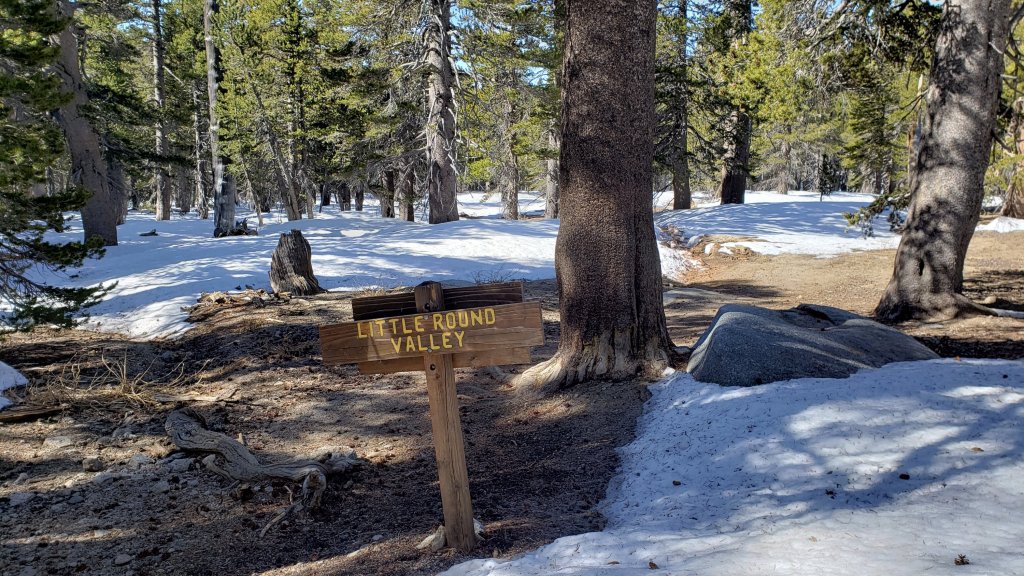
Current snow cover on the PCT is minimal from Miles 151 (Highway 74) to about 175 (Red Tahquitz). Snow is then more-or-less continuous between Miles 175-177. Snow cover is steadily becoming increasingly patchy between Miles 177 to 184, with the exception of the notoriously stubborn 0.5 mile just south of Annie’s Junction at about Mile 180.8. Snow cover is almost continuous from Mile 184 to 185.5, although spikes are not essential. From Mile 185.5 to 191, snow is increasingly patchy. Stubborn sections remain around the crossing of the North Fork of the San Jacinto River (Mile 186), and on the northerly slopes of Fuller Ridge Trail (approx. Miles 187.5-187.8 and 188.6-190.4). See the video review of this section for details, and to decide whether the Black Mountain Road alternate is a better option for you. Miles 191-207 are almost completely clear of snow.

PCT hikers are reminded that overnight stays are not permitted at or near San Jacinto Peak, including in the historic shelter. This is especially critical during the coronavirus pandemic as it is impossible to adequately clean and sterilize the shelter. Mt. San Jacinto State Park regulations permit overnight stays only in established campgrounds. Strawberry Junction (approx. Mile 183) is a good option for thru-hikers.

The Peak Trail at 9800ft not far above Wellman Divide on 7th April 2021 (above), and the same view about three weeks earlier on 16th March 2021 (below).